Introduction
Birth weight (BW) is an important predictor of short-as well as long-term health. Reference Hack, Flannery, Schluchter, Cartar, Borawski and Klein1 Low BW (LBW) neonates have higher risks of peri-natal adverse outcomes and post-natal developmental issues, with higher risks of neurologic and cognitive complications. Reference Chen, Li, Ruan, Zou, Wang and Zhang2 The relationship between BW and long-term outcomes is a U-shaped. Both epidemiologic and animal studies have suggested increased risk of non-communicable diseases (NCDs) like hypertension and diabetes in those born with LBW or macrosomia. Reference Esakoff, Cheng, Sparks and Caughey3 Thus, prevention of LBW, as well as macrosomia, could improve the health of populations. Foetal growth is influenced by maternal age, size and nutrition, addictions, disease states, and exposure to environmental ‘pollutants’, in addition to the role of genetic factors. The Developmental Origins of Health and Disease (DOHaD) paradigm recognises the importance of pre-pregnancy factors, like those which have impact on the development of gametes, and maternal health during pregnancy on the lifelong health of the progeny, especially NCDs and fertility. Reference Sharma, Mishra and Sharan4 In this regard, several studies have investigated the impact of parental viz maternal and paternal BW on the BW of the progeny. Reference Daniele, Farland and Park5–Reference Iwama, Obara and Ishikuro7 However, a literature review revealed that no systematic review and meta-analysis (SRM) has been published to quantify the impact of maternal and paternal BW on the BW of the progeny. We, therefore, decided to perform an SRM to analyse the impact of parental BW on neonatal outcomes like LBW, macrosomia, small for gestational age (SGA), preterm delivery, and burden of NCD in later life.
Methods
Methodology
The meta-analysis was carried out according to the recommendations of the Cochrane Handbook for Systematic Reviews of Interventions. Reference Higgins, Altman and Gøtzsche8 The predefined protocol has been registered in PROSPERO, having a registration number CRD42023495441. All epidemiologic, case–control, cohort, or observational studies published till March 2024 were considered for this SRM. This meta-analysis has been reported in accordance with the Preferred Reporting Items for Systematic Reviews and Meta-Analyses (PRISMA), the filled checklist of which can be found at the end of the manuscript. Reference Higgins, Altman and Gøtzsche8 Since ethical approval already exists for the individual studies included in the meta-analysis, no separate approval was required for this study.
Search method for identification of studies
A systematic literature search was conducted through multiple databases and registers, such as Medline (via PubMed), Embase (via Ovid SP), the Cochrane Central Register of Controlled Trials (CENTRAL) (for trials only), ctri.nic.in, clinicaltrials.gov, global health, and Google Scholar. The search covered these sources from their inception until June 15, 2024. The search strategy utilised a Boolean approach with the terms (parental) OR (maternal) OR (paternal) AND (birth weight); the search terms were applied to titles, abstracts, keywords, and all fields. A thorough and careful search was conducted to find any recently published or unpublished studies in English. This search included examining references within the clinical trials included in this study and relevant journals.
Study selection and outcomes of interest
The population, exposure of interest (independent variable), and outcome (dependent variable) criteria were used to screen and select the studies for this SRM, with the population under focus being neonates, exposure being availability of maternal and/or paternal BW data, control being neonates with normal BW, and outcomes being evaluated were the occurrence of LBW, macrosomia, SGA, preterm labour/delivery, and burden of NCD in later life. LBW in this study was defined as BW <2.5 kg. Reference Shokri, Rizebandi and Karimi9 Optimal BW was defined as 2.5–3.99 kg. Reference Shokri, Rizebandi and Karimi9 Macrosomia was defined as BW >4 kg. Reference Shokri, Rizebandi and Karimi9 SGA was defined as BW predicted by sex and gestational age at ≤−2 standard deviations (or below the 10th percentile). Reference Shokri, Rizebandi and Karimi9
The primary outcome was to evaluate the impact of parental BW on the occurrence of LBW in neonate. The secondary outcomes of this study were to evaluate macrosomia, SGA, preterm labour/delivery, and the burden of NCDs in later life. Studies reporting outcomes of twin pregnancies were excluded from this SRM. Only those studies that had data available for the primary outcome or any of the two secondary outcomes were included in this SRM for analysis.
Data extraction and study selection
Data extraction was carried out independently by two authors using standard data extraction forms. In cases where more than one publication of a single study group were found, results were grouped and relevant data from each report were used in the analyses. Data on the primary and secondary outcomes, as stated above, was extracted. All disagreements were resolved by the third and fourth authors.
Assessment of risk of bias in included studies
Two authors independently reviewed the included qualified articles in a checklist for qualitative assessment using the Joanna Briggs Institute’s approach. Reference Moola, Munn and Sears10 Publication bias was assessed by plotting the Funnel Plot, which specifically targets small study bias, in which small studies tend to show larger estimates of effects and greater variability than larger studies. Reference Liberati, Altman and Tetzlaff11 Presence of one or more of the smaller studies outside the inverted funnel plot was taken as evidence of presence of significant publication bias. Reference Liberati, Altman and Tetzlaff11
Measures of effect
For continuous variables, the outcomes were expressed as mean differences (MD) with 95% confidence intervals (CI). Conventional units were used for analysis, and all studies reporting results in SI units were converted to conventional units for analysis. For dichotomous outcomes (treatment success), results were expressed as risk ratios (RR) or odds ratios (OR) with 95% CI. The Review Manager (RevMan) computer program, version 7.2.0 (The Cochrane Collaboration, 2024. Available at revman.cochrane.org) was used for comparing MD, RR, or OR of the different primary and secondary outcomes.
Assessment of heterogeneity
Heterogeneity was initially assessed by studying the forest plot generated for the primary and secondary outcomes of this study. Subsequently, heterogeneity was analysed using a Chi2 test on N-1 degrees of freedom, with an alpha of 0.05 used for statistical significance and with the I 2 test. Reference Liberati, Altman and Tetzlaff11 The interpretation of I 2 values is as follows: 0% to 40%: might not be important; 40% to 60%: may represent moderate heterogeneity; 60% to 90%: may represent substantial heterogeneity; 90% to 100%: considerable heterogeneity. The importance of the observed value of I 2 depends on the magnitude and direction of treatment effects and the strength of the evidence for heterogeneity (e.g. P-value from the Chi2 test, or a confidence interval for I 2). Reference Liberati, Altman and Tetzlaff11
Data synthesis
Random effects analysis models were chosen for the review to account for the expected heterogeneity arising from differences in population characteristics and research durations. The inverse variance statistical method was applied for all instances. The outcomes were expressed as 95% CI. Forrest plots were plotted with the left side of the graph favouring the offspring with the outcome being assessed and the right side of the graph favouring control (normal BW neonate) using the RevMan computer program, version 7.2.0 (The Cochrane Collaboration, 2024. Available at revman.cochrane.org). P < 0.05 was considered statistically significant.
Results
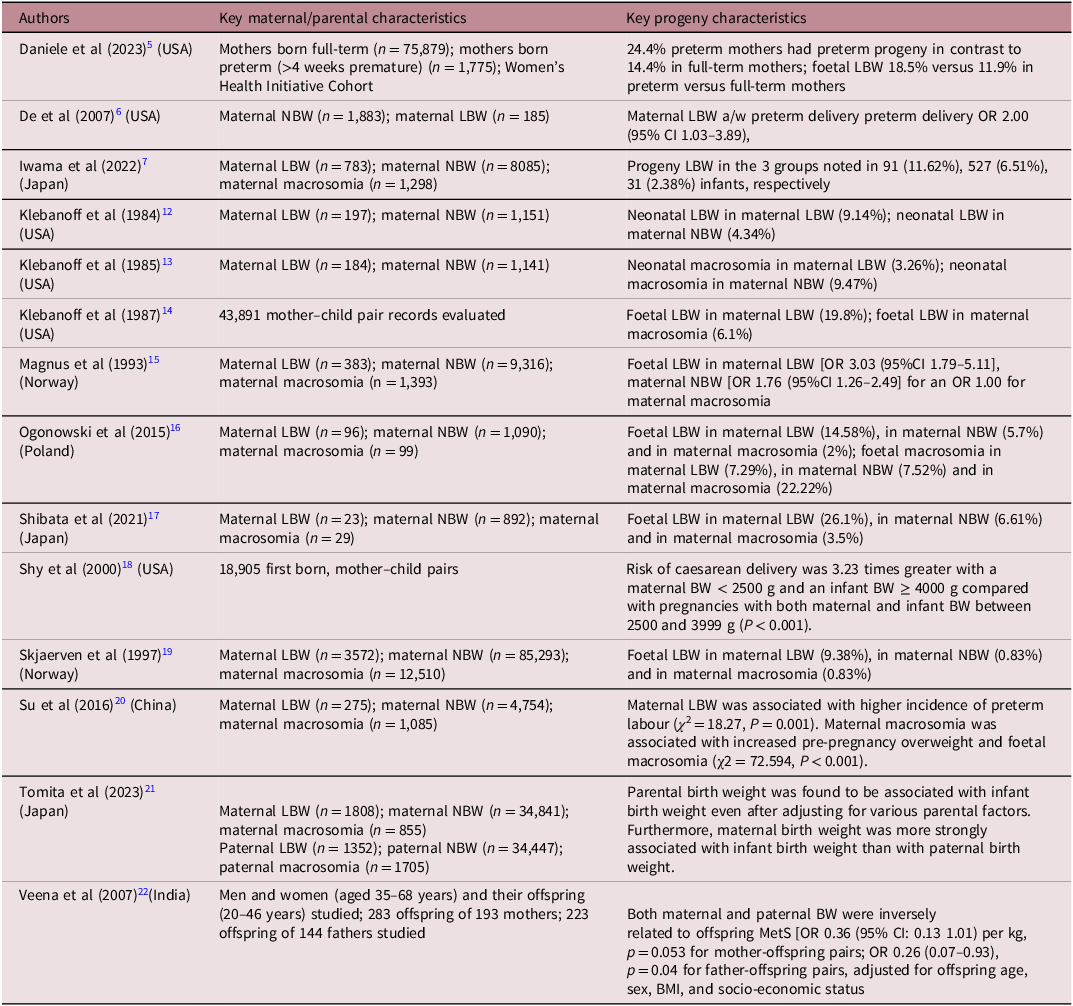
A total of 54,961 articles were found after the initial search (Fig. 1). Following further refinement of the search, the search was down to 1348 articles. One hundred and one duplicates were removed. Following screening of the title and abstract, the search was down to 180 articles which were evaluated in detail for inclusion in this SRM (Fig. 1). Finally, data from 14 studies (320,515 parents and their children), which fulfilled all criteria were analysed in this SRM. Reference Daniele, Farland and Park5–Reference Iwama, Obara and Ishikuro7,Reference Klebanoff, Graubard, Kessel and Berendes12–Reference Veena, Geetha and Leary22 The details of the studies included in this meta-analysis have been elaborated in Table 1. Six of the analysed cohorts were from USA, 3 from Japan, 2 from Norway, and 1 each from India, China, and Poland.
Flowchart elaborating on study retrieval and inclusion in this systematic review and meta-analysis.

Major clinical and biochemical characteristics of mother–child pairs in different studies analysed in this systematic review and meta-analysis

a/w, associated with; CI, confidence interval; LBW, low birth weight; NBW: normal birth weight; OR, odds ratio; BW, birth weight; MetS, metabolic syndrome.
Risk of bias and quality assessment of the included studies
The risk of bias and quality assessment of the included studies have been elaborated in Supplementary Table-1. The risk of bias was done by the JBI tool for cohort studies. Most studies were judged to be of good quality. Except for the study by Skjaerven et al. Reference Skjaerven, Wilcox, Oyen and Magnus19 all studies identified confounding factors and stated strategies to deal with confounding factors.
Effect of parental birth weight on primary outcome
Neonatal low birth weight
Data from 9 studies involving 2,53,216 mother–child pairs were analysed to find out the impact of maternal LBW on the occurrence of neonatal LBW. Mothers who were born LBW had significantly higher chances of delivering babies with LBW as compared to mothers who were born with normal BW [Odds Ratio (OR) 1.95 (95% CI: 1.56–2.46); P < 0.01; I 2 = 91% (considerable heterogeneity); Fig. 2a]. Data from only 1 study (Tomita et al) Reference Tomita, Iwama and Hamada21 involving 35,794 father–child pairs was analysed to find out the impact of paternal LBW on the occurrence of neonatal LBW. Fathers who were born LBW had significantly higher chances of having LBW neonates as compared to fathers who were born with normal BW [OR 1.85 (95% CI: 1.57–2.18); P < 0.01; I 2 = 91%].
Forest plots highlighting the impact of (a) maternal low birth weight on neonatal low birth weight; (b): maternal macrosomia on neonatal macrosomia; (c): maternal low birth weight on neonatal macrosomia.

Effect of parental birth weight on secondary outcomes
Neonatal macrosomia
Data from 6 studies involving 1,16,459 mother–child pairs were analysed to find out the impact of maternal macrosomia on the occurrence of neonatal macrosomia. Mothers who were born with macrosomia had significantly higher chances of having neonates with macrosomia as compared to mothers who were born with normal BW [OR 2.66 (95% CI: 2.44–3.16); P < 0.01; I 2 = 48% (mild heterogeneity); Fig. 2b]. Conversely, mothers who were born LBW had significantly reduced risks of neonatal macrosomia as compared to mothers who were born with normal BW [OR 0.50 (95% CI: 0.39–0.65); P < 0.01; I 2 = 35% (low heterogeneity); Fig. 2c; n = 1,22,261].
Data from only 1 study (Tomita et al) Reference Tomita, Iwama and Hamada21 was available to analyse the impact of paternal BW on the occurrence of neonatal macrosomia. Fathers who were born with macrosomia had significantly higher chances of having neonates with macrosomia as compared to fathers who were born with normal BW [OR 2.28 (95% CI: 1.56–3.33); P < 0.01; n = 36,147]. Paternal LBW had no impact on the risks [OR 0.66 (95% CI: 0.31–1.40); P = 0.28; n = 35,794] of neonatal macrosomia.
Neonatal small for gestational age
Data from 4 studies involving 15,998 mother–child pairs were analysed to find out the impact of maternal LBW on the occurrence of neonatal SGA. Mothers who were born with LBW had significantly higher chances of having neonates with SGA as compared to mothers who were born with normal BW [OR 2.29 (95% CI: 1.72–3.05); P < 0.01; I 2 = 37% (low heterogeneity); Fig. 3a]. Data from 4 studies involving 16,697 mother–child pairs were analysed to find out the impact of maternal macrosomia on the occurrence of neonatal SGA. Mothers who were born with macrosomia had significantly reduced chances of having neonates with SGA as compared to mothers who were born with normal BW [OR 0.40 (95% CI: 0.29–0.53); P < 0.01; I 2 = 0% (low heterogeneity); Fig. 3b].
Forest plots highlighting the impact of (a): maternal low birth weight on neonatal small for gestational age; (b): maternal macrosomia on neonatal small for gestational age; (c) maternal low birth weight on preterm labour/delivery; (d): maternal macrosomia on preterm labour/delivery.

Preterm labour/delivery
Data from 5 studies involving 78,368 mother–child pairs were analysed to find out the impact of maternal LBW on the occurrence of preterm labour/delivery. Mothers who were born with LBW had no impact on the occurrence of preterm labour/delivery when compared to mothers who were born with normal BW [OR 1.20 (95% CI: 0.67–2.16); P = 0.53; I 2 = 88% (moderate heterogeneity); Fig. 3c]. Data from 4 studies involving 71,082 mother–child pairs were analysed to find out the impact of maternal macrosomia on the occurrence of preterm labour/delivery. Mothers who were born with macrosomia had significantly lower chances of having preterm labour/delivery when compared to mothers who were born with normal BW [OR 0.77 (95% CI: 0.63–0.94); P < 0.01; I 2 = 4% (low heterogeneity); Fig. 3d].
Parental body weight on long-term outcomes in children
Data from only 1 study (Veena (2007) et al.) was available which looked at the impact of parental body weight on long-term outcomes in children during adulthood. Paternal LBW [OR 3.28 (95% CI: 1.11–9.74); P = 0.03; n = 168], but not maternal LBW [OR 1.48 (95% CI: 0.65–3.39); P = 0.35; n = 220] was a predictor of increased occurrence of metabolic syndrome (MetS) in children during adulthood. Paternal LBW [OR 14.32 (95% CI: 0.73–282.19); P = 0.08; n = 168] but not maternal LBW [OR 0.76 (95% CI: 0.26–2.28); P = 0.63; n = 220] tended to be a predictor of diabetes in children during adulthood. Maternal LBW [OR 7.69 (95%CI: 0.93–63.62); P = 0.06; n = 220] but not paternal LBW [OR 0.56 (95% CI: 0.15–2.13); P = 0.40; n = 168] tended to be a predictor of increased occurrence of coronary artery disease (CAD) in children during adulthood.
Publication bias
Funnel plots were plotted to look for presence of publication bias in the major outcomes of this study (Fig. 4a–d). Publication bias was found to be high for maternal LBW as a predictor of neonatal LBW (Fig. 4a) and preterm delivery (Fig. 4c), as one or more studies were outside the funnel plot. Publication bias was low for maternal macrosomia as a predictor of neonatal macrosomia (Fig. 4b) and preterm delivery (Fig. 4d), as all the studies were within the funnel plot.
Funnel plots looking for presence of publication bias with regards to (a): maternal low birth weight as predictor of neonatal low birth weight; (b): maternal macrosomia as predictor of neonatal macrosomia; (c): maternal low birth weight as predictor of preterm labour/delivery; (d): maternal macrosomia as predictor of preterm labour/delivery.

Discussion
Maternal pre-pregnancy body weight or BMI is known to impact pregnancy and foetal outcomes. Higher pre-pregnancy body weight and BMI has been linked with elevated risks of pregnancy induced hypertension, preeclampsia, eclampsia, and overall hypertensive disorders of pregnancy. Reference Xiong, Chen and Wu23 Telomeres maintain chromosome stability and mark cellular aging, and their shortening with age compromises genomic stability. In a SRM, an inverse association between maternal pre-pregnancy BMI and telomere length in infants. Reference Lame-Jouybari, Fahami, Hosseini, Moradpour, Hojati and Abbasalizad-Farhangi24 Increased maternal pre-pregnancy weight has been linked with increased risks of congenital heart defect in the newborns. Reference Salmeri, Seidenari, Cavoretto, Papale, Candiani and Farina25 In fact, both maternal pre-pregnancy low weight as well as overweight has been linked with adverse foetal outcomes. Reference Cornish, Magnus and Urhoj26 Our study shows that the link between maternal anthropometry pregnancy outcomes goes much behind to maternal BW and not just limited to the maternal pre-pregnancy weight.
The Developmental Origins of Health and Disease (DOHaD) paradigm has gained increasing recognition for its role in shaping lifelong health outcomes. It explains how intrauterine conditions influence foetal development and predispose individuals to NCDs later in life. The DOHaD paradigm highlights that adverse intrauterine conditions result in series of structural and functional adaptations in the fetus that can have far-reaching consequences, extending into adult cardiometabolic risk. Reference Bradley27 This SRM shows that parental BW significantly influences offspring’s birth weight, suggesting an intergenerational connection between foetal growth, possibly through genetic, and environmental/epigenetic mechanisms. The stronger association between maternal and offspring low BW (OR 1.95) compared to paternal contribution (OR 1.85) (a ‘parent-of-origin’ effect) likely reflects the dominant role of in utero environmental factors and associated epigenetic mechanisms. Reference Wagh, Hatem and Andersson28 This idea is supported by the observation that maternal macrosomia was associated with a 2.66 times higher risk of neonatal macrosomia, while also reducing the risk of LBW (OR 0.40). Overall, these findings emphasise that maternal intrauterine influences are a key determinant of intrauterine growth trajectory of her offspring.
Paternal BW also influenced offspring birth weight, though the impact was less pronounced compared to maternal. This discrepancy may be explained by genomic imprinting, where paternal genes promote foetal growth while maternal genes regulate nutrient allocation to optimise foetal development. Reference Moore, Ishida and Demetriou29 The placenta, being a highly imprinted fetal organ, plays a crucial role in mediating these genetic influences. Reference Frost and Moore30 The mechanisms underlying these associations are deeply rooted in epigenetic modifications, including DNA methylation, histone modifications, and microRNA regulation. Reference Jirtle and Skinner31 For instance, maternal obesity and hyperglycaemia alter placental gene expression, affecting foetal growth patterns and metabolic programming. Reference De Souza Lima, Sanches, Ferreira, De Oliveira, Cleal and Ignacio-Souza32 Emerging evidence suggests that maternal extracellular vesicles, particularly adipocyte-derived small extracellular vesicular microRNAs, influence foetal adipogenesis by targeting transcription factors and metabolic pathways. Reference Kunte, Barberio and Tiwari33 This highlights the critical role of maternal metabolic health in shaping offspring outcomes through epigenetic regulation of gene expression.
Beyond epigenetics, polygenic risk scores (PRS) have been identified as significant predictors of foetal BW, with more than 200 genetic loci implicated in foetal growth regulation. Reference Lewis and Vassos34 The fetal insulin hypothesis, first proposed in 1998, suggests that genetic variants impairing beta-cell function and insulin secretion contribute both to lower BW and a higher risk of diabetes in later life. Reference Hattersley and Tooke35 This study reinforces the genetic component between foetal programming and adult metabolic outcomes. It is clear that BW is not merely a neonatal well-being parameter but a predictor of lifelong metabolic health. Reference Frayling, Timpson and Weedon36
The evolutionary framework provides additional insight into these findings. David Haig’s Conflict Hypothesis’ suggests that maternal and paternal genes compete for control over foetal growth, with paternal genes favouring increased fetal growth and maternal genes optimising nutrient allocation to balance reproductive success. Reference Haig37 This evolutionary dynamic explains why maternal BW has a stronger influence on neonatal size than paternal birth weight. Additionally, the phenomenon of foetal microchimerism, where fetal cells persist in the maternal circulation for years, raises intriguing questions about how cells from older siblings may influence subsequent pregnancies. Reference Iwasa38 This implies that genes that act as growth enhancer evolve to show imprinting with the paternal allele expressed and the maternal allele inactive, whereas a growth suppressor gene tends to have an inactive paternal allele and an active maternal allele. Reference Iwasa38 The colonisation of maternal bodies by offspring cells (foetal microchimerism) raises the possibility that cells of older offspring could have an impact on the implantation of subsequent embryos. Reference Wagh, Hatem and Andersson28 These complex interactions between genetic inheritance, epigenetic modifications, and evolutionary pressures illustrate the multi-layered regulation of foetal growth and metabolic programming.
The clinical implications of these findings are profound. Understanding the genetic, epigenetic, and environmental determinants of BW offers opportunities for personalised interventions to optimise neonatal and long-term metabolic health. Maternal nutritional optimisation and preconception care could help reduce the risk of foetal growth abnormalities, while polygenic risk scores may allow early identification of high-risk pregnancies. Reference Dieguez, Kuang and Josefson39 Targeted interventions to modify epigenetic programming such as maternal folate supplementation and glucose control before and during pregnancy offer success stories in this field. Reference Ondičová, Irwin and Thursby40,Reference Zhao, Liu and Shi41 Future research should focus on longitudinal studies integrating genetic, epigenetic, and metabolic profiling to develop personalised strategies for improving foetal growth trajectories and reducing the risk of NCDs in future generations.
This SRM provides strong evidence that parental BW plays a crucial role in neonatal growth and long-term health. Maternal BW has a dominant influence, with maternal LBW predisposing offspring to LBW and maternal macrosomia increasing the risk of neonatal macrosomia. While paternal contributions are less pronounced, they remain biologically significant, particularly in the context of polygenic inheritance and sperm epigenetics. Reference Tomar, Gomez-Velazquez and Gerlini42 The findings emphasise the importance of integrating genetic and epigenetic data into clinical practice, paving the way for personalised medicine approaches to optimise pregnancy outcomes and mitigate long-term health risks.
This is the first SRM from more than 3 hundred-thousand parent–child pairs to find the association between parental and offspring (intergenerational) growth and well-being in utero as evident in BW, gestational age (SGA) at birth, and programming of NCD. Our study highlights that there is scant data available evaluating the impact of parental BW on long-term metabolic outcomes in their children when they become adults. Analysis of data from a single study showed that paternal but not maternal LBW was a predictor of increased occurrence of MetS and type-2 diabetes (T2D) in children during adulthood. In contrast maternal but not paternal LBW was noted to be a predictor of increased occurrence of CAD in children during adulthood. Data on intergenerational association between parental BW and outcomes are largely available for mother and not father.
Analysing genome wide association study (GWAS) databases, Wang et al. in a Mendelian randomisation study have suggested that foetal-determined genetic factors, more than maternal-determined genetic factors for lower BW are likely to be associated with increased risks of T2D in adult life. Reference Wang, Xiao, Song, Zhuang, Huang, Zhao and Huang43 The ‘foetal insulin hypothesis’ proposed way back in 1998 suggested that lower BW and adult-onset T2D are two phenotypes of the same genotype. Reference Hughes, Hattersley, Flanagan and Freathy44 There is now sufficient evidence to support the idea that variants of certain genes which result in impaired pancreatic beta-cell function and reduced insulin secretion [e.g. glucokinase (GCK), hepatic nuclear factor (HNF)-4A, HNF-1A, HNF-1B, ATP-binding cassette sub-family-B (ABCC)-8, Potassium Inwardly Rectifying Channel Subfamily J (KCNJ)-11, insulin (INS), insulin promoter factor-1 (PDX1), transcription factor (GATA)-4 and GATA-6] contribute to both lower BW and higher T2D risk in later life when inherited by the foetus. Reference Hughes, Hattersley, Flanagan and Freathy44
Parental, especially maternal body size and composition does predictor neonatal body size and body composition later in life. This SRM highlights the importance of transgenerational transmission of metabolic aspects of an individual and any intervention to improve or alter the nutritional status of an individual can have far-reaching impact beyond once generation. This implies that by improving the nutrition of young girls and boys in their childhood and maintaining that in their adult life, the benefits are more likely to be apparent on neonatal and long-term metabolic outcomes in their progeny. Kunte et al recently demonstrated that maternal adiposity, hyperglycaemia, and micronutrient status during pregnancy influences the differential expression of adipocyte-derived small extracellular vesicular (ADsEV) microRNAs in maternal and cord blood, which in turn end up influencing the foetal adiposity through targeted similar adipogenic pathways like the forkhead box O (FOXO) family of transcription factors, mitogen-activated protein kinase (MAPK) pathway and the transforming growth factor beta (TGF-β) pathway. Reference Kunte, Barberio and Tiwari45
The clinical implications of these findings are profound. Understanding the genetic, epigenetic, and environmental determinants of BW offers opportunities for personalised interventions to optimise neonatal and long-term metabolic health. Maternal nutritional optimisation and preconception care could help reduce the risk of foetal growth abnormalities, while polygenic risk scores may allow early identification of high-risk pregnancies. Furthermore, targeted interventions to modify epigenetic programming – such as maternal folate supplementation and glucose control during pregnancy – could offer novel strategies to improve birth outcomes. Reference Ondičová, Irwin and Thursby40,Reference Zhao, Liu and Shi41 Future research should focus on longitudinal studies integrating genetic, epigenetic, and metabolic profiling to develop personalised strategies for improving foetal growth trajectories and reducing the risk of NCDs in future generations.
It must be realised that transgenerational medicine is not just restricted to parents and their offsprings, but may cross multiple generations. In a cohort study, Yim et al noted that grandmother underweight prior to pregnancy is associated with an increased risk of attention-deficit/hyperactivity disorder (ADHD) among grandchildren, independent of grandmother gestational weight gain and maternal pre-pregnancy weight status. Reference Yim, Roberts, Ascherio, Wypij, Kioumourtzoglou and Weisskopf46 In another study from UK analysing data from 209 grandmother-mother pairs and 355 grandchildren, greater grandmother BMI indirectly increased grandchild’s BW via maternal BW and BMI. Reference Shen, Zhang, Jiang, Mzayek, Arshad and Karmaus47 In a prospective cross-generational cohort study from Ireland showed a positive association between central obesity (waist circumference) between maternal grandmother and the grandchild, which was not seen in other grandparental lineages. Reference Somerville, Khalil and Segurado48 Similarly, another study from Aberdeen Scotland showed BW and foetal growth showed intergenerational continuity across 3 generations. Reference Lahti-Pulkkinen, Bhattacharya, Räikkönen, Osmond, Norman and Reynolds49 Hence this can be an area for a future SRM.
Conclusion
To conclude it may be said that maternal LBW is an important predictor of LBW and SGA in neonates. Maternal macrosomia is an important predictor of macrosomia in neonates, and is protective against SGA and preterm labour/childbirth. Improving BW of parents along with prevention of LBW in their early life can go a long way in improving the outcomes in the next generation, specifically with regards to prevention the risk of LBW and adverse neonatal and long-term metabolic outcomes in the next generation.
Supplementary material
The supplementary material for this article can be found at https://doi.org/10.1017/S2040174425100366.
Acknowledgements
None.
Authors’ contributions
The study was conceptualised by DD and LN. Literature search was done by DD, SB and LN. Data entry was done by AKH, LN, SB and DD. Analysis was done by DD, LN, CSY and AKH. All authors contributed equally to manuscript preparation. The systematic review and meta-analysis followed a preestablished protocol registered on PROSPERO (CRD42023495441) and adhered to PRISMA guidelines.
Financial support
None.
Competing interests
None.