Introduction
As landscape modification expands throughout the world, biodiversity conservation depends increasingly on those habitat remnants that persist (Fahrig et al. Reference Fahrig, Baudry, Brotons, Burel, Crist and Fuller2011). Unexploited areas of public use such as road networks could provide key elements to preserve biodiversity without interfering with economic activities (Gardiner et al. Reference Gardiner, Riley, Bonnarco and Ockinger2018). Since roadsides preserve part of the original vegetation characteristics, they provide shelter, nesting sites and feeding sites (Marshall & Moonen Reference Marshall and Moonen2002, Conover et al. Reference Conover, Burger and Linder2007). They are used by different taxa such as invertebrates (Monasterolo et al. Reference Monasterolo, Poggio, Medan and Devoto2020), mammals (Gardiner et al. Reference Gardiner, Riley, Bonnarco and Ockinger2018) and birds (Marshall & Moonen Reference Marshall and Moonen2002), which are among the most studied taxa and considered good bioindicators (Gardner et al. Reference Gardner, Barlow, Araujo, Ávila-Pires, Bonaldo and Costa2008).
Birds of different habitats such as grassland (Gardiner et al. Reference Gardiner, Riley, Bonnarco and Ockinger2018), woodland (Leveau & Leveau Reference Leveau and Leveau2011) and wetland (Vierling Reference Vierling2000) have been recorded on roadsides at different times of the year (Conover et al. Reference Conover, Burger and Linder2007, Leveau & Leveau Reference Leveau and Leveau2011). Even though most studies were conducted in the reproductive season, these areas are essential during winter in order to prevent food depletion in agroecosystems (Conover et al. Reference Conover, Burger and Linder2007). Moreover, roadsides may provide not only corridors (sensu Huijser & Clevenger Reference Huijser, Clevenger, Davenport and Davenport2006, areas used by animals to travel or spread from their original habitat), but also habitat (sensu Huijser & Clevenger Reference Huijser, Clevenger, Davenport and Davenport2006, areas where animals conduct all or parts of their life cycles such as foraging, mate searching and reproduction). Given their importance as biodiversity reservoirs, roadside management measures have been developed for bird conservation, such as increasing food, feeding and nesting sites, mainly in North America, Europe and Australia (Conover et al. Reference Conover, Burger and Linder2007, Fulton et al. Reference Fulton, Smith, Na and Takahashi2008, Douglas et al. Reference Douglas, Vickery and Benton2009).
However, little attention has been given to roadsides in South America, where the most modified landscapes occur (OECD-FAO 2019). The Flooding Pampas, the sub-region with the highest bird diversity of the Argentine Pampas (Codesido et al. Reference Codesido, González-Fischer and Bilenca2013), originally consisted of broad grasslands dotted with water bodies and native tree vegetation (Vervoorst Reference Vervoorst1967). Today, 70% of this area is subject to grazing, while 20% is cropped (Codesido et al. Reference Codesido, González-Fischer and Bilenca2013, Lara & Gandini Reference Lara and Gandini2014). As a consequence, many bird species of the Pampas are decreasing (Azpiroz et al. Reference Azpiroz, Isacch, Dias, Di Giacomo, Fontana and Palarea2012). Moreover, their roadsides are often unnecessarily mown, fumigated or even cropped to increase agricultural yields. Argentine Pampas’ roadsides have a high conservation value: it has been reported that their vegetation is similar to the original vegetation of the region (Herrera et al. Reference Herrera, Sabatino, Jaimes and Poggio2017, Depalma & Mermoz Reference Depalma and Mermoz2019) and that they host great plant and pollinator diversity (Herrera et al. Reference Herrera, Jaimes, Garavano, Delgado and Ispizúa2020, Monasterolo et al. Reference Monasterolo, Poggio, Medan and Devoto2020). In addition, birds are more frequent in field and road borders than in the adjacent fields (Leveau & Leveau Reference Leveau and Leveau2011). However, it is necessary to know whether these roadsides provide habitat for birds throughout the year and to develop appropriate management strategies.
The objective of this report is to determine the importance of the roadsides of the Argentine Pampas for native birds and to suggest management strategies. In order to conduct a complete evaluation of roadsides, we studied the bird communities inhabiting them across all seasons, checking the conservation status of the species involved. Since in other regions specialist birds use roadsides (Vierling Reference Vierling2000, Leveau & Leveau Reference Leveau and Leveau2011, Gardiner et al. Reference Gardiner, Riley, Bonnarco and Ockinger2018), and since Flooding Pampas exhibits grassland, wetland and woodland, we expected to detect birds of these three habitats on roadsides. To determine whether roadsides are used as habitat, we performed behavioural observations of individuals. If roadsides are used as habitat, we expect to detect birds feeding and/or performing reproduction-related behaviours on roadsides. Moreover, in order to identify key elements that provide habitats to birds, we recorded which vegetation types of the roadsides were being used for each behaviour.
Methods
Study area
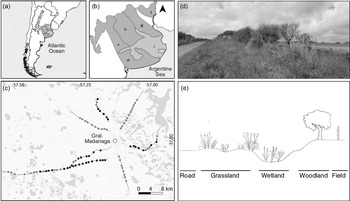
Fieldwork was carried out near General Madariaga city (37°0’7’’S, 57°8’10’’W) in Buenos Aires province, Argentina, within the Flooding Pampas, one sub-region of the Pampean Region (Fig. 1). The sub-region is dominated by grassy vegetation, dotted with water bodies and natural tree vegetation as well as modified areas such as artificial groves and crops (Vervoorst Reference Vervoorst1967). Crops (soy, corn, wheat, sunflower) are increasing and grazing is performed more intensively today than in the past (Lara & Gandini Reference Lara and Gandini2014). Pastures of exotic grasses and forbs are also increasing (Lara & Gandini Reference Lara and Gandini2014). Within an area of 80 000 ha, we selected 90 points along 7 roads with low traffic, separated by at least 800 m from each other. At each point we established one sampling plot, which was a roadside fragment of 200-m length that comprised the area between one edge of the road and the fence of the adjacent field; plots where randomly located on the right or left of the road (Fig. 1). Roadsides had a width range of 6–45 m. Roadsides typically have three vegetation structures: grassland adjacent to the road, wetland covering a ditch parallel to the road and woodland near the fences (Fig. 1). Even though 22% of the plots exhibited only grassland habitat, 40% exhibited grassland and woodland simultaneously, 17% exhibited grassland and wetland simultaneously and 21% exhibited all three habitats. Grassland was dominated by the exotic grass Schedonorus arundinaceus; wetland was dominated by the native species Schoenoplectus californicus, Typha domingensis and Typha latifolia; and woodland was dominated by the native tree Celtis tala (Supplementary Table S2, available online). The predominant cover around the roadsides consisted of cattle-rearing areas characterized by short grass (Table S3).
Study area. (a) Pampas region of central-eastern Argentina (cartographic material obtained from Oyarzabal et al. Reference Oyarzabal, Clavijo, Oakley, Biganzoli, Tognetti, Barberis and Leon2018). (b) (i) Flooding Pampas, entirely within Buenos Aires Province; (ii) Mesopotamic Pampas; (iii) Rolling Pampas; (iv) Flat Inland Pampas; (v) Western Inland Pampas; and (vi) Southern Pampas. (c) Roadsides studied, with sampling plots marked with dots (light grey spots are lowlands covered by water, which include water bodies and wetland vegetation); plots sampled across all seasons are black-filled. (d) Picture of one sampling plot. (e) Schematic view of a typical roadside with its habitats.

Roadsides are regularly maintained for security reasons by local rural services. Therefore, all of our roadsides had a segment of short grass adjacent to the road. In addition, roadside ditches are maintained yearly to avoid flooding. However, we also observed grazing activities on some roadsides.
Fieldwork
We performed bird surveys throughout a whole year: spring (October and November of 2015), summer (January and February of 2016), autumn (April and May of 2016) and winter (July and August of 2016). In each plot, two observers sampled birds using 10-minute point counts during the first 4 hours after sunrise (Bibby et al. Reference Bibby, Burgess, Hill and Mustoe2000), disregarding those birds flying high above the plot. We visited each plot twice in every season, and the maximum number of individuals recorded for each species was considered the species’ abundance. Number of sampled plots differed among the seasons, but 38 plots were surveyed in all seasons.
During spring of 2016 we also made behavioural observations on 24 plots at the peak of the breeding season for most bird species in the region (de la Peña Reference de la Peña2015), when birds exhibit a wider range of behaviours. Three observers recorded the behaviours of 306 individuals representing the 10 most abundant species of this community (Depalma Reference Depalma2020) during the first 4 hours after sunrise. Observations consisted of recording the behaviours performed by individuals until they went out of sight (Miller & Cale Reference Miller and Cale2000). We also recorded the vegetation structure where each behaviour occurred (i.e., the substrate; Table S4). We visited plots only once and excluded the first 5 seconds of observations.
Data analysis
To determine the extent to which birds use roadsides, we related the number of species recorded on roadsides to the total number of species whose distribution includes the study area (Azpiroz Reference Azpiroz2012). We checked the conservation status of each species (MADS 2017, IUCN-RLTS 2021) and their habitats (grassland, wetland and/or woodland; Azpiroz et al. Reference Azpiroz, Isacch, Dias, Di Giacomo, Fontana and Palarea2012, de la Peña Reference de la Peña2015). We classified them as grassland, wetland or woodland specialists if they only use one habitat.
We conducted the seasonal analysis of the bird community by evaluating variations in bird species richness and composition including only those 38 plots that had been sampled in all seasons. We compared richness among seasons with individual-based rarefaction curves, calculating the mean expected richness for a sample of 1253 individuals (spring individuals, smallest amount recorded). We compared mean richness per plot with repeated-measures linear models (random factor: ‘plot’, nested within ‘road’) with a temporal autocorrelation structure of order 1 to account for the correlation between samples taken in adjacent seasons. Seasonal changes in composition were analysed with permutational multivariate analysis of variance (PERMANOVA; random factor: ‘plot’, nested within ‘road’) using Euclidean distance and Hellinger transformation. Composition per plot was analysed with generalized linear mixed models that compared the abundance of grassland, wetland and woodland specialists among seasons (random factor: ‘plot’, nested within ‘road’, and plot area as offset).
In behavioural observations, we considered that an individual used roadsides as habitat if it foraged or performed reproduction-related activities (building or defending nest, displaying, singing and copulating). We classified those individuals that did not forage or perform reproduction-related activities and only roosted, groomed or walked on roadsides within ‘other behaviours’, since it was unknown whether they used roadsides as habitat. We then calculated the proportion of individuals that used roadsides for habitat and other behaviours in each species. We also calculated the frequency with which birds used each substrate for habitat behaviours. Only considering the substrates where birds foraged or performed reproduction-related activities, we expressed substrates as relative frequencies. Finally, we calculated the mean relative frequency with which each substrate was used as habitat by each species.
Results
We recorded 7393 individuals of 95 bird species using roadsides across all seasons; these represented 55% of the bird species of this area (Table S1). These species were grassland specialists (10%), wetland specialists (36%), woodland specialists (13%), birds that use two of these habitats complementarily (30%) and generalists (11%). Four species (Circus buffoni, Limnornis curvirostris, Spartonoica maluroides and Amblyramphus holosericeus) were recently classified as ‘vulnerable’ in Argentina. Moreover, S. maluroides is classified as ‘near threatened”. In addition, 19 species are declining with negative population trends (IUCN-RLTS 2021; Fig. S1 & Table S1).
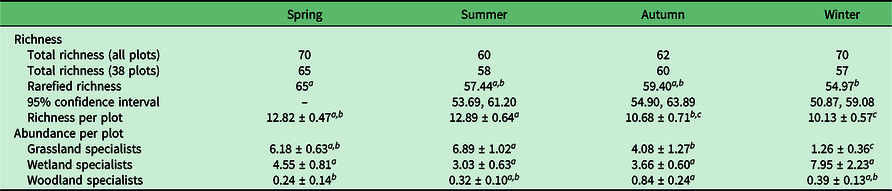
Rarefied bird species richness was greater in spring than in winter, with summer and autumn showing intermediate values (Table 1). Similarly, mean richness per plot was greater in spring and summer than in winter, and autumn showed intermediate values (Table 1).
Bird species richness and specialists’ abundances in roadsides of the Argentine Pampas. We show rarefied richness and its confidence intervals of 95%, and mean richness and mean habitat specialists’ abundances per plot ± standard error. Different letters indicate differences within a row according to confidence intervals (rarefied richness) or a posteriori comparisons (analyses per plot).

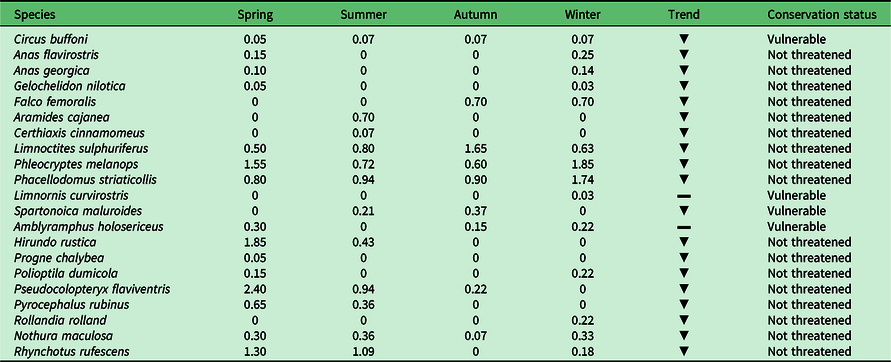
Species composition also varied (PERMANOVA, pseudo-F = 6.118, p = 0.005), with all seasons significantly different from each other (a posteriori comparisons, p < 0.001). Regarding individual bird species, five migrants were recorded only in autumn and winter, while three summer migrants were recorded in spring and summer (Table S1). In addition, in spring, declining species showed the highest relative abundance, with the sum of all declining species being 10% of total abundance (Tables 2 & S1). Regarding abundances per plot, grassland specialists decreased markedly towards the winter, while woodland specialists changed less and wetland specialists did not change (Table 1).
Relative abundances of declining bird species and species of conservation concern in roadsides of the Argentine Pampas across seasons. Population trend was obtained from the International Union for Conservation of Nature (IUCN) Red List of Threatened Species (IUCN-RLTS 2021) and local conservation status was obtained from Ministerio de Ambiente y Desarrollo Sustentable (MADS 2017). The complete list of species detected on roadsides is available in Table S1.

▼ = negative population trend; ─ = stable population trend.
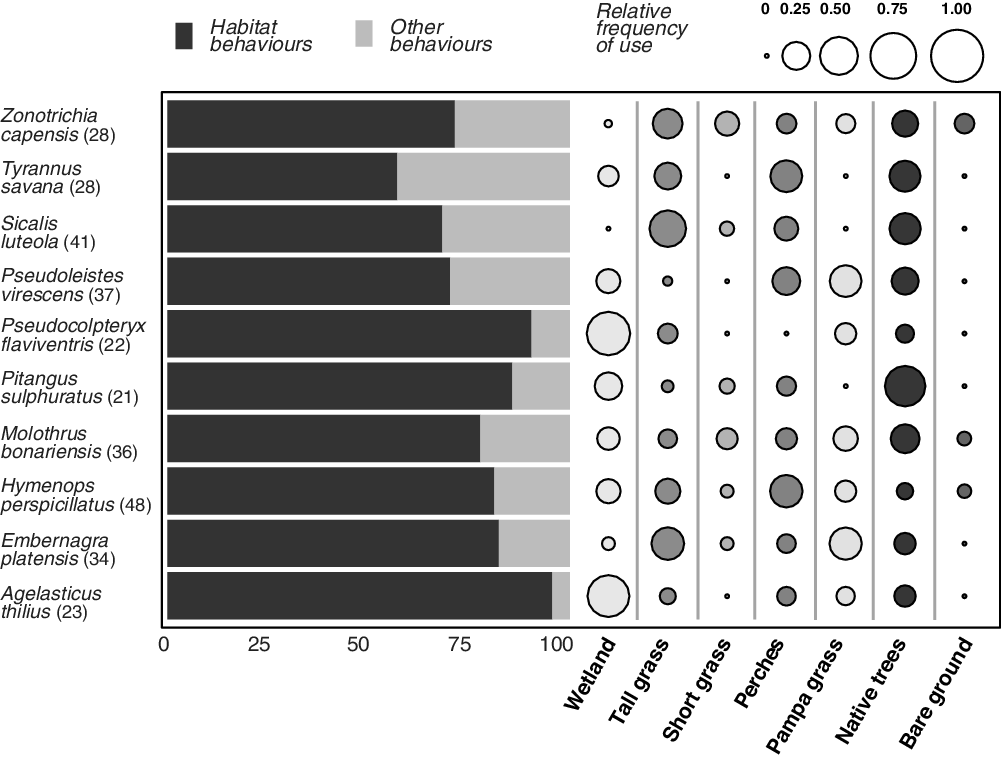
Most individuals were using roadsides as habitat since they foraged, built nests, defended nests, made displays, sang or copulated at least once. Only a small proportion of individuals used roadsides for other behaviours (Fig. 2). Nesting was relatively frequent: 110 individuals of all species (except for the brood parasite Molothrus bonariensis) built or defended nests on roadsides.
Behavioural observations of individuals belonging to the most abundant bird species on roadsides of the Argentine Pampas. (Left) Black bars indicate the percentage of individuals that used roadsides as habitat during behavioural observations (foraging, reproduction-related behaviours) and grey bars indicate those that did not perform habitat-related behaviours. (Right) Circle size indicates the mean relative frequency in which each substrate was used as habitat by each species (each row represents the use of substrates by one species). The number of individuals observed for each species is in parentheses.

The substrates most widely used as habitat were native trees and tall grass (Fig. 2), and native trees had the highest mean relative frequency across species. The least used substrates were bare ground and short grass; however, most bird species used a large variety of substrates (Fig. 2). Similarly, native trees were the most used substrates for other behaviours, while bare ground and short grass were the least used substrates for these behaviours.
Discussion
We found that more than half of the birds described for this region were present on roadsides year-round. Moreover, most individuals used roadsides as habitat since they were either foraging or conducting reproduction-related behaviours, mainly on native trees and tall grass.
As predicted, roadsides are used by a great diversity of birds, including species of conservation concern. More than half of these species are specialists of grassland, wetland or woodland, while almost a third use two of these habitats. Other studies have reported the use of roadsides and field margins by specialist birds (Miller & Cale Reference Miller and Cale2000, Gardiner et al. Reference Gardiner, Riley, Bonnarco and Ockinger2018) and by birds that use more than one habitat (Tscharntke et al. Reference Tscharntke, Tylianakis, Rand, Didham, Fahrig, Batary and Ewers2012). Roadsides might increase the amount of habitat available for specialists in the landscape (Fahrig et al. Reference Fahrig, Baudry, Brotons, Burel, Crist and Fuller2011). In the south-eastern Pampas, birds from riparian areas (e.g., Poospiza nigrorufa) complete their life cycles in patches of Cortaderia selloana grassland (Pretelli et al. Reference Pretelli, Isacch and Cardoni2013). Similarly, birds inhabiting roadsides could complement the habitat availability on roadsides with that of the landscape. Moreover, for those species that use two habitats in their life cycles, roadsides may offer proximity between complementary resources and, since they decrease the need to search for resources in other areas, they may decrease energetic costs and mortality (Fahrig et al. Reference Fahrig, Baudry, Brotons, Burel, Crist and Fuller2011).
Species richness was greater in spring than in winter, and grassland specialists decreased markedly towards the winter. The decrease in species richness on roadsides during winter might be due to the great mobility of birds, which can travel large distances to fulfil their requirements as resources become scarce (Hurlbert & Haskell Reference Hurlbert and Haskell2002). Grassland specialists may be particularly affected by the lower resource availability during winter; decreases in these species’ abundances were mainly due to the decrease of Sicalis luteola (Table S1). This and many other grassland species are granivores and, since seed availability at roadsides decreases in winter (Depalma Reference Depalma2020), birds might spend more time searching for food in the surrounding areas. Instead, in spring, birds might use roadsides more frequently (as reported by Leveau & Leveau Reference Leveau and Leveau2011), since food resource abundances are greater and crop management and cattle in fields may destroy their nests (Azpiroz et al. Reference Azpiroz, Isacch, Dias, Di Giacomo, Fontana and Palarea2012). Roadsides’ characteristics might be essential since, according to our predictions, most individuals observed used roadsides as habitat, suggesting that habitat availability is low in this landscape (Seiler Reference Seiler2001). In addition, the fact that roadsides are used as nesting sites suggests that their management can substantially impact bird populations (Ricklefs Reference Ricklefs1969).
The most widely used substrates were native trees and tall grass, while the least used substrates were bare ground and short grass. However, most bird species used a variety of substrates, as in other linear remnants (Miller & Cale Reference Miller and Cale2000, Conover et al. Reference Conover, Burger and Linder2007). The use of native trees might not be a result of high tree cover but of the birds’ preferences, since woodland is the least abundant habitat of roadsides (Table S2), and the use of native trees by open-habitat birds has already been reported in the Pampas (Isacch et al. Reference Isacch, Maceira, Bo, Demaría and Peluc2005). Moreover, the use of trees not only as perches but also as feeding and nesting sites might be related to the fact that these were native trees that are usually preferred over exotic trees by the birds of this region (Lacoretz et al. Reference Lacoretz, Depalma, Torrella, Zilli, Ferretti and Fernández2021), and that the use of native trees leads to greater nest success for some of these birds (Segura et al. Reference Segura, Dosil-Hiriart and González-García2020).
It is possible to suggest specific roadside management measures for the Pampas. Winter seed availability might be increased on roadsides (e.g., by increasing perennial forbs and flower diversity; Marshall & Moonen Reference Marshall and Moonen2002). Roadsides should be managed in non-reproductive seasons to avoid disturbing bird nests and to allow tall grass availability in the reproductive season in order to increase shelter. Native Flooding Pampas habitats – mainly native grassland, but also wetland and woodland – might be restored by favouring species such as Bromus catharticus and Paspalum dilatatum (grassland), Typha latifolia and Typha dominguensis (wetland) and Celtis tala (woodland), and by controlling invasive species (e.g., Schedonorus arundinaceus). Increasing roadside use could increase the incidence of birds being run over by vehicles, but this impact would probably not be great on these low-traffic, inland roadsides since road kills usually increase with traffic speed (DeVault et al. Reference DeVault, Blackwell, Seamans, Lima and Fernández-Juricic2015). If roadside management should extend to roads with more traffic, we suggest allowing a diversity of native plant species away from the road and maintaining a wide strip of short grass adjacent to the road. One concrete step towards roadside protection in this area would be to derogate the Buenos Aires Province Law No. 10342, which promotes roadside cropping and could lead to the disappearance of native vegetation. Since wide roadsides are usually the most cultivated, particular attention should be paid to avoiding cropping on wide roadsides. Grazing should be explicitly prohibited.
We thus provide evidence for the importance of roadsides for bird conservation in the Argentine Pampas. The fact that birds are good bioindicators that might reflect the response of several other taxa may be useful for promoting roadside preservation and preventing roadside disappearance in this region. We suggest management guidelines that could augment roadsides’ conservation values. There is a need to promote roadside conservation through policymaking and to start applying management actions on roadsides more widely in South America.
Supplementary material
To view supplementary material for this article, please visit https://doi.org/10.1017/S0376892921000424.
Acknowledgements
We thank Daniela R. Acosta, Natalia Mufato, Víctor Blanco and Mariano Kildegard for their assistance in the field. We also thank Mariano Codesido, Santiago Poggio, Piedad Cristiano, Nora Madanes and the anonymous reviewers for their valuable comments that helped to improve earlier versions of this manuscript.
Financial support
DMD was supported by a PhD Fellowship from Consejo Nacional de Investigaciones Científicas y Técnicas (CONICET). This work was supported by a Neotropical Grassland Conservancy (NGC) Ritt-Kellogg Grant to MEM and an NGC Equipment Grant and Student Grant to DMD.
Conflict of interest
The authors declare none.
Ethical standards
None.