Introduction
Harmful alcohol consumption is responsible for 3.8% of all global deaths, 4.6% of global disabilities, and more than 1% of the gross national product (GNP) being lost in most developed countries.Reference Rehm, Mathers, Popova, Thavorncharoensap, Teerawattananon and Patra1 In Brazil, it has been suggested that up to 80% of all admissions for substance dependence are due to alcoholism.Reference Galduroz and Caetano2 Accordingly, understanding the key motivations that drive alcohol abuse is critical. For many years, motivation to consume alcohol has been described as either driven by reward learning (positive reinforcement) or relief of distress (negative reinforcement).Reference Lewis3 More recently, however, there has been more interest in the role of habit formation across different substance and related addictions.Reference Belin, Jonkman, Dickinson, Robbins and Everitt4–Reference Dickinson, Wood and Smith6
Outcome devaluation studies and Pavlovian-instrumental transfer paradigms suggest that alcohol use disorder (AUD) involves a progressive shift from goal-directed control over alcohol seeking and consumption to a more ingrained, automatic, and stimulus-driven behavior largely independent of the expected outcome.Reference Corbit and Janak7 From a neurobiological standpoint, the relative transition from goal directed to habitual use of alcohol may be accompanied by a shift in behavioral control from the ventral to dorsal striatumReference Everitt and Robbins8 and a progressive dysregulation of the hypothalamic pituitary adrenal axis, the sympathetic adrenal medullary system, and the sex steroid systems.Reference Blaine, Milivojevic, Fox and Sinha9
Prevailing models provide a framework that explains chronicity and higher rates of relapse of AUD, with potential to improve or assist with personalization of treatments.Reference Heilig, Thorsell and Sommer10 However, as the evidence supporting these models is based mostly on laboratory studies, research on human participants based in “real life” settings is crucial to fill a gap in the established evidence base.Reference Corbit and Janak7 Although a few studies have reported decreased goal direct choicesReference Sebold, Deserno and Nebe11 and/or increased habit formation in adult humans with addiction,Reference Sjoerds, de Wit and van den Brink12, Reference Sjoerds, van den Brink, Beekman, Penninx and Veltman13 a similar phenomenon has not been noted in younger populationsReference Nebe, Kroemer and Schad14 (for a review on the neurobiological mechanisms underlying habit formation, see Barker and TaylorReference Barker and Taylor15).
Sebold et alReference Sebold, Nebe and Garbusow16 expanded these observations by reporting that “lower model-based” (or higher habitual) control predicted relapse in patients who also had high (mostly affective) expectancies about the effects of alcohol. Also, attempts to measure the motivations according to this model included the creation of the Reasons for Heavy Drinking Questionnaire, a 7-item self-report scale with 1 item addressing habitual drinking.Reference Adams, Schacht, Randall and Anton17 According to a recent Delphi study on the Research Domain Criteria (RDoC) relevant to addiction, more than 80% of experts described the Positive Valence System (Reward Valuation, Expectancy, Action Selection, Reward Learning, Habit) as involved in addiction, with habit being particularly critical for later/chronic stages of the condition.Reference Yücel, Oldenhof and Ahmed18
Thus, in the current study, we aimed to quantify drives for alcohol consumption in AUD patients, focusing on their motivations to reduce fear, to obtain reward, or to execute ingrained habits. Of note, our approach was multidimensional, thus allowing AUD patients to score similarly high on different domains of motivations. We also assessed how habit-, fear-, and reward-related motivations for alcohol use related to different sociodemographic and clinical factors in AUD patients. According to existing models that suggest habitual drinking to be an “end-state” of AUD,Reference Everitt and Robbins8 our main hypotheses were that the former would be associated with greater duration of illness, higher incidence and severity of dependence (particularly perceptual and psychophysical withdrawal), greater number of lifetime detoxifications, and higher severity of anxiety, stress, and depression. In contrast, we hypothesized that affect-modulated drinking (ie, alcohol consumption either to decrease fear or obtain reward) would be associated with a shorter duration of illness, lower severity of dependence, less lifetime detoxifications, and lower severity of comorbid affective symptoms.
Methods
Participants
Fifty-eight Diagnostic and Statistical Manual of Mental Disorders, Fourth Edition (DSM-IV) alcohol abuse patients were included in the study. Fifteen participants (25.9% of the sample) were consecutively recruited from a public substance abuse outpatient clinic at the Institute of Psychiatry of the Federal University of Rio de Janeiro (IPUB/UFRJ), whereas the remaining patients (74.1% of the sample) were recruited consecutively from the substance abuse inpatient clinic of a private hospital in the outskirts of Rio de Janeiro. Data were collected from July 2017 to March 2018. All participants provided written informed consent and agreed with the procedures of the study, which was approved by the local institutional review board in accordance with the Declaration of Helsinki. Besides having a diagnosis of alcohol abuse according to the DSM-IV, participants had to be aged 18–65 years old and had to be able to read and comprehend scales included in the research protocol.
Assessments
Participants were assessed by board certified psychiatrists specialized in diagnosis and treatments of substance abuse individuals (MPP and APR) with the Mini International Neuropsychiatric Interview (MINI)Reference Amorim19 for the confirmation of alcohol abuse and the diagnosis of comorbid discrete psychiatric disorders supplemented by the drug and alcohol section of the Addiction Severity Index (ASI),Reference McLellan, Luborsky, Woody and O’Brien20 which characterizes a range of alcohol related outcomes (including severity, natural history, and number of admissions, among others).
Participants also completed a number of self-report measures, including the Habit, Reward, and Fear Scale (HRFS), an 18-item tool developed by the authors to quantify affective (fear or reward) and non-affective (habitual) motivations for obsessive-compulsive and related disorders and substance or behavioral addictions (see the Appendix); notably, the 6 habit-related items from the HRFS were selected from the existing Self-Report Index of Habit StrengthReference Verplanken and Orbell21; other items remaining were worded in a similar way to address reward (as in addictive disorders) and fear (as in obsessive-compulsive and related disorders). They were based on the Temporal Impulsive-Compulsive ScaleReference Ferreira, Yucel, Dawson, Lorenzetti and Fontenelle22 and included statements about affective states participants experience before, in anticipation of, or after the behaviors; how individuals would feel if prevented from performing the behavior; and whether they are related to other approach- or avoidance-related behaviors. A 7-point Likert scale followed each HRFS with answers ranging from 1 (disagree) to 7 (agree).
Additional instruments included the Alcohol Dependence Scale (ADS)Reference Doyle and Donovan23 to assess the severity of alcohol dependence and its subdomains; the Behavioral Inhibition/Activation Scale (BIS/BAS)Reference Carver and White24; the Urgency, Premeditation (lack of), Perseverance (lack of), Sensation Seeking, Positive Urgency, Impulsive Behavior Scale (UPPS-P)Reference Lynam, Smith, Cyders, Fischer, Whiteside, Smith and Cyders25, Reference Sediyama, Moura and Garcia26; the Creatures of Habit Scale (COH)Reference Ersche, Lim, Ward, Robbins and Stochl27 to quantify different traits related to fear, reward, and habit; and finally, the short form of the Depression Anxiety Stress Scale (DASS-21)Reference Lovibond and Lovibond28, Reference Vignola and Tucci29 to assess severity of associated psychiatric symptoms.
Data analysis
Categorical data were reported in percentages, and continuous data were described as means (and standard deviations) or medians (and range), depending on the normality of distribution. Group comparisons between in- and outpatients were performed using chi-square or Fisher’s test (categorical variables) or student’s T test or Mann–Whitney tests, also depending on normality of distribution. The HRFS total and subscores’ internal consistency, convergent, and divergent validities were established by means of Cronbach’s alpha and Pearson’s correlation. Convergent validities of HRFS subscores were tested in relation to ADS psychophysical withdrawal (PPW) and COH Automaticity (HRFS habit); BIS/BAS fun seeking and UPPS-P sensation seeking (HRFS reward); and BIS/BAS BIS and UPPS-P negative urgency (HRFS fear). Divergent validities were tested by performing correlations of HRFS subscales with scales other than those reported above.
To identify correlates of habit, reward, and fear scores, we utilized the statistical technique of partial least squares (PLS), as detailed in Grant and Chamberlain.Reference Grant and Chamberlain30 PLS is a multivariate, iterative technique that constructs 1 or more latent factors (referred to as PLS components) that optimally explain variation in X and Y. The Y variable was total score on the habit, reward, and fear scores, and X variables were as follows: age; sex; alcohol dependence according to MINI; clinician’s severity of alcohol and other drugs according to the ASI; age at first alcohol use; duration of alcohol use since first use (in years); age at first alcohol intoxication; duration of alcohol use since first intoxication (in years); number of alcohol or other drug detoxifications at home, therapeutic communities, psychiatric hospitals, and other hospital units; ADS loss of behavioral control; obsessive-compulsive drinking style, and perceptual and psychophysical symptoms; DASS-21 stress, anxiety, and depression; BIS/BAS drive, fun seeking, and reward; COH routine and automaticity; and UPPS-P negative urgency, positive urgency, sensation seeking, lack of premeditation, and lack of perseverance.
Unlike traditional regression, PLS is ideal in situations in which variables are correlated with each other, and when the number of variables is large in comparison to the number of cases, as was the case here. PLS essentially constructs a bilinear factor model, projecting explanatory (X) variables and outcome (Y) variables into a new space, identifying the relationship between X and Y matrices using 1 or more latent variables. Analysis was conducted using JMP Pro software Version 13.0. Any missing data points were imputed automatically by JMP using study means. The PLS model was fitted using leave-one-out cross-validation (nonlinear iterative partial least squares [NIPALS] algorithm), and the optimal number of latent factors was selected by minimizing the predictive residual sum of the squares (PRESS). X variables significantly contributing to the model (ie, explaining significant variance in disease severity) were identified on the basis of 95% confidence intervals for bootstrap distribution of the standardized model coefficients not crossing 0 (N = 1000 bootstraps). Variables with variable importance parameter (VIP) < 0.8 were excluded.
Results
Description of the sample
The sample (n = 58) was characterized by a predominance of white (79.3%) males (72.4%) with a mean age of 39.4 (SD = 13.6) years. Participants had been alcohol free for a mean of 26.6 (SD = 24.6) days. Only 27.5% were married or within a stable relationship, and just 17.2% reported being economically active. Most patients (31%) described not having a religion, 27.6% declared being Catholics, and 22.4% were Protestants. On the ASI, alcohol addiction severity was 7.67 (SD = 1.70) according to the interviewer (minimum possible score = 0; maximum possible score = 9) and 2.48 (SD = 1.70) according to the patient (minimum possible score = 0; maximum possible score = 4). Up to 81% of the sample also abused other drugs; the severity of concurrent drug abuse as per the ASI was 6.91 (SD = 3.42) according to the interviewer and 2.67 (SD = 1.73) according to the patient. Age at first alcohol use was 14.53 (SD = 3.47) years, and age of first alcohol intoxication was 16.19 (SD = 3.62) years. The mean number of years since the first alcohol intoxication was 22.50 (SD = 12.12). Number of previous detoxifications for alcohol ranged from 0–10 at home, 0–3 at therapeutic communities, 0–15 at psychiatric hospitals, and 0–2 at general hospitals.
The number of months of spontaneous remission (not resulting from treatment) varied from 0–60 months. The amount of money spent on alcohol in the last 30 days ranged from 0–8000 Brazilian reais (median = 300 reals; 1 US dollar = approximately 3.5 reais). In terms of psychiatric comorbidity according to the MINI, recurrent major depressive disorder was diagnosed in 84.5% of the sample; other substance abuse in 81%; other substance dependence in 79.3%; alcohol dependence in 74.1%; antisocial personality disorder, psychotic syndromes, and generalized anxiety disorder in 20.7% each; dysthymia in 19%; bipolar disorder in 17.2%; panic disorder and social phobia in 10.3% each; agoraphobia in 8.6%; and OCD and bulimia nervosa in 1.7% each. Although all patients have been diagnosed with alcohol abuse, participants described cocaine (34.5%), alcohol (27.6%), more than one substance (19%), and marijuana (6.9%) use as their most significant problems.
Differences between public and private alcohol abuse patients
As expected, inpatients (recruited in a private hospital) had a previous history of being more frequently treated in psychiatric hospitals for alcohol problems (z = –2.51; p = .01); they have also been drinking for a longer time (in months) than outpatients (z = 2.06; p = .04). In contrast, outpatients (recruited in a public hospital) had a greater number of overdoses (z = –3.53; p = .00004), more severe perceptual and psychophysical withdrawal (t = 2.18; df = 16.5; p = .04), anxiety (t = 2.05; df = 56; p = .04), and depression (t = 2.29; df = 34.2; p = 0.03). In terms of HRFS, outpatients displayed greater habit (t = 2.08; df = 56; p = 0.04) and reward-related scores (t = 2.12; df = 56; p = .04). Greater severity among outpatients may reflect the fact that they all come from public services in Rio de Janeiro, which shows restrictions in terms of available beds for individuals with AUD.
Habit, Reward, and Fear Scale (HRFS)
Cronbach’s alpha was deemed adequate (.77) for the whole HRFS and good (.81) for its Habit subscale. Removal of different items (eg, 3, 6, 7, 10, 14, and 16) from the Habit subscale did not increase Cronbach’s alpha values, thus suggesting good internal consistency. As expected, the Habit subscale of the HRFS correlated significantly with ADS PPW (r = .40; p = 0.002). However, it showed no convergent validity with the COH Automaticity scores (r = .20; p = 0.13). Adequate divergent validity was confirmed by the lack of correlations between Habit and BIS/BAS fun seeking (r = .16; p = 0.22), UPPS-P sensation seeking (r = –.06; p = 0.64), BIS/BAS BIS (r = –.13; p = 0.32), and UPPS-P negative urgency (r = –.32; p = 0.80).
Cronbach’s alpha of the Reward subscale of the HRFS (.72) was acceptable. Removal of different items (eg, 2, 4, 9, 12, 15, and 17) of this subscale did not increase Cronbach’s alpha values, thus supporting good internal consistency of the subscale. As expected, the Reward subscale of the HRFS showed good convergent and divergent validities for correlating with the BIS/BAS fun seeking (r = .35; p = 0.006) and not correlating with the ADS PPW (r = .17; p = 0.19), the COH Automaticity (r = .21; p = 0.11), the BIS/BAS BIS (r = –.03; p = 0.81), and the UPPS-P negative urgency (r = .05; p = 0.69). However, the Reward subscale of the HRFS did not correlate to a substantial degree with the UPPS-P sensation seeking (r = .25; p = 0.06).
Finally, Cronbach’s alpha of the Fear subscale of the HRFS (.38) was unacceptably low. In addition, poor convergent validity of the Fear subscale of the HRFS was demonstrated in the present sample by the lack of correlations between its scores with both the BIS/BAS BIS (r = –.08; p = 0.52) and UPPS-P negative urgency (r = .25; p = 0.06). Further, despite lack of correlations between the Fear subscale of the HRFS with the COH Automaticity (r = –.008; p = 0.95), the BIS/BAS fun seeking (r = .13; p = 0.32), and the UPPS-P sensation seeking (r = .06; p = 0.65), its divergent validity was not satisfactory, as it correlated positively with the ADS PPW (r = .33; p = 0.01). For these reasons, PLS models with fear as Y variable of interest were not pursued.
Habit scores as Y variable of interest in PLS model
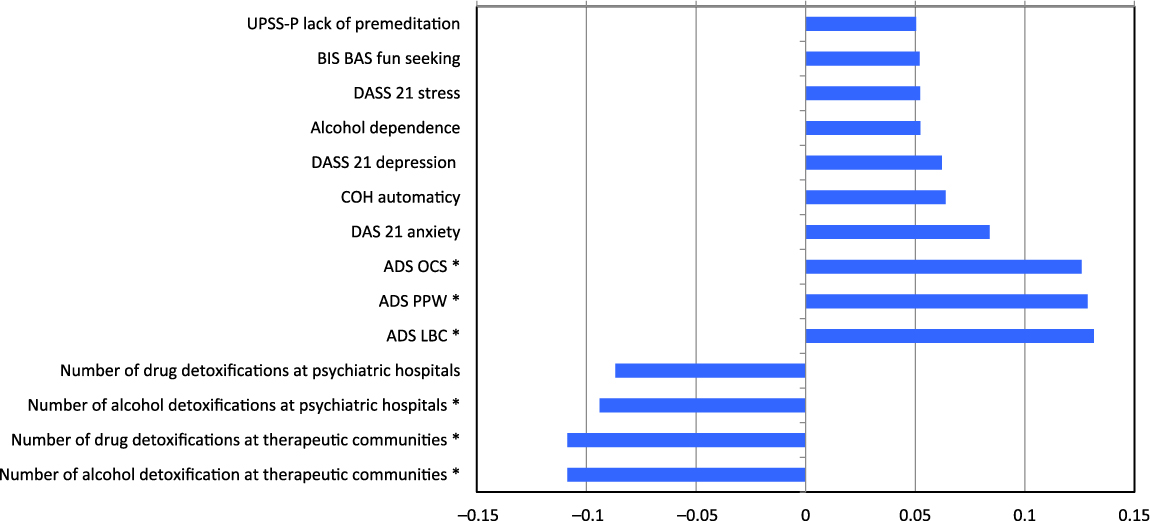
The optimal model had 1 latent factor, and accounted for 23.8% of variance in X variables, and 36.3% of variance in habit scores. The standardized model coefficients for each variable of interest are presented in Figure 1. Variables with positive coefficients had a positive relationship with habit scores, and vice versa. Those measures shown in bold and with an asterisk retained statistical significance by bootstrap, ie, the 95% confidence interval of the bootstrap distribution of the model coefficient did not cross 0. Higher habitual use of alcohol in the present sample was significantly associated with greater severity of alcohol dependence in AUD patients across different domains (including loss of behavioral control, obsessive-compulsive drinking, and perceptual and psychophysical withdrawal) and, unexpectedly, with a lower number of alcohol and drug detoxifications across multiple settings.
Standardized model coefficients for each X variable of interest in the optimal PLS model (1 latent variable): habit related scores of the HRFS as the Y variable of interest. UPPS-P = Urgency, Premeditation (lack of), Perseverance (lack of), Sensation Seeking, Positive Urgency, Impulsive Behavior Scale; BIS BAS = Behavioral Inhibition/Activation Scale; DASS-21 = Depression Anxiety Stress Scale; COH = Creatures of Habit; ADS = Alcohol Dependence Scale; OCS = Obsessive-Compulsive Symptoms; PPW = Perceptual and Psychophysical Withdrawal; LBC = Loss of Behavioral Control. * statistically significant predictive variable by bootstrap.

Reward scores as Y variable of interest in PLS model
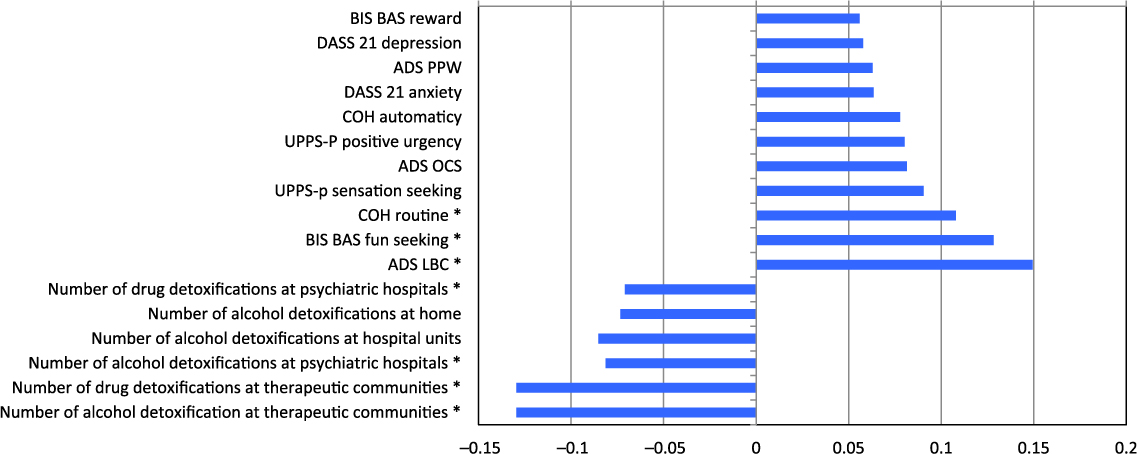
The optimal model had 1 latent factor, and accounted for 17.6% of variance in X variables, and 41.4% of variance in reward scores. The standardized model coefficients for each variable of interest are presented in Figure 2. Variables with positive coefficients had a positive relationship with reward scores, and vice versa. Those measures shown in bold and with an asterisk retained statistical significance by bootstrap, ie, the 95% confidence interval of the bootstrap distribution of the model coefficient did not cross 0. Reward-related scores in the HRFS scores were associated with a single domain of alcohol dependence (namely loss of behavioral control), higher BIS/BAS fun seeking, COH routine, and, as expected, lower number of alcohol and drug detoxifications.
Standardized model coefficients for each X variable of interest in the optimal PLS model (1 latent variable): reward related scores of the HRFS as the Y variable of interest. UPPS-P = Urgency, Premeditation (lack of), Perseverance (lack of), Sensation Seeking, Positive Urgency, Impulsive Behavior Scale; BIS/BAS = Behavioral Inhibition/Activation Scale; DASS-21 = Depression Anxiety Stress Scale; COH = Creatures of Habit; ADS = Alcohol Dependence Scale; OCS = Obsessive-Compulsive Symptoms; PPW = Perceptual and Psychophysical Withdrawal; LBC = Loss of Behavioral Control. * statistically significant predictive variable by bootstrap.

Fear scores as Y variable of interest in PLS model
This model did not converge in terms of the PRESS statistic, indicating that X variables overall did not significantly predict fear score.
Discussion
In this study, we used diagnostic interviews and self-report instruments to address the intensity of different motivations for alcohol use and their correlates in a clinical sample of AUD. We demonstrated that higher severity of alcohol dependence was associated with habitual use of alcohol on the HRFS, in keeping with preclinical data.Reference Everitt and Robbins8 Also in agreement with the above result, the use of alcohol for its rewarding properties on the HRFS was associated with a less generalized severity of dependence and with a range of impulsive personality features. These findings were consistent with our initial hypotheses. Although higher impulsivity levels, particularly UPPS-P sensation seekingReference Coskunpinar, Dir and Cyders31 and BAS drive and fun seekingReference Franken, Muris and Georgieva32 have been reported in alcohol abuse individuals, these studies were unable to previously ascribe these psychological profiles to a specific AUD phenotype.
Despite employing a dimensional approach whose objective did not include the identification of discrete subgroups of AUD patients (the same patient could score similarly high on different motivations), our data suggest that habit- and reward-based alcohol use could partially map into existing subtypes of AUD patients, such as Babor’s types A and B alcoholism, respectively.Reference Babor and Caetano33 For instance, habit-based alcohol use seems to correspond to the more severe type B subgroup, which also shows a longer duration of illness and higher genetic (family history)/environmental (stress/traumatic) risk factors. In contrast, the reward-based alcohol use would be consistent with the less severe (type A) group of alcohol use, also having a shorter duration of illness and low-genetic/environmental vulnerabilities.Reference Babor and Caetano33 Contrary to our initial prediction, higher scores of anxiety and depression were not positively correlated to habit-driven subjects disorder in this sample.
Accordingly, lower number of detoxifications in participants using alcohol to obtain reward may also reflect a more benign course—a finding consistent with the milder subtype of alcohol use described above.Reference Babor and Caetano33 In contrast, the association between lower (rather than higher) number of detoxifications and habitual use of alcohol contradicted our initial prediction. This novel result may be clinically important, suggesting that while habitual alcohol use is associated with more severe alcohol use pathology, such high habit scoring individuals may be less likely to “break their habit” and seek/agree to inpatient treatment. The impact of scale scores on treatment engagement and outcomes should be explored further in future work.
We found that higher reward-driven use of alcohol on the HRFS was associated with higher “routine” scores on the Creature of Habit (COH) scale, and that higher habit-driven use of alcohol on the HRFS tended to be associated with higher “automaticity” scores on the COH scale (albeit the latter was not significant with bootstrap). This may reflect the nature of the COH scale items: the COH “routine” items relate largely to comfort and the need for comfort whereas those for “automaticity” relate more to finding oneself engaged in acts or habits without prior thought. Conceivably early alcohol use may thus be motivated by the need for comfort (ie, reduction of anxiety), whereas later it is linked to more automatic habitual tendencies.
This study has a number of limitations, including a small and heterogeneous sample with different comorbid psychiatric disorders and polysubstance use, a cross-sectional design, and the use of an instrument that still has incipient psychometric properties being evaluated (the HRFS). Habits’ ability to override conscious deliberative tendencies may also interfere somehow with the individual’s competence to describe their own habitual behavior appropriately.Reference Gardner34, Reference Wood and Runger35
Further, initial predictions about fear-driven AUD could not be appropriately tested due to problems exhibited by the Fear subscale of the HRFS. It is difficult to speculate on the reasons for poor convergent and divergent validities and unacceptable intraclass correlations coefficients of this subscale, as they could reflect problems such as low numbers, items that do not address adequately the fear component of alcohol abuse, or even the irrelevance of the fear construct for alcohol abuse patients (which, at least in our population, orbited around themes of reward and habit). Future studies including bigger numbers and participants with impulsive-compulsive disorders with clearer fear components, such as obsessive-compulsive and related disorders (OCRDs), should help clarify these issues. They could also incorporate specific metrics of insight into illness, as the association between greater habit and reward scores and less detoxification among patients with addiction can also reflect greater ability to reflect on their own habitual behavior.
In conclusion, our study represents an important step toward the translation to the clinical arena of experimental human and animal research indicative of transition from goal-directed toward habitual alcohol use with more severe illness (disease progression). In the future, habit and reward subcomponents of the HRFS may be used in alcohol abuse patients to monitor evolution and select more specific treatments.Reference Heilig, Thorsell and Sommer10 Use of such measures in wider contexts, such as in other substance addictions, behavioral addictions, and obsessive-compulsive related disorders, may help to advance the field and further elucidate the fit of this model to understanding different forms of psychopathology.
Disclosure
This work was supported by the Fundação Carlos Chagas Filho de Amparo à Pesquisa do Estado do Rio de Janeiro (L.F., grant numbers 211.191/2015); Conselho Nacional de Desenvolvimento Científico e Tecnológico (L.F., grant number 308237/2014-5); D’Or Institute for Research and Education (L.F.); and the David Winston Turner Endowment Fund (L.F.).
Dr. Yucel reports grants from National Health and Medical Research Council, grants from Australian Research Council, grants from The David Winston Turner Endowment Fund, grants from Monash University, and other from Monash University and Law firms, outside the submitted work.
Dr Chamberlain reports grants from Wellcome Trust; personal fees from Shire, personal fees from Promentis, and personal fees from Cambridge Cognition, outside the submitted work.
Dr Lee, Dr Piquet-Pessoa, Dr Ferreira, Dr Albertella, Dr Menezes, Dr Ribeiro, Dr Fontenelle, and Dr Marcelo Cruz have nothing to disclose.
Appendix: Habit, Fear, and Reward Scale (HRFS)
Please, discuss with your clinician what target behavior he/or she wants to address with this scale. Then, refer to this target behavior (e.g. wash/washing) and indicate the extent to which you agree or disagree with each statement.
TARGET BEHAVIOR: Drink/Drinking Alcohol

Scoring:
Habit: 3, 6, 7, 10, 14 and 16
Reward: 2, 4, 9, 12, 15 and 17
Fear: 1, 5, 8, 11, 13 and 18