Introduction
Many scholars have documented the structural disadvantages tenants face in eviction proceedings due to the cultural privileges of property ownership, the procedural design of summary proceedings, and the disparities in legal representation (Bezdek Reference Bezdek1991; Spector Reference Spector2000; Sudeall and Pasciuti Reference Sudeall and Pasciuti2021; Mason Reference Mason2022; Sabbeth Reference Sabbeth2022; Scherer Reference Scherer2022). Eviction courts operate within a legal framework that values landownership, leading judges to favor landlords’ claims even in the absence of substantive evidence (Bezdek Reference Bezdek1991). A summary proceeding narrows legal inquiry to the eligibility of possession alone, which intentionally ignores the issues of habitability and hardship of tenants (Spector Reference Spector2000; Scherer Reference Scherer2022). In addition, compressed timelines and disparities in legal representation between landlords and tenants make it difficult for tenants to prepare a defense for themselves (Hanley, Howell, and Teresa Reference Hanley, Howell and Teresa2024; Budzinski Reference Budzinski2025). Even when tenants are represented, informal court dynamics and social capital between landlords’ attorneys and court staff tend to lead to biased outcomes, reinforcing structural advantages for landlords and undermining tenants’ ability to assert their rights (Krent et al. Reference Krent, Cheun, Higgins, McElwee and McNicholas2016; Nelson Reference Nelson2021; Fleming-Klink, McCabe, and Rosen Reference Fleming-Klink, McCabe and Rosen2023).
Some scholars suggest that stipulated agreements offer tenants a more flexible and accessible pathway to avoid a judgment of eviction compared to adversarial litigation (Bieretz, Burrowes, and Bramhall Reference Bieretz, Burrowes and Bramhall2020; Eisenberg and Ebner Reference Eisenberg and Ebner2020; Tokarz et al. Reference Tokarz, Stragand, Geigerman and Smith2020; Dermaku Reference Dermaku2022; Ryan and Armstrong Reference Ryan and Armstrong2025). At the same time, however, research has also shown that landlords retain disproportionate bargaining power in negotiations (Dowdall and Weidig Reference Dowdall and Weidig2020; Hare Reference Hare2020; Summers Reference Summers2023, Reference Summers2026; Elliott Reference Elliott2025). Nicole Summers (Reference Summers2026) frames stipulated agreements as “settlements of adhesion,” describing a process in which tenants sign pre-drafted documents prepared by landlords and their attorneys, often without the full participation of tenants in negotiations. In addition, in the absence of statutory guidance governing stipulated agreements, landlords can extract concessions that exceed what the law requires through the pathway involving stipulated agreements (Summers Reference Summers2023, Reference Summers2026).
Meanwhile, some scholars claim that extending the timeline for eviction proceedings helps tenants dismiss their cases and increases housing stability (William Mitchell Law Review 1980; Ryan and Armstrong Reference Ryan and Armstrong2025). One of the measures to increase the duration of eviction proceedings is the right to redemption, which aims to provide a clear mechanism for tenants in nonpayment cases to cure their default and retain their housing, effectively creating an escape route from a judgment of eviction. This is premised on the idea that strengthening tenants’ right to “pay and stay” would reduce forced displacement and mitigate the coercive nature of eviction proceedings. The conditions under which the right of redemption is available, as well as the duration of its guarantee, differ among jurisdictions (Macdonald et al. Reference Macdonald, Malone, Palmer and Sargent2024).
A significant development in this area occurred in 2023 with the enactment of Oregon House Bill 2001 (HB 2001), which substantially expanded tenants’ statutory right to redemption in nonpayment eviction proceedings. Under HB 2001, tenants had a clearly defined legal pathway to dismiss a nonpayment eviction case by paying the full cure amount specified in the termination notice before trial. Unlike stipulated agreements, whose terms are subject to negotiation and largely unregulated under the relevant laws, the expanded right to redemption under HB 2001 established a legally guaranteed pathway for tenants to dismiss their cases. In Multnomah County Circuit Court in Oregon, where judges tend to present tenants and landlords with the choice between submitting a stipulated agreement and proceeding to trial (Farrington et al. Reference Farrington, Bates, Carroll, Wang, Azad Amir-Ghassemi, Cholula and Lindstrom2025), this legislative reform introduced a substantive statutory alternative.
Given this context, the study evaluates whether HB 2001’s expanded right to redemption effectively improved legal outcomes for tenants in nonpayment eviction proceedings and how broadly its protections reached. Using the eviction records and documents from Multnomah County Circuit Court in Oregon, we examine three research questions: whether the proportion of nonpayment cases resolved through stipulated agreements declined following the enactment of HB 2001; whether legal outcomes improved for tenants who pursued formal adjudication under HB 2001; and whether the terms of stipulated agreements filed in the post-reform period aligned with the statutory protections that HB 2001 affords.
Our findings demonstrate that HB 2001 meaningfully expanded tenant protections in nonpayment eviction proceedings. The proportion of nonpayment cases resolved through stipulated agreements declined significantly following the reform, which indicates that more tenants opted for the statutory protections that it affords. Among cases resolved without stipulated agreements, the rate of eviction judgment also showed a statistically significant decline. For cases resolved through stipulated agreements, on the other hand, legal outcomes did not show a statistically significant change, consistent with the expectation that HB 2001’s protections do not extend to tenants who settle outside of formal adjudication. Furthermore, a review of stipulated agreements filed in the post-reform period reveals that their terms and conditions exceeded the statutory pathways under HB 2001, which requires tenants to pay more than the cure amount, accept accelerated move-out timelines, and pay landlord legal costs.
While this study does not capture the specific circumstances that lead a tenant to choose a stipulated agreement over the statutory right of redemption, our findings imply that the underlying power imbalance in eviction court remains deeply entrenched. Despite a well-intentioned legislative reform, the eviction process continues to function as a site where landlords can leverage the threat of removal to impose coercive, long-term conditions on vulnerable tenants. By conducting empirical research, this study provides evidence on the effectiveness of the expanded right to redemption for tenant protections in practice. Moreover, it contributes to the socio-legal literature on eviction by demonstrating how stipulated agreements, which are one of the shadow practices in eviction proceedings, can limit the practical reach of legislative reform to expand the right to redemption for tenants.
Literature review
Power dynamics between landlords and tenants in eviction proceedings
Even though courtroom actors do not want to acknowledge the inequities embedded in eviction proceedings (Kepes and Kempler Reference Kepes and Kempler2024), scholars have demonstrated the structural power imbalance between landlords and tenants in eviction court (Bezdek Reference Bezdek1991; Spector Reference Spector2000; Sudeall and Pasciuti Reference Sudeall and Pasciuti2021; Mason Reference Mason2022; Sabbeth Reference Sabbeth2022; Scherer Reference Scherer2022). Three main factors perpetuate inequities in eviction court: the socio-cultural foundations of landownership, the procedural design and speed of summary proceedings, and the disparity in legal representation between landlords and tenants. First, the most foundational source of imbalance lies in the socio-cultural context that privileges property ownership. Barbara Bezdek (Reference Bezdek1991) claims that eviction courts operate within a normative framework that perceives landownership as valuable. To prevail, tenants have to present arguments that challenge this deeply entrenched premise of landownership, which is an exceedingly difficult task that makes tenants “silent” in court. Moreover, courts frequently issue judgments of eviction in favor of landlords even when neither party presents substantive evidence, reflecting centuries of culture associated with landownership as a marker of moral worth. It also leads to judges’ class-based assumptions about credibility and social order, which prioritize landlords’ arguments over those of tenants (Bezdek Reference Bezdek1991).
A form of summary proceeding for eviction cases further exacerbates the inequities between landlords and tenants. A summary proceeding is premised on the idea that the landlords’ property rights and economic interests outweigh tenants’ housing stability and concerns over property habitability, which limits the legal inquiry to the question of who is entitled to possession of the property (Spector Reference Spector2000; Scherer Reference Scherer2022). Due to the narrow scope of the issues, judges and clerks in eviction courts often view the cases as routine and straightforward, requiring minimal legal expertise and involving little factual dispute beyond whether rent was paid on time or not (Sudeall and Pasciuti Reference Sudeall and Pasciuti2021). Furthermore, the compressed timeline of eviction proceedings leaves tenants with little opportunity to secure legal counsel or prepare a defense (Bezdek Reference Bezdek1991; Hanley, Howell, and Teresa Reference Hanley, Howell and Teresa2024). In civil litigation, such as eviction proceedings, the represented party is more likely to prevail against unrepresented counterparts. The party that possesses greater economic and social capital, such as landlords, is better positioned to secure legal advocacy (Budzinski Reference Budzinski2025; Saunders-Medina et al. Reference Saunders-Medina, Temprano, Morikawa, Bloom and Pelletier2025).
On the other hand, unrepresented tenants often enter into stipulated agreements or accept the legal outcomes without understanding their rights or the terms of the agreements they sign (Krent et al. Reference Krent, Cheun, Higgins, McElwee and McNicholas2016; Hanley, Howell, and Teresa Reference Hanley, Howell and Teresa2024). In addition, Harold Krent and colleagues (Reference Krent, Cheun, Higgins, McElwee and McNicholas2016), who observed eviction proceedings in Cook County between 2014 and 2015 and analyzed legal aid service record data, found that judges rarely verified tenants’ comprehension of the agreements they submitted or legal judgments, asking only perfunctory questions such as “Is this your agreement?” or “Do you agree?” Even when tenants do retain legal counsel, their litigation tools are often constrained by procedural norms, compressed time frames, and informal court dynamics (Scherer Reference Scherer2022; Hanley, Howell, and Teresa Reference Hanley, Howell and Teresa2024). Landlords’ attorneys, who are accustomed to high-volume caseloads, frequently cultivate relationships with judges and clerks in eviction courts, which makes it easier to coordinate their schedules (Fleming-Klink, McCabe, and Rosen Reference Fleming-Klink, McCabe and Rosen2023; Hanley, Howell, and Teresa Reference Hanley, Howell and Teresa2024). This not only helps landlords’ attorneys navigate their schedules efficiently, but it also prevents unrepresented tenants from taking their personal schedules into account, increasing the likelihood that the tenants will fail to appear in court for hearings or trials and receive default judgments. These informal practices can also yield strategic information, influence judicial discretion, and contribute to judgments in favor of landlords (Nelson Reference Nelson2021; Fleming-Klink, McCabe, and Rosen Reference Fleming-Klink, McCabe and Rosen2023; Kepes and Kempler Reference Kepes and Kempler2024; Budzinski Reference Budzinski2025).
Pathways to avoid judgment of eviction: stipulated agreement, right to redemption
Given the unequal power between landlords and tenants, trials in eviction proceedings rarely yield outcomes favorable to tenants. As a result, courts often ask tenants to pursue alternative procedural pathways to avoid a judgment of eviction, such as stipulated agreements or the right to redemption. Stipulated agreements, which are negotiated settlements between landlords and tenants, are typically reached outside the judicial decision-making process. Negotiation to enter into stipulated agreements may be conducted at the stage of pre-filing or post-filing. In addition, some jurisdictions provide in-court mediation services for landlords and tenants (Parrish Reference Parrish2022). Scholars diverge on the normative and practical implications of the effectiveness of stipulated agreements. Proponents argue that stipulated agreements offer procedural flexibility and mutual benefit for all parties, including landlords, tenants, courts, and even local housing markets (Bieretz, Burrowes, and Bramhall Reference Bieretz, Burrowes and Bramhall2020; Eisenberg and Ebner Reference Eisenberg and Ebner2020; Tokarz et al. Reference Tokarz, Stragand, Geigerman and Smith2020; Dermaku Reference Dermaku2022; Ryan and Armstrong Reference Ryan and Armstrong2025). Karen Tokarz and colleagues (Reference Tokarz, Stragand, Geigerman and Smith2020) conducted a mediation project in pro se landlord-tenant cases and found that it resulted in tenants being less likely to receive judgments of eviction, landlords receiving more rent arrears, local housing stability increasing, and courts being able to navigate high-volume cases more effectively.
On the other hand, several scholars caution that stipulated agreements often mask coercive dynamics (Dowdall and Weidig Reference Dowdall and Weidig2020; Summers Reference Summers2023, Reference Summers2026). In particular, Summers (Reference Summers2023, Reference Summers2026) introduces the theoretical concepts of “settlements of adhesion” and “civil probation” to describe stipulated agreements that impose onerous conditions on tenants, often without meaningful negotiation in which all parties are equally involved. In such cases, tenants who are frequently unrepresented may sign agreements that are pre-drafted by the landlords and their attorneys, under implicit threat of immediate eviction (Summers Reference Summers2026). Consequently, these agreements can function as instruments that extend surveillance and control over tenants, with minor noncompliance resulting in expedited eviction (Summers Reference Summers2023).
However, scholars commonly mention that pre-filing mediation with a neutral third-party mediator offers more equitable outcomes than post-filing negotiations, but only for the parties involved (Eisenberg and Ebner Reference Eisenberg and Ebner2020; Parrish Reference Parrish2022). In post-filing contexts, the limited time frame of eviction proceedings, and the adversarial framing of the case often limit the scope of mediation. Landlords may be less willing to participate in negotiations, and mediators may have diminished bargaining opportunities to reshape terms (Bieretz, Burrowes, and Bramhall Reference Bieretz, Burrowes and Bramhall2020; Hare Reference Hare2020; Elliott Reference Elliott2025). Moreover, the imbalance in legal representation exacerbates tenants’ vulnerability and hinder their full participation. Without legal representation, a tenant may lack the capacity to assert the terms and conditions of agreements as well as understand the terms of the agreements that landlords or their lawyers proposed (Engler Reference Engler1997; Hare Reference Hare2020; Elliott Reference Elliott2025; Summers Reference Summers2026).
The right to redemption offers tenants a statutory mechanism to dismiss an eviction case by curing the lease violation, which, for nonpayment cases, means paying the amount to cure listed on the notice of termination. The right to redemption exists in only a subset of states. Of the states that have a right to redemption, the amount of time that tenants have to exercise a right to redemption varies by state. The amount of time that tenants have to exercise this right matters because the period between the issuance of a termination notice and the entry of a legal judgment is often the critical period during which tenants mobilize financial resources or secure alternative housing to avoid a judgment of eviction (William Mitchell Law Review 1980; Ryan and Armstrong Reference Ryan and Armstrong2025). Opponents argue that redemption rights that are too broad may infringe upon landlords’ property rights and impose undue financial burdens on landlords, particularly when tenants delay payment (Kraus Reference Kraus2023).
To balance these competing interests, states vary widely in how they structure the right to redemption, differing in timing and eligibility. For instance, Florida, Louisiana, and Tennessee do not provide tenants with any statutory right to redemption once eviction proceedings are initiated. In contrast, Alabama, Georgia, and South Carolina allow tenants to halt eviction by paying the full amount owed prior to the issuance of a termination notice and before their first appearance. Mississippi, North Carolina, and Texas extend redemption rights up to the point of judgment, meaning tenants can dismiss the case by paying all arrears at any time before the court order (Macdonald et al. Reference Macdonald, Malone, Palmer and Sargent2024). Some jurisdictions offer even broader protections. In the District of Columbia, Maryland, and Virginia, tenants may redeem their tenancy even after a judgment of eviction has been entered if they pay the full balance before the writ of restitution is executed (Brennan Reference Brennan2019). Since eviction procedures are significantly affected by state-specific statutes and court practices (Nelson Reference Nelson2021), it is essential to situate the analysis within the legal and procedural context of Oregon. Therefore, the following section introduces Oregon’s eviction process in detail, with particular attention to the right to redemption and stipulated agreements.
Case study: nonpayment eviction in Multnomah County, Oregon
Eviction process in Oregon
In Oregon, eviction proceedings are limited to determining the right to possession of a property. Landlords seeking to recover monetary damages, such as unpaid rent owed by a tenant, must initiate a separate legal action, typically through a small claims court filing or other non-possession claims. The eviction process in Oregon is governed by Oregon’s Residential Landlord and Tenant Act.Footnote 1 It begins with a landlord’s delivery of a termination notice to the tenant. This notice cites a legally permissible reason for ending the tenancy, such as nonpayment, a lease violation (for-cause eviction), or a qualifying landlord reason, such as the intent to sell or renovate the property. If the tenant fails to cure the lease violation listed in the termination notices by the specified deadline, the landlord can file a formal complaint with the court. Upon filing the complaint and paying the court fees, the court serves the tenant with a summons for a mandatory first appearance, where both parties or their legal representatives must be present. At the first appearance, the parties can either negotiate a stipulated agreement or schedule a trial, leading to a final outcome of either a case dismissal or a judgment of eviction. A tenant who receives a judgment of eviction must vacate the premises within the court-ordered deadline. Otherwise, the landlord can obtain a writ of execution, which is executed by the sheriff’s department to physically remove the tenant and their belongings from the property.
Oregon’s expanded right to redemption under HB 2001
In April 2023, the Oregon Legislature enacted HB 2001, a substantive reform to landlord-tenant law. The legislation strengthened tenant protections in three distinct ways: expanding eligibility for nonpayment eviction protections, reducing the cure amount required for case dismissal, and extending the redemption timeline available to tenants. First, HB 2001 defines what is considered a nonpayment eviction because only tenants facing eviction due to nonpayment are eligible for the protections that HB 2001 provides. HB 2001 broadens the definition of “nonpayment” in section 55(1): “‘Nonpayment’ means the nonpayment of a payment that is due to a landlord, including a payment of rent, late charges, utility or service charges, or any other charge or fee…. By including unpaid balances other than rent in the nonpayment category, HB 2001 ensures that more tenants are eligible for the protections under HB 2001.” For nonpayment cases, HB 2001 specifies the amount to cure to dismiss the case. Before HB 2001, tenants generally had to satisfy their full outstanding balance to avoid a judgment of eviction under the stipulated agreement. Under section 55(3)(c) of HB 2001, however, a court must dismiss an eviction case if the tenant tenders payment covering only “the nonpayment amount owed under the termination notice for nonpayment.” In practice, a termination notice typically lists only the most recent rent due, potentially excluding accumulated balances such as back rent, utilities, and late fees. Therefore, the cure amount is often lower than the tenant’s total outstanding balance, making case dismissal more feasible.
Lastly, HB 2001 expands the time frame within which tenants can tender the cure amount at two stages of the eviction process. At the pre-filing stage, prior law required landlords to deliver a written termination notice of at least seventy-two or 144 hours before filing an eviction case. HB 2001 extends this to a mandatory ten- or thirteen-day notice period (section 58(2)), giving tenants significantly more time to resolve arrears before a case is filed in court. More significantly, HB 2001 guarantees the right to redemption even after a case has been filed—a protection not clearly established under prior law. The phrase “if the court determines” in section 55(3)(c) reasonably implies that payment may be made any time on or before the trial date.Footnote 2 Under the combined statutory timelines—fifteen days from filing to first appearance (section 60(2)(a)(B)), plus up to thirty days from first appearance to trial (section 63(6)(a))—tenants have up to forty-five days after filing to tender payment and obtain dismissal.
In summary, these three protections work together: HB 2001 first broadens eligibility for tenant protections, then lowers the financial bar to cure, and finally extends the timeline for the right to redemption. This expanded right to redemption makes the dismissal of eviction cases a feasible option for tenants facing the risk of nonpayment eviction.
Stipulated agreement in eviction court in Oregon
In Oregon, if both the landlord and tenant, or their attorneys, appear at the first appearance, the court will ask the parties to decide whether to settle the case by entering a stipulated agreement or scheduling a trial. Parties who choose to submit a stipulated agreement are given time during the first appearance to negotiate the specific terms and conditions of the agreement. They then draft a written agreement and file it with the court (Farrington et al. Reference Farrington, Bates, Carroll, Wang, Azad Amir-Ghassemi, Cholula and Lindstrom2025). A stipulated agreement is a court-enforced settlement in landlord-tenant proceedings. Under its terms, the court will enter a judgment of eviction if the tenant fails to comply with any provision of the agreement. Should the tenant fulfill all conditions within the specified time frame, the case is dismissed. However, upon any breach of the agreement, either partially or completely, the landlord may file an affidavit of noncompliance with the court clerk, which identifies the specific provision(s) allegedly violated. Once the affidavit is filed, the court typically issues a judgment of eviction without further evidentiary proceedings. Then, the tenant is notified by mail that a judgment of eviction has been issued against them and the deadline by which they must vacate the premises. If the tenant wants to contest the landlord’s claim of noncompliance, they may request a hearing. These hearings are limited in scope: the judge can only determine whether the tenant adhered to the precise terms of the stipulated agreement submitted to the court.
Oregon Revised Statutes (ORS) 105.146 delineates the specific terms in the stipulated agreements that are judicially enforceable in eviction proceedings. While parties may include additional provisions beyond them, the court does not have authority to enforce any terms not specified in this section. According to ORS 105.146(2), a plaintiff may obtain a judgment of eviction only if their tenants fail to comply with one or more of the following: future performance, conduct, payment of amounts due for a period of not more than six months following entry of the order, payment of future rent not more than the first three monthly rental periods following the entry of the order, and payment of any legal costs or attorney fees.
Before the enactment of HB 2001, stipulated agreements functioned as a pivotal option through which tenants could increase their chances of securing a case dismissal in eviction proceedings and stay in the unit. Based on the authors’ courtroom observations in the Multnomah County Circuit Court, judges often opened first appearances by explaining two procedural paths available to the parties: trial or stipulated agreement. The judges also added that trials are “stressful,” “unpredictable,” “expensive,” and “expertly demanding,” thereby implicitly steering parties toward settlement. Furthermore, some judges framed stipulated agreements as equitable negotiations, underscoring that tenants are not required to commit to unfavorable terms during the process of negotiating the terms and conditions of a stipulated agreement with their landlords. Despite the ideal framing of stipulated agreements as equitable and voluntary, long-standing concerns persist regarding their fairness (Summers Reference Summers2026). Considering the disparity in legal representation between landlords and tenants in Multnomah County’s eviction proceedings (Farrington et al. Reference Farrington, Bates, Carroll, Wang, Azad Amir-Ghassemi, Cholula and Lindstrom2025), questions about the extent to which tenants can negotiate terms or how well they understand their rights and obligations have been raised.
The implementation of HB 2001, however, provided a new pathway to protect tenants and dismiss cases in eviction proceedings. Whereas tenants previously relied heavily on negotiating settlements with their landlords to avoid a judgment of eviction, HB 2001 offers an opportunity for tenants who satisfy the cure amount prior to trial to secure dismissal of their case without adjudication or contractual concessions. As a result, stipulated agreements, particularly those that impose obligations beyond the statutorily required cure amount, may now represent a comparatively onerous and unfair alternative for tenants navigating eviction proceedings.
Research questions and hypotheses
This study aims to evaluate the effectiveness of HB 2001’s expanded tenant protections in nonpayment eviction proceedings. While policy advocates have argued that the right to redemption provides tenants in nonpayment eviction proceedings with a meaningful pathway to avoid a judgment of eviction, empirical evidence on its effectiveness is limited. More importantly, there is a lack of studies that have empirically evaluated whether the right to redemption can be effective when coexisting with another option: stipulated agreements. Therefore, we examine whether the legislative reform meaningfully improved legal outcomes for tenants and how broadly its protections reached in practice. To do this, we pose the following research questions and corresponding hypotheses.
1. Did HB 2001’s enactment reduce the proportion of nonpayment eviction cases resolved through stipulated agreements?
The proportion of cases using stipulated agreements is an important indicator that can determine the practical utilization of HB 2001. Once a stipulated agreement is filed with the court, its terms supersede the statutory protections afforded by law. In other words, tenants who settle through stipulated agreements cannot invoke their expanded right to redemption. If HB 2001 functions as intended, tenants should increasingly opt for formal adjudication over stipulated agreements. Therefore, we hypothesize that the proportion of nonpayment cases resolved through stipulated agreements declined following HB 2001’s enactment.
2. Did HB 2001’s enactment reduce the likelihood of a judgment of eviction for tenants who pursued formal adjudication in their nonpayment eviction proceedings?
HB 2001 expanded tenants’ right to redemption by permitting case dismissal upon payment of the cure amount prior to trial—a protection available only through formal adjudication, not stipulated agreements. If this legislative reform is effective, it should result in better legal outcomes for tenants who do not enter into stipulated agreements. Therefore, our hypothesis is that the rate of eviction judgment declined among nonpayment cases resolved without stipulated agreements following HB 2001, while remaining consistent among cases resolved through stipulated agreements.
3. To what extent do the terms of stipulated agreements filed in the post-reform period for nonpayment eviction proceedings align with the protections that HB 2001 affords?
Beyond its direct effect on legal outcomes in formal adjudication, HB 2001 may also indirectly affect the terms of stipulated agreements by providing tenants with a viable alternative pathway—one that reduces their dependence on stipulated agreements to secure case dismissal. Therefore, we expect that the terms accepted by tenants in stipulated agreements after HB 2001 was enacted closely reflect the statutory baseline that HB 2001 requires rather than systematically exceeding what the law requires.
Data and methods
Data: eviction court records and documents
This study examines nonpayment eviction cases filed in Multnomah County Circuit Court, which is located in Portland, Oregon. Our analysis focuses on cases with first appearances between October 1, 2022, and March 31, 2024, which covers the period before and after HB 2001 came into effect. We obtained judicial records of Forcible Entry Detainer (FED) lawsuits in Oregon’s circuit court system. The State of Oregon Judicial Department provides court case information for the cases filed in Oregon’s circuit courts, tax courts, and appellate courts through its online database, Oregon Judicial Case Information Network (OJCIN OnLine). From this online database, we extracted key information for each eviction case, including the unique case identifier, court location, filing date, judgment, and judgment date as well as whether a stipulated agreement form was submitted to the court.
Next, we selected nonpayment eviction cases among the cases filed in Multnomah County Circuit Court during the study period. To identify nonpayment eviction cases, we partnered with the Oregon Law Center. Attorneys at the Oregon Law Center reviewed the attached documents within OJCIN OnLine to extract statutory references, descriptive keywords from termination notices, and any listed balances owed. Based on this information, we categorized the stated causes of eviction into five groups: nonpayment, for cause, landlord-based reasons, no cause, and other. We then filtered the dataset to include only nonpayment cases, which are directly related to HB 2001’s right to redemption provisions.
Lastly, we gathered information on the specific terms and conditions included in the stipulated agreement by manually reviewing and coding the attached documents within OJCIN OnLine. Oregon’s eviction courts do not use standardized templates for stipulated agreements; as illustrated in Figure 1, these documents vary widely in format and are often handwritten. Due to the limitations of optical character recognition and other automated extraction tools, we manually downloaded and coded the terms and conditions of each agreement. Through this process, we constructed a dataset with the information on 12,499 nonpayment eviction cases filed in Multnomah County Circuit Court, representing 91 percent of all eviction cases in Multnomah County during the study period.
Example of stipulated agreements filed in Multnomah County Circuit Court

To examine stipulated agreements after the enactment of HB 2001 in greater depth, we randomly selected one hundred cases in which tenants agreed to move out and one hundred cases involving payment-based agreements with a first appearance that was six to twelve months after HB 2001 came into effect. These samples represent 17 percent of the 1,186 nonpayment eviction cases with stipulated agreements filed in the post-reform period. HB 2001 also strengthened eviction record-sealing rules, requiring courts to annually seal records for cases in which any money award has been satisfied and either at least five years have passed since a judgment of restitution or at least twelve months have passed since a judgment was entered by stipulation of the parties. As a result, at the time of this study, the majority of stipulated agreement documents filed in the pre-reform and transitional periods were no longer accessible. Because most of the cases for which records remained available ended in a judgment of eviction, relying on these records would have introduced significant selection bias.
Considering this limitation, this study restricts its review of stipulated agreement documents to cases filed during the post-reform period. While this scope precludes a direct comparison of stipulated agreement terms and conditions before and after the legislative reform, it allows for a comparative analysis of outcomes under formal adjudication and the conditions under the stipulated agreements; therefore, we can evaluate the effectiveness of HB 2001’s expanded right to redemption compared to the stipulated agreements.
Methods
Based on the dataset we created, this study integrates three quantitative approaches: descriptive analysis, chi-square tests, and a Fine-Gray competing risks model, with a systematic document review of stipulated agreements filed in the court. HB 2001 went into effect on March 29, 2023; however, to account for the possibility of a transitional period following the enactment of new legislation, all analyses compare outcomes across three distinct time frames: the pre-reform period (October 1, 2022, to March 31, 2023), the transitional period (April 1, 2023, to September 30, 2023), and the post-reform period (October 1, 2023, to March 31, 2024). To answer the first two research questions, we first conducted descriptive analyses to examine changes in two outcomes across policy periods: the proportion of nonpayment cases resolved through stipulated agreements, and the distribution of legal outcomes among cases resolved with and without stipulated agreements. Then, chi-square tests were applied to assess whether the observed descriptive differences across periods were statistically significant, and post-hoc analyses were conducted where significance was found to identify which period-to-period transitions drove the overall pattern.
Since descriptive patterns and chi-square tests could not consider the impacts of the potential confounding factors, we additionally estimated a Fine-Gray competing risks regression model (hereinafter, the Fine-Gray model) to assess changes in the likelihood of a judgment of eviction issued following HB 2001, while controlling for confounding variables. The Fine-Gray model is a survival analysis approach designed for settings in which multiple mutually exclusive outcomes are possible. A traditional cause-specific hazard model considers competing events as censored observations; however, the Fine-Gray model directly estimates the sub-distribution hazard for each outcome, considering the circumstances of the presence of competing risks (Fine and Gray Reference Fine and Gray1999). This makes it well suited for the analysis of legal outcomes for eviction proceedings where a case that ends in dismissal can never result in a judgment of eviction and vice versa.
In the Fine-Gray model, a judgment of eviction served as the primary outcome, and case dismissal served as the competing event. Control variables consisted of stipulated agreement type, tenant and landlord legal representation, and amount owed. To assess whether the effects of stipulated agreements and tenant legal representation on legal outcomes changed following the reform, we incorporated interaction terms between payment-based stipulated agreements and policy period and between tenant legal representation and policy period. Lastly, to examine the substantive terms and conditions of stipulated agreements filed in the post-reform period, we conducted a systematic review of stipulated agreement documents filed in the Multnomah County Circuit Court following the implementation of HB 2001. The review focused on identifying the types of agreements and the specific conditions that tenants accepted, including payment obligations, move-out timelines, and ancillary cost provisions, which were assessed against the statutory conditions that HB 2001 offered for case dismissal.
Findings
This section evaluates whether the strengthening of tenants’ right to redemption under HB 2001 effectively expanded tenant protections in nonpayment eviction proceedings. The analysis is organized into two subsections: changes in the frequency of use of stipulated agreements and legal outcomes following the implementation of HB 2001.
Changes in the proportion of nonpayment cases involving stipulated agreements
In the first section, we examine whether tenants became less likely to choose stipulated agreements after HB 2001’s enactment. While HB 2001 expanded the right to redemption for tenants facing nonpayment eviction, this protection is not automatically guaranteed to all tenants. When a landlord and tenant enter into a stipulated agreement, its terms supersede the statutory protections that HB 2001 affords under formal adjudication. This means that the share of cases resolved through stipulated agreements has implications for how broadly HB 2001’s tenant protections reach in practice. Procedural reform alone may be insufficient if a substantial portion of tenants continues to resolve their cases outside of formal adjudication.
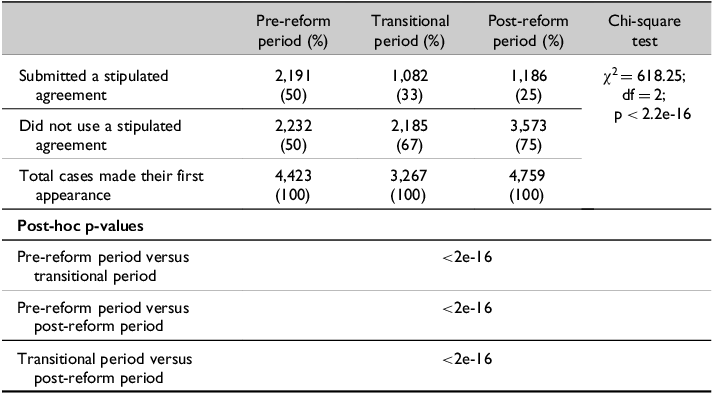
Our analysis shows that the proportion of nonpayment cases involving stipulated agreements declined following the implementation of HB 2001—from 50 percent in the pre-reform period to 33 percent during the transitional period and to 25 percent in the post-reform period. A chi-square test and post-hoc analysis reveal that the decline in the proportion of cases involving stipulated agreements was significant across each successive period (Table 1). This shift implies that tenants were increasingly able to exercise the enhanced redemption opportunities available under HB 2001, opting for formal adjudication over stipulated agreements.
Proportion of nonpayment cases involving stipulated agreements by policy period

Table 1. Long description
A table comparing the proportion of nonpayment cases involving stipulated agreements by policy period. The table has four rows and four columns. Column headers are Pre-reform period (percent), Transitional period (percent), Post-reform period (percent), and Chi-square test. Row labels are Submitted a stipulated agreement, Did not use a stipulated agreement, Total cases made their first appearance, and Post-hoc p-values. Row 1: Submitted a stipulated agreement, 2,191 (50), 1,082 (33), 1,186 (25). Row 2: Did not use a stipulated agreement, 2,232 (50), 2,185 (67), 3,573 (75). Row 3: Total cases made their first appearance, 4,423 (100), 3,267 (100), 4,759 (100). Row 4: Post-hoc p-values, Pre-reform period versus transitional period, Pre-reform period versus post-reform period, Transitional period versus post-reform period. Post-hoc p-values are all less than 2e-16. Chi-square test values are chi-squared equals 618.25, degrees of freedom equals 2, p value less than 2.2e-16.
At the same time, however, since one in four nonpayment cases still involved a stipulated agreement in the post-reform period, the continued use of stipulated agreements by a substantial proportion of tenants warrants attention. This persistence suggests that procedural reform alone may be insufficient to expand tenant protections fully because landlords may leverage their structural advantages to pressure tenants into settlements that bypass the safeguards of formal adjudication, potentially obscuring tenants’ statutory right to redemption under HB 2001.
Changes in the legal outcome of nonpayment eviction cases
The declining proportion of nonpayment cases resolved through stipulated agreements suggests that more tenants are now positioned to exercise their statutory right to redemption under HB 2001. In the second section, we examine whether this expanded right actually leads to better legal outcomes for tenants. We began with a descriptive analysis and chi-square tests to characterize the changes in case outcomes before and after HB 2001, followed by a Fine-Gray competing risks model to assess whether these patterns held after accounting for potential confounding factors. In practice, an increase in case dismissals does not necessarily guarantee better housing outcomes for tenants. Some tenants may pay off their owed balance and continue to stay in their current homes, while others may voluntarily leave before the judgment is issued in the eviction proceeding and have their eviction cases dismissed (Carroll, Cho, and Bates Reference Carroll, Cho and Bates2025). Nevertheless, dismissal does imply a greater likelihood of continued tenancy, and, even where displacement occurs, it prevents tenants from facing the long-term consequences of an eviction record, reducing the risk of housing instability in future searches.
Descriptive analysis and chi-square test
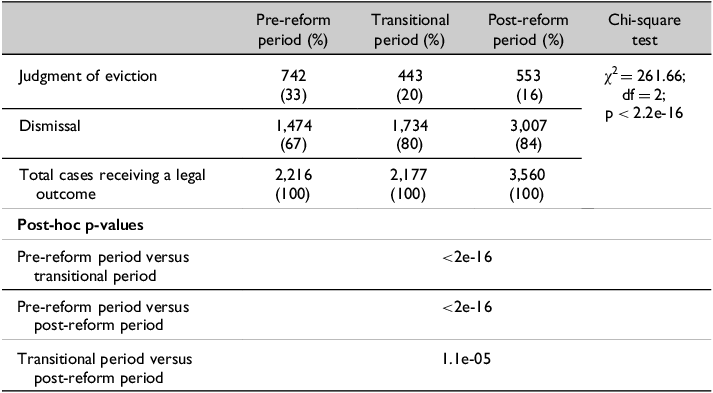
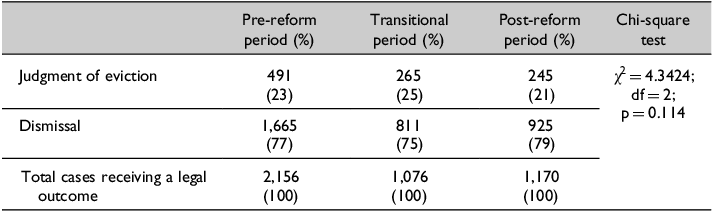
The results of the descriptive analysis reveal that, among nonpayment cases resolved without stipulated agreements, the proportion of cases ending in judgments of eviction declined following the implementation of HB 2001—from 33 percent in the pre-reform period to 20 percent during the transitional period and to 16 percent in the post-reform period. This pattern was confirmed as statistically significant by chi-square tests and post-hoc analysis (Table 2). By contrast, the proportion of judgments of eviction in cases involving stipulated agreements remained relatively stable across the same periods—23 percent (pre-reform period), 25 percent (transitional period), and 21 percent (post-reform period), respectively—with no statistically significant variation (Table 3).
Legal outcome of nonpayment cases not using stipulated agreements by policy period

Table 2. Long description
A table comparing legal outcomes of nonpayment cases across different policy periods. The table has four rows and four columns. Column headers are Pre-reform period (percent), Transitional period (percent), Post-reform period (percent), and Chi-square test. Row labels are Judgment of eviction, Dismissal, Total cases receiving a legal outcome, and Post-hoc p-values. Row 1: Judgment of eviction, 742 (33), 443 (20), 553 (16), Chi-square test: χ2 = 261.66; df = 2; p < 2.2e-16. Row 2: Dismissal, 1,474 (67), 1,734 (80), 3,007 (84). Row 3: Total cases receiving a legal outcome, 2,216 (100), 2,177 (100), 3,560 (100). Row 4: Post-hoc p-values, Pre-reform period versus transitional period, <2e-16, Pre-reform period versus post-reform period, <2e-16, Transitional period versus post-reform period, 1.1e-05.
Legal outcome of nonpayment cases using stipulated agreements by policy period

Table 3. Long description
A table comparing legal outcomes of nonpayment cases using stipulated agreements by policy period. The table has four rows and three columns. Column headers are Pre-reform period (percent), Transitional period (percent), and Post-reform period (percent). Row labels are Judgment of eviction, Dismissal, and Total cases receiving a legal outcome. Row 1: Judgment of eviction, 491 (23), 265 (25), 245 (21). Row 2: Dismissal, 1665 (77), 811 (75), 925 (79). Row 3: Total cases receiving a legal outcome, 2156 (100), 1076 (100), 1170 (100). Chi-square test values are provided for Judgment of eviction: χ2 = 4.3424; df = 2; p = 0.114.
Fine-Gray model
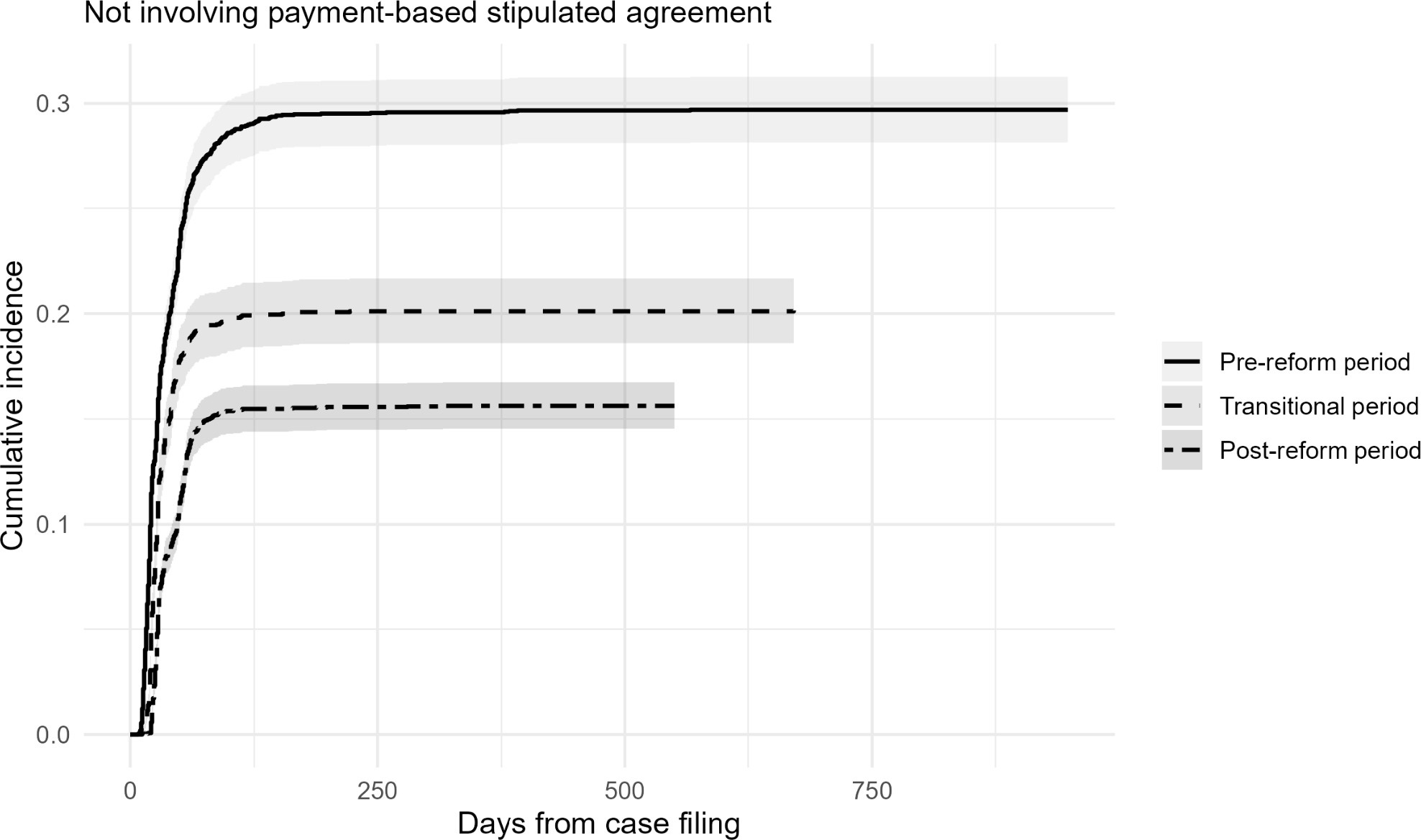
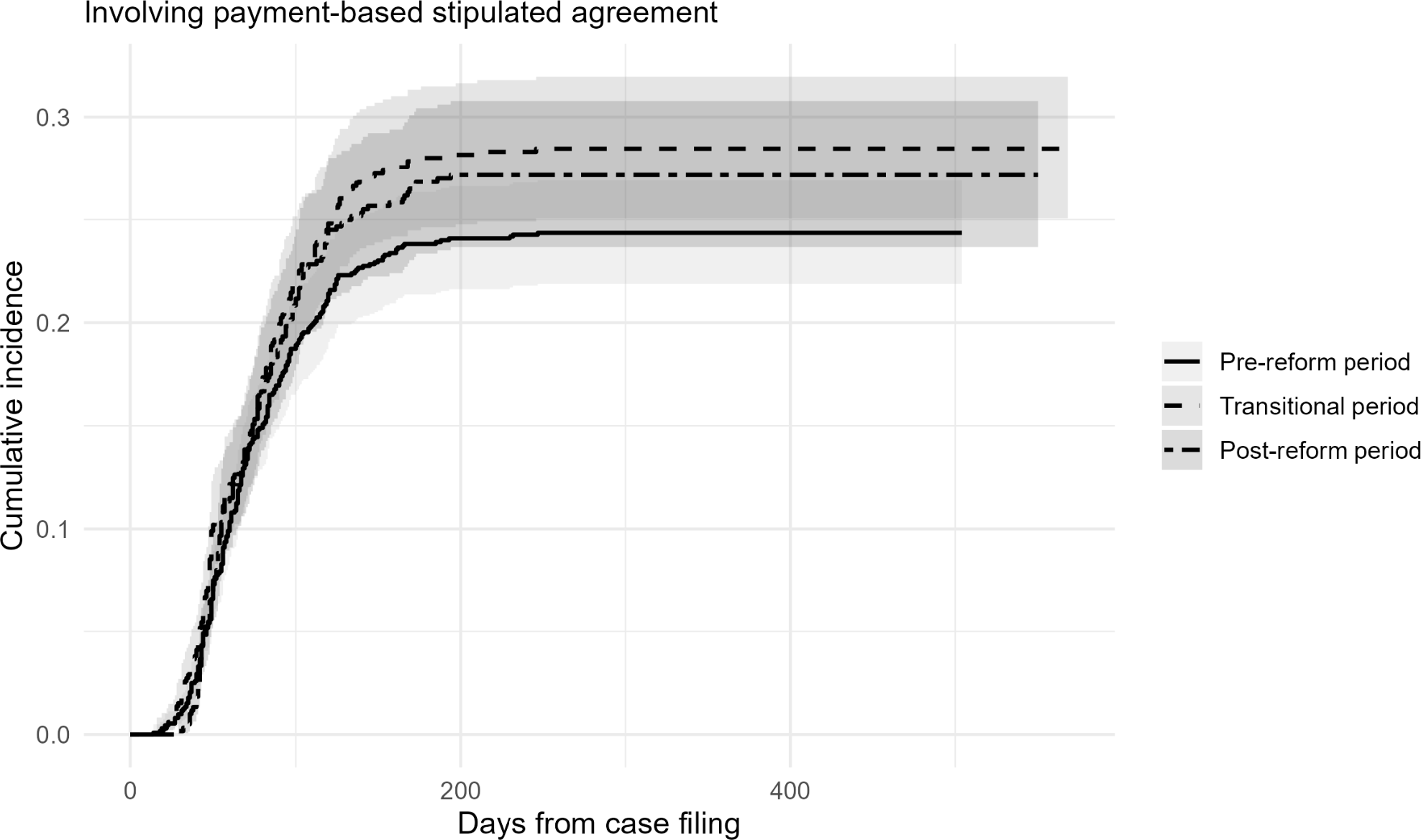
The descriptive patterns and chi-square tests do not account for potential confounding factors that could influence legal outcomes. To address this, we estimate a Fine-Gray model, with a judgment of eviction as the primary outcome and case dismissal as the competing event, controlling for stipulated agreement type, tenant and landlord legal representation, amount owed, and their interactions with the policy period. The results of the Fine-Gray model are consistent with the descriptive findings. The tenant-protective effect of HB 2001 operates effectively: tenants who pursued formal adjudication showed meaningful reductions in their risk of eviction judgment, while those who entered into stipulated agreements were excluded from these benefits. Figure 2 illustrates cumulative incidence curves for the pattern among cases without stipulated agreements—the group for whom HB 2001’s right to redemption was active. The cumulative incidence of eviction judgment in this group decreased across policy periods, from approximately 30 percent in the pre-reform period to around 20 percent in the transitional period and 16 percent in the post-reform period. Figure 3 presents cumulative incidence curves for the pattern among cases involving stipulated agreements—the group for whom HB 2001’s right to redemption could not be used. While this group initially exhibited a lower cumulative incidence of eviction judgment than the non-stipulated group in the pre-reform period, their trajectories converged with those of the non-stipulated group over time.
Cumulative incidence of judgment of eviction: nonpayment eviction cases not involving payment-based stipulated agreement by policy period

Cumulative incidence of judgment of eviction: nonpayment eviction cases involving payment-based stipulated agreement by policy period

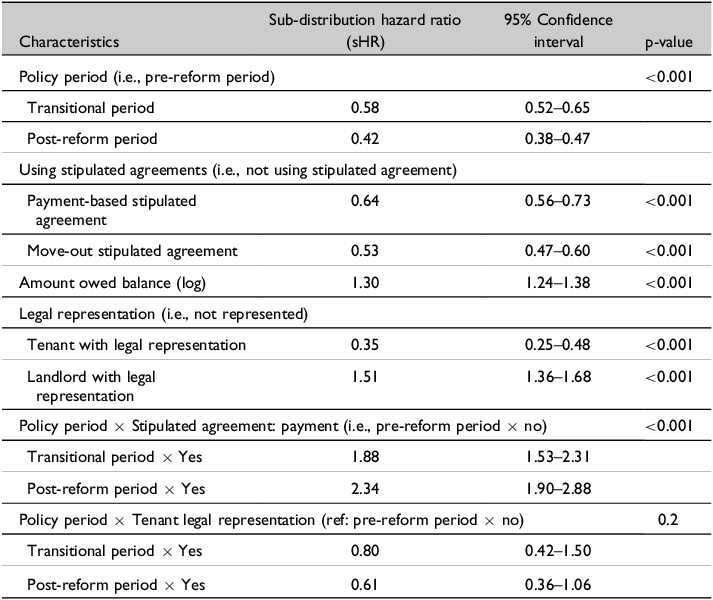
Similarly, the result of the competing risk regression indicates that the overall likelihood of an eviction judgment declined substantially following HB 2001, even after controlling for confounding variables (Table 4). Specifically, compared to the pre-reform period, the sub-hazard ratio for eviction judgment was 0.58 during the transitional period and 0.42 in the post-reform period (p < 0.001). This finding indicates that, after controlling for variables that may affect the legal outcome, the probability of a judgment of eviction after the enactment of HB 2001 decreased. While payment-based stipulated agreements were associated with a lower overall risk of eviction judgment (hazard ratio [HR] = 0.64; p < 0.001), this protective effect diminished relative to cases resolved without stipulated agreements following HB 2001: the interaction terms between policy period and payment-based stipulated agreement show a significantly elevated hazard during both the transitional period (HR = 1.88) and the post-reform period (HR = 2.34). In other words, tenants who entered into payment-based stipulated agreements after the enactment of HB 2001 were more likely to face a judgment of eviction compared to those who pursued formal adjudication under HB 2001.
The Fine and Gray proportional sub-distribution hazard model for judgment of eviction for nonpayment eviction proceedings

Table 4. Long description
A table with 11 rows and 5 columns comparing sub-distribution hazard ratios for eviction judgments. The columns are Characteristics, Sub-distribution hazard ratio (sHR), 95% Confidence interval, and p-value. Row 1: Policy period (i.e., pre-reform period), <0.001. Row 2: Transitional period, 0.58, 0.52-0.65, <0.001. Row 3: Post-reform period, 0.42, 0.38-0.47, <0.001. Row 4: Using stipulated agreements (i.e., not using stipulated agreement), <0.001. Row 5: Payment-based stipulated agreement, 0.64, 0.56-0.73, <0.001. Row 6: Move-out stipulated agreement, 0.53, 0.47-0.60, <0.001. Row 7: Amount owed balance (log), 1.30, 1.24-1.38, <0.001. Row 8: Legal representation (i.e., not represented), <0.001. Row 9: Tenant with legal representation, 0.35, 0.25-0.48, <0.001. Row 10: Landlord with legal representation, 1.51, 1.36-1.68, <0.001. Row 11: Policy period x Stipulated agreement: payment (i.e., pre-reform period x no), <0.001. Row 12: Transitional period x Yes, 1.88, 1.53-2.31, <0.001. Row 13: Post-reform period x Yes, 2.34, 1.90-2.88, <0.001. Row 14: Policy period x Tenant legal representation (ref: pre-reform period x no), 0.2. Row 15: Transitional period x Yes, 0.80, 0.42-1.50. Row 16: Post-reform period x Yes, 0.61, 0.36-1.06.
In terms of control variables, tenant legal representation was associated with a statistically significantly lower risk of eviction judgment (HR = 0.35), though the interaction terms between policy period and tenant representation were not statistically significant. This finding, however, may result from the relatively small number of cases involving tenant legal representation rather than a genuine absence of the effect of legal representation. Landlord legal representation, on the other hand, was associated with a significantly higher risk of eviction judgment (HR = 1.51). The amount owed was positively associated with the likelihood of eviction judgment (HR = 1.30). Additionally, move-out stipulated agreements were associated with a lower overall risk of eviction judgment compared to cases without move-out agreements (HR = 0.53).
In summary, HB 2001’s expanded right to redemption appears to have meaningfully improved legal outcomes for tenants who pursued formal adjudication, though its reach remains constrained by the continued prevalence of stipulated agreements and the structural asymmetries in landlord and tenant legal representation.
Stipulated agreement terms and conditions for nonpayment cases in the post-reform period
Finally, we examine the substantive terms and conditions of stipulated agreements submitted to the court after the implementation of HB 2001. Prior to the implementation of HB 2001, stipulated agreements served as tenants’ primary avenue for case dismissal, which often led landlords to impose burdensome conditions on their tenants. The statutory reforms introduced an alternative pathway though which tenants could pursue formal adjudication and invoke their expanded right to redemption, potentially reducing their dependence on negotiated settlements to dismiss their cases. We cannot assess whether this alternative pathway results in more favorable stipulated agreement terms for tenants given the limitations of the available data; however, we can examine the extent to which the conditions tenants accepted in the post-reform period diverged from the protections that HB 2001 would have provided.
A review of 1,186 nonpayment cases filed in the Multnomah County Circuit Court following the implementation of HB 2001 reveals that stipulated agreements generally fell into two primary categories: payment-based agreements and move-out agreements. These foundational types were often supplemented with additional provisions, including obligations to cover the landlord’s legal expenses, commitments to pay future rent, and behavioral stipulations.
Payment-based agreements
Among the one hundred payment-based agreements reviewed, ninety-eight cases required tenants to pay amounts exceeding the statutory cure amount listed on the termination notice. On average, tenants were obligated to pay $4,047 more than their statutory cure amount, which included rent arrears not listed in the notice, late fees, utility payments, three-month future rent obligations, and the landlord’s legal costs. HB 2001 would have guaranteed tenants a case dismissal upon payment of the cure amount listed in the notices. By entering into a stipulated agreement, they would have had to comply with the obligations far exceeding what the statute requires. Moreover, due to these extractive provisions, many tenants who entered into payment-based agreements made partial payments but failed to meet all of the terms and conditions, ultimately resulting in a judgment of eviction despite having paid a portion of the balance owed—an outcome that formal adjudication under HB 2001 could have prevented.
Move-out agreements
Move-out agreements also imposed burdensome terms and conditions on the tenants. Among the agreements reviewed, the time allotted for tenants to vacate the unit ranged from nine to sixty-one days, with a median of twenty days from the date that the agreement was submitted to the court. HB 2001 extended the timeline between first appearance and trial from a maximum of fifteen days to a range of fifteen to thirty days, thereby providing tenants with more time to either pay the amount to cure or vacate the unit. Yet 32 percent of move-out agreements required tenants to vacate within fourteen days or less, a time frame that is shorter than the statutory minimum that HB 2001 affords. More concerning, 5 percent of move-out agreements required tenants to pay some or all of their rent arrears even after they vacated the unit. In Oregon, landlords must file separate small claims actions to recover back rent after regaining possession. However, tenants who accepted these terms surrendered possession while assuming ongoing financial obligations through a single negotiated agreement, forfeiting protections that formal adjudication would have preserved. Additionally, more than one-third of the move-out agreements we reviewed included provisions requiring tenants to cover the landlord’s legal costs, which is an obligation HB 2001 does not impose as a condition of case dismissal.
In summary, the terms and conditions of the stipulated agreements illustrate the limits of HB 2001’s tenant-protective reach. The statute’s expanded right to redemption offers meaningful protections to tenants who pursue formal adjudication; however, those protections do not extend to tenants who settle through stipulated agreements. The conditions that tenants accepted in post-reform agreements consistently exceeded what HB 2001’s statutory framework requires. Theoretically, HB 2001’s expanded right to redemption could strengthen tenants’ bargaining position in stipulated agreement negotiations; nonetheless, the persistent power imbalance between landlords and tenants in stipulated agreements calls for further research on which tenants enter into stipulated agreements, why they choose this pathway over the right to redemption, and what factors lead them to accept terms and conditions that fall short of the protections that HB 2001 affords.
Conclusion
In the United States, the right to redemption, which helps dismiss cases by granting tenants facing nonpayment eviction filings an extended timeline to pay back rent, is being adopted or discussed in many states and localities, though the specific conditions and timelines vary considerably across jurisdictions (Macdonald et al. Reference Macdonald, Malone, Palmer and Sargent2024). For instance, the Oregon legislature passed HB 2001 in April 2023, which allows tenants to dismiss the cases if they pay the amount to cure or vacate the unit before the date of trial. One of the purposes of this legislative reform was to expand tenant protections in nonpayment eviction proceedings by creating a clearly defined legal pathway to dismiss the cases.
Despite long-standing policy arguments that the right to redemption offers tenants a new pathway to avoid a judgment of eviction, there is a lack of empirical evidence regarding its effectiveness. Therefore, this study addresses this literature gap by evaluating whether Oregon’s HB 2001, which substantially expanded tenants’ statutory right to redemption in nonpayment eviction proceedings, improved legal outcomes for tenants and how broadly its protections reached in practice, drawing on eviction records and documents of nonpayment eviction cases filed in Multnomah County Circuit Court before and after the reform’s enactment.
Our findings demonstrate that HB 2001 meaningfully expanded tenant protections. The reform led to a statistically significant increase in tenants pursuing formal adjudication rather than settle with their landlord through stipulated agreements. In addition, it resulted in a statistically significant increase in case dismissals in nonpayment proceedings not involving stipulated agreements. Prior to this legislative reform, stipulated agreements functioned as the primary de facto mechanism for case dismissal, leaving tenants without a substantive statutory alternative. In the absence of such an alternative, stipulated agreements risked functioning as what Summers (Reference Summers2026) describes as “settlements of adhesion,” where tenants negotiated under conditions of acute asymmetry. Since tenants often lacked access to legal counsel or procedural knowledge, and there is no substantive guidance on stipulated agreements, they tended to accept the drafted agreements that landlords had already filled out without meaningful negotiation. By establishing a clear statutory pathway to dismissal, HB 2001 not only expanded procedural clarity but also reduced tenants’ dependence on negotiated settlements to resolve their cases.
Nevertheless, stipulated agreements persisted in over one-quarter of nonpayment cases in the post-reform period, undermining the statutory protections that HB 2001 sought to guarantee for tenants. A review of the stipulated agreements filed in the post-reform period reveals that they continue to operate as a shadow system, which enables landlords to extract concessions, requiring tenants to pay amounts well beyond the cure amount, including additional rent arrears, future rent obligations, and landlord legal costs, or to vacate within accelerated timelines. Because stipulated agreement terms supersede the statutory protections available through formal adjudication, tenants who settle through this pathway forgo the rights that HB 2001 was designed to guarantee. This finding raises a critical question about the effectiveness of legislative reform in the face of procedural bypasses available to landlords.
Since this study did not observe the negotiation process or collect data directly from tenants, we do not know the details of what factors lead tenants to choose to sign stipulated agreements instead of exercising their statutory right to redemption under HB 2001. However, the persistence and unequal structure of stipulated agreements that we found suggest that the eviction court remains a site of enduring power imbalance between landlords and tenants. Given the complexity of legal language and the low rate of legal representation among tenants in eviction court (Ellen et al. Reference Ellen, O’Regan, House and Brenner2021; Nelson Reference Nelson2021; Damerla Reference Damerla2022; Werth, Reference Werth2020; Fleming-Klink, McCabe, and Rosen Reference Fleming-Klink, McCabe and Rosen2023), legislative reform alone may be insufficient to dismantle the informal practices that continue to disadvantage tenants within the adjudicative process. Therefore, our findings echo previous research suggesting that effectively protecting tenants in eviction proceedings requires simultaneously expanding tenants’ access to legal counsel (Damerla Reference Damerla2022; Golio et al. Reference Golio, Daniels, Moran, Southall and Lamoza2023).