

Introduction
Falls are undesirable events across the lifespan but considerably more so in later life. Serious injuries from falls can lead to costly hospitalizations. According to the 2002 Canadian Institute for Health information (CIHI) National Trauma Registry Analytic Bulletin, falls were the leading cause of hospital admission in Canadian hospitals for the year 2000–2001. The average cost per fall was $8,374, and the total number of cases was 110,862, which produced an estimate of $911 million for the total hospital cost in Canada associated with falls (CIHI, 2002). Ontario accounted for 33 per cent of this cost estimate. In 2004, the Ontario Trauma Registry (CIHI, 2004) reported that, for the year 2002–2003, there were 39,201 injury hospitalizations due to unintentional falls which accounted for 71 per cent of all days in hospital due to injury, with a mean length of hospital stay of 12 days. Cases of individuals aged 65 and older accounted for 62 per cent of injury hospitalizations due to falls with the peak occurring around 80 years of age (CIHI, 2004).
The average hospital cost of a hip fracture in British Columbia was $18,508, resulting in the annual average hospital cost for all senior hip fracture hospitalizations of more than $75 million (Herman, Gallagher, & Scott, Reference Hendrich, Nyhuis, Kippenbrock and Soja2006). In the most recent Economic Burden of Injury in Canada report (SMARTRISK, Reference Scott, Wagar, Sum, Metcalfe and Wagar2009), it was reported that falls were the second leading cause of unintentional injury and accounted for 2,225 deaths, 105,565 hospitalizations, and 883,676 non-hospitalizations.
Clearly, injurious falls that occur outside the hospital are a serious economic burden especially when they happen in later life. This study, however, focused on individuals who enter the hospital and then experience injurious falls. Questions of interest were these: (1) What are the rates of in-hospital injurious falls?; (2) How does the average hospital cost change because of an injurious fall?; and (3) Is there a difference between the cost for patients who experienced serious in-hospital injurious fall versus patients who did not experience a fall?
The incidence of falls in hospitalized patients is a common and serious problem due to consequential injury, litigation, and added hospital cost, as has been well-documented (Evans, Hodgkinson, Lambert, & Wood, Reference Evans, Hodgkinson, Lambert and Wood2001; Hitcho et al., Reference Herman, Gallagher and Scott2004; Krauss et al., Reference Hitcho, Krauss, Birge, Dunagan, Fischer and Johnson2005; Nadkarni, Iyengar, Dussa, Watve, &Vishwanath, Reference Krauss, Evanoff, Hitcho, Ngugi, Dunagan and Fischer2005; Schwendimann, Buhler, De Geest, & Milisen, Reference Quan, Sandararajan, Halfon, Fong, Burnand and Luthi2006). Although some studies have reported that falls represent 40 per cent of all in-hospital accidents (Groves, Lavori, & Rosenbaum, Reference Groves, Lavori and Rosenbaum1993), analysis of an Australian hospital accident database showed that in fact 90 per cent of all such accidents were falls (Goodwin & Westbrook, Reference Goodwin and Westbrook1993), most of which occurred among patients over age 60. Reported falls rates typically vary from 2.9–13 falls per 1,000 patient days depending on hospital type (e.g., general, acute care, or rehabilitation), patient population, length of study, and type of falls considered (first versus multiple) (Oliver, Daly, Martin, & McMurdo, Reference Nadkarni, Iyengar, Dussa, Watve and Vishwanath2004).
The percentage of patients who fall also varies according to type of hospital ward, with studies reporting 53 per cent of falls occurring in medical wards (Nadkarni et al., Reference Krauss, Evanoff, Hitcho, Ngugi, Dunagan and Fischer2005), 37 per cent in stroke rehabilitation (Teasell, McRae, Foley, & Bhardwaj, Reference Sorensen, de Lissovoy, Kunaprayoon, Resnick, Rupnow and Studenski2002), and 25 per cent in geriatric wards (Schwendimann et al., Reference Quan, Sandararajan, Halfon, Fong, Burnand and Luthi2006). The risk of falling among patients aged 65 and older is double the rate for younger patient groups (Halfon, Eggli, Van Melle, & Vagnair, Reference Halfon, Eggli, Van Melle and Vagnair2001). In-hospital falls most frequently occurred when the patient was attempting to get to the bathroom unassisted (von Renteln-Kruse & Krause, Reference Titler, Dochterman, Picone, Everett, Xie and Kanak2004). In addition, polypharmacy was a significant risk factor (Hendrich, Nyhuis, Kippenbrock, & Soja, Reference Heinrich, Rapp, Rissmann, Becker and Koenig1995; Carroll, Slattum, & Cox, Reference Carroll, Slattum and Cox2005; Tinetti, Reference Teasell, McRae, Foley and Bhardwaj2003).
The consequences of in-hospital falls range from no injury; to minor, moderate, and serious injuries; and death (Hitcho et al., Reference Herman, Gallagher and Scott2004; Krauss et al., Reference Hitcho, Krauss, Birge, Dunagan, Fischer and Johnson2005). Although multiple injuries are the least common, they are the most expensive at an average cost of USD$22,368 (the range is $9,969–$64,382) per event (Sorensen et al., 2006). In Canada, the Ontario Trauma Registry reported that the average cost of treating a fractured pelvis was CAD$9,583; fractures or dislocations of lower limbs, $6,581; and of upper limbs, $3,000 (CIHI, 2002). Falls are also associated with a significant increase in length of hospital stay (LOS), reported to be 1–5 weeks longer after an in-hospital fall (Nadkarni et al., Reference Krauss, Evanoff, Hitcho, Ngugi, Dunagan and Fischer2005). A case-control study by Bates, Pruess, Souney, and Platt (Reference Bates, Pruess, Souney and Platt1995) found that in-patient fallers stayed in hospital 12 days longer than a control group, at a cost of USD$4,233. The recent systematic review of the cost of falls in old age (Heinrich, Rapp, Rissmann, Becker, & Koenig, Reference Heinrich, Rapp, Rissmann, Becker and Koenig2010) indicated that falls represent a relevant economic burden with a mean cost per fall-related hospitalization ranging between USD$5,654 and $42,840. The authors observed that direct cost is especially high for fractures in older patients, particularly females, in hospital and long-term care facilities.
The purpose of our study was to estimate the average hospital cost and length of stay for patients who fell during a hospital stay and sustained serious injury. Differences in health care systems, treatment costs, and the extent that cost can change over time provide a strong case for regular updates of cost analyses within a health care system. Considering diversity in cost calculation and reporting for in-hospital falls, it is important to calculate the “unit cost” of a serious, injurious in-hospital fall. This dollar value would allow hospital administrators and policy makers to calculate the cost-effectiveness and cost-benefit of falls prevention strategies.
Methods
We utilized prospectively collected historical data from a tertiary acute care hospital in Ontario, Canada to estimate the difference in hospital cost and LOS related to in-hospital falls. In 1993, this hospital became one of only 10 provincial hospitals that were selected by the Ministry of Health and Long Term Care to collect and provide data to the Ontario Case Costing Initiative (Ontario Case Costing Initiative, Reference Oliver, Daly, Martin and McMurdo2009). The case costing database (CCDB) included the information about direct patient care costs, such as diagnostic imaging, operating room, nursing, labs, drugs; and indirect costs, such as administration, patient support, housekeeping, and financial services. Information was included for both acute in-patient care and day surgery patients. Examples of the level of detail available in the CCDB include radiology cost for pelvis and hip X-ray ($149.64), operation cost for craniotomy for subdural hematoma (CAD$3,824.69), lab cost for potassium tests (CAD $1.11), pharmacy cost for aspirin (CAD $0.07), occupational therapy (CAD $41.47), and meals per day (CAD $35.52). The database did not include costs of professional services, such as physician consultations or research. The goal of the case costing initiative was to help the provincial Ministry of Health determine funding levels for hospitals.
The hospital’s Risk Management Department collected data on all adverse events, including the number and severity of injuries related to falls. The front-line nursing staff was required to fill in standardized paper-based reports of known falls, and submit the reports to the Risk Management Department. Reports were entered into a risk management database. Having both the CCDB and the risk management database available made this hospital an ideal setting for the study. The cost was operationally defined as the sum of all costs experienced by a patient during a hospital stay; and length of stay was defined as the total number of hospital days as calculated from date of admission to date of discharge or death (CIHI, 2004).
A fall was defined as an event in which a person’s unintentional and unexpected loss of balance was followed by his or her landing on a lower level (Zecevic, Salmoni, Speechley, & Vandervoort, Reference Zecevic, Salmoni, Lewko and Vandervoort2006). Injury severity was defined by the Risk Management Department of the participating hospital using four categories: (1) no injury; (2) minimal (minimal discomfort, no harmful effects, no interventions required, no increased length of stay) – for example, cuts, contusions, or swelling; (3) moderate (moderate discomfort and harmful effects, some intervention required, may have increased the length of stay) – for example, lacerations, excessive bleeding, or temporary loss of consciousness; and (4) severe (extreme discomfort, serious harmful effects, major intervention required, major potential to increase length of stay and potential for future intervention) – for example, fractures, major head trauma, or subdural hematoma. Only injuries in category four were of interest in the study because they required medical treatments that resulted in an increased cost of care due to the fall. Patients who experienced this type of injury were labeled index cases.
Unique identifiers for the encounter, patient numbers, and fall dates were retrieved from the risk management database and linked with cost data from the CCDB. We searched the risk management database to identify all patients who experienced an in-hospital fall in the period of 2.5 years, between April 2005 and October 2007, and who were discharged prior to March 31, 2008. We chose this cut-off date because cost data were not available after the end of March 2008 when we analyzed data.
To generate a comparison group, we matched index cases with control cases from the overall hospital in-patient population who did not fall during their hospital stay. We used the same fiscal year to avoid changes in cost over time. The matching criteria were (a) most responsible medical diagnosis (MRDx), (b) age (± 5 years), and (c) gender. The MRDx is defined as the one diagnosis that described the most significant condition related to a patient’s length of stay in hospital (CIHI, 2004). All patient admission records in the CCDB (approximately 96,700 for the 2.5-year period) were considered when identifying matched control cases. For MRDx matching, we used the ICD10 diagnostic code (World Health Organization (WHO), 2009) for each index case to search for controls from the general in-patient population. When a control could not be identified using the exact ICD10 code, we used a broader ICD10 code. For example, a MRDx of “R10.4–Other and Unspecified Abdominal Pain” in the faller was matched to “R10–Abdominal and Pelvic Pain” in the control. Medical charts of index cases were consulted to confirm the MRDx.
The research team received an anonymized secondary data set, collected and extracted by staff in the participating hospital for the analysis. Hence, the study was approved without individual review by the University’s Office of Research Ethics.
Analysis
The primary outcomes of interest were average total costs per in-patient and LOS, and we conducted univariate analysis to assess the difference between fallers and controls. One-sample t-tests were used to compare the cost of every index faller to the average cost of his/her group of matched controls. A positive t-test, with a p value < .05, indicated that the cost for the faller was different from the cost for non-faller controls. We repeated the same comparisons for LOS. A two-sample t-test was used for the overall comparison of all fallers to all matched non-fallers (patients who did not fall during hospital stay). Given the difference in sample size, we assumed unequal variances and used the Satterthwaite method. All cost data are reported in nominal Canadian dollars for calendar years 2005–2007, with a historical average exchange rate of USD$0.87 for CAD$1.00 (SD = $0.04; range: $0.79–1.01).
The sensitivity analysis we performed used increasingly restrictive exclusion criteria to determine how the results changed when bivariate comparisons were focused on patients aged 65 and older who survived the fall. Confidence interval (95%) estimates for cost and LOS difference were calculated for five criteria of sensitivity analysis described in Table 2.
We also performed multivariate regression analysis controlling for MRDx, age, gender, and co-morbidity. To quantify co-morbidity, we calculated the Charlson Co-morbidity Index (CCI) (Charlson, Pompei, Ales, & MacKensie, Reference Charlson, Pompei, Ales and MacKensie1987; Charlson et al., Reference Charlson, Charlson, Peterson, Marinopoulos, Briggs and Hollenberg2008) for all index patients and their controls. Designed originally to predict mortality for patients with breast cancer, this score is derived by summing weights from the adjusted risk of death for each co-morbidity to yield an overall index of co-morbidity between 1 (low) and 17 (high) (Charlson et al, Reference Charlson, Pompei, Ales and MacKensie1987). We applied an algorithm (Quan et al., 2005) to take relevant ICD-10 diagnostic codes and convert them into the CCI, which was treated as a continuous variable. Both dependent variables (cost and LOS) were log-transformed to satisfy the assumptions of homoscedasticity and normality when we used multiple regression. Finally, we exponentiated the raw beta coefficients for each independent variable to provide a meaningful interpretation of the regression results.
Results
All falls were divided into the four categories according to the severity of injury. Of 2,778 falls that we identified in the observation period, 42.6 per cent (n = 1,184) were non-injurious, 51 per cent (n = 1,418) resulted in minimal injury, 4.8 per cent (n = 132) caused moderate injury, and 1.6 per cent (n = 44) were considered serious injurious falls – the latter were the falls in the study. Seven cases were dropped due to a variety of reasons: (a) rare diagnoses (two cases); (b) the injury was not fall-related (one case); (c) the patients were not admitted (two cases); (d) the patient was not discharged prior to the end of the fiscal year (one case); and (e) documentation was not available (one case). The final analysis included a sample of 37 index cases matched with 2,113 control cases admitted during the study period.
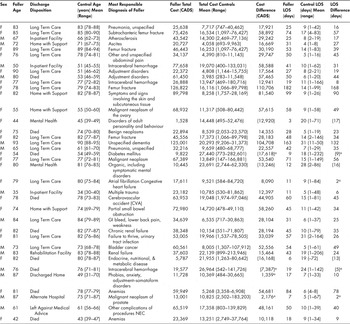
The mean age of fallers was 74 (range: 35–93) versus 71 (range: 30–95) for controls. Of the fallers, 23 (62%) were females and 14 (38%) were males. On average, there were 63 control cases for each index case (range: 4–363). Discharge dispositions for fallers included nine deaths, five transfers to home, 15 long-term care admissions, seven transfers to other facilities, and one patient left hospital against medical advice. Serious injuries included 16 fractures of the hip and pelvis, 10 upper-limb dislocations and fractures, six severe head and spine injuries, and five lower-limb fractures. Table 1 provides detailed descriptions of the index and control cases.
Descriptive information on fallers and controls matched for age, sex, and most responsible diagnosis

a Denotes differences between faller and controls that did NOT reach statistical significance, defined as p < .05
LOS = length of stay
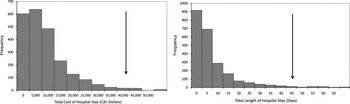
The total average cost for patients who fell and were seriously injured during an in-hospital stay was $44,203 (SD = $30,561) which was $30,696 (95% CI: $25,158–$36,781) greater, and statistically significantly different (p < .0001), from the per-patient-cost for matched controls – for which the cost was $13,507 (SD = $17,575). This average cost of hospital stay for injured fallers was at the 97th percentile on the distribution of cost of non-fallers (see Figure 1). Note that physician consultations, billed separately, were not recorded in the CCDB; therefore, the average total hospital cost we report here was an underestimate of the true cost.
Comparison of total hospital costs and length of hospital stay of severely injured fallers (arrows) compared to that of their matched controls (bars). The average cost and length of stay (LOS) of severe fallers are at the 97th and 98th percentile respectively on the distribution of cost and LOS of non-fallers. Skewed distributions are particularly common when mean values are low, variances large, and values cannot be negative, and are typical of LOS and cost data. The interquartile range of the cost data was $4,989 to $15,772; and the interquartile range of the LOS data was 3 to 12 days.

Overall comparison of LOS also yielded a statistically significant difference (p < .0001) indicating that an in-hospital fall resulting in serious injury incurred, on average, an additional LOS of 34 days. The average LOS of 45 (SD = 39) days for index cases, compared to 11 (SD = 16) days for controls, is shown to occur at the 98th percentile of the distribution of LOS for non-fallers (see Figure 1). There were no significant differences in cost or LOS between females and males.
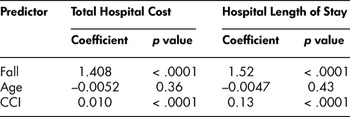
Table 2 shows the results of the sensitivity analyses for the cost differences. With each exclusion criterion, the number of index cases dropped: a significant difference between index and control cases in both cost and LOS remained. The analysis revealed a cost difference of up to $36,980 (95% CI: $21,985–$51,975) for the elderly patients who survived, and LOS differences of up to 42 days (95% CI: 23–62). We did not include an interaction term between age and fall status because of the relatively small group of fallers. In future study, researchers should consider investigating the interaction between age and fall status. The results of our multivariate regression analysis (see Table 3) confirmed that a serious, injurious in-hospital fall significantly raises both total hospital cost and LOS compared to controls (p < .0001).
Results of sensitivity analysis for cost and length of stay difference when increasingly rigorous exclusion criteria were implemented to focus on elderly patients who survived the fallFootnote a

a All differences between fallers and non-fallers were statistically significant with p < .0001; n of fallers differs for different exclusion criteria.
CC = control cases
CI = confidence interval
IC = index cases
Results of the multiple regression models for total hospital cost and length of stay

CCI = Charlson’s Co-morbidity Index; converted from the lognormal model to percentage impact by taking exp (coefficient value). For example, Exp (1.408) = 4.09, which corresponds to a 309 per cent increase in hospital cost associated with a severe injurious fall. Regression estimates are not based on a random sample of all patients as the control group was a matched sample drawn from a much larger population.
Discussion
In this study, we estimated the difference in cost and LOS associated with serious injurious falls at an acute care hospital. In both univariate and multivariate analyses, the average cost and LOS for a seriously injured patient were approximately three times higher than for a control patient. When sensitivity analysis focused on patients age 65 and older who survived the fall, we found that the cost difference increased. This information is of importance to hospital administrators who manage and fund initiatives for reduction and prevention of in-hospital injuries due to falls, especially in light of the pending demographic shift with increased numbers of elderly patients.
During the study period, 2.9 per cent of all admissions at the acute care hospital resulted in a fall, where the incidence of serious injury was 1.6 per cent, and moderate injury 4.8 per cent, of all reported falls. These results are comparable with results from other studies (Halfon et al., Reference Halfon, Eggli, Van Melle and Vagnair2001; Hitcho et al., Reference Herman, Gallagher and Scott2004; Nadkarni et al., Reference Krauss, Evanoff, Hitcho, Ngugi, Dunagan and Fischer2005). Previous cost research did not include the cost associated with nursing workload, however, and resulted in an underestimate of the actual costs of falls (Titler et al., Reference Tinetti2005). In this study, on the other hand, we used data from the most comprehensive case costing system currently available in Canada. In the case costing database, every item is traced and assigned a dollar value, which itemizes patient-specific costs for more than nine million items. The CCDB also provides costs associated with per-minute workload of nursing staff on six levels of patient care. This workload cost is in addition to the procedure-based nursing department costs such as operating rooms, catheters, pacemaker and dialysis labs, diagnostic departments, and pharmacy (Ontario Case Costing Initiative, Reference Oliver, Daly, Martin and McMurdo2009).
Limitations of this study include its focus on in-patient hospital costs related only to serious injurious falls in one Canadian acute care hospital, which reduces the generalizability of our findings. No other costs were taken into consideration, such as pain, disability, reduced quality of life, dependence on others, hospital readmission, or lost time from work. Furthermore, the hospital CCDB does not include the costs of physician consultations, post-acute care rehabilitation, short- or long-term admittance to long-term care, or the costs associated with liability. Therefore, the reported values are an underestimate of the true health care system-wide cost of serious, injurious in-hospital falls.
Although we matched index and control cases with rigor, to preserve the same probability of falling in each group, it is possible that an unobservable characteristic made some patients more likely to sustain serious injurious falls and be more costly on average than the non-fallers group. Such a possibility would place an upward bias on the results. In addition, the control group construction we used could create possible sampling bias. The validity and reliability of data captured in the risk management database is unknown; however, all serious injurious falls were investigated in depth by a safety team comprising hospital unit leadership, risk managers, and patient safety specialists.
Practice Implications
The estimated “unit value” of $30,696 (95% CI: $25,158–$36,781) in additional hospital cost due to treatment of serious injury after an in-hospital fall, and 34 days’ longer stay, will now allow any hospital where serious injurious falls occur to estimate added costs that might have been avoided if the injurious falls were prevented. The increase in hospital stay directly impacts access to care. Injured fallers frequently occupy hospital beds while awaiting transfer to long-term care facilities. These findings have important financial implications in light of a pending demographic shift and increase in numbers of elderly patients. We anticipate that this will provoke further debate among health administrators concerning the value of investing in falls prevention programs, especially considering that the eradication of a small number of low-probability adverse events can produce substantial savings.
For example, the participating hospital in our study had, on average, 18 serious injurious falls per year. Our analysis suggests that with 95 per cent confidence we can say that each serious fall prevented would have resulted in cost savings of between $25,158 and $36,781. This means that eliminating 18 serious injurious falls could result in a savings of $452,844–$662,058 per year for the hospital. Investing this amount in a comprehensive, system-focused (as opposed to a person-centered), organization-wide falls and injury prevention plan has the potential for high cost-effectiveness and a consecutive increase in access to care.
In addition to the public health approach to falls prevention (Scott, Wagar, Sum, Metcalfe, & Wagar, Reference Schwendimann, Buhler, De Geest and Milisen2010), recent research on safety culture in health care informs us that injury prevention interventions should include not only recognition of risk factors and identification of high-risk patients, but also identification of systemic (e.g., organization-wide) causes and contributors of falls. These contributors to adverse events include time and staff shortages, workload, breakdown in communications between shifts and departments, built environments, lack of training and accountability, and professional silos, among others. Stakeholders on all levels of the organization, from front-line staff and middle management to top administrators, must be involved in the implementation of changes that will increase patient safety and improve organizational safety culture (Halligan & Zecevic, Reference Halligan and Zecevic2011).
Some successful models of such a systems approach to falls prevention have already been described (Zecevic, Salmoni, Lewko, & Vandervoort, 2007); administrators, however, should also consider emerging knowledge translation and implementation strategies through evidence-based practices (Fixen et al., Reference Fixen, Blasé, Duda, Metz, Naoom and van Dyke2010). Another point for consideration is the question, Who pays for the consequences of falls? Currently, the cost of falls in Canada is covered by different payers within the health care system which leads to a lack of accountability. Improved system-wide communication and better policies involving different funding sources are required for comprehensive improvements of injury prevention in health care.