Nowadays the physical and psychological benefits of physical activity (PA) are widely recognized. Testament to that is the information we constantly receive about healthy living habits. Numerous studies have illustrated the importance of prescribing physical exercise for people with an array of illnesses (cancer, cardiopathy, respiratory disease, diabetes, etc.) (Castellano et al., Reference Castellano, Pérez-Campdepadrós, Capdevila, Sánchez de Toledo, Gallego and Blasco2013). In recent decades, PA, in addition to being considered a remedy to cure or prevent various illnesses, has also been linked to a subjective sense of health that results in well-being (Reed & Buck, Reference Reed and Buck2009).
Until very recently, studies of PA in all-female samples were few and far between. López (Reference López2008), in a review of 186 articles published between 1995 and 2007, found that most of the studies’ samples included both men and women. The percentage of articles with all-female samples was 5.3%, whereas 31.7% of the studies used all-male samples. Nevertheless, that trend has changed over the years, and increasingly many studies address the differences between the two sexes, and their implications in the PA and sport context. Although men and women have many elements in common, it is clear that physical, physiological, and psychological differences specific to one gender or the other influence different areas of a person’s life, including the fulfillment and meaning they derive from PA. To date, research in female populations has emphasized different Quality of Life (QL) and PA indicators in older women, or women suffering from an illness (Haas, Reference Haas2011). However, few studies have analyzed the relationship between PA and Perceived Quality of Life (PQL) in healthy adult women. Research conducted in different countries has found that women who participate in sport activities are happier, report greater satisfaction with life, and enjoy better QL (Cruz-Ferreiras et al., Reference Cruz-Ferreiras, Fernandes, Gomes, Bernardo, Kirkcaldy, Barbosa and Silva2011; Ghaseminezhad, Reference Ghaseminezhad2011; Huang & Humphreys, Reference Huang and Humphreys2012). One study of a predominantly female population confirmed that physical exercise after work is positively related to positive affect (Feuerhahn, Sonnentag, & Woll, Reference Feuerhahn, Sonnentag and Woll2014). Other studies have found that women and girls who do some type of physical exercise have higher self-esteem, general self-concept, and physical self-concept (Candel, Olmedilla, & Blas, Reference Candel, Olmedilla and Blas2008; Cruz-Ferreiras et al., Reference Cruz-Ferreiras, Fernandes, Gomes, Bernardo, Kirkcaldy, Barbosa and Silva2011; Martin et al., Reference Martin, Liem, Coffey, Martinez, Parker, Marsh and Jackson2010).
Of all the variables related to PA and QL, the literature has focused especially on self-concept, posited from either a unidimensional or multidimensional perspective. A meta-analysis of 37 studies found that exercise positively, significantly influenced self-concept in adults (McDonald & Hodgdon, Reference McDonald and Hodgdon1991). The magnitude of the effect on general self-concept was 0.56. A more recent meta-analysis examined the impact of exercise on global self-appraisals (self-concept and self-esteem), estimating that PA’s average effect size on both psychological variables was 0.23, indicating a weak but significant effect of PA on self-appraisals (Spence, McGannon, & Poon, Reference Spence, McGannon and Poon2005). Conversely, multidimensional measures of self-concept collect more sensitive, concrete metrics, with improved goodness of fit over the global, limited, or non-specific measures captured by unidimensional models (Shavelson, Hubner, & Stanton, Reference Shavelson, Hubner and Stanton1976). Specifically, as past studies have shown, physical self-concept is the dimension most closely tied to PA (Ruiz de Azúa, Reference Ruiz de Azúa2007).
Although self-concept is an important mediating construct, facilitating various psychological and behavioral outcomes, few studies have analyzed this variable as mediating the relationship between PA and different components of QL. Elavsky et al. (Reference Elavsky, McAuley, Motl, Konopack, Marquez, Hu and Diener2005) reported that the effects of PA on QL are partially mediated by intermediate psychological variables. A study by Dishman et al. (Reference Dishman, Hales, Pfeiffer, Felton, Saunders, Ward and Pate2006) in adolescent women yielded evidence that PA reduces the risk of depression via the influence of physical self-concept, improving QL. A more recent study (Feuerhahn et al., Reference Feuerhahn, Sonnentag and Woll2014) found that among other variables, physical self-perception mediated the relationship between PA and positive affect.
Building on earlier research, this study will delve into the relationship between PA practice and different variables related to QL in healthy women. In this study, QL will be understood as subjective well-being, which is comprised of cognitive components (satisfaction with life) as well as emotional components (happiness and negative affect). Self-concept and self-esteem are also important components of QL, and those variables are related to psychological well-being. Furthermore, this study shall consider “PA” any body movement that involves the skeletal muscles and causes energy expenditure, usually measured in kilocalories (Caspersen, Powell, & Christenson, Reference Caspersen, Powell and Christenson1985), as long as the movement is intentional. In keeping with that definition, we excluded involuntary movements – reflex movements for example (Newell, Reference Newell1990). The present research generally employed the term PA since in this case, we were interested in identifying differences between people who are physically active (PA practitioners, regardless of type) and people who are not, on the subjective dimension of QL and self-perception.
This study’s objectives were to: (a) study the relationship between PA practice, PQL, and indicators of PQL; (b) analyze the predictive and incremental validity of sport practice on women’s perceptions of their QL. In other words, we will examine the extent to which a new variable (PA) improves the predictive capacity of a set of previous measures (hedonic well-being, self-concept, and self-esteem) on the criterion variable (PQL); (c) determine whether PA’s ability to predict PQL is mediated by self-concept and/or dimensions thereof; and (d) test for differences in results according to a unidimensional versus multidimensional approach to measuring self-concept.
In light of earlier research findings, we expected that: (a) PA practice would be positively related to PQL, and subjective indicators of PQL, in adult women (Candel et al., Reference Candel, Olmedilla and Blas2008; Cruz-Ferreiras et al., Reference Cruz-Ferreiras, Fernandes, Gomes, Bernardo, Kirkcaldy, Barbosa and Silva2011; Dishman et al., Reference Dishman, Hales, Pfeiffer, Felton, Saunders, Ward and Pate2006; Elavsky & McAuley, Reference Elavsky and McAuley2007; Feuerhahn et al., Reference Feuerhahn, Sonnentag and Woll2014; Ghaseminezhad, Reference Ghaseminezhad2011); ( b) PA would be an important predictor of PQL, significantly increasing explained variance in it (Goñi & Infante, Reference Goñi and Infante2010); (c) self-concept would mediate the relationship between PA and the subjective aspect of QL (Dishman et al., Reference Dishman, Hales, Pfeiffer, Felton, Saunders, Ward and Pate2006; Elavsky et al., Reference Elavsky, McAuley, Motl, Konopack, Marquez, Hu and Diener2005; Feuerhahn et al., Reference Feuerhahn, Sonnentag and Woll2014); and (d) PA’s predictive capacity and the mediating effect of self-concept would vary depending on whether self-concept is measured globally, or in terms of specific dimensions (Ruiz de Azúa, Reference Ruiz de Azúa2007; Shavelson et al., Reference Shavelson, Hubner and Stanton1976).
Method
Sample
The sample was comprised of 160 women aged 18 to 45 years old (M = 27.41; SD = 9.79) in the province of Burgos. Of the whole sample, 54.2% were students, 8.1% working students, 3.7% unemployed students, 30.3% employed non-students, 3.1% unemployed non-students, and 0.6% retirees/pensioners. Regarding the marital status, 45.9% were single, 30.8% married or cohabitating with a significant other, 22.6% had a significant other they did not live with, and 0.6% were widows. Most of the women interviewed (69%) had completed bachillerato (the latter, noncompulsory half of high school) or a professional training program, 10.8% held a bachelor’s degree, 11.4% an associate degree, 0.6% a doctorate, 7% other graduate work; just 1.3% were uneducated, and for another 1.3%, their level of education was unknown.
Following Havighurst’s (Reference Havighurst1972) proposal and other authors’ recommendations (Goñi, Rodriguez, & Esnaola, Reference Goñi, Rodríguez and Esnaola2010; Infante, Goñi, & Villarroel, Reference Infante, Goñi and Villarroel2011) about developmental features of different stages of life, the sample was divided into two age groups: women 18 to 32 years old (N = 107), and 33 to 45 years old (N = 53). ANOVA results indicated no statistically significant differences in any of the dependent variables except academic self-concept, F(1, 144) = 9.05, p = .003, in which case older women’s mean score (M = 3.76; SD = .45) was higher than younger women’s (M = 3.48; SD = .54). In light of those results, we conducted our analyses on the sample as a whole.
Instruments
To conduct this study, a questionnaire was administered, with four items collecting various sociodemographic data (age, occupation – multiple choice, marital status, and level of education), four questions about PA, and six scales to tap QL, and indicators thereof.
Physical activity
To date, the literature has recommended measuring PA practice in terms of three parameters: frequency (times per week), duration (how long each session lasts), and intensity (effort; Jiménez, Martínez, Miró, & Sánchez, Reference Jiménez, Martínez, Miró and Sánchez2008). Therefore, every question on the questionnaire referenced one of those parameters. The frequency and duration of practice variables together comprised the overall PA index, like in other research in Spain conducted by Molina, Castillo, and Pablos (Reference Molina, Castillo and Pablos2007). Intensity of practice was not included as a variable because its subjective nature is problematic. The PA index was computed by multiplying the number of times per week the person does some type of physical activity practice (frequency) by the length of each session (duration).
Quality of life
The general PQL item on the WHOQOL-BREF scale was used, from the Spanish-language adaptation by Lucas-Carrasco (Reference Lucas-Carrasco1998). A sample item is“¿Cómo puntuaría su calidad de vida?” [How would you rate your quality of life?]). Response options ranged from 1 (very poor) to 5 (very good), with higher scores indicating better PQL.
Happiness
We administered the Subjective Happiness Scale, which was validated in two Chilean samples (Vera-Villarroel, Celis-Atenas, & Córdoba-Rubio, Reference Vera-Villarroel, Celis-Atenas and Córdova-Rubio2011). A global measure of subjective happiness, it evaluates a category of well-being as a global psychological phenomenon. It consists of four items with a Likert-type response scale from 1 to 7, with 1 indicating not a very happy person and 7 a very happy person. The higher the score, the higher one’s happiness level is purported to be. The Chilean version showed good internal consistency, obtaining a Cronbach’s alpha of .78, whereas it was somewhat lower in this study, .68.
Life satisfaction
We used the Spanish-language version of the Satisfaction with Life Scale, which Núñez, Martín-Albo, and Domínguez (Reference Núñez, Martín-Albo and Domínguez2010) validated and tested the reliability of in a sample of PA practitioners. It consists of five items, and responses fall on a seven-point Likert scale where 1 means strongly disagree, and 7 strongly agree. The higher the score, the greater one’s satisfaction with life is. The Cronbach’s alpha value obtained was .85, and the same was observed in the present study, indicating the scale has high internal consistency.
Affective state
The version of the Positive and Negative Affect Scale (PANAS) translated into Spanish by Sandín et al. (Reference Sandín, Chorot, Lostao, Joiner, Santed and Valiente1999) was used. It consists of 20 items (10 positive affect, 10 negative affect) and to obtain an affect score (hedonic well-being), we computed the difference between positive and negative affect. Individuals indicate how much they have experienced each emotional state in the past month, responding on a five-point Likert scale (1 very slightly or not at all, 5 extremely). This scale has shown high internal consistency in men and women alike on the positive affect scale (.89 and .87) and the negative affect scale (.91 and .89). This study likewise found it to have good internal consistency, with a Cronbach’s alpha of .73 for positive affect, and .86 for negative affect.
Self-esteem
We administered the Spanish version of the Rosenberg Self-Esteem Scale, translated and validated by Martín-Albo, Núñez, Navarro, and Grijalvo (Reference Martín-Albo, Núñez, Navarro and Grijalvo2007). It consists of 10 items scored on a four-point Likert-type scale (1 = strongly disagree, 4 = strongly agree). Scores range from 10 to 40, with 40 indicating the highest self-esteem. Its internal consistency was high, with a Cronbach’s alpha of .85; this study, too, found it to have high internal consistency (α = .80).
Self-concept
The AF-5 Self-Concept Questionnaire by García and Musitu (Reference García and Musitu2009) was utilized. It includes five subscales (academic, social, emotional, family, and physical) with six items each, for a total of 30 items. Its response format is a five-point Likert-type scale, with 1 signifying strongly disagree and five strongly agree. A high score on the total scale indicates high self-concept. A study by García, Musitu, Riquelme, and Riquelme (Reference García, Musitu, Riquelme and Riquelme2011) confirmed the scale’s five-factor structure. High internal consistency was found, with values ranging from .82 on the Emotional dimension, to .91 on the Academic dimension. Cronbach’s alpha for the overall scale was .88. The present study found similar values, with the total scale (.82) and its constituent dimensions (values ranged from .67 on the Emotional dimension to .76 on the Physical dimension) showing internal consistency on par with those authors.
Procedure
Data collection took place between 2012 and 2014. The sample was recruited in Burgos, Spain from universities, women’s associations, sports clubs, and gyms that offer PA classes. Non-probabilistic sampling was used. The investigator gave the questionnaires to responsible parties at each of the aforementioned sites, and explained the instructions to them; once completed, they were returned to the researchers. The questionnaire takes approximately 30 minutes to fill out. The study followed the ethical standards required to conduct research in human subjects and upheld the fundamental principles outlined in the Declaration of Helsinki and all revisions to it, as well as prevailing norms (informed consent and rights to information, protection of personal data, and guaranteed confidentiality, non-discrimination, and cost-free ability to drop out of the study at any time).
Data Analysis
Previous results indicated that all the scales analyzed met parametric conditions. In order to analyze the relationship between PA practice and different variables linked to QL, bivariate correlational analyses were conducted (Pearson’s coefficient). To determine PA’s strength in terms of predictive, incremental validity – that is, if greater variance in the criterion variable (PQL) is explained by a unifactorial versus multifactorial model – hierarchical multiple regression analyses were done. The “entry” method first included global self-concept as the predictor variable, and then its five dimensions. Finally, to see if global self-concept and its constituent dimensions mediate the relationship between PA and PQL, the Aroian Test was applied; we chose it because it is somewhat stricter than the Sobel test. The data were statistically analyzed using the SPSS data analysis program, version 21.0. All statistical procedures were executed with a 95% confidence interval (significance level equal to .05).
Results
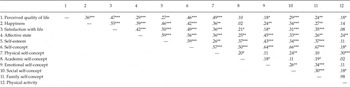
As Table 1 shows, PA was positively correlated with PQL, affective state, general self-concept, and some of its dimensions (Physical and Social). Furthermore, PQL was significantly, positively associated with happiness, satisfaction with life, affective state, self-esteem, and self-concept – general, physical, emotional, social, and family. On the other hand, general self-concept and its constituent dimensions were significantly, positively correlated with the emotional and cognitive components of QL, and with self-esteem. In cases where correlations were not statistically significant, they were at least in the expected direction. Generally speaking, general self-concept showed the strongest correlations.
Correlations between Physical Activity Practice, Quality of Life, and Indicators Thereof

Next, to examine the predictive and incremental validity of PA in PQL, and whether it varies when general self-concept is entered as the predictor variable – versus the dimensions of self-concept – two hierarchical regression analyses were carried out using the three-step entry method.
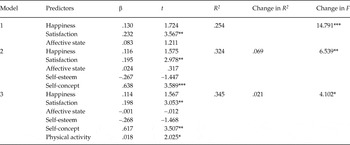
Table 2 illustrates that the first model, comprised of indicators from the hedonic tradition of QL (happiness, satisfaction with life, and affective state), was statistically significant, F(3, 130) = 14.791, p = .0001, accounting for 25.4% of variance in PQL (R 2 = .254, R 2 adjusted = .237). Satisfaction with life was the only variable that turned out to be significant. The second model, which in addition to the above included self-esteem and general self-concept – that is, variables referring to self-appraisal and -definition – was also statistically significant, F(5, 128) = 12.247, p = .0001, explaining 32.4% of variance in the criterion variable, R 2 = .324, R 2 adjusted = .297; change in R 2 = .069; F(2, 128) = 6.539; p = .002. General self-concept and satisfaction with life were found to be significant. The third model, which included PA, also turned out to be significant, F(6, 127) = 4.064, p = .0001, and accounted for 34.5% of variance in PQL, R 2 = .345, R 2 adjusted = .314; change in R 2 = .021; F(1, 127) = 4.102; p = .045. The significant predictor variables were satisfaction with life, self-concept, and PA practice.
Predictive and Incremental Validity of Physical Activity in Perceived Quality of Life, Entering General Self-concept

Note: *p ≤ .05; **p ≤ .01; ***p ≤ .001.
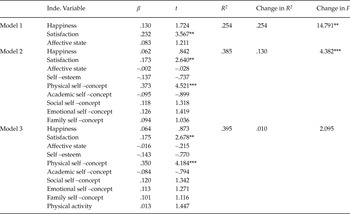
To examine whether differences occurred according to a unidimensional versus multidimensional view of self-concept, in the second regression analysis, we substituted global self-concept with its different constituent dimensions (physical, family, academic, emotional, and social; see Table 3). Like in the analysis above, the first model was found to be statistically significant, F(3, 130) = 14.791, p = .0001, accounting for 25.4% of variance in PQL (R 2 = .254, R 2 adjusted = .237), and satisfaction with life was the only significant predictor. The second model was statistically significant as well, F(9, 124) = 8.622, p = .0001, explaining 38.5% of variance in the criterion variable, R 2 = .385, R 2 adjusted = .340; change in R 2 = .130; F(6, 124) = 4.382; p = .0001. The third model, too, was statistically significant, F(10, 123) = 8.038; p = .0001, explaining 39.5% of variance in PQL, R 2 = .395, R 2 adjusted = .346; change in R 2 = .010; F(1, 123) = 2.095, p = .150. In both the second and third models, satisfaction with life and physical self-concept were statistically significant.
Predictive and Incremental Validity of Physical Activity in Perceived Quality of Life, Entering the Dimensions of Self-concept

*** p ≤ .0001; **p ≤ .010; *p ≤ .050.
Finally, two mediation analyses were conducted to see if PA’s ability to predict PQL was mediated by global and physical self-concept, which turned out to be significant predictors of PQL.
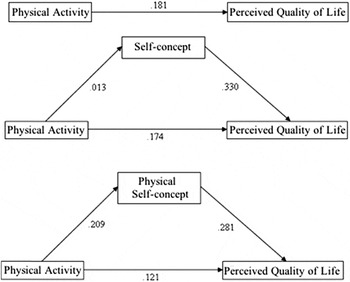
First of all, to ascertain whether global self-concept has a mediating effect, we did three regression analyses. As figure 1 shows, in the first model, PA significantly predicted PQL, F(1, 158) = 5.358, p = .022, R 2 = .033, R 2 adjusted = .027; b coefficient = .020 (SE = .009), and standardized beta coefficient = .181. To control for spurious or confounding effects, the remaining regression analyses included the following as covariates: sociodemographic data (age, occupation, level of education, and civil status), hedonic indicators of QL (satisfaction with life, happiness, and affective state), and self-esteem. In the second model, PA did not significantly predict the mediating self-concept variable, F(11, 119) = 10.081, p = .0001, R 2 = .482, R 2 adjusted = .435; b coefficient = .001 (SE = .005), and standardized beta coefficient = .013. In the third model, both PA and self-concept significantly predicted PQL, F(12, 118) = 5.883, p = .0001, R 2 = .374, R 2 adjusted = .311. The b and Beta coefficients for PA, after controlling for self-concept, were .020 (SE = .009) and .174, respectively, similar to the values we observed in analyses of direct effects, .020 and .181. Self-concept was associated with a b coefficient of .600 (SE = .184) and a Beta coefficient of .330 after controlling for PA.
To analyze the statistical significance of the mediating effect, the Aroian Test was applied. The analysis did not yield statistically significant results, z = 1.91, implying that PA’s effect on PQL does not drop significantly when self-concept is included in the model as a mediator (see Figure 1).
General and Physical Self-concept Mediating the Relationship between PA and PQL.

Second, to see if physical self-concept mediated the relationship between PA and PQL, we followed the same procedure (see Figure 1). As we already commented on above, PA significantly predicted people’s perceptions of their QL. In the second model, PA significantly predicted physical self-concept, the mediating variable, as well, F(11, 127) = 4.894, p < .0001, R 2 = .298, R 2 adjusted = .237; the coefficients b and standardized beta were .023 (SE = .009) and .209, respectively. In the third model, F(12, 126) = 6.163, p < .0001, R 2 = .370, R 2 adjusted = .310, self-concept significantly predicted PQL (t = 3.33, p = .001), while PA ceased to significantly predict PQL (t = 1.5290, p = .131). The b and standardized beta coefficients for PA, controlling for physical self-concept, were .013 (SE = .009) and .121, respectively, less than the values we found in analyzing direct effects (.020 and .181). Physical self-concept was associated with a b coefficient of .284 (SE = .085) and a standardized beta coefficient of .281 when we controlled for PA.
The Aroian Test indicated a statistically significant mediating effect, z = 1.97, p < .050. Thus, PA had a significantly smaller effect on PQL when physical self-concept was included in the model as a mediator.
The ratio between total direct and indirect effect was used to gauge the strength of the mediating effect. The indirect effect, computed as the product of the mediating coefficients .209 and .389, was .281, the direct effect was .181, and the ratio between them was .3245. Thus, approximately 32.45 % of PA’s effect on PQL was mediated by physical self-concept (see Figure 1).
Discussion
As in earlier studies that utilized the WHOQOL-Bref to measure PA’s influence on PQL in different samples (da Silva et al., Reference da Silva Maciel, Vilarta, Modeneze, Girnos Sonati, Santos Vasconcelos, Barros Vilela Junior and Oetterer2013), this study confirmed that PA practice is positively related to the subjective dimension of QL in healthy adult women, too.
Although various studies have demonstrated that PA practice is significantly related to hedonic aspects of well-being like satisfaction with life (Cruz-Ferreira et al., Reference Cruz-Ferreiras, Fernandes, Gomes, Bernardo, Kirkcaldy, Barbosa and Silva2011), happiness (Huang & Humphreys, Reference Huang and Humphreys2012), and positive affect (Feuerhahn et al., Reference Feuerhahn, Sonnentag and Woll2014), this study only observed that to be true of affective state. Other studies have likewise found that PA has no significant relationship with any indicators of subjective well-being, whether satisfaction with life (Goñi & Infante, Reference Goñi and Infante2010) or negative affect (Feuerhahn et al., Reference Feuerhahn, Sonnentag and Woll2014). These results could be due to conceptualizing the indicators differently (Goñi & Infante, Reference Goñi and Infante2010). Another possible explanation is that PA does not affect the general population, instead positively influencing people with different sorts of disorders (Netz, Reference Netz, Tenenbaum and Eklund2007).
That being said, the present research found that PA was related to variables such as general, physical, and social self-concept, which are fundamental psychological components of QL and well-being. Other authors have reported similar outcomes in seniors (García, Marín, & Bohórquez, Reference García, Marín and Bohórquez2012), menopausal women (Elavsky & McAuley, Reference Elavsky and McAuley2007), university students, and adolescents (Candel et al., Reference Candel, Olmedilla and Blas2008; Dishman et al., Reference Dishman, Hales, Pfeiffer, Felton, Saunders, Ward and Pate2006; Martin et al., Reference Martin, Liem, Coffey, Martinez, Parker, Marsh and Jackson2010), among others. Of all the variables analyzed, physical self-concept was the most strongly related to PA. Fox’s (Reference Fox2000) meta-analysis concluded that 78% out of 36 studies reported positive changes in self-esteem and physical self-concept as a result of exercise. This result can be considered robust given that the studies examined were experimental and less affected by behavioral mechanisms. Furthermore, other meta-analyses (Ekeland, Heian, Hagen, Abbot, & Nordheim, Reference Ekeland, Heian, Hagen, Abbott and Nordheim2004; Spence et al., Reference Spence, McGannon and Poon2005) have indicated that PA has a moderate influence (0.23 to 0.57) on physical self-concept. The results also reflect what Fox pointed out in 2000, that PA has a stronger effect on physical self-concept than global self-concept. A study by Opdenacker, Delecluse, and Boen (Reference Opdenacker, Delecluse and Boen2009) also yielded empirical evidence that PA practice has a greater influence on physical self-concept.
Moreover, this study’s results show that self-concept and PQL are closely related. Accordingly, women with better general, physical, emotional, social, and family self-concept rate their QL more positively. Other studies have similarly found a relationship between global self-concept, physical self-concept, and various dimensions of subjective well-being (Goñi & Infante, Reference Goñi and Infante2010).
This research has shown that the predictors of PQL vary if global self-concept or its constituent dimensions are input as the independent variable. Global self-concept predicts PQL along with satisfaction with life and PA practice. And PA increases explained variance in the subjective dimension of QL slightly yet significantly. Nevertheless, when the physical dimension of self-concept is included, that and satisfaction with life are the only variables to predict PQL after controlling for the remaining independent variables. That is, PA stops being a significant predictor, thus confirming the importance of physical self-concept in PQL for this sample of women. Like in Goñi and Infante’s (Reference Goñi and Infante2010) study, here physical self-concept predicted better PQL independently of PA practice.
The results indicate that physical self-concept is a mediating variable in the relationship between PA practice and PQL, while global self-concept does not play an important mediating role. This dimension of self-concept accounted for more than 30% of PA’s influence on women’s appraisals of their QL. A study by Martín-Albo, Núñez, Domínguez, León, and Tomás (Reference Martín-Albo, Núñez, Domínguez, León and Tomás2012) found, in a sample of 293 physical exercise practitioners, that physical self-concept also mediated the relationship between intrinsic motivation and satisfaction with life. These data support the idea that for the women in this study, self-image, which is a central variable in personality research, together with satisfaction with life, contribute the most to PQL. How people represent themselves, physically speaking, is a fundamental determining factor that contributes to a more positive perception of QL.
As Martínez (Reference Martínez2001) points out, the importance of physical self-concept can be explained by an intense social pressure, placed on women above all, according to which a thin physique brings happiness because it is generally associated with beauty and sexual attractiveness, and involves more power and control over the body. Body image is not only tied to physical beauty, but to personality traits that are highly socially desirable. That is consistent with the study by Ruíz, García, and Díaz (Reference Ruiz, García and Díaz2007), which found that one of women’s fundamental motivations to do PA was aesthetic improvement.
In summary, this study’s results support a multidimensional view of self-concept in that they paint a more accurate picture of the relationship between PQL, PA, and the different dimensions of self-concept. Physical self-concept is shown to be a powerful variable that exerts a mediating effect on the relationship between PA and PQL.
Two practical implications can be derived from this study. On the one hand, since physical self-confidence is what primarily drives these young and adult women to practice PA, it would be beneficial to devise interventions that relativize the physical benefits of PA, and develop other essential aspects that increase PQL, including the emotional and social benefits associated with exercise. On the other hand, this study also confirmed that multidimensional measures of self-concept are needed in basic as well as applied research. By determining the importance of each dimension of self-concept, researchers could develop more specific strategies to improve perceived QL and health.
This study has certain methodological limitations. First, given its cross-sectional analytical design, causal relationships cannot be drawn between variables. Also, the non-probabilistic sampling technique employed means the results cannot be generalized, and are circumscribed to the sample of women who participated in this study, not to mention that a considerable number of them were students. Another issue to bear in mind is the bias inherent in the use of subjective self-report measures.
Future research should delve deeper into the mechanisms involved in the mediating role of physical self-concept in the relationship between PA practice and other subjective components of QL, like satisfaction with life. We should also determine which of the dimensions of physical self-concept (physical ability, physical condition, attractive physique, or strength) is the strongest mediating variable in different stages of life (childhood, adolescence, youth, adulthood, old age), or as a function of gender (man or woman) or health status.