Introduction
Members of the compound genus Diplostomum Dubois, Reference Dubois1970 include three subgenera, often elevated to genus level, Diplostomum, Tylodelphys and Dolichorchis (Dubois, Reference Dubois1970; Niewiadomska, Reference Niewiadomska1970). These digenetic trematodes have attracted attention because of their pathogenic metacercariae in fish (Chappell et al., Reference Chappell, Hardie, Secombes, Pike and Lewis1994; Niewiadomska, Reference Niewiadomska1996); fingerlings in hatcheries are particularly vulnerable (Chappell et al., Reference Chappell, Hardie, Secombes, Pike and Lewis1994). Fish heavily infected with the metacercariae may experience loss of vision, reduced growth, emaciation (Chappell et al., Reference Chappell, Hardie, Secombes, Pike and Lewis1994; Chappell, Reference Chappell1995; Niewiadomska, Reference Niewiadomska1996) or deformation of the vertebral column, brain tumour, cellular necrosis and finally death (Machado et al., Reference Machado, Takemoto and Pavanelli2005). It has been further shown that these parasites can reduce fish crypsis and escape response and thus increase their susceptibility to avian predation (Seppala et al., Reference Seppala, Karvonen and Valtonen2004, Reference Seppala, Karvonen and Valtonen2005a, Reference Seppala, Karvonen and Valtonenb). Diplostomum species have been studied extensively in the northern hemisphere, where their biology and life history have been well documented (Chappell et al., Reference Chappell, Hardie, Secombes, Pike and Lewis1994; Chappell, Reference Chappell1995; Niewiadomska, Reference Niewiadomska1996). Their life cycle involves three hosts: snails as first intermediate hosts, fish and piscivorous birds as secondary and definitive hosts, respectively (Chappell, Reference Chappell1995; Niewiadomska, Reference Niewiadomska1996).
Identification of Diplostomum species at all stages of the life cycle is difficult due to striking morphological similarity and phenotypic plasticity induced by age, host and fixation procedures, and the extensive overlap in morphological measurements within and among species (Chappell et al., Reference Chappell, Hardie, Secombes, Pike and Lewis1994; Chappell, Reference Chappell1995; Nkwengulila, Reference Nkwengulila1995; Niewiadomska, Reference Niewiadomska1996). The differentiation of metacercariae, which are frequently encountered, is especially problematic (Chappell, Reference Chappell1995; Niewiadomska, Reference Niewiadomska1996; Niewiadomska & Laskowski, Reference Niewiadomska and Laskowski2002). Identification of metacercariae is made more difficult by the lack of a key devoted to this stage in the life cycle. All present keys and monographs (see Dubois, Reference Dubois1970; Sudarikov, Reference Sudarikov and Skrjabin1971; Niewiadomska, Reference Niewiadomska, Gibson, Jones and Bray2002) are based on the maritae (adult worms). So far only Shigin (1976 cited in Nkwengulila, Reference Nkwengulila1995) has developed a key for metacercariae. This work, however, is in Russian and its usefulness is limited to the Palaearctic region. There is still no key for metacercariae of Tylodelphys species from Africa. The identification of diplostomid metacercariae from Africa is dependent on scattered descriptions in the literature.
Multivariate analyses such as principal component analysis (PCA) (Shostak et al., Reference Shostak, Tompkins and Dick1987; Hoglund & Thulin, Reference Hoglund and Thulin1992; Flores & Baccala, Reference Flores and Baccala1998), cluster analysis (CA) (Flores & Baccala, Reference Flores and Baccala1998) and discriminant function analysis (DFA) (Niewiadomska & Niewiadomska-Bugaj, Reference Niewiadomska and Niewiadomska-Bugaj1995) have recently been used to separate morphologically similar Diplostomum species, with increased success. In Africa, so far only PCA has been employed in separating Diplostomum species (Nkwengulila, Reference Nkwengulila1995; Musiba, Reference Musiba2004). Each of these analyses still treated material from only one locality; they have not looked at morphometric variability among populations. Since species determination in these parasites may depend on measurements (Niewiadomska, Reference Niewiadomska1988; Niewiadomska & Niewiadomska-Bugaj, Reference Niewiadomska and Niewiadomska-Bugaj1995), it is important to understand the degree of variability among populations.
The present article reports on the application of- discriminat analyses to investigate the degree of morphometric variability among diplostomid metacercariae co-occurring in the cranial cavity of the catfish Clarias gariepinus from five localities, namely the Ruvu, Msimbazi and Kilombero rivers, Mindu dam and Lake Victoria.
Study areas
Kilombero River
The Kilombero River basin is a major part of the Rufiji River basin including the Great Ruaha, Kilombero and Luwegu basins. It lies between 34°30′–37°00′E and 8°10′–9°30′S. The Kilombero basin has a total area of 39,990 km2 (which is about 23% of the total area of the Rufiji basin) (Osman, Reference Osman2000). The Kilombero basin has a mean annual rainfall of 1500 mm, mean annual runoff of 255 mm and mean annual evaporation of 1200 mm. The Kilombero River is the main river running through the Kilombero valley, collecting its inflow from the Ruhudji, Kigogo-Ruaha, Kihansi, Luhombero and Mpanga rivers. Below the Shughuri rapids the Kilombero becomes known as the Rufiji River after joining the Luwengu from the south-east. Later, the Rufiji River is joined by the Great Ruaha and traverses the 100 m deep Stieglers Gorge on its way to the Indian Ocean. Fish were collected at Kivukoni, located at 8°12′S and 36°42′E (Osman, Reference Osman2000).
Ruvu River
The Ruvu River basin has an area of about 17,900 km2, and lies between latitude 6°05′ and 7°45′S and longitude 37°15′ and 39°00′E (Maganga et al., Reference Maganga, Butterworth and Moriarty2002; Kabika, Reference Kabika2005). The Ruvu River originates in the Uluguru Mountains south of Morogoro municipality. The Mgeta River is the main tributary, it too originates from in the Ulugurus. South and east of the Ulugurus, the Ruvu crosses flat and swampy plains, and then the gradient increases as it crosses the fall line between the Precambrian interior rocks and the coastal sedimentary deposits. Another major tributary is the Ngerengere, which rises on the western side of the Ulugurus near Morogoro and joins the Ruvu just after the Utari Bridge. Below this point the lower Ruvu flood plain extends over 100 km with meandering and secondary channel development in a north-easterly direction to the Indian Ocean. Generally, annual rainfall in the basin ranges from 800 to 2700 mm with an average annual rainfall amount of 1081 mm (Maganga et al., Reference Maganga, Butterworth and Moriarty2002).
Fish were purchased at Ruvu Darajani village (67 km west of Dar es Salaam), which is located in the lower Ruvu flood plain near the Ruvu Bridge on the Morogoro road. The Ruvu flows throughout the year; however, water declines considerably in the dry season and the river floods the entire flood basin during the rainy season. Fish are caught both in the main river (throughout the year) and in the flood plain during the rainy season.
Mindu dam
Mindu dam is located about 6.4 km south-west of Morogoro municipality on the Ngerengere River. The dam site is located close to the main road from Morogoro to Iringa, approximately 37°36′E and 6°50′S, at 500 m above sea-level. Mindu is 1.6 km long, maximum depth is 11 m, area 400 ha with a capacity of 20,700 litres of water. The catchment area is formed by the western slopes of the Ulugurus to the east (with peaks reaching to 2121 m), and the eastern slopes of the Mindu Mountains to the west. The major rivers feeding the dam are Ngerengere, Mzinga, Lukurunge, Mlali and Mgera. Rainfall of the Ulugurus ranges from 916 mm to 1524 mm and that of the surrounding district is about 892 mm (Kaduma, Reference Kaduma1972). Mindu dam is a reservoir for domestic and industrial use for the Morogoro municipality. It also serves for irrigation and flood control downstream.
Msimbazi River
The Msimbazi River passes through the city of Dar es Salaam, separating the old city centre from the major suburban areas. It is one of several rivers and streams draining the city. It has a catchment area of about 122 km2 and a mean runoff of about 71 mm/year (Mbuligwe & Kaseva, Reference Mbuligwe and Kaseva2005); and it descends from about 260 m above sea-level near its source to between 5 and 35 m above mean sea-level as it approaches the Indian Ocean. It has three major tributaries and sub-tributaries, namely Luhanga, Ubungo and Sinza. Altogether, the Msimbazi River and its tributaries discharge into the Indian Ocean at a rate of 0.345 m3/s during the dry season and 3.318 m3/s during the wet season. The Msimbazi River valley is home to human settlements, informal sector activities, urban agriculture, warehouses, industries and solid-waste disposal sites. It also serves as a receiving water body for wastewater from industries, abattoirs, a large referral hospital and residential areas. People bathe as well as fish in the river. Water from the river is also used for irrigation, watering animals and, to a limited extent, for domestic purposes (Mbuligwe & Kaseva, Reference Mbuligwe and Kaseva2005).
Lake Victoria
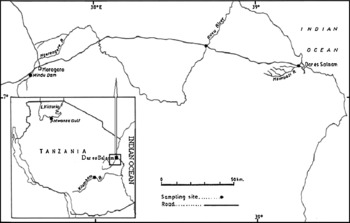
Lake Victoria is the second largest tropical freshwater lake in the world, set in the interior of equatorial Africa and covering an area of 68,800 km2. It is situated at 1°N to 4°S and 31° to 35°E at an elevation of 1134 km above sea-level. The depth, however, is relatively shallow, approximately 40 m on average and a maximum of 79 m. Three nations share the waters of the lake: Kenya, Tanzania and Uganda. However, Tanzania's share is the largest (more than half). The main inflowing rivers are Nzoia, Simiyu, Kagera and Mara, with several streams associated with swamps near the lakeshore within Tanzania. The shoreline length is 3440 km, with most part of the coastline being very irregular with shallow bays and gulfs, especially at the northern and southern part of the lake. The Mwanza gulf is located at the southernmost end of the lake and is one of the main fishing grounds in Lake Victoria. The shape of the gulf elongates from north to south (fig. 1). The papyrus swamps occupy some parts of the gulf and the rest consists of hills sporadically covered with big granite rocks. The surface area is about 500 km2 and the maximum depth is about 18 m (Akiyama et al., Reference Akiyama, Kajumulo and Olsen1977). Fish were collected along the Mwanza Gulf which is the largest gulf at the southern end of the lake.
Map of Tanzania showing sampling sites, namely, Lake Victoria and Mindu dam, Kilombero, Msimbazi and Ruvu Rivers.

Materials and methods
Fish collection and parasite treatment
Fish were bought from artisanal fishermen from the Ruvu, Kilombero and Msimbazi rivers, Mindu dam and Lake Victoria in Tanzania (fig. 1). Parasites (metacercariae) were recovered from the brain cavity of Clarias gariepinus by opening up the skull and teasing out the metacercariae by squirting water using a pipette, within 24 h after collection. The metacercariae were left for 3 h in water in a watch glass in order that the immature ones died and were removed from the subsequent treatments (Shigin, 1986, cited in Nkwengulila, Reference Nkwengulila1995). Material for morphometrics was fixed in 5% hot formalin, stained in hydrocarmine and dehydrated in increasing concentrations of alcohol, using 85% and 96% ethanol followed by two changes of absolute alcohol (Lunaschi & Drago, Reference Lunaschi and Drago2006). Samples were cleared in xylene and mounted in Canada balsam. All metacercariae from all localities were treated in the same manner.
Morphological examination
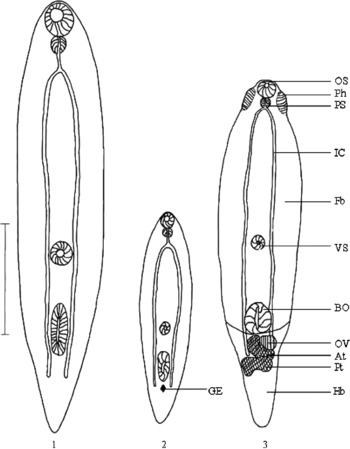
The following measurements were taken from stained materials using a microscope with a calibrated eyepiece (fig. 2): total body length (BL), forebody length (FbL), forebody width (BW), hindbody length (HbL), oral sucker length (OsL), oral sucker width (OsW), ventral sucker length (VsL), ventral sucker width (VsW), pharynx length (PhL), pharynx width (PhW), Brande's organ ( = holdfast organ or tribocytic organ) length (BoL), Brande's organ width (BoW), distance from mid-ventral sucker to anterior end of body (O). Ratios calculated were hindbody to forebody (FbL/HbL), forebody width to body length (BW:BL), distance from mid-ventral sucker to anterior end of body to body length (O/BL), body to Brande's organ (Body/BO), oral to ventral sucker (Os/Vs), oral sucker to pharynx (Os/Ph) and Brande's organ to ventral sucker (BO/Vs) (Niewiadomska, Reference Niewiadomska1988; Hoglund & Thulin, Reference Hoglund and Thulin1992; Niewiadomska & Niewiadomska-Bugaj, Reference Niewiadomska and Niewiadomska-Bugaj1995; Flores & Baccala, Reference Flores and Baccala1998).
Diagrammatic representation of a metacercaria of Diplostomum species showing the character measurements made.

Statistical analysis
Both univariate and multivariate analyses were carried out to test the significance of morphometric variations among diplostomid populations. The measurements were log transformed in order to remove the effects of size. A multidimensional image of the metacercariae was produced by analysing the discriminant function analysis (DFA). The DFA was computed using the SPSS (Version 13) package (SPSS Inc., Chicago, Illinois, USA). Data partitioning was performed by stepwise discriminant analysis in order to verify the data obtained in descriptive statistics within the range. The maximum probability of F value to enter was 0.05. At each step the features that minimized the overall Wilk's lambda most were entered. Individuals were assigned to the samples using the canonical functions, and the percentage of correctly assigned group was an additional measure of differentiation among samples. The percentage of correctly classified individuals gives a measure of the morphological distinctness of the samples. The number of misclassified individuals indicates the degree of intermingling between the populations. Mean of ratios of the original measurements of the samples were calculated according to Niewiadomska (Reference Niewiadomska1988) to compare the degree of differentiation of each character for each sample. The linear discriminant function (L) for each group was calculated separately according to Tabachnick & Fidell (Reference Tabachnick and Fidell1996). For diplostomids from lake Victoria, L was calculated from the formula; L = 7.53HbL+0.106BL+0.163FbL+0.28BW/BL+0.248PhL − 1.168O(VD) − 0.516VsL − 6.167BoW+1.414O/BL+0.369VsW; for Tylodelphys (types 1 and 2) metacercariae, L = 4.342BL+0.147BoW+0.248FbL+0.493BW/BL+0.436O/BL+0.346O(VD) − 3.987PhL+1.413FbL/HbL − 0.209VsL − 0.308Body/BO+0.563OsW; and for Diplostomum (type 3), L = − 4.137FbL − 1.142PhL − 1.246O/BL+1.092BW+1.288VsL+3.026Os/Vs − 2.571Os/Ph − 1.443PhW. The box plots were drawn by STATISTICA software version 6 (StatSoft Inc., Tulsa, Oklahoma, USA).
Results
Occurrence of metacercariae
Fish from the Ruvu River, Kilombero River and Lake Victoria harboured three types of metacercariae; namely, Tylodelphys sp. 1 and 2 (types 1 and 2, respectively) and Diplostomum mashonense (type 3). Morphologically, D. mashonense (type 3) differed from Tylodelphys species (types 1 and 2) in the possession of pseudosuckers, a longer hindbody and highly developed genital organs (fig. 3). Tylodelphys species (types 1 and 2) were differentiated by size and presence of genital enlargen on Tylodelphys sp. 2 (type 2); Tylodelphys sp. 1 (type 1) was larger than Tylodelphys sp. 2 (type 2), otherwise they were morphologically very similar.
Diplostomid metacercariae from the cranial cavity of Clarias gariepinus (1 = Tylodelphys type 1; 2 = Tylodelphys type 2, 3 = Diplostomum type 3; bar = 250 μm). At, anterior testis; BO, Brande's organ; Fb, forebody; GE, genital enlargen; Hb, hindbody; IC, intestinal caeca; Ph, pharynx; PS, pseudosuckers; Pt, posterior testis; OS, oral sucker; OV, ovary; VS, ventral sucker.

Descriptive statistics
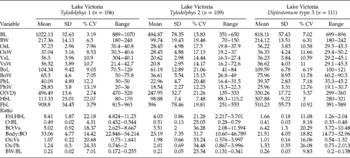
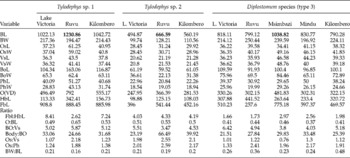
Descriptive analysis of 13 characters and 7 biometric indices of the diplostomid metacercariae (Diplostomum and Tylodelphys) infecting the catfish from one locality, for example Lake Victoria, showed clearly the presence of three types of metacercariae based on their sizes; type 1, 2 and 3 (table 1). Types 1 and 2 were the largest and smallest, respectively, while type 3 was in between. However, there were significant interlocality differences when each type was analysed across the five localities. Tylodelphys (type 1 and 2) metacercariae from the Ruvu River were the largest and those from Lake Victoria were the smallest. On the other hand, Diplostomum (type 3) metacercariae were largest in fish from Msimbazi River and smallest in fish from the Ruvu River (table 2).
Comparison of measurements (μm) of metacercariae of Tylodelphys (type 1 and 2) and Diplostomum (type 3) recovered from the brain cavity of Clarias gariepinus from Lake Victoria in Tanzania. SD, Standard deviation; CV, coefficient of variation.

For descriptions of variables, see fig. 2 and text.
Comparison of mean measurements (μm) of diplostomid metacercariae recovered from the brain cavity of the catfish Clarias gariepinus from five freshwater bodies in Tanzania.

Discriminant analysis
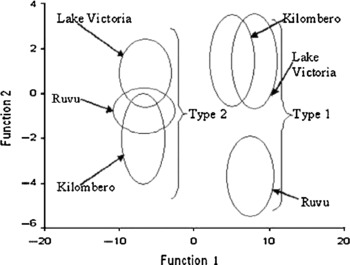
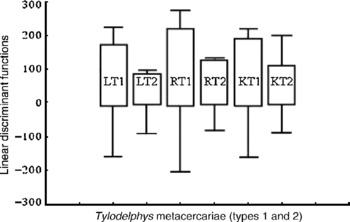
Discriminant function assessment of morphological measurements of Tylodelphys metacercariae (type 1 and 2) of fish from Ruvu River, Kilombero River and Lake Victoria clearly showed interlocality differences (fig. 4). Discriminant function 1 (DF1) axis indicated that over 90.3% of total variation is ‘size-dependent component’ thus confirming the separation of Tylodelphys metacercariae into two groups (type 1 and 2). The contrasting discriminant function 2 (DF2) axis ‘shape-dependent component’ had lower than 6% eigenvector percentage of variance, showing weak differentiation of the two types of metacercariae on the basis of shape. Although there was 84.4% overall correct classification from predicted group membership to actual group membership, individual group membership was variable. Tylodelphys (type 1) metacercariae from Kilombero River were misclassified with Lake Victoria and Ruvu metacercariae by 10.1% and 18.3%, respectively. Tylodelphys (type 1) from Ruvu showed a clear deviation from other type 1 metacercariae, particularly along DF2. Separation of Tylodelphys (type 2) metacercariae from the three localities (Kilombero, Ruvu and Lake Victoria) was also clear despite the fact that metacercariae from Kilombero River intermingled with those from Lake Victoria and Ruvu River by 22.4% and 37.4%, respectively. The most distinguishing features were body length (BL) and Brande's organ width (BoW). The linear discriminant functions (L) for all Tylodelphys metacercariae showed clear intra- and interlocality variations (fig. 5).
Visualization space for discriminant function 1 (DF1) and DF2 of Tylodelphys metacercariae (types 1 and 2) infecting Clarias gariepinus from Lake Victoria, Ruvu and Kilombero rivers. (Ellipses show a morphometric space occupied by a particular group as per numbers within a confidence limit of 95%.)

The box plots of linear discriminant functions against metacercariae of Tylodelphys type 1 (LT1, RT1, KT1) and Tylodelphys type 2 (LT2, RT2, KT2) infecting Clarias gariepinus from Lake Victoria, Ruvu and Kilombero rivers, respectively.

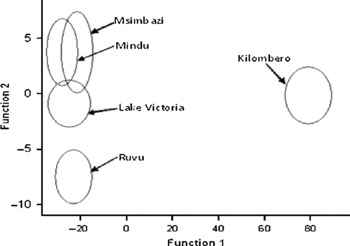
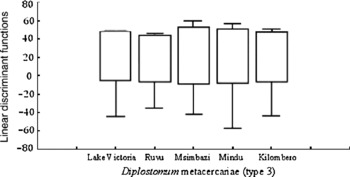
In the discriminant space of Diplostomum (type 3) metacercariae along the canonical functions of their morphometric data range, DF1 and DF2 had 99% and 1% eigenvector percentage of variance, respectively; all the samples were clearly distinct from each other (fig. 6). Remarkably, the Kilombero and Ruvu samples were mostly isolated from each other and from all other samples. The interlocality variations were not very clear within morphometric ranges of Diplostomum (type 3) metacercariae from Lake Victoria, Mindu dam and Msimbazi River, but the differences were much clearer in their group centroids. The overall and individual group assignments in Diplostomum metacercariae were 100% correctly classified. The morphometric variation among the type 3 metacercariae for the different localities was strongly contributed by two length-related features, namely body length (BL) and forebody length to hindbody length ratio (FbL/HbL). Their linear discriminant functions (L) showed strong interlocality variations (fig. 7).
Visualization space for discriminant function 1 (DF1) and DF2 of Diplostomum metacercariae (type 3) infecting Clarias gariepinus from five localities. (Ellipses indicate 95% confidence limit on the centroids.)

The box plots of linear discriminant functions against the metacercariae of Diplostomum metacercariae (type 3) infecting Clarias gariepinus from five localities in Tanzania.

Discussion
Descriptive analysis and ANOVA of metacercariae from the brain cavity of the catfish C. gariepinus in Tanzanian freshwaters categorically revealed three types of metacercariae (types 1, 2 and 3). The three types belonged to two closely related genera namely, Tylodelphys (type 1 and 2) and Diplostomum (type 3) (fig. 3). The Diplostomum (type 3) metacercaria was further identified as Diplostomum mashonense (Beverley-Burton, Reference Beverley-Burton1963). However, close examination of the adults of D. mashonense (see Beverley-Burton, Reference Beverley-Burton1963; Nkwengulila, Reference Nkwengulila1995; Musiba, Reference Musiba2004) reveals that they possess an asymmetrical anterior testis and a genital cone, thus resembling those of D. marahoueense (Baer, Reference Baer1957), which, Niewiadomska (Reference Niewiadomska, Gibson, Jones and Bray2002) renamed Dolichorchis marahoueense. This might suggest that Diplostomum mashonense may belong to another genus, Dolichorchis. On the other hand, types 1 and 2 metacercariae were clearly considered to belong to two different species based on size and the presence of a genital enlargen on type 2; but were all considered to belong to the genus Tylodelphys, hence were coded Tylodelphys sp. 1 (type 1) and Tylodelphys sp. 2 (type 2). Further, each of the three species showed considerable morphometric variations across the five localities. The variations were clearly shown by group centroids in the discriminant space.
Multivariate analyses have been used to address problems related to the separation of morphologically similar trematode groups. Previous workers have successfully applied PCA (Shostak et al., Reference Shostak, Tompkins and Dick1987; Hoglund & Thulin, Reference Hoglund and Thulin1992; Musiba, Reference Musiba2004), DFA (Niewiadomska & Niewiadomska-Bugaj, Reference Niewiadomska and Niewiadomska-Bugaj1995) and PCA and CA (Flores & Baccala, Reference Flores and Baccala1998) in separating closely related species. In each case, however, no single feature was deemed enough to separate similar Diplostomum species. The findings of the present study corroborate those quoted above.
The present study observed high morphometric variations among the populations of the diplostomid species studied. Both the first and second intermediate hosts of Diplostomum species are known to influence the morphological measurements of metacercariae (Graczyk, Reference Graczyk1991; Niewiadomska & Szymanski, 1991). Therefore, utilization of different intermediate hosts by the three diplostomids in distantly located water basins may explain these findings. While the second intermediate host, Clarias gariepinus, of the diplostomid metacercariae understudy is well known, little is known about the first snail hosts. Generally, the natural snail hosts for diplostomids in Africa are not fully understood. Beverley-Burton (Reference Beverley-Burton1963) used Lymnaea natalensis and King & Van As (Reference King and Van As1997) used Bulinus tropicus as experimental hosts. In Tanzania, cercariae resembling those of the Diplostomidae have been reported from Biomphalaria pfeifferi snails at Mindu dam (Nkwengulila & Kigadye, Reference Nkwengulila and Kigadye2005). It appears, therefore, that the snail host range for diplostomids in Africa could be wide, and this may have implications for the morphological measurements of the resulting metacercariae.
The interlocality variations in morphometrics observed here may also have resulted from genetic divergence due to spatial separation. Since spatial distance between populations may lead to genetic divergence and ultimately phenotype differences (Ashrafi et al., Reference Ashrafi, Valero, Panova, Periago, Massoud and Mas-Coma2006), it is tempting to consider that some of the metacercaria in the different localities may be of different species; however, close examination of the morphology did not favour such a theory. Nevertheless, a genetic analysis, e.g. based on microsatellites, would be illuminating in this respect.
In conclusion, the present analysis observed a high degree of morphometric variation among diplostomid metacercariae infecting C. gariepinus populations from Msimbazi, Ruvu and Kilombero rivers, Mindu Dam and Lake Victoria. This high interlocality variation in the morphometrics of metacercariae suggests that the use of morphometrics in identification of diplostomid species has to be applied with caution.
Acknowledgements
This work was supported financially by Sida/SAREC through the Faculty of Science, University of Dar es Salaam, Tanzania. We are also indebted to the Tanzania Fisheries Research Institute (TAFIRI) and the Ifakara Health Research and Development Centre for permission to use their laboratories.