It is now commonly accepted that modern central banks have two main objectives: monetary stability and financial stability.Footnote 1 There is further a broad consensus that the objective of monetary stability is better defined than the objective of financial stability.Footnote 2 In addition, our historical knowledge, at least with regard to Belgium, is much better concerning the history of monetary stability and the role of the National Bank of Belgium (NBB) in it. Thus, on the creation of the NBB, Capie remarks: ‘The principal objective was the maintenance of convertibility, but of almost equal importance was its role as banker to banks, and it seems that an intention from an early point was that it should act as a lender of last resort. Evidence on how this worked remains limited.’Footnote 3 Belgian historiography devotes little attention to the issue. Kauch claims that the NBB was a lender of last resort right from the start in 1850,Footnote 4 which would make the institution a very early pioneer in a European context.Footnote 5 Buyst et al. take a much more sceptical view and doubt that the NBB took up such a role before World War I.Footnote 6 Neither of these positions is, however, well documented. It is an aim of this article to provide more evidence based on a thorough analysis of the banking literature, and on research in the archives of the NBB.
In addition, managing a crisis in a financial institution raises several other issues: who takes the lead in crisis operations? Should the bank in difficulty be saved or can it go bankrupt? What kind of (temporary) construction will be established to provide relief? What will the role of bank mergers and/or of structural reform be in a long-term solution to the crisis? Who will finance the rescue operation and pay for the losses? These questions indicate that during the nineteenth century several institutions had a role in dealing with banking crises: the government, the central (or issue) bank and commercial banks.
First, the government will be involved. Indeed, the government has the ultimate political responsibility for financial stability in a country. Moreover, many financial crises are solvency crises which arise from severe losses on (long-term) investments. Only the government – the taxpayer – has the ‘deep pockets’ which are often necessary to solve these problems.
Second, the academic literature devotes a lot of attention to the ‘lender of last resort’ role of a central bank, and there have been many discussions on the concept itself.Footnote 7 According to the ‘classical’ view, associated with Thornton and Bagehot, a central bank should be ready to supply credit to banks to stop a banking panic.Footnote 8 The so-called ‘Bagehot principle’ has become famous: ‘lend freely at a high rate of interest against good collateral’. The present-day literature often refers to ‘emergency liquidity assistance (ELA)’ which a central bank can give to a financial institution in difficulty.Footnote 9 We follow Capie's approach, which defines the lender of last resort role of a central bank more broadly as ‘the preservation of financial market stability’.Footnote 10
Third, private banks are often involved in the resolution of banking crises. This is especially the case in so-called ‘lifeboat arrangements’ whereby a group of banks comes to the rescue of a specific institution.
In this article we explore the role of these different institutions and of the NBB in particular during financial crises in nineteenth-century Belgium. As the establishment of the NBB itself was a response to a severe banking crisis, we start with the panics of 1838 and 1848. The next section analyses the role of the NBB in monetary stability, while the two following sections discuss the role of the issue bank in financial stability.
I
In the early 1830s, the Belgian Société GénéraleFootnote 11 became the first mixed (or universal) bank in Europe. It not only issued paper money, provided discount credit for commercial purposes and operated a savings bank, but it also participated intensively in the share capital of manufacturing corporations.Footnote 12 Soon the Société Générale completely dominated the banking landscape in Belgium. This created a lot of animosity, the more so as the institution was suspected of favouring a restoration of the United Kingdom of the Netherlands from which Belgium had seceded in 1830. So, in 1835, Belgian patriots set up a rival institution, the Banque de Belgique, which was granted a range of functions comparable to that of the Société Générale, including the right of issue.
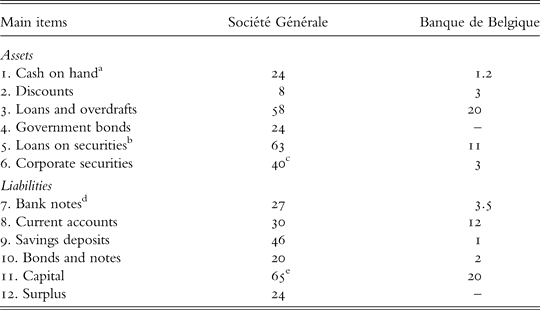
In the following years, these universal banks competed fiercely and tried to gain control over Belgian industry. Money poured into heavy manufacturing, which gave the industrial revolution in the Walloon provinces a powerful impetus. But by behaving in this way, the two banks ran serious risks as their working capital became rapidly tied up in claims that were difficult to realise in crisis periods, such as shares and camouflaged long-term loans. Moreover, their liabilities – mainly banknotes and savings deposits – could be converted or withdrawn at short notice (see Table 1).
Balance sheet of the Société Générale and the Banque de Belgique (end of 1838, in millions of Belgian francs)

Source: Chlepner, Belgian Banking, p. 12.
aIncludes some bank notes issued by the banks themselves. See note d.
bCollateral consisted almost exclusively of shares of industrial corporations promoted by the banks and, in what concerns the Société Générale, in shares of the bank itself.
cIncludes some shares of the Société Générale itself.
dThis item does not represent the notes in circulation; a part of the notes were held by the banks themselves and is included in ‘cash on hand’. The actual circulation was less than 20 million.
eA part of the shares, included in the assets under item 6, has not been actually issued.
By the end of 1838, military tensions between Belgium and the Netherlands flared up again. Panic broke out and the public demanded repayment of deposits and the conversion of banknotes into gold and silver coins. Both the Société Générale and the Banque de Belgique soon faced serious liquidity problems because of their imprudent investment policies. Share prices for instance plummeted, thereby slashing the value of the banks' participations in industrial corporations.
On 17 December 1838 the Banque de Belgique, the second largest financial institution in the country, was no longer able to redeem its banknotes. The bank called the government for financial aid, but in vain, and had to close its doors. Troops had to be deployed around the Banque de Belgique to prevent it from being plundered by angry depositors. Of course, these dramatic events increased the pressure on the Société Générale. But the Société Générale managed to meet its obligations, as it was able – with the help of the Paris Rothschilds – to sell foreign assets on the French capital market.Footnote 13
Gradually it became clear that the suspension of payments by the Banque de Belgique would provoke a wave of bankruptcies among the manufacturing firms it controlled. Fear of social unrest in the industrial areas prompted the government to grant a loan of 4 million francs to the Banque de Belgique.Footnote 14 The government acted thus de facto as lender of last resort. In return, the manufacturing corporations controlled by the Banque de Belgique had to take out mortgages, which were handed over to the government as collateral. On 4 January 1839 the Banque de Belgique resumed its operations.
The whole affair produced a shockwave throughout Belgium. As far as the Société Générale was concerned, the value of banknotes in circulation fell by more than 50 per cent and the amount of savings deposits dropped by almost 40 per cent.Footnote 15 For obvious reasons, the Banque de Belgique suffered even more. At one point its banknotes virtually disappeared from circulation.
But the effects of the crisis did not remain confined to the big banks and their depositors. The most dramatic event was undoubtedly the bankruptcy of John Cockerill's vast industrial empire.Footnote 16 Moreover, in previous years many small bankers had become accustomed to being able to rediscount bills of exchange at the Banque de Belgique or the Société Générale. At the peak of the crisis, however, this source of liquidity dried up. When the Banque de Belgique had to close its doors, the Société Générale also suspended its (re)discount operations. As a result, several local banks went bankrupt and a severe credit crunch paralysed the economy. Therefore the business community demanded the establishment of a specialist discount house supervised by the government that would maintain (re)discount facilities in periods of financial turmoil.Footnote 17
Despite the catastrophic impact of the 1838 financial crisis, few structural measures were taken in the aftermath. The government did not set up a specialist discount house and the system of universal banking was not changed dramatically. Despite continuous lip service, the Société Générale did not improve its liquidity position in any substantial way. The bank, for example, still used savings deposits to finance capital injections in industrial corporations. The battered Banque de Belgique drew some lessons from the crisis and stopped adding new firms to its investment portfolio, deciding to focus more on short-term operations.
The 1848 February Revolution in Paris provoked a new wave of panic in Belgium. To the great anger of the business community the (re)discount activities of the two big banks once again came to a halt. This time, however, it was the Société Générale that faced the most severe liquidity problems. In a few weeks, the value of its banknotes in circulation fell by more than one third.Footnote 18
When the French government suspended the conversion of banknotes to coins, the Société Générale requested the Belgian authorities to do the same.Footnote 19 But the bank realised that parliament would only approve the introduction of the compulsory rate if action was taken to revitalise the (re)discount market. Therefore the Société Générale proposed the establishment of a specialist discount house, supervised by the government.Footnote 20 The bank's request did not mention that such a measure would also be beneficial to the Société Générale by giving it the opportunity to mobilise part of its illiquid assets.
Parliament accepted these proposals into law on 20 March 1848, but important restrictions were imposed. The state only guaranteed the issue of paper money up to a maximum of 20 million francs for the Société Générale and up to 10 million francs for the Banque de Belgique. In return, both institutions had to pledge real estate, state bonds and other securities of at least the same value to the government as collateral. Moreover, the two banks had to publish at least every 15 days, or quinzaine, the total number of banknotes in circulation.
The law of 20 March 1848 also authorised each of the big banks to issue up to 2 million francs of supplementary notes for providing assistance to other financial institutions.Footnote 21 Using these funds, the Banque de Belgique and the Société Générale jointly granted loans to the Banque de Flandre and to the Banque Liégeoise, the two smaller Belgian issue banks. So, the government used the big banks as financial intermediaries to assist other ones.
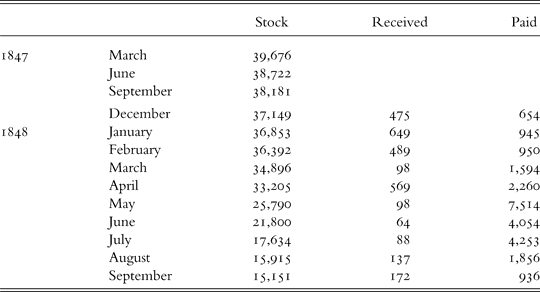
Imposing the compulsory rate by definition stopped the conversion of banknotes to coins, but the population increasingly withdrew savings deposits (see Table 2). In contrast to the 1838 crisis, the Paris Rothschilds were unable to help the bank, as the French capital market was also paralysed. In these circumstances, the Société Générale once again had to call the Belgian authorities for help. But the government showed little enthusiasm to set up a new rescue operation only a few weeks after the first one. Moreover, a parliamentary inquiry clearly demonstrated that the bank's financial difficulties were primarily due to its imprudent investment policies. Finally, the raging financial crisis also hit the government badly as it was unable to sell treasury bills on the market.
Amount of savings deposits at the Société Générale, 1847–8 (end of month, in thousands of Belgian francs)

Note: Deposits of public authorities excluded.
Source: Compte rendu de la Société Générale. Année 1848, pp. 44–5.
The financial chaos also deepened the industrial slump – iron production, for instance, fell by 35 per cent between 1847 and 1848Footnote 22 – which again fuelled fears of a social revolt. After sometimes passionate debates and pressure from King Leopold I, a shareholder in the Société Générale, Parliament adopted the law of 22 May 1848.Footnote 23 This authorised the bank to issue an additional quantity of notes with compulsory interest and a state guarantee up to a limit of 20 million francs. In return, the Société Générale had to pledge extra securities as collateral, had to pay 4 per cent interest on the notes issued, and was prohibited from paying out interest or dividends to shareholders as long as the extra paper money issued had not been redeemed. Finally, the bank was placed under the supervision of three government auditors.Footnote 24
It is clear that the reimbursement of savings deposits was simply financed by printing more inconvertible paper money. Normally the value of such notes would have depreciated vis-à-vis coins, but this did not happen. The strict limitation of the amount of issue authorised played an important role. In addition, the penalties imposed gave the Société Générale a strong incentive to restrict the issue of extra notes as much as possible. So the bank never exhausted its quota. Besides that, the transparency of the rescue operation helped to maintain confidence in paper money. The big banks had to publish every quinzaine the total amount of notes in circulation for the time the compulsory rate was in effect.
The government was able to remedy both the banknote and the savings deposits crises, but what happened to the discount activities? The law of 20 March 1848 had also created a specialist discount house in Brussels supervised by the government. The Société Générale and the Banque de Belgique had to subscribe the capital of 8 million francs on a 50/50 basis. The discount house quickly started its operations and certainly helped to alleviate the crisis, but it never became a real success. After a rapid initial rise, its credit operations fell back again as the Société Générale and the Banque de Belgique resumed their (re)discount activities. Nevertheless, the operations of the Brussels discount house pointed to a structural weakness of the Belgian commercial credit market. The discount office mainly served small and medium-sized firms which were neglected by the big banks.
Two severe financial crises in a decade left deep scars. Public opinion and many politicians demanded substantial reforms of Belgium's shaky financial system. In July 1848 the young, dynamic Walthère Frère-Orban became minister of finance. He was the main leader of the ‘progressive liberals’ in Belgium.Footnote 25 He was convinced of the merits of free trade but, very much in line with French thinking, he also saw a role for the state in economic life, especially in the financial sector.Footnote 26
Frère-Orban severely criticised the Belgian system of universal banking for several reasons. First, it was unacceptable that savings deposits were used to acquire shares of corporations. Such operations not only exposed savers to very high risks, but also jeopardised the liquidity position of the financial institutions. Second, the Société Générale and the Banque de Belgique focused strongly on obtaining controlling participations in companies and therefore did very little to promote discount credit (see also Table 1). The universal banks even distorted the normal functioning of the discount market, as they gave preferential treatment to the companies they controlled. Therefore other firms often faced difficulties in finding commercial credit. To solve this market failure Frère-Orban favoured the establishment of an institution that would grant discount facilities to any firm that provided the necessary guarantees. Third, the universal banks neglected the issuing of notes. On the eve of the 1848 crisis the amount of paper money in circulation was about 20 million francs, barely a quarter of the Dutch figure.Footnote 27 The fact that the Société Générale and the Banque de Belgique refused to accept one another's paper money certainly contributed to this striking difference. It also explains the increasing calls for unification of banknote circulation in Belgium.
What was Frère-Orban's alternative? Inspired by the English financial system, he wanted to split up the various activities of the universal banks and assign them to specialised institutions, in several of which the state would have an important role. His project included the establishment of a separate discounting and issue institution, a separate savings bank (which would later become the Caisse Générale d'Epargne et de Retraite), a mortgage loan institution, etc. In this structure, the Société Générale and the Banque de Belgique would confine themselves to industrial investment activities and become pure banques d'affaires. In the finance minister's view such a segmented financial system would be less prone to liquidity crises, more transparent, and more amenable to effective government supervision.Footnote 28
Of course, Frère-Orban realised that the big banks would fiercely resist his ambitious plans and therefore he decided to follow a gradual approach. His priority was to set up a national discounting and issuing institution on the lines of the Banque de France. Circumstances were favourable as the 1848 financial crisis had made the big banks heavily dependent on the government. After tough negotiations, the Société Générale and the Banque de Belgique renounced their right of issue and most of their discount activities to a new institution, named Banque Nationale.Footnote 29
The law of 5 May 1850 and the statutes (confirmed by royal decree of 4 September 1850) define the principal tasks and structure of the National Bank of Belgium (NBB). Being a private joint-stock company the profit motive was present in the NBB's commercial activities. At the same time, the NBB performed tasks in the public interest, i.e. issuing banknotes and being government cashier. Therefore, it was no more than reasonable that the state supervised the NBB's activities. So the government appointed the governor and there was a government commissioner, something exceptional in those days.
In view of the 1838 and 1848 crises, it comes as no surprise that the NBB's main objective was to maintain convertibility. In line with the theories of the Banking School, the legal framework was fairly liberal concerning the amount of banknotes to be issued. The statutes only required that the NBB's metal stock had to represent at least one-third of its demand liabilities – the total value of banknotes in circulation plus the NBB's current account deposits. With the government's consent, the stock of gold and silver could even fall to one quarter of the NBB's demand liabilities.
However, the law of 5 May 1850 was very strict on the kind of activities the NBB could pursue. Heavily influenced by the so-called classical theory of banking – which was popularised by the writings of Adam Smith, Jean-Baptiste Say and Count Mollien (Napoleon's finance minister) – the NBB's founders put particular stress on the limitation of banking assets to short-term self-liquidating bills. To ensure that banknotes could always be converted to coins, the NBB's activities were largely confined to discount operations linked to commercial operations. The bills of exchange normally had to bear three solvent signatures and reach maturity within 100 days.
The NBB was authorised to discount foreign bills of exchange. Officially Frère-Orban's intention was to stimulate the emergence of an international money market in Belgium.Footnote 30 But the experience of the 1838 crisis probably also played a role. In those days the Société Générale successfully resisted a domestic financial crisis because it could mobilise foreign assets.
The legislator clearly feared that the government could use the NBB to finance public spending.Footnote 31 Therefore, the NBB was allowed to invest in government bonds but only to an amount not exceeding its own capital and reserves. In addition, the number of treasury notes to be discounted was strictly limited. Government securities were admitted as collateral but only for an amount not exceeding 80 per cent of their market value. Finally, the NBB was not permitted to grant loans against the collateral of shares or backed by mortgages. Nor could it acquire property – except for its own use – or invest in industrial corporations.Footnote 32
From the debates in Parliament it is clear that Frère-Orban aimed at a financial system with a pyramid structure, headed by the NBB.Footnote 33 Nevertheless, neither the law nor the statutes refer to the NBB as banker to banks or contain articles that can be read as such. Similarly, the finance minister nurtured the hope that in times of financial turmoil the NBB would maintain its discount activities in order to alleviate the impact of the crisis: ‘Elles [discounting and issuing institutions] doivent enfin être organisées de manière à pouvoir venir au secours du pays dans les moments difficiles, atténuer les effets des crises, en escomptant à des taux raisonnables quand les capitaux deviennent rares. Loin d’être une cause d'embarras, elles doivent contribuer à diminuer l'intensité des crises.' Footnote 34 This pointed to the concept of lender of last resort. But again these ideas were in no way reflected in the law or statutes.
II
The NBB's discount operations took off at a dazzling speed.Footnote 35 Already in 1852 the NBB provided more discount credit than the previous record set by the Banque de Belgique and the Société Générale combined. This success encouraged the NBB to set up a network of discount agencies across the country. Parallel with the expansion of the discount activities, the value of banknotes in circulation rose rapidly. In this way, the NBB remedied several defects of the Belgian money market. However, the formation of deposits at the NBB remained rather negligible. The commercial banks were rapidly accustomed to rediscount freely with the issue bank, whose rediscount policy was very liberal. Consequently they did not feel any need to maintain important deposits at the NBB.Footnote 36
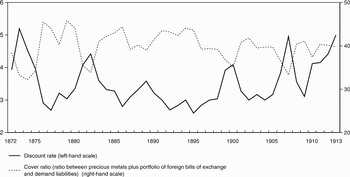
It is generally accepted that monetary stability is a necessary condition for financial stability. Did the NBB meet expectations where the conversion of banknotes to specie was concerned? The NBB managed to maintain convertibility during most international monetary-financial crises of the nineteenth century (1857, 1863–4, etc.). A deterioration of the cover ratio – the ratio between reserves and demand liabilities – was always fended off by using two instruments. The NBB sold its portfolio of foreign bills of exchange, and, if that did not help, it raised the discount rate (see Figure 1).
Discount rate and cover ratio of the NBB, 1872–1913 (annual averages, percentages)
Source: NBB, Bulletin d'information et de documentation, 25.II-3 (1950), pp. 126 and 160–4.

Things went wrong in July 1870. Frightened by the threat of war between France and Prussia, the Belgian finance minister and the governor of the NBB lost their nerves. They ordered immediate evacuation of the metal reserves out of the capital. The removal happened with so much commotion that it sparked panic among the population. People besieged the NBB's head office in Brussels to demand the conversion of notes to coins. To the population's outrage, the NBB simply decided to close its counters, except for one, so that in theory the convertibility of banknotes was maintained. At the same time, the volume of discount transactions was reduced drastically.Footnote 37
In order to resolve the confidence crisis, the government set up an emergency committee chaired by Jules Malou, director of the Société Générale. It urged the NBB to resume the conversion of notes as usual. By doing so, Malou took a calculated risk. In the meantime he had mobilised sterling assets, held by the Société Générale, to fetch gold from London to Belgium. Malou's tactics proved successful: as soon as convertibility seemed assured again, the panic faded away.Footnote 38 The NBB discount transactions also resumed. At first, priority was given to the financing of commercial operations by industrial companies, but soon thereafter the NBB also revived its rediscount facilities.Footnote 39
III
While monetary stability is generally considered to be a necessary condition for financial stability, it is certainly not a sufficient condition. Financial crises can also occur in periods when money is stable. Moreover, by the late 1860s Frère-Orban's grand design of a financial system dominated by specialised financial institutions had largely been realised. With a market share of about 68 per cent, the NBB dominated the discount market.Footnote 40 In 1865 the government had set up the Caisse Générale d'Epargne et de Retraite, which soon played a leading role in the savings market. The other two large financial institutions – the Banque de Belgique and the Société Générale – more than ever concentrated their activities on investment banking. Nevertheless, several smaller institutions continued to operate as universal banks. How crisis resistant was the new financial structure?
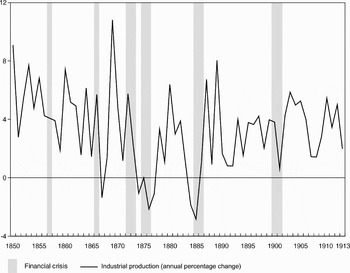
In the generally prosperous 1850s and 1860s (see Figure 2) few banks of substantial size got into difficulties. Of course, the relative absence of convertibility crises contributed to financial stability. But did the NBB also take up a more active role during periods of financial turmoil as promised by Frère-Orban? From the annual reports and archival documents it is clear that the NBB never formally accepted such a responsibility.Footnote 41 This comes as no surprise: neither the law of 1850 nor the NBB's statutes refer to such a role.
Economic slumps and financial crises, 1850–1913
Sources: Annual percentage change in industrial production: Gadisseur, ‘Contribution à l’étude de la production agricole en Belgique de 1846 à 1913', Revue belge d'histoire contemporaine, 4 (1973), pp. 1–48.

Nevertheless the NBB sometimes operated de facto as a supplier of liquidity in case of financial distress. During the 1857 crisis several merchant houses in Antwerp were badly hit by the international collapse in commodity prices.Footnote 42 In order to contain the crisis the main trading houses of the city temporarily set up a Comptoir de prêts sur marchandises, which discounted promissory notes and warrants guaranteed by commodities. The NBB provided rediscount facilities.Footnote 43 Moreover, the Antwerp branch of the NBB backed the operation by raising its advances on gold deposits to 1 million francs.Footnote 44 The total amounts involved in the effort were probably not very large and the NBB, as requested by its bylaws, always demanded sound collateral. Nevertheless, the very fact that the issuing body actively supported the rescue operation probably helped to alleviate the crisis.
In 1866 the collapse of Overend, Gurney and Co. in Britain sent a shockwave through the European commodity and financial markets.Footnote 45 As in 1857 the main trading houses in Antwerp established a Caisse d'avances sur marchandises, but this time the NBB was not involved in the operation.Footnote 46 However, when the Banque de Crédit commerciale d'Anvers went bankrupt, Jonathan Bischoffsheim, director of the NBB, feared that the merchant house crisis would spill over to the Belgian financial sector.Footnote 47 Therefore, he called a meeting of top bankers to investigate whether it was necessary to establish a temporary discount house, similar to the 1848 initiative. Most financiers were convinced, however, that the crisis could be handled without emergency measures and they proved to be right.Footnote 48
The Société Générale had never really accepted Frère-Orban's aim that it should confine its activities to investment banking. In the late 1860s and early 1870s Belgium's largest financial institution found a way out of this straitjacket. Inspired by the English example, it introduced interest-bearing current accounts to stimulate the use of demand deposits, giro payment systems and cheques. Next, the Société Générale decided to set up a network of provincial joint-stock banks. From a legal perspective these provincial banks were separate entities, but the Société Générale controlled a majority of their share capital. The controlled banks had two main tasks within the Générale Group: to attract deposits and to provide direct discount and other credit facilities, e.g. advances in current account, to small and medium-sized firms.Footnote 49 The controlled banks soon became serious competitors for the discount agencies of the NBB.Footnote 50
Although the NBB lost market share in the direct discount business during the late nineteenth century, this was more than offset by the rapid growth of its rediscount activities.Footnote 51 In this capacity the NBB increasingly acquired the status of banker to banks. The availability of ample rediscount facilities changed the financial structure of most Belgian banks. They maintained minimal cash reserves, so that the NBB's interest rate policy became far more effective. Financial institutions usually passed on immediately a change in the official discount rate to their customers. Again the Générale Group was an important exception. The controlled banks usually went to the Société Générale for rediscounting purposes, so the Générale Group was able to adopt a more independent stance.
The rivalry between the NBB and the Générale Group went beyond the issue of discounting bills of exchange. As noted above, the Société Générale had played a crucial role in solving the 1870 convertibility crisis. The whole affair increased the Société Générale's ambition to take up the leading role again in the Belgian banking world. Probably some nostalgia for the institution's prominent position in the pre-1848 period also played a role. Moreover, the year 1870 marked an important shift of power in the Belgian political landscape. The liberal party – with Frère-Orban as the dominating figure – that had shaped Belgian politics for about twenty years lost the elections and were banished to the opposition benches. The Catholic party came into office and soon afterwards Jules MalouFootnote 52 was appointed minister of finance. Malou resigned as vice-governor of the Société Générale, but maintained good contacts with the institution.
The early 1870s were also an important turning point in Belgium's general economic climate. A long period of malaise which lasted until the early 1890s was ushered in (see Figure 2). This unfavourable context,Footnote 53 together with the speculative investment policies of some Belgian banks, was a breeding ground for financial storms. In 1875–6, for instance, the collapse of Simon Philippart's railway empire plunged the Belgian banking system into its third major crisis since independence.Footnote 54
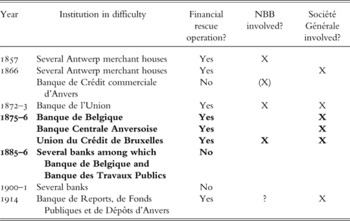
Finance minister Malou, an experienced banker, tried to tackle the crises of the 1870s actively and he gave the Société Générale an important role in the rescue operations (see Table 3). Why did Malou favour the Société Générale over the NBB? Personal and political elements certainly played a role as many Catholic politicians viewed the NBB as a club of Frère-Orban sympathisers.Footnote 55 But pragmatic considerations were probably more important. The NBB's statutes seriously constrained the issue bank from providing financial assistance during a crisis. Indeed, from the 1870s, universal banking had become a typical feature again of Belgium's financial landscape. Most collateral of the universal banks consisted of shares and industrial loans, while bills of exchange and government securities made up only a modest part of their total assets.Footnote 56 But the NBB was only allowed to provide liquidity against the last category of collateral. Moreover, the NBB's first duty was to maintain the convertibility of notes. So its financial capacity to participate in rescue operations was relatively limited, especially in cases where a banking crisis coincided with monetary unrest.
Financial crises in Belgium, 1851–1914

Notes: Major crises of the banking system are in bold. In 1875–6 several smaller banks also got into difficulties and were not helped out.
Sources: see text.
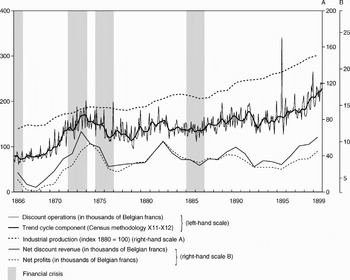
During the crises of 1872–3 and 1875–6 Malou set up several consortia. When the bank in difficulty specialised in supplying discount credit, the finance minister asked the NBB to join the effort. The specific role of the NBB, however, varied considerably from case to case. In 1872 the Banque de l'Union, the country's third largest provider of discount credit, ran into difficulties. During the crisis the Société Générale and the Banque de Belgique, together with eleven other financial institutions, participated in a temporary discount house. The NBB was not among them, but the issuing body pledged to pay 20 per cent of the discount house's potential losses.Footnote 57 Moreover, Figure 3 shows a substantial increase in the NBB's (re)discount operations in 1872 and 1873, which suggests that the issuing body also provided emergency liquidity assistance.
The NBB's discount operations, industrial production and financial crises, 1866–99
Note: The peak in July 1895 was due to massive discount operations for the Belgian branches of the Banque de Paris et des Pays-Bas and Crédit Lyonnais on 19 July 1895 (Archives of the NBB, Conseil d'administration, 21 July 1895).
Sources: Discount operations: NBB, Rapports annuels, 1867–99. Industrial production: Gadisseur, Contribution à l'étude de la production agricole.

In December 1876, the NBB provided expertise for the rescue of the Union du Crédit de Bruxelles, but in contrast to the Société Générale, for example, it was not involved in specific financial arrangements.Footnote 58 Of course, the NBB rediscounted the bills guaranteed by the temporary discount house, but the amounts involved were probably not very substantial. Figure 3 shows that, in 1876, the NBB's total discount operations even declined due to the general slump in the economy.
When a crisis hit universal or investment banks the finance minister did not ask the NBB for assistance.Footnote 59 A clear case was the debacle of the Banque de Belgique, the country's second largest financial institution, in March 1876, due to the bankruptcy of the Philippart empire. To make matters worse, large-scale fraud by an employee of the bank came to the surface, and this immersed the affair in a tense atmosphere of scandal.Footnote 60 Malou feared that the collapse would trigger a run on the banks, so he formed a consortium of Belgian and French financiers to keep the Banque de Belgique afloat. The NBB was not officially involved in this massive operation, nor did it provide large amounts of additional liquidity to the market in a discreet way. In any case it is impossible to find traces of a sudden increase in the NBB's discount activities (see Figure 3). Similarly, the NBB did not join the efforts to rescue the Banque Centrale Anversoise in April 1876.
In all rescue operations set up by Malou the Société Générale was clearly present (Table 3). This can be explained by the leading role of the Société Générale in the Belgian economy and society. Nevertheless, it would be too rash to state that Belgium's largest financial institution acted systematically as a kind of lender of last resort. Much depended on the personality of the finance minister. Malou's successors took a far less active stance when banks got into trouble. During the 1885–6 and 1900–1 financial crises no rescue operations were set up and several banks went bankrupt (see also Figure 3). In 1885–6, especially, the absence of a lender of last resort of some kind was felt in a painful way. The first banks hit were those already weakened by the turmoil of the 1870s. Most of them, including the Banque de Belgique, disappeared from the financial scene. But the crisis was allowed to rage on and to swallow other institutions such as the Banque des Travaux Publics, Belgium's third largest bank. It is estimated that more than 20 per cent of total paid-up capital in the Belgian banking sector went up in smoke.Footnote 61 Moreover, Figure 2 shows that the 1885–6 financial crises coincided with a deep industrial slump. Both phenomena have a clear tendency to reinforce each other, but even this danger could not convince the authorities to intervene.
How can we explain the rather passive attitude of the NBB during financial crises? We noted above that the bylaws of the issuing body seriously constrained the range of assets it could accept as collateral. Furthermore, the NBB gave clear priority to safeguarding the convertibility of its banknotes. This objective is not always easy to reconcile with pumping substantial amounts of emergency liquidity into the banking system. Another element was undoubtedly the profit motive in the NBB's commercial transactions. Figure 3 clearly indicates that the NBB's net profits were closely correlated to its net discount revenues. In that context, rescuing a (potential) competitor was not a straightforward action.Footnote 62 Finally, from the 1880s the NBB became a bureaucratic, inward-looking institution with little interest in the new responsibilities in the public sphere that an issue bank could take up. Growing competition with the Société Générale in the market for direct discount credit contributed to this phenomenon.Footnote 63
A somewhat particular case is the financial turmoil during the spring of 1914. The Banque de Reports, de Fonds Publiques et de Dépôts d'Anvers could no longer meet its commitments. In order to prevent a panic the Société Générale intervened: the bank was simply split up and integrated into the Générale Group. Archival documents of the Société Générale suggest that the NBB somehow assisted the operation.Footnote 64 It is, however, impossible to find confirmation of such an action in the NBB archives. In any case, it is unlikely that the NBB would have backed an operation not integrated in a broader consortium and that only reinforced the position of its main rival.
IV
Before the establishment of the NBB in 1850 the government acted as a reluctant lender of last resort. Fear of a social revolt was a more important motive for intervention than taking care of financial stability. In a system of universal banking, the collapse of a financial institution also provokes liquidity problems in the industrial firms it controls.
In order to solve the convertibility crises of the 1830s and 1840s finance minister Frère-Orban pushed through a fundamental reform of the Belgian banking system. The institutional restructuring was clearly aimed at rendering the financial system more crisis resistant, especially by restricting the leverage of the banking sector. In 1850, the NBB was created, and it received the privilege of issuing banknotes, but could only grant short-term credit and had strict rules concerning collateral. In addition, the financing of the government was strictly limited. The major banks – Société Générale and Banque de Belgique – continued to have stakes in industry, but their financing became less short-term based as they lost the right to issue banknotes.
The NBB clearly took up a key role in maintaining monetary stability, especially by safeguarding the convertibility of banknotes. But did it also become a lender of last resort in the sense of taking on the responsibility for financial stability? This was certainly part of Frère-Orban's grand design. However, there seems to be a certain ambiguity in Frère-Orban's vision. On the one hand he wanted a special role for the NBB, at the top of a hierarchical financial system, but on the other hand he also envisaged a segmented and strongly specialised financial system. In this view the NBB had as its first objective safeguarding the convertibility of banknotes. It was this element which pervaded the statutes of the NBB, restricting the activities of the issue bank to short-term operations. However, in the following decades, the investment banks developed new forms of short-term financing, thereby increasing again the leverage in the financial system.
In the second half of the nineteenth century the NBB usually played a rather passive role during financial crises. Whether a rescue operation was set up or not depended very much on the personality of the finance minister. If the finance minister did not take the lead, as during the 1885–6 and 1900–1 panics, the banking crisis was allowed to rage on, sometimes with devastating effects for the economy. But even if the finance minister decided to intervene, the NBB was not automatically involved in the setting-up of banking consortia. Only when the institution in difficulty was a discount bank did the finance minister ask the NBB to join the effort. When a panic hit a universal bank the finance minister did not ask the NBB for assistance. It would therefore be an exaggeration to consider it as a lender of last resort.
This should be no surprise for several reasons. First, the NBB's statutes determined that the issue bank was only allowed to accept government securities as collateral. Shares or mortgages were explicitly excluded, which severely restricted the NBB's ability to help a universal bank in difficulties. Second, the NBB's principal objective was to maintain convertibility of banknotes, which is difficult to reconcile with pumping large amounts of liquidity into the financial system, especially when financial turmoil coincides with monetary unrest. Third, the NBB was set up as a private limited liability company and rivalled private banks in the discount market, even if the NBB was clearly a bank with functions in the public interest and the government had a special role in it. In this context, a conflict of interest arose for the NBB, as allowing a bank to fail (or at least to suffer) would make it possible to capture more business for itself. This supports the claim of Goodhart and others that an issue bank can only give priority to the long-term interests of the financial system as a whole, if it does not seek to maximise short-run profits and withdraws from its rivalry with commercial banks.
Appendix 1. The Belgian banking system in 1913

Note: resources include capital, reserves, bonds and deposits. To compare: net national income of Belgium amounted in 1913 to about 6.5 billion BEF.
Source: Durviaux, La banque mixte, pp. 82–3.