In 2014, the market value of fresh and processed tomato in the United States, the world’s second largest producer of tomatoes (after China), accounted for more than $2 billion in annual farm cash receipts (NASS 2015). It is well known that weed competition can have a significant effect on tomato crop yield, quality, and production costs (Boyd Reference Boyd2015). Weed management is one of the most challenging and costly issues faced by tomato producers. Similar to other transplanted crops, newly transplanted tomato plants are unable to compete with weeds for limited resources such as light, water, nutrients, and space (Adigun et al. Reference Adigun, Lagoke and Karikari1991; Isik et al. Reference Isik, Kaya, Ngouajio and Mennan2009).
Growers heavily rely on a combination of herbicides and interrow cultivation (Robinson et al. Reference Robinson, Soltani, Hamill and Sikkema2006) for weed control, while many growers have adopted black polyethylene plastic mulch as a weed-control system (Lament Reference Lament1993). These practices are used mainly to reduce weed populations (Gilreath and Santos Reference Gilreath and Santos2004) and maximize yields (Sanders et al. Reference Sanders, Cook and Cranberry1996). Although black polyethylene plastic can suppress weed emergence, weeds that emerge from the openings made in the plastic for transplanting or direct seeding of the crop (Norsworthy et al. Reference Norsworthy, Oliveira, Jha, Malik, Buckelew, Jennings and Monks2008) can subsequently interfere with the growth of the crop. Many growers rely on pretransplant and posttransplant herbicide applications and hand-removal, which can be costly, to control weeds that appear within the tomato planting holes (Garvey et al. Reference Garvey, Meyers and Monks2013). Other methods, such as the use of cover crops (Masiunas et al. Reference Masiunas, Weston and Weller1995) and fumigants (Qiao et al. Reference Qiao, Dong, Wang, Xia, Ji and Wang2012), are also used for weed management in tomato.
Several herbicides have been registered for weed control in tomato. S-metolachlor (Dual Magnum®, Syngenta, Greensboro, NC), rimsulfuron (Matrix®, E. I. du Pont de Nemours and Company, Wilmington, DE), imazosulfuron [1-(2-chloroimidazo[1,2-a]pyridin-3-yl)sulfonyl-3-(4,6-dimethoxypyrimidin-2-yl)urea; League®, Valent U.S.A. Corporation, Walnut Creek, CA], trifloxysulfuron (Monument®, Syngenta), and metribuzin (Loveland Products Inc., Greeley, CO) have been shown to control various weeds in tomato (Devkota et al. Reference Devkota, Norsworthy and Rainey2013).
There are some challenges when using the registered herbicides in tomato. For instance, although rimsulfuron and metribuzin do not cause crop injury in tomato, these herbicide do not control goosegrass [Eleusine indica (L.) Gaertn.] and common ragweed (Ambrosia artemisiifolia L.), creating challenges for the farmer in the north central and eastern United States (Ackley et al. Reference Ackley, Henry and Thomas1997). The increasing emergence of herbicide-resistant weed biotypes is also adding to the complexity of weed management (Robinson et al. Reference Robinson, Soltani, Hamill and Sikkema2006; Soltani et al. Reference Soltani, Robinson, Hamill, Bowley and Sikkema2005; Trader et al. Reference Trader, Wilson, Hagood and Hines2009). Triazine resistance of common lambsquarters (Chenopodium album L.) biotypes is particularly problematic for tomato growers (Robinson et al. Reference Robinson, Soltani, Hamill and Sikkema2006; Soltani et al. Reference Soltani, Robinson, Hamill, Bowley and Sikkema2005). Therefore, new approaches are needed to control weed species in processing tomatoes that escape the effects of herbicides through resistance or late emergence. Rotation of herbicides is also an important tool that producers can use to prevent and manage herbicide-resistant weed populations (Trader et al. Reference Trader, Wilson, Hagood and Hines2009). However, because of the limited number of products currently registered for use in processing tomatoes, farmers may be unable to rotate herbicides as often as desired. Identification of alternative herbicides that can effectively be implemented without considerable increase in weed management costs is important for controlling herbicide-resistant weeds.
Tomato is a crop with considerable importance for commercial vegetable production in Ohio, with approximately 2000 ha of tomato grown in the state each year (NASS 2015). Identification of herbicides that are effective in controlling a range of weeds, yet are safe to use on different tomato varieties, is key to successful tomato production in the north central United States. Halosulfuron-methyl (Sandea®; Canyon Group LLC, c/o Gowan Company, Yuma, AZ) has been shown to be safe on several tomato varieties grown in the southern and southeastern United States (Jennings Reference Jennings2010; Rankins et al. Reference Rankins, Evans, Shankle and Cushman2004). Thus, the objective of this research was to evaluate the response of seven processing tomato varieties commonly grown in the midwestern United States, especially in Ohio, to POST halosulfuron.
Materials and Methods
Field studies were conducted at the Ohio Agricultural Research and Development Center, Wooster, Ohio (40.77°N, 81.91°W; elevation 310 m), during the summers of 2002 and 2004. The soil type was a silty loam with a pH of 6.0 and an organic matter content of 3%. Five inbred tomato varieties, ‘Ohio 8245’, ‘Ohio 7983’, ‘M82’, ‘E6203’, and ‘Heinz 722’, and two hybrid varieties, ‘Peto 696’ and ‘Heinz 9423’, were used. Tomato was direct-seeded in flats and grown in a greenhouse for approximately 7 wk. Tomato seedlings were machine-transplanted using a one-row water wheel transplanter (Holland Transplanter 1500, Holland, MI) on June 11, 2002 and June 3, 2004. Individual plots consisted of three rows that were 10.5 m long. Row spacing was 1.5 m. Field maintenance was done according to the standard recommendations for tomato growers in the region. Crop response data were only collected from the middle row. The experimental design was a randomized complete block with four replications. The split-plot treatment design included two herbicide rates (main plots) and seven tomato varieties (subplots). POST herbicide treatments included halosulfuron at 0, 34.7, and 70 gha−1 and were applied on June 21, 2002 and July 12, 2004 using a CO2-pressurized backpack sprayer. Nonionic surfactant at a rate of 0.25% (v/v) was also added. Spray volume was 187.1 Lha−1, delivered at 241.3 kPa through 8002VS flat-fan spray nozzles (TeeJet Technologies, Glendale Heights, IL). Prior to planting, metribuzin (Sencor®, Bayer CropScience LP, Research Triangle Park, NC) at 277.41 g ha−1 and S-metolachlor (Dual Magnum®, Syngenta) at 1.36 kg ha−1 were applied to control weeds that had emerged on the plots. Air temperature at the time of application was 27 and 23 C in 2002 and 2004, respectively, and wind speed at the time of application was below 3 km h−1 both years. All plots were kept weed free by interrow cultivation and hand-weeding. Average minimum and maximum daily temperatures in the 2002 and 2004 growing seasons were 17 and 30 C and 16 and 28 C, respectively, with total precipitation of 32 cm in 2002 and 31 cm in 2004 (Anonymous 2015).
Crop injury symptoms, including stunting and chlorosis, were assessed visually using a 0% to 100% scale, in which 0% indicated no crop injury and 100% indicated death of the crop. Data were collected 1, 3, and 6 wk after treatment (WAT). The crop was manually harvested from the middle row in each plot a single time, when more than 90% of the fruit were ripe, on September 23 in 2002 and on September 15 in 2004. Crop yield, which included marketable (red) yield, was reported on a per-plot basis.
Data analysis for all field experiments was subjected to ANOVA using PROC MIXED (α=0.05) in SAS® version 9.2 (SAS Institute Inc., SAS Campus Dr., Cary, NC). Years and replications were considered random effects, and all other variables were considered fixed effects (Carmer et al. Reference Carmer, Nyquist and Walker1989). All other variables (application timing and herbicide rate) were considered fixed effects. The random effect of year, and its interaction with herbicide treatment, was significant for crop injury and yield. As a result, data for these parameters are reported by year. Means for those variables were calculated using Fisher’s protected LSD test at the 5% level of probability. Weed-free control data were included in the ANOVA for yield but not for crop injury.
Results and Discussion
Crop Injury
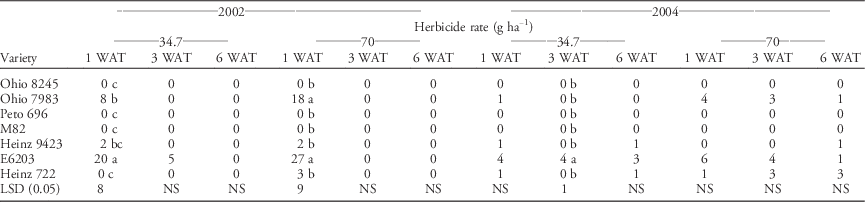
Most tomato varieties did not respond significantly to treatment with halosulfuron. Slight injury symptoms resulting from halosulfuron, characterized by stunting and chlorosis (typical of crop response), were observed sporadically. At 1 WAT, only variety E6203 demonstrated slight stunting (3%) in 2002 with halosulfuron at 34.7 g ha−1, while other varieties did not show any stunting with this application rate. At 3 WAT, stunting was observed in plots treated with halosulfuron at 34.7 g ha−1: Varieties 8245, M82, and E6203 showed 5%, 18%, and 15% stunting, respectively (Table 1). All seven varieties recovered from stunting symptoms by 6 WAT with halosulfuron at 34.7 g ha−1. In the same year, variety E6203 showed 27%, 28%, and 23% stunting at 1, 3, and 6 WAT, respectively, when treated with halosulfuron at 70 g ha−1. Also, 13% stunting was noted in variety M82 at 3 WAT when treated with halosulfuron at 70 g ha−1. Minimal stunting of only 8% also occurred in variety Ohio 8245 at 3 WAT when it was treated with this rate of herbicide, however, this level of injury did not differ statistically from that of the varieties that showed no stunting. In contrast to 2002, tomato plants did not show any stunting in 2004 when treated with halosulfuron at 34.7 g ha−1. Throughout 2004, minimal stunting (up to 3%) occurred in E6203 and M82 when treated with halosulfuron at 70 g ha−1, although the level of injury did not differ statistically among the seven varieties.
Response of tomato crop stunting (%)Footnote a to halosulfuron-methyl applied POSTFootnote b at the Ohio Agricultural Research and Development Center in Wooster, Ohio in 2002 and 2004.

a Means with the same letter are not significantly different according to Fisher’s protected LSD test (α=0.05).
b Abbreviations: POST, posttransplant; WAT, weeks after treatment; NS, nonsignificant (P=0.05).
Chlorosis was observed at 1 WAT with halosulfuron at 34.7 g ha−1. At 3 WAT, slight chlorosis was observed in E6203 (5%), and all plants had recovered from chlorosis symptoms caused by herbicide treatment (Table 2). Also during 2002, varieties 7983 and E6203 showed 18% and 27% chlorosis, respectively, when treated with halosulfuron at 70 g ha−1. However all varieties recovered from chlorosis symptoms by 3 WAT. In contrast to 2002, tomato plants showed slight chlorosis, from 1% to 6%, in plots treated with both halosulfuron rates, and injury levels did not differ statistically among the varieties with the exception of E6203 at 3 WAT in 2002. Similarly, Rankins et al. (Reference Rankins, Evans, Shankle and Cushman2004) and Buckelew et al. (Reference Buckelew, Monks, Jennings, Hoyt and Walls2006) reported no adverse effects resulting from halosulfuron applications on selected tomato varieties in Mississippi and North Carolina, respectively. Jennings (Reference Jennings2010) also reported tomato injury of 3% or less 1 WAT with halosulfuron at 40 g ha−1, and no injury 4 WAT.
Response of tomato crop chlorosis (%)Footnote a to halosulfuron-methyl applied POSTFootnote b at the Ohio Agricultural Research and Development Center in Wooster, Ohio in 2002 and 2004.

a Means with the same letter are not significantly different according to Fisher’s protected LSD test (α=0.05).
b Abbreviations: POST, posttransplant; WAT, weeks after treatment; NS, nonsignificant (P=0.05).
Crop Yield
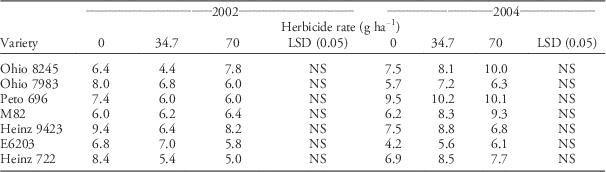
Evidence of lasting effects of herbicide treatment on tomato yield was not observed in 2002 or 2004. Marketable yield did not differ among the treated and control plots for each variety (Table 3). Tomato yield results of this study were similar to those of Robinson et al. (Reference Robinson, Soltani, Hamill and Sikkema2006), which showed no decrease in yield when thifensulfuron-methyl (also an acetolactate synthase–inhibiting herbicide) was applied POST. The yield responses in this study were also similar to those reported for processing tomato varieties developed for southwestern Ontario, Canada, which showed that the application of halosulfuron did not affect yield (Soltani et al Reference Soltani, Robinson, Hamill, Bowley and Sikkema2005). Buckelew et al. (Reference Buckelew, Monks, Jennings, Hoyt and Walls2006) also reported that while halosulfuron at 38.7 g ha−1 provided excellent control of redroot pigweed (Amaranthus retroflexus L.), velvetleaf (Abutilon theophrasti Medik.), hairy galinsoga (Galinsoga quadriradiata Cav.), and jimsonweed (Datura stramonium L.), it did not negatively affect total tomato yield. Rankins et al. (Reference Rankins, Evans, Shankle and Cushman2004) also reported no significant reductions in marketable yield in the tested varieties with halosulfuron application.
Response of tomato yield (in kilograms per plot) to halosulfuron-methyl applied POSTFootnote a at the Ohio Agricultural Research and Development Center in Wooster, Ohio in 2002 and 2004.

a Abbreviations: POST, posttransplant; WAT, weeks after treatment; NS, nonsignificant (P=0.05).
Halosulfuron applied POST caused minimal injury to most of the tested varieties, with the exception of M82 and E6203, which showed injury in 2002. M82 and E6203 are both inbred varieties adapted to arid environments. M82 is a derivative of ‘UC82’, which was developed for the California market. Similarly, E6203 is adapted to California’s climate. However, testing of more varieties would be required to verify that sensitivity is a differentiated feature of the germplasm pools (Sim et al. Reference Sim, Robbins, Van Deynze, Michel and Francis2011; Sim et al. Reference Sim, Van Deynze, Stoffel, Douches and Zarka2012).
These results conform to those of other researchers who have reported that tolerance does exist for certain tomato cultivars. Also, no yield reduction was observed in any of the varieties after POST application of halosulfuron. New processing tomato varieties are continuously being developed and introduced to the industry; thus, tolerance of new varieties to this herbicide will also need to be assessed. Results from this experiment indicated that, although halosulfuron may be a viable option for controlling weeds in some tomato varieties, care must be taken not to use this herbicide on varieties that are known to be sensitive to it.
Acknowledgments
The authors thank Gowan Company and the Midwest Food Processors Association for funding this project. Tomato genotypes used in this research were provided by David Francis, Department of Horticulture and Crop Science, Ohio State University. The authors also thank former Research Associates Tim Koch and Joel Felix for their assistance with the project.