The actual movements of the long-term rate of interest are the result of many forces. It would not be possible to obtain statistical evidence of the operation of any of these unless the effects of the others could be eliminated.
—Ralph George Hawtrey, “Interest and Bank Rate”
I. INTRODUCTION
Ralph George Hawtrey, John Richard Hicks, and John Maynard Keynes discussed the capacity of the central bank to manage the long-term rate of interest by the 1930s. The role of trading operations on financial markets (called “arbitrage” in the current literature)Footnote 1 rests at the core of their debate. Willing to provide a monetary theory of interest rates, Keynes presented a theory of the term structure of interest rates in chapter 37 of a Treatise on Money (1930, 2) in which the liquidity and expectations of financial intermediaries play a central role.Footnote 2
Keynes was influenced by the empirical works of Fed economist Winfield Riefler, who wondered “whether [credit policy on money rates] could seriously affect the average level of bonds yields” (Riefler Reference Riefler1930, p. 218). Riefler’s work does not take a categorical view: the impact of short-term rates over long-term rates “raises a more important question, a question, moreover, that does not lend itself either to categorical affirmation or denial since the answer depends so fundamentally upon the point of view of the observer” (ibid.). Keynes made his own statistical estimations of the long-term interest rate trends in England from 1919 to 1929 and found a strong influence of short-term rates over long-term rates. This influence, according to him, is due to the operations of “banks, insurance offices, investment trusts, finance houses, etc.” (Keynes 1930, 2, p. 320), who change their investment strategies according to their expectations of future short-term rates. According to Richard Sayers, Keynes’s ideas greatly influenced the report of the Macmillan Committee (1928–1931) (Sayers Reference Sayers1938, p. 151), and also Governor Norman, who thought, like Keynes, that a decrease in the long-term rate of interest would stimulate trade (Sayers Reference Sayers1976, 2, p. 437).
Hawtrey, however, discredited Keynes’s theory; he found the Macmillan Committee’s support of Keynes regrettable (Hawtrey Reference Hawtrey1938, p. 188). It is clear that, according to Hawtrey, short-term rates are the primary influence on investments. Hawtrey was also interested (although much less so than Keynes) in the determination of long-term rates. Even if expected short-term rates (depending on monetary forces) can exert some influence over the long-term rate, the trade cycle (determined by real forces) is a stronger determinant. In A Century of Bank Rate (1938), Hawtrey conducted an empirical investigation of 100 years of long-term interest rate trends, despite his reluctance to extract a theory from empirical works. While he observed that the long-term rate seemed to follow short-term rates, for him, it was clear that the impact of short-term rates over long-term rates is small.
Hicks took part in the debate in “Mr Hawtrey on Bank Rate and the Long-Term Rate of Interest” (1939b), which is a review of Hawtrey’s A Century of Bank Rate. Hicks also referred to this debate in Value and Capital (1939a) and other subsequent writings. Hicks took an interesting position in the debate. He supported most of Keynes’s theory and debated intensively with Hawtrey about the importance of expectations on financial markets. Hicks considered that Hawtrey’s treatment of expectations in A Century of Bank Rate could be interpreted as a step towards the acceptance of the theory of the term structure of interest rates.
The Hawtrey–Keynes–Hicks controversy is part of a broader debate that the current literature has already studied. According to Patrick Deutscher (1990, p. 93) and Hicks himself (1939b, 1969, 1989), the main issue in the debate deals with the channel through which interest rates affect macroeconomic variables (investments, employment, and aggregate income). In Keynes’s theory, monetary policy can influence macroeconomic variables by affecting long-term interest rates, whereas in Hawtrey’s theory, the short-term rate matters because it influences traders’ decision to finance (and hold) stocks with borrowed money. This may explain why Hawtrey was less interested than Keynes in developing a theory of the long-term rate of interest, as Deutscher explained (1990, p. 93). However, to understand Hawtrey’s skepticism towards Keynes’s theory, one has to grasp Hawtrey’s view on speculation on financial markets. This side of his thought has not received much attention so far. Surprisingly, Hawtrey also introduced some reactions of the long-term rate according to speculation on future short rates. This paper defends the idea that, in Hawtrey’s thought, the impact of the central bank on the term structure of interest rates might be stronger than what is emphasized in the literature. In the 1930s, Hawtrey and Keynes were both trying to find solutions to the economic depression. In this regard, Roger Sandilands offered an interesting comparison between Hawtrey’s “credit deadlock” and Keynes’s “liquidity trap.” In Hawtrey’s theory, policies focused on low short-term rates failed to encourage traders to invest because the economy was in a “credit deadlock”Footnote 3 (Sandilands Reference Sandilands and Leeson2010, p. 334). Keynes put greater emphasis on a situation of “liquidity trap,” where long-term rates do not respond to short-term rates. However, the controversy becomes clearer if one understands Keynes’s and Hawtrey’s stances on the operations of arbitrage on financial markets. While Deutscher referred to this side of Hawtrey’s theory (1990, pp. 51–53 and 93), our paper covers this aspect of the discussion in greater depth by studying Hicks’s active contribution to the debate.
Section II of this paper shows that in Hawtrey’s and Keynes’s theories, short-term rates of interest are managed by the central bank. Concerning the long-term rate, their theories seem to drift apart. Keynes extended the influence of the central bank to the long-term rate of interest, something that Hawtrey refuted. This point is developed in section III. According to Hawtrey, the long-term rate is more likely to be determined by the expectations of traders, banks, and stock-jobbers on future economic activity. While, empirically, short-term and long-term rates of interest seem to follow a similar trend, according to Hawtrey, it is not due to the monetary policy of the central bank. The fourth section deals with Hawtrey’s treatment of the expectations of ‘professional dealers’ on financial markets. Those expectations are a step toward the acceptance of Keynes’s theory of the term structure of interest rates, even if their importance to long-term rates is relatively weak, according to Hawtrey. Section V analyzes Hicks’s contribution to the controversy between Keynes and Hawtrey. Hicks supports the view that expectations of “professional investors” rest at the core of Keynes’s theory of the term structure of interest rates. Section VI presents Hicks’s view on the limits to arbitrage. While professional investors can bring the long-term rate close to the average of expected short-term rates, it never equals this average. This limit is due to the risk of liquidity associated with holding long-term assets, which generates risk-premiums. Section VII concludes.
II. HAWTREY AND KEYNES ON THE LINK AMONG THE DISCOUNT RATE, THE SHORT-TERM RATE, AND THE LONG-TERM RATE
In a famous quotation from “Alternative Theories of the Rate of Interest,” Keynes paid homage to Hawtrey: “I regard Mr Hawtrey as my grandparent and Mr Robertson as my parent in the paths of errancy, and I have been greatly influenced by them” (Keynes 1937, p. 202). One way that Hawtrey influenced Keynes has to do with the theory of short-term interest rates. In A Century of Bank Rate, Hawtrey made clear that “there is no determinate ‘natural rate’ of short-term interest” (Hawtrey Reference Hawtrey1938, p. 222). The central bank can impact the short-term rates of interest on loan markets. For instance, a rise in the discount rate accompanied by open market sales compels banks to raise their interest rates on loans:Footnote 4 “Now the short-term rate of interest is determined by the money market, which is entirely in the hands of the banks. The central bank is in a position to dictate the rate” (Hawtrey Reference Hawtrey1938, p. 197).
Hawtrey already presented this view in Currency and Credit ([1919] 1927, pp. 55–56), and several other books, such as The Art of Central Banking (1932, pp. 150–151). According to Hawtrey, a central bank occupies a key place within the economy because it can guarantee the “smooth working of the entire economic system” (Hawtrey [1932] 1962, p. 290). The central bank that issues legal tender notes can supply an elastic currency. With such a power, the central bank could influence the short-term interest rate and the level of the unspent margin, which is “the aggregate of the money and bank deposits in the community” (Hawtrey Reference Hawtrey1927, p. 11; as noted in de Boyer and Solis 2011, p. 179). According to Hawtrey, through its influence over short-term rates, the central bank could impact new investments. For instance, he wrote that “a moderate trade depression can be cured by cheap money; the cure will be prompted if a low bank rate is reinforced by purchases of securities in the open market by the central bank” (Hawtrey Reference Hawtrey1933a, p. 29). However, in the 1930s, low short-term rates failed to increase investment because traders were not willing to borrow regardless of short-term rates. Hawtrey called this particular situation a “credit deadlock.” To remedy the credit deadlock, according to Hawtrey, the central bank could intervene in foreign exchange markets: “When a credit deadlock has thrown Bank rate out of action, modifications of rates of exchange may be found to be the most valuable and effective instrument of monetary policy” (Hawtrey Reference Hawtrey1938, p. 277; Hawtrey explained this also in 1933a, p. 153).
Another tool to escape from the credit deadlock is to increase public expenditures. This side of Hawtrey’s thought is not often acknowledged, as Roger Sandilands explains (2010, p. 341). Hawtrey wrote about the benefits of public investments in “Public Expenditure and the Demand for Labour” (1925) and in “Public Expenditure and Trade Depression” (1933b).
In the chapter “‘Modus Operandi’ of Bank Rate,” Keynes took the central bank’s ability to ‘control’ short-term rates for granted: “[W]e shall here assume that changes in bank rate affect the market rate of interest in the same direction” (1930, 1, p. 180). So far, Keynes did not stray from Hawtrey’s main thesis about the control of the central bank over short-term rates of interest. Keynes presented a similar idea in 1931 during a conference; the central bank could control “the basis of credit in the shape of cash and reserve money” through its influence on the banking system (Keynes 1931b, p. 425).
However, Keynes established a relation that Hawtrey refuted. In the first volume of his Treatise, Keynes made the assumption that the bank rate and bond rate move in the same direction by defining the “market rate of interest” as “the complex of bank rate and bond rate.” If the central bank announces a decrease of the discount rate, the long-term rate would decrease too. Keynes aimed at giving a monetary theory of interest rates as opposed to the real theory based on Alfred Marshall’s contributions. The main transmission of the monetary policy was through its impact on the price of long-term bonds. Keynes was influenced on this point by Knut Wicksell. However, Keynes did not find satisfying the way in which the long-term rate of interest is determined in Interest and Prices (1898, pp. 92–93).Footnote 5 The mechanism of transmission of the monetary policy to “the bond rate of interest” (1898, p. 75) should be better analyzed:
Whilst Marshall, unless I have misunderstood him, regarded the influence of bank-rate on investment as the means by which an increase of purchasing power got out into the world, and Mr Hawtrey has limited its influence to one particular kind of investment, namely investment by dealers in stocks of liquid goods, Wicksell … was closer to the fundamental conception of bank-rate as affecting the relationship between investment and saving. (Keynes 1930, 1, pp. 175–176)
Following Wicksell’s intuition, Keynes provided a theoretical ground to the determination of the long-term rate of interest in the second volume of a Treatise on Money. There, he used the empirical study of the Fed economist Winfield Riefler to show that the long-term rate—as defined by “the average of sixty high-grade bonds” (1930, 2, p. 316)—followed the variations of the average of short-term rates from 1919 to 1929. In 1932, Keynes presented this view again by writing that the market rate of interest depends more on monetary forces than on real forces (1932b, p. 422).Footnote 6 He put such a great emphasis on the management of long-term rates because he thought that it could stimulate new investments. The Bank of England should find ways to affect long-term rates. Keynes offered a theory of the long-term rate, which seemed to be lacking in England (as also explained by Moggridge and Howson Reference Moggridge and Howson1974, pp. 234–235): “The monetary authority often tends in practice to concentrate upon short-term debts and to leave the price of long-term debts to be influenced by related and imperfect reactions from the price of short-term debts;—though here again there is no reason why they need do so” (Keynes 1936, p. 206).
According to Keynes, “Banks, insurance offices, investment trusts, finance houses, etc.” (Keynes 1930, p. 320), which are financial speculators, can transmit the discount rate policy to the long-term rate of interest. For instance, if these agents expect a durable fall of short-term rates, they can make a profit by borrowing and renewing their loans at those rates, buying bonds in the meantime. These purchases would lead to a rise in the price of bonds, and thus to a fall of the long-term rate of interest. Keynes presented this idea in chapter 37 of the second volume of A Treatise on Money at the Harris Lecture conference given at the University of Chicago in June 1931 (Keynes 1931a, p. 366),Footnote 7 and also at an annual conference of the National Mutual Life Assurance Society on February 19, 1932:
The other main factor (besides confidence in the future of short-term rates) in bringing down long-term rates of interest is a supply of bank money fully adequate to satisfy the community’s demand for liquidity.… In the last quarter of 1932 the Bank of England’s open market policy had the effect of increasing the volume of bank deposits to a total 12 per cent higher than in the last quarter of the preceding year.… As a result the price of fixed-interest securities rose during this period by 33 per cent. (Keynes 1932a, p. 376)
Financial speculators are different from savers or households that invest their savings into stocks because, for the former, the sole motive is to make profits on future spreads between long-term assets and short-term assets. Their strategy depends on the level of future short-term rates and long-term rates: “If the running yield on bonds is greater than the rate payable on short-term loans, a profit is obtainable by borrowing short in order to carry long-term securities” (Keynes 1930, 2, p. 319).
In The General Theory (1936), Keynes once again presented his theory on the term structure of interest rates, despite a growing pessimism concerning the capacity and willingness of trading operators to purchase long-term bonds by selling short-term debts.Footnote 8 In this book, he tried to understand the situations where long-term rates were not responding to short-term rates. Long-term rates are higher than expected short-term rates because of a liquidity risk affecting long-term lenders. Those agents who purchase bonds by renewing short-term loans can have a capital loss if, for a liquidity need, they have to sell the bond before maturity at a lower market price. The market price of bonds might have fallen since the beginning of the investment: “[I]f a need for liquid cash may conceivably arise before the expiry of n years, there is a risk of a loss being incurred in purchasing a long-term debt and subsequently turning it into cash, as compared with holding cash” (Keynes 1936, pp. 168–169).
Because of the liquidity risk of holding bonds, investment companies prefer holding short-term assets if no premium is offered on longer-maturity assets (Keynes 1936, p. 168). The long-term rate of interest cannot be equal to the average of expected short-term rates because a term premium prevails between those rates. But lenders have an interest in taking the risk to purchase long-term assets if they expect a higher return. This excess return can be defined as a premium that comes from the liquidity risk. Keynes did not use a special term for these premiums; he gave only a description of the risk incurred in long-term lending (Keynes 1936, pp. 168–169).Footnote 9 The premiums depend directly on the liquidity preference of financial speculators. The higher the liquidity preference, the higher the premiums on long-term assets. When financial speculators do not purchase securities when the central bank announces a fall of short-term rates, the long-term rate does not fall. The risk premium rises on long-term maturities. In this situation, the central bank should deal on several maturity assets, so to be ready to take risks on long-term maturity assets. This idea is present both in A Treatise on Money (1930, 2, pp. 332 and 371) and in the General Theory:
[I]n normal circumstances the banking system is in fact always able to purchase (or sell) bonds in exchange for cash by bidding the price of bonds up (or down) in the market by a modest amount; and the larger the quantity of cash which they seek to create (or cancel) by purchasing (or selling) bonds and debts, the greater must be the fall (or rise) in the rate of interest. (Keynes 1936, p. 197)
III. HAWTREY ON THE LONG-TERM RATES AND THE TRADE CYCLE
In his Art of Central Banking ([1932] 1962), Hawtrey devoted a chapter to Keynes’s Treatise on Money (1930). He tackled Keynes’s theory on the term structure of interest rates and wrote that Keynes misinterpreted Riefler’s statistics (Hawtrey [1932] 1962, p. 378). According to Hawtrey, short-term rates are mainly influenced by the central bank, but long-term rates are influenced by the forces of saving and investment. In Capital and Employment (1937), Hawtrey seems once again to oppose Keynes’s theory, but he introduced an interesting remark. He wrote that there is little foundation for the view that short-term rates influence long-term rates, even if “the professional dealer is not wholly indifferent to the short-term rate of interest”:
The professional dealer is not wholly indifferent to the short-term rate of interest. If he can see no reason whatever to think a rise in the prices of securities he holds, he is making a gain; if it is greater, he is making a loss. It is often assumed that these gains or losses must have a substantial effect on the security markets, so that there will be a marked tendency for the long-term rate of interest to move up and down with the short-term rate. In reality there is little foundation for this view. (Hawtrey Reference Hawtrey1937, p. 88)
In the same book, Hawtrey emphasized the role of banks’ operations (sales and purchases of securities) in influencing long-term rates of interest. When banks are constrained by their legal reserve requirements, they can sell securities to increase their advances. These sales, if massive, exert a downward pressure upon the price of securities and an upward pressure on long-term rates of interest (Hawtrey Reference Hawtrey1937, p. 92).Footnote 10
Later, in A Century of Bank Rate (1938), Hawtrey persisted in his disagreement with Keynes. But this time, Hawtrey seemed to be on solid ground. He provided financial statistics of the trend of short-term and long-term interest rates from September 1844 to June 1932 (while Keynes studied a ten-year period, from 1919 to 1929). According to him, the long-term rate is more likely to be determined by the trade cycle. Hawtrey used the example of traders whose investment strategy seems to depend more on their expectations of the future activity of business than on the rate at which they can borrow short-term funds. Traders’ expectations influenced the long-term rate for the period from 1874 to 1896, as Hawtrey explained. Traders expected a fall in the price of commodities and they purchased Consols instead of investing in the real sector. These preferences for Consols engendered a rise in their price, which brought down the long-term rate of interest:
In my book [A Century of Bank Rate] I attributed the rise in Consols in the period 1874–96 to the fall in prices of commodities, which would depress the short-term rate of interest as well as the long-term…. The long-term rate is depressed on account of the shrinkage of profits “which would make investments in industrial enterprises less attractive in comparison with gilt-edged securities” (pp. 158–9). (Hawtrey Reference Hawtrey1939a, pp. 147–148)
In other passages of A Century of Bank Rate, Hawtrey put a special emphasis on the operations of professional dealers on financial markets. Professional dealers sell Consols in periods of active business in order to buy other securities. The rise of the long-term rate reflects agents’ expectations of the future profit of firms, and their expectation of the future yield of securities (Hawtrey Reference Hawtrey1938, p. 187).
An opposite situation occurs during a depression of the economy. During a depression, it is not so much the decrease of short-term rates that can engender a fall of the long-term rate. Expectations of the future profit of firms are nil and therefore investments are discouraged. Professional dealers are more likely to prefer to invest in Consols instead of purchasing stocks (Hawtrey Reference Hawtrey1938, p. 168).
Next, Hawtrey focused on the years from 1920 to 1931. During this period, the high level of the long-term rate was due, according to Hawtrey, to the insistent need (Hawtrey Reference Hawtrey1939a, p. 152) of agents to sell their Consols (called also “Government securities”) in order to invest in stocks because they anticipated rising profits, but not because of the high level of short-term rates. Then, in 1930–31, the long rate diminished because of the suspension of the gold standard, which had led to a depreciation of the pound and to a rise in the price of Consols accounted in pounds, and thus to a fall in the long-term rate of interest (Hawtrey Reference Hawtrey1938, p. 164; 1939a, p. 152).
To sum up, in Hawtrey’s thought, changes in the long-term rate of interest are more likely to reflect professional dealers’ expectations of the future trade cycle. When they expect more active business, they are more willing to purchase stocks and to sell Consols. On the contrary, during an economic depression, Consols are more likely to be bought, and stocks to be sold. Hawtrey considered those influences as the real forces determining long-term rates.
So far, the literature has reckoned that the impact of short-term rates over long-term rates is weak in Hawtrey’s thought (Deutscher Reference Deutscher1990).Footnote 11 However, this interpretation can be qualified with some passages of A Century of Bank Rate, and particularly with the part entitled “Psychological Reactions.” The next part shows that, in Hawtrey’s thought, the impact of short-term rates over long-term rates might be stronger than what the current literature reflects. Some monetary forces can influence the long-term rate of interest.
IV. HAWTREY’S TREATMENT OF EXPECTATIONS
Despite all of Hawtrey’s efforts to discredit Keynes’s theory of the term structure of interest rates, some passages of A Century of Bank Rate (1938) can be interpreted as a step toward the acceptance of Keynes’s theory. In the part entitled “Psychological Reactions” (pp. 249–250), Hawtrey places a lot of importance on expectations—both on commodity and financial markets—of future discount rates announced by the central bank. Traders can change their investment strategy if they expect the level of short-term rates of interest to stay the same. Consequently, announcing monetary policy can influence the expectations of traders on commodity markets. For instance, when traders expect a rise in the future discount rate, they diminish their stocks financed by bank loans:
When the use of Bank Rate to restrict credit became an established practice, traders, being aware of the intentions of the Bank, were inclined to anticipate them. When Bank Rate went up from 3 to 4 per cent., a trader would reason that this was intended to have a restrictive effect on markets, and that, if the effect was not brought about, the rate would simply go higher and higher till it was. Those who took that view would restrict their purchases and demand would fall off, and so the 4 per cent. rate might be found potent enough, even though, if unsupported by traders’ anticipations, a 6 or 7 per cent. rate might have been necessary. (Hawtrey Reference Hawtrey1938, p. 249)
Banks finance two kinds of agents on markets, according to Hawtrey: professional dealers (whom he also calls “stock-jobbers” and “underwriters”) on financial markets, and also traders on commodity markets. While traders finance their stocks with bank advances, professional dealers buy securities with borrowed money (Hawtrey Reference Hawtrey1938, p. 178). Banks are themselves professional dealers, according to Hawtrey. It seems that short-term rates can influence professional dealers’ operations and long-term interest rates, as he explains in chapter V, “Bank Rate and Consols” (Hawtrey Reference Hawtrey1938, p. 146).
In the passage quoted below, Hawtrey refers to an interesting mechanism that could be linked to arbitrage operations; if professional dealers expect a rise of short-term rates from 3% to 7% for a quarter of a year, Hawtrey explains, the price of long-dated securities would fall by 4%. One can suppose that expectations on rising future short rates have led to sales of long-term securities, which have depressed their price:
Suppose that at a center where the normal short-rate is 3%, the short-term rate rises to 7%. If it could be foreseen that the rate would remain at 7% for three months and then drop to 3% again, the extra cost of holding a long-dated security with borrowed money would be offset by a fall in price equal to 1% (the equivalent of 4% per annum for a quarter of a year). (Hawtrey Reference Hawtrey1938, p. 147)
In Capital and Employment (1937), Hawtrey is more explicit about the impact of the central bank on long-term rates, which depends on expectations on future short rates: “The actual effect of the short-term rate of interest on the prices of long-term securities depends upon the time for which the short-term rate is expected to continue” (Hawtrey Reference Hawtrey1937, p. 88; emphasis in original). When the expectations of professional dealers are inelastic on financial markets, the long-term rate does not respond to the variations in short-term rates. Agents must be confident in future expected rates in order to accept the risk of holding long-dated securities. As an empirical fact, Hawtrey observed, short-term rates were too volatile to induce professional dealers to purchase long-dated securities with borrowed money:
Very often a movement of the short-term rate is known to be caused by quite transitory circumstances, so that there is no reason to expect that it will be either above or below its normal average after a few months or even, it may be, a few days.… Under these conditions the effect of the short-term rate on the long-term rate is very small. (Hawtrey Reference Hawtrey1937, pp. 88–89)
We saw that in Hawtrey’s thought—particularly in Capital and Employment (1937) and in A Century of Bank Rate (1938)—the long-term rate is determined by both monetary and ‘real’ forces. On the basis of those books, Hawtrey wrote in the Manchester School of Economic and Social Studies that “the actual movements of the long-term rate of interest are the result of many forces.” Fundamentally, Hawtrey was skeptical about basing a theory of long-term rates on statistical evidence: “It would not be possible to obtain statistical evidence of the operation of any of these unless the effects of the other could be eliminated” (Hawtrey Reference Hawtrey1939a, p. 152).
V. HICKS’S ENTRY INTO THE CONTROVERSY
Hicks entered the debate on the theory of the long-term rate while he was finishing his Value and Capital ([1939a] 1965). It is interesting to note that Hicks started the debate with Hawtrey in “Mr Hawtrey on Bank Rate and the Long-term Rate of Interest” (1939b), which is a critical report of Hawtrey’s A Century of Bank Rate (1938). Hicks retorted to Hawtrey that it is not an “insuperable task” to isolate monetary forces from real forces (Hicks Reference Hicks1939c, p. 154), and he challenged Hawtrey’s theory of the long-term rate.
Hicks supported the thesis that the long-term rate is determined by the average of short-term rates (Hicks Reference Hicks1939c, pp. 153–154), and he disagreed with Hawtrey’s theory of the long-term rate of interest presented in A Century of Bank Rate in which long-term rates are dependent on the business cycle. Unlike the bank rate, or commodity prices (“wholesale price index or the output of pig-iron” [Hicks Reference Hicks1939b, p. 24]), the long-term rate “is quite extraordinarily insensitive to the Cycle” (ibid.). More firmly, Hicks wrote that “the important movements in the long-term rate have nothing to do with the Trade Cycle at all” (ibid.). Hicks underlined that Hawtrey is close to accepting Keynes’s theory of the term structure of interest rates in some passages of A Century of Bank Rate, notably in the part “Psychological Reactions” (Hawtrey Reference Hawtrey1938, pp. 249–250). Hicks acknowledges Hawtrey’s treatment of expectations. Those factors occupy a key place in economics, according to Hicks, because “professional investors” (Hicks [1939a] 1965, p. 169), who deal with short-term and long-term assets, are driven by their expectation of future short-term rates. If the impact of short-term rates on long-term rates is small, in Hawtrey’s theory, it is because short-term rates are not expected to be kept at a constant level (Hicks Reference Hicks1939b, p. 25).
Hicks gave credit to the way that Hawtrey presented the risk of long-term lending in A Century of Bank Rate. This passage is interesting, because Hicks emphasized this risk in Value and Capital ([1939a] 1965) in a similar way. Hawtrey gave the following example of the effect of risk on long-term lending. Suppose that professional dealers finance their holding of long-term securities by borrowing at current short-term rates. If short-term rates rise by four points for three months, and dealers have not expected the rise, it could become more costly to hold a long-dated security by renewing the loan at the short-term rate. Dealers can incur a capital loss. However, if dealers are able to perfectly forecast this rise of short-term rates (which would happen if the central bank announces its policy before implementing it), dealers would sell securities, and the price of securities would fall by four points. The long-term rate of interest would thus rise, and dealers would have avoided capital losses (Hawtrey Reference Hawtrey1938, p. 147). Keynes presented a similar situation in The General Theory (1936, pp.168–169), which we discussed in the second part of this paper.
VI. HICKS’S STANCE ON THE POWER AND LIMITS TO ARBITRAGE
Hicks has been marked by his controversy with Hawtrey in Value and Capital ([1939a] 1965). Hawtrey’s treatment of expectations influenced the way Hicks considered the adjustment of interest rates to the announcement of the monetary policy:
There is only one way in which it [conditions in the security market] may be affected. The long rate is an average, not of expected short rates, but of forward short rates, which equal expected rates plus a risk-premium.… If a rise in current demand increases this risk-premium, then it may force up the long-term rate, even when interest-expectations are inelastic. Perusal of Mr. Hawtrey’s latest work, A Century of Bank Rate, makes me feel that I have probably under-estimated the importance of this consideration. (Hicks [1939a] 1965, p. 281n)
The professional investors, who “operat[e] on the whole gamut, and pa[y] close attention to small differences in rates” (1939a, p. 169), form expectations on future short-term rates. When those agents expect that short-term rates will remain stable, they can make arbitrages between short-term and long-term maturities. The spreads between long-term and expected short-term rates can be reduced (but not eliminated) if monetary policies are credible. Hicks definitely thought, like Keynes—and, to some extent, Hawtrey—that institutions could influence short- and long-term rates: “The important part played by banks and public authorities in determining the system of interest rates has, of course, a great bearing upon the possibility of controlling that system; a possibility much exploited in recent years” (Hicks [1939a] 1965, p. 170).
Although arbitrage and elasticity of interest rate expectations lay at the very core of Hicks’s theory of the term structure of interest rates, he admitted that the level of the long-term rate never perfectly reaches the average of expected short-term rates of interest (Hicks [1939a] 1965, p. 151). The long-term rate of interest cannot reach zero because one has to take up a less liquid position if he chooses to hold financial assets instead of money. A risk premium prevails on long-term securities. These premiums reflect the “limits to arbitrage.”
Hicks explained that risk premiums are generated by a “constitutional weakness” in the market for loans. This weakness results from the liquidity preferences of lenders and borrowers. Lenders prefer buying short-dated debts, while borrowers prefer selling long-dated debts. This means that between two assets offering the same yield but with different maturities, lenders prefer to purchase the shorter one because the liquidity risk is smaller. The risk is the following. After liquidity shock, long-term lenders are urged to sell their asset before the maturity date, and if the market value of the asset has decreased, they will have a lost capital. Therefore, unless a sufficient risk premium prevails on long-term bonds, lenders prefer buying short-term maturities instead of long-term ones in order to avoid the risks of liquidity (Hicks [1939a] 1965, pp. 146–147).
On the other side of the market, borrowers need to borrow funds on longer periods. They hedge themselves against a rise of expected spot/short-term rates of interest by borrowing at the forward rate (Hicks [1939a] 1965, p. 146). Long-term borrowers are willing to borrow at a fixed higher rate (the forward rate) instead of borrowing at the uncertain spot/short rate. The behavior of lenders and borrowers leads to an excess supply of forward contracts (Hicks [1939a] 1965, p. 148).
The short-term preferences of lenders and the long-term preferences of borrowers engender spreads between the long-term rate and the average of expected short-term rates plus the current rate. Hicks defined these spreads as “risk-premiums”: “The forward short rate will thus exceed the expected short rate by a risk-premium” (Hicks [1939a] 1965, p. 148).
Hawtrey challenged Hicks’s definition of the “risk-premium”: “Surely it is a misuse of the term, risk. He might as well call the price of a motor car a premium to insure against the risk of not having a car when required” ([1939a] 1965, p. 149). Hicks defended himself. He wrote that Hawtrey’s explanation is not convincing, because using a car is different from using money. A car is purchased to be used, whereas money is invested in financial assets not to be used immediately. However, holders of assets need to have the money back if a liquidity shock happens. In such a situation, holders of assets might need to convert their bonds into cash, but at a lower price if market prices are low. Because agents are able to anticipate future liquidity shocks, they require excess returns on long-term assets. The long-term rate is then higher than expected short-term rates: “[T]he long rate is normally likely to exceed the short rate by a risk-premium, whose function it is to compensate for the risk of an adverse movement of interest rates” (Hicks [1939a] 1965, p. 166).
Risk premiums can be partly eliminated by the professional investors (Hicks [1939a] 1965, p. 169). Those investors are more willing to take risk than primary lenders and borrowers. In a more contemporary vocabulary, professional investors are less risk-averse. They finance themselves on the money market, where the central bank fixes its discount rate. The monetary policy announcement of the central bank has an impact on the investment strategy of professional dealers, unless the expectations are inelastic to short-term rates. In this situation, the long-term rate does not follow the movement of the average of short-term rates.
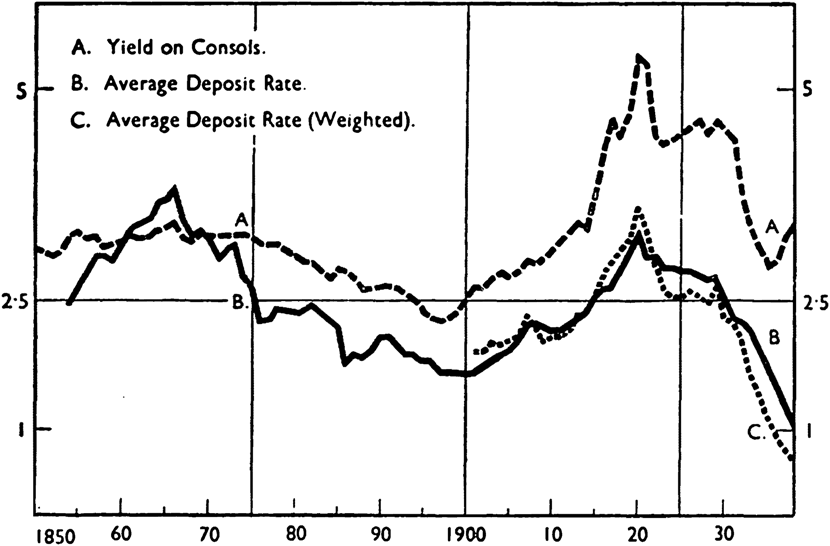
Debating with Hawtrey, Hicks undertook an empirical study of the trend of short-term and long-term rates of interest from 1850 to 1936 (Figure 1). The long-term rate is represented by Curve A. Curves B and C both represent the average short-term rates of interest, but are calculated differently.Footnote 12 Hicks observed a strong correlation between Curve A (the long-term rate) and the average of short-term rates, “which is too close to be accidental” (Hicks 1939b, p. 28).
The Short- and Long-Term Rates of Interest.

Hicks’s empirical study is highly relevant for understanding episodes where long-term rates stop responding to short-term rates. The financial operations of professional investors occupy an important place. Hicks underlined three particular episodes during which the shape of the term structure of interest rates moved in a peculiar way:
1) During the years 1854 to 1866, the average of short-term rates of interest exceeded the long-term rate (Hicks Reference Hicks1939b, p. 28).Footnote 13 The credit risk on short-term investments (which were bank deposits) was so high that agents considered it less risky to buy Consols than to invest in bank deposits. Arbitrage was not happening between short-term and long-term securities because agents were insensitive to short-term rates of interest. High short-term rates did not discourage agents from continuing to hold Consols. This phenomenon was due, according to Hicks, to the bad reputation of banks in the late nineteenth century (Hicks 1939b, p. 29). The average of short-term rates of interest, during this period of time, contained a credit risk of which the long-term rate was deprived. “The banks had not yet acquired their later reputation of solidity, so that the high rates they offered on deposits alarmed the investor as much as they attracted him.… Consols were definitively the safest income-yielding asset which there was” (Hicks 1939b, p. 29).
2) The years 1898 to 1902 (the Boer War) and 1914 to 1918 (the Great War) were characterized by a sharp increase in public debt. The spread between the long-term and the average of short-term rates increased because investors were less willing to purchase securities: they purchased securities but at lower prices. The risk premium on long-term assets increased (Hicks Reference Hicks1939b, p. 33). From 1914, and until 1935, agents anticipated that Consol holding was a risky investment because of increase in public debt issuing during the First World War. Their investment strategy depended more on the future level of the yield on Consols (Hicks Reference Hicks1939b, p. 32).
3) The change in what agents considered as the “normal” level of the short-term rates engendered a change in the slope of the term structure of interest rates. Indeed, from 1914 until 1935, a spread separating the short- and the long-term rate—the risk premium—had never fallen below 2%. The monetary policy influenced the level of the long-term rate of interest, but it did not reduce the 2% risk premium. So, the impact of short-term rates over long-term rates is limited to the extent to which professional investors were willing to take risks: “It is the startling increase in the gap between the long rate and the normal short rate. As we have seen, this gap had already increased to 1% before the war; during the war it rose to nearly 2%, and it has failed to come down below that level at any later time” (Hicks Reference Hicks1939b, p. 31; emphasis in original).
VII. CONCLUSION
Three leading economists, Keynes, Hawtrey, and Hicks, discussed the role of arbitrage on financial markets, which can improve the transmission of monetary policy. They all agreed that the central bank can exercise control over short-term rates of interest, but they differed in their views of its impact on long-term rates.
Hawtrey wrote that long-term rates are the result of both real and monetary forces, and that it is impossible to make a theory of interest rates on the basis of statistical evidence as Riefler (Reference Riefler1930), Keynes (1930), and Hicks (Reference Hicks1939b) attempted to do. Furthermore, Hawtrey denied, unlike Keynes, that the long-term rate can influence the level of investment and aggregate income. One recent reference to this controversy is well analyzed in Deutscher’s R. G. Hawtrey and the Development of Macroeconomics (1990).
However, the parallel debate on the term structure of interest rates has not received much consideration. As we saw, according to Hawtrey, short-term rates did not influence long-term rates because short-term rates were too volatile. Agents arbitrate with long-term securities only when short-term rates are expected to be long-lived. According to Hawtrey, if the average of short-term rates and long-term rates seemed to rise and fall together, it was because they were impacted by common causes: expected rising profits bring up short- and long-term rates because traders sell securities in order to invest, whereas interest rates decrease when declining profits are expected. Hawtrey thus linked long-term rates to the trade cycle. It is interesting to note that Hawtrey took into account expectations of short-term rates of interest in “Psychological Reactions” (1938, pp. 249–250), even if he remained convinced that short-term rates play a weak part in the determination of long-term rates.
Hawtrey’s and Keynes’s theories definitely marked Hicks’s subsequent writings. While Hicks was responding to Hawtrey’s critics in The Manchester School of Economic and Social Studies in 1938, he was finishing his Value and Capital ([1939a] 1965), in which appears Hicks’s theory of the term structure of interest rates. Almost thirty years later, Hicks referred again to the Keynes–Hawtrey controversy in a couple of writings (1969; 1977, esp. ch. 5; 1989).
Throughout his intellectual journey Hicks attached less importance to monetary factors in the dynamic of the trade cycle; he rather insisted on real factors. For instance, in A Contribution to the Theory of the Trade Cycle (1950, ch. 11) the monetary factor is the “interest-rate structure” (“r”). Although this structure of interest rates is sensitive to monetary policy,Footnote 14 Hicks warned that in an economy of long-term financing (where investments are more responsive to long-term rates than to short-term rates), monetary instability is greater than under a system of short financing because monetary authorities cannot directly manage long-term rates. Speculation on financial markets are destabilizing forces, and arbitragers have liquidity constraints that make them prefer short-term assets if no extra yield is offered on long lending. This paper enables a better understanding of why the monetary factor is a weak factor within the business cycle in Hicks’s subsequent writings.