Introduction
Clozapine remains the preferred medication for the pharmacological management of treatment refractory schizophrenia (TRS) (Siskind et al. Reference Siskind, McCartney, Goldschlager and Kisely2016), and is significantly more effective than all other anti-psychotic drugs in reducing psychotic symptoms (Leucht et al. Reference Leucht, Cipriani, Spineli, Mavridis, Örey, Richter, Samara, Barbui, Engel and Geddes2013). However, clozapine use among people with schizophrenia varies internationally from 2 to 3% in the USA (Sernyak & Rosenheck, Reference Sernyak and Rosenheck2008) to up to 60% in China (Tang et al. Reference Tang, Mao, Jiang, Chen, Wang, Cai and Mitchell2008). This variation reflects global differences in prescribing practices and adverse drug reactions (ADRs) monitoring protocols and focus.
Clozapine is associated with significant ADRs, notably neutropenia, myocarditis and sedation (Nielsen et al. Reference Nielsen, Damkier, Lublin and Taylor2011). While it is also associated with increased risk of diabetes and metabolic syndrome (Mitchell et al. Reference Mitchell, Vancampfort, Sweers, van Winkel, Yu and De Hert2013), one study has reported substantially lower mortality associated with clozapine use compared with other antipsychotics (Tiihonen et al. Reference Tiihonen, Lönnqvist, Wahlbeck, Klaukka, Niskanen, Tanskanen and Haukka2009). Concerns about ADRs can lead to clinicians delaying initiation of clozapine (Gee et al. Reference Gee, Vergunst, Howes and Taylor2014). Reported delays of 4–15 years before clozapine commencement may lead to a negative impact on quality of life (Taylor et al. Reference Taylor, Young and Paton2003; Howes et al. Reference Howes, Vergunst, Gee, McGuire, Kapur and Taylor2012).
Much of the clozapine research conducted to date has focused on evaluating its clinical efficacy or on describing national or regional prescribing or dispensing patterns (Nielsen et al. Reference Nielsen, Røge, Schjerning, Sørensen and Taylor2012; Forrester et al. Reference Forrester, Siskind, Winckel, Wheeler and Hollingworth2015). Relatively few studies have documented the characteristics and experiences of people on clozapine in routine clinical settings. Understanding these factors may provide guidance regarding whether or not clozapine use is being targeted to the most appropriate population, how to better identify the needs of consumers taking clozapine and how to improve the quality and safety of clozapine prescribing.
Developed in the 1950s, access to clozapine was reduced after deaths from neutropenia in the 1970s (Kane et al. Reference Kane, Honigfeld, Singer and Meltzer1988). Since clozapine's re-introduction in Australia in 1993, there has been a steady increase in dispensing rates, with an estimated 8.3% of people with schizophrenia dispensed clozapine in 2013 (Forrester et al. Reference Forrester, Siskind, Winckel, Wheeler and Hollingworth2015). This is still well below the estimated 20% of people with schizophrenia whose illness is treatment refractory (Agid et al. Reference Agid, Arenovich, Sajeev, Zipursky, Kapur, Foussias and Remington2011), the target population for clozapine. Antipsychotic polypharmacy for TRS remains common (Waterreus et al. Reference Waterreus, Morgan, Castle, Galletly, Jablensky, Di Prinzio and Shah2012), but its efficacy is equivocal at best, with evidence of increased ADRs (Gallego et al. Reference Gallego, Nielsen, De Hert, Kane and Correll2012). There is a suggestion that clozapine use can reduce the practice of antipsychotic polypharmacy (Chong et al. Reference Chong, Remington and Bezchlibnyk-Butler2000), however this data dates back to the start of the era of second-generation antipsychotic use, and warrants re-examination. Previous studies have also shown that clozapine can be associated with a reduction in alcohol and illicit substance usage (Drake et al. Reference Drake, Xie, McHugo and Green2000).
Surprisingly, few studies have examined the demographic or mental health profiles of people taking clozapine, and even fewer have examined co-morbid substance abuse. Such information can assist in the development of policies to ensure that people with TRS have timely access to clozapine, and the exploration of clozapine's potential in comorbid substance abuse.
Patients appear to have a high level of satisfaction with clozapine, with people remaining on clozapine longer than other antipsychotics and being more adherent (Gilmer et al. Reference Gilmer, Dolder, Lacro, Folsom, Lindamer, Garcia and Jeste2004; McEvoy et al. Reference McEvoy, Lieberman, Stroup, Davis, Meltzer, Rosenheck, Swartz, Perkins, Keefe, Davis, Severe and Hsiao2006; Forrester et al. Reference Forrester, Siskind, Winckel, Wheeler and Hollingworth2015). A study from Australia's first national survey of people living with psychotic disorders in 1997 (Castle et al. Reference Castle, Morgan and Jablensky2002) reported high rates of satisfaction and perceived efficacy among people on clozapine. At that time second-generation antipsychotic medications were relatively new to psychiatry. Given the rise in clozapine and second-generation antipsychotic use since the 1997–1998 survey, it would be of value to determine whether these patterns remain current.
In 2010, Australia's second national survey of people living with psychotic disorders, the survey of high impact psychosis (SHIP), was conducted. This provides an opportunity to update available knowledge regarding real world clozapine use patterns in Australia, and to examine the characteristics and personal experiences of care of people taking clozapine. Using data on the subsample of SHIP respondents with schizophrenia or schizoaffective disorder currently taking antipsychotic medication we aimed to answer the following research questions:
-
(1) What proportions of people with schizophrenia or schizoaffective disorder are using clozapine?
-
(2) Do the demographic, mental health and comorbidity profiles of people taking clozapine differ from those on other antipsychotic medications?
-
(3) Do the frequencies of ADRs among people taking clozapine differ from those taking other antipsychotic medications?
-
(4) Do patterns of psychotropic polypharmacy among people taking clozapine differ from those on other antipsychotic medications?
-
(5) What proportion of people taking clozapine report adherence with their clozapine regime and satisfaction with clozapine?
Method
Design and sample
The second Australian national survey of psychosis was conducted in 2010. The sample was drawn from seven catchment areas across Australia, covering a population of 1.5 million people aged between 18 and 64 years within a total area of 62 000 km2. A two-phase sampling design was used. During Phase I, screening for psychosis took place in public mental health services and in non-government services supporting people with mental illness, in March 2010. A psychosis screener was used to identify people likely to meet criteria for formal diagnosis (Jablensky et al. Reference Jablensky, McGrath, Herrman, Castle, Gureje, Evans, Carr, Morgan, Korten and Harvey2000). Administrative records were scanned to identify people with a recorded diagnosis of psychosis and in contact with public mental health services in the 11 months prior to census but not in the census month. During Phase 2, 1825 screen-positive individuals were randomly selected for interview stratified by catchment site and age. Institutional human research ethics committee approvals were obtained at each of the seven study sites and all participants provided written, informed consent. A detailed description of the sample, methods and aims of the SHIP survey can be found elsewhere (Morgan et al. Reference Morgan, Waterreus, Jablensky, Mackinnon, McGrath, Carr, Bush, Castle, Cohen, Harvey, Galletly, Stain, Neil, McGorry, Hocking, Shah and Saw2012, Reference Morgan, McGrath, Jablensky, Badcock, Waterreus, Bush, Carr, Castle, Cohen, Galletly, Harvey, Hocking, McGorry, Neil, Saw, Shah, Stain and Mackinnon2013).
The analyses reported here focus on the 1049 (57.5%) participants who met criteria for an International classification of diseases version 10 (ICD-10) diagnosis of schizophrenia (n = 789; 75.2%) or schizoaffective disorder (n = 260; 24.8%), and who reported taking any antipsychotic medication in the 4 weeks prior to the survey.
Measures
Medication use
Medication use was based on self-report with participants asked to bring their medications or medications list to the interview (Waterreus et al. Reference Waterreus, Morgan, Castle, Galletly, Jablensky, Di Prinzio and Shah2012). Only medications taken for at least 4 weeks were recorded. Data on duration of use extended to the previous 12 months only. Adherence was based on self-report: ‘In the last four weeks have you taken your prescribed medication as recommended on the bottle or box?’ Participants were asked about ADRs and their perceptions of the helpfulness of each medication they were using. Data on psychotropic medication numbers and class was collected.
Diagnostic interview for psychosis (DIP)
The DIP (Diagnostic Module) (Castle et al. Reference Castle, Jablensky, McGrath, Carr, Morgan, Waterreus, Valuri, Stain, McGuffin and Farmer2006), a semi-structured clinical research interview with an associated computer algorithm based on operational criteria checklist (OPCRIT), generates a diagnostic classification in accordance with ICD-10 and diagnostic and statistical manual (DSM-IV) criteria. Questions and probes derived and adapted from the WHO Schedules for Clinical Assessments in Neuropsychiatry assess present state (last 4–6 weeks), past year (excludes present state) and lifetime occurrence of symptoms including depression, mania, hallucinations, subjective thought disorder and delusions.
The survey interview schedule also assessed socio-demographic characteristics, social participation and functioning, physical health, quality of life, cognitive profile, service use, perceived need for services and other psychopathology not fully covered in the DIP (i.e., worry, panic, anxiety and obsessions).
Positive and affective symptoms
In the present study, we looked at binary responses (present/not present) regarding symptoms of depression, mania, hallucinations, delusions and subjective thought disorder.
Negative symptoms
We identified six symptoms/signs over the past 12 months based on the items identified by Carpenter (Kirkpatrick et al. Reference Kirkpatrick, Buchanan, McKenney, Alphs and Carpenter1989) as operationalised in the Schedules for Clinical Assessment in Neuropsychiatry (Wing et al. Reference Wing, Babor, Brugha, Burke, Cooper, Giel, Jablenski, Regier and Sartorius1990). As we were not able to score attribution, binary responses were summed to produce a score ranging between 0 and 6, with a higher score reflecting increased symptom severity.
Course of disorder
Participants were asked if their symptoms had resolved between acute episodes, or whether they had constant symptoms. These responses were dichotomised into chronic illness (characterised by continuous illness) or non-chronic (characterised by full or partial recovery between episodes).
National adult reading test-revised (NART-R)
The NART-R (Blair & Spreen, Reference Blair and Spreen1989) is a word-reading test widely used as an estimate of premorbid IQ (Schretlen et al. Reference Schretlen, Buffington, Meyer and Pearlson2005). It has high construct validity as a measure of general intelligence and high levels of inter-rater and test-retest reliability (Crawford et al. Reference Crawford, Deary, Starr and Whalley2001). Based on summary NART-R scores (M = 98.0, s.d. = 11.3), premorbid IQ was categorised into the three following levels: Below Average (>1 s.d. below sample mean), Average (within 1 s.d. of sample mean), and Above Average (>1 s.d. above sample mean).
Digit-symbol coding
The Digit-Symbol Coding task (DSCT) from the Repeatable Battery for the Assessment of Neuropsychological Status (Randolph, Reference Randolph1998), a test of speed of processing, was used to assess current cognitive ability. The lower the test score, the poorer a person's speed-based performance. Based on summary DSCT scores (M = 38.3, s.d. = 10.6), current cognitive ability was categorised into three levels: Below Average (>1 s.d. below sample mean), Average (within 1 s.d. of sample mean), and Above Average (>1 s.d. above sample mean).
Personal and social performance (PSP) scale
The PSP Scale is a 100-point rating scale subdivided into 10 categories measuring personal and social functioning over the last 12 months. The interviewer makes a rating based on the degree of disability in four domains of socially useful activities (e.g., work and study), personal and social relationships, self-care and disturbing and aggressive behaviours (Morosini et al. Reference Morosini, Magliano, Brambilla, Ugolini and Pioli2000). Higher scores denote better psychosocial functioning. The PSP has good internal consistency and construct validity (Nasrallah et al. Reference Nasrallah, Morosini and Gagnon2008; Patrick et al. Reference Patrick, Burns, Morosini, Rothman, Gagnon, Wild and Adriaenssen2009).
Physical health
Participants were asked to self-report physical health co-morbidities, and interviewers measured participants’ blood pressure, waist circumference and weight and height to calculate body mass index (BMI) as weight/height2 (Galletly et al. Reference Galletly, Foley, Waterreus, Watts, Castle, McGrath, Mackinnon and Morgan2012). Participants were categorised as underweight (BMI < 18.5), normal (BMI 18.5–24.99), overweight (BMI 25–29.99) or obese (BMI ≥ 30). Fasting blood was collected at accredited pathology centres for the testing of blood glucose, triglycerides and high-density lipoprotein (HDL).
Metabolic syndrome was classified using the International Diabetes Federation harmonized criteria (Alberti et al. Reference Alberti, Eckel, Grundy, Zimmet, Cleeman, Donato, Fruchart, James, Loria and Smith2009). These criteria for metabolic syndrome require three of the following five risk factors to make the diagnosis: at-risk waist circumference; at-risk diastolic and/or systolic blood pressure; at-risk levels of fasting blood glucose, triglycerides, or HDL. People receiving medications for hypertension, hyperlipidaemia or hyperglycaemia were considered to meet the relevant criterion.
Physical activity
Physical activity was measured using the interviewer administered International Physical Activity Questionnaire short form (IPAQ) (Craig et al. Reference Craig, Marshall, Sjöström, Bauman, Booth, Ainsworth, Pratt, Ekelund, Yngve, Sallis and Oja2003) and physical activity in the previous 7 days was categorised into three levels (low, moderate or high) using scoring guidelines. Participants were also asked whether they felt they were doing enough physical activity.
Substance abuse
Participants were asked to self-report lifetime and previous 12-month use of alcohol, cannabis, amphetamine and other drugs (tranquillisers, heroin, cocaine, LSD/hallucinogens, ecstasy, inhalants/solvents). Use was dichotomised into any or no use. The Fagerström test for nicotine dependence was administered (Heatherton et al. Reference Heatherton, Kozlowski, Frecker and Fagerström1991).
Data analyses
Analyses were conducted using SPSS (IBM, Windows Version-22, Armonk, NY, 2011). Means and standard deviations were calculated for continuous variables. Counts were calculated for categorical variables.
A series of logistic regression models were developed to examine factors associated with clozapine use. The binary outcome variable was any clozapine use (with or without other antipsychotic medications use) v. other antipsychotic use only in the previous 4 weeks. Factors potentially associated with clozapine use included demographic characteristics, mental health status, physical health and substance use comorbidities, ADRs and other experiences of care. Because some factors were likely to be correlated, we developed separate models for each. Analyses controlled for diagnosis and chronicity of illness, as these were shown in preliminary analyses to be predictive of outcome – people taking clozapine were significantly more likely to have a chronic course of illness (odds ratio (OR) 2.07, 95% confidence interval (CI) 1.35–2.78, p < 0.001) and to have a diagnosis of schizophrenia (OR 1.96, 95% CI 1.35–2.78, p < 0.001).
Results
-
(1) What proportions of people with schizophrenia or schizoaffective disorder are using clozapine?
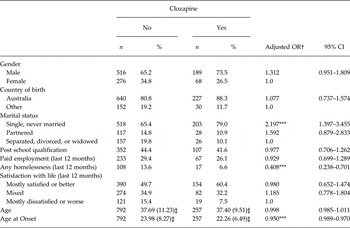
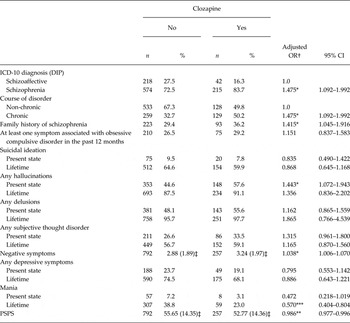
Of the 1049 SHIP participants who met ICD-10 criteria for a current diagnosis of schizophrenia or schizoaffective disorder and reported taking any antipsychotic medication in the past 4 weeks, almost one-quarter (n = 257; 24.5%) reported taking clozapine with or without other antipsychotics, with 65.5% taking a second-generation antipsychotic without clozapine, and 18.9% taking a first-generation antipsychotic without clozapine. A first and second-generation anti-psychotic were taken without clozapine by 8.9%, thus these numbers add to more than 100%. The proportion taking clozapine was higher for those diagnosed with schizophrenia (n = 215; 27.2%), than schizoaffective disorder (n = 42; 16.2%) (Table 1).
-
(2) Do the demographic, mental health and comorbidity profiles of people taking clozapine differ from those on other antipsychotic medications?
Table 1 shows demographic characteristics of participants by use of clozapine. After adjusting for illness chronicity and diagnosis, the odds of being single and never married were more than two times greater among those taking clozapine compared with those taking other antipsychotic medications. The odds of recent homelessness were more than two times lower among people taking clozapine.
Demographic characteristics of 1049SHIP participants with schizophrenia or schizo-affective disorder who reported using any antipsychotic medication in the past 4 weeks, by use of clozapine

SHIP, survey of high impact psychosis; OR, odds ratio; CI, confidence interval.
Satisfaction with life = 9 missing cases.
† All variables are adjusted for chronicity and diagnosis.
‡ Mean and (s.d.).
*p < 0.05, **p < 0.01, and ***p < 0.001.
With respect to mental health status, Table 2 shows the odds of having a family history of schizophrenia, were significantly higher among those taking clozapine, as were the odds of having current hallucinations and a higher number of negative symptoms (adjusted analysis). Conversely, the odds of lifetime manic symptoms were significantly lower. There was no difference between the two groups in terms of current obsessive-compulsive symptoms or on current or lifetime suicidal ideation. Personal and social functioning, as rated by the PSP, was significantly worse for people on clozapine, although the absolute difference was small. Only one third of people with a chronic course of illness were on clozapine. Similarly low proportions of those with current hallucinations or delusions were on clozapine.
Mental health characteristics of 1049 SHIP participants with schizophrenia or schizo-affective disorder who reported using any antipsychotic medication in the past 4weeks, by use of clozapine

SHIP, survey of high impact psychosis; OR, odds ratio; CI, confidence interval; ICD-10, International classification of diseases version 10; DIP, diagnostic interview for psychosis; IPAQ, International physical activity questionnaire; PSPS, personal and social performance scale.
† All variables are adjusted for chronicity and diagnosis; chronicity is adjusted for diagnosis only and diagnosis is adjusted for chronicity only.
‡ Mean and (s.d.).
*p < 0.05, **p < 0.01, and ***p < 0.001.
There was no statistically significant difference in the adjusted analysis between those taking or not taking clozapine in terms of NART Full Scale IQ or Digit-Symbol Coding.
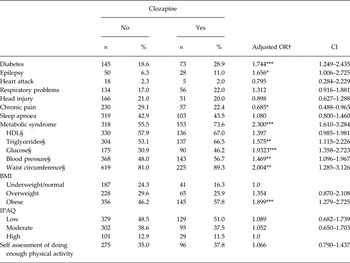
Table 3 shows that people taking clozapine differed from those taking other antipsychotics on a number of indicators of physical health (adjusted analysis) with significantly higher odds of a lifetime self-reported diagnosis of diabetes and epilepsy, but lower odds of current chronic pain. They also had higher odds of metabolic syndrome, specifically meeting threshold criteria for elevated triglycerides, glucose, blood pressure and waist circumference. A higher proportion had obese-range BMI. There were no differences in their level of physical activity or self-rated exercise.
Physical health characteristics of 1049 SHIP participants with schizophrenia or schizo-affective disorder who reported using any antipsychotic medication in the past 4weeks, by use of clozapine

SHIP, survey of high impact psychosis; OR, odds ratio; CI, confidence interval; IPAQ, International physical activity questionnaire, divided into low, moderate and high amounts of physical activity.
Missing cases: diabetes = 16; epilepsy, heart attack, respiratory problems, head injury, chronic pain = 4; sleep apnoea = 69; metabolic syndrome = 268; HDL = 6; triglycerides = 1; glucose = 1; blood pressure = 30; waist circumference = 3; BMI = 27; IPAQ = 14.
† All variables are adjusted for chronicity and diagnosis.
§ Elevated based on International Diabetes Federation criteria.
* p < 0.05, ** p < 0.01, and *** p < 0.001.
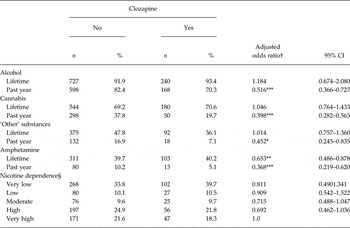
People taking clozapine had similar probabilities of lifetime use of alcohol, cannabis and ‘other’ substances, but lower probabilities of use of these drugs in the previous year v. those not on clozapine (adjusted analysis, Table 4). The probabilities of amphetamine use were lower for people on clozapine in both the previous year and lifetime. There was no difference in nicotine dependence as rated on the Fagerstrom test.
-
(3) Do the frequencies of ADRs among people taking clozapine differ from those taking other antipsychotic medications?
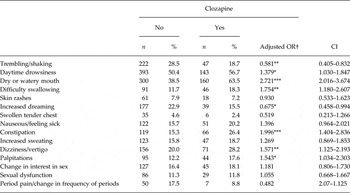
People taking clozapine had significantly higher odds of reported medication attributed experiences of daytime drowsiness, dry or watery mouth, difficulty swallowing, constipation, dizziness/vertigo or palpitations in the previous 4weeks, and significantly lower odds of trembling/shaking or increased dreaming (adjusted analysis, Table 5).
-
(4) Do patterns of psychotropic polypharmacy among people taking clozapine differ from those on other antipsychotic medications?
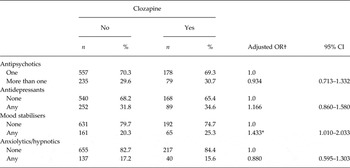
People taking clozapine and those who did not had similar rates of antipsychotic polypharmacy (adjusted analysis, Table 6). Of those in the clozapine group who were taking more than one antipsychotic medication (n = 79, 30.7%), the most commonly used second-generation antipsychotics were risperidone (n = 14 oral, n = 9 parenteral long-acting), and oral amisulpride (n = 16), quetiapine (n = 14), aripirazole (n = 13), olanzapine (n = 7) and ziprasidone (n = 1). Twelve people were on a first-generation antipsychotic (n = 3 oral, n = 9 parenteral long-acting).
Substance Abuse (None v. Any) among 1049 SHIP participants with schizophrenia or schizoaffective disorder who reported using any antipsychotic medication in the past 4 weeks, by use of clozapine

SHIP, survey of high impact psychosis; OR, odds ratio; CI, confidence interval.
Missing cases: alcohol lifetime = 1, past year = 84; cannabis lifetime = 9, past year = 7; amphetamines lifetime = 9, past year = 11; other substances lifetime = 10, past year = 9.
† All variables are adjusted for chronicity and diagnosis.
§ As rated on the Fagerstrom test for nicotine dependence.
*p < 0.05, **p < 0.01, and ***p < 0.001.
Adverse drug reactions in past 4 weeks of 1049 SHIP participants with schizophrenia or schizo-affective disorder who reported using any antipsychotic medication in the past 4 weeks, by use of clozapine

SHIP, survey of high impact psychosis; OR, odds ratio; CI, confidence interval.
Missing cases: trembling/shaking, daytime drowsiness, dry or watery mouth, increased sweating, dizziness/vertigo = 18; difficulty swallowing, nauseous/feeling sick = 19; skin rashes = 23; increased dreaming = 25; swollen, tender chest = 39; constipation, palpitations = 21; change in interest in sex = 26; sexual dysfunction = 40; period pain/change in frequency of periods = 684.
† All variables are adjusted for chronicity and diagnosis.
*p < 0.05, **p < 0.01, and ***p < 0.001.
Rates of Polypharmacy among 1049 SHIP participants with schizophrenia or schizo-affective disorder who reported using any antipsychotic medication in the past 4 weeks, by use of clozapine

SHIP, survey of high impact psychosis; OR, odds ratio; CI, confidence interval.
† All variables are adjusted for chronicity and diagnosis.
*p < 0.05, **p < 0.01, and ***p < 0.001.
The rates of antidepressant and anxiolytic/hypnotic use were similar between those using and not using clozapine (adjusted analysis). People on clozapine had significantly higher odds of taking a mood stabiliser (Table 6). The most commonly used mood stabilisers among those on clozapine (n = 65, 25.3%) were sodium valproate (n = 43), lithium (n = 18) lamotrigine (n = 3) and carbamazepine (n = 1). Three people on clozapine were on anti-seizure medication without mood stabilising properties.
-
(5) What proportion of people taking clozapine report adherence with their clozapine regime and satisfaction with clozapine?
The proportion of people on clozapine reporting that it was ‘somewhat’ or ‘very’ helpful was 88.3%, which is higher than the corresponding results for Zuclopenthixol decanoate (71.7%, parenteral long-acting first-generation antipsychotic) and Olanzapine (76.6%), but not Quetiapine (87.3%) (both oral second-generation antipsychotics). Only 5.2% reported clozapine to be ‘not helpful’ (Olanzapine 8.9%, Quetiapine 3.5% and Zuclopenthixol decanoate 13.6%). Self-reported adherence was high at 91.8% (Olanzapine 85.5%, Quetiapine 82.8% and Zuclopenthixol decanoate 92.6%).
Discussion
Clozapine was used by almost a quarter of all people with schizophrenia or schizoaffective disorder on antipsychotics in recent (12-month) contact with mental health services in Australia. After adjusting for diagnosis and illness chronicity, participants taking clozapine had significantly lower odds of current alcohol, cannabis and other drug use despite similar lifetime odds. Metabolic syndrome, diabetes and epilepsy were more common among people taking clozapine; chronic pain was less common. The probability of psychotropic polypharmacy did not differ between the groups.
Although the survey population in this study differs slightly from the first Australian national psychosis survey from 1997 to 1998, some comparisons can be made. In the first survey, 12.1% of people with schizophrenia on any medication were on clozapine (Castle et al. Reference Castle, Morgan and Jablensky2002). This had more than doubled to 27.2% of people with schizophrenia on clozapine in this 2010 survey. Perceptions of the helpfulness of clozapine remained unchanged between the two surveys, with approximately 5.3% reporting clozapine as being ‘not helpful’ in the first survey compared with 5.2% in this survey.
Strengths and limitations of the study
This study draws from a large epidemiological sample of people with schizophrenia and schizoaffective disorder. It includes diagnostic survey data, biometric measurements and fasting blood results, as well as information on participants’ satisfaction with their medications. However a number of limitations should be taken into account when interpreting our findings.
This survey includes only people in recent contact with mental health services and non-government agencies supporting people with mental illness, and so is missing those people seeing only a private psychiatrist or a general practitioner, which will affect the estimated population with schizophrenia. Given that people on clozapine maintenance were, at the time of the SHIP survey required to attend a hospital affiliated mental health clinic and/or GP appointments every 4weeks, the potential for overestimation is constrained. The 22.4% reported here is considerably higher than the 8.3% estimated in a dispensing sample from Queensland during the same timeframe (Forrester et al. Reference Forrester, Siskind, Winckel, Wheeler and Hollingworth2015).
As noted by Morgan and colleagues (Reference Morgan, Waterreus, Jablensky, Mackinnon, McGrath, Carr, Bush, Castle, Cohen, Harvey, Galletly, Stain, Neil, McGorry, Hocking, Shah and Saw2012), some people did not participate in the survey due to participant refusal or being too unwell to interview. It is possible that these people would have been more likely to have TRS, with or without treatment on clozapine. However, comparison of available participant screening data, including lifetime symptom profiles, for those included and those selected for interview but not participating for any reason suggested that there was no overt selection bias.
Medication usage was based on self-report, as were ADRs. There is risk that self-report may be inaccurate in some cases. However, as per previous studies of self-report medication use and ADRs, there is no reason to suspect systematic bias with self-report (Castle et al. Reference Castle, Morgan and Jablensky2002). For participants on more than one psychotropic agent there can be difficulties in attributing particular ADRs to a particular medication. It is possible that the reported ADRs of people on clozapine and another psychotropic may not have been attributable to clozapine, and as such the comparison of ADRs between the clozapine and non-clozapine groups may underestimate the difference between the groups.
Self-reported adherence to clozapine was high despite high rates of some ADRs (e.g., obesity, drowsiness, dry/watery mouth). This may suggest that these symptoms are considered tolerable by people on clozapine when compared with the benefits they perceive to be associated with this medication. However, we do not know whether survey participants not on clozapine had previously ceased clozapine because of tolerability issues. It is also likely that adherence will have been overestimated because of the 4-week reporting window. The SHIP survey did not gather information about whether people who were not taking clozapine had previous unsuccessful clozapine trials, or trials of other antipsychotic medications, nor did it ascertain how long people had been on clozapine beyond 12 months. This limited our ability to determine what proportion of the SHIP sample with schizophrenia or schizoaffective disorder in our sample would have met criteria for TRS. It also limited our ability to examine factors associated with discontinuation. A separate review of dispensing trends in Queensland, Australia from 2004 to 2013 noted that a quarter of people initiated on clozapine had ceased by 18 weeks (Forrester et al. Reference Forrester, Siskind, Winckel, Wheeler and Hollingworth2015). We were unable to assess the duration between onset of illness and commencement of clozapine.
As this study is a cross-sectional survey, we can only comment on correlations, not causation.
Key findings and implications
People with schizophrenia or schizoaffective disorder on clozapine were more likely to have a chronic course of illness, and after adjusting for chronicity and diagnosis had higher rates of current hallucinations, more negative symptoms, poorer personal and social functioning and were more likely to be single and never married. This would be anticipated given clozapine's indication for TRS, and the associated damaging psychosocial impact.
Although one-quarter of the sample participants were taking clozapine, there were still a large number of people with ongoing chronic illness and high symptom burden who were not on clozapine. Pharmaco-epidemiological studies suggest that only a quarter of people with TRS in Australia are currently on clozapine (Forrester et al. Reference Forrester, Siskind, Winckel, Wheeler and Hollingworth2015). Although we could not derive a sample of people with TRS from SHIP, only one third of people with a chronic course of illness were on clozapine. This data provides further evidence that clozapine is underused in Australia and/or its use has not been tolerated by a substantial proportion of people with TRS. Almost half the people on clozapine did not report a chronic course of illness, but we are unable to ascertain whether any alteration of illness course was related to clozapine use.
Although there are suggestions in the literature that clozapine is associated with higher rates of obsessive-compulsive symptoms (Nielsen et al. Reference Nielsen, Damkier, Lublin and Taylor2011), and lower rates of suicidal ideation (Meltzer et al. Reference Meltzer, Alphs, Green, Altamura, Anand, Bertoldi, Bourgeois, Chouinard, Islam, Kane, Krishnan, Lindenmayer and Potkin2003), we did not find any differences between the groups on these variables.
Of note, people on clozapine were less likely to be homeless. It is unclear as to whether this relates to improved stability associated with clozapine and associated intensive monitoring, or whether homelessness renders use of clozapine too challenging.
Despite higher rates of epilepsy, people on clozapine had lower rates of chronic pain. Clozapine is known to lower the seizure threshold (Pisani et al. Reference Pisani, Oteri, Costa, Di Raimondo and Di Perri2002), but our finding of lower rates of chronic pain among people on clozapine warrants further investigation. A recent Cochrane review suggested that anti-psychotics may have a role in reducing acute and chronic pain (Seidel et al. Reference Seidel, Aigner, Ossege, Pernicka, Wildner and Sycha2013), but there has been limited investigation of clozapine in particular.
Clozapine was associated with significant cardio-metabolic co-morbidity. The rates of diabetes and metabolic syndrome associated with clozapine in this study are consistent with previous reports (Henderson et al. Reference Henderson, Nguyen, Copeland, Hayden, Borba, Louie, Freudenreich, Evins, Cather and Goff2005; Mitchell et al. Reference Mitchell, Vancampfort, Sweers, van Winkel, Yu and De Hert2013). These higher rates of metabolic syndrome and obesity do not necessary mean higher rates of mortality, and this was noted by a Finnish population based cohort study of mortality in people with schizophrenia, which found that clozapine was associated with lower rates of all-cause mortality (Tiihonen et al. Reference Tiihonen, Lönnqvist, Wahlbeck, Klaukka, Niskanen, Tanskanen and Haukka2009). The lower rate of extra-pyramidal side effects and higher rates of cholinergic and sedating ADRs found with clozapine are in keeping with the literature (Nielsen et al. Reference Nielsen, Damkier, Lublin and Taylor2011).
The rate of satisfaction with clozapine was higher than those reported for other representative anti-psychotics, while the reported adherence rate was similar to that of a parenterally-administered long-acting antipsychotic. Rates of antipsychotic polypharmacy were similar between those using and not using clozapine. This may in part be due to augmentation strategies for people with clozapine refractory schizophrenia (Taylor et al. Reference Taylor, Smith, Gee and Nielsen2012), albeit antipsychotic polypharmacy does carry risks and psychiatrist's polypharmacy prescribing practices need critical self-appraisal. People on clozapine were more likely to be on mood-stabilisers. This is likely to be related to the mood-stabiliser's dual role as anti-seizure medication, in response to the impact of clozapine on lowering the seizure threshold, although there is some suggestion that mood-stabilisers may augment the effects of clozapine (Varma et al. Reference Varma, Bishara, Besag and Taylor2011). It was of concern that one person was on both clozapine and carbamazepine given the contraindication to combining these medications (Varma et al. Reference Varma, Bishara, Besag and Taylor2011).
One of our most interesting findings is the association between clozapine use and lower current probabilities of alcohol, cannabis and other drug use, despite similar probabilities of lifetime use of these substances. It is possible that this is a selection bias, in that people are less likely to be trialled or remain on clozapine if they have current substance abuse problems. However, previous studies have shown a reduction in alcohol and illicit substance usage among people on clozapine (Drake et al. Reference Drake, Xie, McHugo and Green2000). It has been postulated that clozapine's neurobiological effects on reducing substance abuse may be mediated by its blockade of alpha-2 noradrenergic and dopamine-D2 receptors and its increase in norepinephrine levels, leading to a normalizing effect on the signal-detection capability of the dysfunctional mesocorticolimbic brain reward circuit (Green et al. Reference Green, Zimmet, Strous and Schildkraut1999).
Conclusions
Clozapine remains the preferred medication for TRS. This study suggests that clozapine is being used for those with more severe illness and that rates of clozapine use are increasing. However there are many other people with severe illness who are not on clozapine. Given the higher rates of obesity, diabetes and metabolic syndrome among people on clozapine, the choice of a trial on clozapine must be weighed against these ADRs. Our finding of lower probability of current substance use and chronic pain among clozapine users warrants further study.
Acknowledgements
This publication is based on data collected in the framework of the 2010 Australian National Survey of High Impact Psychosis. The members of the Survey of High Impact Psychosis Study Group are: V Morgan (Project Director); A Jablensky (Chief Scientific Advisor); A Waterreus (Project Coordinator); A Mackinnon (Statistician); R Bush, D Castle, M Cohen, C Galletly, C Harvey, P. McGorry, J McGrath, H Stain (Site Directors); V Carr (Australian Schizophrenia Research Bank); A Neil (Health Economics); B Hocking (SANE Australia); S Saw (Australian Government Department of Health and Ageing). This report acknowledges, with thanks, the hundreds of mental health professionals who participated in the preparation and conduct of the survey and the many Australians with psychotic disorders who gave their time and whose responses form the basis of this publication. We also acknowledge Sam Mancuso who assisted with the data analysis.
Financial Support
The 2010 Australian National Survey of High Impact Psychosis was funded by the Australian Government Department of Health and Ageing. D J Siskind is supported by a National Health and Medical Research Council, Early Career Fellowship 2016–2019 (APP1111136).
Conflict of Interest
None