Introduction
Among the toughest challenges nineteenth-century German rural planners faced was how to induce small farmers to adopt new agricultural practices. Experts often lamented the chasm between the scientific advances pioneered by the likes of Daniel Albrecht Thaer and Justus von Liebig in the early decades of the century and the legions of ‘backward’ cultivators.Footnote 1 The Prussian Agricultural Ministry’s 1842 naming of a new committee, the Landes-Ökonomie-Kollegium (LÖK), to publicise scientific breakthroughs, the burgeoning rural press and the explosion of regional and local agricultural associations testified to the enduring nature of the problem.Footnote 2 Of course, German agricultural improvers were not alone; as Peter Jones recently observed about Europe as a whole between 1750 and 1840, ‘The encyclopedic approach may have launched Agricultural Enlightenment, but it was not necessarily well-designed to usher knowledge about farming into the safe harbor of improved practice.’Footnote 3 The crop failures of the ‘Hungry Forties’ and the 1848–9 revolutions only intensified reformers’ sense of mission.Footnote 4
The surfeit of technical manuals, scientific journals and government reports about agrarian improvement have made it easy to overlook the visual sources and hands-on models that sprang up across the German landscape after 1850. Moreover, Prussia’s vigorous nineteenth-century schooling campaign meant that literacy rates, including the rural population, had reached 88 per cent by German unification in 1871, the highest in Europe.Footnote 5 Yet experts increasingly believed that material sites such as test plots were vital tools for educating the vast majority of farmers who could not afford elite agricultural schools, or even short stints at so-called winter schools. This article explores how these activities came to be vested with such importance, and contends that they embodied a reckoning with the fraught relationships between farmers and scientific advisers that challenges current narratives about the rise of nineteenth-century cultures of expertise.Footnote 6 In the German case, Frank Uekötter has described a process of ‘oligarchization’, whereby experts increased their influence on state policymaking at the expense of building trust with the farming population, and asserts that advisers only began to ‘see’ farmers in the mid-twentieth century.Footnote 7 But farmers’ mistrust was precisely the hurdle that the activities described here sought to allay and reformers often referred to their audience as ‘the agricultural public’ (das landwirtschaftliche Publikum).Footnote 8 The conviction that such sites were an essential complement to the laboratory, moreover, shows that experts had a more flexible understanding than has been appreciated of where new knowledge was produced and by whom, how it circulated and how scientific credibility was achieved.Footnote 9 Indeed, it suggests that the precepts that guided eighteenth-century European travelling agriculturalists, who sought ‘to turn farmers’ local practice into useful knowledge’, remained resilient throughout the nineteenth and into the twentieth century as well.Footnote 10
Beginning around mid-century, German rural planners began to stress the singular power of visual culture to transmit new farming practices and new values. Thus, in 1849, the head of the LÖK asserted: ‘Who hasn’t heard the farmer’s almost stereotypical reply when urged to try something new: “I first need to see that”? And who hasn’t observed neighbors’ curiosity when one in their midst has decided to take the plunge? In short: the farmer prefers to learn through example.’Footnote 11 More than fifty years later, another declared, ‘A precisely-conducted comparative field experiment is more convincing than 100 lectures and 100 books.’Footnote 12 Accordingly, the surest way to translate scientific gains into common practice was to prevail upon farmers as habitually keen observers who preferred to learn through experience. This is important because instead of merely condemning farmers’ mistrust of the new, some experts consciously began to put themselves into the shoes (or clogs) of their intended audience, that is, to see ordinary farmers as potential partners in the project of rural change.Footnote 13 The narrative of farmers as cautious but curious learners that arose between 1850 and the First World War did not replace the derisive judgements of some, or mean that tension and mistrust on both sides did not slow the spread of new agricultural knowledge.Footnote 14 It also coincided with the increased power of formally trained agricultural advisers in state policymaking, as Uekötter and others have shown. But one cannot ignore, too, the growing intellectual, cultural and financial investment in this new point of view and how it spawned increasingly sophisticated material sites of agricultural improvement. The emerging historiography on the interplay between the history of science and agricultural history is instructive here, with its emphasis on farms as complex ‘objects of knowledge’ and the role of farmers themselves in the diffusion of new ideas and practices.Footnote 15
German planners used multiple stages, or scales, to develop a visual culture of agrarian reform, and there was frequent transfer between them. Sites changed over time, moved locations and sometimes disappeared. Displays grew more sophisticated with technical breakthroughs in cartography, photography and agronomy, as well as larger and grander as the result of increased government funding. Most of these efforts directly targeted small- and medium-sized farmers, meaning those who worked holdings between one and twenty hectares, while others aimed to attract a broader audience that included the press, city dwellers and the growing transnational cadre of rural experts. In the case of exhibitions, the hope was that they would increase public awareness of and interest in agricultural innovations, giving farmers an extra nudge to try something new. After Germany’s political unification in 1871, these endeavours assumed new urgency as the goal of increasing the quality and quantity of the food supply became intrinsic to national policymaking. I have chosen three examples that typified the visual landscape of agrarian science in the German Empire: agricultural exhibitions, test plots and model farms. Taken together, they illustrate how multiple, interconnected visual scales took shape both materially and discursively, and how different forms of display were tailored to specific aims; the linked networks that nurtured these efforts; and how, over time, new ideas and critiques were incorporated into the Ausstellungs – or Schauwesen of rural planning.
But first a word about the transnational context, the range of problems and solutions such projects presented and the tricky issue of reception. First, the influence of the English example on Germany’s visual culture of rural reform cannot be overstated and dated from at least the 1780s.Footnote 16 Indeed, as the nineteenth century progressed, German experts lauded not only English farming practices as the world’s most advanced, but also the methods used to disseminate them. The model of the English Royal Agricultural Shows, first held at Oxford in 1839, loomed especially large. Planners also looked to the Low Countries, Denmark and France for inspiration. Another transnational facet of these projects that, for reasons of space is not explored here, is how they were enmeshed in north-western Europe’s broader exhibition culture of industry and overseas empire.Footnote 17 Using regional and local sources, however, permits a closer view of the relationships between experts and farmers and how displays were tailored to the perceived needs of specific locations. Since the article is part of a larger study of German moor reclamation and colonisation, many of the examples come from north-western Prussia, where the main barriers to agricultural productivity were acidic peat soils and ‘primitive’ cultivation methods like fire farming. Finally, German organisers frequently pondered the question of whether and how such spectacles influenced farmers’ practices. Some measures used to gauge impact included counting the numbers of visitors, exhibitors and participants in exhibitions; travelling agronomists’ reports about whether cultivators emulated expert examples; and, after 1890, how many farmers participated in the expansion of test plots. Before the First World War, farmers themselves began to seek the advice of agronomists, providing another glimpse into the nature of the expert-layman collaborations these activities strove to foster.
The problem of (mis)trust
In 1853, agronomist Wilhelm Hamm was the likely author of an article that celebrated the advances of the previous half-century, ‘Agriculture’s scientific epoch’, in his eponymous Agronomische Zeitung (Agronomical Newspaper).Footnote 18 A former student of Liebig’s, Hamm was best known for his massive study of English agricultural practices and machines and as Germany’s leading agricultural machinery manufacturer. The article warmly praised Daniel Albrecht Thaer, who had ‘freed’ German agriculture from the ‘chains’ of prejudice and made it ‘almost as prosperous’ as the English. The author also lauded Liebig and other chemists who had transformed the ‘art of agriculture into a science’. Noteworthy here, however, is his criticism of Liebig’s dismissive treatment of ordinary farmers. By calling them ‘dim-witted thinkers, he thereby set the entire class [Stand] against him’.Footnote 19 Given that Liebig was already firmly established in the pantheon of German scientists, this was quite an indictment in the leading publication of agrarian science. Nonetheless, the author reassured readers that farmers bold enough to try the new fertilisers eventually ‘saw agriculture through the eyes of science; farmers began to trust themselves, and a new spirit arose among them’.Footnote 20
Also in 1853, the liberal Deutsche Vierteljahrsschrift published a lengthy article that described strategies to improve ‘the small farmer’.Footnote 21 These ranged from advice about bolstering farm children’s education to courses at technical schools (Gewerbeschulen). But the author paid special attention to the power of visual displays and face-to-face encounters between farmers and their would-be advisers. The descriptions of best practices blended characteristic condescension with an effort to explain farmers’ aversion to risk. For example, the article opens with an exhortation to his fellow improvers to ‘bring [your] greater intelligence to bear, but at the same time, always maintain the rural point-of-view [den Standpunkt des Landlebens festhalten]’.Footnote 22 What did this mean, exactly? His explanation of the rationale for visual endeavours as tools of reform stressed their capacity to build trust and, just as importantly, to ease mistrust. The section on model farms, for example, advised the scientific supervisor to behave ‘not as a dictator, but instead to work with the farmer so that he understands the science and is persuaded by it, so that the farmer himself can answer neighbors’ questions’.Footnote 23 The farm itself should be typical of the locality, ‘so that the most common mistakes and deficiencies might be addressed. The model farm must be adapted to the needs of the area.’Footnote 24 He cautioned too that farmers ought not to try every new product and method, and urged them instead ‘to keep a watchful eye on the examples of neighbors, sift through new [ideas] and retain the best ones’.Footnote 25 The author also warned that farmers’ mistrust could have lasting consequences, and that ‘once fooled, [he] will resist all changes, which is not just an individual loss, but a blow to the national good’. Indeed, none other than Prussian Prime Minister Otto von Manteuffel advocated a network of test plots in 1855, because in contrast to agricultural schools and state laboratories, ‘test plots have the advantage of attracting ordinary farmers’ attention and the lessons drawn from them will have immediate practical and fruitful benefits’.Footnote 26
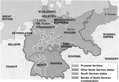
Map of Germany.

The goal of earning trust remained a central theme of the agrarian scientific reform literature, and experts continued to promote visual displays as the best way to build bridges between farmers and themselves. An 1876 article in the newspaper of Württemberg’s Agricultural Council about the need to expand the number of test plots in that south-western state was typical (Figure 1). The author began his pitch with the contention that ‘the only way we are going to persuade the majority of farmers to change their deficient cultivation and fertilization methods is for us to be clear about why the farmer clings to the old ways’.Footnote 27 He explained farmers’ reluctance as a logical aversion to venture onto ‘uncertain ground’ and concluded that ‘the farmer needs to see with his own eyes that he can enact change without worrying about the high cost of failure’. He concluded with the recommendation that travelling instructors be assigned smaller areas to cover ‘in order to become completely familiar with the locality’s land and people, putting him in the position to build the necessary trust’. In the scientific literature on wasteland reclamation, whose main focus was the transformation of raised peat bogs, or high moors, into productive arable, the goal of nurturing trust between poor farmers and scientists became a commonplace. German agronomists constantly bemoaned moor farmers’ ‘backward’ practice of fire farming to grow buckwheat and the environmental damage it caused.Footnote 28 However, they also conceded that the frustratingly slow pace of scientific research into affordable alternatives and the many failed experiments conducted by the Bremen moor research station (MVS), the first of its kind, made farmers’ mistrust entirely logical. In his 1883 summary of the station’s first five years of work, Dr Moritz Fleischer reflected:
In light of moor farmers’ generally deficient material and mental resources, and their persistent mistrust, we needed to approach [our jobs] with the greatest caution. Only through careful planning, frequent personal contact, frank admission of our mistakes and a constant emphasis on the fact that [the goal] is to learn through trial and error, will we gain the trust of the more intelligent moor cultivators, inspire them to try their own experiments and follow our guidelines.Footnote 29
Agricultural exhibitions
Agricultural exhibitions on a regional scale first took off in the 1860s throughout the German-speaking lands. German reformers also organised international shows, like the one in Hamburg in 1863, and participated in exhibits staged abroad. Indeed, by the end of the decade, experts had begun to reevaluate what their purpose ought to be and criticised the hoopla and expense of some, likening them to raucous carnivals that attracted too many non-farmers.Footnote 30 Others, like a travelling instructor (Wanderlehrer) in 1869, defended exhibitions as the only way for small farmers in remote districts to see the latest advances all in one place, and because ‘one must remember that theoretical lessons will never achieve anything unless they go hand-in-hand with practical observation’.Footnote 31 He contended that such events should banish ‘hocus pocus’, namely the sale of goods unrelated to farming and sports competitions, which prevented the average farmer’s careful contemplation of what he was seeing. Moreover, he urged the substitution of placards in German for those in English and French, that knowledgeable representatives should be on hand to answer questions and that judges’ deliberations about prizes should take place publicly, ‘so the why of the [winning] selection is known’.Footnote 32
Exhibitions typified Imperial Germany’s visual culture of agrarian improvement and took place at the district, regional and national levels. In 1874, the Bremen Agricultural Society hosted the new Empire’s first International Agricultural Show.Footnote 33 The Bremen show, held over eight days in June, attracted 160,000 visitors.Footnote 34 Though billed as an international event, the region’s most eminent rural reformer, August Lammers, conceded later that it was ‘basically an exhibition of northwestern agriculture, bolstered by some contributions from elsewhere in the fatherland’; the claim to internationality rested on the inclusion of some English and American agricultural machinery.Footnote 35 Like the English Royal Shows, the main draw for organisers and attendees alike was livestock, with machinery a close second.Footnote 36 Still, in a story for the regional Weser-Zeitung, one reporter stressed the French influence on the Bremen plans. German visitors to the 1873 Vienna World’s Fair, he noted, had been deeply impressed by France’s exhibit of its agricultural progress that presented ‘tableaux in matching frames that compared farm buildings, livestock, harvest yields, implements, etc. as they were [twenty-five years before] and today – the incredible difference between then and now was instantly apparent … If one were to ask how such gains were achieved, one had only to look at the tableaux devoted to prizes and exhibitions’.Footnote 37
Agricultural science also was represented in Bremen. As one planner explained, ‘The exhibition should not be merely a gleaming showpiece … but instead sow vital and healthy seeds to promote the lasting improvement of soil cultivation, forestry and agriculture as a whole.’Footnote 38 To spur interest in the latest moor cultivation practices, a study trip was organised to view the experiments at Haus Füchtel in the neighbouring Duchy of Oldenburg, which attracted some seventy participants.Footnote 39 Another highlight was the ‘scientific exhibit’ sponsored by fourteen of Germany’s thirty-nine agricultural research stations.Footnote 40 The displays used charts to explain the stations’ work and showed instruments available to farmers for soil sampling, gathering weather data, conducting fertiliser tests, seed cleaning, etc. Photographs depicted the weed-infested fields that resulted from using contaminated seeds. Others illustrated the differences in root growth using various fertiliser mixes. The regional Weser-Zeitung exulted: ‘With pride and joy we can confirm that Bremen’s exhibition of agricultural research stations was path-breaking, and presented the largest and most complete picture of scientific research that even professionals had ever seen.’Footnote 41 At the meeting of German agronomists, held on the final day, renowned chemist Erwin Nobbe cheered Germany’s position as the world leader in state-backed agricultural stations and noted that England and France still possessed only private laboratories.Footnote 42 However, to loud cheers, Nobbe also used the occasion to stress the need for such a facility in the north-west, ‘where the extreme poverty of huge swathes of land is in dire need of the advice and guidance of a research station’. Two years later, in 1876, the Prussian Agricultural Ministry named a subcommittee, the Central Moor Commission, which in turn created the aforementioned Bremen moor research station in 1877.
In 1885, engineer Max Eyth formed the German Agricultural Society, or Deutsche Landwirtschafts-Gesellschaft, to organise exhibitions annually in cities across Germany with the goal of presenting ‘a unified picture of the entire [German agricultural] sector’.Footnote 43 Eyth, who had twenty years of experience working for the Fowler steam plough company in England, was a great admirer of the Royal Shows and countered doubts about whether the English exhibition model was right for Germany with a long list of strengths.Footnote 44 In particular, he praised the fact that they were supervised by ordinary farmers ‘who recognize how much a well-run, solidly constructed, goal-oriented exhibition culture can contribute to a nation which aspires to lead the world’.Footnote 45 He also commended the English shows’ balance of experienced and new organisers, who could provide fresh ideas and criticisms. Indeed, the DLG sought to forge a distinct exhibition culture for German agriculture: ‘The shows are not an end in themselves, like our international ones, and not just appendages to our associational festivities … but instead … aim to more or less grapple with very specific practical challenges’.Footnote 46 The determination to stress the exhibitions’ national character solidified over time: all German farmers were eligible to participate, non-German exhibitors were excluded and efforts to restrict competitions to those from a given region were rebuffed: ‘all participants should be measured against the standards set in other parts of Germany … The DLG exhibit cannot fulfill the duties of regional shows, nor does it make them obsolete; in fact, the regional shows are excellent preparation for the national ones.’Footnote 47
After the first DLG exhibit in Frankfurt in 1887, the event moved between large cities across Germany, from Königsberg in East Prussia to the newly-German western city of Straßburg, and from Hamburg in the north to Munich in the south. In 1898 and again in 1910, the Society published detailed reports on the numbers of exhibitors and attendees, judges and prizes, preparations and buildings, the event’s costs, and benefits and summaries of their influence on agriculture. Displays of moor cultivation began in 1889 in Magdeburg and took place only every other year.Footnote 48 The DLG report on shows held between 1899 and 1910 singled out the moor reclamation and cultivation displays at the exhibitions in the north-eastern state of Posen (1900) with fifty-seven exhibitors, ninety-seven at the Hanover venue in 1903 and eighty-five at the 1903 Munich show; by comparison, there were hundreds of exhibitors in dairying, wine, agricultural machines and even beekeeping.Footnote 49 In particular, the Munich organisers were commended for offering a series of study trips to view all four Bavarian moor research stations.Footnote 50 Germany’s agricultural research stations also participated, with by far the largest displays in Munich (109) followed by Berlin (93) the following year. In fact, the Bavarian Moor Research Society (Moorkulturanstalt) staged such an impressive exhibit that the DLG limited the number of prizes for which they could compete.Footnote 51 All four Bavarian research stations created large exhibits with soil maps and samples, photos of test plots and laboratories, drainage equipment, plaster topographical models, albums depicting the variety of Alpine moor vegetation, as well as glass containers with crops grown using different fertiliser combinations.Footnote 52 The advances of German moor cultivation were also on display at the Gothenburg Agricultural Exhibition in Sweden in 1891 and at the World Expositions in Paris in 1900, and four years later in St Louis 1904.Footnote 53 New Bremen research station chief Bruno Tacke observed proudly that Germany and Austria were the only countries that devoted a special section on moor cultivation in the Agricultural Hall.Footnote 54
The national and international exhibitions became celebrated vehicles for advertising the progress of German agriculture and scientific knowledge in the Empire, but to whom? Reading reports of these events by the DLG and the press, it is clear that the shows attracted both rural and urban dwellers and nurtured new markets for agricultural products. Most obviously, of course, they were held in large cities and thus it is likely that a good proportion of visitors came from the host city and that the most prosperous farmers made the journey, even given the provision of transport subsidies by agricultural associations. The shows also underscored Germany’s federal identity by celebrating the links between a given region, or Heimat, be it Rhenish, Bavarian, or East Prussian, and the new nation. The themes of national unity and rural diversity were reinforced by the ceremonial appearances of state and national political figures eager to demonstrate their support for the agricultural sector.
Measured in the numbers of viewers, the DLG Wander-Ausstellungen outranked any other displays of agrarian improvement in the Imperial era. Between 1887 and 1910, they drew 3,722,627 visitors in total; the Hamburg shows set the record for attendance, followed by Berlin and Munich, while the events in Posen, Danzig and Königsberg attracted considerably smaller crowds.Footnote 55 In their assessments of the first decade of DLG Wander-Ausstellungen, planners confirmed that while June was a convenient time for farmers to attend the show, the lower numbers of exhibitors and attendees in the eastern locations was due to the greater distances and less developed rail network.Footnote 56 By contrast, they attributed the excellent infrastructure, commercial vibrancy and central geographical location for the success of the Hamburg and Berlin venues. The carefully gathered statistics helped planners to decide future sites, and cities competed fiercely for the honour of hosting the exhibition and the revenues and publicity it garnered. But planners did not distinguish between rural and urban viewers, and mentions of the audience in the agricultural press rarely differentiated between large and small cultivators. For example, at the 1889 Magdeburg show, one observer commented that the fertiliser exhibit of the Lingen (Emsland) substation in western Hanover ‘inspired widespread amazement; the enormous difference in crop growth was there for all to see. It is clear that [these experiments] … will exercise great influence on agriculture generally, and on the high moors of the Ems region in particular.’Footnote 57 The DLG insisted that experts and experienced annual viewers ‘had no trouble discerning the shows’ positive effects’, however, it acknowledged that ‘many of the displays acquire significance for the general public only after subsequent in-depth discussions’.Footnote 58
One feature of the wasteland cultivation displays, which may have held special interest for smallholders, were depictions of new agricultural colonies that appeared after 1900. In 1904, at the Berlin Exhibit for Moor Cultivation and Industrial Peat, the Hanover Agricultural Chamber unveiled an elaborate spectacle of the ongoing moor colonisation projects at the Provinzialmoor in East Frisia.Footnote 59 Recalling the French example, there were graphic illustrations of each smallholding’s development between 1899 and 1902, and of the project’s evolution since its inception in 1889. The exhibit also included a model of a newly constructed colonist house ‘that reflected long years of experience to overcome the many challenges posed by building on peat soil’, photographs of colonists at work and of individual holdings, and containers of crops including sheaves of rye and oats, hay, potatoes, turnips and fodder beets.Footnote 60 A provincial exhibit of moor cultivation held in the north-western city of Osnabrück in 1908 expanded on this theme. Here, district and state agricultural associations presented a rich array of visual material that underscored the prosperity of Hanoverian moor colonies established in the previous two decades. The exhibit included ‘very clear, large-scale photographs’, graphic tables of the amount of meat produced by livestock raised on test pastures, soil samples that demonstrated the infertility of moors that had been depleted by burning and models constructed by farmers in East Frisia that showed the use of sea sludge (Seeschlick) as a soil amendment.Footnote 61 The district of Meppen presented photos that compared a moor colonist’s house fifty years before with new ones and offered details about building costs, together with house plans.Footnote 62
This sketch of the ways exhibitions were used to convey the goals of agricultural improvement, the potential audiences for such spectacles and experts’ hopeful projections about their capacity to effect changes in practice still begs many questions. Whatever the perceived benefits of visual culture to persuade farmers to substitute one fertiliser for another or to experiment with a new crop, the main weakness of exhibitions was that they presented ‘only the best’ or ‘the best of the best’. Berthold Wölbling, head of the DLG between 1886 and 1907, was acutely conscious of the problem. He observed:
We must be clear about the limits of exhibitions’ influence … Only the best is shown, regardless of the labor and the costs involved in its production. Those who assert that the examples on display, lacking such information, are not likely to be imitated are to a certain degree correct. The other limitation is that the viewer rarely sees the process through which something is produced.Footnote 63
Advocates instead stressed the spirit of competition the displays inspired, and planners took pains to make the rules of competition clear and appoint ‘independent and expert’ panels of three judges.Footnote 64 This is not to say that transgressions did not occur, but rather that the exhibitions sought to instill cultural values of hard work, innovation and ‘fair play’, in addition to the visual evidence of agricultural progress.
German rural experts’ attempt to invest visual displays with the cultural values they felt were key to spurring the productivity of family enterprises was captured succinctly by Dr Salfeld, the lead agronomist of the remote moor research substation in Lingen.Footnote 65 His article, ‘First the envy must come!’ appeared in the Agricultural Newspaper for Northwest Germany in 1896, and referred to a moor colonist’s rejoinder to Salfeld’s query about why his neighbours did not follow his example of using chemical fertilisers on pasturage. Salfeld intoned that in such instances, envy was not ‘hateful and immoral’, but instead a useful motivator and offered similar examples of success that had ‘finally opened the eyes’ of colonists: ‘Yes, envy in the good sense is far more powerful than all the lessons offered by agricultural associations, the rural press and agricultural schools.’Footnote 66 This anecdote helps direct our attention to a different visual scale of reform activity in the German countryside, namely experts’ creation of test plots and model farms. And while it is just as difficult to gauge the size of the audiences for such spectacles, test plots and model farms displayed the trials and errors that exhibitions hid from view. Moreover, because a test plot was tailored to the physical conditions of a specific site and the changing needs of local enterprises, scientists could demonstrate a direct connection between reform and individual livelihoods.
Model farms and test plots
In his recent history of the construction and dissemination of agricultural knowledge in Germany, Frank Uekötter emphasises the tension between experts’ quest for authority and the many uncertainties and variables of agricultural science. This tension was nowhere more evident than in the field, where exercising consistent control over experiments proved elusive.Footnote 67 Uekötter argues that despite its imprecision, the test plot, or Feldversuch, remained the gold standard as a site for agricultural research. This was because, in contrast to the laboratory, the Feldversuch projected ‘an aura of transparency and authenticity’.Footnote 68 After all, Uekötter reminds us, ‘At the end of the day, the aim of agronomy was to improve agricultural practice.’Footnote 69 Rural sociologist Christopher Henke makes a similar point in his work on efforts to improve agriculture in present-day California: ‘By appropriating both the supposed objectivity of science and the place-bound aura of farming a specific piece of land, advisers use these [field] trials to build consensus around their research.’Footnote 70 But the idea has a much longer history, and there are striking continuities in agrarian experts’ approach to the use of test plots and model farms as tools of reform. One reason for their enthusiasm was the potential to enlist farmers not only as viewers but also as participants in the larger project of agrarian improvement. With respect to moor cultivation, German agronomists tried all sorts of ways to induce small family farmers to undertake experiments in order to serve as examples to their peers. These included the provision of subsidies to smallholders willing to try new soil amendments and fertilisers, and the annual competitions held at many moor colonies for ‘best enterprise’.Footnote 71
In the first half of the nineteenth century, numerous German improvers established model farms and many more advocated them as a critical means of showing new and ‘advanced’ practices to ‘the agricultural public [das landwirthschaftliche Publicum]’.Footnote 72 As early as 1819 Carl Sprengel, a pioneer of moor science from Hanover, strongly urged the creation of experimental enterprises, claiming ‘it would show those [farmers] with meager capital an example which proves that, even without means, cultivation can be improved if one learns the correct methods. The skeptic is only won over by examples, only by seeing can those who are difficult to reach be persuaded.’Footnote 73 Sprengel’s mentor, fellow Hanoverian Albrecht Thaer, was, as we have seen, nineteenth-century Prussia’s most famous booster of English agricultural methods in both his writings and at model enterprises.Footnote 74 The first, at Celle near Göttingen, and later at the Möglin estate, east of Berlin, provided some of the earliest visual demonstrations in Germany of English innovations like green fodder, four-course crop rotations and new implements.Footnote 75 In 1851, Thaer’s student Johann Schwarz published the first German guide for creating experimental farms based on his experience leading the agricultural association of West Prussia, in present-day Poland.Footnote 76 In the preface, Schwarz’s editor observed that such undertakings made sense because ‘[the farmer] never works with a book in his hands’.Footnote 77 Schwarz proposed the establishment of two types of model farm, those run by experts and those worked by leaseholders ‘who through exposure to the former have become convinced of the utility of new ideas’.Footnote 78 It was not long before experts in Germany’s north-western moor regions, where agricultural ‘backwardness’ and endemic poverty had aroused concern for decades, began to envision a network of model farms. In 1862, moor scientist and social reformer Wilhelm Peters in Osnabrück repeated the now common refrain:
The huge advantage enjoyed by English agriculture is attributable to the creation of model enterprises based on thoughtful organization, and which are open to the visits and scrutiny of all. In our so-called good areas one finds well-run farms that invite inspection … [In the heathlands] local cultivators cling to the old ways, they first want to see the feasibility of new and improved methods and then see them again. Thus everything moves slowly. If we want to help them, we would establish true model farms among the enterprises under discussion.Footnote 79
German rural planners’ oft-expressed admiration for English models of rural improvement was reciprocated in kind. Thus, in 1864, members of the Royal Agricultural Society concluded that ‘The best thing to be done, therefore, was to establish experimental stations, as was done in Germany. That was the only perfect and feasible system of getting what was really wanted, namely abstract truth for practical application.’Footnote 80
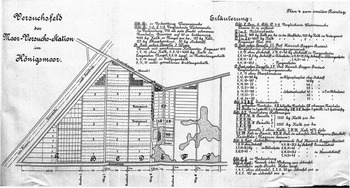
Between its founding in 1877 and the First World War, the Bremen moor research station created and oversaw a network of some 330 test plots.Footnote 81 In 1908, the director observed that the Station’s mission was not only to produce scientific and technical knowledge, but also to share ‘good and certain’ moor reclamation practices with the agricultural public.Footnote 82 The test plots were closely tailored to each site, he explained, ‘in order to gain the trust of surrounding colonists and thereby influence their farming practices. This technique proved incredibly beneficial for spreading new experiences with moor cultivation and to instigate the improvement of the areas in question’; the Station soon added model farms to this foundation of visual culture in order to ‘display the entire process, showing farmers how to introduce these improvements in the quickest and most certain manner’ (Figure 2).Footnote 83 A few years later, on the eve of the First World War, the station’s director reported gleefully that so many Oldenburg farmers had sought funding to create test plots that some applications had to be turned down.Footnote 84 By then there were a total of 204 sites in the states of northern and western Germany, and another 154 in East Elbia and Schleswig-Holstein.Footnote 85 The German Association for the Advancement of Moor Cultivation in the German Empire was another important sponsor of test plots, with 116 examples scattered across Germany.Footnote 86 Last but not least, the Bavarian Landesmoorkulturanstalt, established in 1895, supervised a network of test plots run by the state’s four moor research stations that had grown to 212 hectares by 1907.Footnote 87
Test plots at Königsmoor, Hanover.

Who saw these test fields besides other agronomists and students at agricultural colleges? The 1889 edition of the journal of the Association for the Advancement of Moor Cultivation in the German Empire provides one tantalising example. In early June of that year, Dr Salfeld reported that he held a public talk at the test plots in Groß Fullener Moor west of Meppen in the Emsland.Footnote 88 The purpose was to persuade local cultivators to adopt chemical fertilisers, abandon moor burning and try new crop rotations. He began by exclaiming ‘You have seen with your own eyes the wonderful crops grown on high moors using calcium and artificial fertilizers.’ Salfeld then explained in detail how even poor moor farmers could make these improvements at a reasonable cost and therefore secure a more prosperous future for themselves and their families. Most telling of all was Salfeld’s footnote, which reported that, ‘Despite the unusual heat, 200 farmers and women [Bauern und Frauen] from up to forty kilometers away participated in the viewing of test plots.’Footnote 89
Another reform method borrowed from the English was to sponsor competitions for ‘best moor farm’. In 1897, for example, residents of five moor colonies in Osnabrück district were invited by the Moor Research Station to compete for a prize of 650 marks. Three judges, led by Dr Salfeld of the Lingen substation, evaluated the thirteen entrants on the quality of their crops, soil improvements, livestock, manure collection, condition of buildings and implements, the household (innerer Haushalt) and the farm’s overall condition.Footnote 90 After the judges’ first visit, which was pre-announced, three finalists were selected, including one widow Wilken; the second visit, unannounced, led the judges to conclude that all three enterprises were so exemplary that the prize was divided among them, with Widow Wilken receiving the highest prize of 230 marks. In their summary, the judges urged the MVS to publicise the results in the local press, ‘to spur other moor colonists to undertake similar improvements’.Footnote 91 Moreover, in their description of Widow Wilken’s achievements, it was noted with admiration that she and her young son had received ‘no advice from the moor research station consultant; they must have seen the Station’s pasturage test plots and imitated them’.Footnote 92
One final example of moor farmers’ interest in using test plots for their own benefit is the programme launched by Bremen scientists in 1890 to enlist volunteers to try a new soil amendment, Seeschlick, or sea sludge, from Wilhelmshafen harbour. First introduced in several localities in the Stade district of Hanover, local magistrates reported that the meetings to gauge interest among moor colonists were ‘well-attended’ and almost three hundred farmers in four villages participated the first year.Footnote 93 Indeed, by October the local technical adviser (Kreisbauinspektor) in Blumenthal urged his superiors to expand the programme to more remote areas.Footnote 94 At the same time, he also cautioned that some participants were still ‘somewhat mistrustful’ of the artificial fertilisers that they were required to use in conjunction with sea sludge and declared, ‘We must combat this mistrust, and I propose that we not only offer the Seeschlick for free, but also without strings attached … so that the colonists can figure out for themselves how best to use it.’Footnote 95 In 1900, MVS director Tacke contacted a number of Stade district magistrates about the expansion of test plots and sought recommendations for ‘absolutely reliable and hard-working colonists’, who would receive materials and free guidance.Footnote 96 Over the next decade, a number of farmers voiced interest in the programme to local authorities, volunteering to conduct experiments on their plots. All of them were knowledgeable about the details and some even contacted Bremen scientists directly with their requests. One of them, G. H., leased a small plot of four Morgen (1.6 hectares); in addition to describing the plot’s suitability, he also supplied a strong recommendation from the local magistrate.Footnote 97 Another, Hermann S., had visited the MVS and spoken with Tacke about his proposed experiment.Footnote 98 Two others, Didrich K. and Didrich T., explained that they wanted to participate because peat cutting no longer provided a liveable income and they wanted to create better cow pastures.Footnote 99 Another, carpenter Martin T., sought to create a test plot on his small farm and requested only that if interested, the MVS give him a day’s notice so he could leave work and show them his site.Footnote 100 These testimonies reveal not just a determined desire to improve their land, but an eagerness to forge partnerships with the region’s leading scientific advisers.
Conclusion
The visual culture of agrarian improvement in Germany blossomed in the middle of the nineteenth century in tandem with other, more traditional methods of scientific education like the prestigious institutions at Hohenheim and Weihanstephan. It also coincided with the strengthening of agronomists’ influence on state-sponsored rural improvement projects such as the development of chemical and artificial fertilisers, the promotion of scientific endeavours like soil sampling and seed breeding, and the building of new farm colonies. The most lavish displays were the DLG-sponsored national agricultural exhibitions, but local and regional events helped to reinforce how expert knowledge might be adapted to individual localities and broadened the audience to include small farmers eking out livelihoods in more remote rural districts. These efforts were supplemented by the expansion of model farms and test plots, which had the advantage of giving visual expression to change over time rather than the optimistic ‘snapshots’ of scientific progress presented at agricultural exhibitions.
Taken as a whole, the visual culture of agrarian science in Germany represented a distinctly new approach to the problem rural experts confronted of how to persuade ordinary farmers to venture onto unfamiliar ground. The lively discussions that accompanied these displays and advisers’ close involvement in them expands the existing narrative of agricultural scientists as elite laboratory and government professionals who eschewed the tedious and maddeningly unpredictable work in the field. In particular, the experts discussed here understood clearly that their task would be far less arduous if they earned the farming population’s trust and that the reluctance to abandon old agricultural techniques, whether merited or not, could be quelled by appealing to farmers as astute observers and hands-on learners. The evidence, especially from the local level, demonstrates that these initiatives often found receptive audiences, even if mistrust or suspicion lingered. For historians, a closer examination of these sites and their effects helps to nudge us away from an accounting of scientific breakthroughs led by a cadre of renowned experts and towards an understanding of the difficulties involved in changing daily practices, farming or otherwise.
Acknowledgements
The author thanks the journal’s anonymous reviewers and Carl Griffin for their helpful comments on this article.