Introduction
Emotion perception has largely been showed impaired in patients with schizophrenia, compared to healthy controls Reference Trémeau(1). These deficits are present at the onset of illness Reference Pinkham, Penn, Perkins, Graham and Siegel(2) in both medicated and unmedicated subjects with schizophrenia Reference Kerr and Neale(3,Reference Mueser, Doonan and Penn4) and are significantly correlated to poor social functioning, low levels of social skills and worse vocational functioning Reference Couture, Penn and Roberts(5). Despite this general consensus, there is controversy regarding the exact mechanism explaining the deficit of emotion processing. The unresolved question focusses upon whether this deficit is specific for facial emotion, or if it is secondary to an impairment in face perception.
At the heart of the dominant models for face recognition in healthy subjects Reference Bruce and Young(6,Reference Haxby, Hoffman and Gobbini7), there is the idea that facial identity and expressions are recognised by functionally and neurologically independent systems: one codes changeable facial properties (such as expressions), the other codes invariant facial properties (such as facial identity) Reference Calder and Young(8). The proposal that different anatomic structures process different types of information might lead to a prediction that the perception of facial identity and the perception of facial expression are independent Reference Fox, Oruç and Barton(9). Although traditional models in cognitive neuropsychology have often assumed that facial expression and facial identity are processed along two separate pathways, evidence from fMRI and ERPs suggests instead that emotional processing can strongly affect brain systems responsible for face recognition and memory Reference Vuilleumier and Pourtois(10).
In schizophrenia patients, the processing of facial information has not been systematically examined. Three hypothesis have been formulated about the relationship between face perception and facial emotion recognition. Based on observations that patients were impaired in recognising both emotional and non-emotional facial stimuli, several authors sustained the hypothesis of ‘generalised deficit' (Reference Kerr and Neale3,Reference Mueser, Doonan and Penn4,Reference Novic, Luchins and Perline11–Reference Johnston, Katsikitis and Carr16). In support of this hypothesis, studies on other emotional channels (i.e. prosody) produced similar results consistent with a generalised deficit of emotion perception, probably because of a general cognitive impairment of patients (Reference Edwards, Pattison, Jackson and Wales17–Reference Kohler, Turner and Bilker21). In contrast, other authors found that schizophrenic patients are compromised only in facial emotion recognition tasks, with intact facial recognition, supporting the existence of a specific deficit of emotion perception (‘the differential deficit hypothesis') (Reference Chapman and Chapman22–Reference Kosmidis, Bozikas, Giannakou, Anezoulaki, Fantie and Karavatos28). The discrepancy with previous studies could be because of methodological differences, i.e. the adoption of control and experimental tasks that were not equivalent in their level of difficulties and the sample heterogeneity such as variation in subtypes of schizophrenia, symptom severity, duration of illness and number of hospitalisations Reference Kosmidis, Bozikas, Giannakou, Anezoulaki, Fantie and Karavatos(28). More recent studies attempted to reconcile these two theoretical positions, concluding for an ‘interactive hypothesis' (Reference Baudouin, Martin, Tiberghien, Verlut and Franck29–Reference Martin, Baudouin, Tiberghien and Franck31). In fact, facial identity and facial emotion recognition seem to be inter-related, as a variation of one kind of facial information interfere with the processing of another (Reference Baudouin, Martin, Tiberghien, Verlut and Franck29–Reference Martin, Baudouin, Tiberghien and Franck31).
Moreover, researchers have become increasingly interested in the role of cognition as a possible underlying cause of emotion perception deficits. Also, recent studies have suggested that facial emotion recognition deficits may be part of a cognitive impairment, especially in the domains of attention and executive functions (Reference Kerr and Neale3,Reference Salem, Kring and Kerr12,Reference Silver and Shlomo32,Reference Premkumar, Cooke and Fannon33). Emotion perception and basic cognition (particularly attention and vigilance) resulted often correlated (Reference Kee, Kern and Green34–Reference Sergi, Rassovsky and Widmark39), and both related to functional outcome Reference Marwick and Hall(40). Some authors considered the ability to recognise facial emotions as a key mediator between basic cognition and functional outcome (Reference Vauth, Rüsch, Wirtz and Corrigan41–Reference Addington, Saeedi and Addington43).
The relationship of emotion perception in schizophrenia to symptoms is still unclear. Some studies report deficits to be unrelated to symptoms (Reference Edwards, Jackson and Pattison18, Reference Kucharska-Pietura, David, Masiak and Phillips19), others report that the impairment is greatest in association with positive symptoms (Reference Poole, Tobias and Vinogradov27,Reference Hall, Harris and Sprengelmeyer44,Reference Weniger, Lange, Ruther and Irle45), others report that the impairment is greatest in association with negative symptoms, particularly alogia and flat affect (Reference Poole, Tobias and Vinogradov27,Reference Martin, Baudouin, Tiberghien and Franck31,Reference Sachs, Steger-Wuchse, Kryspin-Exner, Gur and Katschnig38,Reference Hall, Harris and Sprengelmeyer44–Reference Gur, Kohler and Ragland46), and others report that the impairment is greatest in association with overall severity of symptoms (Reference Penn, Combs and Ritchie15,Reference Poole, Tobias and Vinogradov27,Reference Hall, Harris and Sprengelmeyer44,Reference Weniger, Lange, Ruther and Irle45). Despite growing interest in this area on emotion perception, questions concerning the contribution offered by face perception on facial emotion processing remain unanswered. The aim of the present study was to examine whether facial identity recognition is a factor contributing to facial emotion recognition deficit in schizophrenia. The role of facial identity recognition has been analysed in the context of the other factors, known as contributing to emotion perception, such as cognitive functions and symptoms.
Material and methods
Subjects
Patients (N = 58) included in the study were recruited from a population of consecutive out-patients who were referred to the Psychiatric Section, Department of Neuroscience, University of Turin, Italy, and to the Mental Health Department 1 South of Turin, Italy. They all fulfilled formal DSM-IV-TR diagnostic criteria for schizophrenia, in a stable phase. Schizophrenia was considered stabilised if patients had their antipsychotic regimen unchanged for the last 6 months and were judged clinically stable by two clinicians. All the patients were treated with antipsychotic medication at the time of assessment. Subjects were excluded if they had a current disorder other than schizophrenia on Axis I of the DSM-IV-TR, a current or past codiagnosis of autistic disorder or other pervasive developmental disorder, a history of severe head injury (coma > 48 h) and a diagnosis of psychiatric disorders because of a general medical condition.
Controls were 47 healthy individuals (17 males and 30 females), recruited among clinical staff and medical students in the Department of Neuroscience, Psychiatric Section, University of Turin. Their mean age was 28.5 (SD = 10.1), and they had a mean of years of education of 19.0 (SD = 1.0). The inclusion criteria for healthy controls included no current or past psychiatric diagnosis or treatment.
Written informed consent was obtained from all subjects after a complete description of the study. The study followed the ethical guidelines laid down by the Declaration of Helsinki (with amendments).
Data were collected from 1 January 2004 to 1 January 2005.
Psychiatric assessment
Structured Clinical Interview Reference First, Gibbon, Spitzer, Williams and Benjamin(47) for DSM-IV disorders (SCID) was used to confirm the diagnosis of schizophrenia and any possible Axis I comorbidity.
A semistructured interview was used to assess demographic and clinical features (age, gender, education, age at onset of schizophrenia and antipsychotic treatment). All data were confirmed by clinical chart review. Overall severity of illness was rated using the Clinical Global Impression-Severity Scale (CGI-S) Reference Guy(48). Current levels of psychopathological symptoms were assessed using the Positive and Negative Syndrome Scale (PANSS) Reference Kay, Fiszbein and Opler(49), which includes Positive Symptom, Negative Symptom, and General Psychopathology subscales. Depressive symptoms were rated by the Calgary Depression Scale for Schizophrenia (CDSS) Reference Addington, Addington and Schissel(50).
All assessments were performed by two expert clinicians (C.M., T.M.). In an attempt to reduce inter-rater variability, all raters were trained to administer the psychometric tools according to common standards. Also prior to the commencement of the present study, they participated in two pilot studies in order to reach a consensus on ratings that were obtained using psychometric scales. In the first one, we conducted rater training under rather naturalistic clinical conditions using videotaped, semistructured PANSS interviews of schizophrenic patients until all participants were trained during five standardised sessions. The inter-rater reliability was 0.87–0.91 for the positive, 0.83–0.87 for the negative and 0.88–0.92 for the general psychopathology subscales. The procedure for the second pilot study involved the authors completing independent ratings of interviews that were conducted with 15 patients. Subsequently the study group fixed consensus rating by unsigned votes, and had a detailed discussion about each patient in order to improve the rating skill with strict adherence to the manual instructions. In this study, the agreement–within one point–between the raters varied from 85 to 89% of the time for all items on CDSS; 93% of the time for CGI-S. In the present study, efforts were made to maintain inter-rater reliability across the entire study period, including careful calibration and standardisation procedures and regular, in-depth review of a sample of interviews with the lead author.
Cognitive assessment
Patients were assessed with a neuropsychological test battery by one trained psychologist (F.C.), who was unaware of clinical characteristics and results of psychiatric rating scales. The battery was administered and scored according to the established procedures for each test the day after the psychiatric assessments. The assessment was fixed in one session of 1 hour per patient. No subject was familiarised with the tests. Stroop Test Reference Stroop(51) and Trail Making Test Reference Reitan(52) were used to estimate attentive functions. California Verbal Learning Test Reference Delis, Kramer, Kaplin and Ober(53) was used to assess verbal memory-learning. Wisconsin Card Sorting Test (WCST) Reference Heaton, Chelune, Kay and Curtiss(54) was used to assess abstraction and cognitive flexibility. Premorbid intelligence has been evaluated with Test di Intelligenza Breve Reference Sartori, Colombo, Vallar, Rusconi and Pinarello(55), an equivalent version of the National Adult Reading Test (NART) Reference Nelson and Nelson(56) for Italian people.
Facial emotion processing assessment
We used the Comprehensive Affect Testing System (CATS) Reference Froming, Levy, Shaffer and Ekman(57), a group of computerised tests, in order to assess the ability to recognise emotions expressed by human faces. The faces, based on the standardised Ekman collection Reference Ekman and Friesen(58), have been digitally modified to remove elements that might facilitate identification or discrimination of affect expressed by facial muscles. CATS is a standardised, cross-cultural neuropsychological measure of emotion processing. The system collects the accuracy of each answer submitted (percentage of correct responses). The instructions for the recognition of facial emotion tasks were translated by our group in Italian language and used for the present research (the Italian version of CATS can be requested and is available at the website: http://www.psychologysoftware.com/testing_instruments.htm). Testing session was about 40 min and was conducted in a quiet room free from auditory and visual distractors. Emotional stimuli included happy, sad, angry, surprise, disgust, fear or neutral mood.
One trained psychologist (F.C.) administered these tasks, pressing the button on the computer after subject's answer, without time limits.
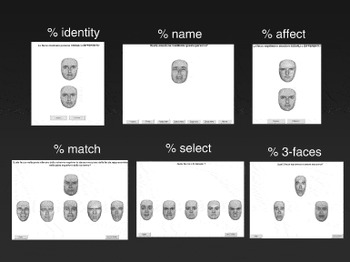
A complete description of each selected subtest follows, and an example of each task is illustrated in Fig. 1:
Examples of Comprehensive Affect Testing System tasks (CATS). Abbreviations: % identity = Identity Discrimination; % affect = Affect Discrimination; % name = Affect Naming; % select = Select Affect; % match = Affect Matching; % 3-face = Three Faces Task © Permission by Psychology Software Inc.

1. Identity Discrimination (%identity): two faces of individuals expressing a neutral mood are shown at a time. The subject indicates whether these faces display the same or a different person. This is a non-emotional test requiring a judgement on facial identity (control task).
2. Affect Discrimination (%affect): two portraits of the same person are presented at a time. The subject indicates whether the pictures exhibit the same or different affect.
3. Affect Naming (%name): a single portrait is shown. The subject identifies the emotion expressed by the person in the picture, choosing between the words written on the bottom of the screen. They can be happy, sad, angry, surprised, disgusted, frightened or neutral.
4. Affect Matching (%match): one face is shown at the top of the screen and five others on the bottom row. The subject indicates which of the five faces displays the same affect shown by the portrait on the top.
5. Select Affect (%select): five faces are shown simultaneously. A sentence appears on the screen asking to select the face showing a specified emotion, such as ‘happy’ or ‘sad’.
6. Three Faces Task (%3 faces): three faces are shown at a time. The subject identifies the two faces expressing the same emotion.
Statistical analysis
Data reduction
Since both independent and dependent variables were assessed using multiple scales and measures, it was deemed appropriate to simplify the analytical procedure by performing a preliminary data reduction in order to reduce multicolinearity and increase statistical power. Five summary variables were created by averaging the standardised z-scores of groups of related measures (reversing sign when appropriate): face perception referred to the percentage of correct responses obtained at the Identity Discrimination task (%identity); emotion perception (average of CATS %Affect Discrimination, %Affect Naming, %Select Affect, %Affect Matching and %Three Faces Task); attentive functions (average of Stroop, and TMT); verbal memory-learning (average of CVLT subscales); and executive functions (average of WCST subscales). In order to retain the best discrimination with respect to clinical symptoms, the clinical measures were not aggregated.
Statistical tests
1. A comparison between patients and controls was conducted by means of CATS scores to verify possible different performances. In light of the group differences in age and level of education, the effects of these potential confounders were evaluated with a multivariate analysis of covariance with age and education as covariates.
2. Univariate linear regression analyses were performed between demographic variables (age, level of education), clinical scales (PANSS positive, PANSS negative, PANSS general psychopathology, CDSS, CGI-S), cognitive functions (attentive functions, verbal memory-learning, executive functions, premorbid intelligence), face perception (CATS: %identity) and emotion perception were computed and a significance level ≥0.10 was applied to include variables in further regression models.
3. A comparison between female and male patients on clinical and cognitive measures (age of onset, length of illness, symptoms, premorbid intelligence, cognitive functions) was performed in order to test if these variables can explain potential differences in the abilities to recognise facial identity and facial emotions, but no significant difference between female and male patients with schizophrenia have been identified (data not shown, available if requested) and they were grouped together in further analyses.
4. In order to discover the relation of each significant variable with emotion perception, different multiple regression models with backward elimination were performed.
5. To avoid possible biases because of treatment, we controlled for type of drug: independent-samples T-test analysis was used to compare the two groups of treatment [first-generation antipsychotics (FGAs) vs. second-generation antipsychotics (SGAs)]. We also controlled for dose of treatment using univariate regression analysis, to find a possible effect on scores in emotion perception. For each patient the chlorpromazine-equivalent daily dosage (CPZ-equivalent) was calculated Reference Woods(59).
Results
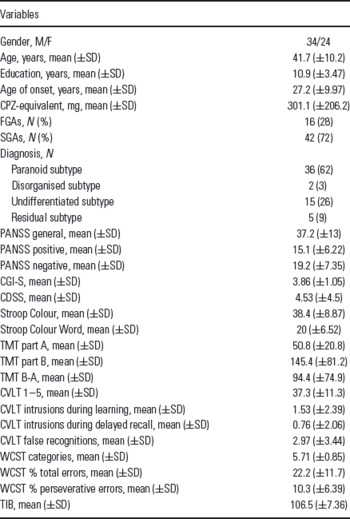
Means and standard deviations of socio-demographic, clinical and cognitive variables of patients are shown in Table 1.
Socio-demographic, clinical and cognitive characteristics of schizophrenic patients

Abbreviations: M = male; F = female; CPZ-equivalent = dose equivalent to 100 mg/day of chlorpromazine; N = number; FGAs = first-generation antipsychotics; SGAs = second-generation antipsychotics; PANSS = Positive and Negative Syndrome Scale; CGI-S = Clinical Global Impression; CDSS = Calgary Depression Scale for Schizophrenia; Stroop = Stroop Test; CVLT = California Verbal Learning Test; TMT = Trail Making Test; WCST = Wisconsin Card Sorting Test; TIB = Test di Intelligenza Breve.
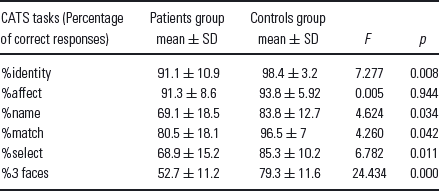
Since we found a significant difference between patients and control group in age (F 1,104 = 43.4, p = 0.000) and level of education (F 1,104 = 178,23, p = 0.000), a multivariate analysis of covariance was performed, with age and level of education as covariates, the percentage of correct responses at CATS as dependent variable and ‘group’ (patients with schizophrenia vs. healthy subjects) as a factor. Patients with schizophrenia had significantly lower correct responses score than healthy controls in all tasks of CATS, except for the %affect task (Table 2).
Performances of patients with schizophrenia and healthy controls on CATS tasks
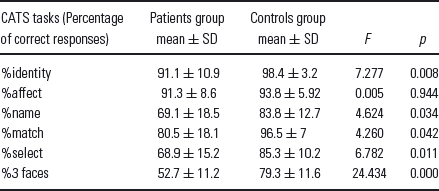
p = significance, between group comparison with multivariate analyses of covariance with ‘age’ and ‘education’ as covariates.
Significant statistical associations were found between emotion perception and age (standardised β = −0.271, p=0.04), PANSS positive (standardised β= − 0.253, p = 0.05), face perception (standardised β = 0.319, p = 0.01), attentive functions (standardised β = 0.307, p = 0.02), verbal memory-learning (standardised β = 0.284, p = 0.03) and executive functions (standardised β = 0.276, p = 0.04).
In order to test the relation of these six factors upon emotion perception, three specific linear regressions with backward elimination were applied.
In a regression including the six significant variables (age, PANSS positive, face perception, attentive functions, verbal memory-learning, executive functions) versus emotion perception, only attentive functions (standardised β = 0.264, p = 0.038) and face perception (standardised β = 0.279, p = 0.029) reached a significant level. Attentive functions explained about 9% of variance in emotion perception scores (R 2 = 0.094; p = 0.019). Face perception explained 10% of variance in emotion perception scores (R 2 = 0.102; p = 0.015).
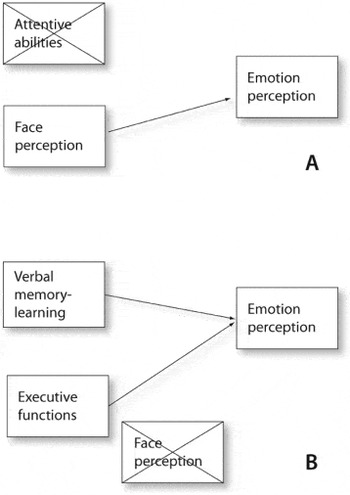
Two partial regressions were performed including five variables, one excluding attentive functions (Fig. 2a) and the other excluding face perception (Fig. 2b), in order to verify whether the removal of one of the two main contributors could discover a contribution on emotion perception by the other variables (age, PANSS positive, verbal memory-learning and executive functions). When we excluded attentive functions, the only significant variable was face perception (standardised β = 0.278, p = 0.032). When we excluded face perception, both verbal memory-learning (standardised β = 0.261, p = 0.042) and executive functions (standardised β = 0.253, p = 0.048) were significant. Verbal memory-learning explained about 8% of variance in emotion perception scores (R 2 = 0.080; p = 0.003). Executive functions explained 7% of variance in emotion perception scores (R 2 = 0.076; p = 0.036).
Partial regressions with backward elimination including five variables, one excluding attentive functions (a) and the other excluding face perception (b).

The emerging model is shown in Fig. 2.
With regard to a role of antipsychotic medication on emotion perception, we found that CPZ-equivalent daily dosage (standardised β = 0.107, p = 0.426) did not correlate with CATS measures and no significant differences were observed between the two subgroups of treatment (FGSs/SGAs : t = −0.77, p = 0.445, df = 56).
Discussion
Our findings are relatively consistent with prior studies of emotional face recognition in schizophrenia. Controls performed better overall when compared to schizophrenia patients. Group differences were significant after controlling for age and education. In one of these tasks (Affect Discrimination), patients and controls did not differ, but this finding may be interpreted as spurious, because among tasks included in the CATS it is the less challenging one, where patients obtained the best score.
The emerging result of this research concerns the direct contribution of face perception in emotion perception abilities in schizophrenia. Contrary to those who support ‘the differential deficit hypothesis', arguing that schizophrenia patients are compromised only in facial emotion recognition, with intact facial recognition (Reference Chapman and Chapman22–Reference Kosmidis, Bozikas, Giannakou, Anezoulaki, Fantie and Karavatos28), we found that our patients were compromised in both face perception and emotion perception abilities. Our data were in line with ‘the generalised hypothesis' (Reference Mueser, Doonan and Penn4,Reference Novic, Luchins and Perline11–Reference Johnston, Katsikitis and Carr16), which suggests that schizophrenia patients are impaired in processing of several facial information (i.e. familiar and non-familiar, age and identity recognition). Moreover, our findings have also highlighted that the impairment in face perception significantly predicted emotion perception.
Second, we found that emotion perception largely depended on attentive functions. Attention could represent a fundamental prerequisite of analysis of facial emotion processing, necessary to fully attend to salient facial features and to decode and interpret emotional expressions (Reference Bruce and Young6,Reference Addington and Addington13,Reference Baudouin, Martin, Tiberghien, Verlut and Franck29,Reference Martin, Baudouin, Tiberghien and Franck31,Reference Morrison, Bellack and Bashore60–Reference Combs, Tosheva, Penn, Basso, Wanner and Laib66). Several areas of clinical research have supported the role of attention abilities in emotion perception. First, a consistent positive correlation between neuropsychological measures of attention and emotion perception has been shown (Reference Addington and Addington13,Reference Kee, Kern and Green34,Reference Combs and Gouvier37,Reference Morrison, Bellack and Bashore60). Second, studies on schizophrenia patients have showed abnormal or restricted visual scan paths on face and emotion recognition tasks in which they tend to focus on non-essential areas of the face or even peripheral aspects of the face (Reference Phillips and David67–Reference Chen, Norton, McBain, Ongur and Heckers71), with the consequence to miss the emotional significance of the facial expression. Third, imaging studies showed reduced neural responses in the frontal, temporal and parietal cortical regions of schizophrenia patients during emotion recognition (Reference Combs and Gouvier37,Reference Andreasen, O'Leary and Flaum72,Reference Phillips, Williams and Senior73). This neuroanatomical feature was speculated to reflect underlying deficits in attention and inefficient processing of sensory information in these patients when performing these tasks. Fourth, novel interventions using attentional-shaping procedures developed in order to improve emotion perception have shown preliminary positive findings Reference Combs, Tosheva, Penn, Basso, Wanner and Laib(66).
Furthermore, when in a further step of analysis we removed the main contributors of emotion perception (face perception and attentive functions), we additionally found a role of executive functions and verbal memory-learning. These findings are consistent with those suggesting that a substantial proportion of the variance in emotion recognition can be explained by executive functions Reference Bell, Bryson and Lysaker(74) and memory (Reference Kee, Kern and Green34,Reference Bryson, Bell and Lysaker62,Reference Schneider, Gur, Gur and Shtasel75,Reference Penn, Spaulding, Reed and Sullivan76). Peer et al. Reference Peer, Rothmann, Penrod, Penn and Spaulding(77) suggested that an emotional misattribution bias could be exacerbated by a poor ability to shift set, i.e. a perseverative response style. Premkumar et al. Reference Premkumar, Cooke and Fannon(33) showed that the number of WCST perseverative errors was positively associated with fear-as-anger misattributions, that could be, at least to some extent, cognitively mediated.
As for verbal memory/learning, previous studies have shown correlations between impairment in face processing and working memory Reference Bryson, Bell and Lysaker(62), and verbal memory (Reference Addington and Addington13,Reference Kohler, Bilker, Hagendoorn, Gur and Gur14,Reference Sachs, Steger-Wuchse, Kryspin-Exner, Gur and Katschnig38,Reference Schneider, Gur, Gur and Shtasel75). Recently, Markwick and Hall Reference Marwick and Hall(40) speculated that combining information on the structural and emotive elements of the face with information retrieved from memory and generated by reason allows increasingly complex judgements to be made of attributes such as attractiveness, distinctiveness, trustworthiness and approachability.
Concerning the minor results, we found an association between PANSS positive and age with facial emotion recognition, even if neither positive symptoms nor age predict the deficit in emotion perception. Contradictory findings have been reported in recent literature concerning these fields of research (Reference Kohler, Bilker, Hagendoorn, Gur and Gur14,Reference Penn, Combs and Ritchie15,Reference Shaw, Dong, Lim, Faustman, Pouget and Alpert26,Reference Bediou, Franck and Saoud30,Reference Silver and Shlomo32,Reference Silver, Shlomo, Turner and Gur35,Reference Mandal, Jain, Haque-Nizamie, Weiss and Schneider78). These discrepancies may be attributable, at least in part, to differences in patient samples (group of patients in different phases of illness, inclusion of patients with diagnosis other than schizophrenia spectrum disorders), and methodological differences among studies. Anyway in our sample of patients, the subjects presenting a greater severity of positive symptoms and the older ones resulted to be more impaired in facial emotion recognition abilities.
Finally, antipsychotic drug treatment would not seem to affect emotion perception in our patients and no differences were found between FGAs- and SGAs-treated, in accordance with a recent review on the psychopharmacological implications in affect recognition deficit Reference Pinkham, Gur and Gur(79).
The interpretation of our results should be considered in light of some limitations. The study is limited by the fact that it is cross-sectional rather than prospective in design. It would be useful to verify whether the relationships reported herein are longitudinally strong and whether the considered variables are valid prospective indicators. Further, the assessment of emotional processing we used takes into account an overall recognition accuracy score rather than accuracy for specific emotions' discrimination and did not allow us to explore whether a particular category of emotions is more impaired in schizophrenic patients.
Despite these limitations, there are some strengths of our work that should be noted. First, our study included a relatively large and thoroughly characterised patient sample (diagnostically homogeneous, clinically stable out-patients). Among the methodological problems in this area of research, Green et al. Reference Green, Kern, Braff and Mintz(80) pointed out small group size of several studies, heterogeneity in diagnosis and inclusion of mixed groups of in-patients and out-patients. Second, we administered a wide neuropsychological battery consisted of tests evaluating several cognitive functional domains, known as contributing to emotion perception. Third, we chose to use CATS, the first standardised, cross-culturally valid neuropsychological measure of emotion processing, which evaluates a large group of domains of emotion processing (i.e. discrimination, selection, labelling and matching facial emotions).
Conclusions
Our data supported multimodal levels of facial emotion analysis that emphasised the independent role of face perception and attentional abilities on affect perception for people with schizophrenia: the deficit of facial identity recognition would reduce the extraction of affective significance of facial stimuli, the impairment of attentive functions independently affected the selection of relevant facial features. The analysis of faces is supported by other cognitive functions that allow to use in a flexible and adequate way facial information (executive functions) and to reconnect past emotional experiences (memory) that help to recognise facial emotions. Recently, it has been shown that schizophrenic patients invariably adopt a cognitive approach when identifying facial affect, favouring a feature-analysis-based strategy, considered compensatory to limbic dysfunction Reference Fakra, Salgado-Pineda, Delaveau, Hariri and Blin(70). The relationship between face perception, attention and emotion processing could have implications for the cognitive rehabilitation of these deficits.
Acknowledgements
This study was supported by a research grant from REGIONE PIEMONTE ‘Bando Regionale per il finanziamento di Progetti di Ricerca Sanitaria Finalizzata, 2006’ and by a grant 2003–1421 by Compagnia di San Paolo, Torino, Italy.