Some of the most enduring propaganda images and slogans of the Second World War emerged from the so-called careless talk campaigns in Britain. Catchphrases such as “Careless Talk Costs Lives” have entered the common lexicon, while Fougasse’s famous posters of Hitler and Goering eavesdropping on the unwise gossip of two female shoppers have been the subject of numerous pastiches by cartoonists on modern political crises, including the recent conflict in Iraq.Footnote 1 The longevity of these phrases and images is explained not just because they were textually and visually striking but also because they were unusual in character. They simultaneously evoke notions of British resilience and sacrifice and an enduring anxiety provoked by the threat of Nazism. This tension stems from the fact that while national wartime propaganda tended to promote a positive, united “world view,” the careless talk initiatives had a quite different impetus. As campaigns concerned with the internal security aims of eliminating opportunities for damaging rumors to spread and with identifying potential “fifth columnists,” these campaigns encouraged a “closing of the ranks” and a suspicion toward others. As such, they ran the risk of disrupting the wartime master narrative of the “People’s War.”
The careless talk campaigns have received relatively little scholarly attention. They are barely mentioned in wider studies of Britain during the Second World War.Footnote 2 Works that do consider the campaigns either confine them to a specific period (notably May–August 1940), focus on one mode of communication, such as the poster, or view them as part of a coherent and unchanging propaganda offensive without considering their place within the broader spectrum of domestic propaganda initiatives.Footnote 3 Tracking the campaigns from 1939 to 1945 reveals the finer shifts and tensions within wartime propaganda. Moreover, for a fuller understanding of the nature of wartime propaganda, these campaigns must be considered together, since this was how the public received them, and this created the environment in which meanings were established. In taking this approach, the careless talk initiatives assume a particular significance. They reveal how official propaganda campaigns could be undermined from within. Films, posters, press advertising, and other forms of persuasion did not present a clear and consistent image to the British people. This is true even within the careless talk campaigns themselves; it is still more so when these are set alongside simultaneous appeals designed to stress the shared interest in national unity. While the “pull to unity” may have “dominated popular culture” and the attempts to celebrate the “ordinary” in wartime Britain, as Sonya Rose argues, the careless talk campaigns generated by the Ministry of Information (MOI) and other government agencies promoted a different culture—one of distrust, suspicion, and fear, where such aspects of “ordinary” life as conversational gossip were presented as dangerous.Footnote 4 The campaigns cast the entire population as potential suspects who lacked discipline, and whose words and private thoughts required control. This contrast between the government’s attempts to consolidate national unity and its warnings against careless talk made official propaganda volatile in its effects. As Rose further observes, the “hegemonic power” of ideas such as the “People’s War” was not uniform or unvarying; such power also “produces and contains possibilities that make it unstable and capable of metamorphosis, reinforcing, or unleashing political and institutional currents that run counter to it.”Footnote 5
This article investigates the dynamics within the major security campaigns from the initial publicity of 1939 and the 1940 “Silent Column” initiative to the preparations for D-Day. It considers how the campaigns were adapted to different phases of the war, why the campaigns were intensified, what key themes were addressed, and what impact the campaigns had on popular behaviors and mentalities. Examination of public reactions to the careless talk campaigns unveils a series of unforeseen and undesired responses to government security propaganda, each provoking particular wartime mentalities: fear, anger, distancing, and depersonalization. Moreover, the campaigns incited a public counternarrative of British identity. This centered on the rejection of any kind of authoritarian vision, encouraged a debate that questioned the relationships between the state and the individual, and reemphasized freedom and privacy as key constituents of Britishness. The article reveals how alternative messages complicated and even undermined the Ministry of Information’s home front propaganda. It points to the fissures not simply in the lived realities of the home front, but in the very projection of the People’s War in British propaganda and the popular imagination. If, as Rose argues, the nation was “being imagined as a unified community of people capable of putting the national interest above their own needs and desires,” this imagination was both muddled and contested.Footnote 6
Propaganda campaigns concerned with internal security began to take shape early in the war. The War Cabinet established a “Committee on the Issue of Warnings against Discussion of Confidential Matters in Public Places.” The Committee met for the first time on 13 October 1939 to consider security in the Services and the possibility of a domestic awareness campaign to be spearheaded by the newly formed Ministry of Information (MOI).Footnote 7 Comprising representatives from the Air Ministry, the Ministry of Supply, the Admiralty, the Home Office, the War Office, the Treasury, and the MOI, the Committee considered action already taken and planned future campaigns to prevent the spread of careless talk. On 13 November, it reported to Cabinet that appropriate measures were in place for His Majesty’s Forces, the Civil Service, the Merchant Navy, the Police and Fire Service, Civil Defence, and armaments factories. By this stage 541,000 posters had been distributed to hotels and public houses, 21,000 to the Post Office, 50,000 to local authorities, 5,000 to labor exchanges, and 4,250 to railways and docks. The MOI had enlisted the help of the press in placing articles in newspapers and secured the BBC’s agreement to produce special radio programs. Security “notices [were] to be thrown on to the screens of cinemas” before the main feature. The Ministry of Transport pledged to “increase lighting of railway carriages on long-distance night journeys” to encourage passengers to “read rather than to talk,” recognizing that “the dimly-lit railway carriage on night journeys is a very fertile breeding-ground for indiscreet talk with or in the presence of strangers.” Prosecutions for careless talk would be publicized as a deterrent, and the public would receive “guidance” as to what constituted a breach of Defence Regulations. The Committee concluded that it was “now satisfied that no further action, apart from that which we have already set in train, is required,” although the matter would be kept under “periodic review to ensure that notices and warnings retain their effectiveness by repetition and variety.”Footnote 8 The initial approach to security propaganda, then, was careful and understated, beginning with the “Keep It Dark” initiative of November 1939 and the further issue of posters in December 1939 warning the public against indiscreet talk that might provide information to the enemy.Footnote 9
The Committee’s work continued into early 1940 with the launch of a new security campaign in February. It secured over 2 million display sites for new artwork, translated slogans into Welsh, and commissioned special posters for Scottish ports. The artist Norman Wilkinson, who also worked on ship camouflage, produced images of sinking ships for posters distributed to factories, and “Fougasse” (the pseudonym of cartoonist Cyril Bird) sketched a series of cartoons around the theme of overheard conversations in public places. Of the 2,250,100 posters distributed, 734,200 were in the Fougasse series, with a further reprint of 248,000 in March. Ealing Studios produced three short films on security matters, the BBC planned further “anti-gossip” talks, and there were attempts to enlist the support of such literary figures as Somerset Maugham, Agatha Christie, and E. M. Delafield.Footnote 10 Prestigious social clubs received “a dignified card—in the style of important invitations—stating that ‘members are earnestly requested to be discreet in discussing naval, military and air affairs.’”Footnote 11
As this initiative suggests, as well as conveying a broad message applicable to all, propaganda was developed along class lines. While intended to target specific audiences, such an approach had the potential to divide rather than unite, and there were soon difficulties. The three short films produced for the February–March 1940 security drive drew criticism for their class-bound approach. Directed by John Paddy Carstairs and screened in 2,000 cinemas with a potential audience of 20 million, Now You’re Talking, Dangerous Comment, and All Hands depicted three examples of indiscreet talk by the Navy, within a scientific research unit, and among RAF officers.Footnote 12 While commentators agreed on the importance of the message, Mass-Observation, an organization set up in 1937 to record popular views on a variety of matters, described adverse audience reactions due to the films’ “essentially upper and middle class attitude” in a report on MOI short films. In all three security films, the report commented, “the spy was a worker (barman, café proprietress, pub crawler), while in two of them the gossipers were working class. The hero of one of these films, a factory scientist with a beautiful large house, is killed by the idiocy of a factory worker. The hero of another is a rich young airman, his fiancé lived in a luxury flat.”Footnote 13 Although in this respect the films proved problematic, particularly as the MOI began to notice an “increase in [public] class resentment,” the wider internal security campaigns met with a favorable response.Footnote 14 They even prompted voluntary action at a local level. The Weymouth Co-operative, for example, fined customers who uttered “have you heard?” to fellow shoppers, while Southampton established a Home Security League to “help maintain a high standard of public morale by personal cheerfulness and by killing rumours.”Footnote 15
During the early careless talk campaigns, reports on morale and public reaction to publicity campaigns, such as those produced by Mass-Observation, only reached government departments sporadically. This changed in 1940, and the flow of information to central government increased exponentially. Reflecting concerns that Mass-Observation’s methods were unscientific and that the cost of their services could escalate, the MOI established a Home Intelligence Division with Mary Adams, a former producer with the BBC’s early television service, as its director. The Division’s aims, according to Adams, were “to provide a basis for publicity [and] … to provide an assessment of home morale.”Footnote 16 It produced reports for use within the MOI and other government departments (Home Security, Labour, Supply, the War Office, and the Air Ministry) with a total circulation of around one hundred copies, twenty-five of which were distributed outside the MOI.Footnote 17 These reports were issued monthly until May 1940, then daily from 18 May to 27 September 1940 (except on Sundays), with weekly summaries thereafter.Footnote 18
The main body of the reports was drawn from the network of Regional Information Officers (RIOs) based in thirteen regional centers.Footnote 19 RIO reports were an important local barometer of public opinion. Telephoning in their data early each afternoon during the peak period of Home Intelligence’s activities from May to September 1940, they offered excerpts from “discussions from their own staff, … casual conversations initiated or overheard on the way to work, … [or from talking to people during] a hurried series of visits to public houses, and other places where the public foregathered.”Footnote 20 London had a dedicated section in each report, reflecting the “special arrangements” in place for the capital, which drew on contacts with “a number of people … in all strata of society, who would be prepared, in response to a telephone call or a personal visit, to report the feelings of those with whom they came into contact.” These contacts ranged from doctors and parsons to newsagents and shop stewards.Footnote 21
In addition to RIOs, Home Intelligence drew on various other sources: “BBC Listener research surveys … , questionnaires completed by such organizations as W.H. Smith and Sons, the London Passenger Transport Board, Citizens’ Advice Bureaux, the Association of Women House Property Managers and the Brewers’ Society,” alongside information from “postal censors,” the Police, and Mass-Observation.Footnote 22 The use of Mass-Observation proved controversial since its early commissions from government agencies in June 1939: two of the organization’s founders, Tom Harrisson and Charles Madge, quarreled over whether government contracts would affect Mass-Observation’s independence, while skeptical civil servants and ministers thought its methods unreliable and costly. Despite her support for Mass-Observation, Adams struggled to retain its services, eventually losing the battle on 30 September 1941.Footnote 23 Government preferred the quantitative methods of its own Wartime Social Survey (established by Arnold Plant at the National Institute of Social and Economic Research) to the qualitative data produced by Mass-Observation.Footnote 24
In the period between the establishment of the Committee on the Issue of Warnings against Discussion of Confidential Matters in Public Places and the second phase of the security campaign in February and March 1940, a vast apparatus designed to record and report on public morale had thus been erected, and this had consequences for any future careless talk initiatives. On the one hand, as Paul Addison and Jeremy Crang point out, up until the advent of the Home Intelligence Division, the MOI “was talking to Britain without listening to Britain.” Clearly, material gathered by the unit could be used by government departments to conduct more effective and penetrating propaganda.Footnote 25 On the other hand, the very existence of the Home Intelligence Division and its subdivision, the Wartime Social Survey, compounded with the increased emphasis on careless talk and the publicity surrounding convictions under the Civil Defence acts, was a potent combination that, in the public mind, threatened the foundations of the democratic state. This led to greater scrutiny of the MOI and its activities and came to a head in the crisis over the security campaigns of July 1940.
In May 1940, Home Intelligence became increasingly alarmed at the levels of rumor and gossip among the population. It reported that “the rumour situation is becoming so serious that it becomes imperative for the whole matter to be discussed in detail. … Enemy agents may be at work and there is malicious gossiping but evidence before us at the moment suggests that most rumours are passed on by idle, frightened suspicious people.”Footnote 26 Such behaviors reflected the public mood in May–June 1940. Home Intelligence reports from this period frequently alluded to the popular belief in the existence of a British fifth column.Footnote 27 Mass-Observation recorded that between 20 May and 5 June 1940 the fifth column was the leading subject of rumors in circulation.Footnote 28 The popularity of spy literature and films and the broadcasts of Lord Haw-Haw, whose listenership of 9 million also peaked in May and June 1940, no doubt fueled already fertile imaginations.Footnote 29 These reports, combined with events in the war itself, convinced the MOI that a more direct and restrictive strategy for internal security propaganda was necessary. Following the invasion of the Low Countries, the evacuation of the British Expeditionary Force from Dunkirk, and the fall of France, Britain was isolated. Any information passed to the enemy could inform a planned invasion by supplying important details to the Luftwaffe and Kriegsmarine.
It was in this context of public anxiety and threatened invasion that the MOI considered new measures in their careless talk publicity. “What the public desired,” the Ministry concluded, was “not so much words of comfort as words of command.”Footnote 30 Taking control of the public mood was chief among the concerns of the new prime minister, Winston Churchill, who took office in May 1940. In June, General Ismay reported the disastrous effects of rumor on morale during the Dunkirk evacuation. As a consequence, Churchill ordered a reinvigoration of security publicity: government propaganda now encouraged Britons to join the “Silent Column.”Footnote 31
Kenneth Clark, Controller of Home Publicity at the MOI, was responsible for directing the initiative.Footnote 32 The campaigns would cover both rumor emanating from abroad and gossip circulating at home. This blurred the distinctions between external foes and internal fools, an approach which it was agreed would require “careful handling.”Footnote 33 On Monday 8 July, the MOI’s Planning Committee confirmed the decision to implement a “Silent Column” campaign, with the Minister
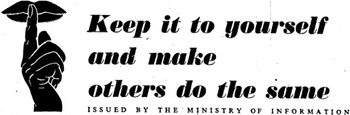
Silent Column advertisement, as it appeared in, e.g., The Times, 12 July 1940. Images have been reproduced with the kind permission of the National Archives (Kew).

of Information, Duff Cooper, to broadcast to the nation on the Thursday.Footnote 34 Details would be issued to the Press thirty-six hours before the first advertisement was due to appear and twenty-four hours before the broadcast, in the hope that the campaign would attract positive editorial comment, as had been the case with the February initiative.Footnote 35 From the outset, citizens’ responsibilities were central to the appeal, and the campaign was conceived as an “invitation” to “every patriotic citizen to enrol.”Footnote 36
However, unlike the security campaigns of February 1940, the advertisements—such as that in figure 1, which appeared in newspapers on 12 July—and Duff Cooper’s broadcast on 11 July undermined public engagement with the idea of citizenship promoted by the government. They differed from previous appeals in their graveness and their sense of compulsion (to “make” others behave in a certain way). As psychological historian Nikolas Rose has suggested, this type of propaganda “sought to produce shame, guilt and condemnation, rather than seeing rumour as arising from specifiable psychological conditions.”Footnote 37 Consequently, the MOI began to receive reports indicating “a growing feeling that too many campaigns take the form of unconstructive prohibitions (Don’t gossip, don’t spend, don’t waste, don’t listen to enemy broadcasts)”Footnote 38 and that there was “too much talking at people nowadays.”Footnote 39
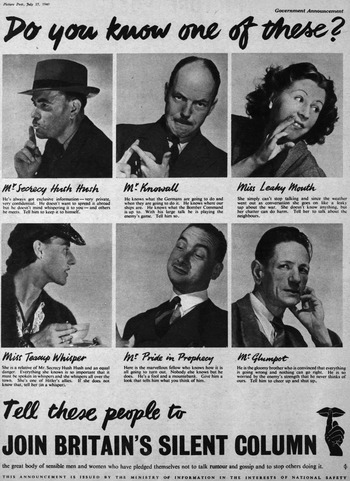
Moreover, in contrast to messages on war aims and those that promoted the idea of the People’s War, the Silent Column campaigns encouraged suspicion. As one Home Intelligence report noted, they transformed the men and women of “Churchill’s Island” into “a nation of spies,” a perception that was encouraged by anti-gossip campaigning and fueled by public interest in and speculation about invasion, fifth columnists, and parachutists.Footnote 40 Even ministers were advised that waiters at their favorite Italian restaurant were being employed by the enemy to eavesdrop on their lunchtime conversations.Footnote 41 The smallest of acts could be interpreted as an unpatriotic gesture. “Those who spread doom and despondency” by engaging in defeatist talk, warned Cooper in his broadcast, “do definite harm: they are hurting the cause, they are delaying the victory; they are enemies—unintentional enemies probably—but enemies of our side.”Footnote 42 The campaign’s publicity sheets singled out individual “types,” reducing fellow citizens to stereotypes whose proclivities were damaging the war effort: Mr. Secrecy Hush Hush, Mr. Knowall, Miss Leaky Mouth, Miss Teacup Whisper, Mr. Pride in Prophecy, and Mr. Glumpot (see fig. 2).Footnote 43 These were the new internal enemies.
Such an accusatory tone prompted widespread popular discontent with the Silent Column campaign. The Home Intelligence daily report for London on 23 July 1940 described “vigorous protests from all classes.”Footnote 44 Angus Calder explained this reaction as “a reflex revulsion against … fifth column mania” and specifically the treatment of enemy aliens.Footnote 45 This is unsatisfactory, since public fascination with fifth columnists did not abate, and British sympathy for enemy aliens had its limitations, as numerous contemporary sources suggest.Footnote 46 Equally, Calder’s interpretation does not adequately explain the depth of feeling aroused by the Silent Column campaign, nor the views expressed in reports sent to the MOI by their Regional Information Officers. A detailed examination of RIOs’ reports, alongside other sources gauging public morale such as Mass-Observation, reveals that, while the campaign may have been a short-term failure, disrupting the MOI’s propaganda narrative, it had unintended positive consequences.
Reports to the MOI from their RIOs pointed to a lack of public understanding of the Silent Column and alarm at prosecutions under the Civil Defence Act for careless talk.Footnote 47 In November 1939, the Committee on the Issue of Warnings against Discussion of Confidential Matters in Public Places suggested that prosecutions for careless talk should receive publicity to demonstrate the personal consequences of breaching regulation 3 of the Civil Defence Act. Prosecutions continued throughout the conflict. While the trials were not especially numerous (fifty-four
Government advertisement placed in Picture Post in July 1940

“guilty” verdicts in the first nine months of 1943, for example), the press often reported on them.Footnote 48 Reports of court cases after 1940 tended to be more sedate. However, in mid-1940, wild stories of overzealous officials and citizens circulated in the press. This eroded the effectiveness of the Silent Column campaign by reinforcing the belief that individual rights were being undermined by the state. On 19 July, the Manchester Guardian reported on a police raid on the home of “an entirely reputable member of the Labour Party.” Local officers confiscated “copies of such blameless volumes as Lord Addison’s ‘Policy for Agriculture’ and the Duchess of Atholl’s ‘Searchlight on Spain.’” The newspaper condemned the MOI for inciting “a sort of amateur Gestapo movement in which a few people with nothing better to do would use a lull in the actual operations of war in order to foment baseless suspicions against their neighbours,”Footnote 49 an attitude reinforced by the Silent Column’s advice to citizens overhearing careless talk to “take out an old envelope and start writing down what they are saying.”Footnote 50 The newspaper denounced the “orgy of tale-bearing and unedifying police court sentences,” pointing to the tensions between the “ugly batch of convictions” and the MOI’s “appeal to people to be more friendly and neighbourly.” It predicted that “in many of these cases most of the damage has been done to a sense of confidence in some of our fellow citizens.”Footnote 51 Confirming the attitude expressed in the Manchester Guardian at the height of the Silent Column campaign, RIOs frequently observed that the public noticed discontinuities in government messages, particularly in relation to the positioning of the individual and the state. RIOs in Leeds reported public “misgiving aroused by the prosecution of prominent S. Yorkshire councillor, the basis of the charge apparently being his strong criticism of Chamberlain for our unpreparedness, and as a traitor. This contrasted with [Lord] Halifax’s ‘we shall not stop fighting till freedom for ourselves and others is secured.’”Footnote 52
Moreover, there was a recognition that government attempts to define a new form of citizenship, forged in the crucible of war and centered on the community—a “people’s community” that blurred the distinction between home and front lines—were being destabilized by the Silent Column campaign. The Daily Morale Report of 20 July 1940 noted that “the civilian is beginning to feel, and has been encouraged to feel, that he is in the front line: at the same time, attempts are apparently being made to undermine his status.”Footnote 53 Citizens clearly felt that their commitment to the war effort should be rewarded yet observed that “the Government does not trust the people as much as it ought to,” a later report added.Footnote 54 The Silent Column campaign revealed a prevailing mentality of “them and us,” language that appeared frequently in reports sent to the MOI from the regions.Footnote 55
This became, in effect, a debate over citizenship and identity.Footnote 56 “Standards of good public conduct” were being shaped from below, and the British public became actively involved in the process of defining who they were and who they were not. British characteristics came to be defined by opposition to the Silent Column campaign: the importance of individuality, private lives, and the right to free expression.Footnote 57 The Silent Column campaign prompted a discussion as to individual rights that citizens ought to expect, simultaneously defining the external “Other”—in this case, authoritarian behaviors.
In complaining about the Silent Column and prosecutions for “careless talk,” the public drew direct comparison with Nazi Germany as a means to demonstrate difference: “It’s the Gestapo over here”; “They can prevent us talking but they can’t prevent us thinking”; “This Silent Column Campaign is a backhand. Although I agree that people shouldn’t say dangerous things, this makes you feel you daren’t say anything. It takes the heart out of you, doesn’t it?”Footnote 58 Such comments came at the height of the controversy over “Cooper’s Snoopers.” In a willful act by the press to undermine the Ministry’s credibility and authority, the Wartime Social Survey was represented as an official “witch-hunt against innocent civilians.”Footnote 59 The press escalated its critique of the survey by portraying it as an unwanted intrusion, with government officials, “Cooper’s Snoopers” (the name given to the initiative by the press after Duff Cooper, the Minister of Information) peering into the minute details of private lives and thoughts in what was seen as a flawed attempt to buoy public morale. In this crucial period between May and July 1940, the combination of government information gathering, prosecutions of those engaging in careless talk, and the Silent Column campaign all prompted a belief that one of the fundamental tenets of British national life, the freedom of the civilian, was in jeopardy. Individuals complained that they had been “fighting for freedom but losing what freedom we’ve got,”Footnote 60 which led to accusations that the British “regime [was] becoming dangerously akin to the one we are fighting.”Footnote 61 RIOs reported that comments on the British government’s “authoritarian mentality” were becoming commonplace: “best to pass no opinion these days—you might get hung”: “I’m afraid to open my mouth”;Footnote 62 “Most people will soon be afraid to say anything.”Footnote 63 At a Labour party meeting in London, candidates “agreed that prosecutions for idle talking were upsetting public morale seriously. People in positions of minor authority [are] accused of officiousness and bullying manner, reminiscent some say ‘of the early days of the Nazis.’”Footnote 64 What became known as the “Gestapo idea” was relatively widespread, arguably more widespread than the essential message about national security,Footnote 65 and “the relationship between the [Silent Column] campaign and prosecutions for defeatist talk and rumours” was deemed “sinister.”Footnote 66
The consistent theme of public criticism was the identification of such authoritarian and intrusive behavior as “un-British.” This public idealization of liberty might in other contexts be celebrated: a Mass-Observation analytical report on “What Does Britain Mean to You?” in September 1941 identified a strong correlation between British identity and “Liberty, love of home, tolerance and justice—these are some of the things which Britain has infused into her sons and daughters.”Footnote 67 Indeed, such was the importance of these concepts to perceptions of Britishness and their long-standing connection to national “ideology” that Mass-Observation reported that “freedom and tolerance are … looked on by many people almost as a British monopoly.” “Imposed authority” was considered antithetical to the British character, with some respondents even praising ineptness, since “efficiency so frequently has its officious side.” On occasion, the two combined to emphasize the role of the individual in national life: “the freedom of the individual is the freedom to be inefficient.” Freedom of thought, opinion, and expression were central to national identity and to a sense of the homeland, “where there is normally a minimum of interference with the individual.”Footnote 68 Government careless talk initiatives between May and July 1940 conflicted, then, with the broader rhetoric of civic republicanism developed by government in the 1930s and 1940s.Footnote 69 This manifested itself during wartime, as Jose Harris has observed, in a “strengthening and legitimation of a highly privatised and unstructured psychological individualism—an individualism that was explicitly opposed to fascism, but that also presented definite boundaries to collectivisation of all kinds,” even forms of collective action and behaviors that appeared to be in the national interest.Footnote 70
In addition, within the careless talk campaigns, the MOI made clumsy attempts to challenge British mannerisms. In reviewing the MOI security short film You’re Telling Me (Paul Rotha, 1941), which depicted the effects of gossip and speculation on the escalation of rumours, Mass-Observation recorded negative reactions to “any propaganda which … implies criticism of British behaviour instead of boasts for it.”Footnote 71 Behavior, in this case the act of a community sharing information due to concern for workers’ welfare at Harper’s factory, was far more important to ideas of Britishness, concluded Mass-Observation, than the “people or land”—it was “more than a sum total of … things and people.”Footnote 72 RIOs also observed that individuals sought to protect the British habit of complaining, targeted by the Silent Column campaigners, and were concerned that there was “no outlet for healthy grumbling.”Footnote 73 Reports confirmed that “many people think that grumbling is a British tradition,”Footnote 74 as Stanley Baldwin famously identified in his 1924 speech to the annual dinner of the Royal Society of St. George.Footnote 75 Not being able to talk to others, to gossip, seemed to unravel communities and, more importantly, how they were imagined. Home Intelligence commented that the campaign as a whole was “creating … an absence of neighbourliness.”Footnote 76 This approach ultimately had the potential to disrupt the master narrative of the People’s War and led to accusations that the Ministry did not understand the British people. The Daily Express commented that their notion of national identity seemed “to come out of some Victorian school story crammed with prigs and bores, to take down on old envelopes the conversations of rumour-mongers, to indulge in precise and prolonged dialogue about victory, and to make noble speeches to ourselves during bombardments.”Footnote 77
However, while the public and published reaction to the Silent Column initiative was overwhelmingly negative and on the surface exposed tensions within government propaganda over the People’s War, paradoxically the campaign ultimately strengthened national bonds. Britons articulated their collective identity by expressing their opposition to authoritarian behavior and their skepticism of a centralized state. This identity emerged not from government appeals to create a People’s War but from a predetermined shared set of values. This provided a clear sense of what Britain was fighting for (and against) and contributed indirectly to the MOI’s task of raising public morale. That said, security publicity continued to contain tensions that threatened to destabilize wartime propaganda tropes.
The MOI could not have predicted the long-term effects of the Silent Column campaign of July 1940. In its immediate aftermath, the campaign raised a furor among the public, the press, and in Whitehall. In many ways, the MOI was the victim of a unique moment in 1940. Through the Silent Column and “Cooper’s Snoopers,” it became the object for frustration, suspicion, and invasion fears. The Ministry was not protected from public admonishment by the originator of the whole episode—the prime minister. Responding to a question in the House of Commons on 23 July 1940, Churchill admitted “this movement to create a silent column has … passed into … innocuous desuetude.” He confirmed that the campaign was to be abandoned with immediate effect. Sentences for careless talk were also to be reviewed.Footnote 78 The Manchester Guardian reported that the prime minister had “[buried] the ‘Silent Column’ with mock solemnity that both amused and gratified the House.”Footnote 79 The MOI could not help but feel wounded by this public rebuke, believing that it had been given a “raw deal” and was “the unfortunate victim of circumstances.”Footnote 80 Even before Churchill’s statement to the House, the MOI had begun to insert “corrective hints” into the media to undo the “repressive atmosphere possibly induced by the campaign.”Footnote 81 However, it admitted that “little could be done to counteract the false impression” that those in authority believed “morale to be low, and intended to raise it by exhortatory propaganda.”Footnote 82 Nevertheless, while RIOs initially concluded that “[the] harm has gone too deep to be so quickly cured,” they reported that reassurance from the Ministry “has helped to relieve the public to some extent.”Footnote 83 Such reassurance took the form of broadcasts by the Minister of Information and rebranded advertisements using a sentence from Churchill’s response to the House on the government’s commitment to security. The slogan “Join the Silent Column” was replaced with “Keep the Enemy in the Dark,” invoking the more successful catchphrase of December 1939.Footnote 84 As this suggests, in the aftermath of the Silent Column initiative, the MOI reverted to the original security campaigns of December 1939 and February 1940. It recognized that the earlier strategy had been more sensitive to the needs of the individual and struck a balance between persuasion and empowerment. Kenneth Clark, responsible for security propaganda in the MOI, noted of the initial careless talk program that “in general, people’s natural way of dealing with the situation should be interfered with as little as possible (‘defeatist’ talk and jokes, for instance, are an ingrained English method of reacting in times of difficulty). Above all, gossip should not be regarded as ‘bad’ either from a psychological or a moral point of view. On the contrary, the free expression and interchange of thoughts and imaginings are both useful and good.”Footnote 85 Clark recognized that security propaganda needed to invest the citizen with authority and knowledge. This had the potential to break down rather than accentuate the gap between government and the public. Mass-Observation remarked in October 1940 upon the “striking degree of non-registration” resulting in “automatic resistance” to government publicity. It suggested that this emerged from public opposition to “officialdom,” the ubiquity of government exhortations and instructions, and significantly, “a growing gulf between the leader and the led,” the latter drawing out the “distinction between authority and an ordinary person.” For Mass-Observation, this distinction was exacerbated by war, during which the “authorities take on an almost separate
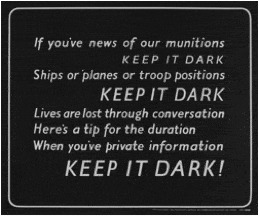
Keep It Dark (TNA: INF 2/95)

existence,” reducing the citizen to a “spectator rather than actor.”Footnote 86 This, of course, was the hallmark of the Silent Column campaign but did not feature as prominently in earlier security initiatives.
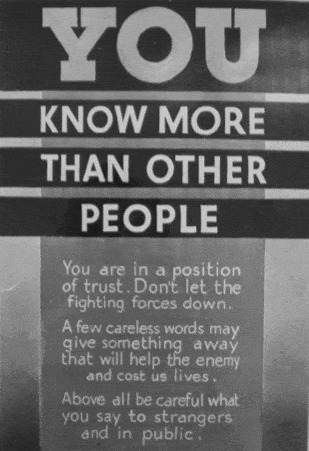
Propaganda campaigns could easily generate a sense of distance between the message and the intended target. Mass-Observation detected that the recipient “unconsciously associate[s direct appeals] not with me but with other people who are not me or mine, but vague YOUs, people of other class or level of intelligence, or passing hikers or girls with kiss curls or old dears with flannel petticoats.”Footnote 87 The “Keep It Dark” campaign, however, transformed the idea of “YOU” in official propaganda. Rather than “that ghostly body of close-lipped automatons” created by the “Silent Column,”Footnote 88 here “the YOU is somebody clever, who knows things, who has private information, who is up to the secrets of the military, who is not an inferior, ‘civilian morale’ character” (see fig. 3).Footnote 89 Such techniques were replicated in the poster shown in figure 4 for distribution in barracks, as well as in MOI “Ten Minute Talks” for young people, which afforded youth a sense of agency and personal responsibility.Footnote 90
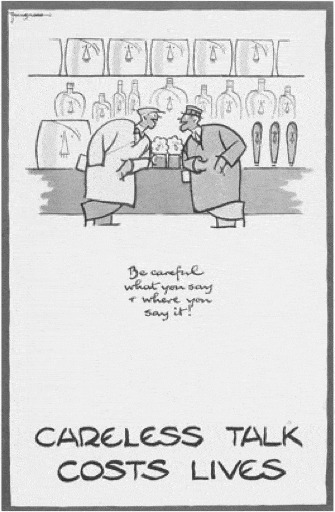
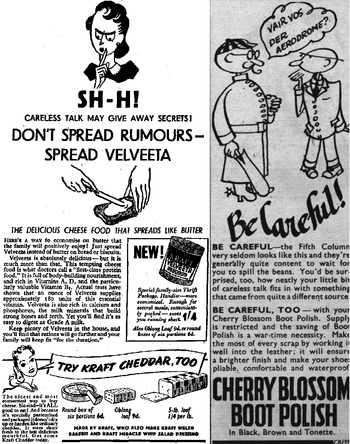
The “Fougasse” posters (see fig. 5), the centerpiece of the February 1940 anti-gossip campaigns, were also reissued after the failure of the Silent Column. They became an enduring aspect of British wartime culture, such that their images and slogans became common reference points and appeared in various contexts. Advertisers traded on the slogan “Careless Talk Costs Lives” to sell products from cheese (“Don’t spread rumours; spread Velveeta”)Footnote 91 to boot polish (for examples
You Know More than Other People poster (TNA: INF 2/95)

of advertisements, see fig. 6).Footnote 92 They were the focus of cryptic clues in the Times crossword.Footnote 93 There was even a racehorse named Careless Talk.Footnote 94
The appropriation and longevity of the campaign slogans were explained by Kathleen Peacey, writing for the Daily Mirror in September 1942: “As a nation, we like funny labels best. I take the careless talk posters to heart just because they are funny, and not dictatorial or pompous.”Footnote 95 Fougasse recognized that hectoring appeals against gossip could create a “sense of shame … or fear” with individuals feeling “innocent and injured.” Moreover, given that “fear closes the mind, instead of opening” it, he argued, only humor could prompt the masses to internalize the message through depersonalization, stripping the propaganda of its accusatory
“Fougasse poster,” 1940 (TNA: INF 3/0229)

tone.Footnote 96 Countering the views offered by Mass-Observation, for Fougasse, depersonalization was a positive psychological force. By using “formula figures—that is, … figures that don’t bear a real resemblance to real people,” Fougasse sought to represent “humanity in general” with the effect that “it can … stand for anybody and therefore for everybody yourself included.”Footnote 97 By representing “humanity in general,” the MOI could export the posters to support security campaigns in allied nations. Despite the doubts of the Australian Department of Information that neither “the London ‘Punch’ style of humour represented in the Fougasse posters,” nor the intervention of a British artist “would be appreciated by Australians,” they proved a considerable success, generating “keen demand”
Advertisements from national newspapers using careless talk themes. The Velveeta advertisement as seen, e.g., in Daily Mirror, 27 February 1940, 15; and the Cherry Blossom advertisement as it appeared in, e.g., Picture Post, 20 February 1943, 6. The image has been reproduced with the kind permission of Cherry Blossom. Every attempt has been made to contact Kraft (the makers of Velveeta), but no reply has been received.

in Perth, Brisbane, and Hobart. They were reprinted in Australian newspapers sponsored by local businesses, the Sun News devoting its prime advertising spot every Friday in June 1940 to the designs, courtesy of Henry Buck’s, a well-known clothing store.Footnote 98
Not only could comedy transcend national barriers, it operated just as well within them by trading on shared national characteristics. Fougasse claimed that “the British tradition does not like having its dangers dramatized and it doesn’t want its patriotism dramatized either.”Footnote 99 The MOI recognized that “our people respond to humour sometimes more than to serious injunctions,”Footnote 100 and it was with this in mind that they chose to re-release Fougasse’s posters as a countermeasure to the austerity of the Silent Column.
While the reissue of the Fougasse posters may support historian Marion Yass’s conclusion that the MOI retreated to “soft sell” in the aftermath of the Silent Column, this ignores the nature and tone of later security propaganda and the fact that security propaganda was not the sole responsibility of the MOI.Footnote 101 Not everyone agreed that the dangers of careless talk could be hammered home using humor. Representatives of the three branches of the Armed Services pointed out in an Inter-Departmental Meeting on Anti-Gossip in March 1940 that “the dangers of gossip was hardly a subject for light treatment such as that of the Fougasse designs.”Footnote 102 Humor, they argued, concealed the consequences of indiscretion, a view underscored by Mass-Observation in their investigations of the slogan “Be like Dad, Keep Mum”: while amusing, the message was not taken seriously by the public.Footnote 103 These debates reflected the tensions between and the differing needs of government departments and highlighted interagency conflict over the ownership of the careless talk campaigns. In the face of the MOI’s “soft sell” and their reluctance to pursue a more direct campaign in the wake of the Silent Column initiative, the War Office took it upon itself to counter “the whimsical Fougasse posters” by producing “a film that would shock the troops into discretion.”Footnote 104 That film was Next of Kin, directed by Thorold Dickinson.Footnote 105
Next of Kin interweaves a series of indiscretions and fifth column actions that culminate in a thwarted attack on the fictional port of Norville. Major Richardson (Reginald Tate), a security officer, is despatched to Brigade headquarters to alert officers and men to the dangers of careless talk and to oversee security measures in advance of a planned operation. His warnings remain unheeded, and both officers and men relay the details of the planned raid to fifth columnists and Nazi spies (Mr. Davies, “Ma” Webster, and Mr. Barratt), who send intelligence to Nazi commanders. Enemy forces lie in wait for the British troops and careless talk results in the unnecessary death of British servicemen. Next of Kin was originally conceived as a twenty-minute forces instruction filmFootnote 106 and marked a renewed emphasis in careless talk propaganda for servicemen, the primary focus of security campaigns after 1941.Footnote 107 Through its public release in May 1942, the film became a showcase for the Army’s conception of careless talk propaganda.
Whereas Fougasse sought to create identification through humor and distancing, Next of Kin invested the slogan “careless talk costs lives” with a graphic visual reality. Documentary filmmaker Edgar Anstey remarked in the Spectator that Dickinson’s film “breaks from old studio taboos in that it depicted the devastating consequences of indiscretion for an army unit on operations in a fictional raid on a French seaport. No one who sees the final sequences,” he concluded, “with the bloody realism of the hand-to-hand fighting and the circle of horrifyingly unexpected Nazi tanks, artillery and dive-bombers closing in on the trapped and disappointed men, will be inclined to forget that modern tactics depend on surprise, and surprise depends on silence.”Footnote 108
Despite the War Office’s hopes that Next of Kin would be more effective than humor in suppressing careless talk, it too did not encourage the public to identify with the government’s message. While audiences clearly understood the moral of the film, they also exhibited a certain amount of distancing, which was apparently correlated with socioeconomic status. Mass-Observation detected a pronounced class reaction, with viewers in the lower social groupings being “inclined to make excuses for the ‘Tommy’, to feel sorry for him, and to treat him as if he were not quite responsible for his actions.” The officers were to blame, with the characters in the viewers’ own social groupings, with whom they would most likely identify, being exonerated.Footnote 109 Worse still, Dickinson was “absolutely harrowed” on being confronted by an elderly woman who informed him that “I’ve got two sons abroad fighting, and I shan’t sleep until they come home.” Such anecdotes were supplemented by reports that viewers “had been carried out [of the cinema after] … fainting.”Footnote 110 These reactions confirmed Mass-Observation’s findings that anti-rumor campaigns mainly affected “the psychologically unbalanced and acutely nervous minority,” while the majority were hardly moved to act at all.Footnote 111Next of Kin, then, not only intensified the existing trend of popular dissociation from government messages, it also drew audiences toward at least three of the five “menaces to public calm” identified by the MOI in June 1940: fear, suspicion, and class feeling.Footnote 112 This reaction draws attention to the difficulties inherent in the MOI’s wider security campaigns. Clark realized that anti-gossip propaganda had “been either comic or horrific.” By 1942, it was clear that neither approach had the desired effect; both exacerbated distancing or induced fear.Footnote 113
But Next of Kin highlighted a further dilemma that had been present from the outset: like previous careless talk campaigns, it challenged the government’s image of “social solidarity” and the concept of a collective “popular conscience” or “people’s mind.”Footnote 114 The very nature of the message the propagandists had to forward—that “walls have ears” and that the nation was awash with fifth columnists and traitors lurking in every corner, ready to seize upon even the smallest snippet of information—detracted from appeals to neighborliness and community, and bred suspicion. This paradox resulted in observable tensions in official wartime narratives, such as the People’s War, tensions that surfaced once again in the later years of the conflict.
People’s War propaganda relied on the image of a community united under the strain of war, invested with a steely determination to defeat the enemy. Its strength lay in a sense of shared values, the will to work together, and cooperation with fellow citizens, regardless of social difference. However, the careless talk campaigns inferred that “fellow citizens” were not necessarily the friends and neighbors depicted in official propaganda: they could also be fifth columnists, spies, or even just gossips whose indiscretion could undermine the war effort. Here the enemy was generalized to the point where it included everyone. This message, a significant part of the Silent Column campaign, continued to prove inherently problematic for British propagandists in the Second World War.
Fifth columnists were portrayed in security propaganda as average men and women who blended seamlessly into communities, indistinguishable from the average Briton. In Dickinson’s Next of Kin, “Ma” Webster (Mary Clare) and timid bookshop owner Mr. Barratt (Stephen Murray) are barely noticed. Mervyn Johns’s character, the inconspicuous Mr. Davies, was “an ordinary little man,” as the film’s press book commented, “just a typical looking Englishman who has worked in this country for years before the war. There is nothing mysterious about him, and that’s what makes him so dangerous.” Drawing attention to the widespread interest in the fifth column and the dominance of “spy mania” in popular culture, United Artists, the film’s distributor, reminded viewers that “popular imagination usually conjures up a vision of a glamorous, exotic female or a mysterious-looking, furtive man. Films and books have always in the past helped to build up this illusion. In real life, your spy is the most ordinary person in the world. There is nothing romantic about him. He might even be the man who is working next to you all day long. … [‘Mr Davies’ is] to all intents and purposes a humble British working man of the same type as thousands of others. That’s your real spy!”Footnote 115
Dickinson’s characters echoed earlier propaganda that focused on the confused identity of the infiltrator. The animated short film Clothes and the Man (1941) used overlays to depict how the Nazi could assume the outward appearance of the average Briton. Mirroring the MOI’s May 1940 campaign to expose “Fifth Column Tricks,” the 1941 film charts the costumes and guises of the Nazi spy: the local man “in a nice country pub having his pint with the best of ’em, but also taking in with his ears any chance remark he might overhear when you’re talking shop with your pals”; a vicar, “very much ‘Let us pray,” spelt P-R-E-Y, of course … very interested in earthly matters as well as things above. A real sky pilot, if you understand what I mean”; a “good ’ol Cockney … might meet ’im anywhere. ’Aving a day off in the country or som’it. Knows ’is onions alright. Not ’alf he don’t”; a “quite ordinary sort of chap … always ready to stand a drink and get into conversation with you. … [Affecting an “Oxford” accent] got a special job in one of the factories, making all sorts of gadgets. … You may think you’re getting something out of him. But it’s ten to one that he’s trying to get something out of you!”Footnote 116
Ministry propaganda emphasized that “in other countries the most respected and neighborly citizens turned out to be fifth columnists when the time came.” Attempting to undermine the view that saboteurs and spies were only to be found in the interred and refugee communities, the MOI reminded the public that “the fifth column does not consist only of foreigners.”Footnote 117 As such, suspicion fell on the inconspicuous men and women of the “People’s Community” who had the potential to be the unnoticed fifth column prowling every pub, railway carriage, telephone booth, and barber shop. As Clothes and the Man demonstrated, this villain was polymorphous, adopted numerous guises, and was able to blend seamlessly into the fabric of everyday life. While Britons were clear that their country was “a home for decent people and undesirables are not welcome,”Footnote 118 defining the “undesirable” and identifying the enemy was becoming increasingly difficult in the light of the careless talk campaigns, particularly, as the MOI constantly reminded the public that spies and fifth columnists were likely to adopt the guise of the “ordinary” man or woman, barely distinguishable from their neighbor. This was a propaganda message that was detrimental to broader appeals to the collective spirit. The Home Planning Committee admitted that it had real potential to “cause ordinary people to look at each other [differently], with suspicion.”Footnote 119
That the fifth columnist could blend in anywhere also threatened the idea of the communal space in the public imagination. In direct opposition to People’s War rhetoric, which emphasized community locations as places of togetherness and solace, careless talk propaganda risked reinventing them as places of danger, deception, foolishness, and suspicion, infiltrated by an unknown enemy, who could be your comrade or your neighbor. Nowhere is this tension more apparent than in the representation of the public house.
In many ways, the dominant narratives of the People’s War were encapsulated in the pub. Viewed by the journalist Thomas Burke in the Preston Herald, as the home of “true democracy” and the ultimate expression of “Britishness,” the pub was “a place where all are equal. … In that centre of mutual tolerance and the operation of our easy English good humour, men recognise not their difference, but their common nature. … The bar makes people what they should be—kind, impulsive, and generous without calculation.”Footnote 120 However, in the government’s careless talk campaigns, the pub was reconfigured as a place of suspicion and danger, where individuals were urged to mind their own business, running counter to the public’s understanding of community.
The pub was a particular target for anti-gossip campaigners. Earlier in the war, Guinness was enlisted by the MOI to produce anti-gossip posters for their customers, while letters were sent to the Brewers’ Society and several smaller breweries by the MOI in March 1940 to encourage publicans to “use their authority if they heard undesirable gossip in their public houses, and to rebuke such gossipers in public.”Footnote 121 The Military Police were already “keeping public houses under observation with a view to reporting cases of harmful gossip by members of His Majesty’s Forces,”Footnote 122 and the Metropolitan Police were seriously considering “organized visitations”Footnote 123 to pubs in order to “secure evidence of harmful gossip” by either members of the Services or civilians.Footnote 124 Had this been widely known, it would no doubt have prompted lively protests along similar lines to the reaction to the Silent Column campaign. This scheme was eventually rejected, not because it presented an affront to democratic freedoms but because it was considered “impractical and undesirable” in terms of public prosecutions.Footnote 125 However, the pub continued to be an important mechanism for the distribution of the Ministry’s security publicity, and its dangers remained a central theme in their careless talk propaganda.
In Dickinson’s 1942 film, Next of Kin, the pub or the bar was the location for many indiscretions: Miss Clare, the morphine addict and good-time girl, is party to the careless talk of officers over a cocktail, while fifth columnist “Ma” Webster gleans valuable information over a pint at the local. In another sequence, a parachutist
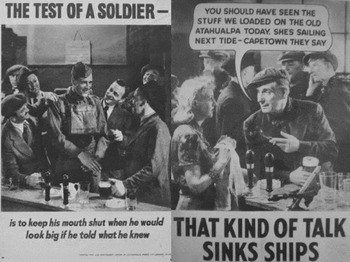
MOI posters used in the promotion of Next of Kin (TNA: INF 2/95)

uses opportunities for intelligence gathering afforded by the drunken behavior of the platoon at the train bar. Similar scenes are played out at a canteen dance where “over a drink … a sergeant blurts out the most vital information of all about preparations for troop movements” in front of the undetected spy played by Johns.Footnote 126 The press book for Next of Kin pointed to the dangers of bar talk, and United Artists suggested cinema tie-ins with MOI posters, including two that represented the pub.Footnote 127
The tensions in the presentation of the pub in the careless talk campaigns are represented in these two posters (fig. 7). In the first poster, the public house is a place for healthy, masculine bonding, representative of desirable behavior. Yet in the second poster, the pub is the setting for indiscreet talk.
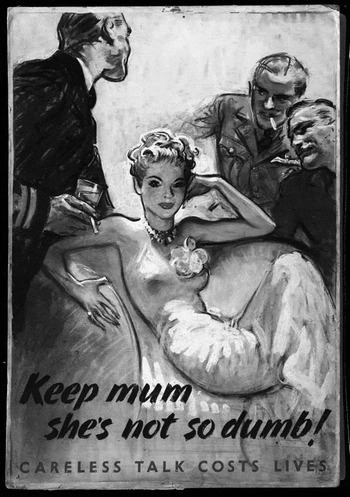
The combination of alcohol and female allure was seen as a particular threat. This was brought out in another poster of 1942 (see fig. 8), intended for distribution in officers’ messes.Footnote 128
The poster accentuated the themes brought out in Dickinson’s film of the same year, also intended primarily for the troops. Historian Antonia Lant points to the evocative dissolve from male officers discussing security to the image of Miss Clare
Careless Talk poster for the commissioned ranks (TNA: INF 3/0229)

“in a halter neck dress with almost bare midriff, dancing on stage before an audience.” The following line links the two sequences: “Let me know where you think we’re weakest.” Lant concludes that this “juxtaposition through editing implies that the answer … is night-club women, which in the film’s terms is true.” In both the poster shown in figure 8 and in the artwork for Next of Kin, the viewer’s eye is drawn to “explosive female lips,”Footnote 129 heavily made-up to heighten “sexual openness [and] disguise.”Footnote 130
This potent combination of alcohol and sex disturbed the authorities. Alcohol was a lubricant for loose tongues, and women were generally depicted as gossips. In their extensive studies of pub culture, Mass-Observation reported that the combination of alcohol and young women was generally perceived as dangerous and immoral—such a powerful sentiment that Sonya Rose contends that it was often seen as more important than class in determining popular “Othering.”Footnote 131 The presence of women was seen to undermine the “male stronghold” of the pub, “imped[ing] male sociability” and counteracting male bonding and community spirit. Women drinking alone or in all female groups were thought to be “not quite ladylike,” with Mass-Observation confirming that many respondents thought that women ought to be accompanied by a male escort to reduce the chance of undesirable behavior.Footnote 132 Such views were reflected in later careless talk campaigns, in which lone women or female groups in search of male attention were presented as particularly subversive or careless, or encouraging indiscretion in men.
The best example of this is the 1943 Army short film Missed Date, in which servicemen Tom, Mike, Bill, and Harry decide on an evening out in a pub in a sleepy country town. The pub is initially depicted as “truly a cosy place with a neat little bar and a dart board too, and a host with a cheery face … [a] home from home, … where everyone seemed a friend,” images that connected to official People’s War propaganda. Indicative of the subversion of and challenge to these narratives, the tone of the film quickly changes when Bill and Harry spot a couple of women with “two saucy smiles.” Pursuing their “favourite indoor sport,” Bill and Harry make a date with the two women for Saturday. Bragging to the women, they disclose that, “there’s a big do on, though we mustn’t say, we know what it’s all about.” On Saturday, the women wait in vain for their dates. Bill and Harry had been at the aerodrome when “Jerry” launched a raid. While the two women ponder why they had been abandoned, an inconspicuous man in the corner keeps his head down: “the date fell through, as the boys are dead. But the fact never came to light that the man in the pub who dozed nearby got his message away that night. Never forget that wherever you are, there are listening ears.”Footnote 133 Not only then was the presence of women seen to be disruptive to male bonding and community building, undermining the overall government message that women were solid and trustworthy citizens playing their part in the People’s War, the pub was transformed from a place of patriotic social interaction into one where dangerous elements lurk behind every corner.Footnote 134
Missed Date was released during renewed security activity surrounding build-up to the plans for the invasion of mainland Europe. Anti-gossip campaigns for the Armed Services intensified once again from 1943, suggestive of the changing security battleground. New campaigns were launched in mid-1943 and again in May 1944. “As the tempo of preparations for invasion quickens,” the Daily Express told its readers, “everyone in Britain is asked to obey this slogan: ‘Don’t pass it on!’” The article emphasized that much careless talk continued to emanate from service personnel.Footnote 135 By 1943, as this suggests, prominence was given to the armed forces in security propaganda, shifting attention away from ordinary citizens whose role was now confined to keeping information quiet rather than anti-gossip. Convictions continued to be publicized in the press, although without the vitriol that accompanied earlier reports and without discussion of the democratic rights of citizens at war, reflecting the changed context in which propagandists now operated.
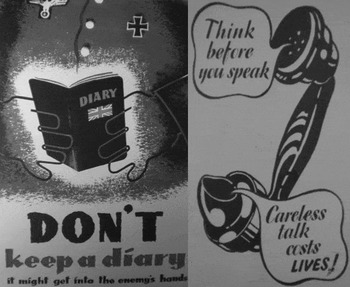
Propaganda from 1943 tended to focus on communications security, a particular issue for the Services. The Directorate of Army Kinematography, who had recruited Thorold Dickinson as head of production following the success of Next of Kin,Footnote 136 was charged by the General Staff with producing a series of short films warning of potential security breaches through the telephone and letter. This was reinforced with poster propaganda designed for distribution in messes and barracks. In this new wave of security publicity, private as well as public spaces became targets. Private letters, phone conversations, and even diaries could disclose valuable information to the enemy (see fig. 9).
In Hush! Not a Word! a 1943 animated film from Anson Dyer’s Analysis studios, details of a new secret weapon are divulged by a “Tommy” wanting to boast to his girlfriend, the information reaching Hitler and Goebbels who immediately order their bombers to raze the airfield. The film ends with the strap-line: “Don’t write it, even to your sweetheart.”Footnote 137
A similar message is conveyed in the 1943 film Chatterbug, which opens with a careless “Tommy” hogging a telephone box oblivious to the gathering crowd outside, while the narrator points out that “most people seem to think that they are cut off from the outside world when they are on the telephone … but speech on the telephone is not secret. … Don’t think you’re safe just because you are in an empty room.”Footnote 138 The film details the numerous ways in which telephone conversations may be overheard: through the switchboard, through careless “jabber” in public spaces, and through “closed” and crossed lines. Chatterbug and Hush! Not a Word! functioned by emphasizing the interplay between the “private” communication and the public arena, with overheard conversations and the passing of information invariably taking place in public houses, on a railway, or at the hairdressers. This, once again, encouraged suspicion of others, notably through the inadvertent passing on of information: “even though the person who overhears
Diary and telephone poster campaigns (TNA: INF 2/95)

you may not be an enemy agent, well, there are plenty of loudmouthed people in this country ready to broadcast everything they know and a lot they can only guess.”Footnote 139 Both films also featured sequences involving the exchange of information with women, and this continued into the final phase of security propaganda following the invasion of Europe on 6 June 1944. Careless Talk, released by Strand Film just a month later, depicted the consequences of the revelations of “love-lorn John Jones” to “indiscreet Mary Brown.”Footnote 140
In the final months of the war, it was largely accepted that security propaganda was necessary and that the natural urge to gossip, such a treasured national pastime, had to be curbed. The Daily Mirror urged its readers to resist the temptation to speculate on events in France. It pointed out that “the excitement that is gripping us makes us all the more careless. … Careless talk was bad enough in the days of preparation. Now—in the days of vital action—it is criminal folly.”Footnote 141 This marked a considerable shift from the presentation of civil defense convictions in May–July 1940, and the campaigns of 1944–45, like those of December 1939 and February 1940, largely passed without press or public criticism. Events were not as pressing in the “phoney war” or on the cusp of victory as they were in the charged days of May–July 1940. As this suggests, tracing the campaigns throughout the war years not only demonstrates their successes and their limitations: it acts as a window onto the morale of Britons at war.
As Duff Cooper, Minister of Information, wrote in July 1940, the careless talk campaigns and exhortations to community through the loose framework of the People’s War were intrinsically linked.Footnote 142 Yet the two propagandistic strands pushed against rather than complemented one another. This was true not only in terms of the nature of the campaigns but also in their inherent messages, creating tensions in Britain’s wartime propaganda campaigns. The Ministry found itself in an impossible position, having to promote the idea of community while at the same time maintaining security by identifying potential dangers within. Consequently, historians should confront the complexities of wartime propaganda narratives and the interactions between them; they should also consider the ways in which cultural products and propaganda more generally were consumed by the public. Propaganda did not exist in a vacuum: it was seen by the public in the round, and this meant that to be successful, it had to be consistent. That contemporaries noted the tensions in British wartime propaganda makes it all the more surprising that scholars have either largely ignored the campaigns in their accounts of wartime Britain or failed to explain their position in relation to appeals to the collective such as the People’s War. This was an unstable propaganda narrative, particularly when set alongside other campaigns, such as those of the Silent Column and its later manifestations. Official People’s War propaganda was not as homogenous as some scholars have suggested, nor was it as powerful in a complex media and social environment in which many different and conflicting ideas were at work.
Most importantly, campaigns concerned with issues of security had significant social consequences. The fissures within and across propaganda campaigns revealed pressures on the relationship between authority and the individual, between the state and the public, and between the rights and responsibilities of the citizen at times of national emergency. The idea of the individual was a well-established British tradition. Arguably, appeals to wartime unity brought the importance of the individual into sharp relief in terms of a traditional British political construct, which even the most skilled propaganda could not override, and this too affected the dynamics of the propaganda of community. Behaviors and mentalities were central to the popular sense of national identity. Within this context, a counternarrative developed that was based around opposition to state interference with the individual. While “[stepping] out of line” rendered the individual “antisocial,” it nonetheless did not prevent people from doing so in relation to careless talk, since the message seemed, in the public mind, seriously to jeopardize individual freedoms.Footnote 143 Here representations of individual freedoms could not be framed in terms of the collective, since it was perceived to come dangerously close to the totalitarian model.
Propaganda was, therefore, playing a specific role, where deep horizontal comradeship was challenged by confused identities, accentuated by the fifth column scare, and characterized by the inadvertent redefinition of community spaces, mutual suspicion between the citizen and state, and a volatile relationship between the individual and authority. This seems to confirm Harris’s contention that the war saw a “strengthening and legitimation of a highly privatised and unstructured psychological individualism.”Footnote 144 While there is some truth to this statement, another possibility also presents itself. While there were tensions within the official attempts to condition a “people’s community” through overt propaganda campaigns, it was paradoxically in response to those campaigns—and their counterpoint, the careless talk campaigns—that the power of the People’s War idea emerged. The campaigns inadvertently sharpened the sense of community from below and became a means through which Britons themselves defined concepts of unity and what they were fighting for and what they were fighting against, as the public response to the Silent Column demonstrated. The careless talk initiatives may have undermined the official propaganda narratives of community, but they reinvigorated and forged others. It was not necessarily propaganda that defined the People’s War but responses to it. Images of unity and disunity, and the behaviors they encouraged, existed side by side: a sense of community could emerge despite government failure to project it adequately. It follows, therefore, that historians should look for new, more complex ways of understanding the dynamics of wartime propaganda that take account of the unforeseen outcomes of specific campaigns and place more emphasis on public agency in constructing their own meanings from official communications.