Implications
Hyperphagia can be experimentally induced in domestic geese as confirmed by the present data, and leads to spontaneous liver steatosis. There is a great variability in individual response to the experimental stimulations, and more specifically in the hyperphagia behaviour. The causes of this variability deserve further investigations. Our results draw original research questions in the perspective of producing fattened livers without force feeding.
Introduction
In order to produce ‘foie gras’, grown geese and ducks are submitted to a period of overfeeding where high amounts of corn are delivered to the birds twice a day to induce liver steatosis. This period, known as ‘gavage’, lasts 10 to 17 days according to the species and the production process. It is generally stated that the response of waterfowl to overfeeding originates from natural abilities of migratory birds to overconsume feed and store energy in preparation for long travels (Odum, Reference Odum1960). Indeed, in birds travelling for long distances, the pre-migratory increase in BW, mainly under the form of fat depositions, can reach up to a 100% of the lean mass (Bairlein, Reference Bairlein1987). The photoperiod is known to be the major environmental factor controlling migration itself and the pre-migratory fattening process (reviewed by Bairlein and Gwinner, Reference Bairlein and Gwinner1994). In particular, the shortening of day length occurring before winter migration accelerates feed intake and fat deposition.
In a previous work (Guy et al., Reference Guy, Fortun-Lamothe, Bénard and Fernandez2013), we clearly demonstrated that hyperphagia and spontaneous liver steatosis could be experimentally induced in domestic Greylag geese by combining a short photoperiod and a sequence of feed restriction followed by ad libitum corn feeding during the fall and the winter. This set of conditions was supposed to mimic pre-migratory changes. We followed the evolution of liver weight and composition along the period of ad libitum corn feeding (from 20 to 31 weeks of age) and noticed that the liver weight rose from 95 (just before corn delivery) to 514 g (at 31 weeks) and most of these changes were associated with an increase in liver lipid concentration from 6% to 50% of liver weight. The variability in individual response was high with the coefficients of variation (cv) ranging from 45% to 71% depending on slaughter age. In this previous experiment, the birds were kept in groups and the individual consumption of corn could not be recorded. Thus, it was not possible to study the relationship between corn consumption and spontaneous liver steatosis.
The aim of the present work was to better understand the link between the level of hyperphagia and the extent of spontaneous liver steatosis. To achieve this goal, we housed the birds in individual cages thus allowing individual recordings of daily feed intake. However, the goose is a gregarious bird whose feed intake is influenced by group behaviour (Arroyo et al., Reference Arroyo, Auvergne, Dubois, Lavigne, Bija, Bannelier and Fortun-Lamothe2013) and different feeding behaviours between group and individually housed (IH) geese could therefore be expected. Thus, contemporary geese were also raised in groups, as described by Guy et al. (Reference Guy, Fortun-Lamothe, Bénard and Fernandez2013), in order to compare the consumption of corn and subsequent liver steatosis between the two housing conditions.
Material and methods
Animals were handled according to the recommendations in animal care in experimentation in agreement with the European Communities Council Directive of 24 November 1986 (86/609/EEC). The investigators implicated in these experiments were certificated by the French governmental authority (agreement no 31-11 43 501). All experimental facilities used here were also certificated for the breeding, care and slaughtering of animals (agreement no A40624).
Animals, feeding and housing conditions
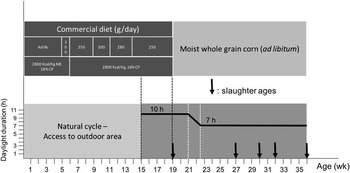
A summarised view of the experimental process is given in Figure 1.
Schematic representation of the experimental treatment in both group housed and individually housed geese.

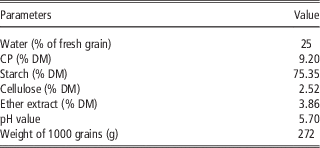
This trial was carried out from 1 July 2010 to 9 March 2011, at the INRA experimental unit on waterfowl (Benquet, France) on a total of 300 1one-day-old male Landaise goslings of the Palmsire strain. Birds were fed a commercial diet from birth to 19 weeks of age (2800 kcal/Kg metabolizable energy (ME) and 180 g/Kg CP from birth to 6 weeks of age and 2800 kcal/Kg ME and 160 g/Kg CP from 7 to 19 weeks of age; Maïsadour, Benquet, France) to meet the National Research Council (NRC) requirements (NRC, 1994). From 20 weeks of age and onwards, the birds were fed moist whole grain maize stored in a flexible silo with a capacity of 30 tonnes (storage in oxygen free conditions) (Laplace, Pau, France). The corn was of standard commercial type and remained at the same dry matter (DM) content than at the time of harvesting (DM=75%; see Table 1 for chemical composition). Moist whole grain was preferred to dried corn grain because of its higher palatability for geese (Guy G, unpublished observations) and its higher starch proportion, which favors hepatic lipogenesis (Hermier et al., Reference Hermier, Salichon, Guy, Peresson, Mourot and Lagarrigue1999).
Chemical composition and physico-chemical traits of the corn

DM=dry matter.
The feeding programme used was identical to that described by Guy et al. (Reference Guy, Fortun-Lamothe, Bénard and Fernandez2013) and based on a feed restriction period which aimed to ensure normal growth while preventing excessive fattening (McLandress and Raveling, Reference McLandress and Raveling1981) and to induce hyperphagia when stopped. The birds were fed ad libitum from birth to 5 weeks of age, then 300 g/day during week 6, 350 g/day during weeks 7 to 9, 300 g/day during weeks 10 to 11, 280 g/day during weeks 12 to 14 and 250 g/day during weeks 15 to 19. The geese had ad libitum access to corn from 19 weeks of age and onwards (Figure 1). Geese were accustomed to the corn diet by a progressive introduction of whole corn grains in the pellet diet during the 3 last days before ad libitum feeding.
From hatching to 4 weeks of age, the birds were kept in a 100 m2 pen in a building dedicated to the starting of goslings. At the age of 5 weeks, the animals were weighed and six groups of 30 birds each were constituted so that the mean and variance of live weight were similar between the groups. These six groups were transferred to a building with no natural lighting where they were housed inside six group pens (group housed (GH) birds) in the left wing of the building. Each pen was 32 m2 which allowed ~1 m2/bird. The group pens were equipped with a small outdoor enclosure but at 15 weeks of age its access was closed in order to control lighting. The remaining 120 animals were kept in the starting building until the age of 12 weeks. At that time, they were weighed and allocated in six groups of 20 birds each so that the mean and variance of live weight were similar between the groups. They were then transferred into six pens in the right wing of the same building as the GH groups. The birds were then placed in collection cages (0.4 m2/bird) designed for the quantitative measurement of feed intake (and for the collection of excreta, but this was not done in the present experiment) (IH birds). These cages were disposed in the six pens (20 cages/pen) without access to the outdoor. Cages were placed side by side in order for the animals to see and hear their peers without being in direct contact.
During the first part of the experiment in the starting building, the birds were submitted to natural lighting. During this period, the daylight hours fell from about 14 h (beginning of July) to 11 h (15 September). Once transferred in the building with no natural lighting (at the ages of 5 and 12 weeks for GH and IH birds, respectively), all birds were kept under artificial lighting following a cycle of 10 h light (L) : 14 h dark (D) with an average light intensity of 30 lux from 0700 to 1700 h that was kept constant along the experimental period. At the start of week 22, the lighting duration was gradually decreased by 30 min every 2 days until reaching a cycle of 7 h L : 17 h D at almost 24 weeks of age. This short photoperiod was maintained up to the end of the experiment and was applied in both GH and IH birds (Figure 1). During the experimental period, no additional heating was provided in the pens, but the temperatures in all rooms were measured every morning at 0730 h.
The group (GH) or individual (IH) feed intake was recorded daily in each pen from 20 to 36 weeks of age, that is during the corn feeding period, by calculating difference in trough weight between two filling. Mortality was assessed daily during the same period.
Slaughter and measurements
The individual live weight was recorded at 15 weeks. A total of 30 GH birds were slaughtered at 19 week of age (just before corn feeding), and were considered as the reference group before the experimental stimulation in both IH and GH birds. Thereafter, groups of 30 GH and 30 IH animals were slaughtered at the end of the 27th, 30th, 32nd and 36th weeks of age, corresponding to 8, 11, 13 and 17 weeks of corn feeding, respectively. Animals were sampled across the different pens according to their weight at 15 weeks, with five GH birds per pen per slaughter age and five IH birds per pen per slaughter age. The same slaughtering procedure was applied at each slaughter age. The feed was not withdrawn before slaughter. The birds were crated in transport cages (four birds per cage) and transported to the experimental slaughterhouse (5 min transport). The animals were weighed before slaughter. They were then suspended individually from a shackle with their head downwards and electrically stunned using head-only scissor tongs delivering a 90 V, 50 Hz AC current for 5 s. All birds were slaughtered by a ventral cut of neck blood vessels within 5 s after the end of the stun.
At about 20 min postmortem, the carcasses were eviscerated and the liver was carefully removed and weighed. Abdominal fat was also collected and weighed. The carcasses were then stored overnight in a +4°C chilling room. The chilled carcasses were anatomically dissected and the following weights were recorded: breast muscle (Pectoralis major), breast skin+subcutaneous fat, thigh+shanks meat and bone, and corresponding skin+subcutaneous fat. In addition, the body fattening index which is a rough approximation of total body fat was calculated as: abdominal fat+2×(breast skin and fat)+2×(thigh skin and fat).
Statistical analyses
ANOVA were performed using the GLM procedure of SAS. The model included the main effects of slaughter age and rearing pen, and the interaction between these two factors. The model was run separately for GH and IH geese. None of the interactions ‘age×pen’ were significant. Therefore, a second model, with only the two main effects ‘age’ and ‘pen’, was used. Where appropriated, means were compared using Duncan’s multiple range tests. Student’s test was used to compare production performances of GH and IH birds at each slaughter age.
Results and discussion
Time-related changes in ambient temperature and corn consumption
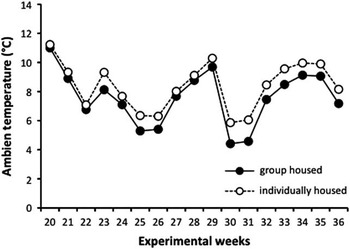
The part of the experiment concerning corn feeding was carried out from 9 November 2010 to 9 March 2011 and the overall temperatures inside the breeding rooms were low (Figure 2). The daily temperatures ranged from −2°C to +18°C along the experimental period and the average temperature was +8.0°C. Unexpectedly, there was a difference in ambient temperature between the left (GH birds) and right (IH birds) wings of the building (Figure 2). On average, the temperature for IH birds was 0.8°C higher than for GH birds.
Time-related changes in the ambient temperature along the experimental period (temperature was recorded every morning at 0730 h and averaged for each week).

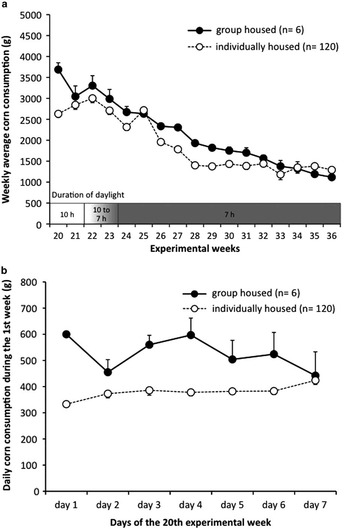
After the feed restriction period (250 g/day during the last week before corn feeding), there was a sharp increase in corn consumption in GH birds (Figure 3a). The total corn consumption during week 20 was 3688 g and as shown in Figure 3b, the feed intake during the 1st day reached 600 g and remained between 450 and 600 g/day the rest of the week. These figures are far above the data found in the literature reporting feed consumption by geese under ad libitum feeding ranging from 200 to 380 g/day according to age and reproductive cycle (Sauveur et al., Reference Sauveur, Rousselot-Pailley and Larrue1988; Arroyo et al., Reference Arroyo, Auvergne, Dubois, Lavigne, Bija and Fortun-Lamothe2012). Thus, the present results not only confirm but strengthen our previous demonstration (Guy et al., Reference Guy, Fortun-Lamothe, Bénard and Fernandez2013) that hyperphagia can be initiated after a feed restriction period in adult geese raised in group, and under the environmental conditions of temperature and light cycle used in the present experiment.
Time-related changes in the average consumption of corn by goose housed in group (the consumption was recorded for the group but averaged by subject, n=30) or individually for the all experimental period by week (a), and daily during the 1st week of corn consumption (b) (vertical bars show the standard error of the mean).

Hyperphagia was less pronounced in IH birds (Figure 3a) and the difference in corn consumption was particularly important during week 20 where the feed intake of IH birds was only 71% of the feed intake of GH birds. Over the whole experimental period, the corn consumption in IH birds was 20% lower than the one recorded in GH birds. Figure 3b also shows that the daily corn consumption gradually increased in IH geese during week 20 to reach the same value (ca. 400 g) as GH birds on the last day of the week, but a peak of consumption of 600 g/day was never reached. The difference in feeding behaviour between GH and IH birds could be attributed to social facilitation in GH birds. According to Clayton (Reference Clayton1978), social facilitation increases the frequency of a given behaviour when other individuals are engaged in the same behaviour. Synchronized feeding due to social facilitation has been reported in broilers (Collins and Sumpter, Reference Collins and Sumpter2007). Geese are gregarious birds whose feed intake is influenced by group behaviour (Arroyo et al., Reference Arroyo, Auvergne, Dubois, Lavigne, Bija, Bannelier and Fortun-Lamothe2013) but, to our knowledge, our results are the first to report an experimental comparison of feed intake between GH and IH geese, though for the latter the proximity of the cages cannot completely exclude the influence of interactions between neighbour birds on their feeding behaviours.
Time-related changes in liver weight and body characteristics
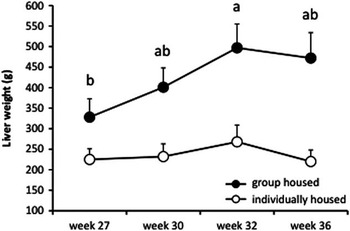
At week 19, before the start of the ad libitum corn feeding period, the liver weight was 93 g, corresponding to 1.55% of BW (cv 15%) (data not shown). Thereafter, in GH geese, the liver weight increased from 328 g (cv 76%) at week 27 to 497 g (cv 65%) at week 32 (Figure 4). In our previous experiment (Guy et al., Reference Guy, Fortun-Lamothe, Bénard and Fernandez2013), the liver weight at week 31 was 514 g (cv 45%), a value similar to the one obtained in the present work but with a lower variability. It is notable that in the present work, the corn feeding period was extended up to week 36, as compared to our previous work (Guy et al., Reference Guy, Fortun-Lamothe, Bénard and Fernandez2013) where it ended at week 31. Our present data suggests that there is no further increase in liver weight, nor any reduction of liver weight variability, when the corn feeding period is extended above 31 weeks of age. In our previous experiment (Guy et al., Reference Guy, Fortun-Lamothe, Bénard and Fernandez2013), where the birds were kept under corn feeding until week 31, there was no case of mortality, as observed in the present experiment until week 32. Between weeks 32 and 36, however, seven GH geese died without any sign of specific pathology (three during week 33, one during week 34 and 35 and two during week 36). The mortality observed during the last part of the experiment cannot be linked to an increase in liver steatosis between weeks 32 and 36, but it could be due to the supply of an imbalanced diet (corn alone) during a prolonged period.
Time-related changes in the liver weight of group housed and individually housed geese (vertical bars show the standard error of the mean) (different letters indicate significant differences between slaughter ages at P<0.05 for the group housed geese or for the individually housed geese).

In IH birds, the liver weight increased during the 1st weeks of corn feeding and reached 225 g (cv 63%) at week 27. However, there was no further significant changes in liver weight in IH birds at the subsequent slaughter dates: liver weight ranged between 225 and 268 g and corresponding cv ranged between 63% and 83%. Hepatic steatosis was much less pronounced in IH compared with GH geese, probably due to the lower corn intake during the experimental period (see below).
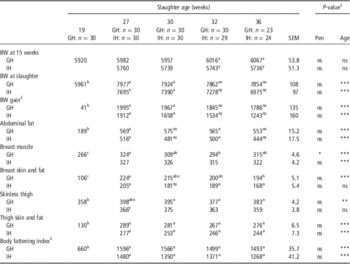
Concerning body traits reported in Table 2, the observed changes in GH birds from weeks 19 to 32 are very similar to those recorded in our previous study where geese were kept under corn feeding until week 31 (Guy et al., Reference Guy, Fortun-Lamothe, Bénard and Fernandez2013). These results confirm our previous observations showing that most of the response to corn feeding in terms of BW and fattening occur during the early stage of the stimulation (between weeks 19 and 27).
Time-related changes in the production performances of group (GH) and individually (IH) housed geese (all data are expressed in g)

GH=group housed; IH=individually housed.
a,b,c,dWithin a row, different superscripts indicate significant difference between means for the effect of age (P<0.05).
x,yWithin a column, different superscripts indicate significant differences between means for the effect of housing (GH v. IH) (P<0.05).
1 Level of probability of the effects of the rearing pen (pen) and age at slaughter. None of the interaction between the two main effects was significant. ***P<0.001, **P<0.01; ns, P>0.05.
2 Weight gain calculated by difference between the weight at 15 weeks and slaughter weight.
3 Body fattening index is a rough approximation of total body fat calculated as: abdominal fat+2×(breast skin and fat)+2×(thigh skin and fat).
In accordance with the results obtained on liver weight, the present data indicate that, regardless of the housing conditions, an extension of the corn feeding period over 32 weeks does not bring further changes in BW and composition: there were no significant changes in any of the variables under study from 32 to 36 weeks (Table 2).
At 32 and 36 weeks, the slaughter weight was significantly lower in IH compared to GH geese. These differences appeared despite the fact that slaughter weight, or weight gain, did not show any significant variation between weeks 27 and 36 in GH and IH birds. There were some indications that overall fattening was lower in IH than in GH geese: abdominal fat was significantly lower at 30 and 36 weeks in IH birds and breast skin and fat was significantly lower at 30 weeks. But these differences were not consistent over time.
Relationship between corn consumption and liver weight in individually housed birds
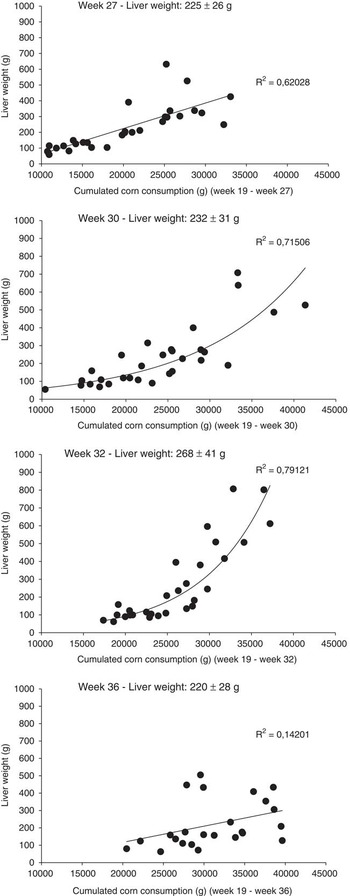
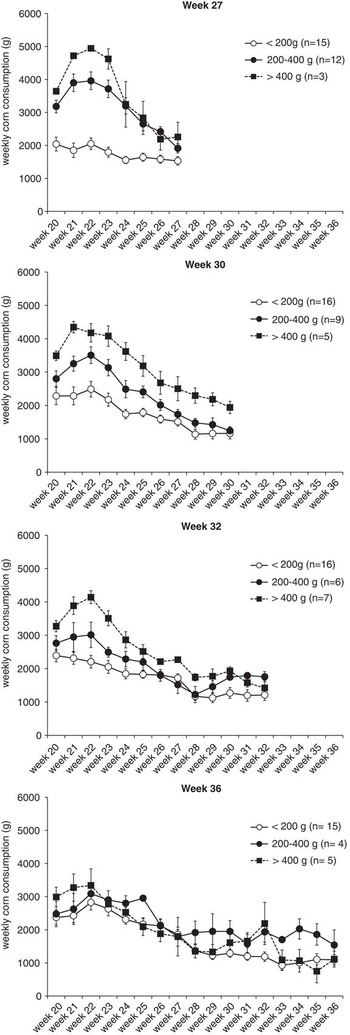
For each of the slaughter dates, there was a significant relationship between the cumulated corn consumption and the liver weight, except at weeks 36, where this relationship was weak (Figure 5). For all the other slaughter dates, the link between liver weight and corn consumption tended to strengthen along the experimental period (Figure 5): the R 2 were 0.62, 0.72 and 0.79 at week 27, 30 and 32, respectively. A further insight into the link between corn consumption and liver weight is given in Figure 6 where, for each slaughter date, the time-changes in corn consumption is given according to the weight class of the livers. It clearly appears that the hyperphagia occurring during the first 3 weeks of corn feeding is crucial in triggering spontaneous liver steatosis since heavy livers (>400 g) were observed only in birds that showed weekly corn consumption over 4000 g/w, on average, during the second and third experimental week (week 21 and 22; Figure 6).
Relationships between cumulated corn consumption and liver weight in individually housed geese for each of the slaughter dates.

Time-related changes in the weekly average corn consumption in individually housed birds according to the weight class of the liver at each slaughter date (vertical bars show the standard error of the mean).

In a study on the autumnal pre-migratory fattening of the garden warbler (Sylvia borin), Totzke et al. (Reference Totzke, Hübinger, Dittami and Bairlein2000) demonstrated that feed restriction before ad libitum feeding and reduction of the light phase enhanced feed consumption during the 1st week of ad libitum feeding. This resulted in an acceleration of fattening which was not, however, totally attributed to hyperphagia but rather to an increased feed utilisation efficiency and/or a reduced metabolic rate. In our case, we can reasonably assume that feed restriction before corn delivery probably enhanced the hyperphagic behaviour in geese and our results clearly show the major role of hyperphagia in liver fattening. The individual data obtained for feed intake point out the high variability in the feeding behaviour of male geese, in response to ad libitum corn feeding. The causes of this variability deserve further investigations. The heritability of feed intake under ad libitum feeding has been reported to be moderated in geese (h 2=0.29; Molnar et al., Reference Molnar, Nagy, Molnar and Bogenfürst2006) but this should be measured again under our experimental conditions where the expression of hyperphagic behaviour is stimulated.
Conclusions
Our data confirm our previously published observations (Guy et al., Reference Guy, Fortun-Lamothe, Bénard and Fernandez2013) showing that under specific management conditions, the geese are able to initiate spontaneous liver steatosis. The main objective of this work was to study the relationships between feed intake and liver steatosis at an individual level. The results clearly show the role of level and pattern of hyperphagia in the development of liver steatosis. A large part of the variability in liver weight is due to the variability in corn intake, except after 17 weeks of corn feeding (week 36) where the relationship with liver weight was weak. The ways to stimulate and maintain hyperphagia in geese, through lighting or feeding programmes, need to be further studied to enhance natural steatosis and decrease its individual variability.
Acknowledgements
The authors wish to acknowledge the members of the scientific advising committee of this project: Dr Elisabeth Baeza (INRA, URA, Tours, France), Dr Christel Marie-Etancelin (INRA, SAGA, Toulouse, France), Dr Thierry Astruc (INRA, QuaPA, Clermont-Fd, France), Prof Stéphane Davail (CNRS, UMR 5254 IPREM, Mont-de-Marsan, France).