





1 Introduction
Let
${\mathbb F}$
 be an algebraically closed field of characteristic
$p$
 and
$G$
 be an almost quasi-simple group. An important problem in representation theory is to classify the subgroups
$H$
 of
$G$
 and irreducible
${\mathbb F} G$
 -modules
$L$
 such that the restriction
$L{{\downarrow }}_H$
 is irreducible. For example, this problem is a natural part of the Aschbacher-Scott program of describing maximal subgroups in finite classical groups; see [Reference Aschbacher1, Reference Scott44] and [Reference Kleidman and Liebeck25, Reference Bray, Holt and Roney-Dougal4, Reference Magaard36, Reference Liebeck and Seitz35].
Suppose from now on that
$\mathrm{soc} (G/Z(G))$
 is the alternating group
${\mathsf A}_n$
 with
$n\geq 5$
 .
Problem 1. Suppose that
$\mathrm{soc} (G/Z(G))$
 is the alternating group
${\mathsf A}_n$
 with
$n\geq 5$
 . Classify the pairs
$(H, L)$
 , where
$H$
 is a subgroup of
$G$
 and
$L$
 is a faithful irreducible
${\mathbb F} G$
 -module such that the restriction
$L{{\downarrow }}_H$
 is irreducible.
Suppose the center
$Z(G)$
 is trivial, that is,
$G= {\mathsf A}_n$
 or
${\mathsf S}_n$
 .Footnote
1
In this case, Saxl [Reference Saxl43] has solved Problem 1 in characteristic
$p=0$
 . In positive characteristic the same has been achieved in [Reference Brundan and Kleshchev7, Reference Kleshchev and Sheth31] for
$p>3$
 , and in [Reference Kleshchev, Morotti and Tiep29] for
$p=2,3$
 .
From now on suppose that
$Z(G)$
 is nontrivial. If
$n\neq 6,7$
 , then
$G$
 is one of the Schur’s double covers
${\hat {\mathsf A}}_n$
 ,
${\hat {\mathsf S}}_n$
 or
$\tilde {\mathsf S}_n$
 .Footnote
2
The group algebras
${\mathbb F} {\hat {\mathsf S}}_n$
 and
${\mathbb F}\tilde {\mathsf S}_n$
 are canonically isomorphic, so we only have to deal with
${\hat {\mathsf A}}_n$
 and
${\hat {\mathsf S}}_n$
 .Footnote
3
Recall that
${\hat {\mathsf S}}_n$
 is the double cover of the symmetric group
${\mathsf S}_n$
 , in which transpositions lift to involutions. It is the group generated by
$t_1,\dots ,t_{n-1},z$
 subject to the following relations:

We have the natural projection

which maps
$t_i$
 onto the transposition
$(i,i+1)$
 and
$z$
 to 1. Then
${\hat {\mathsf A}}_n=\pi ^{-1}({\mathsf A}_n)$
 , where
${\mathsf A}_n<{\mathsf S}_n$
 is the alternating group.
From now on, let
$G={\hat {\mathsf S}}_n$
 or
${\hat {\mathsf A}}_n$
 for
$n\geq 5$
 .
In characteristic
$p=0$
 , Kleidman and Wales [Reference Kleidman and Wales26] classify the faithful irreducible
${\mathbb F} G$
 -modules
$L$
 and subgroups
$H<G$
 such that
$L{{\downarrow }}_H$
 is irreducible, provided that either
$H$
 is quasi-simple or
$H$
 is a maximal subgroup of
$G$
 .Footnote
4
Assume from now on that
$p=\mathrm{char} {\mathbb F}$
 is positive. We may then further assume that
$p>2$
 , as in the case
$p=2$
 the center
$Z(G)$
 acts trivially on an irreducible
${\mathbb F} G$
 -module
$L$
 and so
$L$
 is not faithful.
To state the main results we need to recall the classification of the faithful irreducible
${\mathbb F} G$
 -modules. The reader is referred to Section 7 for details on this. We denote by
${\mathscr {RP}}_p(n)$
 the set of all restricted
$p$
 -strict partitions of
$n$
 . For a partition
$\lambda \in {\mathscr {RP}}_p(n)$
 , we denote by
$h_{p'}(\lambda )$
 the number of parts of
$\lambda $
 not divisible by
$p$
 , and set

Then the irreducible
${\mathbb F} G$
 -modules can be canonically labeled as follows:

Thus, when we write
$D(\lambda ;\pm )$
 it is assumed that
$a_p(\lambda )=1$
 , when we write
$E(\lambda ;\pm )$
 it is assumed that
$a_p(\lambda )=0$
 , etc. We will sometimes write
$D(\lambda ;{\varepsilon })$
 to denote
$D(\lambda ;0)$
 or
$D(\lambda ;\pm )$
 depending on whether
$a_p(\lambda )=0$
 or
$1$
 , and similarly for
$E(\lambda ;{\varepsilon })$
 .
Special
${\mathbb F} G$
 -modules, called the basic and the second basic modules play a special role. These modules have been studied by Wales [Reference Wales46] as irreducible modules arising in reductions modulo
$p$
 of the faithful
${\mathbb C} G$
 -modules corresponding to the partitions
$(n)$
 and
$(n-1,1)$
 , and they are known to be the faithful
${\mathbb F} G$
 -modules of the smallest and the second smallest dimensions when
$n \geq 12$
 [Reference Kleshchev and Tiep34].
Denote


Then, the basic
${\mathbb F}{\hat {\mathsf S}}_n$
 -modules are
$D(\boldsymbol {\unicode{x3b1} }_n;{\varepsilon })$
 and the basic
${\mathbb F}{\hat {\mathsf A}}_n$
 -modules are
$E(\boldsymbol {\unicode{x3b1} }_n;{\varepsilon })$
 ; they are denoted
$X_n$
 and
$X_n^*$
 , respectively
$Y_n$
 and
$Y_n^*$
 in [Reference Wales46, Table III]. The second basic
${\mathbb F}{\hat {\mathsf S}}_n$
 -modules are
$D(\boldsymbol {\unicode{x3b2} }_n;{\varepsilon })$
 , and the second basic
${\mathbb F}{\hat {\mathsf A}}_n$
 -modules are
$E(\boldsymbol {\unicode{x3b2} }_n;{\varepsilon })$
 ; they are denoted
$Z_n$
 and
$Z_n^*$
 , respectively
$T_n$
 and
$T_n^*$
 in [Reference Wales46, Table IV]. See Section 8.1 for a more detailed discussion of these modules. Wales [Reference Wales46] computed the dimensions of the basic and second basic
${\mathbb F} G$
 -modules as follows. Let

Then the dimensions of the basic modules for
${\hat {\mathsf S}}_n$
 and
${\hat {\mathsf A}}_n$
 are, respectively,

and the dimensions of the second basic module for
${\hat {\mathsf S}}_n$
 and
${\hat {\mathsf A}}_n$
 are, respectively,

We now formulate a result by the first and the third authors which deals with the case where
$\pi (H)<{\mathsf S}_n$
 is a primitive subgroup. Recall that a subgroup
$X \leq {\mathsf S}_n$
 is called primitive if
$X$
 acts transitively on
$\Omega :=\{1,2,\dots ,n\}$
 and the only partitions of
$\Omega $
 preserved by
$X$
 are the partitions into either a single set or into
$n$
 singleton sets; otherwise
$X$
 is called imprimitive (imprimitive subgroups may be transitive or intransitive).
Now the result for the case where
$\pi (H)$
 is primitive is as follows.Footnote
5
,Footnote
6
,Footnote
7
Theorem 2 [Reference Kleshchev and Tiep33, Theorem B].
Let
$G = {\hat {\mathsf S}}_n$
 or
${\hat {\mathsf A}}_n$
 with
$n \geq 5$
 ,
$L$
 be a faithful irreducible
${\mathbb F} G$
 -module, and let
$H$
 be a subgroup of
$G$
 such that
$\pi (H)<{\mathsf S}_n$
 is a primitive subgroup not containing
${\mathsf A}_n$
 . Then
$L{{\downarrow }}_{H}$
 is irreducible if and only if one of the following holds:
-
(i) $G = {\hat {\mathsf S}}_n$
 ,
$L$
is a basic module, and one of the following holds:
-
(a) $n=5$
,
$p \neq 5$
, and
$\pi (H) = {\mathbb Z}_{5}\rtimes {\mathbb Z}_{4}$
; -
(b) $n=6$
, and
$\pi (H) = {\mathsf S}_{5}$
; -
(c) $n=6$
,
$p \neq 3$
, and
$\pi (H) = {\mathsf A}_{5}$
; -
(d) $n=8$
, and
$\pi (H)=\mathsf {AGL}_3(2)$
; -
(e) $n=10$
. Furthermore, either
$p\neq 3,5$
and
$\pi (H)={\mathsf S}_6, \mathsf {M}_{10}$
, or
$p\neq 3$
and
$\pi (H)={\mathrm {Aut}}({\mathsf A}_6)$
; -
(f) $n=11$
,
$p=11$
, and
$\pi (H)=\mathsf {M}_{11}$
(two classes); -
(g) $n=12$
,
$p\neq 3$
, and
$\pi (H)=\mathsf {M}_{12}$
.
-
-
(ii) $G = {\hat {\mathsf A}}_n$
,
$L$
is a basic module, and one of the following holds:-
(a) $n=5$
,
$p \neq 5$
, and
$\pi (H) = {\mathbb Z}_{5}\rtimes {\mathbb Z}_{2}$
; -
(b) $n=6$
, and
$\pi (H) = {\mathsf A}_{5}$
; -
(c) $n=7$
, and
$\pi (H) = \mathsf {L}_{2}(7)$
(two classes); -
(d) $n=8$
, and
$\pi (H)=\mathsf {AGL}_3(2)$
(two classes); -
(e) $n=9$
,
$p\neq 3$
, and
$\mathsf {L}_{2}(8) \lhd \pi (H) \leq {\mathrm {Aut}}(\mathsf {L}_{2}(8))$
, or
$3^2\rtimes \mathsf {Q}_8\lhd \pi (H)\leq 3^2\rtimes \mathsf {SL}_2(3)$
; -
(f) $n=10$
,
$p\neq 3$
, and
$\pi (H)=\mathsf {M}_{10}$
; -
(g) $n=10$
,
$p=5$
, and
$\pi (H)={\mathsf A}_6$
; -
(h) $n=11$
,
$p\neq 3$
, and
$\pi (H)=\mathsf {M}_{11}$
(two classes); -
(i) $n=12$
,
$p\neq 3$
, and
$\pi (H)=\mathsf {M}_{12}$
(two classes).
-
-
(iii) $G = {\hat {\mathsf A}}_n$
,
$L$
is a second basic module, and one of the following holds:-
(a) $n=6$
,
$p = 3$
, and
$\pi (H) = {\mathsf A}_{5}$
; -
(b) $n=7$
,
$p = 3$
,
$\pi (H) = \mathsf {L}_{2}(7)$
(two classes); -
(c) $n=8$
,
$p\neq 7$
, and
$\pi (H)=\mathsf {AGL}_3(2)$
(two classes); -
(d) $n=12$
,
$p\neq 3, 11$
, and
$\pi (H)=\mathsf {M}_{12}$
(two classes).
-
-
(iv) $L$
is neither a basic nor a second basic module, and one of the following holds:-
(a) $n=5$
,
$p>5$
,
$G = {\hat {\mathsf S}}_5$
,
$\pi (H) = {\mathbb Z}_{5}\rtimes {\mathbb Z}_{4}$
, and
$\dim L = 4$
; -
(b) $n=6$
,
$p>5$
,
$G= {\hat {\mathsf S}}_6$
,
$\pi (H) = {\mathsf S}_{5}$
, and
$\dim L = 4$
.
-


The immediate consequence of Theorem 2 is
Corollary 3. Let
$G = {\hat {\mathsf S}}_n$
 or
${\hat {\mathsf A}}_n$
 with
$n>12$
 ,
$L$
 be a faithful irreducible
${\mathbb F} G$
 -module, and let
$H$
 be a subgroup of
$G$
 not containing
${\hat {\mathsf A}}_n$
 . If
$L{{\downarrow }}_{H}$
 is irreducible then
$\pi (H)$
 is imprimitive.
In view of Theorem 2, it remains to deal with imprimitive subgroups, which turns out to be a much more difficult case. Under the assumption that
$L$
 is not a basic module, this case is settled in Theorem A below, which is the main result of this paper.
Setting

for every
$i\in I$
 , there is an explicit class
$\mathtt { JS}^{(i)}$
 of i-Jantzen-Seitz (restricted
$p$
 -strict) partitions, and we let

see §3.3.
For a composition
$(\mu _1,\dots ,\mu _r)$
 of
$n$
 we have a standard Young subgroup

If
$n=ab$
 for integers
$a,b>1$
 , we also have the standard wreath product subgroup

We set

and

Theorem A. Let
$G={\hat {\mathsf S}}_n$
 or
${\hat {\mathsf A}}_n$
 with
$n\geq 5$
 , and
$H$
 be a subgroup of
$G$
 such that
$\pi (H)<{\mathsf S}_n$
 is imprimitive. Suppose
$L$
 is a faithful irreducible
${\mathbb F} G$
 -module, which is not basic. Then
$L{{\downarrow }}_H$
 is irreducible if and only if one of the following holds:
-
(i) $H={\hat {\mathsf S}}_{n-1,1}\cap G$
and one of the following holds:-
(a) $L=D(\lambda ;0)$
or
$E(\lambda ;0)$
with
$\lambda \in \mathtt {JS}^{(0)}$
; -
(b) $L=D(\lambda ;\pm )$
or
$E(\lambda ;\pm )$
with
$\lambda \in \mathtt {JS}$
.
-
-
(ii) $G={\hat {\mathsf S}}_n$
,
$H={\hat {\mathsf A}}_{n-1,1}$
and
$L=D(\lambda ;\pm )$
with
$\lambda \in \mathtt {JS}^{(0)}$
; -
(iii) $H={\hat {\mathsf S}}_{n-2,2} \cap G$
, and
$L=D(\lambda ;{\varepsilon })$
or
$E(\lambda ;{\varepsilon })$
with
$\lambda \in \mathtt {JS}^{(0)}$
; -
(iv) $H={\hat {\mathsf S}}_{n-2,1,1}\cap G$
, and
$L=D(\lambda ;\pm )$
or
$E(\lambda ;\pm )$
with
$\lambda \in \mathtt {JS}^{(0)}$
; -
(v) $G={\hat {\mathsf S}}_n$
,
$H={\hat {\mathsf A}}_{n-2,2}$
and
$L=D(\lambda ;\pm )$
with
$\lambda \in \mathtt {JS}^{(0)}$
; -
(vi) $L$
is second basic,
$p\mid (n-1)$
,
$n=2b$
is even and one of the following holds:-
(a) $G={\hat {\mathsf S}}_n$
and
$H=\hat {\mathsf W}_{2,b}$
or
$H=\hat {\mathsf W}_{b,2}$
, -
(b) $G={\hat {\mathsf S}}_n$
,
$\pi ^{-1}({\mathsf A}_{b}\times {\mathsf A}_{b})< H<\hat {\mathsf W}_{b,2}$
with
$[\hat {\mathsf W}_{b,2}:H]=2$
and
$H\neq {\hat {\mathsf S}}_{b,b}$
(there are two such conjugacy classes of subgroups
$H$
), -
(c) $G={\hat {\mathsf A}}_n$
and
$H=\hat {\mathsf W}_{b,2}\cap {\hat {\mathsf A}}_n$
;
-


Theorem A substantially strengthens [Reference Kleshchev and Tiep33, Theorem D]. Note that [Reference Kleshchev and Tiep33, Theorem D] contains a gap – it missed a case corresponding to the case (iii) of Theorem A, and its corrected and expanded version, now also including
$p=3$
 , is proved as Theorem 13.5:
Theorem B. Let
$n\geq 8$
 ,
$H\leq G\in \{{\hat {\mathsf S}}_n,{\hat {\mathsf A}}_n\}$
 , and
$L$
 be a nonbasic irreducible spin
${\mathbb F} G$
 -module such that
$L{{\downarrow }}_H$
 is irreducible. If
$\pi (H)$
 is not almost simple and
$\pi (H)$
 is imprimitive on
$\Omega =\{1,2,\ldots ,n\}$
 then one of the following holds:
-
(i) $G={\hat {\mathsf S}}_n$
and
$\pi (H)={\mathsf S}_{n-2,2}$
, -
(ii) $n$
is even,
$\pi (H)$
is transitive on
$\{1,2,\dots ,n\}$
, and
$H\leq \hat {\mathsf W}_{n/2,2}$
or
$H\leq \hat {\mathsf W}_{2,n/2}$
.


Nonserial irreducible restrictions to maximal subgroups
$\hat {\mathsf W}_{a,b}\cap G$


Table 1 Long description
The table consists of five columns labeled L, dim L, G, H, and p.
* Row 1: L is D (3, 2, 1; plus or minus), dim L is 4, G is S-hat sub 6, H is W-hat sub 3,2, and p is greater than or equal to 7.
* Row 2: L is D (3, 2, 1; plus or minus), dim L is 4, G is S-hat sub 6, H is W-hat sub 2,3, and p is greater than or equal to 7.
* Row 3: L is E (3, 2, 1; 0), dim L is 4, G is A-hat sub 6, H is W-hat sub 3,2 intersected with A-hat sub 6, and p is greater than or equal to 7.
* Row 4: L is D (4, 3, 2, 1; 0), dim L is 96, G is S-hat sub 10, H is W-hat sub 5,2, and p is greater than or equal to 7.
* Row 5: L is E (4, 3, 2, 1; plus or minus), dim L is 48, G is A-hat sub 10, H is W-hat sub 5,2 intersected with A-hat sub 10, and p is greater than or equal to 7.
Nonserial irreducible restrictions to nonmaximal imprimitive subgroups

Table 2 Long description
The table consists of five columns: L, dim L, G, pi (H), and p.
* Row 1: L is D (3, 2, 1; plus or minus), dim L is 4, G is S-hat sub 6, pi (H) is congruent to Z sub 5 semidirect product Z sub 4 which is a subgroup of S sub 5, 1, and p is greater than or equal to 7.
* Row 2: L is D (3, 2, 1; plus or minus), dim L is 4, G is S-hat sub 6, pi (H) is a subgroup of W sub 3, 2 with pi (H) intersection S sub 3, 3 equal to A sub 3, 3 and pi (H) is not a subgroup of S sub 3, 3, and p is greater than or equal to 7.
* Row 3: L is D (3, 2, 1; plus or minus), dim L is 4, G is S-hat sub 6, pi (H) equals W sub 2, 2 times S sub 2, and p is greater than or equal to 5.
* Row 4: L is E (4, 2, 1; plus or minus), dim L is 6, G is A-hat sub 7, pi (H) is congruent to A sub 5 primitive in S sub 6, 1, and p equals 3.
Initial considerations indicate that the basic modules may yield many nonmaximal imprimitive subgroups with irreducible restrictions, and for this reason we have to exclude them. However, for the reader’s convenience we cite the following results from [Reference Kleshchev and Tiep33].
Theorem 4 [Reference Kleshchev and Tiep33, Theorem E].
Let
$G={\hat {\mathsf S}}_n$
 or
${\hat {\mathsf A}}_n$
 ,
$L$
 be a basic
${\mathbb F} G$
 -module, and
$H$
 be a subgroup of
$G$
 such that
$\pi (H)<{\mathsf S}_n$
 is maximal imprimitive. Then
$L{\downarrow }_{H}$
 is irreducible if and only if one of the following holds:
-
(i) $G={\hat {\mathsf S}}_n$
and one of the following holds:-
(a) $H={\hat {\mathsf S}}_{n-a,a}$
,
$a<n/2$
,
$p{\not {\mid }}\,a$
,
$p{\not {\mid }}\,(n-a)$
, and either
$2|n$
, or
$2 {/\!\kern-0.7pt\!\mid }\,n $
and
$p\mid n$
. -
(b) $H=\hat {\mathsf W}_{a,b}$
for some
$a,b\geq 2$
with
$n=ab$
and
$p{\not {\mid }}\,a$
.
-
-
(ii) $G={\hat {\mathsf A}}_n$
and one of the following holds:-
(a) $H={\hat {\mathsf A}}_{n-a,a}$
,
$a<n/2$
,
$p{\not {\mid }}\,a$
,
$p{\not {\mid }}\,(n-a)$
, and either
$2 {/\!\kern-0.7pt\!\mid }\, n$
, or
$2p|n$
. -
(b) $H= \hat {\mathsf W}_{a,b}\cap {\hat {\mathsf A}}_n$
for some
$a,b\geq 2$
with
$n=ab$
and
$p{\not {\mid }}\,a$
.
-


We also point out that the irreducible restrictions
$L{{\downarrow }}_H$
 for the case where
$H$
 is almost quasi-simple are classified in [Reference Kleshchev and Tiep33, Theorem C]. This result which includes the case where
$L$
 is basic, together with Theorem 4, allows one to deal with basic spin modules directly in a number of applications.
The proof of Theorem A requires an application and development of a wide range of tools from representation theory of symmetric groups, both linear and projective. Very important is the superalgebra approach to spin representation theory – in particular we often work with irreducible supermodules and use delicate arguments involving types (
$\!\!\mathtt {M}$
 or
$\mathtt {Q}$
 ) of irreducible supermodules over the superalgebras of interest.
Especially crucial are the branching rules for modular spin representations of symmetric groups obtained in [6, Reference Kleshchev27], and especially [Reference Kleshchev and Shchigolev32]. We develop these in several directions, obtaining consequences which might be of independent interest.
We also use results on decomposition numbers for spin representations, both of general nature [Reference Brundan and Kleshchev8, Reference Brundan and Kleshchev10] as well as for two-row partitions [Reference Morotti38], for blocks of cyclic defect [Reference Müller40], for basic and second basic representations [Reference Wales46], and in characteristic
$3$
 , see [Reference Bessenrodt, Morris and Olsson2]. The results on spin representations in characteristic
$0$
 , especially the irreducible characters, tensor products, and the Littlewood-Richardson rule [Reference Stembridge45] are also used in a crucial way.
We now describe in more detail some of the key steps in the proof of Theorem A for the case
$G={\hat {\mathsf S}}_n$
 , the case
$G={\hat {\mathsf A}}_n$
 requiring similar (and sometimes more delicate) arguments. So let
$H\leq {\hat {\mathsf S}}_n$
 and
$L$
 be an irreducible
${\mathbb F}{\hat {\mathsf S}}_n$
 -module.
We denote by
$S^\alpha $
 (resp.
$M^\alpha $
 ) the Specht (resp. permutation) module over the symmetric group
${\mathsf S}_n$
 corresponding to a partition
$\alpha $
 of
$n$
 . Whenever necessary, all modules over
${\mathsf S}_n$
 are considered as modules over
${\hat {\mathsf S}}_n$
 by lifting along the natural projection
$\pi $
 . We have the natural embedding
$\iota _\alpha :S^\alpha {\hookrightarrow } M^\alpha $
 and the natural projection
$\sigma _\alpha :M^\alpha {\twoheadrightarrow } (S^\alpha )^*$
 .
The reduction lemmas (see Lemma 10.3 and its variation Lemma 10.4) allow us to control the reducibility of the restriction
$L{{\downarrow }}_H$
 by playing homomorphisms

against homomorphisms

The key condition is that
$\sigma _\alpha \circ {\varphi }$
 and
$\psi \circ \iota _\alpha $
 must be nonzero. The reduction lemmas will be applied for special small partitions
$\alpha $
 , by which we mean the
$\alpha $
 ’s with the first row
$\alpha _1\geq n-6$
 (we are mostly interested in the cases
$\alpha =(n-2,2), (n-3,3), (n-6,6), (n-6,4,2)$
 and
$(n-6,2^3)$
 ).
To construct an appropriate
${\varphi }\in \mathrm{Hom}_{{\hat {\mathsf S}}_n}({\textbf {1}}{\uparrow }_H^{{\hat {\mathsf S}}_n},M^\alpha )$
 , we need to control the dimension of the invariant spaces
$\dim (V^H)$
 for various subquotients
$V$
 of
$M^\alpha $
 for small
$\alpha $
 ’s. This will be especially important when
$H$
 is a wreath product subgroup and
$V$
 is a dual Specht module
$(S^{(n-k,k)})^*$
 for
$k\leq 6$
 . To evaluate the dimensions of the invariant spaces, we use results on cohomology of symmetric groups, especially cohomology of dual Specht modules [Reference Burichenko, Kleshchev and Martin11], the submodule structure of permutation modules, and the decomposition numbers. The necessary results on invariants are established in Section 5.
To construct an appropriate
$\psi \in \mathrm{Hom}_{{\hat {\mathsf S}}_n}(M^\alpha ,\mathrm{End}_{\mathbb F}(L))$
 , we combine different methods, since none of the methods works universally for all
$L$
 ’s.
For the first method, note that
$k:=n-\alpha _1+\alpha _2\leq 12$
 for all small
$\alpha $
 ’s, so we have a ‘small’ natural subgroup
${\hat {\mathsf S}}_{k}\leq {\hat {\mathsf S}}_n$
 . Using the construction of the Specht module
$S^\alpha \subseteq M^\alpha $
 , we show in Lemma 10.7 (see also Lemma 10.8 for a minor improvement) that the required homomorphism
$\psi $
 exists if
$x_\xi L\neq 0$
 for a certain explicit element
$x_\xi \in {\mathbb F} {\hat {\mathsf S}}_{k}$
 defined in (10.6). As
$k$
 is small, it is possible to check explicitly (using GAP [15] if necessary) when
$x_\xi D\neq 0$
 for an irreducible
${\mathbb F} {\hat {\mathsf S}}_{k}$
 -module
$D$
 . To prove that
$x_\xi L\neq 0$
 it then suffices to show that such
$D$
 appears as a composition factor in the restriction
$L{{\downarrow }}_{{\hat {\mathsf S}}_{k}}$
 . Here we use in a crucial way the branching rules for modular spin representations of symmetric groups.
For the second method, note that
$\mathrm{Hom}_{{\hat {\mathsf S}}_n}(M^\alpha ,\mathrm{End}_{\mathbb F}(L))\cong \mathrm{End}_{{\hat {\mathsf S}}_{\alpha }}(L{{\downarrow }}_{{\hat {\mathsf S}}_{\alpha }})$
 . Moreover, in the key case
$\alpha =(n-2,2)$
 , it is easy to see that

and the required
$\psi \in \mathrm{Hom}_{{\hat {\mathsf S}}_n}(M^\alpha ,\mathrm{End}_{\mathbb F}(L))$
 exists if and only if the inequality is strict, see Lemma 10.5 for a stronger result. In Section 11, we establish the strict inequality in many cases, again using branching rules for modular spin representations.
Not surprisingly, the basic and the second basic modules are often exceptional and have to be excluded in many results. For the basic modules, this creates less of a problem for us since these modules are excluded in Theorem A anyway, but the second basic module requires a lot of special attention, see especially §§13.2,13.3. Most difficult is to handle (inverse images under
$\pi $
 of) nonmaximal intransitive subgroups. Here of key importance are results showing that these subgroups induce permutation groups (on suitable sets) which are either
$3$
 -homogeneous, or primitive of high order; see, for example, Proposition 13.2 and Lemma 13.15. Classification results on such groups, including [Reference Cameron12], [Reference Kantor24] and [Reference Kleidman and Wales26], allow us to pin down the structure of possible subgroups with irreducible restriction. This provides enough information to study subgroups of
${\hat {\mathsf S}}_{n-1}$
 ,
${\hat {\mathsf S}}_{n-2,2}$
 and
$\hat {\mathsf W}_{n/2,2}$
 . In order to study subgroups of
$\hat {\mathsf W}_{2,n/2}$
 we also classify in Lemma 13.18 subgroups
$H\leq {\mathsf W}_{2,n/2}$
 which project onto
${\mathsf S}_{n/2}$
 under the natural projection
${\mathsf W}_{2,n/2}{\twoheadrightarrow } {\mathsf S}_{n/2}$
 (but are not contained in
${\mathsf A}_n$
 ). We then apply other tools including Wales’ results on decomposition numbers [Reference Wales46], recognition results and dimension bounds from [Reference Kleshchev and Tiep34], and characteristic
$0$
 results from [Reference Stembridge45], to complete the proof.
2 Generalities
2.1 Ground field
Throughout the paper we work over an algebraically closed field
${\mathbb F}$
 of characteristic
$p>2$
 . In particular, unless otherwise stated, all representations are over
${\mathbb F}$
 . Occasionally we will also use complex representations.
For an
${\mathbb F}$
 -algebra
$A$
 we denote by
${\mathrm {Irr}}(A)$
 a complete nonredundant set of irreducible
$A$
 -modules up to isomorphism.
2.2 Groups and modules
Let
$G$
 be a finite group. All
${\mathbb F} G$
 -modules are assumed to be finite dimensional. We denote by
${\textbf {1}}_G$
 or simply
${\textbf {1}}$
 the trivial
${\mathbb F} G$
 -module. For
${\mathbb F} G$
 -modules
$U,V$
 we denote by
$\mathrm{Hom}_G(U,V)$
 the space of all
${\mathbb F} G$
 -module homomorphisms from
$U$
 to
$V$
 , and by
$\mathrm{Hom}_{\mathbb F}(U,V)$
 the space of all linear maps considered as an
${\mathbb F} G$
 -module via

We denote by
$M_{\mathbb F}(G)$
 the maximal dimension of an irreducible
${\mathbb F} G$
 -module. We will often use the classical inequalities
$M_{\mathbb F}(G)\leq M_{\mathbb C}(G)$
 , and

for a central extension
$\hat G$
 of
$G$
 .
Let
$H$
 be another finite group. For an
${\mathbb F} G$
 -module
$V$
 and an
${\mathbb F} H$
 -module
$W$
 we denote by
$V\boxtimes W$
 the outer tensor product of
$V$
 and
$W$
 , which is naturally an
${\mathbb F}(G\times H)$
 -module. On the other hand, given another
${\mathbb F} G$
 -module
$V'$
 we denote by
$V\otimes V'$
 the inner tensor product of
$V$
 and
$V'$
 , which is an
${\mathbb F} G$
 -module via
$g(v\otimes v')=gv\otimes gv'$
 for all
$g\in G,\,v\in V,\,v'\in V'$
 .
If
$H\leq G$
 is a subgroup,
$V$
 is an
${\mathbb F} G$
 -module, and
$W$
 is an
${\mathbb F} H$
 -module, we denote by
$V{{\downarrow }}^G_{H}$
 or simply
$V{{\downarrow }}_H$
 the restriction of
$V$
 to
$H$
 , and by
$W{\uparrow }^G_{H}$
 or simply
$W{\uparrow }^G$
 the induction of
$W$
 to
$G$
 .
Let
$V$
 be an
${\mathbb F} G$
 -module. We denote by
$V^*$
 the dual
${\mathbb F} G$
 -module. We denote by
$V^G$
 the set of G-invariant vectors in
$V$
 . We write
$\mathrm{soc} V$
 and
$\mathrm{hd} V$
 for the socle and head of
$V$
 , respectively. If
$V_1,\dots ,V_a$
 are
${\mathbb F} G$
 -modules, we write

to indicate that
$V$
 has a submodule filtration with subquotients
$V_1,\dots ,V_a$
 listed from bottom to top.
For
$L\in {\mathrm {Irr}}({\mathbb F} G)$
 and any
${\mathbb F} G$
 -module
$V$
 we denote by
$[V:L]$
 the composition multiplicity of
$L$
 in
$V$
 .
Corollary 2.3. Let
$V$
 be an
${\mathbb F} G$
 -module and
$L\in {\mathrm {Irr}}({\mathbb F} G)$
 such that
$[V:L]=1$
 . Suppose
$W$
 is a submodule of
$V$
 with
$\mathrm{hd} W\cong L$
 . Then
$W$
 is the unique smallest submodule of
$V$
 having
$L$
 as a composition factor.
Proof. If
$X$
 is a submodule of
$V$
 with
$[X:L]\neq 0$
 , then
$[V/X:L]=0$
 , so the composition
$W{\hookrightarrow } V{\twoheadrightarrow } V/X$
 has kernel
$K$
 satisfying
$[K:L]\neq 0$
 , hence
$K=W$
 . Thus
$W\subseteq X$
 .
For
$m\in \mathbb {Z}_{\geq 0}$
 , we write
$H^m(G,V)$
 for the mth cohomology space of
$G$
 with coefficients in an
${\mathbb F} G$
 -module
$V$
 , referring the reader for example to [Reference Brown5], [Reference Guichardet16, Chapter 1] for more information on group cohomology. We will use the following well-known result.
Lemma 2.4. Let
$G=A\rtimes B$
 be a finite group,
$V$
 be an
${\mathbb F} G$
 -module, and
$m\in \mathbb {Z}_{\geq 0}$
 .
-
(i) If $p{/\!\kern-0.7pt\!\mid }\, |A|$
then
$H^m(G,V)\cong H^m(B,V^A)$
; -
(ii) If $p{/\!\kern-0.7pt\!\mid }\, |B|$
then
$H^m(G,V)\cong H^m(A,V)^{B}.$


Proof. Since
$p$
 does not divide the order of
$A$
 (resp.
$B$
 ), the corresponding Lyndon-Hochschild-Serre spectral sequences [Reference Guichardet16, 9.1] collapse.
Lemma 2.5. Suppose that for an
${\mathbb F} G$
 -module
$V$
 we have
$V\sim V_1|\cdots | V_t$
 . If
$H^1(G,V_r)=0$
 for all
$r=1,\dots ,t$
 then
$\dim V^G=\dim V_1^G+\dots +\dim V_t^G$
 and
$H^1(G,V)=0$
 .
Proof. The exact sequence
$0\to V_1\to V\to W\to 0$
 with
$W\sim V_2|\cdots | V_t$
 yields the exact sequence

and the result follows by induction on
$t$
 .
The following well-known lemma follows from the Clifford theory (using
$p\neq 2$
 ). In it,
$\mathtt {sgn}$
 is the nontrivial
$1$
 -dimensional
${\mathbb F} G$
 -module with kernel
$G_0$
 , and for an
${\mathbb F} G_0$
 -module
$W$
 , we denote by
$W^\sigma $
 the
${\mathbb F} G_0$
 -module obtained from
$W$
 by twisting with the conjugation by
$\sigma \in G\smallsetminus G_0$
 .
Lemma 2.6. Let
$G_0<G$
 be a subgroup of index
$2$
 . Then we can write

with

and

Corollary 2.7. Let
$V$
 be an
${\mathbb F} G$
 -module and
${G_0}<G$
 be a subgroup of index
$2$
 . Then

Proof. Using the notation of Lemma 2.6, we have by the Frobenius reciprocity,

which implies the result on the socle, and the result on the head is proved similarly.
For an
${\mathbb F} G$
 -module
$V$
 we denote by
$\chi _V$
 its
${\mathbb F}$
 -valued character, that is,
$\chi _V(x)$
 is the trace of
$x$
 acting on
$V$
 for all
$x\in {\mathbb F} G$
 . If
$p>0$
 and
$V=\bar W$
 is a reduction modulo
$p$
 of a
${\mathbb C} G$
 -module
$W$
 (using an appropriate
$p$
 -modular system), then
$\chi _V(g)=\bar \chi _W(g)$
 , reduction modulo
$p$
 of
$\chi _W(g)$
 for all
$g\in G$
 .
2.3 Superalgebras and supermodules
A superspace is a
$\mathbb {Z}/2\mathbb {Z}$
 -graded vector space
$V=V_{{\bar {0}}}\oplus V_{{\bar {1}}}$
 . Let
${\varepsilon }\in \mathbb {Z}/2\mathbb {Z}$
 . For
$v\in V_{\varepsilon }$
 , we write
$|v|={\varepsilon }$
 . Let
$V,W$
 be superspaces. For
$\delta \in \mathbb {Z}/2\mathbb {Z}$
 , a parity
$\delta $
 homogeneous linear map
$f:V\to W$
 is a linear map satisfying
$f(V_{{\varepsilon }})\subseteq W_{{\varepsilon }+\delta }$
 for all
${\varepsilon }$
 . We denote the space of all parity
$\delta $
 homogeneous linear maps from
$V$
 to
$W$
 by
$\mathrm{Hom}(V,W)_{\delta }$
 , and set

We write
$V\cong W$
 (resp.
$V\simeq W$
 ) if there is an isomorphism in
$\mathrm{Hom}(V,W)$
 (resp.
$\mathrm{Hom}(V,W)_{\bar {0}}$
 ).
The tensor product
$V\otimes W$
 of two superspaces is the usual tensor product of spaces considered as a superspace via
$|v\otimes w|=|v|+|w|$
 (here and below in similar situations it is assumed that
$v,w$
 are homogeneous). For
$f\in \mathrm{Hom}(V,V')$
 and
$g\in \mathrm{Hom}(W,W')$
 , we have
$f\otimes g\in \mathrm{Hom}(V\otimes W,V'\otimes W')$
 defined via
$(f\otimes g)(v\otimes w)=(-1)^{|g||v|}f(v)\otimes g(w)$
 .
A superalgebra is a superspace
$A$
 which is a (unital) algebra with
$A_{\varepsilon } A_\delta \subseteq A_{{\varepsilon }+\delta }$
 for all
${\varepsilon },\delta \in \mathbb {Z}/2\mathbb {Z}$
 . An antiautomorphism of a superalgebra
$A$
 is an even linear map
$\tau :A\to A$
 which satisfies
$\tau (ab)=\tau (b)\tau (a)$
 .
Example 2.8. An important example is as follows. Let
$G$
 be a finite group with a subgroup
$G_0\leq G$
 of index
$2$
 . Then the group algebra
$A:={\mathbb F} G$
 is a superalgebra with
$({\mathbb F} G)_{\bar {0}}={\mathbb F} G_0$
 ,
$({\mathbb F} G)_{\bar {1}}=\mathrm{span}(G\smallsetminus G_0)$
 .
For a superalgebra
$A$
 , a (left) A-supermodule is a superspace
$V$
 which is a left
$A$
 -module with
$A_{\varepsilon } V_\delta \subseteq V_{{\varepsilon }+\delta }$
 for all
${\varepsilon },\delta $
 . Let
$V,W$
 be graded
$A$
 -supermodules. A parity
$\delta $
 homogeneous graded
$A$
 -supermodule homomorphism from
$V$
 to
$W$
 is a parity
$\delta $
 homogeneous linear map
$f:V\to W$
 satisfying
$f(av)=(-1)^{\delta |a|}af(v)$
 for all (homogeneous)
$a\in A,\,v\in V$
 . We denote by
$\mathrm{Hom}_A(V,W)_{\delta }$
 the space of all parity
$\delta $
 homogeneous
$A$
 -supermodule homomorphisms from
$V$
 to
$W$
 , and set

We write
$V\cong W$
 (resp.
$V\simeq W$
 ) if there is an isomorphism in
$\mathrm{Hom}_A(V,W)$
 (resp.
$\mathrm{Hom}_A(V,W)_{\bar {0}}$
 ).
In this paper all superalgebras and supermodules are assumed to be finite-dimensional.
If
$\tau $
 is an antiautomorphism of
$A$
 and
$V$
 is an
$A$
 -supermodule, we define the structure of an
$A$
 -supermodule on
$V^*$
 via
$(af)(v)=f(\tau (a)v)$
 for all
$f\in V^*$
 ,
$a\in A$
 , and
$v\in V$
 . The resulting
$A$
 -supermodule will be denoted
$V^\tau $
 and called
$\tau $
 -dual of V, or simply dual of V if it is clear which
$\tau $
 is used.
A subsuperspace of a superspace
$V$
 is a subspace
$W\subseteq V$
 such that
$W=(W\cap V_{\bar {0}})+(W\cap V_{\bar {1}})$
 . A subsupermodule of an
$A$
 -supermodule
$V$
 is a subsuperspace which is also an
$A$
 -submodule. An irreducible A-supermodule is a supermodule
$L$
 which has exactly two subsupermodules:
$0$
 and
$L$
 . If
$V$
 is an
$A$
 -supermodule and
$L$
 is an irreducible
$A$
 -supermodule, the multiplicity of
$L$
 in
$V$
 is denoted
$[V:L]$
 . A completely reducible
$A$
 -supermodule is an
$A$
 -supermodule isomorphic to a direct sum of irreducible
$A$
 -supermodules.
Lemma 2.9. Let
$A$
 be a superalgebra with an antiautomorphism
$\tau $
 ,
$V$
 be an
$A$
 -supermodule, and
$W\subsetneq V$
 be a proper subsupermodule. Suppose
$V$
 and
$W$
 are
$\tau $
 -self-dual. Then

Proof. Using
$\tau $
 -self-duality of
$V$
 and
$W$
 , we see that
$W$
 is also a quotient of
$V$
 . Now every endomorphism of
$W$
 gives rise to an endomorphism of
$V$
 with image contained in
$W$
 . This assignment is injective, but not surjective since the identity on
$V$
 has image
$V$
 .
The socle (resp. head) of an
$A$
 -supermodule is defined as the largest completely reducible subsupermodule
$\mathrm{soc} V\subseteq V$
 (resp. the largest completely reducible quotient module
$\mathrm{hd} V$
 of
$V$
 ).
Let
$A$
 be a superalgebra. We denote by
$|A|$
 the algebra
$A$
 with the superstructure forgotten. If
$V$
 is an
$A$
 -supermodule, we denote by
$|V|$
 the
$|A|$
 -module with the superstructure forgotten. We will use without further comment the following equality which comes from [Reference Kleshchev27, Lemma 12.1.5]:

If
$V$
 is an irreducible
$A$
 -supermodule then either
$|V|$
 is irreducible or it is the direct sum of two nonisomorphic irreducible
$|A|$
 -modules, see [Reference Kleshchev27, §12.2]. In the first case we say that
$V$
 is of type
$\mathtt {M}$
 , while in the second case we say that
$V$
 is of type
$\mathtt {Q}$
 .
For a superalgebra
$A$
 , we denote by
${\mathrm {Irrs}}(A)$
 to be a complete and nonredundant set of irreducible
$A$
 -supermodules up to the isomorphism
$\cong $
 , and we put
${\mathrm {Irr}}(A):={\mathrm {Irr}}(|A|)$
 . A superalgebra version of Lemma 2.6 allows us to relate
${\mathrm {Irrs}}(A), {\mathrm {Irr}}(A_{\bar {0}})$
 , and
${\mathrm {Irr}}(A)$
 :
Lemma 2.11 [Reference Kleshchev27, Proposition 12.2.1].
Let
$A$
 be a (finite-dimensional) superalgebra, and
${\mathrm {Irrs}}(A)=\{V_1,\dots ,V_n\}$
 , with
$V_1,\dots ,V_m$
 of type
$\mathtt {M}$
 and
$V_{m+1},\dots ,V_n$
 of type
$\mathtt {Q}$
 . Then we have:
-
(i) $ {\mathrm {Irr}}(A)=\{V_1^0,\dots ,V_m^0,V_{m+1}^\pm ,\dots ,V_n^\pm \}, $
where
$V_i^0\cong |V_i|$
for
$i=1,\dots , m$
, and
$|V_j|\cong V_j^+\oplus V_j^-$
for
$j=m+1,\dots , n$
. -
(ii) $ {\mathrm {Irr}}(A_{\bar {0}})=\{W_1^\pm ,\dots ,W_m^\pm ,W_{m+1}^0,\dots ,W_n^0\}, $
where
${\mathrm {Res}}^{|A|}_{A_{\bar {0}}}V^0_i\cong W_i^+\oplus W_i^-$
for
$i=1,\dots , m$
, and
${\mathrm {Res}}^{|A|}_{A_{\bar {0}}}V_j^+\cong {\mathrm {Res}}^{|A|}_{A_{\bar {0}}} V_j^-\cong W_j^0$
for
$j=m+1,\dots , n$
.


In the case where the superalgebra
$A$
 is as in Example 2.8, we get from Lemmas 2.6, 2.11:
Lemma 2.12. Let
$G$
 be a finite group with a subgroup
$G_0< G$
 of index
$2$
 , and consider
${\mathbb F} G$
 as a superalgebra as in Example 2.8. For
$V\in {\mathrm {Irrs}}({\mathbb F} G)$
 , we have:
-
(i) If $V$
is of type
$\mathtt {M}$
, then
$V^0:=|V|$
is irreducible,
$V^0\otimes \mathtt {sgn}\cong V^0$
and
$V^0{{\downarrow }}_{G_0}\cong W^+\oplus W^-$
for irreducible
${\mathbb F} G_0$
-modules
$W^\pm $
satisfying
$W^+\not \cong W^-\cong (W^+)^\sigma $
. -
(ii) If $V$
is of type
$\mathtt {Q}$
, then
$|V|\cong V^+\oplus V^-$
with
$V^\pm $
irreducible
${\mathbb F} G$
-modules such that
$V^+\not \cong V^-\cong V^+\otimes \mathtt {sgn}$
, and
$W^0:=V^\pm {{\downarrow }}_{G_0}$
is an irreducible
${\mathbb F} G_0$
-module satisfying
$(W^0)^\sigma \cong W^0$
.


Corollary 2.13. Let
$G$
 be a finite group with a subgroup
$G_0< G$
 of index
$2$
 , and consider
${\mathbb F} G$
 as a superalgebra as in Example 2.8. Let
$H\leq G$
 be a subgroup not contained in
$G_0$
 . In particular,
$H_0:=H\cap G_0<H$
 is a subgroup of index
$2$
 and we also consider
${\mathbb F} H$
 as a superalgebra as in Example 2.8. Let
$V$
 be an irreducible
${\mathbb F} G$
 -supermodule. Suppose the supermodule
$V{{\downarrow }}_H$
 has composition length
$k$
 and let
$D_1,\dots ,D_k$
 be its composition factors (it could happen that
$D_r\cong D_s$
 for
$r\neq s$
 ). Let
$V^{\varepsilon }$
 be an irreducible component of
$|V|$
 and
$W^{\varepsilon }$
 be an irreducible component of
$V{{\downarrow }}_{G_0}$
 , with
${\varepsilon }\in \{0,+,-\}$
 as appropriate. Then:
-
(i) $V^{\varepsilon }{{\downarrow }}_H$
is irreducible if and only if one of the following happens:-
(a) $k=1$
and
$(\mathrm{type of}\ V,\ \mathrm{type\ of}\ D_1)\neq (\mathtt {M},\mathtt {Q})$
. -
(b) $k=2$
,
$V$
is of type
$\mathtt {Q}$
, and
$D_1,D_2$
are of type
$\mathtt {M}$
; in this case we have
$D_1\cong D_2$
.
-
-
(ii) $W^{\varepsilon }{{\downarrow }}_{H_0}$
is irreducible if and only if
$k=1$
.


Proof. Note that the functors
$V\to |V|$
 and
$V\to V{{\downarrow }}_H$
 commute with each other.
By Lemma 2.12, the listed cases produce irreducible restriction. To see that in case (i)(b) we have
$D_1\cong D_2$
 , note by Lemma 2.12 that
$|V|=V^+\oplus V^-$
 ,
$V^-\cong V^+\otimes \mathtt {sgn}$
 ,
$D_1=V^\pm {{\downarrow }}_H$
 ,
$D_2=V^\mp {{\downarrow }}_H$
 , and so
$D_2\cong D_1\otimes \mathtt {sgn}\cong D_1$
 since
$D_1$
 is of type
$\mathtt {M}$
 .
To see that in all other cases the restrictions are reducible, use Lemma 2.12 together with the fact that
$V^+{{\downarrow }}_H$
 and
$V^-{{\downarrow }}_H$
 (resp.
$W^+{{\downarrow }}_{H_0}$
 and
$W^+{{\downarrow }}_{H_0}$
 ) have the same composition length since
$V^-\cong V^+\otimes \mathtt {sgn}$
 (resp.
$W^-\cong (W^+)^\sigma $
 for
$\sigma \in H\smallsetminus H_0$
 ).
If
$V$
 is an
$A$
 -supermodule, we say that
$V$
 admits an odd involution if there exists
$J\in \mathrm{Hom}_A(V,V)_{\bar {1}}$
 such that
$J^2=\mathop {\mathrm {id}}\nolimits _V$
 . An irreducible
$A$
 -supermodule admits an odd involution if and only if it is of type
$\mathtt {Q}$
 , cf. [Reference Kleshchev27, Lemma 12.2.3].
Let
$A,B$
 be superalgebras. The tensor product
$A\otimes B$
 is considered as a graded superalgebra via
$ (a\otimes b)(a'\otimes b')=(-1)^{|b| |a'|}aa'\otimes bb' $
 for all homogeneous
$a,a'\in A$
 and
$b,b'\in B$
 .
Given an
$A$
 -supermodule
$V$
 and a
$B$
 -supermodule
$W$
 , we have the
$(A\otimes B)$
 -supermodule
$V\boxtimes W$
 with the action
$ (a\otimes b)(v\otimes w)=(-1)^{|b||v|}(av\otimes bw)$
 for
$a\in A,\, b\in B,\, v\in V,\, w\in W. $
 We record some well-known natural (even) isomorphisms

for
$A$
 -supermodules
$V,V'$
 ,
$B$
 -supermodules
$W,W'$
 , and subsuperalgebras
$A"\subseteq A\subseteq A'$
 ,
$B"\subseteq B\subseteq B'$
 .
Lemma 2.14. Let
$A$
 and
$B$
 be superalgebras,
$M$
 be an
$A$
 -supermodule and
$N$
 be a
$B$
 -supermodule. If both
$M$
 and
$N$
 admit an odd involution then there exists an
$A\otimes B$
 -supermodule
$M\circledast N$
 such that
$M\boxtimes N\cong (M\circledast N)^{\oplus 2}$
 .
Proof. If
$J_M$
 is an odd involution of
$M$
 and
$J_N$
 is an odd involution of
$N$
 , then the mapping
$J_M\otimes J_N:M\otimes N\to M\otimes N,\ m\otimes n\mapsto (-1)^{|m|}J_M(m)\otimes J_N(n)$
 belongs to
$\mathrm{End}_{A\otimes B}(M\boxtimes N)_{\bar {0}}$
 and
$(J_M\otimes J_N)^2=-\mathop {\mathrm {id}}\nolimits _{M\boxtimes N}$
 . Now take
$M\circledast N$
 to be the
$\sqrt {-1}$
 -eigenspace of
$J_M\otimes J_N$
 on
$M\boxtimes N$
 and note that
$J_M\otimes \mathop {\mathrm {id}}\nolimits _N$
 is an isomorphism between the
$\sqrt {-1}$
 -eigenspace and
$-\sqrt {-1}$
 -eigenspace. We refer the reader to the argument in [6, Section 2-b] for details.
Let
$A$
 and
$B$
 be superalgebras,
$V$
 be an irreducible
$A$
 -supermodule, and
$W$
 an irreducible
$B$
 -supermodule. If
$V$
 and
$W$
 are of type
$\mathtt {Q}$
 then by Lemma 2.14, there exists an
$A\otimes B$
 -supermodule
$V\circledast W$
 such that
$V\boxtimes W\cong (V\circledast W)^{\oplus 2}$
 . In all other cases, we denote
$V\circledast W\cong V\boxtimes W$
 .
Lemma 2.15 [Reference Kleshchev27, Lemma 12.2.13].
Let
$A$
 and
$B$
 be superalgebras. Then

Moreover,
$V\circledast W$
 is of type
$\mathtt {M}$
 if and only if
$V$
 and
$W$
 are of the same type.
The proof of the next lemma does not work in characteristic 0 (but recall we are assuming
$p>2$
 ).
Lemma 2.16. Let
$D$
 be an irreducible
$A$
 -supermodule of type
$\mathtt {Q}$
 , and let
$V$
 be an
$A$
 -supermodule with
$\mathrm{hd} V\cong D$
 . If
$\mathrm{End}_A(V)\simeq \mathrm{End}_A(D)^{\oplus [V:D]}$
 then
$V$
 admits an odd involution.
Proof. We have
$V/{\mathrm {rad}\,} V\cong D$
 . Consider the long exact sequence of superspaces

associated to the short exact sequence
$0\to {\mathrm {rad}\,} V\to V\stackrel {\pi }{\to } D\to 0$
 of supermodules. Since
$D$
 is of type
$\mathtt {Q}$
 , there is an involution
$\bar J\in \mathrm{End}_A(D)_{\bar {1}}$
 . Moreover,
$\mathrm{End}_A(V)\simeq \mathrm{End}_A(D)^{\oplus [V:D]}$
 and the superspace
$\mathrm{Hom}_A(V,{\mathrm {rad}\,} V)$
 embeds into
$\mathrm{End}_A(D)^{\oplus ([V:D]-1)}$
 . So there exists
$J\in \mathrm{End}_A(V)_{\bar {1}}$
 such that
$\pi \circ J=\bar J\circ \pi $
 . It follows that
$J$
 is surjective.
As
$J^2$
 is even and
$\mathrm{hd} V\cong D$
 , up to rescaling of
$J$
 , we may assume that
$J^2=\mathop {\mathrm {id}}\nolimits _V+f$
 for some
$f\in \mathrm{Hom}_A(V,{\mathrm {rad}\,} V)$
 . Then there exists
$k\in \mathbb {Z}_{>0}$
 with
$f^k=0$
 . Take
$m\in \mathbb {Z}_{> 0}$
 with
$p^m\geq k$
 . Since
$p$
 is odd,
$J^{p^m}$
 is odd. Further
$(J^{p^m})^2=\mathop {\mathrm {id}}\nolimits _V^{p^m}+f^{p^m}=\mathop {\mathrm {id}}\nolimits _V$
 . Thus,
$J^{p^m}$
 is an odd involution.
Example 2.17. The rank
$n$
 Clifford superalgebra
${\mathcal C}_n$
 is the superalgebra given by odd generators
$\mathcal{c}_1,\dots ,\mathcal{c}_n$
 subject to the relations
$\mathcal{c}_r^2=1$
 and
$\mathcal{c}_s\mathcal{c}_t = -\mathcal{c}_t\mathcal{c}_s$
 for
$s\neq t$
 . The superalgebra
${\mathcal C}_n$
 has basis
$\{\mathcal{c}_1^{{\varepsilon }_1} \dots \mathcal{c}_n^{{\varepsilon }_n}\mid {\varepsilon }_1,\dots ,{\varepsilon }_n\in \{0,1\}\}$
 , and
${\mathcal C}_n\otimes {\mathcal C}_m\cong {\mathcal C}_{n+m}.$
 The superalgebra
${\mathcal C}_1$
 has a unique irreducible supermodule
$U_1$
 which is the regular
${\mathcal C}_1$
 -supermodule. More generally,
${\mathrm {Irrs}}({\mathcal C}_n)=\{U_n\}$
 , where the Clifford module
$U_n:= U_1^{\circledast n}$
 is the irreducible supermodule of dimension
$2^{\lceil n/2\rceil }$
 and of type
$\mathtt {M}$
 if and only if
$n$
 is even.
Lemma 2.18. Let
$A$
 be a superalgebra and
$V$
 be an
$(A\otimes {\mathcal C}_1)$
 -supermodule. Let
$V'=V$
 with the new action of
$A\otimes {\mathcal C}_1$
 given by
$(a\otimes \mathcal{c})* v=(-1)^{|\mathcal{c}|}(a\otimes \mathcal{c})v$
 for all
$a\in A,\,\mathcal{c}\in {\mathcal C}_1,\,v\in V$
 . Then
$V'$
 is an
$(A\otimes {\mathcal C}_1)$
 -supermodule isomorphic to
$V$
 (via an odd isomorphism).
Proof. It is easily checked that the new formula defines an action, and the (odd) isomorphism is given by
$V\to V',\ v\mapsto (1\otimes \mathcal{c}_1)v$
 , where
$\mathcal{c}_1$
 is the canonical generator of
${\mathcal C}_1$
 .
Example 2.19. The symmetric group
${\mathsf S}_n$
 acts on the generators
$\mathcal{c}_1,\dots ,\mathcal{c}_n$
 of the Clifford algebra
${\mathcal C}_n$
 on the right via place permutations, that is,
$\mathcal{c}_s\cdot g=\mathcal{c}_{g^{-1}s}$
 for
$s=1,\dots ,n$
 and
$g\in {\mathsf S}_n$
 . This action is extended to the action of
${\mathsf S}_n$
 on
${\mathcal C}_n$
 on the right by superalgebra automorphisms. Considering the group algebra
${\mathbb F}{\mathsf S}_n$
 as a purely even superalgebra, we denote by
${\mathbb F}{\mathsf S}_n\ltimes {\mathcal C}_n$
 the superspace
${\mathbb F}{\mathsf S}_n\otimes {\mathcal C}_n$
 considered as a superalgebra via
$(g\otimes \mathcal{c})(g'\otimes \mathcal{c}')=gg'\otimes (\mathcal{c}\cdot g')\mathcal{c}'$
 for all
$g,g'\in {\mathsf S}_n,\ \mathcal{c},\mathcal{c}'\in {\mathcal C}_n$
 . This is a version of the (rank
$n$
 ) Sergeev superalgebra, see [Reference Kleshchev27, §13.2]. For any subgroup
$K\leq {\mathsf S}_n$
 we have the obvious subsuperalgebra
${\mathbb F} K\ltimes {\mathcal C}_n\subseteq {\mathbb F}{\mathsf S}_n\ltimes {\mathcal C}_n$

3 Combinatorics of partitions
3.1 Compositions, partitions, and tableaux
A composition is a sequence
$\lambda =(\lambda _1,\lambda _2,\ldots )$
 of nonnegative integers which are eventually zero. For compositions
$\lambda =(\lambda _1,\lambda _2,\ldots )$
 and
$\mu =(\mu _1,\mu _2,\ldots )$
 , we have the composition

The dominance order
$\unlhd $
 on compositions is given by
$\lambda \unlhd \mu $
 if and only if
$\sum _{i=1}^k\lambda _i\leq \sum _{i=1}^k\mu _i$
 for all
$k=1,2,\dots $
 , see [Reference James17, §3].
For
$n\in \mathbb {Z}_{\geq 0}$
 , we say that
$\lambda $
 is a composition of
$n$
 if
$\lambda _1+\lambda _2+\ldots =n$
 . We often omit an infinite tail of zeros and write
$\lambda $
 as
$\lambda =(\lambda _1,\dots ,\lambda _r)$
 .
A partition is a composition whose parts are weakly decreasing. We denote by
${\mathscr P}(n)$
 the set of all partitions of
$n$
 . If
$\lambda \in {\mathscr P}(n)$
 , we write
$|\lambda |:=n$
 . The only partition of
$0$
 is denoted
$\varnothing $
 . Sometimes we collect equal parts of a partition
$\lambda $
 and write it in the form
$\lambda =(l_1^{a_1},\dots ,l_s^{a_s})$
 for
$l_1>\dots >l_s>0$
 and
$a_1,\dots ,a_s>0$
 .
We identify a partition
$\lambda \in {\mathscr P}(n)$
 with its Young diagram
$\lambda =\{(r,s)\in \mathbb {Z}_{>0}\times \mathbb {Z}_{>0}\mid s\leq \lambda _r\}.$
 We refer to the elements of
$\mathbb {Z}_{>0}\times \mathbb {Z}_{>0}$
 as the nodes. In particular we can speak of nodes of
$\lambda $
 . A
$\lambda $
 -tableau is then a bijection
$t:\{1,\dots ,n\}\to \lambda $
 .
We denote by
$h(\lambda )$
 the number of the nonzero parts in the partition
$\lambda $
 . We denote by
$h_{p'}(\lambda )$
 the number of parts of
$\lambda $
 not divisible by
$p$
 , and by
$h_p(\lambda )$
 the number of parts of
$\lambda $
 divisible by
$p$
 .
A partition
$\lambda $
 is called p-regular if no part of
$\lambda $
 is repeated
$p$
 or more times. We denote by
${\mathscr P}_{\mathrm{reg}}(n)$
 the set of all
$p$
 -regular partitions of
$n$
 .
3.2
$p$
-strict and
$p$
-restricted partitions


We denote by
${\mathscr P}_p(n)$
 the set of all p-strict partitions of
$n$
 , that is, the partitions
$\lambda =(\lambda _1,\lambda _2,\dots )$
 of
$n$
 such that
$\lambda _r=\lambda _{r+1}$
 for some
$r$
 only if
$\lambda _r$
 is divisible by
$p$
 . A
$p$
 -strict partition
$\lambda $
 is called restricted if for all
$r$
 either
$\lambda _r-\lambda _{r+1}<p$
 , or
$\lambda _r-\lambda _{r+1}=p$
 and
$p{/\!\kern-0.7pt\!\mid }\,\lambda _r$
 . We denote by
${\mathscr {RP}}_p(n)$
 the set of all restricted
$p$
 -strict partitions of
$n$
 . We interpret
${\mathscr P}_0(n)$
 as the set of strict partitions, that is, partitions with distinct nonzero parts. For a partition
$\lambda \in {\mathscr P}_p(n)$
 , we set

We interpret
$a_0(\lambda )$
 as

3.3 Addable and removable nodes for
$p$
-strict partitions

We record some combinatorial notions referring the reader to [Reference Kleshchev27, §22.1] for details and examples.
We set

A positive integer
$s$
 can be written uniquely in the form
$s= mp + \ell +1 \pm k$
 , with
$m,k \in \mathbb {Z}$
 and
$0 \leq k \leq \ell $
 . The residue of
$s$
 , written
$\mathtt {res}(s)$
 is then defined to be
$\ell -k$
 . The residue of a node
$A:=(r,s)$
 , written
$\mathtt {res} A$
 , is defined to be
$\mathtt {res}(s)$
 . In particular, the residue of a node depends only on its column.
Lemma 3.3. Let
$\lambda \in {\mathscr {RP}}_p(n)$
 and for each
$i\in I$
 denote by
$\gamma _i$
 the number of nodes of
$\lambda $
 of residue
$i$
 . Then
$a_p(\lambda )\equiv \gamma _1+\dots +\gamma _\ell (\mathrm {mod}\ 2)\,$
 .
Proof. This follows from [Reference Kleshchev27, (22.13), (22.14)].
Let
$\lambda \in {\mathscr {RP}}_p(n)$
 and
$i \in I$
 . A node
$A = (r,s) \in \lambda $
 is called i-removable (for
$\lambda $
 ) if one of the following holds:
-
(R1) $\mathtt {res} A = i$
and
$\lambda -\{A\}$
is again a
$p$
-strict partition; such
$A$
is also called properly i-removable; -
(R2) the node $B = (r,s+1)$
immediately to the right of
$A$
belongs to
$\lambda $
,
$\mathtt {res} A = \mathtt {res} B = i$
, and both
$\lambda - \{B\}$
and
$\lambda - \{A,B\}$
are
$p$
-strict partitions.


Similarly, a node
$B = (r,s)\notin \lambda $
 is called i-addable (for
$\lambda $
 ) if one of the following holds:
-
(A1) $\mathtt {res} B = i$
and
$\lambda \cup \{B\}$
is again a
$p$
-strict partition; such
$B$
is also called properly i-addable; -
(A2) the node $A = (r,s-1)$
immediately to the left of
$B$
does not belong to
$\lambda $
,
$\mathtt {res} A = \mathtt {res} B = i$
, and both
$\lambda \cup \{A\}$
and
$\lambda \cup \{A,B\}$
are
$p$
-strict partitions.


We note that (R2) and (A2) above are only possible in case
$i = 0$
 . If
$A$
 is properly
$i$
 -removable and
$B$
 is properly
$i$
 -addable for
$\lambda $
 , we have the
$p$
 -strict partitions

We say that a node is addable (resp. removable) if it is
$i$
 -addable (resp.
$i$
 -removable) for some
$i\in I$
 .
Now label all
$i$
 -addable nodes of the diagram
$\lambda $
 by
$+$
 and all
$i$
 -removable nodes by
$-$
 . The i-signature of
$\lambda $
 is the sequence of pluses and minuses obtained by going along the rim of the Young diagram from bottom left to top right and reading off all the signs. The reduced i-signature of
$\lambda $
 is obtained from the
$i$
 -signature by successively erasing all neighboring pairs of the form
$+-$
 . Note the reduced
$i$
 -signature always looks like a sequence of
$-$
 ’s followed by
$+$
 ’s. Nodes corresponding to a
$-$
 in the reduced
$i$
 -signature are called i-normal, nodes corresponding to a
$+$
 are called i-conormal. The rightmost
$i$
 -normal node is called i-good, and the leftmost
$i$
 -conormal node is called i-cogood. We define

If
${\varepsilon }_i(\lambda )>0$
 (resp.
${\varphi }_i(\lambda )>0$
 ) and
$A$
 is the
$i$
 -good (resp.
$B$
 is the
$i$
 -cogood) node for
$\lambda $
 , we set
$ \tilde e_i\lambda :=\lambda _A $
 (resp.
$\tilde f_i\lambda :=\lambda ^B$
 ).
Let
$\lambda \in {\mathscr {RP}}_p(n)$
 and
$i\in I$
 . We say that
$\lambda $
 is i-Jantzen-Seitz, written
$\lambda \in \mathtt {JS}^{(i)}$
 , if
${\varepsilon }_i(\lambda )=1$
 and
${\varepsilon }_j(\lambda )=0$
 for all
$j\neq i$
 . We say that
$\lambda $
 is Jantzen-Seitz, written
$\lambda \in \mathtt {JS}$
 , if it is
$i$
 -Jantzen-Seitz for some
$i$
 , that is,
${\mathtt {JS}}=\bigsqcup _{i\in I}\mathtt {JS}^{(i)}$
 .Footnote
8
Lemma 3.4. If
$\lambda \in \mathtt {JS}^{(0)}$
 then
$\tilde e_0\lambda \in \mathtt {JS}^{(1)}$
 .
Proof. Note that
$\lambda $
 must be of the form
$\lambda =(\lambda _1,\ldots ,\lambda _{h-1},1)$
 , with
$\tilde e_0\lambda =(\lambda _1,\ldots ,\lambda _{h-1})$
 . Then
$A:=(h-1,\lambda _{h-1})$
 is a
$1$
 -normal node of
$\tilde e_0\lambda $
 , and it suffices to prove that
$A$
 is the only normal node of
$\tilde e_0\lambda $
 .
If
$\lambda _{h-1}=2$
 , then all addable nodes of
$\lambda $
 are in rows
$\leq h-1$
 , so they are also addable in
$\tilde e_0\lambda $
 . Moreover, the removable nodes of
$\tilde e_0\lambda $
 are exactly the node
$A$
 together with the removable nodes of
$\lambda $
 in rows
$<h-1$
 . As removable nodes of
$\lambda $
 in rows
$<h-1$
 cancel in the reduced signature of
$\lambda $
 , these nodes cancel also in the reduced signature of
$\tilde e_0\lambda $
 . Thus
$A$
 is the only normal node of
$\tilde e_0\lambda $
 .
If
$\lambda _{h-1}>2$
 then the removable (resp. addable) nodes of
$\tilde e_0\lambda $
 in rows
$\leq h-2$
 (resp.
$\leq h-1$
 ) are also removable (resp. addable) in
$\lambda $
 . In the reduced signature for
$\lambda $
 , any removable node in rows
$\leq h-2$
 must cancel with some addable node in rows
$\leq h-1$
 (as the remaining addable node
$(h,2)$
 of
$\lambda $
 cancels with
$A$
 ), so they cancel also in the reduced signature for
$\tilde e_0\lambda $
 . So again
$A$
 is the only normal node of
$\tilde e_0\lambda $
 .
4 Representations of symmetric groups
4.1 Symmetric and alternating groups
The symmetric group on
$n$
 letters is denoted
${\mathsf S}_n$
 and the alternating group on
$n$
 letters is denoted
${\mathsf A}_n$
 . We denote by
$\mathtt {sgn}$
 the sign representation of
${\mathsf S}_n$
 so that
${\mathsf A}_n=\mathrm{Ker}(\mathtt {sgn})$
 .
For a composition
$\lambda =(\lambda _1,\dots ,\lambda _r)$
 of
$n$
 we have a standard Young subgroup

We set

For
$m\leq n$
 we always identify
${\mathsf S}_m$
 with the subgroup
${\mathsf S}_{m,1^{n-m}}\leq {\mathsf S}_n$
 . More generally for a composition
$\mu $
 of
$m$
 we identify
${\mathsf S}_\mu $
 with a subgroup of
${\mathsf S}_n$
 via
${\mathsf S}_\mu \leq {\mathsf S}_m\leq {\mathsf S}_n$
 . We make similar identifications for the alternating groups.
If
$n=ab$
 for integers
$a,b>1$
 , we also have the standard wreath product subgroup

Note that
${\mathsf W}_{a,b}\cong {\mathsf S}_a^{\times b}\rtimes {\mathsf S}_b$
 .
We will use the following lemma which is a special case of Mackey’s Theorem:
Lemma 4.2. Let
$K\leq {\mathsf S}_n$
 with
$K\not \leq {\mathsf A}_n$
 . Then
${\mathbf {1}}{\uparrow }_{K\cap {\mathsf A}_n}^{{\mathsf A}_n}\cong (\mathbf {{1}}{\uparrow }_K^{{\mathsf S}_n}){{\downarrow }}^{{\mathsf S}_n}_{{\mathsf A}_n}$
 .
4.2 Modules over symmetric groups
Let
$\lambda $
 be a partition of
$n$
 . We follow [Reference James17, §3, §4] in the following definitions. A
$\lambda $
 -tableau
$t$
 is a bijection
$t$
 from the set of the nodes of
$\lambda $
 to
$\{1,\ldots ,n\}$
 . For a node
$(i,j)$
 of
$\lambda $
 we think of
$t(i,j)$
 as the entry of
$t$
 inserted into the box
$(i,j)$
 of the Young diagram of
$\lambda $
 . A
$\lambda $
 -tableau is called standard if its entries increase from left to right along the rows and from top to bottom along the columns.
We have the permutation module
$M^\lambda $
 on the set of
$\lambda $
 -tabloids
$\{t\}$
 , which are row-equivalence classes of
$\lambda $
 -tableaux
$t$
 . We have
$M^\lambda \cong {\textbf {1}}_{{\mathsf S}_\lambda }{\uparrow }^{{\mathsf S}_n}$
 and
$(M^\lambda )^*\cong M^\lambda $
 . We also have the Specht module
$S^\lambda \subseteq M^\lambda $
 spanned by the polytabloids

where
$\mathtt {C}_t$
 denotes the column stabilizer of the
$\lambda $
 -tableau
$t$
 . In fact, any
$e_t$
 generates
$S^\lambda $
 as an
${\mathbb F}{\mathsf S}_n$
 -module [Reference James17, 4.5], and the polytabloids corresponding to the standard tableaux
$t$
 form a basis of
$S^\lambda $
 , see [Reference James17, 8.4].
It is well known that the dimension of
$S^\lambda $
 is described by the Hook Formula. For any node
$(i,j)$
 of
$\lambda $
 , the corresponding hook-length is given by
$h_{i,j}^\lambda =\lambda _i+\lambda _j'-i-j+1$
 , where
$\lambda '$
 is the transposed partition, see [Reference James17, 18.2]. The Hook Formula [Reference James17, 20.1] states that

Occasionally we work with Specht modules over the complex field, in which case we use the notation
$S^\lambda _{\mathbb C}$
 ; this is an irreducible
${\mathbb C} {\mathsf S}_n$
 -module, and
$S^\lambda $
 can be obtained from
$S^\lambda _{\mathbb C}$
 using reduction modulo
$p$
 .
Let
$\langle \cdot ,\cdot \rangle $
 be the standard invariant bilinear form on
$M^\lambda $
 from [Reference James17, §4]. Then we have

where
$(S^\lambda )^\perp :=\{v\in M^\lambda \mid \langle v,w\rangle =0\ \mathrm{for\ all}\ w\in S^\lambda \}$
 .
By [Reference James17], we have
$D^\lambda :=\mathrm{hd} S^\lambda $
 is irreducible if
$\lambda $
 is
$p$
 -regular, and

The Mullineux bijection
$\mathtt {M}:{\mathscr P}_{\mathrm{reg}}(n)\to {\mathscr P}_{\mathrm{reg}}(n)$
 is defined from

We usually denote
$\lambda ^{\mathtt {M}}:=\mathtt {M}(\lambda )$
 . An explicit combinatorial description of
$\mathtt {M}$
 is known from [Reference Ford and Kleshchev14], see also [Reference Bessenrodt and Olsson3]. We refer the reader to these papers for details, noting only that
$h(\lambda ^{\mathtt {M}})=r(\lambda )-h(\lambda )+\delta $
 , where
$r(\lambda )$
 is the size of the
$p$
 -rim hook of
$\lambda $
 ,
$\delta =1$
 if
$p{/\!\kern-0.7pt\!\mid }\, r(\lambda )$
 , and
$\delta =0$
 if
$p\mid r(\lambda )$
 .
Lemma 4.6 [Reference James17, 12.1, 12.2].
If
$\lambda \in {\mathscr P}(n)$
 and
$\mu \in {\mathscr P}_{\mathrm{reg}}(n)$
 , then
$[S^\lambda :D^\mu ]\neq 0$
 implies
$\mu \unrhd \lambda $
 , and
$[S^\mu :D^\mu ]=1$
 .
We will also use Young modules
$Y^\lambda $
 which can be defined using the following well-known facts contained, for example, in [Reference James18] and [Reference Martin37, §4.6]:
Lemma 4.7. There exist indecomposable
${\mathbb F} {\mathsf S}_n$
 -modules
$\{Y^\lambda \mid \lambda \in {\mathscr P}(n)\}$
 such that

for some
$m_{\mu ,\lambda }\in \mathbb {Z}_{\geq 0}$
 . Moreover, each
$Y^\lambda $
 is self-dual and can be characterized as the unique indecomposable direct summand of
$M^\lambda $
 such that
$S^\lambda \subseteq Y^\lambda $
 . Finally, for each
$\lambda $
 we have
$Y^\lambda \sim S^\lambda | S^{\mu ^1}|\cdots |S^{\mu ^t}$
 for some
$\mu ^1,\dots ,\mu ^t\rhd \lambda $
 .
Corollary 4.8. If
$\lambda \in {\mathscr P}(n)$
 and
$\mu \in {\mathscr P}_{\mathrm{reg}}(n)$
 then
$[M^\lambda :D^\mu ]\neq 0$
 implies
$\mu \unrhd \lambda $
 , and
$[M^\mu :D^\mu ]=1$
 .
Proof. We have, for example, by Lemma 4.7 that
$M^\lambda \sim S^\lambda | S^{\mu ^1}|\cdots |S^{\mu ^t}$
 for some
$\mu ^1,\dots ,\mu ^t\rhd \lambda $
 , so the result follows from Lemma 4.6.
We will need the following results on cohomology of symmetric groups:
Lemma 4.9. We have
$H^m({\mathsf S}_n,{\textbf {1}})=0$
 for
$0<m<2p-3$
 .
Proof. This is [Reference Kleshchev and Nakano30, Lemma 5.3(b)] (and also easily follows from [Reference Nakaoka41, Proposition 7.3]).
Lemma 4.10 [Reference Burichenko, Kleshchev and Martin11, Theorems 2.4, 4.1].
Let
$\lambda \in {\mathscr P}(n)$
 .
-
(i) $H^1({\mathsf S}_n,(S^\lambda )^*)=0$
unless
$p=3$
and
$\lambda =(1^3),\ (n-3,1^3)$
. -
(ii) $H^2({\mathsf S}_n,(S^\lambda )^*)=0$
unless
$p=3$
and
$\lambda =(1^3)$
,
$(2,1)$
,
$(2^2)$
,
$(1^6)$
,
$(n-3,1^3)$
,
$(n-3,2,1)$
,
$(n-6,1^6)$
.


4.3 Two-row partitions
We will often deal with modules corresponding to two-row partitions, so we introduce a special notation

Of course, it is assumed that
$k\leq n/2$
 . The notation is convenient when
$n$
 is understood – otherwise we use the full notation
$M^{(n-k,k)},S^{(n-k,k)}$
 , etc. Recall that throughout the paper we are assuming
$p=\mathrm{char}{\mathbb F}>2$
 , so the partition
$(n-k,k)$
 is always
$p$
 -regular.
Note that if
$t$
 is a tabloid corresponding to the 2-row partition
$(n-k,k)$
 , then
$t$
 can be fully recovered from its second row, so we can view
$M_k$
 as the permutation module on the set
$\Omega _k$
 of
$k$
 -element subsets of
$\{1,2,\dots ,n\}$
 . For
$k,l\leq n/2$
 , we will use special homomorphisms between permutation modules:

where
$Y$
 is incident to
$X$
 means
$Y\subseteq X$
 or
$X\subseteq Y$
 .
Lemma 4.13 [Reference Wilson47, Theorem 1].
If
$k\leq l\leq n/2$
 then

where the sum is over all
$r=0,\dots ,k$
 such that
$\binom {l-r}{k-r}$
 is not divisible by
$p$
 (interpreting
$\binom {l}{-1}$
 as
$0$
 ).
Lemma 4.14. Let
$k\leq n/2$
 .
-
(i) $M_k\sim S_0^*|S_{1}^*|\ldots |S_k^*$
, -
(ii) if $p>k$
then
$M_k\sim M_{k-1}|S_k^*$
.


Proof. (i) holds by [Reference James17, Example 17.17] and (ii) holds, for example, by [Reference Brundan and Kleshchev7, Lemmas 3.1, 3.2].
Lemma 4.15. Let
$0\leq j\leq k$
 and
$Y\sim S_0^*|S_{1}^*|\ldots |S_k^*$
 . There exists a unique largest submodule
$V\subseteq Y$
 such that
$[V:D_a]=0$
 for all
$j\leq a\leq k$
 . Moreover,
$V\sim S_0^*|S_1^*|\dots |S_{j-1}^*$
 and
$Y/V\sim S_j^*|S_{j+1}^*|\dots |S_k^*$
 .
Proof. There clearly exists
$V$
 such that
$V\sim S_0^*|S_1^*|\dots |S_{j-1}^*$
 and
$Y/V\sim S_j^*|S_{j+1}^*|\dots |S_k^*$
 . By Lemma 4.6, for every
$r$
 we have
$[S_r:D_r]=1$
 , and
$[S_r:D_s]=0$
 only if
$s\leq r$
 . So
$V$
 is a submodule of
$Y$
 such that
$[V:D_a]=0$
 for all
$j\leq a\leq k$
 . If
$W$
 is another such submodule and
$W\not \subseteq V$
 , then
$V+W\supsetneq V$
 is also such a submodule. This yields a nonzero submodule
$(V+W)/V\subseteq Y/V\sim S_j^*|S_{j+1}^*|\dots |S_k^*$
 . Since
$\mathrm{soc} S_r^*\cong D_r$
 for all
$r$
 it follows that some
$D_a$
 with
$j\leq a\leq k$
 is a composition factor of
$(V+W)/V$
 , hence of
$V+W$
 , which is a contradiction.
5 Invariants
In this section, we assume that
$n=2b$
 for an integer
$b>1$
 and consider the following natural subgroups of
${\mathsf S}_n$
 , which are stabilizers in
${\mathsf S}_n$
 of a partition of
$\{1,2,\ldots ,n\}$
 into
$b$
 pairs, respectively into two
$b$
 -subsets:

(There will be one exception to these assumptions – in Lemma 5.34 we consider a different subgroup and do not assume that
$n$
 is even). The main goal of this section is to obtain information about the invariants
$V^{\mathsf W}$
 for various special
${\mathbb F}{\mathsf S}_n$
 -modules
$V$
 and
${\mathsf W}={\mathsf W}_{2,b}$
 or
${\mathsf W}_{b,2}$
 .
Recall that throughout the paper we are assuming
$p=\mathrm{char}{\mathbb F}>2$
 .
5.1 Invariants
$(S_k^*)^{\mathsf W}$
for
$k\leq p$


We begin with
$\dim M_k^{\mathsf W}$
 , which is easily seen to be the number of
${\mathsf W}$
 -orbits on
$\Omega _k$
 . So an elementary check shows:
Lemma 5.1. Let
${\mathsf W}={\mathsf W}_{2,b}$
 or
${\mathsf W}_{b,2}$
 , and
$k\leq b$
 . Then
$\dim M_k^{\mathsf W}=\lceil (k+1)/2\rceil $
 . In particular,

Lemma 5.2. Let
${\mathsf W}={\mathsf W}_{2,b}$
 or
${\mathsf W}_{b,2}$
 , and
$0\leq k\leq b$
 . Let
$X\in \Omega _k$
 and consider the point stabilizer
$\mathrm{Stab}_{\mathsf W}(X)$
 for the natural action of
${\mathsf W}<{\mathsf S}_n$
 on
$\Omega _k$
 .
-
(i) Suppose ${\mathsf W} = {\mathsf W}_{2,b}$
. Then there exist nonnegative integers
$c,d$
such that
$2c+d=k$
and $$ \begin{align*}\mathrm{Stab}_{\mathsf W}(X) \cong {\mathsf S}_d \times {\mathsf W}_{2,c} \times {\mathsf W}_{2,b-c-d}.\end{align*} $$
-
(ii) Suppose ${\mathsf W} = {\mathsf W}_{b,2}$
. Then there exist nonnegative integers
$c,d$
such that
$c+d=k$
, and $$ \begin{align*}\mathrm{Stab}_{\mathsf W}(X) \cong \left\{ \begin{array}{@{}ll} {\mathsf S}_c \times {\mathsf S}_{b-c} \times {\mathsf S}_{d} \times S_{b-d} &\textit{if}\ c\neq d,\\ ({\mathsf S}_c \times {\mathsf S}_{b-c}) \wr {\mathsf S}_2 &\textit{if}\ c=d. \end{array} \right. \end{align*} $$


Proof. We explain how to choose
$c$
 and
$d$
 so that the answer is as predicted.
(i) The group
${\mathsf W} = {\mathsf W}_{2,b}$
 stabilizes the partition
$\{1,2,\dots ,n\}= \bigsqcup _{r=1}^b\{2r-1,2r\}$
 . The set
$X$
 contains exactly
$c$
 of the pairs
$\{2r-1,2r\}$
 and intersects exactly
$d$
 of such pairs at one point.
(ii) The group
${\mathsf W} = {\mathsf W}_{b,2}$
 stabilizes the partition
$\{1,2,\dots ,n\}= \{1,\dots ,b\}\sqcup \{b+1,\dots ,n\}$
 . Then
$c=|X\cap \{1,\dots ,b\}|$
 and
$d=|X\cap \{b+1,\dots ,n\}|$
 .
Corollary 5.3. Let
$0\leq k\leq b$
 ,
${\mathsf W}={\mathsf W}_{2,b}$
 or
${\mathsf W}_{b,2}$
 , and
$K$
 be a point stabilizer in
${\mathsf W}$
 for the action of
${\mathsf W}<{\mathsf S}_n$
 on
$\Omega _k$
 . Then:
-
(i) $O^p(K)=K$
; in particular,
$H^1(K,{\textbf {1}})=0$
. -
(ii) $H^2(K,{\textbf {1}})=0$
.


Proof. We know the structure of
$K$
 from Lemma 5.2, and this immediately implies (i) (since
$p>2$
 ). For (ii), the Künneth formula allows us to reduce it to proving that

for various
$r,t$
 . The first equality follows from Lemma 4.9. The second equality follows using Lemma 2.4 and then Lemma 4.9. The third equality follows from Lemmas 2.4, 4.9 and the Künneth formula.
Lemma 5.4. Let
${\mathsf W}={\mathsf W}_{2,b}$
 or
${\mathsf W}_{b,2}$
 , and
$0\leq k\leq b$
 . Then
$H^1({\mathsf W},M_k)=H^2({\mathsf W},M_k)=0$
 .
Proof. Let
$\mathcal O_1,\dots ,\mathcal O_r$
 be the
${\mathsf W}$
 -orbits on
$\Omega _k$
 with point stabilizers
$K_1,\dots ,K_r$
 , respectively. By Mackey’s theorem,
$M_k{{\downarrow }}_{{\mathsf W}}\cong \bigoplus _{t=1}^r{\textbf {1}}_{K_t}{\uparrow }^{\mathsf W}$
 . So we have
$H^m({\mathsf W},M_k)\cong \bigoplus _{t=1}^r H^m({\mathsf W},{\textbf {1}}_{K_t}{\uparrow }^{\mathsf W})$
 . For each
$t$
 , by Eckmann-Shapiro’s Lemma,
$H^m({\mathsf W},{\textbf {1}}_{K_t}{\uparrow }^{\mathsf W})\cong H^m(K_t,{\textbf {1}}_{K_t})$
 which is zero for
$m=1,2$
 by Corollary 5.3.
We can now compute the invariants
$(S_k^*)^{\mathsf W}$
 for
$p$
 large enough:
Corollary 5.5. Let
${\mathsf W}={\mathsf W}_{2,b}$
 or
${\mathsf W}_{b,2}$
 , and
$0\leq k\leq b$
 . If
$p>k$
 then

Proof. For
$k=0$
 we have
$S_k\cong {\textbf {1}}$
 so the result is clear. Let
$k>0$
 . By Lemma 4.14(ii), there is an exact sequence
$0\to M_{k-1}\to M_k\to S_k^*\to 0$
 , which yields the exact sequence

By Lemma 5.4,
$H^1({\mathsf W},M_{k-1})=0$
 , so
$\dim (S_k^*)^{\mathsf W}=\dim M_k^{\mathsf W}-\dim M_{k-1}^{\mathsf W}$
 , and the result follows from Lemma 5.1.
To deal with the case
$k=p$
 we need a slightly more elaborate cohomological argument. We now assume that
$b\geq p$
 since
$n=2b$
 and we need
$(n-p,p)$
 to be a partition.
Lemma 5.6. Let
$b\geq p$
 , and
${\mathsf W}={\mathsf W}_{2,b}$
 or
${\mathsf W}_{b,2}$
 . Then
$(S_p^*)^{\mathsf W}=0$
 .
Proof. By Lemma 4.13, we have
$\dim {\mathrm {Im}}\, \eta _{p-1,p}=\dim M_{p-1}-1$
 . Let
$v:=\sum _{X\in \Omega _{p-1}}X\in M_{p-1}$
 . As
$v$
 spans the trivial submodule
${\textbf {1}} \subseteq M_{p-1}$
 and
$\eta _{p-1,p}(v)=0$
 , we have short exact sequences


The sequence (5.7) yields the exact sequence

and since
${\textbf {1}}^{{\mathsf S}_n}\cong M_{p-1}^{{\mathsf S}_n}\cong {\mathbb F}$
 and
$H^1({\mathsf S}_n,{\textbf {1}})=0$
 , we deduce that
$\bar M_{p-1}^{{\mathsf S}_n}=0$
 . Moreover,
$\dim M_p^{{\mathsf S}_n}=1$
 , so from (5.8), we have
$Y^{{\mathsf S}_p}\neq 0$
 , that is, there is a submodule
${\textbf {1}}\cong I\subseteq Y$
 . Further,
$\dim Y=\dim M_p-\dim M_{p-1}+1=\dim S_p^*+1$
 and
$D_p$
 is not a composition factor of
$\bar M_{p-1}$
 , so using Lemma 4.15 we deduce that
$\sigma ^{-1}(I)\subseteq M_p$
 must be the unique maximal submodule of
$M_p$
 not having
$D_p$
 as a composition factor and
$M_p/\sigma ^{-1}(I)\cong S_p^*$
 . So we have a short exact sequence

The sequences (5.7)-(5.9) yield exact sequences

Moreover,
$H^1({\mathsf W},M_{p-1})=H^1({\mathsf W},{\textbf {1}})=H^2({\mathsf W},{\textbf {1}})=0$
 by Lemma 5.4. The equality
$(S_p^*)^{\mathsf W}=0$
 now follows.
5.2 Computing
$\boldsymbol{{H}}^{\boldsymbol{{m}}}({\boldsymbol{{\mathsf W}}},\boldsymbol{{S}}_{\boldsymbol{{k}}}^{\mathbf{*}})$
for
$\boldsymbol{{k,m}} \boldsymbol{\in} \{\mathbf{1,2}\}$


We now establish some more results on cohomology of wreath products.
Lemma 5.10. Let
$b\geq 5$
 and
$k=0,1,2$
 . Then
$H^1({\mathsf W}_{b,2},S_k^*)=H^2({\mathsf W}_{b,2},S_k^*)=0$
 .
Proof. For
$k=0$
 we have
$S_0^*\cong M_0^*$
 , so we can use Lemma 5.4. Let
$k\neq 0$
 . By Lemma 2.4(ii), we have

But by [Reference James and Peel21, 3.1, 5.5], as an
${\mathbb F}({\mathsf S}_b\times {\mathsf S}_b)$
 -module,
$S_k^*$
 has a filtration with subquotients of the form
$(S^{(b-i,i)})^*\boxtimes (S^{(b-j,j)})^*$
 . Now,
$H^m({\mathsf S}_b\times {\mathsf S}_b,S_i^*\boxtimes S_j^*)=0$
 for
$m=1,2$
 thanks to the Künneth formula and Lemma 4.10.
To deal with the cohomology
$H^m({\mathsf W}_{2,b},S_k^*)$
 we need the following lemma (where the action of the group
${\mathsf S}_b$
 on the
${\mathsf S}_2^{\times b}$
 -invariants comes from the isomorphism
${\mathsf S}_b\cong {\mathsf W}_{2,b}/{\mathsf S}_2^{\times b}$
 ):
Lemma 5.11. Let
$b\geq 4$
 . Then, as
${\mathbb F}{\mathsf S}_b$
 -modules,
$(S_1^*)^{{\mathsf S}_2^{\times b}}\cong (S^{(b-1,1)})^*$
 and
$(S_2^*)^{{\mathsf S}_2^{\times b}}\cong M^{(b-2,2)}$
 .
Proof. The first isomorphism comes from an easy explicit calculation using
$S_1^*\cong M_1/{\textbf {1}}$
 .
For the second isomorphism, recall that
$S_2^*$
 is reduction modulo
$p$
 of
$S^{(n-2,2)}_{\mathbb C}$
 . Since
$p>2$
 and
${\mathsf S}_2^{\times b}$
 is a
$2$
 -group, we have that
$p{/\!\kern-0.7pt\!\mid }\, |{\mathsf S}_2^{\times b}|$
 , hence

where the second equality follows from the Littlewood-Richardson rule.
Now, let
$\Omega _2(n)$
 be the set of all
$2$
 -element subsets of
$\{1,\dots ,n\}$
 , so that
$M_2$
 is the permutation module on
$\Omega _2(n)$
 . So we have the standard basis
$\{v_A\mid A\in \Omega _2(n)\}$
 of
$M_2$
 with the action
$gv_A=v_{gA}$
 for all
$g\in {\mathsf S}_n$
 and
$A\in \Omega _2(n)$
 . By definition,
$S_2\subseteq M_2$
 is spanned by the polytabloids
$ v_{\{i,j\}}+v_{\{k,l\}}-v_{\{i,l\}}-v_{\{k,j\}} $
 for distinct
$i,j,k,l\in \{1,\dots ,n\}$
 . We have
$S_2^*\cong M_2/S_2^\perp $
 , and it is easy to see that
$ S_2^\perp :=\mathrm{span}\{ w_1,\dots ,w_n\} $
 where we have set
$w_i:=\sum _{j\not =i}v_{\{i,j\}}$
 . For
$v\in M_2$
 , denote

For
$1\leq i\leq n-3$
 , the equality
$\bar w_i=0$
 implies

Then the equality
$(\bar w_{n-2}+\bar w_{n-1}-\bar w_{n})/2=0$
 and (5.13) imply

The equation
$\bar w_{n-2}=0$
 and (5.14) imply

The equation
$\bar w_{n}=0$
 and (5.13),(5.15) imply

By (5.13)–(5.16), the
$n(n-3)/2$
 vectors

span
$M_2/S_2^\perp $
 . Since
$\dim S_2^*=n(n-3)/2$
 , we deduce that (5.17) is a basis of
$M_2/S_2^\perp =S_2^*$
 . So,

are
$b(b-1)/2$
 linearly independent elements of
$(S_2^*)^{{\mathsf S}_2^{\times b}}$
 , where we have set

Taking into account (5.12), we deduce that (5.18) is a basis of
$(S_2^*)^{{\mathsf S}_2^{\times b}}$
 . Moreover,
$w_{1,2}$
 is invariant with respect to the subgroup
${\mathsf S}_{2,b-2}<{\mathsf S}_b$
 . By the Frobenius reciprocity, there is an
${\mathbb F} {\mathsf S}_b$
 -module homomorphism

such that
$w_{1,2}\in {\mathrm {Im}}{\varphi }$
 . Since
$\dim M_2=\dim (S_2^*)^{{\mathsf S}_2^{\times b}}$
 by (5.12), it remains to prove that
$w_{1,2}$
 generates
$(S_2^*)^{{\mathsf S}_2^{\times b}}$
 as an
${\mathbb F}{\mathsf S}_b$
 -module. Let
$W$
 be the submodule of
$(S_2^*)^{{\mathsf S}_2^{\times b}}$
 generated by
$w_{1,2}$
 . For
$\sigma \in {\mathsf S}_{b-1}<{\mathsf S}_b$
 we have
$\sigma \cdot w_{i,j}=w_{\sigma (i),\sigma (j)}$
 and
$\sigma \cdot \bar v_{\{2i-1,2i\}}=\bar v_{\{2\sigma (i)-1,2\sigma (i)\}}$
 , so all
$w_{i,j}$
 with
$1\leq i<j<b$
 belong to
$W$
 , and to complete the proof it suffices to prove that
$\bar v_{\{1,2\}}\in W$
 . Take now
$\sigma $
 to be the transposition
$(1,b)\in {\mathsf S}_b$
 . Then

Using (5.13) to write

and simplifying, we see that (5.19) equals
$ -2\bar v_{\{1,2\}}-\sum _{i=2}^{b-1}w_{1,i}, $
 which now implies that
$\bar v_{\{1,2\}}$
 belongs to
$W$
 .
Lemma 5.20. Let
$b\geq 4$
 and
$k=0,1,2$
 . Then
$H^1({\mathsf W}_{2,b},S_k^*)=H^2({\mathsf W}_{2,b},S_k^*)=0$
 .
Proof. As
$S_0^*\cong M_0^*$
 , for the case
$k=0$
 we can use Lemma 5.4. Let
$k\neq 0$
 . By Lemmas 2.4(i) and 5.11, we have

where the last equality follows, for example, from Lemma 4.10. On the other hand, by Lemmas 2.4(i), 5.11 and Eckmann-Shapiro’s lemma, we have

the last equality following by the Künneth formula and Lemma 4.9.
Lemma 5.21. Let
$b\geq 5$
 , and
${\mathsf W}={\mathsf W}_{2,b}$
 or
${\mathsf W}_{b,2}$
 . Then
$H^1({\mathsf W},S_3^*)=0$
 .
Proof. By Lemma 4.14, there is an exact sequence
$0\to X\to M_3\to S_3^*$
 with
$X\sim S_0^*|S_1^*|S_2^*$
 . This yields the exact sequence

But
$H^1({\mathsf W},M_3)=0$
 by Lemma 5.4, and
$H^2({\mathsf W},X)=0$
 because

Lemmas 5.20, 5.10 and 5.21 yield:
Corollary 5.22. Let
$b\geq 5$
 ,
$0\leq k\leq 3$
 , and
${\mathsf W}={\mathsf W}_{2,b}$
 or
${\mathsf W}_{b,2}$
 . Then
$H^1({\mathsf W},S_k^*)=0$
 .
5.3 More on the invariants of
${\mathsf W}$

Lemma 5.23. Let
$0\leq k\leq 4$
 ,
$b\geq 5$
 , and
${\mathsf W}={\mathsf W}_{2,b}$
 or
${\mathsf W}_{b,2}$
 . Then
$(S_k^*)^{\mathsf W}$
 is given by

Proof. In view of Corollary 5.5 and Lemma 5.6, we only have to deal with the case where
$p=3$
 and
$k=4$
 . In this case, the exact sequence
$0\to Z\to M_4\to S_4^*\to 0$
 with
$Z\sim S_0^*|S_1^*|S_2^*|S_3^*$
 yields the exact sequence

But
$H^1({\mathsf W},Z)=0$
 thanks to Corollary 5.22, and so

Applying Corollary 5.5 if
$p\geq 7$
 or Lemma 5.6 if
$p=5$
 , we also get:
Lemma 5.24. Let
$p>3$
 ,
$b\geq 5$
 , and
${\mathsf W}={\mathsf W}_{2,b}$
 or
${\mathsf W}_{b,2}$
 . Then
$(S_5^*)^{\mathsf W}=0$
 .
For
$p=3$
 , it is probably still true that
$(S_5^*)^{\mathsf W}=0$
 , but we cannot prove it, and so will have to do with a little less, see Lemma 5.28 below. We need some preliminary work. Recall the homomorphisms
$\eta _{k,l}$
 from (4.12).
Lemma 5.25. Let
$p=3$
 . We have
$\dim {\mathrm {Im}}\,\eta _{3,5}=n(n-1)(n-5)/6+1=\dim S_3^*+\dim S_0^*$
 and the sequence
$ M_3\stackrel {\eta _{3,5}}{\longrightarrow }M_5\stackrel {\eta _{5,6}}{\longrightarrow }M_6 $
 is exact.
Proof. The equalities
$\dim {\mathrm {Im}}\,\eta _{3,5}=n(n-1)(n-5)/6+1=\dim S_3^*+\dim S_0^*$
 follow from Lemma 4.13 and the Hook Formula (4.4). By Lemma 4.13, we also have
$\dim {\mathrm {Im}}\,\eta _{3,5}=\dim M_5-\dim {\mathrm {Im}}\,\eta _{3,5}. $
 So it suffices to prove that
$\eta _{5,6}\circ \eta _{3,5}=0$
 . This is an explicit computation: for
$\{a,b,c\}\in \Omega _3$
 we have

where the sum
$\sum _{d,e}$
 is over all
$1\leq d<e\leq n$
 such that
$\{d,e\}\cap \{a,b,c\}=\varnothing $
 , the sum
$\sum _f$
 is over all
$f=1,\dots ,n$
 such that
$f\not \in \{ a,b,c,d,e\}$
 , and the sum
$\sum _{d,e,f}$
 is over all
$1\leq d<e<f\leq n$
 satisfying
$\{d,e,f\}\cap \{a,b,c\}=\varnothing $
 .
We now use Lemma 4.15 to see that (for any
$p\geq 3$
 ) there exist:
-
• the unique largest submodule $Z_6\subset M_6$
with
$[Z_6:D_6]=0$
; moreover, $$ \begin{align*}M_6/Z_6\cong S_6^*\quad\mathrm{and}\quad Z_6\sim S_0^*|S_1^*|S_2^*|S_3^*|S_4^*|S_5^*. \end{align*} $$
-
• the unique largest submodule $V\subset Z_6$
with
$[V:D_5]=[V:D_4]=0$
; moreover, $$ \begin{align*}Z_6/V\cong S_4^*|S_5^*\quad\mathrm{and}\quad V\sim S_0^*|S_1^*|S_2^*|S_3^*. \end{align*} $$
-
• the unique largest submodule $Y\subset M_5$
with
$[Y:D_5]=[Y:D_4]=0$
; moreover, $$ \begin{align*}M_5/Y\sim S_4^*|S_5^*\quad\mathrm{and}\quad Y\sim S_0^*|S_1^*|S_2^*|S_3^*. \end{align*} $$


With this notation, we have:
Lemma 5.26. Let
$p=3$
 and
$b\geq 6$
 . Then
$Z_6/V\cong M_5/Y$
 .
Proof. As
$[M_5:D_6]=0$
 , we have
$[{\mathrm {Im}}\, \eta _{5,6}:D_6]=0$
 , so
${\mathrm {Im}}\, \eta _{5,6}\subseteq Z_6$
 , and from now on we consider
$\eta _{5,6}$
 as a map
$\eta _{5,6}:M_5\to Z_6$
 . Composing with the natural projection
${\mathtt p}:Z_6\to Z_6/V$
 we get the map
$f:= {\mathtt p}\circ \eta _{5,6}:M_5\to Z_6/V$
 . By Lemma 5.25,
$\mathrm{Ker}\,\eta _{5,6}={\mathrm {Im}}\,\eta _{3,5}$
 , so

Moreover,
$[\mathrm{Ker}\,{\mathtt p}:D_5]=[\mathrm{Ker}\,{\mathtt p}:D_4]=0$
 . Hence
$[\mathrm{Ker}\, f:D_5]=[\mathrm{Ker}\, f:D_4]=0$
 , hence
$\mathrm{Ker}\, f\subseteq Y$
 . By dimensions,
$\mathrm{Ker}\,f=Y$
 and
$f$
 is surjective. This implies the claim.
Lemma 5.27. Let
$b\geq 6$
 . For
${\mathsf W}={\mathsf W}_{2,b}$
 or
${\mathsf W}_{b,2}$
 , we have
$H^1({\mathsf W},Y)=H^1({\mathsf W},V)=0$
 and
$\dim Y^{\mathsf W}=\dim V^{\mathsf W}=2$
 .
Proof. We have
$Y\sim S_0^*|S_1^*|S_2^*|S_3^*$
 and
$V\sim S_0^*|S_1^*|S_2^*|S_3^*$
 . By Corollary 5.22, we also have

So
$H^1({\mathsf W},Y)=H^1({\mathsf W},V)=0$
 , and

Lemma 5.28. Let
$b\geq 6$
 . For
${\mathsf W}={\mathsf W}_{2,b}$
 or
${\mathsf W}_{b,2}$
 , we have
$\dim (Z_6/V)^{\mathsf W}=1$
 .
Proof. The exact sequence
$0\to S_4^*\to Z_6/V\to S_5^*$
 yields the exact sequence

For
$p>3$
 , by Lemma 5.23, we have
$\dim (S_4^*)^{\mathsf W}=1$
 , and by Lemma 5.24, we have
$(S_5^*)^{\mathsf W}=0$
 , which implies
$\dim (Z_6/V)^{\mathsf W}=1$
 .
We now assume that
$p=3$
 . The exact sequence
$0\to Y\to M_5\to M_5/Y\to 0$
 yields the exact sequence

We have
$H^1({\mathsf W},Y)=0$
 by Lemma 5.27. Hence
$\dim (M_5/Y)^{\mathsf W}=\dim M_5^{\mathsf W}-\dim Y^{\mathsf W}=3-2=1$
 using Lemmas 5.1 and 5.27. It remains to use Lemma 5.26.
Lemma 5.29. Let
$b\geq 6$
 . For
${\mathsf W}={\mathsf W}_{2,b}$
 or
${\mathsf W}_{b,2}$
 , we have
$\dim Z_6^{\mathsf W}=3$
 .
Proof. From the exact sequence
$0\to V\to Z_6\to Z_6/V\to 0$
 we get the exact sequence

We have
$H^1({\mathsf W},V)=0$
 ,
$\dim V^{\mathsf W}=2$
 by Lemma 5.27, and
$\dim (Z_6/V)^{\mathsf W}=1$
 by Lemma 5.28. The result follows.
5.4 Some consequences
By Lemma 4.14(i), for every
$k$
 , the dual Specht module
$S_k^*$
 is a quotient of the permutation module
$M_k$
 . Using Lemma 4.15, one can see that in fact there is a unique submodule
$Z_k\subseteq M_k$
 with
$M_k/Z_k\cong S_k^*$
 . So we have a natural projection

In this subsection we will show that for some wreath product and parabolic subgroups
$H<{\mathsf S}_n$
 and special values of
$k$
 , there exists
${\varphi }\in \mathrm{Hom}_{{\mathsf S}_n}({\textbf {1}}{\uparrow }_H^{{\mathsf S}_n},M_k)$
 such that the homomorphism
$\sigma _k\circ {\varphi }:{\textbf {1}}{\uparrow }_H^{{\mathsf S}_n}\to S_k^*$
 is nonzero.
The approach to the proof is as follows. We need to show that the map

is nonzero. The exact sequence

yields the exact sequence

which, using the Frobenius reciprocity, can be identified with the exact sequence

where
$\bar \sigma _k$
 is the restriction of
$\sigma _k$
 to
$M_k^H$
 . To prove that
$\bar \sigma _k\neq 0$
 it now suffices to require that
$\dim Z_k^H<\dim M_k^H$
 . We have proved:
Lemma 5.31. Let
$H\leq {\mathsf S}_n$
 ,
$k\leq n/2$
 , and
$\sigma _k:M_k\to S_k^*$
 be the natural projection with kernel
$Z_k$
 . If
$\dim Z_k^H<\dim M_k^H$
 then there exists
${\varphi }\in \mathrm{Hom}_{{\mathsf S}_n}({\textbf {1}}{\uparrow }_H^{{\mathsf S}_n},M_k)$
 such that
$\sigma _k\circ {\varphi }\neq 0$
 .
We now apply this to three special situations, which will be of importance in this paper.
Lemma 5.32. Let
$b\geq 5$
 , and
${\mathsf W}={\mathsf W}_{2,b}$
 or
${\mathsf W}_{b,2}$
 . Then there exists a homomorphism
${\varphi }\in \mathrm{Hom}_{{\mathsf S}_n}({\textbf {1}}{\uparrow }_{\mathsf W}^{{\mathsf S}_n},M_2)$
 such that
$\sigma _2\circ {\varphi }\neq 0$
 .
Proof. We have
$Z_2\sim S_0^*|S_1^*$
 . By Corollary 5.22, we have
$H^1({\mathsf W},S_0^*)=H^1({\mathsf W},S_1^*)=0.$
 So
$\dim Z_2^{\mathsf W}=\dim (S_0^*)^{\mathsf W}+\dim (S_1^*)^{\mathsf W}=1$
 using Lemmas 2.5 and 5.23. On the other hand,
$\dim M_2^{\mathsf W}=2$
 by Lemma 5.1. An application of Lemma 5.31 completes the proof.
Proposition 5.33. Let
$b\geq 6$
 , and
${\mathsf W}={\mathsf W}_{2,b}$
 or
${\mathsf W}_{b,2}$
 . Then there exists a homomorphism
${\varphi }\in \mathrm{Hom}_{{\mathsf S}_n}({\textbf {1}}{\uparrow }_{\mathsf W}^{{\mathsf S}_n},M_6)$
 such that
$\sigma _6\circ {\varphi }\neq 0$
 .
Proof. By Lemmas 5.29 and 5.1, we have
$\dim Z_6^{\mathsf W}=3$
 and
$\dim M_6^{\mathsf W}=4$
 . An application of Lemma 5.31 completes the proof.
We complete this subsection with two results on subgroups
$H$
 of a different kind from
${\mathsf W}$
 . In particular, in this lemma we do not assume that
$n$
 is even.
Lemma 5.34. Let
$H={\mathsf S}_{n-m,m}$
 for
$3\leq m\leq n/2$
 . Then there exists a homomorphism
${\varphi }\in \mathrm{Hom}_{{\mathsf S}_n}({\textbf {1}}{\uparrow }_H^{{\mathsf S}_n},M_3)$
 such that
$\sigma _3\circ {\varphi }\neq 0$
 .
Proof. It is easy to see that the number of
$H$
 -orbits on
$\Omega _3$
 is
$4$
 , so
$\dim M_3^{H}=4$
 . On the other hand,
$Z_3 \sim S_0^*|S_1^*|S_2^*$
 . Moreover,
$\dim (S_k^*)^H\leq 1$
 for
$k=0,1,2$
 , thanks to [Reference Kleshchev, Morotti and Tiep28, Lemma 2.12]. So
$\dim Z_3^H\leq 3$
 . An application of Lemma 5.31 completes the proof.
Lemma 5.35. Let
$n=ab$
 for
$a,b\geq 3$
 and
$H={\mathsf W}_{a,b}$
 . Then there exists a homomorphism
${\varphi }\in \mathrm{Hom}_{{\mathsf S}_n}({\textbf {1}}{\uparrow }_H^{{\mathsf S}_n},M_3)$
 such that
$\sigma _3\circ {\varphi }\neq 0$
 .
Proof. It is easy to see that the number of
$H$
 -orbits on
$\Omega _3$
 is
$3$
 , so
$\dim M_3^{H}=3$
 . On the other hand,
$Z_3 \sim S_0^*|S_1^*|S_2^*$
 . Moreover,
$\dim (S_0^*)^H=1\geq \dim (S_2^*)^H$
 and
$\dim (S_1^*)^H=0$
 by [Reference Kleshchev, Morotti and Tiep28, Theorem 2.13]. So
$\dim Z_3^H\leq 2$
 . An application of Lemma 5.31 completes the proof.
5.5 On invariants
$({{D}}^{\lambda} )^{{\mathsf W}}$

We need a little more information on
$W$
 -invariants. Throughout the subsection, we will use the following generalization of the notation (4.11). Given a partition
$\mu =(\mu _1,\dots ,\mu _r)\in {\mathscr P}(m)$
 with
$\mu _1\leq n-m$
 , we denote

In addition to the dimensions of the invariant spaces of permutation modules from Lemma 5.1, we need to record the dimensions of the invariant spaces
$M_{\mu _1,\dots ,\mu _r}^{{\mathsf W}_{2,b}}$
 for some other special
$\mu $
 ’s.
Lemma 5.36. Let
$b\geq 5$
 and
${\mathsf W}={\mathsf W}_{2,b}$
 . Then

Proof. We have that
$\dim M_{\mu _1,\dots ,\mu _r}^{\mathsf W}$
 is equal to the number of the
${\mathsf W}$
 -orbits on the
$(n-|\mu |,\mu _1,\dots ,\mu _r)$
 -tabloids. It is now an elementary check that the numbers of the
${\mathsf W}$
 -orbits are as recorded.
Lemma 5.37. Let
$p\mid n$
 .
-
(i) If $p=3$
and
$n\geq 12$
then
$D_{4,2}=S_{4,2}$
is a direct summand of
$M_{4,2}$
and (5.38) $$ \begin{align} D_{4,2}\oplus M_{5,1}\oplus M_{3,2}\oplus M_4\cong M_{4,2}\oplus M_5\oplus M_{3,1}. \end{align} $$
-
(ii) If $p>3$
and
$n\geq 10$
then
$D_{2^3}=S_{2^3}$
is a direct summand of
$M_{2^3}$
and $$ \begin{align*} &D_{2^3}\oplus M_{3,2,1}^{\oplus 2}\oplus M_{4,2}\oplus M_{2^2,1}\oplus M_{4,1}\oplus M_{2^2}\oplus M_{3,1}\oplus M_{1^3}\oplus M_3 \\ \cong\,&M_{2^3}\oplus M_{3^2}\oplus M_{4,1^2}\oplus M_{3,1^2}\oplus M_{3,2}\oplus M_{2,1^2}\oplus M_4\oplus M_{2,1}^{\oplus 2}. \end{align*} $$


Proof. (i) Note that no hook length in the first four columns of
$(n-6,4,2)$
 is divisible by
$3$
 . So
$S_{4,2}=D_{4,2}$
 is irreducible by [Reference James and Mathas20, Theorem 4.12]. Further
$D_{4,2}=S_{4,2}\subseteq M_{4,2}$
 and
$[M_{4,2}:D_{4,2}]=1$
 . Since
$S_{4,2}\subseteq Y_{4,2}$
 and
$Y_{4,2}$
 is indecomposable and self-dual, it follows that
$D_{4,2}=S_{4,2}=Y_{4,2}$
 .
Denote the left hand side of (5.38) by
$L$
 , and the right hand side of (5.38) by
$R$
 .
By the determinantal formula [Reference James and Kerber19, Theorem 2.3.15], we have in the Grothendieck group

and since
$S_{4,2}=D_{4,2}$
 , we have

As
$S_{4,2}=Y_{4,2}$
 , by Lemma 4.7, we have that both
$L$
 and
$R$
 are direct sums of Young modules, and it remains to prove the equality of the multiplicities
$(L:Y^\alpha )=(R:Y^\alpha )$
 for all
$\alpha \in {\mathscr P}(n)$
 . Let
$\lambda =(n-6,4,2)$
 . By Lemma 4.7,
$(L:Y^\lambda )=(R:Y^\lambda )=1$
 , and all summands in
$L$
 and
$R$
 are of the form
$Y^\alpha $
 for
$\alpha \unrhd \lambda $
 . As all such
$\alpha $
 are 3-regular, we have by Lemmas 4.7 and 4.6 that

is a unitriangular square matrix. So, by (5.39), we have
$(L:Y^\alpha )=(R:Y^\alpha )$
 for all
$\alpha $
 .
(ii) The proof is similar to that of (i).
Lemma 5.40. Let
$p\mid b$
 and
${\mathsf W}={\mathsf W}_{2,b}$
 . Assume that either
$p=3$
 ,
$b\geq 6$
 and
$\alpha =(n-6,4,2)$
 , or
$p\geq 5$
 ,
$b\geq 5$
 and
$\alpha =(n-6,2^3)$
 . Then
$\dim (D^\alpha )^{{\mathsf W}}=1$
 . Moreover,
$S^\alpha \cong D^\alpha $
 is a direct summand of
$M^\alpha $
 , and, denoting by
$\sigma _\alpha $
 the projection onto this direct summand, there exists
${\varphi }\in \mathrm{Hom}_{{\mathsf S}_n}({\textbf {1}}{\uparrow }_{\mathsf W}^{{\mathsf S}_n},M^\alpha )$
 such that
$\sigma _\alpha \circ {\varphi }\neq 0$
 .
Proof. Let
$p=3$
 . By Lemmas 5.37, 5.1, and 5.36, for
$b\geq 6$
 we have

The rest follows since by Lemma 5.37,
$D_{4,2}=S_{4,2}$
 is a direct summand of
$M_{4,2}$
 . The case
$p\geq 5$
 is proved similarly.
6 Representations of double covers of symmetric and alternating groups
6.1 Double covers of symmetric and alternating groups
In this paper we work with the double cover
${\hat {\mathsf S}}_n$
 of the symmetric group
${\mathsf S}_n$
 , in which transpositions lift to involutions. Precisely,
${\hat {\mathsf S}}_n$
 is the group generated by
$t_1,\dots ,t_{n-1},z$
 subject to the following relations:

We have the natural projection

which maps
$t_i$
 onto the transposition
$(i,i+1)$
 and
$z$
 to 1. We extend
$\pi $
 to a homomorphism of group algebras
$\pi :{\mathbb F}{\hat {\mathsf S}}_n\to {\mathbb F}{\mathsf S}_n$
 .
For a subgroup
$K\leq {\mathsf S}_n$
 , we have the subgroup
$\hat K:=\pi ^{-1}(K)\leq {\hat {\mathsf S}}_n.$
 In particular, we have the double cover
${\hat {\mathsf A}}_n=\pi ^{-1}({\mathsf A}_n)$
 of the alternating group. For a composition
$(\mu _1,\dots ,\mu _r)$
 of
$n$
 we have the subgroups

When
$n=ab$
 , we have the subgroup

For an element of
$g\in {\mathsf S}_n$
 , we denote by
$\hat g$
 (or sometimes
$g\,\hat {}$
 if it is typographically preferableFootnote
9
) an element of
${\hat {\mathsf S}}_n$
 such that
$\pi (\hat g)=g$
 and such that the order of
$\hat g$
 is odd if the order of
$g$
 is odd, which can be achieved by replacing
$\hat g$
 with
$z\hat g$
 if necessary.
6.2 Spin modules
Recall that throughout the paper
${\mathbb F}$
 is an algebraically closed field of odd characteristic
$p$
 . Every
${\mathbb F}{\mathsf S}_n$
 -module inflates along
$\pi $
 to give an
${\mathbb F}{\hat {\mathsf S}}_n$
 -module
${}^\pi V$
 with trivial central action. On the other hand, an
${\mathbb F}{\hat {\mathsf S}}_n$
 -module
$V$
 is called a spin module if the canonical central involution
$z$
 acts on
$V$
 as
$-\mathop {\mathrm {id}}\nolimits _V$
 . The similar terminology and notation is used for
${\mathbb F}{\hat {\mathsf A}}_n$
 -modules.
Lemma 6.1. If
$n\geq 5$
 ,
$G\in \{{\hat {\mathsf S}}_n,{\hat {\mathsf A}}_n\}$
 and
$L$
 is an irreducible spin
${\mathbb F} G$
 -module, and
$H\leq G$
 is a subgroup such that
$L{{\downarrow }}_H$
 is irreducible. We have:
-
(i) $Z(G)=\langle z\rangle $
; -
(ii) $L$
is faithful; -
(iii) $Z(H)=Z(G) \cap H$
; -
(iv) $H/Z(H)\cong \pi (H)$
.


Proof. (i) follows from the simplicity of
${\mathsf A}_n$
 .
(ii) The kernel
$K$
 of the representation corresponding to
$L$
 is a normal subgroup of
$G$
 not containing
$z$
 . So
$\pi (K)\in \{1,{\mathsf A}_n,{\mathsf S}_n\}$
 since
$n\geq 5$
 . If
$K\in \{{\mathsf A}_n,{\mathsf S}_n\}$
 then there is
$x\in K$
 with
$\pi (x)=(1,2)(3,4)$
 . Hence
$z=x^2\in K$
 , a contradiction. So
$\pi (K)=1$
 , hence
$K=1$
 since
$z\not \in K$
 .
(iii) By Schur’s lemma, any
$g\in Z(H)$
 acts as a scalar on
$L$
 , so by faithfulness we have
$g\in Z(G)$
 .
(iv) By (i) and (iii),
$\pi (H) \cong H/(Z(G) \cap H) \cong H/Z(H)$
 .
6.3 Twisted group algebras
To distinguish between the
${\mathbb F}{\hat {\mathsf S}}_n$
 -modules with trivial central action and spin
${\mathbb F}{\hat {\mathsf S}}_n$
 -modules, we consider the central idempotent
$e_z^\pm :=(1\pm z)/2$
 in the group algebra
${\mathbb F}{\hat {\mathsf S}}_n$
 , and the ideal decomposition
${\mathbb F}{\hat {\mathsf S}}_n={\mathbb F}{\hat {\mathsf S}}_ne_z^+\oplus {\mathbb F}{\hat {\mathsf S}}_n e_z^-$
 . Now the
${\mathbb F}{\hat {\mathsf S}}_n$
 -modules with trivial central action can be identified with the modules over the algebra
${\mathbb F}{\hat {\mathsf S}}_ne_z^+\cong {\mathbb F}{\mathsf S}_n$
 , while the spin
${\mathbb F}{\hat {\mathsf S}}_n$
 -modules can be identified with the modules over the algebra

Denoting
$\mathcal{t}_i:=t_ie_z^-\in \mathcal {T}_n$
 , it is easy to see that the algebra
$\mathcal {T}_n$
 is given by generators
$\mathcal{t}_1,\dots ,\mathcal{t}_{n-1}$
 subject only to the relations

Choosing for each
$w\in {\mathsf S}_n$
 a reduced decomposition
$w=s_{r_1}\cdots s_{r_l}$
 , we define
$\mathcal{t}_w:=\mathcal{t}_{r_1}\cdots \mathcal{t}_{r_l}$
 (which depends up to a sign on the choice of a reduced decomposition). Then
$\{\mathcal{t}_w\mid w\in {\mathsf S}_n\}$
 is a basis of
$\mathcal {T}_n$
 , and
$\mathcal {T}_n$
 is a twisted group algebra of the symmetric group
${\mathsf S}_n$
 , cf. [Reference Kleshchev27, §13.1].
We consider
$\mathcal {T}_n$
 as a superalgebra with

Note that the spin
${\mathbb F}{\hat {\mathsf A}}_n$
 -modules can be identified with the
$(\mathcal {T}_n)_{\bar {0}}$
 -modules.
There is an antiautomorphism
$\tau $
 of
$\mathcal {T}_n$
 with
$\tau (\mathcal{t}_i)=-\mathcal{t}_i$
 for all
$i=1,\dots ,n-1$
 , see [Reference Kleshchev27, (13.4)]. By a dual of a
$\mathcal {T}_n$
 -supermodule we always mean
$\tau $
 -dual.
For any subgroup
$H\leq {\mathsf S}_n$
 let

be the corresponding twisted group algebra of H. Denoting
$\hat H:=\pi ^{-1}(H)$
 , we identify the spin
${\mathbb F} \hat H$
 -modules with
$\mathcal {T}_H$
 -modules. Note that
$\mathcal {T}_{{\mathsf S}_n}=\mathcal {T}_n$
 and
$\mathcal {T}_{{\mathsf A}_n}=(\mathcal {T}_n)_{\bar {0}}$
 .
For a composition
$\mu =(\mu _1,\dots ,\mu _r)$
 of
$n$
 , we also use the special notation

We note that as superalgebras

Occasionally, we will need to work over
${\mathbb C}$
 , in which case we use the notation
$\mathcal {T}_{n,{\mathbb C}}$
 ,
$(\mathcal {T}_{n,{\mathbb C}})_{\bar {0}}$
 , etc. For example, we identify the spin
${\mathbb C} {\hat {\mathsf S}}_n$
 -modules with modules over the algebra
$\mathcal {T}_{n,{\mathbb C}}$
 , and since
$\mathcal {T}_{n,{\mathbb C}}$
 is actually a superalgebra, we can speak of spin
${\mathbb C} {\hat {\mathsf S}}_n$
 -supermodules.
6.4 Twisted group algebras of wreath products
In this subsection we assume that
$n=2b$
 is even and collect some information about the structure of the twisted group algebra
$\mathcal {T}_{{\mathsf W}_{2,b}}$
 and more generally
$\mathcal {T}_{{\mathsf S}_2\wr K}$
 for
$K\leq {\mathsf S}_{b}$
 . Let

Recall the Sergeev superalgebra
${\mathbb F}{\mathsf S}_{b}\ltimes {\mathcal C}_{b}$
 from Example 2.19.
Lemma 6.4. The twisted group algebra
$\mathcal {T}_{{\mathsf W}_{2,b}}$
 is generated by
$\mathcal{x}{}_1,\ldots ,\mathcal{x}_{b},\mathcal{y}_1,\ldots ,\mathcal{y}_{b-1}$
 . Moreover:
-
(i) There are isomorphisms of superalgebras
$$ \begin{align*} \mathcal{T}_{{\mathsf W}_{2,b}}\ \ &\stackrel{\sim}{\longrightarrow}\ \ \ \ \ \ \ {\mathbb F}{\mathsf S}_{b}\ltimes{\mathcal C}_{b}\ \ \ \ \stackrel{\sim}{\longrightarrow}\ \ \ \ \mathcal{T}_{b}\otimes{\mathcal C}_{b}, \\ \mathcal{x}{}_k\ \ &\ \mapsto\ \ \ \ \ \ \ \ \ \ \,1\otimes \mathcal{c}_k\ \ \ \ \ \ \ \,\mapsto\ \ \ \ \ \, 1\otimes \mathcal{c}_k\qquad\qquad\ \ \ \ (1\leq k\leq b),\\ \mathcal{y}_j\ \ &\ \mapsto\ \,(j,j+1)\otimes 1\ \ \ \ \ \mapsto\ \ \ \ \ \, \mathcal{t}_j\otimes \frac{\mathcal{c}_{j+1}-\mathcal{c}_j}{\sqrt{-2}}\qquad(1\leq j< b). \end{align*} $$
-
(ii) If $K\leq {\mathsf S}_{b}$
, the above isomorphisms restrict to isomorphisms $$ \begin{align*}\mathcal{T}_{{\mathsf S}_2\wr K}\stackrel{\sim}{\longrightarrow}{\mathbb F} K\ltimes{\mathcal C}_{b}\stackrel{\sim}{\longrightarrow}\mathcal{T}_K\otimes{\mathcal C}_{b}.\end{align*} $$


Proof. There is an algebra homomorphism

Since
$\pi _{\mathcal {T}}((2k-1,2k){}\hat \,)=\mathcal{x}{}_k$
 and
$\pi _{\mathcal {T}}\big (((2j-1,2j+1)(2j,2j+2)){}\hat \,\big )=\pm \sqrt {-1}\mathcal{y}{}_j$
 , the generation statement follows.
(i) It is easy to check that the odd generators
$\mathcal{x}_k$
 and the even generators
$\mathcal{y}_j$
 satisfy the relations of [Reference Kleshchev27, Lemma 13.2.4]. Since
$\mathcal {T}_{{\mathsf W}_{2,b}}$
 and
${\mathbb F}{\mathsf S}_{b}\ltimes {\mathcal C}_{b}$
 have the same dimension, the first isomorphism follows. The second isomorphism comes from [Reference Kleshchev27, Lemmas 13.2.3 and 13.2.4].
(ii) holds by restricting the explicit isomorphisms in (i).
7 Irreducible spin modules
7.1 Irreducible spin modules in characteristic
$\mathbf{0}$

Classically, the irreducible
${\mathbb C} {\hat {\mathsf S}}_n$
 -supermodules are canonically labeled by the strict partitions of
$n$
 . We denote by
$S(\lambda )$
 the irreducible spin
${\mathbb C} {\hat {\mathsf S}}_n$
 -supermodules corresponding to
$\lambda \in {\mathscr P}_0(n)$
 .Footnote
10
So

Moreover,
$S(\lambda )$
 has type
$\mathtt {M}$
 if and only if
$a_0(\lambda )=0$
 . By Lemmas 2.6, 2.11, we now have a complete nonredundant set of irreducible spin
${\mathbb C} {\hat {\mathsf S}}_n$
 -modules up to isomorphism given by

and a complete nonredundant set of irreducible spin
${\mathbb C} {\hat {\mathsf A}}_n$
 -modules up to isomorphism given by

We will refer to the irreducible modules above as
$S(\lambda ;{\varepsilon }),T(\lambda ;{\varepsilon })$
 with
${\varepsilon }\in \{0,+,-\}$
 as appropriate. For example, if
$a_0(\lambda )=0$
 then
${\varepsilon }$
 can only be
$0$
 in
$S(\lambda ;{\varepsilon })$
 , and if
$a_0(\lambda )=1$
 then
${\varepsilon }$
 can be
$+$
 or
$-$
 in
$S(\lambda ;{\varepsilon })$
 .
Lemma 7.1. Let
$g\in {\hat {\mathsf A}}_n$
 ,
$\lambda \in {\mathscr P}_0(n)$
 , set
$T(\lambda ):=T(\lambda ;0)$
 if
$a_0(\lambda )=1$
 ,
$T(\lambda ):=T(\lambda ;+)\oplus T(\lambda ;-)$
 if
$a_0(\lambda )=0$
 , and let
$\chi ^\lambda $
 be the character of
$T(\lambda )$
 . If
$\chi ^\lambda (g)\not =0$
 then the order of
$\pi (g)$
 is odd.
Proof. This follows from [Reference Stembridge45, Corollary 7.5].
Since
$\mathcal {T}_{n,m,{\mathbb C}}\cong \mathcal {T}_{n,{\mathbb C}}\otimes \mathcal {T}_{m,{\mathbb C}}$
 , the following lemma follows from Lemma 2.15.
Lemma 7.2 [Reference Kleshchev27, Lemma 12.2.13].
For
$\lambda \in {\mathscr P}_0(n)$
 and
$\mu \in {\mathscr P}_0(m)$
 , denote
$ S(\lambda ,\mu ):=S(\lambda )\circledast S(\mu ). $
 Then

and
$S(\lambda ,\mu )$
 is of type
$\mathtt {M}$
 if and only if
$a_0(\lambda )=a_0(\mu )$
 . Moreover

We now cite some well-known branching results.
Let
$\lambda =(\lambda _1,\dots ,\lambda _h)\in {\mathscr P}_0(n)$
 with
$\lambda _h>0$
 . Define

and
$R(\lambda ):=R'(\lambda )\sqcup \{(\lambda _1,\dots ,\lambda _{h-1},\lambda _h-1)\}\subseteq {\mathscr P}_0(n-1)$
 . Define also

(where
$\lambda _{-1}$
 is interpreted as
$+\infty $
 ) and, additionally,
$A(\lambda):=A'(\lambda)$
 if
$\lambda_h=1$
 and
$A(\lambda ):=A'(\lambda )\sqcup \{(\lambda _1,\dots ,\lambda _{h},1)\}\subseteq {\mathscr P}_0(n+1)$
 otherwise.
Lemma 7.3 [Reference Morris and Yaseen39, Theorem 3].
Let
$\lambda =(\lambda _1,\dots ,\lambda _h)\in {\mathscr P}_0(n)$
 with
$\lambda _h>0$
 . Then

The next two lemmas follow from [Reference Stembridge45, Theorems 8.1 and 8.3].
Lemma 7.4. Let
$0\leq a<n/2$
 and
$0\leq b\leq n$
 . Then

whenever
$0\leq c<(n-b)/2$
 and
$0\leq a-c<b/2$
 . All other composition factors of
$S(n-a,a){{\downarrow }}_{{\hat {\mathsf S}}_{n-b,b}}$
 are of the form
$S((n-b-d,d),(b-e,e))$
 with
$d+e<a$
 .
Lemma 7.5. Let
$n=2b\geq 6$
 be even. Then, in the Grothendieck group of
${\mathbb C}{\hat {\mathsf S}}_{b,b}$
 -supermodules,

7.2 Irreducible spin modules in characteristic
$p$

The classification of the irreducible spin
${\mathbb F} {\hat {\mathsf S}}_n$
 -supermodules was obtained in [6, Reference Brundan and Kleshchev8] using two different approaches which were later unified in [Reference Kleshchev and Shchigolev32]. The irreducible spin
${\mathbb F} {\hat {\mathsf S}}_n$
 -supermodules are canonically labeled by the restricted
$p$
 -strict partitions of
$n$
 . We denote by
$D(\lambda )$
 the irreducible spin
${\mathbb F} {\hat {\mathsf S}}_n$
 -supermodules corresponding to
$\lambda \in {\mathscr {RP}}_p(n)$
 .Footnote
11
So

Moreover,
$D(\lambda )$
 is of type
$\mathtt {M}$
 if and only if
$a_p(\lambda )=0$
 . In particular,

The supermodules
$D(\lambda )$
 are self-dual; see, for example, [Reference Kleshchev27, Theorem 22.3.1(i)].
By Lemmas 2.6, 2.11, we now have a complete nonredundant set of irreducible spin
${\mathbb F} {\hat {\mathsf S}}_n$
 -modules up to isomorphism given by

and a complete nonredundant set of irreducible spin
${\mathbb F} {\hat {\mathsf A}}_n$
 -modules up to isomorphism given by

We will refer to the irreducible modules above as
$D(\lambda ;{\varepsilon }),E(\lambda ;{\varepsilon })$
 with
${\varepsilon }\in \{0,+,-\}$
 as appropriate. For example, if
$a_p(\lambda )=0$
 then
${\varepsilon }$
 can only be
$0$
 in
$D(\lambda ;{\varepsilon })$
 , and if
$a_p(\lambda )=1$
 then
${\varepsilon }$
 can be
$+$
 or
$-$
 in
$D(\lambda ;{\varepsilon })$
 .
Note that self-duality of the supermodule
$D(\lambda )$
 implies that for
$\lambda \in {\mathscr {RP}}_p(n)$
 and appropriate
${\varepsilon }$
 , we have

Since
$\mathcal {T}_{n,m}\cong \mathcal {T}_n\otimes \mathcal {T}_m$
 , the following lemma follows from Lemmas 2.15, 2.6, and 2.11.
Lemma 7.8 [Reference Kleshchev27, Lemma 12.2.13].
For
$\lambda \in {\mathscr {RP}}_p(n)$
 and
$\mu \in {\mathscr {RP}}_p(m)$
 , denote

Then

and
$D(\lambda ,\mu )$
 is of type
$\mathtt {M}$
 if and only if
$a_p(\lambda )=a_p(\mu )$
 . Moreover:

We will refer to the irreducible modules arising in Lemma 7.8 as
$D(\lambda ,\mu ;{\varepsilon }),E(\lambda ,\mu ;{\varepsilon })$
 with
${\varepsilon }\in \{0,+,-\}$
 as appropriate.
Recall from (2.1) that for an
${\mathbb F} G$
 -module
$L$
 , the endomorphism space
$\mathrm{End}_{\mathbb F}(L)$
 is an
${\mathbb F} G$
 -module.
Lemma 7.9. Let
$\lambda \in {\mathscr P}_p(n)$
 .
-
(i) If $a_p(\lambda )=1$
then
$\mathrm{End}_{\mathbb F}(D(\lambda ;+))\cong \mathrm{End}_{\mathbb F}(D(\lambda ;-))$
as
${\mathbb F}{\hat {\mathsf S}}_n$
-modules. -
(ii) If $a_p(\lambda )=0$
and
$\sigma \in {\hat {\mathsf S}}_n\smallsetminus {\hat {\mathsf A}}_n$
then
$\mathrm{End}_{\mathbb F}(E(\lambda ;+))\cong \mathrm{End}_{\mathbb F}(E(\lambda ;-))^\sigma $
as
${\mathbb F}{\hat {\mathsf A}}_n$
-modules.


Proof. (i) holds using
$D(\lambda ;\pm )\cong D(\lambda ;\mp )\otimes \mathtt {sgn}$
 , and (ii) follows using
$E(\lambda ;\pm )\cong E(\lambda ;\mp )^\sigma $
 .
Example 7.10. We have
$\mathcal {T}_2\cong {\mathcal C}_1$
 , so, recalling Example 2.17 we can identify
$D(2)$
 with the Clifford module
$U_1$
 . It follows that
$D(2)\cong \mathcal {T}_2$
 , the regular
$\mathcal {T}_2$
 -supermodule. So
$\dim \mathrm{End}_{\mathcal {T}_{2}}(D(2))=2$
 , and for any
$\mathcal {T}_{n-2}$
 -supermodule
$X$
 , we have

Lemma 7.12. Let
$V$
 be a
$\mathcal {T}_{n-2,2}$
 -supermodule. Then
$V\oplus V\cong V{{\downarrow }}_{\mathcal {T}_{n-2}}\boxtimes D(2).$
 In particular,

Proof. We consider the
${\mathsf S}_{n-2,2}$
 -modules
${\textbf {1}}_{{\mathsf S}_{n-2}}\boxtimes {\textbf {1}}_{{\mathsf S}_2}\cong {\textbf {1}}_{{\mathsf S}_{n-2,2}}$
 and
${\textbf {1}}_{{\mathsf S}_{n-2}}\boxtimes \mathtt {sgn}_{{\mathsf S}_2}$
 as
${\hat {\mathsf S}}_{n-2,2}$
 -modules via inflation along
$\pi $
 . Moreover, for any composition
$\mu $
 we always identify
$\mathcal {T}_\mu $
 -(super)modules with spin
${\mathbb F}{\hat {\mathsf S}}_\mu $
 -(super)modules. Then, since
$D(2)$
 is the regular
$\mathcal {T}_2$
 -supermodule, we have

using Lemma 2.18, for the last isomorphism. The second statement now follows from (7.11).
8 Reduction modulo
$p$

For
$\lambda \in {\mathscr P}_0(n)$
 , we denote by
$\bar S(\lambda )$
 a
$\mathcal {T}_n$
 -supermodule obtained by reduction modulo
$p$
 from the irreducible
$\mathcal {T}_{n,{\mathbb C}}$
 -supermodule
$S(\lambda )$
 . Similarly, for appropriate
${\varepsilon }$
 , we denote by
$\bar S(\lambda ;{\varepsilon })$
 and
$\bar T(\lambda ;{\varepsilon })$
 reductions modulo
$p$
 of the corresponding irreducible modules over
${\mathbb C}{\hat {\mathsf S}}_n$
 and
${\mathbb C}{\hat {\mathsf A}}_n$
 .
8.1 Basic and second basic modules
Basic and second basic spin modules are specific spin representations of
${\mathsf S}_n$
 or
${\mathsf A}_n$
 . These modules will play a special role in this paper.
Let
$n\geq 1$
 . The basic
${\mathbb C}{\hat {\mathsf S}}_n$
 -supermodule is the irreducible
${\mathbb C}{\hat {\mathsf S}}_n$
 -supermodule
$S(n)$
 corresponding to the partition
$(n)$
 . A basic
${\mathbb C}{\hat {\mathsf S}}_n$
 -module is an irreducible
${\mathbb C}{\hat {\mathsf S}}_n$
 -module of the form
$S((n);{\varepsilon })$
 (there might be one or two such depending on
$a_0((n))$
 ), and a basic
${\mathbb C}{\hat {\mathsf A}}_n$
 -module is an irreducible
${\mathbb C}{\hat {\mathsf A}}_n$
 -module of the form
$T((n);{\varepsilon })$
 (there might be one or two such depending on
$a_0((n))$
 ).
Let
$n\geq 3$
 . The second basic
${\mathbb C}{\hat {\mathsf S}}_n$
 -supermodule is the irreducible
${\mathbb C}{\hat {\mathsf S}}_n$
 -supermodule
$S(n-1,1)$
 . A second basic
${\mathbb C}{\hat {\mathsf S}}_n$
 -module is an irreducible
${\mathbb C}{\hat {\mathsf S}}_n$
 -module of the form
$S((n-1,1);{\varepsilon })$
 , and a second basic
${\mathbb C}{\hat {\mathsf A}}_n$
 -module is an irreducible
${\mathbb C}{\hat {\mathsf A}}_n$
 -module of the form
$T((n-1,1);{\varepsilon })$
 .
A basic
${\mathbb F}{\hat {\mathsf S}}_n$
 -(super)module is a composition factor of a reduction modulo
$p$
 of a complex basic (super)module. A basic
${\mathbb F}{\hat {\mathsf A}}_n$
 -module is a composition factor of a reduction modulo
$p$
 of a basic
${\mathbb C}{\hat {\mathsf A}}_n$
 -module. A second basic
${\mathbb F}{\hat {\mathsf S}}_n$
 -(super)module is a composition factor of a reduction modulo
$p$
 of a second basic
${\mathbb C}{\hat {\mathsf S}}_n$
 -(super)module not isomorphic to a basic
${\mathbb F}{\hat {\mathsf S}}_n$
 -(super)module. A second basic
${\mathbb F}{\hat {\mathsf A}}_n$
 -module is a composition factor of a reduction modulo
$p$
 of a second basic
${\mathbb C}{\hat {\mathsf A}}_n$
 -module not isomorphic to a basic
${\mathbb F}{\hat {\mathsf A}}_n$
 -module.
Recall the definitions of the partitions
$\boldsymbol {\unicode{x3b1} }_n$
 and
$\boldsymbol {\unicode{x3b2} }_n$
 from (1.1) and (1.2). Then, in view of [Reference Wales46, Tables III, IV] and [Reference Kleshchev and Tiep34, Theorem 3.6], the basic
${\mathbb F}{\hat {\mathsf S}}_n$
 -supermodule is exactly
$D(\boldsymbol {\unicode{x3b1} }_n)$
 , the basic
${\mathbb F}{\hat {\mathsf S}}_n$
 -modules are exactly
$D(\boldsymbol {\unicode{x3b1} }_n;{\varepsilon })$
 , the basic
${\mathbb F}{\hat {\mathsf A}}_n$
 -modules are exactly
$E(\boldsymbol {\unicode{x3b1} }_n;{\varepsilon })$
 , the second basic
${\mathbb F}{\hat {\mathsf S}}_n$
 -supermodule is exactly
$D(\boldsymbol {\unicode{x3b2} }_n)$
 , the second basic
${\mathbb F}{\hat {\mathsf S}}_n$
 -modules are exactly
$D(\boldsymbol {\unicode{x3b2} }_n;{\varepsilon })$
 , and the second basic
${\mathbb F}{\hat {\mathsf A}}_n$
 -modules are exactly
$E(\boldsymbol {\unicode{x3b2} }_n;{\varepsilon })$
 .
Lemma 8.1. Let
$n\geq 5$
 . Then Table 3 (resp. Table 4) gives the dimension and type of the supermodules
$D(\boldsymbol {\unicode{x3b1} }_n)$
 (resp.
$D(\boldsymbol {\unicode{x3b2} }_n)$
 ), as well as the expression of
$[D(\boldsymbol {\unicode{x3b1} }_n)]$
 (resp.
$[D(\boldsymbol {\unicode{x3b2} }_n)]$
 ) in terms of
$[\bar S(\lambda )]$
 ’s in the Grothendieck group.
Basic supermodule
$D(\boldsymbol {\unicode{x3b1} }_n)$


Table 3 Long description
The table consists of four columns and four data rows.
Column headers: cases, dimension, type, and [bold alpha sub n].
Row 1: p does not divide n and n is even. Dimension is 2 to the n over 2 power. Type is Q. Final column is bar S open parenthesis n close parenthesis.
Row 2: p does not divide n and n is odd. Dimension is 2 to the n minus 1 all over 2 power. Type is M. Final column is bar S open parenthesis n close parenthesis.
Row 3: p divides n and n is even. Dimension is 2 to the n minus 2 all over 2 power. Type is M. Final column is 1 over 2 bar S open parenthesis n close parenthesis.
Row 4: p divides n and n is odd. Dimension is 2 to the n minus 1 all over 2 power. Type is Q. Final column is bar S open parenthesis n close parenthesis.
Second basic supermodule
$D(\boldsymbol {\unicode{x3b2} }_n)$


Table 4 Long description
The table consists of four columns: cases, dimension, type, and a final column containing bracketed expressions of S-bar.
* Row 1: Case p does not divide n or n minus 1, and n is even. Dimension is 2 super open parenthesis n minus 2 close parenthesis all over 2 times open parenthesis n minus 2 close parenthesis. Type is M. Final column is [S-bar open parenthesis n minus 1, 1 close parenthesis].
* Row 2: Case p does not divide n or n minus 1, and n is odd. Dimension is 2 super open parenthesis n minus 1 close parenthesis all over 2 times open parenthesis n minus 2 close parenthesis. Type is Q. Final column is [S-bar open parenthesis n minus 1, 1 close parenthesis].
* Row 3: Case p divides n and n is even. Dimension is 2 super open parenthesis n minus 2 close parenthesis all over 2 times open parenthesis n minus 3 close parenthesis. Type is M. Final column is [S-bar open parenthesis n minus 1, 1 close parenthesis] minus 1 over 2 [S-bar open parenthesis n close parenthesis].
* Row 4: Case p divides n and n is odd. Dimension is 2 super open parenthesis n minus 1 close parenthesis all over 2 times open parenthesis n minus 3 close parenthesis. Type is Q. Final column is [S-bar open parenthesis n minus 1, 1 close parenthesis] minus [S-bar open parenthesis n close parenthesis].
* Row 5: Case p divides n minus 1 and n is even. Dimension is 2 super open parenthesis n minus 2 close parenthesis all over 2 times open parenthesis n minus 4 close parenthesis. Type is Q. Final column is [S-bar open parenthesis n minus 1, 1 close parenthesis] minus [S-bar open parenthesis n close parenthesis].
* Row 6: Case p divides n minus 1 and n is odd. Dimension is 2 super open parenthesis n minus 3 close parenthesis all over 2 times open parenthesis n minus 4 close parenthesis. Type is M. Final column is 1 over 2 open bracket [S-bar open parenthesis n minus 1, 1 close parenthesis] minus [S-bar open parenthesis n close parenthesis] close bracket.
Proof. This follows from [Reference Wales46, Tables III, IV].
Note that the case
$p>n$
 in the above tables covers the characteristic
$0$
 case.
In the following lemma,
$D(\mu )\otimes D(\boldsymbol {\unicode{x3b1} }_n)$
 refers to the inner tensor product of
${\mathbb F}{\hat {\mathsf S}}_n$
 -modules (such a tensor product has trivial central action).
Lemma 8.2. In the Grothendieck group of
${\mathbb F}{\hat {\mathsf S}}_n$
 -modules, the classes
$\{[D(\mu )\otimes D(\boldsymbol {\unicode{x3b1} }_{n})]\mid \mu \in {\mathscr {RP}}_p(n)\}$
 are linearly independent.
Proof. By [Reference Stembridge45, Theorem 3.3] and Lemma 8.1, the Brauer character of
$D(\boldsymbol {\unicode{x3b1} }_{n})$
 does not vanish on any conjugacy class corresponding to the cycle-shape with odd parts. Moreover, by [Reference Stembridge45, Theorem 7.2], the Brauer character of any spin supermodule vanishes on every other conjugacy class. Since the Brauer characters of irreducible modules are linearly independent, it follows that the Brauer characters of the modules
$D(\mu )\otimes D(\boldsymbol {\unicode{x3b1} }_{n})$
 are linearly independent.
We will need the following branching result for the second basic module:
Lemma 8.3. Let
$n=2b\geq 10$
 be even. In the Grothendieck group of
$\mathcal {T}_{b,b}$
 -supermodules, denote

Then, in the Grothendieck group,

Proof. By Lemma 7.5 (applying reduction modulo
$p$
 to all modules involved there), in the Grothendieck group, we have

The claim now follows using Lemma 8.1.
For the following lemma recall the Clifford supermodule
$U_b$
 from Example 2.17. We identify
$\mathcal {T}_{{\mathsf W}_{2,b}}$
 with
$\mathcal {T}_{b}\otimes {\mathcal C}_{b}$
 via the explicit isomorphism from Lemma 6.4(i). In particular, the
$\mathcal {T}_{{\mathsf W}_{2,b}}$
 -supermodules
$D(\lambda )\circledast U_b$
 make sense for any
$\lambda \in {\mathscr {RP}}_p(b)$
 .
Lemma 8.4. Let
$n=2b\geq 10$
 be even. Then, in the Grothendieck group,

Proof. Recall from Example 2.17 that
$U_b$
 has dimension
$2^{b/2}$
 and type
$\mathtt {M}$
 if
$b$
 is even, and dimension
$2^{(b+1)/2}$
 and type
$\mathtt {Q}$
 if
$b$
 is odd. Denote
${\mathtt B}_\boxtimes :=[D(\boldsymbol {\unicode{x3b2} }_{b})\boxtimes U_b]$
 and
${\mathtt A}_\boxtimes :=[D(\boldsymbol {\unicode{x3b1} }_{b})\boxtimes U_b]$
 . Taking into account Lemma 8.1, the claim of the lemma can be rewritten as

From [Reference Stembridge45, Lemma 3.2],
$U_b$
 can be viewed as a
$\mathcal {T}_{b}$
 -supermodule with
$\mathcal{t}_j$
 acting as
$(\mathcal{c}_{j+1}-\mathcal{c}_j)/\sqrt {-2}$
 . We denote this
$\mathcal {T}_{b}$
 -supermodule by
${}^{\mathcal {T}_b}U_b$
 . Moreover, since in characteristic
$0$
 this construction yields basic spin modules, reducing modulo
$p$
 , we conclude that in the Grothendieck group we have
$[{}^{\mathcal {T}_b}U_b]=c[D(\boldsymbol {\unicode{x3b1} }_b)]$
 for some
$c\in \mathbb {Z}_{>0}$
 . Comparing dimensions, we deduce that
$c=1$
 if
$p{/\!\kern-0.7pt\!\mid }\, b$
 and
$b$
 is even, and
$c=2$
 otherwise.
Write

with
$e_\mu \in {\mathbb Q}$
 . Let
${\mathsf D}$
 be the diagonal embedding of
${\mathsf S}_{b}$
 in
${\mathsf S}_{\{1,3,\ldots ,n-1\}}\times {\mathsf S}_{\{2,4,\ldots ,n\}}$
 . Then
${\mathsf D}\leq {\mathsf W}_{2,b}$
 , and by Lemma 6.4, we have

where
$\otimes $
 is the inner tensor product. Denote
${\mathtt B}_\otimes :=[D(\boldsymbol {\unicode{x3b2} }_{b})\otimes D(\boldsymbol {\unicode{x3b1} }_b)]$
 and
${\mathtt A}_\otimes :=[D(\boldsymbol {\unicode{x3b1} }_{b})\otimes D(\boldsymbol {\unicode{x3b1} }_{b})]$
 . In view of Lemma 8.2, it suffices to prove that

Taking into account that the subgroup
$\pi ^{-1}({\mathsf S}_{\{1,3,\ldots ,n-1\}}\times {\mathsf S}_{\{2,4,\ldots ,n\}})$
 is conjugate to the subgroup
${\hat {\mathsf S}}_{b,b}$
 and that
${\mathsf D}\cong {\mathsf S}_b$
 is the diagonal subgroup of
${\mathsf S}_{\{1,3,\ldots ,n-1\}}\times {\mathsf S}_{\{2,4,\ldots ,n\}}$
 , the terms
${\mathtt D}_{\boldsymbol {\unicode{x3b2} },\boldsymbol {\unicode{x3b1} }}$
 and
${\mathtt D}_{\boldsymbol {\unicode{x3b1} },\boldsymbol {\unicode{x3b2} }}$
 in Lemma 8.3 each contribute
${\mathtt B}_\otimes $
 to
$[D(\boldsymbol {\unicode{x3b2} }_n){{\downarrow }}_{\mathcal {T}_{\mathsf D}}]$
 , while
${\mathtt D}_{\boldsymbol {\unicode{x3b1} },\boldsymbol {\unicode{x3b1} }}$
 contributes
${\mathtt A}_\otimes $
 . Now the required expressions for
$[D(\boldsymbol {\unicode{x3b2} }_n){{\downarrow }}_{\mathcal {T}_{\mathsf D}}]$
 follow from Lemma 8.3.
We will need the following result about the inner tensor products:
Lemma 8.5. Let
$n \geq 5$
 and
$n\not \equiv 0,1 (\mathit{mod }\ p)\,$
 . Then the tensor product of a basic module and a second basic module of
${\hat {\mathsf A}}_{n}$
 has composition length at least
$3$
 .
Proof. We will freely appeal to Tables III, IV and Lemma 2.12 without further reference. We provide details for the case where
$n$
 is even, the case where
$n$
 is odd being similar. For even
$n$
 ,

with
$E(\boldsymbol {\unicode{x3b1} }_{n},0)\otimes E(\boldsymbol {\unicode{x3b2} }_{n};+)$
 and
$E(\boldsymbol {\unicode{x3b1} }_{n},0)\otimes E(\boldsymbol {\unicode{x3b2} }_{n};-)$
 conjugate under the action of
${\hat {\mathsf S}}_{n}$
 and so having the same composition length. Moreover, the
${\mathbb F}{\hat {\mathsf S}}_n$
 -modules
$D(\boldsymbol {\unicode{x3b1} }_{n};+)\otimes D(\boldsymbol {\unicode{x3b2} }_{n},0)$
 and
$D(\boldsymbol {\unicode{x3b1} }_{n};-)\otimes D(\boldsymbol {\unicode{x3b2} }_{n},0)$
 differ by
$\mathtt {sgn}$
 , so have the same composition length. So it suffices to prove that the composition length of any
$D(\boldsymbol {\unicode{x3b1} }_{n};{\varepsilon })\otimes D(\boldsymbol {\unicode{x3b2} }_{n},0)$
 is at least
$5$
 . By the assumption
$n\not \equiv 0,1 (\mathrm{mod }\ p)\,$
 ,
$D(\boldsymbol {\unicode{x3b1} }_{n};{\varepsilon })$
 is a reduction modulo
$p$
 of some
$S((n);\delta )$
 (the choice of
${\varepsilon }$
 and
$\delta $
 is not canonical), while
$D(\boldsymbol {\unicode{x3b2} }_{n};0)$
 is a reduction modulo
$p$
 of
$S((n-1,1);0)$
 , and so it suffices to prove that the composition length of
$S((n);\delta )\otimes S((n-1,1);0)$
 is at least
$5$
 . This follows from [Reference Stembridge45, Theorem 9.3], which guarantees that each
$S^\lambda _{\mathbb C}$
 with
$\lambda \in \{(n-k,1^k)\mid 1\leq k\leq n-2\}\cup \{(n-k,2,1^{k-2})\mid 2\leq k\leq n-2\}$
 is a composition factor of
$S((n);\delta )\otimes S((n-1,1);0)$
 .
8.2 Two-row reductions
In §8.1, we have considered the composition factors of
$\bar S(n)$
 and
$\bar S(n-1,1)$
 . We now discuss the composition factors of reductions modulo
$p$
 of more general two-row representations
$S(n-a,a)$
 .
For
$n\in \mathbb {Z}_{>0}$
 , we set

Lemma 8.6 [Reference Morotti38, Theorems 1.1, 1.2, 1.3].
Let
$n\in \mathbb {Z}_{>0}$
 . For each integer
$a$
 satisfying
$0\leq a\leq m_n$
 , there is exactly one
$\mu _{n,a}\in {\mathscr {RP}}_p(n)$
 such that
$[\bar S(n-a,a):D(\mu _{n,a})]\neq 0$
 and
$[\bar S(n-b,b):D(\mu _{n,a})]= 0$
 for all
$0\leq b<a$
 . Moreover, setting

we have that
$ \{D(\mu )\mid \mu \in {\mathscr {TR}}_p(n)\} $
 is a complete and nonredundant set of composition factors of the reductions modulo
$p$
 of the two-row irreducible
$\mathcal {T}_n$
 -supermodules
$\{\bar S(n-k,k)\mid 0\leq k<n/2\}$
 .
We note that [Reference Morotti38] covers only the cases
$n\geq p$
 , but for
$n<p$
 the group algebra
${\mathbb F}{\hat {\mathsf S}}_n$
 is semisimple, and so the lemma clearly holds in that case with
$\mu _{n,a}=(n-a,a)$
 for all
$a$
 .
Corollary 8.7. Let
$0\leq a\leq m_n$
 . In the Grothendieck group (with coefficients extended from
$\mathbb {Z}$
 to
${\mathbb Q}$
 ) we have

for some coefficients
$c_{b}\in {\mathbb Q}$
 , with
$c_{a}=[\bar S(n-a,a):D(\mu _{n,a})]^{-1}\neq 0.$

By definition, we have
$\mu _{n,0}=\boldsymbol {\unicode{x3b1} }_n$
 and
$\mu _{n,1}=\boldsymbol {\unicode{x3b2} }_n$
 . Much more generally:
Lemma 8.8 [Reference Morotti38, Theorems 1.2, 1.3].
Let
$n>p$
 .
-
(i) If $p=3$
and
$0\leq a\leq m_n$
, then
$\mu _{n,a}=\boldsymbol {\unicode{x3b1} }_{n-a}+\boldsymbol {\unicode{x3b1} }_a$
. -
(ii) If $p>3$
and
$0\leq 2a\leq n-1-p-\delta _{p\mid a}$
, then
$\mu _{n,a}=\boldsymbol {\unicode{x3b1} }_{n-a}+\boldsymbol {\unicode{x3b1} }_a$
.


In general, the explicit description of the individual partitions
$\mu _{n,a}$
 can be found in [Reference Morotti38, Theorems 1.1, 1.2, 1.3]. Most of the time it will be sufficient to just have a description of the set
${\mathscr {TR}}_p(n)$
 given in the Lemma 8.9 below.
For
$p> 3$
 , we define the explicit set of partitions

Here, when writing a partition in the form
$(p^a,\dots )$
 we mean that the part
$p$
 is repeated
$a$
 times. We also set
${\mathscr {TR}}^{\prime }_3=\varnothing $
 . Finally, for
$n\in \mathbb {Z}_{\geq 0}$
 , we let

Lemma 8.9 [Reference Morotti38, Theorems 1.1, 1.2, 1.3].
We have

We now obtain some first results on branching
$D(\lambda ){{\downarrow }}_{{\hat {\mathsf S}}_{n-1}}$
 for
$\lambda \in {\mathscr {TR}}_p(n)$
 .
Lemma 8.10. If
$\lambda \in {\mathscr {TR}}_p(n)$
 and
$[D(\lambda ){{\downarrow }}_{{\hat {\mathsf S}}_{n-1}}:D(\mu )]\neq 0$
 , then
$\mu \in {\mathscr {TR}}_p(n-1)$
 .
Proof. By definition,
$D(\lambda )$
 is a composition factor of
$\bar S(n-a,a)$
 for some
$a$
 . Since reduction modulo
$p$
 commutes with the restriction to a subgroup,
$D(\mu )$
 is a composition factor of
$\bar S(\nu )$
 for some constituent
$S(\nu )$
 of
$S(n-a,a){{\downarrow }}_{{\hat {\mathsf S}}_{n-1}}$
 . By Lemma 7.3,
$\nu =(n-a-1,a)$
 or
$(n-a,a-1)$
 . Hence
$\mu \in {\mathscr {TR}}_p(n-1)$
 .
Lemma 8.11. Let
$n\geq 8$
 and
$\lambda \in {\mathscr {TR}}_p(n)\smallsetminus \{\boldsymbol {\unicode{x3b1} }_n,\boldsymbol {\unicode{x3b2} }_n\}$
 . Then there exists
$\mu \in {\mathscr {TR}}_p(n-1)\smallsetminus \{\boldsymbol {\unicode{x3b1} }_{n-1},\boldsymbol {\unicode{x3b2} }_{n-1}\}$
 such that
$D(\mu)$
 is a composition factor of
$D(\lambda ){{\downarrow }}_{{\hat {\mathsf S}}_{n-1}}$
 .
Proof. This follows immediately from Lemma 8.10 and [Reference Kleshchev and Tiep34, Lemma 3.7].
Lemma 8.12. Let
$0\leq c\leq a\leq m_n$
 and
$0\leq b\leq n$
 . If
$c\leq m_{n-b}$
 and
$a-c\leq m_b$
 then

Lemma 8.13. Let
$\lambda \in {\mathscr {RP}}_p(n)$
 be of the form
$\lambda =((2p)^a,2p-1,p+1,p^{2b},p-1,1)$
 with
$a,b\in \mathbb {Z}_{\geq 0}$
 . If
$p=3$
 , we assume in addition that
$b> \delta _{2\mid a}$
 . Then
$D(\lambda ){{\downarrow }}_{{\hat {\mathsf S}}_{n/2,n/2}}$
 has at least three nonisomorphic composition factors.
Proof. Let
$d:=(a+1)p$
 . By Lemma 8.8, we have
$\lambda =\mu _{n,d}$
 . By Lemma 8.12, we conclude that

are composition factors of
$D(\mu _{n,d}){{\downarrow }}_{{\hat {\mathsf S}}_{n/2,n/2}}$
 .
8.3 Regularization
In [Reference Brundan and Kleshchev10, §2], certain subsets of the nodes are introduced which are called ladders. Recall the notation
$\mathtt {res}(s)$
 from §3.3. Then, for a positive integer
$s$
 , the
$s^{\mathrm {th}}$
 ladder
$L_s$
 is defined as follows. If
$\mathtt {res}(s)\neq 0$
 then

If res
$\mathtt {res}(s)=0$
 then
$s= mp$
 or
$mp + 1$
 for some
$m \in \mathbb {Z}$
 , and in this case we set

Given
$\lambda \in {\mathscr P}_p(n)$
 , we identify as usual
$\lambda $
 with its Young diagram. Then the regularization
$\lambda ^{\mathtt {Reg}}$
 of
$\lambda $
 is the Young diagram obtained from
$\lambda $
 by moving the nodes along the ladders to the left as far as they can go, see [Reference Brundan and Kleshchev10, §2] for more details. It is always the case that
$\lambda ^{\mathtt {Reg}}\in {\mathscr {RP}}_p(n)$
 , see [Reference Brundan and Kleshchev10, Proposition 2.1]. Moreover,
$\lambda =\lambda ^{\mathtt {Reg}}$
 if and only if
$\lambda \in {\mathscr {RP}}_p(n)$
 .
The following ‘leading composition factor’ result follows from [Reference Brundan and Kleshchev10, Theorem 4.4] using [Reference Brundan and Kleshchev8, Theorem 10.8] and [Reference Brundan and Kleshchev9, Theorem 10.4]:
Lemma 8.14. Let
$\lambda \in {\mathscr P}_0(n)$
 , and denote by
$\bar S(\lambda )$
 a reduction modulo
$p$
 of the irreducible
${\mathbb C}{\hat {\mathsf S}}_n$
 -supermodule
$S(\lambda )$
 . Then, in the Grothendieck group, we have

The next lemma shows how to compute the regularization of a partition
$\lambda \in {\mathscr {RP}}_0(n)$
 , provided parts are far enough. In it, for every
$m,r\in \mathbb {Z}_{>0}$
 , we denote by
$\boldsymbol {\unicode{x3b1} }_m^i$
 the set of nodes obtained by shifting the nodes of the Young diagram
$\boldsymbol {\unicode{x3b1} }_m$
 , defined in (1.1), to the right by
$p(i-1)$
 columns:

Lemma 8.15. Let
$\lambda \in {\mathscr P}_0(n)$
 with
$\lambda _r-\lambda _{r+1}\geq p+\delta _{p\mid \lambda _r}$
 for all
$r=1,2,\dots ,h(\lambda )-1$
 . Then

Proof. For
$r=1,\dots ,h(\lambda )$
 , let
$H_r:=\{(r,s)\mid s\in \mathbb {Z}_{>0}\}$
 . Observe that

Moreover, since the rows of each
$(\boldsymbol {\unicode{x3b1} }_{\lambda _r})$
 have length at most
$p$
 , we have
$\boldsymbol {\unicode{x3b1} }_{\lambda _r}^r\cap \boldsymbol {\unicode{x3b1} }_{\lambda _t}^t=\varnothing $
 for all
$1\leq r\neq t \leq h(\lambda )$
 . Hence, setting
$\mu :=\sum _{r=1}^{h(\lambda )}\boldsymbol {\unicode{x3b1} }_{\lambda _r}$
 and
$\nu :=\bigsqcup _{r=1}^{h(\lambda )}\boldsymbol {\unicode{x3b1} }_{\lambda _r}^r$
 , for every
$a\in \mathbb {Z}_{>0}$
 , we have
$|H_a\cap \mu |=|H_a\cap \nu |$
 . So, taking into account (8.16), it suffices to prove that
$\nu $
 is a partition in
${\mathscr {RP}}_p(n)$
 . This follows from the definition (1.1).
8.4 Cyclic defect
Brauer trees of blocks of
${\hat {\mathsf S}}_n$
 with cyclic defect were described explicitly in [Reference Müller40, Theorem 4.4]. We will need the following very special results which follow easily from that description.
Lemma 8.17. We have
-
(i) $\bar S(p+1,2,1)\cong D(p+1,2,1)$
. -
(ii) If $p\geq 7$
then
$[\bar S(p,2,1):D(p-3,3,2,1)]\neq 0$
. -
(iii) $\bar S(2p+1,2,1)\cong D(p+2,p+1,1)$
. -
(iv) $\bar S(p+2,2,1)\cong D(p+2,2,1)$
.


Proof. (i) Since
$\bar S(p+1,2,1)$
 has defect zero, it is irreducible and then
$\bar S(p+1,2,1)\cong D(p+1,2,1)$
 by Lemma 8.14.
(ii) Assume first that
$p\geq 11$
 . By [Reference Müller40, Theorem 4.4] we have that
$\bar S((p-3,3,2,1),0)$
 has 2 composition factors, one shared with
$\bar S((p,2,1);\pm )$
 and one with
$\bar S((p-4,4,2,1),0)$
 . We know from Lemma 8.14 that
$D(p-3,3,2,1)$
 is a composition factor of
$\bar S(p-3,3,2,1)$
 but not of
$\bar S(p-4,4,2,1)$
 . So
$[\bar S(p,2,1):D(p-3,3,2,1)]\neq 0$
 .
If
$p=7$
 then
$\bar S((4,3,2,1),0)$
 has only 1 composition factor and this composition factor is shared with
$\bar S((7,2,1);\pm )$
 . Since
$D(4,3,2,1)$
 is a composition factor of
$\bar S(4,3,2,1)$
 , (ii) holds also in this case.
(iii) It follows from [Reference Müller40, Theorem 4.4] that
$\bar S(2p+1,2,1)$
 is irreducible. Since
$(2p+1,2,1)^{\mathtt {Reg}}=(p+2,p+1,1)$
 the claim follows from Lemma 8.14.
(iv) This is a defect zero case.
9 Branching for spin representations
9.1 Modular branching rules
For
$1 \leq r<s \leq n$
 , we define

and for
$s=1,\dots ,n$
 , let
$ \mathcal{m}_s:=\sum _{r=1}^{s-1}[r,s]\in \mathcal {T}_n $
 , see [Reference Kleshchev27, §13.1]. Then the elements
$\mathcal{m}_1^2,\dots , \mathcal{m}_n^2\in \mathcal {T}_n$
 commute, and for a
$\mathcal {T}_n$
 -supermodule
$V$
 and a tuple
${\textbf {i}}=(i_1,\dots ,i_n)\in I^n$
 , we consider the simultaneous generalized eigenspace

We consider the set of orbits
$\Theta _n:=I^n/{\mathsf S}_n$
 , where the symmetric group
${\mathsf S}_n$
 acts on the
$n$
 -tuples
$I^n$
 by place permutations. Let
$\theta \in \Theta _n$
 . Pick
${\textbf {i}}\in \theta $
 and for every
$j\in I$
 define
$\theta _j:=\sharp \{r\mid 1\leq r\leq n\ \mathrm{and}\ i_r=j\}$
 . Clearly
$\theta _i$
 is well-defined and the tuple
$(\theta _0,\theta _1,\dots ,\theta _\ell )$
 determines
$\theta $
 . Fix
$i\in I$
 . Define
$\theta ^{+i}\in \Theta _{n+1}$
 from
$\theta ^{+i}_j=\theta _j+\delta _{i,j}$
 . If
$\theta _i>0$
 , define also
$\theta ^{-i}\in \Theta _{n-1}$
 from
$\theta ^{-i}_j=\theta _j-\delta _{i,j}$
 .
Given
$\theta \in \Theta _n$
 and a
$\mathcal {T}_n$
 -supermodule
$V$
 , we define
$V_\theta :=\bigoplus _{{\textbf {i}}\in \theta }V_{{\textbf {i}}}$
 . Then
$V=\bigoplus _{\theta \in \Theta _n}V_\theta $
 as
$\mathcal {T}_n$
 -supermodules, see [Reference Kleshchev27, Corollary 22.3.10]. The summand
$V_\theta $
 is actually a superblock component of
$V$
 . In particular, for an irreducible
$\mathcal {T}_n$
 -supermodule
$L$
 , we always have
$L=L_\theta $
 for some unique
$\theta \in \Theta _n$
 .
Let
$V$
 be any
$\mathcal {T}_n$
 -supermodule with
$V=V_\theta $
 for some
$\theta \in \Theta _n$
 . We define the i-induction of V to be the
$\mathcal {T}_{n+1}$
 -supermodule
$ {\mathrm {Ind}}_i V:=({\mathrm {Ind}}^{\mathcal {T}_{n+1}}_{\mathcal {T}_{n}}V)_{\theta ^{+i}}. $
 If
$\theta _i>0$
 , we define the i-restriction of V to be the
$\mathcal {T}_{n-1}$
 -supermodule
$ {\mathrm {Res}}_i V:=({\mathrm {Res}}^{\mathcal {T}_{n}}_{\mathcal {T}_{n-1}}V)_{\theta ^{-i}}, $
 and we set
${\mathrm {Res}}_i V=0$
 if
$\theta _i=0$
 . For a general
$\mathcal {T}_n$
 -supermodule
$V$
 , we define
${\mathrm {Res}}_i V:=\bigoplus _{\theta \in \Theta _n}{\mathrm {Res}}_i (V_\theta )$
 and
${\mathrm {Ind}}_i V:=\bigoplus _{\theta \in \Theta _n}{\mathrm {Ind}}_i (V_\theta )$
 . By [Reference Kleshchev27, Lemma 22.3.12], we have

For irreducible
$\mathcal {T}_n$
 -supermodules, we have a lot of useful information about
$i$
 -induction and
$i$
 -restriction. Recall the combinatorial notions of §3.3.
Lemma 9.1 [Reference Kleshchev27, Theorems 22.3.4, 22.3.5].
Let
$\lambda \in {\mathscr {RP}}_p(n)$
 and
$i\in I$
 . There exist a self-dual
$\mathcal {T}_{n-1}$
 -supermodule
$e_i D(\lambda )$
 and a self-dual
$\mathcal {T}_{n+1}$
 -supermodule
$f_i D(\lambda )$
 , unique up to isomorphism, such that

Moreover,
$e_iD(\lambda )\neq 0$
 if and only if
${\varepsilon }_i(\lambda )>0$
 , and
$f_iD(\lambda )\neq 0$
 if and only if
${\varphi }_i(\lambda )>0$
 . Further, if
${\varepsilon }_i(\lambda )>0$
 (resp.
${\varphi }_i(\lambda )>0$
 ) then:
-
(i) $\mathrm{soc} e_iD(\lambda )\cong \mathrm{hd} e_iD(\lambda )\cong D(\tilde e_i\lambda )$
(resp.
$\mathrm{soc} f_iD(\lambda )\cong \mathrm{hd} f_iD(\lambda )\cong D(\tilde f_i\lambda )$
), and
${\varepsilon }_i(\tilde e_i\lambda )={\varepsilon }_i(\lambda )-1$
(resp.
${\varphi }_i(\tilde f_i\lambda )={\varphi }_i(\lambda )-1$
); -
(ii) $[e_iD(\lambda ):D(\tilde e_i\lambda )]={\varepsilon }_i(\lambda )$
(resp.
$[f_iD(\lambda ):D(\tilde f_i\lambda )]={\varphi }_i(\lambda )$
); -
(iii) if $[e_iD(\lambda ):D(\mu )]\neq 0$
(resp.
$[f_iD(\lambda ):D(\mu )]\neq 0$
) and
$\mu \neq \tilde e_i\lambda $
(resp.
$\mu \neq \tilde f_i\lambda $
) then
${\varepsilon }_i(\mu )<{\varepsilon }_i(\lambda )-1$
(resp.
${\varphi }_i(\mu )<{\varphi }_i(\lambda )-1$
); -
(iv) we have even isomorphisms of superspaces $\mathrm{End}_{\mathcal {T}_{n-1}}(e_iD(\lambda ))\simeq \mathrm{End}_{\mathcal {T}_{n-1}}(D(\tilde e_i\lambda ))^{\oplus {\varepsilon }_i(\lambda )}$
(resp.
$\mathrm{End}_{\mathcal {T}_{n+1}}(f_iD(\lambda ))\simeq \mathrm{End}_{\mathcal {T}_{n+1}}(D(\tilde f_i\lambda ))^{\oplus {\varphi }_i(\lambda )}$
).


Lemma 9.2. Let
$\lambda \in {\mathscr {RP}}_p(n)$
 and
$i\in I$
 . Then we have:
-
(i) $\dim \ \mathrm {End}_{\mathcal {T}_{n-1}}({\mathrm {Res}}_i D(\lambda ))={\varepsilon }_i(\lambda )(1+\delta _{i\neq 0})(1+a_p(\lambda ))$
; -
(ii) $\dim \ \mathrm {End}_{\mathcal {T}_{n-1}}(D(\lambda ){{\downarrow }}_{{\hat {\mathsf S}}_{n-1}})=\big ({\varepsilon }_0(\lambda )+2{\varepsilon }_1(\lambda )+\dots +2{\varepsilon }_\ell (\lambda )\big )(1+a_p(\lambda ))$
.


Proof. (i) By Lemma 9.1,

where we have used (7.6) for the fourth equality and Lemma 3.3 for the last equality and noting that
$a_p(\lambda )\in \{0,1\}$
 by (3.1).
(ii) follows from (i), since
$\mathrm{Hom}_{\mathcal {T}_{n-1}}({\mathrm {Res}}_i D(\lambda ),{\mathrm {Res}}_j D(\lambda ))=0$
 for
$i\neq j$
 .
For the powers of
$i$
 -induction and
$i$
 -restriction on irreducible modules we have the following information, which comes from [Reference Kleshchev27, Lemma 22.3.15] and Lemma 9.1:
Lemma 9.3. Let
$\lambda \in {\mathscr {RP}}_p(n)$
 ,
$i\in I$
 , and
$r$
 be a positive integer. There exist a
$\mathcal {T}_{n-1}$
 -supermodule
$e_i D(\lambda )$
 and a
$\mathcal {T}_{n+1}$
 -supermodule
$f_i D(\lambda )$
 , unique up to isomorphism, such that

Moreover,
$e_i^{(r)}D(\lambda )\neq 0$
 (resp.
$f_i^{(r)}D(\lambda )\neq 0$
 ) if and only if
${\varepsilon }_i(\lambda )\geq r$
 (resp.
${\varphi }_i(\lambda )\geq r$
 ). In this case, we have
$[e_i^{(r)}D(\lambda ):D(\tilde e_i^r\lambda )]=\binom {{\varepsilon }_i(\lambda )}{r}$
 (resp.
$[f_i^{(r)}D(\lambda ):D(\tilde f_i^r\lambda )]=\binom {{\varphi }_i(\lambda )}{r}$
 ),
${\varepsilon }_i(\tilde e_i^r\lambda )={\varepsilon }_i(\lambda )-r$
 (resp.
${\varphi }_i(\tilde f_i^r\lambda )={\varphi }_i(\lambda )-r$
 ), and all other composition factors
$D(\mu )$
 of
$e_i^{(r)}D(\lambda )$
 (resp.
$f_i^{(r)}D(\lambda )$
 ) satisfy
${\varepsilon }_i(\mu )<{\varepsilon }_i(\lambda )-r$
 (resp.
${\varphi }_i(\mu )<{\varphi }_i(\lambda )-r$
 ).
Lemma 9.1 gives some information on composition factors of
${\mathrm {Res}}_iD(\lambda )$
 and
${\mathrm {Ind}}_iD(\lambda )$
 . The next result, which is a rather special case of [Reference Kleshchev and Shchigolev32, Theorem A], improves on this.
Lemma 9.4 [Reference Kleshchev and Shchigolev32, Theorem A].
Let
$\lambda \in {\mathscr {RP}}_p(n)$
 . If
$A$
 is a properly
$i$
 -removable
$i$
 -normal node of
$\lambda $
 and
$\lambda _A\in {\mathscr {RP}}_p(n-1)$
 , then
$[e_iD(\lambda ):D(\lambda _A)]\neq 0$
 .
The following results will be used when studying restrictions from
${\hat {\mathsf S}}_n$
 to
${\hat {\mathsf S}}_{n-2}$
 and
${\hat {\mathsf S}}_{n-2,2}$
 .
Lemma 9.5. Let
$i,j\in I$
 with
$i\not =j$
 . If
$V$
 is a
$\mathcal {T}_{n}$
 -supermodule then
${\mathrm {Ind}}_j{\mathrm {Res}}_i V\cong {\mathrm {Res}}_i{\mathrm {Ind}}_j V$
 .
Proof. We may assume that
$V=V_\theta $
 for some
$\theta \in \Theta _n$
 . Considering
$V$
 as an
${\mathbb F}{\hat {\mathsf S}}_n$
 -module, by Mackey’s theorem, we have
$V{\uparrow }^{{\hat {\mathsf S}}_{n+1}}{{\downarrow }}_{{\hat {\mathsf S}}_n}\cong V{{\downarrow }}_{{\hat {\mathsf S}}_{n-1}}{\uparrow }^{{\hat {\mathsf S}}_n}\oplus V$
 . Hence

Let
$\eta :=(\theta ^{-i})^{+j}$
 . Then
$({\mathrm {Res}}_{\mathcal {T}_n}^{\mathcal {T}_{n+1}}{\mathrm {Ind}}_{\mathcal {T}_n}^{\mathcal {T}_{n+1}}V)_\eta \cong ({\mathrm {Ind}}_{\mathcal {T}_{n-1}}^{\mathcal {T}_{n}}{\mathrm {Res}}_{\mathcal {T}_{n-1}}^{\mathcal {T}_{n}}V)_\eta \oplus V_\eta $
 . It remains to notice that
$({\mathrm {Ind}}_{\mathcal {T}_{n-1}}^{\mathcal {T}_{n}}{\mathrm {Res}}_{\mathcal {T}_{n-1}}^{\mathcal {T}_{n}}V)_\eta \cong {\mathrm {Ind}}_j{\mathrm {Res}}_i V$
 ,
$({\mathrm {Res}}_{\mathcal {T}_n}^{\mathcal {T}_{n+1}}{\mathrm {Ind}}_{\mathcal {T}_n}^{\mathcal {T}_{n+1}}V)_\eta \cong {\mathrm {Res}}_i{\mathrm {Ind}}_j V$
 , and
$V_\eta =0$
 .
Lemma 9.6. Let
$i,j\in I$
 with
$i\not =j$
 . If
$\lambda \in {\mathscr {RP}}_p(n)$
 and
$\varepsilon _j(\lambda )>0$
 , then
$\varepsilon _i(\tilde e_j\lambda )\geq \varepsilon _i(\lambda )$
 .
Proof. This is well-known and follows easily from the definitions of §3.3. Alternatively, noting that
$\tilde f_j\tilde e_j\lambda =\lambda $
 and using Lemmas 9.1 and 9.5, we get

In particular
$({\mathrm {Res}}_i)^{\varepsilon _i(\lambda )} D(\tilde e_j\lambda )\neq 0$
 . So the lemma follows from Lemma 9.3.
Lemma 9.7. Let
$\mu \in {\mathscr {RP}}_p(n-1)$
 ,
$i\in I$
 and
${\varepsilon }_i(\mu )>0$
 . There exists a
$\mathcal {T}_{n-2,2}$
 -supermodule
$e_iD(\mu )\circledast D(2)$
 such that the following holds:
-
(i) if $D(\tilde e_i\mu )$
is of type
$\mathtt {M}$
then
$e_iD(\mu )\circledast D(2)\cong e_iD(\mu )\boxtimes D(2)$
; -
(ii) if $D(\tilde e_i\mu )$
is of type
$\mathtt {Q}$
then
$(e_iD(\mu )\circledast D(2))^{\oplus 2}\cong e_iD(\mu )\boxtimes D(2) $
; -
(iii) $[e_iD(\mu )\circledast D(2):D(\tilde e_i\mu ,(2))]={\varepsilon }_i(\mu )$
; -
(iv) $\mathrm{soc}(e_iD(\mu ))\circledast D(2))\cong \mathrm{hd} (e_iD(\mu )\circledast D(2))\cong D(\tilde e_i\mu ,(2))$
; -
(v) $\dim \mathrm{End}_{\mathcal {T}_{n-2,2}}(e_iD(\mu )\circledast D(2))=\frac {2{\varepsilon }_i(\mu )}{1+a_p(\tilde e_i\mu )}$
; -
(vi) $e_iD(\mu )\circledast D(2)$
is self dual.


Proof. From Lemma 9.1,
$e_iD(\mu )$
 is a self-dual
$\mathcal {T}_{n-2}$
 -supermodule with
$\mathrm{soc} e_iD(\mu )\cong \mathrm{hd} e_iD(\mu )\cong D(\tilde e_i\mu )$
 ,
$[e_iD(\mu ): D(\tilde e_i\mu )]={\varepsilon }_i(\lambda )$
 and

If
$D(\tilde e_i\mu )$
 is of type
$\mathtt {M}$
 , we set
$e_iD(\mu )\circledast D(2):= e_iD(\mu )\boxtimes D(2)$
 , so (i) holds. If
$D(\tilde e_i\mu )$
 is of type
$\mathtt {Q}$
 , then by Lemma 2.16,
$e_iD(\mu )$
 admits an odd involution, so Lemma 2.14 yields a
$\mathcal {T}_{n-2,2}$
 -supermodule
$e_iD(\mu )\circledast D(2)$
 such that (ii) holds. Part (iii) also follows.

and similarly
$\mathrm{hd}(e_iD(\mu )\boxtimes D(2))\cong D(\tilde e_i\mu ,(2))^{\oplus 1+a_p(\tilde e_i(\mu ))}.$
 So (iv) follows from (i) and (ii).
To prove (v), using (i) and (ii), we get

Finally, note that
$e_iD(\mu )\boxtimes D(2)$
 is self-dual. This implies (vi) by (i),(ii) and Krull-Schmidt.
9.2 Composition factors of some explicit restrictions
Lemma 9.8. Let
$\lambda \in {\mathscr {RP}}_p(n)$
 ,
$1\leq r\leq h(\lambda )$
 , and
$\lambda _r=ap+b$
 for integers
$a,b$
 with
$0\leq b<p$
 . Define

Then
$D(\mu )$
 is a composition factor of
$D(\lambda ){{\downarrow }}_{{\hat {\mathsf S}}_{|\mu |}}$
 .
Proof. We say that
$A$
 is the special node for
$\lambda $
 if
$A$
 is the lowest removable node of
$\lambda $
 such that
$\lambda _A\in {\mathscr {RP}}_p(n-1)$
 . Note that the special node is always normal, so
$D(\lambda _A)$
 is a composition factor of
$D(\lambda ){{\downarrow }}_{{\hat {\mathsf S}}_{n-1}}$
 by Lemma 9.4. It remains to observe that one can obtain
$\mu $
 from
$\lambda $
 by successively removing special nodes.
Recall from Lemmas 8.6 and 8.9 the set of partitions
${\mathscr {TR}}_p(n)$
 which label the composition factors of reductions modulo
$p$
 of the irreducible
${\mathbb C}{\hat {\mathsf S}}_n$
 -supermodules labeled by two-row partitions.
Lemma 9.9. Suppose that
$p\geq 5$
 and
$n\geq 10$
 . Let
$\nu \in {\mathscr {TR}}_p(n-1)$
 , and suppose that
$B\neq (1,2p+1)$
 is an
$i$
 -cogood node for
$\nu $
 such that
$\lambda :=\nu ^B\not \in {\mathscr {TR}}_p(n)$
 . Then
$D(\lambda ){{\downarrow }}_{{\hat {\mathsf S}}_{n-1}}$
 has a composition factor
$D(\mu )$
 with
$\mu \in {\mathscr {RP}}_p(n-1)\smallsetminus {\mathscr {TR}}_p(n-1)$
 .
Proof. By Lemma 9.4, it suffices to show that for some
$j$
 there is a properly
$j$
 -removable
$j$
 -normal node
$A$
 of
$\lambda $
 such that
$\lambda _A\in {\mathscr {RP}}_p(n-1)\smallsetminus {\mathscr {TR}}_p(n-1)$
 . We go through different cases and show that most of the time this can be done. When not, we apply some other tricks.
Case 1:
$\nu =\boldsymbol {\unicode{x3b1} }_{n-1}$
 . By [Reference Kleshchev and Tiep33, Theorem 3.6(iii)] and Lemma 9.1, we have
$\lambda \in \{\boldsymbol {\unicode{x3b1} }_{n},\boldsymbol {\unicode{x3b2} }_{n}\}\subseteq {\mathscr {TR}}_p(n)$
 , giving a contradiction.
Case 2:
$\nu =\boldsymbol {\unicode{x3b1} }_{n-1-k}+\boldsymbol {\unicode{x3b1} }_k$
 for
$0<2k\leq n-1-p-\delta _{p\mid k}$
 . There are four subcases depending on whether
$p$
 divides
$k$
 or
$p$
 divides
$n-1-k$
 . We provide details for the most difficult case where
$p{/\!\kern-0.7pt\!\mid }\, k$
 and
$p{/\!\kern-0.7pt\!\mid }\, (n-1-k)$
 . In this case we have
$\nu =((2p)^a,p+c,p^b,d)$
 with
$0< c,d<p$
 , and
$b>0$
 if
$c>d$
 . Then one of the following happens: (a)
$c<p-1$
 and
$\lambda =((2p)^a,p+c+1,p^b,d)$
 , (b)
$b>0$
 ,
$c>1$
 and
$\lambda =((2p)^a,p+c,p+1,p^{b-1},d)$
 , (c)
$d<p-1$
 and
$\lambda =((2p)^a,p+c,p^b,d+1)$
 , (d)
$d>1$
 and
$\lambda =((2p)^a,p+c,p^b,d,1)$
 . The cases (a) and (c) are ruled out because in those cases we have
$\lambda \in {\mathscr {TR}}_p(n)$
 or
$\lambda \not \in {\mathscr {RP}}_p(n)$
 (this last case happens if
$c=d$
 and
$b=0$
 ).
In the case (b), by assumption,
$B=(a+2,p+1)$
 is
$0$
 -cogood for
$\nu $
 , so it is conormal for
$\nu $
 , whence
$c=p-1$
 or
$a=0$
 . If
$c=p-1$
 , we have
$\lambda \in {\mathscr {TR}}_p(n)$
 , so this case is ruled out. Thus
$a=0$
 . If
$d\geq 2$
 then we can take the normal node
$A$
 of
$\lambda $
 to be
$(2+b,d)$
 . If
$d=1$
 and
$b\geq 2$
 , we can take
$A=(b+1,p)$
 . Let
$b=d=1$
 , that is,
$\lambda =(p+c,p+1,1)$
 . If
$c\geq 3$
 , we can take
$A=(1,p+c)$
 . If
$c=2$
 , we have
$D(\lambda )\cong \bar S(2p+1,2,1)$
 by Lemma 8.17(iii). So in the Grothendieck group we have
$ [D(\lambda ){{\downarrow }}_{{\hat {\mathsf S}}_{p+5}}]=[\bar S(2p+1,2,1){{\downarrow }}_{{\hat {\mathsf S}}_{p+5}}] $
 contains
$[\bar S(p+2,2,1)]$
 as a summand thanks to Lemma 7.3. But
$[\bar S(p+2,2,1)]=[D(p+2,2,1)]$
 by Lemma 8.17(iv). But
$(p+2,2,1)\not \in {\mathscr {TR}}_p(p+5)$
 , so by Lemma 8.10,
$[D(\lambda ){{\downarrow }}_{{\hat {\mathsf S}}_{n-1}}]$
 must have a composition factor
$D(\mu )$
 with
$\mu \not \in {\mathscr {TR}}_p(n-1)$
 .
In the case (d), we must have
$d<p-1$
 since
$d=p-1$
 implies
$\lambda \in {\mathscr {TR}}_p(n)$
 . If
$3\leq d\leq p-2$
 we can take the normal node
$A$
 of
$\lambda $
 to be
$(a+b+1,d-1)$
 . If
$d=2$
 , then
$b=0$
 since otherwise
$(a+b,p)$
 is
$0$
 -normal for
$\lambda $
 which contradicts the assumption that
$B=(a+b+2,1)$
 is
$0$
 -cogood for
$\nu $
 . Then
$c\leq b=2$
 . We now deduce that
$c=2$
 since otherwise
$(a+1,p+c)$
 is
$0$
 -normal for
$\lambda $
 which contradicts the assumption that
$B$
 is
$0$
 -cogood for
$\nu $
 . Moreover, now we also deduce that
$a=0$
 since otherwise
$(a,p)$
 is
$0$
 -normal for
$\lambda $
 which contradicts the assumption that
$B$
 is
$0$
 -cogood for
$\nu $
 . Thus
$\lambda =(p+2,2,1)$
 and now we can take
$A:=(1,p+2)$
 .
Case 3:
$\nu \in {\mathscr {TR}}^{\prime }_p$
 . Then one of the following happens: (3.1)
$\nu =(p^a,b,c)$
 with
$1= c<b\leq p-2$
 or
$2\leq c<b\leq p-1$
 ; (3.2)
$\nu =(p^a,p-1,b,1)$
 with
$2\leq b\leq p-2$
 ; (3.3)
$\nu =(p^a,p-1,p-2,2,1)$
 ; (3.4)
$\nu =(p^a,p-1,p-2,2)$
 ; (3.5)
$\nu =(p^a,p-2,2,1)$
 . We provide details for the most difficult case (3.1). Here there are four cases for
$\lambda $
 : (3.1.a)
$a\geq 1$
 and
$\lambda =(p+1,p^{a-1},b,c)$
 ; (3.1.b)
$\lambda =(p^{a},b+1,c)$
 ; (3.1.c)
$c\leq b-2$
 and
$\lambda =(p^{a},b,c+1)$
 ; (3.1.d)
$c\geq 2$
 and
$\lambda =(p^{a},b,c,1)$
 . The cases (3.1.b) and (3.1.c) are ruled out because in those cases we have
$\lambda \in {\mathscr {TR}}_p(n)$
 . The case (3.1.d) can be ruled out by using that
$(a+3,1)$
 is conormal in
$\nu $
 and finding some appropriate normal node
$A$
 whenever
$\lambda \not \in {\mathscr {TR}}_p(n)$
 .
In the case (3.1.a), if either
$c\geq 3$
 , or
$c=2$
 and
$b\leq p-2$
 , then we can take the normal node
$A$
 of
$\lambda $
 to be
$(a+2,c)$
 . If either
$c=2$
 ,
$b=p-1$
 or
$c=1$
 ,
$3\leq b\leq p-2$
 , then we can take the normal node
$A$
 of
$\lambda $
 to be
$(a+1,b)$
 . If
$c=1$
 and
$b=p-1$
 then
$\lambda \in {\mathscr {TR}}_p(n)$
 . If
$c=1$
 ,
$b=2$
 and
$a\geq 2$
 , then we can take the normal node
$A$
 of
$\lambda $
 to be
$(a,p)$
 . Finally, if
$c=1$
 ,
$b=2$
 and
$a=1$
 , then
$\lambda =(p+1,2,1)$
 and
$n=p+4$
 . But
$[\bar S(p+1,2,1)]=[D(p+1,2,1)]$
 by Lemma 8.17(i). So
$ [D(\lambda ){{\downarrow }}_{{\hat {\mathsf S}}_{n-1}}]=[\bar S(p+1,2,1){{\downarrow }}_{{\hat {\mathsf S}}_{n-1}}] $
 contains
$[\bar S(p,2,1)]$
 which contains
$[D(p-3,3,2,1)]$
 by Lemma 8.17(iii) (note that
$p\geq 7$
 since by assumption we have
$n\geq 10$
 ). Since
$(p-3,3,2,1)\not \in {\mathscr {TR}}_p(n-1)$
 , we are done.
Lemma 9.10. Let
$n\geq 13$
 and
$\lambda \in {\mathscr {RP}}_p(n)\smallsetminus {\mathscr {TR}}_p(n)$
 with
$6\leq \lambda _1\leq 2p$
 . Then we have that
$[D(\lambda ){{\downarrow }}_{{\hat {\mathsf S}}_{n-1}}:D(\mu )]\neq 0$
 for some
$\mu \in {\mathscr {RP}}_p(n-1)\smallsetminus {\mathscr {TR}}_p(n-1)$
 with
$6\leq \mu _1\leq 2p$
 .
Proof. If
$p=3$
 then
$\lambda _1= 6$
 . If
$\lambda $
 has
$r$
 nodes in the first three columns, note that
$\lambda =\boldsymbol {\unicode{x3b1} }_{r}+\boldsymbol {\unicode{x3b1} }_{n-r}$
 and
$r\geq n-r+3+\delta _{3\mid r}$
 . So
$\lambda \in {\mathscr {TR}}_3(n)$
 by Lemma 8.9. Thus we may assume that
$p\geq 5$
 .
Suppose first that
$p\geq 7$
 and
$n\leq 16$
 . We use Lemma 8.9 to list all partitions
$\lambda $
 in
${\mathscr {RP}}_p(n)\smallsetminus {\mathscr {RP}}_p(n)$
 for
$n=13,14,15,16$
 , as well as all partitions in
${\mathscr {RP}}_p(12)\smallsetminus {\mathscr {RP}}_p(12)$
 , and check that, with one exception, every such
$\lambda $
 has a normal node
$A$
 such that
$\lambda _A\in {\mathscr {RP}}_p(n-1)\smallsetminus {\mathscr {RP}}_p(n-1)$
 and
$\lambda _A$
 has the first row of length at least
$6$
 ; then application of Lemma 9.4 completes the proof for the nonexceptional cases. The only exception is
$\lambda =(12,2,1)$
 for
$p=11$
 . In this case
$D(12,2,1)\cong \bar S(12,2,1)$
 by Lemma 8.17(i), so, using Lemma 7.3, in the Grothendieck group we have
$[D(12,2,1){{\downarrow }}_{{\hat {\mathsf S}}_{14}}]=[\bar S(11,2,1)]+[\bar S(12,2)]$
 . As
$D(8,3,2,1)$
 is a composition factor of
$S(11,2,1)$
 by Lemma 8.17(ii) and
$(8,3,2,1)\not \in {\mathscr {TR}}_{11}(14)$
 , we can take
$\mu =(8,3,2,1)$
 in this case.
If
$p\geq 7$
 and
$n\geq 17$
 , then
$\mu _1\geq 6$
 for every
$\mu \in {\mathscr {RP}}_p(n-1)$
 . If
$p=5$
 and
$\mu \in {\mathscr {RP}}_p(n-1)$
 with
$\mu _1\leq 5$
 then
$\mu \in {\mathscr {TR}}_p(n-1)$
 . So in either case it is enough to prove that there exists
$\mu \in {\mathscr {RP}}_p(n-1)\smallsetminus {\mathscr {TR}}_p(n-1)$
 such that
$D(\mu )$
 is a composition factor of
$D(\lambda ){{\downarrow }}_{{\hat {\mathsf S}}_{n-1}}$
 .
If
$\tilde e_j \lambda \not \in {\mathscr {TR}}_p(n-1)$
 for some
$j\in I$
 then we are done by Lemma 9.1. So we may assume that for every
$j\in I$
 either
$\tilde e_j\lambda =0$
 or
$\tilde e_j\lambda \in {\mathscr {TR}}_p(n-1)$
 . As
$\tilde e_i\lambda \neq 0$
 for some
$i\in I$
 , denoting
$\nu :=\tilde e_i\lambda $
 we then have
$\lambda =\tilde f_i\nu $
 for
$\nu \in {\mathscr {TR}}_p(n-1)$
 . In other words,
$\lambda :=\nu ^B$
 for an
$i$
 -cogood node
$B$
 for
$\nu $
 . Since
$\lambda _1\leq 2p$
 by assumption, we have
$A\neq (1,2p+1)$
 . We can now apply Lemma 9.9.
Lemma 9.11. Let
$p\geq 5$
 ,
$b\in \mathbb {Z}_{>0}$
 ,
$n=p(b+2)$
 and
$\lambda =(p^{b},p-1,p-2,2,1)\in {\mathscr {RP}}_p(n)$
 .
-
(i) $D(p^{b-1},p-1,p-2,2,1)$
is a composition factor of
$D(\lambda ){{\downarrow }}_{{\hat {\mathsf S}}_{n-p}}$
. -
(ii) Suppose that $b$
is even, and exclude the case
$(b,p)=(0,5)$
. Then the supermodule
$D(\lambda ){{\downarrow }}_{{\hat {\mathsf S}}_{n/2}}$
has at least three nonisomorphic composition factors.


Proof. (i) Recursively remove nodes in
$\lambda $
 from columns
$1, 2$
 then
$p-2,p-3,\dots ,3$
 , then
$p-1,p$
 , observing that on each step the removed node is normal and using Lemma 9.4.
(ii) Let
$a:=b/2$
 and
$\nu :=(p^a,p-1,3,1)\in {\mathscr {RP}}_p(n/2+3)$
 . By removing three consecutive normal nodes and using Lemma 9.4,
$D(p^a,p-1,1)$
 ,
$D(p^a,p-2,2)$
 , and either
$D(p^{a-1},p-1,p-2,2,1)$
 if
$a>0$
 , or
$D(p-3,3)$
 if
$a=0$
 and
$p>5$
 , are composition factors of
$D(\nu ){{\downarrow }}_{{\hat {\mathsf S}}_{n/2}}$
 . So it suffices to show that
$D(\nu )$
 is a composition factor of
$D(\lambda ){{\downarrow }}_{{\hat {\mathsf S}}_{n/2+3}}$
 .
Denote
$\mu :=(p^a,p-1,p-2,2,1)$
 and use (i) to deduce that
$D(\mu )$
 is a composition factor of
$D(\lambda ){{\downarrow }}_{{\hat {\mathsf S}}_{n-ap}}$
 . Now, starting with
$\mu $
 , recursively remove nodes from columns
$1, 2$
 then
$p-2,p-3,\dots ,4$
 to get
$\nu $
 (if
$p=5$
 remove only nodes from columns 1 and 2). Since on each step we removed a normal node, by Lemma 9.4, we have that
$D(\nu )$
 is a composition factor of
$D(\mu ){{\downarrow }}_{{\hat {\mathsf S}}_{n/2+3}}$
 .
Lemma 9.12. Let
$p=3$
 ,
$b\in \mathbb {Z}_{> 0}$
 ,
$n=6(b+3)$
 and
$\lambda =(6^{b},5,4,3^2,2,1)\in {\mathscr {RP}}_3(n)$
 .
-
(i) $D(6^{b-1},5,4,3^2,2,1)$
is a composition factor of
$D(\lambda )_{{\hat {\mathsf S}}_{n-6}}$
. -
(ii) If $b$
is even then the supermodule
$D(\lambda ){{\downarrow }}_{{\hat {\mathsf S}}_{n/2}}$
has at least three nonisomorphic composition factors.


Proof. (i) Recursively remove nodes from columns
$1, 2, 4,3,5,6$
 of
$\lambda $
 , observing that on each step the removed node is normal and using Lemma 9.4.
(ii) Let
$a:=b/2$
 , denote
$\mu =(6^a,5,4,3^2,2,1)$
 and use (i) to deduce that
$D(\mu )$
 is a composition factor of
$D(\lambda ){{\downarrow }}_{{\hat {\mathsf S}}_{n-6a}}$
 . Let
$\nu :=(6^{a},5,3^2,2,1)$
 . Recursively remove nodes from
$\mu $
 in columns
$1, 2, 4,3$
 to get
$\nu $
 . Since on each step the removed node is normal, by Lemma 9.4 we have that
$D(\nu )$
 is a composition factor of
$D(\mu ){{\downarrow }}_{{\hat {\mathsf S}}_{n/2+5}}$
 . Applying Lemma 9.4 again, we have that
$D(6^{a/2},4,3,2)$
 ,
$D(6^{a/2},5,3,1)$
 and either
$D(3^2,2,1)$
 if
$a=0$
 or
$D(6^{a/2-1},5,4,3,2,1)$
 if
$a>0$
 are composition factors of
$D(\nu ){{\downarrow }}_{{\hat {\mathsf S}}_{n/2}}$
 .
Lemma 9.13. Let
$p=3$
 ,
$b\in \mathbb {Z}_{> 0}$
 ,
$n=6(b+2)$
 , and
$\lambda =(6^{b},5,4,2,1)\in {\mathscr {RP}}_3(n)$
 .
-
(i) $D(6^{b-1},5,4,2,1)$
is a composition factor of
$D(\lambda ){{\downarrow }}_{{\hat {\mathsf S}}_{n-6}}$
. -
(ii) If $b$
is even then the restriction
$D(\lambda ){{\downarrow }}_{{\hat {\mathsf S}}_{n/2,n/2}}$
has Loewy length at least
$3$
.


Proof. (i) Recursively remove nodes from columns
$1, 2, 4,3,5,6$
 of
$\lambda $
 , observing that on each step the removed node is normal and using Lemma 9.4.
(ii) Let
$a:=b/2$
 , denote
$\mu =(6^a,5,4,2,1)$
 and use (i) to deduce that
$D(\mu )$
 is a composition factor of
$D(\lambda ){{\downarrow }}_{{\hat {\mathsf S}}_{n-6a}}$
 . Let
$\nu :=(6^{a},4,2,1)$
 . Recursively remove nodes from
$\mu $
 in columns
$1, 2, 4,3,5$
 to get
$\nu $
 . Since on each step the removed node is normal, by Lemma 9.4 we have that
$D(\nu )$
 is a composition factor of
$D(\mu ){{\downarrow }}_{{\hat {\mathsf S}}_{n/2+1}}$
 . Let
$\eta :=(6^{a-1},5,4,2,1)$
 and
$\theta :=(6^a,4,2)$
 . By Lemmas 9.4 and 9.1, we have that
${\mathrm {Res}}_0D(\nu )\cong e_0D(\nu )$
 has Loewy length at least
$3$
 , with socle and head isomorphic to
$D(\eta )$
 and a composition factor
$D(\theta )$
 . Note that
${\mathrm {Res}}_0D(\nu )$
 is a direct summand of
$D(\nu ){{\downarrow }}_{{\hat {\mathsf S}}_{n/2}}$
 . In particular,
${\mathrm {Res}}_0D(\nu )$
 is a subquotient of
$D(\lambda ){{\downarrow }}_{{\hat {\mathsf S}}_{n/2}}$
 . It follows that
$D(\lambda ){{\downarrow }}_{{\hat {\mathsf S}}_{n/2,n/2}}$
 has a subquotient with Loewy length at least
$3$
 (with socle of the form
$D(\eta )\boxtimes D(\alpha )$
 , head of the form
$D(\eta )\boxtimes D(\beta )$
 and a composition factor
$D(\theta )\boxtimes D(\gamma )$
 ).
Lemma 9.14. Let
$p=3$
 ,
$a\in \mathbb {Z}_{>0}$
 be odd,
$n=6(a+2)$
 ,
$\lambda =(6^a,5,4,2,1)\in {\mathscr {RP}}_3(n)$
 and
$\alpha =(6^{(a-1)/2},5,3,1)\in {\mathscr {RP}}_3(n/2)$
 . Then
$[D(\lambda ){{\downarrow }}_{{\hat {\mathsf S}}_{n/2,n/2}}:D(\alpha ,\alpha )]\geq 6.$

Proof. In this proof we use the abbreviation
$T_d:=[\bar S(n-d,d)]$
 with
$0\leq d<n/2$
 in the Grothendieck group of
${\mathbb F}{\hat {\mathsf S}}_n$
 -supermodules, and
$T_{b,c}:=[\bar S((n/2-b,b),(n/2-c,c))]$
 with
$0\leq b,c<n/4$
 in the Grothendieck group of
${\mathbb F}{\hat {\mathsf S}}_{n/2,n/2}$
 -supermodules.
We have
$m_n=3a+4$
 , and
$\lambda =\mu _{n,3a+3}$
 by Lemma 8.8. Further, note that
$a_p(\mu _{n,c})=a_0((n-d,d))=0$
 for all
$0\leq c\leq m_n$
 and
$0<d<n/2$
 , so the corresponding
${\mathbb F}{\hat {\mathsf S}}_n$
 -supermodules
$D(\mu _{n,c})$
 and
${\mathbb C}{\hat {\mathsf S}}_n$
 -supermodules
$S(n-d,d)$
 are of type
$\mathtt {M}$
 .
By [Reference Morotti38, Theorem 1.2] we have in the Grothendieck group for some
$d_{c,b}\in \mathbb {Z}_{\geq 0}$
 :

Inverting, we have for some
$e_{c,b}\in {\mathbb Q}$
 :

In particular, setting
$e_b:=e_{3a+3,b}$
 , we get

We need to get more information on the coefficients
$e_{3a+2}$
 and
$e_{3a+1}$
 . This will come from the following extra information on the decomposition numbers
$d_{c,b}$
 :
Claim 1. We have that
$d_{3a+3,3a+1}=0$
 ,
$d_{3a+3,3a+2}=2x$
 and
$d_{3a+2,3a+1}=y$
 for
$x,y\in \{0,1\}$
 with
$(x,y)\neq (1,0)$
 .
For the proof of Claim 1, we recall that in [Reference Bessenrodt, Morris and Olsson2, Theorem 4.5] an alternative (to the one from [6, Reference Brundan and Kleshchev8]) labeling of spin representations in characteristic
$3$
 was found. Let

be the labeling set from [Reference Bessenrodt, Morris and Olsson2] and
$D'(\lambda )$
 be the corresponding simple supermodules. Setting
$D'(\lambda ):=0$
 if
$\lambda \not \in {\mathscr {P}_{\mathtt {{BMO}}}}(n)$
 , by [Reference Bessenrodt, Morris and Olsson2, Theorem 4.5], we have

for some
$d^{\prime }_\lambda ,d^{\prime }_{\lambda ,\mu }\in \mathbb {Z}_{\geq 0}$
 with
$d^{\prime }_\lambda>0$
 if
$\lambda \in {\mathscr {P}_{\mathtt {{BMO}}}}(n)$
 . It now follows from (9.15) that
$D'(n-c,c)\cong D(\mu _{n,c})$
 for all
$c=0,1,\dots ,3a+4$
 .
For
$\mu \in {\mathscr {RP}}_p(n)$
 , we denote by
$P(\mu )$
 the indecomposable projective supermodule with head
$D(\mu )$
 . For
$c=3a+1,3a+2,3a+3$
 let
$P_c$
 be the projective modules constructed in [Reference Bessenrodt, Morris and Olsson2, Theorem 4.1] corresponding to
$(n-c,c)$
 . These projective supermodules have the following properties.

for some coefficients
$k_c\in \mathbb {Z}_{>0}$
 and
$k_{b,c},k_{\mu ,c}\in \mathbb {Z}_{\geq 0}$
 , and

for some coefficients
$l_c\in \mathbb {Z}_{>0}$
 and
$l_{\nu ,c}\in \mathbb {Z}_{\geq 0}$
 , where


By Lemma 7.3 and (9.17)-(9.20), we have


for some coefficients
$t_c\in \mathbb {Z}_{>0}$
 and
$t_{\nu ,c}\in \mathbb {Z}_{\geq 0}$
 .
By Brauer Reciprocity, we have

Substituting these into (9.16) with
$c=3a+1$
 , we get

where
$(*)$
 stands for other terms not involving
$T_{3a+1},T_{3a+2},T_{3a+3}$
 . Comparing with (9.21), we deduce that
$k_{3a+1}=t_{3a+1}$
 ,
$d_{3a+3,3a+1}=0$
 ,
$d_{3a+2,3a+1}\in \{0,1\}$
 , and
$d_{3a+2,3a+1}=0$
 only if
$d_{3a+3,3a+2}=0$
 .
Substituting into (9.16) with
$c=3a+2$
 , we get

where
$(*)$
 stands for other terms not involving
$T_{3a+2},T_{3a+3}$
 . By [Reference Brundan and Kleshchev8, Theorem 10.8],
$d_{3a+3,3a+2}$
 is even. Comparing with (9.22), we deduce that
$k_{3a+2}=t_{3a+2}$
 and
$d_{3a+3,3a+2}\in \{0,2\}$
 . This completes the proof of Claim 1.
Recalling that
$\lambda =\mu _{n,3a+3}$
 , Claim 1 and (9.15) now imply
Claim 2. There is
$z\in \{0,1\}$
 such that
$-e_{3a+2}=e_{3a+1}=z$
 , that is,

Since
$n=6a+12$
 with
$a\geq 1$
 odd, we have that
$n\geq 18$
 and
$n/2$
 is odd. From [Reference Stembridge45, Theorem 8.1] it then follows that

for some
$e_{j,k}\in {\mathbb Q}$
 .
Note that
$\alpha =\boldsymbol {\unicode{x3b1} }_{(n+10)/4}+\boldsymbol {\unicode{x3b1} }_{(n-10)/4}$
 . Moreover, by Lemma 8.15, for integers
$j\leq (n-10)/4$
 , we have
$ (n/2-j,j)^{\mathtt {Reg}}=\boldsymbol {\unicode{x3b1} }_{n/2-j}+\boldsymbol {\unicode{x3b1} }_j. $
 But for an integer
$j\leq (n-14)/4$
 we then have

By Lemma 8.14, we conclude that
$[T_{j,k}:D(\alpha ,\alpha )]=0$
 whenever
$\min \{j,k\}\leq (n-14)/4$
 , and so from (9.24), taking into account that
$(1-z)\geq 0$
 , we have

Note that the partitions
$(n/2-j,j)$
 for
$j=(n-10)/4,(n-6)/4$
 and
$(n-2)/4$
 have the same numbers of nodes on each ladder, so for such
$j$
 we have

So we can apply Lemma 8.14 to get

Since
$D(\alpha )$
 is of type
$\mathtt {Q}$
 , as are
$S(n/2-(n-j)/4,(n-j)/4)$
 for
$j\in \{2,6,10\}$
 , we have that for
$j,k\in \{2,6,10\}$
 the multiplicity
$[T_{(n-j)/4,(n-k)/4}:D(\alpha ,\alpha )]$
 equals the product of multiplicities

So taking into account (9.26), the first two summands in the right hand side of (9.25) equal
$1$
 and the third summand equals
$4$
 .
Lemma 9.27. Let
$\lambda \in {\mathscr {RP}}_p(n)$
 have one of the following forms:
-
• $\lambda =((2p)^a,2p-1,p+1,p^{2b},p-1,1)$
for some
$a,b\geq 0$
, -
• $\lambda =(p^{2a},p-1,p-2,2,1)$
for some
$a\geq 0$
and
$p\geq 5$
.


We assume that
$n>10$
 if
$p> 3$
 , and
$n>12$
 if
$p=3$
 . Let
$H=\hat {\mathsf W}_{n/2,2}<{\hat {\mathsf S}}_n$
 . Then the supermodule
$D(\lambda ){{\downarrow }}_{H}$
 has composition length at least
$3$
 or it has at least two nonisomorphic composition factors.
Proof. Since
${\hat {\mathsf S}}_{n/2,n/2}\leq H$
 is of index
$2$
 , to prove that the supermodule
$D(\lambda ){{\downarrow }}_H$
 has composition length at least
$3$
 , it suffices to prove that the supermodule
$D(\lambda ){{\downarrow }}_{{\hat {\mathsf S}}_{n/2,n/2}}$
 has composition length at least
$5$
 . Similarly, to prove that the supermodule
$D(\lambda ){{\downarrow }}_{H}$
 has at least two nonisomorphic composition factors it suffices to prove that the supermodule
$D(\lambda ){{\downarrow }}_{{\hat {\mathsf S}}_{n/2,n/2}}$
 has at least
$3$
 nonisomorphic composition factors, which in turn follows if we can prove that the supermodule
$D(\lambda ){{\downarrow }}_{{\hat {\mathsf S}}_{n/2}}$
 has at least
$3$
 nonisomorphic composition factors. These facts are established for different cases in Lemmas 8.13, 9.11, 9.12, 9.13, and 9.14.
10 Special homomorphisms and reduction lemmas
Let
$G={\hat {\mathsf S}}_n$
 or
${\hat {\mathsf A}}_n$
 ,
$H$
 be a subgroup of
$G$
 , and
$L$
 be an irreducible
${\mathbb F} G$
 -module. In this section we develop some sufficient conditions for the restriction
$L{{\downarrow }}_H$
 to be reducible. Recall from (2.1) that
$\mathrm{End}_{\mathbb F}(L)$
 is an
${\mathbb F} G$
 -module such that

It is easy to see that
$\mathrm{End}_{\mathbb F}(L)$
 is an
${\mathbb F} G$
 -module with trivial central action. Similarly, given two spin
${\mathbb F} G$
 -modules
$L$
 and
$M$
 , we have that

For example, if
$\dim M=\dim L$
 and
$\dim \mathrm{Hom}_H({\textbf {1}},\mathrm{Hom}_{\mathbb F}(L,M))> 1$
 then
$L{{\downarrow }}_H$
 is reducible.
For a partition
$\alpha $
 of
$n$
 , we have the permutation module
$M^\alpha $
 , the Specht module
$S^\alpha \subseteq M^\alpha $
 , and the dual Specht module
$(S^\alpha )^*$
 which can be considered as a quotient of
$M^\alpha $
 , see §4.2, so we have the natural homomorphisms

(Note that the notation
$\sigma _\alpha $
 agrees with the notation
$\sigma _k$
 from (5.30) for
$\alpha =(n-k,k)$
 ). These are all modules over
${\mathsf S}_n$
 , and upon restriction they are also modules over
${\mathsf A}_n$
 . We inflate these modules along
$\pi $
 to get the
${\mathbb F} G$
 -modules
${}^\pi M^\alpha ,\,{}^\pi S^\alpha ,\,{}^\pi (S^\alpha )^*$
 (with trivial central action), cf. §6.2. Similarly, if
$\alpha $
 is
$p$
 -regular, we have the
${\mathbb F} G$
 -module
${}^\pi D^\alpha $
 .
Note that, provided
$\alpha \neq (1^n)$
 if
$G={\hat {\mathsf A}}_n$
 , we have
${}^\pi M^{\alpha }\cong ({\textbf {1}}_{{\hat {\mathsf S}}_{\alpha }\cap G})\uparrow ^G$
 , so by the Frobenius reciprocity, for any
${\mathbb F} G$
 -modules
$V,W$
 ,

10.1 Reduction lemmas
Lemma 10.3. Let
$G={\hat {\mathsf S}}_n$
 or
${\hat {\mathsf A}}_n$
 ,
$H\leq G$
 and
$L$
 be an irreducible
${\mathbb F} G$
 -module. Let
$\alpha \in {\mathscr P}_{\mathrm{reg}}(n)$
 and suppose that
$\alpha \neq (n)$
 if
$G={\hat {\mathsf S}}_n$
 , and
$\alpha \neq (n)$
 and
$\alpha ^{\mathtt {M}}\,{\not {\hspace {-0.9mm}}\unrhd }\,\alpha $
 if
$G={\hat {\mathsf A}}_n$
 . If there exist homomorphisms
${\varphi }\in \mathrm{Hom}_G({\textbf {1}}{\uparrow }_H^G,{}^\pi M^\alpha )$
 and
$\psi \in \mathrm{Hom}_G({}^\pi M^\alpha ,\mathrm{End}_{\mathbb F}(L))$
 such that
$\sigma _\alpha \circ {\varphi }$
 and
$\psi \circ \iota _\alpha $
 are nonzero, then
$L{{\downarrow }}_H$
 is reducible.
Proof. Recall from §4.2 that
$\mathrm{hd} S^\alpha \cong D^\alpha \cong \mathrm{soc} (S^\alpha )^*$
 . So by Corollary 2.7, we have
$\mathrm{hd}({}^\pi S^\alpha )\cong {}^\pi D^\alpha \cong \mathrm{soc} ({}^\pi ( S^\alpha )^*)$
 . If
$G={\hat {\mathsf A}}_n$
 then
$\alpha \neq \alpha ^{\mathtt {M}}$
 by assumption, so in all cases we have that the
${\mathbb F} G$
 -module
${}^\pi D^\alpha $
 is irreducible. Moreover, it follows from the assumption
$\alpha ^{\mathtt {M}}\,{\not {\hspace {-0.9mm}}\unrhd }\,\alpha $
 (if
$G={\hat {\mathsf A}}_n$
 ) and Corollary 4.8 that
$[{}^\pi M^\alpha :{}^\pi D^\alpha ]=1$
 .
Now,
$\sigma _\alpha \circ {\varphi }\neq 0$
 implies that
$[{\mathrm {im}\,}{\varphi }:{}^\pi D^\alpha ]=1$
 , and
$\psi \circ \iota _\alpha \neq 0$
 implies that
$[\ker \psi :{}^\pi D^\alpha ]=0$
 . Hence the image of the homomorphism
$\psi \circ {\varphi }:{\textbf {1}}{\uparrow }_H^G\to \mathrm{End}_{\mathbb F}(L)$
 has the irreducible module
${}^\pi D^\alpha $
 as a composition factor. Moreover, by assumption that
$\alpha \neq (n)$
 and in addition
$\alpha \neq (n)^{\mathtt {M}}$
 if
$G={\hat {\mathsf A}}_n$
 since
$(n)=((n)^{\mathtt {M}})^{\mathtt {M}}\unrhd (n)^{\mathtt {M}}$
 . Thus
${}^\pi D^\alpha \not \cong {\textbf {1}}_G$
 . On the other hand
${\textbf {1}}_G$
 is a quotient of
${\textbf {1}}{\uparrow }_H^G$
 and a submodule of
$\mathrm{End}_{\mathbb F}(L)$
 , so there is a homomorphism
${\textbf {1}}{\uparrow }_H^G\to \mathrm{End}_{\mathbb F}(L)$
 with image isomorphic to
${\textbf {1}}_G$
 . We deduce that
$\dim \mathrm{Hom}_G({\textbf {1}}{\uparrow }_H^G,\mathrm{End}_{\mathbb F}(L))\geq 2$
 . Using the Frobenius reciprocity, we get

So
$\dim \mathrm{End}_H(L{{\downarrow }}_H)\geq 2$
 , whence
$L{{\downarrow }}_H$
 is reducible by Schur’s Lemma.
Lemma 10.4. Let
$\alpha \in {\mathscr P}_{\mathrm{reg}}(n)$
 and
$\lambda \in {\mathscr {RP}}_p(n)$
 . Suppose one of the following two assumptions holds:
-
(i) $G={\hat {\mathsf S}}_n$
,
$a_p(\lambda )=1$
,
$L=D(\lambda ;\pm )$
,
$L'=D(\lambda ;\mp )$
; -
(ii) $G={\hat {\mathsf A}}_n$
,
$a_p(\lambda )=0$
,
$L=E(\lambda ;\pm )$
,
$L'=E(\lambda ;\mp )$
, and
$\alpha ^{\mathtt {M}}\,{\not {\hspace {-0.9mm}}\unrhd }\,\alpha $
;


Suppose that
$H\leq G$
 is a subgroup. If there exists
${\varphi }\in \mathrm{Hom}_G({\textbf {1}}{\uparrow }_H^G,{}^\pi M^\alpha )$
 such that
$\sigma _\alpha \circ {\varphi }\neq 0$
 and
$\psi _1,\psi _2\in \mathrm{Hom}_G({}^\pi M^\alpha ,\mathrm{Hom}_{\mathbb F}(L,L'))$
 such that
$\psi _1\circ \iota _\alpha ,\, \psi _2\circ \iota _\alpha ,\,$
 are linearly independent, then
$L{{\downarrow }}_H$
 is reducible.
Proof. As
$\mathrm{hd} S^\alpha \cong D^\alpha \cong \mathrm{soc} (S^\alpha )^*$
 , by Corollary 2.7, we have
$\mathrm{hd}({}^\pi S^\alpha )\cong {}^\pi D^\alpha \cong \mathrm{soc} ({}^\pi ( S^\alpha )^*)$
 . If
$G={\hat {\mathsf A}}_n$
 then
$\alpha \neq \alpha ^{\mathtt {M}}$
 by assumption, so in all cases we have that the
${\mathbb F} G$
 -module
${}^\pi D^\alpha $
 is irreducible. Moreover, it follows from the assumption
$\alpha ^{\mathtt {M}}\,{\not {\hspace {-0.9mm}}\unrhd }\,\alpha $
 (if
$G={\hat {\mathsf A}}_n$
 ) and Corollary 4.8 that
$[{}^\pi M^\alpha :{}^\pi D^\alpha ]=1$
 .
Now
$\sigma _\alpha \circ {\varphi }\neq 0$
 implies
$[{\mathrm {im}\,}{\varphi }:{}^\pi D^\alpha ]\neq 0$
 . Using Corollary 2.3, we deduce that
$S^\alpha \subseteq {\mathrm {im}\,}{\varphi }$
 . So the linear independence of
$\psi _1\circ \iota _\alpha $
 ,
$\psi _2\circ \iota _\alpha $
 implies the linear independence of
$\psi _1\circ {\varphi },\,\psi _2\circ {\varphi }\in \mathrm{Hom}_G({\textbf {1}}{\uparrow }_H^G,\mathrm{Hom}_{\mathbb F}(L,L'))$
 . Using the Frobenius reciprocity, we now get

Since
$L$
 and
$L'$
 have the same dimension, the lemma follows using Schur’s Lemma.
In constructing homomorphisms
$\psi ,\psi _1,\psi _2$
 as in Lemmas 10.3 and 10.4 with
$\alpha =(n-2,2)$
 , the following will be useful:
Lemma 10.5. Let
$G\in \{{\hat {\mathsf S}}_n,{\hat {\mathsf A}}_n\}$
 and
$V,W$
 be
${\mathbb F} G$
 -modules. Then

Moreover, there exist homomorphisms
$\psi _1,\dots \psi _r\in \mathrm{Hom}_G({}^\pi M^{(n-2,2)},\mathrm{Hom}_{\mathbb F}(V,W))$
 such that
$\psi _1\circ \iota _{(n-2,2)},\dots ,\psi _r\circ \iota _{(n-2,2)}$
 are linearly independent if and only if

Proof. Since
$p>2$
 , by Lemma 4.14, there is an exact sequence

This yields the exact sequence

and the result follows using the isomorphism (10.2).
10.2 Special homomorphisms
Let
$G\in \{{\hat {\mathsf S}}_n,{\hat {\mathsf A}}_n\}$
 . In this subsection, motivated by the reduction lemmas of the previous subsection, we will construct, for some partitions
$\alpha $
 and some irreducible
${\mathbb F} G$
 -modules
$L$
 , homomorphisms
$\psi \in \mathrm{Hom}_G({}^\pi M^\alpha ,\mathrm{End}_{\mathbb F}(L))$
 such that
$\psi \circ \iota _\alpha \neq 0$
 .
We will use the following method to construct such homomorphisms. Recall standard tableaux, tabloids, and polytabloids from §4.2. Let
$t^\alpha $
 be the standard
$\alpha $
 -tableau obtained by inserting numbers
$1,\dots ,n$
 into the boxes of the Young diagram
$\alpha $
 down the columns starting from the first column and moving to the right. Let
$R_\alpha $
 (resp.
$C_\alpha $
 ) be the row (resp. column) stabilizer of
$t^\alpha $
 , so that
$M^\alpha \cong {\textbf {1}}_{R_\alpha }{\uparrow }^{{\mathsf S}_n}$
 , and
$C_\alpha ={\mathsf S}_{\alpha '}$
 – the standard parabolic subgroup corresponding to the transposed partition
$\alpha '$
 . Moreover, the Specht module
$S^\alpha \subseteq M^\alpha $
 is generated by the polytabloid

The group
$R_\alpha $
 acts on
${\hat {\mathsf A}}_n$
 via
$r\cdot g=\hat r\,g\,(\hat r)^{-1}$
 for all
$r\in R_\alpha $
 and
$g\in {\hat {\mathsf A}}_n$
 . Let
$\xi \in {\hat {\mathsf A}}_n$
 be an element such that
$\pi (\xi )$
 stabilizes each number in the first row of
$t^\alpha $
 , and denote by
$\mathcal O_\xi $
 the orbit of
$\xi $
 under this action. The linear map

is an
$R_\alpha $
 -invariant element of
$\mathrm{End}_{\mathbb F}(L)$
 . So, by the Frobenius Reciprocity, there exists an
${\mathbb F} G$
 -homomorphism

Moreover, for all
$v\in L$
 , we have
$ \psi (e^\alpha )(v)=x_\xi v $
 where

So to see that
$\psi _\xi \circ \iota _\alpha \neq 0$
 , it suffices to prove that
$x_\xi L\neq 0$
 . Note that
$\mathcal O_\xi \subseteq {\hat {\mathsf A}}_{n-\alpha _1+\alpha _2}$
 and
$C_\alpha \leq {\mathsf S}_{n-\alpha _1+\alpha _2}$
 , so
$x_\xi \in {\mathbb F}{\hat {\mathsf A}}_{n-\alpha _1+\alpha _2}$
 , and to check that
$x_\xi L\neq 0$
 , it suffices to check that
$x_\xi V\neq 0$
 for some composition factor
$V$
 of
$L{{\downarrow }}_{{\hat {\mathsf A}}_{n-\alpha _1+\alpha _2}}$
 . We have proved:
Lemma 10.7. Let
$G\in \{{\hat {\mathsf S}}_n,{\hat {\mathsf A}}_n\}$
 ,
$L$
 be an irreducible spin
${\mathbb F} G$
 -module,
$\alpha $
 be a partition of
$n$
 , and
$E(\mu ;{\varepsilon })$
 be a composition factor of
$L{{\downarrow }}_{{\hat {\mathsf A}}_{n-\alpha _1+\alpha _2}}$
 . If
$x_\xi E(\mu ;{\varepsilon })\neq 0$
 , then
$\psi _\xi \circ \iota _\alpha \neq 0$
 .
In the following lemma we make a minor but useful improvement on Lemma 10.7. Recall the
${\mathbb C} {\hat {\mathsf A}}_n$
 -modules
$T(\lambda )$
 for
$\lambda \in {\mathscr {RP}}_0(n)$
 from Lemma 7.1. Similarly, for
$\lambda \in {\mathscr {RP}}_p(n)$
 , we define the
${\mathbb F}{\hat {\mathsf A}}_n$
 -modules

Lemma 10.8. Let
$G\in \{{\hat {\mathsf S}}_n,{\hat {\mathsf A}}_n\}$
 ,
$L$
 be an irreducible spin
${\mathbb F} G$
 -module,
$\alpha $
 be a partition of
$n$
 , and
$E(\mu ;{\varepsilon })$
 be a composition factor of
$L{{\downarrow }}_{{\hat {\mathsf A}}_{n-\alpha _1+\alpha _2}}$
 . If
$x_\xi E(\mu )\neq 0$
 then there exists
$\psi \in \mathrm {Hom}_G({}^\pi M^\alpha ,\mathrm {End}_{\mathbb F}(L))$
 such that
$\psi \circ \iota _{\alpha }\neq 0$
 .
Proof. If
${\varepsilon }=0$
 then
$E(\mu )=E(\mu ;{\varepsilon })$
 , and we are done by Lemma 10.7. If
${\varepsilon }=+$
 or
$-$
 , then
$E(\mu )=E(\mu ;+)\oplus E(\mu ;-)$
 , and so
$x_\xi E(\mu )\neq 0$
 implies
$xE(\mu ;{\varepsilon })\neq 0$
 or
$xE(\mu ;-{\varepsilon })\neq 0$
 . If
$xE(\mu ;{\varepsilon })\neq 0$
 , we are done.
Suppose
$xE(\mu ;-{\varepsilon })\neq 0$
 . If
$G={\hat {\mathsf S}}_n$
 and
$L=D(\lambda ;0)$
 , or
$G={\hat {\mathsf A}}_n$
 and
$L=E(\lambda ;0)$
 , then both
$E(\mu ;\pm )$
 appear as composition factors of
$L{{\downarrow }}_{{\hat {\mathsf A}}_{n-\alpha _1+\alpha _2}}$
 . If
$G={\hat {\mathsf S}}_n$
 and
$L=D(\lambda ;\pm )$
 then
$E(\mu ;-{\varepsilon })$
 is a composition factor of
$D(\lambda ;\mp ){{\downarrow }}_{{\hat {\mathsf A}}_{n-\alpha _1+\alpha _2}}$
 , so the result follows for
$D(\lambda ;\mp )$
 in place of
$L$
 , and then also for
$L$
 using Lemma 7.9(i). If
$G={\hat {\mathsf A}}_n$
 and
$L=E(\lambda ;\pm )$
 then
$E(\mu ;-{\varepsilon })$
 is a composition factor of
$E(\lambda ;\mp ){{\downarrow }}_{{\hat {\mathsf A}}_{n-\alpha _1+\alpha _2}}$
 , so the result follows for
$E(\lambda ;\mp )$
 in place of
$L$
 , and then also for
$L$
 using Lemma 7.9(ii) and the fact that
$S^{\alpha }$
 and
$M^{\alpha }$
 are
${\hat {\mathsf S}}_n$
 -modules.
Recall the
${\mathbb F}$
 -valued characters from §2.2. In the proofs of the remaining results of this subsection, we will be checking the assumption
$x_\xi E(\mu )\neq 0$
 of Lemma 10.8 by finding
$y\in {\mathbb F} {\hat {\mathsf A}}_{n-\alpha _1+\alpha _2}$
 such that
$\chi (yx_\xi )\neq 0$
 for the
${\mathbb F}$
 -valued character
$\chi $
 of
$E(\mu )$
 . As in Lemma 7.1, we denote by
$\chi ^\lambda $
 the complex character of
$T(\lambda )$
 and express
$\chi $
 as a linear combination of reductions modulo
$p$
 of such complex characters using decomposition matrices in [Reference Jansen, Lux, Parker and Wilson23], [15] and [Reference Müller40, Theorem 4.4] (we use [Reference Stembridge45, Corollaries 7.3, 7.5 Theorem 3.3] to identify the rows, we also often use Lemma 8.14 to identify the columns in the decomposition matrices). We then compute the needed characters
$\chi ^\lambda $
 explicitly on
$yx_\xi $
 , taking into account Lemma 7.1 which allows us to ignore the summands
$g$
 in
$yx_\xi $
 with
$\pi (g)$
 of even order, so we only keep track of the summands
$g$
 such that all cycles in the cycle type of
$\pi (g)$
 are odd. The coefficients of those summands in the product
$yx_\xi $
 are determined explicitly using [15]. To compute the required values
$\chi ^\lambda (g)$
 , we use the character tables in [15] (and [Reference Stembridge45, Corollaries 7.3, 7.5, Theorem 3.3] to identify the rows in the character tables).
Lemma 10.9. Let
$n\geq 6$
 ,
$G\in \{{\hat {\mathsf S}}_n,{\hat {\mathsf A}}_n\}$
 and
$L$
 be a nonbasic irreducible spin
${\mathbb F} G$
 -module. Then there exists
$\psi \in \mathrm {Hom}_G({}^\pi M^{(n-3,3)},\mathrm {End}_{\mathbb F}(L))$
 such that
$\psi \circ \iota _{(n-3,3)}\neq 0$
 .
Proof. If
$p>3$
 then
$M_3\sim S_3|M_2$
 by Lemma 4.14 and the lemma holds by [Reference Kleshchev and Tiep33, Theorem 7.2]. Let
$p=3$
 .
Take
$\xi =(2,4,6)\,\hat {}$
 . Then, considering
${\mathsf S}_{2^3}<{\mathsf S}_n$
 as in §4.1, we have

By [Reference Kleshchev and Tiep33, Lemma 2.4], there exists a nonbasic composition factor
$E$
 of
$L{{\downarrow }}_{{\hat {\mathsf A}}_6}$
 . Then
$E\cong E((4,2);{\varepsilon })$
 for some
${\varepsilon }\in \{+,-\}$
 , since
${\mathscr {RP}}_3(6)=\{\boldsymbol {\unicode{x3b1} }_6,(4,2)\}$
 . By Lemma 10.8, it suffices to prove that
$xE(4,2)\neq 0$
 . Let
$\chi $
 be the
${\mathbb F}$
 -valued character of
$E(4,2)$
 . By [Reference Jansen, Lux, Parker and Wilson23], we have
$[E(4,2)]=[\bar T(4,2)]-2[\bar T(6)]$
 , so
$\chi =\bar \chi ^{(4,2)}-2\bar \chi ^{(6)}$
 , and it suffices to prove that
$\bar \chi ^{(4,2)}(yx)-2\bar \chi ^{(6)}(yx)\neq 0$
 for some
$y\in {\hat {\mathsf A}}_6$
 .
Since
$(1,5)(2,3,4,6)$
 has even order, there are two choices for the lift
$y=((1,5)(2,3,4,6))\,\hat {}$
 . These two lifts differ by multiplication with
$z$
 . Choosing

one has that
$yx=\sum _{g\in C_+}g-\sum _{g\in C_-}g$
 for
$C_\pm \subseteq {\hat {\mathsf A}}_6$
 and the numbers of elements in
$C_+$
 and
$C_-$
 with given cycle types and orders are as follows:

Now,
$\chi ^{(4,2)}(yx)-2\chi ^{(6)}(yx)=-2-2\cdot 0\equiv 1 (\mathrm{mod }\ 3)\,$
 .
Lemma 10.10. Let
$n\geq 12$
 ,
$G\in \{{\hat {\mathsf S}}_n,{\hat {\mathsf A}}_n\}$
 ,
$\lambda \in {\mathscr {RP}}_p(n)\smallsetminus {\mathscr {TR}}_p(n)$
 with
$\lambda _1\geq 6$
 , and
$L$
 be of the form
$D(\lambda ;{\varepsilon })$
 or
$E(\lambda ;{\varepsilon })$
 . Then there exists
$\psi \in \mathrm{Hom}_G({}^\pi M^{(n-6,6)},\mathrm{End}_{\mathbb F}(L))$
 such that
$\psi \circ \iota _{(n-6,6)}\neq 0$
 .
Proof. Take
$\xi =((2,4,6)(8,10,12))\,\hat {}$
 . Then, denoting by
${\mathsf S}_{\{2,4,6,8,10,12\}}$
 the symmetric group on the set
$\{2,4,6,8,10,12\}$
 , we have

By Lemma 9.10, there exists a composition factor of
$L{{\downarrow }}_{{\hat {\mathsf A}}_{12}}$
 of the form
$E(\mu ;\delta )$
 such that
-
○ if $p\geq 13$
then
$\mu \in \{(6,3,2,1),(6,4,2),(6,5,1),(7,3,2),(7,4,1),(8,3,1),(9,2,1)\}$
, -
○ if $p=11$
then
$\mu \in \{(6,3,2,1),(6,4,2),(6,5,1),(7,3,2),(7,4,1),(8,3,1)\}$
, -
○ if $p=7$
then
$\mu \in \{(6,3,2,1),(6,4,2),(8,3,1),(9,2,1)\}$
, -
○ if $p=5$
then
$\mu \in \{(6,3,2,1),(6,4,2),(7,3,2),(8,3,1)\}$
, -
○ if $p=3$
then
$\mu =(7,4,1)$
.


In view of Lemma 10.8, for all such
$\mu $
 , it suffices to prove that there exists
$y=y_\mu \in {\hat {\mathsf A}}_{12}$
 such that
$\chi (yx)\neq 0$
 , where
$\chi $
 is the
${\mathbb F}$
 -valued character of
$E(\mu )$
 . Let

Recall that, according to our convention, the lift
$y_2$
 is chosen to be of odd order, while there are two choices for the lift
$y_1$
 . Here we fix
$y_1$
 as follows:

Then the following holds for all
$i=1,2$
 : we have
$y_ix=\sum _{g\in C_{i,+}}g-\sum _{g\in C_{i,-}}g$
 for
$C_{i,\pm }\subseteq {\hat {\mathsf A}}_{12}$
 such that the numbers of elements in
$C_{i,\pm }$
 with given cycle types and orders are as follows:


By [Reference Jansen, Lux, Parker and Wilson23] and [Reference Müller40, Theorem 4.4], we have
$[E(\mu )]=[\bar T(\mu )]$
 unless one of the following holds:
-
• $p=11$
and
$[E(7,4,1)]=[\bar T(7,4,1)]-[\bar T(6,5,1)]$
; -
• $p=11$
and
$[E(8,3,1)]=[\bar T(8,3,1)]-[\bar T(7,4,1)]+[\bar T(6,5,1)]$
; -
• $p=5$
and
$[E(7,3,2)]=[\bar T(9,2,1)]-1/2[\bar T(10,2)]+[\bar T(12)]$
.


From the character tables we have

Thus
$\chi (y_1x)\neq 0$
 unless
$(p,\mu )\in \{(11,(7,4,1)),(5,(6,4,2)),(3,(7,4,1))\}$
 . To cover these remaining cases use
$\chi ^{(6,4,2)}(y_2x)=312,\,\,\chi ^{(6,5,1)}(y_2x)=-399,\,\,\chi ^{(7,4,1)}(y_2x)=-56.$

Lemma 10.11. Let
$p=3$
 ,
$n\geq 10$
 ,
$G\in \{{\hat {\mathsf S}}_n,{\hat {\mathsf A}}_n\}$
 ,
$\lambda \in {\mathscr {TR}}_3(n)\smallsetminus \{\boldsymbol {\unicode{x3b1} }_n,\boldsymbol {\unicode{x3b2} }_n\}$
 , and
$L$
 be of the form
$D(\lambda ;{\varepsilon })$
 or
$E(\lambda ;{\varepsilon })$
 . Then there exists
$\psi \in \mathrm{Hom}_G({}^\pi M^{(n-6,4,2)},\mathrm{End}_{\mathbb F}(L))$
 such that
$\psi \circ \iota _{(n-6,4,2)}\neq 0$
 .
Proof. Take
$\xi =((2,5,3)(8,10,6))\,\hat {}$
 . Then

By Lemma 8.11,
$E((5,3,2);\pm )$
 or
$E((5,4,1);\pm )$
 is a composition factor of
$L{{\downarrow }}_{{\hat {\mathsf A}}_{10}}$
 . In view of Lemma 10.8, it suffices to prove that there exists
$y\in {\hat {\mathsf A}}_{10}$
 such that
$\chi (yx)\neq 0$
 , where
$\chi $
 is the
${\mathbb F}$
 -valued character of
$E(\mu )$
 . We take
$y=((1,5,2,3,6)(4,8,10,9,7))\,\hat {}\,$
 . Then
$yx=\sum _{g\in C_+}g-\sum _{g\in C_-}g$
 for
$C_\pm \subseteq {\hat {\mathsf A}}_{10}$
 and the numbers of elements in
$C_\pm $
 with given cycle types and orders are as follows:


By [Reference Jansen, Lux, Parker and Wilson23], we have
$[E(5,3,2)]=[\bar T(5,3,2)]$
 and
$[E(5,4,1)]=\frac {1}{2}[\bar T(6,4)]-[\bar T(10)]$
 . Moreover,
$\chi ^{(532)}(yx)=-32$
 ,
$\chi ^{(6,4)}(yx)=-32$
 and
$\chi ^{(10)}(yx)=0$
 , and the lemma follows.
Lemma 10.12. Let
$p\geq 5$
 ,
$n\geq 11$
 ,
$G\in \{{\hat {\mathsf S}}_n,{\hat {\mathsf A}}_n\}$
 ,
$\lambda \in {\mathscr {TR}}_p(n)\smallsetminus \{\boldsymbol {\unicode{x3b1} }_n,\boldsymbol {\unicode{x3b2} }_n\}$
 , and
$L$
 be of the form
$D(\lambda ;{\varepsilon })$
 or
$E(\lambda ;{\varepsilon })$
 . Then there exists
$\psi \in \mathrm{Hom}_G({}^\pi M^{(n-6,2^3)},\mathrm{End}_{\mathbb F}(L))$
 such that
$\psi \circ \iota _{(n-6,2^3)}\neq 0$
 .
Proof. Take
$\xi =((2,3,4)(6,7,8))\,\hat {}$
 . Then
$x:=x_\xi \in {\mathbb F}{\hat {\mathsf A}}_{8}$
 is given by

If
$p\geq 7$
 then by Lemma 8.11 there exists
$\mu \in {\mathscr {TR}}_p(n-1)\smallsetminus \{\boldsymbol {\unicode{x3b1} }_{n-1},\boldsymbol {\unicode{x3b2} }_{n-1}\}$
 such that
$E(\mu ;{\varepsilon })$
 is a composition factor of
$L{{\downarrow }}_{{\hat {\mathsf A}}_8}$
 . In view of (1.1), (1.2) and Lemma 8.9 we have that
$\mu \in \{(6,2),\,(5,3)\}$
 . If
$p= 5$
 then similarly there exists a partition
$\nu \in \{(8,3),\,(7,4),\,(5,4,2),\,(5,3,2,1) \}$
 such that
$E(\nu ;{\varepsilon })$
 is a composition factor of
$L{{\downarrow }}_{{\hat {\mathsf A}}_{11}}$
 and then looking at decomposition matrices and using branching in characteristic
$0$
 , we deduce that
$E(\mu ;{\varepsilon })$
 is a composition factor of
$L{{\downarrow }}_{{\hat {\mathsf A}}_8}$
 for
$\mu :=(5,2,1)$
 .
By Lemma 10.8, for every
$\mu $
 as in the previous paragraph, it suffices to prove that
$\chi (yx)\neq 0$
 for
$y:=(1,3,6,7,8,2,5)\,\hat {}\,$
 and
$\chi $
 the
${\mathbb F}$
 -valued character of
$E(\mu )$
 .
We have
$yx=\sum _{g\in C_+}g-\sum _{g\in C_-}g$
 for
$C_\pm \subseteq {\hat {\mathsf A}}_{8}$
 and the numbers of elements in
$C_\pm $
 with given cycle types and orders are as follows:


By [Reference Jansen, Lux, Parker and Wilson23], we have
$[E(6,2)]=[\bar T(6,2)]$
 and
$[E(5,3)]=[\bar T(5,3)]$
 if
$p\geq 7$
 and
$[E(5,2,1)]=[\bar T(5,2,1)]$
 if
$p=5$
 . Moreover,
$\chi ^{(6,2)}(yx)=-72$
 ,
$\chi ^{(5,3)}(yx)=360$
 and
$\chi ^{(5,2,1)}(yx)=-252$
 . The lemma follows.
11 Restrictions to
${\hat {\mathsf S}}_{n-2}$
and
${\hat {\mathsf S}}_{n-2,2}$


In this section we find lower bounds for
$\dim \mathrm{End}_{{\hat {\mathsf S}}_{n-2,2}}(D(\lambda ){{\downarrow }}_{{\hat {\mathsf S}}_{n-2,2}})$
 . These bounds will then be used to compare
$\dim \mathrm{End}_{{\hat {\mathsf S}}_{n-2,2}}(D(\lambda ){{\downarrow }}_{{\hat {\mathsf S}}_{n-2,2}})$
 with
$\dim \mathrm{End}_{{\hat {\mathsf S}}_{n-1}}(D(\lambda ){{\downarrow }}_{{\hat {\mathsf S}}_{n-1}})$
 given by Lemma 9.2. This will allow us in many cases to apply the reduction lemmas of §10.1 with
$\alpha =(n-2,2)$
 and
$L=D(\lambda ;{\varepsilon })$
 or
$L=E(\lambda ;{\varepsilon })$
 with
$\lambda \in {\mathscr {TR}}_p(n)$
 . In view of Lemma 7.12, it will suffice to understand
$\dim \mathrm{End}_{{\hat {\mathsf S}}_{n-2}}(D(\lambda ){{\downarrow }}_{{\hat {\mathsf S}}_{n-2}})$
 .
To save space, for a composition
$\alpha $
 and
$\mathcal {T}_\alpha $
 -supermodules
$V,W$
 , in this section we denote

We write
${\mathtt {d}}_n$
 for
${\mathtt {d}}_{(n)}$
 and more generally
${\mathtt {d}}_{\alpha _1,\ldots ,\alpha _r}$
 for
${\mathtt {d}}_{(\alpha _1,\ldots ,\alpha _r)}$
 when working with specific partitions.
11.1 Bounding
$ \mathbf{dim}\ \mathrm{End}_{{\hat {\mathsf S}}_{n-2}}(\boldsymbol{{D}}(\boldsymbol{\lambda} ){\boldsymbol{\downarrow }}_{\boldsymbol{\hat {\mathsf S}}_\mathbf{n-2}})$

Recall the material of §9.1. In the next three lemmas we obtain lower bounds for dimensions of endomorphism algebras of the summands
${\mathrm {Res}}_i{\mathrm {Res}}_j D(\lambda )$
 of
$D(\lambda ){{\downarrow }}_{\mathcal {T}_{n-2}}$
 . Recall the notation (11.1).
Lemma 11.2. Let
$\lambda \in {\mathscr {RP}}_p(n)$
 and
$i\in I$
 . Then

Proof. We may assume that
${\varepsilon }_i(\lambda )\geq 2$
 for otherwise
${\mathrm {Res}}_i^2D(\lambda )=0$
 and the result follows. By Lemma 3.3, we have
$a_p(\tilde e_i^2\lambda )=a_p(\lambda )$
 , hence
${\mathtt {d}}_{n-2}(D(\tilde e_i^2\lambda ))= {\mathtt {d}}_n(D(\lambda ))$
 by (7.6). By Lemma 9.3, we have

so

and it suffices to prove that

If
${\varepsilon }_i(\lambda )=2$
 then
$e_i^{(2)}D(\lambda )\cong D(\tilde e_i^2\lambda )$
 by Lemma 9.3, and we have the equality in (11.3). Assume that
${\varepsilon }_i(\lambda )\geq 3$
 . By Lemma 9.1, we have

and
$e_i D(\tilde e_i\lambda )$
 has an irreducible socle. So
$e_i D(\tilde e_i\lambda )\subseteq e_i^{2}D(\lambda )\cong (e_i^{(2)}D(\lambda ))^{\oplus 2}$
 implies
$e_i D(\tilde e_i\lambda )\subseteq e_i^{(2)}D(\lambda )$
 . Moreover, by Lemmas 9.1 and 9.3, we have

so
$e_i D(\tilde e_i\lambda )\subsetneq e_i^{(2)}D(\lambda )$
 , and
${\mathtt {d}}_{n-2}(D( e_i^{(2)}\lambda ))>{\mathtt {d}}_{n-2}(e_iD(\tilde e_i\lambda ))$
 by Lemma 2.9. By Lemma 9.1,

We deduce that
${\mathtt {d}}_{n-2}(e_i^{(2)}D(\lambda ))> {\mathtt {d}}_n(D(\lambda ))({\varepsilon }_i(\lambda )-1)$
 , which implies (11.3).
Lemma 11.4. Let
$\lambda \in {\mathscr {RP}}_p(n)$
 , and
$i, j\in I$
 with
$i\neq j$
 . If
${\varepsilon }_j(\lambda )>0$
 then

Proof. By Lemma 9.6, it is enough to prove the first inequality. We may assume that
${\varepsilon }_i(\tilde e_j\lambda )\geq 1$
 .
By Lemma 9.1,

and the containment is strict if
${\varepsilon }_j(\lambda )\geq 2$
 . So, by Lemma 2.9,

By Lemma 9.1(iv),

So it remains to observe that

Recall the notation (11.1).
Lemma 11.5. Let
$\lambda \in {\mathscr {RP}}_p(n)$
 , and
$i, j\in I$
 with
$i\neq j$
 . Then

Proof. We may assume that
${\varepsilon }_i(\lambda ),{\varepsilon }_j(\lambda )>0$
 . By adjointness of
${\mathrm {Res}}_k$
 and
${\mathrm {Ind}}_k$
 , and Lemma 9.5,

By adjointness again and Lemma 9.2,

so, using (7.6), we deduce that
$D(\lambda )^{\oplus {\varepsilon }_i(\lambda )(1+\delta _{i\neq 0})}\subseteq {\mathrm {Ind}}_i{\mathrm {Res}}_i D(\lambda )$
 . Similarly we have that
$D(\lambda )^{\oplus {\varepsilon }_j(\lambda )(1+\delta _{j\neq 0})}$
 is a quotient of
${\mathrm {Ind}}_j{\mathrm {Res}}_jD(\lambda )$
 . So by (11.6), we have

as desired.
Lemmas 11.4 and 11.5 immediately give
Corollary 11.7. Let
$\lambda \in {\mathscr {RP}}_p(n)$
 , and
$i, j\in I$
 with
$i\neq j$
 . If
${\varepsilon }_i(\lambda ),{\varepsilon }_j(\lambda )>0$
 then

We combine the above lower bounds to get:
Lemma 11.8. Let
$\lambda \in {\mathscr P}_p(n)$
 ,
$X:=\{i\in I\mid {\varepsilon }_i(\lambda )>0\}$
 and
$x:=|X|$
 . Then

Proof. From Lemma 7.12 we have to prove that

Note that

and

So

By Lemma 11.2,

So it is enough to prove that

which in turn follows from

We may assume that
$x>1$
 . Let
$i,j\in X$
 with
$i\neq j$
 . If
$i,j\neq 0$
 , Lemmas 11.4 and 11.5 give

So the pair
$(i,j)$
 with
$i,j\in X$
 and
$i>j>0$
 contributes
$16{\mathtt {d}}_n(D(\lambda ))$
 to the sum in the left hand side of (11.9). On the other hand, if
$j=0$
 then Lemmas 11.4 and 11.5 give

So, if
$0\in X$
 , then the pair
$(i,0)$
 with
$i\in X$
 and
$i\neq 0$
 contributes
$8{\mathtt {d}}_n(D(\lambda ))$
 to the sum in the left hand side of (11.9). Now (11.9) follows.
11.2 Comparing
$\mathbf{dim}\ \mathrm{End}_{{\hat {\mathsf S}}_{n-2,2}}(\boldsymbol{{D}}(\boldsymbol{\lambda} ){\boldsymbol{\downarrow }}_{\boldsymbol{\hat {\mathsf S}}_\mathbf{n-2,2}})$
and
$\mathbf{dim}\ \mathrm{End}_{{\hat {\mathsf S}}_{n-1}}(\boldsymbol{{D}}(\boldsymbol{\lambda} ){\boldsymbol{\downarrow }}_{\boldsymbol{\hat {\mathsf S}}_\mathbf{n-1}})$


In the next two lemmas we will show that
${\mathtt {d}}_{n-2,2}(D(\lambda ){{\downarrow }}_{\mathcal {T}_{n-2,2}})>{\mathtt {d}}_{n-1}(D(\lambda ){{\downarrow }}_{\mathcal {T}_{n-1}})+{\mathtt {d}}_n(D(\lambda ))$
 in most cases. For
$\lambda \in {\mathscr {TR}}_p(n)$
 this will be used in Lemma 11.26 to show that the assumptions of the reduction lemmas of §10.1 are satisfied in some important situations.
Lemma 11.10. Let
$\lambda \in {\mathscr {RP}}_p(n)$
 . Then

unless one of the following holds:
-
• ${\varepsilon }_0(\lambda )\leq 1$
,
${\varepsilon }_j(\lambda )=1$
for some
$j\neq 0$
and
${\varepsilon }_i(\lambda )=0$
for all
$i\neq 0,j$
; -
• ${\varepsilon }_0(\lambda )\leq 2$
and
${\varepsilon }_i(\lambda )=0$
for all
$i\neq 0$
.


Proof. Let
$X:=\{i\in I \mid {\varepsilon }_i(\lambda )>0\}$
 , set
$x:=|X|$
 and

In view of (7.6) and Lemmas 9.2 and 11.8, it suffices to prove that
$S\geq 2$
 . Moreover, if
${\varepsilon }_i(\lambda )\geq 3$
 for some
$i\neq 0$
 it is enough to prove that
$S\geq \delta _{i,0}$
 .
If
$x\geq 3$
 , then
$S\geq 11$
 . If
$x=2$
 and
$0\not \in X$
 then
$S\geq 4$
 . If
$X=\{0,j\}$
 with
$j\neq 0$
 then
$ S={\varepsilon }_0(\lambda )+6{\varepsilon }_j(\lambda )-6 $
 , so
$S\geq 2$
 if
${\varepsilon }_0(\lambda )+{\varepsilon }_1(\lambda )\geq 3$
 . If
$X=\{j\}$
 for
$j\neq 0$
 then
$S=6{\varepsilon }_j(\lambda )-6$
 , so
$S\geq 6$
 if
${\varepsilon }_j(\lambda )\geq 2$
 . Finally, if
$X=\{0\}$
 then
$S={\varepsilon }_0(\lambda )-2$
 , so
$S\geq 1$
 if
${\varepsilon }_0(\lambda )\geq 3$
 .
Lemma 11.11. Let
$n\geq 6$
 and
$\lambda \in {\mathscr {TR}}_p(n)\smallsetminus \{\boldsymbol {\unicode{x3b1} }_n\}$
 . Then

unless one of the following holds:
-
(1) $\lambda =((2p)^a,2p-1,p+1,p^b,p-1,1)$
for some
$a,b\geq 0$
, -
(2) $\lambda =(p+1,p^b,p-1)$
for some
$b\geq 0$
, -
(3) $\lambda =((2p)^a,2p-1,p+1,p^b,p-1)$
for some
$a,b\geq 0$
, -
(4) $\lambda =((2p)^a,p+1,p^b,p-1,1)$
for some
$a,b\geq 0$
, -
(5) $p>5$
and
$\lambda =(p-2,2)$
. -
(6) $p>3$
and
$\lambda =(p^a,p-1,p-2,2,1)$
for some
$a\geq 0$
, -
(7) $p>3$
and
$\lambda =(p^a,p-2,2,1)$
for some
$a\geq 0$
, -
(8) $p>3$
and
$\lambda =(p^a,p-1,p-2,2)$
for some
$a\geq 0$
.


Proof. Denote
$D:=D(\lambda )$
 ,
${\varepsilon }_i:={\varepsilon }_i(\lambda )$
 ,
${\mathtt {d}}_{n-k}:={\mathtt {d}}_{n-k}(D{{\downarrow }}_{\mathcal {T}_{n-k}})$
 for
$k=0,1,2$
 , and
${\mathtt {d}}_{n-2,2}:={\mathtt {d}}_{n-2,2}(D{{\downarrow }}_{\mathcal {T}_{n-2,2}})$
 . We have
$ {\mathtt {d}}_{n-1}={\mathtt {d}}_n({\varepsilon }_0+2{\varepsilon }_1+\dots +2{\varepsilon }_\ell ) $
 by (7.6) and Lemma 9.2. So, taking into account Lemma 7.12, it suffices to prove

By Lemma 8.9, we have
$\lambda \in A\sqcup B$
 , where

Case 1:
$\lambda \in A$
 , that is,
$\lambda =\boldsymbol {\unicode{x3b1} }_{n-k}+\boldsymbol {\unicode{x3b1} }_k$
 with
$0< 2k\leq n-p-\delta _{p\mid k}$
 .
Case 1.1:
$p\mid (n-k)$
 and
$p\mid k$
 . In this case
$\lambda $
 is of the form (1) which we have excluded.
Case 1.2:
$p\mid (n-k)$
 and
$p{/\!\kern-0.7pt\!\mid }\, k$
 . In this case we can write
$\lambda =((2p)^a,p+c,p^b,p-1,1)$
 for
$a,b\geq 0$
 and
$1\leq c\leq p-1$
 . The case
$c=1$
 is excluded in (4). So we may assume that
$2\leq c\leq p-1$
 . Let
$i=\mathtt {res}(c)$
 . Then
${\varepsilon }_0={\varepsilon }_i=1$
 and
${\varepsilon }_j=0$
 for all
$j\neq 0,i$
 , so the right hand side of (11.13) equals
$8{\mathtt {d}}_n$
 . On the other hand, by Corollary 11.7, we have
${\mathtt {d}}_{n-2}({\mathrm {Res}}_0{\mathrm {Res}}_i D\oplus {\mathrm {Res}}_i{\mathrm {Res}}_0 D)\geq 8{\mathtt {d}}_n$
 . If
$c\neq 2,p-1$
 then
$i\neq 1$
 , and to see (11.13), it remains to note that
${\mathrm {Res}}_1{\mathrm {Res}}_0 D\neq 0$
 . If
$c=2$
 or
$c=p-1$
 , then
${\varepsilon }_1(\tilde e_0\lambda )=2$
 , and so
${\mathtt {d}}_{n-2}({\mathrm {Res}}_1{\mathrm {Res}}_0 D)\geq 4{\mathtt {d}}_n$
 ,
${\mathtt {d}}_{n-2}({\mathrm {Res}}_0{\mathrm {Res}}_1D)\geq 2{\mathtt {d}}_n$
 by Lemma 11.4, while
${\mathtt {d}}_{n-2}({\mathrm {Res}}_1{\mathrm {Res}}_0,{\mathrm {Res}}_0{\mathrm {Res}}_1D)\geq 2{\mathtt {d}}_n$
 and
${\mathtt {d}}_{n-2}({\mathrm {Res}}_0{\mathrm {Res}}_1,{\mathrm {Res}}_1{\mathrm {Res}}_0D)\geq 2{\mathtt {d}}_n$
 by Lemma 11.5, so
${\mathtt {d}}_{n-2}\geq 10 {\mathtt {d}}_n$
 , proving (11.13).
Case 1.3:
$p{/\!\kern-0.7pt\!\mid }\, (n-k)$
 and
$p\mid k$
 . In this case we can write
$\lambda =((2p)^a,2p-1,p+1,p^b,d)$
 for
$a,b\geq 0$
 and
$1\leq d\leq p-1$
 . The case
$d=p-1$
 is excluded in (3). If
$d=1$
 then
${\varepsilon }_0=3$
 , and we are done by Lemma 11.10. Let
$2\leq d\leq p-2$
 , and set
$i:=\mathtt {res}(d)$
 . Then
${\varepsilon }_0={\varepsilon }_i=1$
 and
${\varepsilon }_j=0$
 for all
$j\neq 0,i$
 , so the right hand side of (11.13) equals
$8{\mathtt {d}}_n$
 . On the other hand, by Corollary 11.7, we have
${\mathtt {d}}_{n-2}({\mathrm {Res}}_0{\mathrm {Res}}_i D\oplus {\mathrm {Res}}_i{\mathrm {Res}}_0 D)\geq 8{\mathtt {d}}_n$
 . If
$d\neq 2$
 then
$i\neq 1$
 , and to see (11.13), it remains to note that
${\mathrm {Res}}_j{\mathrm {Res}}_i D\neq 0$
 for
$j:=\mathtt {res}(d-1)$
 . If
$d=2$
 , then
${\varepsilon }_0(\tilde e_1\lambda )=3$
 , and so
${\mathtt {d}}_{n-2}({\mathrm {Res}}_0{\mathrm {Res}}_1 D)\geq 6{\mathtt {d}}_n$
 ,
${\mathtt {d}}_{n-2}({\mathrm {Res}}_1{\mathrm {Res}}_0D)\geq 2{\mathtt {d}}_n$
 by Lemma 11.4, while
${\mathtt {d}}_{n-2}({\mathrm {Res}}_1{\mathrm {Res}}_0,{\mathrm {Res}}_0{\mathrm {Res}}_1D)\geq 2{\mathtt {d}}_n$
 and
${\mathtt {d}}_{n-2}({\mathrm {Res}}_0{\mathrm {Res}}_1,{\mathrm {Res}}_1{\mathrm {Res}}_0D)\geq 2{\mathtt {d}}_n$
 by Lemma 11.5, so
${\mathtt {d}}_{n-2}\geq 10 {\mathtt {d}}_n$
 , proving (11.13).
Case 1.4:
$p{/\!\kern-0.7pt\!\mid }\, (n-k)$
 and
$p{/\!\kern-0.7pt\!\mid }\, k$
 . In this case we can write
$\lambda =((2p)^a,p+c,p^b,d)$
 for
$a,b\geq 0$
 and
$1\leq c, d\leq p-1$
 . Set
$i:=\mathtt {res}(c)$
 and
$j:=\mathtt {res}(d)$
 .
If
$2\leq c,d\leq p-1$
 with
$c\neq d+1$
 and
$c\neq p-d$
 then
$i,j\neq 0$
 and either
$i\neq j$
 and
${\varepsilon }_i={\varepsilon }_j=1$
 , or
$i=j$
 and
${\varepsilon }_i=2$
 . In both cases we are done by Lemma 11.10.
If
$2\leq c,d\leq p-1$
 and
$c= d+1$
 then
$b>0$
 since otherwise
$\lambda \not \in A$
 . Moreover,
${\varepsilon }_j=1$
 and
${\varepsilon }_k=0$
 for all
$k\neq j$
 , so the right hand side of (11.13) equals
$6{\mathtt {d}}_n$
 . If
$c=2$
 , then
$j=1$
 , and
${\varepsilon }_0(\tilde e_1\lambda )=2$
 and
${\varepsilon }_2(\tilde e_1\lambda )=1$
 , so
${\mathtt {d}}_{n-2}({\mathrm {Res}}_0{\mathrm {Res}}_1 D)\geq 4{\mathtt {d}}_n$
 and
${\mathtt {d}}_{n-2}({\mathrm {Res}}_2{\mathrm {Res}}_1 D)\geq 4{\mathtt {d}}_n$
 by Lemma 11.4, so the left hand side of (11.13) is at least
$8{\mathtt {d}}_n$
 . If
$c>2$
 , then setting
$k=\mathtt {res}(c-1)$
 , we have
$k\neq 0$
 . Moreover, either
$k\neq i$
 and
${\varepsilon }_k(\tilde e_j\lambda )={\varepsilon }_i(\tilde e_j\lambda )=1$
 , or
$k=i$
 and
${\varepsilon }_i(\tilde e_j\lambda )=2$
 . In both cases Lemma 11.4 implies that the left hand side of (11.13) is at least
$8{\mathtt {d}}_n$
 .
The case
$2\leq c,d\leq p-1$
 and
$c= p-d$
 is similar to the case
$2\leq c,d\leq p-1$
 and
$c= d+1$
 considered in the previous paragraph; one just needs to take into account that
$b>0$
 when
$c=2$
 since otherwise
$\lambda \not \in A$
 .
Let
$c=1$
 . Set
$i=\mathtt {res}(d)$
 . If
$d=1$
 then
${\varepsilon }_0(\lambda )\geq 3$
 . If
$2\leq d<p-1$
 and
$a>0$
 then
${\varepsilon }_i=1$
 and
${\varepsilon }_0=2$
 . So in both cases we are again done by Lemma 11.10. If
$d=2<p-1$
 and
$a=0$
 then
${\varepsilon }_1={\varepsilon }_0=1$
 , the right hand side of (11.13) equals
$8{\mathtt {d}}_n$
 ,
${\varepsilon }_0(\tilde e_1\lambda )=3$
 , so
${\mathtt {d}}_{n-2}({\mathrm {Res}}_0{\mathrm {Res}}_1 D)\geq 6{\mathtt {d}}_n$
 and
${\mathtt {d}}_{n-2}({\mathrm {Res}}_1{\mathrm {Res}}_0 D)\geq 2{\mathtt {d}}_n$
 by Lemma 11.4, and
${\mathtt {d}}_{n-2}({\mathrm {Res}}_0{\mathrm {Res}}_1 D,{\mathrm {Res}}_1{\mathrm {Res}}_0 D)\geq 2{\mathtt {d}}_n$
 by Lemma 11.5, so the left hand side of (11.13) is at least
$10{\mathtt {d}}_n$
 . If
$2<d<p-1$
 and
$a=0$
 then the right hand side of (11.13) equals
$8{\mathtt {d}}_n$
 ,
${\mathtt {d}}_{n-2}({\mathrm {Res}}_0{\mathrm {Res}}_i D\oplus {\mathrm {Res}}_i{\mathrm {Res}}_0 D)\geq 8{\mathtt {d}}_n$
 by Corollary 11.7, and
${\mathtt {d}}_n({\mathrm {Res}}_k{\mathrm {Res}}_iD)>0$
 for
$k=\mathtt {res}(d-1)$
 so the left hand side of (11.13) is greater than
$8{\mathtt {d}}_n$
 . If
$d=p-1$
 we may assume that
$a>0$
 since we have excluded the case (2); if
$p>3$
 this case is similar to the case
$2\leq c,d\leq p-1$
 with
$c\neq d+1$
 , while if
$p=3$
 then
${\varepsilon }_1(\lambda )=1$
 ,
${\varepsilon }_0(\lambda )=0$
 and
${\varepsilon }_0(\tilde e_1\lambda )=4$
 and we can again conclude by Lemma 11.4.
Let now
$d=1$
 and
$2\leq c\leq p-1$
 . If
$3\leq c\leq p-2$
 then
${\varepsilon }_0(\lambda )=2$
 and
${\varepsilon }_i(\lambda )=1$
 , so we can conclude by Lemma 11.10. If
$c=2$
 or
$p-1$
 then
$b\geq 1$
 since
$\lambda \in {\mathscr {RP}}_p(n)$
 ,
${\varepsilon }_0(\lambda )=2$
 and
${\varepsilon }_k(\lambda )=0$
 for
$k\neq 0$
 , so the right hand side of (11.13) equals
$6{\mathtt {d}}_n$
 . Further
${\varepsilon }_1(\tilde e_0\lambda )=1$
 , so
${\mathtt {d}}_{n-2}({\mathrm {Res}}_0^2 D)\geq 4{\mathtt {d}}_n$
 by Lemma 11.2 and
${\mathtt {d}}_{n-2}({\mathrm {Res}}_1{\mathrm {Res}}_0 D)>2{\mathtt {d}}_n$
 by Lemma 11.4. In particular the left hand side of (11.13) is
$>6{\mathtt {d}}_n$
 .
Case 2:
$\lambda \in B$
 . In this case, by definition, we have
$p>3$
 . As we have excluded the cases (6),(7),(8), we are left with the following two subcases.
Case 2.1:
$\lambda \in \{(p^a,b,c)\mid a\geq 0,\ 1= c<b\leq p-2\ \mathrm{or}\ 2\leq c<b\leq p-1\}$
 .
If
$c=1$
 and
$b=2$
 then
$a>0$
 by the assumption
$n\geq 6$
 . So
${\varepsilon }_0=2$
 and
${\varepsilon }_i=0$
 for all
$i\neq 0$
 . We have
${\mathtt {d}}_{n-2}({\mathrm {Res}}_0^2 D)\geq 4{\mathtt {d}}_n$
 by Lemma 11.2, and
${\mathtt {d}}_{n-2}({\mathrm {Res}}_1{\mathrm {Res}}_0 D)>2{\mathtt {d}}_n$
 by Lemma 11.4, so
$ {\mathtt {d}}_{n-2}\geq {\mathtt {d}}_{n-2}({\mathrm {Res}}_0^2 D)+{\mathtt {d}}_{n-2}({\mathrm {Res}}_1{\mathrm {Res}}_0 D)>6{\mathtt {d}}_n, $
 and we have verified (11.13).
If
$c=1$
 and
$a=0$
 , then
$b\geq 5$
 by the assumption
$n\geq 6$
 . In this case
${\varepsilon }_0=1$
 ,
${\varepsilon }_i=1$
 for some
$i\neq 0,1$
 and
${\varepsilon }_j=0$
 for all
$j\neq 0,1$
 since
$d<p-1$
 as
$c=1$
 . Moreover,
${\mathtt {d}}_{n-2}({\mathrm {Res}}_i{\mathrm {Res}}_0 D\oplus {\mathrm {Res}}_0{\mathrm {Res}}_i D)\geq 8{\mathtt {d}}_n$
 by Corollary 11.7, and
${\mathrm {Res}}_{i+1}{\mathrm {Res}}_i D\neq 0$
 or
${\mathrm {Res}}_{i-1}{\mathrm {Res}}_i D\neq 0$
 , so
$ {\mathtt {d}}_{n-2}>8{\mathtt {d}}_n$
 , proving (11.13).
If
$c=1$
 ,
$b>2$
 and
$a>0$
 then
${\varepsilon }_0=2$
 and
${\varepsilon }_i=1$
 for some
$i\neq 0$
 , so we are done by Lemma 11.10.
If
$2\leq c\leq b-2$
 and
$b\neq p-c$
 , then there exist distinct
$i,j\neq 0$
 with
${\varepsilon }_i={\varepsilon }_j=1$
 , and we are done by Lemma 11.10.
Suppose
$2\leq c=b-1$
 . Setting
$i:=\mathtt {res}(c)$
 , we have
${\varepsilon }_i=1$
 and
${\varepsilon }_j=0$
 for all
$j\neq i$
 . If
$c=2$
 then
$a>0$
 by the assumption
$n\geq 6$
 , and
${\varepsilon }_0(\tilde e_1\lambda )=2$
 ,
${\varepsilon }_2(\tilde e_1\lambda )=1$
 , so
${\mathtt {d}}_{n-2}({\mathrm {Res}}_0{\mathrm {Res}}_1 D)\geq 4{\mathtt {d}}_n$
 and
${\mathtt {d}}_{n-2}({\mathrm {Res}}_2{\mathrm {Res}}_1 D)\geq 4{\mathtt {d}}_n$
 by Lemma 11.4, hence
${\mathtt {d}}_{n-2}\geq 8{\mathtt {d}}_n$
 , proving (11.13). If
$3\leq c\neq \ell +1$
 then there exist distinct nonzero
$j,k$
 with
${\varepsilon }_j(\tilde e_i\lambda )=1$
 and
${\varepsilon }_k(\tilde e_i\lambda )=1$
 , so
${\mathtt {d}}_{n-2}({\mathrm {Res}}_j{\mathrm {Res}}_i D)\geq 4{\mathtt {d}}_n$
 and
${\mathtt {d}}_{n-2}({\mathrm {Res}}_k{\mathrm {Res}}_i D)\geq 4{\mathtt {d}}_n$
 by Lemma 11.4, hence
${\mathtt {d}}_{n-2}\geq 8{\mathtt {d}}_n$
 , proving (11.13). If
$c=\ell +1$
 then there exists
$j\neq 0$
 with
${\varepsilon }_j(\tilde e_i\lambda )=2$
 , so
${\mathtt {d}}_{n-2}({\mathrm {Res}}_j{\mathrm {Res}}_i D)\geq 8{\mathtt {d}}_n$
 by Lemma 11.4, hence
${\mathtt {d}}_{n-2}\geq 8{\mathtt {d}}_n$
 , proving (11.13).
Suppose
$2\leq c$
 and
$b=p-c$
 . Setting
$i:=\mathtt {res}(c)$
 , we have
${\varepsilon }_i=1$
 and
${\varepsilon }_j=0$
 for all
$j\neq i$
 . If
$c=2$
 , we have
$a>0$
 , since the case
$\lambda =(p-2,2)$
 has been excluded in (5), and then
${\varepsilon }_0(\tilde e_1\lambda )=2$
 ,
${\varepsilon }_2(\tilde e_1\lambda )=1$
 , so
${\mathtt {d}}_{n-2}({\mathrm {Res}}_0{\mathrm {Res}}_1 D)\geq 4{\mathtt {d}}_n$
 and
${\mathtt {d}}_{n-2}({\mathrm {Res}}_2{\mathrm {Res}}_1 D)\geq 4{\mathtt {d}}_n$
 by Lemma 11.4, hence
${\mathtt {d}}_{n-2}\geq 8{\mathtt {d}}_n$
 , proving (11.13). If
$c>2$
 then
${\varepsilon }_{i-1}(\tilde e_i\lambda )=1$
 ,
${\varepsilon }_{i+1}(\tilde e_i\lambda )=1$
 , so
${\mathtt {d}}_{n-2}({\mathrm {Res}}_{i-1}{\mathrm {Res}}_i D)\geq 4{\mathtt {d}}_n$
 and
${\mathtt {d}}_{n-2}({\mathrm {Res}}_{i+1}{\mathrm {Res}}_i D)\geq 4{\mathtt {d}}_n$
 by Lemma 11.4, hence
${\mathtt {d}}_{n-2}\geq 8{\mathtt {d}}_n$
 , proving (11.13).
Case 2.2:
$\lambda \in \{(p^a,p-1,b,1)\mid a\geq 0,\,2\leq b\leq p-2\}$
 .
If
$b=2$
 , then
${\varepsilon }_0={\varepsilon }_1=1$
 and
${\varepsilon }_j=0$
 for all
$j\neq 0,1$
 . Moreover,
${\varepsilon }_1(\tilde e_0\lambda )=2$
 , so
${\mathtt {d}}_{n-2}({\mathrm {Res}}_1{\mathrm {Res}}_0 D)\geq 4{\mathtt {d}}_n$
 and
${\mathtt {d}}_{n-2}({\mathrm {Res}}_0{\mathrm {Res}}_1 D)\geq 2{\mathtt {d}}_n$
 by Lemma 11.4. By Lemma 11.5, we also have
${\mathtt {d}}_{n-2}({\mathrm {Res}}_0{\mathrm {Res}}_1 D,{\mathrm {Res}}_1{\mathrm {Res}}_0 D)\geq 2{\mathtt {d}}_n$
 and
${\mathtt {d}}_{n-2}({\mathrm {Res}}_1{\mathrm {Res}}_0 D,{\mathrm {Res}}_0{\mathrm {Res}}_1 D)\geq 2{\mathtt {d}}_n$
 . Thus
${\mathtt {d}}_{n-2}\geq 10{\mathtt {d}}_n$
 , proving (11.13).
If
$b=p-2$
 , then
${\varepsilon }_0={\varepsilon }_2=1$
 and
${\varepsilon }_j=0$
 for all
$j\neq 0,2$
 . By Corollary 11.7, we get
${\mathtt {d}}_{n-2}({\mathrm {Res}}_0{\mathrm {Res}}_2 D\oplus {\mathrm {Res}}_2{\mathrm {Res}}_0 D)\geq 8{\mathtt {d}}_n$
 . Moreover, by Lemma 11.5 we have
${\mathtt {d}}_{n-2}({\mathrm {Res}}_3{\mathrm {Res}}_2D)\geq 2{\mathtt {d}}_n$
 if
$p>5$
 , and
${\mathtt {d}}_{n-2}({\mathrm {Res}}_1{\mathrm {Res}}_2D)\geq 2{\mathtt {d}}_n$
 if
$p=5$
 . Thus
${\mathtt {d}}_{n-2}\geq 10{\mathtt {d}}_n$
 , proving (11.13).
If
$2<b<p-2$
 , then, setting
$i:=\mathtt {res}(c)$
 , we have
$i>2$
 ,
${\varepsilon }_0={\varepsilon }_i=1$
 , and
${\varepsilon }_j=0$
 for all
$j\neq 0,i$
 . By Corollary 11.7, we get
${\mathtt {d}}_{n-2}({\mathrm {Res}}_0{\mathrm {Res}}_i D\oplus {\mathrm {Res}}_i{\mathrm {Res}}_0 D)\geq 8{\mathtt {d}}_n$
 . Moreover, by Lemma 11.5 we have
${\mathtt {d}}_{n-2}({\mathrm {Res}}_1{\mathrm {Res}}_0D)\geq 2{\mathtt {d}}_n$
 . Thus
${\mathtt {d}}_{n-2}\geq 10{\mathtt {d}}_n$
 , proving (11.13).
We next consider most of the exceptional partitions in Lemma 11.11. For these we obtain special homomorphisms
$\psi ,\psi _1,\psi _2$
 as in Lemmas 10.3 and 10.4 with
$\alpha =(n-2,2)$
 . In order to do this, we now need to work with modules instead of supermodules.
Lemma 11.14. Let
$n\geq 6$
 ,
$G\in \{{\hat {\mathsf S}}_n,{\hat {\mathsf A}}_n\}$
 and
$L$
 be an irreducible spin
${\mathbb F} G$
 -module labeled by a partition
$\lambda $
 which has one of the following forms:
-
(1) $(p+1,p^a,p-1)$
for some
$a\geq 0$
, -
(2) $((2p)^a,2p-1,p+1,p^b,p-1)$
for some
$a,b\geq 0$
, -
(3) $((2p)^a,p+1,p^b,p-1,1)$
for some
$a\geq 1$
and
$b\geq 0$
, -
(4) $(p^a,p-2,2,1)$
for some
$a\geq 1$
and
$p>3$
, -
(5) $(p^a,p-1,p-2,2)$
for some
$a\geq 0$
and
$p>3$
, -
(6) $(p-2,2)$
for some
$p>5$
.


Then there exists
$\psi \in \mathrm {Hom}_G({}^\pi M^{(n-2,2)},\mathrm {End}_{\mathbb F}(L))$
 such that
$\psi \circ \iota _{(n-2,2)}\neq 0$
 .
Proof. By assumption,
$L=D(\lambda ;{\varepsilon })$
 or
$E(\lambda ;{\varepsilon })$
 for
${\varepsilon }\in \{0,+,-\}$
 with
$\lambda $
 of the form (1)-(6). By Lemma 10.5, we have to prove

Claim. If
${\varepsilon }=0$
 then it suffices to prove that

Indeed, if
$L=D(\lambda ;0)$
 then
$L=|D(\lambda )|$
 by Lemma 2.12, and so for
$k=1,2$
 , we have that
${\mathtt {d}}_{n-k,k}(D(\lambda ){{\downarrow }}_{{\hat {\mathsf S}}_{n-k,k}})=\dim \mathrm{End}_{{\hat {\mathsf S}}_{n-k,k}}(D{{\downarrow }}_{{\hat {\mathsf S}}_{n-k,k}})$
 , hence (11.15) is equivalent to (11.16). On the other hand, if
$L=E(\lambda ;0)$
 then by Lemma 2.12, we have
$L^{\oplus 2}\cong D(\lambda ){{\downarrow }}_{{\hat {\mathsf A}}_n}$
 , hence
$\mathrm{End}_{\mathbb F}(D(\lambda ){{\downarrow }}_{{\hat {\mathsf A}}_n})\cong \mathrm{End}_{\mathbb F}(L)^{\oplus 4}$
 as
${\mathbb F}{\hat {\mathsf A}}_n$
 -modules. Given (11.16), we deduce from Lemma 10.5 that there exists
$\psi \in \mathrm{Hom}_{{{\hat{\mathsf S}}}_n}({}^\pi M^{(n-2,2)},\mathrm{End}_{\mathbb F}(D(\lambda)))$
 such that
$\psi \circ \iota _{(n-2,2)}\neq 0$
 . Restricting to
${\hat {\mathsf A}}_n$
 , there exists an
${\mathbb F}{\hat {\mathsf A}}_n$
 -homomorphism
${}^\pi M^{(n-2,2)}\to \mathrm{End}_{\mathbb F}(D(\lambda ){{\downarrow }}_{{\hat {\mathsf A}}_n}))\cong \mathrm{End}_{\mathbb F}(L)^{\oplus 4}$
 such that
$\psi \circ \iota _{(n-2,2)}\neq 0$
 . Hence there exists an
${\mathbb F}{\hat {\mathsf A}}_n$
 -homomorphism
${}^\pi M^{(n-2,2)}\to \mathrm{End}_{\mathbb F}(L)$
 such that
$\psi \circ \iota _{(n-2,2)}\neq 0$
 .
We now go through different cases.
Case 1:
$\lambda $
 is of the forms (5) or (6), or
$\lambda $
 is of the forms (1),(2) and
$p>3$
 .
In this case we have by Lemmas 9.1, 3.3 and 7.8,

and (11.16) easily follows using Lemmas 3.3 and 7.8. So by the Claim, we may assume that
${\varepsilon }=\pm $
 . In this case, by Lemma 2.12, either
$a_p(\lambda )=0$
 and
$L=E(\lambda ;\pm )$
 , or
$a_p(\lambda )=1$
 and
$L=D(\lambda ;\pm )$
 . From (11.17) and Lemmas 3.3, 7.8, in the first case we deduce

where
$\delta =\pm $
 or
$\mp $
 , while in the second case we deduce

where
$\delta =\pm $
 or
$\mp $
 . In both cases (11.15) follows immediately.
Case 2:
$\lambda $
 is of the forms (1),(2) and
$p=3$
 .
In this case, by Lemma 9.1,

Moreover,
${\varepsilon }_0(\tilde e_1\lambda )=3$
 implies by Lemmas 9.1 and 3.3 that

So Lemma 7.12 and (11.18) imply (11.16), so by the Claim, we may assume that
${\varepsilon }=\pm $
 . So either
$a_p(\lambda )=1$
 and
$L=D(\lambda ;\pm )$
 , or
$a_p(\lambda )=0$
 and
$L=E(\lambda ;\pm )$
 . In both cases, it follows from the first isomorphism in (11.18) that
$L{{\downarrow }}_{{\hat {\mathsf S}}_{n-1}\cap G}$
 is irreducible, so the right hand side in (11.15) equals
$1$
 . We show that the left hand side in (11.15) is at least
$2$
 .

with
-
• $\mathrm{soc}(e_0D(\tilde e_1\lambda )\circledast D(2))\cong \mathrm{hd}(e_0D(\tilde e_1\lambda )\circledast D(2))\cong D(\tilde e_0\tilde e_1\lambda ,(2))$
, -
• $[e_0D(\tilde e_1\lambda )\circledast D(2):D(\tilde e_0\tilde e_1\lambda ,(2))]=3$
, -
• $\dim \mathrm{End}_{{\hat {\mathsf S}}_{n-2,2}}(e_0D(\tilde e_1\lambda )\circledast D(2))=\frac {6}{1+a_p(\tilde e_0\tilde e_1\lambda )}=3(1+a_p(\lambda ))$
,


using Lemma 3.3 for the last equality. By Krull-Schmidt,
$D(\lambda ){{\downarrow }}_{{\hat {\mathsf S}}_{n-2,2}}\cong e_0D(\tilde e_1\lambda )\circledast D(2)$
 .
If
$a_p(\lambda )=1$
 this implies

Since
$D(\lambda ,\pm )\otimes \mathtt {sgn}\cong D(\lambda ,\mp )$
 , we deduce that
$\mathrm{soc} (D(\lambda ;\pm ){{\downarrow }}_{{\hat {\mathsf S}}_{n-2,2}})\cong D(\tilde e_0\tilde e_1\lambda ,(2);\pm \delta )$
 and
$\mathrm{hd} (D(\lambda ;\pm ){{\downarrow }}_{{\hat {\mathsf S}}_{n-2,2}})\cong D(\tilde e_0\tilde e_1\lambda ,(2);\pm \delta ')$
 for some
$\delta ,\delta '\in \{+,-\}$
 are simple. So there exists
${\varepsilon }\in \{+,-\}$
 such that

where
$A$
 and
$B$
 have no composition factor of the form
$D(\tilde e_0\tilde e_1\lambda ,(2);+)$
 or
$D(\tilde e_0\tilde e_1\lambda ,(2);-)$
 . Note by (7.7) that

If
$(D(\lambda ;+){{\downarrow }}_{{\hat {\mathsf S}}_{n-2,2}})^*\cong D(\lambda ;+){{\downarrow }}_{{\hat {\mathsf S}}_{n-2,2}}$
 , then (11.19) implies that
$D(\tilde e_0\tilde e_1\lambda ,(2);\pm {\varepsilon })\cong D(\tilde e_0\tilde e_1\lambda ,(2);\pm {\varepsilon })$
 so

hence
$\delta =\delta '$
 . If
$(D(\lambda ;+){{\downarrow }}_{{\hat {\mathsf S}}_{n-2,2}})^*\cong D(\lambda ;-){{\downarrow }}_{{\hat {\mathsf S}}_{n-2,2}}$
 , a similar analysis shows that again
$\delta =\delta '$
 . Now it is clear that
$\dim \mathrm{End}_{{\hat {\mathsf S}}_{n-2,2}}(D(\lambda ;\pm ){{\downarrow }}_{{\hat {\mathsf S}}_{n-2,2}})\geq 2$
 .
If
$a_p(\lambda )=0$
 then

and a similar argument shows that
$\dim \mathrm{End}_{{\hat {\mathsf A}}_{n-2,2}}(E(\lambda ;\pm ){{\downarrow }}_{{\hat {\mathsf A}}_{n-2,2}})\geq 2$
 .
Case 3:
$\lambda $
 is of the forms (3),(4).
We have
${\varepsilon }_0(\lambda )=2$
 and
${\varepsilon }_i(\lambda )=0$
 for all
$i\neq 0$
 . So by Lemmas 9.1 and 3.3, we have


Moreover, if
$A$
 is the bottom normal node of
$\lambda $
 , then
$\lambda _A\in {\mathscr {RP}}_p(n)$
 and
${\varepsilon }_1(\lambda )=1$
 . So by Lemma 9.4, we have
${\mathrm {Res}}_1{\mathrm {Res}}_0D(\lambda )\neq 0.$
 By Lemma 7.8, we have

for some self-dual supermodule
$V$
 with composition factors of the opposite type to
$D(\tilde e_0^2\lambda ,(2))$
 . If
$a_p(\lambda )=0$
 then the first summand has the endomorphism algebra of dimension
$2$
 . If
$a_p(\lambda )=1$
 then the first summand has the endomorphism algebra of dimension
$4$
 . Since
$\mathrm{End}_{{\hat {\mathsf S}}_{n-2,2}}(V)\neq 0$
 , in both cases we get that
$\dim \mathrm{End}_{{\hat {\mathsf S}}_{n-2,2}}(D(\lambda ){{\downarrow }}_{{\hat {\mathsf S}}_{n-2,2}})$
 is greater than the right hand side of (11.20), proving (11.16). So by the Claim, we may assume that
${\varepsilon }=\pm $
 .
We give details for the case
$a_p(\lambda )=1$
 , the case
$a_p(\lambda )=0$
 being similar. By Lemma 2.12, in the case
$a_p(\lambda )=1$
 we have

for some
$V_\pm \neq 0$
 . So
$\dim \mathrm{End}_{{\hat {\mathsf S}}_{n-2,2}}(D(\lambda ;\pm ){{\downarrow }}_{{\hat {\mathsf S}}_{n-2,2}})\geq 2$
 . It will be enough to show that
$\dim \mathrm{End}_{{\hat {\mathsf S}}_{n-1}}(D(\lambda ;\pm ){{\downarrow }}_{{\hat {\mathsf S}}_{n-1}})=1$
 . By (11.20), (11.22), (11.23), we have

with
$\kappa =\kappa '$
 if
$\delta =\delta '$
 . Moreover, by (11.25),

So
$\kappa \neq \kappa '$
 , hence
$\delta \neq \delta '$
 , and it follows that
$\dim \mathrm{End}_{{\hat {\mathsf S}}_{n-1}}(D(\lambda ;\pm ){{\downarrow }}_{{\hat {\mathsf S}}_{n-1}})=1$
 .
We are now ready to check that key assumptions of Lemmas 10.3 or 10.4 hold for
$\alpha =(n-2,2)$
 and most
$\lambda \in {\mathscr {TR}}_p(n)$
 .
Lemma 11.26. Let
$n\geq 6$
 ,
$G\in \{{\hat {\mathsf S}}_n,{\hat {\mathsf A}}_n\}$
 and
$L$
 be an irreducible spin
${\mathbb F} G$
 -module labeled by a partition
$\lambda \in {\mathscr {TR}}_p(n)$
 . Assume that the following conditions hold:
-
• $\lambda \not \in \{\boldsymbol {\unicode{x3b1} }_n,\, ((2p)^a,2p-1,p+1,p^b,p-1,1),\, (p+1,p^b,p-1,1)\mid a,b\geq 0\}$
; -
• if $p>3$
then
$\lambda \not \in \{(p-2,2,1),\, (p^a,p-1,p-2,2,1)\mid a\geq 0\}$
.


Then one of the following holds:
-
(i) there exists $\psi \in \mathrm{Hom}_G({}^\pi M^{(n-2,2)},\mathrm{End}_{\mathbb F}(L))$
such that
$\psi \circ \iota _{(n-2,2)}\neq 0$
. -
(ii) $G={\hat {\mathsf S}}_n$
,
$L=D(\lambda ;\pm )$
and there exist $$ \begin{align*}\psi_1,\psi_2\in\mathrm{Hom}_G\big({}^\pi M^{(n-2,2)},\mathrm{Hom}_{\mathbb F}(D(\lambda;\pm),D(\lambda;\mp))\big)\end{align*} $$
such that $\psi _1\circ \iota _{(n-2,2)}$
and
$\psi _1\circ \iota _{(n-2,2)}$
are linearly independent. -
(iii) $G={\hat {\mathsf A}}_n$
,
$E=E(\lambda ;\pm )$
and there exist $$ \begin{align*}\psi_1,\psi_2\in\mathrm{Hom}_G\big({}^\pi M^{(n-2,2)},\mathrm{Hom}_{\mathbb F}(E(\lambda;\pm),E(\lambda;\mp))\big)\end{align*} $$
such that $\psi _1\circ \iota _{(n-2,2)}$
and
$\psi _1\circ \iota _{(n-2,2)}$
are linearly independent.


Proof. In what follows, we will work with various
$G$
 -modules
$V,W$
 and their restrictions
$X:=V{{\downarrow }}_H$
 ,
$Y:=W{{\downarrow }}_H$
 to specific subgroups
$H \leq G$
 , and denote

Note that either Lemma 11.11 or Lemma 11.14 applies. If Lemma 11.14 applies, we have (i). So we may assume that Lemma 11.11 applies. Then

Case 1:
$a_p(\lambda )=0$
 and
$G={\hat {\mathsf S}}_n$
 . We have
$L=D(\lambda ;0)=|D(\lambda )|$
 , and (i) follows from Lemma 10.5.
Case 2:
$a_p(\lambda )=1$
 and
$G={\hat {\mathsf A}}_n$
 . In this case
$L=E(\lambda ;0)$
 and
$D(\lambda ){{\downarrow }}_{{\hat {\mathsf A}}_n}\cong L^{\oplus 2}$
 . So, by (11.27), in this case (i) holds as in the claim in the proof of Lemma 11.14.
Case 3:
$a_p(\lambda )=1$
 and
$G={\hat {\mathsf S}}_n$
 . We have
$L=D(\lambda ;\pm )$
 and
$D(\lambda )=D(\lambda ;+)\oplus D(\lambda ;-)$
 . By Lemma 7.9, it suffices to prove the lemma for
$L=D(\lambda ,{\varepsilon })$
 for any choice of
${\varepsilon }$
 . By (11.27),

If there exists
${\varepsilon }$
 with
${\mathtt {d}}(D(\lambda ;{\varepsilon }){{\downarrow }}_{{\hat {\mathsf S}}_{n-2,2}})>{\mathtt {d}}(D(\lambda ;{\varepsilon }){{\downarrow }}_{{\hat {\mathsf S}}_{n-1}})$
 then by Lemma 10.5, we have (i) for
$L=D(\lambda ,{\varepsilon })$
 . So we may assume that no such
${\varepsilon }$
 exists. As
${\mathtt {d}}(L{{\downarrow }}_{{\hat {\mathsf S}}_{n-2,2}})\geq {\mathtt {d}}(L{{\downarrow }}_{{\hat {\mathsf S}}_{n-1}})$
 by Lemma 10.5, we deduce that
${\mathtt {d}}(D(\lambda ;{\varepsilon }){{\downarrow }}_{{\hat {\mathsf S}}_{n-2,2}})={\mathtt {d}}(D(\lambda ;{\varepsilon }){{\downarrow }}_{{\hat {\mathsf S}}_{n-1}})$
 for all
${\varepsilon }$
 . Therefore

So for some
${\varepsilon }$
 , we must have

and (ii) holds for
$L=D(\lambda ;{\varepsilon })$
 by Lemma 10.5.
Case 4:
$a_p(\lambda )=0$
 and
$G={\hat {\mathsf A}}_n$
 . We have
$L=E(\lambda ;\pm )$
 ,
$D(\lambda ){{\downarrow }}_{{\hat {\mathsf A}}_n}=E(\lambda ;+)\oplus E(\lambda ;-)$
 and
$E(\lambda ;\pm ){\uparrow }_{{\hat {\mathsf A}}_n}^{{\hat {\mathsf S}}_n}\cong D(\lambda )$
 . So, using the Frobenius reciprocity and Mackey’s theorem, we get

Similarly

So by (11.27),

If (i) does not hold, then by Lemma 10.5, we have
${\mathtt {d}}(E(\lambda ;\pm ){{\downarrow }}_{{\hat {\mathsf A}}_{n-2,2}})={\mathtt {d}}(E(\lambda ;\pm ){{\downarrow }}_{{\hat {\mathsf A}}_{n-1}})$
 , so

from which (iii) follows by Lemma 10.5.
12 Restrictions to maximal imprimitive subgroups
12.1 Restrictions to maximal intransitive subgroups
In this subsection we classify irreducible restrictions of spin representations to maximal intransitive subgroups. For
$p>3$
 (and nonbasic representations), this is contained in [Reference Phillips42, Theorem 5.16].Footnote
12
Recall the definition of Jantzen-Seits partitions from §3.3, in particular the sets
$\mathtt {JS}^{(i)}$
 .
Theorem 12.1. Let
$G\in \{{\hat {\mathsf S}}_n,{\hat {\mathsf A}}_n\}$
 ,
$L$
 be an irreducible spin
${\mathbb F} G$
 -module, and
$H={\hat {\mathsf S}}_{n-k,k}\cap G$
 for some
$1\leq k\leq n/2$
 . Then
$L{{\downarrow }}_H$
 is irreducible if and only if one of the following holds:
-
(i) $L$
is basic,
$p{/\!\kern-0.7pt\!\mid }\, k$
,
$p{/\!\kern-0.7pt\!\mid }\, (n-k)$
and one of the following holds:-
(a) $G={\hat {\mathsf S}}_n$
and
$p\mid n$
if
$n$
is odd, -
(b) $G={\hat {\mathsf A}}_n$
and
$p\mid n$
if
$n$
is even;
-
-
(ii) $k=1$
and one of the following holds:-
(a) $L=D(\lambda ;{\varepsilon })$
or
$E(\lambda ;{\varepsilon })$
for
$\lambda \in \mathtt {JS}^{(0)}$
, -
(b) $L=D(\lambda ;\pm )$
or
$E(\lambda ;\pm )$
for
$\lambda \in \mathtt {JS}^{(i)}$
with
$i\neq 0$
;
-
-
(iii) $k=2$
and
$L=D(\lambda ;{\varepsilon })$
or
$E(\lambda ;{\varepsilon })$
for
$\lambda \in \mathtt {JS}^{(0)}$
.


Proof. The case where
$L$
 is basic is covered by [Reference Kleshchev and Tiep33, Corollary 4.2]. So we may assume that
$L$
 is not basic, that is,
$L=D(\lambda ;{\varepsilon })$
 or
$L=E(\lambda ;{\varepsilon })$
 with
$\lambda \neq \boldsymbol {\unicode{x3b1} }_n$
 . We set
$h:=h(\lambda )$
 .
For
$n\leq 7$
 the lemma is checked using the decomposition matrices [Reference Müller40, Theorem 4.4], [15], and branching in characteristic
$0$
 [Reference Stembridge45, Theorems 8.1, 8.3]. So we may assume that
$n\geq 8$
 . This assumption guarantees that
$(n-3,3)\in {\mathscr P}_p(n)$
 , and
$h((n-3,3)^{\mathtt {M}})\geq 3$
 hence
$(n-3,3)^{\mathtt {M}}\not {\hspace {-1.1mm}}\unrhd (n-3,3)$
 .
Recall the homomorphisms
$\iota _\alpha $
 and
$\sigma _\alpha $
 from (10.1). By Lemma 10.9, there exists

such that
$\psi \circ \iota _{(n-3,3)}\neq 0$
 .
If
$3\leq k\leq n/2$
 then by Lemmas 4.2 and 5.34 there exists
${\varphi }\in \mathrm{Hom}_G({\textbf {1}}{\uparrow }_{H}^G,{}^\pi M^{(n-3,3)})$
 such that
$\sigma _3\circ {\varphi }\neq 0$
 . So
$L{{\downarrow }}_{H}$
 is reducible by Lemma 10.3. Thus we may assume that
$k=1$
 or
$2$
 .
Let
$k=1$
 . If
$\lambda $
 has normal nodes of two different residues, then by Lemma 9.1, the restriction
$D(\lambda ){{\downarrow }}_{{\hat {\mathsf S}}_{n-1}}$
 has nonzero components in at least two superblocks. So the same holds for
$D(\lambda ;{\varepsilon })$
 and
$E(\lambda ;{\varepsilon })$
 . So we may assume that all normal nodes of
$\lambda $
 have the same residue
$i$
 . If
${\varepsilon }_i(\lambda )>1$
 then by Lemma 9.1, the restriction
$D(\lambda ){{\downarrow }}_{{\hat {\mathsf S}}_{n-1}}$
 is not semisimple. So the same holds for
$D(\lambda ;{\varepsilon }){{\downarrow }}_{{\hat {\mathsf S}}_{n-1}}$
 and
$E(\lambda ;{\varepsilon }){{\downarrow }}_{{\hat {\mathsf A}}_{n-1}}$
 . So we may assume that
$\lambda \in \mathtt {JS}^{(i)}$
 . In this case
$D(\lambda ){{\downarrow }}_{{\mathsf S}_{n-1}}\cong D(\tilde e_i\lambda )^{\oplus (1+\delta _{i\neq 0}a_p(\lambda ))}$
 by Lemma 9.1, so Theorem 12.1 for
$k=1$
 follows from Corollary 2.13.
Let
$k=2$
 . By Lemma 4.14(ii),
$M^{(n-1,1)}$
 is a quotient of
$M^{(n-2,2)}$
 . So, using (10.2), we have

Hence if
$L{{\downarrow }}_{{\hat {\mathsf S}}_{n-2,2}\cap G}$
 is irreducible then so is
$L{{\downarrow }}_{{\hat {\mathsf S}}_{n-1}\cap G}$
 . So we may assume that
$\lambda \in \mathtt {JS}$
 .
Assume first that
$\lambda \in \mathtt {JS}^{(i)}$
 with
$i\neq 0$
 . Since
$\lambda \neq \boldsymbol {\unicode{x3b1} }_n$
 , one of the following happens:
-
• $\lambda =(\ldots ,b,a)$
with
$2\leq a<b<p$
and
$\mathtt {res}(b)=\mathtt {res}(a+1)$
(it could be that
$b=a+1$
); -
• $\lambda =(\ldots ,b,p^c,a)$
with
$2\leq a<p<b<2p$
,
$c\geq 0$
and
$\mathtt {res}(b)=\mathtt {res}(a+1)$
.


Setting
$c:=0$
 in the first case, it can be checked that the nodes
$(h-1-c,b)$
 and
$(h,a-1)$
 are normal in
$\tilde e_i\lambda =(\dots ,b,a-1)$
 . Let
$j:=\mathtt {res}(b)$
 and
$k:=\mathtt {res}(a-1)$
 . If
$j\not =k$
 then
$D(\lambda ){{\downarrow }}_{{\hat {\mathsf S}}_{n-2}}$
 has nonzero components in at least two superblocks. As
$D(2)$
 is the only supermodule of
${\hat {\mathsf S}}_2$
 , the same holds for
$D(\lambda ){{\downarrow }}_{{\hat {\mathsf S}}_{n-2,2}}$
 and then also for
$D(\lambda ;{\varepsilon }){{\downarrow }}_{{\hat {\mathsf S}}_{n-2,2}}$
 and
$E(\lambda ;{\varepsilon }){{\downarrow }}_{{\hat {\mathsf A}}_{n-2,2}}$
 . So we may assume that
$j=k$
 , in which case
$i=\ell $
 and
$j=k=\ell -1$
 . If
$p> 3$
 then
$\ell -1>0$
 , and since
${\varepsilon }_\ell (\lambda )=1$
 and
${\varepsilon }_{\ell -1}(\tilde e_\ell \lambda )\geq 2$
 , we have by Lemma 9.1 that
$[D(\lambda ){{\downarrow }}_{{\hat {\mathsf S}}_{n-2}}:D(\tilde e_{\ell -1}\tilde e_\ell \lambda )]\geq 4$
 , and with
$D(\lambda )$
 and
$D(\tilde e_{\ell -1}\tilde e_\ell \lambda )$
 of the same type by Lemma 3.3. So

If
$p=3$
 then
$a=2$
 and
$b=4$
 , so
${\varepsilon }_0(\tilde e_1\lambda )\geq 3$
 . Hence
$[D(\lambda ){{\downarrow }}_{{\hat {\mathsf S}}_{n-2}}:D(\tilde e_0\tilde e_1\lambda )]\geq 2^{a_3(\lambda )}\cdot 3$
 by Lemma 9.1, and
$D(\lambda )$
 and
$D(\tilde e_0\tilde e_1\lambda )$
 have different types by Lemma 3.3. So

In both cases, the restriction
$L{{\downarrow }}_{{\hat {\mathsf S}}_{n-2,2}\cap G}$
 is reducible by Corollary 2.13.
Finally, assume that
$\lambda \in \mathtt {JS}^{(0)}$
 . By Lemma 3.4, we have
$\tilde e_0\lambda \in \mathtt {JS}^{(1)}$
 . So by Lemmas 9.1 and 3.3, we have
$D(\lambda ){{\downarrow }}_{{\hat {\mathsf S}}_{n-2}}\cong D(\tilde e_1\tilde e_0\lambda )^{\oplus 1+a_p(\lambda )}$
 . By Lemma 3.3, the supermodules
$D(\lambda )$
 and
$D(\tilde e_1\tilde e_0\lambda ,(2))$
 have the same type, and

So
$L{{\downarrow }}_{{\hat {\mathsf S}}_{n-2,2}\cap G}$
 is irreducible by Corollary 2.13.
12.2 Restrictions to wreath product subgroups
In this subsection we classify irreducible restrictions of spin representations to maximal wreath product subgroups.
Theorem 12.3. Let
$n\geq 5$
 ,
$G\in \{{\hat {\mathsf S}}_n,{\hat {\mathsf A}}_n\}$
 ,
$L$
 be an irreducible spin
${\mathbb F} G$
 -module, and
$H=\hat {\mathsf W}_{a,b}\cap G$
 for some
$a,b\geq 2$
 with
$n=ab$
 . Then
$L{{\downarrow }}_H$
 is irreducible if and only if one of the following holds:
-
(i) $L$
is basic and
$p{/\!\kern-0.7pt\!\mid }\, a$
; -
(ii) $L$
is second basic,
$p\mid (n-1)$
and one of the following holds:-
(a) $G={\hat {\mathsf S}}_n$
, and either
$a$
or
$b$
equals
$2$
, -
(b) $G={\hat {\mathsf A}}_n$
and
$b=2$
;
-
-
(iii) $L$
,
$G$
,
$\pi (H)$
are as in Table 1.


Proof. Write
$L=D(\lambda ;{\varepsilon })$
 or
$L=E(\lambda ;{\varepsilon })$
 for some
$\lambda \in {\mathscr {RP}}_p(n)$
 and appropriate
${\varepsilon }\in \{0,+,-\}$
 .
Claim 1. The theorem holds for L basic, that is, when
$\lambda =\boldsymbol {\unicode{x3b1} }_n$
 .
This follows by [Reference Kleshchev and Tiep33, Theorem E].
Claim 2. The theorem holds if
$a,b\geq 3$
 .
We have
$n\geq 9$
 and
$(n-3,3)^{\mathtt {M}}\,{\not {\hspace {-0.9mm}}\unrhd }\,(n-3,3)$
 as
$h((n-3,3)^{\mathtt {M}})\geq 3$
 . Recall
$\iota _\alpha $
 and
$\sigma _\alpha $
 from (10.1). By Lemma 10.9, there exists
$\psi \in \mathrm{Hom}_G({}^\pi M^{(n-3,3)},\mathrm{End}_{\mathbb F}(L))$
 such that
$\psi \circ \iota _{(n-3,3)}\neq 0$
 . Moreover, by Lemmas 4.2 and 5.35 there exists
${\varphi }\in \mathrm{Hom}_G({\textbf {1}}{\uparrow }_{H}^G,{}^\pi M^{(n-3,3)})$
 such that
$\sigma _3\circ {\varphi }\neq 0$
 . So
$L{{\downarrow }}_{H}$
 is reducible by Lemma 10.3.
So from now on we assume that
$L$
 is not basic and
$a=2$
 or
$b=2$
 ; in particular,
$n$
 is even.
Claim 3. The theorem holds for
$n\leq 10$
 .
We have
$n=6,8$
 or
$10$
 . Using GAP to compute restrictions
$S(\alpha ){{\downarrow }}_{\hat {\mathsf W}_{a,b}}$
 for every
$\alpha \in {\mathscr {RP}}_0(n)$
 and decomposition matrices for
${\hat {\mathsf S}}_n$
 , one can write every
$[D(\lambda ){{\downarrow }}_{\hat {\mathsf W}_{a,b}}]$
 as a linear combination with nonnegative coefficients of reductions modulo
$p$
 of irreducible
${\mathbb C}\hat {\mathsf W}_{a,b}$
 -modules. Checking the number of these modules and their types (and using the semisimplicity of
${\mathbb F}\hat {\mathsf W}_{a,b}$
 for
$p>n/2$
 , since then
$p$
 divides neither
$|{\mathsf S}_a|$
 nor
$|{\mathsf S}_b|$
 and so
$p{/\!\kern-0.7pt\!\mid }\,|\hat {\mathsf W}_{a,b}|$
 ), the claim follows, except possibly for the cases where
$\lambda =(4,3,2,1)$
 ,
$(G,a,b)\in \{({\hat {\mathsf S}}_{10},5,2),({\hat {\mathsf S}}_{10},2,5),({\hat {\mathsf A}}_{10},5,2)\}$
 , and
$p=3$
 or
$5$
 . Using decomposition matrices for
${\hat {\mathsf S}}_{10}$
 and
${\hat {\mathsf S}}_5$
 and Lemma 2.12 it can be checked that in the Grothendieck group we have

So
$L{{\downarrow }}_{\hat {\mathsf W}_{5,2}\cap G}$
 is reducible for
$p=5$
 . For
$p=3$
 , we have that the supermodules
$D(4,3,2,1)$
 ,
$D((4,1),(3,2))$
 and
$D((3,2),(4,1))$
 are of type
$\mathtt {Q}$
 . Also, the supermodules
$D((4,1),(3,2))$
 and
$D((3,2),(4,1))$
 are exchanged by the wreath product action of
$\hat {\mathsf W}_{5,2}$
 . It follows that
$L{{\downarrow }}_{\hat {\mathsf W}_{5,2}\cap G}$
 is irreducible for
$p=3$
 . Note that in this case
$(4,3,2,1)=\boldsymbol {\unicode{x3b2} }_{10}$
 , and we get a contribution to the case (ii) in the statement of the theorem. Using the isomorphism of Lemma 6.4 to identify
$\mathcal {T}_{{\mathsf W}_{2,5}}=\mathcal {T}_5\otimes {\mathcal C}_5$
 and the decomposition matrices for
${\hat {\mathsf S}}_{10}$
 and
${\hat {\mathsf S}}_5$
 , we get

since in characteristic
$0$
 we have
$[S(\lambda ){{\downarrow }}_{\hat {\mathsf W}_{2,5}}] =2[S(4,1)\circledast U_5]$
 . So
$D{{\downarrow }}_{\hat {\mathsf W}_{5,2}}$
 is reducible for
$p=5$
 . For
$p=3$
 we have that
$(4,3,2,1)=\boldsymbol {\unicode{x3b2} }_{10}$
 ,
$D(4,3,2,1)$
 is of type
$\mathtt {Q}$
 and
$D(4,1)\circledast U_5$
 of type
$\mathtt {M}$
 and so
$E((4,3,2,1);0){{\downarrow }}_{\hat {\mathsf W}_{2,5}\cap {\hat {\mathsf A}}_n}$
 is reducible, while
$D((4,3,2,1);\pm ){{\downarrow }}_{\hat {\mathsf W}_{2,5}}$
 is irreducible by Corollary 2.13. This gives a contribution to the case (ii)(a) in the statement of the theorem. Claim 3 is proved.
Claim 4. The theorem holds for
$n=12$
 and
$p=3$
 .
By Corollary 2.13, if
$L{{\downarrow }}_{\hat {\mathsf W}_{a,b}\cap G}$
 is irreducible, then the supermodule
$D(\lambda ){{\downarrow }}_{\hat {\mathsf W}_{a,b}}$
 has composition length at most
$2$
 , and if
$D(\lambda ){{\downarrow }}_{\hat {\mathsf W}_{a,b}}$
 has composition length
$2$
 then its two composition factors are isomorphic. Apart from the case where
$\lambda =\boldsymbol {\unicode{x3b2} }_{12}$
 and
$(a,b)=(6,2)$
 , such situations can be excluded using dimensions of irreducible supermodules over
${\hat {\mathsf S}}_{12}$
 ,
$\hat {\mathsf W}_{6,2}$
 and
$\mathcal {T}_6\otimes {\mathcal C}_6\cong \mathcal {T}_{{\mathsf W}_{2,6}}$
 (to compute the dimensions for
$\hat {\mathsf W}_{6,2}$
 and
$\mathcal {T}_6\otimes {\mathcal C}_6\cong \mathcal {T}_{{\mathsf W}_{2,6}}$
 we use the dimensions of irreducible supermodules over
${\hat {\mathsf S}}_6$
 ). In the exceptional case, by [Reference Stembridge45, Theorems 8.1, 8.3] and [Reference Wales46, Tables III, IV], any composition factor of
$D(\boldsymbol {\unicode{x3b2} }_{12}){{\downarrow }}_{{\hat {\mathsf S}}_{6,6}}$
 is of the form
$D(\boldsymbol {\unicode{x3b1} }_6,\boldsymbol {\unicode{x3b1} }_6)$
 ,
$D(\boldsymbol {\unicode{x3b1} }_6,\boldsymbol {\unicode{x3b2} }_6)$
 or
$D(\boldsymbol {\unicode{x3b2} }_6,\boldsymbol {\unicode{x3b1} }_6)$
 . Now the composition length of
$D(\boldsymbol {\unicode{x3b2} }_{12}){{\downarrow }}_{\hat {\mathsf W}_{6,2}}$
 is greater than
$2$
 by dimensions. Claim 4 is proved.
Claim 5. The theorem holds for
$p>5$
 and
$\lambda =(5,4,3)$
 ,
$(5,4,2,1)$
 or
$(5,4,3,2)$
 .
Using decomposition matrices from [15, Reference Jansen, Lux, Parker and Wilson23], we have
$L=D(\lambda ;{\varepsilon })\cong \bar S(\lambda ;{\varepsilon })$
 or
$L=E(\lambda ;{\varepsilon })\cong \bar T(\lambda ;{\varepsilon })$
 . In either case, if
$L{{\downarrow }}_{\hat {\mathsf W}_{a,b}\cap G}$
 is irreducible, then so is
$S(\lambda ;{\varepsilon }){{\downarrow }}_{\hat {\mathsf W}_{a,b}}$
 or
$T(\lambda ;{\varepsilon }){{\downarrow }}_{\hat {\mathsf W}_{a,b}\cap {\hat {\mathsf A}}_n}$
 . But these restrictions are reducible by [Reference Kleidman and Wales26, Theorems 1.1, 1.2]. (Alternatively, we could use the observation that
$11$
 divides
$\dim L$
 but not
$|\hat {\mathsf W}_{a,b}|$
 ). Claim 5 is proved.
Using the above claims we will now complete the proof of the theorem. This will involve some case analysis. Taking into account the cases considered so far in Claims 1–5, we may assume that
$n\geq 12+2\delta _{p,3}$
 . We may assume that either
$\lambda _1\geq 6$
 , or
$p\leq 5$
 and
$\lambda \in {\mathscr {TR}}_p$
 . Indeed, suppose
$\lambda _1\leq 5$
 . If
$p>5$
 then either
$\lambda $
 is as in Claim 5, or
$n\leq 10$
 which is covered by Claim 3. If
$p=5$
 , then
$\lambda $
 is of the form
$(5^a,\mu _1,\mu _2,\dots )$
 where
$(\mu _1,\mu _2,\dots )$
 is a strict partition with
$\mu _1\leq 4$
 , hence
$\lambda \in {\mathscr {TR}}_5$
 by Lemma 8.9. If
$p=3$
 then
$\lambda \in {\mathscr {TR}}_3(n)$
 .
Since
$n\geq 12+2\delta _{p,3}$
 , we have
$h((n-k,k)^{\mathtt {M}})>2$
 for
$1\leq k\leq 6$
 , so

If
$p=3$
 then
$h((n-6,4,2)^{\mathtt {M}})=6$
 , so

If
$p>3$
 then
$h((n-6,2^3)^{\mathtt {M}})>4$
 , so

Case 1:
$\lambda \not \in {\mathscr {TR}}_p(n)$
 .
By Lemma 10.10 there exists a homomorphism
$\psi \in \mathrm{Hom}_G({}^\pi M^{(n-6,6)},\mathrm{End}_{\mathbb F}(L))$
 with
$\psi \circ \iota _{(n-6,6)}\neq 0$
 . Furthermore, by Lemma 4.2 and Proposition 5.33 there exists a homomorphism
${\varphi }\in \mathrm{Hom}_G({\textbf {1}}{\uparrow }_{\hat {\mathsf W}_{a,b}\cap G}^G,{}^\pi M^{(n-6,6)})$
 with
$\sigma _{(n-6,6)}\circ {\varphi }\neq 0$
 . Taking into account (12.4), we may now apply Lemma 10.3 with
$\alpha =(n-6,6)$
 to deduce that
$L{{\downarrow }}_{\hat {\mathsf W}_{a,b}\cap G}$
 is reducible.
Case 2:
$\lambda $
 satisfies the assumptions of Lemma 11.26
.
By Lemmas 4.2 and 5.32, there exists
${\varphi }\in \mathrm{Hom}_G({\textbf {1}}{\uparrow }_{\hat {\mathsf W}_{a,b}\cap G}^G,{}^\pi M^{(n-2,2)})$
 with
$\sigma _{(n-2,2)}\circ {\varphi }\neq 0$
 . Now,
$L{{\downarrow }}_{\hat {\mathsf W}_{a,b}\cap G}$
 is reducible by Lemma 11.26 and Lemmas 10.3, 10.4 with
$\alpha =(n-2,2)$
 .
Case 3:
$\lambda \in {\mathscr {TR}}_p(n)\smallsetminus \{\boldsymbol {\unicode{x3b1} }_n,\boldsymbol {\unicode{x3b2} }_n\}$
 and
$\lambda $
 does not satisfy the assumptions of Lemma 11.26.
Taking into account that
$n$
 is even and that
$(p+1,p^b,p-1,1)$
 or
$(p-2,2,1)$
 is
$\boldsymbol {\unicode{x3b2} }_n$
 , we conclude that
$\lambda $
 is of the form
$((2p)^a,2p-1,p+1,p^{2b},p-1,1)$
 or
$(p^{2a},p-1,p-2,2,1)$
 . By Lemma 9.27 and Corollary 2.13,
$L{{\downarrow }}_{\hat {\mathsf W}_{n/2,2}\cap G}$
 is reducible. So we may assume that
$a=2$
 . If
$p=3$
 then by Lemma 10.11, there exists
$\psi \in \mathrm{Hom}_G({}^\pi M^{(n-6,4,2)},\mathrm{End}_{\mathbb F}(L))$
 such that
$\psi \circ \iota _{(n-6,4,2)}\neq 0$
 . Moreover, by Lemmas 5.40 and 4.2, there exists
${\varphi }\in \mathrm{Hom}_G({\textbf {1}}{\uparrow }_{\hat {\mathsf W}_{2,n/2}\cap G}^G,{}^\pi M^{(n-6,4,2)})$
 with
$\sigma _{(n-6,4,2)}\circ {\varphi }\neq 0$
 . So
$L{{\downarrow }}_{\hat {\mathsf W}_{2,n/2}\cap G}$
 is reducible by Lemma 10.3 with
$\alpha =(n-6,4,2)$
 . The case
$p>3$
 is similar using
$(n-6,2^3)$
 in place of
$(n-6,4,2)$
 and Lemma 10.12 in place of Lemma 10.11.
Case 4:
$\lambda =\boldsymbol {\unicode{x3b2} }_n$
 and
$a=2$
 .
This case follows from Lemma 8.4 and Corollary 2.13.
Case 5:
$\lambda =\boldsymbol {\unicode{x3b2} }_n$
 ,
$b=2$
 .
By Lemma 8.3, we may assume that
$n\equiv 1 (\mathrm{mod }\ p)\,$
 , in which case

Moreover, using the information on types contained in Tables III, IV, we conclude that
$D(\boldsymbol {\unicode{x3b2} }_n)$
 ,
$D(\boldsymbol {\unicode{x3b2} }_{n/2},\boldsymbol {\unicode{x3b1} }_{n/2})$
 and
$D(\boldsymbol {\unicode{x3b1} }_{n/2},\boldsymbol {\unicode{x3b2} }_{n/2})$
 are all of type
$\mathtt {Q}$
 . So

Since
$\sigma \in \hat {\mathsf W}_{n/2,2}\smallsetminus {\hat {\mathsf S}}_{n/2,n/2}$
 resp.
$\sigma \in \hat {\mathsf W}_{n/2,2}\cap {\hat {\mathsf A}}_n\smallsetminus {\hat {\mathsf A}}_{n/2,n/2}$
 exchanges
$D(\boldsymbol {\unicode{x3b2} }_{n/2},\boldsymbol {\unicode{x3b1} }_{n/2};\pm )$
 and
$D(\boldsymbol {\unicode{x3b1} }_{n/2},\boldsymbol {\unicode{x3b2} }_{n/2};\pm )$
 (resp.
$E(\boldsymbol {\unicode{x3b2} }_{n/2},\boldsymbol {\unicode{x3b1} }_{n/2},0)$
 and
$E(\boldsymbol {\unicode{x3b1} }_{n/2}\boldsymbol {\unicode{x3b2} }_{n/2},0)$
 ), we have that the restriction
$L{{\downarrow }}_{\hat {\mathsf W}_{n/2,2}\cap G}$
 is irreducible.
13 Restrictions to nonmaximal imprimitive subgroups
13.1 First reductions
In this subsection, we give a corrected version of [Reference Kleshchev and Tiep33, Theorem D] and extend it to include the case
$p=3$
 .
Lemma 13.1. Let
$n\geq 8$
 ,
$K\leq X\in \{{\hat {\mathsf S}}_{n-2},{\hat {\mathsf A}}_{n-2}\}$
 ,
$\lambda \in {\mathscr {RP}}_p(n)\smallsetminus \{\boldsymbol {\unicode{x3b1} }_n\}$
 satisfy
$\lambda \in \mathtt {JS}(0)$
 , and
$V$
 be an irreducible
${\mathbb F} X$
 -module labeled by the partition
$\tilde e_1\tilde e_0\lambda $
 . If
$V{{\downarrow }}_K$
 is irreducible then
$\pi (K)$
 acts 3-homogeneously on
$\{1,\ldots ,n-2\}$
 .
Proof. By [Reference Kleshchev and Tiep33, Lemma 3.7(i)],
$V$
 is nonbasic.
If
$\pi (K)\leq {\mathsf S}_{n-2}$
 is primitive on
$\{1,\ldots ,n-2\}$
 , then the possibilities for
$(\pi (K),V)$
 are listed in Theorem 2. Going through the list and taking into account that
$n-2\geq 6$
 and
$V$
 is nonbasic, we are left with the cases where
$\pi (K)$
 is
$3$
 -homogeneous on
$\{1,2,\dots ,n-2\}$
 or the following three cases: (1)
$X={\hat {\mathsf A}}_8$
 ,
$p=3$
 ,
$\pi (K)={\mathsf A}_5$
 ,
$V$
 is second basic; (2)
$X={\hat {\mathsf A}}_9$
 ,
$p=3$
 ,
$\pi (K)\cong L_2(7)$
 ,
$V$
 is second basic; (3)
$X={\hat {\mathsf S}}_8$
 ,
$p>5$
 ,
$\pi (K)\cong {\mathsf S}_5$
 , and
$V$
 is neither basic nor second basic with
$\dim V=4$
 . The cases (1)-(3) are ruled out since in those cases
$V$
 is labeled by a partition not of the form
$\tilde e_1\tilde e_0\lambda $
 for
$\lambda \in \mathtt {JS}^{(0)}$
 .
If
$\pi (K)$
 is intransitive on
$\{1,2,\dots ,n-2\}$
 then
$\tilde e_1\tilde e_0\lambda $
 is
$\mathtt {JS}$
 by Theorem 12.1. Since
$\lambda $
 is
$\mathtt { JS}(0)$
 ,
$\lambda \neq \boldsymbol {\unicode{x3b1} }_n$
 and
$n\geq 8$
 we have that one of the following holds: (a)
$\lambda =(\ldots ,3,2,1)$
 and
$\tilde e_1\tilde e_0\lambda =(\ldots ,3,1)$
 ; (b)
$p\geq 7$
 ,
$\lambda =(\ldots ,p-2,2,1)$
 and
$\tilde e_1\tilde e_0\lambda =(\ldots ,p-2,1)$
 ; (c)
$\lambda =(\ldots ,p+1,p^a,p-1,1)$
 and
$\tilde e_1\tilde e_0\lambda =(\ldots ,p+1,p^a,p-2)$
 for some
$a\geq 0$
 . This contradicts
$\tilde e_1\tilde e_0\lambda $
 being
$\mathtt {JS}$
 .
If
$\pi (K)$
 is imprimitive but transitive on
$\{1,2,\dots ,n-2\}$
 , then by Theorem 12.3, either
$p\mid (n-3)$
 and
$V$
 is second basic labeled by
$\boldsymbol {\unicode{x3b2} }_{n-2}$
 , or
$p\geq 7$
 ,
$n=12$
 and
$V$
 is labeled by
$(4,3,2,1)$
 . None of these is of the form
$\tilde e_1\tilde e_0\lambda $
 for
$\lambda \in \mathtt {JS}$
 .
We now extend [Reference Kleshchev and Tiep33, Theorem 7.4] to the case
$p=3$
 (with a slightly larger lower bound on
$n$
 ).
Proposition 13.2. Let
$n\geq 8$
 ,
$H\leq G\in \{{\hat {\mathsf S}}_n,{\hat {\mathsf A}}_n\}$
 , and
$L$
 be a nonbasic irreducible spin
${\mathbb F} G$
 -module. If
$L{{\downarrow }}_H$
 is irreducible, then one of the following holds:
-
(i) $\pi (H)$
is 3-homogeneous on
$\{1,2,\dots ,n\}$
; -
(ii) $\pi (H)$
has an orbit of length
$n-1$
or
$n-2$
on
$\{1,2,\dots ,n\}$
and
$\pi (H)$
acts 3-homogeneously on that orbit; -
(iii) $n$
is even,
$\pi (H)$
is transitive on
$\{1,2,\dots ,n\}$
, and
$H\leq \hat {\mathsf W}_{n/2,2}$
or
$H\leq \hat {\mathsf W}_{2,n/2}$
;


Proof. Write
$L=D(\lambda ,{\varepsilon })$
 or
$L=E(\lambda ,{\varepsilon })$
 for some
$\lambda \in {\mathscr {RP}}_p(n)\smallsetminus \{\boldsymbol {\unicode{x3b1} }_n\}$
 and
${\varepsilon }\in \{0,+,-\}$
 .
If
$\pi (H)$
 is primitive then by Theorem 2 (which is [Reference Kleshchev and Tiep33, Theorem B]), we have that
$\pi (H)$
 contains
${\mathsf A}_n$
 , and so
$\pi (H)$
 satisfies (i). If
$\pi (H)$
 is imprimitive and transitive, then by Theorem 12.3 we are in (iii). So we may assume that
$\pi (H)$
 is intransitive. By Theorem 12.1 we have that
$H\leq {\hat {\mathsf S}}_{n-1}$
 or
$H\leq {\hat {\mathsf S}}_{n-2,2}$
 .
Case 1:
$\pi (H)\leq {\mathsf S}_{n-1}$
 and
$\pi (H)\not \leq {\mathsf S}_{n-2,2}$
 .
As
$L{{\downarrow }}_H$
 is irreducible, the
${\mathbb F}({\hat {\mathsf S}}_{n-1}\cap G)$
 -module
$L':=L{{\downarrow }}_{{\hat {\mathsf S}}_{n-1}\cap G}$
 is also irreducible. By Theorem 12.1,
$\lambda \in \mathtt {JS}^{(i)}$
 for some
$i$
 , and then by Lemma 9.1, the irreducible
${\mathbb F}({\hat {\mathsf S}}_{n-1}\cap G)$
 -module
$L'$
 is labeled by the partition
$\tilde e_i\lambda $
 . Moreover, by [Reference Kleshchev and Tiep33, Lemma 3.7(i)], since
$L$
 is nonbasic,
$L'$
 is also nonbasic. If the subgroup
$\pi (H)\leq {\mathsf S}_{n-1}$
 is primitive then the possibilities for
$(\pi (H),L')$
 are listed in Theorem 2. Going through the list and taking into account that
$n-1\geq 7$
 and
$L'$
 is nonbasic, we are left with the cases where
$\pi (H)$
 is
$3$
 -homogeneous on
$\{1,2,\dots ,n-1\}$
 which contributes to (ii), or the case where
$G={\hat {\mathsf A}}_8$
 ,
$p=3$
 ,
$\pi (H)\cong L_2(7)$
 and
$L'$
 is second basic in which case
$L'$
 is labeled by the partition
$\boldsymbol {\unicode{x3b2} }_7=(4,2,1)$
 , which is not of the form
$\tilde e_i\lambda $
 for
$\lambda \in \mathtt {JS}$
 . So we may assume that the subgroup
$\pi (H)\leq {\mathsf S}_{n-1}$
 is imprimitive. If
$\pi (H)$
 is intransitive on
$\{1,2,\dots ,n-1\}$
 then by Theorem 12.1,
$\pi (H)\leq {\mathsf S}_{n-2,2}$
 . If
$\pi (H)$
 is transitive on
$\{1,2,\dots ,n-1\}$
 , then by Theorem 12.3, either
$p\mid (n-2)$
 and
$L'$
 is second basic labeled by
$\boldsymbol {\unicode{x3b2} }_{n-1}$
 , or
$p\geq 7$
 ,
$n=11$
 and
$L'$
 is labeled by
$(4,3,2,1)$
 . None of these is of the form
$\tilde e_i\lambda $
 for
$\lambda \in \mathtt {JS}$
 .
Case 2:
$H\leq {\hat {\mathsf S}}_{n-2}$
 .
As
$L{{\downarrow }}_H$
 is irreducible, the
${\mathbb F}({\hat {\mathsf S}}_{n-2}\cap G)$
 -module
$L':=L{{\downarrow }}_{{\hat {\mathsf S}}_{n-2}\cap G}$
 is also irreducible. By Theorem 12.1, we have
$\lambda \in \mathtt {JS}^{(0)}$
 , and then by Lemma 9.1, the irreducible
${\mathbb F}({\hat {\mathsf S}}_{n-2}\cap G)$
 -module
$L'$
 is labeled by the partition
$\tilde e_1\tilde e_0\lambda $
 and
$L'{{\downarrow }}_H$
 is irreducible. By Lemma 13.1,
$\pi (H)$
 is 3-homogenous on
$\{1,\ldots ,n-2\}$
 .
Case 3:
$H\leq {\hat {\mathsf S}}_{n-2,2}$
 but
$H\not \leq {\hat {\mathsf S}}_{n-2}$
 .
Let
$K=H\cap {\hat {\mathsf S}}_{n-2}$
 so that
$[H:K]=2$
 , and fix
$h\in H\smallsetminus K$
 . Write
$h=g t_{n-1}$
 for
$g\in {\hat {\mathsf S}}_{n-2}$
 . Define the subgroups
$K^+=\langle K,g,z\rangle \leq {\hat {\mathsf S}}_{n-2}$
 and
$H^+=\langle H,g,z\rangle \leq {\hat {\mathsf S}}_{n-2,2}$
 . Note that
$\pi (K^+)$
 is transitive on
$\{1,\ldots ,n-2\}$
 , since otherwise
$H\leq \langle K^+, t_{n-1}\rangle $
 is contained (up to isomorphism) in some
${\hat {\mathsf S}}_{n-a,a}$
 with
$3\leq a\leq n/2$
 , contradicting Theorem 12.1.
Case 3.1:
$G={\hat {\mathsf S}}_n$
 .
As
$H\leq H^+ \leq {\hat {\mathsf S}}_{n-2,2}$
 the modules
$L{{\downarrow }}_{H^+}$
 and
$L{{\downarrow }}_{{\hat {\mathsf S}}_{n-2,2}}$
 are irreducible. In particular,
$\lambda \in \mathtt {JS}^{(0)}$
 by Theorem 12.1. Moreover, by (12.2), in the Grothendieck group we have

Since
$\mathcal {T}_{\pi (H^+)}=\mathcal {T}_{\pi (K^+)\times {\mathsf S}_2}\cong \mathcal {T}_{\pi (K^+)}\otimes \mathcal {T}_2$
 , we deduce

Note that
$H^+\not \leq {\hat {\mathsf A}}_n$
 , so we can apply Corollary 2.13 to deduce that
$L{{\downarrow }}_{H^+}$
 is irreducible if and only if one of the following happens: (1) the supermodule
$D(\lambda ){{\downarrow }}_{H^+}$
 is irreducible and
$(\mathrm{type of} D(\lambda ),\mathrm{type of} D(\lambda ){{\downarrow }}_{H^+})\neq (\mathtt {M},\mathtt {Q}); (2) D(\lambda )$
 is of type
$\mathtt {Q}$
 and the supermodule
$D(\lambda ){{\downarrow }}_{H^+}$
 has length two, with two isomorphic composition factors of type
$\mathtt {M}$
 . If
$a_p(\lambda )=1$
 then by (13.4) and Lemma 2.15, (1) is satisfied if and only if the supermodule
$D(\tilde e_1\tilde e_0\lambda ){{\downarrow }}_{K^+}$
 is irreducible of type
$\mathtt {M}$
 , while (2) is satisfied if and only if the supermodule
$D(\tilde e_1\tilde e_0\lambda ){{\downarrow }}_{K^+}$
 is irreducible of type
$\mathtt {Q}$
 . On the other hand, if
$a_p(\lambda )=0$
 then (1) is satisfied if and only if the supermodule
$D(\tilde e_1\tilde e_0\lambda ){{\downarrow }}_{K^+}$
 is irreducible of type
$\mathtt {Q}$
 , while (2) never happens. So one of the following happens:
-
(a) $D(\lambda )$
is of type
$\mathtt {M}$
and the supermodule
$D(\tilde e_1\tilde e_0\lambda ){{\downarrow }}_{K^+}$
is irreducible of type
$\mathtt {Q}$
; -
(b) $D(\lambda )$
is of type
$\mathtt {Q}$
and the supermodule
$D(\tilde e_1\tilde e_0\lambda ){{\downarrow }}_{K^+}$
is irreducible of type
$\mathtt {M}$
; -
(c) $D(\lambda )$
is of type
$\mathtt {Q}$
and the supermodule
$D(\tilde e_1\tilde e_0\lambda ){{\downarrow }}_{K^+}$
is irreducible of type
$\mathtt {Q}$
.


In the cases (a),(b), by Lemma 3.3, the
${\mathbb F}{\hat {\mathsf S}}_{n-2}$
 -supermodule
$D(\tilde e_1\tilde e_0\lambda )$
 is of the same type as the
${\mathbb F} K^+$
 -supermodule
$D(\tilde e_1\tilde e_0\lambda ){{\downarrow }}_{K^+}$
 . So the
${\mathbb F} K^+$
 -module
$D(\tilde e_1\tilde e_0\lambda ;{\varepsilon }){{\downarrow }}_{K^+}$
 is irreducible for every
${\varepsilon }$
 . By Lemma 13.1,
$\pi (K^+)$
 is 3-homogeneous, whence so is
$\pi (H)$
 .
In the case (c), by Lemma 3.3, the
${\mathbb F}{\hat {\mathsf S}}_{n-2}$
 -supermodule
$D(\tilde e_1\tilde e_0\lambda )$
 is of type
$\mathtt {M}$
 and the
${\mathbb F} K^+$
 -supermodule
$D(\tilde e_1\tilde e_0\lambda ){{\downarrow }}_{K^+}$
 is of type
$\mathtt {Q}$
 . In particular,
$K^+\not \leq {\hat {\mathsf A}}_{n-2}$
 . By Corollary 2.13 it follows that
$E(\tilde e_1\tilde e_0\lambda ,\pm ){{\downarrow }}_{K^+\cap {\hat {\mathsf A}}_{n-2}}$
 is irreducible. So
$\pi (K^+\cap {\hat {\mathsf A}}_{n-2})$
 and then also
$\pi (H)$
 is 3-homogeneous by Lemma 13.1.
Case 3.2:
$G={\hat {\mathsf A}}_n$
 and
$L=E(\lambda ;0)$
 .
Then
$L$
 extends to
${\hat {\mathsf S}}_n$
 by Lemma 2.12 and we can apply Case 3.1.
Case 3.3:
$G={\hat {\mathsf A}}_n$
 and
$L=E(\lambda ;\pm )$
 .
Since
$H\leq G={\hat {\mathsf A}}_n$
 and
$g t_1\in H$
 , we have that
$g\in {\hat {\mathsf S}}_{n-2}\smallsetminus {\hat {\mathsf A}}_{n-2}$
 . Replacing if necessary
$H$
 by
$\langle H,z\rangle $
 , we may assume that
$z\in H$
 . Note that

where
$\mathtt {p}$
 is the projection
${\mathsf S}_{n-2,2}\to {\mathsf S}_{n-2}$
 . Since
$g\not \in {\mathsf A}_n$
 but
$H\leq {\hat {\mathsf A}}_n$
 , it follows that
$H\leq \pi ^{-1}(\pi (K^+)\times {\mathsf S}_2)=H^+$
 is normal of index
$2$
 and
$H=H^+\cap {\hat {\mathsf A}}_n$
 .
We have
$D(\lambda ;0){{\downarrow }}_{{\hat {\mathsf A}}_n}\cong E(\lambda ;+)\oplus E(\lambda ;-)$
 . Since the
${\mathbb F} H$
 -module
$E(\lambda ;\pm ){{\downarrow }}_H$
 is irreducible, by Corollary 2.13 it follows that
$D(\lambda ){{\downarrow }}_{H^+}$
 is irreducible as supermodule.
Since
$D(\lambda )$
 is of type
$\mathtt {Q}$
 ,
$D(\lambda ){{\downarrow }}_{H^+}$
 must also be of type
$\mathtt {Q}$
 and then
$D(\lambda ;\pm ){{\downarrow }}_{H^+}=D(\lambda ;\pm ){{\downarrow }}_{{\hat {\mathsf S}}_{n-2,2}}{{\downarrow }}_{H^+}$
 is irreducible. So by Theorem 12.1 we have as in (13.4) that

We deduce that the
${\mathbb F} K^+$
 -supermodule
$D(\tilde e_1\tilde e_0\lambda ){{\downarrow }}_{K^+}$
 is irreducible of type
$\mathtt {Q}$
 and

is an irreducible supermodule of type
$\mathtt {M}$
 . In particular the
${\mathbb F} K^+$
 -module
$D(\tilde e_1\tilde e_0\lambda ;\pm ){{\downarrow }}_{K^+}$
 is irreducible. We can then conclude by Lemma 13.1.
We now prove Theorem B which we restate below:
Theorem 13.5. Let
$n\geq 8$
 ,
$H\leq G\in \{{\hat {\mathsf S}}_n,{\hat {\mathsf A}}_n\}$
 , and
$L$
 be a nonbasic irreducible spin
${\mathbb F} G$
 -module such that
$L{{\downarrow }}_H$
 is irreducible. If
$\pi (H)$
 is not almost simple and
$\pi (H)$
 is imprimitive on
$\Omega =\{1,2,\ldots ,n\}$
 then one of the following holds:
-
(i) $G={\hat {\mathsf S}}_n$
and
$\pi (H)={\mathsf S}_{n-2,2}$
, -
(ii) $n$
is even,
$\pi (H)$
is transitive on
$\{1,2,\dots ,n\}$
, and
$H\leq \hat {\mathsf W}_{n/2,2}$
or
$H\leq \hat {\mathsf W}_{2,n/2}$
.


Proof. By Proposition 13.2, one of the following happens: (1)
$\pi (H)$
 is 3-homogeneous on
$\{1,2,\dots ,n\}$
 ; (2)
$\pi (H)$
 has an orbit of length
$n-1$
 or
$n-2$
 on
$\{1,2,\dots ,n\}$
 and
$\pi (H)$
 acts 3-homogeneously on that orbit; (3)
$n$
 is even,
$\pi (H)$
 is transitive on
$\{1,2,\dots ,n\}$
 , and
$H\leq \hat {\mathsf W}_{n/2,2}$
 or
$H\leq \hat {\mathsf W}_{2,n/2}$
 . Now (3) is precisely the conclusion (ii) of the current theorem, and (1) contradicts the assumption that
$\pi (H)$
 is imprimitive since
$n \geq 6$
 . So we may assume that
$H$
 is as in (2), and let
$\Omega _1$
 be the ‘long’ orbit, with
$r:=|\Omega _1|$
 , so that
$r=n-1$
 or
$n-2$
 . Denote
$K:=\pi (H)$
 , and let
$X<{\mathsf S}_r$
 be the image of
$K$
 with respect to its
$3$
 -homogeneous action on
$\Omega _1$
 . So
$X\cong K/J$
 , where
$J$
 is the kernel of the action of
$K$
 on
$\Omega _1$
 , and
$|J|\leq 2$
 . Let
$S:=\mathrm{soc}(X)$
 .
If
$S$
 is nonsimple, we apply [Reference Kleshchev and Tiep33, Proposition 7.5] to the action of
$X$
 on
$\Omega _1$
 , and the argument on [Reference Kleshchev and Tiep33, p. 1996] shows that
$L{{\downarrow }}_H$
 is reducible. So we may assume that
$S$
 is simple. If moreover
$S$
 is abelian, then
$S \cong \mathbb {Z}_r$
 ,
$r \geq n-2 \geq 6$
 is prime, and
$X \leq \mathrm {AGL}_1(r)$
 acting on
${\mathbb F}_r$
 . In this case
$|X|$
 divides
$r(r-1)$
 which is not divisible by
$\binom {r}{3}$
 , so
$X$
 cannot act
$3$
 -homogeneously on
$\Omega _1$
 . Hence
$S$
 is nonabelian,Footnote
13
$X$
 is almost simple, while
$K$
 is not almost simple by assumption; in particular,
$K\neq X$
 and
$|J|=2$
 .
As
$r=n-1$
 implies
$K=X$
 , we must have
$r=n-2$
 . So we may assume that
$\Omega _1=\{3,4,\ldots ,n\}$
 and
$K$
 acts nontrivially on
$\{1,2\}$
 . Let
$K_1$
 be the stabilizer of
$1$
 in
$K$
 , so that
$[K:K_1]=2$
 . Applying [Reference Kantor24, Theorem 1] to
$X$
 , we see that
$X$
 is
$2$
 -transitive, in fact
$3$
 -transitive unless we are in case (a) listed below. Now, by the main result of [Reference Cameron12] applied to
$X$
 , one of the following holds:
-
(a) $S = \mathrm {PSL}_2(q)$
for a prime power
$q=p^f$
, and
$n-2=q+1$
; -
(b) $(S,n-2) = (M_{11},11)$
,
$(M_{11},12)$
,
$(M_{12},12)$
,
$(M_{22},22)$
,
$(M_{23},23)$
, or
$(M_{24},24)$
; -
(c) $S={\mathsf A}_{n-2}$
.


In particular,
$S$
 is
$2$
 -transitive on
$\Omega _1$
 , which implies by [Reference Cameron12, Proposition 5.2] that
$C_{{\mathsf S}_r}(S)=1$
 .
Let
$S^+\leq K$
 be the full preimage of
$S$
 in
$K$
 under the natural projection
$K\to X\cong K/J$
 . Then
$J$
 is a normal subgroup of
$S^+$
 of order
$2$
 , so
$J \leq Z(S^+)$
 and
$|S^+|=2|S|$
 . Now, if
$S^+$
 is perfect then, considering its action on
$\{1,2\}$
 , we see that
$S^+ \leq K_1$
 , so
$J$
 acts trivially on both
$\Omega _1$
 and
$\{1,2\}$
 , hence
$J=1$
 , giving a contradiction. So
$S^+$
 is not perfect, whence
$S^+ \cong J \times R$
 with
$R \cong S$
 . Then
$R = [R,R] \lhd K_1$
 . Thus
$K_1$
 contains a subgroup
$R \cong S$
 which is normal in
$K$
 .
By the assumption that
$K$
 is not almost simple, we have
$\mathrm{soc}(K) = R \times T$
 for a subgroup
$T\neq 1$
 . Then the image
$TJ/J$
 of
$T$
 in
$X$
 centralizes the action of
$S = \mathrm{soc}(X)$
 on
$\Omega _1$
 , so
$T$
 acts trivially on
$\Omega _1$
 . Hence
$T = \langle (1,2) \rangle $
 ; in particular,
$G={\hat {\mathsf S}}_n$
 . By the same argument applied to
$C_K(R)$
 , we have
$C_K(R) = T$
 . In particular,
$|K| \leq 2|{\mathrm {Aut}}(S)|$
 . By Lemma 6.1,
$K \cong H/Z(H)$
 , so the degree of any complex irreducible character of
$H$
 is at most
$\sqrt {|H/Z(H)|}=\sqrt {|K|}$
 . But
$H$
 acts irreducibly on
$L$
 , hence

Suppose
$S={\mathsf A}_{n-2}$
 as in (c). Then
$\mathrm{soc}(K) = R \times \langle (1,2)\rangle $
 implies that
$K={\mathsf A}_{n-2} \times {\mathsf S}_2$
 or
$K={\mathsf S}_{n-2,2}$
 . In the former case,
$\langle H,z\rangle =\pi ^{-1}({\mathsf A}_{n-2} \times {\mathsf S}_2)$
 is centralized by the element
$t_1$
 which is not in
$Z(H)$
 by Lemma 6.1, so
$H$
 cannot act irreducibly on
$L$
 , a contradiction. Thus
$K={\mathsf S}_{n-2,2}$
 and we have arrived at conclusion (i).
It remains to consider the possibilities listed in (a) and (b). Under the additional assumption that
$n \geq 12$
 , by [Reference Kleshchev and Tiep34, Main Theorem] we have

which implies by (13.6) that

Suppose we are in case (a), in particular
$n=q+3$
 . Assume first that
$n \geq 13$
 . If
$q = p^f \geq 11$
 and
$p> 2$
 , then
$f \leq q/9$
 , and
$|{\mathrm {Aut}}(S)| = fq(q^2-1) < 2^{q-3}(q-1)^2$
 , violating (13.8). If
$q = 2^f \geq 16$
 , then
$f \leq q/4$
 , and
$|{\mathrm {Aut}}(S)| = fq(q^2-1) < 2^{q-3}(q-1)^2$
 , again violating (13.8). In the remaining cases
$8 \leq n \leq 12$
 we have
$q=5,7,8$
 or
$9$
 , and
$|{\mathrm {Aut}}(S)| = 120, 336,1512$
 or
$1440$
 , respectively. By (13.6),
$\dim L \leq 15,25, 54$
 or
$53$
 , respectively. But since
$G={\hat {\mathsf S}}_n$
 , [15] yields
$\dim L \geq 16, 48, 112$
 or
$128$
 , respectively, for a nonbasic irreducible spin module
$L$
 , giving a contradiction.
Suppose now that we are in case (b). By (13.8), we have
$(S,n-2)=(M_{12},12)$
 . Since
$M_{12}\cdot 2$
 does not embed into
${\mathsf S}_{12}$
 , we have
$R=S$
 and
$K=R\times T$
 . Since
$R$
 and
$T$
 act on disjoint sets of numbers,
$\mathcal {T}_K\cong \mathcal {T}_R\otimes \mathcal {T}_T$
 as superalgebras. As
$\mathcal {T}_T\cong {\mathcal C}_2$
 and
${\mathcal C}_2$
 has a unique irreducible supermodule
$U_2$
 which is 2-dimensional and of type
$\mathtt {Q}$
 , the maximal dimension of an irreducible
${\mathbb F} H$
 -module is equal to the maximal dimension of an irreducible
${\mathbb F}\hat R$
 -module. But the maximal dimension of an irreducible module over
$\hat M_{12}= 2\cdot M_{12}$
 is
$176$
 , contradicting (13.7).
13.2 Subgroups of
$\hat {\mathsf W}_{{n/2,2}}$

Let
$G\in \{{\hat {\mathsf S}}_n,{\hat {\mathsf A}}_n\}$
 . In view of Theorem 12.3(ii), we need to study the irreducible restrictions
$L{{\downarrow }}_H$
 of the second basic
${\mathbb F} G$
 -module
$L$
 to the subgroups
$H$
 contained in
$\hat {\mathsf W}_{n/2,2}$
 or
$\hat {\mathsf W}_{2,n/2}$
 (for even
$n$
 ) when
$p\mid (n-1)$
 . In this subsection we deal with the subgroups of
$\hat {\mathsf W}_{n/2,2}$
 , and in the next subsection we deal with the subgroups of
$\hat {\mathsf W}_{2,n/2}$
 .
Throughout this subsection, we assume that
$n=2b\geq 10$
 is even and
$p\mid (n-1)$
 . By Table IV and Lemma 8.3, the second basic supermodule
$D(\boldsymbol {\unicode{x3b2} }_n)$
 is of type
$\mathtt {Q}$
 ,

and

As
$p\mid (n-1)$
 , we have that
$b\not \equiv 0,1 (\mathrm{mod }\ p)\,$
 , the supermodules
$D(\boldsymbol {\unicode{x3b1} }_b)$
 and
$D(\boldsymbol {\unicode{x3b2} }_b)$
 are of different types by Tables III, IV, so
$D(\boldsymbol {\unicode{x3b2} }_{b})\boxtimes D(\boldsymbol {\unicode{x3b1} }_{b})=D(\boldsymbol {\unicode{x3b2} }_b,\boldsymbol {\unicode{x3b1} }_b)$
 and
$D(\boldsymbol {\unicode{x3b1} }_{b})\boxtimes D(\boldsymbol {\unicode{x3b2} }_{b})=D(\boldsymbol {\unicode{x3b1} }_b,\boldsymbol {\unicode{x3b2} }_b)$
 .
If
$b$
 is even then
$D(\boldsymbol {\unicode{x3b2} }_{b})$
 is of type
$\mathtt {M}$
 , and
$D(\boldsymbol {\unicode{x3b1} }_{b})$
 is of type
$\mathtt {Q}$
 , so by Lemma 2.12,

Now, restricting (13.10) to
$\mathcal {T}_{{\mathsf A}_b\times {\mathsf A}_b}\cong \mathcal {T}_{{\mathsf A}_b}\otimes \mathcal {T}_{{\mathsf A}_b}$
 , we get

If
$b$
 is odd, then
$D(\boldsymbol {\unicode{x3b2} }_{b})$
 is of type
$\mathtt {Q}$
 ,
$D(\boldsymbol {\unicode{x3b1} }_{b})$
 is of type
$\mathtt {M}$
 , and, as in the case
$b$
 even, we get


Taking into account (13.9), we have proved:
Lemma 13.13. Let
$2\mid n \geq 10$
 and
$p\mid (n-1)$
 . Then the module
$D(\boldsymbol {\unicode{x3b2} }_n;\pm ){{\downarrow }}_{\mathcal {T}_{{\mathsf A}_b\times {\mathsf A}_b}}=E(\boldsymbol {\unicode{x3b2} }_n,0){{\downarrow }}_{\mathcal {T}_{{\mathsf A}_b\times {\mathsf A}_b}}$
 has 4 composition factors, each of dimension
$2^{(n-8)/2}(n-4)$
 .
In the next two lemmas we will use the notation
$\hat {\mathsf W}_{q,r,t}:=\pi ^{-1}({\mathsf S}_q\wr {\mathsf S}_r\wr {\mathsf S}_t)\leq {\hat {\mathsf S}}_{qrt}$
 .
Lemma 13.14. Let
$n=4t \geq 12$
 be even,
$p\mid (n-1)$
 , and
$L$
 be a second basic
${\mathbb F} {\hat {\mathsf S}}_n$
 -module. Then
$L{{\downarrow }}_{\hat {\mathsf W}_{2,t,2}}$
 is reducible.

with
$m>0$
 . In particular, the composition length of the supermodule
$D(\boldsymbol {\unicode{x3b2} }_n){{\downarrow }}_{\pi ^{-1}({\mathsf W}_{2,t}\times {\mathsf W}_{2,t})}$
 is at least
$6$
 . Since
$\pi ^{-1}({\mathsf W}_{2,t}\times {\mathsf W}_{2,t})$
 is normal of index 2 in
$\hat {\mathsf W}_{2,t,2}$
 and
$D(\boldsymbol {\unicode{x3b2} }_n;+){{\downarrow }}_{\hat {\mathsf W}_{2,t,2}}$
 is irreducible if and only if
$D(\boldsymbol {\unicode{x3b2} }_n;-){{\downarrow }}_{\hat {\mathsf W}_{2,t,2}}$
 is (the two modules differing by
$\mathtt {sgn}$
 ),
$L{{\downarrow }}_{\hat {\mathsf W}_{2,t,2}}$
 is reducible.
The next lemma deals with certain subgroups of both
$\hat {\mathsf W}_{b,2}$
 and
$\hat {\mathsf W}_{2,b}$
 , and will be used in this subsection as well as the next one.
Lemma 13.15. Let
$n=2b \geq 10$
 be even,
$p\mid (n-1)$
 ,
$K\leq {\mathsf S}_b$
 ,
$H=\pi ^{-1}(K\wr {\mathsf S}_2)$
 or
$\pi ^{-1}({\mathsf S}_2\wr K)$
 , and
$L$
 be a second basic
${\mathbb F} {\hat {\mathsf S}}_n$
 -module. If
$L{{\downarrow }}_H$
 is irreducible then
$K$
 is primitive on
$\{1,2,\dots ,b\}$
 .
Proof. First, assume that
$K$
 is intransitive. In this case we may assume that
$K\leq {\mathsf S}_{b-a,a}$
 for some
$1\leq a\leq b/2$
 . Then
$H\leq {\hat {\mathsf S}}_{n-2a,2a}$
 . By Theorem 12.1,
$a=1$
 and so
$H\leq \pi ^{-1}({\mathsf W}_{b-1,2}\times {\mathsf S}_2)$
 resp.
$H=\pi ^{-1}({\mathsf W}_{2,b-1}\times {\mathsf S}_2)$
 . So
$L{{\downarrow }}_H$
 is reducible by Proposition 13.2 giving a contradiction.
Next assume that
$K$
 is transitive but imprimitive, in which case
$K\leq {\mathsf W}_{r,t}$
 for some
$r,t\geq 2$
 with
$rt=b$
 . Then
$H\leq \hat {\mathsf W}_{r,t,2}\subseteq \hat {\mathsf W}_{r,2t}$
 (resp.
$H\leq \hat {\mathsf W}_{2,r,t}\subseteq \hat {\mathsf W}_{2r,t}$
 ). By Theorem 12.3, we may assume that
$b$
 is even and
$r=2$
 (resp.
$t=2$
 ), that is
$\hat {\mathsf W}_{r,t,2}=\hat {\mathsf W}_{2,b/2,2}$
 (resp.
$\hat {\mathsf W}_{2,r,t}=\hat {\mathsf W}_{2,b/2,2}$
 ), so
$L{{\downarrow }}_H$
 is reducible by Lemma 13.14 giving a contradiction.
The main result of this subsection is the following theorem (the second basic
${\mathbb F}{\hat {\mathsf A}}_n$
 -module is covered by the theorem as it lifts to a second basic
${\mathbb F} {\hat {\mathsf S}}_n$
 -module).
Theorem 13.16. Let
$n=2b \geq 10$
 be even,
$p\mid (n-1)$
 ,
$L$
 be a second basic
${\mathbb F} {\hat {\mathsf S}}_n$
 -module, and
$H\leq \hat {\mathsf W}_{b,2}< {\hat {\mathsf S}}_n$
 . Then
$L{{\downarrow }}_H$
 is irreducible if and only if one of the following happens
-
(i) $H = \hat {\mathsf W}_{b,2}$
. -
(ii) $\pi ^{-1}({\mathsf A}_b\times {\mathsf A}_b)\leq H\leq \hat {\mathsf W}_{b,2}$
,
$[\hat {\mathsf W}_{b,2}:H]=2$
and
$H\neq {\hat {\mathsf S}}_{b,b}$
(there are two such subgroups
$H$
).


Proof. We use conjugation by the element
$t:= (1,b+1)(2,b+2) \ldots (b,n) \in {\mathsf S}_{b,b}$
 to identify the second factor
${\mathsf S}_{b}$
 of
${\mathsf S}_{b,b}={\mathsf S}_b\times {\mathsf S}_b$
 with the first factor
${\mathsf S}_{b}$
 , and write
${\mathsf S}_{b,b} = \left \{ (u,v) \mid u,v \in {\mathsf S}_{b} \right \}.$
 Let
${\mathtt p}_1$
 (resp.
${\mathtt p}_2$
 ) be the projection of
${\mathsf S}_{b,b}$
 to the first (resp. second) factor.
Note that
${\hat {\mathsf S}}_{b,b}\lhd {\hat {\mathsf W}_{b,2}}$
 is a normal subgroup of index
$2$
 , and
$A:= \pi ^{-1}({\mathsf A}_{b} \times {\mathsf A}_{b}) \lhd \hat {\mathsf W}_{b,2}$
 is a normal subgroup of index
$8$
 isomorphic to the central product
${\hat {\mathsf A}}_{b} \ast {\hat {\mathsf A}}_{b}$
 . Set

We have
$H \cap A \leq \pi ^{-1}(J_1 \times K_1)\cong \hat J_1\ast \hat K_1$
 .
By Theorem 12.3(ii), the restrictions
$L{{\downarrow }}_{\hat {\mathsf W}_{b,2}}$
 and
$L{{\downarrow }}_{{\hat {\mathsf W}_{b,2}} \cap {\hat {\mathsf A}}_n}$
 are irreducible. Now, (13.11), (13.12), and Clifford’s Theorem imply that

for irreducible
${\mathbb F}{\hat {\mathsf A}}_{b}$
 -modules
$X_\pm ,Y$
 such that
$X_+$
 and
$X_-$
 are conjugate under
${\hat {\mathsf S}}_{b}$
 and
$Y$
 extends to
${\hat {\mathsf S}}_{b}$
 .
Claim 1. The restriction
$L{{\downarrow }}_{{\hat {\mathsf S}}_{b,b}}$
 is reducible.
Indeed, under the conjugation action of
${\hat {\mathsf S}}_{b,b}$
 on (the isomorphism classes of)
$X_+ \boxtimes Y,~X_- \boxtimes Y,Y \boxtimes X_+,~Y \boxtimes X_-$
 there are two orbits (namely
$X_+ \boxtimes Y,~X_- \boxtimes Y$
 and
$Y \boxtimes X_+,~Y \boxtimes X_-$
 ).
Claim 2. There is
$s\in H$
 such that
$\pi (s)= (x,y)t$
 for
$x,y \in {\mathsf S}_{b}$
 .
Indeed, by Claim 1,
$L{{\downarrow }}_{{\hat {\mathsf S}}_{b,b}}$
 is reducible, while
$L{{\downarrow }}_H$
 is irreducible by assumption, so
$H\not \leq {\hat {\mathsf S}}_{b,b}$
 .
Claim 3. We have
$yJy^{-1}=K$
 and
$xKx^{-1}= J.$

Indeed, suppose
$a \in J$
 . Then there exists
$h \in H \cap {\hat {\mathsf S}}_{b,b}$
 such that
$\pi (h)=(a,v)$
 for some
$v \in {\mathsf S}_{b}$
 . Now
$shs^{-1} \in H \cap {\hat {\mathsf S}}_{b,b}$
 and

so
$yay^{-1} \in K$
 . Thus
$yJy^{-1} \leq K$
 . Similarly
$xKx^{-1} \leq J$
 , and the claim follows by comparing orders.
Claim 4. We have that
$K \leq {\mathsf S}_{b}$
 is a primitive subgroup.
As
$\pi (s)^2= (x,y)t(x,y)t= (xy,yx)$
 , we have
$s^2 \in H \cap {\hat {\mathsf S}}_{b,b}$
 ,
$xy \in J$
 and
$yx \in K$
 . Now, for any
$(j,k) \in J \times K$
 , we get using Claim 3:

So
$J \times K$
 is a normal subgroup of
$Y:=\langle J \times K,\pi (s) \rangle $
 of index
$2$
 . Moreover, using Claim 3 again,

and

We have shown above that
$yx\in K$
 , so we now deduce that
$(x^{-1},1)Y(x,1)=\langle K \times K,t \rangle $
 , which is precisely the wreath product
$K \wr {\mathsf S}_2$
 inside
${\mathsf W}_{b,2}={\mathsf S}_{b} \wr {\mathsf S}_2$
 . Picking an element
$\tilde {x} \in {\hat {\mathsf S}}_n$
 with
$\pi (\tilde {x})=(x,1)$
 , we now have that
$L$
 is irreducible over
$\tilde {x}^{-1}H\tilde {x} \leq \pi ^{-1}(K \wr {\mathsf S}_2)$
 . Hence
$L{{\downarrow }}_{\pi ^{-1}(K \wr {\mathsf S}_2)}$
 is irreducible, and
$K$
 is primitive by Lemma 13.15.
Recall the notation
$M_{\mathbb F}(G)$
 from §2.2.
Claim 5. We have
$M_{\mathbb F}(\hat K_1)\geq 2^{\lfloor (b-5)/2\rfloor }(b-2)$
 .
Let
$W$
 be a second basic module among the modules
$X_\pm ,Y$
 appearing in the right hand side of (13.17). By Table IV, we have
$\dim W = 2^{\lfloor (b-3)/2\rfloor }(b-2)=2\cdot 2^{\lfloor (b-5)/2\rfloor }(b-2)$
 . So if the claim fails, then
$M_{\mathbb F}(\hat K_1)<(\dim W)/2$
 and so
$W{{\downarrow }}_{\hat K_1}$
 has composition length at least
$3$
 . It follows that the restriction to
$H \cap A$
 of each of the four summands in the decomposition (13.17) has composition length at least
$3$
 , and so
$L{{\downarrow }}_{H \cap A}$
 has composition length at least
$12$
 . Recalling that
$L{{\downarrow }}_H$
 is irreducible and
$H \cap A \lhd H$
 , we see that
$L{{\downarrow }}_{H \cap A}$
 is a direct sum of simple modules of the same dimension
$d \leq (\dim L)/12$
 . Choosing
$U$
 to be one of these simple modules, by Frobenius’ reciprocity we have that
$L{{\downarrow }}_H$
 is a quotient of
$\mathrm{ind}^H_{H \cap A}(U)$
 , a module of dimension
$[H:H \cap A] \dim U \leq 8d < \dim L$
 , a contradiction.
Claim 6. We have
$|K| \geq |K_1| \geq 2^{b-6}(b-2)^2$
 .
Indeed, since
$M_{\mathbb F}(\hat K_1) \leq |K_1|^{1/2}$
 , Claim 6 follows from Claim 5.
Claim 7. If
$K \geq {\mathsf A}_{b}$
 , then
$\pi (H \cap A) = {\mathsf A}_{b} \times {\mathsf A}_{b}$
 .
We have
$K_1 = {\mathsf A}_{b}$
 and then
$J_1 = {\mathsf A}_{b}$
 by Claim 3. Thus
$\pi (H \cap A)$
 is a subgroup of
${\mathsf A}_{b} \times {\mathsf A}_{b}$
 which projects onto
${\mathsf A}_{b}$
 via
${\mathtt p}_1$
 and
${\mathtt p}_2$
 . If
$\pi (H \cap A) \neq {\mathsf A}_{b} \times {\mathsf A}_{b}$
 , since
${\mathsf A}_{b}$
 is simple, by Goursat’s lemma we have that
$\pi (H \cap A) = \{ (v,\sigma (v) \mid v \in {\mathsf A}_{b} \}$
 for some automorphism
$\sigma $
 of
${\mathsf A}_{b}$
 . If
$b = 6$
 , then
$H \cap A \cong \mathsf {C}_2 \times {\mathsf A}_6$
 or
${\hat {\mathsf A}}_6$
 , whence the maximal dimension of an irreducible representation of
$H \cap A$
 is
$\leq 10$
 by [Reference Conway, Curtis, Norton, Parker and Wilson13], whereas
$\dim L = 128$
 and
$[H:H \cap A] \leq 8$
 , contrary to the irreducibility of
$L{{\downarrow }}_H$
 . So
$b \neq 6$
 and
$\sigma $
 is a conjugation by an element of
${\mathsf S}_{b}$
 . By Lemma 8.5, the restriction of any of the four summands in (13.17) to
$\pi ^{-1}(\pi (H \cap A))\leq A$
 has composition length at least
$3$
 . So
$L{{\downarrow }}_{H \cap A}$
 has composition length at least
$12$
 , again contradicting the irreducibility of
$L{{\downarrow }}_H$
 .
Suppose
$K \geq {\mathsf A}_{b}$
 . Then
$\pi (H \cap A) = {\mathsf A}_{b} \times {\mathsf A}_{b} = \pi (A)$
 by Claim 7. Lifting back to
${\hat {\mathsf S}}_n$
 we get that
$H \geq A$
 , since
$b\geq 5$
 and lifts of double transpositions square to
$z$
 . The quotient group
${\hat {\mathsf W}_{b,2}}/A \cong D_8$
 is generated by the cosets of three elements
$s_1,s_2,s_3 \in {\hat {\mathsf S}}_n$
 with
$\pi (s_1) = (1,2)$
 ,
$\pi (s_2) = (b+1,b+2)$
 ,
$\pi (s_3)=t$
 . This group acts faithfully and transitively on the four summands of the decomposition (13.17), and we can label these summands as
$\bar 1,\bar 2,\bar 3,\bar 4$
 so that
$s_3$
 acts via
$(\bar 1,\bar 2)$
 ,
$s_2$
 acts via
$(\bar 3,\bar 4)$
 , and
$s_1$
 acts via
$(\bar 1,\bar 3)(\bar 2,\bar 4)$
 . Every subgroup of order
$4$
 in
${\hat {\mathsf W}_{b,2}}/A$
 will contain its center, generated by
$s_1s_2$
 . Among these three subgroups of order
$4$
 , the subgroup
$\langle s_1,s_2 \rangle $
 , which corresponds to
${\hat {\mathsf S}}_{b,b}$
 , is intransitive, and the other two are transitive, one of which being
$\hat {\mathsf W}_{b,2} \cap {\hat {\mathsf A}}_n$
 . In particular, we arrive exactly at the exceptional cases described in (ii), and it remains to prove that
$L{{\downarrow }}_H$
 is reducible when
$K \not \geq {\mathsf A}_{b}$
 . In that case, by Claims 4 and 6, we can apply [Reference Kleidman and Wales26, Proposition 6.2] to the subgroup
$K$
 of
${\mathsf S}_{b}$
 . We arrive at the following possibilities, where we denote
$S:=\mathrm{soc}(K)$
 .
Case 1:
$(b,S) = (24, \mathsf {M}_{24})$
 . In this case we have
$K=\mathsf {M}_{24}$
 and
$\hat K \cong \mathsf {C}_2 \times K$
 . It follows from [Reference Conway, Curtis, Norton, Parker and Wilson13] that
$M_{\mathbb F}(\hat K_1)\leq M_{\mathbb C}(\hat K) = 10395 < 2^9 \cdot 22$
 , contradicting Claim 5.
Case 2:
$b= 16$
 and
$\mathsf {C}_2^4 \cong E \lhd K \leq \mathsf {ASL}_4(2)$
 . Using Claim 6 we have
$|K/E|> |\mathsf {SL}_4(2)|/2$
 , and so
$K = \mathsf { ASL}_4(2)$
 . In particular,
$K$
 is perfect, so
$K \leq {\mathsf A}_{b}$
 and
$J \leq {\mathsf A}_{b}$
 as well by Claim 3. It follows that
$H \cap {\hat {\mathsf S}}_{b,b} = H \cap A$
 , and hence
$[H: H \cap A] \leq 2$
 , since
$|{\hat {\mathsf W}_{b,2}}/{\hat {\mathsf S}}_{b,b}|=2$
 . However, the decomposition (13.17) shows that
$L{{\downarrow }}_{H \cap A}$
 has at least four summands, contrary to the irreducibility of
$L{{\downarrow }}_H$
 .
Case 3:
$b=12$
 and
$S = \mathsf {M}_{11}$
 or
$\mathsf {M}_{12}$
 . In either case,
$K=S$
 (since
$\mathsf {M}_{12} \cdot 2$
 does not embed in
${\mathsf S}_{12}$
 ). It follows that
$K \leq {\mathsf A}_{b}$
 , whence
$H \cap {\hat {\mathsf S}}_{b,b} = H \cap A$
 , and we arrive at a contradiction as in Case 2.
Case 4:
$(b,S)=(11,\mathsf {M}_{11})$
 . In this case
$K=S$
 is simple, so
$K \leq {\mathsf A}_{b}$
 ,
$H \cap {\hat {\mathsf S}}_{b,b} = H \cap A$
 , and we arrive at a contradiction as in Case 2.
Case 5:
$b = 10$
 and
$S={\mathsf A}_6$
 in its primitive action in
${\mathsf S}_{10}$
 . In this case we have
$\dim W = 64$
 but
$M \leq 20$
 by [Reference Conway, Curtis, Norton, Parker and Wilson13], and we arrive at a contradiction as in Case 1.
Case 6:
$b = 9$
 and
$K \leq \mathsf {AGL}_2(3)$
 or
$K \leq \mathsf {SL}_2(8) \cdot 3$
 . In this case we have
$\dim W = 56$
 but
$M < 28$
 , and we arrive at a contradiction as in Case 1.
Case 7:
$b = 16$
 and
$S = \mathsf {SL}_3(2)$
 or
$K \leq \mathsf {ASL}_3(2)$
 . Here
$\dim W = 24$
 . In the former case we have
$M = 8$
 by [Reference Conway, Curtis, Norton, Parker and Wilson13], and we arrive at a contradiction as in Case 1. In the latter case, as
$\mathsf {ASL}_3(2)$
 is perfect we have
$K \leq {\mathsf A}_{b}$
 , and we arrive at a contradiction as in Case 2.
Case 8:
$b = 7$
 and
$S = \mathsf {SL}_3(2)$
 . Here
$\dim W = 20$
 and
$M = 8$
 by [Reference Conway, Curtis, Norton, Parker and Wilson13], so we arrive at a contradiction as in Case 1.
Case 9:
$b = 6$
 ,
$p=11$
 , and
$S = {\mathsf A}_5$
 . Here,
${\mathsf A}_5 \lhd K \leq {\mathsf S}_5$
 in its primitive action in
${\mathsf S}_6$
 . Since
${\mathsf S}_5$
 does not embed in
${\mathsf A}_6$
 , we have
$K_1={\mathsf A}_5$
 , a maximal subgroup of
${\mathsf A}_6$
 , which lifts to a maximal subgroup
${\hat {\mathsf A}}_5$
 of
${\hat {\mathsf A}}_6$
 . Now using [15] we can check that
$W{{\downarrow }}_{{\hat {\mathsf A}}_5}$
 is a sum of two modules of dimension
$2$
 and
$6$
 . This implies that
$L{{\downarrow }}_{H \cap A}$
 has a summand of dimension
$\leq 4 \cdot 2$
 (since basic modules of
${\hat {\mathsf A}}_6$
 have dimension 4), whereas
$\dim L = 128$
 , contrary to the irreducibility of
$L{{\downarrow }}_H$
 .
Case 10:
$b = 5$
 ,
$p=3$
 , and
$K \leq \mathsf {C}_5 \rtimes \mathsf {C}_4$
 . Here
$|\hat K|=40$
 which is coprime to
$p=3$
 . But
$\dim W = 6$
 , so
$W{{\downarrow }}_{\hat K}$
 must have a simple summand of dimension
$\leq 2$
 . This implies that
$L{{\downarrow }}_{H \cap A}$
 has a summand of dimension
$\leq 2 \cdot 2$
 whereas
$\dim L = 48$
 , contrary to the irreducibility of
$L{{\downarrow }}_H$
 .
13.3 Subgroups of
$\hat {\mathsf W}_{{{2,n/2}}}$

Throughout this subsection, we assume that
$n=2b$
 is even, and study restrictions of second basic modules to subgroups of
$\hat {\mathsf W}_{2,b}$
 (under the additional assumption
$p\mid (n-1)$
 coming from Theorem 12.3(ii)).
For
$1\leq i<n$
 , we denote the simple transposition
$(i,i+1)\in {\mathsf S}_n$
 by
$s_i$
 . We will use the notation
${\mathsf S}_{(2^b)}:={\mathsf S}_{2,\ldots ,2}$
 for the Young subgroup of
${\mathsf S}_n$
 corresponding to the partition
$(2^b)$
 , and
${\mathsf A}_{(2^b)}:={\mathsf S}_{(2^b)}\cap {\mathsf A}_n$
 . We have
${\mathsf S}_{(2^b)}=\{s_1^{a_1}s_3^{a_2}\cdots s_{2b-1}^{a_b}\mid a_1,\dots a_b\in \mathbb {Z}/2\}$
 . The wreath product subgroup
${\mathsf W}_{2,b}={\mathsf S}_{(2^b)}\rtimes {\mathsf S}_b\leq {\mathsf S}_n$
 yields an embedding and a projection

with
${\mathtt p}\circ \iota =\mathop {\mathrm {id}}\nolimits $
 and
$ws_{2i-1}w^{-1}=s_{2{\mathtt p}(w)(i)-1}$
 for all
$w\in {\mathsf W}_{2,b}$
 and
$1\leq i\leq b$
 .
Lemma 13.18. Let
$n=2b\geq 10$
 be even, and
$H\leq {\mathsf W}_{2,b}$
 be a subgroup not contained in
${\mathsf A}_{n}$
 and such that
${\mathtt p}(H)={\mathsf S}_b$
 . Set
$c:=s_1s_3\cdots s_{n-1}\in C$
 . Then one of the following holds:
-
(i) $H={\mathsf W}_{2,b}$
; -
(ii) $H=\{x\iota (y)\mid x\in {\mathsf A}_{(2^b)},\,y\in {\mathsf A}_b\}\cup \{x\iota (y)\mid x\in {\mathsf S}_{(2^b)}\smallsetminus {\mathsf A}_{(2^b)},\,y\in {\mathsf S}_b\smallsetminus {\mathsf A}_b\}$
; -
(iii) $b$
is odd and
$H=g(\langle c\rangle \times \iota ({\mathsf S}_b))g^{-1}$
for some
$g\in {\mathsf S}_{(2^b)}$
. -
(iv) $b$
is odd and
$H=g(\iota ({\mathsf A}_b)\cup \{c\iota (y)\mid y\in {\mathsf S}_b\smallsetminus {\mathsf A}_b\})g^{-1} $
for some
$g\in {\mathsf S}_{(2^b)}$
.


Proof. Let
$B:=H\cap {\mathsf S}_{(2^b)}$
 . Since
${\mathtt p}(H)={\mathsf S}_b$
 , we have
$|H|=|{\mathsf S}_b|\,|B|$
 .
Suppose first that
$B\not \leq \langle c\rangle $
 . Then there exist
$1\leq i\neq j\leq b$
 , and
$a_k\in \{0,1\}$
 for
$k\in \{1,2,\dots ,b\}\smallsetminus \{i,j\}$
 such that

As
${\mathtt p}(H)={\mathsf S}_b$
 by assumption, there exists
$h\in H$
 with
${\mathtt p}(h)=(i,j)$
 . Then

We conclude that
$s_{2i-1}s_{2j-1}\in B$
 . Conjugating with elements of
$H$
 we then deduce that
$s_{2r-1}s_{2t-1}\in B$
 for all
$1\leq r<t\leq b$
 . It follows that
${\mathsf A}_{(2^b)}\leq B$
 . If
$B={\mathsf S}_{(2^b)}$
 then
$R={\mathsf W}_{2,b}$
 . So we may assume that
$B={\mathsf A}_{(2^b)}$
 , in which case we must have

for some subgroup
$L\leq {\mathsf S}_b$
 of index at most 2. Then
$L\in \{{\mathsf A}_b,{\mathsf S}_b\}$
 as
$b\geq 5$
 . If
$L={\mathsf S}_b$
 we get a contradiction since then
$H=\{x\iota (y)\mid x\in {\mathsf A}_{(2^b)},\,y\in {\mathsf S}_b\}\leq {\mathsf A}_{n}$
 . So
$L={\mathsf A}_b$
 , and
$H$
 is as in (ii).
We now assume that
$B\leq \langle c\rangle $
 . As
${\mathtt p}(H)={\mathsf S}_b$
 , there exists
$w\in H$
 with
${\mathtt p}(w)=s_1$
 .
Write
$w=u\iota (s_1)$
 for
$u\in {\mathsf S}_{(2^b)}$
 . We may assume that
$u$
 is odd, for if
$u$
 is even then so is
$w$
 and so all
$hwh^{-1}\in {\mathsf A}_n$
 , but
$H\not \leq {\mathsf A}_{2b}$
 by assumption, so in this case we must have that
$c\in B$
 and that
$c$
 is odd, and we can replace
$u$
 by
$cu$
 .
If exactly one of
$s_1,s_3$
 appears in
$u$
 , that is,
$u =s_1\prod _{i=3}^bs_{2i-1}^{c_i}$
 or
$u =s_3\prod _{i=3}^bs_{2i-1}^{c_i}$
 for some
$c_i\in \{0,1\}$
 then
$w^2=(u\iota (s_1))^2=s_1s_3\in B$
 , which contradicts
$B\leq \langle s\rangle $
 since
$b\geq 5$
 . So we may assume that
$u =(s_1s_3)^c\prod _{i=3}^bs_{2i-1}^{c_i}$
 for some
$c,c_i\in \{0,1\}$
 .
For any
$x\in {\mathsf S}_{(2^b)}$
 and
$y\in {\mathsf S}_{1,1,b-2}$
 , we have

Note that
$x\iota (s_1)x^{-1}\iota (s_1)^{-1}$
 has form
$(s_1s_3)^{d}$
 for some
$d\in \{0,1\}$
 . Since
${\mathtt p}(H)={\mathsf S}_b$
 there are
$x$
 and
$y$
 as above with
$x\iota (y)\in H$
 , so for some
$d\in \{0,1\}$
 , we have

Therefore, we may now assume that
$u$
 is as in the Cases 1-3 below.
Case 1: some but not all of the
$s_{2i-1}$
 with
$i\geq 3$
 appear in u. By (13.19) we may assume that
$u =s_1^as_3^as_5^cs_9\prod _{i\geq 6}s_{2i-1}^{d_i}$
 for some
$a,c,d_i\in \{0,1\}$
 . Let
$h$
 be an element of
$H$
 with
${\mathtt p}(h)=(1,3)s_4$
 . We can write
$h$
 in the form

Then we have the element of
$H$


so
$(whwh^{-1})^3=s_7s_9\in B$
 , again contradicting
$B\leq \langle s\rangle $
 .
Case 2: either all or none of the
$s_{2i-1}$
 with
$i\geq 3$
 appear in u. Then
$u =s_1^as_3^a\prod _{i\geq 3}s_{2i-1}^c$
 for some
$a,c\in \{0,1\}$
 . Since
$u $
 is odd, we must have that
$b$
 is odd and
$c=1$
 . We will use the notation

For
$2\leq j<b$
 , let
$h_j\in H$
 be an element with
${\mathtt p}(h_j)=(1,j)(2,j+1)$
 . For each
$j$
 , we can write
$h_j=v_j\,\iota ((1,j)(2,j+1))$
 for some
$v_j\in {\mathsf S}_{(2^b)}$
 . Then for some
$d_j\in \{0,1\}$
 , we have elements of
$H$
 :

Setting,
$d_1:=a$
 note that

since the group in the right hand side is contained in
$H$
 and has the same order
$|{\mathsf S}_b|\,|B|$
 . But

and
$cs_{2j-1}s_{2j+1}\iota (s_j)=s_{2j-1}(c\iota (s_j))s_{2j-1}$
 . So

for some
$y\in {\mathsf S}_{(2^b)}$
 . Note that
$c\in Z({\mathsf W}_{2,b})$
 . So if
$B=\langle c\rangle $
 , we are in case (iii), and if
$B=\{1\}$
 , we are in the case (iv).
Theorem 13.20. Let
$n=2b\geq 10$
 be even,
$p\mid (n-1)$
 ,
$L$
 be a second basic
${\mathbb F} {\hat {\mathsf S}}_n$
 -module, and
$H$
 be a subgroup of
$\hat {\mathsf W}_{2,b}$
 . Then
$L{{\downarrow }}_H$
 is irreducible if and only if
$H=\hat {\mathsf W}_{2,b}$
 .
Proof. By assumption and Table 4, we have that
$D(\boldsymbol {\unicode{x3b2} }_{n})$
 is of type
$\mathtt {Q}$
 , and
$L=D(\boldsymbol {\unicode{x3b2} }_n;{\varepsilon })$
 for
${\varepsilon }\in \{+,-\}$
 . Under the isomorphism
$\mathcal {T}_{{\mathsf W}_{2,b}}\cong \mathcal {T}_{b}\otimes {\mathcal C}_{b}$
 from Lemma 6.4, we have by Lemma 8.4 that
$[D(\boldsymbol {\unicode{x3b2} }_n){{\downarrow }}_{\mathcal {T}_{{\mathsf W}_{2,b}}}]=2[D(\boldsymbol {\unicode{x3b2} }_{b})\circledast U_b]$
 in the Grothendieck group. Moreover, by Table 4 and Example 2.17, both
$D(\boldsymbol {\unicode{x3b2} }_{b})$
 and
$U_b$
 are of type
$\mathtt {M}$
 if
$b$
 is even, and of type
$\mathtt {Q}$
 if
$b$
 is odd. So the
$\mathcal {T}_{{\mathsf W}_{2,b}}$
 -supermodule
$D(\boldsymbol {\unicode{x3b2} }_{b})\circledast U_b$
 is always of type
$\mathtt {M}$
 , so
$|D(\boldsymbol {\unicode{x3b2} }_{b})\circledast U_b|$
 is an irreducible
$\mathcal {T}_{{\mathsf W}_{2,b}}$
 -module. Since
$|D(\boldsymbol {\unicode{x3b2} }_n)|\cong D(\boldsymbol {\unicode{x3b2} }_n;+)\oplus D(\boldsymbol {\unicode{x3b2} }_n;-)$
 , we deduce

Let
$K\leq {\mathsf S}_{b}$
 be a minimal subgroup with
$\pi (H)\leq {\mathsf S}_2\wr K$
 . Since
$L{{\downarrow }}_H$
 is irreducible, so is
$L{{\downarrow }}_{\mathcal {T}_{{\mathsf S}_2\wr K}}$
 . By Lemma 13.15,
$K$
 is primitive on
$\{1,2,\dots ,b\}$
 . Moreover, by Lemma 6.4(ii),

Since the module
$L{{\downarrow }}_{\mathcal {T}_{{\mathsf S}_2\wr K}}$
 is irreducible, we deduce using Lemmas 2.12, 2.15 that the supermodule
$D(\boldsymbol {\unicode{x3b2} }_{b}){{\downarrow }}_{\mathcal {T}_K}$
 is irreducible and of the same type as
$D(\boldsymbol {\unicode{x3b2} }_{b})$
 ; in particular,
$K\not \leq {\mathsf A}_b$
 . This also implies that the modules
$D(\boldsymbol {\unicode{x3b2} }_{b};\delta ){{\downarrow }}_{\mathcal {T}_K}$
 are irreducible (for appropriate
$\delta \in \{+,-,0\}$
 ).
Since
$K$
 is primitive on
$\{1,2,\dots ,b\}$
 and
$D(\boldsymbol {\unicode{x3b2} }_{b};\pm ){{\downarrow }}_{\mathcal {T}_K}$
 is irreducible, we have
${\mathsf A}_{b}\leq K$
 by Theorem 2. So
$K={\mathsf S}_b$
 since
$K\not \leq {\mathsf A}_b$
 by the previous paragraph. Moreover,
$H\not \leq {\hat {\mathsf A}}_n$
 since
$L{{\downarrow }}_{{\hat {\mathsf A}}_n}=E(\boldsymbol {\unicode{x3b2} }_n;0)$
 and
$E(\boldsymbol {\unicode{x3b2} }_n;0){{\downarrow }}_{\hat {\mathsf W}_{2,b}\cap {\hat {\mathsf A}}_n}$
 is reducible by Theorem 12.3. So
$\pi (H)$
 is as in the cases (i)-(iv) of Lemma 13.18. We now analyze each of these cases.
Case (i). In this case
$\pi (H)={\mathsf W}_{2,b}$
 , so
$H$
 contains a lift of
$(1,2)(3,4)$
 . Any such lift squares to
$z$
 , so
$z\in H$
 and
$H=\hat {\mathsf W}_{2,b}$
 .
Case (ii). In this case
$X:=\{x\iota (y)\mid x\in {\mathsf A}_{(2^b)},\,y\in {\mathsf A}_b\}$
 is a normal subgroup of index
$2$
 in
$\pi (H)$
 , which in turn is normal of index
$2$
 in
${\mathsf W}_{2,b}$
 . As
$\mathcal {T}_{{\mathsf A}_{(2^{b})}}=(\mathcal {T}_{{\mathsf S}_{(2^{b})}})_{\bar {0}}\cong ({\mathcal C}_{b})_{\bar {0}}$
 (resp.
$\mathcal {T}_{{\mathsf A}_{b}}\cong (\mathcal {T}_{b})_{\bar {0}}$
 ), every irreducible supermodule over
$\mathcal {T}_{{\mathsf S}_{(2^{b})}}$
 (resp.
$\mathcal {T}_{b}$
 ) splits as a direct sum of two irreducible supermodules of type
$\mathtt {M}$
 when restricted to
$\mathcal {T}_{{\mathsf A}_{(2^{b})}}$
 (resp.
$\mathcal {T}_{{\mathsf A}_{b}}$
 ).
Moreover, under the isomorphism
$\mathcal {T}_{{\mathsf W}_{2,b}}\cong \mathcal {T}_{b}\otimes {\mathcal C}_{b}$
 of Lemma 6.4,
$\mathcal {T}_{X}$
 embeds into
$\mathcal {T}_{{\mathsf A}_{b}}\otimes ({\mathcal C}_{b})_{\bar {0}}$
 . But
$\dim \mathcal {T}_{X}=\dim \mathcal {T}_{{\mathsf A}_{b}}\otimes ({\mathcal C}_{b})_{\bar {0}}$
 , so we can identify
$\mathcal {T}_{X}=\mathcal {T}_{{\mathsf A}_{b}}\otimes ({\mathcal C}_{b})_{\bar {0}}$
 under the isomorphism.
If
$b$
 is even, then the module
$L{{\downarrow }}_{\mathcal {T}_{X}}=D(\boldsymbol {\unicode{x3b2} }_{b}){{\downarrow }}_{\mathcal {T}_{{\mathsf A}_{b}}}\boxtimes (U_b){{\downarrow }}_{({\mathcal C}_{b})_{\bar {0}}}$
 has 4 irreducible direct summands. Since
$L{{\downarrow }}_{\hat {\mathsf W}_{2,b}}$
 is irreducible, this is only possible if
$L{{\downarrow }}_{\pi ^{-1}(\pi (H))}$
 has 2 composition factors, both of which split further when restricted to
$\hat X$
 . In particular,
$L{{\downarrow }}_{\pi ^{-1}(\pi (H))}$
 and so also
$L{{\downarrow }}_H$
 is reducible.
If
$b$
 is odd, then the supermodule
$D(\boldsymbol {\unicode{x3b2} }_{b})$
 (resp.
$U_b$
 ) is of type
$\mathtt {Q}$
 , and so by Lemma 2.11, we have
$D(\boldsymbol {\unicode{x3b2} }_{b}){{\downarrow }}_{\mathcal {T}_{{\mathsf A}_{b}}}\cong B^{\oplus 2}$
 (resp.
$(U_b){{\downarrow }}_{({\mathcal C}_{b})_{\bar {0}}}\cong C^{\oplus 2}$
 ) for some irreducible module
$B$
 (resp.
$C$
 ) over
$\mathcal {T}_{{\mathsf A}_{b}}$
 (resp.
$({\mathcal C}_{b})_{\bar {0}}$
 ). So, in the Grothendieck group, we have

with
$B\boxtimes C$
 an irreducible module over
$\mathcal {T}_{{\mathsf A}_{b}}\otimes ({\mathcal C}_{b})_{\bar {0}}$
 . As
$\mathcal {T}_{\pi (H)}$
 has both even and odd parts and
$(\mathcal {T}_{\pi (H)})_{\bar {0}}=\mathcal {T}_{X}\cong \mathcal {T}_{{\mathsf A}_{b}}\otimes ({\mathcal C}_{b})_{\bar {0}}$
 , it follows again from Lemma 2.11 that
$L{{\downarrow }}_{\mathcal {T}_{\pi (H)}}\cong (D(\boldsymbol {\unicode{x3b2} }_{b})\circledast U_b){{\downarrow }}_{\mathcal {T}_{\pi (H)}}$
 is an irreducible supermodule of type
$\mathtt {Q}$
 ; in particular, it is reducible as a module.
Cases (iii) and (iv). In these cases
$b$
 is odd, and it suffices to prove that
$L{{\downarrow }}_H$
 is reducible for
$\pi (H)=\langle c\rangle \times \iota ({\mathsf S}_{b})$
 . Then
$\mathcal {T}_{\pi (H)}\cong \mathcal {T}_{\langle c\rangle }\otimes \mathcal {T}_{\iota ({\mathsf S}_{b})}$
 as superalgebra. As
$\mathcal {T}_{\iota ({\mathsf S}_{b})}$
 is a purely even algebra, all its irreducible supermodules are of type
$\mathtt {M}$
 . Since
$b$
 is odd,
$\mathcal {T}_{\langle c\rangle }\cong {\mathcal C}_{1}$
 and so its only irreducible supermodule is of type
$\mathtt {Q}$
 . Thus all irreducible supermodules of
$\mathcal {T}_{\pi (H)}$
 are of type
$\mathtt {Q}$
 .
We have
$L{{\downarrow }}_H\cong (L{{\downarrow }}_{\hat {\mathsf W}_{2,b}}){{\downarrow }}_H$
 and
$L{{\downarrow }}_{\hat {\mathsf W}_{2,b}}\cong |D(\boldsymbol {\unicode{x3b2} }_{b})\circledast U_b|$
 by (13.21). So
$L{{\downarrow }}_{\hat {\mathsf W}_{2,b}}$
 and hence
$L{{\downarrow }}_H$
 can be viewed as a supermodule. As the composition factors of the supermodule
$L{{\downarrow }}_H$
 are all of type
$\mathtt {Q}$
 by the previous paragraph, it is reducible as a module.
14 Proof of Theorem A
Note that
$\pi ^{-1}(\pi (H))=\langle H,z\rangle $
 and
$z$
 acts as
$-1$
 on any irreducible spin representation,
$L{{\downarrow }}_H$
 is irreducible if and only if
$L{{\downarrow }}_{\pi ^{-1}(\pi (H))}$
 is irreducible. So we may assume that
$H=\pi ^{-1}(\pi (H))$
 or, equivalently,
$z\in H$
 .
If
$H$
 is as in Theorem A(iv) then
$n\geq 6$
 since by assumption
$\lambda \neq \boldsymbol {\unicode{x3b1} }_n$
 is
$\mathtt {JS}(0)$
 . Thus for subgroups
$H$
 appearing in Theorem A(i)-(vi),
$\pi (H)$
 contains a commuting product of two simple transpositions and then
$z \in H$
 in those cases.
(a) Assume first that
$\pi (H)$
 is almost simple. Then Theorem A holds by [Reference Kleshchev and Tiep33, Theorem C], taking into account Lemma 3.4 which shows that the condition
$\tilde e_0\lambda \in \mathtt {JS}^{(1)}$
 appearing in [Reference Kleshchev and Tiep33, Theorem C] is redundant (and recalling that
$L$
 is not basic spin by assumption). Indeed, conclusion (i) of [Reference Kleshchev and Tiep33, Theorem C] leads to cases (i) and (ii) in Theorem A, whereas conclusion (ii) of [Reference Kleshchev and Tiep33, Theorem C] leads to cases (iii) (with
$G = {\hat {\mathsf A}}_n$
 ), (iv), and (v) in Theorem A.
(b) Henceforth we may assume that
$\pi (H)$
 is not almost simple. Assume in addition that
$n\geq 8$
 . Then Theorem 13.5 applies, so we are in the situation described either by conclusion (i) or by conclusion (ii) of Theorem 13.5. In the former case, by Theorem 12.1(iii) we arrive at conclusion (iii) (with
$G ={\hat {\mathsf S}}_n$
 ) of Theorem A. In the latter case,
$n=2b$
 is even and
$H\leq \hat {\mathsf W}_{b,2}$
 or
$H\leq \hat {\mathsf W}_{2,b}$
 . In this case, if
$n\geq 10$
 and
$L$
 is second basic, then, by Theorems 12.3, 13.16 and 13.20, we arrive at conclusion (vi) of Theorem A.
In view of Theorems 12.1 and 12.3, this leaves us with the following cases
-
(i) $5\leq n\leq 7$
,
$H<{\hat {\mathsf S}}_{n-1,1}\cap G$
or
$H<{\hat {\mathsf S}}_{n-2,2}\cap G$
, -
(ii) $3\leq b\leq 4$
,
$n=2b$
,
$p\mid (n-1)$
,
$L$
is second basic, and
$H<\hat {\mathsf W}_{b,2}\cap G$
or
$H<\hat {\mathsf W}_{2,b}\cap G$
, -
(iii) $n=6$
or
$10$
,
$(G,L)$
as in Table 1,
$H<\hat {\mathsf W}_{b,2}\cap G$
(resp.
$H<\hat {\mathsf W}_{2,b}\cap G$
), where
$\hat {\mathsf W}_{b,2}\cap G$
(resp.
$\hat {\mathsf W}_{2,b}\cap G$
) is the subgroup appearing in Table 1.


We will now assume
$L{\downarrow }_H$
 is irreducible. Note that for
$4\leq b\leq 5$
 subgroups of
$\hat {\mathsf W}_{b,2}$
 and
$\hat {\mathsf W}_{2,b}$
 need to be transitive by Theorem 13.5(ii). Some subgroups
$H$
 can also be excluded since they are contained in maximal imprimitive subgroups which are ruled out by Theorems 12.1 and 12.3.
(c) Assume
$n=10$
 . Then
$p \geq 7$
 ,
$H < K:=\hat {\mathsf W}_{5,2} \cap G$
 , and
$K$
 is the subgroup listed in Table 1. First suppose that
$G = {\hat {\mathsf A}}_{10}$
 , so that
$\dim L = 48$
 . Then
$\pi (H) \leq \pi (K) = W_{5,2}$
 has order at least
$48^2$
 and is transitive in
${\mathsf S}_{10}$
 . If
$N := [\pi (K),\pi (K)] = {\mathsf A}_5 \times {\mathsf A}_5$
 then
$\pi (K)/N \cong \mathbb {Z}_4$
 is generated by
$s_1t$
 where we can take
$s_1=(1,2)$
 and
$t=(1,6)(2,7)(3,8)(4,9)(5,10)$
 . Now
$\pi (H) \cap N$
 has order
$\geq 48^2/4=576$
 . Since proper subgroups of
${\mathsf A}_5$
 have order
$\leq 12$
 , it follows that
$\pi (H) \cap N$
 projects onto at least one of the two factors
${\mathsf A}_5$
 of
$N$
 . The transitivity of
$\pi (H)$
 implies that
$\pi (H)$
 permutes the two
${\mathsf A}_5$
 -factors of
$N$
 transitively, hence
$\pi (H) \cap N$
 projects onto both factors. By Goursat’s lemma, either
$\pi (H) \cong {\mathsf A}_5$
 or
$\pi (H) \geq N$
 . In the former case,
$|H|$
 divides
$120$
 and hence is not divisible by
$48$
 , a contradiction. So
$\pi (H) \geq N$
 , whence
$z \in H$
 and
$H \geq [K,K]$
 . As
$K/[K,K] \cong \mathbb {Z}_4$
 and
$H < K$
 , we obtain
$\pi (H) = \langle N,(s_1t)^2= (1,2)(6,7) \rangle $
 , which is intransitive, a contradiction.
Next suppose that
$G = {\hat {\mathsf S}}_{10}$
 . Then
$\dim L=96$
 and
$L{\downarrow }_{{\hat {\mathsf A}}_{10}} = L_1\oplus L_2$
 with
$L_i$
 irreducible of dimension
$48$
 . As
$H \cap {\hat {\mathsf A}}_{10}$
 has index at most
$2$
 in
$H$
 and
$L{\downarrow }_H$
 is irreducible, it follows that each
$L_i$
 is irreducible over
$H \cap {\hat {\mathsf A}}_{10}$
 . By the preceding result,
$H$
 contains
$\hat {\mathsf W}_{5,2} \cap {\hat {\mathsf A}}_{10}$
 which has index
$2$
 in
$\hat {\mathsf W}_{5,2}$
 . As
$H < \hat {\mathsf W}_{5,2}$
 , we obtain
$H = \hat {\mathsf W}_{5,2} \cap {\hat {\mathsf A}}_{10}$
 , again a contradiction.
(d) We now use GAP [15] to study the remaining cases
$5 \leq n \leq 8$
 without further reference. We also use Lemma 8.1 and the modular character tables in [15] to get a lower bound (or the exact value) for the dimension of the nonbasic spin module
$L$
 .
(d1) First assume that
$n=5$
 . Then
$L<{\hat {\mathsf S}}_{4,1}\cap G$
 or
$L<{\hat {\mathsf S}}_{3,2}\cap G$
 , and
$\dim L\geq 4$
 . But proper subgroups of
${\mathsf S}_{4,1}$
 or
${\mathsf S}_{3,2}$
 have order
$\leq 12$
 . Thus
$L{{\downarrow }}_H$
 is reducible, a contradiction.
(d2) Next assume that
$n=6$
 . If
$p=3$
 then by Theorems 12.1 and 12.3 we have that
$G={\hat {\mathsf A}}_{6}$
 ,
$L=E((4,2);\pm )$
 ,
$H<{\hat {\mathsf A}}_{5,1}$
 and
$\dim L=6$
 . Since
$|\pi (H)|<36$
 for any
$H$
 with
$H<{\hat {\mathsf A}}_{5,1}$
 , it follows that
$L{{\downarrow }}_H$
 is reducible, a contradiction.
Consider now
$p\geq 5$
 . Then it can be checked from Theorems 12.1 and 12.3 that
$L=D((3,2,1);\pm ){{\downarrow }}_G$
 if
$G={\hat {\mathsf S}}_6$
 and
$H<K$
 for some
$K\in \{{\hat {\mathsf S}}_{5,1},{\hat {\mathsf S}}_{4,2},\hat {\mathsf W}_{3,2},\hat {\mathsf W}_{2,3}\}$
 but
$H\not \leq {\hat {\mathsf S}}_{3,3}$
 and
$H\not \leq \hat {\mathsf W}_{2,3}\cap {\hat {\mathsf A}}_6$
 . Similarly if
$G={\hat {\mathsf A}}_6$
 and
$H<K$
 for some
$K\in \{{\hat {\mathsf A}}_{5,1},{\hat {\mathsf A}}_{4,2},\hat {\mathsf W}_{3,2}\cap {\hat {\mathsf A}}_6\}$
 but
$H\not \leq {\hat {\mathsf A}}_{3,3}$
 and
$H\not \leq \hat {\mathsf W}_{2,3}\cap {\hat {\mathsf A}}_6$
 . Note that if
$p=5$
 then
$(3,2,1)=\boldsymbol {\unicode{x3b2} }_6$
 , while if
$p\geq 7$
 then
$(3,2,1)\not \in \{\boldsymbol {\unicode{x3b1} }_6,\boldsymbol {\unicode{x3b2} }_6\}$
 . Further by Lemma 8.14 we have that
$D((3,2,1);\pm )=\bar S((3,2,1);\pm )$
 and
$E((3,2,1);0)=\bar T((3,2,1);0)$
 . Thus
$\dim L=4$
 , so that
$|\pi (H)|\geq 16$
 . If
$G={\hat {\mathsf A}}_6$
 one can check with GAP that no such group
$H$
 exists. Consider now
$G={\hat {\mathsf S}}_6$
 . Since
$H$
 is not almost simple, one can compute with GAP that there are 10
${\mathsf S}_6$
 -conjugacy classes of possible subgroups
$\pi (H)$
 . For each one of them, one can choose a representative for one
$\pi (H)$
 in the corresponding conjugacy class and lift generators to obtain generators of some subgroup
$H_1$
 with
$\pi (H)=\pi (H_1)$
 . As mentioned in the introduction, we have that
$L{{\downarrow }}_H$
 is irreducible if and only if
$L{{\downarrow }}_{H_1}$
 is, so we may assume that
$H=H_1$
 . GAP is able to compute character tables for each of these subgroups (also the modular character tables, when
$p\mid |H|$
 ). The result then follows by comparing characters.
(d3) Assume now that
$n=7$
 . Then
$L<{\hat {\mathsf S}}_{6,1}\cap G$
 or
$L<{\hat {\mathsf S}}_{5,2}\cap G$
 , and
$\dim L\geq 12$
 if
$G={\hat {\mathsf S}}_7$
 and
$\dim L\geq 6$
 if
$G={\hat {\mathsf A}}_7$
 . Consider first
$G={\hat {\mathsf S}}_7$
 . Then
$|\pi (H)|\geq 144$
 and
$\pi (H)$
 is a proper subgroup of
${\mathsf S}_{6,1}$
 or
${\mathsf S}_{5,2}$
 . The only such subgroup is
${\hat {\mathsf A}}_{6,1}$
 , which contradicts the assumption of
$\pi (H)$
 not being almost simple. Consider now
$G={\hat {\mathsf A}}_7$
 . Then
$|\pi (H)|\geq 36$
 and
$\pi (H)$
 is a proper subgroup of
${\mathsf A}_{6,1}$
 or
${\mathsf A}_{5,2}$
 . It can then be checked with GAP that either
$\pi (H)\cong {\mathsf A}_5$
 or
$\pi (H)={\mathsf A}_{3,3,1}$
 . The former case is excluded since
$\pi (H)$
 is then almost simple, while the latter is excluded in view of Theorem 12.1 since
${\mathsf A}_{3,3,1}\leq {\mathsf A}_{4,3}$
 .
(d4) Finally, we consider the case
$n=8$
 . Then
$p=7$
 ,
$L=D(\boldsymbol {\unicode{x3b2} }_8,\pm ){{\downarrow }}_G$
 and
$H<\hat {\mathsf W}_{4,2}\cap G$
 or
$H<\hat {\mathsf W}_{2,4}\cap G$
 . By Lemma 8.1 we have that
$\dim L=16$
 . The case
$H<\hat {\mathsf W}_{2,b}\cap G$
 is excluded since proper subgroups of
${\mathsf W}_{2,4}$
 have order
$\leq 2^4\cdot 12 < 16^2$
 . So
$H<\hat {\mathsf W}_{4,2}\cap G$
 . Since
$|\pi (H)|\geq 256$
 and it is transitive, we obtain using GAP that
$\pi (H)\geq \langle {\mathsf A}_{4,4},s\rangle $
 where
$s\in {\mathsf S}_{4,4}$
 is an element that permutes the sets
$\{1,2,3,4\}$
 and
$\{5,6,7,8\}$
 . Note that since
$(1,2)(3,4)\in \pi (H)$
 , it follows that
$z\in H$
 , so
$H=\pi ^{-1}\pi (H)\geq \langle {\hat {\mathsf A}}_{4,4},\hat {s}\rangle $
 .
In view of Lemmas 7.5 and 8.1 and since
$p=7>4$
 we have that

It follows that
$D(\boldsymbol {\unicode{x3b2} }_8;+){{\downarrow }}_{{\hat {\mathsf A}}_{4,4}}\oplus D(\boldsymbol {\unicode{x3b2} }_8;-){{\downarrow }}_{{\hat {\mathsf A}}_{4,4}}$
 has 8 composition factors. Since
$D(\boldsymbol {\unicode{x3b2} }_8;+)$
 and
$D(\boldsymbol {\unicode{x3b2} }_8;-)$
 only differ by tensoring with
$\mathtt {sgn}$
 , it follows that each of
$D(\boldsymbol {\unicode{x3b2} }_8;\pm ){{\downarrow }}_{{\hat {\mathsf A}}_{4,4}}$
 has 4 composition factors. Since
${\hat {\mathsf A}}_{4,4}$
 is normal in
$\hat {\mathsf W}_{4,2}$
 and
$[\hat {\mathsf W}_{4,2}:{\hat {\mathsf A}}_{4,4}]=8$
 , we then have from the assumption
$H<\hat {\mathsf W}_{4,2}\cap G$
 that
$G={\hat {\mathsf S}}_8$
 and
$\pi ^{-1}({\mathsf A}_4\times {\mathsf A}_4)\leq H\leq \hat {\mathsf W}_{4,2}$
 ,
$[\hat {\mathsf W}_{4,2}:H]=2$
 . Further
$H\neq {\hat {\mathsf S}}_{4,4}$
 since
$\pi (H)$
 is transitive. Note that there are two such subgroups
$H$
 and for either of these subgroups we have that
$H\cap {\hat {\mathsf S}}_{4,4}={\hat {\mathsf A}}_{4,4}$
 . Since

by (14.22),
$\hat {s}\in H$
 interchanges the sets
$\{1,2,3,4\}$
 and
$\{5,6,7,8\}$
 and thus

it follows that
$L{{\downarrow }}_H$
 is irreducible for either of these two choices of
$H$
 . Thus we arrive at case (vi)(b) of Theorem A.
Acknowledgments
The first author thanks ICERM for support during the final stages of this work.
The authors are grateful to the referees for careful reading and many comments that helped improve the exposition of the paper.
Competing interests
The authors have no competing interests to declare.
Funding statement
The first author was supported by the NSF grant DMS-2346684.
The second author was supported by the DFG grants MO 3377/1-1 and MO 3377/1-2 and the Royal Society grant URF\R\221047.
The third author gratefully acknowledges the support of the NSF (grant DMS-2200850) and the Joshua Barlaz Chair in Mathematics.


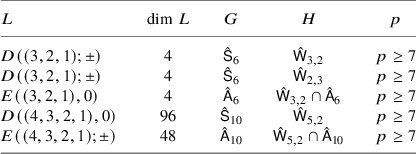

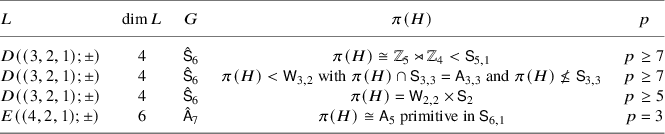
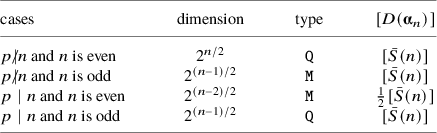

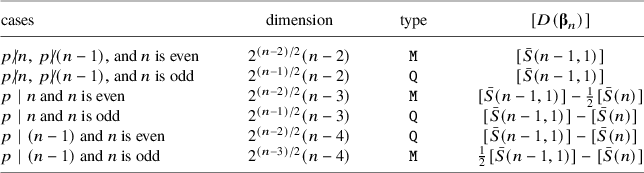


 Open access

