Part 1. Opening ReflectionsFootnote 1
Sixty years ago, in September 1958, the first president of the African Studies Association (ASA), Melville J. Herskovits, mounted the podium at the first annual ASA meeting in Evanston, Illinois.Footnote 2 In an address entitled “Some Thoughts on American Research in Africa,” Herskovits set out the special, exceptional role of U.S. scholars who study Africa. “[B]ecause we are removed in space from the African scene,” he told his listeners,
and because we are from a country that has no territorial commitments in Africa, we come easily by a certain physical and psychological distance from the problems we study that . . ., through no particular merit of our own, bring us naturally to a heightened degree of objectivity . . . . Because we have no commitments, we can study many problems without the sense of urgency present when their solution must be sought in the findings of a given research undertaking. There is nothing particularly American in our position. (Herskovits Reference Herskovits1958:5–6)
With these words, Herskovits set the course for the ASA—a course that, with the support of major philanthropic foundations such as the Carnegie Corporation and the Ford Foundation, along with the U.S. government, would go largely unchallenged for a decade. The “we” that the new Association embraced with this claim had no connections to the continent, by lineage, language, or imperial liability, other than those manifest in and through detached scholarly inquiry. Detachment was required; it was foundational to the scientific objectivity upon which the ASA was based, and it allowed American scholars, who were in Herskovits’s view neither African nor tied to the fading colonial projects of Britain and France, uniquely able to transcend any parochial, national, or imperial interests. In a few short sentences and in language that was racially coded and clear, Herskovits affirmed the central, primary role of white American scholars in the study of Africa in the United States and anointed those scholars with the sacred signs of objectivity and neutrality few others could possess or attain. Writing nearly twenty years later, Columbia University anthropologist and former U.S. Ambassador to Upper Volta (Burkina Faso after 1984) Elliott Skinner recalled “being flabbergasted” by Herskovits’s remarks. Did Herskovits not realize, Skinner asked, “that there were blacks in the audience . . . who would always have a commitment to that continent . . .? What myopia blinded him to the fact that as a white American he was a citizen of a country with a fatal flaw for continuing to discriminate against people with African skins? No commitments?” (Skinner Reference Skinner1976:59). Skinner posed those questions in 1976. It was not the first time such questions were asked, nor would it be the last.Footnote 3
Let me begin with an important and forthright admission. Very little of what I offer here is notable for its originality. Perhaps some of the connections, chronologies, or analyses are inflected by more recent scholarly or political turns. But in essence, I recount a story that has animated previous historical reflections on the ASA, including by some of my presidential predecessors.Footnote 4 What these reflections have in common is a counter-narrative of the ASA’s origins and of the ruptures it has experienced, a counter-narrative aimed at coming to terms with the ASA’s position in the racial landscape of knowledge production about Africa, not only in the United States but globally. The counter-narrative of the origins of African Studies in the United States foregrounds a history very different from the one that is traced, beginning in 1957, through Herskovits and the ASA, through Northwestern and Boston Universities, through Carnegie and Ford and the National Defense Education Act’s Title VI. It is the African Studies so eloquently described by many, most recently by James Pritchett in his 2014 presidential lecture, as that other knowledge river, a river that flows through African American intellectual history right back to the nineteenth and early twentieth centuries and through the work of Black scholars such as George Washington Williams, W.E.B. DuBois, William Leo Hansberry, Carter G. Woodson, Lorenzo Turner, St. Clair Drake, and countless others.Footnote 5 These Black scholars, located in Historically Black Colleges and Universities [HBCUs], constitute a far older lineage of African Studies in the United States, a lineage built on and through resilient Pan-African bonds, but marginalized and displaced by the massive inflow of resources to post-war African area studies, located primarily in traditionally white institutions [TWIs].
The second counter-narrative is of ruptures within the ASA—ruptures directly related to the marginalization of that older lineage of African Studies knowledge. Here, the focus shifts to the late 1960s, to the emergence of the Black Caucus at the ASA annual meeting in Los Angeles in 1968, to the transformation of the caucus into the African Heritage Studies Association in 1969, and then to the disruption of the 1969 meeting in Montreal by Black activists and their white allies. The dominant or conventional ASA narrative of 1968 and ’69 is fairly straightforward: “Montreal” was an unfortunate but necessary rupture, which ultimately resulted in a more diverse and more inclusive ASA, in “which the lines are no longer racial”; it was evidence of the Association’s early growing pains, its youth (Guyer Reference Guyer1996:28; Miller Reference Miller2007:2). But there has also been an important counter-narrative of these ruptures. When the ASA turned forty, for example, then President Sandra Greene was not so sanguine: “I believe the association and its members have yet to come to grips with the past in ways that will prepare the association to be viewed by ourselves and others as truly making a difference in the production and dissemination of knowledge about Africa in the next millennium” (1999:2).
Though twenty years have passed since she spoke those words, I share Greene’s wariness. I do not believe, as an Association, that we have come to grips with this past—have thought deliberately, carefully, and constructively through our origins and ruptures, or considered how they continue to inhabit our present. What I would like to do in the pages that follow is to step back from a comforting narrative of ascension (as opposed to declension), with its comfortable tropes of expansion, diversity, and inclusion, and take a moment to reckon with the forces that haunt our origin stories and which brought the ASA to rupture fifty years ago.
So here are the main points I want to make as I mark both the sixtieth anniversary of the first ASA annual meeting and the fiftieth anniversary of rupture in Los Angeles: First, the privileging of white scholarship was hard-wired into the ASA at its founding. As William Martin and Michael West (1999:85), two scholars whose critical work on the ASA is without parallel, put it nearly two decades ago, “the emergence of this highly racialized field of study—the Africanist enterprise—required the purposeful displacement of a competing older tradition of black scholarship.”Footnote 6 That displacement has not been “undone.” Displacement was foundational to the constitution of the ASA, and it has been enduring. Second, that foundational displacement was consciously intended by many of the founding fellows of the organization to sever any connections with an emerging African American Studies or Black Studies—a severing with which we continue to struggle. And that separation occurred despite the fact, as Martin (2011:70) underscores, that several of the ASA’s founding fathers “found early employment at Howard”—arguably the center of African Studies research and teaching in the United States, if not in the world, in the 1920s and 1930s.Footnote 7 Under the watchful eyes of those founding fathers, “African Studies programs . . . so narrowed their focus,” Sterling Stuckey wrote in the New York Times (Reference Stuckey1971), “as to obscure the larger picture of African peoples, engendering the false conception that only people on the continent are African and under the influence, political and cultural, of Africa.” And finally, my third point has been inspired by calls for the decolonization of knowledge production on the continent and by the “Fallist” movements that have swept across campuses from Cape Town to Oxford, UK, from Charlottesville to Los Angeles. Long before #RhodesMustFall, in fact right back to the early 1960s, decolonization of knowledge production about Africa was at the forefront of struggle in many parts of the African continent, as colonial institutions were being transformed into postcolonial universities. Indeed, there was a moment in the mid-sixties when it appeared that the balance of power over knowledge production might shift decisively from colonial studies of Africa or African area studies back to the continent itself. That Africa-centered project of decolonization was severely compromised by a host of internal and external forces that I do not have the space to detail here. But what I can say is that, at precisely the same moment that Africa-centered projects were being undermined in Africa, a massive influx of Cold War-related funding to African area studies in the U.S. would lead to the emergence and fortification of what Martin and West have aptly termed the “Africanist enterprise.” That U.S.-based enterprise would not assist in the recentering of knowledge production in postcolonial African institutions or help fortify the “continental tradition” in African Studies, but would rather expedite the “rapid recolonization”—American style—of knowledge production about Africa, beginning in the late 1960s.Footnote 8
Part 2. Origins, Foundations, and Gatekeepers
It is impossible to tell the origin story of this Africanist enterprise without “following the money,” especially philanthropic foundation money (Ford, Carnegie, and Rockefeller), which underwrote the massive 1960s expansion of area studies in the United States. In 1948, the Carnegie Corporation awarded USD130,000 to Herskovits to develop courses and support research on Africa.Footnote 9 The Ford Foundation followed up with USD235,000 to Herskovits and Northwestern University to build African Studies (Gershenhorn Reference Gershenhorn2004:194). The second African Studies program in the U.S. was founded at Boston University by William O. Brown with USD200,000 in support from Ford (well over a million in 2009 dollars). Brown convinced the Ford Foundation that this was the moment for the United States to take the lead in studying Africa (Martin Reference Martin2011:62). As colonial powers stepped off center stage and a Cold War world began to take shape, appeals were made and the funds came rolling in. There is no need for me to revisit in detail the extent of the funding of area studies, but a few points warrant highlighting. It should be recalled that it was the Carnegie Corporation that funded the meeting of Africanists in New York in March 1957, where the ASA was founded, and it was the Ford Foundation that stepped in to cover the first two years of ASA operations, following up with support for multiple initiatives over subsequent years (Martin & West Reference Martin, West, Martin and West1999:90; Martin Reference Martin2011:63; Carter Reference Carter1983:5). As Martin and West (1999:90) have pointed out, the “federal government is estimated to have invested $76 million in African projects between 1949 and 1964.”
While we might disagree on whether or not strings were attached to this funding, when it comes to which institutions were funded and which institutions were not, the evidence is incontrovertible. On the list of beneficiaries of foundation and government strategic largesse, there was generally only one HBCU after the Second World War—Howard University—and funding to Howard paled in comparison to that garnered by such institutions as Northwestern, Boston, and Columbia.Footnote 10 The massive infusion of funds to TWIs was not inconsequential. It served to marginalize historically Black institutions in the U.S. from the “Africanist enterprise” and to dismiss the organic pan-African connections between the study of Africa and its diaspora that had been nurtured for nearly a century at those institutions.
If funding was, in part, responsible for hardwiring white dominance into the Africanist enterprise, the structure devised by the founders of the ASA—a structure that remained in place for over a decade—insured that that privilege (coded as “expert,” “scientific,” “scholarly,” and “neutral”) was reproduced within the Association. The founding meeting of the ASA took place in late March 1957 and was attended by over thirty individuals. The overwhelming majority represented TWIs that had benefitted, in some degree, from early foundation support for African Studies. Also present were representatives of the U.S. Department of State, the U.S. Information Agency, the Library of Congress, the United Nations Secretariat, and the Carnegie Corporation. Only two HBCUs—Howard and Atlanta—were represented (by E. Franklin Frazier and Robert Armstrong, respectively.) “The participants,” Gwendolen Carter (1983:5) would later recall, “were selected with a view to geographical and disciplinary distribution as well as their reputation as Africanists.” At that founding meeting and after much debate, the participants decided against an open membership for the Association. As Carter later wrote, this was the “most controversial decision” made at the meeting. In essence, rather than opening the Association to all those with an interest in the continent, it was to be structured around a College of Fellows, “composed originally of the members of the founding conference,” as Gwendolen Carter explains, “which would then control the nomination and election of officers and the subsequent admission of other Fellows” (1983:5–6).
According to the ASA’s foundational by-laws of 1957:
Fellows shall be limited to persons of scholarly attainment in the African field and shall meet such other qualifications as may be established by the Fellows from time to time. The Fellows shall be elected from among persons nominated by the Nominating Committee…. Each person elected a Fellow shall remain a Fellow until his death, resignation or removal in accordance with the By-Laws. Additional Fellows may be elected at the annual meeting.Footnote 11
Individuals not meeting the criteria to be Fellows were welcome to join as associate members, but they were not entitled to vote or serve on the Board. At the ASA’s second Board meeting, in October of 1957, the Fellows drafted a letter of invitation to go out to those whom they considered so qualified, noting that while “fellowship is limited to persons with established scholarly interest in African matters, associate fellowships are open to all persons interested in the objectives of the organization.”Footnote 12 The leadership of the Association, at that juncture, included Herskovits as President and Gwendolen Carter as Vice President (both of Northwestern University); Board members were L. Gray Cowan, who also served as Secretary-Treasurer (Columbia University), William O. Brown (Boston University), Father John Considine (Maryknoll Seminary), Leonard Doob (Yale University), Walter Goldschmidt (UCLA), E. Franklin Frazier (Howard University), C.W. de Kiewiet (University of Rochester), and Vernon McKay (Johns Hopkins University). Frazier was the only African American on the Board, representing the only HBCU.
In the ASA Papers deposited at Northwestern University, there are numerous folders containing over a decade’s worth of applications for membership in the College of Fellows, as well as notes and votes on individual applications by Board members. Reviewing those files provides a stark lesson in how white power and privilege can be so easily reproduced via language that, at first glance, seems neutral, non-racial. In the “judgment of the Board of Directors,” for example, one could become a Fellow by meeting two of the following four criteria: publications on Africa of a “scholarly character,” a doctoral degree with a dissertation in African studies, offering regular courses on African studies at institutions of higher learning, and “in other ways making a scholarly contribution to the understanding of Africa . . .”Footnote 13 But what is “scholarly?” Who gets to decide? At what institutions and in what fields could a prospective Fellow earn a doctoral degree in the late 1950s or early 1960s? As Skinner reflected in 1976,
Afro-Americans. . . felt that the qualifications for voting membership were weighted against the large and distinguished group of black scholars on Africa, who, despite their renown in black circles, were largely unknown to whites . . . .
[They] viewed one of the criteria for voting membership—that which qualified only those persons ‘who had experience in the African field’—as being especially designed to pack the Association with whites. It was broad enough to include every conceivable person known to whites who had ever pushed a piece of paper concerning Africa in any foundation, government bureau, business enterprise, or missionary society; yet this criterion could exclude people like James W. Ivy, who wrote continually on Africa for Crisis magazine, but was unknown to white scholars. (Skinner Reference Skinner1976:60)
Racially-coded language such as that which determined eligibility as a Fellow, when bolstered by massive infusions of funding to TWIs and by the development of a closed, elite governance structure in the early years, hardwired white domination into the ASA and guaranteed its reproduction. But all of this, of course, was couched in a broader discourse of non-racialism, detachment, and neutrality. Again, let me turn to Skinner. “What is fascinating to me, as an anthropologist” he wrote,
is the culturally induced blindness among many of those thirty-five of the forty-eight invited persons who met in New York City. . . . For they appeared to see themselves as intellectually neutral scholars, and not American citizens who had an interest in Africa. Certainly the twelve of them who came from the Department of State, from the United States Information Agency, from the United Nations, from the Carnegie Corporation, and from missionary societies must have known that the ASA would involve more than scholarship. They must have understood the political context in which they were seeking to create an association. (1976:59)
Indeed, Herskovits, who set the ASA’s course in 1958 with his broad presidential statement on scholarly detachment, scientific inquiry, and neutrality, was the very same ASA president in the very same year who, as Martin and West point out, wrote to Allen W. Dulles, Director of the U.S. Central Intelligence Agency [CIA], with an offer for the ASA “‘to aid you in any way it can’” (Martin & West Reference Martin, West, Martin and West1999:91–92).Footnote 14
By 1968, ten years after Herskovits’s offer to Dulles, “the core features of the Africanist enterprise,” as Martin and West have powerfully documented, “were in place. The key journals, centers, and national associations were all established, providing channels for the production of the first generation of scholars at the major research universities dedicated to the study of a newly defined Africa” (1999:97). In his 1996 Abiola Distinguished Lecture at the annual ASA meeting, Thandika Mkandawire, in stark and compelling terms, described the research world produced by the Africanist enterprise. “I doubt,” he said, “whether the divide between area specialists and the indigenous scholars is as sharp elsewhere as that between African scholars and their Africanist counterparts . . . . The vocabulary is still binary ‘us’ versus ‘them,’ Africans versus Africanists. . . [and] it is these walls that necessitate gatekeeping”—one of the main sources of discontent for scholars based on the continent. “Africanists have, consciously or unconsciously, assumed [those gatekeeping functions],” he continued, “ever since the study of Africa became serious business. Reading Senghors, Kenyattas, Cheikh Anta Diops and Nkrumahs one is struck by the fact that we apparently have been carrying out these negotiations with the gatekeepers for years” (1997:26–27). A decade later, Amina Mama’s 2006 Distinguished Abiola Lecture on “Scholarship and Freedom” argued that, if anything, this inequality was “reaching new extremes.” “Today’s unequal profile,” she writes, “indexes the continuation of the oppressive and exploitative legacies of a colonial patriarchal order that excludes—sometimes doubly or triply—large swathes of the worlds’ intellectuals and leaves the potential of millions more Africans unrealized” (Mama Reference Mama2007:5).Footnote 15
Part 3. Gatekeeping and Reckoning with Herskovits
Before moving to the events of 1968/69, I would like to segue briefly from institutional history to a consideration of Herskovits as the foundational gatekeeper, who set the course for the development of the Africanist enterprise—an Africanist whose work bridges African American and African studies, but a scholar who, as many have argued, developed his gatekeeping skills in the 1930s and 1940s in what was called at the time “Negro Studies.” He then deployed those skills with strategic precision in the context of the Africanist enterprise. I offer these remarks with all seriousness of purpose, including personal. Indeed, my own intellectual biography is fully entangled in this story—as a white, first-generation college student, who made her way to Northwestern University as an undergraduate in 1975, and eventually to African history and African Studies, and who spent countless hours in the Africana collection, in the Melville J. Herskovits Library. I benefitted enormously from Herskovits’s legacy, especially from the affirmative action accorded to white students, such as myself, who came to African Studies at TWIs like Northwestern. I do not therefore approach this topic lightly. Let me add two additional caveats: I single out Herskovits in this section not because he is more responsible than others for the ways in which the Africanist enterprise developed, but because of the hallowed “founding father” role with which the ASA has anointed him since his death in 1963, including by memorializing his foundational role through the naming of its most important scholarly prize. My second caveat: my concern is not with the content of Herskovits’s scholarship. My focus is on the institutions he helped build, which have worked historically to exclude Black scholars and privilege white scholars. This distinction is an important one to make. As Skinner points out, there is no question that Herskovits was an “accomplished scholar.” But, and it is not a small “but,” Herskovits clearly did not “have confidence in the scholarly capabilities of African peoples” (1975:58). Skinner is not alone in his assessment. Herskovits’s biographer also concludes in multiple instances throughout Melville J. Herskovits and the Racial Politics of Knowledge Production that Herskovits “encouraged black participation but discouraged black control” (Gershenhorn Reference Gershenhorn2004:19).
The discursive weapon Herskovits deployed in this work of exclusion was, as we have already seen, “objectivity.” The history on this score is long; it is incontrovertible; and it is perhaps nowhere more evident than in the years before he turned his full attention to African Studies and was embroiled in battles for control of what was then known as “Negro Studies.” As Gershenhorn writes,
In addition to his paternalism, Herskovits’s strict adherence to his own notion of objectivist, detached scholarship and his desire to direct the field of Negro studies brought him into conflict with the leading black scholar-activists of the time, Carter Woodson and W.E.B. DuBois. Herskovits accused Woodson and DuBois of engaging in polemics and falling short of scholarly standards of objectivity. (2004:143)
These were not, however, just wars of words. Herskovits’s insistence on so-called objective detachment rendered illegitimate any scholarship concerned with race, racial oppression, and racial justice, and that insistence had real and enduring consequences for the development of both African and African American Studies. The long and tortured history of DuBois’s Encyclopedia Africana is a well-known case in point.Footnote 16 I will not rehearse that history here, but it is of no small significance that for years Herskovits worked to undermine DuBois’s project (a project that only found funding with Ghana’s independence and Nkrumah’s invitation to DuBois to move to Ghana and complete the encyclopedia there). Indeed, according to historian Rayford Logan, Herskovits boasted to him on one occasion that he “was the hatchet man,” who made sure that Carnegie did not support DuBois’s project (Gershenhorn Reference Gershenhorn2004:156). Similar stories of paternalism, of the privileging of white scholars, and of the discursive weapon of “objectivity” are at the center of accounts of Herskovits’s efforts, with the support of the American Council of Learned Societies, to establish the Committee on Negro Studies [CONS] in the 1940s. As Gershenhorn recounts, Herskovits went to extraordinary lengths to limit the participation and membership of scholars such as DuBois, Logan, and Woodson. “Herskovits’ decisions on membership in the CONS,” he writes, “generally limited black participation in order to maintain control and suppress activism. From 1944 to 1947, Herskovits and officials of the ACLS controlled membership decisions and ensured a white majority” (2004:163).
And thus the conundrum with which Herskovits’s biographer struggles throughout his account, as he seeks to reconcile the “Herskovits [who] . . . devoted his life to discovering the dynamism and strength of African and African American societies . . . [and] . . . worked to establish African American and African studies as legitimate disciplines in American higher education,” with the Herskovits who would not cede an inch of control to a single Black scholar (Gershenhorn Reference Gershenhorn2004:231). Herskovits’s former student, Johnnetta B. Cole, one of only two or three Black PhD students whom Herskovits trained, is not quite so equivocal in her reflections. (Cole, after a distinguished career in anthropology, would go on to become the first woman president of Spelman College and serve as Director of the National Museum of African Art.) In the documentary Herskovits At the Heart of Blackness, she reflects: “Herskovits was driven by the power Africa gave him. . . . Scholarship is never so pure that folk don’t have the possibility to carve out a piece that is filled not only with interesting ideas, but with power. Africa was the power platform upon which Herskovits stood” (Smith Reference Smith2009). Although Herskovits worked with all of the major Black scholars of his time, as Martin and West point out, he “alone would move to a position of power and stature within the academy . . . his pivotal position endowed him with a gatekeeper role for the funding of U.S. scholarship on the African diaspora as well as on continental Africa” (Martin & West Reference Martin, West, Martin and West1999:88). That powerful gatekeeper role, so in evidence in the development of “Negro Studies” in the 1930s to 1940s, would be reprised and expanded in the 1950s, as Herskovits turned his attention fully to the African continent.
Part 4. Storming the Gates in 1968 and 1969: A Redemption Song?
Melville J. Herskovits died unexpectedly in February, 1963—five years after he served as the Association’s first president and five years before the ASA experienced the rupture that nearly led to its demise. Elliott Skinner offers compelling insight on that rupture and on the events of 1968. “For blacks,” Skinner wrote, “parity (if not dominance) in the study of Africa is inextricably part of their struggle for full equality in America” (1976:57). Skinner was insisting in 1976 that we situate the ASA within the historical context of the Black Freedom Struggle in the United States and not just in the 1960s. Ten years after its founding, as white rule in apartheid South Africa grew ever more firmly entrenched and as wars of liberation raged from Guinea Bissau to Zimbabwe, the Association’s leadership remained as white as it had been at the first meeting in New York and appeared more determined than ever to remain detached from the struggles of Black people globally, not just in the United States. Moreover, by the mid-1960s, the Association’s leadership was coming under increased scrutiny and criticism (as were the leaders of other area studies Associations) for research undertaken with U.S. government support and concerned overwhelmingly with security and surveillance. This, in and of itself—complicity with the State Department and the CIA and the ways in which debate over those ties split the white leadership of the ASA wide open—is an expansive topic best taken up elsewhere. But I raise it here because it is important for understanding the context of 1968 and the heightened tensions within the ASA College of Fellows and, more importantly, between that leadership and Black scholars who were demanding a place at the Fellows’ table.Footnote 17
As Michael Searles would later recount in Africa Today, the 1968 annual meeting in Los Angeles started like any others: “All matters of academic and reminiscences of past trips to Africa were discussed over gin and tonic with art tours, cocktail parties, receptions and dinners. . . .” But this year, unlike previous years, the events of 1968 had “stimulated in black people the necessity to evaluate all facets of their existence” and, as had happened in countless Associations across the country, the “black Africanists. . . came together to discuss how the Association might more realistically serve the interest of the black world” (1969:11). The caucus was organized by Dr. P. Chike Onwuachi, Director of African-Caribbean Studies at Fisk, and included Michael Searles and Nicholas D. U. Onyewu (both of Federal City College in DC), Leonard Jeffries (Columbia University), John Henrik Clarke (Associate Editor of Freedomways), Nell Painter (San Jose College), Jean Douglass of New York, and Shelby Faye Lewis (Southern University) (Clarke Reference Clarke1970:11). While those participating came from a variety of disciplines, countries, and political groundings, “all agreed that [the] A.S.A. was not meeting the needs of black people” (Searles Reference Searles1969:13). The nearly eighty participants in the caucus developed a position paper, which was presented to the Board. Let me highlight the main points of that important paper:
The African Studies Association is called upon to immediately direct its energies toward rendering itself more relevant and competent to deal with the challenging times and conditions of Black people, in Africa, in the United States and other parts of the Black world . . .
In moving toward this objective, we charge the association with taking the necessary steps to immediately broaden the participation of Blacks in all phases of the association’s operations. . . We note that only one Black person is holding a policy-decision position in an association dealing with countries and societies predominately Black. Too few of the program chairmen and participants are drawn from Black Africanists. In summary, the Association across the Board reflects a white cast and is identified with a predominately white culture.
. . . . [W]e urge that in the recruitment of Black people for various kinds of roles in the ASA that representation be drawn from other persons engaged in interests closely related to African and Afro-American studies with particular emphasis on Black youth inside and outside the university.
We see the future prospects of a vital and meaningful association as directly linked to significantly strengthening its roots and its ties to Black Africanists; we encourage ASA members to seek out African and Afro-Americanists to direct rapidly developing Afro-American studies in the United States and that ASA address itself in meaningful educational ways to changing American public opinion based on deep racism. (Searles Reference Searles1969:11)Footnote 18
As Skinner commented, these 1968 demands were “not the clarion call to revolution; they were rather a request of African peoples for a greater opportunity to work in the Association” (1976:62).Footnote 19 Still, they did constitute a demand for substantive change, not just in the racial demographics of the Association’s leadership, but in the leadership’s approach to politics and its accountability to those with interests in Africa outside of universities. What is also particularly noteworthy, given the enduring separation of African and African American studies on most U.S. college campuses today, is the fact that the Black Caucus insisted that Africanists belonged at the table as Black Studies programs were being launched, in response to Black student demands, at colleges and universities across the country. In other words, 1968 marked, in their eyes, a moment when African and African American studies might be, must be, conjoined.
The leadership of the ASA responded immediately to some of the caucus’s demands by establishing two committees: a Committee on Teaching about Africa and what would be called the “Afro-American Committee” to “consider Afro-American issues.” Noted cultural anthropologist James Gibbs, the first African American scholar to be tenured at Stanford, agreed to chair the Afro-American Committee.Footnote 20 Members of the committee included John Henrik Clarke, Adelaide Hill, Simon Ottenberg, and William B. Schwab.Footnote 21 The committee met on several occasions, and Gibbs presented his committee’s reports to the Board in both May and October of 1969, which included discussion of some of the ameliorative steps that had been taken to date.Footnote 22 Among those steps was an effort to reach out and recruit more Black scholars to the Association: sending a short note regarding “misconceptions about the objectives of the organization,” to potential Black members, along with an ASA brochure, an application to be a Fellow, and a copy of the ASA Newsletter. The letter concluded, “We hope that you will become a member of the African Studies Association.”Footnote 23 Only a few months later, Shirley Fischer, the ASA staff associate, reported to Gibbs, “it was interesting and not at all surprising to find that not one member of the Caucus joined the Association in spite of the follow up recruitment campaign. . . .”Footnote 24
At the May meeting, Board members discussed a preliminary version of the committee’s report and decided to take some action, including inviting some associate members of the ASA (almost all of whom had PhDs) to become full Fellows. They also discussed plans to move the annual meeting in 1970 from Pittsburgh to Baton Rouge or New Orleans in order to more readily engage Black scholars at Black institutions and considered inviting Johnnetta Cole (Herskovits’s former PhD student) and Adelaide Hill to chair the program.Footnote 25 The Afro-American Committee’s final report, delivered to the Board in October, first listed the main goals it thought the Board should consider. The major headings under which the goals were outlined were as follows [caps in original]:
I. INCREASED INVOLVEMENT OF BLACKS IN THE ASSOCIATION. . .
II. CLEARER ARTICULATION OF THE INTELLECTUAL LINKS BETWEEN AFRICAN AND AFRO-AMERICAN STUDIES. (INCLUDING COMPARATIVE STUDIES OF AFRICA AND THE NEW WORLD. . .
III. FACILITATING ARTICULATION OF AND EVALUATION OF THE ‘BLACK POINT OF VIEW’. . .
IV. INCREASING ACCESSIBILITY TO AND UTILIZATION OF AFRICAN STUDIES RESEARCH BY THE BLACK COMMUNITY. . .
V. STIMULATING RESEARCH. . .
VI. A MULTI-FUNCTIONAL GOAL: REGIONAL CONFERENCES. . .
VII. EXAMINATION OF THE ROLE AND INVOLVEMENT OF PREDOMINANTLY BLACK UNIVERSITIES IN AFRICAN STUDIES. . .
After describing the efforts that Fischer had made in reaching out to Black Caucus members, the committee reported that she had subsequently written to eighty-five deans of historically Black colleges and universities. The results of that effort were not reported. In addition, the committee recommended that the 1970 annual meeting be held in New Orleans and that content be “geared more to the needs of the black community.” It also recommended that the Board review committee rosters, prepare a list of Black Fellows for circulation so that chairmen, “would be encouraged to consider a wider range of individuals in filling vacancies.”
The committee found the issue of “facilitating articulation and evaluation of a ‘Black point of view’” especially challenging, and it is worth quoting from the report at length here as it illustrates how the “problem” of Black representation in the ASA became a problem for Black members to solve; it was not cast as a problem for the Association or for its white membership:
It is clear that members of the Black Caucus feel that this is a very important goal. Yet, most members of the Association probably are unsure as to what is the ‘Black point of view.’ Thus, the problem is that Black members of the Association who hold this view must describe and illustrate what Black scholars and the Black community perceive as the Black point of view. This requires the sound documentation of errors in fact, emphasis or interpretation by non-Black scholars and researchers. From this, it may be possible to state what kinds of research Black scholars may be able to do better than (or at least differently from) non-Black scholars. It should also be possible to devise ways of teaching students to evaluate research results and educational materials from the Black point of view as well as the ‘traditional’ (or white) point of view.
In working through this particular problem, the committee posited plenary sessions, book reviews (two reviews of one book, pairing “Black and non-Black” scholars), and the distribution of bibliographies.
In its summary conclusion, the committee acknowledged that full implementation of any of its suggestions would have to await a successful bid for foundation support. Such support would allow the Association to hire more clerical support necessary for “membership recruiting,” provide grants for Black scholars who lacked access to institutional funds to attend the annual meeting, and also to support ASA representation at other conferences. Meanwhile, it noted its efforts to increase Black membership, though those efforts had been “less successful that we should have wished,” and acknowledged it had not made substantial progress toward a “clearer articulation of the intellectual links between African and Afro-American Studies, stimulating research related to Afro-American studies and examination of the role and involvement of predominantly Black universities in African studies.” The final substantive paragraph of the committee’s report noted that “its goals and progress. . . must be examined not only in and of themselves, but in light of the formation of the African Heritage Studies Association, an organization of Black scholars.”Footnote 26
Indeed, by the time the Board took the committee’s report under recommendation in October 1969, the report was not just bureaucratically overburdened, but significantly out of date. History was moving far faster than the Board, as so many things were in 1968, and amelioration was no longer on the table. After the Los Angeles meeting, members of the Black Caucus met in June 1969 in Washington, DC, to inaugurate a new Association—the African Heritage Studies Association [AHSA], with John H. Clarke as President and Nicholas D.U. Onyewu as Secretary General. In his report, “Confrontation at Montreal,” Clarke explains that the “need for self-help among black scholars, and the need for relevancy of the black scholars to ASA served as an impetus for the formation of the Association.” AHSA members showed up in Montreal with a clear plan. Meanwhile, by the time the Board was prepared to consider Gibbs’ report, the annual meeting at Montreal was already underway and, according to Clarke, though it was a “gesture,” it was “distributed too late to have any effect on the conference. . . . It was. . . too little too late.”Footnote 27
The first direct action in Montreal occurred during a plenary session on Thursday morning, when activists seized the microphone and between fifty and one hundred people moved to the front of the room.Footnote 28 AHSA activists set forth their demands, including an immediate change in the “ideological framework of the ASA and to its constitutional procedures,” which facilitated “the election of a predominant white Board of Directors,” the constitution of a new Board “composed of twelve members—six African and six Europeans,” an amendment of rules to allow African scholars’ total participation in the Association and representation of “equal numbers of Africans and Europeans” in decisions about the “allocation of funds for research and publication.”Footnote 29 The ASA Board agreed to take some of these demands under consideration, but refused to resign and argued that all demands would need to go before the Fellows of the Association. They agreed, however, to the appointment of three additional Black Board members. The AHSA rejected this offer, insisting on a new Board with racial parity: six and six.
While some panels and conference business continued after the plenary disruption, at the business meeting later that day, with some 1200 in attendance, the confrontation came to a head, with the AHSA/Black Caucus issuing a formal demand for parity on a new Board consisting of six white and six Black members. Their motion was defeated by a vote of 107 to 97 (recall that only Fellows could vote.). At that point, Fred Burke, then a professor of political science at SUNY Buffalo, stood up and “speaking on behalf of a group of twenty five ‘concerned white liberals’” offered a new motion: for a committee to be established of “thirty men and women elected by the fellows and members of the Association in attendance and of those registered at the convention, stipulating that half of those thirty should be black.” This, in effect, overturned the College of Fellows bylaws. The committee of thirty would draft a new constitution, which would be voted on by the entire membership in April. The Board under this new constitution would be “50/50 White and African.” The “Burke Resolution,” as it was called, was passed by a wide margin by those attending the business meeting.Footnote 30
While there was almost an air of calm in the aftermath of the business meeting, the truce between the various factions did not last long after the conference ended. Correspondence received by the ASA in the aftermath of Montreal, as well as the commentaries published shortly thereafter in Africa Today, are a clear indication of just how deep the divisions were. Almost immediately, a number of white commentators charged “black racism.” Pierre van den Berghe (Reference van den Berghe1969), for example, wrote in Africa Today,
By a clever combination of intimidation and play on the racial guilt of white American members of the Association, a small and totally unrepresentative group of racists succeeded in imposing on the Association a racial definition of the situation, and in stampeding a flock of bewildered self-styled liberals into accepting the principle of apartheid within the Association. . . . Pandering to black racism is, of course, the easiest thing for establishment ‘liberals’ to do.
A not dissimilar set of sentiments circulated in a letter originally penned by Rupert Emerson, Robert Rotberg, Joseph Nye, and Martin Kilson, but eventually signed by dozens of others, including Philip Curtin and other former and future ASA leaders. They argued that the
ASA has been forced to accept racialist principles and to divide its membership into racial categories. . . . We deplore the fact that we must now line up within the Association on one or the other side of what can all too easily become racial barricades. . . . As we see it, a small group of persons operating as the Black Caucus or on behalf of the African Heritage Studies Association took it upon themselves to disrupt key features of the meeting by physical force in order to impose their demands, one of which was the division of the ASA into ‘Africans’ and ‘Europeans’. . . . It may well be that in the past the Association has not reached out actively enough to enlist interested African and Afro-Americans in its membership . . . [but] To yield to the threatened violence which lay behind the disruption . . . seems to us . . . profoundly unlikely to achieve the goal of bringing together on a non-racial basis scholars and others interested in all aspects of Africa and its role in the world.Footnote 31
Of course, what is most striking here are the ways in which the concept of “non-racial” was deployed by some of the leading white scholars of the day, particularly the ways in which the concept of “African” is purposefully and adamantly deracialized. Pierre van den Berghe’s comment in Africa Today exemplifies this most clearly: “The fundamental need of the ASA was to Africanize the Association, not to racialize it. It chose the latter course, and by doing so it has become less African and more American than it was before . . . ” (van den Berghe Reference van den Berghe1969:10–11).
Some white scholars in the ASA leadership assumed a more progressive stance, demonstrating that there was more than one way to be “white” in the ASA in 1969.Footnote 32 Immanuel Wallerstein, for example, saw the demands as creating the possibility of constructive steps forward: “a modern democratic society that doesn’t find some institutional form to recognize the equal rights of groups along with and in addition to the equal rights of individuals is simply according a constant differential advantage to the dominant group or groups. . . . What happened in Montreal was useful for the ASA and for all those who were there. . . . It offered us the possibility of redemption . . . ” (Wallerstein Reference Wallerstein1969:12). There was also one group of white radicals that emerged at Montreal. This group was led by Columbia-trained economist Idrian Resnick and it came out in full support of the demands of the Black Caucus and the AHSA, calling for the “full and immediate democratization of the ASA. . . . If our demands for full democratization and African parity on the interim Board are not met, then we will consider forming another organization and/or disrupting ASA activities.”Footnote 33
Meanwhile, African and African American scholars, who published commentaries in Africa Today or simply wrote directly to the Board, were largely unanimous in their support for the AHSA/Black Caucus demands. “As far as I know,” Nell Painter wrote to the ASA,
The African Studies Association has never divorced itself from the racial climate of the United States. . . . In fact, a substantial body of opinion holds that the Association has consistently helped spread American racism and neo-colonialism in Africa. But what is important to me here is that white opponents of the Black Caucus’ positions cite black racism as its most odious aspect, yet they never worked to correct the white racism which keeps universities, and therefore the ASA, nearly lily white. . . . Has the ASA disassociated itself from American racism? Have members asked why there are so few black people in the Association? Has the Association taken meaningful steps towards changing the conditions which keep most black students from reaching a level where they might even know of the existence of the African Studies Association?Footnote 34
James Turner and Rukudzo Murapa, in a commentary in Africa Today focusing on the important work of Black scholars such as Woodson, Blyden, Hansberry, and Dubois, asked,
(H)ow can Whites claim competence to judge when virtually all of their work, by its gross omissions, reflects them as dismally ignorant of the nature of the black experience and the vast body of literature written by Blacks?. . . . In the final analysis, the incident in Montreal was more than a performance of black self-assertion; it was and is a challenge to the criteria of competence, definition, and direction of white research in Africa. (1969:14)
Given the intensity of the post-Montreal fallout, it is not surprising that the truce briefly brokered via the “Burke resolution” crumbled in the weeks that followed. At first, the ASA and AHSA continued to negotiate, with the presidents of the ASA and AHSA sitting down together at Columbia University on October 21st. At that meeting, they agreed that rather than the 15/15 committee proposed by the Burke Resolution, the ASA and AHSA would each select five members, who would meet to make recommendations about restructuring the ASA. “The principle is clearly understood of parity in the case of the representatives of AHSA and of ASA in both groups,” a jointly signed memorandum stated. Then in early December, in a promising sign, the ASA Board voted in support of changing the by-laws so that there would only be one category of membership and the College of Fellows would be effectively abolished. That resolution would go to the membership early in 1970.Footnote 35
But at the very same time that these positive developments were unfolding, ASA Vice President Philip Curtin argued that “before useful discussion can be held with members of the AHSA,” the Board needed to have “guidance” from its membership.Footnote 36 This move was clearly intended to forestall, if not end, any Board effort to follow through on the Burke Resolution or the revised resolution agreed upon by Cowan and Clarke at the end of October. The questionnaire Curtin drafted eventually went out to the ASA’s entire membership in December (which, at this point, included virtually no one from the AHSA), with members asked to choose what the Association’s next step should be. Members were to click one of the four boxes:
□ The present Board of Directors and officers of the Association should resign and make way for a new Board, one half to be black and one half to be white.
□ The Board should take immediate steps to meet with representatives of the African Heritage Studies Association in order to prepare a new set of by-laws. . . . It would be understood that the new by-laws would provide for racial parity between blacks and whites. . .
□ The Board should follow a non-racial policy in regard to the election of officers and members of the Board . . . but at the same time follow a policy of trying to interest more black scholars in the affairs and direction of the Association. . . This policy would also imply an effort to work cooperatively with the African Heritage Studies Association . . .
□ The Board. . . and officers should try to ensure that all committee appointments and nominations for election to office be made on non-racial grounds. No further effort should be made to meet the objections of the African Heritage Studies Association or any other special interest group.Footnote 37
And while members pondered this questionnaire, plans moved forward to hold the next annual meeting in New Orleans, with Joseph E. Harris, then professor of African history at Williams, agreeing to serve as the Program Chair. There was some confidence, including on Harris’ part, that AHSA members would fully participate.
The ASA and AHSA met again in January, with the ASA represented by Absalom Vilikazi, Philip Curtin, Daniel McCall, and James Duffy, and with Curtin pushing the idea of a sort of supra- or joint Board of the ASA and AHSA. Curtin then drafted a “Memorandum of Principles,” which was shared with the AHSA in early March.Footnote 38 But by that point, any path forward was improbable, if not impossible. Although the ASA Fellows voted (256 for/150 opposed) in favor of abolishing the College of Fellows and instituting one form of general membership, by April the AHSA had no interest in any kind of joint efforts.Footnote 39 The reasons were clear. First, the AHSA learned that Curtin was one of the signatories to the Rotberg, Kilson, and Emerson letter. “The members of the AHSA consider this letter to be a racist attack on African scholarship in general and on the members of the AHSA in particular,” Clarke wrote. “We did not know that Dr. Philip D. Curtin was a signer of this letter when we attended the January meeting. We do not believe that any of the members of the ASA who signed this can deal with African people in good faith.”Footnote 40 More importantly, at its April 11 meeting and based upon responses to the questionnaire crafted by Curtin (in which #3 in support of a “non-racial” policy and no parity was chosen), the Board resolved that it “should follow a non-racial policy in regard to the election of officers and members of the Board of Directors, but at the same time follow a policy of trying to interest more black scholars in the affairs and direction of the association, or trying to promote greater interest in African studies among black Americans.”Footnote 41 With this resolution, the Board made it clear that it would not follow the path set out by Clarke and Cowan in October of the previous year.
Indeed, after meeting with the Board in April and expressing his concerns, Joseph Harris resigned as Program Chair. He explained that he had hoped the ASA would meet the demands of the Black Caucus,
However, the events of Montreal and subsequent discussion relating to those events, the public statements of some ASA members . . . , the ambiguous recommendations of the Board, the uncertainty of support by large segments of white ASA members of those recommendations, and the general dynamics of political formalities have resulted in a failure of ASA to achieve the understanding and cooperation so essential for the kind of meaningful program I would have organized and presented.Footnote 42
At that point, those few AHSA members who had held on to their ASA memberships resigned and the New Orleans meeting was cancelled.Footnote 43 In a July 14, 1970 “Report” to the Board on events from April to July, James Duffy, the ASA’s executive secretary, noted that while the response to the Board’s resolution “has been generally favorable. . . . Most of the officers of the AHSA have resigned as members of the ASA.”Footnote 44
This was not quite, however, the end of the story. There was yet one last attempt from within the Board to follow through on addressing the demands made in Montreal. Johnnetta Cole and Willard Johnson, both African Americans, were elected to the Board that very spring and came on as members at the meeting in Boston on October 24, 1970. (This was also the year that Philip Curtin became President.) At that meeting Cole and Johnson put forward a resolution, very much in the spirit of Montreal,
1) That the African Studies Association commit itself to work for the dignified survival and liberation of African people, at home and abroad, and to adopt such positions statements and take such action as it may deem necessary to contribute to the realization of that end. . .
They also moved that half of ASA dues go to an “African Liberation Fund,” and at every ASA meeting there be at least one plenary session organized by the AHSA and one organized by African scholars present at the meeting. The fourth clause resolved that
the ASA membership instructs the Board of Directors to implement the requests advanced at Montreal by the members of the African Heritage Studies Association and the supporters of ‘the Burke resolution’ calling for any changes in the ASA’s constitution necessary to provide for the selection by the AHSA membership of one-half of the ASA Board, if the AHSA so desires.Footnote 45
The Johnson-Cole resolution, as it was called, went before the membership at the business meeting in 1970, where it was approved by a vote of 151 to 138, with 13 abstentions! After the business meeting, a very heated discussion took place among Board members about what the next steps should be: would the Johnson-Cole resolution undermine the ASA’s tax-exempt status? Should the resolution go to the full membership via a mail ballot? In the end, the Board voted to send the resolution to the membership by mail, just as it had the year before, and the results could have been predicted: 271 affirmed the resolution, 607 voted to repeal, and there was 1 abstention.Footnote 46 Johnson and Cole both resigned from the Board. As Skinner would write a few years later, “They, too, found it impossible to work with whites interested in Africa” (1976:65).Footnote 47
In an attempt to repair what was clearly an irreparable breach, President Curtin crafted a lengthy letter to the membership, announcing that he was going to introduce measures to address some of the concerns behind the Johnson-Cole resolution. He proposed that a new organization might be formed, separate from the ASA and without tax-exempt status, which would take up political issues. “It seems clear that some of the membership does feel strongly about apartheid, racial discrimination, and colonialism as they exist today in southern Africa. . . . In my opinion,” he explained, “and that of the Association’s legal counsel, it is proper for a scholarly association such as ours to express opposition to these conditions.” He also noted that he had invited the AHSA to Boston and it had declined, but that the invitation would be renewed “as a standing invitation.” Finally, while he stated he was in full agreement with the vote of the membership against the establishment of a political fund, he was willing to propose that “the profits from future Annual Meetings be donated to the Eduardo Mondlane Scholarship fund.”Footnote 48
Still, Curtin’s appeal to compromise clung fiercely to Herskovits’s vision of African studies in the United States as “objective,” “non-racial,” and “detached.” As damage control in 1970, his appeal was completely ineffectual. Between fall 1970 and fall 1971, the Association lost 438 individual members and 76 institutional members. Of the individuals, 59 formally resigned, which accounted for 15 percent of the November 1970 membership total. “It is clear,” Duffy wrote to Board members,
that the tail of the Montreal hurricane swept over us in 1971. A number of members confuse the Association with a university and other members seem to believe it is a political party. My own view, which is almost always wrong, is that we have survived the last two years in rather good shape. . . . I expect that, barring disaster, the current membership is a base on which we can build.Footnote 49
In this instance, I suppose, Duffy would be proven correct. The ASA did build on that diminished base and managed to survive the nadir of 1968 to 1971. Exploring how and why, however, would take me far beyond my chronological scope here. But let me make note of the fact that, on the one hand, ASA members began organizing in new and different ways within the Association after 1971, finding community in various off-shoot or coordinate organizations: the African Literature Association in 1974, the Women’s Caucus in 1975; the Association of Concerned Africa Scholars in 1977; the Arts Council of the African Studies Association in 1981. On the other hand, it is extremely significant that the ASA (particularly under Immanuel Wallerstein’s and Absolom Vilakazi’s presidencies in 1972–1973 and 1973–1974, respectively) began to pass political resolutions, including on Guinea-Bissau, and sought different ways of collaborating with the AHSA. In fact, John Henrik Clarke and Immanuel Wallerstein corresponded about the ASA and AHSA establishing a joint committee to revive DuBois’s Encyclopedia Africana project, and the two organizations sent a joint delegation to the International Congress of Africanists in Addis Ababa in December 1973, with John Henrik Clarke representing both the ASA and the AHSA on the International Executive of the ICA.Footnote 50 There was also extensive planning in 1974 and early 1975 for a joint meeting in Ithaca, New York, of representatives of the two Associations for the spring of 1975. It was in preparation for that meeting that Wallerstein wrote his lengthy report, “Background to ASA-AHSA Meeting in 1975,” noting that in the “normal renewal of ASA leadership, there was an evolution of views . . . reflecting an evolution of the membership as well, in which the pre-1969 rigidities on ‘political action’ were relaxed.” Wallerstein concluded his rather optimistic report in preparation for the meeting with the observation that “the ‘center of gravity’ of the ASA has no doubt shifted since 1969 in a direction that makes plausible future collaborations with AHSA on a basis of mutual respect and total parity.” In the end, however, and for a variety of issues, some logistical, some ideological, that 1975 meeting never happened.Footnote 51 Perhaps the center of gravity had shifted, but the moment for mutual collaboration, for total parity had long passed. And the questions posed as rupture—in 1968, in 1969, in 1971? They still hung in the air; they still, I believe, haunt us.
Part 5. Decolonizing the ASA or #HerskovitsMustFall?
One way to interpret the histories I have recounted here is by way of an ascension narrative that might applaud the critical role that the Black Caucus of 1968, that the African Heritage Studies Association of 1969 played in saving the ASA from the worst of itself. And certainly there is some truth in such an interpretation. There is no more College of Fellows; the racial and national demographics of the organization have changed over the years; and through the local arrangements committees the Association works to reach out to communities and especially to K-12 teachers during annual meetings. In addition, the Association, as an association, has kept its distance, for the most part, from U.S. state security initiatives, particularly coming out of the Department of Defense, and has been far more willing to take a stance on what would have been considered by Herskovits “political” issues.
But when we look at the demands made by the Black Caucus, how far has the ASA really come; how far does it still need to go? What is the unfinished business of 1968? My own position is that there is still much work to be done on at least three fronts that were absolutely central to the demands of 1968 and 1969. First, and perhaps foremost, we have not yet figured out, as an Association, a way to be “African Studies” in the racialized landscape that is and will continue to be the United States. This was a foundational problem in 1958, and it has carried on, through 1968, 1998, into 2018. From the ASA’s inception, far too many white scholars have seen African Studies, in alignment with Herskovits’s founding vision, as a kind of space “safe from” or “outside of race,” a “non-racial” space, where we don’t have to, in fact must not, think about race, racialized subjects, whiteness, privilege, or racism, except, as Jemima Pierre has pointed out, in the context of certain quite circumscribed research areas—such as apartheid South Africa (2013).Footnote 52 But a “racially-sanitized encounter between Africans and non-Africans in the current situation,” as Mkandawire warned in 1996, “involves a large dose of self-deception” (Reference Mkandawire1997:35). In fact, many of us witnessed such self-deception the previous year, in 1995, when former ASA President Philip Curtin wrote an editorial in the Chronicle of Higher Education entitled, “Ghettoizing African History,” in which he decried the “fact” that talented white scholars were not getting jobs because those jobs were going to less-qualified Black scholars, in what he claimed to be a “form of intellectual apartheid” that was only “ghettoizing African history” (March 3, 1995). The echoes of Curtin’s 1969 stance in 1995 stand in stubborn defiance of any ascension narrative. While his remarks certainly sparked outrage among many in the African Studies community in 1995, not only in the pages of the Chronicle, but in a Town Hall at the annual ASA meeting that year, it was not, I fear, the last gasp of a dying vision of African Studies in the United States.Footnote 53 That “non-racial,” “racially sanitized” version of African Studies—a version that tenaciously clings to the idea that African Studies can exist in the United States outside of the racist realities of the U.S.—is never far beneath the surface; it continues to haunt the Association’s being. As Lisa Aubrey, a former president of the AHSA, insisted in the ASA’s African Issues (2002:21):
New directions for African Studies must navigate old paths and revisit the issue of race. In doing so, the field can then acknowledge the strong historical intellectual tradition of African Americans’ engagement with Africa. Otherwise, we continue to move in the same circle, with the same antagonisms, complaints, and divisions. Acknowledgment of the past, however, only sets the record straight. Beyond acknowledgment, we must redefine African studies in a way that places Africa at the center of our intellectual foci, with an opening for all voices, including African American voices on their own terms.
And perhaps one way to start that process is to pose again Nell Painter’s questions of 1969: “Has the ASA disassociated itself from American racism? Have members asked why there are so few black people in the Association? Has the Association taken meaningful steps towards changing the conditions which keep most black students from reaching a level where they might even know of the existence of the African Studies Association?”
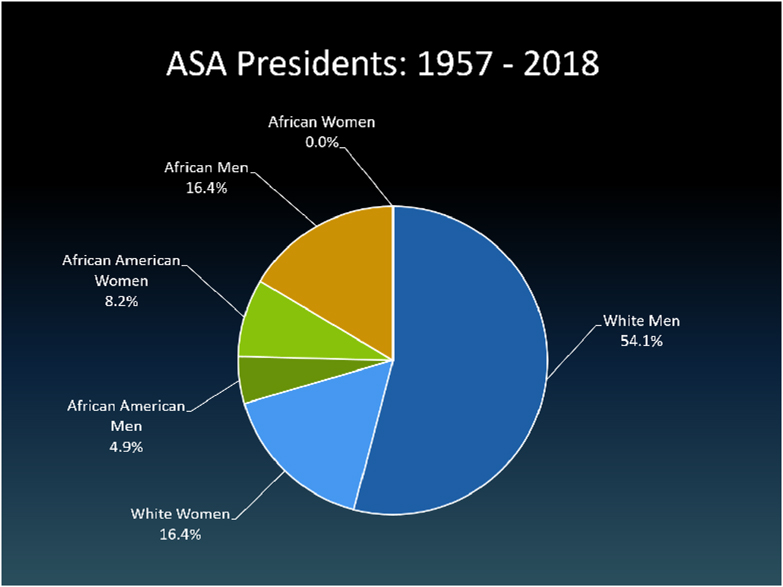
The conservative white backlash to the demands of 1968 and ’69, as we have seen, was premised on “nonracialism,” and consisted primarily of charges of “reverse racism” and “apartheid,” as opponents decried the division of the membership into “racial categories” that could be counted. I am a qualitative, not a quantitative, historian, and I understand well that numbers can obfuscate, invisibilize, and steamroll over nuance, complexity, and much else. But I also know that racism, ignorance, white supremacy, and complacency endure, indeed thrive, when we don’t count, when we refuse to count, especially when we hide behind a banner of “non-racialism.” One of the biggest demands in 1968 and ’69 was for parity. Parity requires counting, imperfect though our categories might be, and counting bring patterns into sharper relief. Sixty-one years into our history, how might we reply to Aubrey’s Reference Aubrey2002 challenge, to the questions posed by Painter in 1969? What do some of the ASA numbers tell us?
Figure 1.

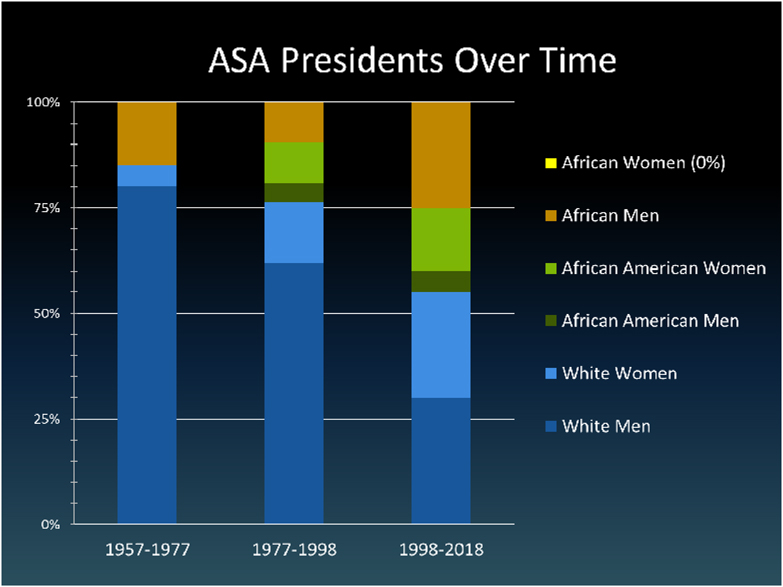
Figure 2.

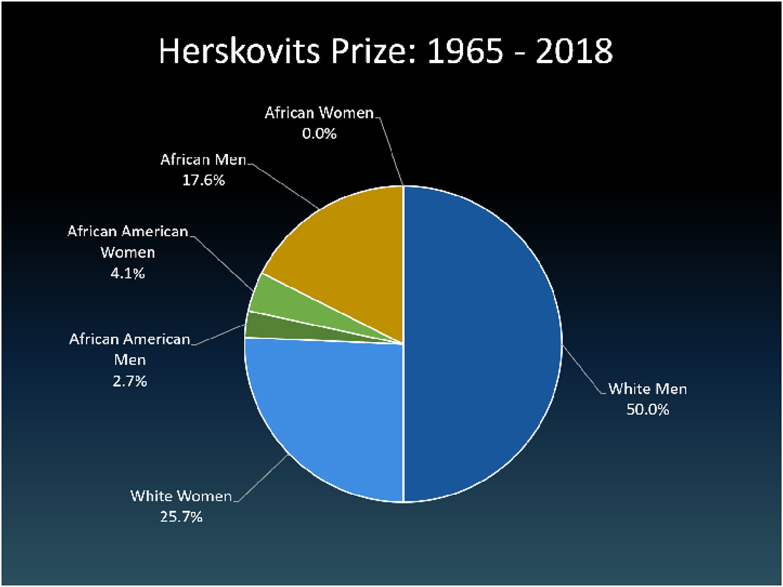
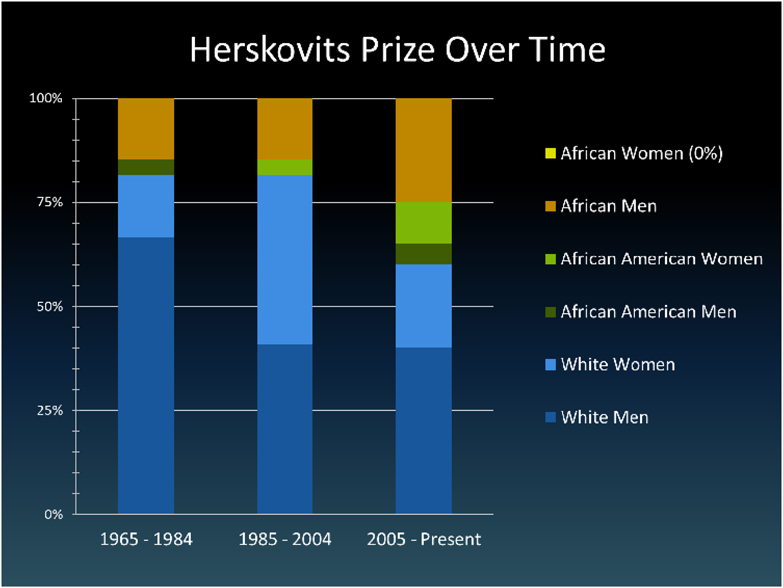
From my perspective, a few salient points emerge. In terms of racial and gender diversity, the long history of the ASA presidency is not a very admirable one and even in the past ten years, our leadership has been 55 percent white and 60 percent male. No African woman has ever been president! With regard to the Herskovits Prize, I would underscore, again, that the award has never gone to an African woman and that over 75 percent of the awards have gone to white scholars. Worth a lengthy pause is the fact that 33 percent of the time that a scholar of color has won the Herskovits Prize, the award has been “shared” with a second winner, who has been a white man. (In 1968 and ’69, the Black Caucus and AHSA demands for “African representation” included in the category “African” people from the continent and from the diaspora. Because of different histories of representation in the ASA over the past sixty years, I am disaggregating “African” and “African American.”)
Figure 3.

Figure 4.

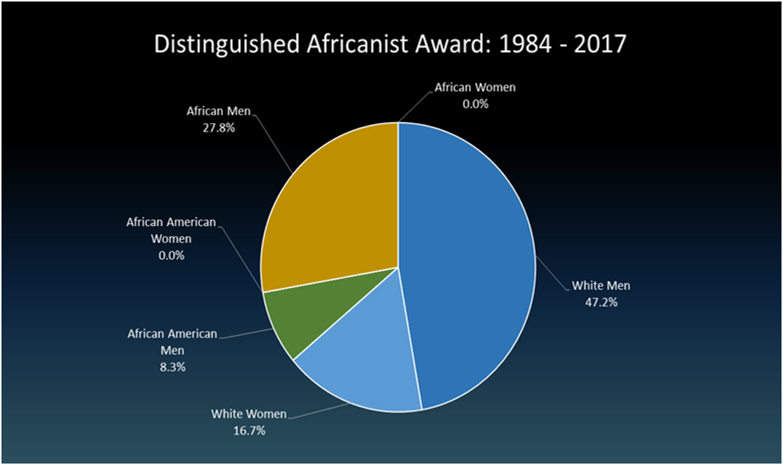
The ASA’s Distinguished Africanist Award has been given 34 times (twice there were two awardees in one year); 83 percent of the awards have gone to men. No African American woman or African woman has ever received this honor, which is in large part an outcome of who teaches where and who has graduate students and other mentees, who, in turn, nominate senior scholars for the award!
Figure 5.

I will be the first to assert that these numbers, these percentages, these visualizations, do not capture the multiple, complex identities—gender, race, ethnicity, class, sexuality, nation, religion, or citizenship—that make up each and every individual who has won an ASA award or served as president. But they do reveal clear patterns of privilege and power that have changed over time, but have not been displaced or transcended, even in the most recent past. As we think about the unfinished business of 1968, these numbers are, as they were then, a place to start.
Secondly, as I argued earlier, the emergence of the “Africanist Enterprise”—an enterprise buttressed by the massive influx of foundation and government funds—facilitated a “recolonization” of Africa by the United States, with U.S. academics, overwhelmingly white, serving as the gatekeepers and determining on an unprecedented scale what knowledge could be produced, what questions should be asked, what was of value. That the consolidation of that “enterprise” more or less coincided with the underfunding of public universities in many parts of the continent in the late 1970s only exacerbated the global inequities and the entrenched coloniality of knowledge production, a coloniality which scholars on the continent, from Accra to Dar es Salaam, from Addis to Dakar, had contested with some success in the 1960s and early 70s. Today, continental organizations such as CODESRIA and, more recently, the African Studies Association of Africa, are at the forefront of re-centering knowledge production about Africa in Africa. What role will the ASA play, can it play, in support of this decolonizing work, in opening up the gates and displacing the gatekeepers? Recall Mkandawire’s Abiola lecture and his poignant question: whether “the divide between area specialists and the indigenous scholars is as sharp elsewhere as that between African scholars and their Africanist counterparts” (1997:26).
Thirdly and finally, there is the question of the ASA’s relationship to the study of global Africa, of the African diaspora. As I combed through the papers and correspondence of the ASA, the Black Caucus, and the AHSA, I was surprised how critical that issue was in the late 1960s. As Black Studies departments were birthed out of Black student struggle, the question being posed by so many African American and African members of the ASA was consistently: where is the ASA in this process? Are we at the table? Before I dug into the archives, I was not aware that during these very critical years, and especially in 1968, Black scholars in the ASA struggled to push the ASA into the work of building Black Studies across the U.S. In other words, there was a moment—a moment of enormous possibility—when the ASA might have played a supportive role in those struggles, including at TWIs. But the ASA leadership at that time rejected outright any such “cross-fertilization.” And so, to this day at most campuses across the United States where there are both African studies and African American studies, they largely occupy different spaces, have different faculty, and pursue agendas that are seldom overlapping. That is one of the major legacies of the defeat of 1969.
So, how does the ASA as an Association reckon with this past, with this genealogy? Is there a redemption song? In the last few years, the ASA Board has headed up some important initiatives in terms of the circulation of published works on Africa between the global north and south; the ASA had its first Africa-based program co-chair for the 2018 annual meeting, and that will be repeated in 2019; it has made a commitment to having Africa-based scholars serve on the Board; its Advocacy Committee now works with a large and representative Task Force on Academic Freedom; and the Association has a stated commitment to diversity and inclusion in its Policies and Procedures. These are important steps that will certainly bring about additive change, but they will not bring about transformative change. What would transformative change look like? I believe in fundamental ways that I am not the person to make that determination and therefore will not end this “meditation” with a Seven Point Development Plan! My hope is that initial conversations began in the two roundtables that followed on the Saturday after my Presidential Lecture, the first on “Ruptures” and the second on “Futures,” where we had the opportunity to listen to several generations think through the past, present, and futures of African Studies, of knowledge production about Africa, and to begin to chart what transformative change for the ASA might entail.Footnote 54
#MustHerskovitsFall as part and parcel of transformative change? On this question, I will share just a few of my own thoughts. I used to think that it was important that the ASA’s most coveted prize was named after someone whose work had such an impact on how scholars conceptualize the African-ness of global Africans. But I know now that that was not what the founding fathers had in mind in 1963 when they began thinking about a “suitable memorial to the first President of the Association” in July, 1963.Footnote 55 It was a memorial to a foundational player in the North American political economy of knowledge production about Africa, a political economy owned and operated overwhelmingly by white scholars at TWIs. The first Herskovits prize was given in 1965. The prize was not endowed. The Board wrote to publishers and asked them to contribute to the prize, which many did for five years, but then began withdrawing their support in 1969. At that time—at the time of Montreal—there were some efforts to raise funds from Herskovits’s students, but those were not particularly successful. So the prize has remained without an endowment, without a vision statement, without a serious conversation about what was and is being memorialized.Footnote 56
I would like to see a critical discussion of this prize and others, symbolic though they may be. Perhaps the Herskovits Prize has generated a dynamic and a meaning of its own that most people do not connect to a particular past, a particular set of decisions? Given the #fallist movements we have witnessed across the globe over these past several years, I suspect that is not the case. In his presidential address, Herskovits made clear how much he valued what he considered to be Americans’ remove or distance “in space from the African scene.” Thankfully, I have met few people in this Association in my thirty-plus years as a member who share that core value. So maybe there are alternatives to a Herskovits Prize? Perhaps we should look to the continent and to those who worked so hard to decolonize the production of knowledge about Africa as their countries struggled for independence? The historian Kenneth Onwuka Dike comes to mind, the person who organized the very first International Congress of Africanists in Accra in 1962. Or perhaps our most prestigious award should recognize some of those who struggled to save the ASA from the worst of itself—in 1968 or 1969? John Henrik Clarke? Shelby Faye Lewis? Or perhaps we should return, in Sankofa-style, to that other genealogy, to that other river of knowledge production that my predecessor James Pritchett so eloquently described in his 2014 presidential lecture, and we should recognize someone such as William Leo Hansberry, probably the first person to teach African Studies in any serious way in the United States in the 1920s—without funding, without research support, from any foundation or government department. How might the ASA honor that deep and rich African American history of African studies, while also acknowledging the Association’s role in its marginalization and displacement?
Acknowledgments
The seed for this paper was planted long ago, during the years I spent at Northwestern University navigating the separate worlds of African and African American Studies. I want to acknowledge Professors P. Sterling Stuckey and Ivor Wilks for all they taught me during that journey. I was able to present draft versions of this paper at the second meeting of the African Studies Association of Africa at the University of Ghana; the University of Michigan’s African History and Anthropology Workshop; Washington University’s African and African American Studies Lecture series; and Michigan State University’s “Eye on Africa” series. I want to thank the many graduate students and faculty who attended those presentations and offered such constructive feedback. Of course, no version of this paper would have been possible without the assistance and support of the librarians and archivists who guided me through the collections at the Schomburg and at Northwestern. I am especially grateful to Esmeralda Kale and Gene Kannenberg Jr. at the Melville J. Herskovits Library at Northwestern. I would also like to thank the following individuals for their very close readings of earlier drafts: Monique Bedasse, Shefali Chandra, Jonathan Fenderson, Seth Graebner, Allen Isaacman, John Parker, Derek Peterson, Anne Pitcher, Carina Ray, David Roediger, Samuel Shearer, and Butch Ware. I am greatly indebted to Carina Ray, who worked so hard to bring the two accompanying roundtables on Ruptures and Futures to fruition, and to those who participated in those Saturday morning sessions (see endnote 54 for the full list of participants). Finally, a very special thanks to Donovan Roediger for assembling the graphs and charts and to the ASA Secretariat, especially to Suzanne Moyer-Baazet, Kathryn Salucka, and Lori Ann Chitty Ray, for logistical and moral support far exceeding the “call of duty.”