Introduction
Successful treatment of hypopharyngeal cancer presents a challenge to head and neck surgeons, particularly when the disease extends into the cervical oesophagus. This is due to the technical difficulties of removing the disease and successfully reconstructing the resulting defect. Several reconstruction options have been discussed in the literature, including colon transfer, jejunal autograft, gastric pull-up, and use of deltopectoral, radial forearm, pectoralis major, rectus abdominus and lateral thigh flaps.
Although the surgical techniques, risks and morbidity of the various reconstruction methods have been discussed in detail,Reference Stepnick and Hayden1–Reference Harrison and Thompson9 little is known about swallowing outcomes, particularly in the long term. Total laryngopharyngoesophagectomy with gastric transposition reconstruction (known as ‘gastric pull-up’) involves major abdominal and thoracic surgery. However, it is considered the reconstruction of choice when disease extends from the hypopharynx into the cervical oesophagus.Reference Stepnick and Hayden1, Reference Shah, Shemen, Spiro and Strong10, Reference Disa and Cordeiro11 Despite the inherent risks of the procedure, gastric pull-up has several advantages, including single-stage reconstruction, one anastomosis (reducing the risk of fistula and stricture) and a rich blood supply.Reference Stepnick and Hayden1, Reference Haller2, Reference Harrison and Thompson9, Reference Hartley, Bottrill and Howard12 Several authors have suggested that patients have good swallowing function after undergoing the gastric pull-up procedure,Reference Fredrickson, Wagenfeld and Pearson4, Reference Shenoy, Pai and Rajan7, Reference Harrison and Thompson9, Reference Schusterman, Shestak, de Vries, Swartz, Jones and Johnson13, Reference Missotten14 particularly when compared with the most popular alternative, jejunal graft reconstruction.Reference Carlson, Schusterman and Guillamondegui15, Reference Schechter, Baker and Gilbert16 However, there are no published studies examining long-term outcomes for swallowing physiology or swallowing function from the patients' perspective, following gastric pull-up surgery.
The aim of this clinical review was to evaluate long-term swallowing and swallowing-related function after gastric pull-up surgery. Specifically, we aimed to answer the following questions about this patient group: do they eat a normal diet; do they restrict their eating environment; have they altered their eating habits (such as eating more slowly and taking less food during one meal); do they regurgitate; and do they swallow fluid and food from the oral cavity into the stomach efficiently?
Materials and methods
Participants
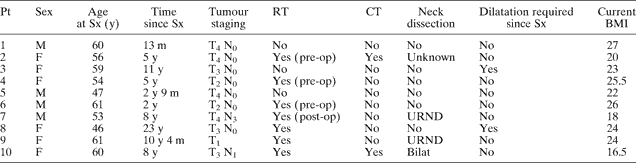
Ten adults (four men and six women aged between 50 and 70 years, median age 57.5 years) were invited to take part (see Table I). All gave written, informed consent.
Participants' details
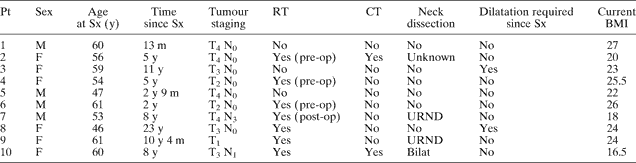
Pt = patient; Sx = surgery; y = years; m = months; RT = radiotherapy; CT = chemotherapy; BMI = body mass index; M = male; F = female; T = tumour; N = node; pre-op = pre-operative; post-op = post-operative; URND = unilateral radical neck dissection; Bilat = bilateral neck dissection
More than one year previously, participants had undergone total laryngopharyngoesophagectomy with gastric pull-up reconstruction and total thyroidectomy for treatment of advanced carcinoma of the hypopharynx and/or cervical oesophagus. The interval between gastric pull-up surgery and participation in this review ranged from 13 months to 23 years, with a median interval of 12 years six months (see Table I).
We excluded patients fitting the following criteria: gastric pull-up surgery within the previous year; any other surgery to the head and neck (excluding neck dissection); any recurrent or new head and neck cancer since the gastric pull-up procedure; any other medical condition (such as cerebrovascular disease) or medications likely to affect swallowing; and inability to read English.
We reviewed participants' medical notes for details of original tumour staging, radiotherapy, chemotherapy and surgical details.
Clinical examination
A consultant head and neck surgeon (DJH) examined all participants to identify structural abnormalities and signs of recurrent disease.
To determine whether participants' weights fell within a healthy range, height and weight were measured to calculate body mass index (BMI).
Swallowing questionnaires
To evaluate participants' perception of their swallowing and eating function, each completed the normalcy of diet and public eating subsections of the performance status scale for head and neck cancer patients.Reference List, Ritter-Sterr and Lansky17 This scale is a validated, reliable and sensitive assessment of disease-specific function in the head and neck cancer population.
We aimed also to collect more detailed information on patients' perceptions of their swallowing and eating functions. At the time of this study, no relevant published questionnaire was available, so we designed one for the purposes of this review. The items in this gastric pull-up swallowing questionnaire reflected the potential swallowing and eating-related problems which may arise following the gastric pull-up procedure. These include slow eating, limited capacity, early satiety and regurgitation (see Appendix 1).
Videofluoroscopy procedure
A speech pathologist specialising in head and neck cancer and dysphagia (AK) and a consultant radiologist (LS) conducted the videofluoroscopy examinations. Both were blinded to the patient's results for the clinical examination and the two questionnaires until after videofluoroscopy analysis was completed.
We selected four test boluses to represent a range of consistencies: two 10 ml liquid boluses (comprising 5 ml Baritop (Baritop 100, Sakai Chemical Industry Company Ltd, Osaka Japan) and 5 ml water); a soft solid bolus (2 rounded teaspoons of banana mixed with 5 ml EZHD (EZHD is a brand of barium mixture) barium diluted according to instructions); and a solid bolus (one-third of a digestive biscuit coated with 5 ml of EZHD barium powder diluted with 10 ml of water). Prior to swallowing, the lateral screening field was established, bordered by the lips, hard palate, cervical spine and stomach at the level of C6/7. Each bolus was screened as it passed through the oral cavity, anastomosis and proximal stomach and into the stomach reservoir.
The videofluoroscopy images were recorded on a Super VHS video recorder (SVO-9620, Sony, Weybridge, UK), and the swallowing timing was recorded by a time code generator.
Videofluoroscopy rating
A speech pathologist specialising in dysphagia and head and neck cancer (AK) rated the videofluoroscopy examinations from the recordings. Six parameters were rated, on a four point scale (as normal, mildly impaired, moderately impaired or severely impaired). These parameters were:bolus control for liquids, soft solids and solids; contact of the oral tongue against the hard palate during the oral stage of swallowing; velo-pharyngeal closure during swallowing; contact of the base of tongue against the posterior pharyngeal wall during swallowing; symmetry of oral clearance of liquids; and oral residue.
Oral transit time was calculated from the start of tongue elevation at the initiation of the swallow to the point at which the tail of the bolus passed the posterior margin of the vertical ramus of the mandible on the lateral view.
We calculated gastric transit as the length of time taken for the bolus to move through the upper stomach and reach the stomach reservoir, measured from the moment the bolus head reached the level of the orogastric anastomosis to the moment the bolus tail reached the stomach reservoir.
Data analysis
Given the small number of participants, we used descriptive statistics to analyse and present the data.
Results and analysis
Ten participants were included. All underwent clinical and nasendoscopic examination and completed the performance status scale for head and neck and the gastric pull-up swallowing questionnaires. Nine participants underwent videofluoroscopy on the same day as their clinical examination and their completion of the two questionnaires. One participant (participant 10) declined to undergo videofluoroscopy examination.
Clinical examination and body mass index
None of the participants had signs of recurrent cancer detected on clinical examination. Participant eight had a stricture at the orogastric anastomosis. Participant nine had bilateral tongue atrophy and immobility secondary to bilateral XIIth nerve palsies sustained intra-operatively. We did not detect any structural abnormality in the other eight participants.
Eight of the participants had BMI scores of 20 or greater. Participant seven had a BMI score of 18, and attributed his limited oral intake to xerostomia and chronic changes in taste following post-operative radiotherapy. He was the only participant who had undergone radiotherapy post-operatively. Participant 10 had a BMI score of 16.5.
Do they eat a normal diet?
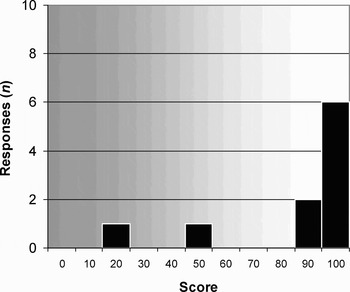
Six participants scored 100/100 and two scored 90/100 on the normalcy of diet subsection of the performance status scale for head and neck cancer patients, indicating that eight out of 10 participants were eating a full diet (see Figure 1). The participant with bilateral hypoglossal nerve palsies reported eating a soft, chewable diet, and the tenth participant reported taking liquids only. Unfortunately, this latter patient did not undergo videofluoroscopy, so the physiological basis for her poor swallowing and eating function remained unknown.
Scores for the normalcy of diet subsection of the performance status scale head and neck cancer patients. Background shading indicates severity; darker shade (i.e. lower scores) indicates worse function.

Do they restrict their eating environment?
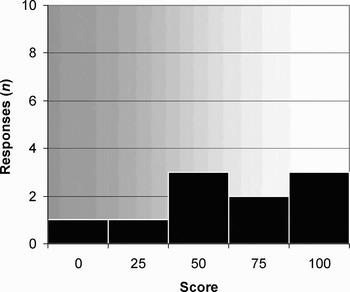
The public eating subsection of the performance status scale for head and neck cancer patients showed greater variability than the normalcy of diet subsection, with half the participants reporting that they did not restrict their eating environment (see Figure 2). The other five participants reported some limitation of their eating environment. Interestingly, the two participants with structural impairments (participants eight and nine) had high scores for both subsections of the performance status scale for head and neck cancer patients, indicating good compensation.
Scores for the public eating subsection of the performance status scale head and neck cancer patients. Background shading indicates severity; darker shade (i.e. lower scores) indicates worse function.

Have they changed their eating habits (such as eating more slowly and taking less food at one meal)?
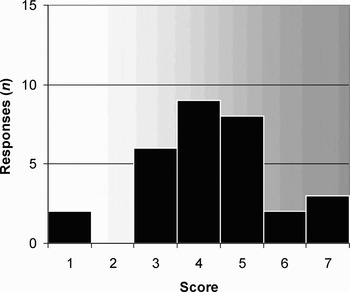
Most of the participants reported moderate changes, compared with their pre-morbid eating patterns, with increased meal-time duration and reduced capacity (i.e. the quantity of food eaten at one meal) (see Figure 3). Only one patient reported that her mealtime duration was unchanged. All the participants reported reduced eating capacity.
Results for section one of the gastric pull-up swallowing questionnaire – eating speed and behaviour. Background shading indicates severity; darker shade (i.e. higher scores) indicates worse function.

Do they regurgitate?
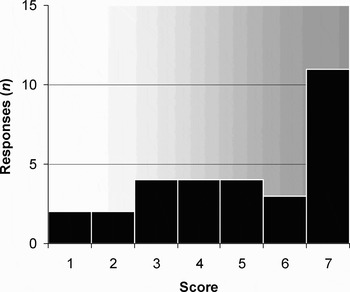
The most common symptom reported by a majority of participants was regurgitation on bending over; six of the 10 participants gave this the most severe rating (seven out of seven), and none rated it as less than four out of seven (see Figure 4). Regurgitation when lying down was also common, with four participants rating this as seven. Several patients spontaneously commented that they avoid eating or drinking before lying down, in order to minimise regurgitation.
Results for section two of the gastric pull-up swallowing questionnaire – eating capacity and regurgitation. Background shading indicates severity; darker shade (i.e. higher scores) indicates worse function.

Do they swallow fluid and food from the oral cavity into the stomach efficiently?
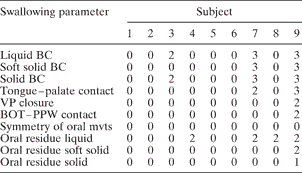
We rated swallowing function as normal across all domains for six of the nine participants who underwent videofluoroscopy (see Table II).
Videofluoroscopy swallowing function
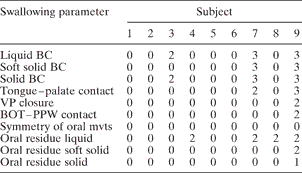
Data presented are videofluoroscopy swallowing function ratings, whereby: 0 = normal function; 1 = mildly impaired; 2 = moderately impaired; 3 = severely impaired. BC = bolus control; VP = velo-pharyngeal; BOT–PPW = base of tongue to posterior pharyngeal wall contact; mvts = movements
Three participants had extended oral transit times. Unsurprisingly, the participant with bilateral hypoglossal nerve palsies had the poorest oral function and the slowest oral transit times. Participant seven attributed his difficulty controlling and clearing food through the oral cavity to chronic radiotherapy side affects. The participant with the anastomotic stricture had good oral control but slow oral transit, as multiple swallows were required to clear each bolus through the stricture. The median oral transit times across the nine participants who underwent videofluoroscopy were 0.7 seconds for liquids, 1.2 seconds for soft solids and 2.5 seconds for solids – broadly within normal limits.Reference Rademaker, Pauloski, Logemann and Shanahan18 Eight of the nine participants cleared liquids from the level of the orogastric anastomosis to the stomach reservoir in less than three seconds. Gastric transit times were highly variable for soft solids and solids, ranging from three seconds to more than 30 seconds. This is to be expected, given the reliance on gravity to propel food from the anastomosis to the stomach reservoir. There are no relevant normative values for gastric transit time to enable comparison, given the anatomical and physiological changes following gastric pull-up surgery.
Discussion
The findings of this clinical review support previous opinions that gastric pull-up reconstruction has good swallowing outcomes.Reference Harrison and Thompson9, Reference Schusterman, Shestak, de Vries, Swartz, Jones and Johnson13–Reference Schechter, Baker and Gilbert16 It is encouraging that eight of our 10 long-term gastric pull-up survivors were eating a normal diet. Of the four patients who had disordered swallowing on videofluoroscopy or dietary limitations, three had clearly identifiable reasons for their dysphagia. For all 10 participants, the most commonly reported functional limitations were reduced eating capacity, slower eating and regurgitation.
There are few previous publications examining swallowing outcomes after gastric pull-up surgery, and none specifically evaluating long-term function. McConnel et al. used manofluorography to assess swallowing physiology in 10 patients after total laryngopharyngectomy,Reference McConnel, Hester, Mendelsohn and Logemann19 including two who had undergone gastric pull-up. They concluded the gastric pull-up patients did not experience dysphagia, unlike five of their eight jejunal graft patients. In a larger study comparing functional outcomes of pharyngoesophageal reconstruction in 115 patients (16 of whom had gastric pull-up), patients were assigned a functional score for speech and swallowing.Reference Schechter, Baker and Gilbert16 The authors concluded that gastric pull-up resulted in better swallowing six months post-operatively, compared with other methods of reconstruction, although the process of assigning the functional score was not clearly defined.
• Successful reconstruction after extended laryngopharyngectomy presents a challenge for head and neck surgeons
• Gastric transposition reconstruction (‘gastric pull-up’) is considered the reconstruction of choice when the disease extends into the cervical oesophagus
• Previous reports have suggested that gastric pull-up reconstruction has good swallowing outcomes when compared with other methods of reconstruction. However, there are no published studies or reviews of long-term swallowing outcomes
• This paper presents the results of a clinical review of swallowing and eating function in 10 long-term survivors of total laryngopharyngoesophagectomy with gastric pull-up reconstruction
• The findings of this review support previous opinions that gastric pull-up has good swallowing and eating outcomes, and indicate that these outcomes continue in the long term
Limitations of this review
Number of participants
In common with most head and neck centres, we have relatively small numbers of long-term survivors of gastric pull-up, and this limited the scope of our clinical review. A prospective research study is required in order to systematically evaluate long-term functional outcomes and quality of life after extended laryngopharyngectomy. Multicentre collaboration is the most feasible method of achieving sufficient numbers of long-term survivors, in order to enable systematic comparison of the benefits and limitations of different reconstruction methods.
Questionnaire design
We recognise the limitations of our gastric pull-up swallowing questionnaire, including the relatively small number of questions and the lack of validation. At the time of this review, there was no published questionnaire addressing swallowing and eating function which was relevant to the gastric pull-up population.
Conclusion
This review of a small number of cases indicates that, unless there is an identifiable structural anomaly (such as stricture or hypoglossal nerve palsy), patients who undergo the gastric pull-up procedure have good long-term swallowing function, with most consuming a normal diet, eating in a range of environments and maintaining a healthy weight. This supports the prevailing opinion that good swallow function is one of the key advantages of this method of reconstruction. Our results indicate that the functional limitations arising from the anatomical and physiological changes after gastric pull-up are predictable and generally consistent across patients; these comprise slower eating, reduced capacity, and regurgitation on bending over or lying down.
Acknowledgements
Bella Talwar, Clinical Lead Dietitian, Head and Neck Centre, University College Hospital London.
Appendix 1. Gastric pull-up swallowing questionnaire
Circle one number between 1 and 7
Section one
(a) How long does it take you to finish a meal?
1 (The same as before I had cancer and surgery)
2
3
4
5
6
7 (Considerably longer since cancer and surgery)
(b) What quantity are you able to eat at one time?
1 (The same as before I had cancer and surgery)
2
3
4
5
6
7 (Considerably less since cancer and surgery)
(c) How much have your overall eating habits altered since the surgery?
1 (Not altered)
2
3
4
5
6
7 (Altered considerably)
Section two
To what degree do you experience:
(a) An uncomfortable feeling of fullness for more than 2 hours after eating?
1 (Never)
2
3
4
5
6
7 (Constantly)
(b) Regurgitation of food or fluid when lying down?
1 (Never)
2
3
4
5
6
7 (Constantly)
(c) Regurgitation of food or fluid when bending over?
1 (Never)
2
3
4
5
6
7 (Constantly)