1 Introduction
Never an ex-Rhodie
Who is an ex-Rhodie . . . I have never met one
I am a Rhodie . . . I will never be an ex-Rhodie
Rhodesians might be dead and buried
But still I am a Rhodie not an ex-Rhodie
And when I pass on I will still be a Rhodie
Rhodesia lives within me even if she does not exist on any map
That must make me a Rhodie
And very proud of the fact that I am ‘the Rhodie’
One day I will be known as the ‘Extinct Rhodie’
But never never an ex-Rhodie
This passage was recently posted on Facebook. The verse, more maudlin than nostalgic, centres on a particular conceit: When ‘Rhodesia’, the self-governing British colony and then independent rebel pariah republic, was replaced by ‘Zimbabwe’, the legitimately independent commonwealth republic, the vast majority of the white denizens of Rhodesia left the country, becoming known as ex-Rhodesians. The author claims that they do not eschew their identification as Rhodesian but continue as unreconstructed Rhodesians (Rhodies) by living as if in the past, holding to a remembered imagined notion of a pre-independent Rhodesia. In this verse, the author offers an assertion that recalls the line from a patriotic song that was popular among Rhodesians at the height of the civil war in the 1970s: ‘Rhodesians never die’. The conclusion of the verse is that the only way that Rhodesians can become ‘ex-Rhodesians’ is by dying. The author's choice of the diminutive moniker ‘Rhodie’ as a means of self-identification is instructive as it invites the inference that the speaker not only mourns the loss of a homeland but effectively and confidently denies real change. This post conveys the attitudes of what Godwin & Hancock (Reference Godwin and Hancock1993: 7) label:
[t]he ‘true’ Rhodesians – the descendants of the Pioneers who had founded the country in 1890, the young ‘Rhodies’ brought up on a history replete with heroes, the ever-faithful worshippers of Ian Smith, and the exiles who now comfort each other at reunions held abroad – all believed that Rhodesians were bound together by a sense of mission and by a shared identity.
The particular claim to a place (Rhodesia) as symbolic of a group's identity (Rhodie) is at the heart of this conceit. Of course, there are other groups (Zimbabweans) who lay claim to the place as differently constructed (Zimbabwe). The ways in which what appears on the surface to be one location is constructed as distinct places with different meanings for different people are crucial to the understanding of how ideology and race have shaped Zimbabwe's biography. I am interested in how whites construct national identity and a sense of belonging to two distinct versions of this place. The first is colonial (and then republican) Rhodesia, where whites as settlers assert their claim to the country by dividing the population into citizens and subjects along racial lines and by designation as Rhodesians and Africans respectively. The second version is post-independent Zimbabwe during the land reform programme in 2000, when whites asserted their right to (historical and contemporary) possession of the land on the basis of their being as legitimately African as black Zimbabweans. I adopt the notion of ‘settlement’ to pursue the changing nature of identity, particularly white identity, in Zimbabwe. At issue is the rehabilitation and appropriation of language formerly used with opprobrium in the white lexicon in order to construct a discourse of belonging when white occupation of vast agricultural lands and whites’ claim to the status as Zimbabweans are finally challenged. In their study of the effects of war and political change on ‘White Rhodesia’, Godwin & Hancock (Reference Godwin and Hancock1993: 11) point out the importance of language as emblematic of attitudes and political views:
There are considerable rewards for paying more attention to what the Rhodesians actually said and did. Their language, rituals, and symbols are fertile sources for their political culture . . . For, by exploring the Rhodesian language, [historians] can draw conclusions about the levels of White ignorance, political sensitivity, and sophistication. They might also locate the deeper recesses where individuals and groups hid their fears and superstitions about the unknown Africa and allegedly unknowable African mind.
Godwin & Hancock reflect on the importance of attending to what people say and the fact that the listener can infer from this the nature of people's ideologies. They also draw attention to the racial divide endemic to this particular biography. They align ‘Rhodesian’ and ‘white’ and juxtapose this pair of terms with ‘Africa’ and ‘African’, implying that the content of the latter pair entails ‘black’. The overarching question therefore has to do with the ways in which ideology and race shape the historical negotiation of national identities in Zimbabwe in both the colonial and postcolonial periods: what are the consequences of the ‘raced national biography’ that established Rhodesia for white national identity in postcolonial Zimbabwe?
To begin to approach this question, we need to address the historical construction of identity through language. Specifically, we must examine the ways in which key terms such as ‘settler’, ‘African’ and ‘European’ work to shape the construction of identity. They acquire powerful connotations over time. In order to understand their role in the raced biography that emerges in the course of the twentieth century, we must examine the nature of the semantic-pragmatic process by which the meanings of these lexical expressions change over time, gathering different kinds of culturally charged force. This theoretical matter is crucial in uncovering the history of a community's discourse. However, because meaning is embedded in the social, cultural, temporal and ideological conditions in which language is used, we need to question the role of an ideology in shaping the contextual meanings of expressions (discourse uses) over time. In this particular case, I am interested in an ideology that is defined by a raced history of its speakers. As our evidence rests on individuals’ language, we must work at the level of the linguistic individual to ask how a speaker's choice of terminology invites inferences about the nature of that speaker's attitudes towards the referents of the term. This final question addresses pragmatic and discourse matters, providing an opportunity to drill down into the discourse to explore the specific cases of ideologically and culturally charged language and the extent to which a speaker's linguistic repertoire identifies his or her own ideological stance.
The historian in search of the social history of colonial Zimbabwe in the course of the twentieth century is struck by the impact of the ego document or first-person writing in the constructions of ‘Rhodesian’ and ‘Zimbabwean’ identity.Footnote 2 The individual anecdote, the personal story and the memoir provide glimpses of what it was like to live in Africa in the colonial period. These self-narratives are also potent sources of evidence for the development of a powerful and complex image that their writers invoke in asserting their sense of ownership and right of abode in southern Africa. My sources for this study include newspapers and other feature journalism, memoirs, speeches and advertisements for public and popular representations of the discourses operating in Zimbabwe's history. I also draw upon fiction, recorded interviews and ephemera produced around key discursive thresholds to explore the production of multiple meanings within competing discourses to generate parallel lexicons. Section 2 establishes the historical centrality of the trope of land to the construction of ‘Rhodesia’ and then ‘Zimbabwe’ as a place. Section 3 outlines the model of semantic-pragmatic change adopted and the historical framework in which the analysis of the changing meanings of key terms is situated. Section 4 is an examination of the meanings of ‘African’ in the lexicons of British colonists and then white Rhodesians before independence in 1980. I argue that it is at the centre of a lexical field for reference to blacks, and show how powerfully the ideology of race contributes to the specialisation of reference. In section 5, I review the demise of the ‘Rhodesians’ and the emergence of a public discourse that centres on the emergence of Zimbabwe with independence under a black majority government. In section 6, I turn to 2000 – the time of ‘Jambanja’ – and explore the process that involves the semantic rehabilitation of the colonial era term ‘African’ by whites. I argue that whites appropriate the term to identify themselves as having legitimate claim to the land that has been at the centre of political, racial and ideological conflict since 1896. Finally, I conclude by re-examining the idea of ‘place’ in the construction of claims for belonging, and by extension, to national identity in postcolonial contexts more generally.
2 The unsettled land
We knew and still know that land was the prime goal for King Lobengula as he fought the British encroachment in 1893; we knew and still know that land was the principal grievance for our heroes of the First Chimurenga, led by Nehanda and Kaguvi. We knew and still know it to be the fundamental premise of the Second Chimurenga and thus a principal definer of the succeeding new Nation and State of Zimbabwe. Indeed, we know it to be the core issue and imperative of the Third Chimurenga which you and me are fighting, and for which we continue to make such enormous sacrifices. (Robert Mugabe Reference Mugabe2001: 92–3)
At the heart of all of the conflict in the country, from the ‘provocative interventions of early colonial rule in what became known as the Ndebele-Shona Rising of 1896–7: the First Chimurenga or Umvukela Wokuqala’ (Ndlovu-Gatsheni Reference Ndlovu-Gatsheni2009: 39), to the civil war or Second Chimurenga of the 1970s, and after independence to the present day, what President Robert Mugabe labelled the Third Chimurenga, is the matter of land (Alexander Reference Alexander2006: 185). The core motivation for colonisation and resistance is land – its occupation, its ownership and its culture. Jocelyn Alexander (Reference Alexander2006: 1) observes that the metaphor of the ‘unsettled land’ has rich and varied meanings throughout Zimbabwean history. At the end of the nineteenth century, ‘the unsettled land’ ‘conjures white settler fantasies of an empty, unproductive land, ripe for exploitation’ and ‘the harsh disruptions of colonial conquest, eviction and agrarian intervention’ (2006: 1). Indeed, in one of the earliest ego narratives about colonial Zimbabwe, F. Courtney Selous reflects upon the prospects for Europeans to flourish and prosper on the land:
It is now known . . . that Matabeleland and Mashunaland are white men's countries, where Europeans can live and thrive and rear strong healthy children; that they are magnificent countries for stock-breeding, and that many portions of them will prove suitable for Merino sheep and Angora goats; whilst agriculture and fruit-growing can be carried on successfully almost everywhere in a small way, and in certain districts, especially in Mashunaland and Manica where there is a greater abundance of water, on a fairly extensive scale. (F. Courtney Selous 1896: 256)
This extract embodies the nineteenth-century British imperialist view of Africa as ripe for European settlement and exploitation. Although Selous was not himself a colonist – he was an explorer and hunter – he here espouses the colonists’ attitude towards the opportunities for settlers to seize and prosper in the territories that became first Rhodesia and then Zimbabwe. Selous wrote this reflection to conclude his account of the Ndebele uprising in 1896 which was incited by the massive expropriation of Ndebele lands and cattle by white settlers. The First Chimurenga or Umvukela Wokuqala heralds the transformation of a British imperial discourse to a Rhodesian settler discourse, a discourse which signals the construction of a white identity ‘derived from the need to establish hegemony and the right to minority rule’ (Alexander Reference Alexander2004: 196). By the beginning of the twentieth century, Rhodesia was an emerging settler colony:
whose major characteristics, as in Australia and Canada, were land seizures, the arrival of a settler population, segregated colonial governance and political and economic privileges for the white community. (Ndlovu-Gatsheni Reference Ndlovu-Gatsheni2009: 58)
The legislative record of the colony, the rebel republic and finally independent Zimbabwe tells the story of seizure, settlement, protection, containment, redistribution, occupation and resettlement of the land. The impact of the definition along racial lines of citizens and subjects was evident in the nomenclature that marks the public discourse about the settlement of the land. Through the twentieth century, Africans were continually displaced from their homes and removed from their farms. The Land Apportionment Act of 1930 codified the segregation of land in Southern Rhodesia, creating ‘European Areas’, ‘Native Reserves’, ‘Native Purchase Areas’ and ‘Forest Areas’, and leaving as ‘unassigned land’ about seven million hectares (Ndlovu-Gatsheni Reference Ndlovu-Gatsheni2009: 66). At the same time, the state sought to shape the nature of settlement and farming practices in the reserves, casting African farming methods as ‘traditional, unproductive and destructive’ (Alexander Reference Alexander2006: 25).
After World War II, as large numbers of white immigrants were settled on farms under the Government's Settlement Scheme, African communities were displaced from the so-called ‘European areas’ (Mlambo Reference Mlambo2009: 76). The consequence was severe overcrowding in the Reserves, with the concomitant results of overgrazing and soil erosion. The state responded with the Native Land Husbandry Act (1951) which enforced livestock reduction, regulated the crops, acreage and areas to be planted, required the application of particular husbandry methods and controlled the marketing and distribution of the products (Raftopoulos Reference Hammar, Raftopoulos and Jensen2003: 17). The tight control of the reserve lands effectively denied blacks land in the reserved areas at all unless they agreed to become peasant farmers following strictly regulated methods. In consequence, ‘those who could not be accommodated in the countryside would be transformed into cheap permanent labour for the emerging manufacturing sector’ (Mlambo Reference Mlambo2009: 86). The Land Tenure Act (1969) further protected the zoning of land along racial lines. As Alexander (Reference Alexander2006: 1) notes, ‘land was central once again in provoking the brutal conflict of the liberation war, and in ultimately bringing about the demise of the settler state’. Alexander demonstrates how the trope of the ‘unsettled land’ applies equally to agrarian reform after independence. From 1980, the state regulated the slow, highly controlled process of resettling the large commercial agricultural area hitherto owned exclusively by whites with black smallholders. Economic protection for whites had been guaranteed by the constitution at independence in the stipulation that land could not be expropriated; it could, however, be bought ‘on a willing-seller – willing-buyer basis’ (Mtisi et al. Reference Mtisi, Nyakudya and Barnes2009: 165). The constitution was a significant obstacle to the new state's ability to deliver on its key promise to restore the land to the people. Moyo & Chambati (Reference Moyo and Chambati2013: 7) point out that in the first decade, land distribution was ‘a market-based and state-managed process which primarily targeted landlessness, “overcrowding” and land shortages among the rural and urban poor and unemployed’. In the 1990s, despite the government's adoption of land expropriation laws, land redistribution both slowed down and tended to benefit elites alone (Moyo Reference Moyo2013: 30). In 1997, when the government gazetted thousands of large commercial farms for compulsory acquisition, the commercial farmers vigorously challenged the government in the courts (Pilossof Reference Pilossof2012a: 34). The result was political impasse until 2000, when war veterans led hundreds of thousands of black Zimbabweans to occupy great tracts of very visibly untouched ‘white’ land. Thus once again the landscape was ‘dramatically unsettled’ (Alexander Reference Alexander2006: 1).
This narrative reflects the continual upheaval wrought by the repeated violent appropriation of land and the attendant eviction and resettlement of its inhabitants. Indeed, the question of the identity of whites in colonial and now postcolonial Zimbabwe has been inextricably bound up with the notion of the land, as Selous expresses it, ‘white men's country’. It centres on the settlement and ownership of land until 1980 and then the resettlement of the land since 2000.
3 A social-historical framework for semantic-pragmatic change
In order to trace the ways in which the discourse of a community reflects the extent to which its identities are closely tied to access to and association with the land over time, I examine the semasiological history of several key lexical terms, focusing on the changing signification of terms like ‘African’ while terms like ‘Rhodesian’ become fixed and fossilised. Underpinning this work is Traugott & Dasher's (Reference Traugott and Dasher2002) Invited inferencing theory of semantic change (IITSC), which models semantic change as speakers' pragmatic innovation in the stream of speech that has the potential to catch on, spread to other contexts of utterance and eventually become conventionalised. According to this model, speakers may use expressions that carry novel implicatures that are highly specific to the context of utterance. Alternatively, they may exploit an existing conversational implicature in an ad hoc way in a new environment. If the new use persists, it has the potential to acquire social value and if members of a community assign social meaning to its use, it might spread to other linguistic contexts and to other speakers, becoming pragmatically strengthened in the process. If the original coded meaning of the expression reduces to a trace in certain contexts or even disappears, then the interactants may conventionalise the now usual pragmatic meaning. The question is what external conditions or factors trigger (or actuate) the semantic-pragmatic change in the use of an expression. In my sociohistorical framework, the discursive context in which speakers generate novel implicatures by the use of an expression is critical to the process of change. I follow Rory Pilossof (Reference Pilossof2012a) in using Gillian Whitlock's (Reference Whitlock2000) notion of a ‘discursive threshold’. In her study of women's autobiography, Whitlock explores how the convergence of a series of political events that ‘configure and invade the private domain’ constitutes a threshold that triggers change in a group's discourse. The group adds a new style or register to its discursive repertoire, selecting the use of register according to the interlocutor and the specific communicative context. Thus a discourse – a style – may become active in the politics of identity when a particular (discursive) threshold is reached. I adapt Whitlock's notion to label the triggering moments in which meanings change, and in so doing, change the discourse they inhabit. In my model, the moment that accommodates semantic-pragmatic change and consequently discursive change is a discursive threshold. Then new discourses build upon elements that have been covertly or privately disseminated (i.e. those implicatures that speakers generate on the fly in the domain of private conversations). Once the threshold has been passed, these implicatures are conventionalised and emerge into the public domain to receive widespread and popular recognition. The threshold thus marks the waning of one discourse and the growing acceptance and use of another within the public domain. Importantly, a community may control more than one discourse at any one time. Constitutive of such discourses are groups of key terms that have complex polysemies that are contingent both upon the interactants and the discursive context in which they are used. Depending upon the specific historical setting and the ideological domain in which the interactants perform, a group of expressions may index the identity of its users. The notion of ‘contingent polysemy’ captures the fact that while an expression may have multiple meanings at any time, some meanings will be more prominent or primed than others for particular speakers depending upon the temporal, ideological and experiential stance of those speakers. In a sense, the temporal, ideological and experiential stance of speakers will prime them to perceive or apprehend some meanings of an expression more readily than others. In this way, different speakers within the same temporal and spatial domain will construe an expression differently depending upon their particular temporal, ideological and experiential stance. For example, Anthony Chennells (Reference Chennells2005: 134) draws our attention to the different meanings attached to whiteness in colonial Rhodesia, noting that ‘settlers of British origin grudgingly accorded whiteness to Jews and Afrikaners’ but in a qualified manner, referring to them as ‘poor whites’, thus preventing ‘too intimate an identification’ with them. So the label ‘poor white’ signifies for the settler of British origin, a white person, but of some other origin, and as such much diminished by comparison. Rory Pilossof (Reference Pilossof2012a) identifies the onset of the land reform programme or land invasions in 2000 as a key discursive threshold for the shift in the nature of the discourses of white Zimbabwean farmers. Key earlier discursive thresholds that are relevant for the study of emerging discourses in Zimbabwe are 1965, the date of the Unilateral Declaration of Independence (UDI) from Britain made by the Rhodesian Front prime minister, Ian Smith; and 1980, the date of legal independence of Zimbabwe and the first general election held on the principle of universal franchise. I track the multiple meanings commanded by key terms and the semantic-pragmatic shifts speakers produce at key discursive thresholds in the history of Zimbabwe. The rest of the article looks particularly at the manner in which discourses disappear from the public realm to go underground and then, when political events converge in particular ways, to resurface.
4 Africans vs Rhodesians in colonial Zimbabwe
In this section, I examine the manner in which the construction of Rhodesia as a white man's country in the course of the twentieth century is reflected in the development of nomenclature for classifying its population. The European settlement of sub-Saharan Africa through the British colonial office had a particular linguistic legacy; specifically, it bequeathed a terminology that distinguished between colonisers and colonised in terms of their geographical provenance. Accordingly, the empire's citizens were Europeans and the empire's subjects were, in the case of Africa, Africans. European empire builders like Britain, Germany and Italy divided the continent among them into colonies and some, like Britain, began to plant permanent settlements of their citizens in those colonies to cement their possessions. In the process, the lexicon of empire was domesticated and localised, acquiring the specificity of place. The Oxford English Dictionary's (OED) primary entry for ‘African’ (OED, s.v. A1) includes the sense of continental origin or provenance that predominates in the period before Europe's imperial expansion into Africa and distinguishes this from what it refers to as ‘local usage’, in which the term is used to differentiate people of ‘African origin’ from those of ‘European origin’:
a native or inhabitant of Africa; a person of African origin (contextually = black African n.); spec. (in local usage) such a person as distinguished from a person of European origin, as (S. Afr.) a member of any of the Bantu-speaking peoples of South Africa. (OED, s.v. A1)
Of course, the entry does not make it clear what precisely results in the specification of the term in local usage. The entry does point to Southern African usage as the instantiation of local usage, indicating its use to denote specifically ‘Bantu-speaking’ peoples indigenous to Southern Africa. This situation can be clarified by the appeal to history. The period in which this (localised) sense dominates is from 1806, some eighty years before whites ventured onto the Zimbabwean plateau. Before the scramble for Africa in the last quarter of the nineteenth century imposed upon the map of Africa boundaries agreed by Britain, Germany, Italy and France, linguists like Bleek (Reference Bleek1862−9) identified different parts of Africa according to the geographical distribution of language families. Accordingly, Bleek placed the Bantu-speaking peoples in Southern Africa. The domestication and metonymic adaptation of the term ‘Bantu’ is illustrated in the early twentieth century in the name of the Bantu Congress of Southern Rhodesia, a political organisation formed in 1934 by mission-educated black men who ‘adhered to colonial modernist ideas of progress and civilisation’ (Ndlovu-Gatsheni Reference Ndlovu-Gatsheni2009: 73). Chennells (Reference Chennells2005: 134) observes that:
[t]he primary signifier of a colonial identity was race, although what race signified differed between colonial systems and sometimes carried different significations within the same system.
In the case of Southern Rhodesia in the early twentieth century, white British (and British South African) settlers were distinguished from the (black) African, colonised by means of the opposition of ‘European’ and ‘African’. In the course of the domestication and localisation of this lexicon, the ideology of race contributes to the specialisation of reference. Thus in practice, ‘European’ comes to be synonymous with ‘white’ and ‘African’ comes to refer exclusively to the indigenous black inhabitants of this territory. This is partly illustrated in the language employed by C. Bernard Rutley in his children's book in which the children relate their travels and adventures through South Africa and Southern Rhodesia:
When the Europeans settled in Southern Rhodesia – in those days known as Mashonaland – besides building Salisbury they also built another town named Victoria. The white inhabitants of Victoria employed many of the native Mashonas as servants, and one day in July 1893 a horde of Matabele warriors poured into the town and killed the unfortunate natives before the eyes of their white masters, who were helpless to prevent the massacre. (C. Bernard Rutley, Reference Rutley1952, Colin and Patricia in South Africa and Southern Rhodesia, p. 193)
In this extract, the British author offers snippets of the white man's history in Southern Rhodesia, ostensibly in Patricia's voice. She introduces the topic of the colonisation of the territory using the imperial term ‘Europeans’ to refer to the settlers. When she gets to the matter of the events in 1893 that provoked the Jameson Raid, she distinguishes between the white inhabitants and their ‘native Mashona’ servants. Throughout this travelogue, blacks are referred to as ‘natives’ while whites are labelled ‘Europeans’; the term ‘white’ is used as an adjective, as in the passage above, that is, ‘white inhabitants’, ‘white masters’. This book was published in London in 1952, the year before Britain created a Federation of central African states, composed of Northern and Southern Rhodesia and Nyasaland. The perspective is that of an outsider, a traveller remarking on both how familiar the ‘Europeans’ are and how exotic and foreign the land is. It is striking that this book employs a colonial vocabulary; the absence of reference anywhere to the colony's inhabitants as ‘Rhodesians’ suggests a particularly British point of view of Southern Rhodesia as a British possession; and of its inhabitants as British colonialists. However by 1960, within the colony, a distinction was increasingly drawn between settlers and those of Rhodesian descent of more than two generations’ depth. Sir Edgar Whitehead, prime minister of Southern Rhodesia, addressing the Royal Institute of International Affairs in London in November 1959, comments explicitly on how (recent) white settlers differ from white Rhodesians. He distinguishes among recent immigrants from Britain who he asserts become ‘the most appalling reactionaries’ on discovering that conditions and people in the country fail to meet their high expectations and ‘the second and third generation Rhodesian born in the country’ who he asserts is ‘far more liberal than most of the immigrants who have come in’ (1960: 194). In his address, he distinguishes too between Africans, the targets of the immigrants’ ‘revulsion’, and ‘Rhodesians’, the white descendants of earlier settlers. Thus, by this time, although ‘Rhodesian’ is slowly replacing ‘European’ in Rhodesian discourse, ‘African’ is embedded and localised in Rhodesian discourse to refer explicitly and specifically to local black people. Whitehead (Reference Whitehead1960: 194) goes so far as to anticipate including blacks as well as whites in the category of ‘Rhodesian’, noting
every sensible young Rhodesian brought up in the country knows that we have to learn to work together, and that the time must come when everybody born in the country is called a good Rhodesian regardless of his race or colour.Footnote 3
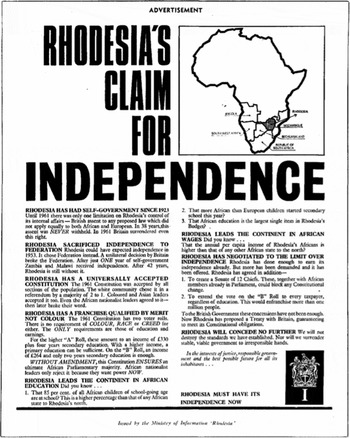
Five years later, Ian Smith's UDI in 1965 rejects British plans for moving towards black majority rule and seeks to establish a white supremacist regime. Thus ‘Rhodesia’ becomes synonymous with ‘white’. It is amply illustrated in the advertisement headed Rhodesia's Claim for Independence, which the Rhodesian Government's Ministry of Information placed in the Daily Mirror on 30 October 1965.Footnote 4
This advertisement (reproduced in figure 1) gives some indication of what the line of the Rhodesian Front government would be after UDI, the threshold of a specifically Rhodesian (rather than a British or colonial) discourse, in which its people are separated by a markedly raced lexicon. The lexicon, which juxtaposes whites (‘European’) and non-whites (‘African’, ‘Coloured’, ‘Asian’), is reflected in the advertisement. Its content insists that independence will be beneficial for all Rhodesians. The manner in which this claim is made is disingenuous, of course, trading on the British reader's ignorance of the place. For example, the claims about ‘African education’ under items 1 and 2 appear to invite the inference that the Rhodesian government makes the education of black children a key priority. Actually, the fact ‘[t]hat more African than European children started secondary school’ in 1965 is not a consequence of more spending or a greater commitment to the education of blacks, but an inevitable consequence of the fact that black children leaving primary school significantly outnumbered whites. The Daily Mirror editorial response to this advertisement published on 3 December 1965 summarises the status of the Rhodesian problem in a forthright manner, noting: ‘Rhodesia is the British Commonwealth's last major squabble about the rights of 220,000 whites and 3,800,000 coloured Africans, and there is no doubt at all about the moral issue’. It then offers an unequivocal condemnation of the motivation for UDI, declaring ‘[t]he racial doctrine of white supremacy practised by Rhodesia's rulers is ugly, wicked and totally indefensible’ (Editorial, Daily Mirror, 3 December 1965).Footnote 5 The language of the editorial's summary reflects the extent to which British attitudes differ from those espoused by the Rhodesians. The editorial pits the term ‘whites’ against a phrase that does not occur in the now highly localised Rhodesian lexicon, namely, ‘coloured Africans’. In the Rhodesian system, terms such as ‘Coloured’, ‘Asian’, ‘African’ and ‘European’ were used as an official means to categorise people because all aspects of their lives were circumscribed by their designated race.Footnote 6 The Daily Mirror’s phrase emphasises the observation that the Rhodesian independence project is designed to keep the whites in power at the same time as continuing to keep all other parts of the population in a position of subjugation. This, of course, was a major challenge to Britain's programme of decolonisation.
Rhodesian Government advertisement in the Daily Mirror, Saturday 30 October 1965. Reproduced by permission of Mirrorpix

Thus by 1965, the meaning of the name ‘African’ in Rhodesian discourse has changed. Specifically, while it retains its vestigial coded meaning (i.e. ‘a native or inhabitant of Africa’), for Rhodesians, it has also acquired a classificatory function to contrast with ‘European’. It is also used metonymically. It refers now, not to all people of Africa, but specifically to the black African people particularly of Rhodesia. Thus African remains a term of description but it acquires uses and forms that primarily convey speaker attitude. The extent to which the term is embedded in local Rhodesian discourse is evidenced in its several diminutive forms, for example, Af and Affie as illustrated in the following example, taken from an interview conducted by David Caute in 1977.
A man who put his house up for sale is in no doubt: ‘The gooks have got it, the whole world is supporting the terrs. I'm taking the gap, though I always thought I'd be one of the last out, you know, putting out the lights and burning it all down as we left. I'm going South. You've got more chance where the ratio is only four to one. I could take out four Affies before they took me out.’ (1977 Umtali) (Caute Reference Caute1983: 165)
The diminutising effect of a speaker's choice of Af or Affie conveys a profoundly paternalistic attitude towards the referent. Not only is Rhodesian discourse explicitly raced, it also represents the black as juvenile and inferior to whites. Writing in 1994, Doris Lessing reflects on her childhood in Rhodesia, noting the extent to which she lived quite separately and ignorantly from the Africans. Writing about living on a farm in the 1930s, she wonders:
Did we talk about the Africans? – the blacks – the ‘munts’ – the ‘kaffirs’? Not much. They were there, taken for granted. No white child learned Shona – considered to be a kaffir language. I don't propose to elaborate on white settler attitudes, there's nothing new to say about them. (Lessing Reference Lessing1994: 113)
She offers three glosses of ‘African’, the latter two being increasingly offensive epithets commonly used in Rhodesian discourse to refer to blacks. The proliferation of terms with different connotations to refer to what Godwin & Hancock (Reference Godwin and Hancock1993) call the ‘allegedly unknowable African mind’ highlights the parallel discourses designed for different audiences in different contexts. Lessing ventriloquises the voice of the white settler in describing Shona as ‘a kaffir language’, thus implicitly inviting the connection by refusing to describe ‘white settler attitudes’ more fully. Lessing's choice of the term ‘white settler’ in this context conveys negative pragmatic force, allowing the inference that the speaker disapproves of the referent.Footnote 7 The highly offensive terms ‘munt’ and ‘kaffir’ persist in the private discourse used among white Rhodesians. This habitual linguistic behaviour is a matter for reflection in Lauren St John's coming-of-age memoir, Rainbow's End, set in the 1970s. The narrator assumes the stance of the teenage girl to report white men's language to refer to ‘the adequacy or inadequacy of the blacks’, and she reflects on the language used in her own family:
No one in our house ever said the word ‘kaffir’ (except in regard to the Kaffir Boom tree); it felt wrong and dangerous and ugly. Mainly we referred to Africans as Africans or ‘boys’ or ‘girls’ or munts, which had an ever-so-slightly disrespectful feel about it but was there in the Fanagalo phrase book in black and white, ‘muntu’, as meaning nothing more sinister than a person or a human being. In which case we were muntus too. (St John Reference St John2007: 38)
The narrator's judgement of the use of munt indicates that its use by whites to refer to blacks was always ‘disrespectful’. Indeed, its definition in ‘the Fanagalo phrasebook’ is no recommendation as a guide for ‘any one [sic] who, when employing or coming into contact with Bantu men or women, finds European languages inadequate to get ideas across’ (Bold Reference Bold1983: 4) to the use of a jargon, also called chiraparapa or typically, ‘kitchen kaffir’ (Ferraz Reference Ferraz1980).Footnote 8 St John lists the dysphemisms that convey the potent force of paternalistic or racist attitudes of the (white) speaker towards his or her (black) interlocutors. The label munt is a shortened and metathesised form of Ndebele umntu (pl. abantu) ‘human being, person’. The coded meaning of this borrowing, adapted into English and used exclusively with negative, pejorative force, is ‘black African (of Rhodesia)’. In the third edition of the OED, munt (s.v. A) is classified as ‘slang’, and defined as follows: ‘Among some white people in South Africa, Zimbabwe, and Zambia, an insulting term for: a black African’.Footnote 9 The OED's illustrative quotation from the Listener magazine attested in 1964 explicitly attributes the use to white Rhodesians in a metalinguistic comment: ‘His friends were muttering . . . about “cheeky munts”, which is the insulting white Rhodesian term for Africans’ (Listener 13 Feb. 1964, 257/1). The term percolated into the discourse of white civilians, adults and children alike, as a slang term to refer to black people. The extract below from Tsitsi Dangarembga's novel, set in the 1960s, echoes the Listener quotation, illustrating the prevalence of the collocation ‘cheeky munt’:
Some [whites] did walk by, but I think they did not speak English; in fact no one spoke at all except for one beefy youth.
‘What's the matter, lady? The munt being cheeky?’. . . . . . . . . . . . . . .
Doris would not keep quiet. ‘The child ought to be in school, learning her tables and keeping out of mischief,’ she railed. ‘Now, don't tell me there aren't any schools, young man, because I know the Governor is doing a lot for the natives in the way of education,’
‘They're kaffirs,’ interjected the youth. ‘They don't want to learn anything. Too much like hard work.’ (Dangarembga Reference Dangarembga1988: 28)
The ‘beefy youth’ exhibits the stereotypical linguistic behaviour of white Rhodesians, offering the pejorative label ‘munt’ before resorting to the extremely derogatory term ‘kaffir’ in response to the use of ‘the natives’, a markedly old-fashioned term, by the elderly white middle class woman. This extract neatly illustrates the co-existence of these terms within the same public discourse though with different patterns of use. In pragmatic terms, by 1965 then, the force of ‘munt’ as an utterance-token by a white person in the Rhodesian context is unambiguously derogatory, insulting and offensive to the referent. The implicature borne by the utterance-type, in other words, on every occasion on which it is produced, is that the referent is the ‘other’; as the referent is not white, he is inferior, and by implication, uncivilised. If ‘munt’ is an offensive, albeit routinised insulting way to refer to black people in Rhodesia, ‘kaffir’ is an extremely abusive term. The OED (s.v. A 2a) identifies the label as ‘a highly offensive term of extreme abuse in Southern African contexts’ since 1940. The use of this utterance-type conveys extreme contempt, fear and loathing of the user for the object or referent of the label. Its choice in discourse immediately and unequivocally identifies the (white) speaker as an extreme racist.Footnote 10
The war between black nationalist guerilla armies and white government forces escalated in the 1970s. Farmers and black civil servants in rural areas were increasingly targeted by the principal guerilla armies while peasants in the Tribal Trust Lands were incarcerated in what the security forces euphemistically labelled ‘protected villages’ for public consumption and ‘keeps’ among themselves (Worby Reference Worby2001: 482). Mtisi et al. (Reference Mtisi, Nyakudya and Barnes2009: 162−5) describe the staggering increase in the financial and human costs of the war between 1978 and the failure of an internal settlement and independence in 1980. At the same time that the physical violence escalated, so too did the verbal violence. In 1970, according to the editor of the Umtali Post (14 October, 1970), the majority of whites had ceased to use words like ‘munt’ and ‘kaffir’ (Godwin & Hancock Reference Godwin and Hancock1993: 48). And St. John's commentary appears to confirm the impression that whites regarded these terms as taboo. However, David Caute's (Reference Caute1983) account of the ‘death of white Rhodesia’ in the second half of the decade suggests that overtly racist language still permeated white discourse. Thus he reports the routine racism of men he comes across (in 1977) like Assistant Superintendent Goddard, who tosses out off-colour stories in the office before asking his interlocutor in the presence of the black clerks: ‘So—do our munts look hungry, like the foreign press alleges?’ (Caute Reference Caute1983: 167). In fact, the Rhodesian uses of munt, Kaffir and African to refer specifically to blacks in Zimbabwe indicate the extent to which these terms had become localised for their speakers, apparently semantically synonymous with ‘black’ (Fitzmaurice Reference Fitzmaurice, Schreier, Trudgill, Schneider and Williams2010: 282). But if whites really did begin to eschew these ostensible synonyms to refer to their black countrymen in public, this avoidance indicates that these terms are highly marked. Specifically, the active choice of such terms leaves the addressee in no doubt about the speaker's attitude towards what he or she is speaking about. They are emblems of racial attitudes. By the end of the 1970s, the lexicon of race was a cornerstone of white Rhodesian discourse, a discourse of superiority which depended upon the process of racialised ‘othering’ in order to construct white identity (Alexander Reference Alexander2004: 195). As Alexander (Reference Alexander2004: 195) notes:
[t]he result was the formation of a white community unified by race. . .whose national identity was founded upon racialism and an idea of the nation that excluded the majority of its inhabitants.
5 We are all Zimbabweans now (1980−2000)
1979 saw the messy transition from war-battered white Rhodesia through an interim government of ‘national unity’ headed by Rhodesian-supported black politicians in an awkwardly named ‘Zimbabwe-Rhodesia’ to the legitimately independent Zimbabwe governed by a black majority. Thus, by independence in 1980, the names ‘Rhodesia’ and ‘Zimbabwe’ commanded very different ideological and racial connotations for its inhabitants. ‘Rhodesia’ is an anachronism; it is a temporary historical name for a colonial territory first demarcated by Rhodes’ British South Africa Company and then defined by the white settler colonial state. It is also an imaginary space occupied by the descendants of white settlers who laid claim to a particular version of the nation space (as captured in the Facebook post in the introduction to this article). In contrast, the historical name ‘Zimbabwe’ is appropriated in the African nationalist reinterpretation of the settler territory in terms of the international system of nation-states on the one hand and an attempt to put aside deep ethnic, regional and tribal identities to assume a homogeneous postcolonial identity on the other.Footnote 11
In his election victory speech on 4 March 1980, Prime Minister-elect Robert Mugabe sought to forge a spirit of reconciliation in order to create a ‘new amity’ among all the territory's people, ‘as Zimbabweans’. He appealed to whites as well as blacks in the pledge to ‘reconstruct and rehabilitate’ this society:
Surely this is now the time to beat our swords into ploughshares so we can attend to the problems of developing our economy and our society. . .I urge you, whether you are black or white, to join me in a new pledge to forget our grim past, forgive others and forget, join hands in a new amity, and together as Zimbabweans, trample upon racialism, tribalism and regionalism, and work hard to reconstruct and rehabilitate our society as we reinvigorate our economic machinery. . . Let us deepen our sense of belonging and engender a common interest that knows no race, colour or creed. Let us truly become Zimbabweans with a single loyalty. (Robert Mugabe, 4 March 1980) Footnote 12
Mugabe's reconciliation speech invited blacks and whites to engage in the reconstruction and rehabilitation of a country ravaged by war, economic crisis, and deep social divisions. The key terms that Mugabe uses to identify the causes of division among Zimbabweans are ‘racialism’, ‘tribalism’ and ‘regionalism’. Racialism is at the heart of the separation and separateness of people according to their race and the consequent profound ignorance that shaped colonial and post-UDI Rhodesian politics and the war. But Mugabe was not speaking to whites alone. Tribalism—in today's terminology, ethnicity—refers to the historical tensions between Shona and Ndebele, symbolised in the conflict between the Shona dominated ZANU(PF) and Ndebele dominated ZAPU. Regionalism proved critical in the emergence of the de facto one-party state in the years after 1980; Mtisi et al. (Reference Mtisi, Nyakudya and Barnes2009: 166) report that in Zimbabwe's first election, ‘[a]ll but one of PF-ZAPU's seats were won in Matabeleland, while ZANU(PF) won all its seats in Mashonaland—boding ill for the post-independence period’.Footnote 13
But in his first parliamentary address delivered in April, 1980, Mugabe urged people to change themselves in order to tackle the challenges that lay ahead. This was nothing less than a call for personal reconstruction:
Tomorrow we shall cease to be men and women of the past and become men and women of the future. It's tomorrow then, not yesterday, which bears our destiny. As we become a new people we are called to be constructive, progressive and forever forward looking, for we cannot afford to be men of yesterday, backward-looking, retrogressive and destructive. Our new nation requires of every one of us to be a new man, with a new mind, a new heart and a new spirit. Our new mind must have a new vision and our new hearts a new love that spurns hate, and a new spirit that must unite and not divide.Footnote 14
In the fiction and memoirs published since 1980, this speech has figured as prominently as the Rhodesian anthems did for the accounts of the demise of White Rhodesia (Fitzmaurice Reference Fitzmaurice, Kytö, Taavitsainen, Smith and Claridge2014). Accordingly, Douglas Rogers reports the reaction of his parents to this momentous speech (2009: 58):
They sat down to watch [Mugabe's television speech], terrified of what he was going to say about us whites; they listened with a growing sense of astonishment.
‘If yesterday I fought you as an enemy, today you have become a friend and an ally,’ Mugabe said at one point. ‘If yesterday you hated me, today you cannot avoid the love that binds you to me and me to you. Is it not folly, therefore, that in these circumstances anybody should seek to revive the wounds and grievances of the past? The wrongs of the past must now stand forgiven and forgotten.’
My parents looked at each other.
‘He speaks rather well,’ said Mom . . .
Weeks passed, then months. We waited for the backlash. Nothing happened. My parents shrugged and decided to stay.
‘We're Zimbabweans now, better get used to it,’ they finally told my sisters and
me, and they meant it. (Rogers Reference Rogers2009: 58−9)
Thus as Zimbabwe emerged, so its white citizens crossed a major discursive threshold. The advent of a new political order seemed to change the public discourse. Rogers's parents, by identifying themselves as ‘Zimbabweans’, declare their intention to remain and participate in the reconciliation offered by Mugabe under the new dispensation. Those whites who would remain ‘Rhodesians’ departed for South Africa and Britain in their thousands (Simon Reference Simon1988). They identified themselves as ‘Rhodesians’, referring to themselves among themselves colloquially as ‘Rhodies’ and as ‘ex-Rhodesians’ when talking to outsiders (Fitzmaurice Reference Fitzmaurice, Kytö, Taavitsainen, Smith and Claridge2014).
The whites who stayed adjusted their public discourse to fit the post-independent setting. Pilossof (Reference Pilossof2012a) illustrates how white farmers represented by the influential Commercial Farmers' Union (CFU) signalled their ostensible willingness to cooperate with the new government. For example, Piers Nicolle, a farmer from Lomagundi, joined the ruling party, ZANU(PF). Peter Godwin interviewed him in 1986, and reports his self-identification:
Whatever his eccentricities, Nicolle seemed to belong in Africa. ‘I'm not a European. When the census official came around we crossed out the word ‘European’ and wrote ‘African’. The official said: ‘Hey, you can't do that, you're white.’ But we soon told him where to go.Footnote 15
It is notable that this story suggests that the census used anachronistic language for the classification of race, namely, ‘European’, and, implicitly, ‘African’, instead of ‘white’ and ‘black’. The veracity of the anecdote, though, is less important than its symbolism. Nicolle conveys his decision to remain in Zimbabwe, in Africa. This anecdote signals the self-conscious appropriation by whites of a term hitherto limited to the classification of black Zimbabweans. This self-identifying act marks the investment of positive force in a term that whites had used in order to other blacks.
At the same time, a massive shift of official nomenclature papered over the deep historical legacy of race in the geopolitical demarcation of the land. The ‘Tribal Trustlands’, the erstwhile ‘Native Reserves’, disappeared to be replaced by ‘Communal Areas’; the ‘African Purchase Areas’, specially designated lands adjacent to the reserves intended for blacks who wished to own land, were reclassified as ‘Small-Scale Commercial Farms’ (SSCF). The largest sector of land use in the country, historically white-owned commercial agricultural areas occupying one-third of the total arable land, was labelled ‘Large-Scale Commercial Farms’ (LSCF). These continued largely to be owned by whites or by companies controlled by whites (Worby Reference Worby2001: 484).
When land and land organisation were subject to reclassification and new names, Zimbabwe's cities and towns also received new names; for example, Salisbury became Harare, Hartley became Chegutu and Fort Victoria became Mazvingo. Other African place names adapted for English pronunciations in colonial times were adapted afresh; for example, Gwelo became Gweru; Shabani became Zvishavane and Selukwe became Shurugwi. However, the official renaming of places and people in independent Zimbabwe did not mean that all old Rhodesian locutions disappeared. Instead, they went underground, to be used in private, in small enclaves of ‘Rhodies’ in South Africa or Britain, but also in Zimbabwe. Rory Pilossof (Reference Pilossof2012a: 119) argues that independence then was ‘a silencing threshold that seeks to ‘leave the past behind’’.
Changes in official nomenclature were not accompanied by radical political or economic change or in the redistribution of the land in the first decade after independence. The persistence of the status quo suggested that whites believed themselves to be entitled to what Mandaza (Reference Mandaza1986: 3) observed was true for the first decade, namely:
a post-white settler situation in which the former white settlers [found] themselves with such political and economic guarantees as would be the envy of any former colonisers in the decolonisation process.
Independence in 1980 saw the emergence of what appeared to be a unified public discourse marked by a political effort to engage all Zimbabweans in nation-building, in personal reconstruction and in reconciliation. In the public sphere, the term ‘Rhodesian’ was used solely to refer to those whites who declared themselves to be unreconstructed. However, beneath the surface, the private discourses that had endured through the war along racial and political lines persisted.
6 Zimbabweans vs white Africans
The Government held a constitutional referendum in 2000 which was designed to expand the power of the state and that of the president. Key items included citizenship, land distribution, the representation of whites in parliament and an executive rather than a ceremonial presidency. When the government's proposals were defeated, it became evident that the new opposition Movement for Democratic Change (MDC) posed a significant electoral challenge to ZANU(PF). The ZANU(PF) government's rhetorical response was to revise the nationalist narrative, according a central role to the land, so that:
[war] veterans were cast as the heroic liberators of the land from whites seen as unreconstructed racists and a former colonial power which was, twenty years after independence, portrayed more fervently than ever as the obstacle to ‘real’ decolonisation. (Alexander Reference Alexander2006: 185)
The immediate political consequence was a crackdown on the MDC and other opposition groups in the urban areas (Pilossof Reference Pilossof2012a: 43). In the rural areas, war veterans led the occupation (or invasion) of large commercial farms, thus inaugurating the radical resettlement of the land. Chaumba et al. (Reference Chaumba, Scoones and Wolmer2003), Hammar et al. (Reference Hammar, Raftopoulos and Jensen2003), Sachikonye (Reference Sachikonye2004), Alexander (Reference Alexander2006) and Pilossof (Reference Pilossof2012a) among many other historians, ethnographers and social scientists, have documented in detail the events from February 2000 through to the end of 2003 which began with farm occupations and then were regulated as the fast-track land reform programme (FTLRP). Of interest to me is the impact that these events had on the discourses employed by the participants at the time and since. There is no doubt that these events marked a discursive threshold which undermined and overturned what Auret (Reference Auret1992) had considered to be the ‘miracle’ of reconciliation among blacks and whites since 1980.
The farm occupations of 2000 came to be labelled ‘the time of Jambanja’ (Chaumba et al. Reference Chaumba, Scoones and Wolmer2003: 539). ‘Jambanja’ comes from the title of a pop song (Jambanja Pahotera) about a fight between two pairs of cheating lovers. Apparently meaning ‘violence’ or angry argument’, the word was applied in different contexts, to refer to ‘the ex-combatant farm invaders themselves, the farm invasions and more broadly politically instigated violence’ (Chaumba et al. Reference Chaumba, Scoones and Wolmer2003: 540). The use of the word evokes violent confrontation and connotes disorder and lawlessness. Chaumba et al. (Reference Chaumba, Scoones and Wolmer2003: 540) report that veterans adopted it as part of a catch-phrase: jambanja ndizvo (‘violence is the answer’). Its introduction into public discourse was discussed in the media. The Daily News’s Tagwirei Bango commented:
For new words to get accepted into a language, they must reflect the mood of the time, fill in a vacuum in the standard lexicon and be accepted as an appropriate form of expression. Thus, the word jambanja which became part of our vocabulary in the past two years, helped people to accept their confusion with an executive order directing the police to ignore crimes classified as political. Jambanja means state-sponsored lawlessness. The police are not expected to intervene or arrest anyone in a jambanja scene because those taking part will have prior state blessing and approval. But, only one interest group, war veterans and ZANU(PF) supporters, is allowed to engage in a jambanja. (Daily News, 27 November 2001, quoted by Chaumba et al. Reference Chaumba, Scoones and Wolmer2003: 540)
The language surrounding these events is charged with tension and serves to highlight the central position of the land. The lexicon includes a number of terms that denote the agents and acts of taking possession of the land: ‘squatters’, ‘settlers’, ‘resettling’, ‘settlement’; ‘occupation’, ‘invaders’, ‘invasion’. Worby (Reference Worby2001) reflects on the diversity of the ‘morally laden lexicon’ that different participants have used, noting that: ‘“invasion” bears a heavy, if ambiguous moral load’ as both invaders and invaded ‘have found sufficient righteousness in its implications for the term to remain remarkably uncontroversial’ (Worby Reference Worby2001: fn. 1). The same observation applies to the term ‘settler’. In colonial times, when modified by ‘white’, ‘settler’ bore opprobrious connotations of colonialist seizing and settling on land, dispossessing its rightful owners. In 2000, the invasions engineered the FTLRP which placed ‘fast track settlers’ onto designated land.
In other words, this lexicon is claimed both by the people whose farms were occupied and by the people occupying the land. Pilossof (Reference Pilossof2012a: 119) argues that these events ‘reinvigorated much of the language and discourse of the Liberation War and offered the opportunity for these discourses to re-emerge and become potent once more’. This was as true for ZANU(PF) as it was for the affected farming communities. Alexander (Reference Alexander2006: 185) notes that ‘Mugabe donned combat fatigues and spoke of enemies and war, veterans occupied farms and revived the liberation war-era meetings called pungwes; while farmers reverted to their agric-alert security systems and were once again killed on their land’. Pilossof (Reference Pilossof2012a: 45) further observes that ‘as the communication networks of the war were reinvigorated, so too was the language associated with it: “terrs”, “gooks” and mujibas became colloquial terms for describing the land occupiers in farming circles’. These observations suggest that the inflammatory language reported in the memoirs of the 1970s did not disappear; it lurked just beneath the surface, to be revived in white public discourse after 2000.
Land and the rights to its possession were at the centre of nationalist politics at the start of the new millennium, and intimately implicated in the question of legitimate rights to the land was the matter of citizenship. James Muzondidya (Reference Muzondidya2004: 225) has explored how, after 2000, in a revised historical narrative of nation, ‘only “native Africans” or vanavevhu/abantwana bombhlabathi (‘children of the soil’)’ are projected ‘not only as the original and true inhabitants of Zimbabwe but also as having pre-eminent rights over the country's land and other resources’. The implication of this narrative is that all other Zimbabweans are foreigners. Governmental control of the electronic media ensured that its essentialist narrative saturated the public sphere. Raftopoulos (Reference Raftopoulos2004: 162) quotes Gandhi & Jambaya's (Reference Gandhi and Jambaya2002) report on the Zimbabwe Broadcasting Corporation's simplistic conceptualisation of ‘nation’ based on race: ‘The Black nation was called Africa. Whites were presented as Europeans who could only belong to Europe just as Africa was for Africans and Zimbabwe for Zimbabweans’ (Gandhi & Jambaya Reference Gandhi and Jambaya2002: 4). Muzondidya (Reference Muzondidya2004: 225) argues that:
the category ‘African’ or ‘Zimbabwean’ in postcolonial Zimbabwe . . . has been essentialised and viewed as an attribute of race and skin colour rather than history and encounters.
In response to the new construction after 2000 of the Zimbabwean as the black Zimbabwean alone, ethnic minorities including whites, Zimbabwean Asians and Coloureds began to appropriate the term ‘African’ as a means of self-identification in public discourse as well as in private.Footnote 16 This discursive move was most apparent in the language of white farmers, who sought to assert legitimate ownership of land and legitimate belonging to the country. It finds expression in farmer memoirs that make the land reform programme central to their narratives. Douglas Rogers's Reference Rogers2009 memoir tells the story of his parents’ transformation, first from Rhodesians to Zimbabweans (see section 5 above), and then from Zimbabweans to Africans as they battle the invasions of their farm and resist resettlement. In the excerpt below, Rogers dramatises the process of naming that his father uses to assert his identity, and more importantly, his perception of his rights in response to a television broadcast of Mugabe speaking in 2002, telling white farmers to ‘go back to Britain, go back to Blair’:
‘Go back to Britain? I am not British! My people have been on this continent for three hundred and fifty years! I never set foot out of Africa until I was fifty years old. My own mother never left it once. My father only left twice – to fight fascists in Europe. Go back to Britain? My grandfather fought against the British in the fucking Boer War, for Christ's sake.’ . . . here was my father having to defend his right to be Zimbabwean – to be an African. (Rogers Reference Rogers2009: 54)
The plight of white farmers in the time of Jambanja received widespread international media attention. For example, Andrew Thompson and Lucy Bailey directed a documentary film, Mugabe and the White African (2009), about the battle of two white farmers, Mike Campbell and Ben Freeth, to take a landmark case against the Zimbabwe government to the Southern African Development Community (SADC) Tribunal. The basis of Campbell's claim to a legitimate right to the land is that he did not inherit it but that he purchased it in 1974, in the middle of the war years, a fact that raises the question of the status of land ownership prior to independence. The significance of Campbell's claim is that he both denies and rejects the assertion that he is a descendant of white settlers who seized the land from blacks in the early twentieth century, forcibly displacing the original inhabitants. The documentary concludes that this was the first time that an ‘African citizen has had their rights upheld through an International Court’. The case rests upon definitions of national identity. In the film, Freeth says:
[i]t is possible to be a white man and an American. It is possible to be a white man and an Australian. But is it possible to be a white man and an African? If you talk to Mugabe, the answer is no. (www.mugabeandthewhiteafrican.com)Footnote 17
Freeth's sentiment responds directly to Mugabe's legislation of Zimbabwean citizenship but it also obscures the historical complexity that attends the construction of white identity in Zimbabwe (see Alexander Reference Alexander2004). The challenge for the white farmers whose commercial farms were targeted by the Zimbabwe government for large-scale resettlement without compensation was to show how they could claim legitimacy of occupancy. This task entailed removing themselves from the stigma of being the descendants of white settlers, and therefore unlawful occupiers of the land. It involves the rhetorical move of casting themselves as Zimbabweans who expressed their commitment to the new, non-racial state and their deference to the majority by purchasing land in a symbolic act of belonging. This kind of move is designed to silence the accusations firstly, that they came by their land by privilege (for instance, through inheritance) and secondly, that they have alternative loyalties, namely, to Britain.
Alexandra Fuller's (Reference Fuller2001) memoir of her childhood in Rhodesia fleetingly gestures to the complexity of race, ethnicity, history and identity. In this extract, she reflects on history:
The Africans did not forget their heroes from this first struggle for independence.
Kaguvi. Also called Murenga, or Resister. From which the word Chimurenga comes.
Mkwati, famous for his use of locust medicine.
Nehanda, the woman, supra-clan mhondoro spirits, She went to her execution on April 27, 1897, singing and dancing. ‘We shall overcome, My blood is not shed in vain.’
Now, how can we, who shed our ancestry the way a snake sheds skin in winter, hope to win against this history? We wazungus. We white Africans of shrugged-off English, Scottish, Dutch origin. (Fuller Reference Fuller2001: 29)
At the same time as acknowledging displacement and non-belonging as wandering whites in the face of a rooted history and embeddedness in the land, Fuller's childhood memoir nevertheless establishes Zimbabwe as home. This statement is emblematic of the sense with which Rhodesian whites felt that they could ‘take the gap’, that is to say, leave the country to settle elsewhere in Africa (e.g. South Africa) or emigrate or return to Britain after independence. It is this attitude too that arguably informed Mugabe's statement in the state newspapers, the Bulawayo Chronicle and the Herald (5 September 2002) that white commercial farmers:
belong to Britain and let them go there. If they want to live here we will say ‘stay’, but your place is in prison and nowhere else. Otherwise your home is outside the country. (Harris Reference Harris2005: 105)
Alexander (Reference Alexander2004: 200) argues that:
[t]he paradox of the ‘white African’ in Zimbabwe, and his or her attendant sense of alienation, stems from the majority of whites having acted and imagined themselves out of a place in the nation of Zimbabwe.
7 Conclusion
What does the notion of the ‘white African’ mean in the context of Zimbabwe? After 1980, whites remaining in Zimbabwe identify (contingently) as white Zimbabweans (Fitzmaurice Reference Fitzmaurice, Kytö, Taavitsainen, Smith and Claridge2014). The self-identification by white Zimbabweans as ‘white Africans’ after 2000 signifies their rejection of any association with or claim to European or, more precisely, British identity. However, this defensive claim to be African responds to the state's emphatic rejection of the claims of whites to the status of Zimbabweans and in the process tacitly acknowledges their resulting alien status. This complex and paradoxical sentiment is expressed in response to a question posted by the Al-Jazeera blogger, Haru Mutasa, in 2010, about the notion of a white African:
The debate can go on until the end of time, but white Africans exist. Prior to 1980 it was unlikely you'd find a white in Zimbabwe who would use the term ‘African’ in reference to themselves, but those who stayed under a black government generally accepted that the time to assert being ‘European’ was passed. My homeland will always be Zimbabwe, and I[’m] a Zimbabwean and an African, even if Mugabe ensures I never set foot on the soil there again. (Warren)Footnote 18
‘Warren’ identifies the discursive threshold represented by Independence in 1980 in changing the language of whites. His post implies that until then, whites used ‘African’ as a means of labelling others, namely blacks. He asserts that whites who remained eschewed the label ‘European’ in order to lay legitimate claim to citizenship of Zimbabwe alone. However, paradoxically, his language suggests that despite claiming Zimbabwe as his ‘homeland’ and his identity as ‘Zimbabwean’ and ‘African’, he makes that claim from somewhere else.
In the highly charged colonial and postcolonial environment, semantic-pragmatic change generates polysemous expressions that can be disambiguated and made meaningful only by matching speakers, topic, ideology and context. The history of colonial Zimbabwe illustrates the extent to which multiple discourses co-exist in speakers’ repertoires and the manner in which they are conditioned by the relationships and identity of their interlocutors. More importantly, the notion of the discursive threshold is a signal herald of new public discourses from selected elements of existing discourses in the construction of national identities in a changing political-historical context.
The semantic and pragmatic relationships among terms like ‘Rhodesian’, ‘Zimbabwean’ and ‘African’ and their referents in public and in private discourse change over time. This relationship is highly unstable and contingent upon the status and identity of their users, the context of utterance and the temporal context. In the period up to 1980, the label ‘Rhodesian’ is used by Rhodesian whites as an emblem of identity. Alexander (Reference Alexander2004: 210) would agree that this value derives from ‘the combined heritage of racial identity construction and racial social organisation’. However positive this label is when used reflexively, when used of these referents by others, ‘Rhodesian’ conveys opprobrium. After 1980, the use of ‘Rhodesian’ uniformly connotes the racist, anachronistic and unreconstructed views of whites unable to countenance change. It is striking that although international observers utilise the phrase ‘white settler’ to refer to the Rhodesian state and to its white denizens as illegitimate occupants of the land, the term is never used by Rhodesians about themselves. Throughout the colonial period, however, because settlement of the land was a key mechanism for building white immigration, the notion of settlement was crucial. The absence of the phrase from the discourse of Rhodesians about themselves may be accounted for by their resistance to decolonisation as symbolised in UDI and implicitly by their rejection of the view that their occupancy of the land was never legitimate. In consequence, it is striking that the term ‘settler’ is appropriated to refer to those moved onto the land during the FTLRP after 2000. As Pilossof (Reference Pilossof2012a: 45) notes, ‘“settler” is a highly charged word in Zimbabwe because of its colonial legacies’, and so ‘[i]ts use by ZANU(PF) and the war veterans undermined the white farmers’ claims to a settler heritage and past’.
What are the consequences of the ‘raced national biography’ that established Rhodesia for white national identity in postcolonial Zimbabwe? Independence renders the label ‘Rhodesian’ anachronistic and irrelevant. After 1980, we encounter the replacement of the term ‘Rhodesian’ with the phrase ‘(white) Zimbabwean’, and then, after 2000 and the time of ‘Jambanja’, the term ‘white African’ emerges as a common means of self-identification by whites. Over the same extended period, the raced lexicon in white discourse has expanded to distinguish subjects from citizens as the other. White speakers generate multiple connotations for racial descriptors such as ‘African’, ‘black’, ‘munt’ and ‘kaffir’, in order to ‘other’ blacks and to deny them the status of citizens.
In the case of the settlement of white Rhodesia and in the case of the FTLRP in the new millennium, we see the powerful influence exerted by people's claims to belong to the land, where ‘the land’ is more a product of their ideology and desire than of law. Worby (Reference Worby2001: 488) argues that in the land reform ‘problematic’:
the nation-space is portrayed as an organically and functionally integrated whole in which citizens of different juridically recognised types – ‘white’, ‘black’, ‘commercial farmer’, ‘communal farmer’ – are held to have, on one hand, a set of natural dispositions, capacities and potentialities and, on the other hand, a set of moral entitlements and obligations.
This discursive construction of the matter fails to recognise the fact that these types and their attributes are neither stable nor static. In the case of language, we have seen that the meanings associated with the components that make up discourse depend crucially upon the momentary stance – ideological, historical and personal – of its speakers. If words shape the construction of identity in postcolonial Zimbabwe for speakers in a contingent fashion, then it is important to attend to what lies behind the labels ‘Rhodie’, ‘African’, ‘settler’ and ‘Zimbabwean’.
Appendix
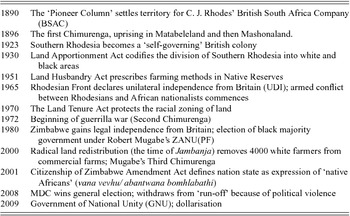
Table A1 offers a summary history of colonial Zimbabwe, covering the last 120 years, during which the territory's government as well as its name has changed multiple times.
Summary history of the unsettled land