The Infectious Disease Society of America supports the development of telehealth programs for antimicrobial stewardship.Reference Siddiqui, Herchline and Kahlon1 Described in a small and growing body of literature, these programs employ 2 complementary approaches, tele-stewardship and tele-consultation, which may overlap. With tele-stewardship, specialists offer recommendations primarily related to treatment considerations, sometimes without an explicit invitation from the clinical provider. With tele-consultation, providers request assistance with clinical cases with uncertain diagnoses.
The Veterans Health Administration (VHA) supports telehealth in the form of electronic consultations (e-consults) and Specialty Care Access Network-Extension for Community Healthcare Outcomes (SCAN-ECHO), which uses secure videoconference technology to build teams with members in geographically distinct locations.Reference Strymish, Gupte and Afable2Reference Beste, Glorioso and Ho3 Previously, we described a pilot program that used telehealth to support antibiotic stewardship efforts at 2 rural Veterans Affairs medical centers (VAMCs).Reference Stevenson, Banks and Stryczek4 The pilot program leveraged SCAN-ECHO infrastructure and equipment to connect pharmacists, infection preventionists, staff nurses, and other clinicians at a rural VAMC with infectious disease physicians at a geographically distant VA to form a videoconference antimicrobial stewardship team (VAST) that combined tele-consultation and tele-stewardship approaches. Here, we describe changes in antibiotic use on the acute and long-term care units at the intervention sites following implementation of the VAST.
Methods
Intervention
Briefly, we conducted a 1-year prospective quasi-experimental study in parallel at 2 rural VAMCs without a full-time local infectious disease–trained professional on staff. The sites were selected based on regional proximity and a pre-existing relationship with the infectious disease physicians (R.J. and C.C.). A multidisciplinary team from each intervention site paired with an off-site infectious disease physician from another VAMC for weekly 1-hour telehealth sessions to discuss concerns related to infections and antimicrobial use among patients at the intervention site.Reference Stevenson, Banks and Stryczek4 For site A (27 acute-care beds with limited capacity for ventilated patients; 162 long-term care beds), the VAST formed in August 2016. For site B (10 acute-care beds with no capacity for ventilated patient; 180 long-term care beds), the VAST formed in October 2016.
Using the VA Corporate Data Warehouse through the VA Informatics and Computing Infrastructure, we analyzed inpatient drug administration and ward census data from the intervention sites. We obtained doses of systemic antibiotics administered to all patients on the acute and long-term care units, beginning with a preintervention period for 12 months before the first VAST session at each site. The first month of the VAST served as a wash-in period, with the subsequent 12 months serving as the postintervention period. We excluded topical, ophthalmic, and otic antibiotics as well as rifaximin, which is typically used as a long-term agent to reduce hepatic encephalopathy for people with liver disease.
Outcomes
The primary outcome was the use of antibiotics in the acute and long-term care settings at both intervention sites, measured as days of therapy per 1,000 days of care (DOT/1,000 DOC). Secondary outcomes included the mean antibiotic spectrum index (ASI) and the mean length of therapy.Reference Gerber, Hersh, Kronman, Newland, Ross and Metjian5 To determine the mean ASI score for each setting per day, we divided the sum of the ASI for all patients on antibiotics by the number of patients receiving antibiotics on that day. The daily mean ASI was then used to determine the mean ASI for each setting per month. Mean length of therapy was calculated by dividing the sum of the number of days of therapy included in a course of antibiotics by the number of courses started that month.
Additional secondary outcomes were days of therapy for antibiotic classes (detailed in Supplemental Table 1 online). To account for administration of >1 antibiotic agent per day, we measured days of antibiotic exposure. Individuals who received 2 different antibiotics on the same day were recorded as having 1 day of antibiotic exposure. The ratio of days of therapy to days of antibiotic exposure indicates the average number of antibiotic agents given to people on antibiotics per day. We also assessed the mean length of stay and rate of in-hospital mortality in the acute and long-term care settings at both intervention sites.
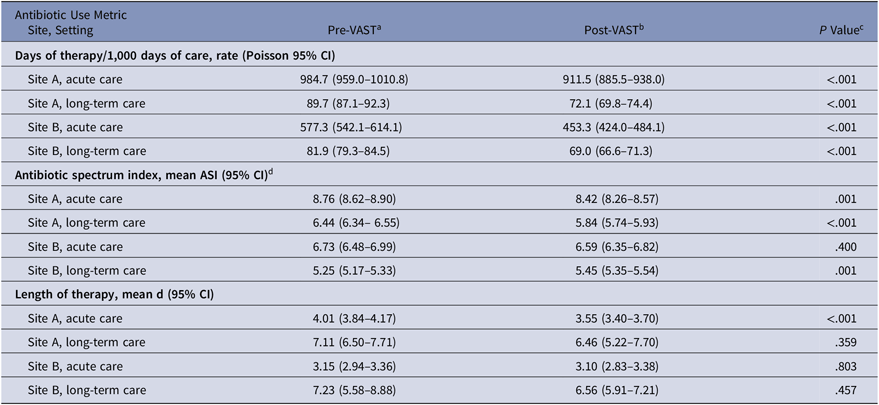
Antibiotic Use Metrics Before and After Implementing the Videoconference Antimicrobial Stewardship Team (VAST)

Note. CI, confidence interval.
a Pre-VAST for site A, August 2015–July 2016; for site B, October 2015–September 2016
b Post-VAST for site A, September 2016–August 2017; for site B, November 2016–October 2017
c P values represent comparisons to the pre-VAST period, with P < .05 as statistically significant.
d The spectrum of antibiotics was based on the types of organisms affected by the agent. Ranges were from 1 to 13 in whole-number increments, with larger numbers indicating broader-spectrum agents.
Analysis
To compare overall antibiotic days of therapy and agent days of therapy for specific classes before and after the intervention, we calculated the rate ratios of the post-VAST period to the pre-VAST period and their 95% confidence intervals. To compare the mean ASI and the mean length of therapy in the pre- and post-implementation periods, we used the Student t test, and we calculated 95% confidence intervals for the pre- and post-VAST means. For individual antibiotic classes, we limited our comparisons to the 5 antibiotic classes with the highest rates of use for the individual settings at sites A and B and applied a Bonferroni’s correction.
Additionally, we calculated the rates of antibiotic days of therapy, mean ASI, and mean length of therapy at monthly intervals, and we used segmented regression with a change in slope allowed at the intervention wash-in month. We plotted the fitted lines and confidence intervals from these regression models to illustrate the changes in antibiotic prescribing over time. All statistical analyses were performed using R version 3.4 software.6 Functions from the epitools and splines packages were used for estimation of rate ratios and segmented regression models, respectively.
Results
Comparing the acute and long-term units at both intervention sites, the days of therapy, measured as DOT/1,000 DOC, and ASI were greater in acute care (Table 1). In contrast, the length of antibiotic therapy was longer in the long-term care units, consistent with an overall longer length of stay in those settings. In the year following the VAST implementation, the days of therapy decreased significantly (P < .001) in the acute and long-term care units at both intervention sites. The largest change occurred in the acute care units at site B, with a rate ratio of 0.79 for the post- to pre-VAST interval. At site A, the mean ASI decreased significantly in the acute (8.76 vs 8.42; P < .001) and long-term care units (6.44 vs 5.84; P < .001). At site B, however, the ASI was unchanged for acute care (6.73 vs 6.59; P = .40) and increased slightly for long-term care (5.25 vs 5.45; P < .001). Regarding length of therapy, the only statistically significant change in the pre- versus post-VAST period was for the acute-care units at site A (4.01 vs 3.55; P < .001).
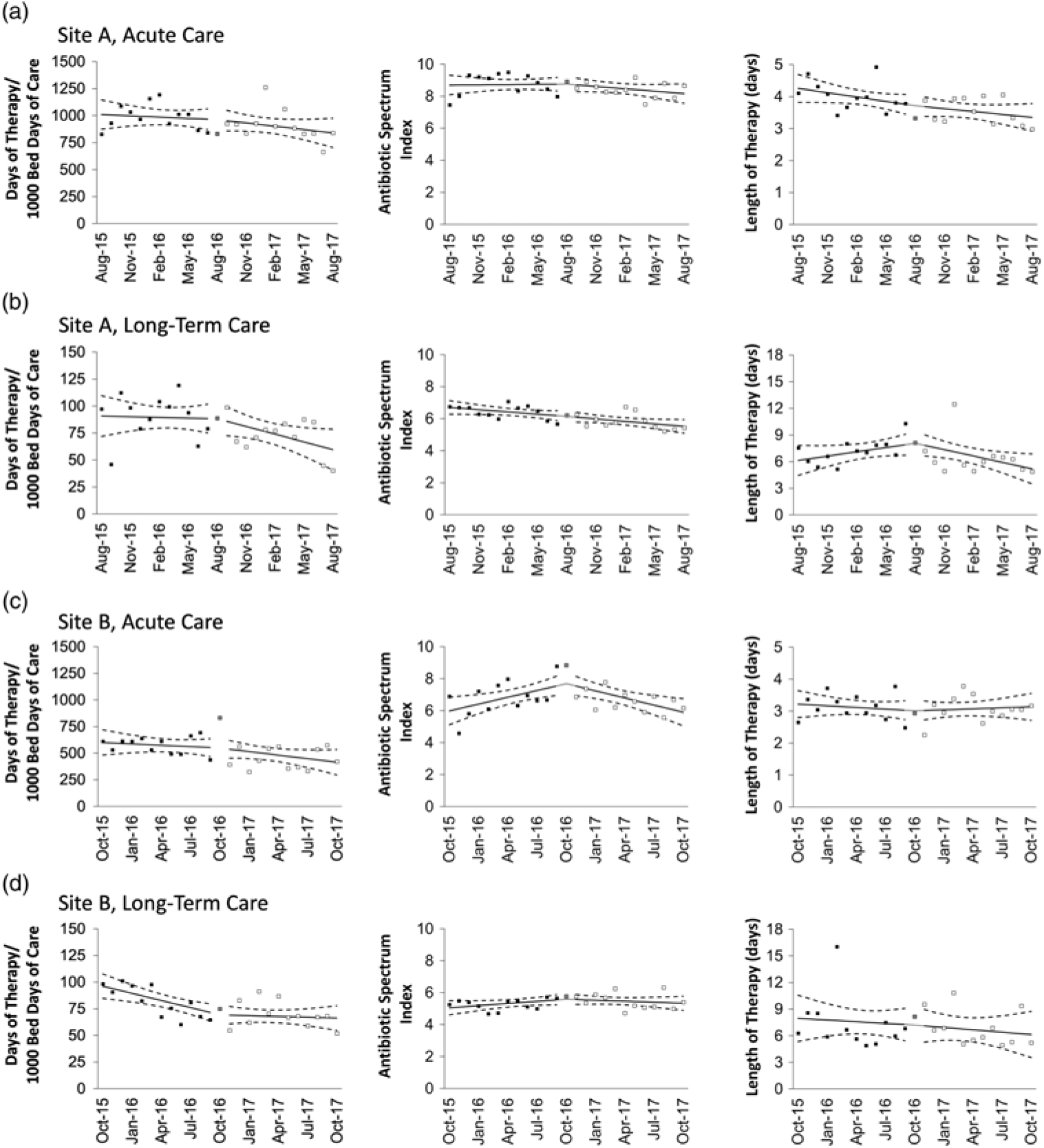
To more fully assess the influence of the VAST, we also examined changes in the days of therapy, ASI, and length of therapy over time (Fig. 1). In general, these data reiterate the findings for comparing the means in the pre-VAST and post-VAST intervals, showing a lower rate of antibiotic therapy across all 4 settings and a lower ASI for the acute and long-term care units at site A. Notably, for the long-term units at site B, while the mean ASI increased, assessment of the ASI at monthly intervals reveals a reversal from an upward to a downward trend in the pre-VAST and post-VAST intervals. The length of therapy for the long-term care unit at site A showed a similar change, demonstrating an influence of the VAST that was not revealed by comparison of the means alone.
Changes in antibiotic use before (black squares) and after (white squares) implementing the videoconference antimicrobial stewardship team (VAST). Solid lines represented the predicted value with the dashed lines indicating the upper and lower confidence intervals. The grey square and line segment represent a 1-month wash-in period for the initiation of the VAST in August 2016 and October 2016 for sites A and B, respectively. The columns from left to right are days of therapy per 1,000 bed days of care, the mean antibiotic spectrum index (ASI), and the mean length of therapy in days.

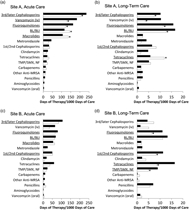
Figure 2 shows the days of therapy for classes of antibiotics, comparing the pre- and post-VAST periods; Supplemental Table 2 (online) details the means and rate ratios. At site A, the use of fluoroquinolones decreased significantly in the acute and long-term care units. The long-term care units at site A also showed a significant decrease in the use of extended-spectrum cephalosporins and BL/BLIs along with a corresponding increase in tetracyclines. For the acute-care units at site B, among the antibiotics with the highest rate of use, none showed a significant decrease following the VAST. In the long-term care units at site B, the use of fluoroquinolones, first- or second-generation cephalosporins, tetracyclines, and urinary anti-infectives all decreased significantly following VAST implementation.
Changes in rates of days of therapy by antibiotic classes in the year before (black bars) and the year after (white bars) implementing the videoconference antimicrobial stewardship team (VAST). Underscores on the y-axes indicate the 5 antibiotic classes with the highest rates of use in each setting; significant changes are noted for those classes with * for P < 0.0025 (after applying a Bonferroni’s correction for n = 20 tests). The individual agents that comprise the antibiotic classes are included in Supplementary Table S2 online. Note. TMP/SMX, trimethoprim/sulfamethoxazole; NF, nitrofurantoin; MRSA, methicillin-resistant Staphylococcus aureus.

For each of the 4 settings evaluated, we determined the ratio of days of therapy to days of antibiotic exposure. At site A, the pre-VAST ratio was 1.56 for acute care and 1.17 for long-term care; at site B, the pre-VAST ratio was 1.29 for acute care and 1.07 for long-term care. These ratios, which differed little in the pre-VAST and post-VAST periods (Supplemental Table 3 online), were consistent with the greater number of agents administered in acute-care settings and with general pattern of antibiotic choices indicated by the ASI scores for each setting. Finally, the mean length of stay and the in-hospital mortality did not differ between the pre-VAST and post-VAST periods for any of the 4 settings (Supplemental Table 4 online).
Discussion
This pilot study demonstrated the feasibility of implementing tele-stewardship within the VHA, which was supported by the SCAN-ECHO model and infrastructure. Overall antibiotic use at 2 rural VAMCs decreased following the introduction of a tele-health antibiotic stewardship program. With the exception of the length of therapy for acute care at site B, the VAST sustained or augmented downward trends in the days of therapy, the spectrum of agents and the length of therapy for acute and long-term care at both intervention sites. Our findings expand previous work in tele-stewardship by promoting antibiotic stewardship simultaneously in acute and long-term care settings.
Several previous reports describe using tele-health to support antibiotic stewardship activities. Three publications have described successful tele-stewardship programs in which specialists reviewed antibiotic prescriptions and communicated recommendations via secure websites, secure messaging systems, or the electronic medical record.Reference Beaulac, Corcione, Epstein, Davidson and Doron7–Reference Wood, Nicolsen, Allen and Cook9 Moreover, 4 reports have described tele-consultation interventions that used secure videoconference technology to bring individuals from remote locations together for regularly scheduled, multidisciplinary team meetings.Reference Yam, Fales, Jemison, Gillum and Bernstein10–Reference Veillette, Vento and Gelman13 An additional publication describes an on-demand approach in which providers requested advice from an on-call infectious disease expert and received real-time feedback over the telephone and through the electronic medical record.Reference Morquin, Ologeanu-Taddei, Koumar and Reynes14 Of these 8 programs, 5 detailed quantifiable decreases in the use of antibiotics and prevalence of multidrug-resistant pathogens or Clostridiodes difficile.Reference Beaulac, Corcione, Epstein, Davidson and Doron7–Reference Ceradini, Tozzi and D’Argenio11 Additionally, with the exception of a single report that reported an intervention in a long-term acute-care hospital, Reference Beaulac, Corcione, Epstein, Davidson and Doron7 the remaining programs focused on acute-care settings.
A novel aspect of the VAST was discussion of patients from acute and long-term care units at the same institution. This permitted the intervention to support antibiotic stewardship activities not only for long-term care residents but also around transitions of care for patients discharged from acute care and admitted to the long-term care. Bringing together healthcare staff from the acute and long-term care units led to productive discussions about mutual patients, including details about their hospital course, behavioral history and goals of care.
Unique characteristics of the VHA setting and the participating sites, while highly conducive to this intervention, may limit the applicability to other sites and healthcare systems. First, the VHA has a robust infrastructure that includes a mature telehealth system with videoconferencing equipment, secure networks for sharing patient information, and personnel knowledgeable in the technical aspects of this work, including capturing workload via the electronic medical record. Second, both intervention sites had a pre-existing relationship with their respective off-site infectious diseases physicians. The familiarity and trust among the involved personnel was likely a strong facilitator for successful intervention, particularly in the initial stages. Third, our analysis did not extend to assessing changes in the rate of multidrug-resistant organisms (MDROs). Both intervention facilities have a low burden of C. difficile infection and of infections with multidrug-resistant pathogens, which suggests that a 1-year postintervention study period may be insufficient to detect changes in their prevalence. Finally, the implementation of the VAST differed between sites A and B, with each team making adaptations to suit their system and culture.Reference Stevenson, Banks and Stryczek4 This pilot project was not designed to test for the relative influences of differences in implementation; further investigation is warranted.
The outcomes from our pilot study demonstrate that tele-stewardship can lead to measurable changes in antibiotic use in acute and long-term care settings. Tele-stewardship alone or in combination with tele-consultation may allow smaller healthcare settings, including those in rural areas, to establish relationships with infectious diseases experts in their region and to strengthen the effectiveness of their local antibiotic stewardship program.
Supplementary material
To view supplementary material for this article, please visit https://doi.org/10.1017/ice.2019.128.
Author ORCIDs
Robin L. P. Jump, 0000-0001-5601-8996
Acknowledgments
The authors thank Stacey Hirth, Robert A. Bonomo, and David C. Aron for supporting development of this program at the Louis Stokes Cleveland Department of Veterans Affairs Medical Center (LSCDVAMC). The findings and conclusions in this document are those of the authors, who are responsible for its content, and do not necessarily represent the views of the Department of Veterans Affairs or the US government.
Financial support
This work was supported by the Veterans Affairs Merit Review Program (PPO 16-118-1; RJ) and, in part, by funds and facilities provided by the Cleveland Geriatric Research Education and Clinical Center (GRECC) and the Specialty Care Center of Innovation at the LSCDVAMC.
Conflicts of Interest
R.J. is the principal investigator on research grants from the Steris Corporation and Pfizer; she has also participated in advisory boards for Pfizer and Merck. None of the other authors have relevant conflicts of interest to disclose.