INTRODUCTION
Radiographers are a part of the multidisciplinary care team who work with patients who have been diagnosed with cancer. The radiographers’ role is both a technical expert and support person in patient care.Reference Baume1–Reference Halkett, Merchant and Jiwa3 Technical expertise and accuracy are of the utmost importance, it is essential that radiographers deliver the prescribed radiation dose to the correct volume because of potential damage that can occur to critical organs.Reference Leaver and Alfred4 At the same time, radiographers have an ethical responsibility to provide adequate patient care and ensure that patients are adequately informed about their radiation treatment.Reference Schafer and Herbst5, Reference Halkett, Cox, Anderson and Heard6
In Norway, registered radiographers with 1-year postgraduate-specific oncology and a radiotherapy education plan, coordinate, plan and deliver radiation therapy to cancer patients. In the radiotherapy department, head and neck cancer does not account for a large proportion of patients on radiotherapy units. However, each head and neck cancer patient treatment is complex and resource consuming compared with most other types of radiotherapy treatments. Treatment has also been found to have a greater impact on the patients’ health compared with other groups of cancer patients receiving radiotherapy.Reference Feber7 Cancer patients are in a vulnerable situation when they enter the radiation therapy departmentReference Halkett and Kristjanson2 and therapy can induce further fears that include concerns of accuracy and side effects.Reference Long8–Reference Hinds and Moyer10 Common side effects of radiotherapy are dysphagia, oral mucositis, xerostomia, fungal or bacterial infections, oral pain, oral blisters or bleedings.Reference Duncan, Epstein and Tu11 The treatment causes side effects that often have a great impact on the patients.Reference Rose and Yates12 Head and neck cancer affects the most visible area of the body, and has a profound impact on the most fundamental activities of daily life, such as speech, breathing, eating and drinking.Reference Larsson and Hedelin13, Reference Wells14
Many studies have identified the emotional and physical distress associated with radiotherapy.Reference Johnson, Lauver and Nail15–Reference Christman17 Cancer patients undergoing radiation therapy to head and neck are anxious and experience emotional stress.Reference Long8, Reference Poroch18 Anxiety, depression, uncertainty and hopelessness are the most frequently reported psychological problems.Reference Ledeboer, van der Velden, de Boer, Feenstra and Pruyn19 AarstadsReference Aarstad20 focused on head and neck cancer patients’ physical symptoms and concluded that the treatment is very demanding for the patients. Head and neck cancer patients need support and care during radiation treatment.
In more recent years, studies have recognised the benefits of improving the communication between radiographers and cancer patients. Communication is central to interaction between radiographers and patients, and communication can assist radiographers to meet patients’ needs in treatment situation. Radiographers are in an ideal position, while engaged in daily delivery of treatment, to assist patients not only in their need for physical comfort but also in their emotional comfort.Reference Halkett and Kristjanson2, Reference Williams and Irurita21 Rose and YatesReference Rose and Yates12 concluded that if the radiographer monitor the process so that daily treatment is as short as possible, and carefully inform the patients of all treatment procedures, patients’ vulnerability can be reduced. Studies report that relevant information in radiotherapy decreases emotional distress and anxiety.Reference Knobf and Sun22 Halkett and KristjansonReference Halkett and Kristjanson2 described how breast cancer patients empathise the emotional support from radiographers during radiation treatment. Patients who are well informed are less anxious and emotionally distressed when they are receiving radiation therapy.Reference Poroch18, Reference Rainly23
Few studies were found which investigate living with head and neck cancer during radiotherapy from patients’ perspective. GamleReference Gamble24 performed a qualitative study where head and neck and lung cancer were interviewed. The study reflected a high degree of satisfaction with care, but that there were some problems regarding insufficient information about the side effects of treatment. The findings showed that communication where health professionals express understanding can assist patients in coping with the challenge of having head and neck or lung cancer. Björklund et al.Reference Björklund, Sarvimäki and Berg25 performed a quality study where eight head and neck cancer patients were interviewed. The patients experienced insufficient support from health services. Head and neck cancer patients’ needs for support and information in the treatment period are not precisely known.
It is important to gain more knowledge about patients’ experiences when they undergo radiation treatment. Through research of patient ‘experiences from an insider's perspective has rarely been done, it seems fair to assume that increased knowledge of this could result in a new understanding of what could facilitate patients’ experiences when they are undergoing radiation treatment’.
A phenomenological hermeneutic approach may contribute to a better understanding on patients’ needs when they are receiving radiotherapy, by providing deeper insight into the experience from the patients’ perspective. This approach is well suited for gaining a deeper understanding of experiences in healthcare.Reference Lindseth and Nordberg26
Aim
To explain the patients’ experience of their care and support throughout the radiotherapy pathway, with a view to improving patient-centered services.
Research question
The research question was:
How may radiographers take care of cancer patients when they undergo head and neck radiation treatment?
METHOD
Study design
The research question directed the researcher to design a study that explored the lived experience of going through radiation treatment. Because the phenomenological research approach exists for this expressed purpose,Reference Anderson27 it was the design chosen for this study. The present study was conducted using in-depth interviews using a phenomenological hermeneutic approach.Reference Lindseth and Nordberg26 The interviews are based on an interview guide and are constructed in interaction between an interviewee and an interviewer. The focus of each interview was on the patient's needs. The interviews were tape-recorded and later, fully transcribed. The approach sough to understand what the patients wanted the professionals to do when they were receiving radiation treatment, from the individual's own perspective, by describing and exploring their reality. The focus is on the understandable meaning of these experiences, rather than the expression of something ‘factual’ that need explanation.Reference Lindseth and Nordberg26 The method is based on text interpretation presented by Ricoeur.Reference Ricoeur28
The data for this study were collected as part of a wider project using both quantitative and qualitative approaches. The main purpose of the project is to focus on head and neck cancers quality of life while they undergo radiation treatment. This article concentrates on the findings revealed by the in-depth interviews only.
Ethics
The study was approved by the Regional Committee for Medical Research Ethics (P REK NORD 200900504-3KST017/400), and the Norwegian Social Science Data Services (21831).
Participants
Patients were recruited through the radiotherapy department at the University Hospital in the north of Norway. All patients with head and neck cancer, referred to the oncology centre for radiotherapy were approached. Patients were eligible for the study if they had been diagnosed with head and neck cancer and were going to receive radiotherapy. Patients were ineligible if they had metastasis or if they were unable to speak and understand Norwegian. The participants received a letter that broadly explained the purpose and the methods of the study and the level of commitment required to participate in the project. A radiographer who was responsible for collecting data from patients in the study, met patients again during first week of treatment to seek consent and administer the questionnaire. In the letter it was written that the patient could be asked to participate in an in-depth interview after treatment. Every third patient who participated in the study was asked about the interview. Twelve cancer patients were invited to participate in the in-depth interview, but one person declined because the patient was too ill to talk for 2 hours.
Interview procedure
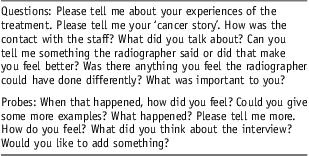
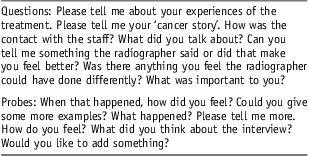
The interviews took place in patients’ home about 1 month post radiation therapy. The interview consisted of open questions about the treatment, and their thoughts and feelings when they received radiotherapy. Every interview began with: please tell me about your experiences of the treatment. The follow-up questions related to the patients narratives and focused on their relationship with radiographers. The purpose was to obtain knowledge of how the patients experienced the field in which the study took place. The main questions were chosen from literature review about communication between health workers and cancer patients (Table 1). Each interaction lasted around two and a half hours and the interviews lasted for around one and a half hours, recorded with a tape recorder. Each person was encouraged to tell the ‘cancer story’ of their experiences. The interviews were transcribed shortly after. The interviews were terminated when no essentially new data arose. Actually, the researcher never knows in the beginning of a study how many informants needed before saturation occurs, which means that the sample size is determined by the data generated. The collection of data was carried out during 2010 and the spring of 2011. Five interviews were conducted spring 2010, four in autumn 2010 and two in March 2011.
Guide used for the in-depth interviews
Data analysis
The analysis of the interview transcriptions was based on a phenomenological hermeneutical interpretation, developed by Lindseth and NordbergReference Lindseth and Nordberg26 and inspired by Ricoeur's philosophy.Reference Ricoeur28 The analysis consisted of three phases: naive reading, structural analyses and comprehensive understanding. This process is not a strict stepwise procedure, but requires movement back and forth between the phases in a dialectic process, moving from understanding to explanation and from explanation to comprehension.Reference Anderson27 The researcher seeks to understand a text from what it says, to what it talks about.Reference Lindseth and Nordberg26 In a phenomenological study is the essence is to understand the meaning itself.Reference Anderson27 The experience must be understood in a human context and related to the person, to the person's life and life situation.Reference Gadamer29 This method has thematic structural analysis, a way of seeking to identify and formulate themes. A theme is a thread of meaning, presented as condensed descriptions and formulates them in a way that discloses meaning.Reference Lindseth and Nordberg26 Data analysis commenced after the first interview and was ongoing throughout the study. Each text was read carefully so that the researcher could get an overall impression of the text.Reference Lindseth and Nordberg26 The overall impression was vulnerable. The main theme was to be treated as a unique person. The sub-themes were about the patients’ needs and their wishes. All themes was summarised and reflected on in relation to the research question. Meaningful information from all the interviews was compared and considered to identify patterns, similarities and variations in the data.Reference Lindseth and Nordberg26 The themes emerged through a process of asking questions about the text and constantly moving between meaningful units and the entire text.
Results and discussion
Eleven patients agreed; seven men and four women. The men varied from 35 to 75 years old and the women from 43 to 55 years. The patients’ diagnoses were tonsil, larynx, nasopharynx, tongue, floor of mouth and lymphoma. All cancer patients felt anxious and vulnerable. They were anxious for the future and whether the treatment would make them well. Having radiation therapy was associated with much uncertainty. As the weeks of treatment passed, the patients were more and more fatigued by the side effects. The patients pass on stories of an intensive treatment period with many strenuous side effects. In this suffering situation, they said that it was very important to be greeted with understanding. In the last 2 or 3 weeks, the side effects were intolerable; the patients had severe problems with eating, some had to be tube-fed, they were in a great deal of pain, had mucus and had difficulty in speaking. In addition, the patients felt very sick. During this time, the patients needed the radiographers to treat them with compassion.
I first came into the waiting room. They said it was straight in, off with the shirt, up on the bench and on with the mask. The radiographer asked to set up the apparatus in advance and then worked with the tuning till everything was right and they were happy. Then they said, ‘Now we are done, now we can start up, is it okay?’ Usually I didn't answer, I just lay perfectly still. Then they went out and started up. I lay there and heard the humming of the machine; I closed my eyes. I could not bear to look at anything. It doesn't take that long, a quarter of an hour, 10 minutes. I do not know how long I lay there, waiting only for them to take the mask off. Then they came in and said that I was done. They took off the mask, nice and gently, only once did I experience getting a rift on my skin, but it was just once out of 30–40 times so there was nothing to complain about. And they were nice people, who asked how I was, if it went well, if I felt dizzy …. (patient 3)
Three main categories emerged during data analysis: politeness, emotional support and communication.
Politeness
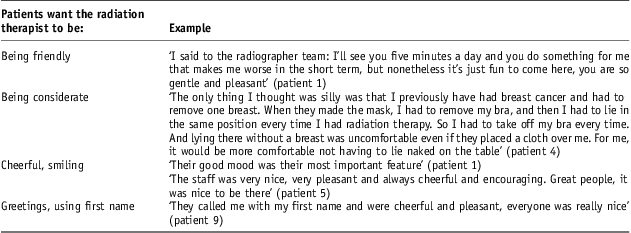
Many stories were about radiographers being friendly (Table 2). The patients preferred that the radiographer met them with kindness and good humour. Three patients highlighted that radiographers’ good mood was most important to make them being less anxious. Eight patients emphasised the importance that radiographers were ‘smiling’ and ‘nice and gentle’ (Table 2). When the radiographer met them with a smile, and greeted and directed their attention towards them, it put them at ease. The patients’ uncertainty decreased slightly. Five patients said that they appreciated that the radiographer used their first name when talking to them (Table 2). When they used their first name, the patients felt that they were seen as a unique person. To be treated as a unique person with kindness were very important for patients throughout the treatment period. All the patients felt confident that they received correct treatment, but they felt unsafe in the treatment situation. The data show that cancer patients undergoing radiation therapy to the head and neck area are anxious, consistent with other studies.Reference Halkett and Kristjanson2, Reference Poroch18, Reference Charamaz30, Reference Holland and Rowland31
Statements to be treated with courtesy
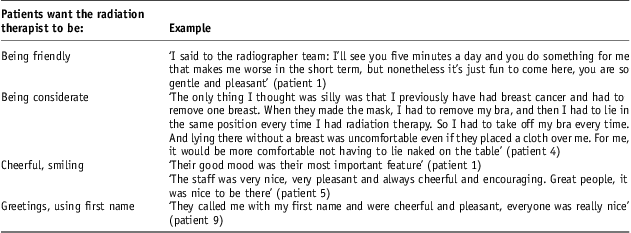
For the patients’ insecurity in the treatment situation to be reduced, it is important that the radiographer is friendly and attentive. The finding matches Charmaz'sReference Charamaz30 discovery which says that health-care personnel can affect the patients’ self-esteem by meeting the patient with kind words and with a smile. The data show that when the radiographer is in a good mood and treats patients in a friendly and courteous way, the patient anxiety is reduced.
There were a few cases where the radiographer were planning and administrating treatment without taking the individual patient's needs into account. One of them (Table 2), show the patient's sense of modesty. The patient who had to undress the upper body felt ‘double naked’ in the treatment situations. The patient was undressed and felt ‘naked’. Radiographers who treat many patients can easily forget how it feels to the individual patient to be undressed. The patient statement shows that the radiographer should try not to expose the patient more than necessary to avoid causing the patient more discomfort in the treatment situation.
Emotional support
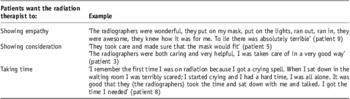
The patients demonstrate that they feel sensitive, revealing a strong need to be met with understanding. The patients spoke of many situations where the radiographer indicated that they understood how they felt (Table 3). Nine patients said that the radiographer were caring and thought that the radiographers provided good treatment (Table 3). Then the radiographers knew, both through words and actions, that they wanted the best for their patients. The patients experienced the radiographers as very caring when they were concerned about how the treatment situation was for the patients (Table 3). Three patients said that the radiographer asked if the mask was well fitted, and if they were well on the treatment table (Table 3). They also asked about how the side effects were developing, and they followed up the visible side effects such as soreness of the skin.
Statements showing patients’ needs for understanding and compassionate

The patients were generally satisfied with the care and support from the radiographers in accordance with Gamble's study.Reference Gamble24 Their statements show that many radiographers exercise care while providing treatment (Table 3). The cancer patients experience a feeling of being taken care of when the radiographer informs, understands and provides care in accordance with Holland and Rowland's study.Reference Holland and Rowland31
Five patients talked about the unpleasant experience at the beginning of treatment when they were strapped into the mask and left alone in the treatment room while the radiation was going on. They express that it was very important how they were greeted by the radiographers in this precarious situation. One of the patients felt alone and scared the first time on radiation (Table 3). When the radiographer showed understanding and compassion, it was easier for the patient. Martin and HodgsonReference Martin and Hodgson32 propose that the radiographer on the first day of a patient's radiation treatment have to provide information in a caring way to alleviate any anxiety or fears the patient might be experiencing.
Five of the patients suffered from claustrophobia. Four forced themselves without mentioning it to the radiographer, whereas only one spoke of the feeling of claustrophobia. When the radiographer came up with encouraging words or reassured them, the patients’ insecurity were reduced. Holland and RowlandReference Holland and Rowland31 describe good communication between health professionals and cancer patients, including when they talk face to face in a quiet environment, and when the staff is honest and understanding.
For all patients, planning of treatment was associated with great uncertainty and anxiety. In this stressful situation, the patients felt very vulnerable. ‘To get time’ was a term several patients used (Table 3). They knew that there were many patients who were about to have treatment, but nonetheless, ‘the staff took time out of their schedule’ to show them understanding.
Nine of the patients lived far away from the hospital. In the treatment period the radiographers were the only health personnel that the patients met daily. The patients expressed that they felt lonely and had a need for contact. This study indicate, in accordance with others, that support is particularly important for patients in the period when they are outpatients.Reference Larsson and Hedelin13, Reference Wells14, Reference Wengstrøm33
Receive information
At start of treatment, patients were very uncertain about how exactly the treatment would be administered. Need for information was great. Good information meant that they felt safe and had a good level of contact with the radiographer. Most of the patients wanted most information so that they were prepared, only one of the patients wanted no information. This corresponds in part with Skalla's studyReference Skalla, Bakitas, Fustenberg, Ahles and Henderson34 which states that some cancer patients undergoing radiation therapy will avoid information about the side effects.
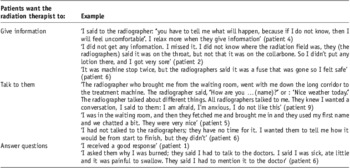
After a few treatments, half of the patients’ anxiety was reduced, and the treatment became routine. But for the other patients it was still stressful to carry out the treatment. In this phase, the side effects began to be troublesome. Cancer patients needed information about side effects and to get answers to their queries (Table 4).
Statements showing patients’ needs for information

Patients were informed in various ways and received differing amounts of information (Table 4) in accordance with Long's study.Reference Long8 Eight patients were satisfied with the information they received from the radiographers, which agrees with the findings of Hammick et al.Reference Hammick, Tutt and Tait35 But not all patients received adequate information (Table 4). Two patients said they got some information, but wanted more insight into what would be done, the same result is shown in Gamle.Reference Gamble24 When the patients do not have any knowledge of what will happen, or when they do not get answers to their questions, feelings of insecurity and loneliness were increased. Some stories were about the radiographer meeting the patient halfway (Table 4). Halkett et al.Reference Halkett, Kristjanson and Lobb36 found that at the second and third time points more than half of the patients’ reported unmet needs concerning information. Two cancer patients in this study said that the radiographers did not inform them or talk to them, but only concentrated on technical aspects. This is in accordance with McCabe's studyReference McCabe37 in which the patients believe that nurses are more concerned with performing tasks than conversing with them. Extensive information means that patients understand what will happen and then feel more safe.Reference Wells14, Reference Skalla, Bakitas, Fustenberg, Ahles and Henderson34, Reference Gaston and Mitchell38 Rose and YatesReference Duncan, Epstein and Tu11 found that when the radiographer informed the patients about all treatment procedures, patients’ feelings of vulnerability are reduced, which is consistent with this study. Effective communication is necessary to establish the individual needs of the patient, to provide relevant information and to enable appropriate supportive care for the patient. Information provides knowledge, builds alliance and reduces uncertainty. The findings show that good information can remove uncertainty and reduce anxiety both before and during treatment.
Patients with head and neck cancer who are treated with radiotherapy need information that is meaningful for them as individuals.Reference Larsson and Hedelin13 For cancer patients, it will be meaningful both to know what will happen, where the radiation fields are and what might be the consequences of the treatment. One patient in this study was not informed about where the fields were (Table 4), and this led to unnecessary side effects. The result is consistent with Halkett et al.Reference Halkett, Kristjanson and Lobb36 findings, they found that one of five patients with breast cancer did not know how much of the breast was included in the treatment.
It was important for all patients that the radiographer responded when they asked questions. Most of them were satisfied with the answers (Table 4).Reference Hammick, Tutt and Tait35 But some radiographers did not give answer. One of the patients asked about side effects, but was told to contact the doctor (Table 4). The statement may indicate that the radiographer could not answer the question or that the radiographer did not know what the role entailed. Halkett et al.Reference Halkett, Cox, Anderson and Heard6 found that radiographers were confused about what role they should play in terms of providing patients support and care.
Some radiographers use the time while they are walking with the patient into the treatment room, to talk. Others are silent. Silence can be interpreted as rejection by the patients. Not being seen or talked to can make the patient feel insignificant in the radiographers’ world. The patients’ statements show that they want attention. In the radiographer's business, there can be a risk that attention is not directed towards the patient. Data in this study may indicate that some radiographers minimise the verbal communication. This is consistent with Boot's findingsReference Booth39 that while necessary information is given, the patient's personal needs are not taken into account. When the radiographer is only concerned with the setting of the apparatus, the patient can easily feel lonely and abandoned in the treatment situation. When the radiographer does not speak to the patient, it may indicate that the radiographer is trying to meet the patients’ needs for security and contact, but regarded it as secondary in relation to implementing the treatment quickly.
Patients pointed out that they were calmer when radiographers chatted with them. Patients had many different stories about radiographers reducing their anxiety by talking with them. In the patients’ stories, many referred to situations where the patients felt like an important part in a relationship, while some spoke of loneliness and rejection (Table 4). The meetings were described as ‘good’ when the radiographer talked, asked questions and remembered what they talked about earlier. Then, the radiographer created a ‘we’ feeling and the patients felt safeguarded. This study, consistent with other studies, highlights the importance of radiographers’ communication in creating a relationship with the patients during radiation treatment to meet patients’ needs.Reference Halkett and Kristjanson2, Reference Wengstrøm33 The majority of the patients expressed importance of being a part of a relationship. Active listening and empathy are important elements in the relationship building process. The radiographer can assist cancer patients’ treatment compliance and coping strategies. Data show that radiographers create alliances with patients when using patient's first name, by asking how they feel and chatting with the patient.
The patients’ experience is related to how the radiographer shows empathy in every single patient encounter. Cancer patients are individuals and may have different resources to successfully complete the intensive radiation therapy. Information provided by radiographers must be based on the individual patient. To do this, the radiographer must talk to the patient, asks questions, listen and interpret the patient's reactions. YilderReference Yilder40 claims that situation awareness is important in the radiography practice. The same can apply to the radiotherapy. When information is based on the unique patient and takes into account the patient's condition and the impending radiation treatment, the purpose of the information is achieved in accordance with Wilson's information model.Reference Wilson41 Then, the patients’ ability to understand what is happening and feel calmer in the treatment situation is achieved.
To create a good and safe atmosphere, a requirement will be that the radiographer talks with the patient. Respectful and human behaviour can lead to an atmosphere of understanding and increased self-esteem for the cancer patients who are undergoing radiation therapy.Reference Gamble24 The radiographers have both a professional duty and a duty to show empathy and must show the patients respect and dignity.42
Limitations
The patients in this study were recruited only from one radiation department in Norway. After 11 interviews no new themes showed up, the researcher closed collection in accordance with the method.Reference Lindseth and Nordberg26
Conclusion
This study indicates that head and neck cancer patients feel vulnerable and need that the radiographer creates a safe and good atmosphere when they undergo treatment. It means to reduce uncertainty, provide emotional support, reduce loneliness, provide information and creates alliances. Successful meetings are characterised by the radiographer smiling, being pleasant, referring to the patient by their name, informing the patient thoroughly, asking open questions and answering questions.
Practice implications
Radiographers need to be careful in the way that they manage patients both physically and emotionally. The radiographer must explain what is done, ask questions about the patient's experience and answer their questions. Through information and support, patients’ experience of powerlessness, abandonment and despair can be reduced. By getting factual information, the patient will feel better safeguarded than if the patient does not receive any information. To build alliance and develop a relationship, the radiographer must follow the patient verbally, confirm the patient's statements and show understanding and respect. To improve patient-centered services all radiographers should treat the patients with courtesy and respect. This indicates to smile and address all the patients by name and to inform thoroughly. The radiographer must ask open questions, for example: ‘how are you?’, ‘is there anything you are wondering about?’. In addition, the radiographer has to answer questions and show understanding.
Given the sparse research on the care of cancer patients undergoing radiation treatment, need for further research is substantial. It will be important to gain further knowledge about cancer patients’ own experiences and assessments.
Acknowledgements
The author would like to express gratitude to the cancer patients who participated in this study, without them this article could not have been possible. The author also thank the staff in radiation therapy department who supported with this research.