INTRODUCTION
Marine eels of the Anguilliformes live in almost all habitats and depth zones of the world's oceans (Haedrich & Merrett, Reference Haedrich and Merrett1988; Böhlke, Reference Böhlke1989) but the biology and reproductive ecology of most species is poorly known. A few eel species that live in shallow water habitats such as coral reefs can sometimes be seen by divers and several are fisheries species, which have provided information about the reproductive biology of eels of the genus Conger (Congridae) (Cau & Maconi, Reference Cau and Maconi1984; Hood et al., Reference Hood, Able and Grimes1988; Okamura et al., Reference Okamura, Utoh, Zhang, Yamada, Horie, Mikawa, Tanaka, Motonobu and Oka2000; Sbaihi et al., Reference Sbaihi, Fouchereau-Peron, Meunier, Elie, Mayer, Burzawa-Gerard, Vidal and Dufour2001; O'Sullivan et al., Reference O'Sullivan, Moriarty, FitzGerald, Davenport and Mulcahy2003; Correia et al., Reference Corrreia, Manso and Cimbra2009; Figueroa et al., Reference Figueroa, Gustavo and Haimovici2010) and of the families Muraenidae (Thresher, Reference Thresher1984; Fishelson, Reference Fishelson1992), Ophichthidae (Wenner, Reference Wenner1976; Casadevall et al., Reference Casadevall, Munoz, Carrasson and Matallanas2001) and Nettastomatidae (Porcu et al., Reference Porcu, Follesa, Gastoni, Mulas, Pedoni and Cau2013). The gonadal morphology of some deep-water eel species have been examined (Fishelson, Reference Fishelson1994), and the gonadal maturation or early life history of captive congrid eels has been studied (Horie et al., Reference Horie, Utoh, Yamada, Okamura, Zhang, Mikawa, Tanaka and Oka2001, Reference Horie, Utoh, Yamada, Okamura, Zhang, Mikawa, Akazawa, Tanaka and Poka2002; Utoh et al., Reference Utoh, Okamura, Yamada, Tanaka, Mikawa, Akazawa, Horie and Oka2004, Reference Utoh, Horie, Mikawa, Okamura, Yamada, Akazawa, Tanaka and Oka2005, Reference Utoh, Horie, Okamura, Mikawa, Yamada, Tanaka, Oka and Tsukamoto2013).
Observations of reproduction-related behaviour or sightings of eels have only been made of a few species such as moray eels of the Muraenidae (Moyer & Zaiser, Reference Moyer and Zaiser1982; Thresher, Reference Thresher1984; Ferraris, Reference Ferraris1985), garden eels of the Congridae (subfamily Heterocongridae) (Fricke, Reference Fricke1970; Thresher, Reference Thresher1984; Kakizaki et al., Reference Kakizaki, Kobayashi, Nakatsubo, Wakiya, Watanabe, Miller and Tsukamoto2015), or ophichthid eels (Cohen & Dean, Reference Cohen and Dean1970; Ross & Rohde, Reference Ross and Rohde2003). Ross & Rohde (Reference Ross and Rohde2003) reported that ophichthid eels come to the surface at night inshore of the Florida Current and 15 eels of four species were captured in dip-nets over 30–60 m depths. Many Ahlia egmontis were observed over 45 m of water to apparently be migrating at night towards the outer continental shelf for spawning off Honduras (Cohen & Dean, Reference Cohen and Dean1970).
Some characteristics of the reproductive ecology of marine eels such as their locations and seasonality of spawning can also be inferred from collections of their leptocephalus larvae (Smith, Reference Smith and Böhlke1989; Minagawa et al., Reference Minagawa, Miller, Kimura, Watanabe, Shinoda, Aoyama, Inagaki and Tsukamoto2007; Miller, Reference Miller2009). These kinds of studies indicate that various species of marine eels spawn along the outer shelf and slope of the East China Sea (Miller et al., Reference Miller, Otake, Minagawa, Inagaki and Tsukamoto2002), but their life histories and those of the genus Ariosoma in general (Miller, Reference Miller2002; Miller et al., Reference Miller, Yamaguchi, Wouthuyzen, Aoyama, Suharti, Ma, Yoshinaga, Minegishi, Kawakami and Tsukamoto2013) are still poorly known.
One of the few marine eel species that has been studied for its seasonality of reproduction is Ariosoma meeki (Ishii et al., Reference Ishii, Yoshiura, Kajimura, Mochioka and Aida2003), which lives in sandy-muddy bottoms of shallow waters around Japan in the western North Pacific (Nakabo, Reference Nakabo2002). It is caught in commercial fisheries in southern Japan and in the East China Sea. Histological and physiological observations indicate its spawning season is between July and August, and that their oocytes show synchronous development (Ishii et al., Reference Ishii, Yoshiura, Kajimura, Mochioka and Aida2003).
This study reports the apparently first documented observation and capture of fully mature female and male congrid eels of A. meeki in the East China Sea (ECS) and evaluates their morphology and reproductive characteristics in relation to the possible implications of when and where they were collected in the Kuroshio Current.
MATERIALS AND METHODS
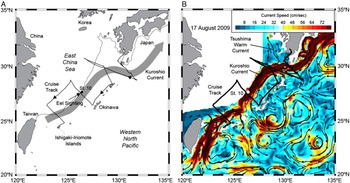
The KT-09-15 cruise of the RV ‘Tansei Maru’ (JAMSTEC, Japan) was conducted from 8 to 21 August 2009 to collect zooplankton samples and make oceanographic observations of the Kuroshio Current and ECS (Figure 1). The survey consisted of plankton net sampling and CTD casts at 15 stations. The cruise track crossed the outer continental shelf of the ECS and the Kuroshio, which flows along the shelf-break before turning to the east just south of Yakushima Island of Japan (Figure 1; Andres et al., Reference Andres, Wimbush, Park, Chang, Lim, Watts, Ichikawa and Teague2008). The observation and collection of the eels reported here occurred at Station 10 (27°37.72N 126°25.11E) at about 02:00 at night on 17 August 2009, with the station being within the west side of the Kuroshio (Figure 1). The ship remained at this station for approximately 24 h, although the ship needed to actively return to the station location due to the strong north-eastward flow of the Kuroshio. The weather conditions on the night the eels were observed and captured were partly cloudy with the crescent moon rising at about 02:10.
Maps showing the cruise track of the KT-09-15 cruise and the location where female and male spawning condition Ariosoma meeki were caught at the surface (St. 10) (A), and the patterns and speeds of surface currents in the region (B). The typical path of the Kuroshio Current is shown in panel (A) with grey shading (adapted from Andres et al., Reference Andres, Wimbush, Park, Chang, Lim, Watts, Ichikawa and Teague2008) along with the 200 m contour depth (dotted line). The current speed of the Kuroshio and the surrounding oceanic region on the day the eels were captured (17 August 2009) is shown in (B) using imagery modified from the data assimilative 1/32° global ocean nowcast/forecast system of the US Naval Research Laboratory (see Shriver et al. Reference Shriver, Hurlburt, Smedstad, Wallcraft and Rhodes2007). The white areas in (B) are shallow areas not included in the current estimates.

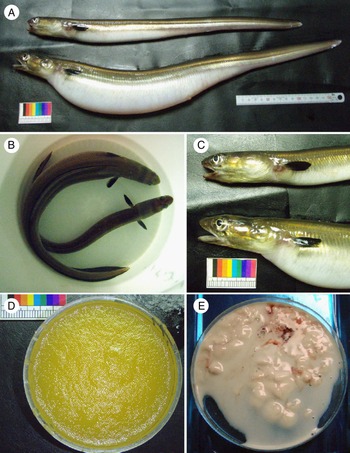
When the eels were seen at night, a dip-net on a long pole was used to catch two of the three eels on the starboard side of the ship. Eels were photographed onboard before being examined (Figure 2A–C). Total length (TL) and body weight (BW) of the specimens were measured and weighed to the nearest 1 mm by a ruler and 1 g by a balance, respectively. The sex of the two captured eels was determined as one female and one male by visual inspections of the gonadal morphology. The gonads (including ovulated eggs or seminal fluid) of the female and male eels were also weighed to the nearest 1 g (GW) by a balance for the calculation of the gonadosomatic index (GSI: 100 × GW × BW−1).
Photographs of male and female Ariosoma meeki eels caught at the surface at night on 17 August 2009 in the Kuroshio Current in the East China Sea, showing lateral views of the male (top) and female (bottom) (A), the same eels while alive in a bucket (B), the anterior regions of their bodies (C), ovulated eggs from the female (D), and seminal fluid and testis tissue from the male (E).

To examine the histology of the gonads, pieces of gonadal tissue were fixed in 10% formalin and then transferred to 70% ethanol, before being dehydrated in an ascending series of graded ethanol concentrations and embedded in paraffin. Sections of 5 µm thickness were prepared and stained with haematoxylin and eosin and were observed using an optical microscope and digitally photographed. Ovulated eggs found within the female's abdominal cavity were fixed in 5% formalin and then digitally photographed under a stereomicroscope, and the diameters of 100 randomly selected eggs were measured using Image J (Schneider et al., Reference Schneider, Rasband and Eliceiri2012). Two specimens were radiographed by Soft-X (Softex Co., Ltd.) to count their total number of vertebrae (Female: 159, male: 156). The whole bodies of the specimens were fixed in 10% formalin. Species identification was carried out morphologically based on Nakabo (Reference Nakabo2002) that enabled identification of the eels as A. meekii.
RESULTS
During night-time on-deck operations on 17 August 2009 (3 days before the new moon) at Station 10 within the west side of the Kuroshio Current (Figure 1), three eels were seen at the surface within the lighted area along the side of the ship. The eels were swimming with the female being located between the male and a sex-unidentified eel on each side of her body. The heads of the male and sex-unidentified eel were positioned in the middle of the female's body. The eels swam under the ship for a while, before coming back into view several minutes later. Then two dip nets were used to capture the eels, with each net catching one eel from about 2:15 to 2:20. Although one male and one female were caught, the other eel was not caught and it swam away.
Both the collected eels had large eyes (eye diameter of female: 17.4 mm, 3.2% (proportion of total length), male: 14.9 mm, 3.6%), black pectoral fins and black posterior regions of their dorsal and anal fins (Figure 2). The female eel was 540 mm in TL and 570 g in BW and had a highly swollen abdomen (Figure 2A–C). The male eel was 410 mm in TL and 200 g in BW, with only a slightly swollen abdomen (Figure 2A–C). The eel that escaped was also of a similar body size and shape as the male that was caught.
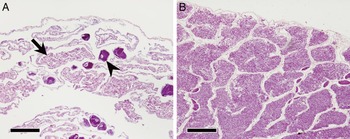
Both the collected female and male eels appeared to be in spawning condition, because some eggs or seminal fluid were released during handling of the two specimens. When the female abdomen was opened by dissection, many yellowish coloured ovulated eggs flowed out (Figure 2D). The male also contained cream-coloured fully matured testis (Figure 2E). In histological observations of the remaining female ovarian tissue after many eggs had been released, a copious amount of post-ovulatory follicles and a small number of sparsely distributed immature oocytes were observed (Figure 3A). The immature oocytes (approximately 30–100 µm in diameter) seemed to be mainly at the chromatin nucleolus stage, but their histological characteristics, abnormal cell shapes, and unclear edges of the nuclei and nucleoli, indicated that these were regressing (Figure 3A). In the male, the seminal lobules of the testes were filled with sperm (Figure 3B). The GSI of the female and the male were 53 and 20, respectively. Mean diameter ± SD of the ovulated eggs was 1.20 ± 0.06 mm (range: 1.03–1.34 mm, N = 100) after preservation in 5% formalin. Plankton sampling was conducted the next day after the eels were captured, but no unusual fish eggs or small eel larvae were detected during sorting of the samples.
Light micrographs of gonadal tissue in the female and male Ariosoma meeki eels. (A) A copious amount of post-ovulatory follicles and a small number of sparsely distributed immature oocytes in the female ovary. Arrow indicates post-ovulatory follicles and arrowhead indicates an oocyte. (B) Seminal lobules of the male testis filled with sperm. Scale bars are 200 µm for both images.

The station where the eels were collected was within the Kuroshio Current near its western edge based on its location relative to the typical path of the current in this area (Figure 1) and the strong current detected by the movement of the ship. The bottom depth at the station was 1337 m, indicating it was not over the shallow slope of the ECS where the western edge of the Kuroshio is located. The CTD profile (St. 10–1 start position: 27°37.78N 126°25.18E) made while the ship was drifting with the current showed that there was no mixed layer of temperature or salinity and that the chlorophyll maximum was between 50 and 100 m (Figure 4). The water temperature and salinity at 5 m at the station were 28.9°C and 33.8, respectively.
Hydrographic profiles of the parameters measured by a CDT cast that was made at Stn. 10 where the Ariosoma meeki eels were caught at the surface in the Kuroshio Current in the East China Sea.

DISCUSSION
This study reports on the collection of A. meeki eels at advanced stages of reproductive maturation while they were at the sea surface within the western side of the Kuroshio Current in the ECS. The behaviour of the male and sex-unidentified eel (seemingly a male based on body shape) that were pressing their heads against the middle of the body where the urogenital pore is located is the same type of behaviour that has been observed in artificially matured anguillid eels in the laboratory that engaged in apparent courtship or pre-spawning behaviour (Boëtius & Boëtius, Reference Boëtius and Boëtius1980; van Ginneken et al., Reference van Ginneken, Vianen, Muusze, Palstra, Verschoor, Lugten, Onderwater, van Schie, Niemantsverdriet, van Heeswijk, Eding and van den Thillart2005). It is unclear if the eels in the present study had come to the surface near the ship as a result of being attracted by the lights of the ship, but this possibility was suggested to be the case in previous sightings of ophichthid eels at the surface (Ross & Rohde, Reference Ross and Rohde2003).
The advanced levels of GSI of the female (53) and male (20) A. meeki were equally high compared with larger artificially matured Japanese eels, Anguilla japonica (Tsukamoto, Reference Tsukamoto2009) and European eels (Boëtius & Boëtius, Reference Boëtius and Boëtius1980; van Ginneken et al., Reference van Ginneken, Vianen, Muusze, Palstra, Verschoor, Lugten, Onderwater, van Schie, Niemantsverdriet, van Heeswijk, Eding and van den Thillart2005) that were close to being ready for reproduction. The freely flowing out ovulated eggs and seminal fluid of the two captured eels also indicate these eels were ready or close-to-ready to spawn. The A. meeki GSI values were higher than female ophichthid eels collected at the surface off North Carolina in the Atlantic that had GSI values of 7–21 (Ross & Rohde, Reference Ross and Rohde2003) and female ophichthids (GSI: 15–20) in the Mediterranean Sea (Casadevall et al., Reference Casadevall, Munoz, Carrasson and Matallanas2001). GSI values of Conger species have usually been even lower (Hood et al., Reference Hood, Able and Grimes1988; Okamura et al., Reference Okamura, Utoh, Zhang, Yamada, Horie, Mikawa, Tanaka, Motonobu and Oka2000; Sbaihi et al., Reference Sbaihi, Fouchereau-Peron, Meunier, Elie, Mayer, Burzawa-Gerard, Vidal and Dufour2001; O'Sullivan et al., Reference O'Sullivan, Moriarty, FitzGerald, Davenport and Mulcahy2003; Correia et al., Reference Corrreia, Manso and Cimbra2009), presumably because those species migrate offshore to spawn (McCleave & Miller, Reference McCleave and Miller1994; Miller et al., Reference Miller, Yoshinaga, Aoyama, Otake, Mochioka, Kurogi and Tsukamoto2011; Kurogi et al., Reference Kurogi, Mochioka, Okazaki, Takahashi, Miller, Tsukamoto, Ambe, Katayama and Chow2012). A large female Conger japonicus caught in the northern ECS had a GSI of 9.5 (Yagi et al., Reference Yagi, Shimoda, Uchida, Shimizu, Aoshima and Kanehara2013). Some information about the GSI of anguillid eels caught in their spawning area by trawls has been obtained (Chow et al., Reference Chow, Kurogi, Mochioka, Kaji, Okazaki and Tsukamoto2009; Tsukamoto et al., Reference Tsukamoto, Chow, Otake, Kurogi, Mochioka, Miller, Aoyama, Kimura, Watanabe, Yoshinaga, Shinoda, Kuroki, Oya, Watanabe, Hata, Ijiri, Kazeto, Nomura and Tanaka2011), but higher values of about 45–65 occur in artificially matured Anguilla japonica females (Tsukamoto, Reference Tsukamoto2009).
The A. meeki eels were observed and caught 3 days before the new moon that was on 20 August. Off North Carolina in the western North Atlantic, all but one of the ophichthids that were caught at the surface were also collected during new moon, even though eels could have been caught in the area at all times of the year (Ross & Rohde, Reference Ross and Rohde2003). Collections of eggs, newly hatched larvae and otolith analyses of larvae have indicated that A. japonica only spawns in the several days before new moon (Tsukamoto et al., Reference Tsukamoto, Otake, Mochioka, Lee, Fricke, Inagaki, Aoyama, Ishikawa, Kimura, Miller, Hasumoto, Oya and Suzuki2003, Reference Tsukamoto, Chow, Otake, Kurogi, Mochioka, Miller, Aoyama, Kimura, Watanabe, Yoshinaga, Shinoda, Kuroki, Oya, Watanabe, Hata, Ijiri, Kazeto, Nomura and Tanaka2011; Aoyama et al., Reference Aoyama, Watanabe, Miller, Mochioka, Otake, Yoshinaga and Tsukamoto2014). However, full moon period spawning was indicated by otolith analyses of Kaupichthys leptocephali (false moray eels: family Chlopsidae) in the Indonesian Seas (Lee et al., Reference Lee, Miller, Hwang, Wouthuyzen and Tsukamoto2008); so there may be variation in lunar spawning patterns in anguilliform eels, as there are in other types of fishes (Takemura et al., Reference Takemura, Rahman, Nakamura, Park and Takano2004).
The location where the spawning-condition A. meeki eels were observed is interesting because it indicates the eels must have made a short spawning migration away from the continental shelf where they live to be over deep water. At least some muraenids seem to spawn in shallow-water habitats wherever they live (Moyer & Zaiser, Reference Moyer and Zaiser1982; Thresher, Reference Thresher1984; Ferraris, Reference Ferraris1985), as do garden eels (subfamily Heterocongrinae), which live colonially in burrows in shallow areas and can spawn from their burrows (Kakizaki et al., Reference Kakizaki, Kobayashi, Nakatsubo, Wakiya, Watanabe, Miller and Tsukamoto2015). Larval distributions also indicate that most marine eels do not migrate beyond the edge of the continental shelf to spawn (Miller, Reference Miller2009), and the ophichthid eels observed at the surface at night were over the continental shelf (Cohen & Dean, Reference Cohen and Dean1970; Ross & Rohde, Reference Ross and Rohde2003). In contrast, Conger oceanicus (McCleave & Miller, Reference McCleave and Miller1994), Conger myriaster (Miller et al., Reference Miller, Yoshinaga, Aoyama, Otake, Mochioka, Kurogi and Tsukamoto2011; Kurogi et al., Reference Kurogi, Mochioka, Okazaki, Takahashi, Miller, Tsukamoto, Ambe, Katayama and Chow2012) and some Ariosoma balearicum (Miller, Reference Miller2002) appear to migrate offshore to spawn, but these may be exceptional cases for marine eels.
The fact that the A. meeki eels were captured in reproductive condition in August was consistent with the estimate made by Ishii et al. (Reference Ishii, Yoshiura, Kajimura, Mochioka and Aida2003) that the spawning season of this species is between July and August. Other species of marine eels in the East Asia region including Conger myriaster and Muraenesox cinereus also spawn in the summer and autumn seasons (Takai, Reference Takai1959, Reference Takai1979; Okamura et al., Reference Okamura, Utoh, Zhang, Yamada, Horie, Mikawa, Tanaka, Motonobu and Oka2000; Miller, Reference Miller2002; Utoh et al., Reference Utoh, Horie, Mikawa, Okamura, Yamada, Akazawa, Tanaka and Oka2005; Minagawa et al., Reference Minagawa, Miller, Kimura, Watanabe, Shinoda, Aoyama, Inagaki and Tsukamoto2007).
The extreme enlargement of the abdomen of the female A. meeki eel to the same degree seen in anguillid eels (Boëtius & Boëtius, Reference Boëtius and Boëtius1980; van Ginneken et al., Reference van Ginneken, Vianen, Muusze, Palstra, Verschoor, Lugten, Onderwater, van Schie, Niemantsverdriet, van Heeswijk, Eding and van den Thillart2005; Tsukamoto, Reference Tsukamoto2009; Tsukamoto et al., Reference Tsukamoto, Chow, Otake, Kurogi, Mochioka, Miller, Aoyama, Kimura, Watanabe, Yoshinaga, Shinoda, Kuroki, Oya, Watanabe, Hata, Ijiri, Kazeto, Nomura and Tanaka2011) and the features like black pectoral fins are similar to what occurs in anguillid silver eels (Okamura et al., Reference Okamura, Yamada, Yokouchi, Horie, Mikawa, Utoh, Tanaka and Tsukamoto2007). There was no evidence though, that the eyes of the spawning-condition A. meeki had become enlarged as they do in anguillid silver eels (Okamura et al., Reference Okamura, Yamada, Yokouchi, Horie, Mikawa, Utoh, Tanaka and Tsukamoto2007), because other species of Ariosoma and a non-gravid specimen of A. meeki have similarly large eyes (Shen, Reference Shen1998; Kawai et al., Reference Kawai, Imamura, Ishito and Nakaya2002). The greatly enlarged abdomen of the female A. meeki indicate that this species, like anguillid eels (Tsukamoto et al., Reference Tsukamoto, Chow, Otake, Kurogi, Mochioka, Miller, Aoyama, Kimura, Watanabe, Yoshinaga, Shinoda, Kuroki, Oya, Watanabe, Hata, Ijiri, Kazeto, Nomura and Tanaka2011), is probably semelparous. Moreover, the oocytes of A. meeki in this study showed synchronous development (Ishii et al., Reference Ishii, Yoshiura, Kajimura, Mochioka and Aida2003) and the ovaries of the female contained only the many post-ovulatory follicles and a small number of regressed immature oocytes. Hood et al. (Reference Hood, Able and Grimes1988) inferred that Conger oceanicus seems to only spawn once during its life history, and this was also inferred for other species of conger eels (Figueroa et al., Reference Figueroa, Gustavo and Haimovici2010).
The observation and capture of both male and female A. meeki eels in the western side of the Kuroshio in this study provide the first clues about when and where this species may spawn. Further information about the habitats used by these eels, their spawning locations and their larval distributions needs to be obtained to provide a better understanding of their life histories.
ACKNOWLEDGEMENTS
We thank the captain, crew and the other scientific members of the KT-09-15 cruise of the RV ‘Tansei Maru’, with special thanks to Y. Terasaka and K. Hirosaki for assistance in observing and collecting the specimens. We also thank H. Izumi for support in histological analyses.