Introduction
Maternal smoking during pregnancy is associated with serious adverse effects for both mother and offspring, including preterm delivery, fetal growth restriction and infant death (Centers for Disease Control and Prevention (US), 2001). Smoking rates during pregnancy among women with low socioeconomic status are high in Argentina and Uruguay. The reported prevalence varies from 10% in Argentina and up to 26.7% in Uruguay being among the highest in Latin America and worldwide (Althabe, Colomar, Gibbons, Belizan, & Buekens, Reference Althabe, Colomar, Gibbons, Belizan and Buekens2008; Berrueta et al., Reference Berrueta, Morello, Alemán, Tong, Johnson and Dietz2015).
Tobacco smoking cessation is usually associated with subsequent weight gain mediated by several mechanisms. In the general population, post-cessation weight gain is on average 5 kg, with a large variability across studies. A meta-analysis showed that after one year of continuous abstinence, 34% of former smokers gain 5–10 kg and up to 13% gain over 10 kg. (Aubin, Farley, Lycett, Lahmek, & Aveyard, Reference Aubin, Farley, Lycett, Lahmek and Aveyard2012) Concerns about weight and weight gain among women have been reported as one reason for the initiation and continuation of smoking, as well as a reason for relapse after quitting in non-pregnant women (Grogan, Hartley, Conner, Fry, & Gough, Reference Grogan, Hartley, Conner, Fry and Gough2010; Pomerleau & Saules, Reference Pomerleau and Saules2007). Among pregnant smokers, concern about post-cessation weight gain has been associated with not making a quit attempt during pregnancy (Berg, Park, Chang, & Rigotti, Reference Berg, Park, Chang and Rigotti2008) as well as with post-partum relapse (Levine, Marcus, Kalarchian, Houck, & Cheng, Reference Levine, Marcus, Kalarchian, Houck and Cheng2010; Levine, Marcus, Kalarchian, Weissfeld, & Qin, Reference Levine, Marcus, Kalarchian, Weissfeld and Qin2006).
In addition to pregnant smokers’ weight concerns, some studies have reported an association between tobacco smoking cessation or reduction and higher gestational weight gain (GWG) in pregnant smokers (Favaretto et al., Reference Favaretto, Duncan, Mengue, Nucci, Barros and Kroeff2007; Rode, Kjærgaard, Damm, Ottesen, & Hegaard, Reference Rode, Kjærgaard, Damm, Ottesen and Hegaard2013). Most of these studies except one were performed in European countries or the United States, recruited women with high educational level, or used self-reported data of weight gain or smoking status. Weight gain during pregnancy is associated adverse neonatal outcomes, (Dzakpasu et al., Reference Dzakpasu, Fahey, Kirby, Tough, Chalmers and Heaman2015) and increase of cesarean section (Dietz, Callaghan, Morrow, & Cogswell, Reference Dietz, Callaghan, Morrow and Cogswell2005).
It is of interest to have information on pregnant women of low socioeconomic status in countries with high smoking prevalence with a good prospective follow up of weight gain during pregnancy. The purpose of this study was to compare GWG in women who quit smoking during pregnancy with those who continued smoking. Acknowledging that this group of women who stop smoking might increase their weight during pregnancy and that they fear this outcome could increase health-care providers’ awareness of this barrier to cessation and thus contribute to its proper screening and management. Also, it provides information about an issue that should be considered and tackled within cessation interventions and guidelines for pregnant women.
Methods
Participants and Setting
This study uses baseline data from a clustered randomised controlled trial and prior to implementing a brief counselling intervention based on the 5As (Ask, Advise, Assess, Assist and Arrange) during routine antenatal care, in selected prenatal clinics. Main trial results and detailed methodology are published elsewhere (Althabe et al., Reference Althabe, Alemán, Mazzoni, Berrueta, Morello and Colomar2013, Reference Althabe, Aleman, Berrueta, Morello, Gibbons and Colomar2016). Trained interviewers identified eligible women during hospitalisation for delivery in 10 public hospitals in Buenos Aires, Argentina and two public maternity hospitals in Montevideo, Uruguay from October 2011 to May 2012. To be eligible for the study, women had to have received antenatal care in any of 12 hospitals or 20 associated prenatal care centres in Buenos Aires, Argentina and Montevideo, Uruguay. Women with mental or physical impairments that prevented them from being interviewed, or women with a diagnosis of stillbirth at admission to the hospital were ineligible to participate. All consecutively eligible women who signed an informed consent form were included until a sample of 100–200 women per cluster was achieved, as required for the main trial. Twin pregnancies, which were included for the main trial, were excluded from this study, as recommendations on GWG in twin pregnancies are different from those in singletons, and frequency of twin pregnancies in the main study was too small to enable a subgroup analysis.
Data collection and Variables
Interviews were conducted in person within the first 48 h after delivery. The questionnaire included questions on basic demographics, tobacco use, second-hand smoke exposure and recall of cessation counselling during the prenatal care visits. Data collectors obtained saliva samples within 12 h after delivery from women who reported having ceased smoking during pregnancy. Women were asked to gently chew on the cotton swab insert from a Salivette (Sarstedt, Newton, NC, USA). These were stored accordingly and shipped to the U.S. Centers for Disease Control and Prevention laboratory in Atlanta, Georgia, for analysis (Althabe et al., Reference Althabe, Alemán, Mazzoni, Berrueta, Morello and Colomar2013). Salivary cotinine was measured using high-performance liquid chromatography atmospheric-pressure chemical ionisation tandem mass spectrometry. Although the precise cut-off point to determine active smoking in pregnant women is unknown, we considered a cut-off point of > 10 ng/mL as recommended by Society for Research on Nicotine and Tobacco. This cut-off point is lower than the one used for the general population, as nicotine is metabolised and cotinine is cleared faster in pregnant women (Benowitz et al., Reference Benowitz, Jacob, Hall, Tsoh, Ahijevych and Jarvis2002). Smoking status was used to categorise the women as non-smokers, early quitters, late quitters or continuing smokers. Non-smokers were those who reported never smoking, had tried cigarettes but did not smoke regularly, or quit smoking before they found out that they were pregnant. Early quitters were those who reported quitting as soon as they found out that they were pregnant, were abstinent until delivery, and had saliva cotinine levels ≤ 10 ng/mL. Late quitters were those who reported smoking at the time they found out they were pregnant but quit later during pregnancy and remained abstinent until delivery, and had saliva cotinine levels ≤ 10 ng/mL. Continuing smokers were those who reported smoking every day or on some days throughout pregnancy, or within the last week prior to delivery. Women who reported quitting during pregnancy, but had a salivary cotinine level > 10 ng/mL were classified as continuing smokers.
Anthropometric variables such as pregestational weight, height and weight at the last antenatal visit before delivery were obtained from the medical records. Pregestational weight was self-reported by women and recorded by clinicians in their first antenatal visit. Weight gain was calculated as the difference between the woman's weight at the last antenatal appointment before delivery and pregestational weight. Body mass index (BMI) was calculated as weight (kg)/height (m)2. World Health Organisation categories of nutritional status expressed as BMI were used: underweight < 18.5 kg/m2, normal weight 18.5–24.9 kg/m2, overweight 25–29.9 kg/m2 and obesity ≥ 30 kg/m2 (NHLBI Obesity Education Initiative Expert Panel, 1998).
Trimester of the first prenatal visit and gestational age at delivery were also obtained from the medical records.
Analysis
Descriptive statistics were used to describe the women's basic demographics, smoking status, anthropometric data and nutritional status. Generalised estimating equations were used to account for clustering. Linear regression analysis was performed, in which the dependent variable was weight gain and the exposure was smoking status, which was adjusted for pre-pregnancy BMI and other possible confounders such as age, gestational age at delivery, smoking rate and parity. Analysis of variance (ANOVA) and post-hoc Bonferroni correction were used to compare crude means between non-smokers, quitters and continuing smoking, and pairwise respectively Wald Chi-squared tests and Bonferroni correction were used to compare adjusted means of weight gain. p values < 0.05 were considered to be statistically significant. IBM SPSS software (version 20; IBM Corp., Armonk, NY, USA) was used.
Ethics
The protocol and informed consent documents were submitted and approved by the ethics committees of all participating hospitals; the Ethics Committee of the Ministry of Health of the Province of Buenos Aires, Argentina; the Ethics Committee of the School of Medicine, Universidad de la República, Uruguay; and the Tulane University Institutional Review Board, USA.
Results
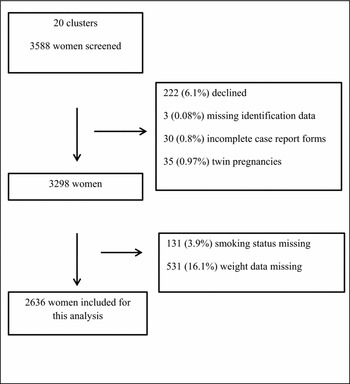
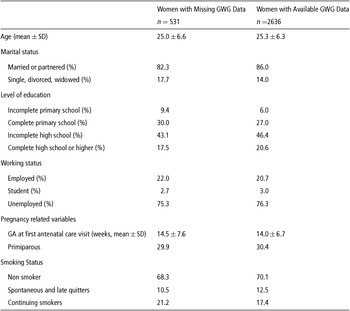
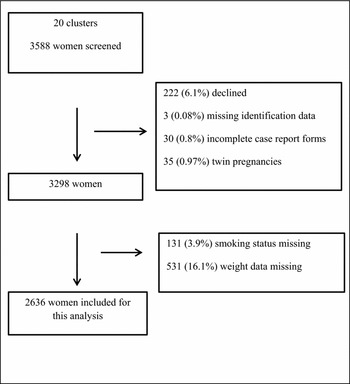
Twenty prenatal clinics (clusters) were involved, and 3,588 women were assessed for eligibility and invited to participate. Of these, 222 (6.1%) declined to participate, three (0.08%) were excluded because of a missing identification number, 30 (0.8%) because of incomplete case report forms and 35 because of a twin pregnancy. Of the remaining 3298, 131 (3.9%) were excluded because of missing smoking status and 531 (16.1%) because of missing weight gain data, resulting in a final sample of 2,636 women (Insert Figure 1 here). We compared women with and without weight gain data and no clinically significant differences were found regarding age, parity, working status or timing of the first antenatal care appointment. However, women with missing data had a lower level of education, were more frequently single, and had slightly higher levels of tobacco use (Insert Table 1 here).
Study population.
Characteristics of women with and without gestational weight gain data
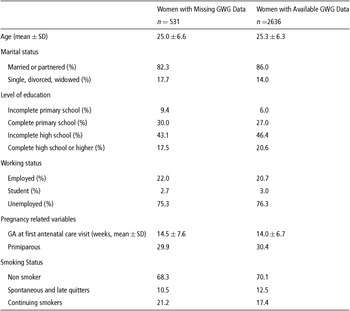
GA: gestational age; GWG: gestational weight gain; SD: standard deviation.
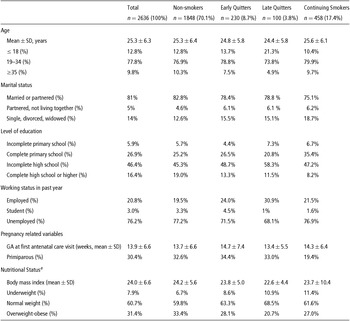
The characteristics of the 2,636 included women are shown in Table 2. (Insert Table 2 here) Overall, 29.9% of women were smokers at the beginning of pregnancy; among them 41.9% quit, 29.2% were early quitters; 12.7% were late quitters; and 58.1% were continuing smokers (Table 2). Half of the women lived with at least one smoker and 35.9% reported second-hand smoke exposure. Most women (60.7%) had a normal pre-pregnancy BMI, 7.9% were underweight, 20.3% were overweight and 11.3% were obese. Early and late quitters had similar characteristics, while continuing smokers were older, less educated, as well as being multiparous and being single in a higher proportion than quitters.
Main characteristics of women by smoking status
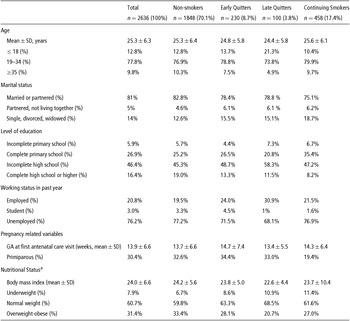
GA: Gestational age, SD: standard deviation.
aCategories of nutritional status: underweight is defined as a Body Mass Index (BMI) < 18.5 kg/m2, normal weight is 18.5–24.9 kg/m2, overweight is 25–29.9 kg/m2, and obesity is ≥30 kg/m2.
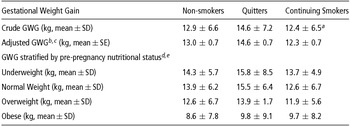
The crude mean GWG was 13.1±6.7 kg overall: 12.9±6.6 kg in non-smokers, 14.6±7.3 kg in early quitters, 14.7±7.1 kg in late quitters and 12.4±6.5 kg in continuing smokers. As no significant differences were found between early and late quitters regarding their characteristics or weight gain, we considered all quitters as a group for the rest of the analysis. The mean weight gain was significantly higher in quitters than in continuing smokers (p < 0.001), and than in non-smokers (p < 0.001) Linear regression analysis showed that quitting increased GWG by 2.4 kg (Wald 95% confidence interval, CI; 1.3–3.4) after adjusting for possible confounders such as age, pre-pregnancy BMI, parity, educational level, smoking rate and gestational age at delivery (p < 0.001). Mean weight gains were also stratified by pre-pregnancy BMI, as this factor contributed significantly to the model. Weight gain was higher in quitters than in smokers and non-smokers in all categories of pre-pregnancy BMI, with the greatest difference among women of normal weight at the beginning of pregnancy (Insert Table 3 here). The adjusted mean infant birth weight for quitters was 3,398 g (Wald 95% CI; 3,309–3,487 g), and 3,196 g (Wald 95% CI; 3,124–3,269 g) in smokers (p < 0.001).
Gestational weight gain by smoking status, crude, adjusted and stratified by pre-pregnancy nutritional status
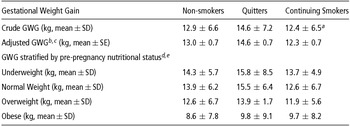
BMI, Body Mass Index; GWG, gestational weight gain; SD, standard deviation; SE, standard error.
a p < 0.001 for comparison between groups, (ANOVA), p < 0.001 for pairwise comparison between quitters and smokers and between quitters and non-smokers, p = 0.44 for pairwise comparison between smokers and non-smokers, (Bonferroni test).
b Adjusted by pre-pregnancy BMI, parity, educational level, smoking rate and gestational age at delivery.
c p < 0.001, by Wald Chi-squared test, p < 0.001 for pairwise comparison between quitters and smokers and between quitters and non-smokers, p = 0.34 for pairwise comparison between smokers and non-smokers, (Bonferroni test)
d Categories of nutritional status: underweight is defined as a BMI < 18.5 kg/m2, normal weight is 18.6–24.9 kg/m2, overweight is 25–29.9 kg/m2, and obesity is ≥ 30 kg/m2.
e p < 0.001, by Wald Chi-squared test, adjusted for the factor pre-pregnancy nutritional status in a linear regression model.
Discussion
Women who quit smoking during pregnancy gained significantly more weight than those who continued to smoke, or were non-smokers Quitters gained on average 2.4 kg more than those who continued smoking, after adjusting for possible confounders. We found no difference in weight gain according to the time of cessation (early vs. late pregnancy). Additionally, infants born to women who quit smoking had significantly higher mean birth weight—about 202 g more—than infants born to smokers, so part of the higher GWG could be explained by a higher infant birth weight.
The study had several strengths. Smoking cessation was confirmed biochemically, which is critical as using self-reported data can result in a 10% non-disclosure of true smoking status (Tong et al., Reference Tong, Althabe, Aleman, Johnson, Dietz and Berrueta2014). The study also provided information on weight gain according to the timing of cessation and among women who quit spontaneously (without intervention), which is by far the most common form of cessation during pregnancy (Mc Bride, Emmons, & Lipkus, Reference Mc Bride, Emmons and Lipkus2003). Finally, the study included a large sample of women with low socioeconomic status in two Latin American countries where the prevalence of smoking during pregnancy is high. However, some limitations should be noted. In over 10% of the initial sample, we had missing data on weight gain and that forced us to exclude cases from the analysis. A possible explanation for this under-registration in clinical records by health care providers was a lack of time in real clinical practice. Furthermore, we consider it is unlikely that clinicians fail to register clinically relevant data or outliers as very low or very high weight gain so this might not have biased the results necessarily. Baseline characteristics of women with missing data showed similarities in some variables but differences in the rates of tobacco use and levels of education, so this could diminish the generalisability of our results. However, there is no evidence that supports that these two conditions could be associated with higher GWG that could have been under-registered in our study, so results may not necessarily be skewed. Pre-gestational weight registered in clinical records by health care providers is sometimes self-reported by women and might be not accurate. However, as weight at the first appointment was measured and registered, and as most women do not increase much in weight in their first trimester, pre-gestational weight inaccuracy was at least limited, though we were not able to validate self-reported pregestational weight, comparing it to actual weight in the first visit, due to the way we collected the data. Weight measurements before pregnancy are seldom available in practice and research studies, especially in healthy women, but evidence supports that self-reported pre-pregnancy weight is reliable.(Holland, Moore Simas, Doyle Curiale, Liao, & Waring, Reference Holland, Moore Simas, Doyle Curiale, Liao and Waring2013) Finally, depending on when women find out they were pregnant there might have been some overlap between early and late quitters, because of the way these categories were defined.
Higher GWG in pregnant quitters compared with pregnant smokers has been reported by others (Favaretto et al., Reference Favaretto, Duncan, Mengue, Nucci, Barros and Kroeff2007; Restall et al., Reference Restall, Taylor, Thompson, Flower, Dekker and Kenny2014). In contrast, Levine et al. in an interventional study showed that after adjusting for pre-pregnancy BMI, GWG was not significantly different among quitters and smokers (Levine, Cheng, Cluss, Marcus, & Kalarchian, Reference Levine, Cheng, Cluss, Marcus and Kalarchian2013). However, they reported a significant difference in weight gain only between women who quit early in pregnancy and smokers. That study involved interventions to encourage cessation, such as in-person counselling or incentives, suggesting that weight gain might have been targeted or minimised with intervention, compared with unaided cessation. Moreover, inadequate weight gain associated with continuing smoking has been reported (Furuno, Gallicchio, & Sexton, Reference Furuno, Gallicchio and Sexton2004).
Because excessive GWG may increase the risks for macrosomia, Cesarean section, preterm delivery and maternal hypertension, among other adverse outcomes, these findings have clinical implications (Dzakpasu et al., Reference Dzakpasu, Fahey, Kirby, Tough, Chalmers and Heaman2015). Also, excessive GWG could place women at risk for being overweight or obese throughout their life (Levine, Cheng, Marcus, & Kalarchian, Reference Levine, Cheng, Marcus and Kalarchian2012) and increase the offspring's risk of obesity and non-communicable diseases in adulthood (Schellong, Schulz, Harder, & Plagemann, Reference Schellong, Schulz, Harder and Plagemann2012).
Considering current Institutes of Medicine recommendations for GWG (Rasmussen, Catalano, & Yaktine, Reference Rasmussen, Catalano and Yaktine2009), mean GWG in pre-pregnancy underweight and normal weight quitters in our study are within the recommended range (12.7 to 18.1 kg for underweight and 11.3 to 15.8 kg for normal weight). In overweight and obese women, both quitters and continuing smokers in our study are above recommended range (6.8 to 11.3 kg and 4.9 to 9.1 kg for overweight and obese, respectively), revealing a broader health problem related to pre-pregnancy nutritional status. Consistently, recently published data on expected GWG for normal weight women, derived from a prospective, highly standardised, multi-country study sets standards of appropriate GWG median in 13.7 kg (IQR 10.9–16.8 kg),(Ismail et al., Reference Ismail, Bishop, Pang, Ohuma, Kac and Abrams2016) Therefore gaining 2.4 kg in quitters seems largely outweighed by the proven benefits of smoking cessation for both the mother and infant.
Strategies to manage post cessation weight have been studied in the general population and in pregnant women. A systematic review conducted by Farley et al. in 2012 found that weight management education alone is not effective in reducing post cessation weight gain and might reduce success in quitting smoking. Slane et al. found that modifiable eating behaviours have an influence on GWG among former smokers and early quitters (Slane & Levine, Reference Slane and Levine2015). That study examined the relationship between self-reported restraint (conscious attempts to control or reduce food intake) and disinhibition (tendency to overeat in response to emotional situations) with GWG in pregnant women who quit smoking. GWG was defined as the difference between self-reported pregestational weight and weight recorded some when at the third trimester. After controlling for pre-pregnancy BMI, weeks to delivery, age, race and nicotine dependence, dietary restrain remained associated with higher GWG overall. However, it remains unclear if dietary restraint happens in response to increasing GWG or if restraint itself contributes to higher GWG. Some specific cessation pharmacotherapies reduce post cessation weight gain in the short-term but they are not currently recommended in pregnancy and there are also few long-term efficacy data (Farley, Hajek, Lycett, & Aveyard, Reference Farley, Hajek, Lycett and Aveyard2012).
Conclusions
In conclusion, this study has provided information about mean weight gain following smoking cessation in a large cohort of pregnant women. Women with weight concerns should be properly informed about the magnitude of post cessation weight gain (2.4 kg on average), which seems outweighed by the benefits of cessation to both mothers and infants. In view of this, interventions for quitting smoking in pregnancy should be developed and tested to effectively address weight gain and weight concerns that could eventually act as a barrier to cessation or as a reason for postpartum relapse. Further research about effective pharmacological and psychosocial interventions to tackle weight concern and minimise post cessation weight gain in the short and long term among pregnant women is needed.
Acknowledgements
The authors would like to thank all study participants and acknowledge the following participating coordinators and hospitals:
In Argentina: D. Fernandez at Hospital Municipal Materno Infantil “Dr. Carlos Gianantonio”; J. Anton at Hospital Zonal General de Agudos “Heroes de Malvinas”; E.Macagno at Hospital Zonal General de Agudos “Dr. Carlos Bocalandro”; M. Ferrary at Hospital Zonal General de Agudos “Magdalena Villegas de Martınez”; V. Nicolaci at Instituto de Maternidad Santa Rosa; M.T. Moreno Hospital Zonal General de Agudos “San Roque”; M.R. Sabbadın at Hospital Zonal General de Agudos “Dr. Narciso Lopez”; S.M. Souza at Hospital Zonal General de Agudos “Evita Pueblo”; C. Muzzio at Hospital Municipal “Ostaciana B. de Lavignolle”; L. Frıas at Hospital Zonal General de Agudos “Dr. Lucio Melendez.”
In Uruguay: O. Grana and E. Gomez, at Administracion de los Servicios de Salud del Estado; A. Raggio at Banco de Prevision Social.
We would also like to acknowledge Dr. Van Tong, for her valuable feedback.
Financial Support
This research received no specific grant from any funding agency, commercial or not-for-profit sectors. The main trial was supported through Center for Diseases Control and Prevention cooperative agreement 5U48DP001948-04 (SIP09-18) to Tulane University. The findings and conclusions in this article are those of the authors and do not necessarily represent the official position of Center for Diseases Control.
Conflicts of Interest
None
Ethical Standards
The authors assert that all procedures contributing to this work comply with the ethical standards of the relevant national and institutional committees on human experimentation and with the Helsinki Declaration of 1975, as revised in 2008.