Introduction
Kenya has a population of 38 million people from more than 40 ethnic groups within eight provinces. Although Kenya was thought to be one of the most stable democratic republics in eastern Africa, the last presidential election resulted in civil unrest. In December 2007, disputed national election results were announced, resulting in unprecedented levels of violence between the ethnic groups of the two presidential candidates as well as other groups.1 Targeted ethnic violence especially occurred where groups were living outside their traditional settlement areas, Rift Valley and Nyanza Provinces. Sociopolitical instability persisted for weeks, displacing over 350,000 people and affecting supplies and services, including health care.2, 3 The violence calmed when the two presidential candidates signed a power-sharing agreement on February 28, 2008.4 Prior to these events, Kenya had been successful in increasing access to essential health care services, particularly for the estimated 6.7% of the population living with HIV infection. For example, the number of patients receiving antiretroviral therapy (ART) increased from 60,400 in 2005 to 172,000 in 2007.5 Nairobi and Central, Nyanza and Rift Valley Provinces have HIV prevalence rates ranging from 3.8% to 15.3%, and those areas contain over three-quarters of ART patients nationally.6 These same areas were the most affected by the post-election violence (PEV).
In March 2008, health-related effects of the PEV in Nyanza, Rift Valley, and Central Provinces were assessed, with a focus on patients requiring long-term daily drug therapy. A systematic survey was conducted among patients, focusing on those with HIV and other chronic conditions, to assess disruption of health services received and to describe mental health problems encountered during the PEV period. Mental health problems in post-conflict settings, including symptoms of depression, anxiety, and post-traumatic stress disorder, have been previously described.Reference Lopes Cardozo, Talley, Burton and Crawford7, Reference Sabin, Lopes Cardozo, Nackerud, Kaiser and Varese8 However, the effect of severe and widespread civil unrest on the mental health of persons with chronic illnesses, including those taking ART, previously has not been evaluated. The mental health of these patients and a convenience sample of internally displaced persons (IDPs) were examined. However, because of lack of knowledge of representativeness of the selected IDPs, the two groups were not compared using statistical analysis.
Methods
The assessment was conducted 10 weeks after the election, March 10–21, 2008. A two-stage cluster sampling method was used to select patients receiving ART. Twelve health facilities providing ART were randomly selected (first stage) in each of three provinces, with probability proportional to the number of people served at each facility. Cumulatively, these facilities represented 22% of the national ART patient population. On the interview day, 35-50 patients >15 years old were consecutively selected (second stage) from the ART clinic at the selected facility. Patients were asked about their demographics, possession of a health record card indicating a chronic illness, presence of chronic diseases, and access and use of health services and treatment. If numbers of HIV-infected patients were insufficient to attain sample size, consecutive patients were interviewed starting with tuberculosis (TB) clinics then proceeding to general outpatient clinics at the same facility on the same day. The sample size for each province, assuming a 10% non-response rate and a confidence interval of +/-5% around a point estimate of 50% missing therapy, was 427. The patient analysis was weighted for HIV-infected patients when comparing the results across provinces. Each respondent provided verbal consent before being interviewed. Additional data were abstracted for counts from selected registers for January and February 2008 (PEV period) and for two months in 2007 (baseline period) at each selected facility. Statistical analyses performed included Chi-square to determine differences for categorical variables; t-test for continuous variables; and non-parametric Wilcoxon signed-rank test and Poisson regression for changes in counts for register data and for rates of patient-days of therapy missed, respectively. SAS 9.1 (Cary, North Carolina USA) was used for analysis and a P value <.05 was considered significant.
The mental health assessment was also conducted among the patients at the selected facilities and IDPs in camps. Nine IDP camps from the 15 districts in the three provinces were identified for the assessment based on proximity to the ART facility, security concerns, and the ability to provide a wide census distribution across camps. Thirty-five to 50 conveniently selected IDPs were interviewed per camp. All respondents provided basic demographic data, and were asked whether they or their family members had witnessed or experienced violence (defined as actual or threat of physical harm to self or others). Because of the tribally based violence, no ethnicity data were collected. The Hopkins Symptom Checklist-25 (HSCL-25), a standardized questionnaire to detect depression and anxiety symptoms that has been previously used in conflict situations and a variety of cultures, was administered to patients and IDPs.Reference Derogatis, Lipman, Rickels, Uhlenhuth and Covi9-Reference Lopes Cardozo, Vergara, Agani and Gotway11 The checklist is composed of a 10-item subscale for anxiety and a 15-item subscale for depression, with each item scored from 1 to 4. Mean cumulative symptom scores >1.75 for each subcategory have been found to be valid in predicting clinical diagnosis of anxiety and affective disorders.Reference Derogatis, Lipman, Rickels, Uhlenhuth and Covi9, Reference Mollica and de Marneffe12 Because the IDP sample was a non-probability sample (weighting was not possible because a true camp census was not known and varied daily), no statistical analyses were performed. The questionnaire, including the HSCL-25, was translated into Swahili and back-translated into English. The survey was conducted among persons >15 years old who gave verbal consent.
The survey was determined to be investigational review board exempt because it was not research, and ethically approved by the Kenya Medical Research Institute and the US Centers for Disease Control and Prevention.
Results
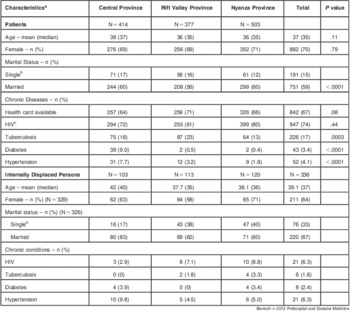
A total of 1,294 patients (response rate 99%) in 35 health facilities (one facility was found to be an orphanage) and 336 IDPs in nine camps, in Rift Valley, Nyanza, and Central Provinces completed the questionnaire. The IDP and patient participants had similar characteristics. Patient demographics were comparable across the three provinces; disease prevalence rates except for HIV infection varied (Table 1). A total of 67% of patients had a health record card; there were no differences among provinces in this respect. Sixty-one percent to 80% of facility-identified patients were HIV-infected, with fewer patients receiving therapy for tuberculosis, hypertension, or diabetes (Table 1). Of patient and IDP participants, two-thirds were female, most were married, and their mean and median age was in the late thirties. Among the sampled IDPs, 6% reported having HIV or hypertension; fewer had reported tuberculosis or diabetes.
Demographic Characteristics and Health Status of Patients Interviewed at Health Care Facilities (chi-squared statistics used to determine differences across provinces for categorical variables and t-test for continuous variables) and Internally Displaced Persons Interviewed at Camps, by Provinces, Kenya, March 10-21, 2008

aN in the subcategories does not total the overall N because some persons did not answer specific questions.
bsingle included divorced, separated or widowed.
cweighted.
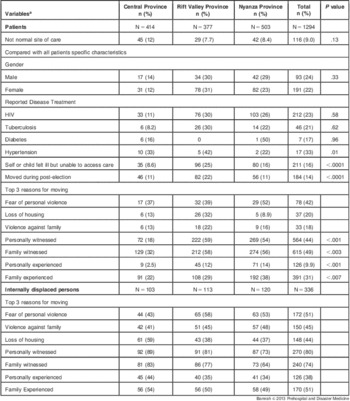
Of all 1,294 facility-based respondents, nine percent reported that they had not returned to their routine health care facility since the post-election unrest (Table 2). Of HIV-infected patients, 4.7% in Rift Valley, 6.8% in Nyanza, and 11% in Central Provinces had not returned. In Rift Valley Province, 25% of patients reported that they or their children were unable to access care at some point during the post-election period, as did 16% of patients in Nyanza Province, and nine percent of patients in Central Province (Table 2).
Migration among Internally Displaced Persons and Migration and Inability to Access Health Care among Patients During 2008 Post-Election Period, Kenya, March 10-21, 2008 (chi-squared statistics used to determine differences across provinces for categorical variables)

aN in the subcategories does not total the overall N because some persons did not answer specific questions.
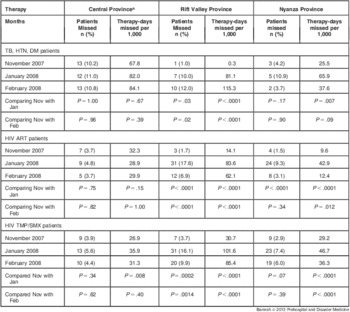
Fewer than 15% of patients receiving long-term therapies had more days of treatment interruption during the PEV period compared with days of interruption in November 2007. Interruptions in therapy overall were seen more in January 2008 than in February 2008 when compared with November 2007. In particular, Central Province saw no interruptions in February 2008 and more therapy-days missed only for trimethoprim/sulfamethoxazole prophylaxis in January compared with November 2007 (Table 3). In Nyanza, all participating patients had therapy-days missed in January, but only therapy-days missed significantly for ART and trimethoprim/sulfamethoxazole in February 2008. In addition, in Nyanza, no greater numbers of patients missed therapy except for ART patients in January compared with November 2007. Rift Valley Province was the most affected of the three provinces, with both significantly more therapy-days missed and numbers of patients missing all types of therapy assessed for January and February compared with November 2007 (Table 3).
Number of Patients Who Reported Missing Therapy (combined tuberculosis [TB], hypertensive [HTN] or diabetic [DM, insulin or oral hypoglycemic], and HIV [anti-retroviral therapy, ART, or trimepthoprim/sulfamethoxazole [TMP/SMX]), and the Number of Therapy-Days Missed per 1,000 Therapy-Days per Month by Province, Kenya (Poisson regression used to determine differences across provinces in rates of patient-days of therapy missed)

aThe higher rates of Central Valley patients missing therapy were predominately accounted for by higher prevalence rates of hypertensive and diabetic patients.
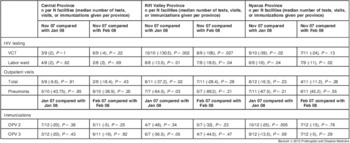
In Rift Valley and Nyanza Provinces, the numbers of women tested for HIV in labor wards to prevent mother-to-child transmission services decreased significantly in January and February 2008 compared with the November 2007 numbers, as did the numbers of persons tested for HIV through voluntary, counseling, and testing services (Table 4). In Central Province, no decreases were observed. No changes were seen in the numbers of patients tested for HIV at antenatal clinics, nor were there changes in the numbers of those presenting to HIV clinics at the provincial level. However, per province, only 58%-92% and 67%-75% of antenatal care and HIV clinics, respectively, had available registers. No increases were seen in stock-outs of nine antiretroviral or five TB drugs; although only 67%-80% of the facilities had ART records and 54%-63% of facilities had TB pharmaceutical records. The proportion of TB patients interviewed who received a ≥45-day supply of anti-TB medication increased from 4.6% in November 2007 to 69% in December 2007. The reason given for the increase was the anticipation of the holidays and the election. In Rift Valley Province, total outpatient visits decreased in January 2008 compared with November 2007 levels in eight of 10 facilities, while no significant changes were seen in the other provinces. Immunization rates were stable during the PEV period compared with the corresponding two months of 2007 for oral polio vaccine (OPV) 1, measles, tetanus, and Vitamin A. However, there were decreases in January 2008 compared with January 2007 in administration of OPV2 in 10 of 12 health facilities in Nyanza and in administration of OPV3 in 6 of 7 Rift Valley facilities, with available records.
Hospital, Clinical, and Immunization Register Counts (n = number of facilities with a decrease in number of tests, visits, or immunizations given per province, N = number of facilities per province with registers) Comparing Two Months of 2007 with the Two-Month Post-Election Violence Period by Province, Kenya (non-parametric Wilcoxon signed-rank test used to determine differences across provinces in counts for register data)

Abbreviations: VCT, Voluntary counseling and testing; †OPV, Oral polio vaccine
One fifth (22%) of patients in Rift Valley Province had moved as a result of PEV; this rate was greater than rates in the other two provinces (Table 2). Of all patients who moved, 74 (40%) reported being separated from their families at the time of the interview. Exposure of interviewed patients and their family members to violence was common and more frequently reported in Nyanza and Rift Valley Provinces than in Central Province. Although few patients had personally experienced violence (2.5%-14%), many had witnessed it (18%-59%) or reported that family members had experienced violence (22%-38%) (Table 2).
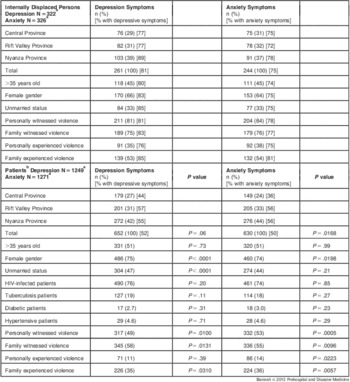
Anxiety and depression symptoms were common among patients per the HSCL-25—about half of those interviewed reported symptoms of anxiety and depression (Table 5). Significant associations were found between depression and anxiety symptoms and the various exposures to violence, with the exception of those who personally experienced violence and symptoms of depression. Prevalences of depression and anxiety symptoms among interviewed patients varied by province, with Central Province having lower prevalences than in the other two provinces. Among patients, associations were not found between the presence of HIV, tuberculosis, diabetes, or hypertension and the frequency of anxiety or depression symptoms. Being both female and not being married was associated with having depression symptoms, while being female only was associated with anxiety symptoms (Table 5).
Percentage of Demographic Characteristics, Violence Experiences, and Medical Conditions among Patients and Residents of Camps Presenting with Symptoms of Depression or Anxiety per Hopkins Symptom Checklist-25 (HSCL-25) in the Four Previous Weeks, Kenya, March 10-21, 2008

aN in the subcategories does not total the overall N because some persons did not answer specific questions.
bWeighted Surveyfreq procedure using the Taylor series method to account for clustering among patients only.
Selected IDPs more commonly reported personally experiencing (34%-44%) or witnessing (73%-89%) violence than patients in these provinces. IDPs had higher rates of depression and anxiety symptoms than patients per the HCSL-25 (approximately three-quarters (Table 5)). These percentages were the same across provinces and did not vary by age, gender, or marital status. Even though the majority of IDPs were married, about 80% of those with anxiety or depressive symptoms were unmarried.
Discussion
Although >10% of patients in all three provinces had moved or were unable to access their routine health care facility during the post-election period, most of these patients (>85%) avoided treatment interruptions in the post-election period compared with interruption proportions during the previous year. HIV-infected patients tended to experience no more difficulty adhering to medications during PEV than other patients on chronic therapies; non-adherence rates returned to baseline in February in Nyanza Province but remained higher in Rift Valley Province, suggesting that PEV effects may have resolved less rapidly in Rift Valley Province. The PEV effects on individuals and health care services differed across provinces, with Rift Valley Province the most and Central Province the least affected.
Symptoms of anxiety and depression were highly prevalent; half of the patients and three-quarters of IDPs showed anxiety or depression symptoms per the HSCL-25 following the PEV. The higher rates of both these symptoms among IDPs were expected based on previous studies. Exposures to violence were greater among IDP participants than among patients, and previous studies have shown that symptoms of affective disorders and of posttraumatic stress disorder are more common among IDPs than among persons who did not move during periods of violence.Reference Lopes Cardozo, Vergara, Agani and Gotway11 Differences by province in depression or anxiety symptom rates or prevalence of violent exposures were largely not found among interviewed IDPs, implying the same factors caused a person to become an IDP irrespectively of province. Prevalences of depression and anxiety symptoms among interviewed chronic disease patients in this study were associated with exposures to violence; such symptoms were less frequent in Central Province, where violence was less widespread than in Nyanza and Rift Valley Provinces.
Baseline associations between chronic diseases and affective disorders have been found in a variety of settings. The prevalence of depression and anxiety symptoms using the HSCL-25 among patients receiving treatment for diabetes or hypertension in semi-rural South Africa was found to be 38.5%; depression symptoms were 24.4% among a random sample of respondents in an area of rural Uganda with a high HIV prevalence rate.Reference Kagee13, Reference Bolton, Wilk and Ndogoni14 Moreover, a study using the Center for Epidemiologic Studies Depression Scale and Patient Health Questionnniare-9—two other standard depression assessments—found that the prevalence of depression was 47% among Ugandan HIV-infected adults and 34% among HIV-infected patients in western Kenya, respectively.Reference Kaharuza, Bunnell and Moss15, Reference Monahan, Shacham and Reece16 However, these rates are lower than or similar to the rates found in the current survey, where HIV infection as not found to be associated with higher rates of depression and anxiety symptoms, implying that the PEV may have had an additive effect contributing to the higher rates of depression and anxiety symptoms seen.
There were a number of limitations to this study. First, given the difficulty of hiring personnel and mobilizing into the most affected areas, the survey took place later than initially designed (March 2008). Secondly, the assessment design did not allow capture of information from patients who could have been most affected by the PEV—those who still had not returned to health care facilities. In addition, the impact of the unrest may have varied within provinces or smaller jurisdictions preventing significant effects from being detected in a provincial-level analysis.
This study used convenience samples of non-HIV-infected patients and IDPs and therefore, the ability to generalize the findings is limited. Furthermore, HSCL-25 cannot assess the severity of affective disorder symptoms, nor has it been validated in the Kenyan context. Such shortcomings may affect the clinical ability to use the instrument to detect depression or anxiety disorders in these populations.Reference Kaaya, Fawzi and Mbwambo17, Reference Lee, Kaaya and Mbwawbo18 Anxiety and depression symptoms may be normal for a limited time after unusually stressful events, but persistence of these symptoms would be consistent with significant psychiatric disorders, such as posttraumatic stress disorder and major depression. Among IDPs who continued to reside in camps (almost 30,000 in July 2008—seven months after the election), the risk of psychiatric morbidity was increased, because conditions in Kenyan IDP camps continued to lack basic services.19, 20 The duration of symptoms could not be assessed by a one-time evaluation. However, most victim studies that have assessed the course of posttraumatic stress disorder after disasters suggest that symptoms persist for a few years.Reference Galea, Nandi and Vladov21
The data demonstrate that the PEV had a negative impact on health services, but also that affected facilities and staff managed to cope with many challenges that arose and that most health system adverse effects were short-lived. Even in Rift Valley Province, the most severely affected area, there was an impact on facility services, although facility closures were less than the media's reported 30%.Reference Gettleman22
Out of the findings, a series of recommendations in regard to preparedness and response is proposed. As countries expand the number of patients receiving ART, contingency plans for medication delivery and communication in the event of crisis or natural disasters should occur from the outset. Many facilities in Kenya routinely dispense 30-day supplies of ART, but in numerous facilities, greater quantities were dispensed in anticipation of upcoming holidays and national elections (Dr. Lyndon Marani, Kenya Ministry of Health, personal communication, August 2008). Tuberculosis patients received a substantially greater medication supply in December 2007—a decision that subsequent events proved to be judicious. National HIV program planners should consider whether it would be feasible to provide integrated services for additional chronic diseases and to reduce the frequency of visits for medication refills, an approach that could reduce patient transport requirements, cost, and burden on the health care system.Reference Janssens, Van Damme and Raleigh23-Reference Philips, Zachariah and Venis25
Only 67% of patients had individual health cards at the time of interview, potentially complicating the provision of therapy to these patients. The importance of these cards should be emphasized to patients and health care workers, including their completeness and accuracy. Patient education should emphasize knowing medications’ names and carrying adequate supplies whenever a patient leaves home. During a widespread crisis, it is reasonable and desirable for health care facilities to share patient information, without undue consent procedures. Finally, facilities should routinely collect patients’ telephone numbers, and facilities should give patients telephone numbers to call to request medical record information.
Unfortunately, countries with the highest proportion of persons living with HIV/AIDS often have limited resources, and their governments may be unstable. The medical community did not feel this was the case in Kenya before December 2007. The Kenyan HIV and TB patients probably had lower rates of non-adherence during the PEV because of health care workers’ foresight and anticipation of holidays and national elections; other countries may not be as fortunate during manmade or natural disasters. Emergency preparedness, including mechanisms to communicate better with the end-users and to ensure constant delivery of medications, needs to be established ahead of time and be a part of any health care system that is trying to increase coverage to vulnerable populations that require daily medications.
While the immediate reaction to these types of emergencies often rightfully focuses on establishing safe environments and access to food and medical care, the mental health needs of people in these situations are extensive. The very high rates of anxiety and depression symptoms indicate the need for expanded access to treatment and attention to mental health issues during civil unrest. This was especially true among unmarried patients and IDPs who had high rates of depressive symptoms; these persons may lack personal support and would benefit from expanded attention to mental health. In addition, in settings with a high prevalence of persons taking ART, as in Sub-Saharan Africa, interventions may need to incorporate concerns of HIV-infected persons who may also experience high background rates of depression. Although evidence of effective interventions during conflicts is weak, interventions for depression in primary care have been shown to be cost-effective.Reference Patel, Araya and Chatterjee26 Further research of psychiatric issues among affected populations is warranted.
Conclusions
Post-election violence disturbed access to routine medication and services and was associated with substantial mental health symptoms; however, more than 85% of patients avoided treatment interruptions, including patients taking ART. Many facilities in Kenya dispensed more than 30-day supplies of ART and anti-TB medication in anticipation of upcoming holidays and national elections—a decision that subsequent events proved to be judicious and may be useful in similar situations elsewhere.
Acknowledgments
The findings and conclusions in this manuscript are those of the authors and do not necessarily represent the views of the US Centers for Disease Control and Prevention.
The authors would like to give special thanks to Drs. Patrick Nguku and Kibet Sergon for initial support in the assessment; to Ms. Odylia Muhenje and Dr. Nicolas Wambua for their leadership and performance during data collection; and to Dr. Allen Hightower and Mr. Curtis Blanton for their contribution to study design and analyses, respectively.