INTRODUCTION
Coastal zones are mainly understood as large areas between continental and marine environments that allow the coexistence of many depositional environments, such as tidal plains, deltas, beaches, dunes, estuaries, lagoons, etc. (Souza et al. Reference Souza, Filho, Esteves, Vital, Dillenburg, Patchineelam and Addad2005). Fifteen percent of the world’s coastal zones are constituted by lagoons, one of the most productive ecosystems of the biosphere (Barroso and Bernardes Reference Barroso and Bernardes1995). Lagoon areas are present throughout the Brazilian coast, most predominant in Rio de Janeiro and Rio Grande do Sul States (Esteves Reference Esteves1998). Some of these lagoons are hypersaline, especially in Rio de Janeiro State. This is the case of the Lagoa Salgada, which presented hypersaline characteristics throughout its formation, a condition favored by the marine influence. Recent studies pointed to a semi-arid local climate and the depth reduction of the Lagoa Salgada caused by the combination of low precipitation and high evaporation rates (Silva et al. Reference Silva, Mansur and Almeida2018) that may be related to climate change and/or anthropogenic impact over the years (Moreira-Turcq Reference Moreira-Turcq2000). Many coastal lagoons were formed by transgressions and regressions of the coastline over the years. These lagoons have been the target of many studies in the last years for having recent stromatolites, among them is Lagoa Salgada.
Hypersaline lagoons are the perfect environments for stromatolite formation. Stromatolites are organosedimentary structures formed by complex interactions of microbial mats and the surrounding environmental factors, registering environmental records from the time of their formation. The first example of a recent stromatolite was found in Shark Bay, Australia, in 1954, before that they were considered extinct by researchers (Dupraz et al. Reference Dupraz, Reid, Visscher, Reitner and Thiel2010). The stromatolites are classified in the microbialites group, a type of organic sedimentary deposits that have been mineralized as a result of a benthic microbial community trapping and binding sediments and/or forming the site of mineral precipitation (Burne and Moore Reference Burne and Moore1987). The cyanobacteria are the dominant microorganisms in stromatolites, mainly responsible for carbonate minerals (CaCO3) precipitation in microbial mats (Dupraz et al. Reference Dupraz, Reid, Braissant, Decho, Norman and Visscher2009). The precipitation function of the current mineral in hypersaline lagoons seems to vary according to the environmental conditions and the metabolism of the lagoon, so the formation of stromatolites changes from one system to another (Dupraz et al. Reference Dupraz, Reid, Braissant, Decho, Norman and Visscher2009). These organisms are believed to have dominated 80% of all geological formations on planet Earth and are the oldest evidence of life found, dating back to around 3.5 billion years (Vologdin Reference Vologdin1962; Hofmann Reference Hofmann1969, Reference Hofmann1973; Walter Reference Walter1976; Grotzinger and Knoll Reference Grotzinger and Knoll1999; Riding and Awramik Reference Riding and Awramik2000). In addition, they represent a great material in research areas like carbon sources studies (Braissant et al. Reference Braissant, Cailleau, Aragno and Verrecchia2004), petrography (Awramik and Buchheim Reference Awramik and Buchheim2012; Pizarro and Branco Reference Pizarro and Branco2012), and paleoclimatic reconstruction (Vasconcelos and McKenzie Reference Vasconcelos and McKenzie1997; Silva e Silva and Senra Reference Senra2000; Vasconcelos et al. Reference Vasconcelos, Warthmann, McKenzie, Visscher, Bittermann and van Lith2006; Iespa et al. Reference Iespa, Iespa and Borghi2012; Bahniuk Reference Bahniuk2013; Birgel et al. Reference Birgel, Meister, Lundberg, Horath, Bontognali, Bahniuk, De Rezende, Vasconcelos and Mckenzie2015; Carvalho et al. Reference Carvalho, Oliveira, Macario, Guimarães, Keim, Sabadini-Santos and Crapez2017).
14C dating is the main chronology technique used to estimate the stromatolite growth pattern enabling the comprehension of the growth processes through the correlation with environmental proxies present within the layers (Lemos Reference Lemos1994; Srivastava Reference Srivastava1999; Carvalho et al. Reference Carvalho, Oliveira, Macario, Guimarães, Keim, Sabadini-Santos and Crapez2017; Bahniuk Reference Bahniuk2013; Nascimento et al. Reference Nascimento, Eglinton, Haghipour, Albuquerque, Bahniuk, Mckeniz and Vasconcelos2019). However, before using 14C for dating purposes some questions have to be answered. Was the calibration curve the one that best represents the studied environment? Do the results obtained actually represent the exact moment that the structure started its growth? In lagoon ecosystems since the marine environment may influence samples, how was the local marine reservoir effect taken into account? Thus, the purpose of this work is to analyze the 14C dating results found in the literature for Lagoa Salgada and debate their calibration and local corrections, in order to understand the implications of appropriate data handling to the environmental evolution studies.
STUDY AREA
The Lagoa Salgada region (41º01’31“W–41º00’09”W and 21º55’20“S–21º54’10”S) is characterized by a record of geological evolution associated with oscillations in the relative sea level during the Late Quaternary, formed during the development of the deltaic complex of the Paraíba do Sul river (Lamego Reference Lamego1955; Iespa et al. Reference Iespa, Iespa and Borghi2012) and can be classified as a restinga plain lagoon (Soffiati Reference Soffiati1998) (Figure 1).
Lagoa Salgada location map, Rio de Janeiro State, Brazil. Adapted from Google (2022).

Previous studies consider that the age of formation of the lagoon is 3780 ± 170 years BP, estimated through mollusk shells dating in association with sediments (Srivastava Reference Srivastava1999). Lemos (Reference Lemos1994) estimated its surface area as 16 km2, with a length of 8.6 km and a maximum width of 1.9 km. However, the occurrence of paleo-margins indicates that the lagoon was larger in dimensions and depth in the past. It is located in the emerging portion of the Campos Basin, which is a sedimentary basin with a divergent margin that coincides with characteristics of other basins along the Brazilian coast, formed during the separation of the Gondwana paleocontinent (Dias et al. Reference Dias, Carminatti, Scarton, Guardado and Esteves1991).
The occurrence of a western boundary upwelling system promotes particular climatic characteristics of the semi-arid within a tropical environment. This atypical climatic condition is the key to the development of stromatolite structures in this region (Vasconcelos et al. Reference Vasconcelos, Warthmann, McKenzie, Visscher, Bittermann and van Lith2006). In addition, the non-stratification of water and its transparency favor the light penetration necessary for the cyanobacteria photosynthetic activity and subsequent precipitation of calcium carbonate and the sea level variation has transported nutrients that may have improved algae metabolism, contributing to the appearance of stromatolites in this location (Iespa et al. Reference Iespa, Iespa and Borghi2012).
According to Martin et al. (Reference Martin, Suguio, Dominguez, Flexor and Azevedo1984, Reference Martin, Suguio and Flexor1993), the Paraíba do Sul deltaic complex was an open ocean system during its formation. The geological characteristics of the region favored the formation of barrier islands in a second stage. This result was corroborated subsequently by the work of Pereira (Reference Pereira2014), Blanco (Reference Blanco2014), Silva (Reference Silva2017), and Cruz et al. (Reference Cruz, Barbosa, Blanco, Oliveira, Silva and Seoane2019). According to these authors, the Lagoa Salgada was formed after a phase of Paraíba do Sul river coastal plain erosion and relative sea level rising.
Bahniuk (Reference Bahniuk2013) determined three formation phases: the initial phase around 2300 yrs BP, a water body open to the ocean with a terrestrial influence; a transitional phase between 1982 ± 91 yrs BP and 1128 ± 100 yrs BP; and the final phase, dated between 592 ± 95 yrs BP and 260 ± 99 yrs BP, representing a restricted system, totally microbial. However, Dorneles (Reference Dorneles2018) studied bivalves trapped in the lower layers of the stromatolite and proposed that an estuarine environment may have appeared around 2300 yrs BP. One can observe that the radiocarbon data from Bahniuk (Reference Bahniuk2013) and from Dorneles (Reference Dorneles2018) are only presented in conventional radiocarbon ages (14C yrs BP). It is important to mention that using only laboratory measurements is not appropriate, especially in environmental studies where the data should be calibrated using the specific calibration curve and the local reservoir offset should be taken into account (Millard Reference Millard2014).
In addition, Srivastava (Reference Srivastava1999) affirmed that this lagoon is the only one in Brazil with the occurrence of well-developed columnar, widespread, and stratiform carbonate stromatolites from the Holocene. According to Damazio (Reference Damazio2004), this occurrence is directly favored by the presence of cyanobacteria and extreme physical and chemical conditions (hypersaline environment) associated with carbonate sedimentation. Coimbra et al. (Reference Coimbra, Silva, Barbosa and Mueller2000), used 14C-AMS dating in recent stromatolite associated with pollen analysis from sediment cores to infer dry/wet phases during the stromatolite growth and created the hypothesis that the stromatolite growth started at 2260 ± 80 yrs BP under drier climatic conditions, and finished around 290 ± 80 yrs BP during humid conditions that may have the presence of the grazing organisms, such as microgastropods, leading them to graze cyanobacteria, inhibiting stromatolite growth. Coimbra et al. (Reference Coimbra, Silva, Barbosa and Mueller2000) data were presented as conventional radiocarbon ages, not calibrated. Then, Iespa et al. (Reference Iespa, Iespa and Borghi2012) demonstrated that it is possible to carry out a paleoenvironmental analysis on stromatolite using the petrographic technique, showing that the bioerosion and dissolution varied along the stromatolite, thus indicating changes in the lagoon, such as increased pH, reduced turbulence and water circulation and reduced biological activity, with filamentous cyanobacteria settling on the upper layer of the stromatolites. Silva et al. (Reference Silva, Alves, Magina and Gomes2013) identified 21 species of cyanobacteria in stromatolites from Lagoa Salgada, the most representative of which are Microcoleus chthonoplastes and Lyngbya aestuarii. Callefo (Reference Callefo2014) studied biominerals as a way of understanding microbial biosignatures and Silva et al. (Reference Silva, Mansur and Almeida2018) mapped microbialites types, identifying damage and threats and providing suggestions for local geoconservation. Birgel et al. (Reference Birgel, Meister, Lundberg, Horath, Bontognali, Bahniuk, De Rezende, Vasconcelos and Mckenzie2015) associated microbial processes to evaluate the role of methanogenesis in the formation of 13C-enriched stromatolites in Lagoa Salgada. Nascimento et al. (Reference Nascimento, Eglinton, Haghipour, Albuquerque, Bahniuk, Mckeniz and Vasconcelos2019) dated a sediment core from Lagoa Salgada in order to evaluate influences on carbonate geochemistry and mineralogy. In their work the base of the core was dated (2620 ± 93 yrs BP) and the same result as the calibrated date (2600 yrs cal BP).
METHODS
A bibliographic survey, which includes studies carried out in the Lagoa Salgada using the radiocarbon dating technique, was made. Among them, we chose four works that could be improved by radiocarbon revision and calibration.
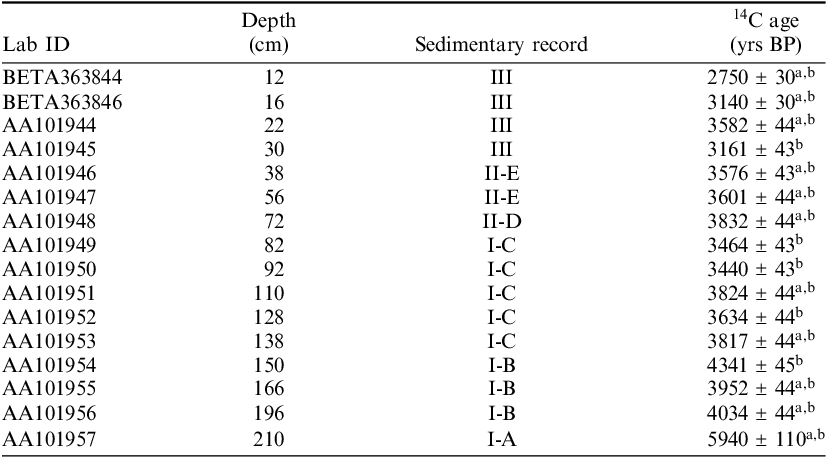
A sediment core was studied by Cruz et al. (Reference Cruz, Barbosa, Blanco, Oliveira, Silva and Seoane2019) and radiocarbon data were calibrated using the IntCal13 curve (Reimer et al. Reference Reimer, Bard, Bayliss, Beck, Blackwell, Bronk Ramsey, Buck, Cheng, Edwards and Friedrich2013), the available atmospheric curve for the northern hemisphere at the time (Table 1). Not only the Southern Hemisphere curve SHCal (Hogg et al. Reference Hogg, Heaton, Hua, Palmer, Turney and Southon2020) would better represent terrestrial environments in the study region, but atmospheric curves are characterized by high-frequency oscillations which reflect the variability of radiocarbon production due to cycles of Solar intensity. Although freshwater influence may have been an important factor in carbon dynamics in the context of Lagoa Salgada, that may not well represent coastal environments influenced by the sea. The same sediment core was studied by Blanco (Reference Blanco2014) and radiocarbon data were calibrated using an atmospheric curve with a local marine reservoir offset correction of ΔR = 8 ± 17 yrs BP (Angulo et al. Reference Angulo, Souza, Reimer and Sasaoka2005) for some depth was considered submerged at that time as indicated by other proxies, which is not appropriate.
Lagoa Salgada sediment core information and 14C age results presented in Cruz et al. (Reference Cruz, Barbosa, Blanco, Oliveira, Silva and Seoane2019) and Blanco (Reference Blanco2014) previous work.

a Lagoa Salgada sediment data from Cruz et al. (Reference Cruz, Barbosa, Blanco, Oliveira, Silva and Seoane2019).
b Lagoa Salgada sediment data from Blanco (Reference Blanco2014).
In such a context, the marine reservoir effect can be rather relevant in 14C calibration. In order to take into account both marine and continental influences in specific sites, the Marine curve, presently Marine20 (Heaton et al. Reference Heaton, Köhler, Butzin, Bard, Reimer, Austin, Bronk Ramsey, Grootes, Hughen, Kromer, Reimer, Adkins, Burke, Cook, Olsen and Skinner2020), is used together with a local offset ΔR (Alves et al. Reference Alves, Macario, Spotorno, Oliveira, Muniz, Fallon, Souza, Salvador, Eschner and Bronk Ramsey2020). ΔR values are usually empirical data obtained from the comparison of known age marine materials or combinations of coeval terrestrial and marine samples. The available data for the Southeastern Brazilian Coast comprise studies based on archaeological sites (Alves et al. Reference Alves, Macario, Souza, Aguilera, Goulart, Scheel-Ybert, Bachelet, Carvalho, Oliveira and Douka2015a, Reference Alves, Macario, Souza, Pimenta, Douka, Oliveira, Chanca and Angulo2015b; Carvalho et al. Reference Carvalho, Macario, Oliveira, Oliveira, Chanca, Alves and Douka2015; Macario et al. Reference Macario, Souza, Aguilera, Carvalho, Oliveira, Alves, Chanca, Silva, Douka, Decco, Trindade, Marques, Anjos and Pamplona2015, Reference Macario Kita, Alves, Chanca, Oliveira, Carvalho, Souza, Aguilhera, Tenório, Rapagña, Douka and Silva2016a, Reference Macario, Alves, Carvalho, Oliveira, Ramsey, Chivall, Souza, Simone and Cavallari2016b, Reference Macario, Tenório, Alves, Oliveira, Chanca, Netto, Carvalho, Souza, Aguilera and Guimarães2017, Reference Macario, Alves, Belém, Aguilera, Bertucci, Tenório, Oliveira, Chanca, Carvalho, Souza, Scheel-Ybert, Nascimento, Dias and Caon2018) and those based on known age shells from museum collections (Macario et al. Reference Macario, Souza, Aguilera, Carvalho, Oliveira, Alves, Chanca, Silva, Douka, Decco, Trindade, Marques, Anjos and Pamplona2015). Although rarely available, ideally ΔR values should be chosen from the closest point in time and space, since local effects are expected to vary with time as the geographic features of the site evolves. Global variations of the marine reservoir effect with time are better represented by the Marine20 curve, but it is important to notice that available values in literature from previous studies need to be recalculated before use. It is important to mention that Nascimento et al. (Reference Nascimento, Eglinton, Haghipour, Albuquerque, Bahniuk, Mckeniz and Vasconcelos2019) data set was not included in the present work since it was not possible to distinguish if the data presented are conventional 14C age and how it was calculated.
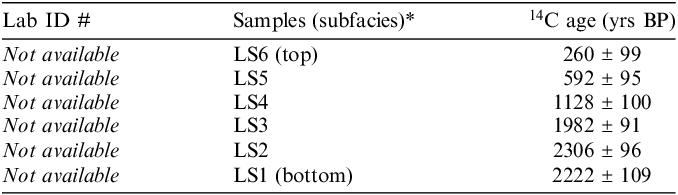
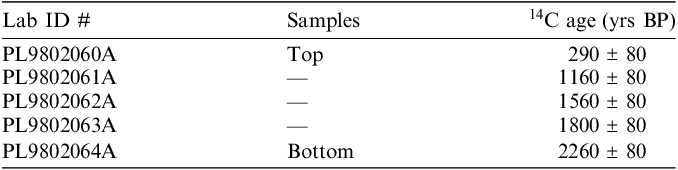
Bahniuk (Reference Bahniuk2013) and Coimbra et al. (Reference Coimbra, Silva, Barbosa and Mueller2000) studied recent stromatolite samples from Lagoa Salgada, measuring different layers along the growth direction, with the aim of understanding the lagoon’s geological evolution and the impacts of environmental changes on stromatolite growth. Results, however, have been reported in Conventional Radiocarbon Ages (Tables 2 and 3), which consider that the organisms have lived in isotopic equilibrium with the atmosphere and radiocarbon production has been constant over time. However, carbonate samples from marine or lagoon origin are formed in isotopic equilibrium with such an environment, and therefore their radiocarbon ages should take into account the marine reservoir effect and both global and local variations of 14C concentration over time, i.e., they need to be calibrated with the marine curve and the local offset ΔR should be considered.
Lagoa Salgada Stromatolite information and results presented in Bahniuk (Reference Bahniuk2013).

* Bahniuk (Reference Bahniuk2013) sample code.
Lagoa Salgada Stromatolite information and results presented in Coimbra et al. (Reference Coimbra, Silva, Barbosa and Mueller2000).

The present work aims to improve the discussion about Lagoa Salgada environmental evolution through the calibration and reservoir offset corrections applied to the radiocarbon dates from Blanco (Reference Blanco2014), Cruz et al. (Reference Cruz, Barbosa, Blanco, Oliveira, Silva and Seoane2019), Bahniuk (Reference Bahniuk2013), and Coimbra et al. (Reference Coimbra, Silva, Barbosa and Mueller2000). As the studied site is influenced by both the sea and the continental sources we opted to consider a wide possible ΔR ranging from low positive values, representing the influence of average global surface ocean, since no strong upwelling or old carbonate sources are present, to very negative ones, representing maximum continental influence with no high frequency oscillations. Although the competition between marine and freshwater influence is expected to vary with time in the studied region (Macario et al. Reference Macario, Alves, Belém, Aguilera, Bertucci, Tenório, Oliveira, Chanca, Carvalho, Souza, Scheel-Ybert, Nascimento, Dias and Caon2018) there is not enough data to estimate such variation at the present time. The radiocarbon dates were calibrated using Marine20 calibration curve (Heaton et al. Reference Heaton, Köhler, Butzin, Bard, Reimer, Austin, Bronk Ramsey, Grootes, Hughen, Kromer, Reimer, Adkins, Burke, Cook, Olsen and Skinner2020) with the OxCal software v4.2.4 (Bronk Ramsey Reference Bronk Ramsey2013) and ΔR was considered undetermined within (-400,100), since all available ΔR values for the surrounding region are compatible with this range (Carvalho et al. Reference Carvalho, Macario, Oliveira, Oliveira, Chanca, Alves and Douka2015; Alves et al. Reference Alves, Macario, Spotorno, Oliveira, Muniz, Fallon, Souza, Salvador, Eschner and Bronk Ramsey2020).
A depositional model considering a uniform sequence was applied to the sediment core results from Blanco (Reference Blanco2014) and Cruz et al. (Reference Cruz, Barbosa, Blanco, Oliveira, Silva and Seoane2019) using boundaries that consider the sedimentary records and its units and subunits as observed by the authors. Due to its natural depositional pattern, the OxCal model applied to the stromatolite samples from Bahniuk (Reference Bahniuk2013) and Coimbra et al. (Reference Coimbra, Silva, Barbosa and Mueller2000) was a simple sequence prioritizing layer order.
CALIBRATION RESULTS AND ENVIRONMENTAL DISCUSSION
Using 14C results obtained for a sediment core from Blanco (Reference Blanco2014) and Cruz et al. (Reference Cruz, Barbosa, Blanco, Oliveira, Silva and Seoane2019) (model code SED) and for stromatolites from Bahniuk (Reference Bahniuk2013) (model code STM1) and Coimbra et al. (Reference Coimbra, Silva, Barbosa and Mueller2000) (model code STM2) we created one chronological model for each case. For both, we analyzed the agreement index using the Outlier_model in OxCal software.
For the sediment samples, an agreement index (A_model) of 12.3% was obtained and the Outlier_model has shown that SED-3, SED-5, and SED-13 layers should be considered outliers a posteriori with 99%, 80%, and 100% of probability, respectively.
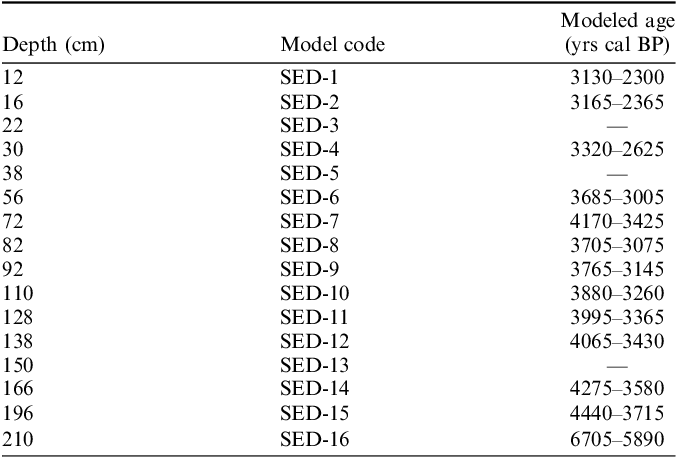
Without SED-3, SED-5, and SED-13 the agreement index (A_model) was improved to 91.4% and the model presented in Figure 2 was used in the present work. Table 4 presents the sediment core calibrated results after modeling within 95.4% probability.
Sedimentary deposition model for the Lagoa Salgada based on calibration of Blanco (Reference Blanco2014) and Cruz et al. (Reference Cruz, Barbosa, Blanco, Oliveira, Silva and Seoane2019) published raw data (SED). Calibration was made using Marine20 curve (Heaton et al. Reference Heaton, Köhler, Butzin, Bard, Reimer, Austin, Bronk Ramsey, Grootes, Hughen, Kromer, Reimer, Adkins, Burke, Cook, Olsen and Skinner2020) and OxCal v4.4.4 software (Bronk Ramsey Reference Bronk Ramsey2021).

Sediment core from Lagoa Salgada modeled calibrated results based on Cruz et al. (Reference Cruz, Barbosa, Blanco, Oliveira, Silva and Seoane2019) and Blanco (Reference Blanco2014) previous data (SED). Calibration was made using Marine20 curve (Heaton et al. Reference Heaton, Köhler, Butzin, Bard, Reimer, Austin, Bronk Ramsey, Grootes, Hughen, Kromer, Reimer, Adkins, Burke, Cook, Olsen and Skinner2020) and OxCal v4.4.4 software (Bronk Ramsey 2021).

According to Blanco (Reference Blanco2014) and Cruz et al. (Reference Cruz, Barbosa, Blanco, Oliveira, Silva and Seoane2019) the base of core corresponds to the period that the sea level has risen 5 m above the actual sea level (Martin et al. Reference Martin, Suguio, Dominguez, Flexor and Azevedo1984), what in the present work corresponds to 6705–5890 yrs cal BP (SED-16) and the actual area of Lagoa Salgada should probably be submerged at that time influenced by a high energy hydrodynamic condition (Pereira Reference Pereira2014). The following period 4440–3715 yrs cal BP (SED-15) and 4275–3580 yrs cal BP (SED-14) (interval in green in Figure 2) have shown high sedimentation rate and fine grain size indicating the influence of a high energy environment, due to barrier island formation and waves influence during the last marine regression. According to Blanco (Reference Blanco2014) and Cruz et al. (Reference Cruz, Barbosa, Blanco, Oliveira, Silva and Seoane2019), the fluvial influence in the first phase is evidenced by the depletion of stable isotopes C and N.
In Figure 2 the layers SED-8 to SED-12 (in red) cover the interval between 4065–3430 yrs cal BP (SED-12) and 3705–3075 yrs cal BP (SED-8) and according to Blanco (Reference Blanco2014) and Cruz et al. (Reference Cruz, Barbosa, Blanco, Oliveira, Silva and Seoane2019) they are related to changes in the system energy favoring the discharge of sediments from Paraíba do Sul river what is corroborated by Martin et al. (Reference Martin, Suguio, Dominguez, Flexor and Azevedo1984), Martin et al. (Reference Martin, Suguio and Flexor1993) and Pereira (Reference Pereira2014). Following these works, Lagoa Salgada formation occurred until 3685–3005 yrs cal BP (SED-6) (boudeaux interval in Figure 2). Additionally, this period is marked by the predominance of a humid climate, when there was an outcrop of the coast and successive episodes of marine regression (Nascimento et al. Reference Nascimento, Eglinton, Haghipour, Albuquerque, Bahniuk, Mckeniz and Vasconcelos2019). A high deposition of organic materials in the sediment suggests input of terrigenous material from the Paraíba do Sul river under low energy conditions, which converges with the sandy lagoon sediments rich in organic matter and bivalve shells in sandy-clay sediments found around the São Tomé region (Martin et al. Reference Martin, Suguio and Flexor1993). Around 4000 yrs BP there were cold event fluctuations that enhanced the precipitation (Strikis et al. Reference Strikis, Cruz, Cheng, Karmann, Edwards, Vuille, Wang, De Paula, Novello and Auler2011), as one can observe in Figure 2 the inversion during the bourdeaux interval may be a reflection of these events.
The abrupt change in geological characteristics during 3320–2625 yrs cal BP (SED-4), is registered by the presence of carbonate nodules in the middle of the siliciclastic sediments (Blanco Reference Blanco2014; Cruz et al. Reference Cruz, Barbosa, Blanco, Oliveira, Silva and Seoane2019). This sedimentation suggests variation in the environmental conditions due to the lagoon’s hypersalinity, the semi-arid influence of the site, and due to upwelling (Nascimento et al. Reference Nascimento, Eglinton, Haghipour, Albuquerque, Bahniuk, Mckeniz and Vasconcelos2019), leading to the precipitation of salts and carbonates in a low-energy environment. Other proxies studied by Blanco (Reference Blanco2014) and Cruz et al. (Reference Cruz, Barbosa, Blanco, Oliveira, Silva and Seoane2019) in the sediments from the interval 3320–2625 yrs cal BP (SED-4) indicate a mixture of C sources, suggesting a system with estuarine physical-chemical characteristics.
The sedimentological records from 3165–2365 yrs cal BP (SED-2) interval (ciano interval in Figure 2) suggest environmental conditions enabling stromatolite formation with microbial mats presence until 3130–2300 yrs cal BP (SED-1). The former (latter) period better represent the one reported in Blanco (Reference Blanco2014) and Cruz et al. (Reference Cruz, Barbosa, Blanco, Oliveira, Silva and Seoane2019) as the interval between 2870–2757 yrs cal BP. Additionally, as presented in their works this last environmental change to a lagoon system with autochthonous C production and microbial activity indicates that the lagoon was already formed at that time being completely isolated from the sea.
The lagoon formation was registered in the top layers of the sediment core and in the present work, we proposed a model for the recent stromatolite data from Bahniuk (Reference Bahniuk2013) and Coimbra et al. (Reference Coimbra, Silva, Barbosa and Mueller2000) in order to improve the lagoon’s geological evolution comprehension. The first model (STM1) showed an agreement index (A_model) of 96% while the second model (STM2) agreement index was (A_model) 102.3%. Both growth models can be observed in the figures below (Figures 3 and 4) and the calibrated results are shown in Table 5.
Stromatolite growth model based on Bahniuk (Reference Bahniuk2013) 14C-dated samples (STM1). Calibration was made using Marine20 curve (Heaton et al. Reference Heaton, Köhler, Butzin, Bard, Reimer, Austin, Bronk Ramsey, Grootes, Hughen, Kromer, Reimer, Adkins, Burke, Cook, Olsen and Skinner2020) and OxCal v4.4.4 software (Bronk Ramsey Reference Bronk Ramsey2021).

Stromatolite growth model based on Coimbra et al. (Reference Coimbra, Silva, Barbosa and Mueller2000) 14C-dated samples (STM2). Calibration was made using Marine20 curve (Heaton et al. Reference Heaton, Köhler, Butzin, Bard, Reimer, Austin, Bronk Ramsey, Grootes, Hughen, Kromer, Reimer, Adkins, Burke, Cook, Olsen and Skinner2020) and OxCal v4.4.4 software (Bronk Ramsey Reference Bronk Ramsey2021).

Lagoa Salgada Stromatolite modeled calibrated results based on Bahniuk (Reference Bahniuk2013) (STM1) and Coimbra et al. (Reference Coimbra, Silva, Barbosa and Mueller2000) (STM2) previous data. Calibration was made using Marine20 curve (Heaton et al. Reference Heaton, Köhler, Butzin, Bard, Reimer, Austin, Bronk Ramsey, Grootes, Hughen, Kromer, Reimer, Adkins, Burke, Cook, Olsen and Skinner2020) and OxCal v4.4.4 software (Bronk Ramsey Reference Bronk Ramsey2021).

The models presented in Figures 3 and 4 were made based on the stromatolite radiocarbon results from Bahniuk (Reference Bahniuk2013) and Coimbra et al. (Reference Coimbra, Silva, Barbosa and Mueller2000), respectively, where it is possible to observe 3 different phases in lagoonal evolution. The first phase (phase I, yellow in Figures 3 and 4) from 2410 to 1705 yrs cal BP (STM1) and 2330 to 1695 yrs cal BP (STM2) is related to an open sea environment indicated by clumped isotope methodology and biomarker fingerprints (BIT index, δ13C and δ18O) (Bahniuk, Reference Bahniuk2013) and with high biological activity and turbulence as observed in petrographic analysis by Iespa et al. (Reference Iespa, Iespa and Borghi2012). They also found high porosity in stromatolite samples marked by bioerosion and dissolution indicating a good pattern for reservoirs.
According to pollen analysis from Coimbra et al. (Reference Coimbra, Silva, Barbosa and Mueller2000) a dryer period started in 2540 ± 60 yrs BP. This arid climatic condition is corroborated by Lemos (Reference Lemos1994) that found a color pattern alternance in a laminated sediment core deposition showing siliciclastic sediments (light color) and dark sediments with many carbonate grains due to high evaporation associated with low rainfall favoring water column reduction and CaCO3 concentration improvement.
From 1980 to 555 yrs cal BP (STM1) and 1805 to 585 yrs cal BP (STM2) was observed a transitional phase (phase II, green in Figures 3 and 4) with the presence of micro gastropods from estuarine and lagoonal environments (Dorneles Reference Dorneles2018; Bahniuk Reference Bahniuk2013). This conclusion is in agreement with Iespa et al. (Reference Iespa, Iespa and Borghi2012) that pointed out that this phase represents the primary stage of lagoon formation, also called a coastal lake when separated from the sea by narrow barriers of land (Mohan et al. Reference Mohan, Short, Cambers, MacLeod, Cooper, Hopley and Craig-Smith2005). In this phase, petrographic analysis indicated water turbulence decrease, dissolution, bioerosion processes, and current influence decreased in the internal records of the stromatolite, in addition, a gradual increase in salinity was observed. In Lemos (Reference Lemos1994), this phase is seen in a mud package that contains medium to fine-sized quartz grains, and on top of which there are microgastropods and bioturbations with an abundance of shell fragments, which can be interpreted as a lagoon environment, with warm, calm and saline waters.
The final phase of the lagoon (phase III, pink in Figures 3 and 4) occurred from 555 yrs cal BP to present days (STM1) and from 585 yrs cal BP to present days (STM2) which according to Bahniuk (Reference Bahniuk2013) is a totally bio-influenced environment. The petrographic analysis by Iespa et al. (Reference Iespa, Iespa and Borghi2012) evaluated this phase where the lagoon ended its formation, marked by the decrease in water circulation end the presence of bioclasts in the mats, but the cyanobacteria are more adapted to extreme conditions and continue to produce layers in the stromatolites, although continuous and wavy. Reducing the porosity of the top layers. According to Coimbra et al. (Reference Coimbra, Silva, Barbosa and Mueller2000), a humid climate has developed in the region in the last 400 years, according to the pollen analysis, coinciding with this final phase of the Lagoa Salgada. Furthermore, the work considers that this climate favors the growth of micro gastropods, observed in the upper organic mud layer.
After the proper calibration of the radiocarbon data set from previous works, it is possible to correlate the environmental evolution of Lagoa Salgada with the accurate period that the events occurred as observed in the 4 kyrs BP event obtained through Th/U mentioned by Strikis et al. (Reference Strikis, Cruz, Cheng, Karmann, Edwards, Vuille, Wang, De Paula, Novello and Auler2011).
CONCLUSIONS
In the present work we presented an overview of the Salgada lagoon studies in order to improve environmental evolution discussion through appropriate 14C data handling. A depositional model and growth models were developed with OxCal Software using corrected and calibrated radiocarbon dates from four previous works. The sedimentary depositional model has shown ages between 6705–2300 yrs cal BP. The results indicate that initially the Lagoa Salgada was submerged. After the sea regression the barrier island began to be formed during 4440–3580 yrs cal BP and that was the very beginning of the lagoon formation. From 4065 to 3075 yrs cal BP was registered changes in the system energy favoring the discharge of sediments from Paraíba do Sul river. During the interval between 3320–2365 yrs cal BP the lagoon presented estuarine characteristics. Microbial mats were present during 3165–2300 yrs cal BP enabling stromatolite formation. These results suggest that the lagoon was not completely isolated during the period studied through sedimentary analysis, but still it was in the formation process at that time. One of the remarkable characteristics of the Lagoa Salgada environment which is recorded, in both, sediment and stromatolite is a carbon anomaly with values of up to 20‰ VPDB recorded in the last 2600 cal. This particularity is in concordance with all previous radiocarbon data.
The growth model proposed in this work for the stromatolite samples has shown three different phases in lagoonal recent evolution: phase I from 2410 to 1695 yrs cal BP is related to an open sea environment; phase II from 1980 to 585 yrs cal BP represents a transitional phase under estuarine and lagoonal environments influence; phase III from 585 yrs cal BP to the present days was observed a bio-influenced environment with stromatolite growth even in extreme conditions. The models obtained showed more accurate results and demonstrated consistency with previous research. The corrected and properly calibrated ages obtained may contribute to a better comprehension of the evolution model of the Lagoa Salgada and Paraíba do Sul deltaic complex.
ACKNOWLEDGMENTS
The authors would like to thank Brazilian financial agencies CNPq (Grant 315514/2020-5 and Grant 426338/2018-9 to C. Carvalho; Grant 317397/2021-4 to K. Macario; Grant 309412/2019-6 to F Oliveira); FAPERJ (Grant E-26/202.714/2018 to C Carvalho; Grant E26/202615/2019 to K Macario; Grant E-26/201.320/2022 to F Oliveira); INCT-FNA (Grant 464898/2014-5), and Project CLIMATE-PRINT-UFF (Grant 88887.310301/2018-00) for their support. We also thank CNPq for the master scholarship of M. I. Oliveira. Finally, we would like to thank anonymous reviewers for constructive comments that helped improve the manuscript.
SUPPLEMENTARY MATERIAL
To view supplementary material for this article, please visit https://doi.org/10.1017/RDC.2023.83