Introduction
In recent decades, the prevalence of childhood obesity has increased dramatically.Reference Hallal, Andersen and Bull 1 Obesity negatively influences social life,Reference Lee 2 can damage child metabolic health and exhibits moderate tracking from early life to adulthoodReference Herman, Craig and Gauvin 3 when most health-related consequences manifest. It is recognized that the etiology of obesity is complex and involves epigenetic, environmental, behavioral and intrauterine factors, as well as a multitude of possible interacting effects.Reference McAllister, Dhurandhar and Keith 4 However, in spite of evidence that birth weight affects adult obesityReference Skilton, Siitonen and Würtz 5 and cardiovascular risk,Reference Johnsson, Haglund and Ahlsson 6 the early postnatal period has received little research attention.
Other early life factors such as the timing of biological maturation further seem to contribute to greater adiposity development,Reference Dietz 7 but perhaps differentially in boys and girls, due to different timing and tempo of maturation.Reference Ahmed, Ong and Dunger 8 Other difference is the indicator, which in girls, there is a clear indicator that is menarche, different from boys where it is more difficult to determine timing and tempo of biological maturation.Reference Ahmed, Ong and Dunger 8 Previous studies have investigated birth weight and maturation relative to later obesity risk, but have failed to adjust for potentially key confounding variables and have not explored mediating factors. For instance, Wang et al.Reference Wang, Dinse and Rogan 9 observed that girls with higher birth weight tended to be younger at menarche compared to girls with lower birth weight, but the association between birth weight and adiposity was not a topic of the study.
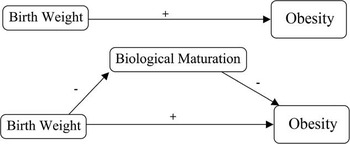
The aim of this study was to investigate the relation between birth weight and adolescent obesity, with specific focus on exploring possible mediating effects by maturational timing. We hypothesized that biological maturation would either partially or entirely mediate a positive association between birth weight and higher adolescent obesity (Fig. 1).
Theoretical illustration of earlier biological maturation mediating an association between birth weight and obesity indicators in adolescence.

Methods
Sample
This was a cross-sectional study with retrospective data collection for birth weight in Brazilian adolescents aged between 10 and 17 years. All participants were enrolled in public schools in Londrina city which has an intermediate human development index. 10
Participant recruitment was performed in two stages. First, all public schools of the city were separated into regions (north, south, east, west and downtown) and two schools were randomly selected from each location. Subsequently, two to three classes were randomly identified in each school and all students within classes (except those using prescription medicine or undergoing treatment for an illness) were invited to participate in the study. Students that did not return a consent form signed by parents were ineligible. The total number of adolescents recruited was 1395, but 414 failed to provide all data required for this analysis and were excluded. Reassuringly, we have previously reported that participants who provided complete data were representative of all adolescents that were initially enrolled to this study.Reference Silva, Werneck and Collings 11 The local ethics committee approved all of the study procedures which adhered to the principles of the Declaration of Helsinki.
Birth weight
Birth weight was obtained from maternal recall in response to the question ‘What was the weight of your child at birth?’ The answer was free text and values were converted to kilograms.
Biological maturation
Biological maturation was assessed using peak height velocity (PHV) which provides an indication of somatic maturity on the basis of measured height, sitting height and leg length.Reference Mirwald, Baxter-Jones and Bailey 12 Chronological age was subtracted from the distance to PHV to estimate the age at occurrence of maturation, which was used as a continuous variable in analyses.
Adiposity indicators
Body mass index (BMI, kg/m2) was calculated from body weight and height, which were measured according to the procedures described by Gordon et al.Reference Gordon, Chumled and Roche 13 Central fat was derived from waist circumference, which was also measured according to recommendationsReference Katzmarzyk, Srinivasan and Chen 14 with an anthropometric tape of 0.1 cm precision. Using standard procedures,Reference Harrison, Buskirk and Carter 15 triceps and subscapular skinfold thicknesses were measured by an experienced technician with a calibrated Lange® caliper (accuracy=0.5 mm). For quality control, the technical error of measurement (TEM) of skinfolds was calculated from repeated measurements taken from 90 adolescents who participated in a separate pilot project, but who were similar to the current study sample with respect to age, somatic maturity and body fat (data not shown). The TEMs were 3.5 and 4.8% for triceps and subscapular skinfolds, respectively. From the skinfold data, percent body fat was estimated.Reference Boileau, Lohman and Slaughter 16
Covariates
Habitual physical activity was estimated by a 16-item questionnaire that was self-completed by adolescents.Reference Baecke, Burema and Frijters 17 The questionnaire asked about physical activity performed at school, in formal sports and leisure time; the sum of all domains constituted our habitual physical activity indicator. Additional details about the questionnaire, including reproducibility statistics and a description of a positive association between habitual physical activity and cardiorespiratory fitness in this sample (demonstrating face validity of the instrument), have been previously reported.Reference Silva, Fernandes and Ohara 18 Socio-economic status was assessed using the Brazilian Association of Marketing Research Companies questionnaire, 19 which was answered by parents. Families were assigned to one of five hierarchical groups based on asset possession (such as ownership of a television, radio, washing machine or car) and the educational status of the head of the family. Gestational age was acquired by maternal recall in response to the question ‘For how many weeks were you pregnant with your child?’. Finally, in the current study population we have previously shown that cardiorespiratory fitness is inversely associated with clustered metabolic risk (including waist circumference).Reference Silva, Werneck and Collings 11 In order to control analyses for cardiorespiratory fitness, a 20-m shuttle run test was performed and peak oxygen consumption was estimated (in ml/kg/min) using commonly implemented methods.Reference Leger, Mercier and Gadoury 20
Statistical analysis
Descriptive statistics are presented using frequencies, means and standard deviations. To investigate differences in variables between boys and girls t-tests and χ2 test were used. Partial correlations (adjusted for chronological age) were calculated between birth weight, maturation and adiposity variables.
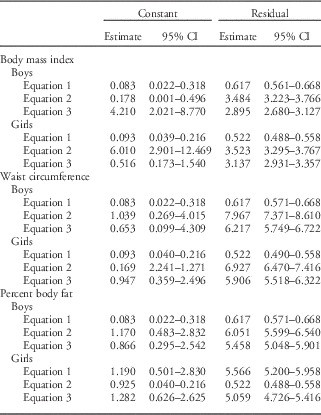
Tests of mediation were conducted according to the principles of Baron and Kenny.Reference Baron and Kenny 21 In the first equation, the mediator variable (somatic maturation) was regressed onto the independent variable (birth weight). In a second set of equations, dependent variables (BMI, waist circumference and percent body fat) were regressed onto birth weight. Finally, in a third set of equations, dependent variables (obesity indicators) were regressed onto independent variables (birth weight) whilst controlling for the candidate mediator (biological maturation). To account for clustering of children within schools multilevel models were constructedReference Krull and MacKinnon 22 and all equations were controlled for chronological age, gestational age, socio-economic status and cardiorespiratory fitness.
Mediating effects were identified if the following criteria were met: in the first equation, birth weight significantly predicted biological maturation; in the second equation, birth weight significantly predicted adiposity; in the third equation, biological maturation significantly predicted adiposity, and the association between birth weight and adiposity (from Equation 2) was either partially or entirely removed due to adjusting for somatic maturation. Analyses included the bootstrap method of resampling to estimate confidence intervals for total, direct and indirect effects. All statistics were carried out according to written procedures,Reference Krull and MacKinnon 22 , Reference Preacher and Hayes 23 in SPSS 22.0 and the level of significance was decided a priori as P<0.05.
Results
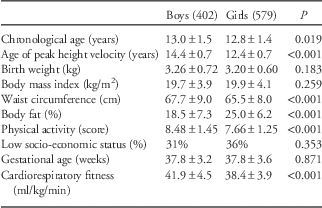
Table 1 presents the characteristics of the included 981 adolescents (59% girls), who had a mean age of 12.9±1.4 years; boys were slightly older than girls. The estimated age at attainment of PHV was expectedly lower in girls than boys, as were the levels of physical activity and cardiorespiratory fitness. Boys exhibited higher waist circumference than girls but a lower total percent body fat.
Characteristics of the sample

Higher scores of physical activity indicates greater physical activity participation.
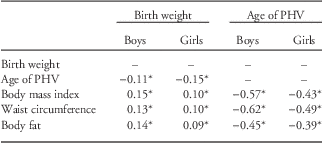
Partial correlations between birth weight, somatic maturation and adiposity variables are presented in Table 2. Birth weight was significantly negatively correlated with predicted age of PHV and positively correlated with all adiposity variables. Stronger negative correlations were seen between age of PHV and adiposity, indicating that later maturating adolescents were typically leaner.
Partial correlations between birth weight, maturation and adiposity, stratified by sex

All values are adjusted for chronological age.
PHV, peak height velocity.
*P<0.05.
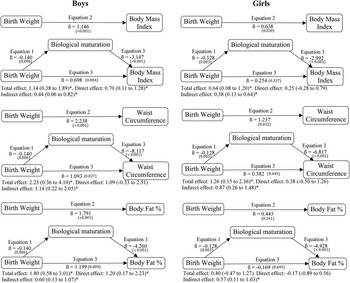
The results of all components of mediation models are presented in Fig. 2. In boys, there was consistent evidence for partial mediation by maturation status (P<0.05) and evidence of full mediation for waist circumference. In girls, all significant associations between birth weight and obesity indicators were entirely attenuated by somatic maturation; note there was no direct effect observed between birth weight and percent body fat and thus no scope for mediation. The proportion of mediation and the magnitude of indirect effects (95% confidence intervals) accountable to somatic maturation in the relation between birth weight and adiposity were identified as being, for boys and girls, respectively: BMI=39%, 0.44 (0.06–0.82) and 66%, 0.38 (0.13–0.64); waist circumference=52%, 1.14 (0.22–2.05) and 66%, 0.87 (0.26–1.48); body fat=35%, 0.60 (0.13–1.07) and not significant for girls. Random effects of multilevel analysis are shown in Table 3. In general, with exception for body fat among girls, the standard deviation (estimation) of cluster level was at least 70% lower than the standard deviation of individual level.
Multilevel mediation models of biological maturation in relationship between birth weight and indicators of obesity in adolescents. Adjusted by chronological age, gestational age, cardiorespiratory fitness and socio-economic status. Data are presented with β values as well as their corresponding P-value within parentheses. Total, direct and indirect effects are presented with β and 95% confidence intervals derived from bootstrapping resampling method. *p < 0.05.

Random effects of multilevel equations from mediation models

CI, confidence intervals.
Discussion
Adolescence represents a critical phase during which substantial changes in body composition occur. However, the correlates and determinants of these changes are not well established. We aimed to analyze the mediating role of biological maturation in the relationship between birth weight and obesity markers in adolescents. We observed that birth weight was inversely related to age of PHV and positively associated with adiposity in adolescents. In addition, estimated age of PHV was consistently mediated a positive relationship between birth weight and various adiposity indices in both sexes. The results of the current study highlight that birth weight and maturation seem to act as determinants of adolescent obesity, and that the sequence of events for birth weight may involve partial mediation by maturation.
It has previously been speculated that there are three key periods for the development of adiposity, the prenatal period, the timing of adiposity rebound and the transition to puberty.Reference Dietz 7 Birth weight reflects prenatal growth and development,Reference Whitaker and Dietz 24 and previous studies have described U-shaped associations between birth weight and adiposity development.Reference Yu, Han and Zhu 25 , Reference Chiavaroli, Derraik and Hofman 26 This is somewhat consistent with observed positive relationships between birth weight and adiposity in adolescence. As maturation can be influenced by factors which include obesity status,Reference Ahmed, Ong and Dunger 8 , Reference Seminara, Messager and Chatzidaki 27 , Reference Colledge 28 it was hypothesized that birth weight could trigger a pathway responsible for obesity later in life that was mediated by earlier maturational timing. Indeed, like other studies which have indicated that early maturing adolescents tend to have higher prevalence of cardiovascular risk factors,Reference Werneck, Silva and Souza 29 , Reference Boyne, Thame and Osmond 30 it was found that earlier maturers exhibited higher adiposity levels. In line with the hypothesis of this study, somatic maturation either partially or fully mediated the relationships between birth weight and different indicators of obesity.
Possible biological mechanisms available to support our proposed sequence of events [higher birth weight>higher adiposity>earlier maturation (lower APHV)>higher adiposity] include a higher liberation of leptin by adipose tissue. Leptin plays an important role in puberty onset by influencing the gonadotropin-releasing hormone,Reference Ahmed, Ong and Dunger 8 possibly by activating kisspeptins (especially Kiss-1) and the GPR54 receptor which acts on the hypothalamus.Reference Seminara, Messager and Chatzidaki 27 , Reference Colledge 28 Another possible mechanism linking adiposity with earlier biological maturation involves insulin resistance caused by high body fat; resultant hyperinsulinemia could decrease globulin binding of sex hormones and increase the level of sex steroid hormones in the blood.Reference Ahmed, Ong and Dunger 8 , Reference Klein, Baron and Colli 31 Furthermore, the roles of leptin and insulin may be interconnected, as insulin resistance can cause higher leptin sensitivity.Reference Lustig, Sen and Soberman 32 , Reference Jasik and Lustig 33 Subsequent earlier maturational timing from these events may increase obesity risk via a multitude of different parameters, including behavioral factors. For instance, obesity status has been shown to discourage sports participation and reduce physical activity levels.Reference Pietiläinen, Kaprio and Borg 34 A role for activity behaviors at the earliest stage of our proposed chain of events seems less likely as, although there is evidence to the contraryReference Hildebrand, Kolle and Hansen 35 meta-analyses suggest that birth weight is not an important determinant of physical activity in youth.Reference Oglund, Hildebrand and Ekelund 36 Nonetheless, early gains in childhood adiposity that are driven by birth weight could be accentuated by inactivity and predispose to earlier maturation. For instance, Collings et al.Reference Collings, Brage and Ridgway 37 have reported inverse cross-sectional associations between physical activity and adiposity in young childhood.
Another detail of this study was related with evidence of full mediating effects by APHV in girls and only partial mediation in boys. A possible explanation could be due to earlier maturational age in girls, meaning that birth and maturation were closer in proximity for girls compared with boys.Reference Ahmed, Ong and Dunger 8 In both sexes, we observed that biological maturation had a stronger association with adiposity than birth weight. Again, this difference may simply be down to proximity, as the event of maturation was closer in time to the measurement of adiposity. It may also be the case that biological maturational exerts a more direct (predominantly hormonally mediated) relationship with adiposity, while the relationship between birth weight and outcomes is more distal and indirect, and seemingly involves mediators such as biological maturation.
Strengths of the current study include a relatively large and homogenous cohort but with a wide range of birth weights from a developing country. Although confounding by factors such as excess maternal gestational weight gain cannot be ruled out, homogeneity of the sample will have reduced the potential for confounding by other factors and we further adjusted the analyses for cardiorespiratory fitness,Reference Moliner-Urdiales, Ruiz and Vicente-Rodriguez 38 socio-economic status and gestational age. Controlling for gestational age permitted differentiation between participants with low birth weight because of premature birth as opposed to growth restriction. We also tried to adjust for physical activity,Reference Carson, Rinaldi and Torrance 39 however, this introduced problems of collinearity with cardiorespiratory fitness, hence physical activity was removed from the analysis. We incorporated valid indicators of adiposityReference Skilton, Siitonen and Würtz 5 , Reference Johnsson, Haglund and Ahlsson 6 and somatic maturation,Reference Mirwald, Baxter-Jones and Bailey 12 but investigation of other indicators of development such as skeletal or sexual maturation would be insightful in future studies, as they can progress at different rates.Reference Malina, Bouchard and Bar-Or 40 Although birth weight and gestational age were measured retrospectively, maternal recalls are highly correlated with measured birth weight,Reference Adegboye and Heitmann 41 , Reference O’Sullivan, Pearce and Parker 42 and the presented data are highly comparable with the measured birth weights reported by a Brazilian birth cohort.Reference Hildebrand, Kolle and Hansen 35 With regards to the statistical analysis, the assumption of linearity was violated in the relationship between APHV and percent body fat. Moreover, there was no interaction between independent variable and mediator in the models.
In summary, earlier biological maturation mediated the observed positive associations between birth weight and multiple adiposity indicators in adolescent boys and girls. Future researcher of early exposures should be conducted with long-term and repeated measurements of exposure, outcome, mediators and confounders to aide better understanding of causality and the inter-relationships between birth weight, biological maturation and obesity.
Acknowledgments
The authors thank Alessandra Okino, Jair Oliveira, Danielle Venturini and Décio Barbosa for research support; Crisieli Tomeleri, Mariana Carnelossi and Sandra Kawaguti for acquisition of data; Coordination for the Improvement of Higher Education Personnel (CAPES/Brazil) for scholarships (D.R.P.S.) and National Council of Scientific and Technological Development (CNPq/Brazil) for funding the project (483867/2009-8) and for scholarship of scientific initiation (A.O.W.) and productive research (E.R.V.R., E.S.C. and R.A.F.).
Financial Support
This work was supported by Brazilian Council of Scientific and Technological Development.
Conflicts of Interest
None.
Ethical Standards
The authors assert that all procedures contributing to this work were approved by the Ethics committee of Londrina State University according to the Helsinki declaration (process: 29216/2010).