Implications
Hydrogen is an important intermediate linking rumen fermentation and methanogenesis. Dietary starch content and rhubarb supplementation did not alter volatile fatty acid (VFA) concentrations and CH4 emissions, but increased the ruminal dissolved hydrogen concentration in goats. This study implies that dissolved hydrogen is more sensitive than VFAs and CH4 production in response to changes in dietary components. Increasing dietary starch content from 220 to 320 g/kg dry matter (DM) and 2.8% of rhubarb supplementation cannot alter rumen fermentation and CH4 emissions in goats.
Introduction
Fermentation of carbohydrate to VFA in the rumen produces molecular hydrogen (H2), which is utilized by methanogens to produce CH4 (Hegarty and Gerdes, Reference Hegarty and Gerdes1998). Hydrogen exists as two forms in the rumen, such as gaseous H2 (gH2) and dissolved H2 (dH2) (Wang et al., Reference Wang, Janssen, Sun, Muetzel, Tavendale, Tan and Pacheco2013), and only dH2 has biological function in the rumen. In vitro and in vivo studies indicate that changes in rumen fermentation and methanogenesis are always associated with changes of ruminal dH2 concentration (Wang et al., 2014 and Reference Wang, Wang, Xie, Janssen, Sun, Beauchemin, Tan and M.2016c).
Compared with fiber, dietary starch fermentation is more rapid and complete, and promotes propionate and butyrate production in the rumen, accompanied with increased H2 production (Janssen, Reference Janssen2010). Rhubarb rhizomes and roots (Rheum palmatum L.) contain the anti-microbial ingredients emodin, aloe-emodin and rhein (Wang et al., Reference Wang, Li, Bao, You, Wang, Shi and Zhang2008), and have been shown to inhibit methanogenesis while increasing gH2 accumulation in vitro (Garcia-Gonzalez et al., Reference Garcia-Gonzalez, Gonzalez and Lopez2010; Wang et al., Reference Wang, Wang, Yang, Deng, Tang and Tan2016d). However, other studies have reported that elevated dietary starch and rhubarb supplementation did not alter rumen individual VFA concentration and CH4 production in vivo (García-González et al., Reference García-González, Giráldez, Mantecón, González and López2012; Hatew et al., Reference Hatew, Podesta, Van Laar, Pellikaan, Ellis, Dijkstra and Bannink2015). Ruminal VFA and dissolved CH4 (dCH4) concentration are more than 500 times greater than dH2 concentration (Wang et al., Reference Wang, Wang, Xie, Janssen, Sun, Beauchemin, Tan and M.2016c), and slight changes in ruminal VFA production and methanogenesis may alter dH2 concentration. Unfortunately, ruminal dH2 and dCH4 concentration were not always measured in published studies that examined methanogenesis.
This study was conducted to investigate the effects of increasing dietary starch content and rhubarb supplementation on dissolved gases, rumen fermentation, selected microbial groups and CH4 emissions in goats. It was hypothesized that ruminal dH2 may have greater sensitivity to increased dietary starch intake and rhubarb supplementation compared with other metabolites such as VFA and dCH4, and as such increased dH2 concentration may not correspond to decreased CH4 emissions.
Material and methods
Animals and diets
In all, eight female Liuyang Black goats (a local breed in southern China, 1 to 1.2 years of age) with BW of 25.5±2.67 kg (mean±standard deviation) at the start of the experiment were used. The experimental design was a replicated 4×4 Latin Square with a 2×2 factorial arrangement of treatments. The two factors were low v. high starch content, and diets with or without rhubarb rhizomes and roots. The level of rhubarb used was based on a preliminary study using the same goats for 28 days that showed more than 2.8% dietary rhubarb (corresponding to 15 g/day) decreased feed palatability, leading to a substantial decrease in DM intake (DMI). The rhubarb was from rhizomes and roots of R. palmatum L. collected in Xining, China. Similar material was previously shown to contain 1.08 to 2.04 mg/g emodin, 1.08 to 2.04 mg/g aloe-emodin and 0.70 to 2.90 mg/g rhein (Wang et al., Reference Wang, Li, Bao, You, Wang, Shi and Zhang2008). It was milled through a 0.15-mm screen (WJX-100; Yuanwo Company, Shanghai, China), and added to the concentrate before feeding. The low-starch diet was formulated to meet 1.2 times maintenance digestible energy requirements of goats according to Zhang and Zhang (Reference Zhang and Zhang1998), assuming a feed intake of 540 g DM/day. Dietary concentrations of maize and wheat bran were manipulated to generate different starch levels in the diets (Table 1). The diets were designed to be isonitrogenous.
Ingredients and chemical composition of the experimental diets (g/kg DM)

DM=dry matter; OM=organic matter; EE=ether extract; GE=gross energy.
1 Premix is formulated to provide (per kilogram of Premix): 400 g of NaHCO3, 2 g of Fe, 1 g of Cu, 0.01 g of Co, 0.05 g of I, 6.6 g of Mn, 4.4 g of Zn, 0.003 g of Se, 29 g of Mg, 333 mg of retinol, 5 mg of cholecalciferol and 838 mg of α-Tocopherol.
Each experimental period lasted 24 days with the first 14 days for diet adaptation and the last 10 days for sampling and data collection. All goats were kept in individual pens and had free access to fresh water. The DMI was individually estimated during the initial 5 days of the diet adaptation period by offering the diet for ad libitum intake. The amount of feed allocated daily thereafter was set at 100% of DMI to minimize diet selection. Dietary forage and concentrate were offered in two equal portions at 0800 and 1700 h and feed refusals were recorded daily.
Nutrient digestibility
Total-tract nutrient digestibility was determined over 5 days (days 15 to 19 of each experimental period). Total feces were collected and weighed daily. A subsample (~1%) was frozen immediately at −20°C, and another subsample (~1%) was acidified using 10% (w/w) H2SO4 to prevent N loss and then frozen immediately at −20°C. All samples were processed for chemical analysis according to the procedures of Wang et al. (Reference Wang, Wang, Zhang, Ungerfeld, Long, Mao, Jiao, Beauchemin and Tan2017).
Rumen sampling
Rumen contents were collected orally using an oral stomach tube at 0, 2.5 and 6 h after the morning feeding on days 20 and 21 of each experimental period. The first 100 ml of rumen contents were discarded, and the following 200 ml were rapidly collected for sampling. Two subsamples (35 ml each) were immediately frozen at −80°C in liquid nitrogen for DNA extraction and subsequent microbial quantification. Two other subsamples (35 ml each) were immediately transferred into 50-ml plastic syringes for measuring dH2 and dCH4 concentrations. About 20 ml of the rumen contents were used for the measurement of ruminal pH using a portable pH meter (Starter 300; Ohaus Instruments Co. Ltd, Shanghai, China). After pH measurement, an aliquot of 2.5 ml was centrifuged at 15 000×g for 10 min at 4°C. The supernatant (1.5 ml) was transferred into tubes containing 0.15 ml of 25% (w/v) metaphosphoric acid, and this mixture was vigorously hand-shaken and stored at −20°C for subsequent determination of VFA and ammonia.
Methane emissions
Methane emissions were measured individually for 3 days after collection of rumen contents (the 1st day was for adaptation and the last 2 days for data collection) in a respiration chamber system using a modified protocol of Wang et al. (Reference Wang, Wang, Sun, Chen, Tang, Zhou, Han, Kang, Tan and He2015). The Plexiglas construction of the three respiration chambers permitted the goats to see each other, thereby minimizing stress. The net volume of each chamber was about 2.0 m3 (i.e. 1.7 m length×0.9 m width×1.3 m height). Goats were restrained in the chambers in modified metabolic crates with a feed bin, drinking water container and separate trays to collect feces and urine. Each chamber was fitted with a fresh air inlet at the back and an air outlet at the side. Air inlets were piped from a common vent. The outlet hose from each chamber was connected to a diaphragm flow-meter for measuring the exhaust airflow. On average, the flow rate of air was maintained at 40 m3/h. A negative pressure was maintained inside the chambers to prevent losses of CH4 produced from goats. Outlet gas from each chamber and ambient gas were connected to multiport inlet unit of the gas analyser (GGA-30p; Los Gatos Research, CA, USA) using 1/8-inch polyurethane tubing. The cycling time to separately measure CH4 concentration from the chambers was 30 min, with 8 min for each chamber gas and 6 min for ambient gas. The between-chamber differences were documented by releasing the same amount of pure CH4 into each chamber (with no animals) and then determining whole-chamber flux when the exhaust concentration reached steady state. Correction factors accounting for between-chamber differences were estimated using the methodology described by McGinn et al. (Reference McGinn, Beauchemin, Coates and Colombatto2004) to minimize the chamber effect. The chambers were opened twice a day at 0800 and 1800 h for 20 min to deliver diet and remove feces and urine trays. Methane emission rates were calculated every 30 min from net concentrations of CH4 and flow rate of air through the chamber. Emissions when chambers remained open (during feeding and cleaning) were assumed to be equal to the average CH4 emissions 1 h before the chambers were opened.
Sample analysis
Feeds, feed refusals and feces were dried at 65°C for 48 h and grounded through a 0.15-mm screen (WJX-100; Yuanwo Company) for chemical analysis. Gross energy (GE) was measured using an isothermal automatic calorimeter (5E-AC8018; Changsha Kaiyuan Instruments Co. Ltd, Changsha, China). The organic matter (OM, method 942.05), CP (method 954.01) and ether extract (EE, method 920.39) were determined according to AOAC methodologies (AOAC, 1995). Neutral detergent fiber and ADF were assayed according to the method of Van Soest et al. (Reference Van Soest, Robertson and Lewis1991), and expressed as inclusive of residual ash. Heat stable amylase was added for NDF analysis. Starch was analyzed following a pre-extraction with ethanol (80%) according to the procedure of Kartchner and Theurer (Reference Kartchner and Theurer1981). Dissolved CH4 and dH2 in rumen fluid were measured using the procedures described by Wang et al. (Reference Wang, Wang, Janssen, Zhang, Sun, Pacheco and Tan2016b).
Frozen-strained rumen fluid samples were thawed and centrifuged at 15 000×g for 10 min at 4°C, and individual VFA concentrations in the supernatants were analyzed using gas chromatography (Agilent 7890A; Agilent Inc., Palo Alto, CA, USA), according to the method described by Wang et al. (Reference Wang, Sun, Janssen, Tang and Tan2014). Estimated net metabolic hydrogen production relative to the amount of VFA produced (
 $$R_{{NH_{2}^{{}} }} $$
) was calculated according to the stoichiometric equation developed by Wang et al. (Reference Wang, Wang, Janssen, Zhang, Sun, Pacheco and Tan2016b), assuming equal fractional rates of individual VFA absorption.
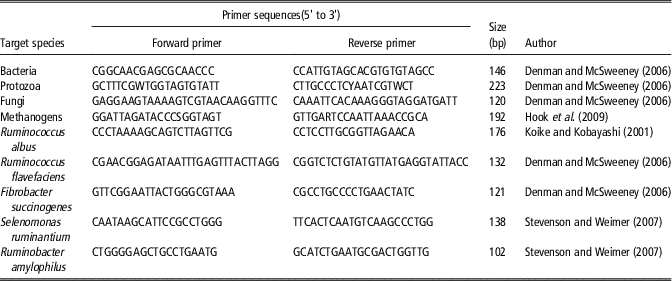
Rumen samples of the 3 sampling times were pooled and freeze-dried for microbial analysis. Genomic DNA was extracted using QIAamp DNA Stool Mini kit (Qiagen, Hildem, Germany) following the manufacturer’s instructions, under the assumption that low yields of DNA from stool kits can be systematic across all samples (Henderson et al., Reference Henderson, Cox, Kittelmann, Miri, Zethof, Noel, Waghorn and Janssen2013). The quantity of DNA was measured based on absorbance at 260 and 280 nm using a ND-2000 spectrophotometer (NanoDrop Technologies, Wilmington, DE, USA). Total bacteria, protozoa, fungi, methanogens and selected bacterial groups were quantified by qPCR using primers validated in our laboratory by Jiao et al. (Reference Jiao, Lu, Tan, Guan, Zhou, Tang and Han2014) as listed in Table 2. Quantitative PCR was performed according to the procedures described by Jiao et al. (Reference Jiao, Lu, Tan, Guan, Zhou, Tang and Han2014). Final absolute amount of target group or species were estimated by relating the cycle threshold (C T) value to the standard curves and expressed as log10 copies/g DM rumen contents. The abundance of five common rumen bacteria species was measured relative to the total bacterial DNA using qPCR and species-specific 16S rRNA gene-targeted primers. The abundance of each bacterial species or group was determined using the ∆CT method, and the ratio of the amount of one target species with respect to total bacteria was then calculated (Stevenson and Weimer, Reference Stevenson and Weimer2007; Wang et al., Reference Wang, Wang, Xie, Janssen, Sun, Beauchemin, Tan and M.2016c).
Primers used for qPCR

Statistical analysis
Experimental data without 3 sampling time points were performed using the mixed procedure of SPSS 12.0 software (Chicago, IL, USA). Data were analyzed with the following model:
 $$Y_{{ijkl}} {\equals}\mu {\plus}A_{i} {\plus}P_{j} {\plus}S_{k} {\plus}RH_{l} {\plus}S_{k} {\times}RH_{l} {\plus}e_{{ijkl}} $$
where Y ijkl is the response; μ is the general mean; A i is the random animal effect; P j is the fixed period effect; S k is the fixed effect of starch level; RH l is the fixed effect of rhubarb supplement; S k ×RH l is the interaction between starch level and rhubarb supplement; and e ijkl is the random error term.
Rumen fermentation data with 3 sampling time points were analyzed using the mixed procedure with repeated measures for sampling time in SPSS 12.0 software. Data were analyzed with the following model:
 $$Y_{{ijklm}} {\equals}\mu {\plus}A_{i} {\plus}P_{j} {\plus}S_{k} {\plus}RH_{l} {\plus}S_{k} {\times}RH_{l} {\plus}T_{m} {\plus}e_{{ijklm}} $$
where Y ijklm is the response; μ is the general mean; A i is the random animal effect; P j is the fixed period effect; S k is the fixed effect of dietary starch level; RH l is the fixed effect of rhubarb supplement; S k ×RH l is the interaction between starch level and rhubarb supplement; T m is repeated measurement effect of the 3 sampling time points; and e ijklm is the random error term.
The covariance structure was heterogeneous autoregressive (ARH1), which had low Akaike’s information criterion values to optimize the statistical analysis. Differences at P⩽0.05 were considered significant and 0.05<P⩽0.10 was considered a trend.
Results
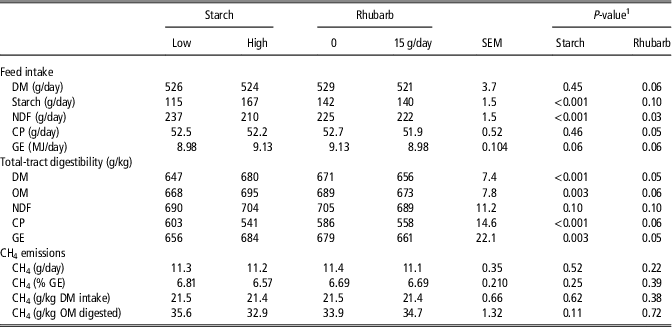
The goats increased BW from 25.5±2.67 kg to 27.0±2.64 kg (mean±standard deviation) during the experiment (data not presented in Tables). There were no interactions (P>0.10) between starch level and rhubarb on nutrient intake, total-tract nutrient digestibility or CH4 emissions, thus only the main effects are presented (Table 3). As expected, goats fed the high-starch diet had greater intakes of starch (+45%, P<0.001) and lower intakes of NDF (−11%, P<0.001) and tended to have increased GE intake (+1.8%, P=0.06) compared with goats fed the low-starch diet. Goats fed the high-starch diet also had greater (P<0.01) total-tract digestibility of DM (P<0.001), OM (P=0.003) and GE (P=0.003) and lower total-tract digestibility of CP (P<0.001), compared with goats fed the low-starch diet. Rhubarb tended (P=0.05 to 0.06) to decrease the intake of DM, CP and GE and total-tract digestibility of DM, OM, NDF, CP and GE. Neither dietary starch level nor rhubarb affected CH4 emissions (as g/day, % of GE, g/g DMI and g/g OM digested).
Effect of starch content and rhubarb on feed intake, total-tract digestibility and enteric methane (CH4) emissions in Liuyang black goats

DM=dry matter; GE=gross energy; OM=organic matter.
Values are means and pooled SEM, n=8.
1 Interaction of starch×rhubarb does not exist for any of the variables (P>0.10), and thus is not provided.
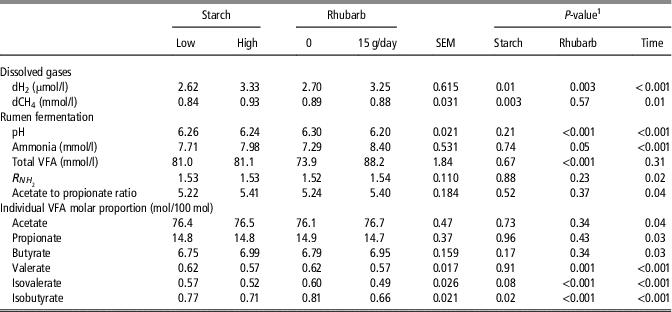
There were no interactions (P>0.10) between starch level and rhubarb supplement on dissolved gases or rumen fermentation, thus only the main effects are presented (Table 4). Goats fed the high-starch diet had greater (P⩽0.01) ruminal dH2 (+27%) and dCH4 (+11%) concentrations, and lower valerate, iso-valerate and iso-butyrate concentrations in rumen fluid, compared with goats fed the low-starch diet. Rhubarb increased (P⩽0.05) dH2 (+20%), ammonia and total VFA concentration, but decreased (P⩽0.01) pH and valerate, iso-valerate and iso-butyrate concentrations in rumen fluid.
Effect of starch content and rhubarb on ruminal dissolved gases and fermentation end products in Liuyang black goats

dH2=dissolved hydrogen; dCH4=dissolved methane; VFA=volatile fatty acid;
$$R_{{NH_{2}^{{}} }} $$
=estimated net metabolic hydrogen production relative to the amount of total VFA produced.
Values are means and pooled SEMs, n=8.
1 Interaction of starch×rhubarb does not exist for any of the variables (P>0.10), and is thus not provided.
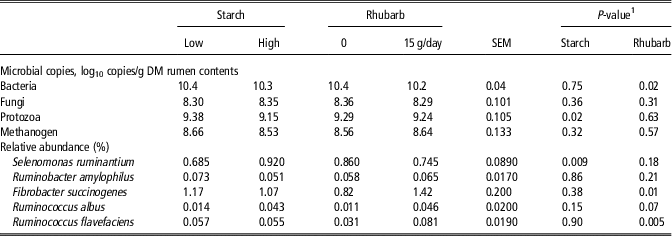
Goats fed the high-starch diet had lower (P=0.02) copy number of protozoa and greater (P=0.009) relative abundance of Selenomonas ruminantium in rumen fluid, when compared with goats fed a low-starch diet (Table 5). Rhubarb decreased (P=0.02) copies of bacteria, with increased (P⩽0.01) relative abundance of Fibrobacter succinogenes and Ruminococcus flavefaciens and a tendency (P=0.07) for increased copies of R. albus.
Effect of starch content and rhubarb on microbiota in the rumen of Liuyang black goats

DM=dry matter.
Values are means and pooled SEMs, n=8.
1 Interaction of starch×rhubarb does not exist for any of the variables (P>0.10), and thus is not provided.
Discussion
Replacing wheat bran with maize increased starch and decreased NDF contents in the diet as expected. Negative effects of increased starch intake on ruminal fiber digestion are usually attributed to a decline in ruminal pH (Firkins et al., Reference Firkins, Eastridge, St-Pierre and Noftsger2001; Ferraretto et al., Reference Ferraretto, Crump and Shaver2013). In the present study, all treatments had ruminal pH⩾6.19, which explained the non-existent effects of elevated starch intake on NDF digestibility. The 2.8% of DM inclusion of rhubarb in the treatment diet is slightly greater than the 2.2% of DM level used in a previous study by García-González et al. (Reference García-González, Giráldez, Mantecón, González and López2012), who reported a tendency for decreased feed intake of goats fed rhubarb without a change in feed digestibility. In our study, the decreased DMI and feed digestibility may be due to a possible palatability issue or lower digestion rate caused by rhubarb supplementation.
Starch is hydrolyzed more rapidly and has greater digestibility than fiber in the rumen (Owens et al., Reference Owens, Secrist, Hill and Gill1998). As a result, greater H2 production occurs. Wang et al. (Reference Wang, Wang, Xie, Janssen, Sun, Beauchemin, Tan and M.2016c) showed that elevated starch intake was associated with increased ruminal dH2 concentration in lactating dairy cows. Rooke et al. (Reference Rooke, Wallace, Duthie, McKain, de Souza, Hyslop, Ross, Waterhouse and Roehe2014) reported that beef cattle fed a high-starch diet had greater gH2 emissions than those fed a low-starch diet. In the present study, we observed that elevated dietary starch intake increased dH2 concentration in the rumen.
In vitro studies have shown that rhubarb can inhibit the activity of methanogens, thereby reducing CH4 production (García-González et al., Reference García-González, López, Fernández and González2008; Kim et al., Reference Kim, Arokiyaraj, Lee, Oh, Chung, Jin, Kim, Kim, Lee and Baik2016; Wang et al., Reference Wang, Wang, Yang, Deng, Tang and Tan2016d). When the flow of H2 to CH4 is stopped by CH4 mitigation agents, the rate of H2 generated exceeds the rate of H2 consumption, leading to gH2 accumulation (Guyader et al., Reference Guyader, Ungerfeld and Beauchemin2017). Increased gH2 accumulation typically accompanies the inhibition of methanogenesis in vivo (Martinez-Fernandez et al., Reference Martinez-Fernandez, Denman, Yang, Cheung, Mitsumori and McSweeney2016; Vyas et al., Reference Vyas, McGinn, Duval, Kindermann and Beauchemin2016). In vitro supplementation of rhubarb also decreases CH4 production with increased gH2 production (Wang et al., Reference Wang, Janssen, Sun, Muetzel, Tavendale, Tan and Pacheco2013). In contrast, the present in vivo study showed no effect of rhubarb on CH4 production, even though ruminal dH2 concentration was increased. The discrepancies between previous in vitro studies and the present in vivo study may be attributed to differences in dose of rhubarb, as high rhubarb supplementation caused a decrease in palatability in the present study. Nevertheless, dH2 concentration is more sensitive than dCH4 concentration in responses to rhubarb supplementation of the diet. Ruminal dCH4 concentration was more than 100 times greater than dH2 concentration, which is consistent with our previous studies (Wang et al., Reference Wang, Ungerfeld, Wang, Zhou, Basang, Ao and Tan2016a and Reference Wang, Wang, Xie, Janssen, Sun, Beauchemin, Tan and M.2016c). Thus, a small change in methanogenesis may cause a large change in dH2 concentration.
Neither elevated starch intake nor rhubarb supplementation decreased enteric CH4 emissions in the current study. The lack of CH4 mitigation response indicates that a moderate increase in starch content (from 220 to 320 g/kg DM) and 2.8% of rhubarb supplementation are below the threshold needed to reduce enteric CH4 emissions. A decrease in CH4 production can be expected to accompany shifts of acetate to propionate or butyrate production (Beauchemin and McGinn, Reference Beauchemin and McGinn2005), because propionate and butyrate create alternative hydrogen sinks to methanogenesis and are associated with less net metabolic hydrogen produced per mole of hexose fermented (Janssen, Reference Janssen2010; Ungerfeld, Reference Ungerfeld2015). In the present study, lack of treatment effect on molar proportions of major individual VFA is consistent with the lack of effect on CH4 production, as is in agreement with the reports of Hatew et al. (Reference Hatew, Podesta, Van Laar, Pellikaan, Ellis, Dijkstra and Bannink2015). Furthermore, lack of difference in CH4 emissions among treatments is also consistent with the lack of effects on
$$R_{{NH_{2}^{{}} }} $$
, indicating that efficiency of metabolic hydrogen produced per mole of VFA produced does not differ among the dietary treatments.
Even though CH4 emissions were not altered by dietary treatments, elevated starch intake increased ruminal dCH4 concentration. Wang et al. (Reference Wang, Wang, Xie, Janssen, Sun, Beauchemin, Tan and M.2016c) reported that increased dCH4 concentration was associated with decreased CH4 emissions. One possible explanation for this apparent contradiction may be that the treatments differ in their saturation of dCH4 in rumen fluid. Dissolved gases, including dH2 and dCH4, are supersaturated (saturation factor>unity) in rumen fluid (Wang et al., Reference Wang, Ungerfeld, Wang, Zhou, Basang, Ao and Tan2016a). The extent of supersaturation may be affected by many factors, such as viscosity or surface tension of the rumen fluid and rumen motility. The elevated concentrate content of the high-starch diet may have decreased rumination activity (Yang et al., Reference Yang, Beauchemin and Rode2001; Kargar et al., Reference Kargar, Khorvash, Ghorbani, Alikhani and Yang2010), which would help to maintain more dissolved gases in the liquid phase. Supersaturation greatly decreases gas mass-transfer from the liquid to gas phase of the rumen, so that dCH4 concentration may not be positively correlated with the amount of CH4 emitted from the rumen. Another possible explanation could be that treatments differed in passage rate of solid phase from the rumen. The elevated concentrate content in the high-starch diet may have increased the ruminal passage rate, which inhibits methanogenesis in the rumen (Dittmann et al., Reference Dittmann, Hammond, Kirton, Humphries, Crompton, Ortmann, Misselbrook, Südekum, Schwarm, Kreuzer, Reynolds and Clauss2016).
It has been reported that dH2 concentration is closely associated with changes in ruminal microbiota, and higher and lower dH2 concentration facilitates H2 users and producers, respectively (Wang et al., Reference Wang, Wang, Xie, Janssen, Sun, Beauchemin, Tan and M.2016c). Protozoa are important H2-producing microorganisms, whereas S. ruminantium is a well-known H2-consumer (Belanche et al., Reference Belanche, Doreau, Edwards, Moorby, Pinloche and Newbold2012). In our study, elevated dietary starch content decreased protozoa population and increased abundance of S. ruminantium, which is consistent with the elevated ruminal dH2 concentration. For ruminants fed the high-starch diet, increased dH2 concentration may promote the growth of S. ruminantium that are capable of disposing electrons derived from fermentation, while inhibiting the growth of protozoa that are capable of producing electrons during fermentation (Belanche et al., Reference Belanche, Doreau, Edwards, Moorby, Pinloche and Newbold2012; Wang et al., Reference Wang, Wang, Xie, Janssen, Sun, Beauchemin, Tan and M.2016c). However, this phenomenon was not observed when comparing goats fed diets with and without rhubarb supplementation.
In summary, elevated dietary starch intake (+44%) and 2.8% of rhubarb supplementation did not affect ruminal VFA profile and CH4 emissions, yet it increased ruminal dH2 concentration in goats. Thus, rhubarb may not be an effective CH4 mitigation strategy unless the palatability issue can be overcome enabling higher inclusion in the diet. Dissolved H2 concentration was more sensitive to dietary changes compared with dCH4, VFA and CH4 emissions.
Acknowledgements
This work was supported by National Key Research and Development Program of China (grant nos 2016YFD0700201 and 2016YFD0500504), National Natural Science Foundation of China (grant nos 31561143009 and 31472133), State Key Laboratory of Animal Nutrition (grant no. 2004DA125184F1705), China Agriculture Research System (grant no. CARS-36), Youth Innovation Promotion Association CAS (grant no.2016327) and CAS President’s International Fellowship (grant no. 2018VBA0031). The authors thank Alexander N. Hristov for reading an early draft of the manuscript and providing useful comments.
Declaration of interest
The authors declare that they have no conflicts of interest.
Ethics statement
All animal procedures followed our institutional guidelines for the care and use of animals, and were approved by the Animal Care Committee (approval number ISA-W-201502), Institute of Subtropical Agriculture, the Chinese Academy of Sciences, Changsha, China.
Software and data repository resources
None of the data were deposited in an official repository.