Introduction
Caring for a person with dementia imposes a heavy burden on informal carers and is associated with negative effects on their health and quality of life (Etters et al., Reference Etters, Goodall and Harrison2008). Several meta analyses and systematic reviews have concluded that well-designed support programs decrease burden and improve psychological well-being of informal carers, and enable them to provide at-home care for a longer period of time. Caregiver interventions are particularly effective if they go beyond medical information and teach behavior management skills, offer advice on available services, and provide strategies for self-care (Parker et al., Reference Parker, Mills and Abbey2008; Huis in het Veld et al., Reference Huis in het Veld, Verkaik, Mistiaen, van Meijel and Francke2015; Vandepitte et al., Reference Vandepitte, Van Den Noortgate, Putman, Verhaeghe, Faes and Annemans2016). Interventions that target carers have been shown to provide benefits for the person with dementia as well (Schulz et al., Reference Schulz2002; Brodaty et al., Reference Brodaty, Green and Koschera2003). The increasing use of computers and internet by older adults (Gell et al., Reference Gell, Rosenberg, Demiris, LaCroix and Patel2015) opens novel opportunities for delivering information, counseling, and support to informal caregivers, particularly when traditional formats such as face-to-face meetings or support groups are difficult to organize or are hindered by geographical or mobility related barriers. Advantages of internet-based e-learning and information programs over traditional formats of carer support include convenience of use, overcoming of geographical barriers, variety of information delivery formats, and low cost (Serafini et al., Reference Serafini, Damianakis and Marziali2007; Goodwin et al., Reference Goodwin, Mills, Anderson and Kunik2013). Web-based (Boots et al., Reference Boots, de Vugt, van Knippenberg, Kempen and Verhey2014) multi-component interventions for dementia caregivers have been reported by users to be educational, convenient, beneficial, and interesting (Lewis et al., Reference Lewis, Hobday and Hepburn2010). Such interventions have been shown to reduce caregiver depression (Blom et al., Reference Blom, Zarit, Groot-Zwaaftink, Cuijpers and Pot2015) and stress (Kajiyama et al., Reference Kajiyama2013), improve illness-related knowledge and self-efficacy (Cristancho-Lacroix et al., Reference Cristancho-Lacroix, Thompson and Low2015), and strengthen empathy and understanding (Hattink et al., Reference Hattink2015).
In the RHAPSODY project (Research to Assess Policies and Strategies for Dementia in the Young), a group of researchers from six European countries (France, Germany, the Netherlands, Portugal, Sweden, United Kingdom) aims to develop a comprehensive, multi-media, educational, and skill-building program for informal carers of people with young onset (i.e. symptoms occurring before the age of 65 years) dementia (YOD) delivered via the internet, and to evaluate the e-learning program in a randomized, wait-list controlled, multi-center pilot study.
Carers of people with YOD were chosen as a target group for the web-based intervention for several reasons. Although the prevalence of YOD is much lower than that of dementia in later life (Harvey et al., Reference Harvey, Skelton-Robinson and Rossor2003; Mercy et al., Reference Mercy, Hodges, Dawson, Barker and Brayne2008), it has a more severe impact on affected individuals and their informal carers. This is due to: high frequency of problem behaviors (Sansoni et al., Reference Sansoni, Duncan and Grootemaat2014); disruption of family relations (Svanberg et al., Reference Svanberg, Spector and Stott2014) including partnership and intimacy (Harris, Reference Harris2009), and often involving children (Millenaar et al., Reference Millenaar2014); frequent conflicts between the caring role and other family or professional responsibilities (Ducharme et al., Reference Ducharme, Kergoat, Pasquier and Coulombe2013); significant economic consequences due to early retirement or reduced working hours. People with YOD and their informal carers are an underserved group, because correct and timely diagnosis of YOD as well as appropriate counseling and medical treatment may be difficult to obtain (Mendez, Reference Mendez2006). Furthermore, existing health and social care structures for people with dementia rarely meet the needs of this particular group of patients and family carers since they have been designed for older adults (Bakker et al., Reference Bakker, de Vugt, Vernooij-Dassen, van Vliet, Verhey and Koopmans2010). Services specifically designed for people with YOD and their carers are available at only a few centers across Europe (Goldberg, Reference Goldberg2011; Hooghiemstra et al., Reference Hooghiemstra2012), and access to these services may be hindered by geographical and mobility-related barriers.
Methods
Study design
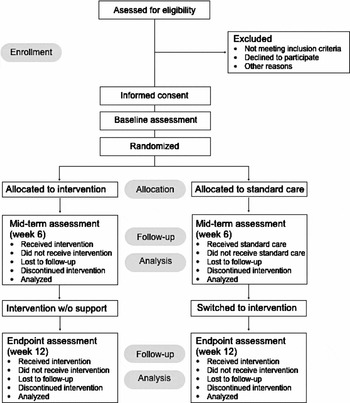
The pilot study has been designed as a randomized trial with a wait-list control group. It will be conducted in three countries (France, Germany, and United Kingdom) and focuses on the acceptability of the e-learning program. It will also trial test procedures (e.g. recruitment, randomization, program utilization) and outcome measures (e.g. caregiving self-efficacy, perceived stress and burden, health-related quality of life, user satisfaction, caring-related knowledge) to help with planning a larger trial to investigate the efficacy and cost-effectiveness of the intervention (Craig et al., Reference Craig, Dieppe, Macintyre, Michie, Nazareth and Petticrew2008; Thabane et al., Reference Thabane2010). After providing written informed consent and baseline assessment, participants will be randomly assigned to the e-learning program or to a wait-list control group without immediate access to the intervention. The immediate-start group will have access to the e-learning program and to technical support provided by the research team for six weeks. Throughout the study, both groups will continue to receive care as usual. After mid-point assessment, the control group will have access to the program including technical support for six weeks. The e-learning program will continue to be available to the immediate-start group during this second phase to determine whether prolonged access to the program increases usage and provides any further benefits to carers. Effect sizes of the outcome measures will be estimated and a preliminary health economic evaluation will be performed. Information on patients including diagnosis, symptoms, treatment and services received will be obtained from the carers at baseline. Approval for the pilot study will be obtained from the local ethics boards, and the trial has been registered at the German Registry for Clinical Trials (DRKS00009891). The trial flow chart is shown on Figure 1.
Study flow diagram.

Participants
The participants will be recruited by various means, including through memory clinics and post-diagnosis services having access to large YOD populations, and patient advocacy groups. Participants will be primary informal carers of people meeting diagnostic criteria for dementia in Alzheimer's disease (AD) (McKhann et al., Reference McKhann2011) or behavioral variant frontotemporal dementia (bvFTD) (Raskovsky et al., Reference Raskovsky2011) with symptom onset before the age of 65 years, diagnosis established before the age of 68 years, and diagnosis disclosed no more than three years prior to enrolment in the study. Carers of people with other causes of dementia, participants who do not have a minimum level of computer literacy, and those without access to the internet will be excluded. A sample size of 60 participants is considered to be adequate for the pilot study (30 per group, 20 in each country) (Lancaster et al., Reference Lancaster, Dodd and Williamson2004; Teare et al., Reference Teare, Dimairo, Shephard, Hayman, Whitehead and Walters2014).
Assessments
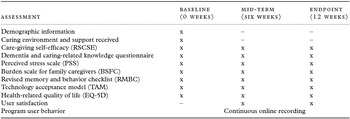
The participants will be assessed at three time points: baseline (after consent, before randomization), six weeks (the mid-point when the control group crosses over to receive the intervention); 12 weeks (the final endpoint). At baseline (week 0), information will be gathered from carers on socio-demographic background, history of the patient's illness and treatment, as well as use of existing support and information services. The selection of outcome measures was informed by practical factors including administration time, with a preference for self-report measures, validated scales, and instruments available in the three working languages (English, French, and German). Data will be gathered by face-to-face or telephone interview (Table 1).
Outline of the assessments and timelines of the pilot study

Outcomes
Caregiving self-efficacy was selected as the primary outcome. The Revised Scale for Care-giving Self-Efficacy (RSCSE) (Steffen et al., Reference Steffen, McKibbin, Zeiss, Gallagher-Thompson and Bandura2002) was identified as the most domain-specific tool to assess care-giving activities, offering optimum validity compared to more general measures. It contains 19 items covering the areas of obtaining respite, responding to disruptive behaviors and controlling upsetting thoughts about caregiving.
Secondary outcomes cover a range of targeted issues. Caregiver stress will be assessed using the 10-item version of the The Perceived Stress Scale (PSS) (Cohen et al., Reference Cohen, Kamarck and Mermelstein1983), which is a quick to administer and widely used indicator of subjectively evaluated stress with well-established acceptable psychometric properties. Caregiver burden will be measured using the 10-item short form of the Burden Scale for Family Caregivers (BSFC) (Gräsel et al., Reference Gräsel, Chiu and Oliver2003) which assesses carers’ global subjective burden relating to the care of a chronically ill person. The extent of problems dealing with behavioral change will be indicated by The Revised Memory and Behavior Checklist (RMBC) (Teri et al., Reference Teri, Truax, Logsdon, Uomoto, Zarit and Vitaliano1992). This is a carer-report measure of symptoms in YOD patients and one of few instruments that evaluates both cognitive and behavioral symptoms, and provides an indication of the extent to which carers feel impacted by symptoms. Health-related quality of life will be rated on the EQ-5D-5L (EuroQuol-Group, 2009), a standardized instrument for indicating health status at five levels in five dimensions (mobility, self-care, usual activities, pain/discomfort, anxiety/depression) which is used in health economic analyses for the calculation of quality-adjusted life years (QALYs).
Program feasibility, user satisfaction, and computer literacy will be investigated using the Technology Acceptance Model (TAM) (Venkatesh and Bala, Reference Venkatesh and Bala2008). This assesses perceived usefulness, ease of use, intention to use, computer self-efficacy, and computer anxiety. To assess acceptability of the intervention, qualitative information on user experiences and satisfaction with program content and mode of delivery will be obtained through individual interviews with all participants using a semi-structured interview guide after week 12. Since no appropriate and validated instrument is available for the assessment of dementia- and caring-related knowledge, a questionnaire was developed by RHAPSODY members with special expertise in education on dementia. Engagement with the intervention will be assessed through utilization data (e.g. number and duration of visits, click paths) that is logged for each user during participation in the e-learning program. In addition, the time spent in coaching participants, managing the website when it is live, and monitoring the online forum by site personnel, technical staff, and project members, respectively, will be logged.
Intervention
The educational and skill-building e-learning program is being developed to assist informal carers in coping with YOD and managing the behavioral, interpersonal, organizational, and financial problems encountered, and to provide a comprehensive resource of information. The design of the intervention adopts a multiple-component model of dementia carer support which has been successfully evaluated in the Resources for Enhancing Alzheimer's Caregiver Health (REACH) II Study (Belle et al., Reference Belle2006; Burgio et al., Reference Burgio, Collins, Schmid, Wharton, McCallum and DeCoster2009). It also takes account of the official policies and guidelines for health and social care professionals on the care of people with YOD, and the information available for patients and carers in the six countries involved, both of which were researched through open internet searches and by targeting the web sites of relevant organizations (government sector, professional bodies, health insurers, provider groups, and patient advocacy organizations). Evidence on the care needs and access to services of people with YOD and their informal carers is available from a systematic review (Millenaar et al., Reference Millenaar, Bakker, Koopmans, Verhey, de Vugt and Kurz2016) and is complemented by findings from qualitative interviews conducted as part of the Needs in Young Onset Dementia (NeedYD) Study in the Netherlands (Millenaar et al., Reference Millenaar2015) and from focus groups with family carers undertaken in five other European countries.
Based on this evidence, the intervention will be organized into seven chapters addressing the major components of support for YOD carers, including medical information (with a focus on problem solving), dealing with behavioral change, coping with role shift in the family, and finding help. The program will be developed as a web-based, multimedia e-learning course, comprising of explanations by experts, case study examples, as well as interviews with family carers and service providers. It will also include sections where participants can choose topics to work through in more detail. To meet the users’ needs for interaction with fellow carers with whom they may share experiences, the program will also include a user forum. The forum will be monitored to eliminate inappropriate content. Similar online programs that included social functionalities have been successfully applied in other target groups, e.g. in overweight adults (Pressler et al., Reference Pressler2010).
Control group
A wait-list control group will be used in order to enable all participants to benefit from the intervention and to enhance recruitment. Participants allocated to the control group will have access to the e-learning program for six weeks following the mid-point assessment.
Statistical analysis
Data will be entered at each site into a common central database using an electronic case record form. The primary end point will be the six-week assessment. Descriptive statistics will be conducted to detail the study population characteristics at baseline. The impact of the intervention on each outcome will be assessed by comparing the change score (week 0 to week 6) between the intervention group and the control group using t-test or non-parametric tests as appropriated. An intention-to-treat procedure (ITT analysis) will be applied. The possible additional benefit of another six weeks of access to the program will be determined by a global ANOVA including the following fixed effects: group (intervention or control), period (period 1: weeks 0–6; period 2: weeks 6–12), and the interaction between group and period. This will indicate whether periods 1 and 2 differ in the intervention and/or control groups and whether the intervention group differs from the control group in period 2. Analysis of satisfaction and acceptability of the program will be conducted based on program analytics (back-end data), triangulated with findings from self-report questionnaires. Qualitative feedback will be analyzed using a content analysis. Subgroup analyses will explore whether particular participant variables at baseline are associated with program efficacy (such as diagnosis, time since diagnosis, patient gender, caregiver gender, country) are associated with program outcomes. The association between program usage and participant outcomes will also be tested. All quantitative analyses will be exploratory since this is a pilot study and no power calculations have been performed.
Health economic analysis
An embedded health economic analysis will assess the costs and outcomes of the e-learning intervention in a cost-consequences framework at the six-week follow-up point. The costing exercise will focus on direct intervention delivery costs, including the time spent by technical staff in managing the website when it is live, and time spent monitoring the online forum. The resources devoted to the development of the e-learning program and its translation will not be considered since these are fixed costs and costs per user will fall the more widely the program is accessed. An initial estimate of the incremental mean cost per QALY gained from access to the intervention will be performed using data collected from EQ-5D-5L in preparation for the full cost-effectiveness analysis in the larger trial.
Intervention refinement and dissemination
The results of the pilot study, including both quantitative data and qualitative feedback from participants, will be used to refine the e-learning program and to produce a final product that will be made available to organizations supporting YOD patients and carers across Europe, providers, including insurers and medical boards. National and municipal authorities will be approached since the internet-based e-learning program is particularly suited for use in rural areas where few support structures and services are available. Selected content of the intervention will be used to create a range of educational materials addressing a variety of potential user groups including informal carers, healthcare professionals, and service providers.
Discussion
The internet and modern consumer electronics offer novel ways for delivering information and counseling to people with dementia and their informal carers as a complement or alternative to traditional formats of education and support. The RHAPSODY project takes advantage of the new media to provide an online information and skill-building intervention that is specifically tailored to the needs of carers of people with YOD for whom appropriate services are scarce and may be difficult to access. These informal carers are particularly vulnerable, highly burdened and underserved, but being younger than most dementia carers, may especially benefit from an online, computer-delivered intervention. The Rhapsody program builds on the existing evidence on dementia caregiver support, on surveys of the policy and information environment, and on an analysis of individual needs and access to care. Hence, it focuses on the areas that are most relevant to carers of people with YOD, including practical problem solving, dealing with psychological and interpersonal issues, finding help and looking after oneself.
In recent years, online programs of differing content, format, and duration have been created for professional and non-professional dementia caregivers released by a number of institutions and organizations, including nursing schools (https://www.coursera.org/course/dementiacare), a research consortium funded by the European commission (http://www.startraining.eu), care education providers (http://www.dementiaforum.org/education/e-learning/), and patient organizations (http://www.scie.org.uk/dementia/e-learning/). Few internet-delivered e-learning programs for informal dementia carers have been evaluated in randomized controlled trials, demonstrating benefits regarding caregiver empathy (Hattink et al., Reference Hattink2015), depression and anxiety (Blom et al., Reference Blom, Zarit, Groot-Zwaaftink, Cuijpers and Pot2015), and perceived stress (Kajiyama et al., Reference Kajiyama2013). It is not clear to date whether this type of intervention can increase behavior management skills, alleviate psychological and interpersonal problems, enhance help-seeking competence, or improve self-care. Another open question is which components of online programs including social functionalities such as discussion forums are particularly beneficial to dementia carers. To our knowledge, the only online information and support program that specifically targets YOD is offered by the Alzheimer's Association (http://training.alz.org/products/1025/living-with-alzheimers-for-younger-onset-alzheimers). This program does not address other forms of dementia.
The RHAPSODY pilot study will explore the usability and acceptability of the e-learning and support program, and indicate areas for refinement. It will provide measures of outcome for carers (self-efficacy, caring-related knowledge, subjective burden and stress, skills for dealing with patients’ problematic behaviors, access to available services). Any improvements in these areas may translate into gains relating to patients’ behavioral and functional status (Schulz et al., Reference Schulz2002; Brodaty et al., Reference Brodaty, Green and Koschera2003). This information gathered will provide a basis for planning a fully powered, multi-center, randomized and controlled trial evaluating the efficacy, and cost-effectiveness of the e-learning program in a larger participant population. The pilot study will add to the evidence on the potential and limitations of internet-delivered educational and skill-building media in dementia care. It will also provide insight into the importance of specific program components for acceptance, adherence, and user benefit and satisfaction. The evidence gained may have an impact on the development of digital learning in various segments of healthcare.
Conflict of interest
None.
Description of author's roles
A. Kurz planned the study, wrote the grant application, and contributed the main parts of the manuscript. C. Bakker co-designed, coordinated, and conducted the needs assessment analysis. M. Böhm is a technical advisor to the study and is responsible for the online data collection and analysis. J. Diehl-Schmid provided scientific input to the e-learning program and assisted in writing the paper. B. Dubois participated in designing the pilot study. C. Ferreira contributed to several components of the e-learning program. H. Gage leads the policy and information environment analysis and is responsible for the health economic evaluation. C. Graff provided scientific input to the e-learning program and helped with writing the paper. T. Hergueta designed the pilot study and is responsible for the statistical analysis. S. Jansen leads the development of the dissemination strategy of the project. B. Jones has contributed to the English version of the e-learning program. A. Komar is responsible for the online multimedia format of the intervention. A. de Mendonça contributed to designing the pilot study and provided e-learning program components. A. Metcalfe participated in the design of the pilot study and is responsible for the French version of the e-learning program. K. Milecka is the project manager and coordinated the writing of the paper. J. Millenaar contributed to the design and conducted the needs assessment component of the project. A. Orrung Wallin assisted with writing the paper. J. Oyebode has contributed to the English version of the e-learning program. H. Schneider-Schelte designed the family issue and self-care parts of the e-learning program. S. Saxl was involved in the development of the interpersonal and self-care parts of the program and contributes to the development of the dissemination strategy. M de Vugt leads the needs assessment and contributed to the design of the study.
Acknowledgments
The authors would like to thank Dr. Florence Gauzy at Bavarian Research Alliance for advice and assistance with the preparation and submission of the RHAPSODY proposal to the JPND. RHAPSODY is an EU Joint Program - Neurodegenerative Disease Research (JPND) project. The project is supported through the following funding organizations under the aegis of JPND (www.jpnd.eu). France: National Research Agency; Germany: Ministry of Education and Research; the Netherlands: the Netherlands Organization for Health Research and Development; Portugal: Foundation for Science and Technology; Sweden: The Swedish Research Council; United Kingdom: Economic and Social Research Council. The RHAPSODY Study Group also includes the following individuals: England: Wendy Parker; France: Sarah Boucault, Sophie Tezenas du Montcel; Germany: Johannes Mayer; Silvia Egert, Edith Heimsch, Alfred Zollner (Münchner Studienzentrum); Uta Schwertel (IM-C); The Netherlands: Raymond Koopmans; Portugal: Helena Barrios, Maria Graça Melo, Tiago Mendes; Sweden: Petra Lilja Anderson, Anna-Karin Edberg.