


In a telling anecdote, missionaries recounted how a Lacandon Maya boy shot an arrow through the jungle, which led to his death (Baer and Merrifield Reference Baer and Merrifield1972:35). While pursuing game, this Lacandon hunter had released an arrow that missed its target, and he went to retrieve it. When he found it, the arrow was embedded in an ancient, ruined building. Apparently, the boy dropped his bow and went home to die because of the perceived unfortunate event of desecrating a deity’s home. The missionaries did not discuss the hunter’s thoughts, but we can reconstruct what crossed his mind. Lacandon feel that Maya ruined buildings are places constructed by nonhuman persons, or deities, who inhabit them. Piercing a powerful entity’s building with an arrow was taken as a threatening act, as seen in Mesoamerican codices (Palka Reference Palka2023). Instead of sustaining nonhuman persons by burning incense at the ruins, the boy felt he participated in a destructive act, culminating in his demise.
Numerous nonhuman persons, which are invisible beings associated with nature and the cosmos, such as water, the earth, game animals, crops, and the sun, exist everywhere in Lacandon ontology. They have human qualities, and they can be angered, placated, and convinced to help by social interaction and ritual food. These persons can also be described by the terms “deity” and “divinity,” as we do in this article.
Specifically, Lacandon Maya (Hach Winik, or “Real Persons”; the word “Lacandon” is from the Tzeltalan “Lacanton” or Ch’olan “Lacamtun”) believe that ancient Maya ruins are houses of certain nonhuman persons (winik, or “other persons”; Balsanelli and Palka Reference Balsanelli and Palka2025; Boremanse Reference Didier2020; McGee Reference McGee2005; Palka and Balsanelli Reference Palka, Balsanelli, Woodfill and Henderson2024). These houses have life, spirit, and souls that must be sustained by human offerings. The nonhuman persons living in another realm must be visited at their homes and placated or even influenced.
These archaeological sites are architecturally and spiritually unique because they are ritual landscapes made by the nonhuman persons during times of creation (Bruce Reference Bruce1974). Their spiritual nature explains why there are awe-inspiring buildings, carved monuments, murals, and artifacts made of jade and obsidian. However, humans can only see the ruined buildings. In the realm of nonhuman persons, the ruins are houses that resemble those of the Lacandon. Although Lacandon use the word “ruinaj” in their language (from Spanish “ruina”; Baer and Baer Reference Baer and Baer1969), the concept of Maya ruins borrowed from outsiders is far from an Indigenous perspective.
The temples built by the ancient Maya occupy great significance in the mythology and cosmology of the Hach Winik. Lacandon beliefs constitute an emblematic case that illustrates how a Maya group signified ancient buildings by creating notions about the ritual landscape and the nonhuman entities inside. In Lacandon cosmovision and religion, ancient temples acquire a specific significance on various levels. First, they are divine structures built and inhabited by the deities. Consequently, they became visible proof of divine presence in the forest. They are also important landmarks guiding Lacandon people during their population displacements. Second, the ruins are important centers of interaction between human beings and their deities; that is, they are fundamental ritual spaces and places of worship that became Lacandon pilgrimage destinations (McGee Reference McGee2005; Palka Reference Palka2014; Palka et al. Reference Palka, Lozada, Folch and López2023). Here people visit important nonhuman persons to encourage them to maintain reciprocal interaction and give humans what they need. Finally, ruins are regarded as living places, subject to a peculiar animistic perspective.
Together we have collaborated with Lacandon Maya to better understand their lives, worldview, and their ancestors (Palka et al. Reference Palka, Sánchez, Lozada, McGee, Hernandez, Juarez, Balsanelli and Salgado2020). Collectively, we have more than 30 years of experience interacting closely with Lacandon people, living in their small settlements, and working together on annual archaeological and ethnographic investigations. We engage with our collaborators on topics of interest to everyone, such as subsistence practices, language, and religion. Furthermore, the two archaeologist authors continuously work with Balsanelli, an ethnographer, to better understand Lacandon lifeways.
These approaches have resulted in detailed information for our analyses of Lacandon beliefs and practices related to Maya ruins. We use the term “ruins” following Western academic literature, but it is not used by Lacandon people. They use “yatoch k’uh,” “houses of the divine.” Lacandon allow us to excavate ruined structures today because they also want to learn when they date to and how they were used. However, excavating ruins would have been harder decades ago, because the deities living there could have been angered and likely would become vengeful (Baer and Merrifield Reference Baer and Merrifield1972:35).
In this article, we discuss Lacandon Maya views of their landscape and the places of nonhuman persons in it. We do not focus on comparisons within Amerindian ontology; we merely place Lacandon beliefs within studies of Indigenous perspectivism to explain how they perceive ancient Maya ruins and incorporate them in their lives. Our study concentrates on these ritual places as powerful divine spaces inhabited by entities that must be contacted, appeased, and even cajoled to engage in positive interactions with them. We discuss Lacandon perspectives of landscapes, people, and deities, as well as of ancient Maya ruins in the forests. We conclude by presenting ruins as “communicating places” in the ritual landscape, because Lacandon travel there to socially interact with the resident nonhuman persons. Their rituals and meals for the deities sustain those residents, and people, in turn, receive what they need, such as rain, plentiful crops and game, and health for sick family members. Lacandon avoid living near ruins, because deities tell them to stay away. They also change the location of their settlements like nonhuman persons who move from ruin to ruin. Importantly, Postclassic Maya (ca. AD 1000–1500), who were ancestors of the Lacandon, also visited Maya ruins to perform rituals and leave ceramic incense burners (Palka Reference Palka2014; Stanton and Magnoni Reference Stanton, Magnoni, Stanton and Magnoni2008; Thompson Reference Thompson and Jones1977). Our findings provide insights into their and other Mesoamerican peoples’ behaviors at ruins and the relations they have had with deities there.
Lacandon Maya Perspectivism
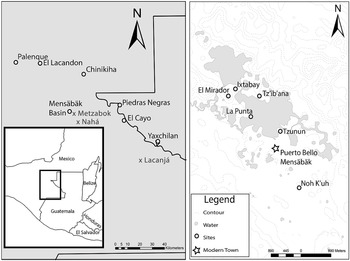
Lacandon Maya are found in the forests of northeast Chiapas, Mexico (Figure 1). Before the end of the twentieth century, Lacandon people also occupied the Petén jungles to the east in Guatemala across the Usumacinta River. Northern Lacandon populations are concentrated in the villages of Nahá (also Najá) and Mensabäk (also Metzabok). Southern Lacandon Maya reside at Lacanja (Lacanjá Chan Sayab; also Lacanhá). Smaller settlements are scattered between these population clusters. Maya ruins, consisting of mounds of earth and stone—some with extant temple superstructures, carved stelae and altars, house platforms, and surface artifacts, including grinding stones, broken ceramics, and stone tools—are found across Lacandon territory. Contemporary Lacandon have intriguing Indigenous perspectives regarding ancient Maya ruins and their denizens, particularly those in the nearby sites of Palenque and Yaxchilán (see Figure 1).
The location of the Lacandon Maya villages of Mensabäk (also Metzabok), Najá (also Nahá), and Lacanjá, as well as nearby archaeological sites in Chiapas, Mexico (map by Santiago Juárez and Joel Palka).
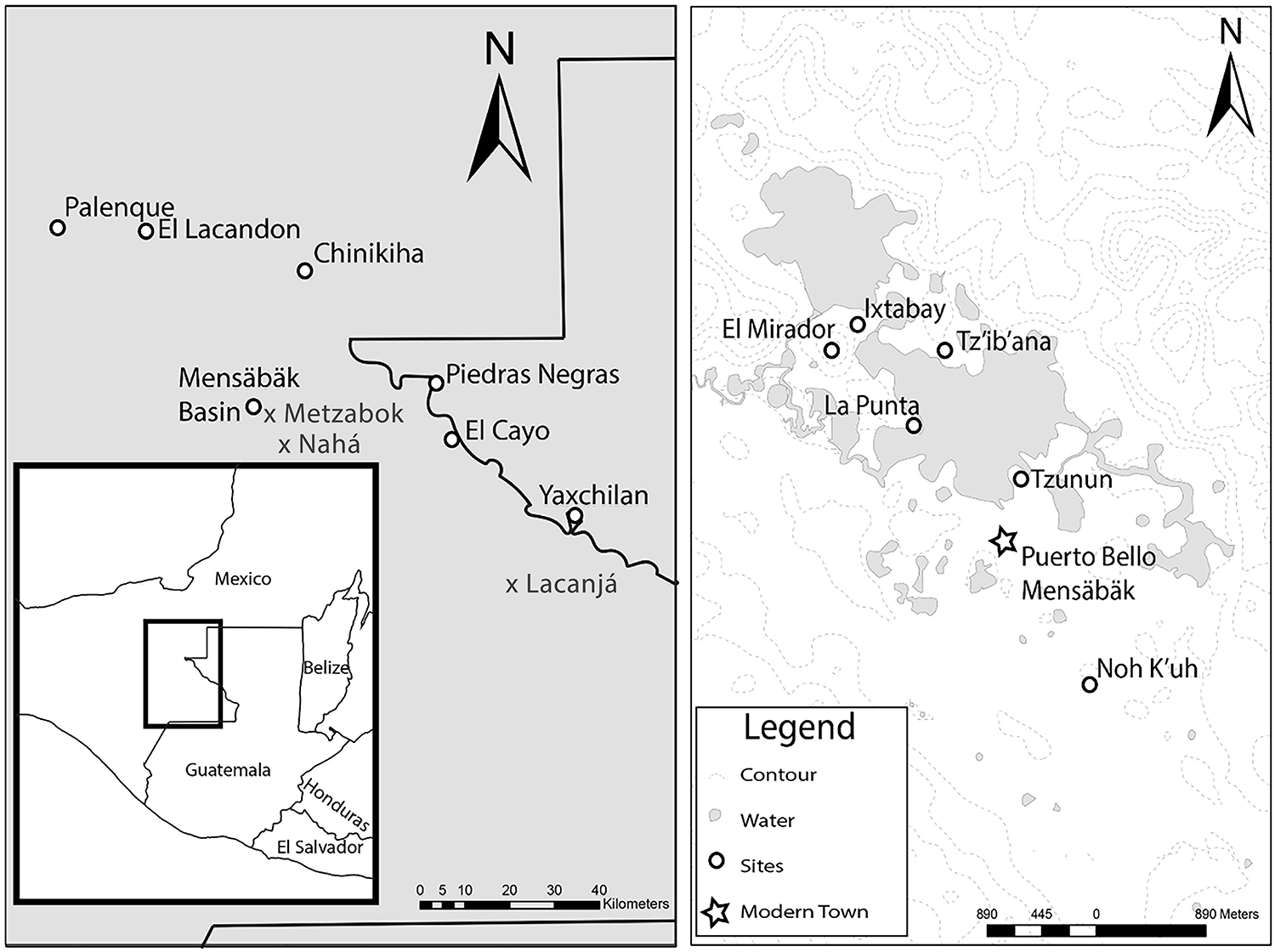
Figure 1 Long description
A) The left map displays the location of Lacandon Maya villages and archaeological sites in Chiapas, Mexico. Key locations include Palenque, El Lacandon, Chinikihá, Mensabäk Basin, Metzabok, Nahá, Piedras Negras, El Cayo, Yaxchilán and Lacanjá. An inset map shows the broader region, including parts of Mexico and Guatemala. B) The right map focuses on specific sites and modern towns in the area. The legend indicates contour lines, water bodies, sites and modern towns. Notable sites include El Mirador, Ixtabay, La Punta, Tzibana, Otzurun, Puerto Bello Mensabäk and Noh K′uh. Modern towns are marked with stars, while other sites are marked with circles. The maps use contour lines to depict elevation changes and water bodies are marked, providing a detailed view of the region′s geography.
Lacandon Maya perspectivism, like that of other Amerindian societies, includes their view of the world and the types of people (winik), or persons, who inhabit it (Balsanelli Reference Balsanelli2018, Reference Balsanelli2019a, Reference Balsanelli2019b; Balsanelli and Palka Reference Balsanelli and Palka2025; Woodfill and Henderson Reference Woodfill, Henderson, Woodfill and Henderson2024). According to their ontology, Lacandon do not see the world as it really exists. For instance, nonhuman persons reside across the landscape, but people merely view the persons who manifest themselves as certain animals, plants, and materials (Viveiros de Castro Reference Viveiros de Castro2010). The nonhuman persons have parallel lives to Lacandon. They have fields (milpas), which Lacandon see as forest and lakes, and they have houses that appear to them as caves, cliffs, and Maya ruins. Because of a pervasive animacy, the world is imbued with life, souls, and divinity, which Lacandon describe as “pixan.” Everything has pixan, yet things and beings associated with nonhuman persons have an increased amount of this life force. These things and persons have bodies and destinies that differ from humans because of their association with cosmic energies and cycles (Monaghan Reference Monaghan1998). Their being and personhood are related to how they were created and how they are sustained. Lacandon deities were born from flowers or created by other deities, and they, in turn, formed people from clay.
In the Lacandon cosmos, other persons and life forces exist, such as kuxa’an and k’uh (or k’ul/k’ur; also dios or santo), which are interrelated. The root of these terms is “k’ul,” which can be glossed as “deity/divinity” that is generated by the forest and deities themselves. Beliefs regarding k’uh involve nonhuman persons or what we call deities, as well as the materials involved with them, such as incense burners (Balsanelli Reference Balsanelli2018, Reference Balsanelli2019a, Reference Balsanelli2019b; Boremanse Reference Didier, Voss and Koechert2010:128). For example, incense smoke is deity food (uyo’och k’uh), and ceramic incense burners are their vessel bodies (uläk’il k’uh; “ceramics of the deities”). The incense burners do not represent the nonhuman persons: instead, they are and act as the deities (Balsanelli Reference Balsanelli2019a; Boremanse Reference Didier2020; Palka Reference Palka2014; Palka and Balsanelli Reference Palka, Balsanelli, Woodfill and Henderson2024). The burners do not merely symbolize deities or hold offerings: they are deity essences because they contain a stone from the ruins (Baer and Baer Reference Baer and Baer1950:267–268; Bruce Reference Bruce1968:137–139; McGee Reference McGee1990:50–52).
The concept of k’uh is so important that it represents life, known as kuxa’an (k’uhxa’an, or “divinity connectedness”). Because of this pervasive life-divinity, people engage with it everywhere. Through social interaction, nonhuman persons with significant k’uh have agency (Palka and Balsanelli Reference Palka, Balsanelli, Woodfill and Henderson2024) that affects the lives of Lacandon Maya. Hence, Lacandon must continue this interaction with these persons to acquire food, assure their health, and obtain things they need, such as cloth and machetes. Lacandon offerings and prayers are carried out to maintain, please, and influence the nonhuman persons, who then provide Lacandon with the proper foods that constitute their bodies.
This interaction is a clear example of how Lacandon people, in observing the landscape and the divine characteristics of ancient structures, connect Maya ruins to specific nonhuman persons. When Lacandon wandered through the Chiapas rainforest that has both natural elements (mountains, cliffs, lakes, caves) and human-made features (temples, rock art, ancient offerings in shrines), they created their own “divine-animistic landscape”: places inhabited by gods or divine persons, all of which are endowed with specific behaviors and functions (Lozada Reference Lozada2024; Palka Reference Palka2014). Therefore, people had to move constantly in such ritual spaces to maintain communication with their different divinities. They interacted with them through pilgrimages and rituals at their ruin homes whenever their intercession was needed.
These nonhuman persons actually animate the landscape and cosmos. We use “animism” as an Indigenous ontology from the literature (Woodfill and Henderson Reference Woodfill, Henderson, Woodfill and Henderson2024) that acknowledges that all things are subjective, with agency sharing the same “interiority”: a mind, soul, and spirit. However, these things are different in their external expression (the body). According to Lacandon Maya, gods, spirits, animals, plants, humans, and places are endowed with the same life essence (a pixan, as discussed earlier). These beliefs hold that all creatures and things are “intrinsically human.” For instance, a tree is a person who can pray, cry, and feel pain. A cave is “alive” and can punish persons who enter it without ritual permission.
Divine nonhuman persons have more or are more connected to the k’uh life force; thus, their bodies, essences, and personhood have more power and all-encompassing perspectives (Balsanelli Reference Balsanelli2018). They also eat divine foods, such as incense and rubber figures with life force, which makes their being, perspectives, abilities, and bodies different from humans. Lacandon Hach Winik, or “real people,” have different bodies connected to unique foods, behaviors, and perspectives; hence, their personhood is different from the deities. Animals and plants have different types of k’uh and pixan, and they eat things from the forest and earth, so their bodies and selves contrast with those of humans and deities. By considering a condition of extended personhood, Lacandon people, as in other animistic societies, must maintain a relationship of respect, reciprocity, and harmony with all the elements constituting their cosmos (and their natural environment). In such an ontology, people are not the owners of “nature”: they are a part of it and belong to a huge network of relationships established between humans-deities-plants-animals and places, which include ancient Maya ruins.
Lacandon Perceptions of Maya Ruins
Just before Western explorers encountered the Classic Maya ruins and murals of Bonampak, Chiapas, an outsider asked a Lacandon man, “Have you seen any ruins?” This man responded, “What are ruins?” (Baer and Baer Reference Baer and Baer1969). This statement sums up Lacandon Maya views of archaeological sites: the remains of ancient Maya are not seen as “ruins” but as manifestations, homes, materials, and embodiments of deities and entities in themselves. Lacandon do not view archaeological sites as the settlements of their ancestors but as the material and divine remnants of nonhuman persons created before people and as the places of contact and communication with deities about human needs. Lacandon give offerings to deities in Maya ruins to convince them to maintain people and their world.
Maya ruins are a central part of the Lacandon worldview. Studies have clarified the importance of ancient Maya ruins for Lacandon people. They actually see ancient stone buildings, many of which have collapsed, but nonhuman persons see them as thatched roof houses made of wooden beams and boards (Boremanse Reference Didier, Voss and Koechert2010:136). Because the ruins are monumental, they had to have been made by deities. Although caves and cliffs are also important houses for nonhuman persons, the presence of stone buildings and sculpture indicates that they contain a great deal of sacred life force, including pixan and k’uh. Ruins are divinely more powerful places because they are the houses of nonhuman persons associated with the sky. Caves are the homes of earth deities and are not as powerful as the ruined buildings of celestial divinities (Boremanse Reference Didier2020).
For Northern Lacandon, several events involving nonhuman persons occurred at the nearby Maya ruins of Palenque (Boremanse Reference Boremanse1982). A central celestial diety, Hachäkyum, was born there, and he lived and died in these ruins. This nonhuman person was buried in a structure here, possibly the Temple of the Inscriptions. According to some versions of this myth, his son T’uup created a double of himself, as other deities did, to ascend to live with his father who transitioned to the heavens. T’uup’s earthly double, possibly an ancient Maya sculpture, still resides at a pyramid at the site. T’uup had conflicts with his elder brothers, so they too are destined to stay on earth and reside at Palenque.
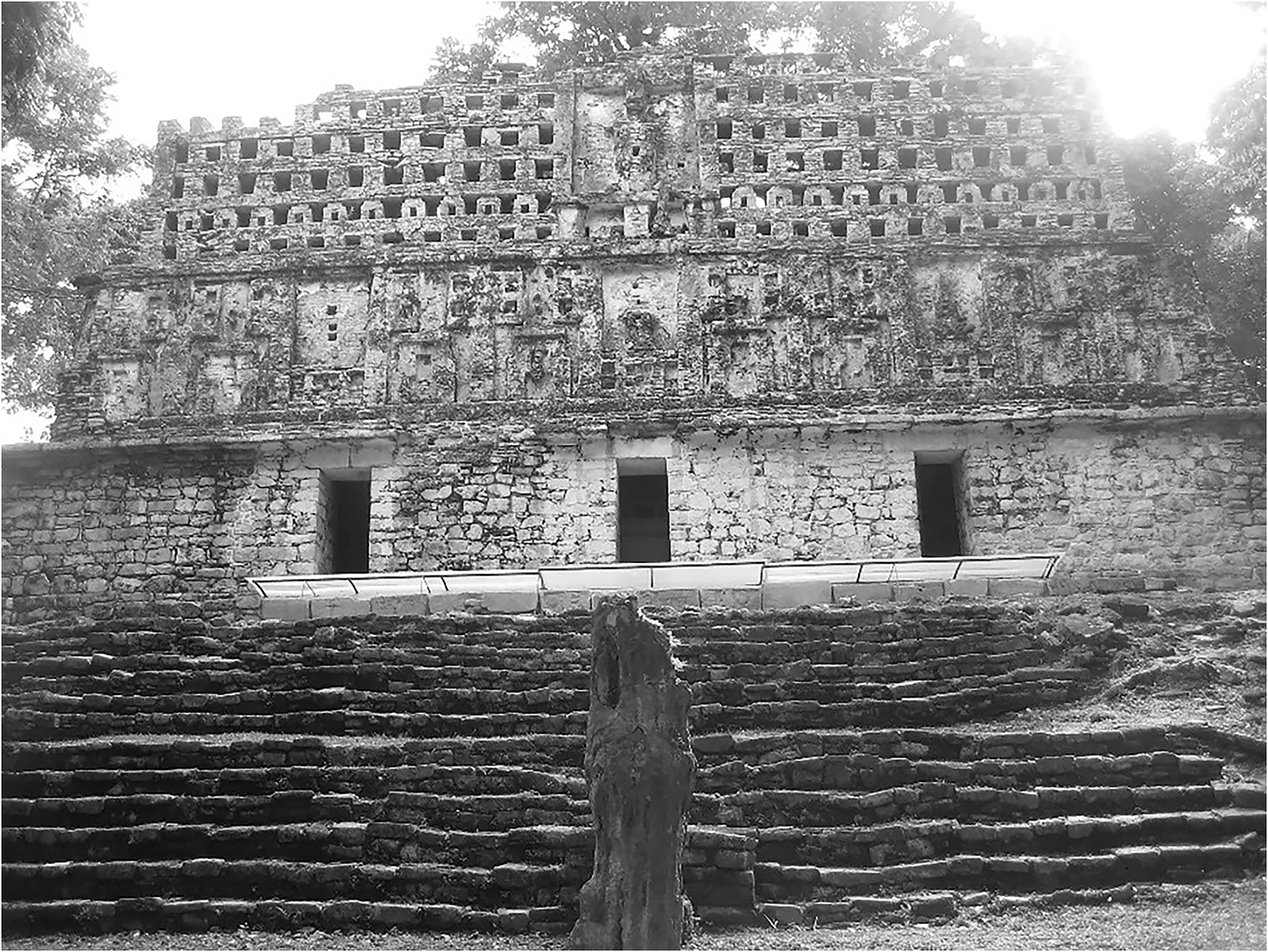
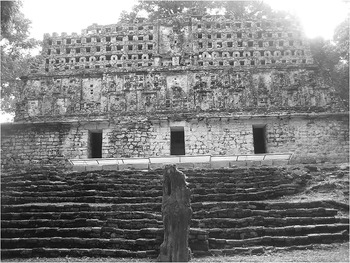
The ruined structures at the Maya site of Yaxchilán on the Usumacinta River were also the homes of sky deities (Figure 2). Hachäkyum lived here with his wife, sons, sons-in-law, and assistants. Northern Lacandon Maya refer to this site as Chi’ xokla’ uyatoch Hachäkyum (“Mouth of the Xok waters, the house of our true lord”; Boremanse Reference Didier, Voss and Koechert2010:130), and Southern Lacandon call it Uya’lam uyatoch Ik Yum (“The lower part of the house of Our Lord”). Boremanse (Reference Didier, Voss and Koechert2010:129) identified a deity or an image of a deity called Hach Biram (also Bilam; see the later discussion) that is the headless Maya statue of Bird Jaguar VII, located in Structure 33. For some, the image pertains to Hachäkyum. According to Lacandon mythology, when the statue places its head on its shoulders, it will signal the Xur T’an, the “End of the World” anticipated by a solar eclipse (Boremanse Reference Didier2020; Cook Reference Cook2019). Xok, which is a term related to “shark,” perhaps from bull sharks in the river, is the name of a divinity with feminine and fish attributes connected to water and fish and their capture. Northern Lacandon state that these divine entities once lived at the ruins of Palenque, Chiapas, but they moved to Yaxchilán (Boremanse Reference Boremanse1982:85). Hence, the nonhuman persons move their residences and fields just like Lacandon do.
Yaxchilán Structure 33, a Lacandon pilgrimage shrine at a Classic Maya ruin (photograph by Josuhé Lozada).
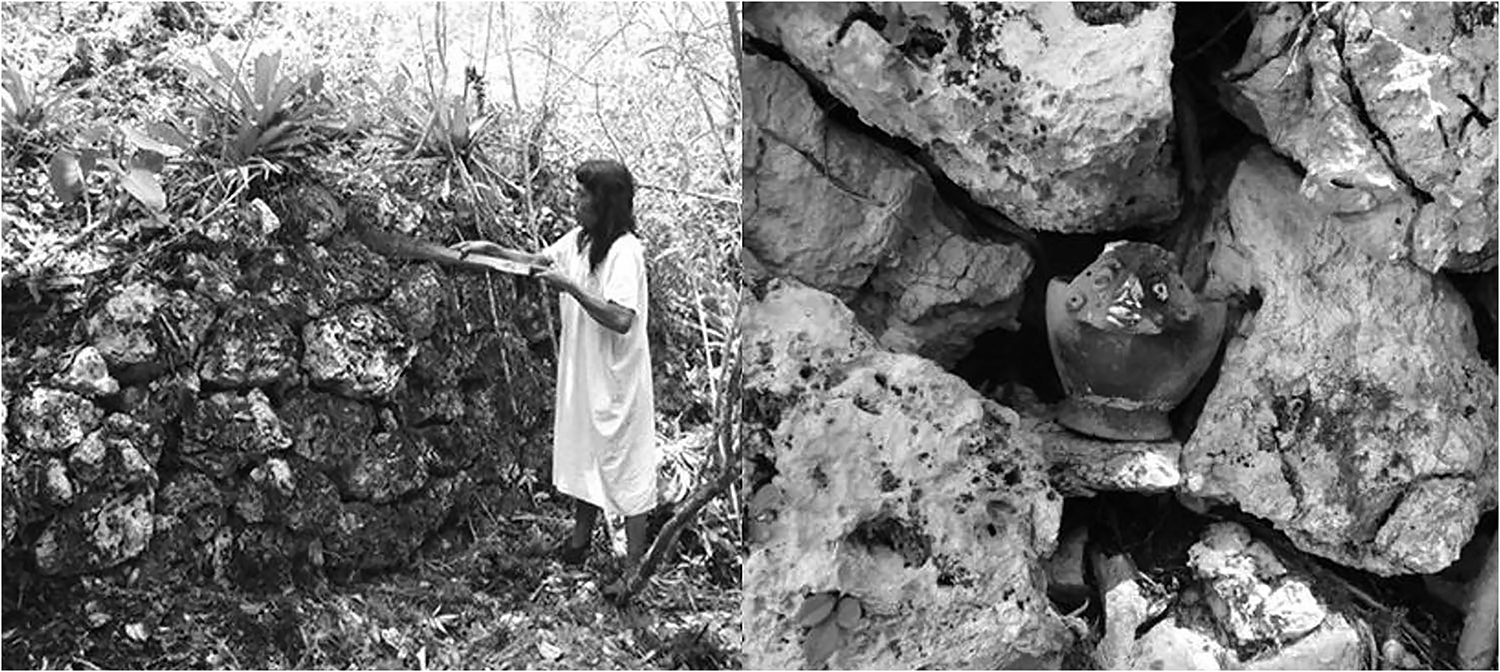
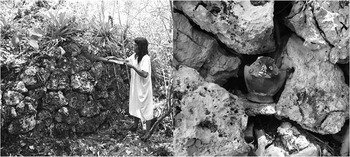
Smaller archaeological sites scattered across the forest, mostly ones with mounds, are viewed as the homes of earthly nonhuman persons. These entities also reside in caves (aktun). For example, the Northern Lacandon deity Chäkaktun (“Red hollow/cave stone [with water]”) lives in a mountain with caves, called El Mirador (also called Chäkaktun; see Figure 1) that has a ruined stone temple on its summit at Lake Mensabäk (Figure 3). Mensabäk (“Maker of black-soot powder [rain]”), a nonhuman person associated with rain, earth, and the land of the dead, like Tlaloc in central Mexico, resides in a nearby lakeside cliff with ancient rock art and Maya skeletons and souls (Palka Reference Palka2014:285–291). People do not see the thatched roof house of this divinity but only see just a cliff. They cannot see the adjacent fields and cow pastures of the realm of the dead but only the lake surface.
Lacandon pilgrimage shrine at an ancient Maya temple at El Mirador, Mensabäk, Chiapas, with a ceramic incense burner in the stone walls (photographs by Joel Palka).
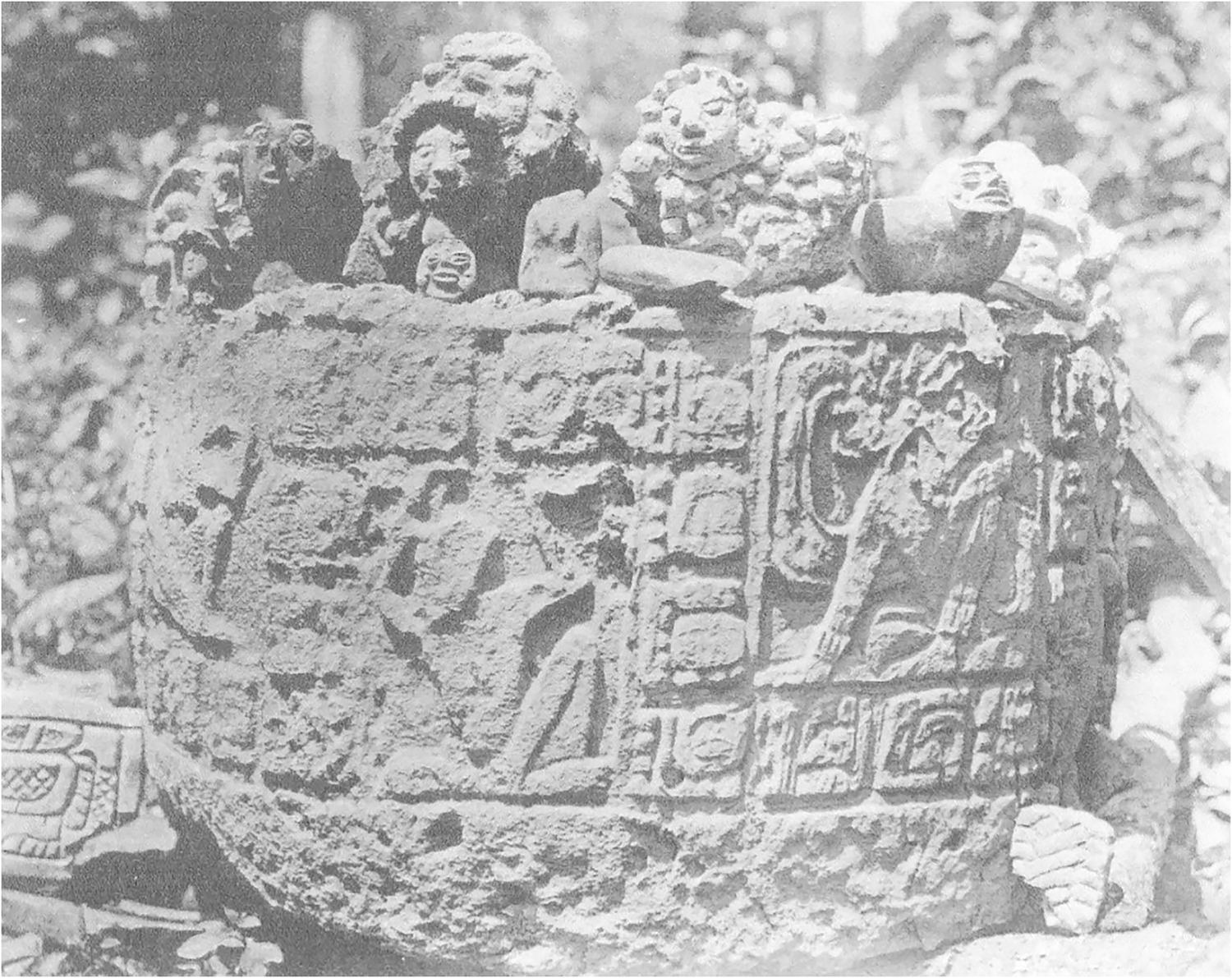
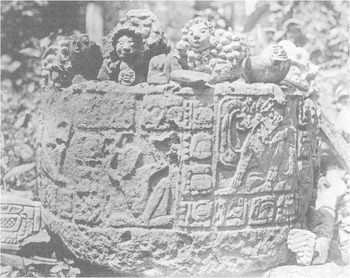
Lacandon ceramic incense burners have been found at ruins across the Petén and Chiapas lowlands (Figure 4), indicating the importance of the sites in the Lacandon worldview and the ceremonies required to interact with nonhuman persons there. Importantly, the stones placed in their ceramic incense burners usually are obtained at these ancient sites (Baer and Baer Reference Baer and Baer1950:262–256; Boremanse Reference Didier, Voss and Koechert2010). These stones consist of pebbles from masonry walls, or they are artifacts found at the ruins, such as carved jade beads and anthropomorphic heads (Tozzer Reference Tozzer1907). To obtain these stones, Lacandon make ritual pilgrimages to the ruins to provide offerings to nonhuman persons there in exchange for the incense burner stones. Lacandon state that these stones are the seats and organs of the nonhuman persons merging with the incense burners. The sacred stones further animate the incense burners, giving them more pixan, or life force, because they are seen as the “original deity,” or u chuni k’uh, the source of divine power.
Early photograph of Lacandon incense burners on an ancient Maya stone altar at a shrine at Yaxchilán (photograph by Teobert Maler [Reference Maler1903:Plate LXXX]).
Lacandon believe that the souls (pixan) of the deities entered the sacred stones during the incense burner renewal ceremony when they were deposited inside the new censers. The stones from ruins and their deities also give the incense burners divine healing powers (Boremanse Reference Didier2020:64; Bruce Reference Bruce1968:137–139). Stones from lakes or caves not seen as deity houses will not serve as the receptacle of the life force of the nonhuman persons connected to the incense burners. When the incense burners die and before they are deposited in a ritual cave, Lacandon remove these vital organ stones and place them in new incense burners to animate them.
Let us clarify further the Lacandon conceptions of ancient ruins. During an expedition in the Chiapas jungle, Jacques Soustelle was surprised that the Lacandon referred to ruins (and some caves) as “stone houses.” He tried to explain this belief by assuming that, because the Hach Winik possessed an elementary material culture and built simple huts made of wood and guano, they naturally considered the ancient Maya monumental stone constructions to be prodigious divine works (Soustelle Reference Soustelle1971:213, 214). However, Soustelle did not consider the fact that the Lacandon conceived the ruins as the inhabited spaces of divinities. He also did not consider the absence of the natural/artificial or sacred/profane dichotomy in Maya culture (Brady Reference Brady, Breton, Becquelin and Ruz2003; Morales Reference Morales Damián2019; Petrich Reference Petrich2007; Taube Reference Taube, Gómez-Pompa, Allen, Fedick and Jiménez-Osorio2003). As Estrada Ochoa (Reference Estrada Ochoa2009:191) rightly emphasizes, the geographical space of the Maya is not divided between natural and cultural but is both at the same time. Schele and Freidel (Reference Schele and Freidel2011,73–74), referring to the ancient Maya, explain this concept:
The geography of the human world was made up of plains, mountains, caves, cenotes, rivers, lakes and swamps, in addition to the places and buildings made by men: cities and villages with their houses, palaces, temples and ball games. For the Maya, that world had life and was imbued with a sacredness concentrated in special points, such as caves and mountains. . . . Within that model of sacred landscape, human built communities that merged with the patterns generated by the gods, while creating a second matrix of man-made power points. The two systems were considered complementary, not independent.
As these authors suggest, humans used to build their spaces following patterns previously created by the deities. Recent studies on Lacandon religion have shown that dichotomies such as natural/artificial and natural space/anthropic space have no place in Lacandon thought (Balsanelli Reference Balsanelli2018, Reference Balsanelli2019b; Balsanelli and Palka Reference Balsanelli and Palka2025; Boremanse Reference Didier1998, Reference Didier, Voss and Koechert2010). Moreover, deities and humans hold different perspectives of the world. An informant of Nahá describes how the deities see caves and lakes: “Those are their houses . . . the owners of the caves are like people, their home is in the caves, you really don’t see if there is a house, you see a cave, they see their house. You see a lake, we see a lake, but it’s not a lake, that’s their place, their home (K’in Murux, personal communication 2019).
Every ruin, even those that appear as unshaped piles of stone, is considered to be a house for nonhuman persons. An informant of Metzabok explains that even the smallest portions of an ancient temple, like the walls of the archaeological site called Kuh’i Chom (Deity of Vultures; called Tzunun by archaeologists; see Figures 1 and 3), which are the walls of structures and defensive walls, are the houses of deities. He also clarifies that we cannot see what the deities see, because our eyes are “backward” (k’ex awich), an expression that perfectly depicts perspectivism in Lacandon terms regarding how humans view ruins:
A: Are there gods in every ruin?
K: They are all inhabited by the gods, they are always there.
A: Even when they are not well-preserved? Even if they’re small?
K: You can’t see it, your eyes are “backwards,” you only see stones. Look where there’s that wall, on the path to K’uhi Chom, a god lives there, it has an owner.
A: I can’t see the temple of the god.
K: You don’t see it, the god can see his house, it has its roof, he has his whole house, like my own house, just like that, you just can’t see it.
A: Are ruins alive . . . like caves?
K: Eeeh, they are very alive, I say! [K’in, personal communication 2001].
In every cave and archaeological site live certain terrestrial or sky deities, in addition to minor nonhuman persons. Hence, it is believed that these places have “an owner” (yaan uwinkil) and are considered living spaces (kuxa’an). In fact, some deities living in ruins are the “deities of life-essence” (u kuxtey k’uh), who made the ancient artifacts found there (Bruce Reference Bruce1968:137). The main function of these persons/owners (winik) is to protect their sanctuaries and modulate human behavior in their vicinity, as we discuss later. Likewise, in line with the Maya notions presented earlier, temples become important spaces of interaction, where communication between humans and nonhuman entities is allowed. They are also sacred spaces, a view that has been maintained by other Maya peoples: “Stelae, like rulers, possessed this divine soul-like quality (what Tzotzil Maya today call ch’ulel) and were in some way considered living things invested with k’uh. This is indicated by the occasional labeling of monuments as k’uhul lakamtuun, ‘holy banner stones’” (Houston et al. Reference Stephen, Stuart and Taube2006:84).
Therefore, the “stone houses of the deities” are believed to be inhabited by divine entities and spaces that are kuxa’an (“alive”). When approaching them, it is mandatory to follow numerous prohibitions and to maintain a respectful state of ritual purity, especially if the purpose of the visit is ceremonial interaction. Lacandon women may not approach the temples and pray to the deities; they must keep a safe distance. If they violate these rules, the punishment could be a serious illness, an accident, and even death, as we saw at the beginning of the article. The same danger was faced by men who approached the houses of the deities to communicate with them without respecting the period of sexual continence imposed before conducting rituals. These rituals are important for they help persuade the deities to give Lacandon things that are important in their lives. The nonhuman persons must be placated and convinced to do good things for people, rather than harming them.
Maya Ruins in Lacandon Myths
According to Lacandon theogony, the appearance of Maya ruins precedes the creation of human beings and of the earthly plane that, for the Lacandon people, is identified with the living forest. The ruins are not human works, as explained in their origin myths (Baer and Baer Reference Baer and Baer1950:224). In fact, the first stone temples here were built by the remote deity Ka’ Koch, who, after completing the creation of the Lacandon deities, constructs the buildings in which “his beings” dwell. According to a version of the creation myth in Nahá, after the Lacandon deities awoke, Ka’ Koch sowed palms (guano) for thatch on the earth. He then collected the leaves and arranged them in layers: these became stone blocks, walls, and stairways. This is how the buildings of Palenque came into being in a muddy and lifeless land that was deprived of trees, lakes, mountains, animals, or people. There, the deities grow up and become old in the mythical age in which the Lacandons and their forest had not yet been born:
They went to look for a place to live. Ka’ Koch was the one who thought about it. He looked for the palm thatch . . . it came out fast! He was the one who planted the palms, but the thatch turned into stones. He made their houses out of the stones, he made them out of palm thatch, so they could have their homes, you see them as stones. They are layered, but he made them, and because he is a god, he transformed the thatch into stones; they became stones. He did it quickly, because thatch is stone [Don K. (Nahá), personal communication 2019].
After completing the creation of the temples, Ka’ Koch withdraws into a dark sky, entrusting the creation of the earth to his divine children (Bruce Reference Bruce1965). Each deity in the myths occupies a specific temple at Palenque. For example, the main deity Hachäkyum (“Our True Lord”) takes as his residence the impressive Temple of the Inscriptions, and his son T’uup dwells in the tower in front that served as an observatory. In that divine city, which some Lacandon elders call Kula’an K’uh, or “Where the Deities Sit,” Hachäkyum together with his brothers create the forest, the stars, the animals, and the plants; finally, they mold the first generation of Lacandon from fired clay (Bruce Reference Bruce1974; Cook Reference Cook2019).
At the mythical beginning of the human era, people and deities lived together in the forest surrounding Palenque. The ruin is the center of the world, the place where all the mythical events take place with the divinities and Lacandon ancestors, with the nukuch winik (“ancient persons”) as protagonists. However, at any given moment, the deities may feel the desire to move; thus, each one drifts from Palenque in a different direction. During their pilgrimages, they choose new houses, establishing themselves in ruins scattered throughout their territory, or they create new ones. For example, the rain deity Mensabäk lived for a time at the Maya ruin of Toniná, where he married a local princess until he decided to flee with her (Bruce Reference Bruce1974; Cook Reference Cook2019). Together with a group of minor deities (uwinik, “his people”), this nonhuman person wandered in the forest until he reaches a new site, first in a cleft red mountain (Chäkaktun mentioned earlier) and then in a nearby cliff. This deity felt this site was a perfect place to live because it is full of lakes, fish, land, wood, and game. The village he founded would later be named after him using the Spanish term “Metzabok,” which is now the name for this Northern Lacandon settlement.
In the same way, Känank’ax, the “Guardian of the Forest” and the deity associated with the earth, departed from Palenque. He made his way through the area with his people (minor deities) and settled in a small temple in the forest near the ritually important lake called Yahaw Petha’. This lake near Nahá has cliffs with rock art, caves with human skeletons, and ancient Maya ruins. The dwelling of this deity is a small Classic period temple at the site of Känank’ax-Sibal (Lozada Reference Lozada2024; see Figure 5). This extant temple was once filled with Lacandon ceramic incense burners. In another example, Lacandon believe that most of the celestial deities eventually moved to the Maya city of Yaxchilán, which becomes the new “center of the world” (Chumuk Ka’n). Some Lacandon call this ruin Uchi’ Xokra’ (“The Mouth of the Usumacinta”).
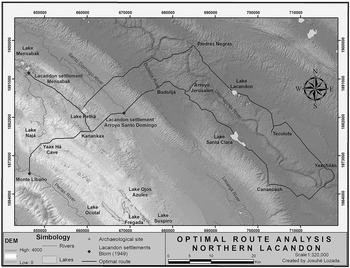
Northern Lacandon settlements of Mensabäk and Najá (at Lake Najá; also Nahá) and their pilgrimage routes to Maya ruins ending at Yaxchilán (map by Josuhé Lozada).
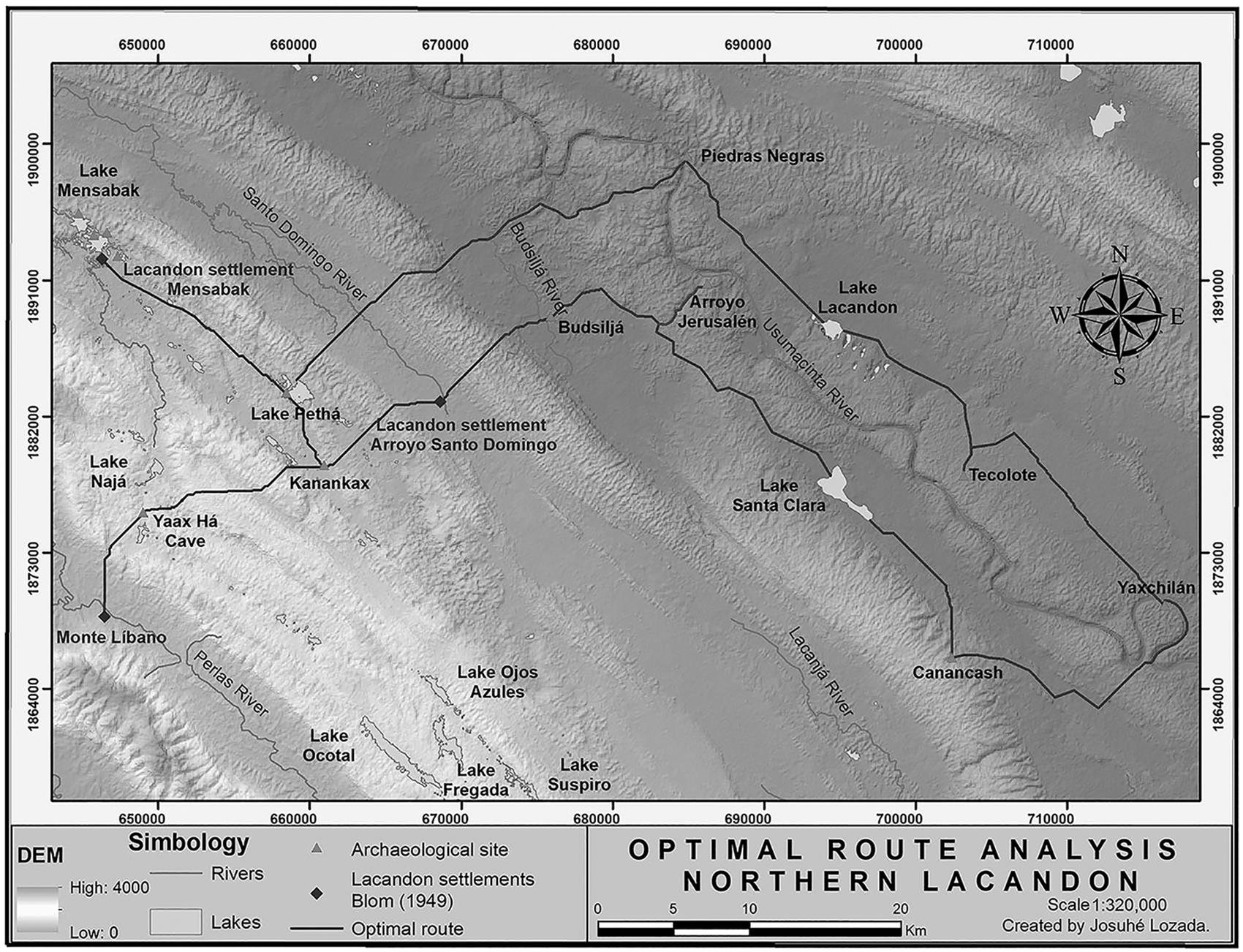
Figure 5 Long description
The map titled ′Optimal Route Analysis Northern Lacandon′ displays various geographic and cultural features in the Northern Lacandon region. It includes labeled lakes such as Lake Mensabak, Lake Najá, Lake Lacandon and Lake Otoch. Settlements are marked, including Mensabak, Najá and Lacanja. Archaeological sites are indicated with specific symbols and routes are outlined across the region. The map features a compass rose for orientation and a scale bar for distance measurement. The legend explains symbols used for archaeological sites, Lacandon settlements and lakes. The map is created by Josuhé Lozada, with a DEM (Digital Elevation Model) background showing elevation variations.
The behavior of the deities just described must be understood according to the conceptions the Lacandon have about nonhuman divine persons, who in their celestial abodes in the Underworld or in the caves, behave and live like humans (Boremanse Reference Didier1998:202; Bruce Reference Bruce1965). Until the middle of the last century, the Lacandon lived dispersed in the vast forest. Their existence was characterized by mobility, with small family groups constantly moving to find suitable places to live and establish new fields (McGee Reference McGee1990; Palka Reference Palka2005; Soustelle Reference Soustelle1959:146; Tozzer Reference Tozzer1907). A wise, elderly Lacandon man at Nahá explained that people also constantly changed settlements to emulate the behavior of their deities:
A: You told me that Hachäkyum is in Yaxchilán, is that right?
C: That one is in Yaxchilán.
A: Where was he born?
C: A long time ago, in Palenque, but he moved, he left Palenque, he left on foot.
A: Why did he abandon Palenque?
C: He abandoned it, because, you see, they are like the Lacandons, they move, they move across the jungle, the Lacandons did not stay in one place: they settled here, and if there was no wood for fire, they looked for another place to live, when they found wood they made another town, so did Hachäkyum, the gods are people, because they did not wear trousers, they did not wear shirts, only the real cotton [Lacandon tunic], they did that [moving] every year. Hachäkyum taught it, he cleared the field for his milpa, he looked for a place to make a milpa, after a few years he moved again. You know, Hachäkyum left Palenque, he went up the Usumacinta River, he is there now, that is what they told me. . . . When the world ends . . . well, I will not live to see the end of the world . . . but he will return there, in the center of the world, the very center, the center of the sky [Yaxchilán], he will sit there, near Guatemala [Chan K’in, personal communication 2022].
Lacandon offer different opinions about the origin of the temples of Yaxchilán. According to some informants, the ruins were created by the remote deity Ka’ Koch, whereas others claim that the wandering nonhuman persons built those temples to be their homes after moving from Palenque. In any case, the ruins have always been considered divine works. First, certain deities arrived at the new site of Yaxchilán, where they “built their houses”; later they called their relatives, a situation that follows the Hach Winik model of family settlement (Boremanse Reference Boremanse1982). Like their deities, when the Lacandons moved and found a good place to settle, they convinced relatives to join them:
A: Which gods are in Yaxchilán?
K: There is the house of Isana’, there is also the house of Säk Äh Puk . . . they are like the Lacandon, they went there to make their houses, Säk Äh Puk came to visit Itsana’ and stayed there, he made his house.
A: So, it’s not that there are two of them; it’s the same god that moves.
K: The same, all of them. Yaxchilán came later; Palenque is the beginning. Palenque . . . do you know the very big palace/temple? It belongs to Hachäkyum, the two-layers temple is T’uup’s, there was also Säk Ähpuk.
A: There they were born, then they left.
K: Then they all left.
A: Ah, that’s why there are gods that . . . they are in two places, but no. . . .
K: No, it is that their houses are empty [in Palenque]; now they are not there; they are in Yaxchilán, the Hach Biram is Hachäkyum face [image], it is his face, they cut off his head [Don K. M., personal communication 2022].
The mobility of the deities and the construction and occupation of temples led to the creation of the divine landscape of the Lacandon. As they moved through the jungle, they followed the footprints of their deities: they located the ruins, which they interpreted as the passage of the nonhuman persons and proof of their presence. Thus, when the Lacandons needed to ask for the intervention of the deities, they could address them directly, praying and burning copal incense in their sanctuaries or the deity houses. It is necessary to reiterate that all the buildings are considered to be the houses of nonhuman persons, no matter in which state of conservation they are—whether reconstructed temples or simple accumulations of stones.
However, larger and better-preserved structures are associated with nonhuman persons of higher rank and greater k’uh and pixan forces; the smaller mounds were associated with minor deities, such as the Chembeh K’uh (“wandering deities”). These are jaguar deities that inhabit stone mounds and caves (Boremanse Reference Didier2020:159; Bruce et al. Reference Bruce, Carlos Robles and Chao1971:82; Davis Reference Davis1978:19). Their function is to protect the forest, and in the past, they were invoked in case of need by burning copal at their houses during pilgrimages to communicate with them.
Lacandon Pilgrimages to Maya Ruins
Early explorers “discovering” Maya ruins mention that Lacandon Maya were there first (Maler Reference Maler1903; Tozzer Reference Tozzer1907). At archaeological sites across Chiapas and Petén, they found Lacandon ceramic incense burners within the stone temples (see Figure 4; Palka et al. Reference Palka, Lozada, Folch and López2023). At Yaxchilán, they even encountered Lacandon visitors, who lived in Petén; they were performing rituals near the temples, including burning incense and performing the dance of the toucan (Maler Reference Maler1903; Palka Reference Palka2005). The buildings at Yaxchilán, especially Structure 33, contained many Lacandon ceramic incense burners. Additionally, an ancient sculpture in the full round, the headless statue mentioned earlier, was labeled as “an idol in a Lacandon temple” because it was particularly revered in this structure (Palka Reference Palka2005:268). This is the statue in human form that Lacandon believe is the nonhuman person known as Hach Biram (or Hach Bilam), from whom this site got its Spanish name of Yaxchilán. Chicle tappers decapitated this monument; subsequently, Lacandon believed that the world would end when its head was reattached.
Before conducting rituals in such ruins, Lacandon abstain from sex and certain foods, including chiles or cacao, depending on the context and family. They must not be angry when making a pilgrimage to ruins to communicate with their deities. Lacandon travel for hours or days to the sites and camp away from the deities’ houses in the ruins. They bring incense burners and incense nodule boards or they use ones from previous rites. Lacandon religious specialists light incense in the bowl of the burner and provide offerings of food, drink, and cigars to the faces on the burners to please the deities.
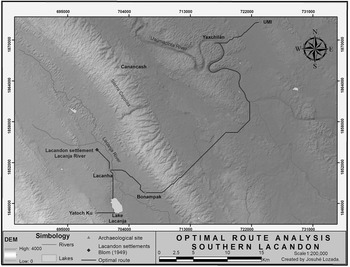
Our analyses of Lacandon incense burner types found by archaeologists at Yaxchilán revealed that visitors from Southern Lacandon populations, mainly from Lacanja, and from the north, likely from Metzabok and Nahá, made pilgrimages here to communicate with celestial deities (Figures 5 and 6). Lacandon settlements are located west of Yaxchilán, and their temple/god houses (yatoch k’uh; McGee Reference McGee1990) face this ruin to the east. Least-cost travel estimates in GIS and discussions with Northern Lacandon collaborators provide some routes traveled by Lacandon pilgrims. Interestingly, all pilgrims walked east to reach the site and then returned west to their homes. The Northern Lacandon traveled east to west and then north to south to arrive at Yaxchilán, whereas Southern Lacandon traveled east to west and then south to north. Boremanse (Reference Boremanse1982:90) points out that Lacandon once lived to the southwest of the Maya ruins of Palenque and Yaxchilán, indicating a potential northeast and then southwest movement of pilgrims visiting these sites.
Pilgrimage routes of Southern Lacandon from Lacanja (also Lacanjá) to Yaxchilán (map by Josuhé Lozada).
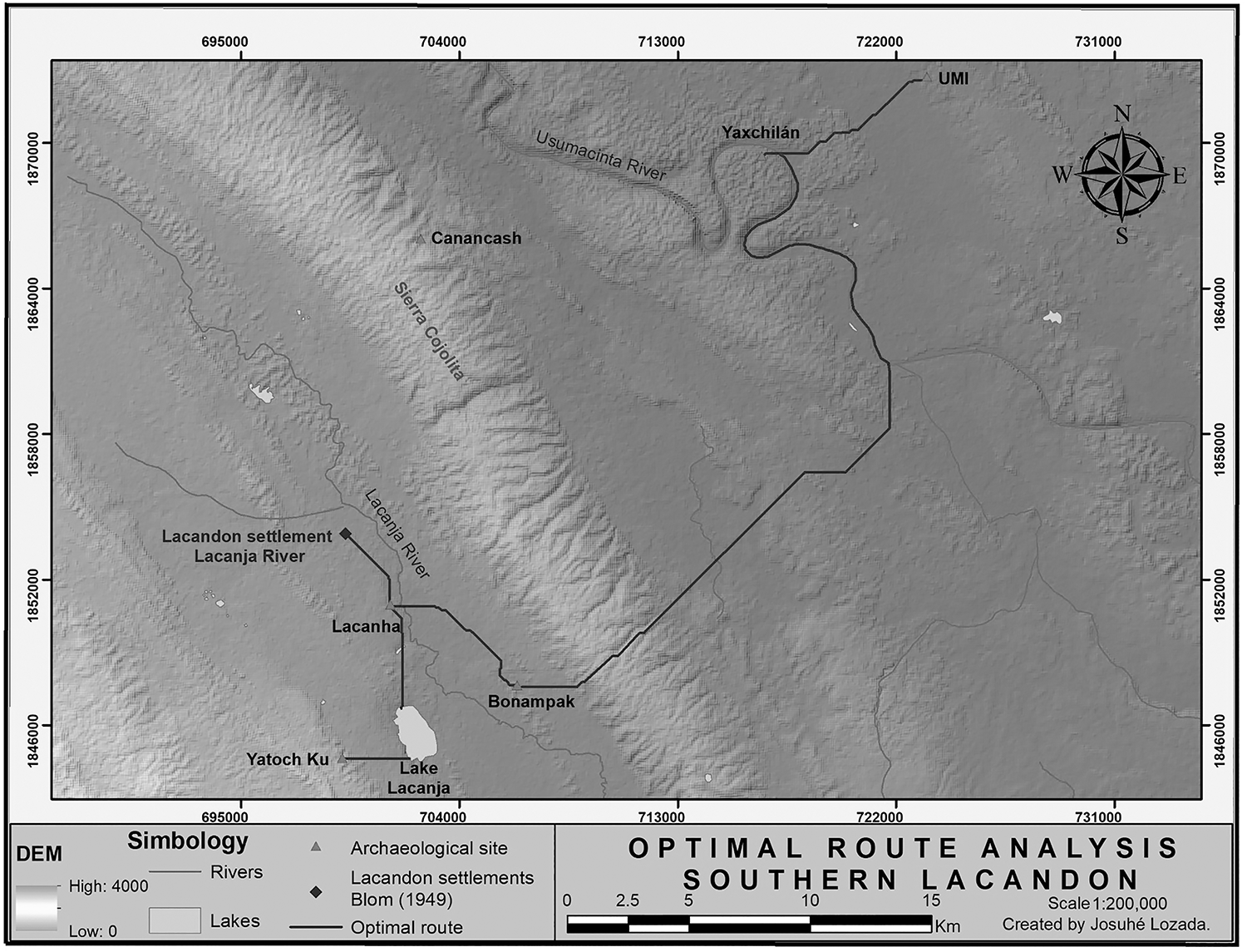
Figure 6 Long description
The map displays an optimal route analysis for the Southern Lacandon region. It includes topographical features and settlements such as Lacanja, Yaxchilán and Nahá. The map highlights archaeological sites and Lacandon settlements, with routes marked for optimal travel. Rivers and lakes are also depicted. The compass rose indicates north and the scale is provided in meters. The map is created by Josuhé Lozada, with a DEM (Digital Elevation Model) background, showing elevation contours. The symbology includes archaeological sites, rivers, Lacandon settlements and optimal routes.
It is possible that Lacandon pathways to and from Yaxchilán mimic the sun’s apparent route across the sky during the solar year. Hence, Lacandon pilgrimages could symbolize growth and ascendancy on the way east toward Yaxchilán and maturity and completion on the way back to the west. Similar travel patterns and associated beliefs in birth, origins, renewal, and maturity can be viewed in Huichol pilgrimages and rituals to the origin place Wirikuta in San Luis Potosí in eastern Mexico and then back to west Mexico (Gutiérrez del Angel Reference Gutiérrez del Angel2010; Neurath Reference Neurath2020). This solar connection may have been central to Lacandon ceremonial practices because the ruins of Yaxchilán are viewed as connected to nonhuman persons associated with the sun and sky.
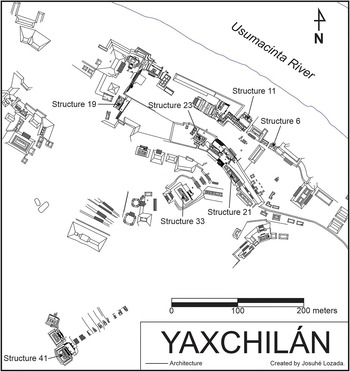
Contemporary Northern Lacandon have made pilgrimages to Yaxchilán with anthropologists (Lozada Reference Lozada2024; McGee Reference McGee2005), whose publications have shown that certain structures are associated with specific nonhuman persons (Figure 7). Lacandon travel through the ruins leaving offerings in structures while communicating with these nonhuman persons through prayer. One counterclockwise path moves east to west, north to south, and from low to high terrain (McGee Reference McGee2005). For Northern Lacandon, Itsanal lives in Structure 19, Bol/Bor lives in Structure 23, Structure 11 is the house of the sun deity K’in. Kayum lives in Structure 21, and Structure 41 is the home of K’ulel. Finally, Säk Ähpuk resides in the lower part of Structure 6, whereas an all-important deity, Äh K’inchob, resides in the upper story. One building with preserved red paint is said to be the house of a deity who sacrificed human beings and painted the structure with blood. This interpretation recalls past Maya and Lacandon practices of anointing objects with human blood as offerings to nonhuman persons.
Map of Yaxchilán with numbered structures, or deity houses, visited by Lacandon pilgrims performing rituals (map by Josuhé Lozada).
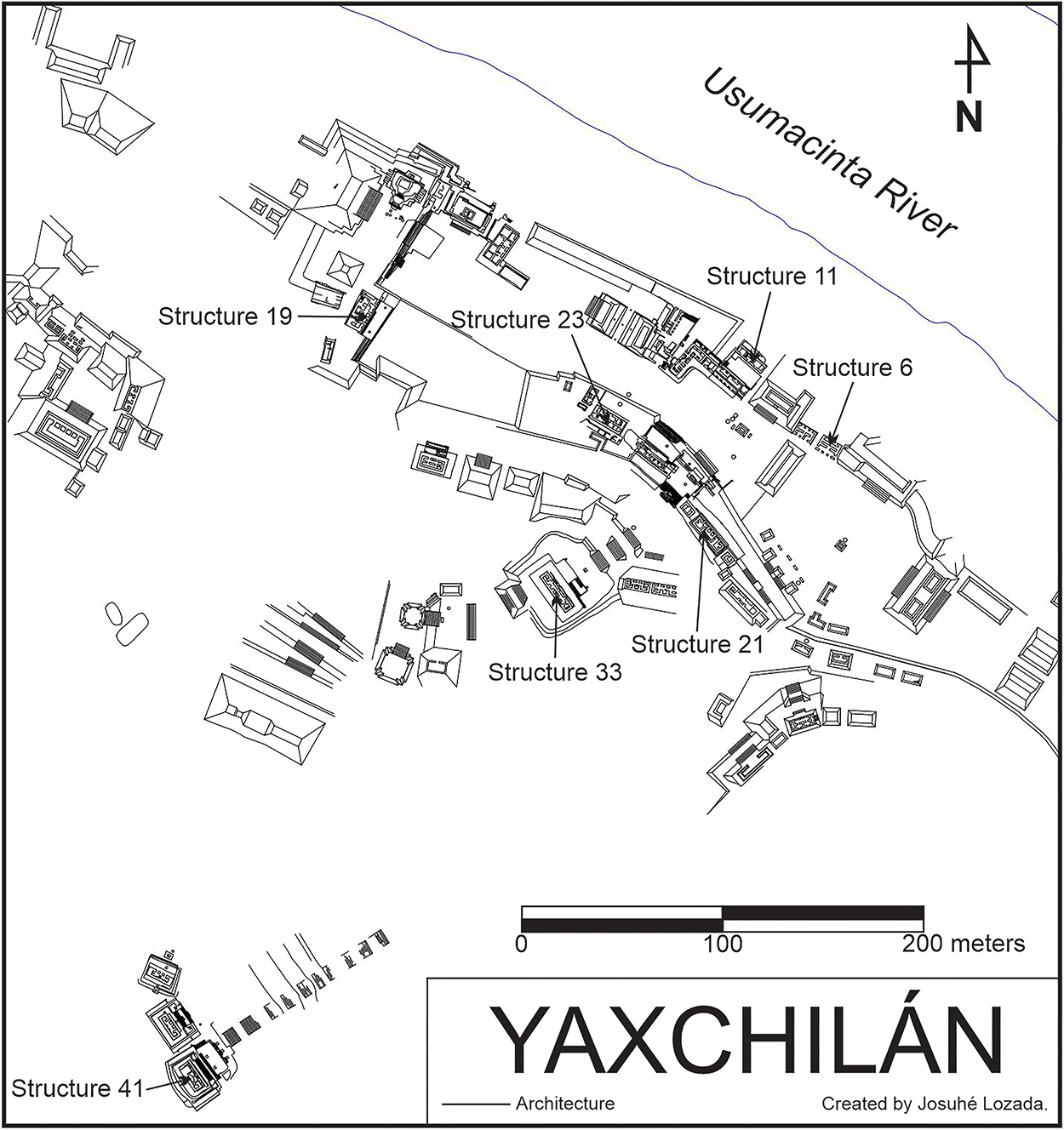
Figure 7 Long description
The map of Yaxchilán depicts various numbered structures situated along the Usumacinta River. Key structures include Structure 19, Structure 23, Structure 11, Structure 6, Structure 21, Structure 33 and Structure 41. The map includes a scale bar indicating distances of 100 and 200 meters. An arrow points north for orientation. The map is labeled ′Yaxchilán′ with a note on architecture and the creator′s name, Josuhé Lozada. The structures are distributed along the river, with some clustered together and others more isolated. The layout suggests a linear arrangement following the river′s course.
Interestingly, Lacandon visitors believe a building high on the Yaxchilán acropolis hill, Structure 33, is Hachäkyum’s house. This nonhuman person is central to their beliefs as the entity who created all Lacandon Maya and provides them with food and other things they need. Lacandon provide many offerings to this entity in the form of incense, food, and drink to the incense burner connected to this nonhuman person. Hence, they attempt to manage or modify the deity’s actions for human ends. These beliefs and practices explain why so many Lacandon incense burners have been recovered in Structure 33: this building is a central communicating place to interact with this celestial deity at a high point in the ruins.
When the deities lived in Palenque, the first human beings could visit to communicate directly with them. The myths tell that the Lacandon ancestors saw these nonhuman persons and could converse with them to advance their petitions in a personal way. When the deities moved to occupy their celestial abodes “above Yaxchilán,” the Lacandon then needed intermediaries: the deity effigy incense burners. It is believed that the first incense burners were molded by Hachäkyum, who gave them to the Lacandon so that they could contact him and other celestial deities when they became invisible to humans’ eyes (Boremanse Reference Didier, Voss and Koechert2010:146).
Because each deity corresponded to a specific temple, the stone relic to be deposited inside the body of the censer had to come from his house (Davis Reference Davis1978:2–74; Tozzer Reference Tozzer1907:87–88). Lacandon explain how an ancestor discovered the ruined temple at the site of Känank’ax-Sibal. He personally met the deity Känank’ax in the forest who showed him his house. Here the deity told him that if he wished to communicate, he could pick up a relic from his temple, place it in his censer, and pray to him by offering copal. Or he could make a pilgrimage to his house. In this manner, he could obtain the help of Känank’ax whenever it was needed (Boremanse Reference Didier2020:74-75).
According to consultants in Nahá, when the ethnographic Lacandon Maya discovered the Classic Maya temple of Känank’ax-Sibal at Lake Yahaw Petha’ animals were still abundant there. Therefore, the site became important for hunting, an activity that was fundamental for Lacandon religion and subsistence (Baer and Merrifield Reference Baer and Merrifield1972:236; Balsanelli Reference Balsanelli2020; Soustelle Reference Soustelle1966:10). The discovery of numerous nearby caves containing vestiges of the ancient Maya—ceramic pots, censers, skulls, and other ritual items—led to the belief that important hunting deities lived in the area. Hence, this temple was attributed to the deity Känank’ax, the Guardian of the Forest and the lord of the hunting deities. This important nonhuman person is the warden of the animals and allows hunters to kill their prey, but only if they communicate with him (Balsanelli Reference Balsanelli2020:155–157).
To take an animal’s life, Lacandon hunters (usually men) must establish a contract with this deity and with lesser divinities considered as “Animal Masters” or “animal owners” because they are responsible for animals’ lives and reproduction. A hunter must deliver offerings to these deities before entering the forest (Balsanelli Reference Balsanelli2020). If the hunt is successful, the hunter needs to return something to the deities. This offering can be some of the meat and, most importantly, the bones of the prey. This last phase of the rite is fundamental, for it is believed that the Animal Masters can create new creatures using the vital essence contained in their bones (Brown Reference Brown2005; Brown and Emery Reference Brown and Emery2008).
The Lacandon used to perform frequent pilgrimages to the temple of Känank’ax at this site to ask for permission to hunt and to fulfill their ritual duties afterward. According to consultants, people made pilgrimages to Sibal every week; they used to sleep near the temple where they burned copal and chanted to Känank’ax to communicate with this divinity. They would also take stones from the temple back to their god houses to place them in their incense burners, thereby maintaining a connection to this nonhuman person living at this ruin.
In addition to obtaining relic stones for incense burners, pilgrimages were made to the temples of Yaxchilán, Palenque, or the Yahaw Petha’ lake with the Känank’ax temple whenever deity intervention was needed, especially when deep crises were affecting Lacandon communities. From interviews we learned that these pilgrimages were made when dangerous epidemics spread or when someone in the family was seriously ill or in danger of dying. In these cases, people decided to directly address the deities in their home sanctuaries where they burned copal, offered gifts of small censers or clay cups, and asked for the intercession of the resident deities (Boremanse Reference Didier2020; McGee Reference McGee2005; Palka Reference Palka2014).
Several authors who studied Lacandon religion observed that these rites were often based on avoiding or curing sicknesses and preventing death (Baer and Baer Reference Baer and Baer1950:133; Davis Reference Davis1978:36; Tozzer Reference Tozzer1907:103). Lacandon explain that, in the past, their fathers made long pilgrimages to the ancient Maya ruins to ask for the protection of the deities for some seriously ill person or to thank them for their healing. In this sense then, ruins are considered to be “very alive” (ne kuxa’an) places where divine power can exist in greater force. A woman recalled how her father visited the gods in their house:
A long time ago, when I was a child, it was also dangerous for us to give birth. Many died, children died too, many people got sick. My father used to go to the ruins, there is a lot of “strength” there, as if the gods . . . yaan umuk, chich umuk [had strength, much strength], ruins are so much alive, they are so sacred. Many [gods] live there, my father used to pray for us, for his children, for his wife, my mother, and when she was pregnant. . . . Those are the houses of the gods. Father said that the gods are happy to be visited in their house, they receive offerings, they listen to you, they listen when you burn copal in their home, that’s what father told me [Nuk, personal communication 2023].
At the ruins, Lacandon communicated with deities to convince them to intercede on their behalf. People provided sustenance for deities to maintain them so that they would reciprocate by maintaining people. These beliefs and practices demonstrate that Lacandon had pacts or covenants with deities and traveled to their homes to feed and please them so they would be influenced to help humans with their sustenance and address their needs regarding health and childbirth.
Conclusions: Maya Ruins as Lacandon Communicating Places
In this article, we described Lacandon Maya (Hach Winik) perspectives of and ceremonies at ancient Maya ruins. Lacandon state that the ruins and material culture within them were made by nonhuman persons (other winik) and are parts of them (k’uh). As we have shown, Maya archaeological sites, sculpture, and even Lacandon incense burners are their deities and not just material culture. The incense burners and archaeological sites are seen as alive and concentrate the sacred entities of k’uh and pixan associated with cosmic energy and nonhuman persons. The major ruins are places of the creation of deities associated with the sky, and small sites are connected to earthly realms. The ruined buildings are also the houses of the nonhuman persons. Everyone sees them as ruins, but they are actually like Lacandon pole-and-thatch houses, which is how their owners see them.
The Lacandon beliefs and ceremonies can be compared to those in other parts of Mesoamerica. In their work on Nahua pilgrimage, sacred places, and ritual items, Sandstrom and Effrain-Sandstrom (Reference Sandstrom and Sandstrom2023) discuss Indigenous pantheistic religion in Veracruz and Mesoamerica in general. Religious beliefs center on a unifying divinity and life that permeate the world and all things in it (like the Lacandon k’uh). Aspects of this divinity and life are united or divided depending on the ritual and social circumstances. For instance, Nahua rain and water deities derived from this unifying force can be contacted in their homes in the mountains with caves and water during droughts. These mountains and caves, and the deities living within them, are localized physical manifestations of the unifying animistic universe.
Nahua people state that these significant geographical features, as well as archaeological sites, are homes of the deities that people can visit in times of need. Nahua ritual specialists have the training and connections with nonhuman persons to be able to create altars in the landscape with cut-paper figures. These altars and anthropomorphic figures are used to contact the divinities tied to the unifying animistic life. These figures function similarly to Lacandon incense burners used at Maya ruins.
Lacandon rituals in ancient Maya ruins can be contextualized from the work of ethnographers studying Mesoamerican religions. Anthropologists view pilgrimages to ritual landscapes with offerings as effectively communicating with and attempting to persuade and control nonhuman entities to acquire what they need (Neurath Reference Neurath2020; Questa Reference Questa2023). Astor-Aguilera (Reference Astor-Aguilera2010) points out that ritual materials, or “communicating objects,” in past and present Maya cultures have been used to effectively communicate human concerns to nonhuman persons. Similarly, we view ancient Maya ruins and other ritual landscapes as “communicating places” (Palka Reference Palka2014). These ruins are the homes of powerful nonhuman persons who must be visited and placated through offerings, especially during personal crises or before the rainy season has come, which preserves the necessary social interaction for mutual benefit.
Rites in ritual structures at human settlements may not always get the desired outcomes. Deities can be vengeful, they can cause sickness and drought, and thus they must be visited at their houses. Neurath (Reference Neurath2020) has pointed out that the usage of materials directly associated or connected to nonhuman persons is necessary to manage and even control the social interaction and positive outcomes between people and the nonhuman persons. Thus, Lacandon Maya visit the homes of nonhuman persons and burn incense in the ceramic burners connected to these entities to more effectively enhance their social interaction with the deities and thereby obtain what people (and the nonhuman persons) require in their lives. This interaction is a dialogue in which Indigenous people act to care for and persuade the deities within the ritual landscape to address human needs, such as health, water, game animals, and abundant crops (Questa Reference Questa2023).
The inhabitants of Maya ruins are thus agents or divine subject-persons that can affect the lives of Lacandon people. Lacandon preserve social relationships with nonhuman persons at these sites so all the persons involved benefit from the interaction. The nonhuman entities receive sustenance, recognition, and even entertainment from Lacandon rituals, offerings, and prayer. Lacandon people receive enhanced health and access to food in the fields and from animals in the forests through the helpful actions of the nonhuman persons at the ruins. Lacandon do not live at these ritual places because the nonhuman persons have told them in dreams that they must avoid living near the ruins and move far away. Furthermore, they have been informed by the deities to visit Maya ruins at certain times and specific occasions to provide them with the necessary offerings and prayer; only then will the deities be placated and provide what people want. The incense burners of Postclassic Maya placed in ancient Maya ruined buildings can be interpreted similarly as communicating objects with the houses of deities who were sustained by people and therefore chose to maintain people and their communities as well.
The insights from Lacandon regarding the ritual use of archaeological sites go beyond Indigenous Mesoamerican beliefs of “ancestral places of memory”—past places associated with deities, origin places, and homes of the deities. The archaeological sites can be viewed as prominent physical manifestations of nonhuman persons, all-encompassing life forces, and communicating places where Indigenous people directly contact and influence deities in their abodes to address human concerns and achieve balance. These sites are the material concentrations of divinity where people cannot live but must carry out pilgrimages to enable the necessary social interaction and reciprocal care. We can now better understand how contemporary Lacandon Maya maintain ties with nonhuman persons attached to Maya ruins, including caves with burials, cliffs with rock art, and ancient Maya monumental architecture. Lacandon perceive these sites as part of a living landscape associated with nonhuman agents who are invisible to human eyes but who are necessary for Indigenous social life, health, subsistence, and community prosperity.
Acknowledgments
We would like to thank Art Joyce and Roberto Rosado-Ramírez for their invitation to participate in their Society for American Archaeology session on Indigenous perspectives of ruins in Mesoamerica and to publish with the session’s presenters in this journal. We thank the organizers, session participants, and reviewers who helped us formulate our analyses for this article. We greatly appreciate our ongoing collaborations with Lacandon Maya at Metzabok and Nahá in Chiapas, Mexico.
Funding Statement
Funding for field research was provided by the National Endowment for the Humanities (RZ5098609), the National Geographic Society, the University of Illinois-Chicago, Arizona State University, the Universidad Nacional Autónoma de Mexico, and the Instituto Nacional de Antropología e Historia in Mexico City.
Data Availability Statement
Data and materials are available at the School of Human Evolution and Social Change at Arizona State University, Estudios Mayas at the Universidad Nacional Autónoma de Mexico, and Estudios Arqueológicos at the Instituto Nacional de Antropología e Historia in Mexico City and Tuxtla Gutiérrez in Chiapas, México.
Competing Interests
The authors declare none.

 Open access

