INTRODUCTION
With the continued disturbance and destruction of tropical forests, secondary forests now comprise an expanding proportion of all tropical forest land and understanding how their ecological processes recover from disturbances (e.g. logging, shifting cultivation or burning) is therefore becoming increasingly important (Brown & Lugo Reference BROWN and LUGO1990, Chazdon et al. Reference CHAZDON, LETCHER, VAN BRUEGEL, MARTÍNEZ-RAMOS, BONGERS and FINEGAN2007, Corlett Reference CORLETT1995, Finegan Reference FINEGAN1996, Guariguata & Ostertag Reference GUARIGUATA and OSTERTAG2001). In Kalimantan (Indonesian Borneo) shifting cultivation is still an important form of agriculture (de Jong Reference DE JONG1997, Lawrence et al. Reference LAWRENCE, PEART and LEIGHTON1998, Nagy & Proctor Reference NAGY, PROCTOR, Sist, Sabogal and Byron1999) and creates a mosaic of agricultural fields and secondary forest stands of various ages. A reasonable body of work has accrued describing the recovery of tropical forests following shifting cultivation but this has focused mainly on above-ground processes (reviews by Brown & Lugo Reference BROWN and LUGO1990, Chazdon et al. Reference CHAZDON, LETCHER, VAN BRUEGEL, MARTÍNEZ-RAMOS, BONGERS and FINEGAN2007, Guariguata & Ostertag Reference GUARIGUATA and OSTERTAG2001). Generally, there is an increase in above-ground biomass and species diversity as the stands age. However, much less work has been done on examining below-ground processes during tropical secondary succession or on the accumulation of carbon (C) and nutrients in roots, soils or mycorrhizal fungi.
Roots comprise up to 25% of total plant biomass in lowland tropical forests (Cairns et al. Reference CAIRNS, BROWN, HELMER and BAUMGARDNER1997, Sanford & Cuevas Reference SANFORD, CUEVAS, Mulkey, Chazdon and Smith1996) and are essential in structural support and water and nutrient uptake, transport and storage. They are therefore equally as important as above-ground components for the functioning of the ecosystem. During root decomposition, C and nutrients will be returned to the soil; therefore, to improve our knowledge of elemental cycling in tropical secondary forests we need to understand root biomass and distribution in secondary forest soils. Studies examining the effects of secondary succession on root biomass in tropical forests have mainly been conducted in montane forests. For example, Berish (Reference BERISH1982) and Hertel et al. (Reference HERTEL, LEUSCHNER and HÖLSCHER2003) showed large increases in root mass during secondary succession in forests of Costa Rica but, in contrast, Cavelier et al. (Reference CAVELIER, ESTEVEZ and ARJONA1996) found no change in root mass in Colombian successional forests. Indeed, it has been suggested by Raich (Reference RAICH1980) that ‘fine-roots regrow rapidly after forest felling’ as he found that fine-root mass of a 1-y-old successional forest in lowland Costa Rica was not different from that in an undisturbed primary forest.
Negative correlations between soil nutrient status and fine-root mass have been found across a range of Australian and Neotropical forests (Maycock & Congdon Reference MAYCOCK and CONGDON2000, Powers et al. Reference POWERS, TRESEDER and LERDAU2005) but there are few comparable smaller-scale studies which have determined the relative importance of soil nutrient status on root mass at the landscape scale or in secondary successional forests (but see Ostertag Reference OSTERTAG1998, Reference OSTERTAG2001). Soil nutrient status is also likely to have an effect on root nutrient status and, given that foliar nutrient concentrations have been reported to decrease during secondary succession (Bonal et al. Reference BONAL, BORN, BRECHET, COSTE, MARCON, ROGGY and GUEHL2007, Ellsworth & Reich Reference ELLSWORTH and REICH1996, Reich et al. Reference REICH, ELLSWORTH and UHL1995), it is of interest to determine if similar changes in nutrient concentrations occur in roots during secondary succession. Therefore, in terms of understanding C and nutrient return to the soil, it is important to understand the factors controlling root nutrient concentrations in more detail (Gordon & Jackson Reference GORDON and JACKSON2000).
In this study, I examine changes in root mass and element concentrations along a successional chronosequence of secondary forest stands (1–31 y, plus primary forest) and test the following hypotheses: (1) root mass increases with stand age, (2) root element concentrations increase with stand age, and (3) there is a negative relationship between soil nutrient status and root mass.
METHODS
Study area
The Project Barito Ulu (PBU) research area is situated in Central Kalimantan, Indonesia, at 114°0′E, 0°06′S, in the centre of the island of Borneo and is within the Heart of Borneo protected area. The research area contains a range of forest types including tropical lowland evergreen rain forest and heath forest (kerangas) as well as areas of shifting cultivation fallows of various ages (Brearley et al. Reference BREARLEY, PRAJADINATA, KIDD and PROCTOR2004, Mirmanto et al. Reference MIRMANTO, PROCTOR, GREEN and NAGY1999, Nagy & Proctor Reference NAGY, PROCTOR, Sist, Sabogal and Byron1999, Prajadinata Reference PRAJADINATA1996). The geology is based on a Tertiary sedimentary formation which has given rise to sandy ultisols that are acidic and low in nutrients (Brearley et al. Reference BREARLEY, PRAJADINATA, KIDD and PROCTOR2004, Mirmanto et al. Reference MIRMANTO, PROCTOR, GREEN and NAGY1999). The base-camp is around 150 m asl. Mean maximum and mean minimum temperatures are 34.0 °C and 22.6 °C with mean annual rainfall around 3800 mm with no month having a mean of less than 200 mm of rain; the climate is therefore considered to be perhumid aseasonal. However, there are consistent annual fluctuations in rainfall with the wettest months being November to April (with the exception of February) and the driest months being June to September (Brearley et al. Reference BREARLEY, PROCTOR, SURIANTATA, NAGY, DALRYMPLE and VOYSEY2007).
Forest plots
The plots were situated in stands of various ages along the Busang and Joloi rivers; all were within 10 km of the PBU base-camp. In each stand (with the exception of the 1-y-old stands) three plots of the same age were set up in representative areas of vegetation. For the 1-y-old stands, two plots were set up at each of three separate stands (Table 1). The experimental design was therefore somewhat pseudo-replicated. The primary forest plots are those of Brearley et al. (Reference BREARLEY, PRAJADINATA, KIDD and PROCTOR2004), the 31-y-old and 14-y-old plots were set up by Prajadinata (Reference PRAJADINATA1996) at an earlier stage of succession, and the 3-y-old and 1-y-old plots were set up specifically for this study. Previous crops would have included rice (Oryza sp.), maize (Zea sp.), cassava (Manihot sp.), and a small range of vegetables. Sites were burnt before cultivation, the length of which is normally 2 y (Brearley et al. Reference BREARLEY, PRAJADINATA, KIDD and PROCTOR2004). Unfortunately, the number of times the sites were cultivated prior to secondary succession is not known in most cases.
Forest plot characteristics in the Barito Ulu area (Central Indonesian Borneo) used for the study of below-ground secondary succession. All values are mean ± SE. In each stand (with the exception of the 1-y-old stands) three plots of the same age were set up in representative areas of vegetation. For the 1-y-old forest, two plots were set up in each of three separate stands.

The diameter at breast height (dbh; 1.3 m) of all trees and lianas greater than a given dbh within each plot was recorded using standard methodologies (Brearley et al. Reference BREARLEY, PRAJADINATA, KIDD and PROCTOR2004). Differing number and sizes of plots and minimum tree dbh for enumeration depended upon the age, and therefore heterogeneity, of the vegetation (Table 1). There was a general increase in basal area with stand age (Table 1) and also in mean tree height (pers. obs.); hence stand biomass increased with age since abandonment of agriculture.
Roots
Sampling and mass. Locations for root coring were selected in a stratified random fashion within each plot. Increasing numbers of cores were taken from plots of older age due to increasing heterogeneity of the vegetation (Table 1). The unconsolidated surface litter layer was gently removed and a corer (internal diameter 4.2 cm) was inserted into the soil to a given depth. The core containing the soil and roots was then extracted. There were two sets of cores: one set was taken to a depth of 10 cm and another set was taken to a depth of 20 cm (in separate randomizations). Cores were soaked in stream water overnight (there is no indication that this process affects root nitrogen or phosphorus; Green Reference GREEN1992) and soil was then washed from the samples through a 2-mm sieve over a 0.5-mm sieve in order to extract the roots which were retained on the sieves. Roots were then picked off the sieves using forceps with no attempt made to separate live and dead roots. All samples were processed within 24 h. Roots from 20-cm depth were dried in the sun in the field, returned to Ireland, and then dried at 75 °C for 96 h. Roots from 10-cm depth were stored in 70% ethanol, returned to Ireland, and then dried as above. The roots were divided into three size classes: < 2 mm (fine roots), 2–5 mm (small roots), and 5–10 mm (coarse roots) and each size class weighed separately.
Carbon and nutrient concentrations. Root C and nutrient concentrations were determined on the roots to 20-cm depth. Each sample was ground in liquid nitrogen (N) and homogenized prior to analysis. In some cases, for roots < 2 mm diameter, there was insufficient material for analysis so 82% of the samples were analysed for C and N and 97% of the samples were analysed for phosphorus (P). Carbon and N concentrations were analysed on c. 0.15-g subsamples using a LECO CNS-1000 elemental analyser. For P, c. 0.5-g subsamples (plus two or three anti-bumping granules) were refluxed in 10 ml concentrated nitric acid at 190 °C for about 5 h. They were then made up to 50 ml with deionized water and P was determined colorimetrically using molybdenum blue methodology on a Shimadzu UV-1601 spectrophotometer. For roots 2–5 mm in diameter, samples were composited to provide sufficient material (usually two original samples from the same plot were bulked to give one new sample) for a total of 28 samples. These were then prepared and analysed for C, N and P as above.
Soils
Soil samples were taken from the faces of the holes used to take the roots to 10 cm depth. They were air-dried in the sun and packed in plastic bags in the field for return to Ireland where they were sieved to pass a 2-mm mesh. Sample pH was measured by adding 10 g of soil to 25 ml of distilled water. It was stirred and left to equilibrate for 1 h before measurement with a pH meter (pH 510, Eutech Instruments). Total C and N were analysed on c. 0.2-g subsamples using a LECO CNS-1000 elemental analyser. Phosphorus was extracted from c. 5-g subsamples with 20 ml Modified Kelowna reagent (Ashworth & Mrazek Reference ASHWORTH and MRAZEK1995) by shaking them on a rotary shaker for 30 min. Phosphorus was then determined colorimetrically using molybdenum blue methodology on a Hitachi U-1100 spectrophotometer. Moisture content of the air-dried soil was determined by heating c. 2.5-g subsamples to 105 °C for 24 h and all results are expressed on a soil oven-dry basis.
Statistics
Changes in root mass, and C and nutrient concentrations with stand age (primary forest was set at an arbitrary 500 y old) were analysed using linear mixed-effects models with the stand considered as a random effect using R 2.4.1; Box-Cox transformations were carried out as appropriate. Pearson's correlation coefficients were calculated between root and soil characteristics using Minitab 15.1; for roots to 10-cm depth this was done on an individual core basis, for roots to 20-cm depth it was done on a plot basis as soil samples were taken to a depth of 10 cm only.
RESULTS
Soils
There was a trend of increasing soil acidity as succession proceeded (Table 2, P < 0.10). The 31-y-old and 3-y-old stands had the highest concentrations of soil C and N, with the lowest concentrations found in the 14-y-old and 1-y-old stands. Primary forest generally had intermediate values for both of these elements (Table 2). There were no significant changes in extractable soil P during succession (Table 2).
Changes in soil characteristics during secondary succession in tropical forests in the Barito Ulu area (Central Indonesian Borneo). All values are mean ± SE and are expressed on an oven-dry (105 °C) basis.

Root mass
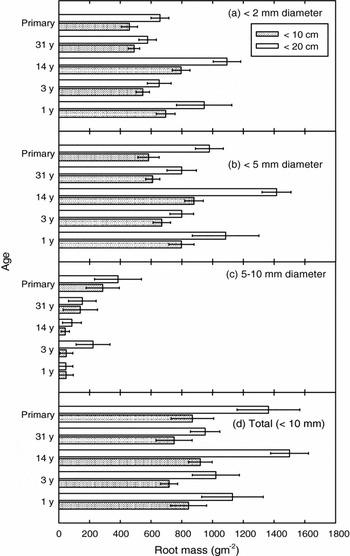
For roots to a depth of 10 cm, there was no significant increase with stand age for those < 2 mm diameter, those < 5 mm diameter, or the total root mass (Figure 1). For roots 5–10 mm diameter, the primary forest had a six-fold increase in mass relative to the 1-y-old stand although this was not significant due to large variation (Figure 1).
Changes in root mass during secondary succession in tropical forests in the Barito Ulu area (Central Indonesian Borneo) assessed by soil coring to two depths for fine roots < 2 mm diameter (a), small roots < 5 mm diameter (b), coarse roots 5–10 mm diameter (c), and total (< 10 mm) root mass (d). All values are mean ± SE.

For roots to a depth of 20 cm, again, there was no significant increase with stand age for those < 2 mm diameter, those < 5 mm diameter, or the total root mass (Figure 1). For roots 5–10 mm diameter, the primary forest had an eight-fold increase in mass relative to the 1-y-old stand although, again, this was not significant due to large variation (Figure 1).
Root carbon and nutrient concentrations
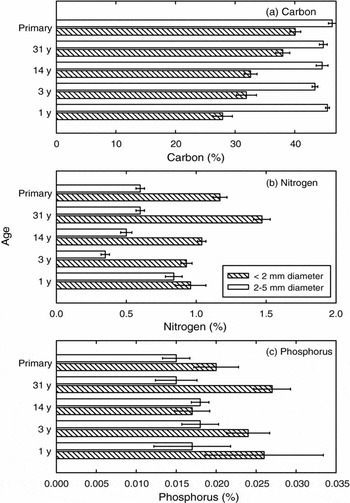
For fine roots < 2 mm diameter, C concentrations tended to increase with increasing stand age (P < 0.10), and small-roots 2–5 mm diameter showed no significant increase in C concentration with stand age (Figure 2). For fine roots, N concentrations were greatest in the 31-y-old stand; for small-roots, N concentrations were greatest in the 1-y-old stand (Figure 2). There was no effect of stand age on root P concentrations (Figure 2). Root N and P concentrations were greater in fine roots < 2 mm diameter when compared with small roots 2–5 mm diameter but the opposite pattern was seen for root C concentrations which were greater in the 2–5 mm diameter roots (t-test, P < 0.001 in all three cases).
Changes in root element concentrations in two diameter classes during secondary succession in tropical forests in the Barito Ulu area (Central Indonesian Borneo) assessed by soil coring. The figure shows carbon (a), nitrogen (b), and phosphorus (c) concentrations in roots to 20 cm depth. All values are mean ± SE.

Correlations between root mass and soil characteristics
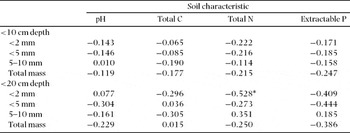
The only significant negative correlation between root mass and soil elemental concentration was for fine roots < 2 mm diameter to 20-cm depth and soil N (P < 0.05; Table 3).
Correlations between root mass assessed by soil coring and soil characteristics for roots <10 cm depth (assessed on an individual core basis) and < 20 cm depth (assessed on a plot basis) in the Barito Ulu area (Central Indonesian Borneo) (* = P < 0.05).

DISCUSSION
Root mass
Fine- and small-root mass did not significantly increase with stand age suggesting that these roots recover rapidly after forest disturbance (within 1 y). Following this initial recovery, root mass appears to be controlled more by soil fertility than stand age. However, an assertion of rapid regrowth assumes that root mass in agricultural fields is lower than in secondary forests which may not always be the case (Powers Reference POWERS2004), and was not measured in this study. Above-ground biomass increased by a factor of at least 30 during secondary succession (F. Q. Brearley, unpubl. data) whereas below-ground root mass did not increase, indicating that trees are allocating proportionately more resources below-ground (to roots) than above-ground during the early stages of secondary succession.
Raich (Reference RAICH1980) found rapid recovery of fine-root mass within 1 y and Cavelier et al. (Reference CAVELIER, ESTEVEZ and ARJONA1996) found no effect of forest stand age on root mass. In contrast, Berish (Reference BERISH1982), Hertel et al. (Reference HERTEL, LEUSCHNER and HÖLSCHER2003) and Muthukumar et al. (Reference MUTHUKUMAR, SHA, YANG, CAO, TANG and ZHENG2003) all showed root mass to increase with stand age. Whilst Hertel et al. (Reference HERTEL, HÖLSCHER, KOHLER, LEUSCHNER and Kapelle2006) found a significant positive correlation (r 2 = 0.32) between stand age and total fine-root biomass across a number of studies, they also found no significant differences in total root mass between secondary forest stands of various ages and primary forest (D. Hertel, pers. comm.). The above contrasts show that the relationship between successional stand age and root mass is not always clear. It should be noted that some of the stand ages in this study were pseudoreplicated which limits the generalization of the results as differences detected in root characteristics may be controlled not only by the stand age but also differences between stands in terms of soils, hydrology or site history. Nevertheless, this was the only design possible to include older stands of a known age as secondary forests are usually re-cut within 15 y in the Barito Ulu area (pers. obs.).
When compared with other tropical forest data sets, the Barito Ulu mean root mass (658 g m−2 for roots < 2 mm diameter to 20-cm depth) was well above the mean values presented elsewhere. For example, Jackson et al. (Reference JACKSON, MOONEY and SCHULZE1997) found a mean value of 570 g m−2 although the majority of the studies in that paper examined roots to a greater depth than I did. The Barito Ulu values are also at least 2 SE greater than the mean presented by Hertel & Leuschner (Reference HERTEL, LEUSCHNER, Bruijnzeel, Scatena and Hamilton2010) of 451 ± 45 g m−2 (live root mass only) but their studies were generally to 40–50 cm depth. Of course, differences in sampling depth, inclusion of live/dead roots, and differing root diameters make comparisons between studies difficult but, where strict comparisons were made, the Barito Ulu values were still higher than values from many other forests (Cavelier et al. Reference CAVELIER, WRIGHT and SANTAMARÍA1999, Muthukumar et al. Reference MUTHUKUMAR, SHA, YANG, CAO, TANG and ZHENG2003, Powers et al. Reference POWERS, TRESEDER and LERDAU2005, Raich Reference RAICH1980, Yamashita et al. Reference YAMASHITA, KASUYA, KADIR, CHIK, QUAH, OKUDA, Okuda, Manokaran, Matsumoto, Niiyama, Thomas and Ashton2003).
Seasonal variation in root mass and nutrient concentration has been found in a similar site at Danum Valley in Sabah by Green et al. (Reference GREEN, DAWSON, PROCTOR, DUFF and ELSTON2005) who showed root mass to be lower in the drier season. I examined root mass in the drier season at Barito Ulu and my results may therefore underestimate the maximum root mass to a certain degree. I also did not separate live and dead root mass in this study (estimates of dead root mass in similar forests are < 5%: Green et al. Reference GREEN, DAWSON, PROCTOR, DUFF and ELSTON2005; < 15%: Powers et al. Reference POWERS, TRESEDER and LERDAU2005). I hypothesize that root turnover is more rapid in the younger secondary stands (as trees grow faster and die younger) and therefore a larger proportion of roots in the younger stands may have been dead. There may also have been roots of some crop species remaining in the soil which had not fully decomposed over the intervening 1-y period although this is unlikely. Finally, as samples were only taken to 20 cm depth this may have underestimated root mass in the older stands in relation to the younger stands as I hypothesize that the maximum rooting depth would increase with stand age.
Relationship between root mass and soil fertility
When nutrients are limiting to growth, trees may be expected to allocate resources preferentially below-ground in order to increase their growth and/or reproductive rates. Lack of a particular nutrient in a soil may therefore lead to increased root biomass if that nutrient is considered limiting to growth (Bloom et al. Reference BLOOM, CHAPIN, and MOONEY1985). Previous studies found negative correlations between root mass and soil N (Maycock & Congdon Reference MAYCOCK and CONGDON2000, Powers et al. Reference POWERS, TRESEDER and LERDAU2005), P (Gower Reference GOWER1987, Powers et al. Reference POWERS, TRESEDER and LERDAU2005) and Ca (Gower Reference GOWER1987). It was interesting to note that soil fertility had a greater effect on root mass than did stand age and this was also shown by Powers (pers. comm.) for tropical dry forests in Costa Rica. Negative correlations between root mass and soil fertility suggests nutrient limitations to tree growth in these successional forests. The only significant correlation was with soil N, this is likely due to the volatilization of N during biomass burning whereas P and cations are returned to the soil in ash (Kleinman et al. Reference KLEINMAN, PIMENTEL and BRYANT1995). Davidson et al. (Reference DAVIDSON, REIS DE CARVALHO, FIGUEIRA, ISHIDA, OMETTO, NARDOTO, SABÁ, HAYASHI, LEAL, VIEIRA and MARTINELLI2007) have recently shown that secondary forest stands in the Amazon cycle N more conservatively than mature forests lending weight to the hypothesis of N limitation in these successional forests.
Root carbon and nutrients
The most notable change in root element concentration during succession was an increase in root C for roots < 2 mm diameter with primary forest roots having about 40% C compared with about 28% C in 1-y-old-stand roots. Jaramillo et al. (Reference JARAMILLO, AHEDO-HERNÁNDEZ and KAUFFMAN2003) found a similar, but less pronounced, pattern for roots in Mexican forests and pastures. These differences in C concentration are probably due to differences in root age and/or morphological differences between early- and late-successional species, with older and late-successional species (and larger diameter roots) containing a higher concentration of C due to a higher proportion of woody tissue (with a greater proportion of structural components) and fewer younger cells with higher nutrient concentrations.
There was no clear effect of succession on root N concentrations with differing root diameters having greater concentrations at differing ages. If it were possible to separate out the roots of certain common species it may have been easier to detect any potential trends by avoiding the confounding factor of changing tree species composition during succession. There was no difference in root P concentration with different stand ages. Arunachalam et al. (Reference ARUNACHALAM, PANDEY, MAITHANI and TRIPATHI1997) also found no notable effects of secondary forest stand age on root nutrient concentrations.
Root nutrient concentrations, especially P, were low when compared with data presented by Gordon & Jackson (Reference GORDON and JACKSON2000) and Jackson et al. (Reference JACKSON, MOONEY and SCHULZE1997). The value for root P is likely to be a slight underestimate as the recovery of P by nitric acid digestion in our Dublin laboratory is around 87% (M. Kavanagh & F. Q. Brearley unpubl. data). Seasonal variation in root nutrient concentration has also been found at Danum Valley in Sabah by Green et al. (Reference GREEN, DAWSON, PROCTOR, DUFF and ELSTON2005) who showed that roots extracted in the drier season had higher N concentrations (1.66% in the drier season vs. 1.41% yearly mean), but lower P concentrations (0.028% in the drier season vs. 0.049% yearly mean). Concentrations of N and P in this study decreased with increasing root diameter in agreement with other studies (Arunachalam et al. Reference ARUNACHALAM, PANDEY, MAITHANI and TRIPATHI1997, Gordon & Jackson Reference GORDON and JACKSON2000, Soethe et al. Reference SOETHE, LEHMANN and ENGELS2007).
Conclusions
Fine roots regrew rapidly during secondary succession in this ecosystem indicating that above-ground disturbance does not always have a long-lasting effect on fine-root biomass. In these successional forest stands, soil N was the factor with the strongest control over fine-root mass suggesting that this element may be limiting in secondary forests of central Borneo.
ACKNOWLEDGEMENTS
This research results from work undertaken by the joint cooperative project (Project Barito Ulu), established between the Ministry of Forestry, Indonesia and the University of Cambridge, UK. I thank the Carnegie Trust for the Universities of Scotland and the Trinity College Dublin Association and Trust for their financial support; Kursani and Afri Mardinata for field assistance; Rupert Ridgeway for logistical support in Indonesia; Lembaga Ilmu Pengetahuan Indonesia for research permission; Muhammad Mansur (Herbarium Bogoriense) for acting as my research counterpart; Mark Kavanagh, Fran O'Donovan and Jacqueline Stone for technical assistance; Robert Bagchi for statistical advice; and Dietrich Hertel, Jennifer Powers and journal reviewers for their helpful comments on the manuscript.