Introduction
Nutrient intake, body energy reserves and suckling are major regulators of reproductive performance in beef cows (Wettemann et al., Reference Wettemann, Lents, Ciccioli, White and Rubio2003). Body condition score (BCS) at calving and secondarily post-partum feeding level, assessed through live-weight (LW) changes during lactation, together with suckling frequency, are high explanatory factors affecting the length of the post-partum interval of suckler cows managed in harsh mountain areas (Sanz et al., Reference Sanz, Bernués, Villalba, Casasús and Revilla2004a).
The traditional management in the Spanish Pyrenees takes into account a grazing season in which cattle graze on high mountain ranges (1500 to 2200 m) during summer and on permanent and forest pastures (900 to 2200 m) during spring and autumn. The duration of the winter housing period depends on the organisation of calving seasons, which are normally grouped from early autumn to late spring. Calf handling throughout the indoor period used to restrict suckling to once or twice daily in short intervals (Sanz et al., Reference Sanz, Casasús, Villalba and Revilla2003). However, suckler cattle systems are currently involved in an extensification process, which forces farmers to aim at new herd management strategies in accordance with the subsidies of the Common Agricultural Policy of the EU (D’Hour et al., Reference D’Hour, Revilla and Wright1998).
The use of herbaceous and shrub vegetation by beef cattle during autumn and winter has been proposed as an alternative practice (Casasús et al., Reference Casasús, Bernués, Sanz, Villalba, Riedel and Revilla2007), though these sward surfaces do not meet animal requirements throughout lactation and result in cow-weight losses and low calf gains (Casasús et al., Reference Casasús, Blanco, Sanz, Bernués and Revilla2006). Underfeeding beef cows leads to raised concentrations of their circulating non-esterified fatty acids (NEFA) (Easdon et al., Reference Easdon, Chesworth, Aboul-Ela and Henderson1985; Grimard et al., Reference Grimard, Humblot, Ponter, Mialot, Sauvant and Thibier1995; Ponter et al., Reference Ponter, Douar, Mialot, Benoit-Valiergue and Grimard2000) owing to adipose tissue mobilization. These metabolites have also been suggested as potential metabolic signals to the hypothalamic–pituitary axis in the post-partum period (Stevenson et al., Reference Stevenson, Lamb, Hoffmann and Minton1997).
In addition, the continuous access of calves to dams (ad libitum suckling), which is enhanced under grazing stocking, has been associated with a delay in the resumption of post-partum ovarian activity (Short et al., Reference Short, Bellows, Staigmiller, Berardinelli and Custer1990; Williams et al., Reference Williams, Gazal, Vega and Stanko1996), especially in moderate nutritional conditions (Diskin et al., Reference Diskin, Grealy and Sreenan1992; Sinclair et al., Reference Sinclair, Molle, Revilla, Roche, Quintans, Marongiu, Sanz, Mackey and Diskin2002; Sanz et al., Reference Sanz, Casasús, Villalba and Revilla2004b). We hypothesize that calf management practices influence nursing behaviour, thereby, the cows that establish a more intense mother–young bonding during lactation attain a longer interval to reach first post-partum ovulation.
The aims of this study were to compare, under the same moderate nutritional conditions, the animal performance and nursing behaviour of beef cows managed according to three different suckling frequencies.
Material and methods
Animals and management
The experiment was carried out at La Garcipollera Research Station, in the mountain area of the southern Pyrenees (North-eastern Spain, 42°37′N, 0°30′W, 945 m a.s.l.).
Thirty-six multiparous autumn-calving cows (aged 7.5 ± 0.52 years) of Parda de Montaña breed (selected from old Brown Swiss for beef purpose) were housed in a loose-housing system after summer grazing on mountain pastures, and randomly assigned to three nursing frequencies from the day after parturition according to their calving date (average, 25 October ± 3.2 days), LW (mean, 566 ± 9.3 kg), BCS (mean, 2.6 ± 0.02) and calf sex (19 females and 17 males). Treatments were: Once-daily restricted nursing during a 30 min period at 0800 h (RESTR1), twice-daily restricted nursing during two 30 min periods at 0800 and 1530 h (RESTR2) and ad libitum nursing (ADLIB). In both restricted-nursing treatments, calves remained in groups in cubicles (5 × 5 m2) adjacent to their dams’ resting areas, with no visual or olfactory isolation. Cows and calves were housed on straw-bedded pens (one pen per treatment).
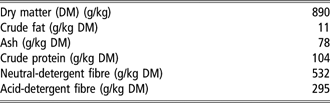
Cows were group-fed throughout the experiment, a diet containing around 80 MJ metabolizable energy (ME)/cow per day that met close to 75% of the energy recommendation (winter conditions simulation) for a 565-kg beef cow producing about 9 kg of milk with no change in LW during lactation (Agricultural Research Council (ARC), 1980). Diet consisted of 10 kg (as-fed basis) of a total mixed ration (Table 1) offered once daily at 0900 h. Group-allocation was used to allow better expression of behaviours. The biggest cows might have eaten slightly more than the smallest due to hierarchy, but requirements are proportional to LW, thereby needing more feed for the biggest than the smallest. There were no feed refusals over the experimental period. Water was supplied ad libitum in longitudinal troughs and mineral block supplements were placed on the feeders to allow free consumption. Calves did not receive any feed supplement other than milk throughout lactation and they had access to water during suckling periods (RESTR1 and RESTR2) or continuously (ADLIB).
Chemical composition of the total mixed ration used in the experiment (g/kg)Footnote †
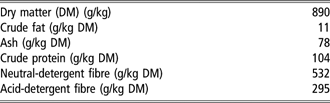
Feedstuffs (g/kg fresh-weight basis): barley straw (470), barley grains (126), dehydrated alfalfa (100), beet molasses (80), citric pulp pellets (72), maize gluten meal (54), soybean meal (38), rape meal (38), alfalfa pellets (12) and vitamin and mineral supplement (10). Vitamin and mineral supplement contained per kg (fresh-weight basis) Ca 107 g, P 85 g, Cl 156 g, Mg 9 g, Na 102 g, S 20 g, Fe 4 g, Zn 12 g, vitamin A 12 000 IU, vitamin D3 1200 IU, vitamin E (α-tocopherols 91%) 53 mg and Cu 20 mg.
† Analyses from weekly feed samples pooled on fortnight intervals.
One bull of the same breed was introduced into each treatment pen on day 52 ± 5.2 post partum (3 months after the first theoretical calving date) during a 3-month breeding season. Cows were weaned on day 106 ± 5.6 post partum. Data from two cow–calf pairs, one in RESTR2 and one in ADLIB, were excluded before the end of the experiment because of calf death. Necropsies revealed that calves died from digestive complications not attributed to the study. The care and use of animals followed the European guidelines (European Union Directive No. 86/609/CEE, 1986).
Measurements
Cows and calves were weighed before morning feeding within 24 h after calving and thereafter at weekly intervals during the first 3 months post partum. Cow BCS was assessed at calving on a 1 to 5 scale (Lowman et al., Reference Lowman, Scott and Somerville1976) by two trained technicians. Calf average daily gain (ADG) was calculated by linear regression of weights against time.
Milk yield and composition was measured on day 61 ± 2.2 post partum in eight cows per treatment. Milk yield was estimated by the oxytocin technique proposed by Le Du et al. (Reference Le Du, McDonald and Peart1979) and machine milking (0900 and 1500 h). Individual milk samples were taken for fat and protein analysis using an infrared technique (Milkoscan 4000; Fosselectric, Ltd, Hillerød, Denmark). Production of 4% fat-corrected milk was calculated.
Behaviour recordings were performed in two sub-groups of four cow–calf pairs (a total of eight pairs) balanced for calf sex, formed out of the 12 cows per treatment, on days 30 ± 0.7 and 66 ± 0.8 of lactation. Dams nursed their calves in a barn (4.5 m × 7.5 m) close to their resting area. Each sub-group was brought into the recording barn (which was a sub-part of the main barn) according to their calving date, after which the calves were allowed to enter. Cow–calf pairs from restricted-nursing systems (RESTR1 and RESTR2) were kept in the recording barn for 30 min. The ADLIB sub-group was brought into the barn 24 h prior to sampling in order to assure acclimatisation and they were kept in it for the following 24 h-recording period.
In RESTR1 and RESTR2, every cow–calf pair was randomly allocated each day to one observer (a total of four observers), and additional video recordings were used as back up for occasional uncertain observations. In the ADLIB treatment, the observations were performed through scan-sampling video recording at 5-min intervals. The duration of nursing bouts was extrapolated for the 5 min separating two successive scans.
The pen was artificially illuminated at night (200 lx), allowing monitoring of the whole circadian cycle (24 h). Every cow–calf pair had coloured neck collars to aid identification. A single observer, who was also involved in recording the restricted-nursing treatments, viewed all the video recordings of the ad libitum treatment.
The number and duration of filial and non-filial nursing bouts were recorded, and the nursing duration per day was calculated as the sum of nursing time per bout in each observation period (30 min, 2 × 30 min or 24 h, respectively). A nursing bout started when the calf took a teat in its mouth and ended when the last teat was left and the calf moved away from the udder (Das et al., Reference Das, Redbo and Wiktorsson2001). In RESTR1 and RESTR2, the following nursing bout was considered after a period of other activities of at least 1 min from the previous bout. The circadian nursing pattern in ADLIB treatment was analysed as the mean time that a calf devoted to suckle every hour, divided by the total nursing duration per day.
Blood sampling and assays
NEFA and progesterone concentrations were determined through blood samples (5 ml) collected fortnightly (NEFA) and twice weekly (progesterone), before morning feeding, by tail vessel puncture, into plain glass and heparinized tubes, respectively. Samples were centrifuged at 3000 × g for 15 min at 4°C. Serum and plasma were harvested and stored at −20°C until analysis.
Serum NEFA were analysed using a commercial kit (Randox Laboratories Ltd., Crumlin, Co. Antrim, UK). Samples were assayed in duplicate. Medium (0.58 mmol/l) and high (1.31 mmol/l) commercial reference serum samples (bovine precision serum; Randox Laboratories Ltd, Co. Antrim, UK) were used to evaluate the accuracy of the analysis. The mean intra- and inter-assay coefficients of variation were 6.0% and 8.9% for medium concentration sample, and 4.4% and 6.3% for the high concentration sample, respectively.
Plasma progesterone concentrations were measured using a solid-phase radioimmunoassay commercial kit (Coat-A-Count progesterone kit®; Diagnostic Products Corporation, Los Angeles, CA, USA) validated in our laboratory. Low (0.8 nmol/l), medium (2.6 nmol/l) and high (12.6 nmol/l) concentration samples were used to estimate the mean intra-assay coefficients of variation (CV) (13.3%, 8.5% and 6.0%) and inter-assay CV (20.0%, 10.8% and 10.9%). The sensitivity averaged 0.1 nmol/l. The onset of luteal activity after calving was considered when progesterone levels were >1.6 nmol/ml. If cows had not ovulated before weaning, the interval to first post-partum ovulation was regarded as this date and all experimental procedures were terminated. Short oestrus cycles (8 to 12 days) after first ovulation were considered when progesterone rises lasted for a single sampling.
Statistical analyses
Normal distribution of data was tested with the Shapiro–Wilk test before further analysis with SAS statistical software (version 9.1; SAS Institute Inc., Cary, NC, USA). Data from calf LW at birth and daily gains, interval to first post-partum ovulation and plasma progesterone concentrations of cows during the first luteal phase were tested with analysis of variance (ANOVA) (PROC GLM), according to the model:

where yij is the dependent variable, μ is the overall mean, αi is the treatment effect and εij is the residual error. The preliminary model concerning calf performance data contained the fixed effect of calf sex and the interaction calf sex × treatment, but they were omitted from the final analysis because they were not significant (P > 0.05).
The cow LW evolution and the serum concentrations of NEFA (previously log-transformed to achieve normal distribution) were tested with repeated measures ANOVA (PROC MIXED), by means of the following mixed model:

where yijk is the dependent variable, μ is the overall mean, αi is the treatment effect, dj is the animal effect j, βk is the week of lactation effect and εijk is the residual error.
Differences between proportions were analysed using the Fisher exact test (PROC FREQ).
The different sampling methodology for behavioural traits did not allow comparing the nursing activities statistically. Total nursing duration, bout durations and bout frequency were only compared between morning and afternoon nursing periods within the RESTR2 treatment. Normal distribution of data could not be verified and thus means were compared with the Kruskal–Wallis non-parametric test (PROC NPAR1WAY).
Data are reported as least-square means (if normally distributed) or means and their associated standard errors. Differences with a P < 0.05 were considered significant.
Results
Animal performance
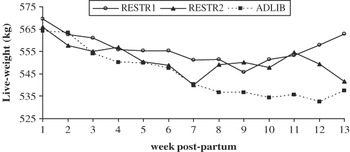
All treatments lost around 5% of their LW at calving until the start of the breeding period (average 52 ± 5.2 days post partum) (Figure 1). However, by the end of the third month post partum, RESTR1 and RESTR2 had nearly recovered their initial LW (loss of around 1% and 3%, respectively), while ADLIB maintained the same magnitude of weight loss than during the previous period (around 5% of their initial LW).
Live-weight evolution in beef cows nursing once daily (RESTR1), twice daily (RESTR2) or ad libitum (ADLIB) during lactation.

Likewise, cows nursing ad libitum showed a higher (P < 0.05) fat-corrected milk yield (8.9 ± 0.72 kg/day) than their restricted nursing counterparts (7.0 ± 0.72 and 6.2 ± 0.77 kg/day in RESTR1 and RESTR2, respectively). The mean milk fat and milk protein content in all cows was 3.7 ± 0.1% and 3.2 ± 0.1%, respectively.
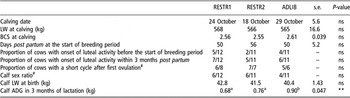
Calf LW at birth was similar across treatments but their ADG during the first 3 months of lactation was higher in ADLIB than in restricted-nursing groups (Table 2; P < 0.05).
Productive and reproductive performance of Parda de Montaña beef cows managed under restricted nursing once daily (RESTR1), twice daily (RESTR2) or ad libitum (ADLIB)

LW = live weight; BCS = body condition score; ADG = average daily gain.
‡Only cows that resumed second ovulation prior to weaning were included.
#Male to female ratio within treatment.
**P < 0.01, ns = not significant (P > 0.05).
Within a row, least-square means with different superscripts are significantly different (P < 0.05).
The proportion of cows cycling before the start of the breeding period and within the first 3 months of lactation, as well as the proportion of cows showing a short oestrus cycle after first ovulation were similar across nursing systems (Table 2; P > 0.05). The interval to first post-partum ovulation was not affected by the nursing frequency (average 74 ± 9.2 days; P > 0.05). The amount of plasma progesterone during the luteal phase of a short cycle was 29% of that produced during the luteal phase of a normal cycle (3.8 ± 0.35 v. 13.0 ± 1.21 nmol/ml; P < 0.001).
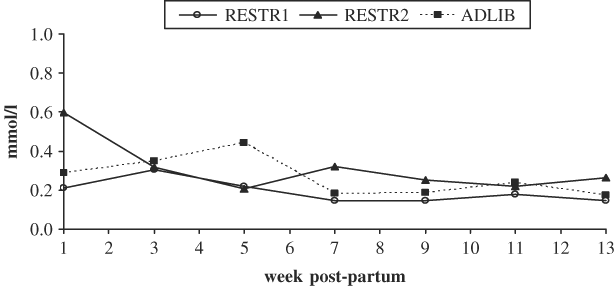
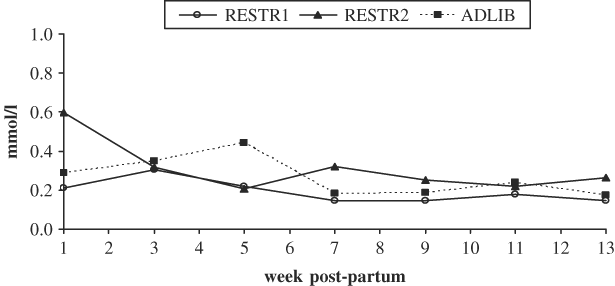
The profile of serum NEFA throughout lactation in each nursing system is shown in Figure 2. The mean serum concentrations of NEFA were different among treatments (P < 0.01), being lower (P < 0.05) in RESTR1 (0.18 mmol/l) than in RESTR2 and ADLIB cows (0.29 and 0.25 mmol/l, respectively). These metabolites were affected by time after calving (P < 0.001), with higher values (P < 0.05) during the first 5 weeks post partum (0.33, 0.32 and 0.27 mmol/l on week 1, 3 and 5 of lactation) than subsequently (average 0.20 mmol/l), regardless of treatment.
Profile of serum non-esterified fatty acids in beef cows nursing once daily (RESTR1), twice daily (RESTR2) or ad libitum (ADLIB) during lactation (back transformed values of least-square means from the analysis of log values).
Nursing behaviour
Descriptive results of nursing behaviour are shown in Table 3. As expected, the highest occurrence of nursing bouts was observed in ADLIB, leading to greater nursing duration per day (not statistically compared) in this treatment (58.8 ± 5.84 min) than in their restricted-nursing counterparts (22.2 ± 1.42 and 34.3 ± 1.16 min, in RESTR1 and RESTR2, respectively).
Nursing activities in Parda de Montaña cows with total available time for nursing being 30 min (RESTR1), 2 × 30 min (RESTR2) and 24 h (ad libitum (ADLIB))Footnote †

† Mean ± standard error; treatments were not statistically compared due to different sampling methodology.
Cows nursing twice daily (RESTR2), showed a higher duration of nursing throughout the morning (18.5 ± 0.87) than during the afternoon meal (15.8 ± 1.01), although this difference was only a tendency (P < 0.10). The number of bouts (2.3 ± 0.24 v. 2.3 ± 0.28) and duration of nursing per session (9.6 ± 1.10 v. 8.2 ± 0.97 min), as well as the time spent nursing other calves (1.2 ± 0.37 v. 0.7 ± 0.40 min), were similar across morning and afternoon periods (P > 0.05).
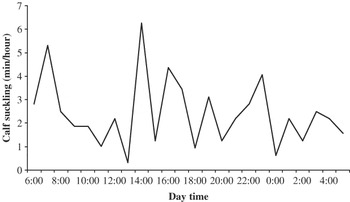
When cows nursed ad libitum, four suckling peaks were detected (Figure 3). The first coincided with sunrise between 0600 and 0700 h (9% total nursing time), the second just after noon between 1300 and 1400 h (11% total nursing time), the third in the afternoon between 1500 and 1600 h (7% total nursing time) and the last between 2200 and 2300 h (7% total nursing time). The remaining nursing activity (66%) was evenly distributed throughout the rest of the day (54% of nursing time occurred between 0600 and 1800 h).
Circadian nursing pattern in cows kept indoors in continuous access with their offspring during lactation.

Discussion
Nursing frequency affected cow and calf gains during the first 3 months post partum in moderately fed Parda de Montaña cows. Even though actual feed consumption was not measured, all cows were fed the same ration, leading to a higher milk production in dams nursing ad libitum and consequently more important weight losses within 3 months post partum in this treatment than in restricted-nursing groups.
Previous studies conducted in the same conditions did not find significant differences in animal performance between twice daily and ad libitum nursing (Sanz, Reference Sanz2000) nor once daily and ad libitum nursing (Sanz et al., Reference Sanz, Casasús, Villalba and Revilla2003) in this breed. However, in the latter works, the level of feeding was above maintenance (100% and 110% of the theoretical energy requirements, respectively) and therefore, a different distribution of dietary energy to support nutrient demands may have arisen.
A long-term energy restriction in lactating dairy cows (20% of their energy requirements) has been reported to produce a decrease of 2.2 kg fat-corrected milk yield (Coulon and Rémond, Reference Coulon and Rémond1991), through a mechanism of metabolic adaptation in cows suffering negative energy balance, in order to reduce energy expenditures and maintain homoeostasis. Notwithstanding, in our experiment, the lower level of production was only proved in cows managed under restricted nursing, since cows nursing ad libitum achieved milk yield and thereby calf growth rates similar to well-fed animals (Sanz, Reference Sanz2000; Sanz et al., Reference Sanz, Casasús, Villalba and Revilla2003). These results would suggest that differences across nursing frequencies, regarding animal performance, become more marked under moderate post-partum feeding levels than in situations in which cow requirements are met. Cows managed under continuous access to calves may divert a higher proportion of their energy intake to promote milk yield instead of assuring LW stability.
The greater serum concentrations of NEFA in cows nursing twice daily and ad libitum compared to the most restricting management (once-daily nursing) was not linked with the evolution of LW in these treatments. Cow LW gains reflect energy balance (Petit and Micol, Reference Petit and Micol1981), and according to the earlier work, once- and twice-daily nursing groups may have adapted their productive performance to achieve a nearly zero-energy balance within 3 months post partum, although they resumed ovulation in a similar way to cows nursing ad libitum. Cows nursing twice daily showed higher serum concentrations of NEFA but had similar performance to their counterparts nursing once daily. However, the NEFA mobilisation in cows nursing ad libitum did not allow coping with nutrient demands and these dams lost LW.
In that sense, Marongiu et al. (Reference Marongiu, Molle, San Juan, Bomboi, Ligios, Sanna, Casu and Diskin2002) reported lower plasma NEFA soon after ad libitum nursing restriction to once-daily nursing (25 to 50 post partum) in beef Sarda and Charolais × Sarda cows, which was attributed to an improvement in cows’ energy balance.
The serum concentrations of NEFA were relatively high until week 5 of lactation and dropped smoothly afterwards. This probably highlighted the activation of lipolytic pathways during the early post-partum period as well as a greatly increased adrenergic stimulation of lipolysis at this time (Bell, Reference Bell1995). The NEFA stabilization with advancing lactation may have been partly due to the falling LW, which resulted in lower maintenance requirements, as found by Easdon et al. (Reference Easdon, Chesworth, Aboul-Ela and Henderson1985), Grimard et al. (Reference Grimard, Humblot, Ponter, Mialot, Sauvant and Thibier1995) and Ponter et al. (Reference Ponter, Douar, Mialot, Benoit-Valiergue and Grimard2000) in suckled beef cows with similar level of feeding to the present experiment. In addition, the absorption of fatty acids in our case is probably low because the most abundant feedstuffs of the mixed ration (barley straw and dehydrated alfalfa, 570 g/kg) contain little crude fat content and rather mostly acetogenic nutrients (hemicellulose and cellulose). On the whole-day video recordings (ADLIB cow–calf pairs), we also observed that the time devoted to eat straw bed was over two-fold the time used to consume the actual feed provided (224 ± 16 v. 93 ± 9 min/day, unpublished data). Even considering that intake rate was probably higher when cows ate the mixed ration (121 ± 19 g dry matter/min) and the greater fill value of cereal straw compared to the current total dry mixed ration, straw consumption might have supplied some energy to overcome their moderate feeding level. However, the low quality of this forage did not help in improving reproductive response in any treatment.
The nursing activity was influenced by calf raising system. Cow–calf pairs allocated 74%, 57% and 4% of the time spent together to suckle in RESTR1, RESTR2 and ADLIB, respectively. In case of restricted-nursing treatments, this proportion is high compared to other studies conducting similar managements (36% of the time, Das et al., Reference Das, Redbo and Wiktorsson2001). This longer nursing period could correspond to the lack of alternative feeding herein, since pasture and concentrate consumption increased with calves’ age in that work (Das et al., Reference Das, Wiktorsson and Forsberg1999). In contrast, cows nursing ad libitum displayed similar nursing behaviour to other studies in which calves were raised exclusively on milk in confinement (3% to 4% of the day, Lewandrowski and Hurnik, Reference Lewandrowski and Hurnik1983; 5% of the day, Williams et al., Reference Williams, Osborn, Kirsch and Tilton1984). These nursing patterns were linked to ADGs of calves in each treatment and support the idea that descriptive information of suckling behaviour provides practical value to assess the maternal effects on calves’ performance (Paranhos da Costa et al., Reference Paranhos da Costa, Albuquerque, Eler and Silva2006).
However, re-establishment of cyclic ovarian activity was unrelated with nursing management, in line with other authors who found no relationships across oestrus and nursing behaviour (Lewandrowski and Hurnik, Reference Lewandrowski and Hurnik1983; Odde et al., Reference Odde, Kiracofe and Schalles1985; Day et al., Reference Day, Imakawa, Clutter, Wolfe, Zalesky, Nielsen and Kinder1987). These results are in agreement with the experiments of Williams et al. (Reference Williams, McVey and Hunter1993), who showed that suckling-mediated anovulation was independent from mammary somatosensory cues but probably dependent upon visual and olfactory cues.
The non-filial nursing accounted for 11%, 3% and 15% of filial nursing time in RESTR1, RESTR2 and ADLIB, respectively. It has been suggested that this activity is merely non-nutritious when it lasts for a short period (<1 min) (Das et al., Reference Das, Redbo and Wiktorsson2000), but may indicate a problem of milk availability when it is accompanied by a high rate of butting (de Passillé, Reference de Passillé2001). Nevertheless, the number of butts towards a cow udder was similar in dams nursing once and twice daily (Álvarez et al., Reference Álvarez, Palacio, Casasús, Revilla and Sanz2006). In our experiment, we also found that there was no evidence that the maternal–offspring bonding could be impaired in the most restricted-nursing management because the number of cow licks to calves per day was significantly higher in RESTR1 than in RESTR2 (55.5 v. 22.5, respectively).
With regard to circadian variation of nursing activity in ADLIB, our results might reflect a metabolic need of the calves to obtain milk at intervals not longer than 7 to 8 h. The existence of a high incidence of nursing during the nocturnal period (nearly 50%) is similar to some previous studies in free-ranging (Somerville and Lowman, Reference Somerville and Lowman1979) and enclosure-kept beef cows (Lewandrowski and Hurnik, Reference Lewandrowski and Hurnik1983), but could be partially induced by the light used for night-monitoring since other authors reported more suckles during daylight (Odde et al., Reference Odde, Kiracofe and Schalles1985). The occurrence of nursing peaks at sunrise (between 0500 and 0700 h) and around midday (between 1200 and 1400 h) seems to be consistent in all the afore-mentioned studies, regardless of housing conditions.
Restricted nursing, once daily for approximately 30 min, has been reported to reduce the interval to first post-partum ovulation in beef cows (Randel, Reference Randel1981; Reeves and Gaskins, Reference Reeves and Gaskins1981) but not twice-daily nursing (LaVoie et al., Reference LaVoie, Han, Foster and Moody1981; Lamb et al., Reference Lamb, Miller, Lynch, Thompson, Heldt, Loest, Grieger and Stevenson1999), when compared with a control group (ad libitum nursing). Other authors have found no differences between once- and twice-daily nursing, but both systems were useful to shorten the interval to first ovulation compared to ad libitum nursing (Diskin et al., Reference Diskin, Grealy and Sreenan1992). Our results do not support the latter experiments since the higher nursing intensity of cows with continuous access to calves did not seem to delay the onset of luteal activity, when compared with restricted-nursing frequencies in moderate nutritional conditions. Hence, we hypothesize that post-partum feeding level and nursing were confounded factors affecting the resumption of the ovarian activity and thus, most of the experiments may not be comparable with the present conditions because they worked with cows, which calved in good condition and were fed diets that exceeded requirements during lactation.
Energy restriction both before and during the early post-partum period, delays the onset of oestrus cycles and ovulation by suppressing LH pulse frequency (Schillo et al., Reference Schillo, Hall and Hileman1992). In primiparous and multiparous Brahman cows (Bos indicus) fed 90% of their energy requirements, the ovarian response to restricted once-daily nursing has been proved inconsistent (Browning et al., Reference Browning, Robert, Lewis, Neuendorff and Randel1994), in a similar way to our results, whereas increasing post-partum feeding level enhanced the onset of luteal activity in their case. Likewise, in primiparous Angus cows, LH release in response to calf removal was weak when energy intake was below requirements (Whisnant et al., Reference Whisnant, Kiser, Thompson and Hall1985).
Sinclair et al. (Reference Sinclair, Molle, Revilla, Roche, Quintans, Marongiu, Sanz, Mackey and Diskin2002) observed that cows with moderate BCS (below 2.5) displayed a poor ovarian response, when restricted nursing was imposed shortly after selection of the first dominant follicle to emerge after day 21 post partum, in a multi-centric study including Simmental, Sarda, Brown Swiss and Hereford × Holstein genotypes. In a parallel way, earlier experiments in Parda de Montaña cows confirmed that calf restriction from day 45 post partum compared to ad libitum suckling was a useless practice to induce ovulation, when cows showed a BCS at calving of 2.0 and were fed 75% of their energy requirements during lactation (Sanz et al., Reference Sanz, Casasús, Villalba and Revilla2004b).
The proportion of dams cycling within the first 3 months post partum was poor in the three treatments. Such situation would impair their subsequent reproductive performance, especially if a short breeding season wished to be applied, and also compromise their target 12-month calving interval in almost half the cows. In addition, this outcome would suggest that the level of post-partum dietary energy may exert a deeper influence than the effect of nursing frequency on the re-establishment of ovarian activity in Parda de Montaña cows.
We found no differences across nursing frequencies regarding the incidence of short oestrus cycles (8 to 12 days) after the first ovulation, which have been observed more frequently in cows nursing twice daily and ad libitum than in non-nursing cows (LaVoie et al., Reference LaVoie, Han, Foster and Moody1981). Short cycles are probably caused by an early release of prostaglandin F2α (PGF2α) from the uterine endometrium which results in premature luteolysis (Zollers et al., Reference Zollers, Garverick, Youngquist, Ottobre, Silcox, Copelin and Smith1991), which involves nursing-induced oxytocin release (Troxel et al., Reference Troxel, Opsomer and Kesler1984). Another hypothesis has suggested that transient increases in progesterone, occurring before the first oestrus after calving, may prepare the reproductive tract for rebreeding so as to provide a more desirable uterine environment (Werth et al., Reference Werth, Whittier, Azzam, Deutscher and Kinder1996). With regard to this issue, we observed that plasma progesterone concentrations in the first short cycle after calving were remarkably lower than in subsequent normal cycles, which was in agreement with previous reports (Wells et al., Reference Wells, Holness, McCabe and Lishman1986).
In conclusion, the post-partum luteal function in cows managed under continuous access to calves was similar to once- and twice-daily nursing systems, despite the greater suckling intensity of the formers. Restricting calf presence rarely enhances the resumption of ovarian activity when suckler cows are managed in moderate nutritional conditions.
Acknowledgments
We wish to thank the staff of La Garcipollera Research Station for their technical assistance and Dr J. L. Alabart for the validation of progesterone and NEFA procedures. The study was supported by the Ministry of Education and Science of Spain and the European Union Regional Development Funds (INIA RTA-2005-231). Student was in receipt of grant from INIA-DGA.