1. Introduction
The aim of the present paper is to empirically investigate the relationship between social capital and human development in a sample of European countries for the post-war period. Social capital generally includes features of social organization, such as trust, norms, and networks, that facilitate co-ordinated action between conflicting interests for the pursuit of a mutual benefit. Human development refers not only to the expansion of aggregate output and income, but also to the satisfaction of basic needs and human capabilities, such as health and education, which depend on public provisions, as well as participation in social and political institutions. We argue that such means and ends to development rely upon norms and networks of trust, reciprocity, and co-operation that manifest themselves in social organizations and extend to synergy relations with state institutions.
In Making Democracy Work (1993), Putnam deploys various historical, statistical, and econometric techniques to explore the idea that differences in socio-economic development and institutional performance across Italian regions are related to differences in their endowment of social capital. Relatively higher levels of income, industrialization, and public welfare in regions of the North are attributed to widespread norms of reciprocity and dense networks of civic engagement, as opposed to the South, which is characterized by fewer associations and limited political involvement. Since then, cross-country empirical studies, based on neoclassical theories of economic growth, offer evidence of the significant and positive contribution of social trust and civic norms to increases in aggregate output, contrary to variables of group membership that produce ambiguous results. The rationale is that social trust and civic norms correct for market and state inefficiencies by reducing transaction costs and information asymmetries, whereas membership is often associated with anti-growth rent-seeking and lobbying practices of special-interest groups. In the present paper, we argue that social capital, especially as membership in social organizations, enhances development by supporting generalized representation and participation of social stakeholders in public policy and public goods provision to promote broader welfare aspects of human development in synergy with state institutions of governance and welfare. This is true not only in developing countries, where social networks appear to secure public welfare, particularly in the absence of formal market and state institutions, but also in more developed countries, where social organizations complement market and state institutions by contributing directly to development as part of the third sector of the economy.
A brief overview of the empirical literature on the relationship between social capital and development is presented in Section 2. We begin with cross-country growth studies to set out the empirical framework of regression techniques and statistical indices to be applied. We propose a shift to more multi-dimensional approaches of development and consult relevant studies to explore the influence of social capital. In Section 3, we empirically test for the relationship between social capital and human development during the period 1960–2002 for a sample of 32 European countries. We regress the UN's Human Development Index, which captures improvements in individuals’ income, health, and education, on measures of social capital, namely social trust, civic norms, and group membership, whilst controlling for a series of economic, social, political, and regional development factors. Regression results show that group membership is positively linked to human development, which might point to the role of social organizations in welfare and development. Furthermore, the positive association of human development with variables of public expenditure and the quality of governance might be indicative of the importance of state–society synergy relations. Section 4 speculates on why group membership has had such an effect on human development by offering a case study analysis to explore further the historical and cultural factors that determine the effectiveness of the welfare system and the third sector in Europe. We close with some concluding remarks in Section 5.
2. Earlier work on social capital and development
From a more neoclassical stance, cross-country empirical studies of social capital and economic growth, based on Barro-type regressions, include the work of Knack and Keefer (Reference Knack and Keefer1997), Whiteley (Reference Whiteley2000), and Zak and Knack (Reference Zak and Knack2001). Knack and Keefer examine cross-country growth differentials averaged for the period 1980–1992 for a sample of 29 market economies from around the world. Whiteley, as well as Zak and Knack, examine a larger sample, which includes a larger growth period, 1970–1992, and a larger number of countries, 34 and 41, respectively. By using data mainly from the World Values Surveys, these studies find that indicators of generalized trust, which capture attitudes of trust towards most people, exhibit a strong, significant, and robust relationship to growth. Knack and Keefer also discover that variables of civic co-operation, calculated from responses to questions about the extent to which one justifies certain pro-social acts (such as paying taxes or not accepting bribes) have a strong and positive effect on growth. In contrast, the authors show that indices of group membership, expressed as the average number of groups per respondent in each country, appear to have a statistically insignificant impact on growth. They speculate that this might be due to the negative effects imposed by rent-seeking organizations, which offset any positive effects of more encompassing groups.
In Putnam's view, inspired by Tocqueville's interpretation of civic norms and values, ‘associations instill in their members habits of co-operation, solidarity, and public-spiritedness’, which contribute to effective social collaboration for good governance and development (Reference Putnam1993: 89–90). However, not all types of social connections and organizations are beneficial to wider public interest. Olson (Reference Olson, Crafts and Teniolo1996) sets it bluntly when he refers to the activity of what he calls distributional coalitions that ‘shift the distribution of income in the society in [their] favour through lobbying for special-interest legislation’ (p. 75). In order to capture the opposite effects of different types of groups, Knack and Keefer introduce two distinct variables that separate social organizations into ‘Olsonian’ and ‘Putnam-esque’ groups: the former includes trade unions, political parties, and professional associations, which are expected to function as distributional coalitions; the latter includes religious/church organizations, cultural groups, and youth work associations (scouts/guides), which are viewed as more encompassing groups (Reference Knack and Keefer1997: 1272–1274). No meaningful results are produced. The authors conclude that it is perhaps the case that trust and civic norms actually capture the socially beneficial dimensions of social capital in terms of generalized trust, as opposed to group membership, where it becomes difficult to distinguish between socially efficient and inefficient memberships and activities.
No doubt, certain social organizations that serve particularist interests and discriminate against other groups can lead to illegitimacy, bribery, corruption, nepotism, cronyism, and crime. Streeten (Reference Streeten2002) refers to these groups as ‘anti-social’ capital, where the positive effects of co-operation in intra-group relations are offset by the negative effects of inter-group relations (pp. 11–13). Woolcock (Reference Woolcock1998) analyses the interaction of inter-group and intra-group relations and their effect on development. He introduces two distinct but complementary forms of social capital, namely ‘embeddedness’ and ‘autonomy’. First of all, economic exchange is embedded in social relationships, cultural practices, and political contexts – an idea developed by Polanyi (Reference Polanyi1944). However, a high degree of density and closure characterizing intra-community social relations could in fact impose considerable constraints on individuals to make the transition to participate in larger, more extensive exchange networks across communities. Moreover, social ties with powerful institutional actors, especially those transcending the public and private realm, can function as vehicles of corruption, nepotism, or exploitation against development (Woolcock, Reference Woolcock1998: 162–164). Bourdieu (Reference Bourdieu and Richardson1986) stresses the possibility of differential access to capital resources within exclusive and introvert groups, which reduces the potential of non-members to organize and mobilize in favour of wider social demands. Fine (Reference Fine2001) cites studies in both the developed and developing world where structures of inequality and power support networks across the public–private divide that reinforce relationships founded on patronage and clientelism rather than fostering more inclusive forms of civic engagement (pp. 122–123).
To avoid this outcome, Woolcock suggests the development of a complementary set of autonomous social ties that ensure access of community members to extra-community networks, as well as commitment of policy makers to collective goals against the influence of particularist interests (Reference Woolcock1998: 163–164). Autonomous social ties are based on a dynamic re-evaluation and re-socialization of norms and networks that would allow embedded ties of local groups to extend across communities and towards policy-making institutions through mechanisms of social mobilization, political participation, and moral reasoning. This reflects the synergy view to social capital, which emphasizes within group relations (bonding social capital), as well as across group relations (bridging social capital) (Woolcock and Narayan, Reference Woolcock and Narayan2000). Within this nexus of social relationships, the role of the state is particularly important, not only in the provision of public goods and law enforcement, but also in coordinating alliances across boundaries of community, class, ethnicity, race, politics, and religion (Evans, Reference Evans1996: 11; Woolcock and Narayan, Reference Woolcock and Narayan2000: 236). As Heller (Reference Heller1996) points out, synergy relations between state and society are capable of creating institutional forms and political processes for the promotion of development objectives. From his study on the civics movement and government reform in Kerala, India, he observes that, despite particularist interests and patronage politics of casts and communal groups, the mobilization of industrial workers and state reformists has contributed to the establishment of state–society synergy relations that give priority to more programmatic and encompassing social demands (Reference Heller1996: 1057).
Within this context, social groups and synergies are associated with the pursuit of broader aspects of development that take into account the satisfaction of basic needs and the expansion of human capabilities, such as health and education, as well as participation in social and political institutions. The ultimate aim would be the removal not only of material, but also of social, political, and spiritual forms of deprivation, or sources of ‘unfreedom’, such as poverty, neglect of public facilities, and repressive states (Adelman, Reference Adelman1975: 306; Sen, Reference Sen1999: 3). Hence, apart from the availability of financial resources and the expansion of economic production, development policy would focus on institutions of political participation, representation, and association; social and cultural practices of reciprocity and co-operation; and public provisions in health and education (Robeyns, Reference Robeyns2005: 96). The provision of collective goods depends on institutional arrangements and governance systems that operate beyond the market and state and rely on elements of social capital (Ostrom, Reference Ostrom2007: 250). Thus, development is contingent on the existence of norms and networks of trust and reciprocity, and particularly on the creation of effective social organizations and groups (NGOs, co-operatives, self-help groups), which offer direct access of economic and non-economic resources to a wider segment of the population or which press local authorities and planners to act in favour of human development (Sen, Reference Sen1999: 36–38, 70–71).
There are empirical studies in developing countries that test for the contribution of social capital in promoting different economic and non-economic dimensions of development. Some of these studies include, but are not limited to works of Uphoff and Wijayaratna (Reference Uphoff and Wijayaratna2000), Isham and Kähkönen (Reference Isham, Kähkönen, Grootaert and Bastelaer2002), and Krishna and Uphoff (Reference Krishna, Uphoff, Grootaert and Bastelaer2002), which examine the development of water system projects for irrigation and the provision of clean drinking water in regions of Sri Lanka, Indonesia, and India, respectively. These studies reveal a positive and statistically significant impact of social capital indicators, including generalized trust and social networks, on measures of development, which are identified with productivity, health, and voluntary participation in the conservation of common resources. They simultaneously control for a number of factors, such as social division, political competition, mechanization of production, infrastructure, government staff support, literacy, number of castes, and village size. Fewer studies have examined the impact of social participation on broader aspects of development in more advanced countries. Here the role of social capital could be associated with social organizations of the third sector of the economy, which comprises of non-market, non-state activities that rely on forms of social integration primarily based on norms and networks of reciprocity. Reciprocity involves the movement of funds between economic subjects that is different from market exchange and state redistribution, because it is inseparable from human relations and social values, and is not imposed by a central authority. Nevertheless, the effectiveness of reciprocity and third sector organizations depends on the existence of synergistic relations with public institutions, which enhance participation of social organizations in political and economic processes as dynamic forms of social advocacy and social service providers (Staveren, Reference Staveren2001: 53–57; Adaman and Madra, Reference Adaman and Madra2002: 1049–1050; Evers and Laville, Reference Evers, Laville, Evers and Laville2004: 18, 20). The idea put forth is that social organizations, in synergy with public institutions, have a positive effect on broader development outcomes, beyond increases in income. In the following sections, we explore this hypothesis for Europe.
3. Empirical study for European countries
Methodology of regression analysis
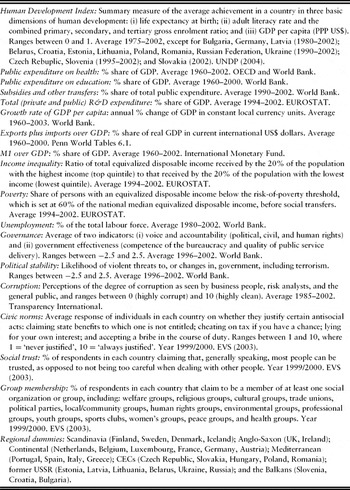
We contribute to prior research by examining a total of 32 European countries beyond the typical set of Western European countries. Specifically, we introduce countries of Central East Europe and the former Soviet Union, some of which have recently become members of the EU or stand as candidate countries for future accession. We are able to enrich our sample, because of social capital data made available by the European Values Study (2003) (EVS, hereafter), which is part of the World Values Study employed by most empirical work. We formally test our hypothesis by estimating cross-country regressions, where human development is regressed on social capital, while simultaneously controlling for a series of economic, social, political, and regional development factors. The econometric specification employed draws from the work of Ranis et al. (Reference Ranis, Stewart and Ramirez2000), and particularly from their emphasis on factors such as civil society, NGOs, and social capital, which are considered a major source of human development enhancement (pp. 198–201).Footnote 1 Our empirical analysis differs in that we focus on a set of developed rather than developing countries. Also, instead of life expectancy and adult literacy rates, we use the UN's composite Human Development Indicator (HDI, hereafter) (UNDP, 2004) to measure human development and examine its association to social capital. Finally, we expand our set of controls to include development factors that capture the quality of governance, social exclusion, market operations, and political stability, in addition to public provisions, economic growth, income inequality, and regional dummies used by Ranis et al. (Reference Ranis, Stewart and Ramirez2000). For a detailed description of data and sources, see Table A of the Appendix.
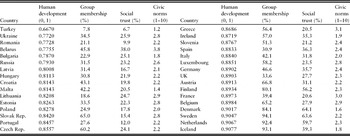
The HDI is the average of three measurable dimensions of human development corresponding to health, education, and income (UNDP, 2004: 127–128, 259). From Table 1 we observe that countries of Scandinavia and Northern Europe achieve the highest scores of HDI – around 0.9. Countries with the lowest scores include Turkey and countries of Central East and Eastern Europe. We must make note of the rather small variation of HDI, due to the fact that the vast majority of countries in our sample belongs to the high category of HDI rankings, which implies small differences in the underlying indicators (UNDP, 2004: 138). However, this can also be viewed as a benefit for our analysis, in the sense that it can provide a more stringent test of our hypothesis on the role of social capital.

Social capital in each country is captured by three standard indicators: group membership, as the percentage of respondents belonging to at least one social organization (Beugelsdijk and Schaik, Reference Beugelsdijk and van Schaik2005); social trust, as the percentage of respondents claiming to trust most people (Knack and Keefer, Reference Knack and Keefer1997; Zak and Knack, Reference Zak and Knack2001); and civic norms, as the extent to which respondents justify, on average, a series of unsocial acts (Oorschot and Arts, Reference Oorschot and Arts2005). From Table 1 it is evident that group membership in Scandinavian countries is above 80%, whereas in the Mediterranean South, with the exception of Greece, group membership is below the average (47%), which is also true for a number of Central East and Eastern European countries. The distribution is similar for generalized trust, which is positively correlated with group membership (r = 0.76). However, the civic norms index appears to be uncorrelated with group membership (r = 0.001) and social trust (r = –0.04). It is perhaps the case that it captures different cultural or institutional elements of trust (Clercq and Dakhli, Reference Clercq and Dakhli2003); nevertheless, we keep this variable for reasons of comparison with prior research.
Regression results
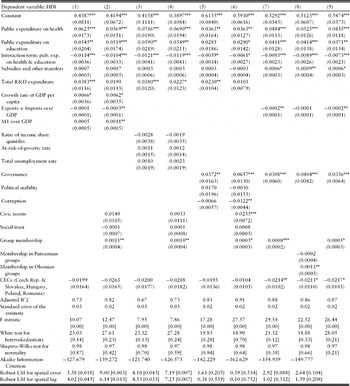
Regression results are presented in Table 2. For the purposes of our cross-sectional analysis, variables for each country are averaged over the period for which data are available from 1960 to 2002, with the exception of our social capital variables for which data were available for the survey year 1999/2000. Due to limited sample size and a wide array of explanatory variables, we estimate a series of specifications in which each group of economic, social, and political variables enters individually (equations (1), (3), (5)). Variables representing public expenditure are included in all equations, because they have statistically significant coefficients across different specifications. We then introduce social capital variables to test our main hypothesis with regard to their contribution in human development (equations (2), (4), (6)). Finally, we evaluate the combined performance of economic, social, and political variables (equation (7)), as well as the influence of alternative social capital variables that distinguish between different types of groups (equation (8)). Equations are estimated with OLS procedures, except for equation (9), where we employ 2SLS methods after testing for endogeneity. Further tests to ensure the validity of the assumptions of the classical normal linear model are summarized in the final rows of Table 2.
Cross-country regressions of human development and social capital (N = 32)

Note: Standard errors are in parentheses. *** 1% level, **5% level, and *10% level of statistical significance. Probabilities are in brackets.
First of all, we observe that public provisions in health and education play an important role in the improvement of human development.Footnote 2 In all equations depicted in Table 2, coefficients for public expenditure on health and education are positive and statistically significant. Their interaction term also has a statistically significant coefficient with a negative sign. This perhaps reveals the substitutability between these two types of public expenditure in satisfying development objectives. What it implies is that there is a certain threshold beyond which a rise in public expenditure in one area would not contribute to human development, given the level of expenditure in the other area. For instance, coefficients in equations (1) and (2) of Table 2 imply that a 1 percentage point increase in public expenditure on education as a share of GDP would produce a rise in HDI only in countries with levels of public expenditure on health as a share of GDP that are roughly below 5% (= 0.055/0.011), ceteris paribus. This would include all countries but the Netherlands, Estonia, Denmark, and Sweden. The variable for subsidies and other transfers performs less well, because its coefficient, albeit positive, is smaller and statistically insignificant. It might have been useful to distinguish between particular types of subsidies and transfers, but data were not available.
Another variable that appears to be equally important in the development process is the quality of governance, introduced in equations (5) and (6), as part of a set of political indicators employed in our analysis, including political stability and corruption. We observe that amongst these variables governance has a statistically significant coefficient with the expected positive sign. In particular, an increase in the scale of governance by one unit, which corresponds to an improvement in the accountability and effectiveness of government authorities, will increase the value of HDI by 0.03, ceteris paribus. However, the variable capturing conditions of political stability has a coefficient that is statistically insignificant. It is likely that our variable is not capturing events of political unrest and conflict that took place in the post-war period, such as the dictatorships in South Europe and the collapse of the communist regime in East Europe, because it covers the period from 1996 onwards. Finally, with regard to corruption, the coefficient becomes statistically significant when we introduce variables of social capital in equation (6). However, since higher values of the corruption index indicate less corruption, the negative sign of the coefficient implies that less corruption will contribute less to human development. An explanation could be that, in less developed countries, where the quantity and quality of public and private provisions are more limited, citizens may have to rely on unofficial and often corrupt dealings with the state in order to secure a substantive level of income and welfare.
Moreover, it is worth noting that the positive and rather strong influence of public expenditure and governance variables could be indicative of the contribution of synergistic relations between public and private sectors, when combined with the positive and statistically significant effect of group membership in equations (6)–(9). This would imply that human development depends on strong social participation in third sector organizations coupled with strong state institutions that respond to social demands by ensuring government effectiveness and accountability in welfare expenditure and public goods provision.
Economic growth is introduced in equations (1) and (2), along with economic variables of international trade and financial development. Indeed, we observe that GDP per capita growth has a positive and statistically significant coefficient such that a rise in economic growth by 1 percentage point would increase the value of HDI by 0.007 units, ceteris paribus. The other variables become statistically significant in equation (2), where social capital variables are introduced. The coefficient for financial development, measured as the share of money supply M1 in GDP,Footnote 3 is positive, which is consistent with arguments that the creation of financial institutions for ensuring credit could improve the development prospects of a region. International trade, measured as exports plus imports over GDP, has a negative coefficient, which is counter to arguments emphasizing the benefits from the international realloction of resources towards more productive and efficient uses. Outcomes here might be influenced by the less developed countries of Eastern Europe that exhibit a relatively high degree of openness, similar to more developed countries such as Belgium and the Netherlands. It is the case that either the benefits of international trade have not yet been realized, or opening markets at such early stages of transition, without the appropriate domestic institutions for policy, finance, and research, has had adverse effects on development in these countries. Finally, the coefficient for economic growth loses statistical significance when the variable for governance is introduced in the equation, which is also true for variables of money supply and technological innovation (research and development expenditure) (results not presented here).Footnote 4 This perhaps reveals that economic growth, financial conditions, and technology do have an impact on human development; but this depends on political institutions to ensure the effective allocation of output and resources. Therefore, we omit these variables from our final specification in equation (7).
Variables of social exclusion – namely inequality, poverty, and unemployment – are introduced in equations (3) and (4). In both specifications, with and without social capital, coefficients are statistically insignificant, and only that of income inequality has the expected – negative – sign. One explanation for such findings is lack of long-run data to capture the actual magnitude of such problems, since, for inequality and poverty, data are available only for the period 1994–2002. Alternatively, one might think that aggregate measures are usually unable to capture often dispersed, localized, or simply undetected instances of low income and high poverty in more developed countries. However, as Ranis et al. observe in their study of developing countries, income distribution variables run counter to their expectations; that is, a more equal distribution does not seem to advance human development (Reference Ranis, Stewart and Ramirez2000: 204–205). Also, it can be argued that the consequences of social exclusion cease to have overall adverse effects on development, because we have controlled for the contribution of the welfare system, based on the provision of public goods by the state and the third sector. Indeed, by dropping all other regressors, the coefficient for income inequality becomes statistically significant at the 1% level; it loses statistical significance once group membership and governance are introduced in the regression (results not presented here).
We investigate the effect of further regional characteristics of European countries by introducing a set of regional dummies, which represent geographical groupings with similar historical, cultural, and institutional features: Scandinavia, Anglo-Saxon countries, Continental Europe, the Mediterranean South, Central East European countries, former Soviet countries, and the Balkans. We discover that only the coefficient for the regional dummy of Central East European countries displays relatively stronger statistical significance across alternative specifications (results not presented here). This dummy variable appears in all equations of Table 2 to account for regional-specific effects, which become statistically significant at the 10% level in equation (7). However, the coefficient has a negative sign and thus implies that factors specific to this region have had an adverse effect on human development in these countries, perhaps as a result of times of tribulation during the communist era.
We now come to test our hypothesis on the contribution of social capital to human development. From Table 2 we observe that group membership has a coefficient that is positive and statistically significant across specifications. This is not in general agreement with findings in the growth literature, where the weak relationship between group membership and growth performance is attributed to negative externalities produced by special-interest groups as a result of rent-seeking and lobbying. Again counter to empirical work on growth, social trust appears to have a statistically insignificant, albeit positive, coefficient. This outcome maintains even if we drop the group membership variable (result not presented here). One possible explanation could be that human development depends less on attitudes and sentiments of generalized trust and more on the capacity of members of social groups to organize, co-operate, and set goals to fulfill development objectives. Finally, with regard to civic norms, the coefficient becomes statistically significant in equation (6), when we introduce political variables of governance; but it is positive, that is, an increase in the index, which corresponds to more uncivic behaviour, appears to improve rather than inhibit development. Our rationale here is similar to that discussed for corruption: in countries that are less endowed with effective and accountable public institutions, improvements in development will depend on the ability of civilians to pursue their personal welfare individually by participating in clientelistic networks of state patronage. We therefore omit civic norms and corruption variables from our final specification in equation (7), because they are difficult to interpret. In sum, we find that participation in social organizations of the third sector of the economy has a direct impact on human development through the voluntary provision of public goods, and not only indirectly through the resolution of state and market inefficiencies. Indeed, in equation (7), which controls for a compact set of variables with a relatively stronger association to human development,Footnote 5 group membership is amongst the variables that appear to have a positive and statistically significant influence on human development: its coefficient implies that a 1 percentage point increase in membership would produce an increase in HDI of approximately 0.0008 units, ceteris paribus.Footnote 6
Of course, the simple act of membership in a variety of social organizations ranging from human rights associations to choir groups, and relating to more or less active or benign forms of participation, would not suffice to claim its beneficial impact on development. To consider the influence of different types of social organizations, we replace the group membership index with two distinct variables to distinguish between Olsonian groups (trade unions, political parties, and professional associations) and Putnamian groups (religious/church organizations, cultural groups, and youth work associations) (Knack and Keefer, Reference Knack and Keefer1997; Beugelsdijk and Schaik, Reference Beugelsdijk and van Schaik2005). In equation (8) of Table 2, we observe that, counter to expectations, Olsonian groups have a positive and statistically significant coefficient, whereas Putnamian groups have a negative, albeit statistically insignificant one. A possible explanation is that Olsonian groups include organizations, such as trade unions, that had a positive contribution to reform and development for regions such as Scandinavia, whereas Putnamian groups incorporate religious groups that for some countries pose obstacles to development. We examine qualitative aspects of social organizations in the next section.
Further tests presented in Table 2 might be indicative of the fact that there are qualitative aspects of social capital that are not fully captured by our group membership indices. Tests for spatial autocorrelation point to the existence of a spatial autoregressive process in the error term, which is attributed to data problems when the scale of observation (e.g. administrative units) does not match the spatial scale of the process under study and thus does not take into account spill-over effects between multiple units.Footnote 7 Nevertheless, when we re-estimate equation (7) with ML procedures to account for spatial dependence, we discover that coefficients for all regressors, including the autoregressive parameter for spatial errors, become statistically significant at the 1% level (results not presented here). Also, even though equation (7) appears to have one of the lowest information criterion values, equation (6), which includes variables on corruption and civic norms, has the lowest information criterion value amongst alternative specifications. Perhaps these variables capture aspects of bonding ties within groups without bridging ties across groups.
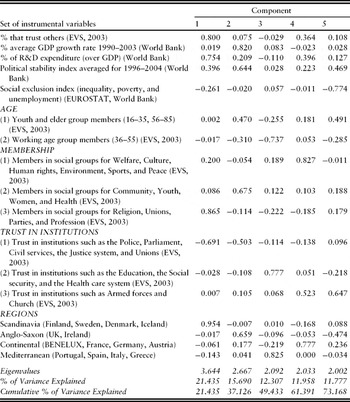
Finally, one might argue that in our final specification, the coefficient for group membership is capturing the effect of development on social capital, as improved conditions of health, education, and income could expand the ability for social involvement (Fafchamps, Reference Fafchamps2006). To solve for potential endogeneity of the group membership variable, we apply 2SLS methods. Since the instruments we use are relatively large in number and perhaps interrelated, we conduct a principal components analysis to obtain instruments that are uncorrelated, valid, and more efficient (Bai and Ng, Reference Bai and Ng2006) (Table B of the Appendix). Formal tests for instrument relevance and validity reveal that there are no severe inconsistencies in 2SLS.Footnote 8 In equation (9), we see that the coefficient for group membership falls, but remains positive and statistically significant. Alternatively, we can re-estimate the regression using values of HDI from the year 2002 as the dependent variable, and maintain values of group membership prior to that year. The coefficient for group membership is positive, statistically significant, and with a value equivalent to that obtained with 2SLS (results not presented here).
Overall, results draw our attention to the importance of social organizations in more developed countries, where they contribute directly to broader welfare aspects of development as part of the third sector of the economy in synergy with state institutions of welfare expenditure and governance. However, historical and cultural differences across regions lead to conceptual differences of what the third sector is and does in the economy, which cannot be captured by survey questions when they address queries concerning respondents’ membership in a specified list of voluntary associations. For instance, an approach borne out of the experience of Northern and Western regions of Europe tends to give more emphasis on the participation of individuals in a set of formal organizations, possibly underestimating the richness of informal social groups and networks present in South and East Europe. However, informal networks established to combat pressing social problems can, under certain conditions, lead to a highly localized, dispersed and fragmented third sector, which is not only incapable of scaling up activities to encompass more groups and influence policy, but is also susceptible to control from formal institutions. Furthermore, synergy of social organizations with state institutions can only be implicitly deduced from our empirical results if we accept that the existence of more encompassing organizations is associated with a high proportion of group membership and a high quantity and quality of public provisions by the state. Hence, further case study analyses across regions are necessary to obtain a more complete account of the conditions that determine participation in and effectiveness of social organizations.
4. A case study analysis for European countries
We analyse qualitative features of the European third sector to address the question of why group membership generates a positive impact on human development in our sample, contrary to general findings in the growth literature. For this purpose, we follow Evers and Laville (Reference Evers, Laville, Evers and Laville2004) and adopt a historical-dynamic perspective, which emphasizes the sociopolitical aspects of third sector activities, as opposed to an approach that sees them as an economic decision by maximizing individuals to create an auxiliary force in response to market and state failures. Hence, the European third sector is studied within a context of welfare pluralism and political embeddedness, where social organizations interact with public legislation and welfare state policies, the values and practices of private business, contributions of informal family and community life, and initiatives by popular movements. This has led to the emergence of social economic organizations, such as mutuals and co-operatives, which are motivated by solidarity and welfare considerations, and generate benefits for a class or group, rather than individual interest (Evers et al., Reference Evers, Laville, Borzaga, Defourny, Lewis, Nyssens, Pestoff, Evers and Laville2004: 13, 20). Nevertheless, different interactions between social and political actors across European countries produce differences in the ability of the third sector to participate in the formation of public policy and the provision of public goods in synergy with the state.Footnote 9 In particular, we put forth the idea that the differential influence of the third sector on human development depends on the contextual framework of welfare systems that prevail in different regions and determine the interrelationships between social organizations and public authorities. Even though the focus of such analyses has been North and West European countries, we make an attempt to incorporate post-socialist countries of East Europe.
We recall from Section 3 that Scandinavian countries, as well as countries of Continental Europe, have relatively higher levels of group membership and human development. We speculate that welfare systems in these countries foster generalized norms and networks of co-operation and synergy that are conducive to human development by supporting mass representation and participation of social classes in policy making and the provision of public goods. Specifically speaking, in the universal, social-democratic system of Scandinavian countries, voluntary associations have been forged by membership-based and democratically governed popular movements, particularly amongst labour classes and agrarian populations, that acted as forces of social advocacy. These were not single organizations, but whole networks of organizations comprised of trade unions, independent political parties, co-operatives, banks, and educational and training institutions to promote the ‘collectivization of needs’. Furthermore, political and financial constraints on the Swedish welfare state since the 1990s have called for the direct contribution of new popular movements, where citizens participate as co-producers of social services (Evers et al., Reference Evers, Laville, Borzaga, Defourny, Lewis, Nyssens, Pestoff, Evers and Laville2004: 27; Pestoff, Reference Pestoff, Evers and Laville2004: 64, 66, 80). In corporatist welfare systems of Continental European countries, such as Germany, Austria, France, and Belgium, the responsibility for the provision of social services is handed over to non-state, and non-profit organizations. Nevertheless, the service regime was regulated by the state, which undertook economic accountability for the provision of social services to citizens. In this manner, third sector organizations were brought closer to the government and were prompted to form large national federations linked to political parties and churches. They would thus participate in a system of ‘institutional fixation’, where they undertake an intermediary role between private and public agents (Bode and Evers, Reference Bode, Evers, Evers and Laville2004: 102, 107–108; Evers et al., Reference Evers, Laville, Borzaga, Defourny, Lewis, Nyssens, Pestoff, Evers and Laville2004: 28).
Liberal and dual systems, characteristic of the UK and South Europe respectively, are systems where services are generally not provided by the state and remain for the most part in the private domain of markets and households. Liberal welfare systems support a welfare mix where a rich network of charitable organizations serves the most disadvantaged segments of the population; but these organizations enjoy less synergy with the state, which maintains a passive regulatory role, and are seen as a response to market and state inefficiencies. Charitable associations in the nineteenth century were influenced by organized religious groups, who played a dominant role in meeting with social needs and exercising social control in conjunction with social elites, who were expected to attend to the welfare of their local population by voluntarily contributing their property. Conservative governments of the late twentieth century would reserve a more central role for the third sector, but in response to their commitment for the rolling back of the welfare state. Policies for privatization of social services urged third sector organizations to become increasingly entrepreneurial and competitive, forcing them to compromise social needs (Evers et al., Reference Evers, Laville, Borzaga, Defourny, Lewis, Nyssens, Pestoff, Evers and Laville2004: 23, 27; Taylor, Reference Taylor, Evers and Laville2004: 126–127, 132–133). In the dual systems of Southern Europe, third sector organizations did not play a significant role in society and were highly marginalized until the late twentieth century. The only institution thought to be responsible for social welfare was the state. However, access to welfare was much less a universal or egalitarian right as in social democratic systems; it became more of a privilege granted on the basis of personal acquaintance or patronage. A history of authoritarian regimes, centralized governance, partitocratic institutions, and familist structures gave rise to ‘a particularist and clientelistic welfare system in which values and principles differed according to the social group concerned’ (Borzaga, Reference Borzaga, Evers and Laville2004: 51). The welfare state would thus carry out its obligations by focusing on cash benefits rather than on the provision of social services, and by exercising control over the activities of third sector organizations (Borzaga, Reference Borzaga, Evers and Laville2004: 51; Evers et al., Reference Evers, Laville, Borzaga, Defourny, Lewis, Nyssens, Pestoff, Evers and Laville2004: 27–28).
Transition economies of Central and Eastern Europe portray a different relationship between the third sector and the welfare state. The totalitarian system in Soviet Russia fostered a set of formal organizations and networks to mobilize compliance with the regime by means of bureaucratic commands and ideological coercion. Uncertainty and oppression from formal organizations would then encourage people to create informal networks with friends and family to protect themselves against the state by relying on personal contacts, barter or bribes (Rose, Reference Rose, Dasgupta and Serageldin2001: 150, 160, 166). Hence, ‘[t]he new democratic governments inherited a citizenry with low levels of trust in public institutions and with the habit of relying on inter-personal relations’ (Rose-Ackerman, Reference Rose-Ackerman2001: 415). In post-socialist Russia, the ability of third sector organizations to operate independently and effectively is curtailed by concentration of political power, restrictive legislation, and co-optation by government. Citizens’ participation in the third sector is further hindered by uncertainty of current economic and political conditions, as well as by public perceptions that view international donor agencies as Western imports incapable of responding to local associations’ needs and values. This despite the fact that Russia hosted a vibrant civic life in the first years of the Soviet system, as well as in the 1980s as a consequence of the perestroika (Hemment, Reference Hemment2004: 216–217; Heinrich, Reference Heinrich2007: 318–319, 321–323).
In closing, we must mention that each of the aforementioned welfare systems hosts a number of countries that have differences as much as similarities. One example is the Dutch system of pillarization, which emerged in the turn of the twentieth century and was characterized by the organization of social and civic life along three pillars (Catholic, Protestant and Social) and by the establishment of various consensus-oriented institutions to temper social tensions (Heinrich, Reference Heinrich2007: 270). There are also differences across transition economies: for instance, in Poland, the development of co-operatives followed different patterns in the Prussian, Russian, and Austrian parts of the country until World War I, leading to different types of associations that prevented the cultivation of generalized norms and networks of trust and participation across groups (Svendsen and Svendsen, Reference Svendsen and Svendsen2004: 52–53). Another example is Turkey, which shares some of the features of South European dual welfare systems, but bares certain local peculiarities arising from the tension between compulsory secularism instituted by Mustafa Kemal, on the one hand, and the advent of a post-secularist society and policy pursued by Muslim actors, on the other (Keane, Reference Keane1998: 28). On the whole, our discussion here, albeit speculative rather than conclusive, points to the fact that contextual factors of the interplay between private and public actors across European countries have a significant role in determining the capacity of third sector organizations and synergistic relations to promote generalized participation and broader development objectives.
5. Conclusions
Our analysis focused on the relationship between human development and elements of social capital, namely civic norms, social trust, and group membership, in a sample of European countries for the post-war period. After a brief overview of theoretical and empirical contributions from contemporary social capital research, we evaluated the developmental role of social capital in Europe by conducting a regression analysis and complementing empirical findings with a case study analysis across regions.
Regression outcomes offer evidence that social capital, particularly in the form of group membership, is positively related to human development. This is counter to evidence produced in the growth literature, where civic norms and social trust appear to have a relatively stronger effect. Civic norms and social trust are seen as a means to overcome market and state inefficiencies, as opposed to group membership, which is often associated with rent-seeking practices and patron–client relations that are detrimental to the growth process. However, when we examined broader concepts of development, it was shown that, given changes in output and international markets, membership in various types of organizations, alongside public provisions and the quality of governance, was positively linked to improvements in health, education, and income. Hence, social organizations appear to contribute directly to development as part of the third sector of the economy, which undertakes (private) voluntary provisions of public goods in synergy with the state. Case study analyses would inform us of contextual factors that influence the developmental capacity of social organizations and synergy relations, and depend on qualitative features of welfare systems established across European countries. We speculate that Scandinavian and Continental European countries enjoy relatively higher levels of human development because they are characterized by generalized norms and networks of social participation and state–society synergy relations, as opposed to countries of South and Central East Europe where patron–client relations and special-interest groups prevail and inhibit development.
It could be argued that different conceptualizations, structures and norms of third sector activity across countries are influenced by the economic, social, and political changes invoked by different forms of technical progress and economic growth. However, it is also true that society responds more or less to such changes by organizing popular movements, co-operatives, charities, and solidarity-based organizations to determine the context of welfare provisions and development policies. We must not overlook the historical possibility of change being socially addressed and constituting the source for new forms of partnerships and collective action to exploit the opportunities and confront the obstacles to human development. Empirical findings above perhaps draw attention to the potential of social organizations to enhance development by ensuring mass mobilization and participation in a system of political exchange and public goods provision that would respond to social welfare objectives. Current challenges imposed by globalization, international competition, and marketization of social service and goods provision are expected to affect the capacity of third sector organizations and synergy relations to secure social priorities and public welfare. It remains a task for further research to investigate the type of organizations and synergies that would confront these challenges within the new global arena.
Appendix
Description of variables and data sources

Principal components analysis of instrumental variables

Note: Based on varimax rotation method with Kaiser normalization, converging in seven iterations (SPSS, 2004). Variables under the label social exclusion, age, membership, and trust in institutions correspond to standardized factor scores produced after conducting a principal components analysis. Age represents the distribution of members in social organizations across seven age groups from 16 to 85. Membership is the % of respondents that are members of a list of voluntary organizations. Trust in institutions is the average level of confidence respondents express towards a list of institutions (where 1 = ‘a great deal’, 2 = ‘quite a lot’, 3 = ‘not very much’, 4 = ‘none at all’).