

Although the terminology varies across reading theories, there is a strong consensus on the two main procedures that children must acquire at the single word reading level: decoding abilities and accurate and automatic recognition of words (Coltheart, Reference Coltheart2005; Ehri, Reference Ehri, Oakhill and Beard1999; Farrington-Flint, Coyne, Stiller, & Heath, Reference Farrington-Flint, Coyne, Stiller and Heath2008). This paper focuses on the assessment of these two reading processes and specifically the utility of common reading tests in detecting different types of reading difficulties.
Several models have been put forth to describe the reading process. These include, but are not limited to, stage models (Frith, Reference Frith, Patterson, Marshall and Coltheart1985), phase or wave theories (Ehri, Reference Ehri, Oakhill and Beard1999; Siegler, Reference Siegler1996), connectionist models (Plaut, McClelland, Seidenberg, & Patterson, Reference Plaut, McClelland, Seidenberg and Patterson1996), and cognitive models (Coltheart, Reference Coltheart, Coltheart, Sartori and Job1987; Coltheart, Rastle, Perry, Langdon, & Ziegler, Reference Coltheart, Rastle, Perry, Langdon and Ziegler2001) of reading. This paper is theoretically based on the dual route model of single word reading (Coltheart, Reference Coltheart, Coltheart, Sartori and Job1987; Coltheart, Curtis, Atkins, & Haller, Reference Coltheart, Curtis, Atkins and Haller1993; Coltheart et al., Reference Coltheart, Rastle, Perry, Langdon and Ziegler2001; Morton & Patterson, Reference Morton, Patterson, Coltheart, Patterson and Marshall1980). The dual route model was chosen as it provides a clear framework for understanding and independently assessing the specific acquisition of the two main reading processes that children must acquire to become proficient readers (i.e., phonological decoding or nonlexical reading skills and word recognition or lexical reading skills).
The dual route model of single word reading proposes that skilled readers have available two relatively independent procedures or processes for converting print to sound. These two procedures are referred to as the lexical and nonlexical reading routes. The lexical route involves accessing representations of words in a mental lexicon or memory store to recognise familiar words. The nonlexical procedure represents knowledge about how to apply letter-to-sound, or grapheme-to-phoneme, correspondence rules and is used to read words that a reader has not previously encountered (i.e., words that are not stored in the mental lexicon; Coltheart et al., Reference Coltheart, Curtis, Atkins and Haller1993; Coltheart et al., Reference Coltheart, Rastle, Perry, Langdon and Ziegler2001).
Although the dual route model posits that both routes are activated by written input, the two routes differ in the types of support they offer a reader. Using the lexical route, a reader is able to rapidly process all words they have previously encountered, including irregular words (e.g., yacht, pint), but will have difficulty processing unfamiliar words or nonwords (e.g., jeaph, zickling), as these words do not have a lexical representation. Processing along the nonlexical route, a reader will successfully read nonwords, unfamiliar and familiar regular words (i.e., words that obey the letter-to-sound rules of English; e.g., leaf, make). However, irregular words, which do not follow the standard spelling-to-sound rules, cannot be read successfully via this procedure. Reading irregular words by the nonlexical route will produce an incorrect response, known commonly as a regularisation error (e.g., pronouncing pint as if it rhymed with mint; Castles, Reference Castles2006; Coltheart et al., Reference Coltheart, Curtis, Atkins and Haller1993).
Based on this distinction made within the dual route theory, acquisition and functioning of the lexical route is assessed by irregular word reading, as irregular words will only be pronounced correctly if they are stored in the mental lexicon (with connections to the correct pronunciation). Nonlexical skills are assessed by nonword reading, as these made-up words will only be pronounced correctly if the reader is able to successfully apply grapheme-to-phoneme rules. Regular words, which can be read via either procedure, are uninformative with reference to assessing the acquisition of either lexical or nonlexical reading skills (Coltheart, Reference Coltheart2006; Coltheart et al., Reference Coltheart, Curtis, Atkins and Haller1993).
In the process of reading acquisition, different components of the dual route model can be selectively impaired, resulting in slower acquisition of the processing skill carried out by this ‘impaired’ component. Various cases have been reported with a very selective difficulty during the acquisition process (for an overview, see Castles, Bates, & Coltheart, Reference Coltheart2006; Jones, Castles, & Kohnen, Reference Jones, Castles and Kohnen2011). That is, there are children who display difficulties in the acquisition of only one specific reading procedure.
Developmental dyslexia has been defined as an unexpectedly low reading level given a child's age, education and intelligence level (American Psychiatric Association, 2002). Two of the most researched subtypes of developmental dyslexia are ‘surface’ and ‘phonological’ dyslexia. These subtypes can be accounted for by a selective difficulty in acquiring lexical (surface dyslexia) or nonlexical (phonological dyslexia) reading skills as outlined by the dual route model (see Castles et al., Reference Castles, Bates and Coltheart2006; Castles & Coltheart, Reference Castles and Coltheart1993; Goulandris & Snowling, Reference Goulandris and Snowling1991; Hanley, Hastie, & Kay, Reference Hanley, Hastie and Kay1992; Howard & Best, Reference Howard and Best1996; Manis, Seidenberg, Doi, McBride-Chang, & Petersen,1996; Snowling & Hulme, Reference Snowling and Hulme1989).
Children with developmental phonological dyslexia have a specific difficulty reading nonwords and unfamiliar words, while their word reading ability for both familiar regular and irregular words is normal or comparatively better. Children with developmental surface dyslexia, on the other hand, display a specific difficulty reading irregular words, while their reading of regular words and nonwords, which follow typical grapheme-to-phoneme correspondence rules, is normal or comparatively better (Castles, Reference Castles2006). Dual route theorists account for these two subtypes by positing that developmental phonological dyslexia reflects a specific difficulty in acquiring the nonlexical reading route, while developmental surface dyslexia reflects a specific difficulty in acquiring the lexical reading route (Castles, Reference Castles2006; Castles & Coltheart, Reference Castles and Coltheart1993).
While it is acknowledged that most children with reading difficulties will have difficulty acquiring both lexical and nonlexical reading skills, the aforementioned research has demonstrated that there is often a significant difference between these skills. Hence, an ideal assessment tool should independently assess how children fare in their acquisition of both lexical and nonlexical reading skills. Therefore, relatively pure measures of each processing component (i.e., lexical and nonlexical) are required. As noted above, the dual route model outlines the individual components or modules of the single word reading system and informs assessment by outlining the tests (or item types) known to pinpoint where a reading difficulty lies within this system (for an overview, see Coltheart, Reference Coltheart2005).
Clinically, it is important to identify the nature of children's reading difficulties in order to provide targeted remediation. It is known from single case studies that programs that are successful in remediating poor phonological decoding skills (i.e., nonlexical skills) are markedly different from remedial programs targeted at children with poor lexical reading skills (see Broom & Doctor, Reference Broom and Doctor1995a, Reference Broom and Doctor1995b; Brunsdon, Hannan, Coltheart, & Nickels, Reference Brunsdon, Hannan, Coltheart and Nickels2002; Brunsdon, Hannan, Nickels, & Coltheart, Reference Brunsdon, Hannan, Nickels and Coltheart2002; Rowse & Wilshire, Reference Rowse and Wilshire2007). Even for children with mixed dyslexia it is important to measure both lexical and nonlexical skills, as the level of difficulty in each procedure has implications for instructional planning (Brunsdon, Hannan, Coltheart, & Nickels, Reference Brunsdon, Hannan, Coltheart and Nickels2002). Therefore, if assessment tools do not adequately identify a child's reading difficulty or where a basic reading difficulty lies, the child may fail to qualify for remedial efforts, or the instruction provided may unfortunately be inappropriate and unsuccessful.
Despite consensus on the fact that there are two basic procedures that children need to acquire, and the evidence of the existence of developmental phonological and surface dyslexias, most routinely used word identification reading tests do not separate out words that can be read by both the lexical and nonlexical procedures (e.g., regular) and words that can only be read via the lexical procedure (e.g., irregular). Furthermore, the sensitivity of stimuli on several nonword reading tests is questionable (for an overview, see Colenbrander, Nickels, & Kohnen, Reference Colenbrander, Nickels and Kohnen2011). With reference to the dual route model and the assessment of lexical and nonlexical reading skills, the following will outline important characteristics of word identification and nonword reading tests.
Single word reading accuracy is a component of most standardised literacy/reading tests. However, as already noted, the words on these tests generally vary in their orthographic regularity. Regular words can be pronounced by either applying grapheme-to-phoneme correspondence rules or, if the word is familiar, by using sight word reading skills, whereas irregular words must be stored in a individual's sight vocabulary or mental lexicon to be pronounced correctly. Therefore, general word identification tests may not be appropriate tools for pinpointing the nature of children's reading difficulties (i.e., lexical or nonlexical). Considering that regular word reading is supported by both the lexical and nonlexical reading routes, scores on regular word reading would be expected to be higher than the other two item types (i.e., nonwords and irregular words), a dual route model expectation that has been supported by several studies (Castles et al., Reference Castles, Bates and Coltheart2006; Castles et al., Reference Castles, Coltheart, Larsen, Jones, Saunders and McArthur2009; Castles & Coltheart, Reference Castles and Coltheart1993; M. Coltheart & Leahy, Reference Coltheart and Leahy1996). Therefore, it is expected that word identification tests containing high proportions of regular word items may overestimate a child's reading level (at least with reference to lexical reading skills). While it is acknowledged that children need to be able to successfully read both regular and irregular words, for assessment and remedial purposes it is essential to differentiate between the acquisition of lexical and nonlexical reading skills and not overestimate a child's capabilities.
Orthographic regularity is not the only important factor that needs to be considered when selecting and comparing word identification tests. Considering that most word identification tests share very little item content, other factors such as word length and word frequency should also be considered. Both word length and frequency are known to influence children's scores on tests of single word reading accuracy, whereby high frequency words and shorter words are easier to read (Spencer, Reference Spencer2010).
Nonword reading is known to be a powerful predictor of primary school children's reading ability (Rathvon, Reference Rathvon2004) and is considered the optimal measure of phonological decoding/nonlexical reading skills (Jackson & Coltheart, Reference Jackson and Coltheart2001; Rack, Snowling, & Olson, Reference Rack, Snowling and Olson1992). Furthermore, nonword reading difficulties are prominent in children classified as low progress or dyslexic readers (Rack et al., Reference Rack, Snowling and Olson1992; Snowling, Goulandris, & Defty, Reference Snowling, Goulandris and Defty1996). Nonetheless, several studies have shown that not all nonword items are accurate measures of nonlexical reading skills (Colenbrander et al., Reference Colenbrander, Nickels and Kohnen2011; Olson, Forsberg, Wise, & Rack, Reference Olson, Forsberg, Wise, Rack and Lyon1994). A number of characteristics of nonword items can influence how easily they are read.
A large body of research has shown that nonwords that are visually similar to real words can be read at least partially via visual analogy, thus reducing demands on nonlexical reading skills (V. Coltheart & Leahy, Reference Coltheart and Leahy1996; Goswami, Ziegler, Dalton, & Schneider, Reference Goswami, Ziegler, Dalton and Schneider2003; Manis, Custodio, & Szeszulski, Reference Manis, Custodio and Szeszulski1993; Rack et al., Reference Rack, Snowling and Olson1992; Treiman, Goswami, & Bruck, Reference Treiman, Goswami and Bruck1990). For example, Treiman et al. (Reference Treiman, Goswami and Bruck1990) reported that nonwords that shared their vowel consonant (i.e., rhyming) unit with many real words, such as tain and goach (referred to as ‘H words’), thus having many real word neighbours (e.g., rain and coach), were significantly easier to pronounce than those that shared their vowel consonant unit with few or no real words, such as taich and goan (referred to as ‘L words’). This pattern was evident in first graders, adults and both poor and good third grade readers. Furthermore, knowledge of grapheme-to-phoneme correspondence rules was more highly correlated with performance on L words than it was for H words.
Secondly, the length of nonwords is also an important factor to consider when assessing nonlexical reading skills. Research has shown that children with dyslexia do not necessarily differ from normal readers of the same reading age when reading single syllable nonwords (e.g., wut, steg), but do perform poorer when reading two syllable nonwords (e.g., tegwop; Snowling, Reference Snowling1981).
Finally, the presence of consonant clusters (i.e., two consonant letters that correspond to two consonant sounds; e.g., the sk in skith) within a nonword also affects how easy they are to decode. Snowling (Reference Snowling1981) reported that the number of consonant clusters had an effect on the ability of children identified with dyslexia to pronounce nonwords, but not children within the control group, whereby increasing the numbers of consonant clusters resulted in greater difficulty to read the nonwords. Similar findings were reported in a later study by Holligan and Johnston (Reference Holligan and Johnston1988), who showed that children identified with dyslexia did not differ from children within the control group when given a list of three-letter single-syllable nonwords, with a simple consonant-vowel-consonant (CVC) structure, to read (e.g., rop). However, the children with dyslexia had more difficulty than children in the control group when given more complex, single syllable nonwords (e.g., haive). Together, the research investigating syllable length and number of consonant clusters suggests that simple CVC, three-letter nonwords may not adequately indentify children who have difficulties acquiring or applying nonlexical reading skills. The effect of syllable length is less clear, although Snowling's (Reference Snowling1981) findings suggest caution with using one-syllable nonwords to assess nonlexical reading skills.
In summary, a number of variables can affect how difficult it is to read a nonword. Consequently, tests of nonword reading containing large proportions of items that are visually similar to real words (i.e., have many real word orthographic neighbours and contain real word bodies), single syllable, and/or contain only one consonant cluster (i.e., consist of three letters only) may not be sensitive enough to identify children who have poor nonlexical reading skills.
The current study employed selected word identification and nonword reading measures, where the items differ in regards to the aforementioned characteristics (a detailed analysis of the chosen tests characteristics is provided in the Method section). The study had two main aims:
(1) to investigate the impact of these characteristics on test performance in a group of children with reading difficulties, and
(2) to determine how much widely used reading measures vary in their detection of lexical and nonlexical reading difficulties in a group of children with reading difficulties.
In order to achieve these aims, reading subtests from two of the most commonly used achievement measures, the Woodcock-Johnson III Tests of Achievement (Woodcock, McGrew, & Mather, Reference Woodcock, McGrew and Mather2001) and the Wechsler Individual Achievement Test – Second Edition (Harcourt Assessment, 2007), were compared with a cognitive measure of reading, the Castles and Coltheart Reading Test 2 (Castles et al., Reference Castles, Coltheart, Larsen, Jones, Saunders and McArthur2009), which was developed based on the main distinction made in the dual route model of reading.
Method
Participants
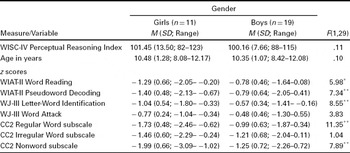
The sample consisted of 30 children who were identified as having reading difficulties (19 boys, 11 girls, M chronological age = 10.40 years; see Table 1)Footnote 1. The children were recruited from four Sydney independent schools (n = 19) or through Macquarie University reading studies (n = 11). Participants recruited through independent schools were identified as low progress readers by learning support staff or classroom teachers. The Macquarie University reading study selected children with a z score of −1 or lower on either (or both) the Nonword or Irregular Word subscales of the Castles and Coltheart Reading Test 2Footnote 2.
Summary Statistics and ANOVA Results by Gender

*Indicates F value significant at the .05 level. **Indicates F value significant at the .01 level.
The original sample included 39 children, with nine children excluded. Seven children were not included in the analyses as their scores were well within the normal range (above the 20th percentile) on all reading tests administered. A further two children from non-English speaking backgrounds were excluded as the tests used in the study were developed for and normed on children whose first language was English.
Characteristics of Tests Selected for the Current Study
Following personal communication with education advisors and school psychologists in Sydney (NSW), subtests from two of the most commonly employed tests for identifying reading difficulties in primary school age children in NSW were chosen for the current study: the Woodcock-Johnson III Tests of Achievement (WJ-III; Schrank & Woodcock, Reference Schrank and Woodcock2009; Woodcock et al., Reference Woodcock, McGrew and Mather2001) and the Wechsler Individual Achievement Test – Second Edition (WIAT-II; Harcourt Assessment, 2007). These tests were then compared to the Castles and Coltheart Reading Test 2 (CC2; Castles et al., Reference Castles, Coltheart, Larsen, Jones, Saunders and McArthur2009).
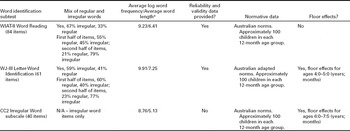
Table 2 outlines the word identification subtests used in the study. It can be seen from this table that the word identification subtests from the WJ-III and WIAT-II contain both regular and irregular words. A word is assigned as ‘regular’ if all of its graphemes are pronounced in a predictable way, while a word is assigned as ‘irregular’ if the pronunciation of one or more of its graphemes cannot be correctly predicted from the spelling. We used a list of grapheme–phoneme rules based on all English monosyllables that appear in CELEX, an English lexical database (Baayen, Piepenbrock, & Gulikers, Reference Baayen, Piepenbrock and Gulikers1995). The first and third author classified all words and discussed any discrepancies.
Overview of Word Identification Subtests

aAverage word length and word frequency for each word list was calculated using the English Lexicon Project (Balota et al., Reference Balota, Yap, Cortese, Hutchinson, Kessler, Loftis and Treiman2007a, Reference Balota, Yap, Cortese, Hutchinson, Kessler, Loftis and Treiman2007b). The mean frequency for all words in the database = 4.49 (SD = 2.89), and mean length for all words in the database = 8.29 (SD = 2.52).
Table 2 shows that the proportions of regular to irregular word items on the WIAT-II and WJ-III vary such that higher proportions of irregular items occur towards the end of the subtests. Furthermore, in comparison to the WJ-III, the WIAT-II subtest contains a higher proportion of irregular words. Consequently, due to the age-determined starting points and discontinuation rules that each subtest contains, the proportion of regular to irregular items attempted will inevitably vary from child to child. In contrast to these measures, the CC2, a test developed based on the dual route model of reading, measures regular and irregular word reading on separate subscales.
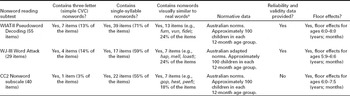
Table 3 outlines the nonword reading subtests used in the study. It can be seen from this table that the three subtests vary in the proportions of nonword items that contain real word bodies, are single syllable and/or contain only one consonant cluster (i.e., consist of three letters only). Of note, in comparison to the WIAT-II and WJ-III nonword subtests, a smaller proportion of the CC2 nonwords contain real word bodies, are single syllable, and only one is a simple CVC, three-letter nonword. Floor effects are also reported for each measure. Floor effects were defined as a raw score of one that corresponds to a standard score that is not at least two standard deviations below the mean (Rathvon, Reference Rathvon2004). The availability of reliability and validity data and details on the normative data are also noted.
Overview of Nonword Reading Subtests

aIn order to identify nonwords that share their body (vowel consonant unit) with real words we used the Children's Printed Word Database (Masterson, Stuart, Dixon, & Lovejoy, Reference Masterson, Stuart, Dixon, Lovejoy and Lovejoy2002). Nonwords that share their body with two or more real words are reported here.
Procedure
The study was approved by the Macquarie University Human Research Ethics Committee. All children were tested individually at their school or in their home by the first author. All tests were administered in one session according to standardised instructions. Written consent was obtained from participants’ parents/legal guardians and verbal assent was obtained from each child before testing. To control for order effects, the tests were administered in five different combinations.
Measures
Wechsler Intelligence Scale for Children – Fourth Edition – Australian Standardised Edition – Perceptual Reasoning Index (WISC-IV; Wechsler, Reference Wechsler2005). As a measure of nonverbal IQ, children were administered three subtests, Block Design, Matrix Reasoning and Picture Concepts, to obtain the Perceptual Reasoning Index (PRI). Internal consistency for the PRI is high (average r xx = .91).
Castles and Coltheart Reading Test 2 (CC2; Castles et al., Reference Castles, Coltheart, Larsen, Jones, Saunders and McArthur2009). Children were administered the pencil and paper version of the CC2. The CC2 consists of three lists of items: 40 regular words (e.g., bed, chicken), 40 irregular words (e.g., give, blood) and 40 nonwords (e.g., norf, framp). The regular and irregular word items are matched on frequency, length and grammatical class. Each item is printed onto a card and the examiner presents one card at a time to the child. The test is untimed. The items for each list are graded in increasing order of difficulty. However, the three lists are pseudo-randomised to minimise guessing. Testing is discontinued on each subscale when five consecutive errors are made. An accuracy score out of 40 for each subscale is obtained and converted into a z score. Internal consistency and validity data are yet to be published. Using the current sample, Cronbach's alpha for the Regular, Irregular and Nonword subscales were .85, .86 and .94, respectively.
Wechsler Individual Achievement Test – Second Edition – Australian Standardised Edition (WIAT-II; Harcourt Assessment, 2007). Children were administered the Word Reading and Pseudoword Decoding subtests from the WIAT-II.
Word Reading. This subtest consists of 47 subword items (e.g., matching letters, identifying rhyming words) and an 84-item graded word list. Internal consistency for this subtest is high (average r xx = .97). The subtest has grade-specified starting points and is discontinued after seven consecutive scores of zero. Due to the age and grade range of the current study sample, none of the children were exposed to the subword items.
Pseudoword Decoding. This subtest contains 55 nonword items. All children begin with item one and the subtest is discontinued after seven consecutive scores of zero. Internal consistency for this subtest is high (average r xx = .96).
Woodcock-Johnson III Tests of Achievement – Australian Adaption – Form B (WJ-III; Schrank & Woodcock, Reference Schrank and Woodcock2009; Woodcock et al., Reference Woodcock, McGrew and Mather2001). Children were administered the Letter-Word Identification and Word Attack subtests from the WJ-III.
Letter-Word Identification. This subtest consists of 14 subword items (e.g., letter identification and matching letters) and a 61-item graded word list. Internal consistency is high (median r xx = .91). The subtest has grade-specified starting points and is discontinued after six consecutive scores of zero. Due to the age and grade range of the current study sample, none of the children were exposed to the subword items.
Word Attack. This subtest contains 32 items (3 letter–sound items and 29 nonword items). All children begin with item four and the subtest is discontinued after six consecutive scores of zero. Internal consistency is high (median r xx = .87).
Statistical Analyses
Prior to analysis, scores were examined for accuracy of data entry, missing values, normality and outliers. All statistical tests are two-tailed, with p values less than .05 considered statistically significant. In order to conduct within-subject comparisons, all test scores were converted into standardised z scores. A series of mixed model repeated measures ANOVAs were conducted to determine the significance, direction and magnitude of any within-subject differences across the tests. Where multiple post hoc comparisons were made, the Bonferroni adjustment procedure was used to minimise the chance of committing a Type I error. Where multiple correlations were conducted, alpha levels were set at .01. All statistical analyses were performed using PASW Statistics 18.
Results
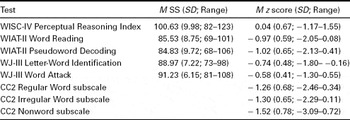
Descriptive statistics for all measures are shown in Table 4. There were no missing data for any of the variables (N = 30 for all study variables). A series of one-way ANOVAs revealed that chronological age and nonverbal IQ scores were not significantly different for girls and boys. Standardised z scores on several of the reading measures were different for girls and boys, whereby, on average, boys scored higher than girls (see Table 1). As such, gender was included as a between-subjects factor in the repeated measures analyses.
Descriptive Statistics

Note. SS = Standard Score (M = 100; SD = 15).
As noted earlier, a proportion of children were selected into the study on the basis of previous test scores on the CC2 Irregular Word and Nonword subscales. Therefore, one-way ANOVAs were conducted to compare z scores on these subscales between the two recruitment groups (i.e., university reading study or independent school). Results showed that scores were not significantly different for the two groups on the CC2 Nonword subscale, F(1, 29) = 4.00, p = .06, or the CC2 Irregular Word subscale, F(1, 29) = 1.66, p = .21. However, the difference between recruitment groups on the CC2 Nonword subscale was approaching significance, whereby, on average, children recruited through independent schools scored better on this subscale (M = −1.32, SD = 0.75) than the children recruited through university reading studies (M = −1.88, SD = 0.72). Therefore, recruitment group was included as a between-subjects factor in the repeated measures analysis investigating differences between children's test scores on the three nonword reading measures.
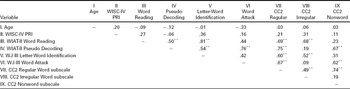
Correlation coefficients summarising the relationship between all reading measures, age and nonverbal IQ are reported in Table 5. The WJ-III Letter-Word Identification and WIAT-II Word Reading scores were significantly, positively and strongly correlated. The WJ-II Word Attack and WIAT-II Pseudoword Decoding scores were also significantly, positively and strongly correlated. WISC-IV PRI and age were not significantly associated with one another or any of the study reading measures and were therefore not considered in any of the subsequent analyses.
Intercorrelations

Note. I = Age in years; II = WISC-IV Perceptual Reasoning Index; III = WIAT-II Word Reading; IV = WIAT-II Pseudoword Decoding; V = WJ-III Letter-Word Identification; VI = WJ-III Word Attack; VII = CC2 Regular Word subscale; VIII = CC2 Irregular Word subscale; IX = CC2 Nonword subscale.
**Indicates correlation significant at the .01 level.
Of particular interest were the associations between performance on the CC2 subscales and the other reading measures. For the word identification measures, the WJ-III Letter-Word Identification and WIAT-II Word Reading scores were significantly, positively and moderately correlated with the CC2 Regular and Irregular Word subscales. CC2 Regular and Irregular Word reading were significantly and moderately associated. For the nonword reading measures, the WJ-III Word Attack and WIAT-II Pseudoword Decoding scores showed significant, positive and moderate correlations with scores on the CC2 Nonword subscale, with the stronger association between CC2 Nonword subscale and WIAT-II Pseudoword Decoding. Furthermore, all nonword reading measures (i.e., CC2, WIAT-II and WJ-III) showed a significant and positive correlation with the CC2 Regular Word subscale score.
Differences Between Word Identification Subtest Scores
To explore the detection of lexical reading difficulties, a 2 × 3 mixed model ANOVA with gender as the between-subjects factor and z scores on the three word identification subtests (WIAT-II Word Reading, WJ-III Letter-Word Identification, CC2 Irregular Word subscale) as the within-subjects factor was conducted. Mauchly's test indicated that the assumption of sphericity had been violated, χ2 (2) = 8.11, p = .02. Therefore, the degrees of freedom were adjusted using the Greenhouse–Geisser correction (ɛ = .79). There was a main effect for word identification subtests, F(1.59, 44.46) = 17.40, p < .001, ηp2 = .38. The main effect for gender was also significant, F(1, 28) = 5.21, p = .03, ηp2 = .16, with boys performing, on average, z = 0.41 higher than girls across the tests. The word identification subtests by gender interaction was not significant, F(1.59, 44.46) = 1.14, p = .32, indicating that the pattern of results was similar for girls and boys. Using the Bonferroni correction, follow-up tests of simple effects comparing scores across the three word identification subtests, revealed that all test scores were significantly different from one another. WIAT-II Word Reading scores (M z score = −1.03) were significantly lower than WJ-II Letter-Word Identification scores (M z score = −0.80), t(56) = 3.46, p = .005; CC2 Irregular Word subscale scores (M z score = −1.34) were significantly lower than WJ-III Letter-Word Identification scores, t(56) = 4.94, p < .001, and WIAT-II Word Reading scores, t(56) = 3.25, p = .009. There was no main effect for order of test administration when this variable was included in the analyses as a between-subjects factor.
Word Regularity, Word Length and Word Frequency
Due to age-determined starting points and discontinuation rules, individual children were exposed to different sets of items on the three word identification subtests. Consequently, the mean proportion of irregular/regular word items, the mean word length and the mean written word frequency were calculated for each individual child's item set on the WIAT-II and WJ-III word identification subtests.
There were large variations in the proportion of regular to irregular word items that children were exposed to on the WIAT-II and WJ-III subtests. On average, compared to the WJ-III (M = 54.96, SD = 9.77, Range = 34.38–63.16) children were exposed to higher proportions of irregular word items on the WIAT-II (M = 59.45, SD = 7.98, Range = 44.00–72.50). Within-subjects analyses showed that this difference between the proportions of irregular word items on the WIAT-II and WJ-III was significant, F(1, 29) = 9.36, p = .005.
For each child, the mean length of the words (represented by the number of letters in each word) attempted on the CC2 Irregular Word subscale, and the WJ-III Letter-Word Identification and WIAT-II Word Reading subtests was calculated. Repeated measures ANOVA showed a main effect for word length, F(2, 58) = 268.37, p < .001. On average, the items on the CC2 Irregular Word subscale were shortest (M = 4.79, SD = 0.23), followed by the items on the WIAT-II (M = 6.30, SD = 0.60), then the WJ-III (M = 7.85, SD = 0.99) word identification subtests.
For each child, the mean written frequency of the words attempted on the CC2 Irregular Word subscale, and the WJ-III Letter-Word Identification and WIAT-II Word Reading subtests was calculated using the English Lexicon Project Database (Balota et al., Reference Balota, Yap, Cortese, Hutchinson, Kessler, Loftis and Treiman2007a, Reference Balota, Yap, Cortese, Hutchinson, Kessler, Loftis and Treiman2007b). Repeated measures ANOVA showed a main effect for word frequency, F(2, 58) = 24.61, p < .001. On average, the word items on the CC2 Irregular Word subscale were most frequent (Log HAL M = 9.94, SD = 0.60), followed by the items on the WJ-III (Log HAL M = 9.65, SD = 1.25), and the WIAT-II (Log HAL M = 8.87, SD = 1.06) word identification subtests.
Differences Between Nonword Reading Subtest Scores
A 2 × 2 × 3 mixed model ANOVA, with gender and recruitment group as the between-subjects factors and z scores on the three nonword reading subtests (Word Attack, Pseudoword Decoding, CC2 Nonword) as the within-subjects factor, was conducted to compare children's scores across the three nonword reading measures. Mauchly's test indicated that the assumption of sphericity had been violated, χ2(2) = 7.38, p = .03. Therefore, the degrees of freedom were adjusted using the Greenhouse–Geisser correction (ɛ = .80). There was a main effect for nonword reading subtests, F(1.59, 41.42) = 30.31, p < .001, ηp2 = .54. The main effect for gender was approaching significance, F(1,26) = 3.50, p = .07, ηp2 = .12, with boys performing, on average, z = 0.43 higher than girls across the three nonword reading subtests. The main effect for recruitment group was not significant, F(1, 26) = .94, p = .34. No interactions were significant (all p values > .30). Using the Bonferroni correction, follow-up tests of simple effects comparing scores on the three nonword reading subtests revealed that all test scores were significantly different from one another. WIAT-II Pseudoword Decoding scores (M z score = −1.07) were significantly lower than WJ-III Word Attack scores (M z score = −0.66), t(52) = 4.65, p < .001; CC2 Nonword subscale scores (M z score = −1.63) were significantly lower than WJ-III Word Attack scores, t-(52) = 7.04, p < .001, and WIAT-II Pseudoword Decoding scores, t(52) = 3.95, p < .005. There was no main effect for order of test administration when this variable was included in the analyses as a between-subjects factor.
Proportions of Children Identified by Each Measure
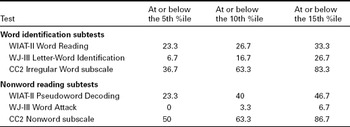
Table 6 shows the cumulative percentage of children scoring at or below the fifth, tenth and fifteenth percentiles across the word identification and nonword reading measures. To avoid being either too stringent or liberal, we chose to present data on three cut points, as all three are frequently used in the literature to identify children with reading difficulties (Felton & Wood, Reference Felton and Wood1992; Vellutino, Scanlon, & Lyon, Reference Vellutino, Scanlon and Lyon2000). From Table 6, it is evident that the CC2 subscales identify the largest proportion of children with reading difficulties, regardless of the cut point that is used. Furthermore, 97% of the sample fell at or below the 15th percentile on at least one of the CC2 subscales, 57% of the sample on at least one of the WAIT-II subtests, and 30% of the sample on at least one of the WJ-III subtests (data not reported in tables).
Cumulative Percentage of Children at or Below the Fifth, Tenth and Fifteenth Percentiles Across Study Measures

Note.%ile = percentile.
Discrepancies Between the Measures in Identifying Lexical and Nonlexical Reading Difficulties
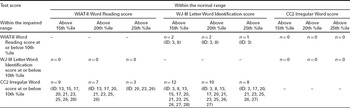
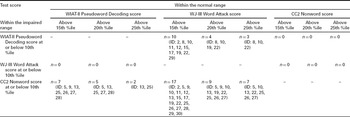
Tables 7 and 8 show the number of children who scored at or below the 10th percentile on one measure (i.e., word identification or nonword reading subtest), but within the ‘normal range’ on the other subtests. Case identification numbers are included to show the particular participants that constitute each cell in the tables. The stringent cut point of at below the 10th percentile for identifying a reading impairment was chosen to avoid identifying children whose scores fell close to the normal range (i.e., between the 11th and 15th percentiles). Due to the arbitrary nature of cut points and the varying levels used in the literature to define the normal range, it is represented here by three values: above the 15th, 20th or 25th percentile.
Discrepancies Between the Word Identification Measures in Identifying Lexical Reading Difficulties

Note. %ile = percentile; ID = participant identification number.
Discrepancies Between the Nonword Reading Measures in Identifying Nonlexical Reading Difficulties

Note. %ile = percentile; ID = participant identification number.
Table 7 reports the results for the word identification measures. From this table it can be seen that when children scored at or below the 10th percentile on the WJ-III Letter-Word Identification subtest, they obtained scores that were at least below the 15th percentile on all other word identification measures used. Two children scored at or below the 10th percentile on WIAT-II Word Reading, but at least above the 20th percentile on WJ-III Letter-Word Identification. Nine and 12 children scored at or below the 10th percentile on the CC2 Irregular Word subscale, but at least above the 15th percentile on the WIAT-II and WJ-III word identification subtests, respectively.
Table 8 reports the number of children who scored at or below the 10th percentile on each nonword reading measure, but within the normal range on the other nonword reading measures. From this table it can be seen that when children scored at or below 10th percentile on the WJ-III Word Attack subtest, they obtained scores that were at least below the 15th percentile on all other nonword measures used. Ten children scored at or below the 10th percentile on WIAT-II Pseduoword Decoding, but at least above the 15th percentile on WJ-III Word Attack. Seven and 17 children scored at or below the 10th percentile on the CC2 Nonword subscale, but at least above the 15th percentile on the WIAT-II and WJ-III nonword subtests, respectively.
Discussion
This study employed selected word identification and nonword reading subtests to (1) investigate the impact of item characteristics on the test performance of children with reading difficulties, and (2) to determine how much widely used reading measures vary in their detection of lexical and nonlexical reading difficulties in a group of children with reading difficulties.
Within-subjects analyses showed that children with reading difficulties performed differently across the three word identification subtests. Specifically, the degree of impairment was largest on the CC2 Irregular Word subscale, followed by the WIAT-II Word Reading subtest, then the WJ-III Letter-Word Identification subtest. The differences between all test scores were significant. On average, scores on the WJ-III Letter-Word Identification subtest were approximately half a standard deviation higher than scores on the CC2 Irregular Word subscale (z = 0.54), and scores on the WIAT-II Word Reading subtest were approximately one third of a standard deviation higher than scores on the CC2 Irregular Word subscale (z = 0.30).
It is suggested that the pattern of results and the magnitude of difference between word identification subtest scores is at least partially due to the proportions of regular to irregular word items that the children were exposed to on these subtests. As noted earlier, due to the age-determined starting points and discontinuation rules, these proportions inevitably vary from child to child (see Table 6). On average, children in the current study were exposed to higher proportions of regular word items on the WJ-III Letter-Word Identification subtest than on the WIAT-II Word Reading subtest. Consistent with dual route model predictions, the power of a test to assess the acquisition of lexical reading skills appears to be diluted relative to the proportions of regular words that they contain (Coltheart, Reference Coltheart2006). This finding, whereby children's test scores increased relative to the proportion of regular words in the subtests, is consistent with previous research reporting that both typically developing children and children with reading difficulties perform better on regular word reading (which is supported by both the lexical and nonlexical reading routes) than irregular word reading (which is only supported by the lexical reading route; Castles & Coltheart, Reference Castles and Coltheart1993; M. Coltheart & Leahy, Reference Coltheart and Leahy1996).
While the proportions of regular to irregular words appear to be related to the magnitude of differences among the word identification subtest scores, written word frequency and word length do not appear to account for the current pattern of results. Although the average written word frequency of items was significantly different across the subtests, the differences were small and children were exposed to the highest frequency items on the CC2 Irregular Word subscale, followed by the WJ-II, then the WIAT-II word identification subtests. If word frequency was having a significant impact on the results, children would be expected to perform best on the subtest containing the higher frequency items (i.e., the CC2), which was not the case in the present study. The same argument can be made for word length. While word length was significantly different across the subtests, the differences were small and children were exposed to the shortest word items on the CC2 Irregular Word subscale, followed by the WIAT-II, then the WJ-III Letter-Word Identification subtests. If word length was having a significant impact on the results, children would be expected to perform best on the subtest containing shorter items (i.e., the CC2), which again was not the case in the present study (Spencer, Reference Spencer2010).
Children in the current study also performed differently across the three nonword reading measures. Specifically, the degree of impairment was largest on the CC2 Nonword subscale, followed by the WIAT-II, then the WJ-III nonword subtests. On average, scores on the WJ-III Word Attack subtest were almost one standard deviation higher than scores on the CC2 Nonword subscale (z = 0.97), while scores on the WIAT-II Pseudoword Decoding subtest were approximately half a standard deviation higher (z = 0.56) than scores on the CC2 Nonword subscale.
On the basis of previous research, it is suggested these findings are at least partially due to the structure of the nonword items on these subtests. Several studies have shown that nonwords that contain either a simple CVC structure, are single syllable or contain real word bodies are easier to read and less effective when attempting to identify children with poor nonlexical reading skills (V. Coltheart & Leahy, Reference Coltheart and Leahy1996; Goswami et al., Reference Goswami, Ziegler, Dalton and Schneider2003; Manis et al., Reference Manis, Custodio and Szeszulski1993; Snowling, Reference Snowling1981; Treiman et al., Reference Treiman, Goswami and Bruck1990). As shown earlier, while the CC2 does contain such items, in comparison to the WIAT-II and WJ-III nonword subtests, smaller proportions of CC2 nonword items possess these characteristics. Of note, while the proportions of these characteristics are similar on the WIAT-II and WJ-III nonword subtests, on average the children in the present study scored significantly lower (z = 0.41) on the WIAT-II nonword measure, suggesting it is more sensitive in detecting children's decoding difficulties. Compared to the WIAT-II, the WJ-II Word Attack subtest contains a much smaller number of items. It is suggested that this small number of items and steep item gradient likely reduces the sensitivity of the subtest in differentiating across the range of decoding abilities (Rathvon, Reference Rathvon2004). Consequently, in our sample this particular subtest appeared to be less sensitive.
In the current study, girls scored significantly lower than boys on several of the reading measures. While many studies have reported that boys are more likely than girls to experience reading difficulties (see Wheldall & Limbrick, Reference Wheldall and Limbrick2010), the degree of reading difficulty is generally equal across the genders (Berninger, Nielsen, Abbott, Wijsman, & Raskind, Reference Berninger, Nielsen, Abbott, Wijsman and Raskind2008). Therefore, it is suggested that the effect of gender in the current study is likely due to the small sample size, and it is expected that with a larger sample, the effect of gender would be nullified. Furthermore, although the degree of difficulty was larger for girls in the current study, the pattern of results was similar for boys and girls across the tests.
Consistent with previous research (Siegel, Reference Siegel1992; Siegel & Himel, Reference Siegel and Himel1998; Tanaka et al., Reference Tanaka, Black, Hulme, Stanley, Kesler, Whitfield-Gabrieli and Hoeft2011), nonverbal IQ was not associated with performance on any of the reading measures. These findings provide further evidence to suggest that reading difficulties and dyslexia should not be defined by reference to a child's IQ level.
The main limitation of the current study was the convenience sample. Therefore, it is unclear if the current pattern of results would be evident in a more representative sample of children with reading difficulties. Furthermore, the sample was small and most children had difficulties with both lexical and nonlexical reading skills. Group studies focusing on children with isolated difficulties (i.e., pure developmental surface and phonological dyslexia) would provide a clearer picture of the tests that are most sensitive to detecting lexical and nonlexical reading difficulties. Moreover, the CC2 normative data were collected from three Sydney schools, while the WIAT-II and WJ-III normative data were collected nationally. Nonetheless, scores on the Reading subscale of the National Assessment Program – Literacy and Numeracy (NAPLAN) for the three Sydney schools were all within one standard deviation of the national average at the time that the CC2 normative data were collected (Australian Curriculum, Assessment and Reporting Authority [ACARA], 2008). Therefore, it is unlikely that the nature of the normative data can fully account for the current study results.
Extending the current research to investigate other commonly used reading measures is recommended. In Australia, there is an abundance of academic ability tests and specific reading tests available for the assessment of children's basic reading skills. It would be clinically useful to extend the current research in order to provide clinicians and education specialists with clearer guidelines as to which tests to select.
The results of this study provide further support for the dual route model and the distinction between lexical and nonlexical reading skills as a useful framework for guiding the assessment of children's basic reading skills. As predicted by the dual route model (Coltheart, Reference Coltheart2006), findings from the present study suggest that word identification subtests that consist of both regular and irregular words (i.e., WJ-III Letter-Word Identification and WIAT-II Word Reading) may overestimate children's reading skills, at least with reference to their ability to use the lexical reading route. The findings also suggest caution in using nonword subtests that contain large proportions of three-letter, simple CVC or single-syllable nonwords when assessing whether or not a nonlexical reading difficulty exists. These issues are not only relevant for diagnostic testing, but also relevant when devising curriculum-based measurements.
The findings also have important clinical implications; namely, that tests should be selected carefully when assessing children with reading difficulties because the choice of test(s) could make a difference to how many children are eligible for additional assistance or remediation. The large variations in the proportions of children falling below the three specified cut points across the tests highlight this point. Despite the cut point used, the CC2 Irregular Word and Nonword subscales clearly identified the largest proportions of children, including a large number of children that the WIAT-II and WJ-III measures did not identify. Additionally, the WIAT-II subtests (particularly the nonword subtest) identified a number of children that the WJ-III subtests did not (see Tables 7 and 8). Therefore, if tests are not selected carefully a reading difficulty may not be identified. Furthermore, past research has shown that targeted remedial programs are most successful, and in order to pinpoint the nature of a reading difficulty, separate assessment of both lexical and nonlexical reading skills is required (Brunsdon, Hannan, Coltheart, & Nickels, Reference Brunsdon, Hannan, Coltheart and Nickels2002; Brunsdon, Hannan, Nickels, & Coltheart, Reference Brunsdon, Hannan, Nickels and Coltheart2002; Rowse & Wilshire, Reference Rowse and Wilshire2007).
In summary, guided by the dual route model framework, the current study has shown that several characteristics appear to influence the ability of word identification and nonword reading tests to identify the severity and nature of children's reading difficulties. The results highlight the importance of test selection and the consideration of item characteristics when assessing children for assessment and remedial purposes.