Introduction
Muscle strength is important for the performance of everyday activities. There is growing recognition of a relationship between muscle strength and general health.Reference Aihie Sayer and Cooper 1 Epidemiological studies in adults have shown that lower grip strength is associated with higher overall mortality and increased risk of coronary heart disease, type 2 diabetes and metabolic syndrome.Reference Rantanen, Guralnik and Foley 2 – Reference Sayer, Syddall and Martin 9 The main known determinants of muscle strength in adults include sex, body size, age, physical activity, genetic and hormonal influences and nutrition and levels of inflammation.Reference Rolland, Czerwinski and Abellan van Kan 10 , Reference Morley, Baumgartner, Roubenoff, Mayer and Nair 11 Factors associated with muscle strength in children are less well established but include age, sex and free fat mass.Reference Lehman, Kafko, Mah, Mosquera and Reilly 12 , Reference Sartorio, Lafortuna, Pogliaghi and Trecate 13 Muscle strength increases throughout childhood and adolescence, peaking in young adulthood. It is maintained into middle age before starting to decline.Reference Aihie Sayer and Cooper 1 Muscle strength in later life therefore reflects both the peak reached and the rate of loss.
There is increasing interest in the early life determinants of muscle strength; studies have shown that birthweight is positively related to muscle strength in adult life.Reference Sayer, Syddall, Gilbody, Dennison and Cooper 14 – Reference Sayer, Syddall and Martin 16 Three studies of children, including CanadianReference Rogers, Fay, Whitfield, Tomlinson and Grunau 17 and GuatemalanReference Martorell, Ramakrishnan, Schroeder, Melgar and Neufeld 18 adolescents and 5-year-old Australian children,Reference Ford, Kitchen and Doyle 19 have shown higher grip strength in children of normal birthweight than in those of low birthweight. As far as we know, there have been no studies of children representing the full ‘normal’ range of birthweights. No studies have examined associations of grip strength with other birth measurements, apart from weight, to determine whether grip strength is specifically related to muscle size at birth.
Mean birthweight in India is low compared to that of white Caucasian babies born in high-income countries.Reference Yajnik, Fall and Coyaji 20 , Reference Krishnaveni, Hill and Veena 21 We have shown that this results predominantly from lower lean tissue and muscle mass at birth.Reference Yajnik, Fall and Coyaji 20 , Reference Krishnaveni, Hill and Veena 21 Studies in India and elsewhere have shown associations between lower birthweight and reduced lean body mass in later childhood or adult life.Reference Singhal, Wells, Cole, Fewtrell and Lucas 22 – Reference Joglekar, Fall and Deshpande 24 Small size at birth, and specifically small muscle size at birth, may therefore have long-term adverse effects on physical capacity. The Parthenon birth cohort study in Mysore, India included detailed anthropometry at birth on a large sample of healthy babies, representing the full range of birth sizes in India. We have used data from this cohort to test the hypothesis that lower weight and smaller muscle size at birth (as measured by arm muscle area (AMA)) are associated with reduced grip strength at the age of 9 years.
Methods
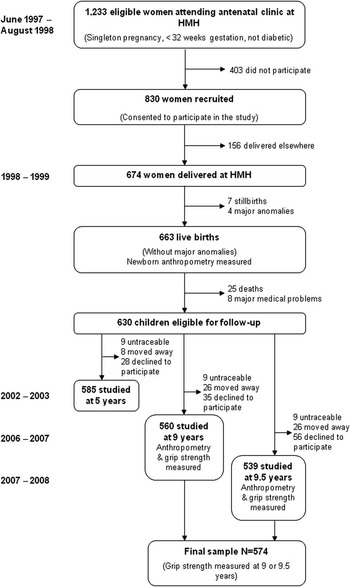
The Mysore Parthenon Study (Fig. 1) is a prospective birth cohort study, initiated in 1997–1998.Reference Hill, Krishnaveni, Annamma, Leary and Fall 25 , Reference Krishnaveni, Hill and Leary 26 Women living in Mysore city or surrounding rural villages, booking consecutively into the antenatal clinic of the Holdsworth Memorial Hospital (HMH) and satisfying the recruitment criteria (willingness to participate, singleton pregnancy, gestational age <32 weeks and no prior history of diabetes) were enrolled into the study (67% of eligible women). Gestation was determined from the last menstrual period date, or a first trimester ultrasound scan if the last menstrual period date was uncertain. Of the 830 women recruited, 674 delivered at HMH, and 663 of these were live births without major congenital anomalies (Fig. 1).
Children in the Mysore Parthenon Study.

The babies were measured by one of four trained observers within 72-h of birth. Weight was measured to the nearest 5 g using a digital weighing scale (Seca, Seca Medical Scales and Measuring Systems, Hamburg, Germany), and crown-heel length to the nearest 0.1 cm using a Harpenden neonatal stadiometer (CMS Instruments, London, UK). Mid-upper arm circumference (MUAC) was measured to the nearest 0.1 cm with blank tape, which was marked and measured against a fixed ruler. Skinfolds (triceps and subscapular) were measured to the nearest 0.1 mm using Harpenden callipers (CMS Instruments). The average of three readings was used. AMA was calculated using first principles to derive the following formulaReference Jelliffe and Jelliffe 27 :

The children were subsequently followed up annually to the age of 5 years and then 6-monthly until 9.5 years. Follow-up at 1 year was on the child’s first birthday (±4 weeks) for children born at term and on the anniversary of the expected date of delivery (±4 weeks) for preterm children. Follow-up visits from 2 to 9.5 years were on the child’s birthday (±4 weeks) and (additionally after 5 years) 6 months after the birthday (±4 weeks) for all children.
At 9 and 9.5 years, 560 and 539 children, respectively, were studied; 9.5-year results were used preferentially with age-adjusted 9-year data being used for 35 children (Fig. 1). Grip strength was measured to the nearest 0.5 kg by one of six trained fieldworkers, using a Jamar dynamometer (Model J00105, Lafayette Instrument Company, Loughborough, UK). The measurer showed the technique to each child, who was seated with their forearm resting on the arms of the chair with the wrist free. The child held the dynamometer with the fieldworker supporting its weight. Encouragement was given to the child throughout the procedure, to squeeze as tightly and for as long as possible until the maximum reading was obtained. Three readings were made with each hand, alternating between right and left hands and the maximum of the six measurements was used for the analysis.
Anthropometry was performed using standardized methods. Weight was measured to the nearest 100 g using a digital weighing scale (Salter, UK). Standing height was measured to the nearest 1 mm using a wall-mounted stadiometer (Microtoise, CMS Instruments, UK). MUAC and triceps and subscapular skinfolds were measured as at birth. AMA was calculated in the same way as at birth.
Socio-economic status was assessed using the Standard of Living Index (SLI), 28 designed by the National Family Health Survey, which derives a score based on household sanitary facilities, water source, power supply, type and size of house, cooking fuel used and ownership of property, land, livestock and household assets. Higher scores indicate higher socio-economic status. The HMH patient base comes mainly from ‘middle-class’ and ‘lower middle-class’ socio-economic groups.
The main analysis sample comprised all children with birth data and grip strength measured at 9 or 9.5 years (n = 574).
The project was approved by the HMH Research Ethics Committee and informed consent was obtained from parents and children.
Statistical analyses
Variables with skewed distributions (9-year skinfold thickness and body mass index (BMI)) were log transformed. Birth measurements were adjusted to a gestation of 40 weeks using linear regression. Grip strength and anthropometry values for children studied at 9 years were adjusted to 9.5 years using linear regression. Comparisons between groups were analysed using t-tests, as were comparisons between the sexes. Associations between size at birth and grip strength were analysed using linear regression. We examined socio-economic status as a possible confounding variable, and included adjustment for this in regression models. We tested for sex differences in the association between birth size and grip strength by using interaction terms; none of the interactions were statistically significant and therefore both sexes were included in the final regression models. Anthropometry at birth and 9 years and SLI scores were converted to sex-specific within-cohort s.d. scores in regression models to allow comparison of relative effect size. We also derived s.d. scores at birth and 9 years using the World Health Organization (WHO) growth reference, in order to describe the size of the children of Mysore in an international context. 29
To measure associations of growth (changes in body size) at different ages post-natally with 9-year grip strength, we derived ‘conditional’ variables for each body measurement for the age intervals from birth to 2 years, 2–5 years and 5–9 years. All anthropometric measurements were standardized using Cole’s LMS method.Reference Cole and Green 30 Standardized anthropometric measurements at the end of a given interval were regressed on the standardized measurement at the beginning of the interval in order to obtain the conditional growth for that interval. These conditional variables were stratified by sex. The residuals were extracted (these represent the change in size observed during each interval, over and above what would be expected given the child’s earlier size) and stored as s.d. scores to allow comparison of effects of growth at different ages. By construction, conditional s.d. scores for different age intervals are uncorrelated. This permits them to be simultaneously included in regression models, in order to identify associations between specific periods of post-natal growth and the outcome of interest. This approach eliminates some of the statistical problems associated with modelling longitudinal measurements of body size, which are usually highly correlated.Reference Fall, Sachdev and Osmond 31 , Reference Adair, Martorell and Stein 32 Data were analysed using Stata version 10.1.
Results
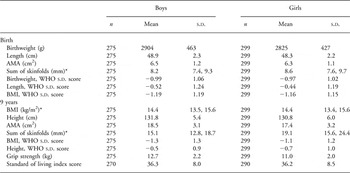
Table 1 shows the characteristics of the children at birth and 9 years. The children were on average short, light and thin according to the WHO growth reference, both at birth and 9 years; the prevalence of low BMI and stunting at birth (BMI and length <−2 s.d.) was 23% and 10%, respectively; equivalent figures at 9 years were 26% and 7%. Boys were heavier and longer at birth than girls (P = 0.03 and P = 0.002, respectively), and had higher mean grip strength (P < 0.001). Boys were also taller than girls (P = 0.04) but there was no significant difference in weight.
Descriptive statistics for the cohort of 574 Indian children

AMA = Arm muscle area; BMI = body mass index; WHO = World Health Organization.
Sum of skinfolds equals sum of triceps and subscapular skinfolds.
*Median and inter-quartile range (skewed variable).
Birth measurements
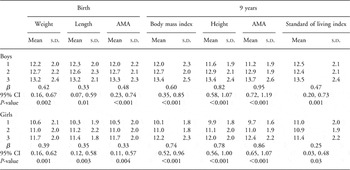
Birthweight was positively related to grip strength at 9 years (Table 2). A 1 s.d. increase in birthweight was associated with a 0.40 kg (0.18 s.d.) increase in grip strength. There were significant associations of a similar magnitude between grip strength, AMA and length at birth. There was no significant association with sum of triceps and subscapular skinfolds at birth (β = 0.05; 95% CI: −0.05, 0.16; P = 0.33).
Grip strength (kg) according to size at birth and 9 years and social-economic status at 9 years

AMA = arm muscle area.
This table was based on 574 children, except for standard of living index score, which was missing for five boys and nine girls. All variables were standardized to form sex-specific within-cohort s.d. scores to enable comparison of effect sizes. Group 1 for all exposures is the bottom 25% of the distribution (<−0.67 s.d.), group 2 is the middle 50% and group 3 is the top 25% (>0.67 s.d.). β (95% CI) is the change in grip strength (kg) per s.d. increase in each exposure (continuous variable).
Post-natal growth
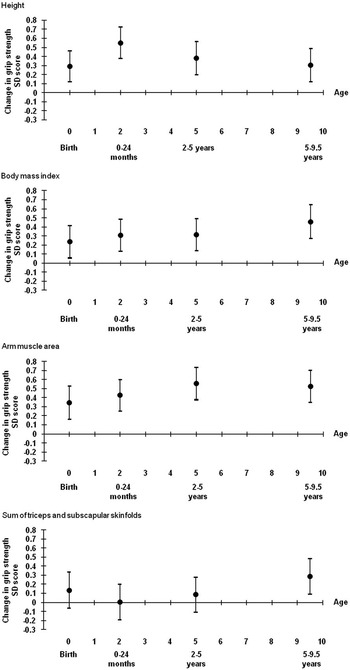
Greater gain in height, BMI and AMA during all periods of post-natal growth, over and above that expected given the child’s earlier size, were associated with higher grip strength (Fig. 2). In contrast, skinfold measurements at birth, infancy and early childhood were unrelated to grip strength.
Change in grip strength s.d. score per s.d. change in conditional growth.

Current size and socio-economic status
Grip strength was positively related to 9-year BMI, height and AMA (Table 2), but not skinfold thickness. Mean grip strength was lower by −0.81 kg (95% CI: −1.37, −0.24) in boys and −1.26 kg (95% CI: −1.79, −0.72) in girls who were of low BMI, and by −1.93 kg (95% CI: −3.11, −0.96) in boys and −2.15 kg (95% CI: −2.99, −1.31) in girls who were stunted, compared to children of normal BMI and height. Grip strength was higher in children of higher socio-economic status (Table 2).
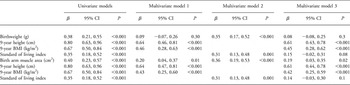
Birth size, 9-year size and SLI scores were inter-correlated. For example, 9-year height and AMA rose by 0.31 s.d. and 0.26 s.d. per s.d. increase in birth length and AMA, respectively, and by 0.23 s.d. and 0.15 s.d. per s.d. increase in SLI score. After adjusting for 9-year size, the associations between size at birth and grip strength were greatly attenuated and no longer statistically significant for birthweight and length but remained statistically significant for AMA (Table 3). The results were similar if we further adjusted for 9-year AMA (β = 0.16, 95% CI: 0.00, 0.32; P = 0.047). The relationship between birthweight and grip strength was the same in the whole sample (n = 574) and the subset of 560 children who were analysed in Table 3. There were no significant interactions between birthweight and 9-year size in relation to grip strength.
Multiple regression analysis showing the association of 9-year grip strength (kg) with birthweight, adjusted for 9-year size and socio-economic status for 560 Indian children

BMI = body mass index.
All models included sex; all exposure variables were Z-standardized. The univariate models contained each of the listed variables individually. The multivariable models included the birth size variable (birthweight or arm muscle area at birth) in addition (simultaneously) to the variables with data shown.
Discussion
Summary of findings
We measured grip strength in a large sample of healthy 9-year-old South Indian children from across the whole range of sizes at birth. The children were short and thin by international standards, both at birth and 9 years. Grip strength was positively related to weight, length and AMA at birth. In addition, greater gain in BMI, height and AMA post-natally predicted higher grip strength.
The associations between birth size and grip strength were greatly attenuated and no longer statistically significant for birthweight and length after adjusting for 9-year body size. Statistical significance remained only for AMA, suggesting that, if causal, post-natal growth is on the causal pathway.
Strengths and limitations
The strengths of the study were that it included a large sample of healthy children, who had detailed standardized measurements, not just weight, at birth and at least annually up to the age they were studied. There was minimal loss to follow-up. The children were all born in one hospital, which could limit the representativeness of the sample. The HMH is in a poor area of Mysore City, and offers concessions for poorer patients, but attracts patients from a wide spectrum of socio-economic status. We consider these children to be representative of the low-middle class urban South Indian children.
Birth size and grip strength
The positive association between birthweight and grip strength was consistent with, and similar in magnitude to, associations seen in other studies in children and adults.Reference Sayer, Syddall, Gilbody, Dennison and Cooper 14 – Reference Ford, Kitchen and Doyle 19 It suggests a link between pre-natal nutrition and/or growth and muscle function in later life. Primary muscle development begins in the human foetus at 8–10 weeks’ gestation, followed by the formation of secondary muscle fibres at 10–18 weeks.Reference Gollnick, Timson, Moore and Riedy 33 , Reference Barbet, Thornell and Butler-Browne 34 By 20 weeks, these become homogeneous and undergo maturation and differentiation. After birth, muscle growth is achieved primarily through hypertrophy of existing fibres. The importance of foetal development for the accrual of muscle mass is indicated by a number of studies showing associations between birthweight and lean body mass and/or muscle mass in later life.Reference Singhal, Wells, Cole, Fewtrell and Lucas 22 , Reference Gale, Martyn, Kellingray, Eastell and Cooper 35 – Reference Sachdev, Fall and Osmond 42 A link between body size at birth and later muscle size is therefore well established. The relationship of grip strength to birthweight, length and AMA at birth, and the much weaker relationships with skinfolds at birth, suggests that it is muscle size at birth rather than overall size that mediates these relationships. However, in an observational study it is impossible to say whether environmental factors, like maternal nutrition, or genetic factors are responsible for the relationship between birthweight and grip strength.
Post-natal growth and grip strength
Larger size at birth tends to ‘track’ throughout childhood, and although lower birthweight is often associated with compensatory or ‘catch up’ growth in the immediate post-natal period, higher birthweight is associated with faster childhood growth and larger size throughout childhood.Reference Tanner 43 Our data suggest that this could explain the higher grip strength observed in children who were larger at birth. In addition, any increase in height, BMI and AMA during infancy and childhood, over and above what would be expected from larger size at birth, was also associated with higher grip strength. Overall, children who have grown faster at any prior stage of development and who have grown larger muscles, either because of better nutrition, faster maturation or genetic influences, have greater muscle strength. This is in keeping with other studies of grip strength in children, which have consistently reported strong correlations between overall size and/or muscle mass and grip strength.Reference Sartorio, Lafortuna, Pogliaghi and Trecate 13 , Reference Marrodan Serrano, Romero Collazos and Moreno Romero 44 , Reference Hager-Ross and Rösblad 45 The time periods we chose for studying post-natal growth were selected to provide a measure of growth during infancy (0–2 years), early childhood (2–5) and late childhood (5–9). Although reference data for grip strength in children are scarce, the mean grip strength in the children of Mysore, who were short and thin according to the WHO growth reference, was lower than in recent studies of Spanish children (boys 15.0 kg and girls 13.9 kg at 10 years) and Swedish children (boys 14.0 kg and girls 13.0 kg at 9 years) who were also taller.Reference Marrodan Serrano, Romero Collazos and Moreno Romero 44 , Reference Hager-Ross and Rösblad 45
Studies in adults have shown that the positive relationship between grip strength and birthweight is attenuated but remains significant after adjustment for current height and weight.Reference Sayer, Syddall, Gilbody, Dennison and Cooper 14 , Reference Kuh, Bassey and Hardy 46 This has been explained by a postulated effect of developmental influences on muscle quality as well as quantity. Our findings for AMA at birth are consistent with this. However, the attenuations of the associations in Mysore after adjusting for current size suggest that effects on muscle quantity dominate in childhood when muscle growth is still occurring, and effects on muscle quality appear predominantly in later life.
Other factors related to grip strength
Apart from body size, other ‘current’ factors related to grip strength in Mysore were gender and socio-economic status. Higher grip strength in boys than girls is consistent with other studies in children,Reference Sartorio, Lafortuna, Pogliaghi and Trecate 13 , Reference Marrodan Serrano, Romero Collazos and Moreno Romero 44 , Reference Hager-Ross and Rösblad 45 and with greater height in boys (although there was no difference in AMA at this age). Socio-economic status was positively related to grip strength and, like birth size, appeared to be partly mediated by 9-year size.
Conclusion
This study has shown, in a large sample of children representing the full range of birth and childhood size for an Indian population, that larger muscle size at birth and faster muscle growth post-natally are associated with greater muscle strength. Further follow-up of these children will be required to determine whether this association persists, resulting in greater peak muscle strength.
Acknowledgements
The authors are grateful to the women and children who participated, to Dr S.C. Karat, the current Director and Dr B.D.R. Paul, former Director of HMH and the obstetric and paediatric consultants. The authors thank Jayakumar, Geetha, Saroja, Chachyamma, Tony Gerald, Tony Clifford, Shobha, Gopal Singh, Nalinakshi, Rumana, Jane Pearce and Patsy Coakley for their substantial contributions. The authors also thank Sneha-India for its support.
Funding
The study was funded by the Parthenon Trust, The Wellcome Trust and the Medical Research Council, UK.
Statement of Interest
None.