I. INTRODUCTION
It has been 20 years since the rechargeable Li-ion batteries were first commercialized. The creation of the LiCoO2/C rocking chair system opened a new era for the research and application of this energy storage device.Reference Ozawa1 Since then, various sorts of materials were developed to satisfy the increasing requirements of the market. Nowadays, rechargeable Li-ion batteries are the key components for the consumer electronics, mobile phones, laptop computers, and even pure or hybrid electronic vehicles.Reference Tarascon and Armand2 As mentioned in previous reports,Reference Whittingham3, Reference Goodenough and Kim4 the cathode materials play a significant role on the performance, price, and safety of the Li-ion batteries. Hence, considerable attentions have been paid to the research and development of novel materials with high capacity, environmental friendly, low cost, and security features.Reference Arico, Bruce, Scrosati, Tarascon and Van Schalkwijk5–Reference Etacheri, Marom, Elazari, Salitra and Aurbach8 Since it was first introduced to the market in 1991 by SONY Corporation, LiCoO2 has been widely used. It can be easily prepared and enables a fast and reversible Li+ intercalation/deintercalation due to its well-ordered layered structure. The lithium ions can intercalate/deintercalate fluently between the layers.Reference Antolini9, Reference Ying, Jiang and Wan10 Nevertheless, the high price and toxicity of Cobalt have enforced researchers to seek candidates for replacing Cobalt in recent years. Among them, spinel LiMn2O4 is a promising alternative material. Based on its low cost, environmental friendliness, and nontoxicity features, it has attracted more and more interests.Reference Amatucci and Tarascon11–Reference Yue, Huang, Lv and Yang14 Furthermore, one group in Fudan University has reported that the LiMn2O4 can be used in the water solution electrolyte-based Li-ion battery system.Reference Luo and Xia15 The similar results can also be found in Qu et al.’sReference Qu, Fu, Zhan, Samuelis, Maier, Li, Tian, Li and Wu16 and other reports.Reference Manjunatha, Suresh and Venkatesha17 It is vital improvement that Li-ion batteries with water solution electrolyte would be more security than that of flammable organic electrolyte ones.
Recent years, with the advance of the nanotechnology, it steers the present research into a fantastic direction. Nanoscaled electrode materials have exhibited great enhancement in electrochemical performance due to short path lengths for Li+ transport, the large electrode–electrolyte contact, large surface-to-volume ratio, and other special characterizations in nanoscale.Reference Manthiram, Murugan, Sarkar and Muraliganth18–Reference Zhao, Wang, Lu, Nan, Xiao and Li20 Several groups have reported various methods to synthesize nanoscaled LiMn2O4, such as combustion,Reference Lu and Fey21 sol–gel,Reference Hwang, Santhanam and Liu22–Reference Thirunakaran, Sivashanmugam, Gopukumar, Dunnill and Gregory25 pulsed laser deposition,Reference Tang, Lai and Lu26 and templating methods.Reference Li, Cheng, Guo and Chen27, Reference Cabana, Valdes-Solis, Palacin, Oro-Sole, Fuertes, Marban and Fuertes28 Among them, the wire-like or rod-like morphology attracts our attention because one-dimensional nanostructure electrode materials exhibit a great deal of particular properties, including: (i) One-dimensional rod-like or wire-like nanoelectrode materials can provide one-dimensional pathway for intercalation/deintercalation lithium ions during the charge/discharge process.Reference Mai, Xu, Xu, Han and Luo29 (ii) The wired morphology has the potential not only to increase the filled ratio but also to solve the safety problem.Reference Kim, Muralidharan, Lee, Ruffo, Yang, Chan, Peng, Huggins and Cui30 (iii) It is feasible to put multiple electrodes onto them to enhance the battery performance.Reference Yang, Xie, Ruffo, Peng, Kim and Cui31 Cui’s team has reported that LiMn2O4 nanowires are excellent in charge storage capacity and rate performance.Reference Kim, Muralidharan, Lee, Ruffo, Yang, Chan, Peng, Huggins and Cui30 Zhou et al. also reported that LiMn2O4 nanowires had good discharge capacities, especially under high charge/discharge rate. In addition, as observed in scanning electron microscope (SEM) images, the LiMn2O4 nanowires have an interdigitated space distribution, which helps to diffuse the electrolyte and also reduces the stress.Reference Hosono, Kudo, Honma, Matsuda and Zhou32 However, synthesis of LiMn2O4 as reported previouslyReference Hosono, Kudo, Honma, Matsuda and Zhou32 was complicated and time consuming.
Here, we present a two-step hydrothermal approach to synthesize uniform LiMn2O4 nanowires. First, γ-MnOOH nanowires are prepared by hydrothermal method. Subsequently, γ-MnOOH nanowires are transformed into pure-phase LiMn2O4 by mixing and sintering with LiOH. The electrochemical performance of the product is also investigated and is found that the as-prepared LiMn2O4 nanowires show excellent cyclability.
II. EXPERIMENTAL SECTION
A. Synthesis of LiMn2O4 nanowires
Analytical grade KMnO4, cetyltrimethylammonium bromide (CTAB) and deionized water used to prepare γ-MnOOH nanowires by hydrothermal reaction as previous report.Reference Xiao, Wang, Wang, He, Peng and Li33 0.7 g KMnO4 and 0.5 g CTAB are dissolved into 40 mL deionized water at room temperature by magnetic stirring to form a homogenous clear solution. The mixed solution is transferred into a Teflon-lined stainless steel autoclave and heated at 180 °C for 12 h. After the reaction, the as-prepared γ-MnOOH nanowires are separated by centrifuging and washed sequentially with deionized water and ethanol for several times. The obtained powder is subsequently dried at 60 °C for 12 h in the air.
The as-prepared γ-MnOOH nanowires, commercial analytical grade LiOH•H2O, and ethanol are then mixed thoroughly by magnetic stirring. The mixture is calcined at 750 °C for about 3 h. Finally, the LiMn2O4 nanowires are obtained.
B. Characterization of product
The x-ray diffraction (XRD) patterns of the products are collected by using Rigaku D/max 2500Pc x-ray diffractometer with Cu–Kα radiation (λ = 1.5418), over a range of 2θ = 10–70° with a step size of 0.02°. The FullProfReference Roisnel, Rodriguez-Carvajal, Delhez and Mittemeijer34 program is used for Rietveld refinement. The size and morphology of sample are investigated with LEO-1530 field-emission scanning electron microscope.
C. Electrochemical measurements
The electrochemical performance of prepared LiMn2O4 is evaluated by using coin-type cell with lithium metal as the counter electrode. The working electrode is fabricated by making slurry of 80 wt% active material of LiMn2O4, 10 wt% acetylene black, and 10 wt% polyvinylidene fluoride binder. The slurry is coated onto an aluminum foil by an applicator and then dried overnight in a vacuum oven at 120 °C. The electrolyte is a 1 M LiPF6 in a 1:1 mixture of ethylene carbonate/diethyl carbonate and the separator is Celgard 2500. The cells are assembled in the glove box filled with highly pure argon gas. The galvanostatic charge/discharge experiment is performed between 3.0 and 4.3 V at current density of 100 mAh/g.
III. RESULTS AND DISCUSSION
A. Morphology characterization
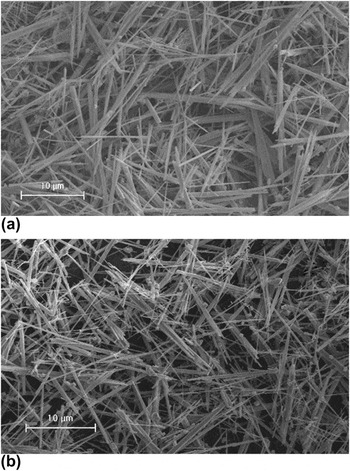
The morphology of the γ-MnOOH nanowires (a) and LiMn2O4 nanowires (b) samples are shown in Fig. 1. As shown in Fig. 1(a), the γ-MnOOH nanowires mainly consist of uniform nanowire structure with typical diameter in the range of 200–300 nm and the length up to tens of micrometers. The image of LiMn2O4 nanowires [Fig. 1(b)] shows that the final product retains the wire-like morphology of the precursor even though the reaction is carried out at high temperature. Overall, these images reveal that the LiMn2O4 nanowires were interconnected to form porous network architecture.
SEM images of γ-MnOOH nanowires (a) and LiMn2O4 nanowires (b).

B. Phase formation and refinement
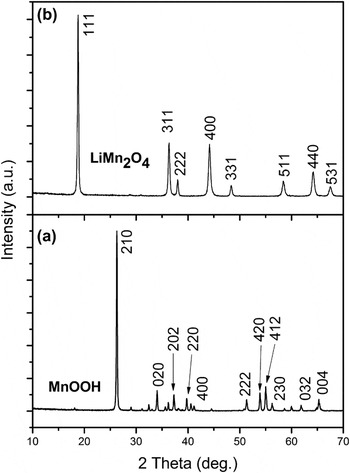
Figure 2 displays the XRD patterns of the γ-MnOOH nanowires (a) and LiMn2O4 nanowires (b). To obtain rod-like LiMn2O4, γ-MnOOH nanowires are firstly prepared by using CTAB as a reductant for transforming Mn7+ (KMnO4) into Mn3+, and then, the H+ ions in γ-MnOOH react with hydroxide ions to form H2O. Parts of the Mn3+ are oxidized to Mn4+ by O2 when exposing to the air atmosphere during the process of sintering. With Li+ merged into the lattice, the LiMn2O4 nanowires are finally prepared. In the XRD pattern of the precursor [Fig. 2(a)], most reflection peaks can be indexed to monoclinic γ-MnOOH [Joint Committee on Powder Diffraction Standards (JPCDS) 74–1631]. After further sintering with LiOH·H2O, the γ-MnOOH is entirely transformed into LiMn2O4 [see Fig. 2(b)]. No impurity phase was detected.
XRD patterns of γ-MnOOH nanowires (a) and LiMn2O4 nanowires (b).

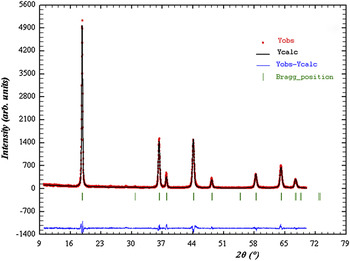
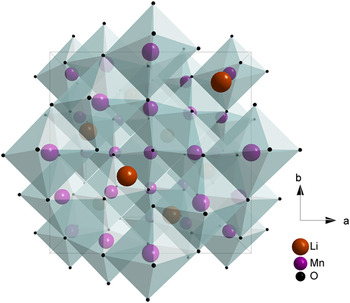
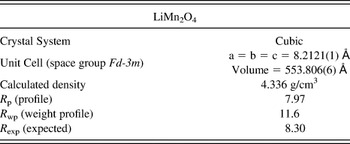
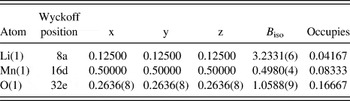
Rietveld refinement of the XRD data of LiMn2O4 nanowires is carried out in the space group of Fd-3m (No. 227) and the result is shown in Fig. 3. The structural information can be found in Tables I and II. According to the Fig. 3, as well as the R factors in Table I, the calculated curve (black) matches well with the experimental data (red), which confirmed that the pure LiMn2O4 nanowires can be synthesized by our two-step method simply. The atomic coordinates and distribution of all atoms are shown in Table II. Mn atoms are found to statistically occupy the 8a sites, while Li+ occupy the 16d sites. The high symmetry cubic cell of LiMn2O4 ensures that the intercalation and deintercalation of the lithium ions from Mn–O octagonal framework is isotropic. Therefore, the pathway of lithium ion is equivalent in three directions (along a, b, and c) in the space. This viewpoint was also proved by previous articles.Reference Kumagai, Fujiwara, Tanno and Horiba35–Reference Long, Dunn, Rolison and White37Figure 4 shows a view of the crystallographic structure along c axis based on the results of the refinement. The refinement results also exhibit that Mn–O octahedrons occupy the main part of the lattice, which can build a sturdy framework for Li+ intercalation and deintercalation. It can also restrict the expansion/contraction of the cubic spinel structure with electrochemical lithium insertion/extraction and suppress the manganese atoms releasing from the oxides into the electrolyte. All in all, the stable structure can lead to excellent cyclability.
Observed (red open circles), calculated (black solid line), and difference (blue bottom line) XRD patterns for LiMn2O4. The tick marks represent the position of all possible Bragg reflections of LiMn2O4.

An ab projection of the crystal structure of LiMn2O4.

Refined structural parameters for the XRD of the LiMn2O4 nanowires.

Fractional atomic coordinates from XRD data for LiMn2O4.

C. Electrochemical performance measurements
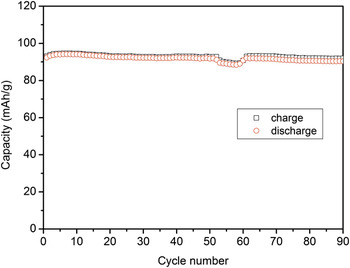
Plots of discharge specific capacities versus cycle number at a rate of 100 mAh/g are displayed in Fig. 5. The LiMn2O4 clearly exhibits excellent cyclability. After charging/discharging 90 times, the charge and discharge specific capacities retain 91 and 90 mAh/g, respectively.
The cycle stability of LiMn2O4 nanowires at rate of 100 mA/g.

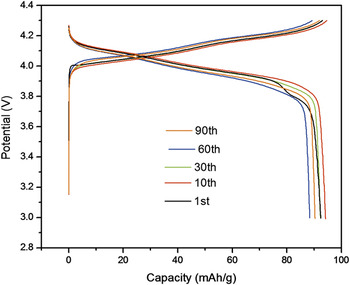
The charge/discharge curves at the 1st, 10th, 30th, 60th, 90th cycles are shown in Fig. 6. After 90 cycles, the charge and discharge capacity of the LiMn2O4 merely faded and still kept at about 90 mAh/g. All the curves were similar with each other. Moreover, all these curves reveal a 4 V (versus Li+/Li) plateau, which is a key character of the spinel structural LiMn2O4. These results further prove that the LiMn2O4 nanowires have a good cycle performance.
Charge and discharge curves of LiMn2O4 nanowires at the 1st, 10th, 30th, 60th, and 90th cycles.

As mentioned above, the LiMn2O4 nanowires exhibited excellent cyclability. It could be concluded that the internal structure and the morphology play a significant role in it. During the whole charge/discharge process, the specific capacity fades little. This can be firstly attributed to stable Mn–O octahedron in LiMn2O4 cell (shown in Fig. 4), which can keep the lithium ion pathway stable when Li+ ions intercalate and deintercalate. What’s more, one-dimensional nanostructure facilitates transport of charge and electrons along the length direction. Further, one-dimensional nanostructure can provide more reaction sites, which can accelerate the charge/discharge process. Previous reportsReference Kim, Muralidharan, Lee, Ruffo, Yang, Chan, Peng, Huggins and Cui30, Reference Hosono, Kudo, Honma, Matsuda and Zhou32 have also demonstrated that one-dimensional nanostructure rod-like or wire-like LiMn2O4 displayed great electrochemical performance. In a word, the rod or wire morphology of LiMn2O4 does suppress the loss of discharge capacity.
IV. CONCLUSION
LiMn2O4 nanowires have been synthesized by a two-step approach. γ-MnOOH nanowires were firstly prepared by hydrothermal method. The as-prepared γ-MnOOH and LiOH are thoroughly mixed and sintered at 750 °C for about 3 h in order to get the LiMn2O4 nanowires. The final LiMn2O4 nanowires display excellent electrochemical performance in terms of cyclability—where the stable crystal structure plays a key factor, while the wire-like morphology is another important factor. One-dimensional electronic pathways facilitate charge/discharge electron transport and could potentially improve the electrode-filled ratio. So we have reason to believe that the synthesized LiMn2O4 nanowires will have great potential application in lithium battery field.
ACKNOWLEDGMENT
This work was financially supported by National 973 project of China (2010CB833100 and 2012CB932504) and the National Natural Science Foundation of China (11105159) and (10905095).