At the annual Musical Only fan event in Shanghai, Salieri, Elisabeth, Jesus Christ, and Hamilton stand in a circle singing “Do You Hear the People Sing?” while Enjolras holds a flag across the face of the Orphan of Zhao. Other fans are busy hanging self-created posters or exchanging fan-made merchandise. After the event, everyone changes out of their costumes and back into their casual street attire, merging into the metropolitan crowd. But the tricolor cockade, the symbol of Chinese fans of musical theatre, remains pinned on their bags and collars. The tricolor cockade was used by Democratic-Republicans during the French Revolution to signify political ideals of freedom, equality, and fraternity. Later, the tricolor flowers on the chests of the revolutionary young pioneers in the 1985 musical adaptation of Victor Hugo’s Les Misérables (1862), named the Friends of the ABC by Hugo, were stained red with romanticists’ blood after they were killed by city guardsmen. Chinese fans not only use this symbol as an analogy for their relationship with each other but also to imagine a revolutionary friendship between themselves and the foreign performers of Les Mis and all other musicals. The cockade shows the fans’ affiliation with the Friends of the ABC, the fictional association that best symbolizes the spirit of idealism and romanticism they incorporate into their social practices.
Student Essay Contest Honorable Mention
Lele Han (Shanghai Theatre Academy) wrote this essay as an MFA student in the Social Performance Studies program at the Shanghai Theatre Academy. She is currently an MFA student at STA and an MA student in Performance Studies at Tisch School of the Arts/NYU.
Her research interests include theatre historiography, musical theatre, fan studies, intercultural performance, and dramaturgy. hanlele1030@gmail.com
Social Performance Studies (SPS) at Shanghai Theatre Academy is a program combining theatre studies, anthropology, sociology, and related disciplines. SPS is derived from performance studies, focusing on the analysis and practice of grassroots theatre education, individual professional performances, and community-building performances to explore the function of social performance in promoting a healthy society with reasonable rules. This program aims to train students who can offer performance education to various social groups and analyze social performances from an interdisciplinary perspective. https://en.sta.edu.cn/
From fans singing musical numbers and recreating musical scenes to cosplaying characters in everyday settings, these spectacular reperformances typically reflect the hybrid identity of Chinese musical theatre fans. Since 2011, institutions such as Shanghai Culture Square have introduced musicals from Broadway, the West End, Germany, France, and beyond to their audiences, expanding their appreciation of musicals from other countries. Beginning in 2019, due to the popularity of the television musical singing contest Super Vocal and the success of smaller scale musical theatre venues in the neighborhoods surrounding People’s Square, an increasing number of fans have dragged their luggage across the country in pursuit of not just Western musicals but also original Chinese musicals and Chinese adaptations of Korean musicals in Shanghai. With their interests in many different musical cultures, Chinese musical fans do not have the same “clever and easily recognizable labels” (Deaville Reference Deaville, Sternfeld and Elizabeth2020:356) as their Broadway counterparts, such as Rentheads and Hamilfans. Instead, they self-mockingly name themselves theatre jiucai (韭菜, garlic chives), a high-yield plant widely grown in China that quickly developed into widely used memes among Chinese internet users. “Garlic chives” refers metaphorically to common people “who are constantly lured into participating in all kinds of economic activities, but whose investments are destined to be consumed” by the higher economic and political forces known as the liandao or “sickle”—those who reap the profits (Pang 2022:83).
Generation Z fans make up the majority of theatre garlic chives, with females aged 15 to 22 being the most involved. Since the 1911 Xinhai Revolution ended the last imperial dynasty, Chinese youth have been endowed with the potential to transform the country and the world.
The current generation, wandering between hope and despair, is increasingly receiving international attention. According to Xiang Biao, the pandemic has been the catalyst of Gen Z’s “rescripting of the Chinese dream,” potentially leading to the reorganization of China’s collective life (in Bicker Reference Bicker2024).
Young fans of musicals have received mixed reviews from the mass media and academia. In a report published in January 2024, China Central Television focused on repeat attendees with the positive intentions of making friends and being entertained at the Asia Mansion, also known as “vertical Broadway,” an office building converted into 19 little theatres (CCTV 2024). The support from mainstream media comes from the government’s requirement to promote art and cultural development. The correlation between cultural and economic development was first articulated in Xi Jinping’s 2007 proclamation to promote “the construction of a cultural metropolis,” followed by the Shanghai government’s 2017 proposal to brand Shanghai as the “city of performing arts in Asia” with an emphasis on live art (Huang C. 2021:160). In this sense, the continuous financial and emotional investment of musical fans contributes to boosting the city’s prosperity and fulfilling the government’s plan. However, according to elite intellectuals with negative attitudes towards fans, musicals are one of the few forms of entertainment that can escape the government scrutiny of danmei (耽美, boys’ love) content. The large contingent of ardent female fans attracted to gay representation onstage has influenced Chinese theatre practitioners to largely abandon high-concept shows in favor of producing star-vehicle musicals that depict romantic relationships between male characters (Wu 2021).
At the 2023 Musical Only event in Shanghai, fans dressed up as various musical theatre characters and sang “One Day More.” Images shared to Sina Weibo via @ShibayeDanshi (是捌叶但是). (https://weibo.com/6681855061/4915940343156325; screenshot by Lele Han)

How do we identify Chinese Gen Z musical theatre fans, a community poised between China and the West, mainstream and margins, teenager and adult? The number of musical theatre performances in mainland China reached 9,960 in 2023, with 60% of those in Shanghai (Wenhui Daily Reference Daily2024). This genre reaches even wider audiences in China through the release of original soundtracks, pirated videos, and recorded cover songs, closely intertwining the lives of thousands of Chinese young people with musical songs and characters. They constitute not only the “diffused audience” (Abercrombie and Longhurst Reference Abercrombie and Longhurst1998) who repeatedly listen to and watch musicals via the internet, but they are also performers crossing between aesthetic and social performance. For fans, aesthetic performances imitate the ideal version of musicals for entertainment, while social performances give them more freedom to repurpose musicals to make changes in their lives and society. Christopher Small’s expansion of the concept of musical performance helps make sense of various forms of fan singing and dancing: “To music is to take part, in any capacity, in a musical performance, whether by performing, by listening, by rehearsing or practicing, by providing material for performance (what is called composing), or by dancing” (1998:9). The Chinese musical fans’ reperformances could also be understood as a series of song-and-dance acts, a performative gesture of vocality and physicality that falls on a continuum between the efficacy of ritual and the entertainment of performing arts (Schechner Reference Schechner1974), between self and character, and between improvisation and choreography.
Li Pan cosplayed Javert from Les Misérables and improvised with another audience member playing Jean Valjean in the lobby of Shanxi Grand Theatre, June 2023. (Photo courtesy of Li Pan)

In-depth interviews and archival research reveal that in musical theatre fans’ individual monologs and collective performances, two central character types are repeatedly reenacted: idealistic martyrs and revolutionary friends. The social and artistic functions of such reenactments both on- and offstage and the effect of these performances on fans as sociopolitical actors provoke questions about the network of young Gen Z fans in China and their common dreams and pursuits.
Mapping Fans Reperformance
The “Ideal Model” and Purpose
The fans of musicals who include other song-and-dance corporeal gestures in their reperformances hearken back to the rise of reperformances by Chinese opera audiences. In particular, the fandom of Yue opera, which swept Shanghai in the 1940s, bears a striking resemblance to contemporary musical fandom, both consisting primarily of schoolgirls, middle-class working women, and young homemakers. These well-educated modern women learned to sing Yue opera by themselves through commercially available recordings, launching fan clubs known as piaofang (票房, amateur society) to practice acting because “everyone likes humming a few songs” (Jiang Reference Jiang2015:166). However, their enactments were often dismissed as poor imitations because the virtuosity of performers in the Chinese physical training tradition of Yue is often evaluated based on how closely they conform to a known “ideal model.” The ideal model is socially and artistically engineered to curtail biologically determined behavior patterns (Fei and Sun Reference Fei and Sun2013:16). For example, Chinese opera education “simply requires that master do and the student imitate,” asking students to carefully observe the instructor’s demonstration (Riley Reference Riley1997:22). This method is carried over into current musical theatre training in China, where teachers ask students to “find a Broadway video and imitate the movements,” thereby practicing the vocal techniques they observe to gain a deeper understanding of the characters (H. Huang Reference Huang2021:134). In aesthetic performance, the intricate link between the body, acquisition of theatrical knowledge, and identity-making is such that Chinese intellectuals are accustomed to measuring performers’ behavior against the ideal model to categorize them as either professional performers, amateur-turned-vocational performers, or amateur performers. According to this evaluation system, both the performances by female fans of Yue opera and contemporary musical fans have been construed as aesthetically deficient and amateur.
Although contemporary musical theatre fans try to keep close to the ideal versions of musicals they have selected—by imitating recordings of professional performances, participating in theatre workshops, and attending private lessons given by performers—most do not seek to master performance techniques. Li Pan, a 20-year-old English major, describes her imitation of Philip Quast’s version of “Stars” from Les Misérables as “copying homework”; she is more fascinated by the experience of “writing homework”: “I sing according to my understanding of the role, incorporating my interpretation and feelings and trying various expressions to set me free” (Li Reference Li2024). Thus, the amateur versus professional binary reinforces the cultural hierarchies of aesthetic performance that may obscure the true motives of these grassroots performances.
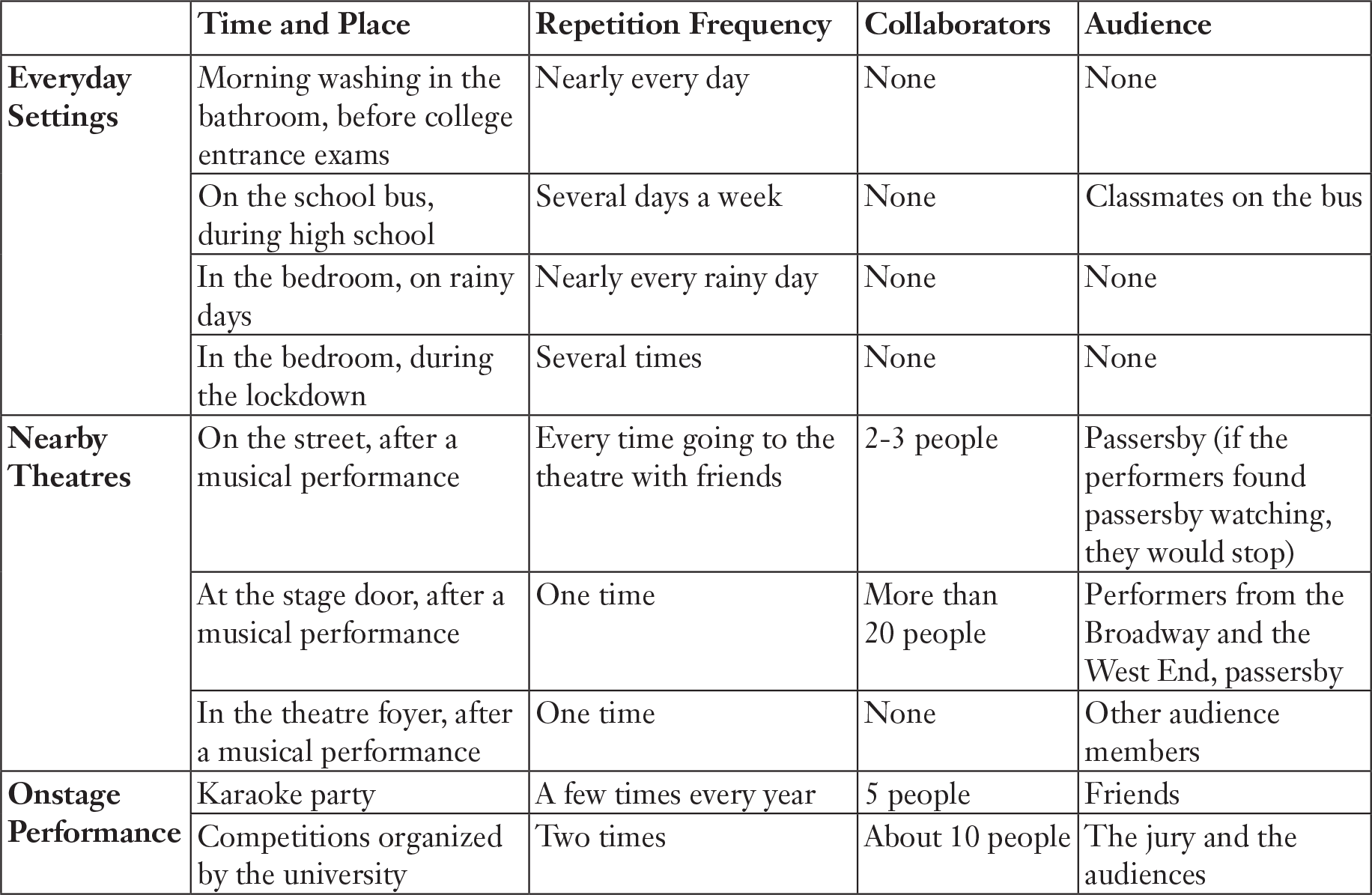
Breaking down the dichotomy between social and aesthetic performance and locating fans’ performances within the evolving duality between imitation and recreation, entertainment and efficacy sheds light on how social identity is constructed through musical fandom. The key to deciding whether or not fan enactment is social or aesthetic may not depend on performers’ virtuosity but rather the wider social context. For instance, Les Misérables is one of the classic musicals most frequently reperformed by Chinese fans. These young people, who have little professional vocal and physical training, learn the details of the performance by repeatedly listening to and watching the 10th- and 25th-anniversary editions of the show, which are accessible on the Chinese video-sharing platform Bilibili with translated subtitles. They have therefore internalized the songs and characters from Les Misérables into their private repertoire. Even though the fans’ ideal models and untrained bodies are extremely similar, when they perform in various places with a range of frequency and with different collaborators and audiences, the performers’ voices and gestures interact with external objects or beings differently. Such performances can be better understood in terms of these differing purposes, social relationships, and audiences (see fig. 3).
Location and social contexts of Les Misérables reperformed by fans. (Chart by Lele Han)

When fans are humming alone in their bedrooms or while washing their faces in the morning, they become performers, imitating the movement and voice of the characters or idols that fascinate them most instead of becoming the characters, simultaneously serving as the audiences who evaluate and modify these imitative performances. For example, Zhao Xingyue, a 23-year-old Chinese international student, explains her everyday state of unconscious humming: “I’m mimicking the character, but I don’t feel that I am the character” (Zhao 2024). She tends to act more improvisationally, based on imitation, while remaining only herself. Most of these recurring song-and-dance enactments take place in daily life with no other audience, and where unexpected spectators may even be deliberately avoided: “When we see someone coming, we quickly run away” (Chen 2024). In that case, do these reenactments constitute personal rituals rather than aesthetic performances? Another type of performance frequently occurs in areas around the theatre in the aftermath of a publicly presented musical performance. When fans attending the theatre dress up as characters in the show or sing a chorus at the stage door, such “showing-doing” (Schechner Reference Schechner2013:28) is targeted at a specific audience, including other fans and even the casts. For these performances, fans sometimes use more strictly choreographed gestures and more explicitly embody a dramatic character. Li, who cosplayed Javert in the lobby when she attended the French concert version of Les Mis at the Shanxi Grand Theatre, admits that the presence of other audience members at the concert would influence her performance: “When there is an audience of strangers around me, I try to sing as closely as possible to the image that people have in their minds” (Li Reference Li2024). These performances begin to include basic theatre elements such as costumes, props, and audience.
Fans’ performances are re-presented, relocated, and rematerialized in different contexts, leading to tension between the individual performing and the performance they seek to imitate, between their aesthetic and social purpose. These two dimensions can be mapped onto a coordinate system. In figure 4, the x-axis presents the degree to which the performer imitates the ideal model based on the musical version they selected by adopting the persona of the character, following a rigidly choreographed script, and improving the technical aspects of the musical performance, such as rhythm and tone. By contrast, a performer less concerned with the ideal model tends to act improvisationally, with no attempt to embody the dramatic role, and be less conscious of musicality. The y-axis derives from the efficacy-entertainment dyad put forward by Richard Schechner (Reference Schechner1974) to describe the purpose of a fan performer: efficacy describes the extent to which the performer expects to obtain results from the performance—to realize the transformation of self in reality. Entertainment refers to situations where performers only want to experience temporary fun in the realm of art.
Map of fan performance, based on Richard Schechner’s “Efficacy/Entertainment Dyad.” (Schechner Reference Schechner1974:467; graph by Lele Han)

Ann Enlong and his white-collar cast of Elisabeth won the Best Acting Prize at the ChinaJoy Cosplay contest. Bilibili, 9 September 2023. (www.bilibili.com/video/BV1eP41187pk/?spm_id_from=333.337.searchcard.all.click&vd_source=481fef24462c00bdfe9d914218976ab0; screenshot by Lele Han)

Different forms of fan performance evolve and shift their positions on these continua. In general, fan reperformances that are both highly ideal-modeled and entertainment-focused can be classified as aesthetic performances, with the most typical instances being student and white-collar musical theatre club performances, where fans produce and perform popular Western musicals. On the other hand, highly efficacious, less ideal-modeled instances are more likely to be social performances. When a student hums Les Misérables every morning, she does not care whether her voice and movements are elegant enough but hopes to gain strength and a spirit of resistance: “I am also oppressed by mundane criteria such as academic qualifications and decent jobs, and I want to rebel against them, and then overcome them” (Zhang Reference Zhang2024). Moreover, there is also a northeast and southwest on the graph, at which points hybrids crossing between aesthetic and social performances thrive. On 4 May 2020, students at Wuhan University performed online “Pour la peine [Because of This Pain],” the chorus of the French revolutionary youth from 1789: The Lovers of the Bastille (2014), after reciting “The Declaration of the Rights of Man and of the Citizen.” Chinese students imitated the intonation and vocals of the original cast perfectly, but with the context of 1789 so strongly relevant to the Wuhan city closure, the audience was likely more impressed by the content and lyrics: “On doit pouvoir changer l’histoire, pour la peine [We should be able to change history, for the pain]” (WHUsical 2020).Footnote 1
On 30 April 2024, Dan Lian sang for the Affiliated High School of Peking University musical club. (Photo by Chuqi Xiao)

Individual Monologs
Rites of Passage of the Idealists
Regardless of musical theatre fans’ theatrical knowledge or access to live performances, most enjoy humming songs alone in everyday settings, which is not only one of the most widespread reperformances by fans but also the seedbed for other types of enactment. Day and night, huge numbers of fans recreate their favorite shows, simultaneously taking on roles of performer, director, and audience. Whether these performances occur in private places like homes or in public spaces such as open paths, the performers usually do not seek the involvement of an audience. Over time, these repeated reperformances become integrated with daily routines and develop into personal habits. In the diagram of musical fans’ performances (fig. 4), humming alone would be classified as a weak ideal-model performance with strong efficacy. Ann Enlong, who works in journalism, described his performance during his daily walk:
ANN: I start singing and dancing joyfully when I listen to music while walking. This mainly happens when nobody is around, so I am completely relaxed.
HAN: Do you select the music you listen to with purpose?
ANN: I look for the appropriate song when I want to experience specific emotions. For example, “It’s Quiet Uptown” from Hamilton will quickly bring me to tears.
HAN: Does this kind of performance change your mood?
ANN: Yeah, it makes me at peace with the world. (Ann 2024)
Ann has gained great experience and skill in white-collar musical clubs and karaoke performances. In contrast, his humming while walking is “completely relaxed,” with little intentional control over voice and body movement. At the same time, he selects songs to impact his real-life emotional state, such as to restore calm after distress. This example illustrates that Chinese youth fans actively apply the melody, characters, and emotions of musical theatre to their everyday lives to help them cope with the difficulties of growing up in the contemporary world. In addition to Ann, several students mentioned that they routinely sang “Non-Stop” (Hamilton, 2015) to speed up their writing and catch up on homework; “You Will Be Found” (Dear Evan Hansen, 2015) to feel understood and overcome social anxiety; and “Ich Gehör nur mir [My Life Belongs to Me]” (Elisabeth, 1992) to gain confidence before exams (Chen 2024; Yue Reference Yue2024). In this kind of performance, instead of attempting to portray dramatic characters, the fans sing the characters’ message and intent as their real selves, imagining the corresponding scene and dancing improvisationally in the liminal state of “not me–not not me” (Schechner Reference Schechner1985:110). With the character’s trajectory of desires and intentions internalized, the performers may transition from one state of mind to another, reorienting their worldviews in daily life. A 15-year-old junior high school student mentioned the impact of repeatedly performing “Non-Stop,” during which the character Alexander Hamilton writes the Federalist Papers: “It gives me a lot of inspiration when I do my work. Maybe tomorrow I will die, so I want to live as much as I can before that” (Zhang Reference Zhang2024). Even as the song fades and the dance disappears, the reperformances have served as a rite of passage and a means of identity transformation.
Musicals have the capacity to initiate identity transformation due to the formal discontinuity between the book and the musical numbers. The structure of musicals naturally contains two competing orders of time: the tension between the plot’s progressive time and the music’s repetitive time (McMillin Reference McMillin2006:6). As the plot advances, the torrent of desire grows within protagonists and spectators, exceeding the limits of bodies and culminating in the spectacle of song and dance.
The restless song-and-dance moments can shake the stable character identities constructed by the logically unified plot, causing audiences to reflect on the characters and themselves in a new way. Scott McMillin has argued that this aspect of musical theatre dramaturgy provides audiences with a Kierkegaardian pleasure through repetitively experiencing the double order of time, which leads them to recognize “I am what I am and then some” (2006:182).
For Chinese Gen Z fans, musical reenactments compensate for the absence of initiation rites in their lives, helping teenagers search for “I am what I am and then some.” Although all 18-year-old students in mainland China are required to participate in school-organized initiations, the ceremonies revolve around the ideals of the Communist Party with the goal of ideological indoctrination, including “pledging allegiance to the flag, receiving the national flag, accepting the wishes of the Party, and obtaining documents about CPC member admission” (Zhou Reference Zhou2016:56). Their psychological transformation and maturity deliberately ignored, the youth are reduced to what Foucault called “homo economicus” ([2004] 2008:266), caught in a blind drive for development, following the same path of enrollment in university and application for a job; to hand over their labor, knowledge, and creativity to be commodified by the national market. Their self-designation as “garlic chives” reflects self-awareness as political and economic subjects, tamely adjusting daily performances to social scripts while expressing themselves “in such an ironic, carnivalesque yet morbid way [that] makes light of their living conditions” (Pang 2022:96). The politicization of theatre garlic chives who repurpose musical theatre songs as secular rituals lies in the fact that, despite catering to social expectations, they also question what it means to be a youth or an adult in contemporary Chinese society.
The fan-made script for the Reunion stage door performance suggests that “when the performers come out,” every fan sings “Drink with Me.” Instructions were also sent proposing that “when the cast begin to say goodbye,” fans start to perform the classical Chinese song “Farewell,” lyrics by Li ShuTong based on John P. Ordway’s music. (Photo by Yanqi Ge)

Dan Lian, a senior high school student in Beijing, recalls how musical theatre intertwined with her life: “I am just coming of age and always think about ‘college life,’ ‘stepping into society,’ and so on. ‘When I Grow Up’ from Matilda (2010) had a great impact on me as I grew up” (Dan 2024). Meanwhile, Mozart! (1999) inspired her to think about what she loves and wants to accomplish, and Hamilton gave her hope to fight for her dream. Dan usually reperforms these favorite musical songs in the classroom, hallway, and musicals club after an exhausting school day. “Sometimes these sounds are like sunshine illuminating my life, and this sense of the sublime makes me feel I am ephemeral in the world,” she explains (Dan 2024). It is no coincidence that Generation Z fans have frequently recreated musical theatre as a tool for self-exploration, and in addition to empathizing with the adolescent protagonists of Matilda, Dear Evan Hansen, and Spring Awakening (2006), they have constantly cast yearning glimpses at the romantic youthful images of idealistic martyrs and revolutionary pioneers, including Mozart (Mozart!), Elisabeth (Elisabeth), Hamilton (Hamilton), Enjolras and Grantaire (Les Misérables), and the like. What is interesting about this trend is that so-called youth is not a specific life stage but a state of being that might be characterized by a strong sense of transformation and the desire to promote historical change. The two overlapping themes—idealism and revolution—constitute the youth consciousness. In general, the musical reperformances occur as individual monologs consistently invoking the images of idealistic martyrs, with performing teams more broadly responding to the predecessors of revolutionary pioneers.
Raymond Knapp has concluded that musicals from Broadway and around the world have been influenced by the strand of German idealist philosophy emphasizing “the development and maintenance of a subjective self” and reflecting “who you are,” which was realized in musical productions as transformative qualities such as courage, heroic resolve, and a vision of the future (2006:165). Musicals that inspire these ideals are widely circulated among teenage Chinese fans, the most typical examples being three songs that adopt star imagery: “Gold von den Sternen” (Gold from the Stars) from the Austrian musical Mozart!, “Ich Gehör nur mir” (My Life Belongs to Me) from Elisabeth, and “Stars” from Les Misérables. While this symbolic imagery in “Stars” represents Javert’s faith in a world of order and structure, in the other two, the function of the song is to arouse the subject’s motivation to reach for the stars. In “Gold from the Stars,” when Mozart returns from Paris disappointed and unappreciated, the baroness advises him that if he wants to seek gold from the stars, he must embark on an adventure. Chinese fans’ remarks and interpretations of this song on the music streaming platform NetEase Cloud Music indicate an “I am Mozart” phenomenon:
My family reunion in China at 11:30 a.m. to celebrate the Lunar New Year, while I am listening to this song at 4:30 a.m. in Germany, thinking about how I have not been home for a year and still need to study hard, get employment, and find the life of the sprinkling starlight in Europe. (DuoyudangeOr 2017)
This time last year, I was listening to this song and decided to drop out of the domestic double first-class institution to study abroad, and now I have received the ideal school offer, taking a gap year […] (Sanyusanshang 2023)
I just became a 12-grade student, and my test scores are far from ideal. At 10:30 p.m., after school, I study until I am exhausted. On the way home, I listen to the song several times, as if many golden stars appeared outside the car window, and I burst into tears. […] I want to live my own life even if bodies are smashed, and bones are shattered. (RunAwayfromHere 2020)
While reenacting musical fragments, fans have appropriated Mozart’s melody and rewritten lyrics about pursuing dreams to tell personal narratives concerning studying abroad, finding jobs, and taking college entrance exams—diverse individual narratives that reflect shared social narratives. Each musical genre offers certain narrative solutions that allow performers to “describe [their] place in a dramatized pattern of relationships” (Frith Reference Frith1996:275); in particular, “Gold from the Stars” illustrates the interaction between the sublime object and the human subject. The audience’s inner transcendence is stimulated by the contrast between the performer’s ephemeral body and the infinite nature and everlasting spirit of the artistic ideal as expressed through the song. This may raise the subject’s ambition to conquer the object in order to get rid of the petty and mediocre aspects of their lives to leap upward, ultimately transforming into the sublime subject in practice. Each time the performer brings the songs to new surroundings, they enter a liminoid space and integrate new special and personal relationships into the song’s narrative solutions. With everyday rehearsals, performers shed mediocrity, repetitively practicing their ideal identities—which may lead them to imitate Mozart’s adventurous behavior in everyday life, believing in their talents and beginning on challenging journeys. Although Mozart could not escape being burned by the metaphorical stars, “Gold from the Stars” helps young Chinese individuals transition to new situations and social realities, bringing them closer to the idealized identities of their own expectations.
Collective Performance
Eros behind Revolution
If we regard the solo performance of a fan as a protagonist’s monolog, then a conversational drama has begun when the antagonist appears. In the evolution from one to two, from monolog to dialog, fans’ performances evolve from social performances with a strong ritual function to a series of showing-doings that are somewhere between social and aesthetic performances, increasingly highlighting the perimeters of entertainment and highly ideal-modeled imitation. As common people with amateur untrained bodies, the fans’ pursuit of performance artistry is a brave attempt to seek the degree of freedom of expression equal to that of professionals; the possession of a disciplined body is a prerequisite for continued training at any professional artistic institution. Even in high school and university musical clubs that include various kinds of bodies, there is still a casting hierarchy; students’ opportunities to perform onstage are mainly based on academic performance. University musical clubs that receive funding and faculty support are typically found in C9 league institutions (on par with US Ivy League schools), led by experienced directors, and equipped with complete stage machinery, according to an investigation by Laura MacDonald into the official musical theatre clubs in China’s elite universities (2020).
Outside of these somewhat rigid organizations, there are many more musical theatre lovers. Among Gen Z fans, there are many defeated candidates excluded from musical clubs, working-class people, and those who are too shy to express themselves. Most of the grassroots groups they organize advocate for equitable partnerships. Ann once took part in a performance of Elisabeth by a white-collar musical group that recruited members from throughout the country. After nearly a year of rehearsals, over 60 people participated in the final nonprofit production, without the hierarchy of the usual theatre roles, such as producer and director:
ANN: Many people in our musicals club are in charge of theatre management, including finding props and venues. Because most performers’ bodies are undisciplined and difficult to guide, several people are responsible for directing. Each leader of separate groups plays a role in directing expression, emotion, movement, and composition. Someone would video the actors’ expressions, slow the recording down, and discuss how to improve his expression. […] Nobody puts on airs, but the group needs someone to manage. (Ann 2024)
For the aesthetic performances of these grassroots groups, the parallel elements of expression, movement, and composition are each directed by different members. The director’s role is not with one person but with a group. This decentralized community carries over into fans’ everyday contact outside rehearsals, for example in their fan-made merchandise exchanges that occur not only annually at Musical Only but routinely around the entrances of the little theatres at the Asia Mansion before the show. Most musical lovers meet because of their shared hobby, and they are appreciative audiences of each other’s creative work.
Reunion (重聚) is a series of musical concerts presenting 26 iconic numbers performed by Broadway and West End stars that took place in January 2024 in Beijing and Shanghai. The Chinese concert producer promoted it as a gala for fans to meet their idols again after the pandemic, including Ramin Karimloo, who played the Phantom in Phantom of the Opera on Broadway; Samantha Barks, who played Éponine in the film of Les Misérables; Natalie May Paris from the original West End cast of Six, and others. After the concert, a fan named Lily distributed scripts with bilingual lyrics, attracting a large crowd gathered outside at the stage door to perform “Drink with Me” for the cast. The fans joined in a chorus, singing: “At the shrine of friendship never say die/Let the wine of friendship never run dry” (Schönberg Reference Schönberg1985). “Drink with Me” is the song of ABC Friends celebrating their friendship before their potentially fatal confrontation at the barricade the next day. The Chinese translation paraphrases the lyrics as a classical Chinese farewell poem composed in four-character lines, a genre used by ancient romantic poets to express blessings when friends depart. By recontextualizing the ABC Friends’ song, fans build an affective bond among romanticists across temporalities and cultures.
On 21 January 2024, after the Reunion musical concert at the Beijing Tianqiao Performing Arts Center, fans gathered near the stage door and performed a medley of revolution-themed musical songs until midnight. (Photo by Yanqi Ge)

As a participant in the fan chorus, medical student Yu was impressed by the professional performance given by many collaborators. She observed that over 20 fans continued to perform Les Misérables and Hamilton on the street after the cast left:
There were three or four main vocalists in the inner circle who were highly engaged with the performance, so I felt like I saw a show. Nearly a dozen individuals gathered outside the circle, singing or humming along with them. (Yu Reference Yu2024)
In these reperformances Chinese fans employ the membership in the fictional revolutionary associations of the ABC Friends and the Hamilton characters not only to connect with each other and their favorite stars, but also frequently to select revolutionary narratives of Western musicals for their public collective social performances. These gatherings feature “young, scrappy and hungry” (Miranda Reference Miranda2015) songs like “Do You Hear the People Sing?,” “One Day More,” and “My Shot.” This trend dates back to 2018 when a collective of Shanghai fans sang “Do You Hear the People Sing?” after a performance of Les Misérables, which was interpreted as a social performance against the authoritarian political system by the foreign and Taiwan media but not reported domestically (New Tang Dynasty Television 2018). In recent years, including the prevalent collective online musical fan concerts during the pandemic, revolutionary melodies have become a productive tool for personal responses to social events. Following a Zoom performance by the original Broadway cast of Hamilton in April 2020, a number of Chinese fans organized online concerts during the lockdown, with Hamilton and Les Mis featured as the most popular repertoires. With the exception of Wuhan University students adapting a Chinese version of “One Day More” to criticize the government’s Covid-19 policy, most online fan concerts initially aimed to compensate for the absence of live theatre rather than to broadcast political commentary.
Meanwhile, the fan community continues to be regarded as apolitical fanatical groupies by domestic media, and indeed they are eager to reperform love songs like “On My Own” and “Satisfied,” which also bear witness to revolution from the perspective of marginalized characters. Still, as was revealed in a Sina Weibo survey headlined “Who would you rather be in Les Misérables?” (Musical bot 2019), fans have reservations about the subversive power of revolution. Instead, they prefer romantic characters such as Éponine and Grantaire, who die in the barricade battle because of their loved ones, rather than purely politically motivated characters. How do fans negotiate between revolution and love, social and artistic goals when reusing the revolutionary narratives that play the central role in musical theatre productions?
During the Wuhan lockdown, Wuhan University musical club members organized an online gala and montaged themselves with the revolutionary youth in 1789: The Lovers of the Bastille. Bilibili, 11 May 2020. (www.bilibili.com/video/BV1Lg4y1B7bM/?spm_id_from=333.788.videopod.episodes&vd_source=481fef24462c00bdfe9d914218976ab0&p=23; screenshot by Lele Han)

In the modern history of popular song-and-dance performances, revolution and love always lurk in the rewatching and reenactment by fans. The two impulses are frequently parallel and sometimes intertwined, but revolution always undermines love as a loftier purpose. Whether it was gewuju (歌舞剧), the song-and-dance theatre genre combining American jazz, Broadway musicals, and Chinese folk music started by the composer Li Jinhui in the 1920s, or the all-female Yue opera during Shanghai’s isolated island period (1937–1941), the early song-and-dance performances were criticized by left-wing intellectuals and supporters of the Chinese Communist party as decadent due to their romantic themes, invocations of physical desire, and celebrity appeal. For example, Nie Er challenged Li Jinhui for works such as Maomao Yu (毛毛雨, Drizzle; 1927) that he said lacked social consciousness of proletarian mobilization (in Wen Reference Wen2012:162). In response to the command of Chinese communist leaders to resist the Japanese invaders, beginning in 1931, artists had to add themes reflecting the grand narrative of nationalist “patriotic love” (Lee Reference Lee2006:84). However, in contemporary musical fans’ secondary creation and interpretation, the original specific context and meaning of the revolutionary songs gradually fade into the background and are replaced with the desire for personal freedom, success, and everyday “romantic love” (Lee Reference Lee2006:84): “Les Misérables moves me because of the pursuit of a better life, such as the concept of freedom and equality, and also the joy of imagining romantic relationships between these energetic characters” (Li Reference Li2024); “I love some of the slogans of the revolution where we are fighting for our future, and I would believe in something that is so hot-blooded and heroic” (Dan 2024). Fans’ pursuit of an ideal world echoes with the fictional Friends of ABC. When the French revolutionary youth raised the red flag above the barricades, the Communist revolution guided by Marxist ideology would not begin for another 90 years. The French flag represented instead a general appeal for a better future.
In terms of fans’ inner motivation, love can be extended to eros—not equal to sexual desire but rather referring to the desire for beauty. Outwardly, fans may be obsessed with the performers’ physical expression and the characters’ romantic relationships, which is usually a form of narcissism masquerading as love for another. Fans get a glimpse of a more idealized self in the image of their idols or characters, which draws them infinitely closer to both their idols and their ideal selves. Despite their narcissism, these characters may eventually become a catalyst for the personal growth of the admiring fan: as Plato once put forward in The Symposium, “all good things have come to be from love of beautiful things” (1991:139). Ideally, fans would reproduce virtues such as the love of knowledge, justice, bravery, and wisdom. Furthermore, in combination with Herbert Marcuse’s interpretation of eros, fans’ love of the objects of their admiration would also endow them with the political power to resist repression. When human subjects transfer “erotic fulfillment from the corporeal love of one to that of the others, to the love of beautiful work and play, and ultimately to the love of beautiful knowledge,” they may engage in more harmonious and liberating societal relationships (Marcuse [Reference Marcuse1987] 1998:211).
Many Chinese Generation Z audiences have become fans after being devoted to a particular musical or performer, which then drives them to build loving relationships with other fans, expanding their social circles through “making friends with those who like to watch the same musicals with me. Sometimes they can resonate with me on a deeper level than actual friends” (Wang Reference Wang2024). As they find a love of beautiful works and knowledge, many fans start to learn about theatre, history, and foreign languages: “In junior high school, those who liked history were usually male military buffs […] Then I learned about another side of the history that was not about big planes and tanks through musical theatre, which awakened my interest and motivated me to major in history” (Ding Reference Ding2024). Others have left a hometown to become a first-generation resident of a big city:
“I resolved to go to the big city to watch live musicals in 2013, and then I was admitted into a top university and stayed in the big city” (Ann 2024). Many become more confident people: “I wanted to be a silent, calm, decent, perhaps a stereotypical Chinese girl until I learned about musical theatre. Now, I want to be as confident as the performers and enjoy expressing myself without caring about what other people think” (Li Reference Li2024).
Eventually, both Eros and revolution serve as the impulse for individual pursuit and realization of an ideal, a pursuit central to the popular fan fiction by Nicaiwojiaosha (你猜我叫啥), Wo yu Lixiang Zhouxuanjiu (我与理想周旋久, Struggling with My Ideal). The two main characters are famous Chinese musical stars: Xu, the new star actor, used to be a fan of the veteran actor, Zheng. With love and hard work, he realized the dream of performing with his idol on the stage. Because of this, many musical lovers perceive Xu as an idealized version of themselves. In this fan fiction set in 2066, Xu wrote his last fan letter to the long-deceased Zheng before his death, telling him that more and more young people have taken up the torch of his ideals and contributed to the transformation of Chinese theatre, just as the two characters once did. Everything begins with the love of musical idols and productions, which motivates fans to study theatre and stick to their ideals, with the potential for real-world change:
Godot did not come, but the spring of Chinese theatre came. Since you passed away, Chinese theatre has become better […] Over the years, many young people, whether they have just graduated or have been working for some time, came to me and said, “Mr. Xu, we want to become a top performer or playwright in the future, and I want to bring Chinese drama to the world.” I looked at them as if seeing myself at that time, stubborn and vigorous. Unconsciously, I became you, and countless young people became me. […]
You always said that you see the vitality of theatre practitioners, the persistence of young people struggling for the uncertain ideal, and the future of the industry in me, which inspires you. But if it were not for you, how could I have willingly tumbled along this muddy road? (Nicaiwojiaosha 2023)
Chinese Gen Z fans not only perform disciplined social roles but also seek the freedom to express themselves as idealists and romantic revolutionaries. They replace the narrative solutions of the musical with their own personal stories, with the aim to realize self-transformation or bring their ideals out into the public. In this respect, musical theatre gives fans an increasing sense of empowerment by letting them cross the boundary between entertainment and efficacy, breaking through the constraints of physical skill and creative ability. The artistic and social ideals of today’s musical theatre fans are difficult to find in mainstream Chinese theatre since the socialist realistic drama places a great emphasis on ideological control in dramatic dialog; the idealism of youth has long been absent from mainstream theatre.
At the 2017 Musical Only event in Shanghai, every participant wore the tricolor cockades on their chests. They re-created the Friends of the ABC drinking scenes with Enjolras lying in the center. Images shared to Sina Weibo via @XiaoA_Yuqingdongfang (小A_遇卿东方). (https://weibo.com/1612096410/4132416400793601; screenshot by Lele Han)

The fans’ song-and-dance gestures are a form of sociopolitical activism. This post-Tiananmen generation has “never known anything but perpetually improving opportunities” (Fish Reference Fish2015:7) but has begun to realize that their lives could be crashed by powerful economic and political forces, especially after the pandemic. Even though it is impossible for them to systematically change current Chinese society, they can transform the way they find and make meaning at the individual level. “The only way for life to defer death isn’t to preserve it as such […] but rather to be reborn continually in different guises” (Esposito 2008:181). The value of musical theatre is in its capacity to empower fans with alternative ways of making meaning and to be reborn in different characters—idealistic, romantic, and ambitious. Facing the neoliberal mechanism of reducing the individual to a drive for rudimentary survival and capital investment, fans reclaim their vitality through everyday reperformances that arouse their desire to get closer to the ideals they find in their idolized shows and characters. In this sense, Chinese Generation Z fans are more attached to the original meaning of garlic chives: a resilient vegetable that may be harvested but will continue to grow.