INTRODUCTION
African border regions show very diverging social dynamics. Many border areas are sparsely populated, socially stable and politically marginal, with little infrastructure and a low degree of integration into a globalised economy. Yet scattered along these borders, we find bustling trade boomtowns in which everything seems to happen at once; economic opportunities create urban growth and rapid societal change, while new political institutions challenge the authority of the state. Finally, transport corridors and pipelines cross borders on their way from the mines and oil fields to the harbours, bringing a steady flow of raw materials out of the continent to fuel the industries of Europe, Asia and the Americas.
These three different borderland situations stand for three types of cross-border trade. In a typology I develop more fully in the second section, I call them ‘green’, ‘grey’ and ‘blue’ trade: local trade in everyday goods carried across the green boundary by people who are at home in the area; locally embedded trade on the grey tarmac roads or railway lines, passing through official border posts and dependent on dense local political and economic networks; and the commodity trade on the blue ocean, organised by actors who are more at home in the capitals than in the geographic border regions. The interplay between these three types of trades, I argue, crucially characterises borderland dynamics in Africa today.
Before expounding the typology, I have to take a step back. In the first section, I give an analytical overview of how the social space of African borderlands emerged. Their history in colonial and postcolonial Africa has shaped the way they generate and structure opportunities for trade today. Without reference to the way state boundaries have come to influence social realities in Africa, we cannot understand the specific constellation between ‘green’, ‘grey’ and ‘blue’ border actors today.
My aim in the first section (and in the article in general) is not to find anything essentially African about African borders. I use African material and border theory to mutually illuminate each other. While border studies can help us to understand the historical conditions of specific African countries today, African borderlands can form a lens to analyse the social, economic and political consequences of borders in general. Throughout the article, I cannot achieve either without some degree of generalisation, which, although always wrong if confused with reality, helps us to describe and understand reality more accurately.
The third section argues that differentiating between different types of cross-border trade can not only help us to understand borderland dynamics; it also gives us tools to describe and analyse important structures in the wider field of African politics. The way the different types of actors come into conflict or cooperate in specific situations has crucial consequences for political and economic structures in general, and for the relation between state and society in particular. I use regional integration as a field to exemplify such consequences.
The Conclusion then comes back to the divergent social dynamics along African borders. I argue that African borderlands are typically characterised by the pivotal role of ‘grey’ border actors and by a systematic conflict between ‘grey’ and ‘blue’ actors. Both stem from political and economic conditions on the African continent, and analysing cross-border trade allows us to better understand these conditions.
For the sake of clarity and brevity, I have kept the article conceptual. I focus on trade alone, neglecting migration and the various links between the two fields, and I only analyse political issues through the lens of cross-border traders. The constraints of a journal article make it impossible to give a full overview of existing literature, or to always make the empirical data underlying my argument explicit.
ELEMENTS OF A CONCEPTUAL FRAMEWORK
Why borders matter
Why do borders matter in Africa? Any answer to this question has to start with what state borders have in common. In the international system of sovereign states – be they colonial or postcolonial – borders make the radical claim to mark the line where one state's authority begins and another one's ends. On one side of that line, the claim for the monopoly on the legitimate use of violence lies with one government in one capital; a few steps further, the claim lies with a different government in a different capital. (For an excellent overview of the development of the concept of sovereignty, see Reinhard Reference Reinhard1999; on territory and the resources of domination, Storey Reference Storey2012; Elden Reference Elden2013).
This claim lies at the heart of state borders. Evidently, it should never be confused with real life. Africanist scholars have time and again shown how precarious colonial and postcolonial governments’ capacity to project their power has been, how haphazardly many laws have been implemented and how rarely (if ever) systems of governance have conformed to Weberian ideas of statehood (e.g. Berman Reference Berman1990, Reference Berman1998; Herbst Reference Herbst2000; Cooper Reference Cooper2002; Hagmann & Péclard Reference Hagmann and Péclard2010). Yet its incomplete realization does not render a claim irrelevant. Looking at African societies and economies today, we quickly realise how relevant borders have become over the last one and a half centuries. State borders separate areas in war from countries at peace and democracies from dictatorships; they structure settlement patterns, cultural forms, typical economic activities, consumption opportunities or kinship ties.
If we take seriously the relative weakness of state power in many areas of Africa, which often makes it possible to cross boundaries informally, how can the societal relevance of borders be explained? Why has their claim to structure the world been so powerful?
First of all, in an international system based on sovereign states, borders have always had a high degree of external legitimacy. Even where their location was unknown to the local population, the neighbouring power knew them as the official end of its domination. From early colonial times, attempts to extend a government's sovereignty beyond its borders were not only seen as aggression towards a neighbour, but as a threat to the global political order. States not immediately involved in the conflict often put pressure on the parties to respect their boundaries. This external legitimacy of the boundary regime found its expression in a huge number of treaties, conventions and declarations, from the Berlin Conference in 1884/85 to the 1964 AOU Resolution 16(I) on the intangibility of African borders, and beyond.
International recognition turned colonial boundaries into containers of sovereignty, and thus into the relevant units of administration. Colonial states in Africa never had the capacity to regulate as many details as administrators might have liked to regulate, nor could they consistently implement what regulations there were – but with few exceptions (see Vaughan et al. Reference Vaughan, Schomerus and de Vries2013 for Sudan), they rarely stopped trying. Whatever state authorities did, they did within their own boundaries. In a slow and unfinished process, this shaped realities to conform to the boundaries: road and rail networks, currencies, school systems and official languages, military service, passport and visa regimes, migration routes or technical norms, to give just a few examples, became structured in a manner that reinforced the boundaries’ relevance and gradually filled the claim with meaning.
Changes in the structures of real living conditions were thus grounded in structures of administration and legislation. State officials were always more dependent on their own superiors than on officials on the other side; consequently, a decision taken in the capital would trickle down to remote outposts, but would stop being implemented across the border. Governments might not have spent a huge amount of resources in the countryside, but what resources they spent were allotted within their country. As a consequence, unofficial networks of patronage and power, as well, mostly developed within a state, not beyond its borders (cf. Berman Reference Berman1998).
These processes did not depend on states’ interest in controlling the border itself. Even where efforts to demarcate, secure or defend the borderline remained sketchy – as they often did in colonial Africa, especially where land was not the main factor of productionFootnote 1 – the organisation of official power within states reinforced the meaning of the border.
Countries rarely completely stopped demarcating and controlling their borders. First, borders had a performative function (Jones Reference Jones2009; Coplan Reference Coplan, Wilson and Donnan2012; Kaiser Reference Kaiser, Wilson and Donnan2012): since sovereignty was conceived in territorial terms, the basis of a state's legitimacy had to be established at the margins of that territory. Secondly, import duties and taxes collected at entry points were major sources of revenue for colonial and postcolonial states (Chalfin Reference Chalfin2010b; Nugent Reference Nugent2002, Reference Nugent, Wilson and Donnan2012). To collect them, states had to have at least a modicum of control over the more important border crossing points.
Through all these processes, living conditions on both sides of a border began to diverge. Once this process set in, the difference between both sides also became a resource for individual agency, which in turn reinforced the meaning of the border (e.g. Chalfin Reference Chalfin2001; Nugent Reference Nugent2002; Dobler Reference Dobler2009c; Howard Reference Howard2014; Zeller Reference Zeller2015). The borderland as a social space started to emerge.
The emergence of the borderland
Borderlands in the technical sense of the term are more than just the geographic regions around a border (Martinez Reference Martinez and Schofield1994; Asiwaju & Nugent Reference Asiwaju and Nugent1996; Baud & van Schendel Reference Baud and van Schendel1997). They are social spaces in Henri Lefèbvre's (Reference Lefèbvre1974) sense: geographic spaces linked to societal institutions and socially imbued with meaning. As I show below, the geographic place of these social spaces can vary considerably for different groups of actors. For now, I will concentrate on the specific kinds of interactions in which the borderland emerges and is reproduced. I analyse these interactions mainly in the economic sphere, in which borders put a premium on selective cross-border cooperation (Anderson & O'Dowd Reference Anderson and O'Dowd1999; Jackson Reference Jackson2006; Feyissa & Hoehne Reference Feyissa and Hoehne2010).
We have seen that administrative measures taking state boundaries for granted tend to shape reality so that it conforms to the model. Laws, administrative practices and living conditions become comparatively more homogeneous within the state's boundaries. The neighbouring state's institutions show a similar initiative, equally producing a tendency to homogeneity.
Regulation and living conditions on both sides can in theory develop along similar lines, without producing any differences across boundaries. In this case, the boundary will not create huge incentives for economic transactions; the choice of goods on offer on both sides will be as similar as their prices, and the borderland will usually not be a very dynamic place for trade (e.g. Miles Reference Miles1994).
Very few pairs of neighbouring African countries, however, have in the past experienced strong and lasting parallel developments. Even where neighbouring countries show very similar economic and social trajectories, political decisions are rarely fully taken in parallel. Given the tedious balance between budget constraints and popularity, for example, different countries have decided to subsidise, tax or regulate different kinds of goods in starkly different manners. Since they rest on typical conditions over a given territory, such political interventions very often amplify existing differences between territories. Coffee or cocoa may not grow in the savannah regions of West Africa's coastal states, but price policies affect the entire country and enhance differences to their Sahelian neighbours (Bulir Reference Bulir2002; Akiyama et al. Reference Akiyama, Baffes, Larson and Varangis2003; Moseley et al. Reference Moseley, Carney and Becker2010). Oil may only be found in a remote area, but its exploitation turns the entire country into an oil producing state (see Soares de Oliveira Reference Soares de Oliveira2007; Heilbrunn Reference Heilbrunn2014 for differing perspectives on the consequences).
By defining the units for political decisions on pricing, taxation or import duties, borders translate continuous differences between regions into discrete differences between states. Even in the European Union, whose markets and policies are much more integrated than those of any two neighbouring African countries, price differences create cross-border traffic. Given the low degree of homogeneity of resource endowment, geography and political regulations across Africa, price differences and consequently incentives for cross border trade are often much higher.
The closer markets for a cross-border good lie to the border, the less significant transport costs are and the higher potential profits become. We will later see that proximity of the markets to the border is just one of the factors defining traders’ profits. Still, we can, in a first approximation, conceptualise the economic borderland in Thünen (Reference Thünen1842–63) circles of declining rates of return, one for each different good traded across the border. Some goods, whose prices do not differ between the sides, will not directly be affected by the border at all. For all others, price differences have to be set off against transport costs. Trade profits are highest in close proximity to the boundary, while the significance of price differences in relation to transport costs declines the further markets move away from it. Economically, then, the borderland can be described as the zone in which rates of return are still affected by the border.
I will complicate this simple model later on. Its main merit is to show how variable the geographic place of the borderland is. Like a new canal in Thünen's model, new roads or railways can transform its contours just as thoroughly as new regulations that affect price differences or make the border more or less porous for a specific good.
Price differences are of course more complicated than this model suggests. State administrations do not become passive bystanders once differences between two countries are in place. If they have created price differences through legislation, states usually try to control them by political means; if price differences were created by social or natural conditions, states often use them as a tax resource by levering duties on imports. In both cases, cross-border trade profiting from price differences is labelled smuggling and prohibited.
If regulations against smuggling were perfectly enforced, they would lessen or eliminate motivation for cross-border trade. Even in the strongest states, however, such regulations are rarely entirely enforceable. Given the limited capacity (and often the limited will) of many African state administrations to enforce their regulations comprehensively, state borders very often create significant economic chances.
Whereas much of the trade between highly industrialised states rests on the functional integration of differently structured market segments, informal trade in Africa frequently derives profits from the political separation between market segments. In consequence, this variant of cross-border trade cannot be entirely formalised without destroying the grounds for its existence.
Borderlands can become dynamic places because states have a capacity to project their vision onto social spaces contained within the boundary; a meaningless border would not affect economic chances. If a state's capacity and will to project its power becomes too great, however, the leeway for economic actors shrinks. Between these two poles, regulated differences create opportunities in borderlands (see also Walther Reference Walther2014a).
Profiting from these opportunities often takes more than just being there. Cross-border trade involves bridging the two sides. This usually is most difficult when trade is most lucrative: when the two sides are least integrated, and where selective enforcement of regulations makes smuggling and other forms of illegal trade more difficult than the legal variants. In order to better understand this, we have to leave the national framework and analyse the cross-border dimension more closely.
Borderlands as frontier spaces: trade and social integration
So far, we have seen that the creation of two different spaces of relative internal homogeneity, the implementation of different regulations on both sides of the boundary and the partial enforcement of tax and duty regimes affect market conditions on the two sides of the boundary. Price differences create a premium for traders who can bridge the two sides. If this was all, cross-border markets would perhaps be more lucrative than markets within the country, but they would not significantly differ in organisation. What makes them special is, again, the specific political framing of the boundary between markets. Cross-border markets, unlike in-country markets, bridge sovereign political entities; their distinctive features rest on this peculiarity.
The link between cross-border trade and political power becomes most apparent in a form of trade peculiar to borders: smuggling. As long as goods remain in one country, one can buy them, sell them or steal them, and their possession might be illegal, but they cannot be smuggled. Smuggling means moving goods into a different customs area without complying with relevant import regulations.Footnote 2 Smugglers thus illegally use a defining feature of cross-border trade: whenever goods cross a national border, they leave one regulatory space and enter another.
In theory, the transfer between the two regulatory spaces should itself be smoothly regulated. Often, forms have to be filled in in the country of origin for exporting goods; with the help of these forms, the goods are checked out of the regulatory sphere and stripped of their legal status. Similar forms have to be filled in for importing them on the other side of the border, checking them into a new regulatory sphere and giving them a new legal status if the necessary conditions are fulfilled. The zone of liminality in this rite of passage is formed by the no-man's land between the two border posts, in which the goods are neither here nor there. Integrated border management systems try to eliminate even this liminal space, automatically checking in on the other side what has been checked out on one side.
The very idea of smuggling tells us that reality often does not accord to this model. One reason is limited capacity to implement regulations. Another reason has to do with the nature of institutions in general and the nature of the border as limit of state sovereignty in particular: parliaments, customs officials, police forces and the judiciary all are only competent to act on one side of the border. The transfer of goods between the spheres of regulations does not fall under the sovereignty of any one state. Consequently, even state representatives who passionately care about regulations on their side often have little interest in regulations on the other side. As long as export papers are in order and no crime in their own legislation is involved, border officials generally have little reason to inquire whether import duties have been paid to the neighbouring state (e.g. Dobler Reference Dobler2009a).
Outright smuggling is the most obvious and perhaps most frequent strategy to profit from the incomplete regulation of the transfer between the two sides; others involve under-invoicing or round tripping of untaxed or subsidised export goods (MacGaffey Reference MacGaffey1991; Boyrie et al. Reference Boyrie, Nelson and Pak2007; Mevel et al. Reference Mevel, Vakataki‘Ofa, Karingi, Elhiraika, Mukungu and Nyoike2014). These various illegal forms of cross-border trade are in practice usually mixed with its perfectly legal variants. They form a continuum of possibilities cross-border traders can flexibly use according to the circumstances. In order to fully use them, traders need the capability to bridge the border more efficiently than state actors. Unlike the state institutions, cross-border traders cannot rely on networks on one side only, but have to use ties to the other side of the border. The resulting networks and power dynamics lie at the heart of the social space commonly called the borderland.
Trade networks by necessity span both sides of the border. Where trade is completely legal, no more trust is necessary between buyer and seller than for trade within a state. Forms of illegal trade, which are usually more lucrative, often necessitate a closer cooperation. Whether they are built from pre-existing ties within cross-border communities or newly established with trade profits as incentive, the networks of cross-border cooperation have a different reach than national power structures.
In places where high trade profits combine with inconsistent state control, cross-border networks can grow into alternative systems of power (see e.g. Roitman Reference Roitman2005; Raeymaekers Reference Raeymaekers2009; Titeca & de Herdt Reference Titeca and de Herdt2010; Meagher Reference Meagher2014). They often come into systematic conflict with state institutions on one or both sides of the border, but their interest is rarely to replace the state or to abolish the boundary. They do not thrive on an absence of control, but on the exclusivity of their ability to sidestep it. Co-opting state agents therefore is the more effective solution. This frequently engenders those informal arrangements of alternative power involving state and non-state actors on both sides of the boundary many scholars have come to associate with African borderlands (see Egg & Herrera Reference Egg and Herrera1998, and below for further references). Here, borderlands become social frontier spaces, in which even regulation efforts from the centre can be used to establish alternative social and political structures (Kopytoff Reference Kopytoff1987).
The central institutions of individual states frequently try to impose their own order on the borderlands (if only to centralise the resources generated from trade), but alternative power structures often prove resilient towards intervention – not least due to their ability to use the other side of the boundary to evade domination.
In all the processes outlined here, people living in the borderlands are not passive victims of boundary drawing (Baud & van Schendel Reference Baud and van Schendel1997; Nugent Reference Nugent, Bellagamaba and Klute2008; Doevenspeck Reference Doevenspeck2011). Once the boundary has translated into a practical reality and social, economic and political conditions on both sides have started to diverge, the border turns into a resource. To profit from this resource, you have to keep up the difference in principle while bridging it in practice. Both keeping up the conceptual divide and crossing it in exclusive trade networks reinforce the significance of the boundary. Whatever their origin, borders are not kept alive by states alone.
A TYPOLOGY OF CROSS-BORDER TRADERS
My aim in the first part was to lay the conceptual grounds for understanding some familiar traits of many African borderlands: lively and partly localised cross-border trade, state institutions which play a significant role without really managing to impose their order, and the presence of powerful non-state groups of actors who balance the state institutions’ power without replacing them. These characteristics are of course by no means ‘African’ alone; they can be found in many borderlands around the world.
I now turn to the different actors who populate such borderlands. Existing borderland typologies usually differentiate between types of borderlands by referring to specific factors characterising them as a social entity (e.g. Asiwaju Reference Asiwaju1976; Martinez Reference Martinez and Schofield1994; Decoville et al. Reference Decoville, Durand, Sohn and Walther2013; Miles Reference Miles2014). Such typologies are very useful for comparing the dynamics in different borderlands, but they necessarily homogenise borderland situations. This may mask the fact that borderlands are very often characterised by a competition between different groups of actors who use different resources and are embedded in the economic, social and political landscape in their own distinct ways. I use a different and complementing approach. I identify three types of cross-boundary actors, which I call actors of the green, the grey and the blue boundary (or occasionally, for brevity, ‘green (etc.) border actors’). Political, economic and social dynamics in borderlands, I argue, can be characterised as a specific mode of relation between these groups of actors, and political discussions about border governance often are the expression of their conflicting interests. The typology can thus be used to comparatively analyse different borderlands, but it primarily describes groups of actors present in most borderland situations.
The three types are ideal types in a Weberian sense. We rarely find them in pure form, but their differentiation allows us to better understand real-life situations. I have deliberately chosen the term ‘border actor’ due to its double meaning. Real-life traders are social actors in the sense outlined by Schütz & Luckmann (Reference Schütz and Luckmann2003) and Emirbayer & Mische (Reference Emirbayer and Mische1998). Ideal types, however, can never do justice to the possibilities of human agency, and taking the types as real would risk turning human beings into actors in a play, who are little more than incorporations of specific social roles.
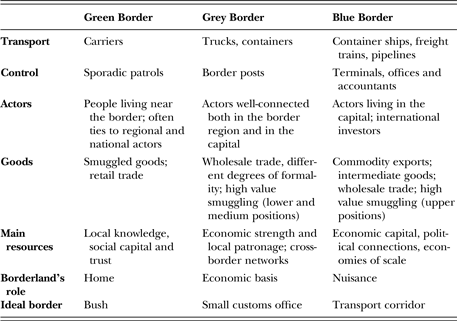
My typology starts from the way goods are typically transported across the border by a group of actors for their own aims. This might seem random at first, but means of transport crucially affect the scale of trade, the avenues of border crossing and the possibilities of state control. Because of this, the social organisation of trade and the resources needed to trade successfully differ, as well. In spite of its simplicity, the typology captures important analytical differences. To keep it simple, I leave aside some important forms of trade – caravan trade or trade on river craft and small boats moving across maritime boundaries, for example. They could easily be integrated into the model, or at least analysed using the same categories.
The green border: paths through the bush
People living in borderlands routinely use the border's proximity to cross it with goods. They might or might not become professional traders; if they do, they trade in small volumes at first, crossing the boundary on foot, on bicycles or motorcycles or in canoes, often outside of official border posts (e.g. Zeller Reference Zeller2008; Feyissa & Hoehne Reference Feyissa and Hoehne2010; Walther Reference Walther2014a). Their domain is what I call the green border: bush, savannah or desert and the myriad paths across it. In most African countries, they cross the border without any visa stamp or prior authorisation.
For traders across the green border, trade is only one reason for everyday cross-border interaction, and it is usually embedded in other activities. People living in border areas make use of environmental resources on the other side, grazing livestock, using water holes, foraging or hunting; they profit from infrastructure by going to hospitals or schools; they visit friends or family members across the boundary. It would be very costly for states to thoroughly control such everyday cross-border interaction. Few African borders are secured with fences, and these normally leave gaps for people crossing on foot; if not, people living in the surroundings frequently cut their own gaps for crossing.
Many states make provisions for this variant of cross-border movement by allowing people living close to the border to cross without a visa and by exempting goods of a certain value from import duties and taxes. Legalising movement across the green boundary is much easier than controlling it, and this everyday interaction usually brings advantages to both states. Individual trade is of so little value that enforcing tax payment would be inefficient.
Leaving the green boundary entirely uncontrolled, however, would tempt other actors to use it for high-value smuggling. Most states therefore try to gain a modicum of control by establishing a sporadic state presence in the more lively areas. Border police may pitch a tent close to a crossing point for some time; they may have informants along the boundary; and they certainly run patrols along the borderline. The main aim of such measures is not to control the actors crossing the green boundary, but to avoid their collusion with traders higher up the value chain: actors of the grey and the blue boundary.
The grey border: roads and railways
Paths through the bush can only be used on foot, by bicycles or motorcycles. Higher trade volumes need a different infrastructure: roads or railway lines on which containers and trucks can move. I call the points where they cross the boundary the ‘grey border’ – a border the colour of tarmac.
Controlling the grey border is different from controlling the green. Whereas myriad passing points form the green border, roads and railway lines are few and far between. This makes them much easier to control: it is enough to set up a control point where the road meets the border. A barrier and an office with stamps, computers and opening hours at the right place go a long way towards controlling trade. Typically, everyone who moves across the boundary is registered and individually authorised or denied entry. In the same manner, all goods that pass the border post can be inspected, registered, taxed or confiscated.
Very often, these control points are lone islands along a boundary on which control is barely enforced (see Herbst Reference Herbst2000; Das & Poole Reference Das and Poole2004; Hagmann & Korf Reference Hagmann and Korf2012; Korf & Raeymaekers Reference Korf and Raeymaekers2013; Boas Reference Boas2015 for discussions of the consequences of such selective institutionalisation). The green boundary can start a few hundred metres away from the control point; even at the checkpoint, actors of the green boundary may pass unhindered.
For an outside observer, it is often not easy to understand why goods pass through the checkpoint at all, since a short detour would make it possible to avoid detection. The first reason is obvious: trucks (not to mention railways) do not easily pass through the green boundary. Splitting up the load to smuggle it across the boundary raises transaction costs and is only worthwhile for high-value, high tax goods: for alcohol, petrol or cell phones, for example, not for cement or onions.
What is more, wholesale traders often need some kind of paperwork as proof that their goods were legally imported. Even where in-country controls are rare, bigger trade volumes in customable goods may attract scrutiny and make smuggling over the green boundary much riskier and, in the long run, more expensive than importing goods through the grey border.
The necessity to have the right stamps on the right documents, and thus to pass through the official border post, is one of the defining features of the grey border (Dobler Reference Dobler2009a, Reference Dobler2009b). It lies at the heart of the interplay between economic, administrative and political actors in many African borderlands. Where economic actors can bypass controls – as on the green border – state agents and traders might become opponents, but there is little incentive for collusion. On the grey border, they very often need each other. Traders have an interest in obtaining the right stamps without strictly conforming to the regulations by, say, paying the full amount of tax on the full value of goods. Administrative personnel have access to the stamps and can, within certain limits, decide which papers they stamp. Political actors decide on the focus and intensity of controls, both of the administrative personnel and of trade goods. If the three groups find common ground, a part of the trade profits can flow towards administrative and political actors as a payment for officialising legally problematic transactions.
The simplest form of such collusion is a one-off bribe: instead of paying import duties or conforming to other official regulations, money paid to an official buys you the right stamp on your papers. Offering or accepting a bribe, however, makes you vulnerable; if you are not sufficiently familiar with the social context and the actors involved, it may do you more harm than good. The situation becomes more foreseeable if you know whom you are dealing with and can rely on the trust generated by earlier interactions (Dobler Reference Dobler2009b, Reference Dobler, Peters and Handschin2012; Little Reference Little, Sarris and Morrison2010; Titeca & de Herdt Reference Titeca and de Herdt2010). Since traders frequently move across the same border post, they have the opportunity to establish social relations with administrative and political actors.
Where bribes are an everyday occurrence locally perceived as licit, such social relations might from the start be facilitated by payments. Often, however, the possibility of bribes only follows from social relations. A trader might buy drinks for customs agents or offer a cigarette; she might try to chat a bit longer than strictly necessary, or enquire about an official's family. With time, such relations might move on to include a general discussion of economic circumstances and the low wages of officials; traders might offer logistic help to a politician's party or donate goods to a good cause. Sooner or later, a problem will occur in the papers which leaves a scope for discretion, and the trader will ask help from the person she knows best. Whether cooperation remains at this level or moves on towards outright corruption: social contacts between economic, administrative and political actors make the movement of goods smoother and more efficient.
The grey boundary situation facilitates contacts, creates continuing social relations and provides incentives for all actors to keep up the relationship once it develops. This combination turns the grey border into an ideal social space for the emergence of networks between economic, administrative and political actors (Raeymaekers Reference Raeymaekers2009; Titeca Reference Titeca2012; Meagher Reference Meagher2014; Titeca & Flynn Reference Titeca and Flynn2014). These groups of actors are not isolated individuals themselves. They often include different levels of institutional or patronage networks: lorry drivers and transport entrepreneurs, warehouse managers and warehouse owners, customs officials and supervisors, politicians on different levels. If the situation is stable enough, interactions on all levels can interlink, and networks between different groups of actors can intersect with inner-group networks. A lower customs official, for example, can help the driver of a trader who is close to a senior official; a trader can give employment to the brother of a politician, who might find it easier to deal with a senior policeman than he does himself. Different forms of power relations are integrated into a relatively stable system that can turn into an apparatus of domination (see Mühlmann & Llaroya Reference Mühlmann and Llaryora1968; Popitz Reference Popitz1992 for theoretical analyses of this process). Crucially, the evolving networks partially reach across the boundary to the other side and can thus acquire a level of reach, flexibility and resource endowment which makes them difficult to control for the institutions of any one state (Little Reference Little, Sarris and Morrison2010; Walther Reference Walther2014b).
The more densely integrated the different levels and different groups of actors become, the greater the likelihood that new practical norms emerge from their interactions. This concept, first developed by Jean-Pierre Olivier de Sardan (e.g. Olivier de Sardan Reference Olivier de Sardan2008; Bierschenk & Olivier de Sardan Reference Bierschenk and Olivier de Sardan2014; see also Titeca & de Herdt Reference Titeca and de Herdt2010 for an excellent application), describes routinised and generally accepted ways of doing things in the local arena that are affected by state regulations without completely conforming to them. Practical norms are the result of explicit negotiations and implicit understandings of the actors involved in the local situation.
Even though they can become very stable, they are never immune to outside intervention. Higher administrative and political levels in the capitals are often sceptical outsiders to the informal networks flourishing in the borderlands and to their practical norms. Frequently, they try to intervene and to impose their own vision of how things should be done. Routine instruments like the collection of trade data, internal audits or the rotation of borderland officials are enforced to limit the possibilities of collusion between economic and political actors, be it in the name of accountability, or be it in the name of profits from trade across the blue border (see below). Experiences from many African borderlands, however, show the high degree of resilience of informal networks (Titeca & de Herdt Reference Titeca and de Herdt2010; Raeymaekers Reference Raeymaekers2012b). Due to their dense institutional and personal enmeshment, their economic robustness and their capacity to use links to the other side of the boundary, grey border networks often manage to co-opt the forces meant to control them.
The blue border: airspace, oceans, pipelines and corridors
Actors of the grey border can turn over large amounts of goods and make huge profits. The specific social space in which they are successful, however, also limits the scope of their business. It is not easy to keep grey border businesses profitable from the capitals. Their owners or at least trusted managers have to be at home in the borderland and have to know their way through its messy, deliberately opaque and frequently changing social landscape. Illegality often increases profits, but it comes with the price and risk of co-opting others. If the distance between a businessperson and the local context becomes too great, those others can increase their demands or occasionally stake a hostile takeover of the business.
The high echelons in international cross-border trade are no longer the domains of typical grey borderland actors. They are controlled by a different group, which I call actors of the blue border – from the colour of the ocean on which container ships and oil tankers operate, and the sky across which freight planes fly. Their business follows a completely different logic. Grey border actors find most of their profits in artificial price differences between two countries – price differences kept up by regulation, taxation, import restrictions or other forms of political interventions. Blue border actors find most of their profits in global economic imbalances: in the differences between different countries’ resource endowment, manufacturing capacity or agricultural production.
They transport raw materials, intermediate goods or manufactured goods in huge amounts. Even important grey border actors often follow a single shipment and make sure it reaches its destination on the most profitable way – today, say, through this particular border post where a friendly customs officer is on duty from noon; tomorrow through a different one that does not yet have the computer system to recognise that a number on the bill of lading is wrong (Dobler Reference Dobler2008b). For blue border actors, navigating this difficult terrain has become too costly. Their business lives on steady, if often lower profits from high volume trade; its enemies are shifts in the terms of trade, unfavourable political regulation or transaction costs. Where the ideal boundary is the bush for green border actors, the small customs’ office for grey border actors, for blue border actors it is the pipeline, the transport corridor and the one-stop border post. The differences created by borders are a resource for their business, but crossing the boundary itself is just a nuisance.
A large part of the trade from many African countries is in raw material. The major resources for this trade are capital endowment on the one hand (which brings economies of scale and makes it possible to react flexibly to changes in international commodity prices) and political connections on the other. Since most commodity exporters need some kind of state authorization, access to people who decide on contracts is crucial. So blue cross-border trade creates networks between economic and political actors, as well; these networks, however, are neither transnational nor at the margins of the state. With a few exceptions – mostly weak states with mineral resources in marginal areas – they play out in the capitals and reach into the national power centres: the tender boards, mining ministries or transport authorities (see e.g. Chalfin Reference Chalfin2010a, Reference Chalfin2010b). Their practical norms are more exclusive, less transparent to outsiders and less openly acknowledged than the practical norms in ‘grey’ cross-border trade. Traders no longer primarily use networks to avoid tax or duty payment, but to secure a reliable flow of goods to bring across the border on the one hand, the right infrastructure decisions on the other (for a few recent examples of such cooperation, see Lee Reference Lee2014; Chalfin Reference Chalfin2015; Soares de Oliveira Reference Soares de Oliveira2015) (Table I).
Comparison of Border Actors

SOME POLITICAL CONSEQUENCES
Conflicting visions of cross-border integration
The interplay between ‘green’, ‘grey’ and ‘blue’ actors has important and far-reaching political consequences which I cannot fully explore in this article. To exemplify at least some of them, I will use the field of regional integration.
Each of the three ideal types of border actors has a different resource base and different interests, and consequently pursues a different variant of cross-border cooperation and integration. For ‘green’ and ‘grey’ boundary actors, personalised cross-border ties are essential. The nature of these ties differs; typically, ‘green’ actors rely more on kinship ties and other pre-existing elements of social structure, while ‘grey’ actors establish new ties that follow an economic logic first, but can develop into more comprehensive social relations. In both cases, the emerging networks are centred on the borderland. They may, and usually do, extend into the capitals, but they are densest and most complex in the border regions. Their cross-border dimension makes them different from and often uncontrollable for networks within state institutions. As I have argued above, this different reach is at the heart of the integration between political and economic networks in borderlands.
Regional integration in Africa has often been characterised by the conflicting roles political institutions from above and economic activities from below play in it (Bach Reference Bach1999; Söderbaum Reference Söderbaum2004; Söderbaum & Taylor Reference Söderbaum and Taylor2008; Kayizzi-Mugerwa et al. Reference Kayizzi-Mugerwa, Anyanwu and Conceicao2014; Iheduru Reference IheduruForthcoming are good sources to get an overview of the discussion). In scholarly debates, integration from below is very often equated with informality. Differentiating ‘green’, ‘grey’ and ‘blue’ border actors might allow for a more nuanced analysis. Actors of the green and grey border typically pursue ‘regional integration from below’, which follows a distinctly different logic than cross-border integration from above. It creates a web of social relations in which practical norms emerge and define how business can be done successfully. The resulting cross-boundary social space can be very opaque to outsiders – an opacity the actors often voluntarily create or increase by information management. To succeed in this environment as an outsider, you need brokers, whose services come at a price.
Regional integration from above – clearly favoured by ‘blue’ border actors – strives to eliminate this opaque space and to create what Wolfgang Zeller calls the ‘Teflon tubes’: pipelines, transport corridors and one-stop border posts (Söderbaum & Taylor Reference Söderbaum and Taylor2001; Zeller Reference Zeller2008). Through such tubes, goods can move freely and without hindrance; the border post and the boundary line become the scenery through which trucks pass without really having to stop. Transport corridors lower transactions costs by eliminating the need to engage with the messy social space of the borderland.
If conflicts emerge between the two groups, the central state institutions more often than not side with the ‘blue’ border actors. ‘Blue’ trade cannot easily bypass the central state's official regulations and institutions. It very often relies on tenders, licences or state contracts; it is visible, registered, taxed and legal, and its actors are more likely to be linked in patronage networks with politicians in the capital than with those in the borderland.
As a consequence, regional integration measures negotiated in the capitals often bypass the borderlands. Instead of running in parallel and reinforcing each other, regional integration from above and from below counteract each other. The ensuing competition and the capacity of ‘green’ and ‘grey’ borderland networks to co-opt local state institutions makes integration measures from above unlikely to fully succeed.
Cooperation
The systematic conflict between border-related interests of the different groups does not necessarily result in antagonism. It roots in different resource endowments and capabilities, and green, grey and blue border actors very often need each other. The resulting ties between the three groups are too manifold to enumerate here, but a few examples will show the breadth of possible cooperation.
Traders who move across the green border often get their supply from warehouse owners or bulk traders who are typical actors of the grey border; they might receive credit or political protection in return for information, access to local networks or portage services.
Blue boundary actors might prefer it if their goods could cross the boundary without anybody's interference, but reality often looks different. Raw materials indeed often cross the boundary unhindered once the necessary arrangements are in place. Manufactured goods, however, still often need to be reloaded in border towns. Borders frequently separate trade chain segments, so that a different group of traders’ turf starts on the other side; such a separation can be formally regulated (by exclusive distribution contracts or state laws) or more informally caused by political protection, language barriers or societal divisions. In other instances, different state and non-state standards on both sides of the boundary make reloading necessary – from railway gauges to labelling regulations and from insurance policies to the prohibition to transport returnable pallets across a boundary (Dobler Reference Dobler2008b).
As long as transport corridors have not totally eliminated friction points at the border, blue border actors need middlemen on the ground. Sometimes it is essential to know the right people in a local office to sort out problems with transport papers; sometimes you need political connections to get land for a warehouse or a container terminal; sometimes even the best contacts in the national capital do not reach onto the other side of the border. Grey boundary actors or people embedded in their patronage networks often organise or provide such essential services for blue border actors.
Last, but not least, links between the levels emerge as traders move up or down the supply chain. Many combine trade in the green and the grey, or in the grey and the blue, segments of cross-border trade. They bring their old experiences and contacts into the new field and build on them.
These are just a few examples for cooperation and collusion between green, grey and blue boundary actors. Such cooperation does not eliminate the systematic conflict between the groups of actors; it makes the social space of the borderland more opaque and more resilient by integrating all three levels into overlapping patronage networks. These networks organise the exchange and distribution of such different things as trade goods, economic capital, information, legitimacy, local knowledge, political support or simply muscle in times of crisis. Cooperation between the levels can as crucially influence the real-life outcome of agreements on cross-border cooperation from above as their conflict can.
CONCLUSION: ‘AFRICAN’ BORDERLANDS?
In the Introduction, I promised to use African dynamics and border studies to mutually illuminate each other. I hope that by now, the chances and difficulties of this endeavour have become clear. There certainly is no single ‘African borderland’ we could use to theorise upon borders in Africa and their differences to or commonalities with borders in general. I would still argue, however, that we can find traits that are typical to African border situations today – typical in the sense that Africans living in a borderland, or Africanists writing about it, would come to expect them and find their absence worthy of explanation.
‘Typical’ African borderlands in this sense are characterised by a relatively strong position of grey border actors in the borderland coupled with a systematic and ongoing conflict between grey and blue border actors. Since both features are directly linked to the structures of economic opportunities in African cross-border trade, analysing African borderlands can contribute to our understanding of African political and economic conditions in general.
From the conceptual framework analysed in the first section of the paper, three factors emerge that crucially shape borderland dynamics: (1) The degree of economic, social and political differences between both sides, (2) the quality and frequency of state regulation and control on the border and (3) the degree and shape of cross-border economic integration. Each of these factors can be described as a sliding scale on which we can comparatively situate different borderlands. On all three scales, situations most frequently described in the literature on African borderlands occupy a middle position.
As regards differences between the two sides, most African borders are relatively young. Many separate societies that were closely connected to each other before the border was established, and influenced by similar colonial regimes and comparable economic marginalisation afterwards. Societies on both sides are too similar and too interconnected for the borderlands to have become, in Martinez's (Reference Martinez and Schofield1994) term, alienated. On the other hand, the differences created by national histories – legislation, power networks, infrastructure development and so on – are large enough to make borders very relevant dividing lines. Country conditions are different enough to put a premium on cross-border trade, but not so different as to make trade impossible.
The same applies to the role of the state. Here, too, ‘typical’ African borderlands take a middle position between too little control, which would make the boundary irrelevant, and too much control, which would affect economic chances. This middle level of bureaucratic institutionalisation is also the optimum for the development of neo-patrimonial networks between political and economic actors. Traders cannot simply ignore the state, so they have to come to some form of arrangement; but state institutions are pliable enough to make informal arrangements possible. If an even lower degree of control allows informal networks emerging from ‘grey’ cross-border trade to capture the ‘blue’ cross-border trade in raw materials, they can develop into parallel systems of authority.
Third, a good part of cross-border trade in Africa rests on economic differences created by the politically structuring roles of borders. It is fuelled by price differences created or augmented by regulation, not by the functional integration of two national economies. As a consequence, trade chances directly depend on informal networks between economic, political and administrative actors – networks that simultaneously create and limit cross-border integration.
The only exceptions are the export in raw materials and the corresponding flow of manufactured consumer goods it finances. Here, cross-border trade indeed relies on functional integration along value chains – although African economies usually do not play any significant role in value addition. Consequently, ‘blue’ actors see borders very often as more of a nuisance than a resource.
The combination of borders that are relevant without being watertight, of state institutions that matter without being independent from society, and of strong local economic actors shaping the way the two sides are integrated with each other creates conditions particularly favourable to ‘grey’ border actors, to localised practical norms and to a limited co-optation of state actors.
At the same time, commodity exports from Africa create opportunities for ‘blue’ cross-border trade. These different sections of cross-border trade thrive in, and consequently favour, diverging and often directly opposing social situations: border towns and their alternative local power networks on the one hand, transport corridors and container terminals on the other.
It is precisely in this conflict and its political consequences that we have to look for the typical in African border situations. How the conflict plays out and who gains the upper hand in a given situation varies as much according to the local economic, political and social peculiarities as to the international players involved. One could show the conflict at work in so diverse phenomena as the emergence of West African entrepôt states in the 1970s and 1980, the politics of oil economies, or the widely differing role informal trade networks play in, say, Senegal or the DRC. As long as African economies are mainly embedded in the world economy as suppliers of raw materials and as consumers, and as long as the changeable nature of African state sovereignty opens up spaces for both grey and blue actors, the conflict itself is likely to create ever new permutations of the same power game – and African borderlands will remain vantage points from which to analyse the forces of social change.