

The role of a school psychologist in Australia is multifaceted with service provision consisting of direct (e.g., psychometric assessment or counselling) and indirect (e.g., consultation or professional development for school staff) work within school communities. School psychologists work across education settings, and while the scope of support offered is diverse, a primary goal is to utilise their professional skills and knowledge to support academic success and promote student social and emotional wellbeing, and general mental health (Australian Psychological Society, 2016; Branstetter, Reference Branstetter2012). Professional practice of school psychologists is guided by the Australian Psychological Society (APS) Code of Ethics (2007) and Ethical Guidelines (APS, 2012), and the Australian Psychologists and Counsellors in Schools Association (APACS) Code of Ethics (Australian Guidance and Counselling Association, 1997).
International research suggests psychologists working in schools face unique professional and ethical challenges due to the nature of the work (Corcoran & Billington, Reference Corcoran, Billington, Dragonas, Gergen, McNamee and Tseliou2015; Farrell, Jimerson, Kalambouka, & Benoit, Reference Farrell, Jimerson, Kalambouka and Benoit2005; Hosie, Reference Hosie2007). Research from Australia has previously explored professional practice of school psychologists, alluding to the unique ethical challenges they face (Bell & McKenzie, Reference Bell and McKenzie2013; Thielking & Jimerson, Reference Thielking and Jimerson2006; Thielking, Moore, & Jimerson, Reference Thielking, Moore and Jimerson2006). The research reported here directly explores how psychologists working in the Victorian state school system construct meaning around ethical practice in secondary schools and investigates how they have met challenges to professional ethics when working across education systems.
Ethics and Psychological Practice in Schools
The Australian Health Practitioner Regulation Agency (AHPRA) oversees the Psychology Board of Australia (PsyBA), which has regulatory authority for psychologists practising within Australia (AHPRA, 2017a). The PsyBA adopts the APS Code of Ethics for practising psychologists and also has various guidelines outlining and clarifying the Board's expectations on issues pertinent to the profession (e.g., professional standards and guidelines, registration; AHPRA, 2017b). The guidelines related to peer consultation (including supervision, individual or group consultation) stipulate that psychologists must complete a minimum of 10 hours consultation per year (Psychology Board of Australia, 2015). The APS Code of Ethics is informed by various factors, including current law, community attitudes and cultural standards. International influences also play an important role in the development of ethical guidelines with psychologists across the globe facing similar ethical issues (Allan & Love, Reference Allan and Love2010). Various state government policies, guidelines and legislation also have an impact on psychologists working in schools.
Legislation is an important consideration when working through professional ethical dilemmas. For example, the APS Code of Ethics (2007) highlights legal compliance, stating ‘Psychologists respect and act in accordance with the laws of the jurisdictions in which they practise’ (APS, 2007, p. 7). However, Pope and Vasquez (Reference Pope and Vasquez2010) encourage further thought be given to legal standards and question whether these are, at all times, consistent with professional ethical standards or potentially prevent practitioners from responding in appropriate ways.
The Framework for the Effective Delivery of School Psychological Services (APS, 2016) has been developed for psychologists working in a range of educational settings, including in government, independent and Catholic school sectors, and acts as a guide that complements the APS Code of Ethics. The Framework provides relevant information relating to the professional training and ethical practices of school psychologists, provision of services, and the requirements constituting effective professional practice in schools.
Of note, the Framework covers duty of care concerns and the legalities of reporting child abuse and neglect in Victoria. Concurrent with current legislation (e.g., the Children, Youth and Families Act [2005]), psychologists are not mandated to report suspected cases of child abuse in Victoria (Australian Institute of Family Studies, 2014; APS, 2012). However, according to state government policy, there is a ‘moral and ethical obligation’ for student support service staff to report cases when detected (Department of Education and Early Childhood Development [DEECD], 2012). Where suspected cases arise and there are ‘reasonable grounds that a child is in need of protection’ (Australian Institute of Family Studies, 2014, p. 1), student support staff are directed to speak with their school principal (DEECD, 2012). Navigating and interpreting legislative and policy directives can be complex and challenging, not only for new psychologists entering the field, but also for more experienced practitioners and school staff more generally (Corcoran & Finney, Reference Corcoran and Finney2015).
Privacy of information contained in client files is another ethical issue that has increasingly been raised by psychologists working in schools (Jifkins & Thielking, Reference Jifkins and Thielking2010). In response to growing concerns, the APS has provided clarification about the ownership of client case files and where psychologists’ ethical responsibilities are situated. Student files that contain information from counselling sessions relating to mental health and wellbeing must be treated in accordance with privacy legislation and, as such, can only be disclosed with the student's, and often parent's informed consent, police warrant or summons (Jifkins & Thielking, Reference Jifkins and Thielking2010). Where ownership of student files lies within the school, principals do not have unlimited access to the information (Jifkins & Thielking, Reference Jifkins and Thielking2010). The relationship between the school psychologist and principal will be returned to below.
Maintaining confidentiality, a related ethical dilemma, is not unconditional. The legal and professional bases for upholding this principle are particularly relevant, if not at times a source of conflict, for school psychologists working with young people. In Victoria, the Children Youth and Families Act (2005), Privacy Act (1988) and Australian Privacy Principles (Office of the Australian Information Commision, 2014) are important reference points in this regard. As already mentioned, the Children Youth and Families Act (2005) details mandatory reporting requirements. The Privacy Act (1988) outlines exemptions to upholding confidentiality. The Australian Privacy Principles (2014), outlined in the Privacy Act (1988), are relevant to Victorian schools, stating that procedures related to the storage and management of personal information must be open and transparent. The APS Code of Ethics stipulates that psychologists must ‘safeguard the confidentiality of information obtained during their provision of psychological services’ (APS, 2007; p. 15) but also outlines circumstances that allow for the disclosure of confidential information. These conditions include having the consent of a student and/or parent or legal guardian, any outstanding legal requirements necessitating disclosure, and circumstances in which the student is considered as being at imminent risk of harm. Ethical decision making entails complexities often not foreseen until psychologists, in situ, are called upon to give professional opinion.
Client confidentiality and consultation with other professionals is viewed as more complex when employed within the school system (Flanagan & Miller, Reference Flanagan and Miler2010). Psychologists working in and outside of schools are permitted to disclose information during consultation with colleagues provided they obtain consent and protect client privacy (APS, 2007). Concerns regarding confidentiality may not be as clear for school-based practitioners, particularly when their practice is premised on the child's educational interest, thereby providing grounds for principals and teachers to gain access to information (Flanagan & Miller, Reference Flanagan and Miler2010).
Issues regarding client confidentiality and access to information by teaching staff are frequently raised with the APS by Australian school psychologists (Jifkins & Thielking, Reference Jifkins and Thielking2010). These concerns often relate to policies that have been developed in schools looking to give school staff unrestricted access to confidential client files. As discussed above, client information can only be accessed by others with the student's and, where applicable, parent or guardian's informed consent. Where there are concerns about duty of care (e.g., duty to protect a young person from harm), Jifkins and Thielking (Reference Jifkins and Thielking2010) suggest joint discussion between the principal and psychologist to ensure mandatory reporting obligations and privacy legislation requirements are adhered to. Distinguishing between educational interest and duty of care can be a source of confusion for school-based staff. Duty of care in this regard primarily relates to the type of potential harm (e.g., physical, psychological) and immanency of risk surrounding the young person and their present circumstance.
Research investigating breaches in confidentiality, particularly in the context of working with adolescents, also highlight difficulties psychologists face when making decisions regarding ethical standards. It appears an awareness of when to breach client confidentiality is a common area of confusion, as the two following examples illustrate.
International research carried out by Rae, Sullivan, Razo, and de Alba (Reference Rae, Sullivan, Razo and de Alba2009) used a sample of 78 members of the American National Association of School Psychologists. They produced vignettes created from psychologists’ views on breaching confidentiality with adolescents displaying risk-taking behaviours across six behavioural domains. These included drug use, smoking, alcohol use, sexual behaviour, suicidal behaviour, and antisocial behaviour. As the intensity of the behaviour increased in each domain, school psychologists were more likely to breach client confidentiality. There was an exception with two of the domains, sexual behaviour (particularly the situation where a HIV-infected young person admitted to having unprotected sex) and suicidal behaviour. Psychologists were more likely to breach confidentiality in these two domains even if the behaviour was reported at lower frequency. There was also an increased likelihood that psychologists would report antisocial behaviour displayed by males as opposed to females.
Response variability was also reflected in research undertaken by Duncan, Williams, and Knowles (Reference Duncan, Williams and Knowles2013). This study adapted vignettes used by Rae et al. (Reference Rae, Sullivan, Razo and de Alba2009) to investigate Australian psychologists’ (N = 264) perceptions of breaching client confidentiality to parents when working with adolescents. The level of complexity associated with ethical decision making was noticeable in that practitioner responses demonstrated significant disagreement in 43% of cases across all behavioural domains. The authors suggested that the inconsistencies in responses could be related to participants’ limited understanding of when to breach confidentiality.
Psychologists in the Education System
While the value of psychologists working in schools has been consistently well documented (Farrell et al., Reference Farrell, Jimerson, Kalambouka and Benoit2005; Watkins, Crosby, & Pearson, Reference Watkins, Crosby and Pearson2001), practices in education have changed markedly in recent times. For example, past managerial practice regularly involved psychologists being accountable to a senior psychologist or a specialist counsellor. More recently, however, psychologists are increasingly reporting to school principals or a student services manager within their local area (Faulkner, Reference Faulkner2007). Hosie (Reference Hosie2007) recognises the specialised nature of school psychology as being performed within interweaving systems of governance and service provision. Systemic requirements, such as line management, are specifically highlighted when ethical issues pertain to individual schools’ and teachers’ values and expectations, parental concerns, as well as the various psychological issues young people present with.
It is also noteworthy that there is disparity between psychologists’ practice and the perceptions and expectations of school staff about what that role should entail (Magi & Kikas, Reference Magi and Kikas2009; Leach, Reference Leach1989). In a recent analysis regarding the work of school psychologists, research conducted in Melbourne by Bell and McKenzie (Reference Bell and McKenzie2013) surveyed teachers, parents, and psychologists for their views of tasks associated with the role. The sample consisted of school psychologists (N = 138), teachers (N = 100), and parents (N = 107) from government, Catholic and independent schools. The results highlighted misconceptions shared by parents and teachers about the school psychologist's role (e.g., psychologists administer discipline, counselling used as part of the disciplinary process, or providing teachers with access to counselling records). Differences were further expounded by teachers overestimating tasks performed by school psychologists. In this regard, Bell and McKenzie (Reference Bell and McKenzie2013) also found discrepancies related to role boundaries, confidentiality, informed consent, and dual relationships, especially those between teachers and psychologists.
The complexities and unique challenges faced by school psychologists, both locally and internationally, have been previously identified, as have been examples of ethical dilemmas often present within educational settings. The preceding discussion also highlighted relevant ethical and legal frameworks within Victoria and Australia. The discussion now goes on to specifically explore accounts from psychologists working in the Victorian state secondary school system, particularly within potentially complex situations, and how these practitioners construct meaning around ethical practice and have met challenges to professional ethics when working across education systems.
Research Design
This research is grounded in an understanding of knowledge production apprised by social constructionism (Gergen, Reference Gergen2015). Social constructionism recognises and acknowledges the multiple cultural and historical traditions informing social action. From these traditions and our entwined material relationships, knowledge is produced, maintained, and understood (Burr, Reference Burr1995). Social constructionism also identifies language use as forming and informing life, setting psychosocial meaning making within embodied joint action (Corcoran & Cromby, Reference Corcoran and Cromby2016). The way in which people construct meaning around their experience and the impact of broader social contexts on this align with a critical realist interpretation of social constructionism (Braun & Clarke, Reference Braun and Clarke2006; Willig, Reference Willig2013). Within this framework, the current research considers how Victorian school psychologists conceptualise, construct, and talk about ethical practice in schools.
The study was undertaken to satisfy the research component of a postgraduate psychology program. Prior to beginning the research, approval was obtained through a University Human Research Ethics committee and the Department of Education and Training (DET) Research Office (DEECD changed its title to DET in 2015). Regional directors of the DET were emailed information about the research and asked to circulate this information to psychologists working in schools. Interested parties were invited to make contact with the first author. Purposive sampling was employed to recruit participants for the research (Frost, Reference Frost2011).
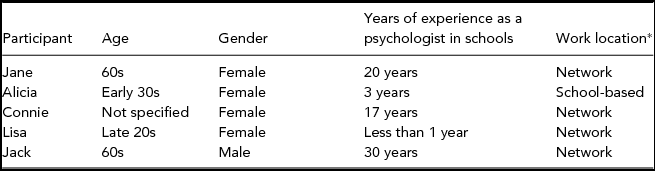
Interviews were conducted by the first author via telephone or face-to-face contact with five psychologists employed by the DET. Participants were currently working or had previously worked in state secondary schools within regional offices across Victoria. Of the five participants, four were female and one male, with the number of years of experience as a psychologist ranging from 4 to 30 years. The number of years participants worked as a psychologist in a school setting ranged from less than 1 year to 30 years. See Table 1 for participant demographics.
Participant Demographics

Note: *Psychologists were from regional and metro offices. Specific participant location was withheld to protect anonymity.
According to Willig (Reference Willig2013), semi-structured interviews provide insight into the ways in which people construct meaning around certain topics. An interview schedule was developed and used as guide for the semi-structured interviews conducted. The schedule included open-ended questions that were used as prompts to encourage participants to speak about their experiences of ethical practice in the school setting. Initial questions were more general (e.g., ‘What brought you to work as a school psychologist?’), and as rapport was established became more personal (e.g., ‘What ethical dilemmas do you most often experience in the school setting?’). Participants were allocated pseudonyms in the transcript and final reporting to ensure confidentiality. Participants were emailed a copy of their interview transcript to confer veracity.
Thematic analysis is suited to various epistemological perspectives, including social constructionism (Willig, Reference Willig2013). ‘Within a social constructionist framework’, we have previously stated, ‘our narratives actively help to create multiple realities and emerge from unique lived experiences’ (Kapoulitsas & Corcoran, Reference Kapoulitsas and Corcoran2015, p. 90). As such, we do not present the following interpretations as univocal. The first author collated data and identified themes in line with Braun and Clarke's (Reference Braun and Clarke2006) stages of thematic analysis. The six stages of thematic analysis were followed, including: familiarisation with the data set, generating initial codes, searching for themes, defining and naming identified themes, reviewing, and reporting on the themes. The analysis was also reviewed by the second author for consistency of categorisation. The following section details the five psychologists’ understanding of ethics in their practice within schools, particularly exploring supports and challenges to professional ethics when working across education systems. Two key themes emerged from the interviews: (1) legalities and ethics, and (2) peer support.
Legalities and Ethics
Participants primarily drew attention to legal issues when they conceptualised ethical practice within the school system. Jane trained in education and psychology and has worked in schools for more than 20 years as a teacher, principal, and psychologist. Jane highlighted the principal's position in relation to case note accessibility: ‘The principal has the legal responsibility for who sees these files, where the information goes, so if you're happy to do that and let people have access but you're legally liable’ (Line 274). Alicia, aged in her 30s, has been a school-based psychologist school for 3 years and she furthers the point regarding staff access to sensitive client information:
We just found out that our wellbeing notes can be accessed by the principal and the principal team so that makes it three people that can view these and so we were wondering (. . .) what impact that does have on who sees our notes and how much information we put in there? (Lines 277–308)
The principal team's access to Alicia's confidential wellbeing information raises legislative and ethical concerns potentially breaching the Privacy Act (1988), the Health Records Act (2001) and the APS Code of Ethics (2007). Issues regarding who among school staff has legitimate access to confidential information in turn holds ramifications for mandated reporting (see earlier distinctions regarding legal and professional responsibilities of school-based staff). Later in this section, Alicia elaborates on the difficulties she experiences in sourcing adequate discipline-specific supervision to address complex circumstances like these and the potential for psychologists to become isolated in their practice.
Given the emphasis placed on safeguarding confidential client information in psychological practice, it is not surprising that participants like Alicia highlighted access to records within schools as an issue of concern for school psychologists. Schools are becoming more multidisciplinary, and given this trend, it may be useful to reconsider how psychologists, and more broadly educational staff, understand the ethics of confidentiality so as to keep the promotion of student wellbeing central to psycho-educational practice. How education staff can simultaneously uphold and comply with various professional standards presents an ongoing challenge for all concerned. Incorrect interpretations of legislation by education administrators or principals, potentially allowing unrestricted access to confidential psychology files, has been questioned in previous research (Jacob-Timm, Reference Jacob-Timm1999; Jifkins & Thielking, Reference Jifkins and Thielking2010).
Alicia did refer to the legal responsibility of the principal and how this related to decision-making processes when making notifications to child protection: ‘We have a really good process where we make sure (. . .) we would never notify without the principal's knowledge so ultimately she signs off on everything’ (Lines 254–270). More generally, participants also spoke about their responsibility to report abuse to child protection agencies. When asked what issue presented most regularly regarding ethics deliberations, Jack stated:
I suppose the most common one is mandatory reporting in terms of abuse (. . .) we're not mandated but still feel obliged to and sometimes there's a difficulty with that where the school knows the family and I've had it in the past where school have been a bit reluctant to make a referral because they don't want to upset the family or they don't think it'll do much good. (Lines 241–248)
As mentioned earlier, according to legislation and AHPRA guidelines, Victorian psychologists are not legally mandated to report. However, as Jack's statement intimates, DET policies position all school-based staff reporting as an ‘ethical and moral obligation’ (DEECD, 2012, 2014) and, as such, psychologists may feel ethically compelled to address risks of harm.
Participant's statements illustrate how multiple factors appear to influence decision-making notifications within schools. Lisa illuminated the professional differences in reporting responsibilities of psychologists and teachers:
Given teachers are mandated if they've got any sort of suspicion or they've got any information suggesting something's not right, even just if they call and nothing happens, at least they've followed that responsibility whereas I guess I can sort of wait and gather more information depending on the circumstance. (Lines 556–557)
Psychologists can also be used as consultants by teaching staff:
Most schools have their mandatory reporting policy and teachers are mandated so sometimes it's a secondary consult about whether teachers should be making a report. (Jane, Lines 308–309)
Teachers are mandated to report whereas psychologists aren't so there are times when I have had information provided to me from teachers where I would sort of say as a mandated reporter I would advise you contact child protection but sometimes they have been a bit reluctant to call or they just want to have a discussion so I don't know how quick teachers are to call child protection given they are mandated reporters. (Lisa, Lines 497–506)
The interviewees drew attention to the psychologist's role within schools being one that involves consultation with teaching staff around ethical issues. This has been identified in previous research as a task psychologists often adopt (Branstetter, Reference Branstetter2012). Given this capacity, it is important to consider how psychologists might be distinguished from teachers in terms of knowledge around mandatory reporting and ethical issues. Base competencies that must be attained by intern or graduate psychologists in Victoria include distinct legal, ethical, and professional frameworks sourced from 6 years of formal education (Australian Psychology Accreditation Council, 2014). While teachers, educated over 4 years of accredited study, are required to be knowledgeable of their legal and ethical responsibilities in line with the teaching profession code of conduct (Victorian Institute of Teaching, 2014), Boon's (Reference Boon2011) research emphasises a need for the addition of formal ethics training, currently not part of the curriculum in Australian tertiary undergraduate education courses. Psychologists’ advanced and more comprehensive level of training may go some way to explaining differences that currently exist between professions.
Distinctions between psychologists and teachers’ role responsibilities raise further questions for schools and their communities; in particular, whether differences in mandatory reporting requirements hold concurrent implications for psychologist-teacher relationships in the school setting. For example, the ‘expertise’ bestowed on psychologists could, in effect, disempower teachers in the carriage of their responsibilities. To counter this possibility, it is important for all concerned to consider newly introduced legislation applicable to every adult in Victoria. The ‘Failure to disclose offence’ came into effect in October 2014 as part of the Crimes Amendment (Protection of Children) Act 2014. This legislation stipulates that it is a community-wide responsibility to report child sexual abuse. The legislation specifies that any adult who forms a ‘reasonable belief’ that a child has been sexually abused is mandated to report this and failure to comply carries a maximum penalty of 3 years imprisonment (Department of Justice, 2014). However, certain exemptions may apply to psychologists, such as if the client is over 16 years and requests confidentiality (Department of Justice, 2014). While departmental policies situate the reporting of abuse as an ethical requirement, legal directives apply beyond particular settings and can never be excluded from consideration.
While participants in this study duly reflected on the legal nature of their roles, they positioned themselves having primarily an ethical obligation to report concerns. Jack's account reported above resonates with this theme. Other participants stated: ‘(A)lthough we're not mandated it probably wouldn't affect my making a report’ (Jane, Lines 295–296); and ‘Notifications is always a grey area but I think for me the ethical side of it comes out the most’ (Alicia, Line 252).
Nevertheless, these reports accede that the legal nature of their role subsequently influences potential action. Participants conceptualised complex ethical issues as being influenced by legal responsibilities, school-related factors, policies, and legislation. The transcripts suggested participants felt less institutional pressure than their teaching colleagues but relief that legal responsibility fell on other professionals within the educational setting (e.g., principals).
Varied Peer Support
Each participant reported adopting collaborative approaches when providing support to students and school staff. From this area of discussion, participants viewed professional peer support as a crucial resource in working successfully within such partnerships. Of particular note was the importance placed on who was actually providing such support to the practitioner.
Terms used to describe the types of supervision psychologists may access varies. Peer consultation, peer group supervision, and peer supervision usually involve confidential discussions with senior psychology staff relating to ethical issues and reflective professional practice. Informal supervision has been reported as more favourable for urgent issues (Annan & Ryba, Reference Annan and Ryba2013). Formal professional supervision often involves connection with colleagues internal or external to their place of employment, usually with structured timeframes. Supervision serves to provide support, increase professional knowledge, and uphold professional practice standards. Despite its clear benefits, psychologists have reported limited access to supervision in the education sector (Thielking et al., Reference Thielking, Moore and Jimerson2006).
Participants each conveyed the value of having access to peer support and the potential for this contact to help moderate ethical dilemmas. The benefit of having regular access to peer support is evident in responses outlined below. Jane is based in a Student Support Services Officer (SSSO) network and recognised access to regular informal support within her team and externally: ‘I'm quite confident to ask and consult with any of the people here but I'd go to different people about different things so we've got a broad range of experience here’ (Lines 405–407). Outside of her own workplace, Jane could also access peripheral consultation with staff from the local Child and Adolescent Mental Health Service.
The following two excerpts highlighted differing experiences with psychologists working in multidisciplinary teams. As a school psychologist with over 17 years’ experience, Connie's account regarding support received within her team seemed positive:
I get most of my support from my colleagues and I know it's probably not the commonplace but I have a very supportive team where they're very professional and they make time and they're quite considerate so I work in an excellent team and I feel very supported. I know not all networks and not all practices work that way — some people are isolated. (Lines 523–527)
Connie, who also works in a SSSO service, has multiple connections to the network she worked in. The support she received from her colleagues had reportedly been essential in mitigating potential ethical challenges that she was presented with:
My kids go to one of the local primary schools that our network services so when I joined this network we had to look at how I would manage the conflict because I know some of the parents on a personal basis. (Lines 419–425)
For Alicia, the difference between being a school-based psychologist as opposed to one working across department networks influenced access to regular support from other psychologists. While Alicia worked alongside other professionals within the school setting, as she explains in the following excerpt, they were from different disciplines:
You've got the department psych [sic]. I think the psychologists at [name of school] that work within the [name of region] would have each other (. . .) I'm sure they get supervision (. . .) whereas here at the school it's a different story there's a wellbeing coordinator so there's always that person to bounce ideas off but for me is different being based at the school. (Lines 385–386, 386–388)
She then contemplates where potential issues may arise when distinction is not made between discipline-specific and managerial supervision:
I think that we're pretty much on the same page for the most of it but they have a different understanding around all the psych [sic] tests and the assessments and so making it clear that because they're not a psych [sic] that they can't be doing those tests. (Lines 392–394)
Two of the school-based psychologists involved in the study spoke of wanting greater access to peer support with other psychologists:
I personally feel like I would like supervision (. . .) previously because I had another psych [sic] as the wellbeing coordinator I was able to get that so I think it's up to me to go and source it if I need to it's not available (. . .) the department psych [sic] gives us that consultation but it's quite brief and I think I would like a bit more. (Alicia, Lines 402, 407)
Lisa, aged in her 20s, has worked as a school psychologist for less than a year. She previously worked in a child and adolescent mental health setting for approximately four years. She elaborated on her experience of peer support in both the education system and mental health setting. Lisa initially reflected on the frequency of contact she has with her supervisor:
I don't often see her so it's not like you're coming back to that office where all your colleagues are there so you can you know get assistance it's just less structured not to say less supportive but (. . .) you're working on your own it's a lot more independent this kind of work. (Lines 444–447)
Lisa made another comparison regarding the supportive environment she was a part of in her previous employment: ‘. . . this role is a lot more isolated. I don't work closely with many other psychologists. I have one who I see regularly but you are sort of on your own a lot working in unknown territory’ (Lines 502–504). Lisa and Alicia's responses align with Thielking et al.’s (Reference Thielking, Moore and Jimerson2006) research wherein psychologists reported inadequate access to supervision. This circumstance seemingly continues in present-day practice despite the APS (2013) recommendation that access to external supervision for psychologists should be supported financially by schools or education departments.
Recent research conducted by Eckersley and Deppeler (Reference Eckersley and Deppeler2013) with Victorian school psychologists has suggested that opportunities to work in a collaborative environment are the exception rather than the rule. This was echoed in responses given by participants in the current study where they reported experiences of isolation from the school community. It is important to note that while some practitioners may have less opportunity to access discipline-specific support, they still positioned themselves as ethical practitioners. Limited access to supervision does not suggest that psychologists working in isolation are less likely to practise in an ethical manner. Such circumstance does, however, provide less opportunity for psychologists to explore solutions to potential ethical issues.
Consultation is considered an important part of systemic ethical problem-solving models (Pope & Vasquez, Reference Pope and Vasquez2010). Jack, in his 60s, has worked as a psychologist and teacher in the education system for over 30 years and is experienced in supervising other psychologists. He, too, reflected on the importance of peer support: ‘I've been a supervisor for lots of people and part of their requirement is that they ask for support (. . .) that's part of their ethical requirements’ (Lines 171–180). He further elaborated on the availability of peer support and the benefits on ethical practice:
You get the chance to discuss difficult situations or to support each other and I think that's very important especially for the less experienced people (. . .) I know a lot of psychologists have to pay for supervision when they're in private capacity. We don't have to do that. We don't get the supervision that we used to or the training that we used to but there's still the team meetings and things that can be very supportive. (Lines 343–351)
As a profession, psychology places importance on peer support that provides continued opportunity to critically reflect on professional practice and ethical challenges (APS, 2016). This standard was supported by participants in this study, who recognise collaboration as facilitative of ethical practice providing them with opportunities to talk through issues they experience. Situating ethical practice as a collaborative process serves to broaden notions informing ethical responsibility, extending these beyond the lone and solitary practitioner. Ethical decision-making models (e.g., see Pope & Vasquez, Reference Pope and Vasquez2010) can assist practitioners in safeguarding against potential traps and provide a framework for working through complex ethical issues where conflicting values, ethical standards, and legislation exist.
Conclusions
This research demonstrates how ethical considerations in practice move beyond individual school psychology practitioners to engage more complex dynamics that exist at relational and organisational levels shaped by legislation, policy, and socio-political practices. Reflections on the intersection between ethics and the law helped to unpack challenges associated with identifying and responding to various presenting risks, an issue that promotes uncertainty for all school staff, psychologists included. The psychologists in this study ultimately positioned themselves as ethical practitioners despite the challenges and barriers they have experienced.
Professionally supportive relationships, in particular with other psychologists, were highly valued by the study's participants and reportedly conducive to creating environments that promote ethical practice. Given past research recognises that psychologists’ work within schools can be an isolating experience (Eckersley & Deppeler, Reference Eckersley and Deppeler2013), systemic practices that ensure supportive structures should be favoured; for example, access to regular internal or external supervision, and peer support by psychologists across schools and networks. To circumvent professional isolation, alternatives to face-to-face support should continue to be explored; see, for example, Annan and Ryba's (Reference Annan and Ryba2013) New Zealand-based study exploring less traditional forms of supervision such as social and literary supervision. Also, given the ambiguity at times associated with ethics and working within the school setting, it is essential to consider how newly graduated workers within the field are both oriented to and offered ongoing support.
Limitations of the Research
The research reported here was completed for a postgraduate psychology program, and due to the time restraints involved, relatively small in scale. The purposive sample was limited to psychologists employed in the state education system, concentrating attention to government policies and legislation. Additional research into psychologists’ ethical practice, from across education sectors (e.g., independent and Catholic) in Victoria and Australia, as well as internationally, is required. This would allow further exploration and comparison of how psychologists account for, or make meaning of, ethical practice around the country and globe.
This research explored how ethical practice is understood by a group of Victorian school psychologists employed in and across state secondary education systems. As well as highlighting various intersections between ethics and legal responsibilities, participants reported collaborative work practices and peer support as central themes. Situated within a social constructionist's purview, our critical analyses of language used by practitioners provides a baseline to explore psychologists’ interpretations in relation to legislation and policies. Continued discursive examination of psychologists’ accounts, organisational complexities and standards offers important avenues for future research.
Acknowledgments
The authors would like to acknowledge the support of the Victoria Department of Education and Training.
Financial Support
This research received no specific grant from any funding agency, commercial, or not-for-profit sectors.
Conflicts of Interest
None.
Ethical Standards
The authors assert that all procedures contributing to this work comply with the ethical standards of the relevant national and institutional committees on human experimentation and with the Helsinki Declaration of 1975, as revised in 2008.