Infection and colonization with multidrug-resistant organisms (MDROs) is common among residents of long-term care facilities (LTCFs).Reference Cassone and Mody1-Reference McKinnell, Singh and Miller3 Contamination of surfaces and medical equipment with MDROs and other pathogens within LTCFs occurs relatively frequentlyReference Jinadatha, Quezada, Huber, Williams, Zeber and Copeland4,Reference Murphy, Eells and Quan5 and may contribute to the transmission of and infection with these organisms. The emerging pathogens Candida auris and carbapenem-resistant Enterobacteriaceae (CRE) are prevalent in LTCFs in Brooklyn and Queens, New York.Reference Adams, Quinn and Tsay6,Reference Prasad, Labaze and Kopacz7 Previous consultative and regulatory visits to these facilities by the New York State Department of Health (NYSDOH) identified opportunities to improve basic infection control practices, including environmental cleaning and disinfection. We hypothesized that participation in a quality improvement initiative that included training, resources, and a forum to share best practices and challenges would improve the thoroughness of cleaning (TOC) at participating facilities. The objectives of the initiative were (1) to improve environmental cleaning and disinfection practices in LTCFs, (2) to identify best practices within these facilities, and (3) to characterize challenges and barriers related to cleaning and disinfection.
Methods
All LTCFs in Brooklyn and Queens, New York, were invited to participate in a 3-month quality improvement initiative coordinated by NYSDOH and the Greater New York Hospital Association (GNYHA). Participating facilities were expected to complete a questionnaire on current cleaning and disinfection practices, to attend an in-person training session, to join 3 follow-up conference calls, and to perform 2 assessments of TOC using a fluorescent marking system (Glo Germ Company, Moab, Utah).
For assessment of TOC, participants received hands-on training on use of the fluorescent marking system during the in-person training session, and they were given the necessary supplies. Assessments were to be conducted by an infection preventionist, nursing leader, or environmental services supervisor or director. In total, 12 high-touch surfaces (HTS) were identified for assessment of TOC following daily and/or discharge cleaning across a sample of rooms. Facilities were allowed to select the specific rooms to be evaluated and to choose among the 12 designated HTS for sampling within each room. “Thorough cleaning” was defined as complete removal of the fluorescent mark. Findings were entered into a standardized electronic data collection form. Collected data were sent to GNYHA where results were summarized. Facilities received reports that contained their data and data for all facilities combined. Facility leaders were expected to share the results of the first assessment with frontline environmental services workers (ESWs) for education and training purposes prior to the second assessment. Differences between the 2 assessments of daily and discharge cleaning were evaluated using the Wilcoxon-Mann-Whitney test. Only facilities reporting data for daily cleaning and/or discharge cleaning during both assessment periods were included in the analyses.
Participants were provided with educational materials and technical support from NYSDOH, GNYHA, and a physician consultant with expertise in infectious diseases and healthcare epidemiology. In addition, 5 facilities were selected to receive a consultative and educational site visit by the physician consultant and a GNYHA project coordinator. Sites were selected from among 36 that indicated interest in such a visit based on NYSDOH statistics, known resources, and perceived need for assistance. The purposes of the site visits were to assess current practices and challenges, provide consultative advice, and provide education to frontline ESWs and nursing personnel. Assessments were conducted via facility tours, conversations with facility leaders and frontline personnel, and review of cleaning and disinfection products and procedures. The educational presentation described risks and mechanisms of pathogen transmission, the role of environmental cleaning and disinfection in LTCF safety, and important cleaning and disinfection concepts (eg, HTS, contact time).
Results
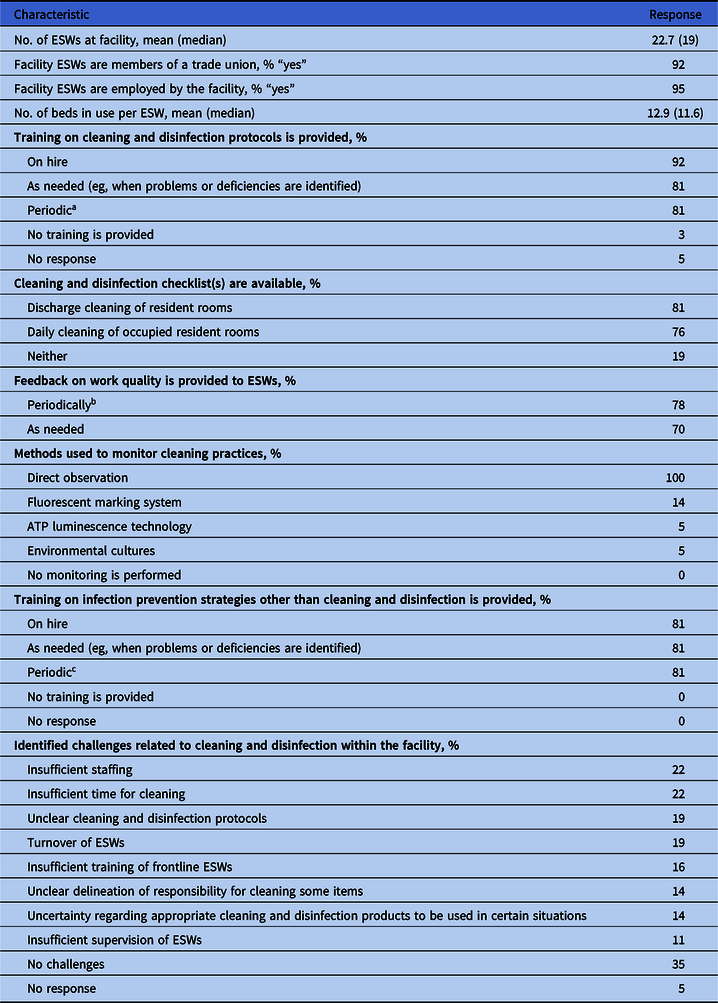
Among 106 eligible LTCF, 48 (45%) enrolled in the project. At least 1 person from 38 LTCFs (79%) attended the in-person meeting in May 2018. Overall, representatives from 37 LCTFs (77%) completed the survey of baseline characteristics. Characteristics of the participating LTCFs are shown in Table 1. The 3 subsequent conference calls were attended by 29, 27, and 24 participants, respectively. Moreover, 19 and 22 facilities were represented in the first and second calls, respectively. Data regarding the number of facilities represented during the third call were not available.
Baseline Characteristics of Participating Long-Term Care Facilities (n=37)

Note. ESW, environmental services workers; ATP, adenosine triphosphate.
a Frequency of periodic training on cleaning and disinfection protocols (n=30): annually 47%, quarterly 13%, monthly 7%, no response 27%. An additional 7% of respondents wrote in “weekly” as the frequency of training.
b Frequency of feedback on work quality (n=29): annually 45%, quarterly 7%, monthly 14%, weekly 21%, daily 7%, “other” 3%, no response 3%.
c Frequency of periodic training on infection prevention strategies other than cleaning and disinfection (n=30): annually 43%, quarterly 10%, monthly 10%, no response 23%. Additionally, 7% of respondents wrote in “semi-annually,” 3% wrote in “weekly,” and 3% wrote in “daily” as the frequency of training.
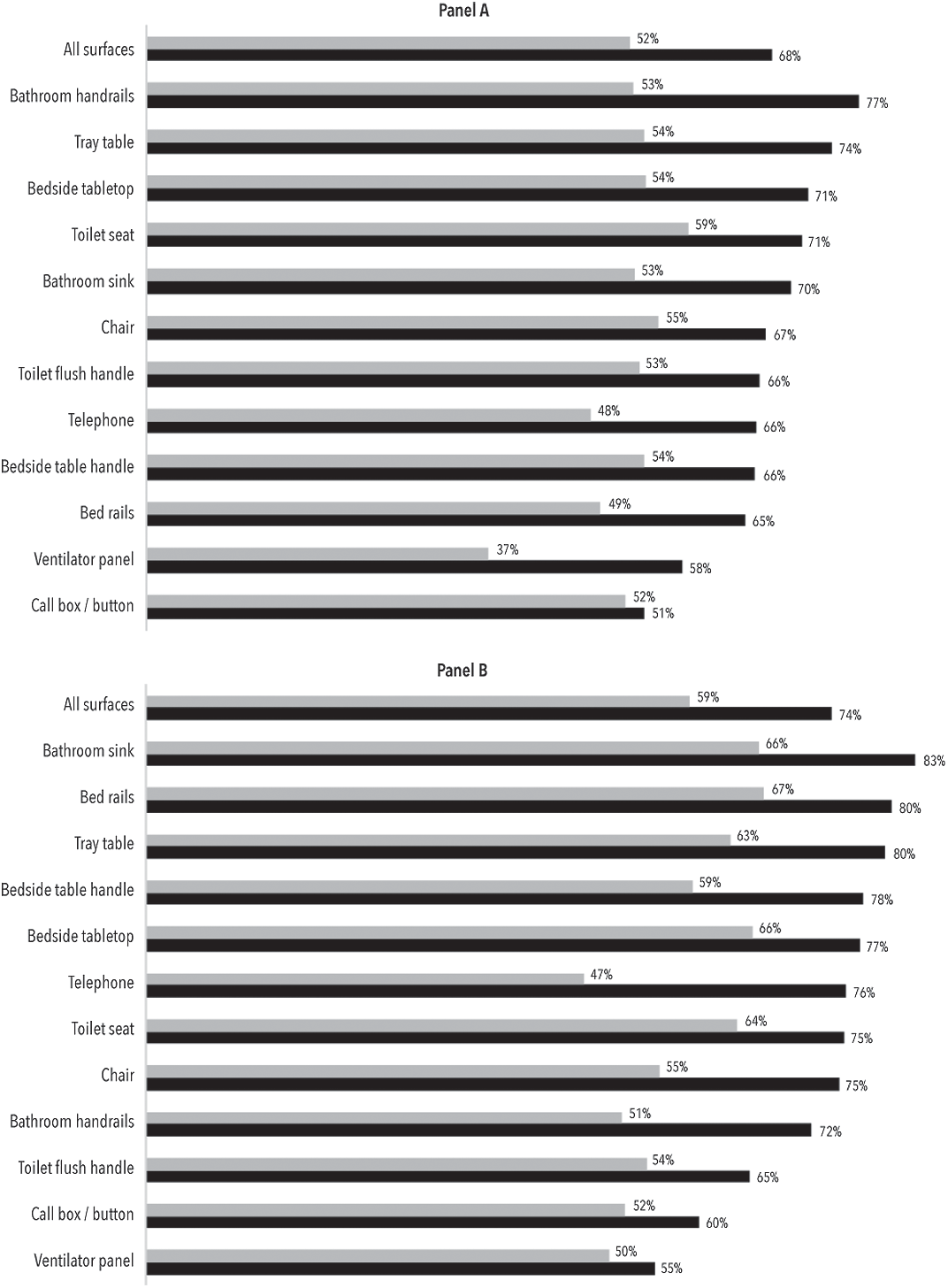
The TOC assessments were conducted in May and June 2018, during which 32 facilities assessed the TOC of 11,151 HTSs. Of these assessments, 8,418 (75%) were reported by facilities that submitted data during both rounds of data collection. Furthermore, 16 LTCFs submitted 2 rounds of TOC data collected in association with daily cleaning of occupied rooms, and 11 LTCF submitted 2 rounds of discharge cleaning TOC data. Overall, the percentage of HTSs that were thoroughly cleaned during daily cleaning increased from 52% to 68% (a 29% relative increase; P < .0001). For discharge cleaning, we observed a 26% relative increase in thoroughly cleaned HTSs (74% vs 59%; P < .01). The TOC varied substantially among individual HTSs (Fig. 1) and LTCFs. Among LTCFs, thorough daily cleaning ranged from 6% to 100% and from 28% to 100% during the first and second rounds of data collection, respectively. For discharge cleaning, rates of thorough cleaning ranged from 11% to 91% and from 41% to 100% during the first and second rounds, respectively.
Percentage of high-touch surfaces (HTSs) determined to be clean after routine daily cleaning (panel A) and discharge or terminal cleaning (panel B) in long-term care facilities (LTCFs). Data are displayed for all HTSs combined and for each individual HTS. Light gray bars represent the findings from the first assessment of the thoroughness of cleaning. Black bars represent the findings of the second assessment. Overall, 16 LTCFs submitted data on daily cleaning and 11 LTCFs submitted data on discharge cleaning during both assessment periods.

Commonly encountered challenges identified during the 5 site visits included (1) lack of knowledge among ESWs and clinical staff regarding required contact time for disinfectants used in the facility, (2) poor delineation and awareness of responsibility for cleaning and disinfection of medical equipment, (3) clutter in resident rooms that precluded thorough cleaning, (4) tears in furniture coverings and furnishings/fixtures that were difficult to clean (eg, chipped wood and paint, crevices), and (5) demanding, often unrealistic, workloads for ESWs. In addition, some “best practices” were identified, including (1) systems to allow personnel to easily distinguish clean from dirty equipment (eg, bagging clean ventilators), (2) use of disposable blood pressure cuffs and dedicated sphygmomanometers for residents colonized with C. auris, (3) prominent display of contact precautions signage with visual aids, and (4) frequent interdepartmental communications regarding residents on contact precautions.
Discussion
Most LTCFs (84%) that participated in this initiative were able to perform at least 1 assessment of the thoroughness of environmental cleaning. Among the smaller group of participants that submitted data from 2 assessments, the overall TOC appeared to improve during the project period. These findings suggest that regional initiatives that provide technical support, educational materials, and opportunities to share and discuss challenges and best practices may contribute to reductions in the risk of pathogen transmission in LTCFs. Although these findings are encouraging, several limitations must be acknowledged. The project period was brief, and a relatively large proportion of participants did not submit TOC data for both assessment periods. The accuracy and validity of TOC data were not independently confirmed. The sample size was inadequate to assess changes within facilities and among individual HTS. Finally, the project did not assess the effect of improvements in TOC on pathogen transmission.
In addition to the observed engagement and improvements, we identified several challenges and barriers common among participating LTCFs. These challenges may prevent improvement in some facilities, limit the degree to which improvements can be made, or increase the likelihood that improvements will not be sustained. Future research and quality improvement efforts are needed to minimize the risk introduced by environmental contamination in LTCFs. Key factors to be addressed include enhancing engagement, identifying and reducing barriers within individual facilities, providing longer-term assistance and support, optimizing sustainability of improvements (eg, through ongoing education, monitoring, and feedback), and finally, evaluating the impact of improvements in cleaning and disinfection on pathogen transmission and infection.
Acknowledgments
The authors thank the participating facilities for their efforts.
Financial support
This study was supported by the Council of State and Territorial Epidemiologists (CSTE) Antibiotic Resistance Containment Project Funding Opportunity (grant no. 1U38 OT000143-04).
Conflicts of interest
All authors report no conflicts of interest relevant to this article.