While authenticity as a philosophical concept has long been used to structure debate on individual identity, in more contemporary parlance authenticity has been additionally used to assess anything from participants in reality TV shows to social media postings. Authenticity's wide deployment has meant academia has engaged the concept in a diverse range of fields, notably tourism studies, performance studies and identity studies, but also increasingly in the area of cultural authenticity, especially in a collective sense.Footnote 1 This article builds on this latter field of cultural authenticity by extending thinking on authenticity as it relates to ethnicity. As the backdrop of this analysis, I examine reviews of Robert Wilson's stage play I La Galigo, a production that draws on the mythological Bugis epic La Galigo.Footnote 2
For readers with a background and interest in Indonesia, the article will be of value in its assessment of the recreation and reification of ethnic identity; for readers versed in performance studies, the article offers insight into the ways in which reviews and critique structure discourse around visual displays of origin narratives; for readers with an interest in authenticity, the article examines recent theorisation to tangibly show how the trope is deployed to serve various ends — from promoting a singular view of subjects to embracing cultural hybridity.
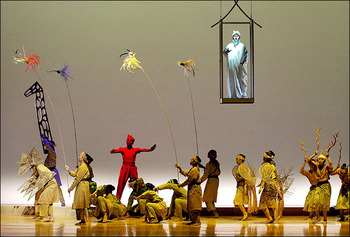
The subject of this article is the performance piece I La Galigo, which is based on La Galigo. La Galigo is an origin narrative of the Bugis — an ethnic group numbering around five million people in South Sulawesi, Indonesia — which describes the founding of Middle Earth, the place where the offspring of the gods descended to live as humans. In 2004, Robert Wilson's stage play, based on this narrative, debuted in Singapore, before being staged throughout Europe, the United States, and Australia (Fig. 1). It was not until 2011 that the play was finally staged in South Sulawesi.Footnote 3 More details concerning the production's genealogy are given in the following sections. Wilson's production received both acclaim and critique and many reviews focused on Wilson's ability to create an authentic representation of Bugis identity and envisaged past. That authenticity became a central measure of the production's success speaks to the importance placed on authenticity in both media studies and everyday public discourse. In what follows, I use reviews of Wilson's production as a site for analysis of authenticity.Footnote 4
Still photo from the stage play I La Galigo. (Permission to use kindly granted by The Bali Purnati Center for the Arts and Change Performing Art)

In analysing notions of authenticity this article is divided into four substantive sections. First, I introduce the La Galigo epic. La Galigo (Sure' Galigo or Sureq Galigo) is the term used to describe the origin narrative, while I La Galigo is the name of the stage play, and also the name of the central protagonist in the epic. Second, I turn to an analysis of reviews of Wilson's theatrical production. Some reviews centre on aspects such as lighting or the execution of dance pieces, but many focus their review on the degree of authenticity achieved. Third, I explore notions of ethnicity, identity and Indonesian nation-building as they intersect with the trope of authenticity. In the final substantive section I frame the concept of authenticity by presenting a short historical overview of the development of the term, and analyse recent theoretical innovations concerning authenticity, primarily in the work of Marcus Banks, Charles Lindholm and Dimitrios Theodossopoulos. The article concludes by showing that while for many Bugis and non-Bugis theatre reviewers and commentators, there is and should be a singular definable Bugis identity, for others, Bugis identity is always already a mix of different global influences. It is this latter awareness of the dynamic nature of authenticity that resonates with theoretical insights embracing cultural flux in analyses of authenticity.Footnote 5
The Bugis and La Galigo
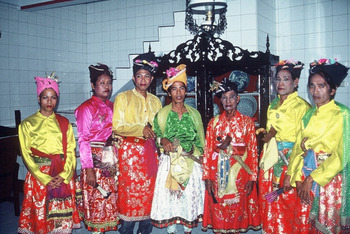
Heavenly deities, ocean-dwelling rulers and androgynous beings permeate the mythological past of Bugis South Sulawesi. Stories tell of great trees refusing to be chopped down, deities moving between upper and lower worlds, love-making, and epic battles won by bissu whose weaponry is invincible. Bissu are an order of androgynous shamans, conceptualised as being half-female and half-male, who first descended to earth during mythological Bugis times. Bissu occupied key roles within Bugis royal courts for many generations, advising rulers about such things as when to go to war and with whom to trade. To this day bissu continue to play a (limited) spiritual role within Bugis society and have close links to the Bugis origin narrative La Galigo (see Fig. 2). Bissu are seen as entwined with La Galigo both because they are mentioned in the narratives and because many bissu are in possession of La Galigo manuscripts that they can fluently read.
Bissu dressed in their regalia, with Puang Matoa Saidi centre. (Photo taken by author)

La Galigo is so named after one of its main protagonists, I La Galigo. According to Sirtjo Koolhof, La Galigo:
consists of a scattered collection of manuscripts and oral stories, which all share the same characteristics that distinguish them from other literary genres: they are composed in an elaborate flowery language (usually called Old Bugis), with an abundant use of formulas, parallelisms, and a strict pentasyllabic meter. Furthermore they all confine themselves to the adventures of protagonists who belong to the first six generations of human beings on earth, all descendants of the gods in the Upper- and Underworld.Footnote 6
Mattulada refers to La Galigo as ‘a reference book dealing with the social and cultural background of South Sulawesi people’.Footnote 7 For Northrop Frye, narratives such as those contained in La Galigo tell a society what things are important for people to know, ‘whether about its gods, its history, its laws, or its class structure’.Footnote 8 La Galigo might then be regarded as what Eric HavelockFootnote 9 calls a ‘tribal encyclopaedia’ that ‘provided a massive repository of useful knowledge, a sort of encyclopaedia of ethics, politics, history and technology’.Footnote 10 Koolhof remarks, however, that La Galigo does more than contain knowledge, ‘it portrays the very origin of their ancestors and their ancestral customs. Regardless of whether this is a realistic depiction of the situation in the past, for [many] Bugis it is at least how it should have been, and in many respects still should be’.Footnote 11 The historical reality of the period referred to in La Galigo, though, has been trenchantly deconstructed through historical and archaeological fieldwork.Footnote 12
Whether from memory or from reading manuscripts, the recounting of La Galigo narratives serves a number of purposes. First and foremost, its recitation constitutes a form of entertainment. I remember early on in my fieldwork in the late 1990s, falling asleep in a bed I shared with my host-sisters listening to grand tales of Bugis characters undertaking heroic challenges. One story I clearly remember concerned princess Wé Cudai' preparing herself to meet her future husband by spending hours brushing her hair and making sure her baju bodo (long silk blouse) was perfectly arranged. Second, the telling of such narratives is a way of providing continuity to contemporary life by providing a link with the past. For instance, my host-sisters and I were applauded when we acted in ways considered ma lebbi (demure) and compared with princess Wé Cudai' and her sister-in-law Wé Ténriabéng. Providing such links may give people a sense of place and a feeling of pride about their origins, sentiments that are promoted not just by individuals, but also by local and state governments keen to encourage a sense of community. Third, recitations are pedagogical. For example, ideals of male assertiveness and bravery are reinforced through narratives where the central protagonists travel far away to make their fortune.Footnote 13 Fourth, narratives are recalled in various ways to speak to contemporary issues, such as on matters related to gender.Footnote 14 For instance, one recorded narrative that forms part of the La Galigo collection tells of the first time the parents of I La Galigo, Wé Cudai' and her husband Sawérigading, make love face-to-face, suggesting, in this version at least, that women be sexually assertive:
Sawérigading, dizzy from palm wine, drowsy from drink, could no longer control his desire and swept up his wife and carried her into her room and laid her down within the curtains of her bed. They embraced each other and exchanged sirih leaves from each other's mouths. She floated on his broad chest and he stroked her tenderly, the way he would stroke a fighting cock. She wrapped herself around him like thread around a spool. He lifted her to the Upper World and they sank to the bottom of the Underworld. Their bodies fitted together like a pot with a perfect lid. Sawérigading spent the whole night caressing his wife. Wé Cudai' was already very skilled at celebrating within the curtains. Like a fighting cock, Wé Cudai' was already an expert at the attack in the little chamber within the bed curtains. She was no longer embarrassed to attack over and over inside the silken sarong.Footnote 15
A surprising abundance of La Galigo manuscripts survive scattered throughout Sulawesi and elsewhere. While there is no single author of La Galigo, and as Campbell Macknight astutely points out, it is misconceived to talk about the ‘length’ of La Galigo as it was never envisaged as a collective work,Footnote 16 if all scattered episodes were compiled they would consist of 300,000 lines, longer even than the Mahabharata.Footnote 17 Indeed Jennifer Lindsay notes that the phrase ‘longer than the Mahabharata’ has become a mantra, part of the vocabulary of La Galigo itself.Footnote 18
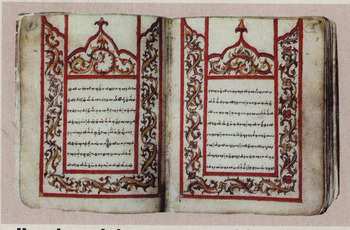
Rudolph A. Kern laid down the basis for analysing this material, publishing over 1,356 pages of summaries of some 31,500 pages from 113 manuscripts.Footnote 19 Numerous other scholars have also made contributions to the collection, transcription, translation, analysis and dissemination of segments from La Galigo.Footnote 20 There has also been work on the visual design of La Galigo (Fig. 3).Footnote 21
Text written in Bugis script. (Permission to use kindly granted by Wikipedia Commons)

While La Galigo was never ‘composed’, various dates have been suggested for when it began to take shape. Ambo Enre and Christian Pelras argue that La Galigo began orally around the mid-fourteenth century.Footnote 22 Johan Nyompa suggests the ninth or tenth century, a date similar to that of the Old Javanese Ramayana, as the time of its conception.Footnote 23 Koolhof, however, asserts, ‘The manuscripts extant today are no older than approximately two centuries, and the majority of them are no older than 100–150 years. The oldest dateable La Galigo manuscript is kept in the Stads-of Athenaeumbibliotheek, Deventer and was obtained in 1784.’Footnote 24 Macknight also doubts that much was written down before 1700 and comments that most manuscript texts are probably newer.Footnote 25 Indeed, some of the episodes involve the hero Sawérigading going to MeccaFootnote 26 and the dead being buried rather than cremated,Footnote 27 both of which suggest that Islam was already influential in Sulawesi (the earliest evidence of Islam in Sulawesi is the early seventeenth century).
There is a long tradition of writing in South Sulawesi, however, predating the coming of Islam. Writing was adopted in South Sulawesi as early as the fifteenth century,Footnote 28 with Noorduyn noting that indigenous documents indicate that substantive writing began sometime within three decades after the year 1511.Footnote 29 Thomas Hunter suggests, though, that the Bugis script might have already been in use by the tenth century.Footnote 30 Macknight and Cummings examine the process of moving from an oral form of expression to writing extensive compositions within the context of South Sulawesi.Footnote 31 As William Cummings notes, there was no clear transition from orality to literacy, but rather there was continual overlap, symbiosis and exchanges that characterised the boundary between these forms of information.Footnote 32 Some texts were composed orally while others were preserved or performed orally, or a mix of all of these. Often there was no direct relationship between oral and written histories and they ‘addressed each other from a careful distance, held in tension through an ongoing counterplay of assertion and denial as each sought the upper hand’.Footnote 33 Cummings further observes that a power play existed between those who controlled the production and dissemination of history and those who did not.Footnote 34 Historical narratives thus gained meaning and exerted an influence on the shape of events as desired by those in power. As a result, discourses about the past are imbricated in all manner of contested social relationships, hierarchies and rivalries, resulting in the past being used to respond to present social tensions. Indeed, Koolhof shows how elites modified Bugis manuscripts such as La Galigo to suit contemporary needs, rather than vice versa.Footnote 35
Bugis manuscripts are often stored in the homes of high-ranking nobles. Puang Petta Bala Sari, who was the highest-ranking woman in the Bugis regency of Wajo', compiled a large collection of manuscripts that she kept stored under lock and key in a metal filing cabinet at the back of her house compound. These manuscripts were rarely accessed though, and since her passing in 2003 relatives I spoke with said the material has been scattered throughout Sulawesi. Not only are there relatively few people who can fluently read the Bugis script in which such manuscripts are written, but the scripts themselves are considered by many sacred items. Puang Sari's possession of these manuscripts was a potent symbol of her status; to affirm their sacristy she would only let people see the manuscripts after prayers were recited and incense was lit. All of the manuscripts were originally written only in Bugis script and her ability to fluently read them, combined with the ritual of reading, added a sense of mystique to her possession of them. A number of microfilms are also stored outside Sulawesi, namely in Jakarta, Canberra and Leiden, largely the result of a project jointly funded by Hassanudin University in Makassar and the Ford Foundation. At present, Leiden in the Netherlands holds the longest coherent fragment of these manuscripts, with 12 parts constituting the initial sequence of the Bugis creation myth.
Discourses of Robert Wilson's I La Galigo
While in South Sulawesi in the late 1990s filming a documentary about bissu shamans, Rhoda Grauer heard numerous tales recounted from the La Galigo epic and was inspired to conceive of a theatrical production based on these narratives.Footnote 36 Grauer, who was living in Bali, discussed her ideas with Restu I. Kusumaningrum, director of the Bali Purnati Center for the Arts. Both Grauer and Kusumaningrum admired the work of avant-garde stage director Robert Wilson and were thrilled when he agreed to become involved in the project. Kusumaningrum had worked with Wilson previously. Through their collaboration, and in consultation with Bugis cultural experts and Indonesian musicians, artists, and dancers, a three-and-a-half hour stage production was developed. Interestingly, though, while the website of Change Performing Arts (an independent production company based in Milan under whose auspices the production was funded) includes a long list of production credits, not one of the cultural experts or Bugis contributors are mentioned.
In discussing his ambitions for the production, Wilson spoke of enjoying working with
an epic of this scale because the memory of the heroes is still present in the people of the village. It is a surreal world but yet it is real. The eyes and the hands of the performers become a concrete translation — with the colours, the sounds, the whispers, the perfumes — of the mystery and the divine. It is sensuality and beauty. There are very modern themes in the myth but the spectacle is mainly about the explosion of creativity. It is images, dance and music. The words are few: they are in the chant of the Bissu priest, the one who holds the secrets of the oral tradition of Sureq Galigo which guides the events between the sky and the earth.Footnote 37
Wilson's desire to provide a concrete translation and capture the secrets of the oral tradition of La Galigo suggest a desire to authentically recreate and perform the past in the present.
An entire discourse has developed around La Galigo since Wilson's stage production. Lindsay outlines many of the key themes of this discourse stressed in both pre-production publicity and in subsequent reviews.Footnote 38 These themes include: the length of La Galigo (it is longer even than the Mahabharata); its antiquity (it is a pre-Islamic epic that relates to the sacred world of ancient Bugis rituals); notions of loss, obscurity and threat (the epic and the world of bissu were almost lost and forgotten); and discovery and salvation (the epic was rediscovered and brought to the world's attention by foreigners who recognised the true value of the epic).
Since its 2004 debut in Singapore, the I La Galigo production has received no less than 25 reviews and scholarly responses.Footnote 39 The production received much critical acclaim, but it also met with disapproval and opposition.Footnote 40 On a national level, Indonesian embassy personnel abroad felt sidelined as they were not ‘formally contacted to facilitate the tour as a “cultural mission” from Indonesia’.Footnote 41 Indonesia's Intellectual Property Society questioned the legality of the production as Indonesian copyright law dictates that reproductions of cultural material outside Indonesia require official state permission.Footnote 42 While copyright and ownership are not necessarily concepts compatible with La Galigo material,Footnote 43 this appropriation shows how intangible cultural expressions are re-scripted as national intellectual and cultural property.Footnote 44 During a research trip to South Sulawesi in 2007 people I spoke with complained that Bugis people were not properly consulted; they also believed that any Bugis consultants who were hired were underpaid for their efforts.
A persistent central concern of reviews and commentary, though, is the degree to which the production authentically represented Bugis culture and history. Such concern assumes, of course, that there is an authentic Bugis culture, history, and even an authentic Bugis person. This is of concern for Indonesians (including Bugis) and Westerners alike, although all in diverse ways. In one cutting review by Una Chaudhuri, Professor of Drama at New York University, the play was devoid of any ‘authentic performance of Bugis tradition’ and came ‘perilously close to the ethnographic floor shows presented at Bali's tourist resorts’.Footnote 45 The length of the article did not provide space to explore why ethnographic floor shows are undesirable. The following review by New York Times columnist Edward Rothstein, posits that there was an authentic Bugis culture, but that it is now near-vanished even though the people who created it remain prominent:
This epic, with its tales of six generations of gods and its focus on the fate of the Middle World — our own — thus offers the mythological and ritualistic thinking of a near-vanished culture, even though the people who created it, the Bugis, numbering 5 million, remain prominent on the Indonesian island of South Sulawesi, and still invoke the folk wisdom and ritualistic instruction of the stories. The drama's transvestite priests, known as Bissu, who are supposed to be invulnerable and play a central guiding role in the epic, still exist, but they, too, are only shadows of their former selves.Footnote 46
While this reviewer might be forgiven for claiming that South Sulawesi is an island, whereas in fact it is a province on the island of Sulawesi, the claims that firstly, contemporary Bugis culture is in some way easily definable and distinct from past Bugis culture and, secondly, that the latter is ‘near-vanished’, are harder to forgive. Yet Rothstein is not alone in making sensationalist claims about lost Bugis culture. For instance, also writing for the New York Times, Wayne Arnold suggests that Bugis culture is subjugated and nearly forgotten; one is left wondering by whom:
Subjugated and nearly forgotten, however, are the cultures of dozens of other indigenous ethnic groups from around the archipelago, including that of the Bugis from Sulawesi island.Footnote 47
Helen Shaw, contributor to the New York Sun, also notes this imminent vanishing:
Mr. Saidi is himself one of the vanishing Bissu priests, one of perhaps 50 people alive who can still read the archaic Indonesian language.Footnote 48
The framing of Bugis culture, including La Galigo and bissu, as ‘near-vanished’ and ‘nearly forgotten’ leads into another theme of the reviews, the (re)discovery of Bugis culture, including for Carla Bianpoen, correspondent for the Jakarta Post, an exploration of ‘music that had almost disappeared’.Footnote 49 Indeed, in the review by Rothstein the production is explicitly framed as an effort at exhumation:
So this three-hour work, which had its world premiere last year in Singapore and has been performed in Europe, is, to a certain extent, an effort at exhumation and resurrection, trying to bring back to life something nearly lost. One of the few remaining Bissu priests, Puang Matoa Saidi, sat on the stage all evening, offering his blessings, chanting narration and turning pages in a text, as if testifying both to the epic's survival and to its vulnerability.Footnote 50
The person largely attributed with the resurrection is Rhoda Grauer, who for Arnold is ‘the American documentary filmmaker who more or less rediscovered Galigo’:
Ms. Grauer, a native of Poughkeepsie, N.Y., who moved to Bali in 1997, stumbled on the Galigo epic while in Sulawesi researching Buginese traditions. Among her surprising discoveries was that there were surviving members of the Bissu priesthood, a group chosen largely from the Bugis transvestite community, who were traditionally advisers to the Bugis royalty.Footnote 51
Indeed Grauer's documentary on bissu is entitled The Last Bissu: Sacred transvestites of Sureq Galigo,Footnote 52 reinforcing the idea that bissu are near extinction and thus in need of a saviour, a role Grauer is presented as playing:
I couldn't believe that there could be such an amazing story, so beautifully written so long ago, longer than the world's great epics text [sic], that was still virtually unknown to the world outside of South Sulawesi … When I learned that there were fewer than a hundred people alive who still read and understood the manuscripts, I thought something had to be done!Footnote 53
It is unclear where this statistic of 100 readers (or the earlier 50) of Bugis script comes from, especially as the script and language are taught in schools in South Sulawesi, but the number is reproduced in other reviews:
This doesn't make the drama itself any less strange, for it was adapted by Rhoda Grauer from a 6,000-page sacred epic, Sureq Galigo, written between the 13th and 15th centuries in an Indonesian language that can now be read by no more than 100 people.Footnote 54
Presenting La Galigo as being rediscovered seeks to affirm that the production was based on an original and uncontaminated source. La Galigo's seclusion is understood to have preserved its purity. This purity is linked with the idea of authenticity: the source was unadulterated and because Wilson took a hands-off approach and allowed indigenous performers (who are inherently authentic) to sculpt the production in a way that faithfully resembles an original, authenticity was achieved. Lindsay, a leading scholar of Indonesian culture, performing arts, and literature, writes that audience members noted that they were expecting to see an authentic recreation of La Galigo; what they wanted was a production that was purely Bugis; a production with only Bugis actors, musicians, and music.Footnote 55 So the first way in which reviews engage with the trope of authenticity is by presenting I La Galigo as based on an uncontaminated Bugis epic that was rediscovered in its pure, authentic, form by a foreign other.
While many reviews present Grauer in the role of saviour, reviews are also at pains to stress local involvement in the production, constituting the second way in which reviews employ the trope of authenticity. For instance, Shaw presents Wilson as being very hands-off:
Fortunately, ‘I La Galigo’, outside of its clap-on, clap-off design, actually has very little to do with Robert Wilson, per se. Certainly, his characteristic gestures — sleek set pieces, slow, stylized parades — are here. But as his director's note confirms, he has simply provided a frame for 50-plus Indonesian artists to ply their trade.Footnote 56
In Shaw's review the authenticity of the production is achieved precisely because Wilson is hands-off and thus enables the Indonesian artists who, by virtue of being Indonesian, imbue the production with a tangible, creative heritage. Indeed, Grauer was adamant that the cast be composed of Indonesians, suggesting that foreign actors would detract from the authenticity of the production:
Another obstacle came when Wilson and the Change Performing Arts suggested an international cast, as they were used to. But Restu and Grauer held firm, and Wilson as well as Change immediately understood the significance and artistic value of an all-Indonesian cast, Indonesian assistants to the technical experts, Indonesian-made cloth for the costumes, even Indonesian products for make-up.Footnote 57
While there is stress here on having an Indonesian cast, even above having a Bugis cast, actors are rarely named in reviews. For instance, while a reader of any review will learn the names of Robert Wilson, Rhoda Grauer, Restu Kusumaningrum and Rahayu Supanggah, only one review mentions the name of any actors: Kadek Tegeh Okta WM who plays the leading male role of Sawérigading and Coppong Daeng Rannu who plays the Rice Goddess.Footnote 58 Moreover, no performers are interviewed in-depth on their experiences of being part of the production. Such omissions suggest that the idea of an authentic production lies in representation of the ethnic identity of the cast as Indonesian (or even Bugis), rather than in enabling the cast to be visible commentators.
While for many having an Indonesian cast, Indonesian-made cloth, and Indonesian make-up (or even more precisely Bugis ones) were deemed vital to ensuring the authenticity of the production, those in the audience who could comment upon this were unfortunately not average Indonesians (as only the wealthy could afford tickets) or people from Sulawesi (at least not until the play debuted in Makassar in 2011):
The headline of your Dec. 2 front-page story, ‘I La Galigo’ finally back home, struck me as somewhat ironic given that Indonesian audiences will be charged Rp 250,000 (US$25) to Rp 750,000 ($75) for a ticket to view a piece of their own culture … Why does culture — particularly a performance based on a 14th-century indigenous Indonesian poem — need to be so exclusive …? Wouldn't it be wonderful if this production could be staged [for free]? I La Galigo would then truly belong to the people of Indonesia… .Footnote 59
The fact that a wealthy, non-Sulawesi audience is presented as demanding a silenced Indonesian cast to ensure production authenticity speaks to larger issues raised in postcolonial theory, as does the review above by Daniel Ziv, a columnist for the Jakarta Post, noting that Indonesians are charged to view ‘a piece of their own culture’. Indeed, the processes and dynamics inherent in adapting a local product for global consumption provides an intriguing site for interrogating postcoloniality and modernities.Footnote 60 The work of Edward Said is relevant here both in terms of showing the inseparability of power and knowledge and the silencing of the Other. In the pertinent quote below we can read West in a worlding frame, where Asia becomes Westernised as it is rendered into English:
To the extent that Western scholars were aware of contemporary Orientals or Oriental movements of thought and culture, these were perceived either as silent shadows to be animated by the Orientalist, brought into reality by them, or as a kind of cultural and international proletariat useful for the Orientalist's grander interpretive activity.Footnote 61
The framing of a people viewing a ‘piece of their own culture’ reifies ethnicity and culture; the positioning of the Other (Bugis/Indonesian) as in continual need of re/naming, re/defining, and controlling, works to silence the indigenous voice. Reviews focus on the composition of the cast, but neither cast nor Bugis cultural advisors were allowed a voice to articulate their views of the production structure and re/creation.
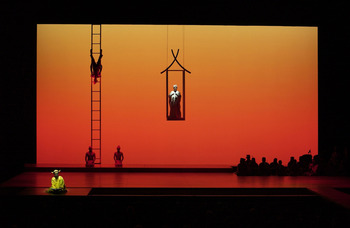
It is not just the composition of the cast that is assessed in terms of authenticity, but also what the cast did. According to scholar of Indonesian theatre Matthew Cohen, for some audience members the production achieved a feeling of authenticity in large part by bravely refusing to exploit the theatrical appeal of seeing the leader of the bissu community, Puang Matoa Saidi, perform actual bissu rites.Footnote 62 Rather, in this framing Puang Matoa Saidi sat impassively on stage and in so doing played ‘a crucial role in making I La Galigo a more than profane production’ (Fig. 4).Footnote 63 Indeed, Puang Matoa Saidi's presence ‘as chanter infused the production with sacred energy, but the sanctity of religious tradition is guarded from degradation by mass consumption’.Footnote 64 Through passivity, Cohen notes that cast members imbued the production with a sense of authenticity — passivity was read as enabling the original and pure heritage of La Galigo to come through, bypassing a performer's interpretation. Passivity thus forms a third way in which reviews frame authenticity.
Still photo of the I La Galigo stage play, with Bissu Puang Matoa Saidi sitting in yellow, front left. (Permission to use kindly granted by The Bali Purnati Center for the Arts and Change Performing Art)

A fourth way in which reviews frame the production through the trope of authenticity is through assessment of the musicians, music (both the composition and the selection of instruments), and dance. Lindsay reveals that audiences expected to see a genuine Bugis performance, but when the ‘Javanese’ composer and music director, Supanggah, was asked at a public forum where the musicians came from, the audience felt a sense of ‘reduced authenticity’ when it was revealed that the musicians came from all over Indonesia, not just Bugis South Sulawesi.Footnote 65 The production also included music and dances taken from across Sulawesi and the Malay world, such as the Makassar pakarena dance, leading some audience members ‘regretfully’ feeling that the production borrowed cross-cultural elements and was therefore less Bugis than Indonesian, or even Asian.Footnote 66 There did not seem, then, to be so much a critique of the music as a critique of whether it was authentic or not.
Even where reviews positively acknowledged the incorporation of a variety of musical influences, many reframed this incorporation to reinforce the authenticity of the production. For instance, Bianpoen notes that, ‘Their music sounds traditional, but has actually been composed for the production by the Javanese composer Rahayu Supanggah after intensive research in South Sulawesi.’ This intensive research enabled Supanggah to distance himself ‘from his Javanese roots’.Footnote 67 Moreover, the inclusion of ‘instruments originating from other areas’, rather than reduce the authenticity of the production, in fact enabled Supanggah to ‘achieve the typical archaic sounds associated with the ancient epic, colored by moods in the spirit of the various regions in South Sulawesi’.Footnote 68 Many reviews thus assessed musical components in terms of achievement of authentic sound and imagery.
A fifth way in which authenticity was evoked in reviews was in terms of the content of the production. Through ‘respecting belief’ and making sure that the production was not sacrilegious (in part by not interrupting the production with an intermission), some reviewers noted that the production gives a religious experience, sentiments presented to again reinforce the authentic reproduction of the epic:
The chance to see such a concentration of Indonesian talent rarely exists, even on its home soil. And in the final moments, after hours of constant music, for an instant the world lapses into silence. When the stage clears but for the Rice Goddess (Coppong Daeng Rannu), a treasure of dignity moving her fan, the work finally creates a genuine religious experience.Footnote 69
Authenticity was further achieved through content management for some reviewers by leaving elements out of the production. For example, some reviews noted that the inclusion of Islamic elements would have reduced the authenticity of the production. As Bianpoen notes, Supanggah ‘had to watch out for Islamic influences, since the epic stems from the pre-Islamic period’.Footnote 70 Indeed, in its attempts to present imagined cultural purity and signal Bugis authenticity, Lindsay notes that all Islamic elements were purged from the production.Footnote 71 In Rothstein's review Islam is presented as literally destructive in respect to La Galigo (unfortunately no evidence is provided in the review to ascertain whether Islamic fundamentalists have actively destroyed La Galigo manuscripts):
In modern times, it may never even have been read in its entirety, so fragmented are the manuscripts that have survived the ravages of humidity and decay, and destruction by Islamic fundamentalists in recent decades.Footnote 72
While for some reviewers the purging of elements seen as modifying original Bugis culture such as Islam reinforced the authenticity of the production, in other reviews, this cleansing was considered to undermine the production's authenticity by not acknowledging cross-cultural influences. As Lindsay notes, Bugis culture and identity were artificially homogenised in the production and any dynamics inherent within these groupings were unfortunately ignored.Footnote 73 For Rothstein, ‘It is impossible, though, to say just how much of the original spirit of the epic remains.’Footnote 74 We see the assumption here that there was an original spirit, a sentiment that goes against the nature of La Galigo which through its oral dissemination and political deployment has always changed and adapted.
During fieldwork in South Sulawesi in 2007, I discussed with people their thoughts on the production of I La Galigo. While like me, no one had seen the production, people had picked up on the disseminated themes of the reviews. There were mixed responses. Some people felt renewed pride (bangga) in the international fame that I La Galigo had received, and felt a real sense of belonging to a group with a rich cultural heritage. Others, however, expressed a great deal of resentment about the manner and content of the production. For instance, one of the most frequently articulated concerns was that the production was a jumbled conflation of Javanese, Balinese and other elements and that any quintessential Bugis elements were lost. People thus lamented that the production was no longer a Bugis production but that it was an Indonesian or even an Asian production. Indeed one person asserted that Wilson has modified La Galigo so much that his production is a betrayal (khianat) of the original Bugis epic. Other informants specifically voiced concern over Wilson's choices, declaring that Wilson had no right to produce and present such a culturally and ethnically mixed (gado-gado) performance. One individual stated that ‘La Galigo is an original and authentic Bugis commodity, not one that can or should be mixed up by someone who does not even appreciate what La Galigo really is.’ These collective and various critiques create a semiotic community whereby through language and knowledge people assert a shared Bugis identity, showing how authenticity is a significant concept in debates of ethnicity in Indonesia, and for Indonesians overseas.Footnote 75
As we can see, comments and reviews predominantly focused their critique on the achievement of authenticity through five aspects: an uncontaminated epic, local involvement, cast passivity, music and dance assemblage, and production content. Reviews then judged the production accordingly. There are different notions of what authenticity entails. For instance, some people saw the use of Javanese musical instruments as reducing the authenticity of the production, while others asserted that the use of the instruments enabled the creation of an authentic Bugis sound. Furthermore, some people saw the purging of Islamic elements as producing an authentic Bugis narrative, while others saw the denial of Islamic influence as eroding the production's authenticity. But what the aforementioned reviews presuppose is a singular, pure, Bugis identity and its authentic re/creation was the site for judging the success or otherwise of the play. But there were some key narrators who acknowledged and celebrated cultural fusion, and for them, authenticity came from acknowledgement of hybridity.
Some commentators, notably Indonesian ones, implied the impossibility and indeed irrelevance of achieving authenticity and therefore did not frame a singular authenticity as the central trope upon which to judge production success. For instance, while many people critiqued the authenticity of the production through cast and music assemblages, Restu I. Kusumaningrum, who had a directorial role in the production, permitted innovation, albeit within ‘authentic’ parameters:
While Ms. Grauer struggled with a group of scholars to condense the vast poem into workable dramaturgy, Ms. Restu organized a group of performers, which she insisted come exclusively from Indonesia. Though most of the performers in the Wilson production are from Sulawesi, the result is far from traditional, Ms. Restu said. ‘It's like nothing I've seen in Indonesia’, she added. ‘I feel like I'm looking at a Surrealist painting’.Footnote 76
While Restu affirmed the importance of players being Indonesian, unlike most commentators she was pleased that the outcome was far from ‘traditional’. In a similar vein, Muhammad Salim, a Bugis cultural expert and advisor to the production, notes:
The best thing about the production is that international audiences can experience the Galigo story as something new and modern but with deep roots, roots that are undeniably Bugis and ancient but also contemporary, still growing.Footnote 77
Salim, too, firmly grounds the production as something with deep, undeniably ancient Bugis roots, but he acknowledges flux and celebrates the production's contemporary flavour.
In respect to music, we also see Indonesian commentators noting, in response to questions about whether the music should have been more representative of Bugis culture, that the music had to be from the present because the production was from the present.Footnote 78 Sarah Weiss, an ethnomusicologist attached to Yale-NUS in Singapore, reveals that the musicians felt that ‘their own musical experience, and those of musicians in previous generations, was already mixed: Makassar, Selayar, Mandar, Bugis, Indonesian, global’.Footnote 79 Indeed, the composer, Supanggah, encouraged musicians to use collective creativity and ‘discover new possibilities for synergistic fusion’:Footnote 80
‘It was Sop Konro (a soup delicacy from Makassar) with Coca Cola,’ he said jokingly.Footnote 81
Sop Konro is of course positioned in Indonesia as a Makassar (a neighbouring ethnic group to Bugis) delicacy, not a Bugis one, and so Supanggah's comments here serve to further highlight hybridity.
There does then appear somewhat of a chasm between Indonesians directly involved with the production and other commentators in terms of the centrality of authenticity in determining the production's success. While reviewers (both foreign and Indonesian) often were at great pains to affirm the authenticity of the production (achieved, for instance, through actor passivity), or to critique the production for its lack of authenticity (determined, for instance, through the use of Indonesian dancers rather than Bugis dancers), for some observers Bugis culture and La Galigo itself have always been products of fusion. Indeed, for some, this celebration of fusion is what made the production authentic. The dominant theme, then, in formal and informal reviews of I La Galigo is authenticity, particularly authenticity as applied to ethnicity. Clues to the importance of ethnicity can be seen when looking at the construction of the Indonesian nation.
Being authentic
Reviews of I La Galigo reference authenticity as a key site for evaluation, and claims on authenticity often distil down to issues of identity, particularly authentic ethnic identity. Martin Sökefeld notes that, ‘In contemporary texts on identity, the concept seems not to exist in the singular. Whereas it was once defined by sameness and unity, both qualities have given way to difference and plurality.’Footnote 82 Indeed, James Clifford has shown that it is exceedingly difficult to attach identity, meaning, or authenticity to a coherent culture or language.Footnote 83 As such, identity is no longer seen in academic circles in the way Erik Erikson earlier proposed: ‘The term “identity” expresses such a mutual relation in that it connotes both a persistent sameness within oneself (selfsameness) and a persistent sharing of some kind of essential characteristics with others.’Footnote 84 Yet while postmodern approaches link identity to concepts such as hybridity and multiplicity, individuals tend to experience identity as a unitary entity. Indeed, many I La Galigo reviews are predicated on the supposed existence of a singular, unitary Bugis identity; authentic recreation of this equates to production success while going beyond the limits of ‘Bugis-ness’ renders the production inauthentic and a failure. The I La Galigo reviews thus speak to the importance for viewers of a definable and presentable Bugis identity. The antecedents of the need for a tangible Bugis identity can be seen in rhetorics of colonialism and nation-building, as we see below.
In the Predicament of culture, Clifford discusses the positioning of colonised peoples into discrete and knowable categories (such as the ‘Third World’).Footnote 85 This containment of the colonised is in turn interpolated by Western narratives of identity. Yet Clifford alerts us to improvisatory cultural responses where authenticity is relational, identities no longer stable, and where self–other relations engage power, rhetoric and discourse, rather than be entrenched in a cultural essence. For Clifford, a ‘new global culture’ challenges static ways of viewing culture, and embraces hybrid amalgamations — and we do see this flexible account of authenticity in some comments on I La Galigo, for instance in celebratory comments by Suppangah, the musical director, on the production being Sop Konro mixed with Coca Cola. In acknowledging the transformative potential of such readings of authenticity, Anne Maxwell notes that ‘the colonised have more to gain from histories that challenge the concept of identity, than from histories that sustain the illusion of a unified subject’.Footnote 86 While for Supanggah, an authentic production acknowledged fusion, for many others, authenticity could only be produced through some notion of purity, for instance eliminating all Islamic elements. Discourses of colonialism and reification of ethnic identities cooperate with notions of nation-building to dictate conceptions of authenticity.
While Indonesia is certainly not alone in seeking to establish national belonging through solidifying cultural identity referenced to a limited number of timeless signifiers such as dress, food, and language, it does make a particularly fascinating and transparent case.Footnote 87 Moreover, in Indonesia we can clearly see the inequities associated with instigating national belonging. For instance, since decentralisation began in the early 2000s, Indonesia has become increasingly characterised by putra-daerahism, the notion that status and privilege are accorded to people born in particular areas.Footnote 88
The idea that Bahasa Indonesia (Indonesian) should be the singular national language of a united Indonesia was first formally stated as part of the Sumpah Pemuda (Youth Pledge) declared in Batavia (Jakarta) in October 1928. Following this declaration, Indonesia's National Awakening movement (Kebangkitan Nasional Indonesia) fostered in people across the archipelago a feeling that they were all Indonesian. While prior to Dutch and Japanese colonialism people across the archipelago had not thought of themselves as sharing a coherent political identity, Dutch authority in particular left a legacy of both a territorial boundary that would become the modern Indonesian nation-state, and an educated elite passionate about creating an independent country. This educated elite forcefully argued that a national language was needed to unify people with diverse cultural backgrounds. Indonesian, a derivative of Malay, was declared the national language at the same time as the Proclamation of Independence in 1945. Also at this time, Indonesia adopted the guiding philosophy of Unity in Diversity (Bhinneka Tunggal Ika) to foster in citizens a feeling that they were part of the nation-state, while acknowledging cultural and language differences.
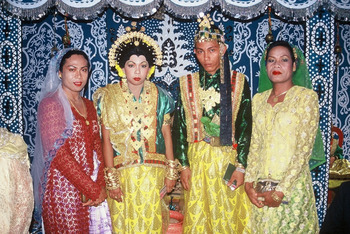
The reification of ethnic difference in Indonesia, and its forced alignment with provincial units (and sub-units in some cases) occurred most forcefully during Suharto's New Order period (1965–98). Each ethnic group was clearly defined, allocated ‘traditional’ dress and represented in miniature in places such as Taman Mini Park in Jakarta, the latter being the brainchild of Ibu Tien Suharto, President Suharto's wife. Indonesia is now imagined to comprise distinct ethnic groups who are geographically located in a specific space, referred to by Tom Boellstorff as ethnolocality (Fig. 5).Footnote 89
Reification of ethnic dress, in this case a Bugis wedding couple flanked by calabai' Indo' Boting, male-to-female wedding planners. (Photo taken by author)

Indonesia's strategy of unity-in-diversity has had varying degrees of success. Ethnicity has become reified, but the notion of a pan-Indonesian-ness is continually refuted. In particular, groups in Papua and Aceh persevere in asserting independence claims, and movements for regional autonomy persist in places such as South Sulawesi.Footnote 90 Expatriate Indonesians also convey assertions of specific ethnic belonging through semantic play.Footnote 91 One example of unintended creation of Indonesian subjecthood is the emergence of a ‘gay archipelago’, where gay and lesbian individuals feel a sense of belonging at the national, rather than local, level.Footnote 92
Within reviews of I La Galigo, notions of identity, ethnicity and nation are asserted in various ways. Supporting advertisements promoted I La Galigo variously as a Bugis, Sulawesi, Indonesian, Malay, or Asian production. There were attempts to ‘localise’ the production as being Malay by virtue of its inclusion of wayang kulit shadow puppeteers from the Malaysian state of Kedah.Footnote 93 Conversely, advertising material frequently promoted the event as bringing an Asian repertoire to an international public.Footnote 94 In particular, Singaporean advertisements tended to downplay any cultural specificity in favour of explicitly conveying an ‘international’ rather than an ‘ethnic’ image.Footnote 95 For some commentators, this Singaporean appropriation was read as a powerful nation exploiting a less powerful entity. As a result of such framing, many Bugis felt that ‘quintessential’ Bugis elements were lost and they lamented that it was no longer authentically a Bugis, but an Indonesian or even an Asian, production. As Macknight, a prominent scholar of South Sulawesi, including its literature, wonders, ‘How far can expression of Bugis culture and identity be Indonesianized? And does it matter?’Footnote 96
The deployment of authenticity in respect to ethnicity links to Gayatri Spivak's notion of strategic essentialism, where a unitary identity can be a useful way to assert cultural legitimacy.Footnote 97 Indeed, asserting legitimacy in the postcolonial world must often necessarily be affirmed through unbroken traditional and historical connection.Footnote 98 But while some reviewers sought to uncover an authentic essence, others acknowledged cultural flux and the influence of globalisation, where globalisation itself was seen not as a homogenising agent, but rather as reinforcing, indeed even creating, localised identities. Moreover, in a regional/local respect, Michael Bodden's work on identity and theatre in South Sulawesi shows how ‘regional cultural identity is part of a process of the changing relations between centre and region within a national culture, and is also intertwined with the relationship of regional cultural workers to their local audiences as well as to each other’.Footnote 99 This ‘doubleness’ of identity politics, that is, the desire to ‘claim a particular, distinctive identity while at the same time wishing to critique and relinquish any claims to a fixed, stable notion of self’,Footnote 100 fosters insight into the competing paradoxes of contemporary identity formation.
Through the global commodification of cultural identity politics, commodities such as I La Galigo can be positioned to affirm a sense of Bugis cultural uniqueness.Footnote 101 Moreover, deployment of authenticity claims in relation to I La Galigo can contribute to community building; indeed authenticity negotiations re/politicise ethnicity.Footnote 102 But some Indonesian regional artists do not view local knowledge and practices as property subject to exclusive claims by individuals or corporate groups, including the state.Footnote 103 Rather, they view I La Galigo as something to be used and enjoyed by all, with some acknowledgement of origins, and authenticity is thus not found in a singular unadulterated form. This reimagining of authenticity powerfully extends thinking on identity, as we see in the final section.
Authentic is as authentic does
There is no authoritative definition of authenticity; unlike other fashionable terms in current public or critical debate (postmodernism, gender, the clash of civilizations, etc.), even in the universities few people can come up with a name or a work that has brought the concept of authenticity to public attention.Footnote 104
It is perhaps the pervasiveness of the notion of authenticity that enables it to elude singular definition; or it may also be due to its longevity — debates around authenticity have attracted Western philosophers since Aristotle. Charles Lindholm provides extensive discussion of notions of authenticity,Footnote 105 but for our purposes it might suffice to say that it has overlapping meanings including: sincere, true, honest, absolute, basic, essential, genuine, ideal, natural, original, perfect, pure, real, and right.Footnote 106 The Oxford English Dictionary also provides a useful definition, describing authenticity as something that is ‘made or done in the traditional or original way, or in a way that faithfully resembles an original’.Footnote 107
Much early thinking on authenticity continues to resonate today. For instance, Jean-Jacques Rousseau's eighteenth-century observation of ‘savages’ being necessarily closer to a pure state of nature, and that the authentic self only existed among primitives, peasants, innocent children, and, for some, by communing with the soul,Footnote 108 has influenced generations of anthropologists and other seekers of the exotic.Footnote 109 Indeed many of the reviews examined here position Bugis (or Indonesian) subjects as an indigenous community most able to present an authentic rendition of I La Galigo. A contemporary of Rousseau, the philosopher and cultural theorist Johann Herder saw a purity of origin coinciding with an innate capacity for authentic feeling and aesthetic creation, which existed among members of a primal collective, untainted by civilised manners.Footnote 110 Herder thus located authenticity in specific locations for specific groups — which is one of the strands of authenticity discourse revealed in the reviews discussed in this article.Footnote 111 Only cultural purity is considered to give a nation its specific originary character, saving it from being lost in the melange of modernity.Footnote 112 As Lindholm notes, Herder's vision of the authentic integrity of cultures continues to influence romantic nationalists proud of claims to a primordial origin — a claim that runs contrary to the academic preference for recognition of cultural hybridity and pluralism.Footnote 113 We see such former notions raised, for instance, when Indonesia's Intellectual Property Society argued that reproductions of cultural material outside Indonesia violated copyright laws.
In the first half of the twentieth century, Jean-Paul Sartre also commented on authenticity by presenting a ‘romantic idealisation of the exotic, oppressed and marginal’, showing nostalgia for the authenticity of ‘primitive’ tribes and ethnic groups.Footnote 114 Romantic readings presuppose that authenticity will be discovered somewhere far away, and can only be obtained after overcoming numerous obstacles and undergoing rites of passage that allow infiltration into the backstage realms of social life.Footnote 115 That authenticity is hidden underscores a specific Western ontology imagining authenticity as something denigrated by contact — other ontologies suggest that the authentic is revealed on the surface; mischievousness is hidden below.Footnote 116 As Theodossopoulos shows, this vision has given rise to the exoticised version of authenticity that predominates today, articulated in contradistinction with modernity.Footnote 117 Indeed, the framing of Grauer as heading off to far away Sulawesi to discover the lost and forgotten La Galigo epic speaks directly to this discourse. Moreover, the presentation of I La Galigo as something preserved unadulterated is deployed to frame the production's authenticity.
In attempting to understand meanings of authenticity in a more contemporary setting, Lionel Trilling contrasted the somewhat overlapping concept of sincerity.Footnote 118 Trilling argued that in the daily enterprise of ‘putting ourselves on the social stage’, sincerity ‘plays a curiously compromised part’: it tempts us to ‘play the role of being ourselves’, to ‘sincerely act the part of the sincere person, with the result that a judgment may be passed upon our sincerity that is not authentic’.Footnote 119 In other words, as Müller notes, it is possible to be sincere in acting one's sincerity, ‘but it is impossible to be authentic in acting one's authenticity’.Footnote 120 In this reading, the notion of authenticity must be beyond sincere, beyond acting, and beyond mere performance. Indeed Sartre noted that by seeking authenticity one is immediately lacking authenticity.Footnote 121 In this reading, merely by seeking to recreate an authentic version of the La Galigo narrative, any potential authenticity was lost.
For Charles Taylor, authenticity is loosely defined as being true to one's inner voice.Footnote 122 Yet, as one's inner voice is accessible only as distinct from the outer voice, ‘it can be heard only when there is a social environment from whose demands one can then break free in order to assert one's trueness to oneself’.Footnote 123 As such, assessing authenticity appears an impossible undertaking. This impossibility has led to more postmodern interpretations of authenticity that suggest, in contrast to Trilling for instance, that rather than be beyond performance, authenticity is in fact a performative act. Indeed Judith Butler's analysis of camp, and queer theory in general, shatters any allusion that authenticity is a plausible quality.Footnote 124 As Andy Ruddock argues in respect to media representations, ‘Authenticity is presented as a phenomenon with a necessarily performed and therefore mediated dimension’.Footnote 125 Such a performed and mediated dimension suggests that there is no essence to authenticity, but rather that our belief in whether something is real, true and pure is subjective. The implausibility of an essential authenticity does not, however, reduce the concept's powerful cultural pull or quell desire to performatively resituate one's own authenticities in the place of the reputed original.Footnote 126Authenticity's valence is wholly positive;Footnote 127 it is revered and sought without ambivalence. As Lindholm notes, the range of self-help books on display in any bookshop shows the very real desire for authentic self-discovery.Footnote 128 This desire makes me wonder if anyone or anything can ever be too authentic.
In a recent special edition of Anthropological Quarterly focused on authenticity, Theodossopoulos argues for ‘a perspective on the study of authenticity that acknowledges the simultaneous co-existence of more than one parallel manifestation of authenticity in any given negotiation of the authentic’.Footnote 129 In acknowledging that there is no unitary, fixed, all-embracing definition of authenticity, multidimensional authenticities lead to new ways of seeing the concept. As such, authenticity can provide local actors with tactical advantage and an opportunity to apply their own specific meanings. With this framework, we can also look at the contradictions and dilemmas that authenticity generates and assess the multiple claims made on the work authenticity undertakes. Simultaneous authenticities liberate analysts from assessing ‘real’ authenticity and instead allow acknowledgement of process, facilitating a view of authenticity as expressive, instrumental, and nominal, which I outline below.
In extending thinking around the potential dynamics of authenticity, Marcus Banks encourages us to see authenticity as a strategic process.Footnote 130 In doing this, he extends Dennis Dutton's view of authenticity, which involved nominal authenticity (provenance) and expressive authenticity (verified by the thing itself).Footnote 131 To this mix, Banks adds instrumental authenticity, which is deployed to achieve some material or otherwise clearly identifiable benefit. In reviews of I La Galigo we can see claims of nominal authenticity (the epic was rediscovered in a pure form), and expressive authenticity (having Bugis actors, especially bissu, on stage, showed authenticity). But there were also instrumental claims. For some reviewers who wanted to showcase Bugis modernity and globality, there were comments about it being ‘based on tradition, but far from traditional’ and being ‘enjoyed by a global audience’. Through this reading we see authenticity as a process, rather than a static quality, deployed instrumentally and asserted, negotiated, performed, and rejected through social and political interaction. We see authenticity as context-dependent and its associated processes attached to, or recognised in, objects and social action.Footnote 132 Assessments can be made around who has the power to define authenticity and we can seek understanding of the strategic deployment of authenticity to reach certain aims (e.g. promotion of I La Galigo as an Asian, rather than Bugis, production to sell tickets in Singapore). An examination of I La Galigo provides a case study of the ways in which collective authenticity is framed, providing concrete circumstances of how authenticity is pursued.Footnote 133I La Galigo also allows us to see how reframing invention with inventiveness permits acknowledgement of authenticity as continually recreated through spontaneous and agentic local transformations.Footnote 134
Conclusion
Using the stage production of I La Galigo as its discussion point, this article explored ways in which reviews shed light on the varied meanings and deployments of the trope of authenticity. Five key ways in which reviews engaged the trope of authenticity were explored: presenting I La Galigo as based on an uncontaminated Bugis epic that was rediscovered in its pure, authentic form by a foreign other; stressing the value of local, rather than foreign, involvement in the production; through cast passivity; selection of music, dance and musicians; and selective inclusion of production content. While reviewers had differing views on how authenticity was or should have been exemplified through these aspects, authenticity remained central.
Like I La Galigo, ethnicities and identities do not copy available texts, but rather develop particular productions through performative translations. Prior to Wilson's play there had never been a visual performance of I La Galigo; the only performances involved chanting, with narratives being passed down orally or through written script. As such, the visual production cannot be criticised for having inauthentically performed the epic. Just like I La Galigo, there are no original identities and as such there are no authentic, or otherwise, presentations of self; there is no simulacrum because there is no original.Footnote 135 This is not to say, of course, that people did not feel that any visual representation of the narrative may have been an abrogation, or that they may have a particular conception of what a visualisation of the narrative should be like according to images they maintain. But indeed this is precisely what my article shows: authenticity is deployed by various agents, from governments to nationalist movements, from scholars and reviewers to collective groups and agentic individuals. The performative and creative nature of authenticity allows it to serve such disparate ends.
Rather than seeing either the performance of the play or the performance of self as inauthentic, wrongly performed, a misrepresentation, or as falsely appropriating other elements, it can be more valuable to see such productions and performances through tropes of process and interplay. I La Galigo, like identities, involves cultural translation, the use of creative technologies, and dynamic mergings of identity with local, national, global and religious elements. Convergences of these factors produce particular identities. The qualities of authenticity — its potential to denigrate or inspire new cultural expressions and tactics — invite analytical engagements that move beyond authenticity's philosophical foundation.Footnote 136 As Theodossopoulos incites, we should not shy away from authenticity's inherent essentialism, but rather confront its particular and dichotomous meanings in an attempt to understand and make visible the comparisons of value these meanings entail.Footnote 137 By exploring authenticity's multidimensional potential, its simultaneity, and its associated processes, we give context and specific meaning to the ways in which people construct identities all the while engaging the trope of authenticity. Engaging the past and its re/creation, in this case through an analysis of reviews of I La Galigo, is one way to highlight the relentless negotiation of authenticity.