Introduction
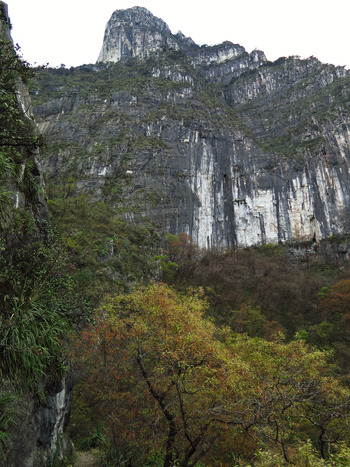
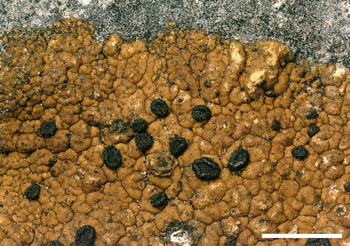
Arthoniales is the third largest order of predominantly lichenized fungi, with c. 1900 species in seven families (e.g. Tehler Reference Tehler1990; Ertz & Tehler Reference Ertz and Tehler2011; Frisch et al. Reference Frisch, Thor, Ertz and Grube2014; Lücking et al. Reference Lücking, Hodkinson and Leavitt2017; Diederich et al. Reference Diederich, Lawrey and Ertz2018). The order also includes non-lichenized, lichenicolous or saprotrophic lineages apparently derived by loss of lichenization (Thiyagaraja et al. Reference Thiyagaraja, Lücking, Ertz, Wanasinghe, Karunarathna, Camporesi and Hyde2020). During fieldwork in north-eastern Mexico, two species of Arthoniales, remarkable within the order by their unusual growth forms, were collected on limestone outcrops. The study area is located in the states of Coahuila and Nuevo León in the north-eastern portion of the country, particularly centred on the metropolitan area of Monterrey, which is located between the Gulf Coastal Plain and the Sierra Madre Oriental (SMO) (INEGI 1986). This part of Mexico has the third least documented lichen fungi diversity in the country, with only 295 species recorded (Herrera-Campos et al. Reference Herrera-Campos, Lücking, Pérez-Pérez, Miranda-González, Sánchez, Barcenas-Peña, Carrizosa, Zambrano, Ryan and Nash2014), but recent collections suggest its richness is highly underestimated (A. Huereca, unpublished data). While working on the city's lichen flora inventory, a very striking specimen was documented by a local botanist through the platform of iNaturalist (iNaturalist 2020). This discovery led to the exploration of a saxicolous community inhabiting calcareous rocks with xerophytic vegetation in partially humid conditions (Fig. 1). The limestone outcrops in the region have historically been scarcely sampled and harbour poorly known lichen flora. The two peculiar Arthoniales were collected in this habitat. The first has a conspicuous placodioid orange thallus and could be identified as Phoebus hydrophobius R. C. Harris & Ladd, a species that was considered endemic to the Ozark Ecoregion in the USA (Harris & Ladd Reference Harris and Ladd2007). The second represents a new species that is also striking by having a placodioid to subfoliose thallus. The peculiar growth forms render their systematic placement uncertain within the order Arthoniales. The genus Phoebus was described as belonging to the family Roccellaceae (Harris & Ladd Reference Harris and Ladd2007), but was recently placed as ‘Arthoniales genera incertae sedis’ due to the lack of molecular data (Lücking et al. Reference Lücking, Hodkinson and Leavitt2017).
Massive limestone outcrop at Cerro de las Mitras in Monterrey (Mexico), the type locality of Alyxoria sierramadrensis. In colour online.

The present study aims to describe the new species in the genus Alyxoria and to determine the family affiliation of the genus Phoebus with the support of molecular data.
Materials and Methods
Voucher specimens are deposited in the herbaria MEXU, BR, S, NY and in the private herbarium of Alejandro Huereca. The external morphology was studied and measured using an Olympus SZX12 stereomicroscope. Macroscopic photographs were taken using a Keyence VHX-5000 digital microscope and a VH-Z20R/W/T lens. Hand-cut sections and squash preparations of ascomata and thalli were mounted in water, a 5% aqueous potassium hydroxide solution (K), or in Lugol's iodine solution (1% I2) without (I) or with K pretreatment (KI) and studied using an Olympus BX51 compound microscope. Sections of thallus were also pretreated in acetone, then mounted in lactophenol cotton blue to determine the type of cortex following Aptroot & Schumm (Reference Aptroot and Schumm2011). Measurements refer to dimensions in water. Microscopic images were captured using an Olympus BX51 compound microscope, fitted with an Olympus SC50 digital camera. Colour reactions of the thalli were studied using K, common household bleach (C), K followed by common household bleach (KC), para-phenylenediamine dissolved in ethanol (PD) and long-wave UV (366 nm). Lichen secondary metabolites were identified using thin-layer chromatography (TLC) in solvent B’ (Orange et al. Reference Orange, James and White2010).
Molecular techniques
Well-preserved and freshly collected specimens lacking any visible symptoms of fungal infection were used for DNA isolation. Hand-cut sections of ascomata and thalli of Phoebus hydrophobius and the new species of Alyxoria were used for direct PCR as described in Ertz et al. (Reference Ertz, Tehler, Irestedt, Frisch, Thor and van den Boom2015). The lichen material was washed with acetone and then rinsed with water to remove remnants of pigments. The material was placed directly in microtubes with 20 μl H2O. Amplification reactions were prepared for a 50 μl final volume containing 5 μl 10× DreamTaq buffer (Thermo Scientific, www.thermoscientific.com/onebio), 1.25 μl of each of the 20 μM primers, 5 μl of 2.5 mg ml−1 bovine serum albumin (Thermo Scientific), 4 μl of 2.5 mM each dNTPs (Thermo Scientific), 1.25 U DreamTaq DNA polymerase (Thermo Scientific) and the lichen material. DNA extractions of Lecanographa species, viz L. dimelaenoides (Egea & Torrente) Egea & Torrente, L. hypothallina (Zahlbr.) Egea & Torrente and L. lyncea (Sm.) Egea & Torrente s. lat., obtained during a previous study (Ertz & Tehler Reference Ertz and Tehler2011) were also used for generating missing mtSSU sequences. A targeted fragment of c. 0.8 kb of the mtSSU rDNA was amplified using the primers mrSSU1 and mrSSU3R (Zoller et al. Reference Zoller, Scheidegger and Sperisen1999). A fragment of c. 1 kb of the RPB2 protein-coding gene was amplified using the primers fRPB2-7cF and fRPB2-11aR (Liu et al. Reference Liu, Whelen and Hall1999). The yield of the PCR reactions was verified by running the products on 1% agarose gel using ethidium bromide. Both strands were sequenced by Macrogen® using amplification primers. Sequence fragments were assembled with Sequencher v.5.4.6 (Gene Codes Corporation, Ann Arbor, Michigan). Sequences were subjected to ‘Megablast’ searches in GenBank for a preliminary taxonomic assignment.
Taxon selection and phylogenetic analyses
For the phylogenetic analyses, a set of 37 OTUs was used, consisting of taxa representing all major clades currently accepted in the Lecanographaceae (Ertz & Tehler Reference Ertz and Tehler2011; Frisch et al. Reference Frisch, Thor, Ertz and Grube2014) and three outgroup species, viz. Dimidiographa longissima (Müll. Arg.) Ertz & Tehler (Roccellographaceae), Lecanactis abietina (Ach.) Körb. (Roccellaceae) and Opegrapha vulgata (Ach.) Ach. (Opegraphaceae) (Table 1).
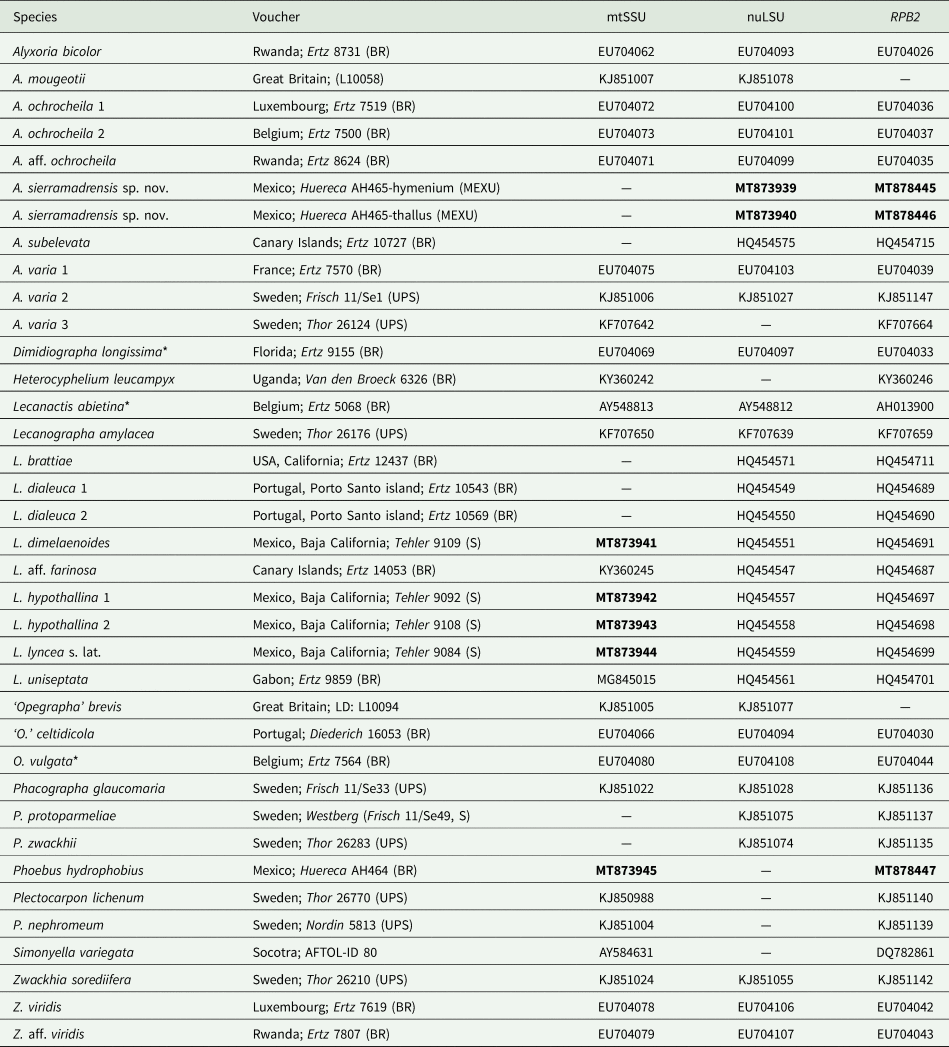
Lecanographaceae specimens used in the phylogenetic analyses (Fig. 2) with GenBank Accession numbers and voucher information. Newly generated sequences are in bold; em-dash indicates missing data; * = outgroup.

The sequences were aligned using MAFFT v.7.402 (Katoh et al. Reference Katoh, Misawa, Kuma and Miyata2002) on the CIPRES Web Portal (Miller et al. Reference Miller, Pfeiffer and Schwartz2010) and manually corrected for errors using Mesquite 3.04 (Maddison & Maddison Reference Maddison and Maddison2015). Ambiguously aligned regions according to Lutzoni et al. (Reference Lutzoni, Wagner, Reeb and Zoller2000) and introns were manually removed and excluded from subsequent analyses.
To examine topological incongruence among data sets, maximum likelihood (ML) analysis was carried out on each of the single-locus data sets. We used RAxML v.8.2.12 (Stamatakis Reference Stamatakis2014) with 1000 replicates of ML bootstrapping (ML-BS) under the GTRGAMMA model of sequence evolution. Analyses were run on the CIPRES Web Portal (Miller et al. Reference Miller, Pfeiffer and Schwartz2010). All topological bipartitions were compared for the two loci. A conflict was assumed to be significant when differing topologies for the same set of taxa (one being monophyletic and the other being non-monophyletic) were each supported with bootstrap values ≥ 70 (Mason-Gamer & Kellogg Reference Mason-Gamer and Kellogg1996). Based on this criterion, a phylogenetic conflict was detected for Lecanographa atropunctata Sparrius et al. between the mitochondrial and the RPB2 genes. Based on the mitochondrial gene mtSSU, L. atropunctata (GenBank Accession numbers: KY360244, HQ454548, HQ454688) is the sister species to the genus Zwackhia (ML-BS = 77; fig. not shown), while it is the basal taxon of the Lecanographa clade (ML-BS = 97; fig. not shown) in the phylogenetic tree based on the nuclear gene RPB2. Therefore, L. atropunctata was removed from subsequent analyses, although this conflict had no impact on our conclusions regarding the taxonomic affiliation of the newly sequenced taxa. The mtSSU, nuLSU and RPB2 data sets were then concatenated.
The combined three-locus data set of 37 samples consisted of 2418 unambiguously aligned sites, 583 for mtSSU, 962 for nuLSU and 873 for RPB2. A Bayesian analysis was carried out on the concatenated three-locus data set using the Metropolis-coupled Markov chain Monte Carlo (MCMCMC) method in MrBayes v.3.2.7a (Huelsenbeck & Ronquist Reference Huelsenbeck and Ronquist2001; Ronquist & Huelsenbeck Reference Ronquist and Huelsenbeck2003) on the CIPRES Web Portal (Miller et al. Reference Miller, Pfeiffer and Schwartz2010). Best-fit evolutionary models for each partition were estimated using the Akaike Information Criterion (AIC) as implemented in jModelTest2 (Darriba et al. Reference Darriba, Taboada, Doallo and Posada2012). The GTR + I + G model was selected for the mtSSU as well as for the RPB2/1st and RPB2/3rd positions, while the TVM + I + G model was selected for the RPB2/2nd position and the TrN + I + G model for the nuLSU. Two Bayesian MCMCMC runs were executed in parallel, each using four independent chains and 40 million generations, sampling trees every 1000th generation. Tracer v.1.6.0 (Rambaut et al. Reference Rambaut, Suchard, Xie and Drummond2013) was used to ensure that convergence was reached by plotting the log-likelihood values of the sample points against generation time. Convergence between runs was also verified using the PSRF (Potential Scale Reduction Factor), confirming that values for all parameters were equal to 1.000. Posterior probabilities (PP) were determined by calculating a majority-rule consensus tree generated from the 60 002 post burn-in trees out of the 80 002 trees sampled by the two MCMCMC runs using the sumt option of MrBayes. In addition, a maximum likelihood (ML) analysis was performed using RAxML v.8.2.12 (Stamatakis Reference Stamatakis2014) with 1000 ML bootstrap iterations (ML-BS) and the GTRGAMMA model.
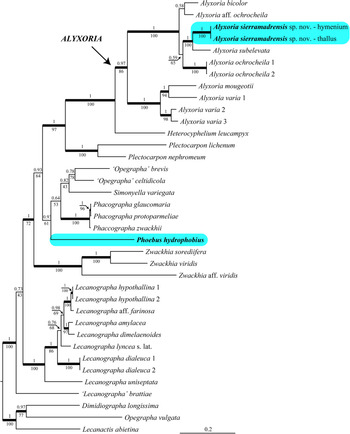
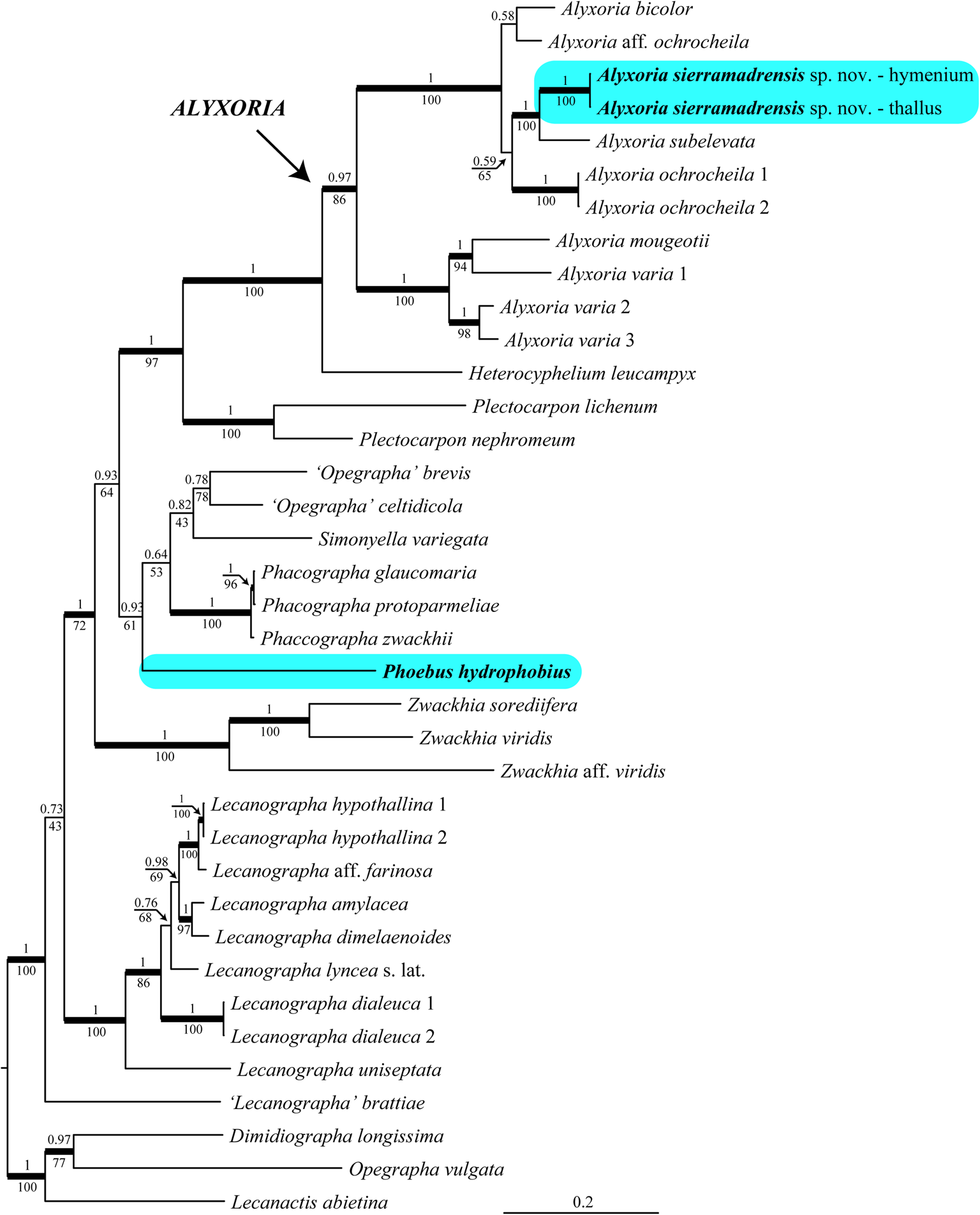
The Bayesian tree did not contradict the RAxML tree topology for the strongly supported branches. Therefore, only the Bayesian tree is shown with the PP values added above the internal branches and the ML-BS values added below (Fig. 2). Internodes with ML-BS ≥ 70 and PP ≥ 95 were considered strongly supported (Alfaro et al. Reference Alfaro, Zoller and Lutzoni2003; Lutzoni et al. Reference Lutzoni, Kauff, Cox, McLaughlin, Celio, Dentinger, Padamsee, Hibbett, James and Baloch2004). Phylogenetic trees were visualized using FigTree v.1.4.2 (Rambaut Reference Rambaut2012).
Three-locus (nuLSU + mtSSU + RPB2) Bayesian tree representing the proposed phylogenetic relationships among taxa of Lecanographaceae, with three outgroup species. MrBayes posterior probabilities are shown above branches, and RAxML bootstrap values are shown below branches. Thicker lines highlight internodes considered strongly supported by both analyses. Names of samples for which sequences were generated in this study are indicated in bold and highlighted with a shaded box. In colour online.
Results
Phylogenetic analysis
Ten new sequences were obtained for this study and 85 additional sequences were retrieved from GenBank (Table 1). The Bayesian tree obtained from the combined three-locus analysis of the Lecanographaceae data set is shown in Fig. 2. The main well-supported lineages are in accordance with the results obtained by Frisch et al. (Reference Frisch, Thor, Ertz and Grube2014) and Van den Broeck et al. (Reference Van den Broeck, Lücking, Gaya, Chaves, Lejju and Ertz2017). The genus Lecanographa has a basal position and is recovered as paraphyletic. The generic affiliation of L. brattiae (Egea & Ertz) Ertz & Tehler requires further study. The genera Alyxoria, Phacographa, Plectocarpon and Zwackhia form well-supported lineages. Phoebus hydrophobius has a rather isolated position as sister to a clade including Phacographa, two species of Opegrapha s. lat. and Simonyella variegata J. Steiner but this relationship is weakly supported by both phylogenetic analyses. The genus Alyxoria is divided into two fully supported lineages: one containing three specimens of A. varia s. lat. (a complex of species in need of revision) and a specimen of A. mougeotii (A. Massal.) Ertz et al.; a second formed by A. bicolor (R. C. Harris & Lendemer) Ertz & Tehler, A. ochrocheila (Nyl.) Ertz & Tehler, A. aff. ochrocheila, A. subelevata (Nyl.) Ertz & Tehler and the new species. This second lineage is referred to hereafter as the ‘Alyxoria ochrocheila subgroup’. The new species is sister to Alyxoria subelevata with strong support.
Taxonomy
Alyxoria sierramadrensis Ertz, Huereca, Salcedo-Martínez & Tehler sp. nov.
MycoBank No.: MB 836549
A species of Alyxoria characterized by a placodioid to subfoliose thallus, rounded ascomata with a widely exposed, whitish pruinose hymenial disc, an orange, K+ purple medulla and 3-septate ascospores, (17–)19–23(–25) × 7–9 μm.
Type: Mexico, Nuevo León, Monterrey, Cerro de las Mitras, Cara Norte, route to Pico Perico, ascent through Colegio La Salle, 25°43′01.02″N, 100°24′55.65″W, 1314 m elev., Piedmont scrub and Xerophytic scrub (‘Matorral submontano’ y ‘Matorral xerófito’) with elements of Quercus spp. forest, on limestone rock, 30 March 2019, Alejandro Huereca AH-465 (MEXU—holotype; S—isotype).
(Fig. 3)
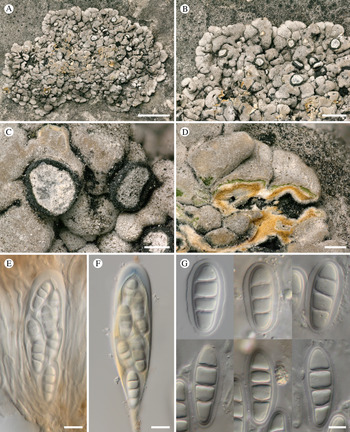
Alyxoria sierramadrensis (holotype). A–C, thallus and ascomata. D, thallus with a section showing the orange medulla due to the presence of anthraquinones. E, ascus in KOH. F, ascus in K/I showing the apical blue ring. G, ascospores in water. Scales: A = 5 mm; B = 2 mm; C & D = 500 μm; E & F = 10 μm; G = 5 μm. In colour online.

Thallus placodioid to subfoliose, epilithic, c. 1–3 cm diam., pale brown, covered by a whitish pruina on most of its surface, smooth, dull, convex, continuous, composed of elongated lobes or areoles 0.8–3 × 0.8–1.5(–2) mm; thallus lobes in section 290–360 μm thick, with a distinct upper cortex; upper cortex hyaline to pale yellow, c. 40–65 μm, of ‘Branched type’ (sensu Aptroot & Schumm Reference Aptroot and Schumm2011: 7), filled with many crystals of calcium oxalate (H2SO4!); algal layer c. 40–75 μm; medulla 160–210 μm below the algal layer, including an orange central part c. 100–110 μm thick (anthraquinones), with numerous crystals of calcium oxalate (H2SO4!); lower surface ecorticate, covered by a thin layer (c. 25–40 μm) of black, branched hyphae c. 4–5 μm thick. Photobiont trentepohlioid; cells mostly broadly ellipsoid, 12–19 × 9–15 μm.
Ascomata scattered, (0.3–)0.5–1.2 mm diam., rounded, sometimes shortly elongated, sessile, not or slightly constricted at the base; margin c. 0.1–0.2 mm wide, black, smooth, epruinose, slightly raised above the hymenial disc; hymenial disc flat, widely exposed, white pruinose. Exciple brown-black, K− or K+ magenta-red supposedly due to presence of an anthraquinone, 75–90 μm thick. Hypothecium dark brown, extending down to the substratum, up to c. 300 μm thick. Hymenium 125–150 μm tall, hyaline to pale yellowish, clear, I+ red, K/I+ blue becoming slightly greenish blue; epihymenium pale brown, I+ persistently blue, K/I+ blue; subhymenium 35–50 μm tall, pale yellowish, I+ persistently blue. Paraphysoids richly branched and anastomosing, c. 2(–2.5) μm thick, not or only slightly enlarged at apices, up to 3 μm. Asci narrowly clavate, (6–)8-spored, 70–80 × 18–21 μm, without or with a tiny ocular chamber; in K/I non-amyloid except for an amyloid (blue) endoascus layer in the upper part, and an amyloid apical ring. Ascospores (17–)19–23(–25) × 7–9 μm, 3-septate, oblong to somewhat clavate, not constricted at septa, cells more or less equal in size except one or the two inner cells often slightly broader; over-matured spores becoming brownish with a coating of minutely pigmented granules; perispore distinct, c. 1.5–2 μm thick.
Conidioma seen only once in cross-section, immersed in the thallus, pyriform, 250 × 200 μm; wall paraplectenchymatous, c. 10–20 μm thick, dark brown in the upper half, hyaline below; conidiogenous cells ampulliform, simple, 8–10(–15) × 2 μm; conidia bacilliform, simple, hyaline, 5–6 × 1.2–1.5 μm.
Chemistry
Thallus surface C−, K−, KC−, PD−, UV−; medulla C−, K+ purplish, PD−, UV± bright orange. TLC revealed two unidentified anthraquinones of R f 60 and R f 63, one unidentified UV+ violet substance after heating, of R f 55, and one unidentified UV+ reddish substance before heating, of R f 67 (holotype tested in solvent B’).
Etymology
The specific epithet refers to the mountain range of the Sierra Madre Oriental (SMO) in the north-eastern part of Mexico where the species has been collected.
Ecology
Alyxoria sierramadrensis grows on exposed limestone rocks in semi-humid environments, particularly vertical rock walls with Xerophytic scrub and Piedmont scrub mixed with oaks, sometimes near montane streams or drainages (Fig. 1). It has been found at 800–1500 m above sea level. At the type locality (Fig. 1), the flora found in this habitat belongs to xerophytic scrub with Agave univittata Haw., Astrolepis sinuata (Lag. ex Sw.) D. M. Benham & Windham, Callisia repens (Jacq.) L., Decatropis bicolor (Zucc.) Radlk, Echeveria simulans Rose, Echinocereus viereckii Werderm, Esenbeckia berlandieri Baill. ex Hemsl., Ferocactus hamatacanthus (Muehlenpf.) Britton & Rose, Opuntia engelmannii Salm-Dyck ex Engelm., Pellaea ovata (Desv.) Weath., Sedum palmeri S. Watson and Selaginella wrightii Hieron., among others. These elements are typical for the semi-desert in north-eastern Mexico (Rzedowski Reference Rzedowski2006). Alyxoria sierramadrensis appears to be restricted to exposed rock outcrops, and it was not found on shaded rocks. Associated lichenized fungi include Bagliettoa calciseda (DC.) Gueidan & Cl. Roux, Buellia trachyspora Vain., Caloplaca eugyra (Tuck.) Zahlbr., C. saxicola (Hoffm.) Nordin agg., Lecanora aff. marginata (Schaer.) Hertel & Rambold, Phoebus hydrophobius, Psora pseudorussellii Timdal, Speerschneidera euploca (Tuck.) Trevis., Squamulea galactophylla (Tuck.) Arup et al., Xanthopsorella texana (W. A. Weber) Kalb & Hafellner and unidentified Verrucaria.
Distribution
Alyxoria sierramadrensis is rather common in suitable habitats along the physiographic region of the SMO and is currently known from six localities: Coahuila (one) and Nuevo León (five). The locality ‘Cañon San Matías’ in central Coahuila is located in the municipality of Nadadores, which belongs to the subprovince of ‘Sierras y Llanuras Coahuilenses’. It consists of folded limestone mountain ranges, oriented north-west to south-east, mostly with steep small folds, with a precipitation of 300–400 mm (INEGI 2015). The remaining localities are in Nuevo León, in the subprovince of ‘Gran Sierra Plegada’, predominantly formed by limestone mountains with scattered hills and valleys, running parallel to the Gulf of Mexico. This mountain range has an average precipitation of 360 mm (INEGI 1986) and creates an orographic barrier with the eastern slopes capturing the moist winds originating in the sea. Alyxoria sierramadrensis should be searched for in the state of Texas, especially in the Edwards Plateau and the Ozark Ecoregion, since central and southern Texas and northern Mexico share similar lichen flora and plant communities (Harris & Ladd Reference Harris and Ladd2007; McLaughlin Reference McLaughlin2007; Morse & Lendemer Reference Morse and Lendemer2019). In Mexico, the neighbouring states of San Luis Potosí and Tamaulipas should be investigated. These states also include portions of the SMO with the same type of rock but are more humid due to the considerably higher precipitation further south in Mexico (900 mm and 491 mm respectively; INEGI 2002, 2017).
Conservation and threats
Four of the five localities in Nuevo León are found in the metropolitan area of Monterrey in four prominent mountains within the city: Cerro de Chipinque, Cerro de Las Mitras, Cerro de La Silla and Cerro El Topo Chico. All of these are protected nature reserves with different management programmes and protection status (either national or state parks), but they are still under strong anthropogenic pressure, especially urban development (Lazcano et al. Reference Lazcano, Contreras-Lozano, Narvaéz-Torres and Chávez-Cisneros2012; Green & Sánchez Reference Green and Sánchez2013). Except for the C. de Chipinque, these mountains have become ‘artificial sky islands’ since the city has encroached on their slopes, disrupting the connectivity between ecosystems, and therefore the exchange of biodiversity (García et al. Reference García, Contreras, Lozano, García, Lazcano, Torres, Salinas, Borré, Chávez, Contreras, Ramos and Aguilera2013; Lazcano et al. Reference Lazcano, Nevárez de los Reyes, García-Salas, Mata-Laredo and Wilson2019). Furthermore, due to the abundance of limestone in the region, mining operations are common even in the city's mountains (Montalvo-Arrieta et al. Reference Montalvo-Arrieta, Chávez-Cabello, Velasco-Tapia, de León I, Werner and Friedman2010). Unfortunately, despite being designated as a state Protected Natural Area, the type locality of A. sierramadrensis includes two limestone quarries on the north-western flanks of the mountain (Lazcano et al. Reference Lazcano, Contreras-Lozano, Narvaéz-Torres and Chávez-Cisneros2012, Reference Lazcano, Nevárez de los Reyes, García-Salas, Mata-Laredo and Wilson2019). The greatest threat to the lichen flora in the metropolitan area is the bad air quality, ranked in recent years as one of the poorest in Mexico and Latin America (Green & Sánchez Reference Green and Sánchez2013). This is mainly caused by emissions from the petrochemical and chemical industries as well as from concrete refinement processes, and its vehicle population of almost 2 million units (Molina et al. Reference Molina, Mena, Mediavilla Sahagún, Gómez Sánchez, Barrera Huertas and García2019). However, no surveys have been conducted that investigate the impact of air pollution caused by industrial activity on the lichens.
Notes
The new species is unique among the Lecanographaceae in the placodioid to subfoliose thallus with a medulla containing large amounts of anthraquinones. The only member of the Lecanographaceae known with anthraquinones in the medulla is Lecanographa subgrumulosa (Egea et al.) Egea & Torrente, a lichenized fungus known from Morocco and south-east Spain that also grows on limestone rocks. That species differs from Alyxoria sierramadrensis in having a crustose, ecorticate, white to greyish white, cracked or areolate thallus without lobes at the margin, lirelliform, seldom roundish ascomata, a K+ dark green excipulum, I+ blue hymenium, narrower mature asci (12–15 μm), narrower ascospores (4.5–6 μm) and longer conidia (6–10 μm) (Egea et al. Reference Egea, Torrente and Manrique1993). Other Arthoniales known to contain anthraquinones in the medulla occur in the genera Crocellina and Roccella, but these are very different species having lecanorine ascomata and belonging to the Roccellaceae (Tehler et al. Reference Tehler, Irestedt, Wedin and Ertz2010; Ertz et al. Reference Ertz, Tehler, Irestedt, Frisch, Thor and van den Boom2015). Species of Placolecis (Lecanorales, Catillariaceae) are also known from limestone and share a placodioid thallus with a characteristic orange medulla due to the production of anthraquinones, but the ascomata are epruinose, the asci have a prominent amyloid tholus lacking any internal differentiation (Catillaria-type) and the ascospores are simple (Yin et al. Reference Yin, Wang, Liu, Zhang, Yang, Li and Wang2019). In our phylogenetic analyses (Fig. 2), the new species is sister to Alyxoria subelevata. This latter species also has ascomata with a widely exposed hymenial disc covered by a whitish pruina but it differs from Alyxoria sierramadrensis in having a thin crustose thallus, lirelliform ascomata of 0.6–2(–3) × 0.2–0.5 mm and narrower (4–6 μm wide) ascospores (Torrente & Egea Reference Torrente and Egea1989).
The thallus is unusual for a species of Alyxoria and we wondered whether the ascomata might represent a lichenicolous fungus growing on the thallus of a second species. In order to test this hypothesis, we generated sequences from very tiny fragments of material of both the thallus and the hymenium by direct PCR. We obtained two loci (nuLSU and RPB2) for each and included both in the phylogeny. In addition, we also amplified the nuLSU of a second, sterile thallus from the same type specimen. The nuLSU was identical to that of the fertile thallus; this last sequence was not published because it was used only for testing the reliability of our new data. No necrotic areas were found around the ascomata, and the species is known from several localities where no similar lichens are found. Moreover, the new species is part of the Alyxoria ochrocheila subgroup, including lichens also known to frequently have anthraquinones and similar ascoma and ascospore types (see Discussion). Thus, the chemistry and morphology also support the phylogenetic placement. For these reasons, we are convinced that the ascomata do not represent a lichenicolous fungus growing on the sterile thallus of another lichen.
Additional specimens examined
Mexico: Coahuila: Nadadores, Rancho Salsipuedes ‘Cañón San Matías’, 27°27′14.2″N, 101°54′58.1″W, 1320 m, Piedmont scrub and Xerophytic scrub (‘Matorral submontano’ y ‘Matorral xerófito’) with elements of Quercus spp. forest, sedimentary rock conglomerate, 2019, Alejandro Huereca AH-543, AH-544 (hb. A. Huereca). Nuevo León: Monterrey, Cascadas del Cerro de la Silla, 25°37′32.04″N, 100°12′52.78″W, 917 m, Xerophytic scrub with Piedmont scrub elements, limestone rock, 2019, Alejandro Huereca AH-466 (BR, MEXU, NY); Santa Catarina, Cañón de Casa Blanca, before the crossing of ‘El Paso del Caballero’, 25°34′39.34″N, 100°42′38.08″W, 1520 m, ecotone of Piedmont scrub and Xerophytic scrub (‘Matorral submontano y Matorral xerófito’), limestone rock, 2019, Alejandro Huereca AH-545 (hb. A. Huereca).
Phoebus hydrophobius R. C. Harris & Ladd
Opuscula Philolichenum 4, 64 (2007).
Description and illustration
See Harris & Ladd (Reference Harris and Ladd2007).
Distribution and habitat
This species was considered endemic to the Ozark Ecoregion in the USA (Harris & Ladd Reference Harris and Ladd2007) but is newly recorded for Mexico (Fig. 4). In Mexico, Phoebus hydrophobius is found in the same habitat and localities as Alyxoria sierramadrensis, but it is relatively more abundant.
Phoebus hydrophobius (Huereca AH-464). Thallus and ascomata. Scale = 2 mm. In colour online.

Specimens examined
Mexico: Coahuila: Nadadores, Rancho Salsipuedes ‘Cañón de los Cedros’, 27°20′49.93″N, 101°51′36.32″W, 1090 m, Piedmont scrub (‘Matorral submontano’) with elements of Quercus spp. forest, on limestone rock, 2018, Alejandro Huereca AH-254 (hb. A. Huereca); Nadadores, Rancho Salsipuedes ‘Cañón San Matías’, 27°27′14.2″N, 101°54′58.1″W, 1320 m, Piedmont scrub and Xerophytic scrub (‘Matorral submontano’ y ‘Matorral xerófito’) with elements of Quercus spp. forest, sedimentary rock conglomerate, 2019, Alejandro Huereca AH-542 (MEXU). Nuevo León: Monterrey, Cascadas del Cerro de la Silla, 25°37′32.04″N, 100°12′52.78″W, 917 m, Xerophytic scrub and Piedmont scrub (‘Matorral xerófito y Matorral submontano’), with elements of Quercus spp. forest, limestone rock, 2019, Alejandro Huereca AH-175 (hb. A. Huereca); Monterrey, Cerro de las Mitras, Cara Norte, route to Pico Perico, ascent through Colegio La Salle, 25°43′01.02″N, 100°24′55.65″W, 1314 m, Xerophytic scrub and Piedmont scrub (‘Matorral xerófito y Matorral submontano’) with elements of Quercus spp. forest, limestone rock, 2019, Alejandro Huereca AH-464 (BR); Santa Catarina, Cañón de Casa Blanca, before the crossing of ‘El Paso del Caballero’, 25°34′39.34″N, 100°42′38.08″W, 1520 m, ecotone of Piedmont scrub and Xerophytic scrub (‘Matorral submontano y Matorral xerófito’), limestone rock, 2019, Alejandro Huereca AH-545 (hb. A. Huereca).
Discussion
Besides the discovery of a new species, the most important result obtained from the present study is the placement of two lichenized fungi developing placodioid thalli within two separate lineages of the Lecanographaceae. This family was first recognized by Ertz & Tehler (Reference Ertz and Tehler2011) before it received its formal status by Frisch et al. (Reference Frisch, Thor, Ertz and Grube2014). Seven genera (Alyxoria, Heterocyphelium, Lecanographa, Phacographa, Plectocarpon, Simonyella, Zwackhia) were previously accepted in the Lecanographaceae (Ertz & Tehler Reference Ertz and Tehler2011; Frisch et al. Reference Frisch, Thor, Ertz and Grube2014; Van den Broeck et al. Reference Van den Broeck, Lücking, Gaya, Chaves, Lejju and Ertz2017) and all are represented in our phylogenetic analysis (Fig. 2). Phoebus is thus the eighth genus confirmed in this lineage. The Lecanographaceae include non-lichenized (lichenicolous) fungi, lichenized fungi with crustose, predominantly thin thalli and one fruticose species, Simonyella variegata. Alyxoria sierramadrensis and Phoebus hydrophobius are therefore the first species with a placodioid thallus recognized as belonging to the Lecanographaceae. Similar growth forms in the Arthoniales were known only in the genus Roccellina. This latter genus of Roccellaceae is remarkably diverse in terms of thallus type, ranging from crustose to fruticose, and including placodioid to subfoliose species. The placodioid thallus led Harris & Ladd (Reference Harris and Ladd2007) to compare the genus Phoebus with Roccellina, despite the authors admitting that it does not seem closely related to that genus due to the unique thallus pigmentation and anatomy. The specimens of Alyxoria sierramadrensis were also annotated first as ‘Roccellina’ before our molecular investigation. Historically, thallus growth forms played an important role at the family and generic systematic level in the Arthoniales, but recent evidence from molecular studies showed that it has often been overestimated, even for generic delimitation. Multiple evolution of the fruticose growth form for instance is now well documented in the families Opegraphaceae and Roccellaceae, even within genera such as Dendrographa, Pentagenella and Roccellina (Tehler & Irestedt Reference Tehler and Irestedt2007; Ertz & Tehler Reference Ertz and Tehler2011). Within Lecanographaceae, the fruticose lichen Simonyella variegata is surprisingly related to the crustose lichen ‘Opegrapha’ celtidicola (Jatta) Jatta and lichenicolous species of Opegrapha s. lat. and Phacographa (Van den Broeck et al. Reference Van den Broeck, Lücking, Gaya, Chaves, Lejju and Ertz2017; fig. 2), but the generic delimitation within this lineage is in need of further investigation. While the growth forms of Alyxoria sierramadrensis and Phoebus hydrophobius might have pointed to a relationship with the genus Roccellina or at least to a placement in the family Roccellaceae, the ascomata, asci and ascospore types clearly support a placement in the family Lecanographaceae. Some characters of our new species also support the placement in the genus Alyxoria, particularly the combination of a prominent and epruinose black margin with a widely exposed and whitish pruinose hymenial disc (at least shared by some species in the genus such as A. subelevata, the sister taxon of A. sierramadrensis), and short few-septate ascospores with a distinct gelatinous sheath. The new species is part of the Alyxoria ochrocheila subgroup, which includes lichens also known to frequently produce anthraquinones. As in Alyxoria ochrocheila, the epihymenium and subhymenium of A. sierramadrensis are I+ persistently blue while the hymenium is I+ red, a very rare combination in the Arthoniales, perhaps restricted to the A. ochrocheila subgroup (Ertz Reference Ertz2009).
Alyxoria sierramadrensis and Phoebus hydrophobius are two remarkable examples of parallel evolution of the placodioid growth form within the Lecanographaceae; within Arthoniales, this was previously known only from the genus Roccellina in the Roccellaceae. The two species further highlight the high degree of morphological plasticity in the Arthoniales and provide additional new proof that generic delimitation cannot always rely on thallus morphology. Much remains to be done to improve our understanding of the evolution within Arthoniales, for which molecular data are still limited despite important progress in the last decade.
Acknowledgements
We would like to thank SEMARNAT for authorizing the scientific research permit SGPA/DGS/712/3113/17 issued to S. M. Salcedo-Martínez. We also cannot thank enough Dr Carlos Velasco Macías, who was the first person to find the new species, for his help locating more individuals. We are indebted to Wim Baert and Lynn Delgat for their help with the molecular work and to Cyrille Gerstmans for his help with the figures.
Author ORCIDs
Damien Ertz, 0000-0001-8746-3187; Alejandro Huereca, 0000-0002-6460-2380; Sergio Manuel Salcedo-Martínez, 0000-0003-4672-420X; Anders Tehler, 0000-0002-4171-5497.