




No CrossRef data available.
A Makeover for the Introductory Comparative PoliticsCourse: Revising the College Board's Advanced Placement Program®(AP®) Course in Comparative Government and Politics
Published online by Cambridge University Press: 25 April 2006
Extract
A college-level introductory course rarely gets the attention itdeserves. It tends to be the oldest course in one's repertoire; thecourse that has the least-direct interface with one's researchactivities; the one that is most easily farmed out to adjunctfaculty; and also the one that draws the largest audience, from allcorners and crevices of the campus. It is easy to fall into acomfort zone with an introductory course, instead of thinkingself-critically about one's method and effectiveness of instruction.Moreover, in a department setting, the introductory course is rarelythe focus of our interaction with colleagues.
Information
- Type
- THE TEACHER
- Information
- Copyright
- © 2006 The American Political Science Association
Background
A college-level introductory course rarely gets the attention it deserves. It tends to be the oldest course in one's repertoire; the course that has the least-direct interface with one's research activities; the one that is most easily farmed out to adjunct faculty; and also the one that draws the largest audience, from all corners and crevices of the campus. It is easy to fall into a comfort zone with an introductory course, instead of thinking self-critically about one's method and effectiveness of instruction. Moreover, in a department setting, the introductory course is rarely the focus of our interaction with colleagues.
An opportunity was recently provided to step out of this comfort zone and think systematically about the structure and contents of the introductory comparative course. The College Board recently convened a committee of political scientists with diverse country expertise and experience teaching introduction to comparative politics for the purpose of evaluating the existing Advanced Placement Program® (AP®) Comparative Government and Politics course in light of the courses being offered at universities and colleges.1
The faculty members of this group were Vicki Hesli, University of Iowa; Mark Jones, Rice University; Neil Mitchell, University of Aberdeen; K.C. Morrison, University of Missouri at Columbia; Stephen Ndegwa, Northwestern University; G. Bingham Powell, University of Rochester; Jean C. Robinson, Indiana University; and Donley Studlar, West Virginia University. ETS political scientists attending were Beth Fecko-Curtis and Greg Vafis.
The members of this group were Mehrzad Boroujerdi, Syracuse University; Karen Coston, Blacksburg High School; Neil Mitchell, University of Aberdeen; Stephen Ndegwa, Northwestern University; and Jean C. Robinson, Indiana University. ETS political scientists attending were David Richards and Greg Vafis.
The experience of revising the AP Comparative Government and Politics course may have value for college faculty who are either constructing their own introductory comparative politics course for the first time, or revising their existing course. In what follows, we review the approach used to modify the course, reassemble some of the arguments surrounding the choices and trade-offs necessitated by a semester-length course, and present the recommendations of the committee. This account reflects our understanding of the process and development of the course and not necessarily the College Board's views or the views of the various committee members, although, we would not anticipate too much divergence.
As It Was: The Course before Revision
The College Board's AP Comparative Government and Politics course is taught in high schools nationwide. It is meant to replicate, in a high school environment, the substantive experience of an introductory college course. For many students, the course culminates in a nationally administered exam, given each May. The AP Comparative Government and Politics Development Committee, a group of college academics and high school AP teachers appointed by the College Board, is responsible for the content validity of both the course and exam.
Teachers were required to cover four core countries (China, France, Great Britain, and Russia) and one of three other countries (India, Mexico, or Nigeria). The pre-revision AP Comparative Government and Politics course specifications included six major content areas:
- The Sources of Public Authority and Political Power
- Society and Politics
- Citizen and State
- Political Framework
- Political Change
- Introduction to Comparative Politics
A detailed outline of specific areas of comparative politics falling under these broad categories was available to AP teachers. For instance, “Political Framework” included political parties and interest groups, the scope of government activity, types of regimes, and more. AP teachers were also given some guidance by the Development Committee as to how much emphasis to place on various content areas.
Revising the Course: A Four-Fold Approach
The committee used a four-fold approach to revise the AP Comparative Government and Politics course. First, it needed to establish the goals of the course. What skills should students learn from this course? What ideas should be communicated to students? What important changes and sources of change in the world should be highlighted?
Second, the committee needed to create a framework to support the types of learning set as goals. How would the selection of a pure case-intensive or thematic approach affect the types of learning desired? Is an integrative approach more desirable, or even possible from a practical perspective? AP courses are designed to reflect the college classroom experience, so it was also of interest to know what is happening in introductory comparative classrooms.
The third decision stage focused on which countries the AP Comparative Government and Politics course would include. Several related questions occupied the committee: What countries are covered in the major textbooks? What does the study of any particular country contribute to the goals of the course? Should developed and developing countries be equally represented? How might the study of regional or supranational governance organizations help meet course goals? Should these organizations have the same weight as countries?
Finally, the committee had to determine what major concepts, theories, and themes were most appropriate to meet the goals of the course. This entailed thinking about changes in the discipline, particularly about ideas and conceptual tools. The course has to keep pace with the disciplinary evolution of concepts: recognizing their genesis, useful life, and obsolescence. The course must aim to present concepts, theories, and themes to students in a meaningful way. While we may include some timeless, if contested, concepts such as democracy, we also need to keep current with the shifts in thinking about the concept. For example, as democracy spreads, we have begun to conceive of democracy in a “continuous,” not just categorical, way. We have added categorical refinements such as “illiberal democracy” and dimensions such as social capital. Also, concepts that bridge with other subfields, for example globalization, deserve special attention.
Below, we discuss how the committee members dealt with these issues, including what they decided to recommend based on their own content knowledge, on their knowledge of the discipline of comparative politics, and on the results of a survey of college faculty who teach the introductory comparative course.
Course Goals
Even in a changing discipline and political world, the basic goals of an introductory comparative politics course remain quite familiar: communicate to students the importance and relevance of the politics of other states or groups of states and the costs of insularity in an interdependent world; give students a taste of the rich variation in political behaviors and institutions, even among similarly prosperous countries; and share with students some of the excitement of thinking analytically about politics, which means thinking about causes and consequences in the political world, about counter-intuitive results, about the concepts that help organize our knowledge and suggest interrelationships, and about how comparison is fundamental to this endeavor. In short, we want students to know something about politics abroad, to appreciate the reservoir of knowledge that this provides, to understand the interdependence and dynamic nature of political arrangements, and to begin to recognize the analytic opportunities of comparison. To achieve these things, the introductory course has to respond to changes in the world and the discipline. Advances in the speed of communications, globalization, democratization, the collapse of European communism, and the triumph of the idea of the market in party and policy agendas all have implications for course content.
Case-Study, Thematic, or Both?
The committee knew from the outset that one choice it would have to make is whether to stick with a case-oriented approach or shift toward more emphasis on themes and concepts. The more traditional approach, which incorporated intensive investigation of a few countries, had never been devoid of concepts and themes. On the other hand, there has been a recent trend toward the inclusion of more countries and regions, and toward a greater emphasis on cross-country and cross-area generalization. Facilitating this newer approach is the development of themes and concepts that help unify knowledge of political phenomena, both in a geographical and disciplinary sense.
Since the AP course is supposed to reflect the college introductory classroom experience, the committee had to find out where these two approaches stand in relation to their use in the modern classroom. A survey was conducted to answer this and other relevant questions. The survey used by the committee was designed by Elizabeth Fecko-Curtis and Gregory Vafis of ETS, the company that creates and scores the AP Government and Politics exams for the College Board. The survey was sent to 280 colleges and universities, 200 of which were (at the time) the top AP score-receiving institutions. The other 80 schools were added to improve the representative balance in terms of geographic region, institution type (public or private), and size. The survey item below was used to ascertain the relative prevalence of the case-study and thematic approaches in today's introductory comparative politics classroom.

We see that slightly more than half of the respondents indicated that they equally employ a combination of the traditional case-intensive and thematic approaches. Also of note is that more respondents use the combined approach than use either exclusive approach on its own. Given the sometimes strong debate about case-intensive versus thematic/large-N research in the comparative politics discipline, this evidence of pluralism is welcome news. As it stood, the existing AP Comparative Government and Politics course largely took a case-intensive approach. We see, however, that only 22% of the respondents employed this approach. Thus, while the AP courses are supposed to be compatible with introductory college courses, it appears the comparative government and politics course had fallen behind the times somewhat.
Consequently, the committee strongly supported increasing the conceptual and thematic content of the AP course, a direction reinforced by the results of the survey, while underlining the importance of being able to refer to a set of countries that showed the application of the concepts to actual political systems. In making this recommendation, members of the committee stressed the importance of comparison in awakening methodological awareness among students and the essential role of conceptual clarity in this effort. Beyond this, the committee felt that the AP course needed to reflect disciplinary shifts in emphasis and include, for example, more explicit treatment of globalization, the process of democratization, the role of civil society, and public policy. While committee members raised few reservations about strengthening the conceptual content of the course, the discussion of country selection was livelier.
Country Selection
The pre-revision AP Comparative Government and Politics course featured four required countries and three developing countries from which AP teachers were to pick one on which to focus. The developing countries were not included on the multiple-choice section of the exam because it would be unfair to test students on countries that their teacher may not have covered. In the free-response (essay) section of the exam, at least one question gave students the chance to write about the developing country they studied in their AP class.
The core countries used in the existing AP Comparative Government and Politics course were France, Great Britain, Russia, and China. The three developing countries were India, Mexico, and Nigeria. The committee reviewed this list to determine whether it remained appropriate, as well as the broader organizing principle of separate core and developing countries. The survey item below provided information about the prominence given developing countries in the college course.

We see from the survey item that the large majority of respondents were spending two or more weeks covering developing countries. Indeed, the committee decided to do away with the core-country/developing-country dichotomy and to represent all the chosen countries on all parts of the exam. But which countries to choose?
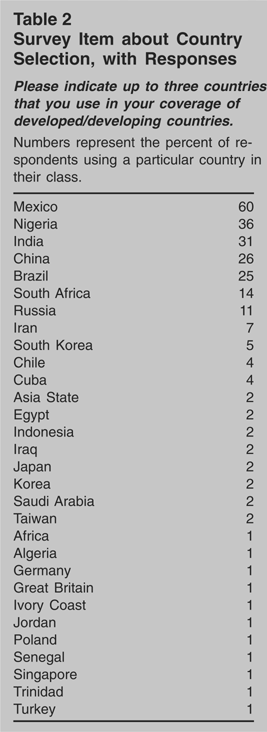
The committee members used further survey items to help shape their thinking about what countries to include. These items gave information about country selections college faculty were making in their introductory comparative politics college classrooms. In the original survey, the countries were listed alphabetically, but here they are sorted by the percentage of respondents teaching about the countries in their introductory courses (see Tables 1 and 2).
Survey Item about Country Selection, with ResponsesOther countries listed by respondents were Afghanistan, Algeria, Cuba, Czech Republic, European Union, Indonesia, Iraq, Saudi Arabia, Senegal, Singapore, Spain, Tobago, Trinidad, and the United States.

Survey Item about Country Selection, with Responses

Interestingly, the survey results suggested that the existing AP course reflected the college practice quite closely. Great Britain, France, Russia, China, Mexico, India, and Nigeria were among the top 10 country choices at the college level. Nevertheless, the committee wanted to move toward a uniform core group of countries that could be included within a one-semester course. For the selection of countries, the committee had in mind three general criteria: the countries selected had to illustrate both non-democratic and democratic politics; they had to represent institutional and geocultural diversity; and finally, the committee was restricted in the number of countries that AP teachers could reasonably be expected to cover in a one-semester course. At the same time, the committee did not feel bound by what was currently featured in the textbooks.3
One challenge for teachers of this new course will be to find appropriate textbooks. While the committees responsible for the revisions consulted textbooks, the College Board has a no-endorsement policy regarding textbooks, and as such the committee made no explicit recommendations. Suffice it to say, however, that many publishers keep a keen eye for content shifts in AP programs (this is a rather large textbook market) and, most likely, there will soon be appearing a selection of both revised and new textbooks taking into account the country changes and thematic revisions discussed herein.
Even with these criteria, the choices were not easy. The committee had an interesting exchange of views on the relative merits of studying Great Britain or Germany. Great Britain offered a parliamentary democracy with a place for a monarch, a unitary system that included a mix of nations, political stability without a written constitution, and relative accessibility. Germany offered coalition politics, a pioneer of closer European integration, and an electoral system that has become the model for electoral reform. If forced to choose because of limits on the total number of countries to be covered, members generally preferred Germany to Great Britain. On the other hand, such a choice would depart from what the survey suggested was the general college practice—with Great Britain being the most popular country selection at the college level. One of the missions of the AP program is to provide high school students with a learning experience comparable to that of an introductory college course. Indeed, careful studies are regularly done to ensure comparability between AP courses and their college counterparts. Thus, given that Great Britain, already familiar to AP instructors, is the runaway first choice of college instructors of this subject, it seems appropriate that it remain represented in the core group of AP Comparative Government and Politics countries.
Russia came second in the survey and, as a case, it provides rich material on political change, on non-democracy and transitional or illiberal democracy, and on economic change from a command toward private ownership and a market system. China added to the geocultural and institutional diversity of the group and illustrated the working of a non-democratic political system. Mexico was kept from the original list, as it is a developing country of obvious relevance to U.S. students and it represents a useful opportunity to discuss, in a Latin American context: globalization and inequality, patron-client relations, and democratization in the face of a one-party system, among other things.
The committee also wanted to make sure that the course captured the impact of cultural and religious forces in its selection of the Iranian case. There was a strong sentiment not to be “Euro centric” and more positively to include an Islamic Middle Eastern country. Clearly, there were alternatives here too. Some argued that Islam could be covered within the discussion of Nigeria, India, or even contemporary Britain. And, if the Middle East required representation, other possibilities included Egypt or Saudi Arabia. While the textbooks did not cover it very well, the theocracy in Iran captured the committee's attention as an example of a political system set up in part as a rejection of Western approaches to politics. And, its status as the world's only theocratic republic made it an even more interesting case.

There was debate about the place of the European Union (EU) in the course. Members of the committee noted that the EU represented a qualitatively new type of challenge to the traditional notion of the state, and the survey results above suggest that most college courses provide some coverage of the EU. Nevertheless, the committee decided not to include the EU as equivalent to a core country in the course but rather to consider how it fits under the major themes and concepts of the course (notably nation, state, globalization, and supranational governance) as well as under the discussion of public policy in relation to Great Britain.
Concepts and Themes
Finally, the committee had to provide guidance on the important concepts and themes to be included in the course. The committee was very aware that while the traditional subfields of political science continue to organize the discipline, there is overlapping subject matter undermining the traditional division of labor, so much so that it is now often difficult to determine quite where comparative politics stops and international relations begins. For example, globalization raises issues about the interlinking and interdependency of political systems, as well as issues concerning the location of power, sovereignty, and decision-making. The committee recognized that globalization was a multidimensional concept with cultural, economic, and organizational components, and that each of these components had implications for politics. On a cultural level, political parties or governments might be moved to defend their understanding of national cultures against Westernization or the spread of the English language. Economically, expanded markets diminish national control over economic performance and pressure national efforts to protect citizens from shifts in investment or trade. Organizationally, the corollary of expanded markets are expanded political arrangements such as the EU and the World Trade Organization that shift decision-making from national capitals. The committee expected that these issues would gain increasing prominence in the college-level comparative course.

The survey item above shows that almost all respondents spend time on democratization in their introductory comparative politics class, with half of respondents spending two or more weeks on democratization. Members of the committee agreed that democratization should have a prominent place in the new course. This decision informed country selection, including both democracies and nondemocracies, and reinforced interest in related themes and concepts such as accountability, the role of civil society, social movements, and the media. These concepts and themes represented an addition to the traditional coverage of democratic representation and participation, the discussion of interest groups, parties, elections, and parliamentary and presidential systems as alternative ways to organize democratic politics.
Both globalization and democratization speak to the relationship between economic and political change. To what extent does a global polity accompany a global economy? What level of economic well-being enables sustained democratic politics? How have neoliberalism, structural adjustment, and the agendas of developed countries and supranational actors affected the economics and politics of developing countries? Within political systems, how does changing economic performance affect political leaders? Thinking about Chinese and Soviet leaders, to what extent are even nondemocratic political leaders accountable or affected by economic performance? Even if the introductory course could not be expected to provide an extensive treatment of these questions, it could provide stimulating and relevant material for students of comparative politics.
Committee members recommended that policy outcomes constitute an identifiable component of the course. Policies bring home the importance of politics and policy performance, providing a useful point of comparison among political systems. The economy, environment, welfare, population, civil liberties, rights, and freedoms were among the range of policy issues identified for discussion in the comparative course.
The Revised Course
Six countries were ultimately included in the revised course: China, Great Britain, Iran, Mexico, Nigeria, and Russia. Appendix A contains the final AP Comparative Government and Politics course content specifications. There remain six main content categories, but these are different from the previous version of the course—recast to reflect both conceptual and country-specific changes made by the committee:
- Introduction to Comparative Politics
- Sovereignty, Authority, and Power
- Political Institutions
- Citizens, Society, and the State
- Political and Economic Change
- Public Policy
The category of “Public Policy” was added to use broad and enduring policy challenges faced by many countries as a vehicle for a greater focus on actual comparison across countries. The “Political and Economic Change” category was created to cover democratization, globalization, and fragmentation. “Sovereignty” was added to the original “authority and power” category to emphasize its importance not only in light of the threats posed by globalization, but also with regard to its saliency in the context of supranational governance. The committee had to walk a fine line in creating these guidelines. On the one hand, it had to make the guidelines inclusive and explicit enough to both adequately represent the discipline and to serve as a model for a national curriculum. On the other hand, the guidelines could not be so inclusive as to be prohibitively cumbersome. Thus, the committee forged a set of guidelines that is explicit enough to ensure some reliability in content coverage in classrooms across the United States, without intending to be exhaustive of all important concepts. For example, the concepts of failed states and weak states (concepts of great current practical importance) are not explicitly mentioned in the guidelines, but fit under the “state building, legitimacy, and stability” subtopic in the “Sovereignty, Authority, and Power” category.
Conclusion
The committee was charged with the task of recommending revisions to the AP Comparative Government and Politics course that reflected the current and future state of the discipline. The committee endorsed both a shift to a greater conceptual and thematic focus and a revised list of specific countries to be covered in the course. The committee did not seek, and did not reach, unanimity on all issues. The liveliest disagreements came over regional coverage and country selection—whether to include a Middle Eastern country, and whether to swap Germany for Great Britain—but not over the decision to strengthen the conceptual and thematic component and to use the study of specific political systems to illustrate these concepts and themes.
In thinking about these issues, the committee adopted a four-fold approach to revising the AP Comparative Government and Politics course. The following four questions provide a general overview of this process:
- What are the goals of the course, in terms of student learning?
- What structure, or approach, best supports meeting the course goals?
- What countries are most appropriate for meeting student-learning goals?
- What concepts, theories, and themes are most appropriate for meeting student-learning goals?
If we replicated the exercise with a different committee, it is unlikely that we would come up with precisely the same content and structure, just as it is unlikely that an individual instructor in thinking about how to design or redesign the course would arrive at the same place. But we think that gaining an idea of how the committee worked through the issues and what conclusions they arrived at may be helpful to those teaching this important course. For the members, the committee provided a unique opportunity to exchange views and ideas about teaching the foundations of political science in a comparative context. For the College Board, the committee initiated a redesign of a course that is one of the shop windows of the discipline.
Biographies
Neil J. Mitchell is professor of politics at the University of Aberdeen. He is the author of Agents of Atrocity: Leaders, Followers, and Violation of Human Rights in Civil Wars (Palgrave Macmillan, 2004) and other books and scholarly articles. He is currently chair of the Advanced Placement (AP) Comparative Government and Politics Development Committee.
David L. Richards is assistant professor of political science at the University of Memphis. He is co-director of the CIRI Human Rights Data Project (www.humanrightsdata.org) and his research focuses on government respect for human rights, particularly as examined through the lenses of economic globalization and democratic institutions. From 2003–2005 he worked at ETS in Princeton, NJ, on political science-related assessments and publications, including the AP Comparative Government and Politics revision.
Appendix A

Reprinted, with permission of the College Entrance Examination Board. College Entrance Examination Board, College Board AP Government & Politics Course Description (New York: College Entrance Examination Board, 2005).

Survey Item about Country Selection, with ResponsesOther countries listed by respondents were Afghanistan, Algeria, Cuba, Czech Republic, European Union, Indonesia, Iraq, Saudi Arabia, Senegal, Singapore, Spain, Tobago, Trinidad, and the United States.
Survey Item about Country Selection, with Responses
 You have Access