


I. Introduction
We examine the role of social interactions between U.S. Senators in stock trading decisions. We study this setting not only because it allows for more powerful tests to examine the sharing of information that leads to trading but also because there are ongoing concerns that members of Congress benefit from information obtained from their political position. We proxy for interactions between Senators and changes in those interactions over time through changes in the physical location of each Senator’s desk relative to other Senators in the Senate Chamber (see Masket (Reference Masket2008), Chown and Liu (Reference Chown and Liu2015), and Harmon, Fisman, and Kamenica (Reference Harmon, Fisman and Kamenica2019)). We expect these interactions to spur information sharing both within and outside the Chamber, in person and via other means, as Chown and Liu (Reference Chown and Liu2015) have documented that Senators who sit closer together are more likely to co-sponsor legislation together. Using this setting, we examine whether the likelihood of executing similar stock trades is related to the degree of Senator interactions. We also investigate whether the information shared is public or private, and the source of information, to more directly speak to the concerns about Congressional trading. Finally, we analyze the motivations to share information and the potential benefits that accrue to sharing information, and in doing so, we provide the first empirical evidence on career-related benefits from sharing information.
Despite prior evidence that individuals share trading information through social networks or because of the geographical proximity of their home (Hong, Kubik, and Stein (Reference Hong, Kubik and Stein2004), (Reference Hong, Kubik and Stein2005), Cohen, Frazzini, and Malloy (Reference Cohen, Frazzini and Malloy2008), (Reference Cohen, Frazzini and Malloy2010), Pool, Stoffman, and Yonker (Reference Pool, Stoffman and Yonker2015), and Huang, Hwang, and Lou (Reference Huang, Hwang and Lou2021)), it is an open question whether Senators share information that would lead to executing similar stock trades. Although members of Congress have been required to file an annual statement providing a listing of their trades since the passage of the Ethics in Government Act of 1978, public scrutiny over their trading activities has increased dramatically in recent years. The passage of the STOCK Act in 2012 made members of Congress explicitly subject to insider trading regulations (Christensen, Mikhail, Walther, and Wellman (Reference Christensen, Mikhail, Walther and Wellman2017), Stephan, Walther, and Wellman (Reference Stephan, Walther and Wellman2021)). This increased scrutiny may discourage Senators from discussing any trading-relevant information.
We investigate whether Senators are likely to share information and the outcomes of sharing information by analyzing their stock trading activities. Specifically, for each trade made by a Senator while Congress is in session, we identify whether any other Senators also traded a stock in the same industry within 5 trading days. We focus on co-trading at the industry level as the legislation passed by the Senate, and thus, the value-relevant information Senators may have access to predominantly affects industries rather than individual firms (Cohen, Diether, and Malloy (Reference Cohen, Diether and Malloy2013)). We limit our analysis to trades made while Congress is in session to increase the likelihood that any similarity in trading activities can be attributed to Senators’ word-of-mouth interactions.
Consistent with information sharing between Senators, we find that when two Senators are more likely to interact (i.e., sit closer together in the Senate Chamber), they are more likely to trade stocks in the same industry within a 5-trading-day window. In our estimations, we control for time-invariant factors for each Senator pair that may be correlated with their trading activities by including Senator-dyad fixed effects, in addition to various control variables and Congress and stock fixed effects. Thus, changes in the extent of interactions between Senators are driving this result, making it unlikely that it is due to an omitted factor such as seniority or preexisting relationships with other Senators. We further document that this association between seat proximity and co-trading is concentrated where the two Senators belong to the same political party, consistent with homophily effects in social interactions (e.g., Pool et al. (Reference Pool, Stoffman and Yonker2015), Huang et al. (Reference Huang, Hwang and Lou2021), Hwang (Reference Hwang, Hilary and McLean2023)). Thus, our subsequent analyses focus on same party interactions.
To provide greater confidence that our results are due to the sharing of information between Senators while serving in Congress, we perform three additional tests. First, we employ an identification strategy that exploits the timing of Senate elections to capture exogenous variation in likelihood a given Senator will be present in Washington DC. Every 2 years, one out of three Senators is up for re-election. In the last year of a Senator’s term, Senators spend a much greater amount of time campaigning in their home state and are thus often away from Washington DC (Fenno (Reference Fenno2002), Chown and Liu (Reference Chown and Liu2015)). These campaign-induced absences should reduce the degree of interactions between Senators and thus also reduce the sharing of information. Consistent with this prediction, we find that there is no association between seat proximity and co-trading for those Senator pairs when one or both Senators are spending more time in their home district because they are campaigning for re-election. Second, to ensure these null results are not driven by a general lack of trading when Senators are campaigning, we examine whether the number of monthly trades executed by a Senator is lower when that Senator is busy campaigning. We do not find any evidence suggesting that this is the case. Third, we perform a falsification test and document that the association between seat proximity and co-trading does not hold when Congress is not in session. The lack of association in this falsification test is consistent with reduced interactions and/or reduced access to valuable political information when Congress is out of session. These analyses jointly validate our interpretation that the co-trading we document is due to variation in the sharing of information through interactions, as proxied by changes in seat proximity.
Next, to investigate the nature of the information being shared, we document that there is no association between co-trading based on Senator interactions and recent public news. We further find that the association between interactions and co-trading is weakened as the degree of scrutiny faced by Senators increases (Tahoun (Reference Tahoun2014)). This time-series variation with scrutiny is consistent with the information they are sharing potentially being private.
Consistent with the sharing of private information, we also find that co-trades executed by Senators that are more likely to interact (e.g., sit closer together) yield positive and significant market-adjusted returns of 1.1%. We further document that the profitability of co-trades increases by 42 basis points for each meter closer that Senators sit together. Thus, co-trading linked with greater interactions between Senators tends to be more informed than the typical trading done by Senators.
To identify the possible source of this private information, we investigate the cross-sectional variation in the association between the degree of interactions and co-trading with industry oversight arising from the committees on which the Senator serves (Mehta and Zhao (Reference Mehta and Zhao2020), Mehta, Srinivasan, and Zhao (Reference Mehta, Srinivasan and Zhao2020), and Stephan et al. (Reference Stephan, Walther and Wellman2021)). Our evidence suggests that Senators share information obtained through legislative activities. Specifically, when the Senator has oversight over an industry, the relation between the likelihood of co-trading and seat proximity becomes stronger. This cross-sectional finding mitigates the concern that our findings are due to common information shocks leading to common Senatorial trading.
To provide additional support for the conclusion that Senators share privileged industry information gleaned from their committee work, we analyze Senator trades in stocks likely affected by Congressional activities in narrow windows when the availability of private information is high. Specifically, we examine co-trading in energy-related stocks shortly after hearing dates of the Senate’s Energy and Natural Resources Committee where the first Senator trading is a member of that committee. Using an event study design, we find that the association between co-trading in energy stocks and the degree of Senator interactions is indeed greater shortly after an Energy and Natural Resources Committee hearing if the first Senator trading is on that committee and the second Senator trading is not on the committee. In a falsification test, we observe that this finding does not hold for co-trading in nonenergy-related stocks after these same committee meetings. These analyses hold constant all other factors that may be correlated with the extent of interactions between two Senators and the likelihood of co-trading and only vary whether one Senator has access to private information about this industry. As such, these results provide more support for our inference that Senators share privileged information obtained through their positions in Congress and decide (either individually or in concert) to trade stocks based on this information.
We also investigate what motivates Senators to share information. We first examine if Senators share information to curry favor with or signal competence to other Senators in their party, consistent with impression management (Berger (Reference Berger2014), Hwang (Reference Hwang, Hilary and McLean2023)). In this analysis, we focus on the relative power of the Senators. We measure the power of each Senator based on the Senator’s committee rankings and relative voting power (Cooper, Gulen, and Ovtchinnikov (Reference Cooper, Gulen and Ovtchinnikov2010)). We predict that Senators with less power are more likely to share information with Senators with more power in an effort to curry favor and gain status. Consistent with this prediction, we find that the association between our proxy for the degree of Senator interactions and co-trading is stronger when the information transfer is from a Senator with relatively lower power to a Senator with relatively higher power.
We next examine if sharing private information benefits a Senator’s career at some point in the future. While many career benefits may accrue to Senators who share information, we examine one specific benefit: developing or strengthening relationships with powerful Senators that results in the assignment to higher ranking committees. We focus on committee assignments because it is observable and represents one important means where politicians can increase their influence and visibility, as well as interact with other powerful leaders.Footnote 1 We document that both the number and the percentage of highly ranked (“Super A”) committees a Senator is assigned to are positively associated with the number of co-trades that the Senator had in the prior Congress in which they were the first trader (and thus the one who likely had the information to share). The extent of Super A committee assignments is also positively associated with the average co-trading profitability earned by those other Senators in the prior session (i.e., the second traders who likely received information).Footnote 2 These findings suggest that one career benefit associated with sharing information through interactions is an increase in the power of the Senator’s position, either because sharing information conveys the Senator’s expertise or because of a strategic quid pro quo relationship where one Senator provides private information in exchange for more exclusive committee assignments.
This article contributes to several streams of literature. First, we contribute to the social finance literature that investigates information exchange through relationships and networks and its impact on individuals’ trading activities (e.g., Hong et al. (Reference Hong, Kubik and Stein2004), (Reference Hong, Kubik and Stein2005), Cohen et al. (Reference Cohen, Frazzini and Malloy2008), (Reference Cohen, Frazzini and Malloy2010), Hvide and Östberg (Reference Hvide and Östberg2015), Pool et al. (Reference Pool, Stoffman and Yonker2015), Hirshleifer (Reference Hirshleifer2020), Huang et al. (Reference Huang, Hwang and Lou2021), Kuchler and Stroebel (Reference Kuchler and Stroebel2021), Han, Hirshleifer, and Walden (Reference Han, Hirshleifer and Walden2022), Hwang (Reference Hwang, Hilary and McLean2023), and Chi, Hung, Lin, and Tseng (Reference Chi, Hung, Lin and Tseng2025)).Footnote 3 Our use of the physical location of each Senator’s desk provides a powerful setting to detect the likelihood of interactions that can lead to the sharing of information by allowing us to identify who could plausibly communicate with whom. Further, the desk inhabited by each politician is rearranged regularly for reasons other than those related to stock trading, providing time-series variation in the likelihood that two Senators will interact (Chown and Liu (Reference Chown and Liu2015)). Our placebo tests also provide compelling support for causal interpretations.
We also contribute to this literature by documenting that word-of-mouth communication can lead to improved trading performance. In our setting, Senators who co-trade based on information likely received from a colleague earn significant abnormal returns. This finding contrasts with much of the literature that finds that word-of-mouth information tends to harm retail investors’ stock market performance (e.g., Hvide and Östberg (Reference Hvide and Östberg2015), Huang et al. (Reference Huang, Hwang and Lou2021), Chen and Hwang (Reference Chen and Hwang2022), and Hwang (Reference Hwang, Hilary and McLean2023)). The presence of significant abnormal returns suggests that in our setting, Senators are not biasing the information they share (in contrast to, e.g., Hirshleifer (Reference Hirshleifer2020) or Han et al. (Reference Han, Hirshleifer and Walden2022)) but rather are conveying information that is useful for trading. One potential explanation for why our findings differ from prior studies is that we study a setting where networks have access to privileged political information.
We also contribute to this literature by examining the nature and source of information shared, as well as the motivations for sharing information. Our tests identify private information gleaned from policy developments and Congressional oversight as one source of information being shared. Moreover, our results support the impression management motivation for sharing information by documenting that less powerful Senators are more likely to share information with their more powerful colleagues (Berger (Reference Berger2014 )). Further, our analysis of the assignment to higher ranking committees in the next Congress is the first empirical evidence illustrating career benefits for individuals relaying private, value-relevant information to a colleague.
Our analyses also contribute to the literature that investigates the benefits members of Congress earn through stock trading. This literature has examined two possible motives for Congressional trading: i) building relationships with constituent firms (Eggers and Hainmueller (Reference Eggers and Hainmueller2014), Tahoun (Reference Tahoun2014)) and ii) profiting from privately acquired information (e.g., Ziobrowski, Cheng, Boyd, and Ziobrowski (Reference Ziobrowski, Cheng, Boyd and Ziobrowski2004), Ziobrowski, Boyd, Cheng, and Ziobrowski (Reference Ziobrowski, Boyd, Cheng and Ziobrowski2011), Stephan et al. (Reference Stephan, Walther and Wellman2021), and Abdurakhmonov, Snider, Ridge, and Hasija (Reference Abdurakhmonov, Snider, Ridge and Hasija2023)). Our findings contribute to this second literature by suggesting that politicians not only trade on information obtained through their positions but also communicate this information to other Senators, who in turn also trade. We further propose an additional self-interested incentive to engage in information sharing that complements the impression management motive: furthering one’s own career.
Lastly, our study speaks to ongoing concerns that members of Congress benefit from information obtained through their political positions. The passage of the Stop Trading on Congressional Knowledge (STOCK) Act on Apr. 4, 2012 made it illegal for members of Congress to trade stocks based on privileged political information obtained through their positions.Footnote 4 Since its passage, many have criticized that the Act did not go far enough, and that the lax ethics rules still allow members of Congress and their households to profit on privileged information (Bravender, Levinthal, Hall, and Wang (Reference Bravender, Levinthal, Hall and Wang2021), Broadwater (Reference Broadwater2021), Metzger (Reference Metzger2021), (Reference Metzger2022), Diaz (Reference Diaz2022), Walsh (Reference Walsh2022), and Werschkul (Reference Werschkul2022)). To address these concerns, several bipartisan bills have been introduced in the House and Senate between 2021 and 2026 (e.g., S.564, H.R.1579, S.3504, S.3494, H.R.345, H.R.7008). If passed, these bills would prohibit members of Congress from trading in individual stocks, similar to the provisions in the AICPA code of conduct concerning auditors’ investing in client stocks. While we are unable to pinpoint precisely the exact information being shared and thus are unable to determine if Senators are sharing and trading on information in violation of insider trading laws, the results we document would not be expected if the information being shared were public.Footnote 5 Thus, we believe that the findings of our study could be informative for those considering legislation as one means to eliminate trading on privileged political information. Further, our evidence on the sharing of industry-level information suggests additional restrictions on trading in industry-level funds may be warranted.
II. Data and Descriptive Statistics
In this section, we describe the data and key variables we use to test the relation between Senator interactions and co-trading.
A. Congressional Trading Data
Each Senator is required to file a report annually with the Senate Office of Public Records to provide information about their personal finances and financial transactions. Senators must provide a detailed listing of the purchase, sale, or exchange of individual stocks, mutual funds, and treasury bills, interest and dividends received, and information on other financial transactions. We obtain a list of Senators’ individual stock and exchange-traded fund (ETF) purchases and sales from Stephan et al. (Reference Stephan, Walther and Wellman2021), which they extracted from the Center for Responsive Politics (CRP) and the Senate Office of Public records.Footnote 6 In our analysis, we focus on the period between Apr. 5, 2012, and Dec. 31, 2018. We begin our sample after the passage of the STOCK Act in April 2012 to ensure that the rules governing Congressional trading activities i) do not change during our sample period and ii) are relevant to the current environment. Our sample period ends in 2018 as that is the last year we have data on trading and congressional activity. Moreover, COVID-19 lockdown restrictions in the following election cycle limited in-person interactions. In our main analysis, we only use trades that are executed while Congress is in session as we are interested in the flow of information between Senators when they are most likely to interact.
B. Degree of Interaction Measure: Seating Proximity
Our proxy for interactions between each Senator pair is the physical distance between their two desks in the Senate Chamber.Footnote 7 As noted previously, we expect these interactions spur information sharing both within and outside the Senate Chamber (Chown and Liu Reference Chown and Liu2015). As illustrated in Chown and Liu (Reference Chown and Liu2015), the area where Senators sit within the Chamber is roughly 12 m by 24 m and contains a desk (bolted to the floor) for each of the 100 Senators.Footnote 8 Senators pick their Chamber desk by seniority within each political party, and as a result, junior Senators often end up in the distal wings of the Chamber. While Senators generally prefer to sit “front and center in the Chamber” (Chown and Liu ((Reference Chown and Liu2015), p. 182)), Senators often have idiosyncratic reasons for desk assignments, which provides needed variation between seniority and seating assignments.Footnote 9 For example, Senator Kennedy always sat at the back of the Chamber to allow for easy access to the Cloakroom because of his back issues (Chown and Liu (Reference Chown and Liu2015)). Since elections occur every 2 years and each Senator serves a 6-year term, a Senator will move locations multiple times during a single term, allowing variation in the distance between each pair of Senators. Furthermore, seating assignments can also change within a 2-year window due to other circumstances (e.g., Senator deaths, resignations). Notwithstanding these considerations, Senators can influence where they sit, thereby raising a potential “reflection” problem where any observed co-trading is driven by endogenous desk choice rather than interpersonal communications. The fixed effects in our empirical design and the subsequent falsification tests mitigate this reflection concern (see Sections III.B and III.C).
Following Chown and Liu (Reference Chown and Liu2015), we obtain the physical location of each Senator’s desk, as well as the beginning and end dates of the Senator’s assignment to that desk, from the scale diagrams available at the Senate’s website (see Appendix A, Figure A1 for an example).Footnote 10 During our sample period, there are 14 different seating arrangements. Using Python, we transpose each Senator’s desk location into Cartesian space, and we use the coordinates to construct ChamberDistance, the distance between Senator i and Senator j in meters (see Chown and Liu (Reference Chown and Liu2015) for additional details). During this period, we find that an average of 13.67% of Senators change locations with a new seating arrangement, and of those Senators that move, the average change in location is 3.67 meters (untabulated).
Although we can obtain the physical location for every Senator’s desk at any given point in time during our sample period, we eliminate Senators that do not engage in at least one trade of an individual stock during our sample period. We impose two additional requirements to identify information-based trades. First, to eliminate trades executed for liquidity purposes, we eliminate observations where the Senator traded in 10 or more individual stocks on a single day. Second, to eliminate trades that are part of a routine trading strategy, we follow Cohen, Malloy, and Pomorski (Reference Cohen, Malloy and Pomorski2012) and eliminate trades by a Senator in the same individual stock placed in the same calendar month for at least 3 consecutive years; our results are unchanged if we do not impose this requirement.Footnote 11 After imposing these requirements, our sample contains 445 Senator-year observations, representing 81 unique Senators and 5,114 trades. The fact that we do not have all 100 Senators represented in our sample each year is likely due to some Senators’ holding their investments in blind trust, trading exclusively in mutual funds, or providing incomplete data (Stephan et al. (Reference Stephan, Walther and Wellman2021)).
To examine the relation between the distance between desks in the Senate Chamber and co-trading, we employ a dyad-trade level structure. Specifically, for each trade in our sample executed by a Senator (referred to as Senator i), we construct observations for each pairing of Senator i with every other Senator in our sample in that year (referred to as Senator j). The resulting sample used in our empirical analyses consists of the 307,427 dyad-trade level observations. Table 1 provides descriptive statistics for this sample. As shown in Table 1, the desks of two Senators are, on average, approximately 10.152 meters apart, consistent with the mean distance of 9.992 meters in Chown and Liu (Reference Chown and Liu2015).

TABLE 1 Long description
The table contains seven columns: Variable Name, N, Mean, Std. Dev., p25, Median, and p75. All variables have an N of 307,427.
* CoTrade: Mean 0.024, Std. Dev. 0.155, p25 0.000, Median 0.000, p75 0.000.
* ChamberDistance: Mean 10.152, Std. Dev. 5.898, p25 5.183, Median 9.268, p75 14.842.
* SenioritySum: Mean 20.648, Std. Dev. 13.550, p25 10.000, Median 18.000, p75 28.000.
* CoMembership: Mean 0.799, Std. Dev. 0.765, p25 0.000, Median 1.000, p75 1.000.
* CoSponsorship: Mean 33.255, Std. Dev. 16.727, p25 21.000, Median 30.000, p75 42.000.
* HighOversight: Mean 0.594, Std. Dev. 0.491, p25 0.000, Median 1.000, p75 1.000.
C. Politician Characteristics
For each politician in our sample, we construct measures of their seniority and oversight. Using data from Charles Stewart’s website on Senate Membership, we define Seniority as the number of years that individual has been a member of the Senate.Footnote 12 The mean (median) level of Seniority for the 445 Senator-year observations in our sample is 10.744 (7.000) years (not tabulated).
We measure a Senator’s oversight over a given industry using firm-level lobby reports from LobbyView.org. These reports provide both the identity of the firm and a code corresponding to the issue the firm is lobbying about. Using the crosswalk in Appendix A3 of Bertrand, Bombardini, and Trebbi (Reference Bertrand, Bombardini and Trebbi2014), we link the issue codes in each lobby report to the Senate committee with oversight over those issues and then link those lobby reports to individual Senators based on committee membership. We measure HighOversight as an indicator variable that equals 1if the Senator has oversight for at least one of the top three most frequently lobbied issues in an industry, and 0 otherwise. As shown in Table 1, 59.4% of the Senators have oversight over the industry to which the traded firm belongs.
D. Outcome Measure of Information Flow: Co-Trading
We investigate an outcome of the flow of information between two Senators by examining whether two Senators whose desks are physically closer are more likely to execute similar trades. We measure similarity in trading as executing stock trades in firms belonging to the same industry (based on Fama–French 12 industry classifications) within a short period of time.Footnote 13 We focus on trading at the industry level to measure similarity under the assumption that the private political information that Senators may possess is more likely to pertain to an entire industry rather than a single firm. The motivation for this assumption stems from the fact that the majority of legislation affects industries, and legislation is rarely drafted and enacted against a single firm (Cohen et al. (Reference Cohen, Diether and Malloy2013)). Thus, we define CoTrade as an indicator variable that equals 1 if Senator j trades a stock in the same industry within 5 trading days of a trade executed by Senator i for a stock in that industry, and 0 otherwise.Footnote 14 As shown in Table 1, the frequency of co-trading stocks within the same industry in the same 5-day period is relatively rare; 2.4% of our dyad-trade level observations (or 7,523 observations) represent co-trades.
III. Empirical Results
A. Chamber Distance and Senator Co-Trades
To examine the association between the likelihood of co-trading stocks within the same industry and seat distance, we estimate the following linear probability model for our dyad-trade level sample:

where CoTrade is an indicator variable equal to 1 if Senator j traded a stock in the same industry within 5 trading days of trade k executed by Senator i at time t, and 0 otherwise; and ChamberDistance is the distance between the desks of Senators i and j at time t. In estimating equation (1) and subsequent models, we divide Chamber distance by 1,000 for ease of interpretation. In equation (1), we expect α1, the coefficient on ChamberDistance, to be negative if two Senators who sit closer together are more likely to co-trade stocks in the same industry.
Our primary tests use a linear measure of distance in contrast to other work where interactions are proxied by being located in the same city (Hong et al. (Reference Hong, Kubik and Stein2005)) or neighborhood (as measured by Pool et al. (Reference Pool, Stoffman and Yonker2015) as living within 2.6 normalized miles of each other or by Huang et al. (Reference Huang, Hwang and Lou2021) as living within 3 miles of each other), working in the same plant (Hvide and Östberg (Reference Hvide and Östberg2015)), or being assigned to the same military unit (Chi et al. (Reference Chi, Hung, Lin and Tseng2025)). In our setting, the physical space involved tends to be much smaller than in those studies. For robustness, we ensure our results hold using logarithmic or categorical measures of distance (see Table 2).

TABLE 2 Long description
The table is divided into three vertical panels, each with four columns labeled 1 through 4 under the dependent variable CoTrade.
Panel A: Entire Sample
* ChamberDistance: -1.276 with three asterisks in columns 1 and 2 (t-statistic -5.61).
* Ln(1 plus ChamberDistance): -0.008 with three asterisks in column 3 (t-statistic -4.29).
* ChamberDistance 0-5m: 0.007 with three asterisks in column 4 (t-statistic 3.61).
* ChamberDistance 5-10m: 0.002 in column 4 (t-statistic 1.52).
* SenioritySum: -0.001 across columns 2, 3, and 4.
* CoMembership: -0.001 across columns 2, 3, and 4.
* CoSponsorship: 0.000 with two asterisks across columns 2, 3, and 4.
* Fixed Effects: Congress F E, Dyad F E, and Stock F E are all marked Yes.
* N: 307,427. Adjusted R-squared: 0.18.
Panel B: Same Political Party Subsample
* ChamberDistance: -1.815 and -1.820 with three asterisks in columns 1 and 2.
* Ln(1 plus ChamberDistance): -0.009 with three asterisks in column 3.
* ChamberDistance 0-5m: 0.012 with three asterisks in column 4.
* ChamberDistance 5-10m: 0.006 with two asterisks in column 4.
* Controls: No in column 1, Yes in columns 2-4.
* N: 163,413. Adjusted R-squared: 0.17.
Panel C: Different Political Party Subsample
* ChamberDistance: -0.375 and -0.309 (not significant) in columns 1 and 2.
* Ln(1 plus ChamberDistance): -0.002 (not significant) in column 3.
* ChamberDistance 0-5m: -0.005 (not significant) in column 4.
* ChamberDistance 5-10m: -0.002 (not significant) in column 4.
* N: 144,014. Adjusted R-squared: 0.18.
Following Chown and Liu (Reference Chown and Liu2015), we include in equation (1) the following dyad-level characteristics at time t: the sum of seniority between Senators i and j (SenioritySum), the number of committees that Senators i and j both sit on (CoMembership), and the number of bills that Senators i and j both sponsor (CoSponsorship).Footnote 15 We also include Congress, stock, and Senator dyad fixed effects to control for spurious co-trades. The Congress fixed effects control for time-period factors correlated with co-trading, such as the health of the economy, which could influence trading by all Senators in general; the stock fixed effects control for time-invariant firm characteristics correlated with co-trading, such as whether the company is commonly traded by everyone (e.g., Apple); and Senator dyad fixed effects control for time-invariant characteristics of Senators i and j correlated with co-trading, such as whether both Senators are wealthy and simply trade more often. Also note that by including dyad fixed effects, our model estimation relies on variation in the seat distance between the same two Senators over time. The results from estimating equation (1) hold if we use alternative fixed effect structures and/or clustering approaches.Footnote 16
Panel A of Table 2 provides the results for estimating equation (1). As shown in column 1, the estimated coefficient on ChamberDistance is −1.276, which is significant (p < 0.01). The negative coefficient indicates that the likelihood of co-trading in the same industry is significantly higher when Senators are more likely to interact (e.g., the distance between their desks in the Senate Chamber decreases). The coefficient on ChamberDistance remains significantly negative after we include politician-dyad control variables in addition to Congress, Senator dyad, and stock fixed effects (column 2). The results are similar when we measure distance using the logged value, Ln(1 + ChamberDistance) (column 3). In column 4, we replace ChamberDistance with two categorical measures for distance; ChamberDistance0-5m (ChamberDistance5-10m) equals 1 if the two Senator’s desks are 0–5 (5–10) meters apart, 0 otherwise. We find that the likelihood of co-trading increases when the two Senators sit within 5 meters of each other (coefficient on ChamberDistance0-5m = 0.007, p < 0.01).
By contrast, the estimated coefficients on our control variables, SenioritySum and CoMembership, are insignificant. The insignificant coefficient on CoMembership is puzzling, as one would expect that sitting on more common committees would be more likely to increase co-trading. One possible explanation is that the variation in CoMembership is limited, reducing the power to detect an association between CoTrade and CoMembership.
In untabulated analyses, we assess the sensitivity of these results to the window used to identify co-trading. We continue to find a negative and significant coefficient on ChamberDistance if we shorten the window to 3 trading days (−0.995, t-stat = −5.10, p < 0.01) or expand the window to 10 trading days (−1.388, t-stat = −5.08, p < 0.01).Footnote 17 This finding suggests that Senators who interact more (as proxied by sitting closer together in the Chamber) are more likely to share industry-related information that they in turn use to make trading decisions.
B. Chamber Distance and Senator Co-Trades Conditional on Party Affiliation
We further probe the association between seating proximity and co-trading conditional on the party affiliation of the Senator dyad. Prior work in social finance has documented homophily in social networks; that is, individuals prefer to interact with those who share their backgrounds, preferences, or beliefs (Pool et al. (Reference Pool, Stoffman and Yonker2015), Huang et al. (Reference Huang, Hwang and Lou2021), Hwang (Reference Hwang, Hilary and McLean2023)). Thus, we hypothesize that Senators who sit closer together and belong to the same political party are more likely to exchange information than Senators who belong to opposite political parties.Footnote 18 This hypothesis is also motivated by evidence on the increased polarization of U.S. Senators over time (Lewis, Poole, Rosenthal, Boche, Rudkin, and Sonnet (Reference Lewis, Poole, Rosenthal, Boche, Rudkin and Sonnet2021)), suggesting that Senators would be less likely to convey trading information outside their party lines.
To test this conjecture, we split our sample based on whether the two Senators in the dyad belong to the same political party and re-estimate equation (1) on the two subsamples. Panels B and C of Table 2 provide the results of these estimations. As shown in Panel B, the estimated coefficient on ChamberDistance is significantly negative if the two Senators belong to the same political party.Footnote 19 The magnitude of the coefficient in column 1 indicates that as the two Senators’ desks move 1 meter closer together, which is the average distance between a Senator’s desk and their closest neighbor, the likelihood of co-trading increases by 0.18%. This effect represents a 7.86% increase in the unconditional likelihood of co-trading.Footnote 20 The negative coefficient also holds in column 3 when we consider a logged distance measure. Further, in column 4, the estimated coefficients on both categorical measures of distance (ChamberDistance0-5m and ChamberDistance5-10m) are both significant (p < 0.01) and increasing in magnitude as Senators sit closer together.
By contrast, when the two Senators belong to different political parties (Panel C), the estimated coefficient on any of the distance measures considered is insignificantly different from zero. Thus, our findings appear to be concentrated where the two Senators belong to the same political party. One potential concern is that these insignificant results are not driven by homophily but rather the fact that on average, two Senators sitting in the same political party sit closer together than two Senators sitting in different political parties.Footnote 21 However, the insignificant coefficient on ChamberDistance0-5m in Panel C indicates that two Senators of opposing political parties that sit within 5 meters of each other are not more likely to co-trade. Thus, our insignificant results are consistent with a lack of homophily inhibiting information sharing across parties.
To provide additional support that the results in Table 2 are due to the sharing of information as proxied by micro-geographical proximity, we next perform a falsification test where we re-estimate equation (1) using trades executed when Congress is not in session. We maintain that the degree of Senator interactions as well as Senators’ access to private political information from their legislative activities is lower when Congress is not in session. Thus, if our results are driven by unmodeled factors correlated with our proxy for interactions, we should continue to find ChamberDistance loading even when the Senators are not at their Chamber desks. In untabulated analyses, however, we find that the estimated coefficient on ChamberDistance is not significantly different from zero (p > 0.10) for trades executed when Congress is not in session. Although one limitation of this analysis is the smaller sample size (n = 6,309), this falsification test is consistent with the results in Table 2 being attributable to Senators sharing information related to legislative activities when they are more likely to interact with each other.
Taken together, the analyses in Table 2 are consistent with our conjecture that politicians who share similar ideological beliefs (as measured by party affiliation) are more likely to also share industry information that leads them to execute similar trades. Given that the results are concentrated for Senator dyads belonging to the same party, we focus on this subsample in subsequent analyses.
C. Identification: Campaign Re-Election
To provide even more persuasive evidence that our results capture information sharing, we next employ an identification strategy that exploits variation in the timing of Senator elections to capture exogenous variation in likelihood a given Senator will be present in Washington DC. This test is designed to capture when the degree of interactions between a given pair of Senators is lower for exogenous reasons. An institutional characteristic of the U.S. Senate is that although Senators serve 6-year terms, every 2 years a subset of Senators must go up for re-election. In the year before Senators face an upcoming re-election, they spend a greater amount of time in their home state to campaign for re-election and thus less time in Washington DC (Chown and Liu (Reference Chown and Liu2015), Fenno (Reference Fenno2002)).Footnote 22 These campaign-induced absences should reduce word-of-mouth interactions and thus the sharing of information. Therefore, if our results in Panels A and B of Table 2 are due to sharing of information, we expect the relation between seat proximity and co-trading to be mitigated within a Senator dyad when one or more of the Senators are campaigning.
An advantage of this analysis, relative to the not-in-session falsification test in Section III.B, is that only a subset of the Senator pairs is identified at any point in time as being likely away from the Senate Chamber. To perform this test, we augment equation (1) with an indicator variable, EitherSenatorCampaigning (BothSenatorsCampaigning), that equals 1 if year t is the last year of a 6-year term for either (both) Senator(s) in the dyad and the trade occurs between Nov. 1 of year t-1 and Oct. 31 of year t (i.e., the 12-month window prior to the election).Footnote 23 We then interact this variable with our variable of interest, ChamberDistance. If our prediction is correct, we expect the coefficient on the interaction term to be positive and significant.
Panel A of Table 3 provides the results of this analysis for the same political party subsample. Consistent with Table 2, the estimated coefficient on ChamberDistance is negative and significant (p < 0.01). By contrast, in column 1, the coefficient on the interaction term, ChamberDistance × EitherSenatorCampaigning, is 0.704 (t = 2.51, p < 0.05), indicating that the negative association between seat proximity and the co-trading is attenuated when one Senator is likely away from Washington DC due to re-election campaigning. When both Senators are up for re-election and thus it is even more likely that at least one is not in Washington DC, we find that the negative association between seat proximity and co-trading is completely offset for these dyads. Specifically, in column 2, the coefficient on ChamberDistance × BothSenatorsCampaigning is 1.976 (t = 2.38, p < 0.05), and the F-statistic testing if ChamberDistance + ChamberDistance × BothSenatorsCampaigning equals 0 is 0.02 (p > 0.10).

TABLE 3 Long description
Panel A, titled Chamber Distance and Re-Election, uses Co-Trade as the dependent variable across two models.
* ChamberDistance: -1.914 (t-stat -6.06) in model 1 and -1.865 (t-stat -5.94) in model 2, both significant at 1 percent.
* EitherSenatorCampaigning: -0.006 (t-stat -3.06) in model 1.
* ChamberDistance times EitherSenatorCampaigning: 0.704 (t-stat 2.51) in model 1, significant at 5 percent.
* BothSenatorsCampaigning: -0.015 (t-stat -3.08) in model 2.
* ChamberDistance times BothSenatorsCampaigning: 1.976 (t-stat 2.38) in model 2, significant at 5 percent.
* Fixed Effects (F E): Both models include Controls, Congress F E, Dyad F E, and Stock F E.
* Statistics: N is 163,413 and Adjusted R-squared is 0.17 for both.
Panel B, titled Monthly Senator Trades and Re-Election, compares raw Trades (model 1) and Ln(1 plus Trades) (model 2).
* SenatorCampaigning: -0.229 (t-stat -1.12) in model 1 and -0.025 (t-stat -0.56) in model 2; neither is statistically significant.
* Fixed Effects (F E): Both models include Senator F E and Year-Month F E.
* Statistics: Number of observations is 4,464. Adjusted R-squared is 0.61 for model 1 and 0.53 for model 2.
To ensure that these findings are not due to a general reduction in trading activities when a Senator is campaigning for re-election, we examine whether the number of monthly trades executed by a Senator is lower when that Senator is busy campaigning. Specifically, we regress the raw number of trades (or the log of 1 plus the number of trades) executed by a Senator in a month on an indicator variable equal to 1 if the month falls within the 12-month window just prior when that Senator is up for re-election (SenatorCampaigning), Senator fixed effects, and year-month fixed effects, and we cluster standard errors by Senator. In Panel B of Table 3, we find that the coefficient on SenatorCampaigning is not significantly different from zero (p > 0.10) regardless of the dependent variable used. This finding mitigates the concern that our results in Panel A are driven by an overall lack of stock trading when a Senator is on the campaign trail.
IV. Nature and Source of Information
While the results in Tables 2 and 3 suggest that Senators who are more likely to interact share industry-related information that leads them to trade stocks, the results are silent on the nature and source of information shared. In this section, we perform two broad sets of tests to shed light on these issues. First, we examine whether our results are consistent with Senators’ trading on public or private information. Second, we investigate variation in our results with different potential information sources available to Senators. Further, we utilize an identification strategy focusing on a single industry in short windows to support the inference that Senators share private information obtained through their political positions.
A. Nature of Information
The results in Tables 2 and 3 cannot distinguish whether the information shared that led to co-trading is publicly available or private. To investigate this question, we perform three sets of analyses. First, we construct measures of recent public news events and examine whether the propensity for two Senators who sit close to each other to trade stocks in the same industry varies cross-sectionally with these public news measures. Second, we examine whether the likelihood that two Senators who sit close to each other trade stocks in the same industry varies over time with the scrutiny Senators face. Third, we examine whether the profitability of co-trades executed by Senators is higher when the two Senators sit close to each other.
1. Publicly Available Information
One explanation for the results in Tables 2 and 3 is that Senators who interact with each other informally discuss recent news events which in turn leads each Senator to trade based on publicly available information. To examine if our results are consistent with the sharing of publicly available information, we construct two measures of news events based on the buy-and-hold abnormal return in the 5 trading days before Senator i trades. These proxies rely on the market incorporating any public, value-relevant news events in prices. The first measure, |PastReturn|, is the absolute value of the abnormal return over days (−5, −1) for the individual stock in which Senator i trades on day 0. The second, |PastIndReturn|, is the absolute value of the abnormal return for the industry over days (−5, −1) in which the stocks traded by Senators i and j belong. We then augment equation (1) with a main effect and an interaction effect for our measure of public news events. If Senators who sit closer together co-trade following significant public news events (as evidenced by a large magnitude of the abnormal firm-specific or industry return), we expect the interaction term to be negative.
Table 4 presents the results of this analysis. Regardless of whether a firm-specific (column 1) or industry-level (column 2) measure of news is used, the estimated coefficient on the interaction term with ChamberDistance is not significantly different from zero (p > 0.10).Footnote 24 These findings suggest that our results in Tables 2 and 3 are unlikely to be driven by the sharing of public information.

TABLE 4 Long description
A data table with three columns. The first column lists variables, while the second and third columns represent two different regression models for the dependent variable Co Trade.
* Chamber Distance: Model 1 shows minus 1.978 with a t-statistic of minus 6.02. Model 2 shows minus 1.782 with a t-statistic of minus 5.34. Both are significant at the 1 percent level.
* Absolute value of Past Return: Model 1 shows minus 0.031 with a t-statistic of minus 1.41. This variable is not present in Model 2.
* Chamber Distance times absolute value of Past Return: Model 1 shows 5.249 with a t-statistic of 1.56. This variable is not present in Model 2.
* Absolute value of Past Ind Return: Not present in Model 1. Model 2 shows 0.046 with a t-statistic of 0.52.
* Chamber Distance times absolute value of Past Ind Return: Not present in Model 1. Model 2 shows minus 4.252 with a t-statistic of minus 0.32.
* Controls, Congress F E, Dyad F E, and Stock F E: All are marked as Yes for both models.
* N: Model 1 has 163,303 observations. Model 2 has 163,413 observations.
* Adjusted R-squared: Both models show a value of 0.17.
2. Scrutiny
We next examine whether time-series variation in the scrutiny faced by Senators influences the association between co-trading and Senator interactions. Based on the findings in Tahoun (Reference Tahoun2014), we predict that if Senators are trading on private information shared by a colleague, this behavior would be less likely in periods when Senators are under greater scrutiny by the Senate Ethics Committee. To capture such scrutiny, we gather data on alleged violations reported by the Senate Ethics Committee.Footnote 25 From these Annual Reports of the Select Committee on Ethics, we collect the number of alleged violations and the number of preliminary inquiries in each year. The mean (median) number of alleged violations over our sample period is 73.57 (57.00), while the mean (median) number of preliminary inquiries conducted is 6.85 (5.00).Footnote 26 We use these time-series variables as our proxies for scrutiny.
To test our prediction, we include in equation (1) the main effect of scrutiny and the interaction of ChamberDistance and scrutiny.Footnote 27 Table 5 provides the results of this analysis. We consider two measures of scrutiny: the number of alleged violations (AllegedViolations) in each year or the number of preliminary inquiries (PreliminaryInquiries) conducted. For both scrutiny measures, we find that the main effect of scrutiny is significantly negative (p < 0.01), consistent with the likelihood of co-trading being lower when scrutiny is high. Further, the interaction term of scrutiny and ChamberDistance is positive and significant (p < 0.01) in both columns, indicating that the association between co-trading and the distance between two Senator’s desks is mitigated when scrutiny is high. This finding corroborates our inferences from Table 4 and suggests that Senators share private information used for trading with other Senators that sit close to them on the Chamber floor.

TABLE 5 Long description
A table with two columns labeled Co Trade.
Row 1: Chamber Distance has coefficients of minus 2.534 and minus 2.542, both significant at the 1 percent level, with t-statistics of minus 7.05 and minus 7.36 respectively.
Row 2: Alleged Violations in column 1 is minus 0.000 with a t-statistic of minus 5.65.
Row 3: Chamber Distance times Alleged Violations in column 1 is 0.012 with a t-statistic of 3.56.
Row 4: Preliminary Inquiries in column 2 is minus 0.001 with a t-statistic of minus 5.07.
Row 5: Chamber Distance times Preliminary Inquiries in column 2 is 0.127 with a t-statistic of 4.15.
Model specifications for both columns include Controls (Yes), Congress F E (No), Dyad F E (Yes), and Stock F E (Yes).
The sample size N is 163,413 for both models, and the Adjusted R-squared is 0.17 for both.
3. Private Information and Co-Trade Profitability
To provide further evidence supporting the sharing of private information, we examine the association between the profitability of co-trades and ChamberDistance. If Senator i shares information that is not yet reflected in price with a Senator that sits in close proximity that leads them to co-trade, we expect that the association between profitability of Senator j’s trades and ChamberDistance would be negative. Following Blackburne, Kepler, Quinn, and Taylor (Reference Blackburne, Kepler, Quinn and Taylor2021) who examine the profitability of insider trading, we measure the profitability of the co-trades (BHAR) as the sum of the buy-and-hold market-adjusted return for purchases (buy-and-hold return times −1 for sales) over (0, +180), where day 0 is the date of the trade of the Senator in the dyad who trades second.
Panel A of Table 6 provides the mean and median BHAR conditional on whether the two Senators sit closer together than the median value of ChamberDistance in the same party subsample. This univariate analysis indicates that co-trades executed by Senators that sit closer together yield a mean (median) return of 1.1% (0.4%). This positive and significant average market-adjusted return contrasts with the average underperformance of all trades executed by members of Congress during the post-STOCK Act period (Belmont, Sacerdote, Sehgal, and Van Hoek (Reference Belmont, Sacerdote, Sehgal and Van Hoek2022)). It also contrasts with the general finding that word-of-mouth communication tends to harm individual investors’ stock performance (e.g., Hvide and Östberg (Reference Hvide and Östberg2015), Huang et al. (Reference Huang, Hwang and Lou2021), Chen and Hwang (Reference Chen and Hwang2022), Hwang (Reference Hwang, Hilary and McLean2023)). Further, compared to Senators that sit farther apart, we find that Senator j earns roughly an incremental 1% return on co-trades when that Senator sits closer to Senator i (p < 0.10). Using hand collected data of the trade range selected on the forms that Senators file for their trading activities, we estimate that the co-trades executed by Senators that sit closer together generate an average gain of $819.49 over the 180 days after the trade, compared to an average loss from co-trades executed by Senators that sit further apart of –$4,331.14 (t-stat = 2.96, p < 0.01, results not tabulated).Footnote 28 The average gain from co-trades executed by Senators that sit closer together increases to $2,378.91 when we only consider trades that are greater than $15,000.Footnote 29 These estimates are comparable to those reported in Stephan et al. (Reference Stephan, Walther and Wellman2021). They report that the average trade executed by a politician likely to have privileged access to a brokerage’s sell-side research earns an incremental $33 ($680) in the 5 (365) days after the trade. Collectively, these findings suggest that while all trades executed by Senators may not be informed, the subset of co-trades executed by Senators that are more likely to interact appear to be based on private information that is shared.

TABLE 6 Long description
Panel A, titled Univariate Analysis, compares mean and median returns for two groups. For Chamber Distance less than the median distance, the mean is 0.011 and the median is 0.004. For Chamber Distance greater than or equal to the median distance, the mean is minus 0.001 and the median is minus 0.011. The Test of difference row shows a t-statistic of 1.68 with one asterisk for the mean and a Z-statistic of 2.37 with two asterisks for the median.
Panel B, titled Multivariate Analysis, shows the regression of BHAR on Chamber Distance. The coefficient for Chamber Distance is minus 4.203 with two asterisks, and the t-statistic in parentheses is minus 2.26. The model includes Congress F E, Politician F E, and Stock F E, all marked as Yes. The sample size N is 3745, and the Adjusted R-squared is 0.08.
Panel B of Table 6 provides the results of the multivariate estimation of BHAR on ChamberDistance and fixed effects. Consistent with the results in Panel A, we find that the estimated coefficient on ChamberDistance is negative (−4.176, t = −2.25, p < 0.05).Footnote 30 In economic terms, these results suggest that when two Senators belong to the same party, the average profitability of their co-trades increases by 42 basis points for each meter closer together their seats move in the Senate Chamber. Given that some trades executed by politicians are done for reasons unrelated to trying to earn short-term trading profits (Tahoun (Reference Tahoun2014)), which should reduce the average profitability that we observe, these results seem reasonable and economically meaningful. Coupled with the findings in Tables 4 and 5, these results suggest that Senators belonging to the same party that sit close to each other share private information that results in more profitable co-trading.
To shed light on the nature of events that could lead to the evidence we document, we performed an in-depth investigation for an observation from our sample. On Mar. 25, 2013, Senator Mark Begich (AK–D) executed a trade in the technology sector, earning an estimated 121.61% in buy-and-hold abnormal return in the subsequent 180 days. This trade followed a hearing for the Commerce, Science, and Transportation committee on which Senator Begich served. Specifically, on Mar. 7, 2013, the Commerce, Science, and Transportation committee hearing debated the merits of developing a cybersecurity partnership between the private and public sector.Footnote 31 This hearing laid the groundwork for Senate Bill S. 1353—Cybersecurity Enhancement Act of 2014, which was later introduced on July 24, 2013, and eventually signed into law on Dec. 18, 2013.Footnote 32 On Mar. 26, 2013, the day after Senator Begich’s trade, Senator Kay Hagan (NC–D) also executed a trade in the technology sector, earning an estimated 23.8% in abnormal returns in the following 180 days. Both companies traded by Senators Begich and Hagan later received government contracts following the passage of the Cybersecurity Enhancement Act.Footnote 33 Neither Senator Begich nor Senator Hagan were connected to the traded firms. Further, unlike Senator Begich, Senator Hagan did not belong to the Commerce, Science, and Transportation committee. However, both Senators sat close to each other in the same row on the Senate floor and would have used the same aisle to enter and exit the Chamber, suggesting that Senator Begich had the opportunity to share private information gleaned from the Mar. 7, 2013 committee hearing with Senator Hagan through social interactions. This anecdote supports our inferences from Tables 4 to 6 that Senators share private information that leads them to co-trade. Further, it suggests that one possible reason we find improved stock market performance, in contrast with the general finding that retail investors do not benefit from word-of-mouth communications, is that we study a setting where professional networks have access to privileged political information (Kuchler and Stroebel (Reference Kuchler and Stroebel2021), Hwang (Reference Hwang, Hilary and McLean2023)). We next investigate whether the evidence is consistent with this source of information being shared.
B. Private Information Source: Committee Oversight
In this section, we examine a potential source of private information that varies across Senators and arises from a Senator’s political position: information obtained through a Senator’s committee assignments (Mehta and Zhao (Reference Mehta and Zhao2020), Mehta et al. (Reference Mehta, Srinivasan and Zhao2020), and Stephan et al. (Reference Stephan, Walther and Wellman2021)). In our tests, we consider the oversight of Senator i, the first Senator in the dyad that trades, under the assumption that the first Senator trading possesses information that they may share with their fellow Senators. We maintain that a finding that the relation between CoTrade and ChamberDistance is stronger when a Senator is more likely to have access to industry related information is consistent with the source of that information being the Senator’s position in Congress.Footnote 34
To examine the effect of committee oversight, we identify whether the first Senator trading in the Senator dyad (Senator i) serves on a committee that has a high degree of oversight over the industry in which the firm whose stock is being traded belongs. We define HighOversight as an indicator variable that equals 1 if the Senator sits on a committee that has oversight over at least one of the top 3 issues lobbied by this industry in that year, 0 otherwise. The results discussed later hold if we base this indicator variable on the top 5 issues lobbied by the industry (untabulated).
To examine the cross-sectional variation in the relation between CoTrade and ChamberDistance with oversight, we include in equation (1) a main effect and an interaction effect for HighOversight. Table 7 provides the results from this analysis. The estimated coefficient on the interaction term, ChamberDistance × HighOversight, is negative and significant (p < 0.01). These results indicate that the likelihood of two Senators co-trading is not only higher if they are more likely to interact but even higher if the first Senator trading sits on a committee with oversight over that industry. This finding is consistent with the first trader sharing private information obtained through committee assignments.

TABLE 7 Long description
The table contains a single column for the dependent variable CoTrade.
Independent Variables and Coefficients:
* Chamber Distance: negative 1.362 with a t-statistic of negative 3.80, significant at the 1 percent level.
* High Oversight: 0.000 with a t-statistic of 0.21.
* Chamber Distance multiplied by High Oversight: negative 0.723 with a t-statistic of negative 2.88, significant at the 1 percent level.
Fixed Effects and Controls:
* Controls: Yes.
* Congress F E: Yes.
* Dyad F E: Yes.
* Stock F E: Yes.
Summary Statistics:
* N: 163,413.
* Adjusted R-squared: 0.17.
Note: t-statistics are provided in parentheses below the coefficients. Three asterisks denote significance at the 1 percent level.
C. Identification: Committee Hearing Event Study
Our evidence so far supports the inference that Senators share private information they obtain from their committee assignments for trading purposes. While we are unable to rule out all possible explanations for the significant associations we document, our results in Tables 2–7 include numerous fixed effects to control for unmodeled factors that could influence our results. Notably, with the inclusion of dyad fixed effects, we rely on changes in the distance between two Senators to document the effect of changes in the degree of interactions on co-trading. Thus, any omitted variable must be correlated with the change in seat distance between two Senators to account for our findings. Moreover, the documented cross-sectional and time-series variation in Tables 5 and 7 mitigates the concern that a common information shock drives Senators to trade in similar stocks. In this subsection, we provide additional support for our inferences by focusing on trading following specific committee hearing dates. In contrast to our prior analyses, the benefit of these analyses is that we can identify the specific Senators that had access to those hearings, the stocks that are potentially affected by the hearings, and trading by Senators in the affected stocks. These features provide a strong setting to identify the transfer of information obtained from committee assignments between two Senators.
For these tests, we focus on the activities of the Energy and Natural Resources Committee of the Senate because the firms affected by the actions of this committee can be reasonably identified (those belonging to the energy industry). Further, during our sample period, there were numerous Congressional actions related to this industry, making it a fruitful setting to examine trading on shared political information. We hand-collect hearing dates for this committee from the official website of the Senate Committee on Energy and Natural Resources and membership of this committee over our sample period from Charles Stewart’s website.Footnote 35 Using this sample, we examine whether two Senators who sit closer together are more likely to co-trade in energy stocks shortly after an Energy and Natural Resources Committee hearing if the first Senator trading is a member of the Energy and Natural Resources Committee. To test this, we estimate the following model:

where EnergyCoTrade is measured the same as our CoTrade measure before, except it only equals 1 when two Senators co-trade in the energy industry (according to Fama–French 12 industry classification), and 0 otherwise; EHearingWindow is an indicator variable equal to 1 if the trade by Senator i (i.e., the first trader) occurred within 10 trading days following a hearing date of the Energy and Natural Resources Committee; and ECommitteeMember is an indicator variable equal to 1 if Senator i (i.e., the first trader) is a member of the Energy and Natural Resources committee at time t. This model allows us to compare the likelihood of co-trading in energy stocks during a specified window conditional on access to privileged hearing information. Specifically, our variable of interest is the three-way interaction; we predict that the coefficient on ChamberDistance × EHearingWindow × ECommitteeMember is negative if the likelihood of co-trading in energy-related stocks is higher during the short window after an Energy and Natural Resources Committee hearing for two Senators who sit closer together if the first Senator trading is a member of the Energy and Natural Resources Committee.
Column 1 in Table 8 provides the results from estimating equation (2). As predicted, the estimated coefficient on ChamberDistance × EHearingWindow × ECommitteeMember is negative and significant for co-trades occurring shortly after a committee hearing date (−0.542, t = −2.29, p < 0.05). In economic terms, this result suggests that when two Senators move one desk closer together, the likelihood of co-trading in energy stocks after a committee hearing increases by 26.92% when the first Senator trading is on that committee relative to when that Senator is not on that committee. One possible explanation for this finding is that both Senator i and j serve on the Energy and Natural Resources Committee and simply receive common information from those committee meetings, which they did not share with each other, but instead independently traded on that common information. To rule out that alternative explanation, the estimation in column 2 further requires that second Senator trading is not a member of the Energy and Natural Resources committee. We continue to find that the estimated coefficient on ChamberDistance × EHearingWindow × ECommitteeMember is negative and significant in column 2. The results of these analyses indicate that Senators who sit closer together are more likely to co-trade in energy stocks shortly after an Energy and Natural Resources Committee hearing if the first Senator trading is a member of the Energy and Natural Resources Committee. These findings provide support for our inference that Senators share information gleaned from their positions in Congress.

TABLE 8 Long description
A statistical table with four columns of results. The dependent variable for columns 1 and 2 is Energy Co Trade, and for columns 3 and 4 is Non Energy Co Trade.
Key independent variables and their coefficients (with t-statistics in parentheses):
* Chamber Distance: -0.156 (t = -2.01) in column 1; -0.198 (t = -2.07) in column 2; -1.626 (t = -4.88) in column 3; -2.523 (t = -5.94) in column 4.
* E Hearing Window: -0.000 in columns 1 and 2; 0.002 in column 3; 0.003 in column 4.
* Chamber Distance times E Hearing Window: 0.078 in column 1; 0.120 in column 2; -0.274 in column 3; -0.567 (t = -2.18) in column 4.
* E Committee: -0.010 in column 1; -0.012 in column 2; 0.017 in column 3; 0.008 in column 4.
* Chamber Distance times E Committee: 0.533 in column 1; 0.677 in column 2; -0.021 in column 3; 0.727 in column 4.
* E Hearing Window times E Committee: 0.004 (t = 2.59) in column 1; 0.006 (t = 2.63) in column 2; -0.007 in column 3; -0.008 in column 4.
* Chamber Distance times E Hearing Window times E Committee: -0.542 (t = -2.29) in column 1; -0.678 (t = -2.38) in column 2; 1.315 in column 3; 1.787 in column 4.
Fixed Effects and Statistics:
* Controls, Congress F E, Dyad F E, and Stock F E are all marked ‘Yes’ for all columns.
* N (Observations): 163,413 for columns 1 and 3; 129,064 for columns 2 and 4.
* Adjusted R-squared: 0.05 in column 1; 0.06 in column 2; 0.17 in column 3; 0.18 in column 4.
If these findings are driven by sharing information obtained from the energy committee hearings, these results should not hold if we instead were to examine co-trading in nonenergy industries after these same energy committee hearings. To investigate this, we perform a falsification test in columns 3 and 4 of Table 8, where we replace the dependent variable with NonEnergyCoTrade, an indicator variable that equals 1 if both Senators co-trade stocks in any industry other than the energy industry, and 0 otherwise. We find that the estimated coefficient on ChamberDistance × EHearingWindow × ECommitteeMember is insignificant, as expected. This insignificant finding holds regardless of whether the second Senator is on the Energy and Natural Resources committee. This null result is consistent with the co-trading in energy-related stocks documented in columns 1 and 2 being attributable to the information Senator i obtained from the committee hearing and sharing it with Senator j.
V. Motivations to Share Information
The results in Section IV suggest that Senators of the same party who sit close together on the Chamber floor share private information gleaned from their political positions that they use in trading. A natural question is what motivates Senators to engage in this behavior? One motivation identified by prior literature on word-of-mouth communication is impression management. Under impression management, individuals share information to garner status and to signal their expertise and that they are “in the know” (Berger (Reference Berger2014), Hwang (Reference Hwang, Hilary and McLean2023)). In this section, we examine if there is evidence consistent with Senators sharing information in an attempt to signal expertise and gain status with other Senators. We also examine if there are any career benefits associated with sharing private, value-relevant information with colleagues.
A. Currying Favor with Powerful Senators
We begin to explore potential reasons for why a Senator might share information with other Senators by examining if there is evidence consistent with Senators sharing information in an attempt to curry favor and establish stronger relationships with other Senators. To do so, we examine cross-sectional variation in the relation between co-trading and seat proximity based on the relative power of the two Senators in the dyad. Following Cooper et al. (Reference Cooper, Gulen and Ovtchinnikov2010), we use data from Charles Stewart’s website on committee membership and measure the power of each Senator i in year t based on the Senator’s committee rankings, incumbent status, and relative voting power.Footnote 36 The mean (median) of Power in our sample of 445 Senator-year observations is 16.78 (10.41) (not tabulated). We calculate the difference in Power between the two Senators in the dyad (PowerDiff) to measure the relative difference in power in that year. Since PowerDiff is defined as Senator i’s power minus Senator j’s power, PowerDiff is negative if Senator i is less powerful than Senator j. The mean (median) difference in power is −3.487 (−1.795) in our dyad-trade level sample (not tabulated), indicating that, on average, the Senator that first executes the trade in our sample is less powerful than the second Senator in the dyad.
If a Senator engages in information sharing in order to curry favor with more powerful colleagues, we expect that the association between co-trading and seat proximity would be stronger when the first Senator trading (i.e., the Senator with information) is less powerful than the Senator that subsequently trades on the information that was shared. This reasoning would lead to a positive coefficient on ChamberDistance × PowerDiff.
Panel A of Table 9 provides the results of this analysis. Consistent with our predictions, we find that the association between CoTrade and ChamberDistance is stronger when the Senator in possession of the information (Senator i) has lower power than the second trader (Senator j). Specifically, the coefficient on ChamberDistance × PowerDiff is 0.035 (t = 2.07, p < 0.05). This finding suggests that one reason information sharing occurs is that a less powerful Senator is trying to curry favor and gain status with a more powerful Senator. We examine a benefit of sharing information with more powerful Senators next.

TABLE 9 Long description
Panel A: Chamber Distance and Senator Co-Trading.
- ChamberDistance: -1.748 (t-stat -5.28).
- PowerDiff: 0.000 (t-stat 0.46).
- ChamberDistance times PowerDiff: 0.035 (t-stat 2.07).
- Includes Controls, Congress F E, Dyad F E, and Stock F E. N equals 163,413. Adjusted R-squared is 0.17.
Panel B: Career Benefits of Information Sharing with Congressional Experience Controls. Columns 1 and 3 measure Super A number; columns 2 and 4 measure Super A percentage.
- CoTradeScaled: 0.031 (t-stat 1.70) in col 1; 0.011 (t-stat 2.02) in col 2.
- CoTradeOtherProf: 1.850 (t-stat 2.79) in col 3; 0.475 (t-stat 2.95) in col 4.
- Seniority: Significant positive coefficients across all columns (0.006 and 0.004).
- CommitteeScore: Significant positive coefficients across all columns (0.666 to 0.681).
- N equals 263. Adjusted R-squared ranges from 0.12 to 0.30.
Panel C: Career Benefits with additional controls for age elected, work experience, and education.
- CoTradeScaled: 0.023 (t-stat 1.18) in col 1; 0.009 (t-stat 1.73) in col 2.
- CoTradeOtherProf: 1.595 (t-stat 2.26) in col 3; 0.384 (t-stat 2.64) in col 4.
- Seniority: 0.004 (t-stat 1.47) in col 1; 0.003 (t-stat 3.86) in col 2.
- CommitteeScore: Significant positive coefficients (0.543 to 0.557).
- N equals 263. Adjusted R-squared ranges from 0.17 to 0.34.
B. Career Benefits Associated with Information Sharing
In this section, we posit that sharing private information used for trading is one way in which a Senator can garner status and signal their expertise in order to benefit their careers at some point in the future. One potential benefit is an increase in their assignments to highly ranked committees. In the Senate, there are 20 permanent committees and 4 joint committees (in addition to the occasional temporary committee), whose membership is roughly allocated between political parties based on the percentage of representation in the Senate. Prior to the start of each Congress, the leaders of the party conferences determine committee assignments. The Senate committees are divided into three categories (Class A, B, and C) based on relative importance. The most important and exclusive of the Class A committees are referred to as the “Super A” committees.Footnote 37
We examine whether Senators who are likely to have shared value-relevant information with other Senators have a greater amount of their committee assignments in the next Congress on the most important committees. We use two variables to measure the extent of a Senator’s committee assignments on the highest ranked committees. The first is the number of Super A committees that the Senator is assigned to in the next Congress (SuperA#). The second measure is the number of Super A committees as a percentage of their total number of committees that the Senator is assigned to in the next Congress (SuperA%).
We consider two measures of the extent of value-relevant information sharing by Senators. The first measure, CoTradeScaled, is the number of co-trades with Senators in their party in the prior Congress in which they were the first trader (e.g., Senator i) divided by the total number of individual trades executed by that Senator in the prior Congress. The second measure, CoTradeOtherProf, is the average profitability earned by all Senators j from co-trades executed with Senator i in the prior Congress.Footnote 38 In other words, this measure captures the extent to which the first Senator initiated trades that actually generated profits for the second trader. We maintain that if the second trader is making money on the trades, then the second trader is more likely to have an incentive to help the first trader obtain a more exclusive committee assignment. Using these measures, we then estimate the following model:

In addition to including Congress fixed effects to control for time-period factors, we also include controls for other factors that may affect the percentage of highly ranked committees a Senator is assigned to. These variables include Seniority, as more senior Senators may have gained greater insights from their experience and thus are more likely to be assigned to more exclusive committees; NumCommittee, as the number of committees on which the Senator sits at the end of the previous Congress may reflect their knowledge, power, and influence; and the ranking of the committees they previously served on, as measured by CommitteeScore. 39 Since equation (3) examines the assignment of committees in the next Congress based on their co-trading and committee characteristics in the prior Congress, we are only able to include returning Senators in the estimation.
Panel B of Table 9 provides the results from these estimations. As predicted, the estimated coefficient on CoTradeScaled is positive and significant in column 1 for SuperA# (0.031, t = 1.70, p < 0.10) and in column 2 for SuperA% (0.011, t = 2.01, p < 0.05). We find stronger results where we measure the extent of information sharing as the average profitability earned by other (i.e., second) Senators executing co-trades in the prior Congress. In column 3 (column 4), the estimated coefficient on CoTradeOtherProf is 1.850 (0.475) (p < 0.01) after including control variables and Congress fixed effects.
The estimations in Panel B include characteristics of Senators from their time in Congress to control for factors, such as expertise, that likely influence their assignments to Super A committees. In Panel C, we also include controls for characteristics of Senators’ educational achievements and employment before they served in Congress. To do so, we reviewed each Senator’s biographical sketch and created a series of indicators for educational achievements (i.e., whether the Senator had earned a graduate degree), amount of prior work experience (as proxied by the Senator’s age when first elected to Congress), and area of prior work experience (as proxied by the field(s) of the Senator’s prior work experience).Footnote 40 The estimated coefficient on CoTradeScaled becomes insignificant in column 1 when we use SuperA# as the dependent variable, but it remains significant in column 2 for SuperA% (0.009, t = 1.73, p < 0.10). As in Panel B, the results are stronger when we consider CoTradeOtherProf; the estimated coefficient in column 3 (column 4) is 1.595 (0.384) (p < 0.05). Thus, our measures of the extent to which Senators share value-relevant information remain significant determinants of being appointed to the most highly ranked committees even after controlling for proxies of Senators’ expertise and experience.
Taken together, these results suggest that Senators who share information that is used in trading benefit by being assigned to the highest ranked committees in the next Congress. There are two possible explanations for this finding. One, consistent with the impression management motivation, is that Senators signal their expertise and gain status by sharing information, and Senators who are viewed as experts are more likely to be assigned to more exclusive committees. An alternative explanation is that there is a strategic quid pro quo: Senators are willing to share private insights on an industry’s near-term future with their colleagues who earn abnormal returns from trading on that privileged information. In turn, Senators that share information are rewarded with committee assignments that give these Senators positions of greater influence. While the collective evidence is more consistent with strategic motivations, we are unable to completely rule out that impression management plays a part in explaining why Senators share information.
VI. Conclusion
This study examines the role of social interactions between U.S. Senators in stock trading decisions. We find that Senators are more likely to co-trade in the same industry when they are more likely to interact (as measured by how close they sit together on the Senate Chamber floor). To provide support for our inferences, we employ an identification strategy based on campaigning prior to re-election to capture exogenous variation in the likelihood Senators interact and share information related to legislative activities, and a falsification test on trades executed when Congress is not in session. We also find no evidence that the association between seat proximity and co-trading varies with recent public news, but this association does vary systematically with the degree of scrutiny faced by Senators for ethics violations. Further, the profitability of co-trades is greater when Senators sit closer together. Taken together, these findings suggest that Senators share private information with Senators that sit in close proximity. Further, we document cross-sectional variation in the association between seat proximity and co-trading with Senatorial committee oversight, consistent with the source of this private information being industry information obtained from their committee work. This inference is supported by an event study analysis examining co-trading in energy stocks in a short window after Senate Energy and Natural Resources committee hearings. We also examine motivations for why Senators share information. Our evidence suggests that Senators share information to curry favor with more powerful Senators. We also document a career benefit from engaging in these activities: the assignment to more highly ranked committees. This result is the first evidence on the career-related benefits of engaging in information sharing in the social finance literature.
Funding statement
We are grateful for the financial support from the Kellogg School of Management at Northwestern University, Pennsylvania State University, Texas A&M University, University of Oregon, and University of Utah.
Appendix A. Example of Senate Seating Diagram
Figure A1 displays the senate seating diagram of the 114th U. S. Congress, First Session (Jan. 6, 2015 to Dec. 18, 2015).

FIGURE A1 Long description
At the top center is the dais. The highest level contains a central desk labeled V P, flanked by S A and D S, with A D S and R S further out. Below V P is a long desk with labels J C, P, L C, and A S. Two empty rectangular boxes sit below this desk.
The seating area is divided into two main sections. On the left, under the label DEMOCRATS, desks are arranged in five radial columns. From the center aisle moving left, the first column contains numbers 10, 20, 44, 46. The second column contains 5, 94, 99. The third column contains 64, 67, 12, 11. The fourth column contains 84, 51, 97, 91. The fifth column contains 69, 43, 19, 88. Further left are two outer blocks. The upper block contains rows with 3, 83, 96, 66; 14, 25, 81, 33; 63, 71, 16, 87; and 36, 98. The lower block contains rows with 56, 39, 29; 21, 31, 68, 62; 15, 75, 18, 93, 37.
On the right, under the label REPUBLICANS, desks are also in five radial columns. From the center aisle moving right, the first column contains 9, 40, 27, 52. The second column contains 60, 38, 57. The third column contains 23, 8, 89. The fourth column contains 41, 61, 90, 7. The fifth column contains 86, 28, 53, 54, 2. Further right are two outer blocks. The upper block contains rows with 24, 6, 73, 85; 58, 1, 92, 17; 76, 72, 13, 32; 30, 4, 78, 82; and 34, 100, 55, 70, 80. The lower block contains rows with 49, 48, 47, 77; 59, 35, 22; 74, 50, 95, 42, 26; and 65, 45.
Appendix B. Variable Definitions
- AllegedViolations:
-
The number of alleged violations of Senate rules received in a Congress. Source: Select Committee on Ethics.
- BHAR:
-
The 180-day buy-and-hold market-adjusted return for a purchase and the 180-day buy-and-hold market-adjusted return times −1 for a sale. Source: CRSP.
- BothSenators Campaigning:
-
An indicator variable that equals 1 if both Senator i and Senator j are in the last year of their 6-year terms in year t, and the trade occurs between Nov. 1 of year t – 1 to Oct. 31 of year t, and 0 otherwise. Source: Charles Stewart.
- ChamberDistance:
-
The geographical distance between Senators i and j in the Senate Chamber. Source: Senate.gov
- ChamberDistance0-5m:
-
An indicator variable that equals 1 if ChamberDistance is less than 5 meters, and 0 otherwise. Source: Senate.gov.
- ChamberDistance5-10m:
-
An indicator variable that equals 1 if ChamberDistance is between 5 and 10 meters, and 0 otherwise. Source: Senate.gov.
- CoMembership:
-
The number of committees that Senators i and j both sit on in a Congress. Source: Charles Stewart.
- CommitteeScore:
-
The average committee score for each Senator. Super A, other Class A, Class B, and Class C committees were assigned a score of 4, 3, 2, and 1, respectively. Source: Charles Stewart.
- CoSponsorship:
-
The number of bills that Senators i and j sponsored together in a Congress. Source: LobbyView.
- CoTrade:
-
An indicator variable equal to 1 if Senator j trades a stock in the same industry that Senator i traded within 5 trading days, 0 otherwise. Source: CRP.
- CoTradeOtherProf:
-
Average of the total profitability earned by all Senators j from co-trades executed with Senator i in the prior Congress. Source: CRSP.
- CoTradeScaled:
-
The number of co-trades with Senators in their party in the prior Congress in which they were the first trader divided by the total number of individual trades executed by that Senator in the prior Congress. Source: CRP.
- ECommitteeMember:
-
An indicator variable equal to 1 if Senator i is a member of Energy and Natural Resources committee in year t, and 0 otherwise. Source: Charles Stewart.
- EHearingWindow:
-
An indicator variable equal to 1 if Senator i trades 10 trading days following a hearing date of the Energy and Natural Resources Committee, and 0 otherwise. Source: Energy and Natural Resources Committee.
- EitherSenator Campaigning:
-
An indicator variable that equals 1 if either Senator i or Senator j is in the last year of their 6-year term in year t, and the trade occurs between Nov. 1 of year t – 1 to Oct. 31 of year t, and 0 otherwise. Source: Charles Stewart.
- EnergyCoTrade:
-
An indicator variable equal to 1 if Senator j trades a stock in the energy industry within 5 trading days after Senator i traded an energy stock, and 0 otherwise. Source: CRP.
- HighOversight:
-
An indicator variable that equals 1 if Senator i has oversight for the top 3 most frequently lobbied issues in an industry, and 0 otherwise. Source: LobbyView.
- Ln(1 + ChamberDistance):
-
The natural log of 1 plus ChamberDistance. Source: Senate.gov.
- NonEnergyCoTrade:
-
An indicator variable equal to 1 if Senator j trades a stock in the same nonenergy industry that Senator i traded within 5 trading days, and 0 otherwise. Source: CRP.
- NumCommittee:
-
The number of committees on which the Senator sits at the end of the previous Congress. Source: Charles Stewart.
- |PastReturn|:
-
The absolute value of the 5-day buy-and-hold abnormal return of the stock traded by Senator i over (−5, −1), where day 0 is the trading date for Senator i. Source: CRSP.
- |PastIndReturn|:
-
The absolute value of the 5-day buy-and-hold abnormal return of the industry in which the stock traded by Senator i belongs over (−5, −1), where day 0 is the trading date for Senator i. Source: CRSP.
- PowerDiff:
-
The difference between Senator i’s power and Senator j’s power. Senator power is calculated following Christensen et al. (Reference Christensen, Mikhail, Walther and Wellman2017). Source: Charles Stewart.
- PreliminaryInquiries:
-
The number of alleged violations for which the Committee staff conducted a preliminary review in a Congress. Source: Senate website.
- SenatorCampaigning:
-
An indicator variable equal to 1 during the 12 months prior to when the Senator is up for re-election, and 0 otherwise. Source: Charles Stewart.
- Seniority:
-
The total number of years that a Senator has served in the Senate. Source: Charles Stewart.
- SenioritySum:
-
The sum of seniority between Senators i and j in a Congress. Source: Charles Stewart.
- SuperA%:
-
The number of Super A committee assignments divided by total number of committee assignments. Source: Charles Stewart.
- SuperA#:
-
The number of Super A committee assignments. Source: Charles Stewart.
- Trades:
-
The number of trades a Senator executed in a month. Source: CRP.

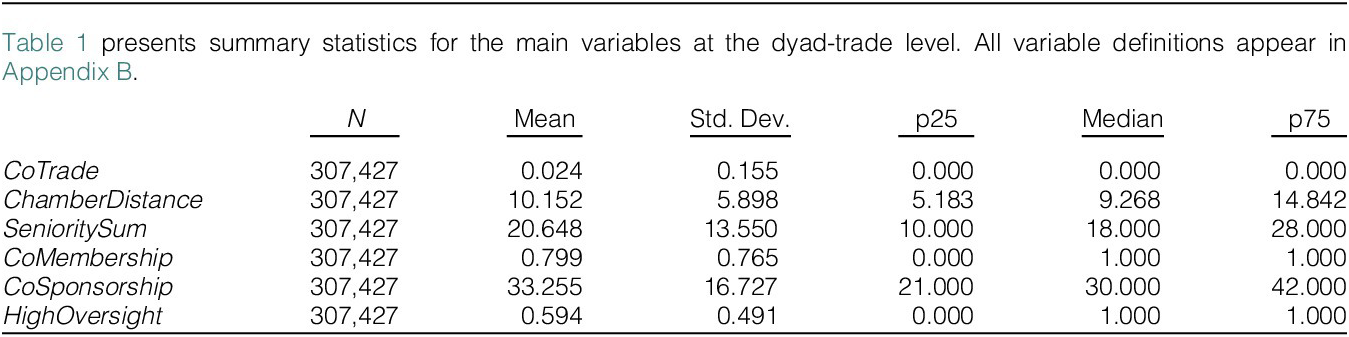
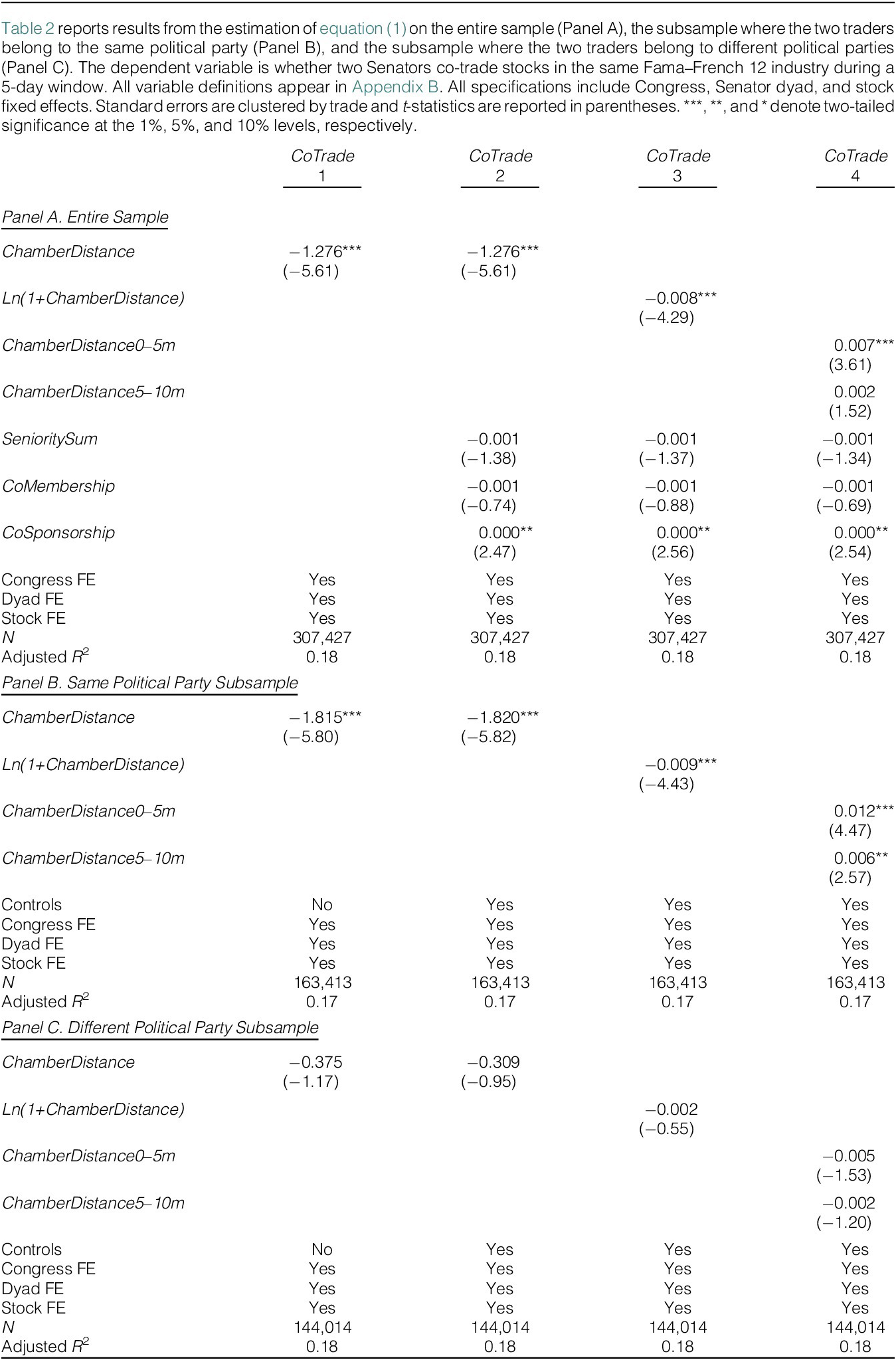
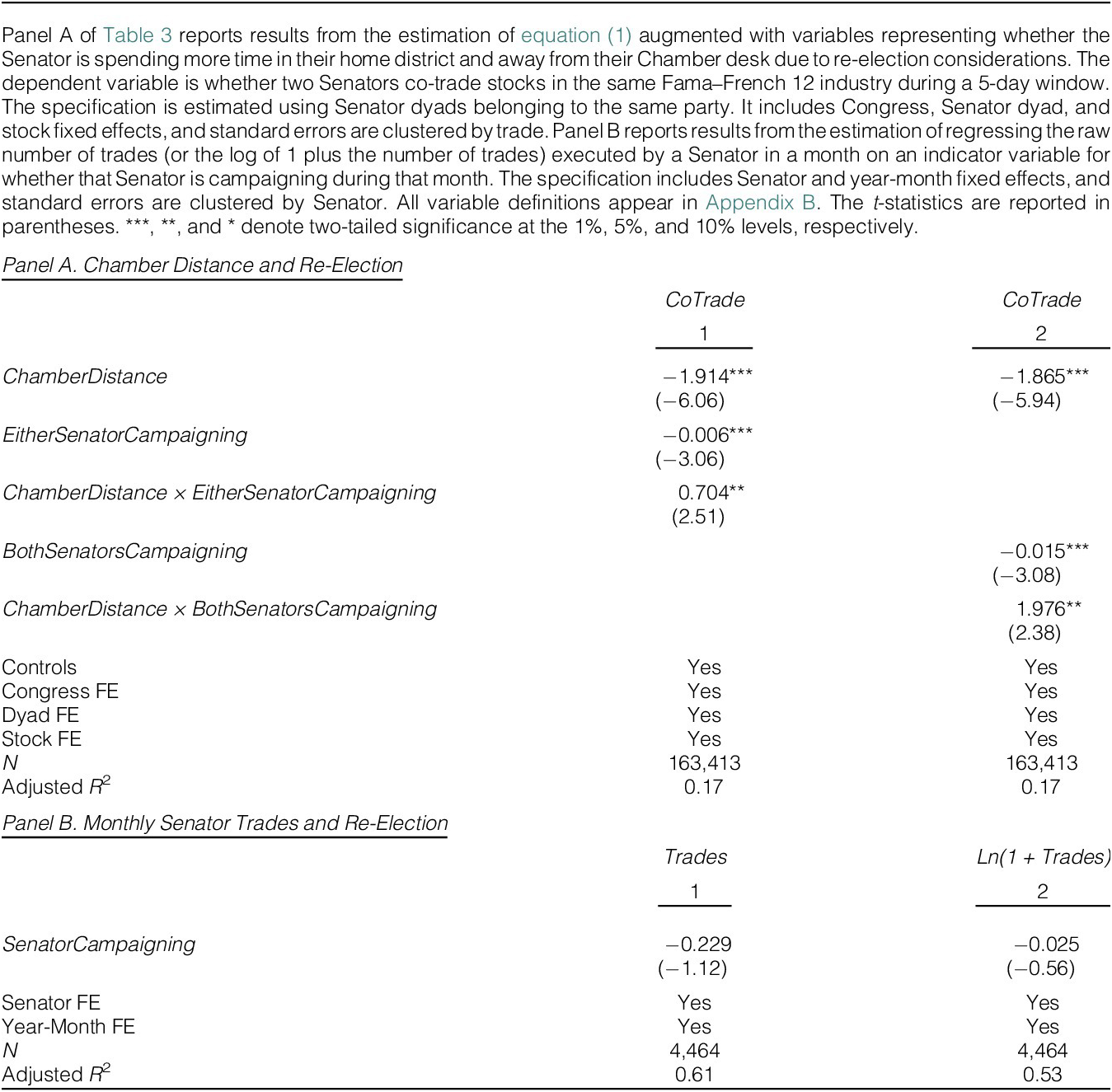
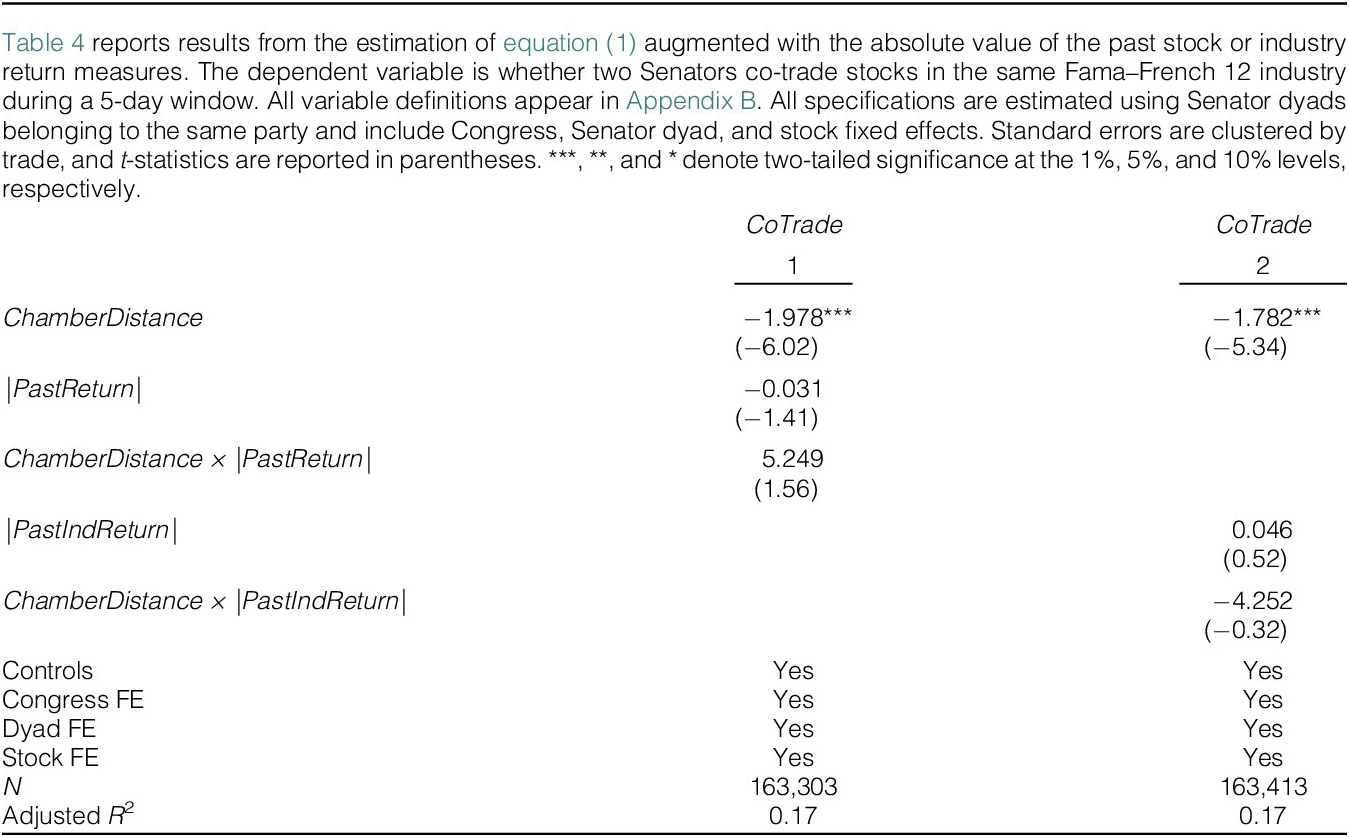
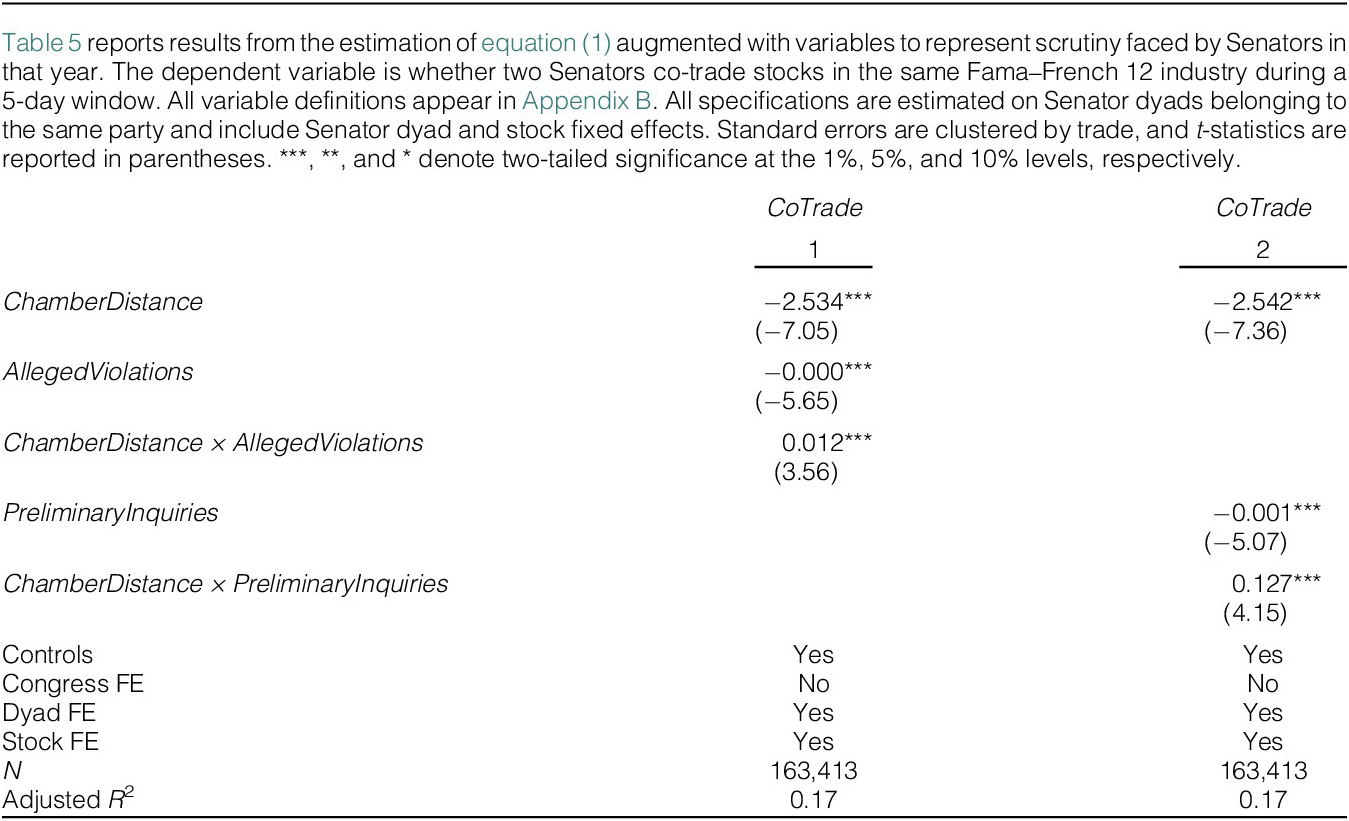
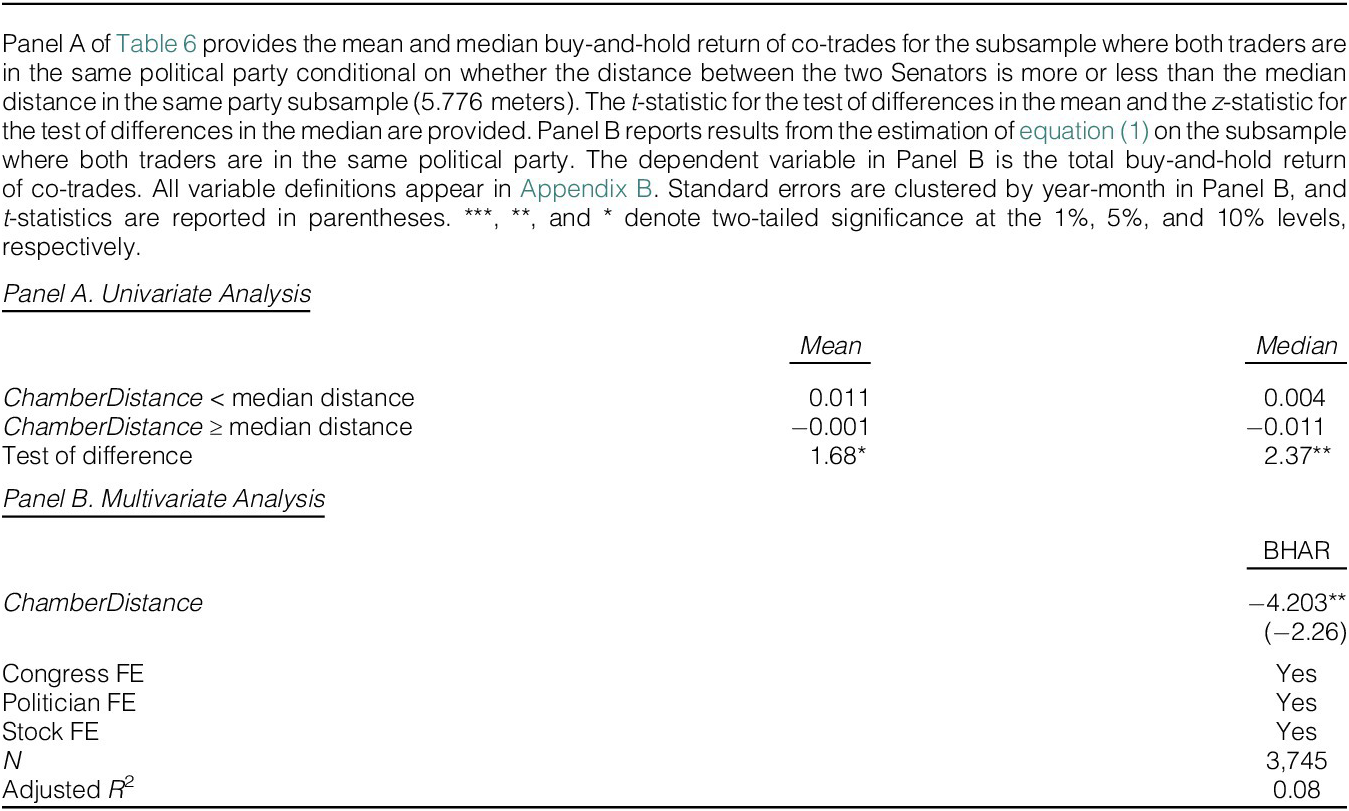
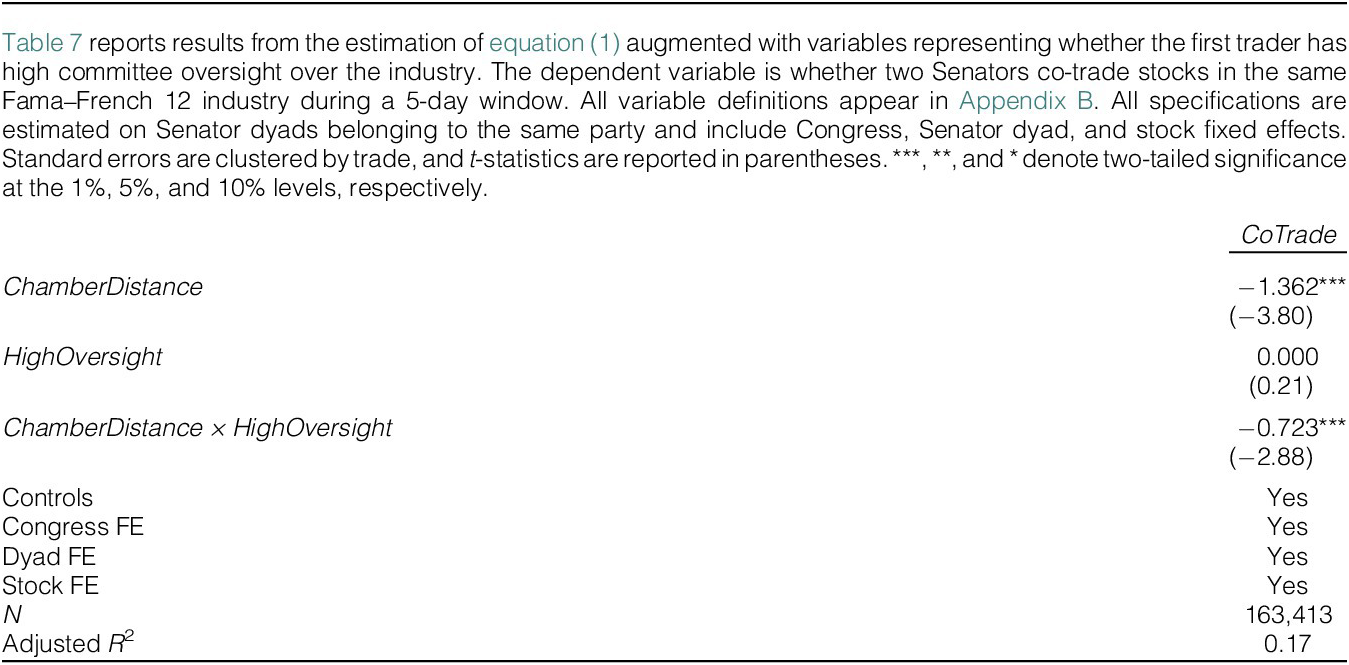
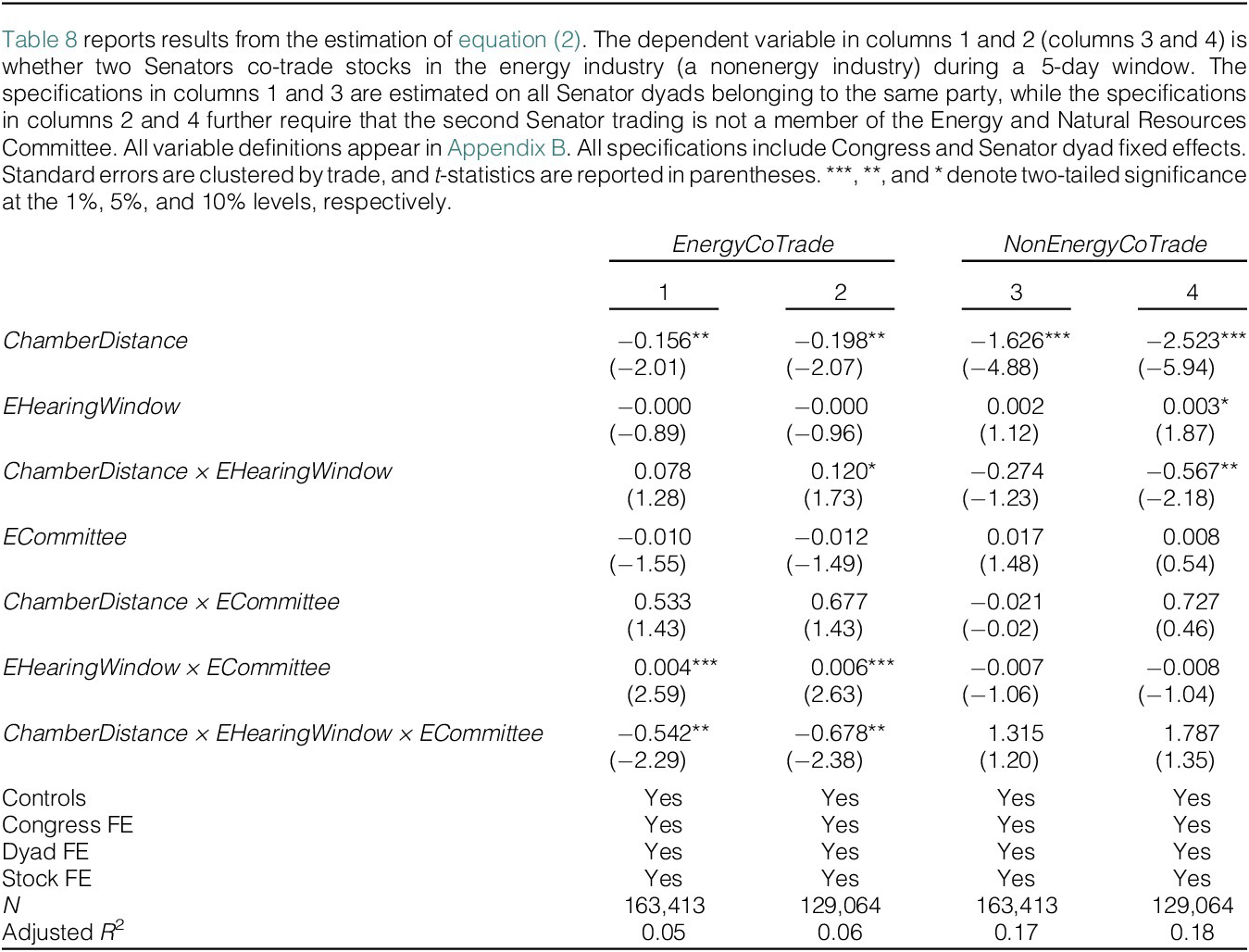
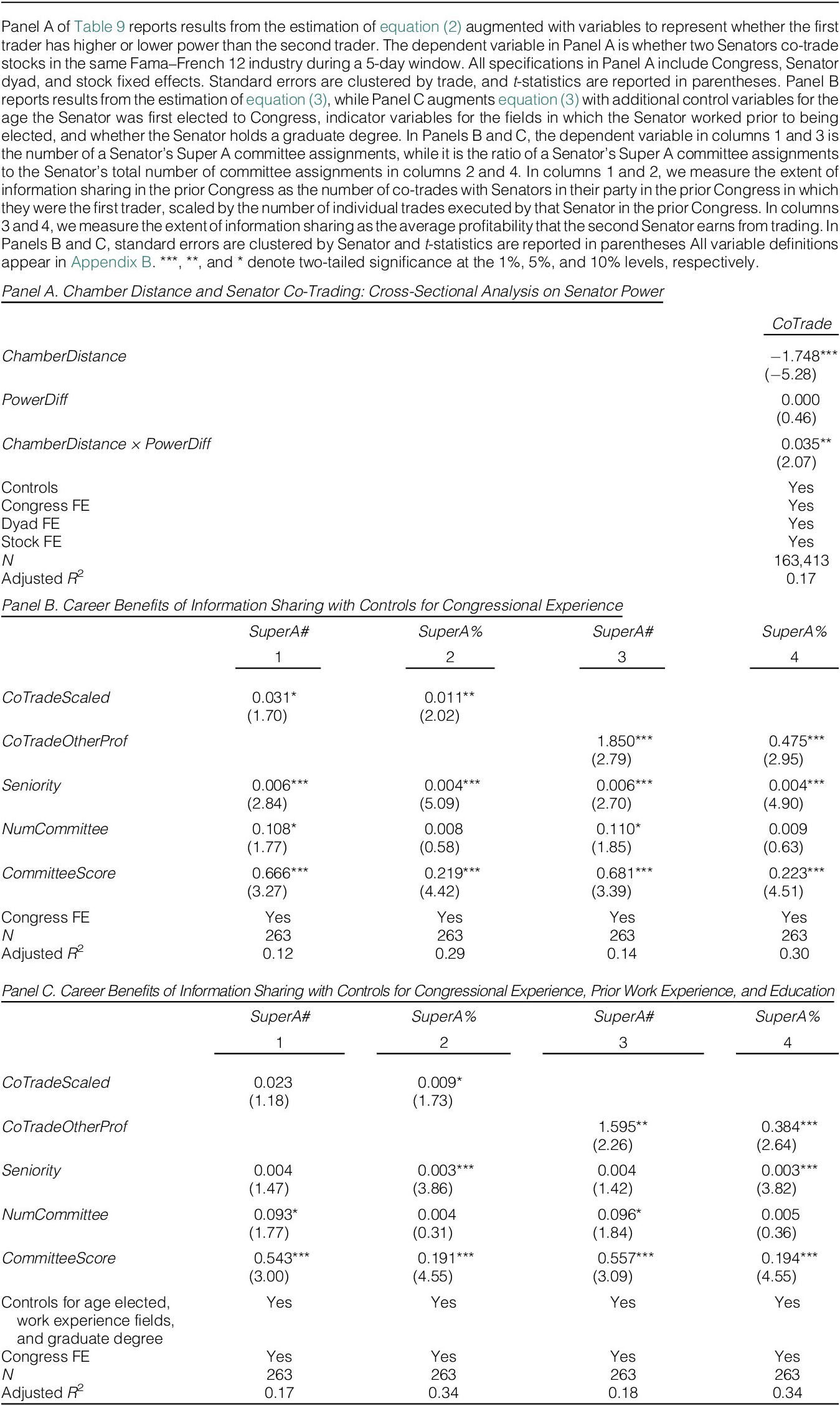
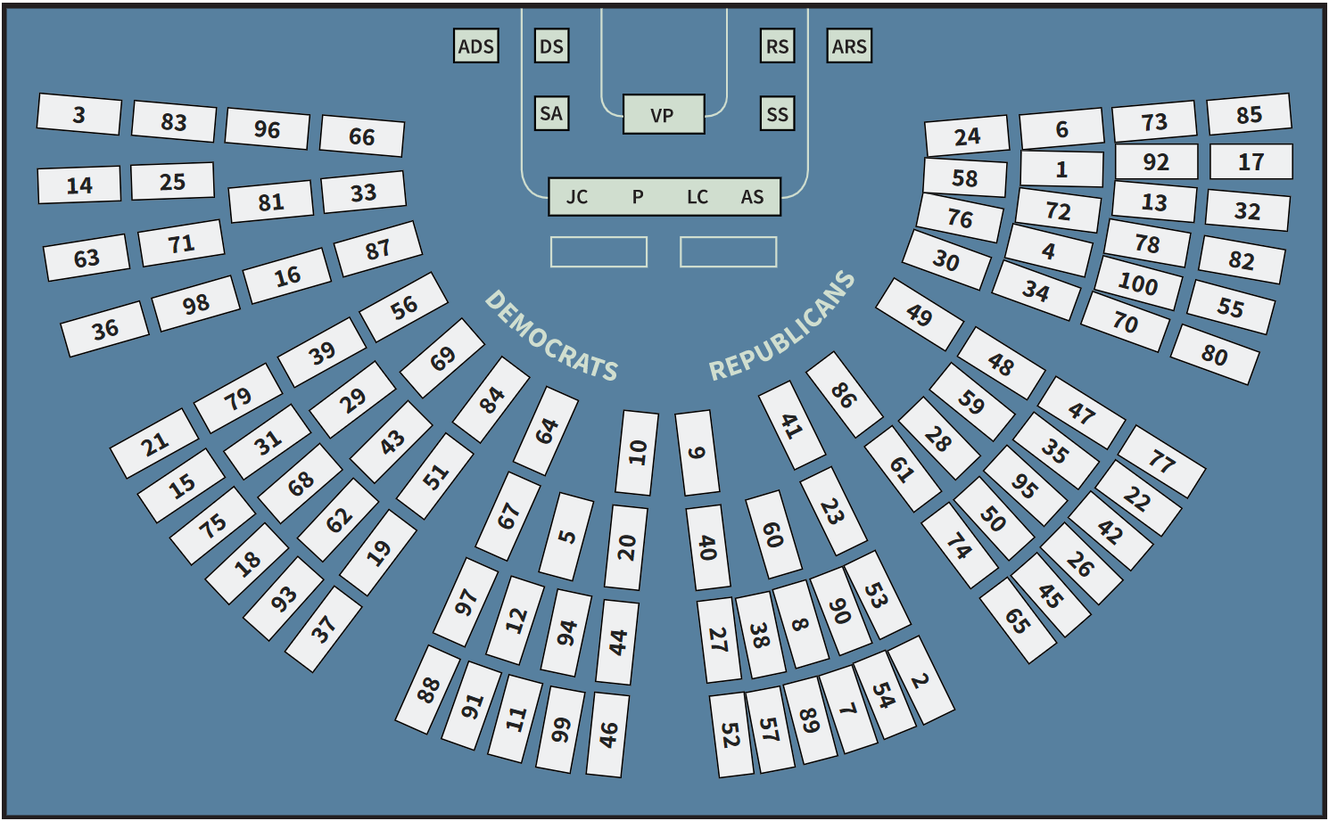

 Open access

