Introduction
The earthquake that occurred in Turkey on February 6, 2023 serves as a stark reminder of the devastating impact of major earthquakes, highlighting their status as some of the most destructive natural disasters. The epidemiology of earthquake-related injuries and deaths is unique, requiring careful consideration of the challenges and complexities they present. Reference Yılmaz, Karakayali and Yilmaz1,Reference Yilmaz2 When evaluating earthquake-related injuries, it becomes evident that the collapse of structures leads to a multitude of injuries, including blunt force trauma, penetrating injuries, and crush injuries. Survivors of such injuries often face additional complications that contribute to increased morbidity and mortality rates. The damage caused by collapsed building materials, particularly to the extremities, necessitates a comprehensive understanding of four distinct terminologies: crush injury, crush syndrome, compression syndrome, and compartment syndrome. Reference Rajagopalan3 Although these conditions may arise from different causes and mechanisms in a disaster setting, they collectively demonstrate the critical importance of managing the immediate consequences of earthquakes. Furthermore, it is essential to address the challenges faced by individuals trapped under debris, such as the difficulty in accessing water, which can lead to dehydration and further complications. Consequently, the management of earthquake-related casualties requires not only a focus on trauma care, but also an emphasis on acute kidney injury (AKI) as it frequently occurs and necessitates dialysis.
Disasters, such as earthquakes, possess a distinctive characteristic that sets them apart from ordinary circumstances, precipitating an overwhelming demand that surpasses the available resources. Particularly earthquakes, with their potential to impact entire cities or even multiple regions, profoundly disrupt prehospital and hospital capacities, resulting in inadequate resources to meet the comprehensive needs of the affected population. Reference Yılmaz, Karakayali and Yilmaz1 To ensure effective, efficient, and prudent resource utilization, proper triage practices play an indispensable role. Reference Bazyar, Farrokhi and Khankeh4 Triage assumes paramount importance in earthquake settings and remains a fundamental practice across all disaster scenarios. Through meticulous triage and referral procedures, patients receive appropriate prioritization, considering the high prevalence of complex injuries that may necessitate surgical interventions or intensive care. Employing trauma scores tailored to different outcome predictions facilitates this process. However, it is crucial to acknowledge the significant and prevalent complication of AKI among individuals affected by earthquakes, in addition to trauma-related injuries, often requiring referrals to specialized centers. Consequently, a notable proportion of this patient cohort experiences AKI as a complicating factor, necessitating the provision of dialysis. Recognizing the higher likelihood of AKI and dialysis requirement in this population, coupled with the time constraints inherent in disaster situations demanding expedited evaluation and decision making, accurate identification of patients at an elevated risk of requiring dialysis during the initial assessment in the emergency department (ED) becomes imperative. However, solely relying on the identification of risk factors may prove inadequate in daily practice. Thus, integrating a swift and reliable risk scoring system holds the potential to significantly enhance patient management protocols by effectively identifying patients at an elevated risk of dialysis. Furthermore, scoring systems can serve as valuable tools for measuring effectiveness and ensuring quality control. In the context of catastrophic patient influx during disaster situations, a universally applicable scoring system based on physiological parameters can equip clinicians with the ability to interpret a case’s prognosis, providing valuable insights within the chaotic environment prevalent in such circumstances.
In line with these considerations, the primary objective of this study is to identify early indicators that predict the indication for dialysis in patients presenting to the ED with earthquake-related injuries. The secondary objective of the study is to develop a rapid and easily applicable rule-out scoring system based on these factors. By achieving these objectives, this research aims to enhance the early detection and management of patients at risk of AKI requiring dialysis following earthquakes.
Methods
Study Design and Setting
This study was designed as a retrospective, single-center, observational study aiming to identify the factors predictive of dialysis requirement among patients with earthquake-related injuries. The screening of patients was conducted retrospectively at the Emergency Medicine Clinic of Diyarbakır Gazi Yaşargil Training and Research Hospital (Diyarbakır, Turkey), spanning from February 6, 2023 through February 16, 2023.
Diyarbakır Gazi Yaşargil Training and Research Hospital holds particular significance, as it serves as both a Level 1 Trauma Center and a hospital situated in one of the 11 provinces affected by the Kahramanmaraş, Turkey earthquake on February 6, 2023. Consequently, the hospital played a dual role: (1) being the initial point of medical contact for some injured patients, and (2) receiving referrals from surrounding provinces where hospitals had incurred greater damage, resulting in limited triage capabilities confined to the ED. As a result, the hospital catered to a heterogeneous patient population with varying levels of earthquake-related trauma.
Diyarbakır’s medical landscape is characterized by a comprehensive network of health care institutions, including a university hospital, an educational and research hospital, and two government-operated medical facilities. Notably, the Diyarbakır Gazi Yaşargil Training and Research Hospital occupies a significant position within this framework. Distinguished by its substantial main complex housing 19 advanced operating theaters, the hospital also features an adjunct section dedicated to maternal and pediatric care, encompassing 10 specialized units.
Of particular significance is the exclusive implementation of emergent hemodialysis procedures, a practice limited to the university hospital and the Diyarbakır Gazi Yaşargil Training and Research Hospital. The latter’s facilities include a provision of 40 beds designed to address adult hemodialysis needs, augmented by an additional nine beds tailored to accommodate the specific requirements of pediatric hemodialysis cases. It is also noteworthy that the availability of hemodialysis services extends to the confines of the Level 3 Intensive Care Unit, affording access to three dedicated hemodialysis beds.
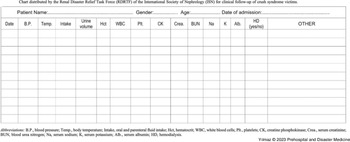
Notably, during the duration of this study, dialytic procedures were administered exclusively using hemodialysis or hemofiltration modalities, with the omission of peritoneal dialysis applications. It was decided which patients would be on dialysis using the guidelines and patient follow-up charts created by Sever, et al (Figure 1). Reference Sever and Vanholder5
Chart Distributed by the RDRTF of the ISN for Clinical Follow-Up of Crush Syndrome Victims.
Abbreviations: RDRTF, Renal Disaster Relief Task Force; ISN, International Society of Nephrology; BP, blood pressure; Temp, body temperature; Intake, oral and parenteral fluid intake; Hct, hematocrit; WBC, white blood cells; Plt, platelets; CK, creatine phosphokinase, Crea, serum creatinine; BUN, blood urea nitrogen; Na, serum sodium; K, serum potassium; Alb, serum albumin; HD, hemodialysis.

Prior to the commencement of the study, ethical approval was obtained from the Ethics Committee of Diyarbakır Gazi Yaşargil Training and Research Hospital (date: May 26, 2023; no: 406). The research procedures strictly adhered to the principles outlined in the Helsinki Declaration.
Selection of Participants
Participants eligible for this study were selected among individuals who presented to the ED of the center during the period of February 6, 2023 through February 16, 2023. The inclusion criteria encompassed individuals who suffered injuries directly related to the earthquake and received their initial medical assessment and care at this specific hospital. Additionally, patients referred from surrounding areas for advanced diagnostic and treatment requirements were also included. Exclusion criteria comprised patients who succumbed within the initial 48 hours, individuals with pre-existing chronic kidney failure undergoing renal replacement therapy, and cases where pertinent information could not be retrieved.
Data Collection and Handling of Missing Data
Demographic characteristics of the included patients, such as age and gender, were recorded, along with their duration of entrapment under debris (evaluated based on search and rescue notes). Patient follow-up notes and the hospital information management system were scrutinized to extract data on the presence of injuries in the extremities, vertebrae, cranium, abdomen, or thorax, as well as details regarding debridement fasciotomy, amputation procedures, hyperbaric oxygen therapy, presence of extremity fractures, and history of orthopedic surgery. The data extraction was performed manually by trained emergency physicians that were blinded to the study. Furthermore, laboratory parameters obtained from blood samples collected at the initial medical contact center were documented, including pH value, partial pressure of carbon dioxide, lactate level, bicarbonate level, complete blood count parameters (hemoglobin, hematocrit, red cell distribution width), urea, creatinine, albumin, aspartate transaminase (AST), alanine transaminase (ALT), lactate dehydrogenase (LDH), albumin-corrected calcium level, creatine phosphokinase level, sodium, potassium chloride levels, C-Reactive Protein (CRP) level, as well as AST-to-ALT ratio and urea-to-creatinine ratio.
Notably, a subset of pertinent variables exhibited a marginal incidence of missing data, constituting less than five percent of the total observations. In addressing this issue, a methodological recourse was undertaken by means of the multiple imputation paradigm. The utilization of multiple imputation is a statistically validated technique wherein absent data points are estimated to engender completed datasets. Implicit in this procedure is the presumption that the mechanism of data absence is stochastic in nature, intrinsically linked to observed variables rather than latent attributes. This rigorous approach engendered comprehensive datasets amenable to subsequent analyses. Of paramount importance was the judicious implementation of sensitivity analyses, which served to ascertain the potential ramifications stemming from varying missing data assumptions. Such analytical introspection bolstered the robustness of the ensuing statistical inferences, warranting heightened confidence in the veracity of the study’s outcomes. The meticulous management of missing data thereby accentuated the integrity of the analytical framework, culminating in a scholarly endeavor underpinned by methodological precision and analytical soundness.
Outcomes
The primary aim of this study was to identify the crucial factors that can effectively predict the requirement for dialysis in individuals who have suffered injuries due to the earthquake. Additionally, the secondary objective involved the development of a highly sensitive rule-out score, referred to as the Seismic Assessment of Kidney Function to Rule Out Dialysis Requirement (SAFE-QUAKE score), to accurately assess the probability of dialysis necessity.
Analysis
The statistical analysis was performed using the Statistical Package for Social Sciences (SPSS v29., IBM Corp.; Armonk, New York USA) software. Descriptive statistics were employed to summarize the data, including counts and percentages for categorical variables, and mean (standard deviation [SD]) or median (interquartile range [IQR] 25th - 75th) for continuous variables. The normal distribution assumption of the groups was assessed by visually inspecting histograms and conducting the Shapiro-Wilk test. For comparisons between independent groups, appropriate statistical tests were utilized, such as the chi-square test or Fisher’s exact test for categorical variables, and Student’s t-test or Mann-Whitney U test for continuous variables.
All statistical tests were two-tailed, and a significance level of <.05 was considered statistically significant. To determine the impact of individual variables that exhibited significant differences between groups on the primary outcome, an artificial neural network (ANN) analysis was employed. The ANN model utilized a multilayer perceptron architecture with one hidden layer and three neurons. The activation function was set as the hyperbolic tangent, the output function as softmax, and the error function as cross-entropy. The model’s internal validation was conducted using a training cohort comprising 71% of the data and a testing cohort comprising 29%. The training and testing cohort was selected randomly via statistics application.
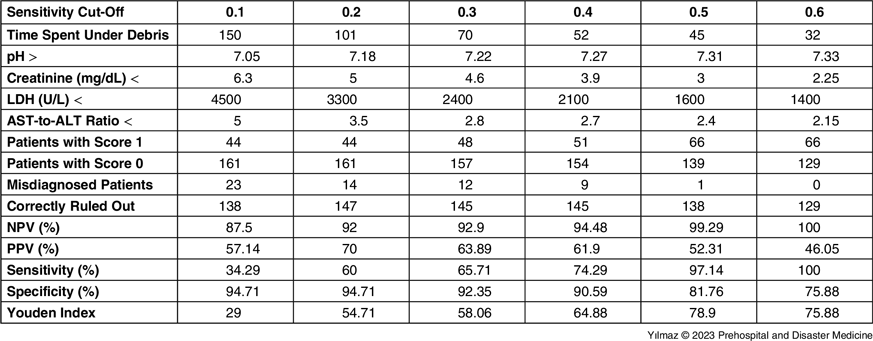
To develop the SAFE-QUAKE score derived from the ANN, the importance of each variable was assessed using normalized importance, and the top five variables with importance scores exceeding 90% were selected. A novel approach was employed to create the rule-out score. Receiver operating characteristic (ROC) curves were generated for these five variables, and specific cut-off values were determined based on their intersection with sensitivity levels of 0.1, 0.2, 0.3, 0.4, 0.5, 0.7, 0.8, and 0.9. This resulted in the creation of nine possible rule-out scores, where values below the cut-off were assigned a score of zero and values above the cut-off were assigned a score of one. The ability of these scores to rule out patients without dialysis outcomes in the dataset was then evaluated using the Youden Index. The objective of the score was to achieve a misdiagnosis rate of less than two percent while maximizing the exclusion of patients from further evaluation.
Results
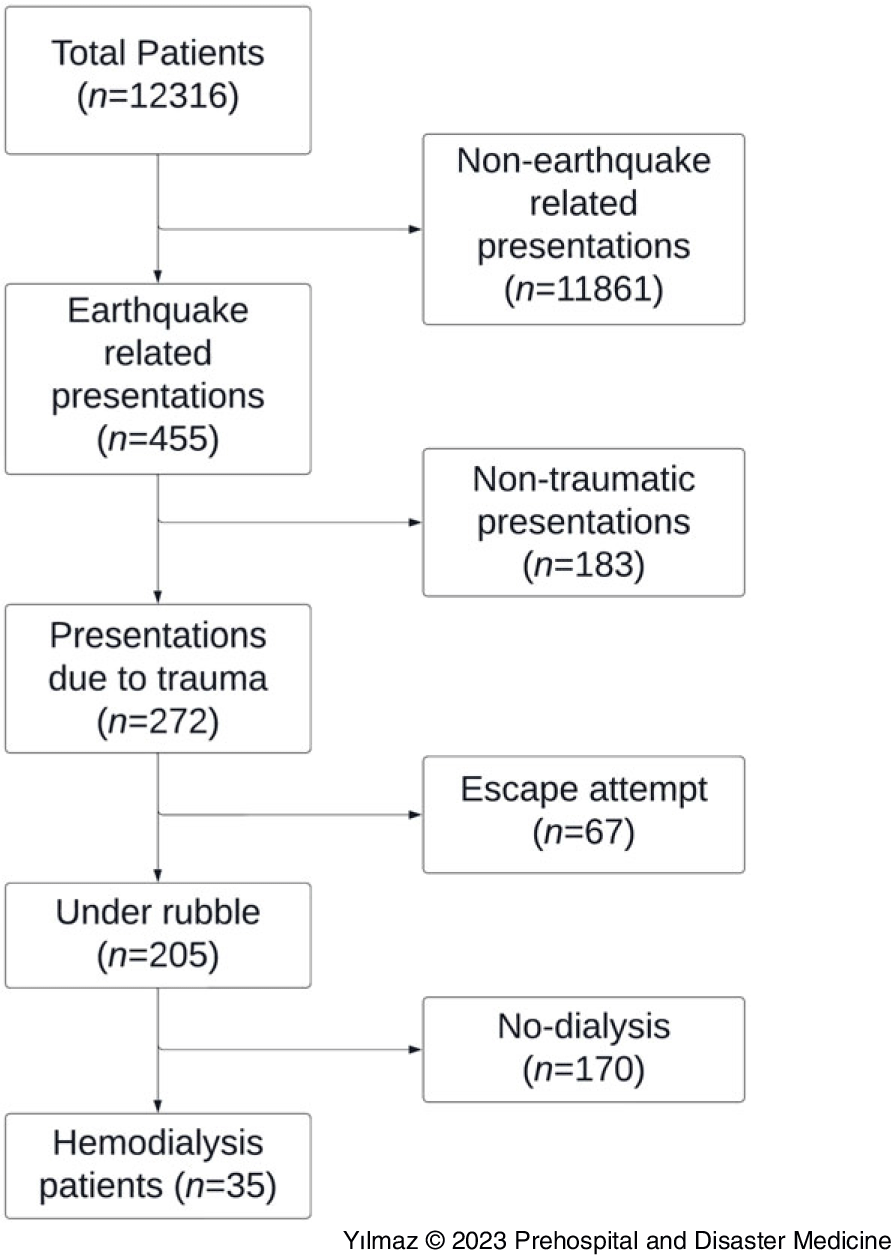
During the study period, a total of 12,316 patients sought medical attention at the ED. Among these cases, 455 were attributed to earthquake-related incidents, while 11,861 cases were unrelated to earthquakes. Within the subset of earthquake-related presentations, 272 cases were trauma-related, while 183 cases were classified as non-traumatic. Specifically, among the trauma-related cases, 67 instances were associated with escape attempts and 205 cases involved individuals trapped under rubble (Figure 2).
Patient Flowchart Depicting the Distribution and Categorization of Patients Presenting to Diyarbakır Gazi Yaşargil Training and Research Hospital.

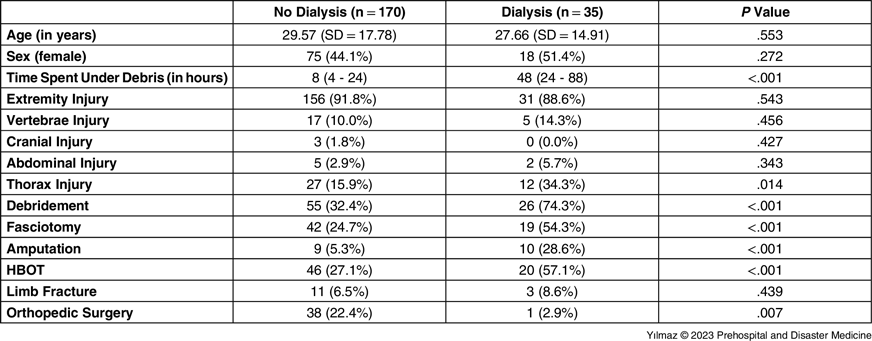
Of these patients, 205 were included in the study’s analysis. Based on their outcomes, the patients were divided into two groups: the no dialysis group (n = 170; 82.9%) and the dialysis group (n = 35; 17.1%). The mean age in the no dialysis group was 29.57 (SD = 17.78) years, while in the dialysis group, it was 27.66 (SD = 14.91) years with no statistically significant difference between the groups (P = .553); Table 1. The proportion of females in the no dialysis group was 44.1% (n = 75), while in the dialysis group, it was 51.4% (n = 18) and there was no significant difference in gender distribution (P = .272). The dialysis group had a significantly longer median duration of being trapped under debris (48 hours [IQR 24 – 88 hours]) compared to the no dialysis group (eight hours [IQR 4 – 24 hours]); P <.001. There were no statistically significant differences between the groups regarding extremity, vertebral, cranial, or abdominal injuries (P = 0.543; P = .456; P = .427; and P = .343, respectively). However, the rate of thoracic injuries was significantly higher in the dialysis group (34.3%; n = 12) compared to the no dialysis group (15.9%; n = 27); P = .014). The dialysis group also had higher rates of debridement (74.3%; n = 26), fasciotomy (54.3%; n = 19), amputation (28.6%; n = 10), and hyperbaric oxygen therapy (57.1%; n = 20) compared to the no dialysis group (32.4%, n = 55; 24.7%, n = 42; 5.3%, n = 9; and 27.1%, n = 46, respectively), with all comparisons showing statistical significance (P <.001). There were no significant differences in the rate of extremity fractures between the no dialysis group (6.5%; n = 11) and the dialysis group (8.6%; n = 3); P = .439. However, the rate of fracture-related surgeries was significantly higher in the no dialysis group (22.4%; n = 38) compared to the dialysis group (2.9%; n = 1); P = .007.
Comparison of Patient Characteristics and Injury Profiles between Groups

Abbreviation: HBOT, hyperbaric oxygen therapy.
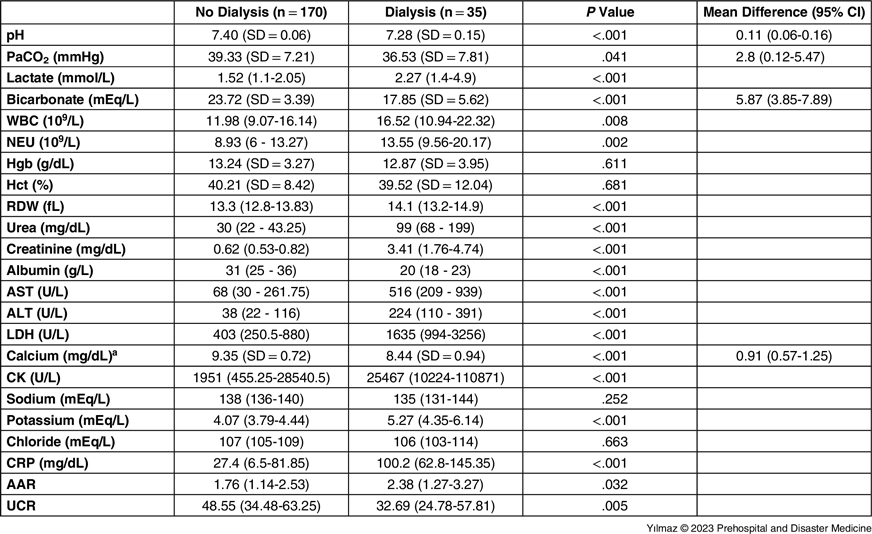
When examining the blood gas data, the dialysis group had a significantly lower mean pH value (7.28 [SD = 0.15]) compared to the no dialysis group (7.40 [SD = 0.06]), with a mean difference of 0.11 (95% CI, 0.06 – 0.16); P <.001. The mean partial pressure of carbon dioxide was significantly lower in the dialysis group (36.53 [SD = 7.81] mmHg) compared to the no dialysis group (39.33 [SD = 7.21] mmHg), with a mean difference of 2.8mmHg (95% CI, 0.12 – 5.47 mmHg); P = .041. The dialysis group also had a significantly higher median lactate value (2.27 [IQR 1.4 – 4.9] mmol/L) compared to the no dialysis group (1.52 [IQR 1.1 – 2.05] mmol/L); P <.001. Moreover, the mean bicarbonate value was significantly lower in the dialysis group (17.85 [SD = 5.62] mEq/L) compared to the no dialysis group (23.72 [SD = 3.39] mEq/L), with a mean difference of 5.87mEq/L (95% CI, 3.85 – 7.89); P <.001.
In terms of laboratory data (Table 2), the dialysis group exhibited significantly higher median white blood cell (WBC) count (16.52 [IQR 10.94 – 22.32] *109/L) and neutrophil count (13.55 [IQR 9.56 – 20.17] *109/L) compared to the no dialysis group (11.98 [IQR 9.07 – 16.14 *109/L] and 8.93 [IQR 6 – 13.27 *109/L], respectively; P = .008, P = .002). There were no significant differences between the groups in terms of mean hemoglobin concentration and hematocrit (P = .611, P = .681). However, the dialysis group had a significantly higher median red cell distribution width (14.1 [IQR 13.2 – 14.9] fL) compared to the no dialysis group (13.3 [IQR 12.8 – 13.83] fL); P <.001). The dialysis group also exhibited significantly higher median levels of urea, creatinine, AST, ALT, LDH, creatine kinase (CK), potassium, and CRP compared to the no dialysis group (P <.001 for all comparisons). The median albumin level was significantly lower in the dialysis group (20 [IQR 18 – 23] mg/dL) compared to the no dialysis group (31 [IQR 25 – 36] mg/dL); P <.001. The no dialysis group had a significantly higher mean corrected calcium level (9.35 [SD = 0.72] mg/dL) compared to the dialysis group (8.44 [SD = 0.94] mg/dL), with a mean difference of 0.91 (95% CI, 0.57 – 1.25) mg/dL. There were no significant differences between the groups in terms of median sodium and chloride levels (P = .252, P = .663). The dialysis group had a significantly higher median AST-to-ALT ratio (2.38 [IQR 1.27 – 3.27]) compared to the no dialysis group (1.76 [IQR 1.14 – 2.53]); P = .032. The median urea-to-creatinine ratio was significantly higher in the no dialysis group (48.55 [IQR 34.48 – 63.25]) compared to the dialysis group (32.69 [IQR 24.78 – 57.81]); P = .005.
Comparison of Laboratory Parameters and Acid-Base Balance between Groups

Abbreviations: PaCO2, partial pressure of carbon dioxide; WBC, white blood cell count; NEU, neutrophil count; Hgb, hemoglobin concentration; Hct, hematocrit; RDW, red cell distribution width; AST, aspartate aminotransferase; ALT, alanine aminotransferase; LDH, lactate dehydrogenase; CK, creatine kinase; CRP, C-Reactive protein; AAT, ALT-to-AST ratio; UCR, urea-to-creatinine ratio.
a Corrected calcium concentration.
Based on the parameters that showed significant differences between the groups, a neural network analysis was conducted to simplify the score. The diagnostic accuracy of this analysis in predicting the need for dialysis was observed to have a ROC value of 0.985 (95% CI, 0.972 - 0.998), indicating excellent predictive performance. The five parameters with the highest normalized importance values were identified as follows: creatinine (100.0%), duration of being trapped under debris (99.7%), LDH (97.5%), pH (91.6%), and AST-to-ALT ratio (91.5%).
Using the cut-off values derived from the ability of each parameter to predict dialysis with a sensitivity of 50% (as described in the methodology section), a simplified SAFE-QUAKE rule-out score was created. This score included 139 patients (Table 3), and among them, only one patient required dialysis, resulting in a negative predictive value of 99.29%. The cut-off values for the rule-out score were determined as follows: duration of being trapped under debris <45 hours, pH >7.31, creatinine <3, LDH <1600, and AST-to-ALT ratio <2.4.
Diagnostic Accuracy Analysis of the Scoring Generated at Different Sensitivity Thresholds of the Parameters in SAFE-QUAKE for Rule-Out Purposes

Abbreviations: SAFE-QUAKE, Seismic Assessment of Kidney Function to Rule Out Dialysis Requirement; LDH, lactate dehydrogenase; AST, aspartate aminotransferase; ALT, alanine aminotransferase; NPV, negative predictive value; PPV, positive predictive value.
Discussion
This study has yielded valuable insights into the prediction of dialysis requirements among earthquake-related injury cases. The findings in this study highlight the pivotal role played by several key factors, namely the duration of entrapment under debris, pH levels, creatinine levels, LDH levels, and the AST-to-ALT ratio. Introducing the innovative SAFE-QUAKE scoring system has resulted in a remarkable sensitivity rate of 99.29% in effectively ruling out the need for dialysis. These significant outcomes hold profound implications for expediting patient assessments and refining referral protocols, thereby enhancing the landscape of earthquake-related health care management.
The establishment of the Renal Disaster Relief Task Force (RDRTF) by the International Society of Nephrology (ISN; Brussels, Belgium) serves the purpose of proactively addressing organizational challenges in kidney care following large-scale natural and man-made disasters. A fundamental aspect emphasized by the RDRTF is the critical role played by logistics in these contexts, encompassing the procurement, maintenance, distribution, and replenishment of personnel and resources. This dimension is regarded as a key indicator of vulnerability, particularly in chaotic disasters characterized by limited medical supplies and personnel, and a potential discrepancy between health care demand and supply. Reference Vanholder, Sever, De Smet, Erek and Lameire6 Consequently, two primary options emerge: (1) seeking medical aid and personnel support from other regions or countries, and (2) considering the evacuation of AKI patients from the affected disaster area. Reference Peek-Asa, Kraus and Bourque7,Reference Whittaker, Fareed, Green, Barry, Borge and Fletes-Barrios8
The significance of these considerations is exemplified by the events in Turkey on February 6, 2023 when two major earthquakes resulted in catastrophic destruction across 11 provinces. Official reports indicate the profound impact of the disasters, with a total of 21,859 patients admitted to hospitals, including 10,601 who underwent surgical interventions. Furthermore, 51,152 individuals, including both patients and injured individuals, were transferred to hospitals in other cities, while 13,612 patients were discharged after seeking ED care related to the disasters. 9 The majority of injured patients initially sought treatment in the EDs and field hospitals within the affected provinces. However, due to the damage incurred by local health care institutions, they were subsequently transferred to health care facilities outside the disaster zone following triage and early interventions.
In the context of significant earthquakes, it is crucial to consider the prevalence of crush injuries, which often lead to AKI. Previous experiences indicate varying rates of AKI occurrence, ranging from 40.0% to 63.1% in cases of crush injuries resulting from major earthquakes. Reference Oda, Tanaka and Yoshioka10–Reference Richards, Tattersall, McCann, Samson, Mathias and Johnson12 Additionally, it is estimated that approximately one-half of the patients who develop AKI following earthquake-related crush injuries require dialysis. Reference Richards, Tattersall, McCann, Samson, Mathias and Johnson12,Reference Earthquakes13 This study specifically focused on the management of kidney failure, taking into account factors such as the diverse definitions of “kidney problems” in the literature and the availability of dialysis units in hospitals as potential modifiers. Reference Sever, Vanholder and Lameire14,Reference Najafi, Van Biesen and Sharifi15 Accordingly, the primary endpoint centered on the need for dialysis. The results of this investigation revealed an overall dialysis rate of 17% among earthquake-related injury cases presenting to the ED, closely aligning with existing literature. While acknowledging the need for individual evaluation of each disaster due to its unique characteristics, the similarity of these findings to the literature substantiates their generalizability and underscores their profound implications.
Upon conducting an extensive literature review, it becomes evident that within the realm of disasters, specifically those encompassing catastrophic events like earthquakes, a conspicuous emphasis is placed on the implementation of dynamic processes. These processes typically commence with the initiation of the Simple Triage and Rapid Treatment/START triage protocol in the field, followed by the seamless continuation of triage procedures within the confines of the ED. Subsequently, after providing prompt triage and essential early-stage interventions for patients, there emerges a prevailing recommendation for the integration of the Secondary Assessment of Victim Endpoint (SAVE) triage system. Reference Benson, Koenig and Schultz16 This system is devised with the primary objective of optimizing the allocation of scarce resources by judiciously directing them toward patient subgroups expected to derive the utmost benefit. The SAVE triage system critically evaluates the survivability of patients presenting with a diverse array of injury patterns, harnessing trauma statistics to establish a clear and quantifiable relationship between anticipated benefits and the resources expended. Significantly, a seminal work by Benson, Koenig, and Schultz in 1996 not only thoroughly elucidates the SAVE triage system, but also offers a meticulous delineation of its tailored application to three distinct patient cohorts: burn patients, stratified based on burn percentage and age; head trauma patients, assessed utilizing the Glasgow Coma Scale; and patients necessitating amputation, evaluated through the Mangled Extremity Severity Score. However, despite conducting an exhaustive review of the available literature, no additional studies pertaining to the SAVE triage system were identified, underscoring the need for further research in this area. Nevertheless, it is noteworthy to consider the potential advantages of employing straightforward algorithms for resource management and treatment decision making within the context of disasters, as such an approach holds promise in mitigating the inherent chaos and panic that often ensue. 17,Reference Zanlungo, Ikeda and Kanda18 In light of this research, it is proposed that the present study makes a valuable contribution to the existing SAVE triage scoring systems by incorporating a user-friendly scoring mechanism with a specific focus on dialysis. This addition is particularly advantageous for physicians operating within damage control EDs, especially during the critical phase of initial damage control and the subsequent transfer of patients to more distal health care facilities. By integrating this dialysis-oriented scoring system into the existing framework, the aim is to enhance the accuracy and effectiveness of triage assessments, thereby optimizing patient outcomes in resource-limited disaster settings.
Upon comprehensive examination of the extant literature, it is evident that one of the parameters within the QUAKE-SAFE scoring system pertains to the duration of being trapped under debris, which serves as a contributing factor in assessing the need for dialysis among patients. A thorough review of prior research, congruent with this investigation, reveals a positive correlation between the duration of entrapment and the incidence of AKI, as well as the requirement for hemodialysis. Reference Sagheb, Sharifian, Roozbeh, Moini, Gholami and Sadeghi19,Reference Hatamizadeh, Najafi and Vanholder20 However, it is worth noting that divergent findings have also been reported, suggesting an inverse relationship between entrapment duration and the necessity for dialysis. Reference Sever, Erek and Vanholder21 The manifestation of crush syndrome following earthquakes primarily arises from the deleterious pressure exerted by collapsed structures on muscle tissues, resulting in the release of metabolites from compromised muscular physiology. Reference Baeza-Trinidad22 Given the dearth of comprehensive studies investigating the impact of compression severity, duration, and affected body regions as risk factors for crush syndrome, there remains a pressing need for an individualized approach to this subject matter. In light of the aforementioned literature, several salient observations can be delineated. Firstly, when considering the regional context, it becomes evident that crush injuries, directly attributable to earthquakes, are infrequently encountered among patients presenting to the ED subsequent to sustaining head and chest injuries. This is likely due to the prolonged and excessive pressure required to induce such a syndrome, frequently culminating in fatal outcomes. Reference Yoshimura, Nakayama, Nakagiri, Azami, Ataka and Ishii23,Reference Peek-Asa, Kraus, Bourque, Vimalachandra, Yu and Abrams24 This study, encompassing a cohort of patients, revealed no significant disparities in terms of extremity, vertebral, cranial, or abdominal injuries between individuals necessitating dialysis and those who did not. However, it is important to highlight that thoracic injuries exhibited a discernible disparity; nonetheless, it is noteworthy that this specific injury did not robustly predict the need for dialysis, in line with the existing body of literature. Furthermore, with regard to the severity of compression, this investigation yielded noteworthy findings, with significantly heightened incidences of debriding, fasciotomy, amputation, hyperbaric oxygen therapy, and orthopedic surgery observed among patients requiring dialysis following extremity injuries sustained during earthquakes. In this context, it is plausible to postulate that the severity of trauma inflicted upon the affected extremity, consequent to compression, assumes greater clinical significance in relation to the need for dialysis, surpassing the mere severity of compression itself. In evaluating the duration of entrapment beneath debris subsequent to an earthquake, a pertinent study conducted by Li, et al has demonstrated that even a mere hour of pressure exerted on bodily regions suffices to trigger the onset of crush syndrome. Reference Li, Qian and Liu25 In congruence with the existing literature, this study reveals that non-dialysis patients exhibited significantly briefer durations of entrapment under debris when compared to their dialysis-dependent counterparts. Reference Hu, Zeng and Fu26 Interestingly, an independent risk factor for dialysis necessity was also discerned, with entrapment exceeding 45 hours emerging as a critical determinant, irrespective of concomitant injuries sustained by the patient.
When examining the physiological mechanisms involved in crush injuries, it becomes apparent that the compression and rupture of muscle cells, stemming from their compromised structure, elicit the release of intracellular enzymes and proteins such as myoglobin, along with electrolytes including potassium, magnesium, phosphate, acids, creatine phosphokinase, and LDH. These substances, crucial for cellular function, are excessively liberated into the systemic circulation, yielding a toxic effect that inflicts damage on various tissues, notably the kidneys, and may escalate to life-threatening proportions. Reference Rajagopalan3,Reference Rubinstein, Abassi, Coleman, Milman, Winaver and Better27 It is noteworthy that well-defined diagnostic criteria exist for discerning cases of AKI attributed to crush syndrome, which frequently manifests subsequent to crush injuries. Reference Plötz, Bouma, van Wijk, Kneyber and Bökenkamp28,Reference Yeolekar and Mehta29 However, the central focus of this study does not revolve around establishing the diagnosis of crush injury, crush syndrome, or AKI in patients presenting post-earthquakes. Rather, the aim lies in delineating the determinants of subsequent dialysis requirements and formulating a practical and easily applicable scoring system based on these parameters. Consequently, this investigation entails an exhaustive analysis of serum enzyme profiles utilized to discriminate between these distinct conditions, coupled with an assessment of diverse parameters associated with crush injury, crush syndrome, and AKI, culminating in the development of the QUAKE-SAFE scoring system. Reference Yeolekar and Mehta29 Within this study cohort, consisting of individuals affected by earthquakes seeking treatment at the ED and subsequently necessitating dialysis, the QUAKE-SAFE scoring system encompasses four fundamental parameters: pH, creatinine, LDH, and AST-to-ALT ratio. Of particular significance, these findings align with those of Hu, et al, who demonstrated the duration of entrapment under debris as a significant predictive factor for AKI in the context of crush injuries observed during the Sichuan earthquake. Reference Hu, Zeng and Fu26 Moreover, they underscored elevated levels of CK, AST, albumin, and WBC count as salient predictors of AKI, as ascertained through meticulous blood analyses. However, it is imperative to acknowledge that divergences between this study and theirs arise from disparate research objectives. While this investigation focuses on discerning the need for dialysis consequent to AKI following crush syndrome, Hu, et al primarily sought to detect the incidence of AKI itself. These dissimilarities can be attributed to variations in study endpoints, ultimately yielding divergent outcomes.
Various parameters have been employed to characterize kidney injuries associated with earthquakes in different instances. For instance, in the context of the Marmara earthquake, parameters such as blood urea nitrogen (BUN), phosphorus, and calcium have been utilized, while the Sichuan earthquake research has focused on parameters including WBC count, albumin, AST, and CK. Reference Hu, Zeng and Fu26,Reference Feng, Zen, Liu, Luo, Jiang and Peng30 Similarly, investigations concerning the Wenchuan earthquake have considered parameters such as CK, ALT, AST, and LDH. Reference Sever, Erek and Vanholder31 These specific parameters were chosen to identify and evaluate the extent of earthquake-related renal damage. In this research endeavor, it was observed that CK levels exhibited a statistically significant elevation among patients requiring dialysis. However, despite this association, CK levels did not demonstrate a substantive predictive value in influencing the decision-making process regarding dialysis initiation when compared to the other five parameters under investigation. It is worth noting that elevated CK levels or subsequent fluctuations in CK levels typically serve as indicators of recent muscular injury. Nevertheless, the CK test lacks the ability to pinpoint the specific muscles affected or elucidate the underlying etiology of the damage. 32 Moreover, the primary aim of this study was to expedite prompt management decisions, including the expeditious determination of dialysis requirements upon initial presentation and the prompt referral of patients to appropriate treatment centers. Consequently, regular intervals for monitoring CK levels and a comprehensive analysis of their dynamics were not pursued. Thus, the absence of CK levels as a decisive parameter influencing decision making should not come as a surprise, considering the study’s emphasis on alternative and clinically relevant factors.
In this study, the objective was to develop the QUAKE-SAFE scoring system, leveraging collective experiences to facilitate the tertiary triage (SAVE) process of patients presenting to the ED in the aftermath of catastrophic disasters. Specifically, the aim was to make early determinations regarding the appropriate referral center and hierarchical follow-up for each patient, with a particular focus on stratifying individuals who may or may not require dialysis intervention during the early stages of their management. Concurrently, the aim was to streamline decision making in patient management by implementing a straightforward algorithm to predict the likelihood of dialysis requirements following catastrophic events, thus expediting timely and informed decisions for patient referrals and management within the affected hospital settings. Through the application of the QUAKE-SAFE scoring system in the study cohort presenting to the designated center, the potential to effectively differentiate patients at risk of developing dialysis needs from the remainder of the cohort was observed, thereby demonstrating its utility in clinical practice.
Limitations
This study has several limitations that should be considered when interpreting the findings. Firstly, it is important to note that this was a single-center retrospective study, which may limit the generalizability of the results to other health care settings. However, given the unique nature of earthquake-related studies and the challenges associated with their replication across multiple centers, conducting a study of this nature in a single center was deemed valuable. Nonetheless, future research involving multiple centers would enhance the generalizability of the developed scoring system. Secondly, while the sample size of 205 patients is substantial, a larger sample size would further strengthen the reliability and statistical power of the scoring system. Despite efforts to control for confounding variables, there may still be unmeasured factors that could influence the outcomes, including pre-existing conditions and individual patient responses, which should be taken into account. Moreover, the external validity of the developed scoring system may be influenced by variations in seismic activity, health care systems, and disaster response protocols across different earthquake scenarios and regions. Therefore, caution should be exercised when applying the scoring system to diverse settings. Additionally, the scoring system has not been externally validated in independent datasets or different earthquake settings. External validation is necessary to assess the robustness and generalizability of the scoring system in various contexts.
Conclusion
This study has provided valuable insights into predicting dialysis requirements among earthquake-related injury cases. The innovative SAFE-QUAKE scoring system, incorporating factors such as entrapment duration, pH levels, creatinine levels, LDH levels, and AST-to-ALT ratio, achieved a remarkable sensitivity rate of 99.29% in ruling out the need for dialysis. These findings have important implications for expediting patient assessments and refining referral protocols in earthquake-related health care management. The QUAKE-SAFE scoring system offers a practical approach to predicting dialysis needs, optimizing triage and patient outcomes in resource-limited disaster settings. Further research and collaboration are needed to validate and enhance this scoring system for broader implementation.
Conflicts of interest
The authors declare that there is no conflict of interest regarding the publication of this article.
Author Contributions
RC, MO, ACT, RA, and SY conceived the study and designed the trial. RC, MO, ACT, and AS supervised the conduct of the trial and data collection. RC, MO, ACT, SY, and RA undertook recruitment of participating centers and patients and managed the data, including quality control. ACT provided statistical advice on study design and analyzed the data; RC, MO, ACT, and AS chaired the data oversight committee. RC, MO, ACT, RA, and SY drafted the manuscript, and all authors contributed substantially to its revision. RC, MO, ACT, RA, and SY take responsibility for the paper as a whole.
Supplementary Material
To view supplementary material of this article, please visit https://doi.org/10.1017/S1049023X23006453