Introduction
Atypical dementias present with symptoms differing from those of archetypal Alzheimer's disease (AD). Frontotemporal dementia (FTD) is broadly divided into behavioral variant (bvFTD) and language variant (lvFTD) subtypes, and it is often initially misdiagnosed as depression due to subtle early-stage behavioral changes (Beber and Chaves, Reference Beber and Chaves2013). sCJD can sometimes have a similar early neuropsychiatric presentation but rapidly progresses into a movement and cognitive disorder (Appleby and Lyketsos, Reference Appleby and Lyketsos2011).
Clinically, these illnesses appear to lead to significant caregiver burden, arguably, at a higher frequency than typical AD. Significant efforts in the fields of neurology and psychiatry are being made towards early diagnosis as an important target for appropriate management strategies of these dementing illnesses (Beber and Chaves, Reference Beber and Chaves2013). However, little research in the field of atypical dementia focuses on caregiver burden, a known risk factor for institutionalization for patients with dementia (Boutoleau-Bretonniere et al., Reference Boutoleau-Bretonnière, Vercelletto, Volteau, Renou and Lamy2008).
A few studies have reported caregiver burden is greater for bvFTD as compared to AD. One study described differences in caregiver burden as being attributed to higher apathy, disinhibition, and eating disorders in bvFTD (Boutoleau-Bretonniere et al., Reference Boutoleau-Bretonnière, Vercelletto, Volteau, Renou and Lamy2008). A study by Riedijk et al. found that a shorter disease duration in FTD also correlated with increased caregiver burden (Riedijk et al., Reference Riedijk2006). However, such disease-specific correlations with increased burden have not been shown with respect to sCJD. In fact, a formal assessment of caregiver burden has never been done in sCJD patients to the authors’ knowledge. It is likely that the differences observed in caregiver burden associated with sCJD and bvFTD compared to AD are primarily caused by disease specific characteristics.
No known studies have been published comparing caregiver burden between FTD, sCJD, and AD. The aim of this study was to examine caregiver burden in atypical dementias, to determine if caregiver burden differs by dementia etiology, and to analyze what aspects of specific disease etiologies may be contributing to caregiver burden.
Methods
We conducted a cross-sectional cohort study examining data from the Johns Hopkins Frontotemporal and young Onset Dementia Clinic. A total of 223 adults with atypical dementia including YOAD, bvFTD, lvFTD, and sCJD were seen at the JHH from May 2004 through February 2010. Eligible patients either met NINCDS-ADRDA criteria for AD (Dubois et al., Reference Dubois2007), FTD criteria as defined by Neary et al. (Neary et al., Reference Neary1998), or MRI-CJD Consortium criteria for sCJD (Zerr et al., Reference Zerr2009). Seventy-six patients (forty-two male and thirty-four female) remained in the study after excluding those without ZBI scores and alternative diagnoses.
Various instruments were used to collect data on elements that could potentially impact caregiver burden. A short version of the ZBI (Bédard et al., Reference Bédard, Molloy, Squire, Dubois, Lever and O’Donnell2001) was used to quantitatively assess caregiver burden and was the primary outcome measure of this study. Elements other than disease etiology that could potentially impact caregiver burden were evaluated and used in analyses. These elements included neuropsychiatric symptoms (assessed via NPI-Q (Kaufer et al., Reference Kaufer2000)), daily functioning (assessed via Clinical Dementia Rating (Morris, Reference Morris1993)), cognition (assessed via the Mini-Mental State Exam (Folstein et al., Reference Folstein, Folstein and McHugh1975)), and motor impairments (assessed via the Unified Parkinson's Disease Rating Scale-II (Movement Disorder Society Task Force on Rating Scales for Parkinson's disease, 2003)).
Statistical analyses were conducted using SPSS software (version 22). χ2analyses were used for categorical variables and analyses of variance were used for continuous variables. Post-hoc analyses were conducted using Bonferroni correction. For non-parametric continuous variables, Kruskal–Wallis analyses were used. Statistical significance was defined as a p value < 0.05. Confounding variables that were significantly different between diagnostic groups were entered into a Cox proportional hazard regression model using sCJD as the comparative variable to determine influence on ZBI scores.
Results
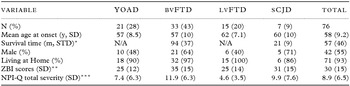
Mean ZBI scores were 25 for AD (SD = 12), 35 for bvFTD (SD = 15), 25 for lvFTD (SD = 14), and 31 for sCJD (SD = 15) (Table 1). Mean ZBI scores were significantly different according to ANOVA analysis (p = 0.026). Bonferroni correction confirmed a trend toward greater difference in ZBI scores in bvFTD compared to AD (p = 0.053).
Group characteristics arranged by disease type

YOAD = Young-onset Alzheimer's disease, bvFTD = behavioral variant frontotemporal dementia, lvFTD = language variant frontotemporal dementia, sCJD = sporadic Creutzfeldt–Jakob disease, ZBI = zarit burden interview, NPI-Q = Neuropsychiatric Inventory.
*Kruskal–Wallis test (n = 12), 8.308, df = 1, p = 0.004.
**ANOVA, F = 3.29, p = 0.026, (Bonferroni, bvFTD>AD, p = 0.053).
***ANOVA, F = 4.86, p = 0.004, (Bonferroni, bvFTD>lvFTD, p = 0.004).
Group characteristics arranged by disease type are listed in Table 1. The mean age at onset for all patients was 58 years (SD = 9.2). There were no differences for mean age at onset as measured by ANOVA analysis between groups. There was a difference in survival time between bvFTD and sCJD groups based on Kruskal–Wallis analysis (p = 0.004) with sCJD surviving an average of 21 months (SD = 9) and bvFTD surviving an average of 94 months (SD = 37). Survival time was not available for lvFTD and YOAD because all patients in these groups remained alive at the time of study conclusion.
In this cross-sectional study, 71 of the 76 patients reported living at home at the time of the study (93%). Looking across diagnoses, no statistically significant difference was found between patients living at home and those with other living arrangements. Living arrangements also did not statistically impact ZBI scores across diagnoses.
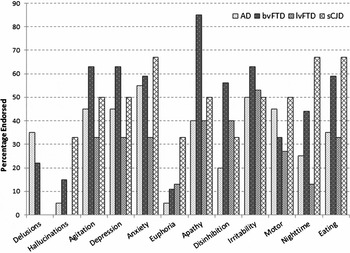
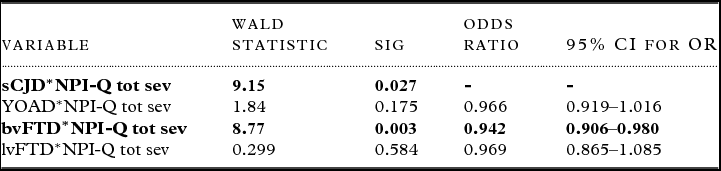
Mean NPI-Q caregiver distress scores were higher for bvFTD (mean = 16, SD = 9.3) and sCJD (mean = 13, SD = 11) compared to YOAD (mean = 8.8, SD = 2) (Kruskal–Wallis, mean = 15.2, p = 0.002). Out of 12 symptom domains on the NPI-Q, an average of 4.7 (SD = 2.7) were endorsed for all groups. sCJD and bvFTD had the highest NPI-Q number of endorsed symptom domains (mean = 5.5, SD = 3.1 and mean = 5.8, SD = 2.5 respectively), while the AD group scored significantly fewer on average (mean = 4, SD = 2.6) (ANOVA, F = 3.95, p = 0.012). Figure 1 depicts the percentage of endorsed NPI-Q symptom domains per diagnostic group. Mean NPI-Q total severity scores were higher for sCJD (mean = 9.9, SD = 7.6) and bvFTD (mean = 11.9, SD = 6.3) compared to AD (mean = 7.4, SD = 6.3) (Table 1). This difference was determined to be statistically significant (ANOVA, F = 4.86, p = 0.004). Apathy was also found to be statistically significant on NPI-Q, with higher likelihood for apathy in bvFTD (85%, Fisher's exact test, 2-sided, p < 0.001) and lower likelihood for AD (40%, χ2 = 4.15, p = 0.042). bvFTD also exhibited higher disinhibition than AD (56%, χ2 = 4.7, p = 0.03). There were no significant differences between the groups in other scales including the MMSE, Unified Parkinson's disease rating scale, mean initial global CDR and CDR Sum of Boxes. In the final regression analyses of ZBI scores, an interaction effect was found between diagnosis category and NPI-Q total severity score for sCJD (OR = 1, p = 0.027) and for bvFTD (OR = 0.942, p = 0.003) (Table 2). Neither ZBI nor NPI-Q total severity scores were significantly different by themselves in regression analyses.
Number of endorsed NPI-Q symptom domains by diagnosis.

Regression analysis of ZBI scores by diagnosis and NPI-Q total severity score. Neither ZBI nor NPI-Q total severity scores were statistically significantly different by themselves

sCJD = sporadic Creutzfeldt–Jakob disease, YOAD = Young-onset Alzheimer's disease, bvFTD = behavioral variant frontotemporal dementia, lvFTD = language variant frontotemporal dementia, ZBI = Zarit Burden Interview, NPI-Q tot sev = Neuropsychiatric Inventory-Q total severity score.
Discussion
Results from this study demonstrate higher mean ZBI scores for bvFTD and sCJD compared to AD and lvFTD, suggesting that caregivers of patients suffering from bvFTD and sCJD have higher caregiver burden. NPI-Q scores were also higher in bvFTD and sCJD for caregiver distress, number of endorsed symptom domains, and NPI-Q total severity. bvFTD was more likely to have apathy and disinhibition compared to AD on the NPI-Q, and both of these factors have been found to correlate with higher caregiver burden in bvFTD when compared to AD (Boutoleau-Bretonniere et al., Reference Boutoleau-Bretonnière, Vercelletto, Volteau, Renou and Lamy2008). The final regression model examining ZBI scores found a significant interaction effect between final diagnosis and NPI-Q total severity score for sCJD and bvFTD. This suggests that higher severity of neuropsychiatric symptoms in bvFTD and sCJD are disease specific, possibly domain specific, and contribute to higher caregiver burden.
Given differences in stage of illness in this study as well as behavioral and motor components of bvFTD and sCJD, one might predict differences in functional and motor assessments compared to AD and lvFTD. These are important parameters to explore given that a decrease in the ability to perform ADLs correlates with institutionalization in AD. However, lack of differences in CDR, MMSE, and UPDRS II scores between groups in this study is consistent with Boutoleau-Bretonniere et al.'s findings of similar functional scores in FTD and YOAD (Boutoleau-Bretonniere et al., Reference Boutoleau-Bretonnière, Vercelletto, Volteau, Renou and Lamy2008). This suggests that functional ability does not account for significant differences in caregiver burden among atypical dementias in the current study.
Despite these important findings about caregiver burden in atypical dementias, this study has limitations common to many dementia studies. Low sample size is a common problem faced by sCJD researchers given the rarity of the disorder. Another limitation is that although total NPI severity and distress scores were collected, there were missing domain specific severity and caregiver distress data for some individuals. This missing data limited the comparison of NPI domain severity and caregiver distress scores across groups. However, a graph of percentage endorsing each NPI-Q symptom domain provided in Figure 1 shows near global greater endorsement of symptoms in bvFTD and sCJD. Unlike findings from previous studies, this graph shows motor abnormalities are reported less frequently for bvFTD compared to AD. sCJD and AD do not appear different with regard to reported motor symptoms in this study (Figure 1). These results could have been different if measured for severity, as motor abnormalities are found in sCJD to a greater extent than AD, yet UPDRS-II scores did not differ significantly between diagnostic groups. This may be a result of motor symptoms not being a prominent symptom when patients are evaluated in a dementia clinic setting.
As expected, a difference was found in the survival time between bvFTD and sCJD groups, with sCJD surviving an average of 21 months (SD = 9) and bvFTD surviving an average of 94 months (SD = 37). The 21-month mean survival time for sCJD is atypical but is explained by a large preponderance of atypical molecular subtypes in our sample that are known to have extended survival time. According to Parchi et al. criteria, sCJD molecular subtypes included in our study were MV1–2 (n = 2), MV2 (n = 1), VV1–2 (n = 1), VPSPr MV (n = 1), and two unknown (Parchi et al., Reference Parchi1999). These atypical molecular subtypes are also characterized by more cognitive symptoms than motor symptoms at illness presentation.
Assessing and characterizing caregiver burden in dementia is important as caregivers often experience declines in their own physical and mental well-being, which in turn can affect the patient (Alzheimer's Association, 2012). Furthermore, caregiver burden is often associated with dementia type and neuropsychiatric symptoms (Lee et al., Reference Lee, McKeith, Mosimann, Ghosh-Nodyal and Thomas2013). This study adds to the epidemiological literature on caregiver burden associated with atypical dementias. Caregiver burden was higher in sCJD and bvFTD compared to AD and lvFTD as measured by the ZBI. Caregiver distress, number of symptom domains endorsed, and total severity of neuropsychiatric symptoms were also higher for sCJD and bvFTD patients compared to AD and lvFTD as measured by NPI-Q. Further, data suggest that apathy, disinhibition, eating disorder, and aberrant motor behaviors are contributing symptoms correlating with caregiver burden. Future studies looking specifically at symptom severity of NPI-Q domains will give more conclusive results which will help guide management of risk factors contributing to caregiver burden in families affected by atypical dementias.
Conflict of interest
None.
Description of authors’ roles
A. Uflacker wrote the manuscript and assisted in designing the study. B. Appleby designed the study, collected data, analyzed data, and assisted in writing the manuscript. C. Onyike collected data, assisted in study design, and analyzed data. M. Edmondson assisted in writing the manuscript.
Acknowledgments
This work was funded in part by the Stivison Fund for CJD Research.