The global prevalence of mental health disorders among adolescents is a pressing concern, affecting over 13 % of this population. Anxiety and depression collectively account for approximately 43 % of adolescent mental disorders considered in the Global Burden of Disease study with a higher prevalence observed in females(Reference Keeley1). Anxiety disorders are characterised by uncontrollable excessive worrying, accompanied by symptoms such as restlessness, head and muscle aches, poor concentration, irritability and sleep disturbance. Childhood anxiety disorders exhibit variability in their average age of onset, with reports indicating onset as early as 7 years(Reference Liu, Chen and Lewis2). Depression disorders are characterised by persistent sadness and a loss of interest in once-enjoyable activities and are also accompanied by symptoms such as restlessness, poor concentration, irritability and sleep disturbance(Reference Walter, Abright and Bukstein3). The average age of onset varies but typically appears in early to mid-adolescence at 12–14 years(Reference Lewinsohn, Clarke and Seeley4).
A growing body of literature now confirms that adolescents with depression are more likely to have unhealthy dietary patterns and consume fewer healthy foods, compared with non-depressed youth(Reference Korczak, Perruzza and Chandrapalan5–Reference Francis, Stevenson and Chambers8). As anxiety and depression are highly comorbid among youth(Reference Al-Asadi, Klein and Meyer9,Reference Konac, Young and Lau10) ; however, it is important to consider whether this phenomenon is attributable exclusively to depression and to clarify whether poor diet quality or unhealthy dietary patterns contribute to the development or worsening of anxiety, or conversely, whether anxiety influences dietary intake. As symptoms of anxiety frequently precede those of depression among children and youth(Reference Kovacs, Gatsonis and Paulauskas11,Reference Angold and Costello12) , the presence of a significant association between anxiety and dietary patterns would suggest the need to intervene earlier in childhood to improve dietary quality among children at risk and their families. A recent scoping review revealed an association between lower levels of anxiety and a variety of ‘healthy’ dietary constituents and patterns observed in studies involving both animals and humans(Reference Aucoin, LaChance and Naidoo13).
While some research suggests anxiety may lead to ‘comfort eating’ of high-fat, high-sugar foods as a coping mechanism(Reference Pickering, Alsio and Hulting14,Reference Dallman, Pecoraro and Akana15) , data pertaining to this association are limited, particularly from children and adolescents. Conversely, studies also suggest that unhealthy dietary patterns may contribute to the development or worsening of anxiety symptoms in some individuals(Reference Aucoin, LaChance and Naidoo13,Reference O’neil, Quirk and Housden16) . The potential for a bidirectional relationship between diet and anxiety is further supported by the role of various neurotransmitters and hormones (corticosteroids, insulin, leptin, etc.) that influence both peripheral and central nervous system functioning(Reference Murphy and Mercer17).
The impact of anxiety and depression disorders extends beyond adolescence, as they are associated with cardiometabolic disorders, including diabetes and CVD, in adults(Reference Scott18). Childhood cardiometabolic risks, for example, unhealthy dietary intake, also track to adulthood(Reference Shrestha and Copenhaver19). Despite their high prevalence and well-documented comorbidity(Reference Brady and Kendall20–Reference Kalin22), research on diet and adolescent mental health to date has focused primarily on the association between diet and depression(Reference Firth, Solmi and Wootton23). Hence, little is known about the unique contribution of anxiety to diet quality, particularly among children and adolescents.
Of the few studies investigating diet quality and anxiety in youth, findings have been mixed. Two cross-sectional studies reported a positive association between self-reported anxiety symptom severity and unhealthy dietary patterns(Reference Rao, Shah and Jawed24,Reference Weng, Hao and Qian25) , and one cross-sectional study found no association between a healthy dietary pattern and self-reported anxiety symptoms(Reference Tehrani, Salehpour and Beyzai26).
One potential obstacle to understanding the connection between diet quality and anxiety is the lack of consistency in measurement across different studies, as well as the high degree of comorbidity between anxiety and depression disorders among young people. Previous studies investigating the relationship between anxiety and diet quality in adolescents have relied on either a single self-report item(Reference Rao, Shah and Jawed24) or self-report questionnaires to measure anxiety(Reference Weng, Hao and Qian25,Reference Tehrani, Salehpour and Beyzai26) rather than an anxiety disorder diagnosis. None of these studies have explored dietary indices based upon a FFQ among their study population.
To bridge this knowledge gap, the present study employs a clinical population exhibiting clinically significant anxiety, indicating both the severity of anxiety symptoms and associated functional impairment. Furthermore, we adopt a hypothesis-driven approach to assess diet quality, utilising four dietary indices derived from a 24-hour FFQ. This approach aligns with the suggestion that whole-of-diet measures, rather than measures of single foods or nutrients, may provide a better understanding of the relationship between diet and health outcomes(Reference Vajdi and Farhangi27). As a result, our approach enhances result comparability while also mitigating the potential influence of measurement errors. The current study aims to investigate the association between anxiety symptoms and diet quality in individuals with clinically significant anxiety, hypothesising that higher anxiety symptoms will be associated with poorer overall diet quality and increased consumption of unhealthy foods independent of the presence of depression.
Methods
Participants
Youth (11–18 years) were recruited from consecutive referrals from an outpatient psychiatric program for children and adolescents referred by primary care providers for assessment of mood and anxiety concerns to the Department of Psychiatry’s centralised intake system, within The Hospital for Sick Children (SickKids), a tertiary care children’s hospital in downtown Toronto, Canada. All those referred to the clinical program are invited to participate in research. Exclusion criteria included inability to provide informed consent/assent (e.g. psychotic disorder, developmental delay), history of hypomania/mania and significant chronic medical illness (e.g. rheumatologic disease and cancer). Healthy children and adolescents (hereafter referred to as healthy controls) were recruited from the community and contacted the research team for eligibility screening in response to promotional materials (community posters, flyers and social media). Healthy controls were excluded if they had a current or previous diagnosis of depression, anxiety disorder, bipolar disorder or psychotic disorder and/or family history of a mood disorder (depression or bipolar disorder) in a first-degree relative.
Study procedure
Clinical assessment of participants was completed over 1–2 d and included prospective self-report measures, dietary assessment and semi-structured psychiatric diagnostic interview. All study measures were recorded using Research Electronic Data Capture, a secure web-based application for database management and were anonymised(Reference Harris, Taylor and Thielke28). Data collection occurred from 2016 to 2022.
Measures
Mental health
Anxiety disorders and major depressive disorder (MDD) were diagnosed using the Schedule for Affective Disorders and Schizophrenia for School-Age Children-Present and Lifetime version, a semi-structured psychiatric interview that was administered by a trained member of the clinical research team(Reference Kaufman, Birmaher and Brent29). All anxiety disorder subtypes were included as a diagnosis of an anxiety disorder. MDD is characterised by persistent low mood, diminished interest or pleasure in activities, and a range of emotional and physical symptoms lasting at least 2 weeks, impacting daily functioning and overall well-being(30). Among adolescents it often also includes symptoms such as irritability, agitation, unexplained aches or pains, changes in school performance and avoidance of social activities rather than explicit expressions of sadness or hopelessness(Reference Bernaras, Jaureguizar and Garaigordobil31).
Symptoms of anxiety were assessed using the Screen for Childhood Anxiety and Related Disorders(Reference Birmaher, Khetarpal and Brent32), a forty-one-item self-report screening tool for anxiety symptoms with demonstrated reliability and internal consistency(Reference Runyon, Chesnut and Burley33). The Screen for Childhood Anxiety and Related Disorders is comprised of five anxiety subscales: somatic/panic, generalised anxiety, separation anxiety, social phobia and school phobia. Symptom frequency is reported using a three-point scale (‘almost never’, ‘sometimes’ and ‘often’). Scores range from 0 to 82, with a score of ≥ 25 indicating potentially clinically significant anxiety symptoms(Reference Birmaher, Brent and Chiappetta34).
Depression symptoms were measured using the Centre for Epidemiological Studies Depression Scale for Children, a twenty-item questionnaire which includes assessment for depressed mood, feelings of guilt and worthlessness, sense of helplessness and sleep disturbances(Reference Fendrich, Weissman and Warner35). Symptom frequencies over the past week are rated on a scale of 0–3 and scores range from 0 to 60, with higher scores indicating greater depressive symptoms.
Dietary intake
Dietary data were collected using a self-reported FFQ(36). Participants reported on the frequency of consuming twenty-four categories of foods from 0 to 3 times in the previous 24 h. FFQ data were assessed for logical consistency to flag outliers and inconsistencies. Thorough data cleaning procedures were implemented to remove incomplete or inconsistent responses, ensuring the overall integrity of the data.
Diet quality assessment
Four diet indices for assessing adolescent diet quality were selected from the literature(Reference Dalwood, Marshall and Burrows37) and have been previously used to assess diet quality in the same sample in relation to depression(Reference Korczak, Perruzza and Chandrapalan5). Items from the FFQ were mapped onto the scoring algorithms of four dietary indices as a proxy measure of dietary quality using previously outlined algorithms and scoring methods(Reference Korczak, Perruzza and Chandrapalan5) (Appendix Table A1).
The Dietary Questionnaire (DQ) Index. The DQ is a nine-item measure used in the Australian Healthy Neighbourhoods Study(Reference Jacka, Kremer and Leslie38). The DQ produces a Healthy Eating Score (DQ-H) and Unhealthy Eating Score (DQ-UH), which quantifies intake and behaviours consistent with healthy and less healthy dietary patterns with a maximum score of 5 and 30, respectively. The DQ index has been previously shown to perform similarly to other dietary measures when evaluating the dietary patterns of adolescents in Canada(Reference Korczak, Perruzza and Chandrapalan5).
Healthy Eating Habits Scale (HEHS). The HEHS is a twenty-three-item measure of dietary intake(Reference Yannakoulia, Lykou and Kastorini39). Items are summed to create two sub-scale scores: healthy (HEHS-H) and unhealthy (HEHS-UH) eating (maximum scores 22 and 15, respectively) with higher scores indicative of greater healthy or unhealthy food intake.
Health and Behaviour of Teenagers Dietary Questionnaire (HBT). The HBT is a nine-item measure used in the Health and Behaviour of Teenagers Study(Reference Wardle, Jarvis and Steggles40) that produces a healthy (HBT-H) and unhealthy (HBT-UH) subscale score reflecting servings of healthy (maximum score of 13) and unhealthy foods (maximum score of 20) typically consumed daily, respectively. Higher sub-scale scores indicate more frequent healthy or unhealthy eating habits.
Youth Healthy Eating Index (YHEI). The YHEI is a thirteen-item measure modified for use in children and adolescents from the Healthy Eating Index(Reference Feskanich, Rockett and Colditz41). The YHEI evaluates the consumption of healthy and unhealthy foods into one overall score over a 24-hour reference period (maximum of 90 points). Higher scores indicate healthier dietary practices.
Covariates
Covariates were identified based on existing research(Reference Burke and Storch42–Reference Carter, Pascoe and Bastounis48) including age, sex and BMI kg/m2. Height and weight were measured by clinic staff using standardised procedures. BMI-for-age z-scores were calculated according to chronological age and sex using the WHO Growth Reference for Children and Adolescents(Reference de Onis, Onyango and Borghi49). BMI status was determined from standard BMI-for-age z-scores cut-offs for overweight (> 1 sd above the mean), obesity (> 2 sd above the mean) and underweight (< 2 sd below the mean). Household income was parent reported and measured as total household income before taxes in the previous year.
Statistical analysis
The sample is described using means and sd or proportions as appropriate. Pearson, point biserial and phi correlation coefficients were calculated to determine the correlation between Screen for Childhood Anxiety and Related Disorders scores and covariates for continuous and categorical variables. Correlation coefficient (r) values < 0·3 were considered weak, 0·3–0·7 were considered moderate and values > 0·7 were indicative of strong correlations(Reference Schober, Boer and Schwarte50). Community and clinical data were combined under the assumption of the null hypothesis that there would be no association between diet quality and anxiety, allowing for a greater range and variance in variable values and increasing power to detect an association between the variables of interest. Dietary indices significantly associated with anxiety symptoms in the correlation matrix were further interrogated using separate linear regressions. Age and sex differences have been observed in comfort food preferences(Reference Wansink, Cheney and Chan51), higher BMI has been associated with dysfunctional eating behaviour(Reference Nguyen-Rodriguez, Chou and Unger52) and all are significantly associated with anxiety disorders among youth(Reference DeJesus, Breitkopf and Ebbert53). Therefore, all models were adjusted for age, sex and z-BMI using multivariable linear regression models. Since anxiety disorders were highly comorbid with MDD, we next tested the impact of comorbid depression with anxiety on dietary index subscales (mDQ-H, mHEHS-H and mHBT-H) by adjusting for MDD diagnosis, in addition to age, sex and z-BMI in the multivariable linear regression models.
For model 1, the minimal detectable effect size is f2 = 0·097 with a sample size of 128 participants, four predictors and 80 % statistical power. For model 2, the minimal detectable effect size is f² = 0·048 with a sample size of 128 participants, five predictors and 80 % statistical power. To decrease the risk of type I errors due to multiple testing (three models), a Bonferroni correction was applied and P values < 0·017 (0·05/3) were considered significant for the multivariable linear regression models(Reference Armstrong54). A conservative variance inflation factor of three was used to detect the multicollinearity in the regression analyses. A sensitivity analysis was conducted to determine the effect of antidepressants on diet by excluding participants with anti-depressant medication use (n 13) from the analysis. Excluding participants taking antidepressant medication did not alter the association between diet quality and anxiety (data not shown). We also conducted a sensitivity analysis to investigate the impact of missing data for income and ethnicity, and our results remained consistent with the original findings (data not shown). Analyses were conducted using R version 4.2.3(Reference Team55).
Results
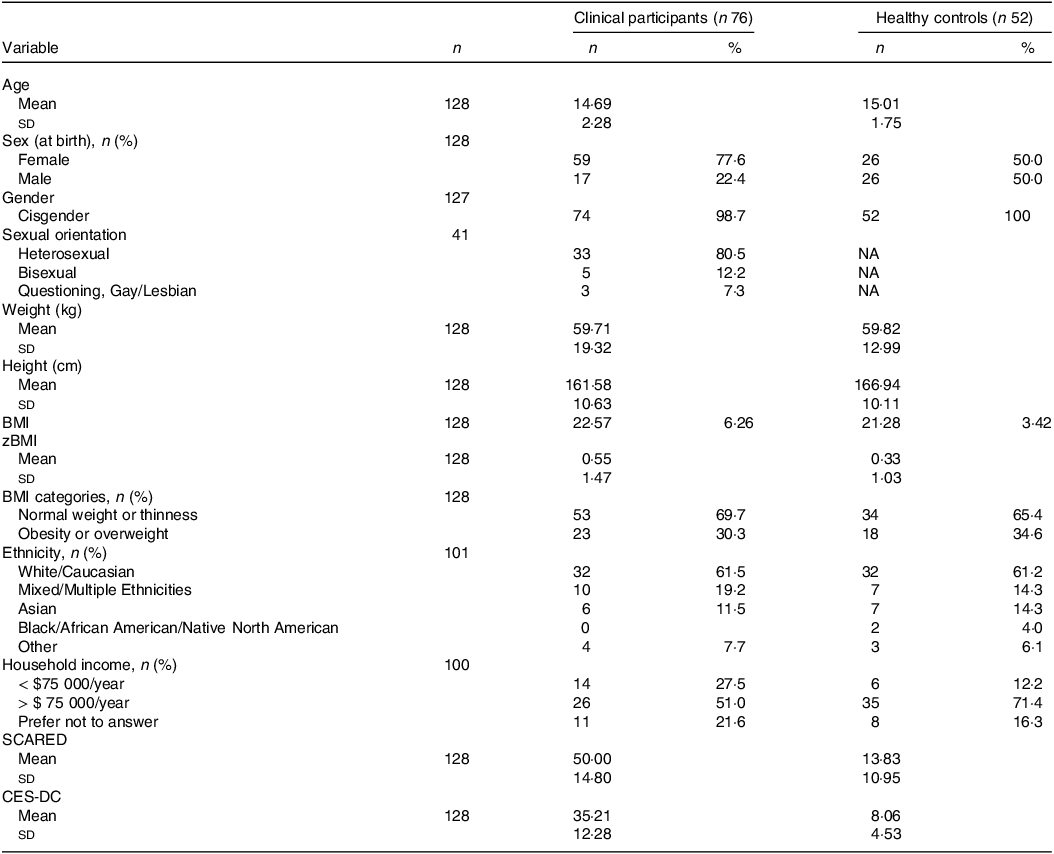
One hundred and twenty-eight children and adolescents were included in the study (n 76 clinical participants with an anxiety disorder; n 52 healthy control community participants). Among participants with an anxiety disorder, n 19 (25 %) had no comorbid mood disorder while n 57 (75 %) had a comorbid MDD diagnosis. Pearson correlations for the dietary index scores were as follows: DQ-H and HEHS-H: 0·56 (0·43, 0·67); DQ-H and HBT-H: 0·72 (0·63, 0·80); HEHS-H and HBT-H: 0·92 (0·90, 0·95); DQ-UH and HEHS-H: 0·51 (0·37, 0·63); DQ-UH and HBT-UH: 0·53 (0·39, 0·64) and HEHS-UH and HBT-UH: 0·76 (0·68, 0·83). Participant characteristics are outlined in Table 1.
Participant characteristics across diagnostic groups (Mean values and standard deviations; numbers and percentages)

zBMI, BMI-for-age z-score; SCARED, Screen for Child Anxiety Related Disorders; CES-DC, Centre for Epidemiological Studies Depression Scale for Children.
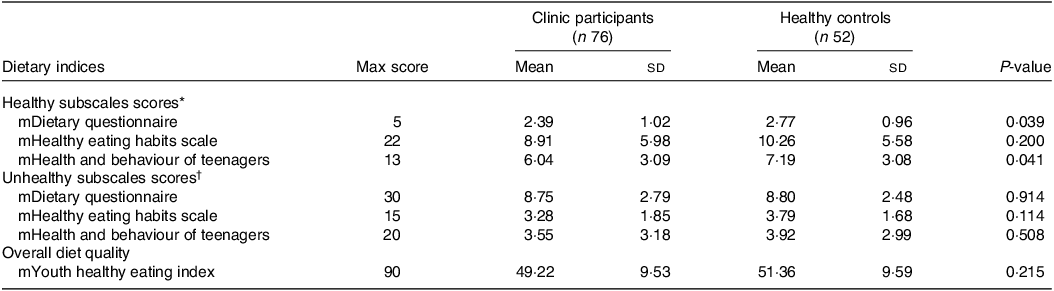
Healthy controls had higher mean healthy subscale scores for two of the three measures (mDQ-H and mHBT-H; P = 0·039 and P = 0·041, respectively). Unhealthy dietary quality index subscale scores (mDQ-UH, mHEHS-UH and mHBT-UH), and overall dietary index score (mYHEI) did not differ between healthy controls and clinic participants (Table 2).
Comparison of mean (SD) modified (m) dietary quality index scores across diagnostic groups

* Higher scores indicate healthier diet quality;
† higher scores indicate unhealthier diet quality.
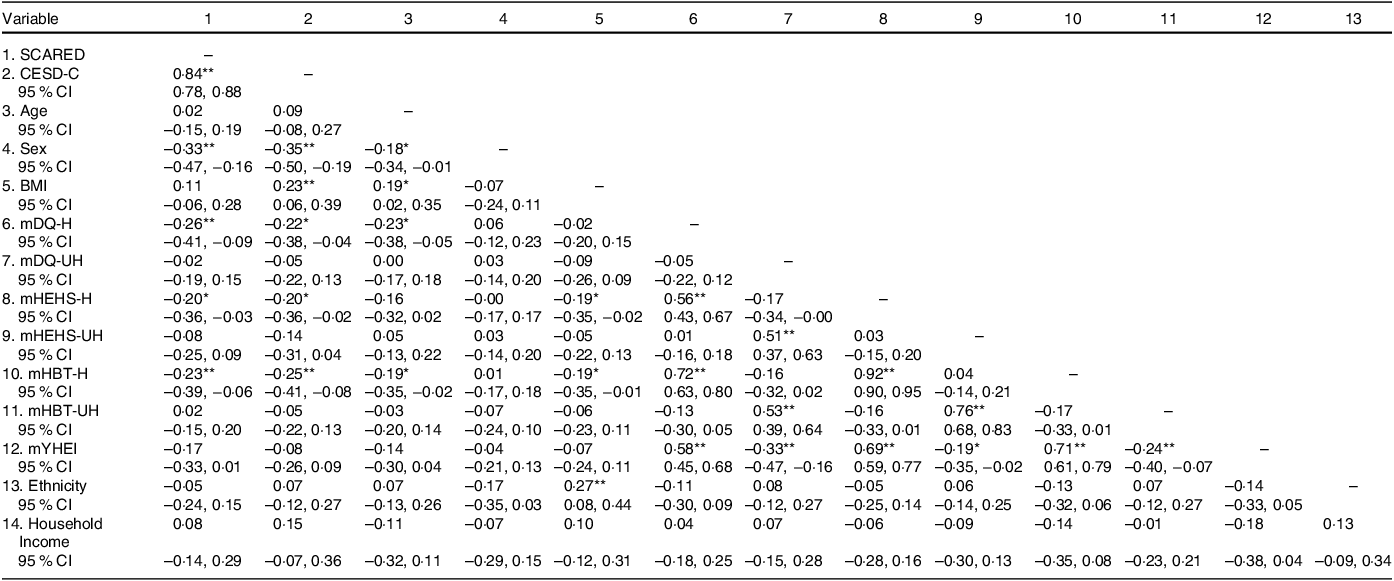
In univariate analysis, higher anxiety symptoms (Screen for Childhood Anxiety and Related Disorders scores) were associated with lower healthy diet index subscale scores (mDQ-H r = −0·26, 95 % CI –0·41, −0·09, P < 0·01; mHEHS-H r = –0·20, 95 % CI –0·36, −0·03, P < 0·05; mHBT-H r = −0·23, 95 % CI –0·39, −0·06, P < 0·05) and female sex (r = −0·33, 95 % CI –0·47, −0·16, P < 0·01). Anxiety symptoms were highly correlated with depressive symptoms (CESD-C; r = −0·84, 95 % CI 0·78, −88, P < 0·01) (Table 3). Anxiety symptoms were not associated with unhealthy diet quality subscale scores (mDQ-UH, mHEHS-UH and mHBT-UH), overall diet quality index score (mYHEI), age, BMI, ethnicity or household income (Table 3).
Correlation (r) with 95 % confidence intervals for anxiety symptoms and covariates, n 128

SCARED, Screen for Child Anxiety and Related Disorders; CES-DC, Centre for Epidemiological Studies Depression-Children; mDQ-UH, modified Dietary Questionnaire – Healthy (mDQ-H); modified Dietary Questionnaire – Unhealthy; mHEHs, HEHS, modified Healthy Eating Habits Scale; mHEHS-UH, modified Eating Habits Scale – Unhealthy; mHBT-H, modified Health Behaviours of Teenagers – Healthy; mHBT-UH, modified Health Behaviours of Teenagers – Unhealthy; mYHEI, modified Youth Healthy Eating Index.
SCARED: lower scores are less severe; CESD-C: lower scores are less severe; higher dietary index scores indicate greater (un) healthy diet quality.
Correlations between continuous variables are Pearson’s correlations, between continuous and dichotomous variables are point biserial correlations and between two dichotomous variables are phi coefficients. Dichotomous variables had the following categories: Sex (at birth): 1 = male, 2 = female; Ethnicity: 0 = Caucasian/white, 1 = non-Caucasian, non-white; Living Arrangements: 0 = biological parents1 = joint custody both biological parents/ Biological mother only/ Biological father only/ Adoptive parent; Household income: 0 = higher income (> $75 000), 1 = lower income (< $75 000). Values in square brackets indicate the 95 % confidence interval for each correlation. * Indicates P < 0·05. ** indicates P < 0·01.
After applying the Bonferroni correction (significance level of P = 0·017), the multivariate analysis interrogating the association between the healthy diet index subscale scores and anxiety symptoms was significant, in the models adjusted for age, sex and BMI z-scores (mDQ-H scores (β = −0·28, P = 0·002), mHES (β = −0·23, P = 0·015) or mHBT-H (β = −0·26, P = 0·005). When a comorbid diagnosis of MDD was included in the model, healthy diet index subscale scores were no longer associated with anxiety (mDQ-H scores (β = −0·24, P = 0·038), mHES (β = −0·22, P = 0·066) or mHBT-H (β= −0·21, P = 0·077)) (Table 4).
The association between a healthy diet and anxiety symptoms (SCARED) across dietary measures (95 % confidence intervals; standard errors)

SCARED, Screen for Child Anxiety and Related Disorders; zBMI, BMI-for-age z-score; MDD, major depressive disorder diagnosis.
b is the SCARED beta coefficient; β is the standardised SCARED beta coefficient; lower SCARED scores are less severe; higher dietary index scores indicate greater healthy/unhealthy diet quality ratio; P values < 0·017 were considered significant following adjustment for multiple testing.
* Model 1. Dietary index subscale ∼ age, sex, BMI z-score and SCARED score.
† Model 2. Dietary index subscale ∼ age, sex, BMI z-score, major depression diagnosis and SCARED score.
Discussion
To our knowledge, the current study is the first to examine the association between diet quality and a diagnosed anxiety disorder among youth. The results indicate that adolescents with an anxiety disorder consume a lower intake of healthy foods compared with healthy controls. In contrast, the consumption of unhealthy foods is similar among anxious and non-anxious youth. The study also reveals a correlation between higher anxiety symptoms and lower healthy diet index subscale scores. However, the presence of comorbid depression weakened this association across all diet subscale scores. This suggests that the impact of anxiety symptoms on diet may not be independent of MDD.
Previous literature examining the association between diet and anxiety is sparse. A recent scoping review found that more than half (56 %) of the literature examining this relationship was comprised of animal studies. Among human experimental studies, only 10 % included participants with anxiety(Reference Aucoin, LaChance and Naidoo13). Accordingly, the present study makes a meaningful contribution to current knowledge as it includes adolescents with clinically significant anxiety symptoms. The less healthful eating habits observed in individuals with comorbid anxiety and depression in the current study align with Wang et al.’s cross-sectional study of 5003 adolescents (mean age 13·1 years), where participants with comorbid anxiety and depression had notably lower odds (OR 0·50, P < 0·001) of adhering to a traditional Chinese (healthy) food pattern(Reference Weng, Hao and Qian25). However, the lack of an association between unhealthy eating and anxiety symptoms demonstrated in the current study is not consistent with the findings of Wang et al, however, which found greater odds (OR 1·93, P < 0·001) of being in the highest tertial of a snack food dietary pattern among comorbid anxiety and depression(Reference Weng, Hao and Qian25). One possible explanation for this discrepancy may be that clinical participants and healthy controls consumed equally unhealthy diets in the current study (Table 2). Another explanation for the discordant findings concerning unhealthy dietary intake may lie in the different study settings. The current study’s findings align with an Iranian community sample of 280 adolescent girls, mean age 16·2 years where differences in depression scores but no differences in anxiety scores (P = 0·87) were observed across quintiles of adherence to a Mediterranean-style dietary pattern(Reference Tehrani, Salehpour and Beyzai26). Although the sample size is small, such that results require replication in larger samples, the focus of the study on adolescents with clinically significant anxiety symptoms is novel and as such, findings make a new contribution to the current understanding of the association between anxiety symptoms and dietary patterns in youth. Current findings also align with the only other study conducted among individuals with clinical diagnoses of depression and anxiety that we are aware of, which was conducted among adults. Adults with concurrent depressive and anxiety disorders (n 1634) had lower diet quality scores than healthy controls (Mediterranean diet score: β = −0·41 (95 % CI = –0·60, –0·21); alternative healthy eating index β = −0·22 (95 % CI = −0·42, –0·03))(Reference Gibson-Smith, Bot and Brouwer56).
Stronger associations between anxiety and diet quality were observed for DQ-H than HBT-H or HEHS-H. While all scores include fruits and vegetables in the healthy subscale score, the DQ-H also includes low-fat dairy, whereas the HEHS-H also includes 100 % orange, grapefruit, tomato juice, dried beans, peas, lentils, black beans and soybeans. This may suggest that the association between comorbid anxiety and depression with diet quality might be influenced by the consumption of low-fat dairy products. To our knowledge, this is a novel, yet preliminary, finding that warrants further investigation.
In adulthood, heightened cardiometabolic risk has been associated with psychiatric conditions experienced during childhood and adolescence, such as anxiety and depression disorders, regardless of body weight or the presence of metabolic syndrome(Reference Goldstein and Korczak57). The current study did not find a significant association between BMI and anxiety in adolescents. However, this is in contrast to a meta-analysis by Burke et al. which found a small but statistically significant effect (r = 0·08; 95 % CI) (0·06, 0·11); P < 0·001) indicating that increases in anxiety symptoms with increasing body weight(Reference Burke and Storch42). One possible explanation for this discrepancy is that most participants in the current study were of healthy BMI, whereas the meta-analysis included participants seeking weight management treatment. Another study of healthy-weight children and adolescents found that the presence of an anxiety disorder was associated with a greater trend towards weight gain over time, compared with those without an anxiety disorder at baseline. These findings suggest that anxiety may be a risk factor for future overweight and obesity, even among healthy-weight adolescents(Reference Rofey, Kolko and Iosif58). Taken together with results from the current study, these findings suggest that while adolescents with clinically significant anxiety may not manifest increased body weight as youth, dietary risk factors for future overweight and obesity are present and can be detected before weight gain. Preventive interventions aimed at reducing the risk of future obesity in these vulnerable populations are likely to be more effective than those aimed at weight loss in adulthood(Reference Pandita, Sharma and Pandita59). Our findings highlight the need to assess health behaviours among children and adolescents who may be at increased risk of future weight gain and related mental health disorders, such as those with clinically significant anxiety.
A strength of the current study is the inclusion of adolescents displaying clinically significant anxiety and depression symptoms. In addition, the study also examined healthy and unhealthy diet quality using several dietary indices to increase the ability to observe results across measures, an area in which research is sparse. Several limitations should also be considered. The misreporting of energy and protein intake when assessing diet by self-report is a widely recognised limitation in investigating the effects of diet on health. Underreporting is a major problem, especially due to inter-individual variation in misreporting, which significantly weakens the relationship between diet and disease. Despite the impact of reporting errors on self-reported dietary intake, our previous research has shown that reporting bias among adolescent outpatients is similar to that of adolescents in community samples(Reference Campisi, Cost and Korczak60). Comprehensive 24-hour food recall measures of dietary intake that include multiple days of intake should be employed in future studies to represent habitual intake more accurately. Also, as this study was focused on youth with clinically significant anxiety symptoms, who have high rates of comorbid depression symptoms, findings cannot be generalised to youth with subclinical levels of anxiety symptoms. The current study is underpowered to detect small effect sizes due to the limited sample size. However, the observed effect sizes in our study align with findings from adult studies across diverse measures thereby enhancing the validity of our results despite the potential limitation in statistical power. The preponderance of female participants in the current sample, while reflective of the increased prevalence of anxiety and depression among female v. male youth, limits the generalisation of study findings to adolescent males. Larger population-based and ethnically diverse studies are needed to parse associations across anxiety severity, ethnicities and comorbidity to guide wider public health initiatives. Given the cross-sectional design, this study cannot establish the temporal direction nor infer causality of the observed associations between anxiety symptoms, dietary patterns and comorbid depression. Furthermore, the non-random selection of participants necessitates caution when generalising these findings to the broader adolescent population. The recruitment of control comparator youth relied on the volunteerism of healthy youth, introducing potential selection bias. Given the small number of studies on this topic early in the life course, however, our results provide the basis for prospective longitudinal studies to examine directionality.
Conclusions
Increased anxiety symptoms may be associated with a poorer healthy diet; however, this effect is attenuated by depression. These findings highlight the complex interplay between anxiety, depression, and diet in adolescents. The results of this study support the need for an integrated approach to the assessment of mental and physical well-being. By identifying and addressing risk factors for adverse metabolic and physical conditions that co-occur with adolescent internalising disorders such as anxiety and depression, it may be possible to reduce the accrual of comorbidities across the lifespan, resulting in improved overall health outcomes for anxious children.
Acknowledgments
The authors would like to acknowledge the participants of the study; Reva Schachter and Marlena Colasanto who were part of the initial protocol development and assisted with data collection; and all research assistants who helped with data collection.
This work was supported by the Brain and Behavior Research Foundation: (grant number 26400) and Canadian Institute of Health Research: (grant number 409491).
S. C. C., K. A. S. and D. J. K. conceptualised the study design and analysis plan. S. C. C. and K. A. S conducted the analysis and wrote and revised all drafts of the manuscript. D. J. K. provided senior supervision for all aspects of the study. All authors assisted in data interpretation, critically reviewed and approved the final manuscript.
There are no conflicts of interest.
The datasets used and/or analysed during the current study are available from the corresponding author upon reasonable request.
This study was conducted according to the guidelines laid down in the Declaration of Helsinki and all procedures involving human subjects/patients were approved by the Hospital for Sick Children Research Ethics Board #1000054479. Written informed consent was obtained from all participants.
Supplementary material
For supplementary material/s referred to in this article, please visit https://doi.org/10.1017/S0007114524001533