


Introduction
Borderline personality disorder (BPD) is a serious mental disorder, which is both disabling and prevalent (Lieb, Zanarini, Schmahl, Linehan and Bohus, Reference Lieb, Zanarini, Schmahl, Linehan and Bohus2004). Individuals with BPD demonstrate pervasive psychopathology, spanning multiple phenomenological sectors, including emotional dysregulation, anxiety, impulsivity, suicidality, self-injurious behaviours (SIB), transient psychotic symptoms, dissociation and chronic interpersonal difficulties. There is no convincing evidence for medication treatment for BPD as a whole (Lieb, Voellm, Ruecker, Timmer and Stoffers, Reference Lieb, Voellm, Ruecker, Timmer and Stoffers2010). Psychotherapy continues to be the primary treatment for BPD (Stoffers, Voellm and Lieb, Reference Stoffers, Voellm and Lieb2009); 75% of individuals with BPD will be hospitalized in the course of their treatment (Lieb et al., Reference Reiss, Jacob, Farrell, van Vreeswijk, Broersen and Nadort2004).
Hospitalization is arguably necessary when a patient's life is threatened; however, specialized inpatient treatment for this more severely disabled group, which has not responded to a variety of outpatient treatment efforts, is not widely available. Internationally, clinicians are compelled to turn to general psychiatric inpatient treatment of unknown effectiveness. It has even been suggested that traditional inpatient care has the potential to trigger negative effects (Gunderson and Links, Reference Gunderson and Links2008) or may merely be expensive custodial care for patients with BPD to maintain safety using external control.
The evaluation of clinical and cost effectiveness of specialized treatment for inpatients with BPD is a neglected research area. To date, the majority of studies have focused on outpatient treatment (summarized in Stoffers et al., Reference Stoffers, Voellm and Lieb2009; Zanarini, Reference Zanarini2009). Inpatient studies have been limited to Dialectical Behaviour Therapy (DBT; Linehan, Reference Linehan1993) and psychodynamic psychotherapy. Twelve weeks of inpatient DBT in a non-randomized trial demonstrated greater improvements on measures of depression, anxiety, interpersonal function, social adjustment, global psychopathology and SIB than the wait-list control (Bohus et al., Reference Bohus, Haaf, Simms, Limberger, Schmahl and Unckel2004). However, 50% of the patients failed to show clinically significant improvement and no specific BPD measure was reported (Bohus et al., Reference Bohus, Haaf, Simms, Limberger, Schmahl and Unckel2004). Other inpatient trials are either non-randomized and non-controlled (Kroger et al., Reference Kroger, Schweiger, Sipos, Arnold, Kahl and Schunert2006), use a mixed personality disorder sample (e.g. Chiesa, Fonagy and Holmes, Reference Chiesa, Fonagy and Holmes2006), report only qualitative results (e.g. Silk et al., Reference Silk, Eisner, Allport, DeMars, Miller and Justice1994) or suffer from methodological flaws (summarized in Springer and Silk, Reference Springer and Silk1996). The high morbidity, mortality, utilization and costs (van Asselt, Dirksen, Arntz and Severens, Reference van Asselt, Dirksen, Arntz and Severens2007) of mental health services associated with BPD and the paucity of empirical research indicate a need for the further evaluation of inpatient treatment, and the development of additional treatment approaches for non-responders to the limited treatments available.
Schema Therapy (ST) is a comprehensive treatment for BPD (Young, Klosko and Weishaar, Reference Young, Klosko and Weishaar2003; Arntz and van Genderen, Reference Arntz and van Genderen2009) with a growing body of research evidence. The idea of ST is that early maladaptive schemas trigger under- or over-modulated emotion and action states that are referred to as modes. Modes are seen as interfering with patients’ ability to use adaptive coping or interpersonal skills. Decreasing the intensity and frequency of maladaptive modes and strengthening adaptive modes are thought to allow patients to respond adaptively to life situations and improve their quality of life.
Individual ST has demonstrated efficacy for the full range of BPD psychopathology and critical psychosocial outcome measures, such as quality-of-life and cost-effectiveness (Giesen-Bloo et al., Reference Giesen-Bloo, van Dyck, Spinhoven, van Tilburg, Dirksen and van Asselt2006; van Asselt et al., Reference van Asselt, Dirksen, Arntz, Giesen-Bloo, van Dyck and Spinhoven2008). Farrell and Shaw (Reference Farrell and Shaw1994) developed a group therapy model of ST (Farrell and Shaw, Reference Farrell and Shaw2012). A RCT (Farrell, Shaw and Webber, Reference Farrell, Shaw and Webber2009) and pilot studies outside the developer's site (Dickhaut, Reference Dickhaut2010) of outpatient GST demonstrated large effect sizes on measures of BPD symptoms in total and on all nine subscales of the Borderline Personality Disorder Severity Index (BPDSI; Giesen-Bloo, Wachters, Schouten and Arntz, Reference Giesen-Bloo, Wachters, Schouten and Arntz2010), reflecting a symptom reduction in all of the nine DSM-IV criteria. Moreover, Dickhaut (Reference Dickhaut2010) found a reduction of general psychopathology in the Symptom Checklist-90-R's global severity score (Derogatis, Reference Derogatis1994) and improved scores on measures of quality-of-life.
Since group therapy is the most commonly employed modality in inpatient settings, GST has particular promise for inpatient BPD treatment. Outpatient GST was adapted to an intensive model by its developers and combined with individual ST to be used as a comprehensive inpatient treatment program for severe BPD (Farrell and Shaw, Reference Farrell and Shaw2005). Independently, Reiss and Vogel (Reference Reiss, Vogel, Roediger and Jacob2010) developed another combined ST inpatient BPD program. The core components of ST and the structure and length of treatment were judged to be equivalent in both programs. For these reasons the results of the three pilots are reported together with the goal of beginning to evaluate the effectiveness of a time-limited, combined program of individual and group ST for inpatients with severe BPD.
Method
Participants
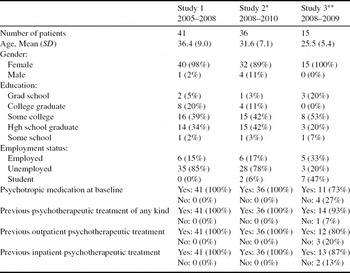
In Pilot Study 1 and 2 patients who had a BPD diagnosis confirmed were referred to a specialized all-BPD inpatient unit of a medical school affiliated hospital in the United States. Ethical approval from the university institutional review board and informed consent from patients were obtained. Patients came through the hospital's usual referral process from community mental health centres. Consecutive referrals who met criteria and consented were accepted into the program, which usually had a waiting list. The ST program was an open group; new admissions occurred as patients were discharged. The group size was 11, based on the number of beds on the hospital unit assigned to the program. The majority of patients were court committed to the hospital, but the decision to participate in the BPD ST program was voluntary. The decision to stay in the program was voluntary. Any patient who asked to leave the program was transferred to a general psychiatric unit and received alternative general treatment. Exclusion criteria were a lifetime diagnosis of schizophrenia, schizoaffective disorder, bipolar 1 disorder, severe and pharmacological treatment resistant major depressive disorder (MDD), an IQ lower than 80, antisocial or narcissistic personality disorder (PD). In Pilot Study 1 6.7% (3/45) of referred patients were disqualified based upon exclusion criteria: two patients with severe MDD for whom inpatient electroconvulsive therapy (ECT) was planned and one patient with schizoaffective disorder. In Pilot Study 2, 2.6% (1/38) of referred patients were disqualified based upon exclusion criteria: IQ below 80. The retention rate for patients who qualified and consented was 97.6% (41/42) for Pilot Study 1 and 97.3% (36/37) for Pilot Study 2. The one premature drop-out in Pilot Study 1 left after her first group session and the one in Pilot Study 2 dropped out due to referral for ECT after a partial week in the program. Both were withdrawn from the study and omitted from analysis as they did not receive an adequate dose of treatment. Control of psychopharmacological treatment was beyond the scope of these pilot studies. Scheduled benzodiazapines were not given and patients admitted on them were tapered and withdrawn. All patients had a history of suicide attempts and SIB at intake. Table 1 presents the main demographic characteristics of all samples.
Patient demographics by study

* Due to rounding scores may add up to more than 100%; **Completers only
In Pilot Study 1 diagnoses were confirmed by clinical interview (conducted by a senior clinical psychologist) and meeting the BPD qualifying score on the Borderline Syndrome Index (Conte, Plutchik, Karasu and Jerrett, Reference Conte, Plutchik, Karasu and Jerrett1980). At the time the study began, this was the only self-report BPD measure of change available. In Pilot Study 2, the same psychologist conducted a clinical interview guided by the Questionnaire of the Clinical Interview for DSM-IV Personality Disorders (SCID-II; First, Spitzer, Gibbon and Williams, Reference First, Spitzer, Gibbon and Williams1996). Although the program was 12 weeks long, the average length of stay in Pilot Study 1 was 18 weeks. Posttreatment assessment occurred at discharge. The primary reason for discharge delays was the need for supported housing. When discharge was delayed, patients continued some ST programming. In Pilot Study 2, the formal ST treatment program ended and patients completed the assessments after 12 weeks. Those who stayed longer had individual therapy with minimal group treatment and spent four of five weekdays on home visits. This lack of exact dose control of the treatment reflects the reality of conducting studies in naturalistic settings where patients cannot be denied all psychotherapeutic treatment because a study period ended.
In Pilot Study 3, 17 patients with a diagnosis of BPD, confirmed by SCID-II Interview (First et al., Reference First, Spitzer, Gibbon and Williams1996), were referred to a general psychiatric inpatient unit of a University Department of Psychiatry and Psychotherapy in Germany. All patients had signed informed consent and the study had ethical approval. Patients were admitted according to referral order. The group size was eight, based on the number of beds on the hospital unit assigned to the program. Exclusion criteria were the same as in studies 1–2, with the addition of the diagnosis of severe MDD. In Pilot Study 3 5.9% (1/17) of referred patients were excluded due to a confirmed diagnosis of narcissistic PD. One patient dropped out at the end of week 4 and was excluded from the analysis, as not receiving a minimal dose of treatment. Thus retention rate was 15/16 (93.8%). Psychopharmacology followed the protocol of pilot studies 1 and 2. Patients were assessed and discharged at the end of 10 weeks if no acute suicidality was present (none were delayed). Follow-up assessment of borderline-specific and general psychiatric symptoms was conducted 12 weeks after discharge.
The inclusion and exclusion criteria of all studies reflect the heterogeneity of the BPD population in naturalistic clinical settings. They are consistent with the recommendations made by a NIMH panel of BPD experts (Zanarini et al., Reference Zanarini, Stanley, Black, Markowitz, Goodman and Pilkonis2010). The exclusion of narcissistic, schizotypal, schizoid and antisocial PD and Dissociative Identity Disorder was chosen to protect the group process from disruptions not part of BPD psychopathology.
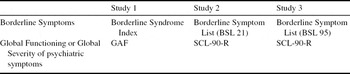
Outcome measures (see Table 2)
Borderline Syndrome Index (BSI; Conte et al., Reference Conte, Plutchik, Karasu and Jerrett1980) is a 52-item true or false self-report measure of BPD symptoms that allows measurement of change by specifying a time period for the subject upon which to base answers. The BSI asks, through 52 questions, about the presence of BPD symptoms during the last 2 weeks. The total score has an internal consistency of KR-20 = .92 (p<.001).
Outcome measures by study

Borderline Symptom List (BSL) is a 95-item self-rating scale that allows for quantification of the borderline-typical symptoms with good psychometric properties. Pilot Study 2 used the short version (Bohus, Reference Bohus2004; Wolf et al., Reference Wolf, Limberger, Kleindienst, Stieglitz, Domsalla and Philipsen2009); Pilot Study 3 used the long version (Bohus et al., Reference Bohus, Limberger, Frank, Chapman, Kühler and Stieglitz2007). Intercorrelations between both versions are high (r = .96; Wolf et al., Reference Wolf, Limberger, Kleindienst, Stieglitz, Domsalla and Philipsen2009).
Symptom Checklist-90-R's global severity score (GSI, mean of the sum of all items; Derogatis, Reference Derogatis1994) was used in pilot studies 2 and 3 as a measure of subjective experience of general symptoms. Internal consistency of this score is very high, Cronbach's alpha = .79-.89.
Global Assessment of Functioning Scale (GAF; Jones, Thornicroft, Coffey and Dunn, Reference Jones, Thornicroft, Coffey and Dunn1995) ratings by consensus of the treatment team members (psychologist, psychiatrist and master's level clinical social worker) were used in Pilot Study 1 as a measure of global functioning.
The first three measures are self-report, eliminating the issue of rater bias. The clinician rated GAF scores were rated by consensus of the treatment team referring to a copy of the scale as an empirical anchor.
Treatment
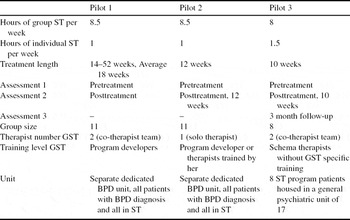
The inpatient ST programs include group and individual components (Table 3). The studies are comparable in the proportion of group and individual sessions, group format and group size, but differ in treatment length, number of therapists and therapists’ training.
Treatment components in the three pilot studies

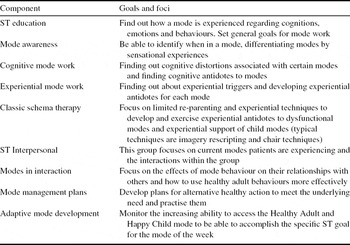
Like individual ST, GST (Farrell and Shaw, Reference Farrell, Shaw, Roediger and Jacob2010; Farrell and Shaw, Reference Farrell and Shaw2012) is technically integrative, combining aspects of process and educational groups to make strategic use of group therapeutic factors such as cohesiveness and vicarious learning (Yalom, Reference Yalom2005). A co-therapist pair work together to balance focus between individuals and the group. The program and course of treatment is described in Farrell, Shaw and Reiss (Reference Farrell, Shaw, Reiss, van Vreeswijk, Broersen and Nadort2012), Reiss and Vogel (Reference Reiss, Vogel, Roediger and Jacob2010) and in a case study by Reiss, Jacob and Farrell (Reference Farrell and Shaw2012). Since the studies were completed a treatment manual for GST with a patient workbook has been prepared (Farrell and Shaw, Reference Farrell and Shaw2012). Table 4 presents the focus and goals for group sessions of the ST program.
Components of intensive group schema therapy

Formal adherence measures for GST had not been developed at the time of these pilot studies. All group sessions were conducted by at least one of the developers of the programs and random session videotapes were reviewed by ST supervisors. Supervision occurred bi-weekly.
Results
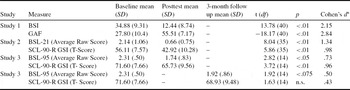
Table 5 shows the means of the outcome measures at the different assessment points. As hypothesized, at the end of the inpatient ST programs significant changes occurred in borderline-specific and general psychopathology measures. Global severity of psychiatric symptoms, whether measured by GAF or SCL-90-R, was also reduced significantly in all three pilot studies. In Pilot Study 1 we found a significant reduction in BPD symptoms measured with the BSI from pre- to posttreatment (p<.01; Cohen's d = 2.15). GAF scores increased significantly after treatment, indicating improved global functioning (p<.01; Cohen's d = 2.84). Although we have no formal measures at follow-up in Pilot Study 1, we have the report of treating clinicians for 28 of 42 patients (67%) for the incidence of important BPD symptoms for the year after inpatient treatment: re-hospitalization, SIB requiring medical care, and suicide attempts. In that group 86% had no hospitalization, 6% had one brief (less than 10 days) hospitalization, and an additional 8% had two brief hospitalizations, compared to a mean of six hospitalizations in the year before treatment. In terms of SIB, 100% reported SIB requiring medical care in the 30 days before inpatient treatment; in the year after treatment only 18% had SIB. For suicide attempts, 100% had a recorded attempt in the year before treatment and in the year following treatment only 14% (6) had a suicide attempt.
Means, SDs and Effect Sizes using SD of change scores of the outcome measures by study and time, and results

*
 $\delta = \frac{{\mu _1 - \mu _2 }}{{\sigma _D }}$
.
In Pilot Study 2 the effect size on the borderline specific measure dropped markedly when compared to Pilot Study 1 (p<.01; Cohen's d = 1.34), yet we still found a significant reduction in BPD symptoms measured with the BSL. In Pilot Study 2 GSI-T-scores on the SCL-90-R (p<.01; Cohen's d = .98) decreased significantly, indicating a decrease in global severity of psychiatric symptoms.
In Pilot Study 3 a repeated measures ANOVA (F = 3.83; df = 2,28; p<.05) demonstrated a significant reduction of BPD symptoms over time as measured with the BSL. To compare results at the three assessment points in Pilot Study 3 we calculated orthogonal contrasts between pretreatment and posttreatment measures of Pilot Study 3 and between pretreatment and follow-up measures of Pilot Study 3. When looking at contrasts among the three measurement points, a significant reduction in BPD symptoms is found between pretreatment and posttreatment scores (p<.05), with an effect size of Cohen's d = .73. When pretreatment and 3-month follow-up measures are compared there is no significant difference in BPD symptoms, but a marked tendency towards reduction is found (p<.075; Cohen's d = .50). Looking at general psychopathology via a repeated measures ANOVA, GSI scores on the SCL-90-R decreased significantly over time (F = 7.19; df = 2,28; p<.01). We calculated orthogonal contrasts between pretreatment and posttreatment measures of Pilot Study 3 as well as between pretreatment and follow-up measures to make the results comparable to Pilot Studies 1 and 2. When looking at contrasts, a significant difference in global severity of psychiatric symptoms was found between pretreatment scores and post ST inpatient treatment scores (p ≤ .01; Cohen's d = .96). However, when pretreatment and 3-month follow-up measures are compared no significant difference in global severity of psychiatric symptoms is found (p >.05; Cohen's d = .43) indicating a relapse of symptoms after discharge (see Table 5).
Discussion
In all three uncontrolled pilot studies BPD specific as well as global severity of psychopathology symptoms were reduced significantly in patients with severe BPD. These findings need to be evaluated in a RCT, with posttreatment follow-up to evaluate whether the treatment effects accomplished in intensive ST programs will be maintained over time and how these treatment effects compare to those of other BPD inpatient treatment programs.
Pilot Study 3 reached posttreatment scores comparable to those reported for inpatient DBT, which were assessed a month after discharge (Bohus et al., Reference Bohus, Haaf, Simms, Limberger, Schmahl and Unckel2004). Pilot Study 3 demonstrated significant reductions in BPD symptoms and global severity of psychiatric symptoms from pre- to posttreatment; however no statistically significant change from pretreatment to 3-month follow-up was found in global severity of psychiatric symptoms and only a tendency towards reduction of borderline specific symptoms. The small sample size (N = 15) may not provide sufficient power to detect the small changes in effect size typical for psychotherapy studies. There is no formal information about outpatient follow-up psychotherapy, but it can be assumed that patients with severe BPD need such treatment. Currently, the average waiting time for outpatient psychotherapy in Rhineland-Palatinate, Germany is 14.2 weeks (Bundespsychotherapeutenkammer, 2011) suggesting that patients did not receive outpatient treatment during the follow-up assessment time. A relapse of symptoms is likely to occur under these circumstances. Bohus et al. (Reference Bohus, Haaf, Simms, Limberger, Schmahl and Unckel2004) report an effect size of 0.84 one month after discharge in their inpatient DBT trial. Yet, in an uncontrolled inpatient DBT trial Kroger et al. (Reference Kroger, Schweiger, Sipos, Arnold, Kahl and Schunert2006) found an effect size of 0.68 from pre- to posttreatment and 0.44 from pretreatment to a 15-month follow-up comparable to the results of Pilot Study 3. The informal follow-up results collected for Pilot Study 1 indicate improvement in a percentage of patients at least equal to that reported for inpatient DBT (Bohus et al., Reference Bohus, Haaf, Simms, Limberger, Schmahl and Unckel2004). However, the figures may be better in this group, which remained in outpatient care than in the group lost to follow-up. The role of outpatient follow-up is another variable to evaluate in future studies.
An important economic question to answer is whether the ST intensive program can be delivered outside of hospitals. Mentalization-based (MBT) day-hospital treatment programs have shown effectiveness in improving symptoms and functioning of patients with BPD (Bateman and Fonagy, Reference Bateman and Fonagy1999, Reference Bateman and Fonagy2001, Reference Bateman and Fonagy2009). Just recently Bales et al. (Reference Bales, van Beek, Smits, Willemsen, Busschbach and Verheul2012) demonstrated that manualized day hospital MBT can be effectively implemented in a naturalistic setting. The reduction in costs for day hospital compared to inpatient treatment is approximately 80%.
A difficulty in interpreting all studies to date on BPD inpatient treatment is the lack of consistency in measures used (Zanarini, Reference Zanarini2009). These pilot studies all used a direct measure of BPD symptoms and one of global severity of psychiatric symptoms, but different measures were used for Pilot 1, the earliest of the studies. The length of treatment also varied from a mean of 18 weeks to 10 weeks. Pilots 2 and 3 are more comparable in measures and length. Another possible influence is the difference between samples in employment (e.g. 85% unemployed in Pilot Study 1 vs. 20% unemployed in Pilot Study 3). Due to GST being in the treatment development stage at the time of the pilot studies there were slight variations in the programs. Fidelity to ST was checked by supervisors, but we cannot rule out the effects of variations in the group program on outcome.
Despite these limitations these pilot studies give us important information about the benefits of using a structured specialized program for severe BPD in inpatient settings and the feasibility of conducting such studies. The overall results compare favourably to those described by experts (Gunderson and Links, Reference Gunderson and Links2008) and no patient was made worse by treatment. There is so little data evaluating inpatient treatment programs or even reports of what treatment is utilized in these settings that our studies offer a starting point for the evaluation of controlled specialized BPD treatment other than DBT. The treatment effect sizes for Pilot Study 1 are comparable to outpatient GST studies (Farrell et al., Reference Farrell, Shaw and Webber2009; Dickhaut, Reference Dickhaut2010). Pilot Studies 2 and 3 demonstrated lower effects. One explanation could be deviations from the GST model: Pilot Study 2 groups were conducted by a solo therapist who was highly experienced in the model, but one therapist cannot fulfill the GST requirements for BPD groups. In Pilot Study 3 therapists were trained in individual ST, but had no training in GST. One can assume that training is likely to affect treatment outcome. In addition, the treatment in Pilot 3 was shorter than Pilot 1. Although a dismantling study of the active ingredients of GST was not the purpose of the studies, the differences in effect size found provide us with new hypotheses to test.
Future studies should use the same outcome measures and treatment length, include randomization and a control group and measure adherence to the GST model as well as therapist training. Our findings add further evidence that inpatient programs for patients with severe BPD can do more than keep them safe with external control at a high cost.
Acknowledgements
Neele Reiss and Klaus Lieb (Pilot Study 3) would like to acknowledge the supervisor of individual ST, Gitta Jacob, PhD and their treatment team members – Friederike Vogel, MD, Marco Nill, MD and Mechthild Graf-Morgenstern, MD for their contributions to the ST treatment program. The third pilot study was supported in part by funds from University Medical Center Mainz MAIFOR grant (No.88).
Ida Shaw and Joan Farrell (Pilot Studies 1 and 2) would like to acknowledge the contributions of their team at Larue Carter Hospital – Vicki Silver, LCSW, Karen Fuller, D.Min. and John Mitchell, MS. The first pilot study was supported in part by funds from Indiana University School of Medicine Psychiatry Biomedical Research Grant and the second pilot study was supported in part by funds from the Clarian Values Grant.



Comments
No Comments have been published for this article.