INTRODUCTION
Over the past few years, the damage and destruction of cultural heritage in armed conflicts have made front-page news on many occasions. For example, in Syria, the old city of Aleppo (a United Nations Education, Scientific and Cultural Organization [UNESCO] world heritage site) has been on the frontline of the battle between the government forces and armed non-state actors (ANSAs), with its cultural heritage having been damaged or destroyed as a result of the fighting. Its medieval market (the Souq al-Madina) was burned to the ground; the outer wall of its citadel extensively affected; the main gate of the Umayyad Mosque (often known as the Great Mosque), also destroyed; and its library consumed by flames. Footnote 1 The world heritage site of Palmyra was attacked twice by the Islamic State group, leading to the destruction of the Bel and Baalshamin temples and to the extensive damage of its Roman amphitheater.
In Iraq, the shrine of the Prophet Yunus and the Mosul Museum, among others, were the object of deliberate attacks by the Islamic State group, which filmed their devastation. Footnote 2 Prior to losing the city of Mosul, the Islamic State group dynamited the Al Nuri mosque—the place from where al-Baghdadi declared the Islamic State caliphate and himself to be its caliph in June 2014. Footnote 3 The Islamic State group has also put in place a systematic looting plan through its “Antiquities Division,” which raises funds through the issuing of licenses and the collection of taxes for the digging and trafficking of Iraqi and Syrian artifacts. Footnote 4 Khaled al-Assad, the head of antiquities in Palmyra, was even assassinated in 2015 after refusing to cooperate with the Islamic State group and to disclose the whereabouts of some of the site’s antiquities. Footnote 5
In Mali in 2012, Islamist ANSAs attacked the world heritage town of Timbuktu, destroying more than 4,000 manuscripts, 14 mausoleums, and the door of the Sidi Yahia mosque. The use of these sites of worship was deemed “idolatrous” and heretical within their interpretation of Sharia law. In September 2016, the International Criminal Court (ICC) sentenced Ahmad Al Faqi Al Mahdi, a member of the Islamist group Ansar Dine and head of its morality brigade, to nine years of imprisonment for having intentionally directed attacks against the mosque and nine of the mausoleums, a charge to which he pled guilty. Footnote 6
Historical monuments, religious buildings, and other cultural sites have also been damaged as a result of military use. The changed dynamics of warfare brought about by intra-state conflict between ANSAs and state-armed forces have increasingly turned urban areas into battlegrounds. For example, in Syria Crac des Chevaliers—a medieval crusader castle and a declared world heritage site, which is located near the city of Homs—was allegedly being used by ANSAs before it was air raided by government forces in July 2013. Footnote 7 As mentioned above, the city of Aleppo has withstood substantial damage (for example, its Souq and the Great Mosque) as a result of armed clashes and military occupation.
While the scale of looting and the destruction of cultural heritage during recent armed conflicts has been described as unprecedented, one of the key differences between past and present-day armed conflicts is that, today, most armed conflicts taking place in the world are non-international in character. Footnote 8 A non-international armed conflict is defined as “protracted armed violence between governmental authorities and organized armed groups or between such groups within a State.” Footnote 9 The level of violence must reach a certain level of intensity to exclude mere internal disturbances, and “non-governmental groups involved in the conflict must be considered as ‘parties to the conflict’, meaning that they possess organized armed forces.” Footnote 10 Thus, most armed conflicts taking place in the world now involve ANSAs, which, in turn, may be present in territories that are rich in cultural heritage. There is therefore a need to better understand how these groups view cultural heritage and, when appropriate and feasible, engage such groups toward compliance with international standards applicable in armed conflicts for its protection.
This is the approach adopted by Geneva Call, a neutral and impartial non-governmental organization (NGO) dedicated to promoting the respect of international humanitarian law (IHL) by ANSAs. IHL is a branch of international law that regulates the conduct of warfare by seeking to limit its effects and protect the persons who are not, or no longer, taking part in hostilities and the civilian objects that may be affected by armed conflicts. IHL offers cultural heritage a regime of protection in armed conflict that goes beyond that afforded to civilian objects. The two most important treaties in this regard are the 1954 Hague Convention for the Protection of Cultural Property in the Event of Armed Conflict (Hague Convention) and its 1999 Second Protocol. Footnote 11
ANSAs refer to armed entities that are not under state control. They include a variety of actors, including opposition and insurgent movements, de facto authorities, paramilitary groups, and self-defense militia. The general rules of IHL apply to all parties involved in an armed conflict, whether they are state armed forces or ANSAs. Since the majority of IHL treaties that touch upon cultural heritage were drafted taking inter-state wars as a model, very little attention has been paid to their application in non-international armed conflicts or to the obligations and role of ANSAs. Footnote 12 This runs counter to the current state of affairs where non-international armed conflicts are the norm and to the trend in general academic literature (outside the scope of cultural heritage) that in the past few years has seen the appearance of a number of publications that center on ANSAs and non-international armed conflicts, given their increasing relevance. Footnote 13 However, none of these works tackle cultural heritage specifically.
In this context, Geneva Call embarked in late 2015 in a pioneer study to: (1) examine the international legal framework relating to cultural heritage applicable to ANSAs; (2) identify and analyze the attitudes of ANSAs toward cultural heritage, highlighting both positive and negative examples from current practices; (3) assess the status, risks, and opportunities of engaging ANSAs toward the protection of cultural heritage in armed conflict; and (4) recommend various forms of action that could be undertaken to enhance those efforts. The study revolves around three case studies: Iraq, Mali, and Syria. The armed conflicts in such countries share some common aspects: there has been a sectarian turn to some extent; they have all involved a number of ANSAs, including Islamist groups; and the level of destruction, damage, and looting of cultural heritage has been significant. The study has gathered information through field visits and qualitative research based on interviews carried out either in person or through written questionnaires with representatives of ANSAs and international organizations and institutions that deal with the protection of cultural heritage globally or in the selected countries. Footnote 14
This article summarizes the preliminary findings of the forthcoming two-year study. It first acknowledges that the attitudes of ANSAs toward cultural heritage are diverse and can be broadly divided into two major trends: a destructive attitude, according to which ANSAs conduct deliberate attacks and/or plunder, and what can be described as “the other trend,” where ANSAs do not seek to intentionally damage or destroy cultural heritage but, rather, recognize the importance of safeguarding and respecting cultural heritage, even if their military tactics may expose it to incidental, collateral damage. The article also provides a general insight into the way specialized organizations that deal with cultural heritage either globally or regionally have addressed the impact (both positive and negative) of ANSAs on cultural heritage. Then, it identifies first-hand accounts concerning the behavior of ANSAs operating in Iraq, Mali, and Syria. The conclusion offers some tentative recommendations to enhance the protection of cultural heritage in non-international armed conflicts.
ANSAS’ ATTITUDES TOWARD CULTURAL HERITAGE
The attitudes of ANSAs toward cultural heritage during armed conflict can be divided into two main categories. On the one hand, there are ANSAs that, as a matter of policy, deliberately target cultural heritage in the conduct of warfare because of what it represents. On the other hand, there are ANSAs that do not adopt such a policy and tend to respect cultural heritage during their military operations, with some of them even having taken concrete measures to safeguard cultural heritage from the possible adverse effects of an armed conflict.
The Deliberate Targeting Trend
Over the past few years, cultural heritage has increasingly become the direct target of systematic and deliberate attacks by ANSAs. A notorious example is the Islamic State group, which since 2014 has intentionally damaged or destroyed cultural heritage in Iraq and Syria under the pretext that it regards it as heretical to Islam, even calling the targeted statues and shrines “false idols.” Footnote 15 Its targets have included artifacts, religious sites, and ancient monuments, with some even being listed as world heritage sites. The Islamic State group has destroyed Byzantine mosaics and Assyrian statues as well as Sufi and Shia shrines in the region of Raqqa in Syria. Footnote 16 It has also destroyed several mosques, churches, and Sufi and Shia shrines and tombs in Mosul in northern Iraq, the site of the ancient Assyrian capital of Nineveh. Footnote 17 The video of the destruction of the Mosul Museum that went viral in February 2015 shows a representative of the group recalling how the Prophet Muhammad destroyed the idols in Mecca and adding: “These statues and idols, these artefacts, if God has ordered [their] removal, they [are] worthless to us even if they are worth billions of dollars.” Footnote 18 In addition, the Islamic State group has been involved in the looting of several archaeological sites and even established an “Antiquities Department” to authorize their plunder and collect their proceeds methodically. Footnote 19 However, its attacks on cultural heritage have not been limited to objects that have a religious meaning. Following its capture of the ancient city of Palmyra in May 2015, the Islamic State group dynamited several of its temples, including the Temple of Bel and the Temple of Baal Shamin, its Arch of Triumph, as well as its tetrapylon and part of its Roman theatre after recapturing the city in January 2017. Footnote 20
In Mali, Islamist ANSAs aimed to enforce their interpretation of Sharia law in the territories that were under their control in the north in 2012–13, which eventually led to the infamous attacks against the world heritage town of Timbuktu. Footnote 21 In June 2012, Ansar Dine decided to destroy mausoleums of Sufi Muslim saints, which were used by the local population for prayers and as places of pilgrimage. Footnote 22 This decision was taken in consultation with members of Al-Qaeda in the Islamic Magreb (AQIM). Ahmad Al Faqi Al Mahdi, who was at that time the head of the “Hesbah,” the morality brigade established by Ansar Dine, had confirmed that, under Islamic law, there should not be any construction over a tomb. Footnote 23 He agreed to conduct the attacks, which were carried out between 30 June 2012 and 11 July 2012 against 10 of the most important religious and historic sites in Timbuktu. Footnote 24 A spokesperson of Ansar Dine allegedly declared that “[t]here is no world heritage. It does not exist. Infidels must not get involved in our business.” Footnote 25
The ANSAs abiding by this destructive policy have regularly targeted world heritage sites, which are regulated by the World Heritage Convention and include monuments, sites, and groups of buildings of outstanding universal value—that is, of cultural “significance which is so exceptional as to transcend national boundaries and to be of common importance for present and future generations of all humanity.” Footnote 26 Conscious of their importance, these ANSAs try to send a message of defiance to the rest of the world by attacking such recognizable sites. By the same token, the fact that a monument has been listed as a world heritage site seems to have also been taken into account by the Office of the Prosecutor of the ICC in selecting and pursuing the case against Al Mahdi. Footnote 27 The Office of the Prosecutor largely relied on the world heritage status of the city of Timbuktu when arguing that the event met the gravity threshold required by the ICC Statute. Footnote 28 In its discussion on aggravating circumstances, the Trial Chamber took into account that all sites destroyed but one (the Sheikh Mohamed Mahmoud Al Arawani Mausoleum) “were UNESCO World Heritage Sites and, as such, their attack appears to be of particular gravity as their destruction does not only affect the direct victims of the crimes, namely the faithful and inhabitants of Timbuktu, but also people throughout Mali and the international community.” Footnote 29 More than 10 years before, in the trial against Pavle Strugar and Miodrag Jokić at the International Criminal Tribunal for the former Yugoslavia, which involved the shelling of the Old Town of Dubrovnik—also a world heritage site—the Trial Chamber already stated that “the Old Town [of Dubrovnik] is also legally distinct from the rest of the wider city because the Old Town … enjoys a World Heritage listing and the protections and immunities that are consequent on that listing.” Footnote 30
The common denominator to all of these ANSAs that have been directly involved in the intentional destruction of cultural heritage is that they have sought to deny existing beliefs and have imposed their own ideology and interpretation of religion. In the words of Karima Bennoune, the UN special rapporteur in the field of cultural rights, “fundamentalists often seek to erase the culture of others and the syncretic nature of culture and religion and stamp out cultural diversity. Such efforts represent the misuse of what is claimed to be culture against cultural rights.” Footnote 31 The intentional destruction of cultural heritage may be related to a strategy of “cultural cleansing,” a term that was used by UNESCO Director-General Irina Bokova in relation to the situation in Iraq in 2014 to signify the tactic of erasing the unwanted history of a territory and the identity of its people by destroying its cultural heritage and, thus, any physical evidence of it. Cultural cleansing aims to eradicate cultural diversity and replace it with a single, homogeneous cultural and religious perspective.
The Other Trend
In contrast to the adoption of a clearly destructive policy, many ANSAs recognize and appreciate the value of cultural heritage, thus having a more positive attitude toward it. A number of ANSAs worldwide have bound themselves to respect cultural objects in their internal regulations and codes of conduct. Footnote 32 For example, when it was a rebel group, the Sudan People’s Liberation Movement/Army (SPLM/A) stated, in its 1983 manifesto, that “cultural objects which include religious monuments, buildings such as mosques and churches and various icons are respected by the SPLM/A.” Footnote 33 As another example, the Colombian Ejército de Liberación Nacional (ELN) stated in its Code of War that religious sites or cultural objects shall not be attacked. Footnote 34 Also in Colombia, a guerrilla commander of the Fuerzas Armadas Revolucionarias de Colombia-Ejército del Pueblo (FARC-EP) dedicated himself to building a museum in the mountains of the department of Cauca. The museum, called “La Cristalina,” was allegedly created to protect cultural heritage from looters and, nowadays, houses more than 3,000 pieces. Footnote 35
Geneva Call’s study has nevertheless found that, while the interviewed ANSAs are willing to respect and even protect cultural heritage, they lack any knowledge whatsoever of the international legal standards for the protection of cultural heritage and, in many cases, capacity building to ensure its protection to the maximum extent feasible. According to Article 1 of the Hague Convention, cultural property refers to “movable or immovable property of great importance to the cultural heritage of every people.” This may include monuments of architecture, art, or history, whether religious or secular, archaeological sites, groups of buildings, and works of art or manuscripts. The Convention also extends protection to buildings whose main and effective purpose is to preserve or exhibit the movable cultural property, such as museums, libraries, and centers containing monuments. When Geneva Call enquired about the concept of cultural heritage, all of the ANSAs interviewed demonstrated an instinctively broad and sound understanding of the term. For example, the Partiya Karkerên Kurdistanê (PKK) responded that “culture comprises all of the products of thought and action throughout human history. Heritage is what is handed down to us and what we hand on to posterity.” Footnote 36 The answer from the representative in Europe of the Mouvement National de Libération de l’Azawad (MNLA), a Malian Tuareg ANSA, went on to include intangible heritage. He defined cultural heritage as “what remains: material constructions but also morality, artisanship, and immaterial practices, such as proverbs, riddles, poesy, prose, songs, and language itself.” Footnote 37
As evinced by the Hague Convention, the IHL framework protecting cultural heritage in armed conflict has, to date, mostly focused on tangible cultural heritage, including monuments, archaeological sites, works of arts, and so on. Footnote 38 Nevertheless, access to (or enjoyment of) all forms of cultural heritage, including its intangible manifestations, is also protected through the human right to participate in cultural life which states party to the relevant treaties must realize (Article 15 of the International Covenant on Economic, Social and Cultural Rights and Article 27 of the International Covenant on Civil and Political Rights). Footnote 39 One must also take into consideration the 2003 UNESCO Convention for the Safeguarding of the Intangible Cultural Heritage, which encompasses heritage such as traditions, language, songs, instruments, and the like “that communities, groups and, in some cases, individuals recognize as part of their cultural heritage.” Footnote 40 This Convention seeks the safeguarding and respect of such heritage as well as raising awareness of its importance. Footnote 41 Although the international obligations enshrined in this Convention are directed at states, they can provide guidelines for those ANSAs that are willing to implement international standards, particularly with regard to some of the safeguarding measures contained therein, such as the need to adopt a general policy aimed at promoting the function of intangible cultural heritage in society; to designate or establish one or more competent bodies for the safeguarding of the intangible cultural heritage present in its territory; or to establish documentation institutions for the intangible cultural heritage and facilitating access to them. Footnote 42 As the focus of this article is on the protection of tangible heritage, these instruments will not be considered further. However, they are worth noting given that ANSAs often refer to intangible cultural heritage when asked to define “cultural heritage.”
In some specific instances, the interviewed ANSAs had doubts as to what qualified as cultural heritage. For example, the MNLA representative admitted that it was unsure whether a fortress built by the French near Kidal qualified as cultural heritage because it perceived this building as a symbol of colonialism. The most concerning aspect that Geneva Call noted is that none of the interviewed ANSAs knew about, had seen, or had heard about the blue shield emblem, which is provided for in Article 16 of the Hague Convention and allows state parties to use it to signal the presence of cultural property falling under its protection. Some ANSAs recognized, and were even able to draw, the symbol used for world heritage sites, but these were very few in comparison with the wide range of objects that constitute cultural heritage and deserve protection under international law.
The Hague Convention further enunciates four basic obligations applicable to ANSAs: (1) the prohibition of the use of cultural property and its immediate surroundings or of the appliances in use for its protection for purposes that are likely to expose it to destruction or damage in the event of armed conflict (except in cases of imperative military necessity); (2) the prohibition of acts of hostility directed against cultural property (this obligation may also be waived where required by imperative military necessity); (3) the obligation “to prohibit, prevent and, if necessary, put a stop to any form of theft, pillage or misappropriation of, and any acts of vandalism directed against cultural property”; Footnote 43 and (4) the absolute prohibition of acts of reprisal directed against cultural property. At the time the interviews were conducted, none of the ANSAs had any specific knowledge of these rules or had received any training pertaining to them. As put by a commander of a Free Syrian Army (FSA) brigade: “We know the rules in general but not in detail. We are aware there is an international law but no idea about how it applies in details. However, these sites are part of the Syrian identity—everyone is eager to protect them.” Footnote 44
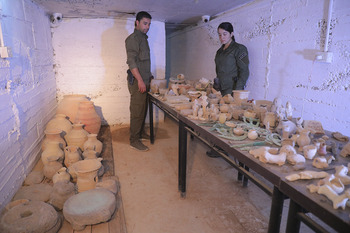
Despite their general lack of technical knowledge, some ANSAs have adopted measures, on a policy and/or practical level, to safeguard and respect cultural heritage in conformity with the obligation to prohibit, prevent, and put a stop to any form of theft, pillage, misappropriation, or vandalism. For example, in the Kurdish-populated areas of Syria, which are controlled by the People’s Protection Units (YPG)/Women’s Protection Units (YPJ), the de facto autonomous administration of Rojava has established an Antiquities Authority and, in 2015, passed an act on the protection of cultural heritage that prohibits destruction and damage of antiquities and archaeological sites and provides for sanctions in case of non-compliance. Footnote 45 There have been many cultural sites under YPG/YPJ control where looting has increased dramatically since the outbreak of the war. Footnote 46 The Asayish, the police force of the Rojava administration, has a special unit that deals with organized crime, including illicit trafficking and excavations, and it claims to have arrested 122 persons and confiscated many cultural objects (such as ancient statues, tablets, or coins, some dating back to 3,000 bc) (Figure 1). Footnote 47 It has also deployed mobile patrols to inspect the main archaeological sites. Similarly, the YPG/YPJ have reportedly issued a command order to respect cultural property, though in some cases they have established military positions in the vicinity of cultural sites. Footnote 48
Cultural artifacts guarded by the Asayish, the police force of the Rojava administration, in a special storage in Syria. Photograph courtesy of Geneva Call.

FSA brigade commanders interviewed in the context of Geneva Call’s study claimed to have taken measures to protect archaeological sites from plunder and theft, deploying guards to watch over sites in the areas under their control and to have arrested a gang involved in the theft of manuscripts in Aleppo. Footnote 49 Geneva Call conducted two pilot trainings on the protection of cultural heritage with FSA commanders in December 2015 and June 2017 in Geneva. Following the first one, one brigade reportedly increased the protection of the Umayyad Mosque of Aleppo, especially of its sundial, also protecting the Zachariah’s mausoleum with sandbags and bricks. Footnote 50 After learning that they could not use archaeological sites as military bases during their first pilot training, some FSA commanders, upon their return, began to raise awareness among the civilian population of the need to preserve Syrian heritage and gave advice on this subject to its chief of staff and his advisers. Footnote 51 In northern Iraq, the various militias active in Mount Sinjar have posted guards to protect Yazidi temples from attacks from the Islamic State group. Footnote 52 Several fighters of the Sinjar Resistance Units were reportedly killed in 2015 while defending the shrine of Sheikh Hassan in Gabara. Footnote 53
In Mali, the MNLA established a department in charge of culture, handcraft, and tourism, led by Ambéïry Ag Rhissa, which reportedly worked to raise awareness on the importance of protecting cultural heritage, including among MNLA fighters. Footnote 54 The group was also involved in the protection of the Tomb of Askia in Gao in 2012, when it was in control of the town. Footnote 55 In February 2013, during clashes with Islamist groups near Tessalit, the MNLA captured three boxes containing more than 1,000 ancient manuscripts. In a letter dated 22 March 2013, Ag Rhissa informed UNESCO about the seizure, providing a comprehensive list of the manuscripts and requesting support to return them to their owner (assumed to be the Ahmed Baba Institute of Higher Learning and Islamic Research in Timbuktu). Footnote 56 According to Ag Rhissa, the manuscripts were ultimately recovered and destroyed by Islamist groups. Footnote 57
This episode highlights one of the major deficiencies of the Hague Convention in non-international armed conflicts: the structural deficit that plays against the technical assistance of ANSAs. According to Article 19(3), UNESCO may offer its services to all parties in a non-international armed conflict, including ANSAs. Yet, while the state parties may directly call upon UNESCO “for technical assistance in organizing the protection of their cultural property, or in connexion with any other problem arising out of the application of the … Convention,” the Hague Convention does not envisage the same possibility for ANSAs. Footnote 58 The available means of communication between UNESCO and ANSAs is thus unidirectional, which is a problem in situations where ANSAs are in need of specialized advice or have requested assistance with regard to the protection of cultural property, which may be situated in the territory they control, as was the case with the ancient manuscripts in Mali. Similarly, the Rojava Antiquities Authority has reportedly tried to obtain technical support and equipment for conserving cultural and archeological sites, but their requests have remained unsuccessful to date.
In addition, lists of protected heritage or maps indicating their location are usually in the hands of the state’s central administration. This is the case in Syria where, at least during the first years of the conflict, the inventories of movable and immovable cultural property were housed in archives controlled by the Ministry of Culture. Footnote 59 While all parties to the conflict must respect cultural property, knowing its location is a prerequisite for this to happen. However, the Hague Convention does not envisage the exchange of relevant information between warring parties. ANSAs are thus at a disadvantage when it comes to specialized capacity and access to readily available information and risk-preparedness protocols, which the state armed forces may have put in place. Although Article 19(2) encourages all parties to a conflict “to bring into force, by means of special agreements, all or part of the other provisions of the present Convention,” to date there is no record of an agreement of this sort ever being made. Footnote 60
The Second Protocol was drafted to update and improve the Hague Convention, and, while it did so in many respects, it maintains the structural deficit described above. Footnote 61 According to Article 8(a) of the Second Protocol, ANSAs have a positive duty to remove, as far as possible, cultural property from the vicinity of military objectives in order to avoid its incidental damage. If this is not possible, ANSAs are requested to take in situ measures of protection to the maximum of their capacity. Nevertheless, the maximum extent feasible to which an ANSA may implement these precautions against the effect of hostilities may be compromised because only the state parties may call upon UNESCO for technical assistance. By contrast, it has been demonstrated that providing capacity building can yield very positive results. For example, the Smithsonian and other organizations trained heritage professionals in the use of sandbags and other in situ measures to safeguard ancient mosaics of the Ma’arra Museum in the Idlib Province, an area under the control of a Syrian ANSA. When the museum was bombarded by government forces in 2015 and 2016, most of the mosaics were left intact. Footnote 62
The attitude of ANSAs toward cultural heritage is more ambivalent when it comes to its use for military purposes, which could be a consequence of their lack of knowledge of legal standards. For example, the MNLA representative in Europe interviewed by Geneva Call suggested that the MNLA had used the French colonial fortress mentioned above because its location on the top of a hill amounted to a privileged military position and because it was unsure that the fortress constituted cultural heritage for the purposes of international law. He also admitted that the MNLA would attack cultural sites if there was no military alternative or if it was ignorant of its protected status. Footnote 63
During a Geneva Call meeting with FSA commanders, a commander, speaking for his own brigade in response to the question: “have your brigades used cultural sites in its military operations?” replied: “No, for example we have freed the Temple in the Harem District (within the Idlib Governorate), and now we protect and guard it. We have never occupied a historical site.” Footnote 64 However, with respect to the targeting of cultural sites used by the enemy, the response was more ambiguous:
As far as Aleppo is concerned, it is a sensitive situation as the whole city is a historical site where we are face-to-face with the regime to protect it. Because of its importance, we have refrained from attacking it. … The Citadel of Aleppo [a world heritage site] has been used as a shelter for the soldiers of the regime. The FSA has attacked the site in order to establish authority on it. If we go inside this area, the regime might then bombard the whole area. As we recognise this risk, we avoid going into the Citadel so that the regime does not use this as an excuse to destroy and kill us all. Footnote 65
At Geneva Call’s 2017 meeting, a FSA brigade commander recounted that, toward the end of 2012, the government armed forces had placed snipers in a castle in Harem (Idlib) that was situated on the top of a hill. The commander affirmed that they had no alternative than to attack it but that they did so giving advance warning and without using heavy artillery. Footnote 66
Granted, these statements must be placed in contrast with independent reports. Footnote 67 As mentioned earlier, “[t]he continuing armed conflict in Syria between the national armed forces and the Free Syrian Army (FSA) and the al-Nusra Front has also led to significant damage to, or destruction of, cultural heritage.” Footnote 68 For example, in 2013, insurgents were reported to have established their headquarters near Aleppo’s Old Souk, turning its old town into a battleground. Footnote 69 In 2014, the Umayyad Mosque in Aleppo was reportedly used by rebel snipers, which led to its shelling and eventual collapse. Footnote 70 However, caution must be applied in qualifying such use or attack as a violation of IHL because, in some circumstances, the use of cultural sites for military purposes may be justified by imperative military necessity, which could have been the case with Aleppo’s Old Souk or its Umayyad Mosque and Idlib Harem castle.
THE RESPONSE OF SPECIALIZED ORGANIZATIONS
It appears from interviews with specialized organizations that only a very few deal with ANSAs in order to strengthen the protection of cultural heritage in armed conflict. One example is the Smithsonian Institution’s Cultural Rescue Initiative, which has negotiated directly with ANSAs for access to heritage sites in opposition-controlled areas through its Safeguarding the Heritage of Syria and Iraq Project. Footnote 71 The Smithsonian, along with the US Committee of the Blue Shield, has also created a pocket training manual known as the Guide to Mosul Heritage, which has been distributed to the Kurdish Peshmerga, among other armed forces, before the recapture of the city. Footnote 72 However, the survey conducted among specialized organizations identified a paradoxical situation. On the one hand, well-established institutions whose mandate encompasses the protection of cultural heritage appear not to engage with ANSAs on this issue at present because of the restrictions within their mandate or political limitations. On the other hand, a number of newly-established organizations, some of them created as an ad hoc response to protect cultural heritage in current armed conflicts (in particular in Iraq and Syria), lack funding or other resources to carry out this mission.
Representing the first category, UNESCO has been caught in a dilemma. According to Article I(3) of its Constitution, UNESCO “is prohibited from intervening in matters which are essentially within the Member States’ domestic jurisdiction.” Establishing contact with ANSAs may be regarded as a breach of this obligation insofar as it may be considered recognition of their authority and legitimacy. By contrast, Article 19(3) of the Hague Convention grants UNESCO the possibility to “offer its services to the parties to the conflict” (meaning both state and non-state parties) in non-international armed conflicts. Moreover, Article 19(4) of the Convention expressly states that establishing contact with the parties “shall not affect the[ir] legal status.” No reservation was made by any state party regarding any of these provisions. Therefore, it may be argued that
establishing contact, in the framework of the 1954 Hague Convention, with a non-State actor during an armed conflict not of an international character involving one or several High Contracting Party(ies) [to the Convention] or taking place within the territory of one or several High Contracting Party(ies) cannot be considered as a violation of the principle of non-intervention in internal affairs. Footnote 73
Furthermore, Member States together with the Secretariat developed a Standard Plan of Action to Protect Cultural Property in the Event of Armed Conflict that explicitly states that one of the Secretariat’s possible actions is to “[e]stablish contacts with the warring parties (including States and ANSAs as applicable) and send letters to them signed by the Director-General regarding the protection of cultural property in the event of armed conflict.” Footnote 74 While this document has not been formally adopted by the state parties to the Convention, they have taken note of it. In practice, however, the situation is more complex since UNESCO has recently admitted that the “nature of contemporary conflicts … presents a challenge, as they often involve non-State actors, with whom intergovernmental organizations cannot establish relations.” Footnote 75
In the past, there have been two instances where UNESCO has decided to engage, out of its own initiative, with ANSAs for the benefit of cultural and natural heritage, respectively. In response to threats by the Taliban to destroy the Bâmiyan Buddhas in Afghanistan in 2001, the then director-general of UNESCO, Koïchiro Matsuura, made direct contact with Mullah Mohamed Omar, the leader of the Taliban, and subsequently appointed Ambassador Pierre Lafrance as special envoy to meet with Mullah Omar and dissuade him from destroying the site. Footnote 76 Likewise, in the context of the escalation of the conflict in the Democratic Republic of the Congo and the ensuing threat to the country’s five world heritage properties, the director of the World Heritage Centre undertook a mission there from 24 November to 3 December 2001, on the occasion of which he met with a number of stakeholders and “senior decision-makers, including leaders of the rebel administration in Goma, Beni and Bunia.” Footnote 77 In addition, in 2004, the World Heritage Committee “[r]equest[ed] the Director General of UNESCO to use UN and other appropriate diplomatic channels to influence high level SPLA [Sudan People’s Liberation Army] officials, urging them to put a halt to the poaching by their fighters as well as an immediate retreat of SPLA troops from the vicinity of the Garamba National Park.” Footnote 78 The following year, it “invite[d] the Director-General of UNESCO to use his good offices to sensitize all the parties concerned about the real risk to the outstanding universal value of Garamba National Park and to engage such parties in a dialogue leading to avoid the loss of such value.” Footnote 79 However, this sort of initiative does not represent standard procedure at UNESCO.
UNESCO is currently considering the possibility of establishing “safe havens” and “cultural protected zones” in conflict areas by means of Article 19(2) of the Hague Convention, which encourages the parties to the conflict to endeavor to bring into force, by means of special agreements, the other provisions of the Convention, including those concerning transport of cultural property (Articles 12 and 18). In addition, it acknowledges that, considering the current situation witnessed globally, with ANSAs being increasingly involved in major conflicts, solutions need to be identified, such as encouraging the ratification of the Hague Convention and the Second Protocol and developing “cooperation with entities such as Geneva Call, which works in promoting principles inspired from international humanitarian law along armed non-State actors.” Footnote 80
At the other end of the spectrum, Heritage for Peace represents the experience of newly-established organizations. Heritage for Peace is a NGO established in 2013 as a response to the conflict in Syria. Its main mission is to “support the Syrian heritage sector to safeguard their patrimony in any way they can.” Footnote 81 Its activities include providing training and capacity building to interested stakeholders in the effort to protect cultural heritage. This includes educating belligerent forces on their obligations to protect Syrian cultural heritage under international law. The NGO has conducted “train-the-trainer” courses in Turkey for members of the Syrian opposition—in particular, the so-called Interim Syrian Ministry of Culture (IMoC)—in 2014 and 2015. Through Heritage for Peace, the IMoC and the Syrian Directorate General of Antiquities and Museums attended a conference in Santander, Spain, in April 2014 that led to the Santander Declaration on the Protection of Syria’s Heritage. Footnote 82 Although the overall result of these trainings has been positive, the organization has faced certain difficulties such as funding, staffing-related issues, inability to establish a comprehensive needs assessment, logistical challenges, and so on. Footnote 83 Specialized organizations concerned with the protection of cultural heritage are thus not engaging with ANSAs on a systematic basis, while such cooperation could make a difference in practice to the level of protection afforded to cultural property in current armed conflicts.
KEY FINDINGS
-
1. Although ANSAs could be seen as being reluctant to accept the legitimacy of international rules protecting cultural heritage since they lack the legal capacity to negotiate international treaties or to become parties thereto, none of the ANSAs interviewed as part of the study expressed disagreement with these rules.
-
2. All of the interviewed ANSAs have an instinctively holistic understanding of the notion of “cultural heritage,” encompassing both a tangible and intangible dimension, but they are unaware of its definition under international law as well as the existence of the blue shield emblem.
-
3. All of the interviewed ANSAs admitted to a lack knowledge of the specificities of the various international legal rules protecting cultural heritage in armed conflict, having at best a basic awareness of the general rules of IHL, such as the principle of distinction, which merely demands not targeting civilian property.
-
4. All of the interviewed ANSAs expressed interest in obtaining training on the international legal framework protecting cultural heritage. The two pilot trainings conducted by Geneva Call with FSA brigade commanders further supported the idea that training would be of benefit to such groups given the number of practical and relevant questions posed by brigade commanders and the subsequent measures undertaken following the first training.
-
5. Many of the interviewed ANSAs have taken measures to safeguard and respect cultural heritage, including world heritage sites. However, their attitude remains ambivalent in some respects. For example, one group suggested having used a historical fort, which is part of cultural heritage, in a situation that did not appear to fall within the military necessity requirement as provided for in international law. Of course, this may be due to a lack of awareness of the international rules for the protection of cultural heritage.
-
6. Although they have some level of internal capacity, many ANSAs have expressed an interest to cooperate with specialized organizations and receive technical assistance for protecting cultural and archaeological sites.
-
7. The situation with specialized organizations remains a paradox: newly established organizations, such as Heritage for Peace, would be open to engage further with ANSAs but face structural capacity challenges, whereas well-established institutions that would have the resources to engage with ANSAs, such as UNESCO, face their own limitations.
-
8. ANSAs do not necessarily know about the existence of newly established NGOs concerned with the protection of cultural heritage and, instead, may try to approach UNESCO when they need advice or technical assistance. Some ANSAs have mentioned having tried getting in touch with specialized institutions, but their requests have remained unanswered. As a result, ANSAs do not know who to contact (successfully) to support their attempts at safeguarding cultural heritage.
CONCLUSION AND WAYS FORWARD
Most armed conflicts nowadays are non-international in character. ANSAs involved in such conflicts are active in (and sometimes even in control of) areas rich in cultural heritage, including world heritage sites. Insofar as cultural heritage is of importance for the whole of humanity, ensuring its preservation necessitates acknowledging the significant role that ANSAs play in this regard. This article has identified examples of both negative and positive practices, where ANSAs have destroyed cultural objects or, on the contrary, have taken measures to protect them. As demonstrated through the interviews conducted so far, there are two main obstacles that prevent ANSAs from protecting cultural heritage to the maximum extent feasible. First, all of the ANSAs that Geneva Call interviewed on this issue were unfamiliar with the international rules protecting cultural heritage in armed conflict, including the blue shield emblem. There is no need to amend these rules, but, rather, it is imperative to make them known and accessible to ANSAs.
Second, while ANSAs need training and capacity building, they often operate in isolation from organizations specialized in the protection of cultural heritage. In light of this, Geneva Call recommends the following ways forward:
-
1. Conduct sensitization and awareness-raising campaigns for both ANSAs and their constituencies, highlighting the significance of cultural heritage, its need for protection, and its key role of post-conflict recovery and reconciliation.
-
2. Clarify the obligations that are applicable to ANSAs through existing authorities, such as the supervisory bodies of the applicable conventions, the special rapporteur in the field of cultural rights, UNESCO, and other relevant organizations.
-
3. Provide training to ANSAs on the international legal framework for cultural heritage protection. Geneva Call has developed innovative dissemination tools (such as videos and booklets as well as an application quiz) as part of its public campaign “Fighter not Killer” Footnote 84 and is currently developing a training module on IHL rules related to cultural heritage specifically directed towards ANSAs.
-
4. Provide training to ANSA relevant authorities and heritage professionals operating in areas under their control on standards related to the preservation of cultural heritage, such as how to build an inventory, techniques of identification and protection from immediate dangers, standards of behavior with regard to the safeguarding of cultural heritage, and so on. This should be accompanied by technical assistance and capacity building so that such individuals can effectively implement these measures to protect cultural and archaeological sites and combat the illicit trafficking of cultural objects.
-
5. Encourage ANSAs to commit to safeguard and respect cultural heritage through the negotiation of special agreements (for example, on the establishment of “cultural protected zones” around heritage sites located in conflict areas); Footnote 85 the adoption of other measures (such as unilateral declarations, codes of conduct, command orders, bilateral agreements, and so on); and monitoring their implementation.
Even though the above ways forward are unlikely to influence those groups that deliberately attack cultural heritage, it should not overshadow the considerable room for improvement that exists with regard to ANSAs that do not follow the same policy and that show interest for its protection. As this article tries to show, some level of emergency heritage response is possible, even in times of war.