1. Introduction
In the post-Cold War and subsequent post-9/11 period, international security has been tense due to various inter- and intra-state conflicts as well as, for instance, low intensity conflicts. Therefore, the international community, including the UN, has demanded that foreign military troops be sent, for example, to fragile and failed states which were devastated by internal conflicts, terrorist attacks, or even natural disasters. In fact, the international community has advocated peace operations as a direct commitment – often of Western, developed, and democratic countries – to such weak and failed states. For example, such states created the concept of the Responsibility to Protect (R2P) in the sector of security. Likewise, the terms of ‘human security’ and ‘humanitarian intervention’ have become well-known and well-used concepts in peace operations. While a number of security-building operations have been deployed, they have faced various challenges. The encouragement of such operations led to a major problem, i.e. the overstretching of globally extended operations coupled with limited military capacity. In other words, the overstretching has resulted in the growing difficulty of finding troops for new missions. Against this backdrop, Japan, as one of the developed and democratic countries, has been asked to maximize the capacity of its SDF to overseas operations for international peace and security – despite the SDF ‘constraint’ to focus primarily on the national defense of Japan.
This article examines Japan's crisis management capabilities by focusing on SDF engagement in overseas operations with respect to UN peacekeeping, counter-terrorism, and disaster relief. UN peacekeeping operations have played a main role as a mechanism of conflict resolution since the 1950s. More recently, special attention has been paid to counter-terrorism or the so-called war on terror, especially in Iraq and Afghanistan in the post-9/11 period. This article initially focuses on the role of the SDF in UN peacekeeping operations, and on counter-terrorism operations in Afghanistan. Furthermore, as disaster relief operations are considered to have a large potential for humanitarian operations following the recent outbreaks of the devastating earthquakes and tsunami in the Sumatra Islands in 2004 and especially in Japan in 2011, it also deals with SDF response to disaster relief. First, the article explains the historical background of the demand for the SDF to dispatch to each operation. Second, it describes the legislative process leading to novel laws that enabled SDF dispatches to each operation. Third, it answers the following three key questions: (1) What is the main rationale for Japan to enhance the crisis management capabilities of the SDF in overseas operations? (2) What are the current obstacles to enhancing SDF crisis management capabilities in each case? (3) How could these challenges be tackled? Finally, this paper undertakes a comparative analysis of the three types of SDF operations, thereby providing a comprehensive assessment of Japan's crisis management capabilities. This article argues that the Japanese government as well as the SDF need to live up to these challenges in order to better position themselves to react quickly to crisis situations which require the dispatching of military forces.
2. Japan's crisis management capability towards UN peacekeeping operations
2.1. The history and challenges of Japan's contribution to UN peacekeeping operations
In 1952, before Japan joined the UN, Foreign Minister Katsuo Okazaki officially stated that Japan would fulfill all the obligations of a UN member by all the means at its disposal. Yet in June 1954, the House of Councilors passed a resolution not to allow the SDF to be dispatched abroad. Nevertheless, some legal scholars suggested that the SDF could participate in missions authorized by the UN, but the issue did not become a major topic of discussion in the diet.Footnote 1 Japan joined the UN in 1956. In 1965, Japan was elected as a non-permanent member of the UN Security Council. According to the Tokyo Shimbun, in Februaury 1966, the Ministry of Foreign Affairs drafted a UN Resolutions Cooperation Bill, which specifically mentioned personnel, including members of the SDF, as part of Japan's contribution to UN missions.
In 1982, the Japanese government submitted a resolution to the General Assembly that highlighted the need to strengthen the role and effectiveness of the UN in maintaining international peace and security. In response, the UN asked each member state to submit concrete proposals with opinions from institutes and specialists in order to strengthen the UN. The Japanese government formed an advisory panel chaired by a former UN Ambassador, including academics such as Sadako Ogata, Shigeru Kozai, and Hidejiro Kotani. The group's final report encouraged Japan's participation in UN peacekeeping operations.
With the winding down of the Cold War, the Ministry of Foreign Affairs sought to dispatch civilians to UN PKOs in order to avoid domestic political controversy. In 1988, Prime Minister Noboru Takeshita proposed the International Cooperation Initiative and identified five areas including UN peace operations in which Japan could play a role on the world stage.Footnote 2 In November 1989, the Director General of the Japan Defense Agency, Juro Matsumoto, stated in the diet that he was considering authorizing the use of troops for anti-terrorist operations, protecting Japanese nationals overseas, and international peacekeeping activities.Footnote 3
While Japan did not make any military contribution to the 1990–91 Gulf War, the Japanese government advanced its thinking on peacekeeping due to pressure from the US. In October 1990, the Japanese government submitted a UN Peace Cooperation Bill which would legally allow the SDF to be dispatched on UN missions. Japan made a huge financial contribution of $13 billion to the US-led international coalition in the Gulf. Nevertheless, Japan's ‘non-bloodshed’ policy received much criticism from the international community. In response to these pressures, a ‘PKO Bill’ was introduced in September 1991, which included the so-called ‘Five Principles’Footnote 4 for the participation of Japanese contingents in UN peacekeeping operations. These were:
1. Agreement on the ceasefire shall have been reached among the parties to the conflicts.
2. The parties to the conflict, including the territorial states, shall have given their consent to deployment of the peacekeeping force and Japan's participation in the force.
3. The peacekeeping force shall strictly maintain impartiality, not favoring any party in the conflict.
4. Should any of the above guideline requirements cease to satisfy the government of Japan, she may withdraw her contingent.
5. Use of weapons shall be limited to the minimum necessary to protect the lives of personnel, etc.
After much deliberation, the PKO Bill became law in June 1992. This International Peace Cooperation Law (the PKO Law) became the legal basis for SDF participation in all UN peacekeeping operations.
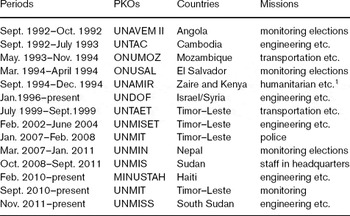
Table 1 shows the SDF dispatches to UN missions to date. One can see that all of the missions that the Japanese SDF engaged in have been logistical. This is due to the constitutional restraint which prohibits combatative operations by the SDF. However, it does not fit well with the reality of UN peacekeeping operations. Peacekeeping forces which are not legally permitted to engage in combat operations in emergency situations, such as the SDF, are not welcome in UN peacekeeping operations, where all of the forces should be unified in accordance with common Rules of Engagement. For example, when the SDF were working in Timor-Leste as an engineering and transportation unit in UNTAET and UNMISET in 1999 to 2004, they were unarmed and unprepared for combat in the areas viewed as security risks. For protection, they had to rely on the New Zealand battalions in Covalima, the Portuguese ones in Bobonaro and Dili, and the Koreans in Oecusse.Footnote 5 As a result, the Japanese SDF have not been much requested to deploy contingents to peacekeeping operations by the UN. For example, Japan's contribution to UN peacekeeping operations from July 2004 to February 2010 was token as the number of SDF personnel to UN peacekeeping had been less than 40.Footnote 6 Furthermore, it is to be noted that the Five Principles might enforce SDF personnel to withdraw from UN operations before completing the mandates depending on local conditions. In fact, according to Yomiuri Shimbun in December 2012, the Japanese government plans to make the decision to withdraw the transportation and engineering contingents of the SDF in UNDOF from the Golan Heights due to the deteriorating security situation caused by the internal conflicts in Syria.Footnote 7
Japan's contribution to UN peacekeeping operations

Note: 1Japan's contribution to UNAMIR can be categorized not as peacekeeping but as a humanitarian mission.
Source: International Peace Cooperation Headquarters (IPCHQ), Cabinet Office, www.pko.go.jp/PKO_J/data/other/pdf/data01.pdf.
2.2. The role of IPCHQ as policy-making body in UN peacekeeping
How is Japan's participation in UN peacekeeping operations decided? It is the dispatching states rather than the UN that show a keen interest in participating in UN peacekeeping operations. Contributing states are usually suggested by the UN Security Council, followed by the states’ own approval, and an official UN invitation. This formal invitation is based on prior informal discussions between UN officials and delegates from the member states.Footnote 8 In Japan's case, such discussions and negotiations are conducted between the UN and the International Peace Cooperation Headquarters (IPCHQ) in the Cabinet Office. If the IPCHQ confirms that the potential peacekeeping operation meets the conditions of the basic framework of the PKO Law, it forwards the proposal to the Chief Cabinet Secretary. Then, if the Secretary is convinced that the PKO proposal can expect political support from the Japanese diet and the public, he/she orders the dispatch of a fact-finding mission to the potential operational area. If the fact-finding mission confirms that Japanese SDF or civilian police can comply with the PKO Law and the Five Principles, it is passed on to the diet. While the Chief Cabinet Secretary requires diet approval, the IPCHQ drafts an implementation plan, which specifies the details of the tasks of the Japanese staff, the duration of the mission, and the types of equipment such as weapons used by them. Finally, the IPCHQ asks the UN to issue a formal request of Japan's dispatch to the UN peacekeeping operation. Then, after officially receiving this UN request, the Chief Cabinet Secretary will obtain approval of the implementation plan from within the cabinet. Finally, the SDF will be allowed to officially prepare for dispatch to the UN peacekeeping operation.Footnote 9 Thus, in Japan it is IPCHQ in the Cabinet Office rather than the Ministry for Foreign Affairs that plays a significant role in preparing the framework of peacekeeping policy. The IPCHQ is also in charge of recruiting civilian staff, including election monitors in UN peacekeeping, and is the key organization which plans the training programme of UN peacekeeping for the SDF and civilians. Thus, it is significant that Japan has a special office for UN peacekeeping, namely, IPCHQ, in the Cabinet Office.
2.3. The rationale behind the enhancement in Japan's crisis management capabilities in UN peacekeeping
The main rationale for enhancing Japan's crisis management capabilities in UN peacekeeping operations is political. For instance, as a PKO contributing country Japan gains international clout and is able to express its international policy more distinctively. Peacekeeping operations provide Japan with the opportunity to imbue its diplomacy with some prestige and identity as a positive actor on the international political stage. Japan's commitment to UN peacekeeping also broadens its diplomatic options on the international political stage. It is significant for Japan to have a more influential voice at the UN since it has maintained a ‘UN-centered policy’. At the same time, Japan's peacekeeping policy is also motivated by more pragmatic concerns. The Japanese government has been convinced that Japan's role as a positive contributor to UN peacekeeping would influence its bid for a permanent seat on the UN Security Council.Footnote 10 To this end, it has been referring to its SDF contributions in several UN peacekeeping operations as evidence of its qualification for permanent membership in the Council.Footnote 11
An additional rationale is related to Japan's own security concerns. Japan's geopolitical position is a significant factor in shaping Japanese attitudes towards UN peacekeeping operations. The political difficulties related to North Korea, Afghanistan, India–Pakistan, China–Taiwan, and the territorial disputes in the South China as well as East China Sea reveal Asia's position as one of the most potentially volatile areas in the world.Footnote 12 This is, for example, indicated by serious arms races, such as those between China, Japan, South Korea, Indonesia, India, and Australia.Footnote 13 In this context, the UN is seen as a potential dampener of regional instability and avenue for the peaceful resolution of disputes that could fundamentally threaten Japanese interests. The National Defense Program Guidelines, approved by the Japanese Cabinet on 17 December 2010, mention North Korean and Chinese military modernization as destabilizing factors to Japan's national security. The guidelines then stressed that ‘Japan will participate in international peace cooperation activities in a more efficient and effective manner.’Footnote 14 In Japan's view, regional stability is key to its economic and political interests and can be promoted through its participation in UN peacekeeping. This partly explains why Japan's major commitments to date have been to missions in its own region, in Cambodia and Timor-Leste.
There is also an institutional rationale. In fact, there are the benefits for the SDF. The Japanese SDF exerted high skill and expertise in their performance in UN peacekeeping operations. The writer's field research in United Nations Mission of Support in East Timor (UNMISET) in September 2003 provided evidence that the Japanese engineering units have obtained a high degree of skill and professionalism. Many SDF members achieved popularity with the Timorese public. One SDF officer also commented on the confidence-building effects of participation in UNMISET. He argued that the successful mission in Timor-Leste boosted SDF morale by providing the value of training in operational areas.Footnote 15
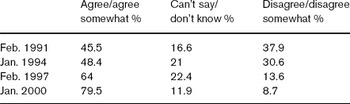
Furthermore, the rationale for improving Japan's crisis management capabilities in UN peacekeeping operations is related to the public support for the government. UN peacekeeping has been increasingly supported by public opinions in the 1990s and the early 2000s, as can be seen from Table 2. UN peacekeeping operations are evaluated positively by the public as they contribute to world peace.
Poll question asking respondents if they agree or disagree with SDF participation in future UN peacekeeping operations

Source: P. Midford, ‘Japanese Mass Opinion toward the War on Terrorism’, in R.D. Eldgridge and P. Midford (eds.), Japanese Public Opinion and the War on Terrorism (New York: Palgrave Macmillan, 2008), p. 28.
2.4. Strengthening Japan's crisis management capability in UN peacekeeping
How could Japan's crisis management capabilities for UN peacekeeping operations be further enhanced? First, legal reform is urgently required. The Five Principles of the PKO Law are not only outdated but also irrelevant to the current ambitions of the SDF in peacekeeping operations. They have even negatively influenced the SDF performance in the operational areas. As a result, former Minister of Foreign Affairs Seiji Maehara commented on the necessity of easing the regulations on the use of force by the SDF in overseas operations during his term in office. In June 2010, a report by the key members of the Japan Association for the United Nations Studies, also recommended that Japan create a permanent law to enable Japanese personnel participating in UN operations to conduct their missions more effectively.Footnote 16
Second, some researchers/observers suggest that the SDF should conduct joint peacekeeping training exercises with peacekeepers from other countries. Such training exercises would act as an incentive for SDF personnel and assure neighboring states that Japan's participation in UN peacekeeping is not related to militaristic objectives or neo-imperialism. In November 2009, Japan co-hosted ‘US–Japan Global Peace Operations Initiative Senior Mission Leaders Course (GPOI SML)’ with the US, at the Ministry of Foreign Affairs of Japan. The GPOI SML course was one of the action programs of Global Peace Operations Initiatives (GPOI), which was launched as the US contribution to the broader G8 Action Plan for Expanding Capability for Peace Support Operations, adopted at the 2004 G8 Sea Island Summit. The course participants, comprising of 26 military, police, and civilian personnel from 13 countriesFootnote 17 in the Asia-Pacific region, underwent training and discussions in the multiple tasksFootnote 18 of UN peacekeeping. This is important as an integrated approach among civilian, military, and police units continues to grow.Footnote 19 Moreover, in 2011, Japanese peacekeeping instructors from the SDF were teaching in training institutes in Mali, Egypt, Ghana, and Malaysia. The then Japanese Prime Minister Naoto Kan also announced that his government was studying new ways of increasing SDF peacekeeping contributions.Footnote 20
Third, the SDF should expand their logistical missions despite the revised PKO Law in 2001 which enabled the SDF to take over the main tasks of peacekeeping forces (PKF). This law does not suggest that Japan should completely shift its missions from logistical to military support, as the Department of Peacekeeping Operations (DPKO) at UN Headquarters has faced difficulty in securing logistical support from member states. In fact, logistical support requires a high level of training and skills in communication, engineering, and transportation – exactly what Japan has so far supplied for UN peacekeeping. The writer's field research in Timor-Leste in 2003 records that the Japanese SDF Engineer Unit in UNMISET gained a high reputation for their standard of skills.Footnote 21 Compared with military support missions, logistic missions are hardly likely to have problems with the use of force in their peacekeeping tasks. In this context, the case of China could be a good example and model for Japan's SDF. China has enhanced its reputation as an emerging UN peacekeeper, and dispatched 1,936 military and police personnel in October 2011, which ranked it 16th among all PKO-contributing member states. China has sent its military and police personnel to 12 UN peacekeeping operations in Africa, the Middle East, Asia, and Central America. Interestingly, all of the Chinese military contingents conduct logistic missions only.Footnote 22 Following the Chinese case, Japanese SDF should also be dispatched to UN peacekeeping operations as logistic units not only to Asia but also other regions such as the African continent.
Fourth, the SDF should enhance their rapid deployment cabability. In March 2007, the Ministry of Defence (MoD) decided to create the Central Readiness Force (CRF). The SDF personnel selected to join CRF receive the training necessary for their participation in UN peacekeeping operations. The CRF is the first program for the SDF to provide special education on international missions.Footnote 23 Furthermore, the Japanese SDF also started to participate in the UN Stand-by Arrangement System (UNSAS)Footnote 24 in July 2009. The SDF applied for Level 1 of UNSAS, requiring member states to submit a list of the type of tasks, and the duration and the size of the support the SDF can provide to UNSAS.Footnote 25
3. Japan's crisis management capability towards counter-terrorism in Afghanistan
3.1. The 9/11 terrorist attack and the establishment of the anti-terrorism law in 2001
The terrorist attacks in the US on 11 September 2001 had a huge impact on views of how to maintain international peace and security. On the day after the attacks, the UN Security Council unanimously adopted Resolution 1368 (2001), which called on member states ‘to work together urgently to bring to justice the perpetrators, organizers and sponsors of these terrorist attacks’.Footnote 26 On 28 September 2001, Resolution 1373 (2001) to combat international terrorism was also adopted unanimously. It provided a wide-ranging list of measures which all states are legally obliged to implement, such as preventing the financing of terrorist acts, preventing the movement of terrorists by effective border controls, and finding ways of intensifying and accelerating the exchange of operational information regarding the actions of terrorists and networks.Footnote 27
The day after the 9/11 terrorist attacks, Prime Minister Jun-ichiro Koizumi ordered his cabinet members to consider the possibility of dispatching the SDF for counter-terrorist activities in the near future.Footnote 28 In a press interview, he mentioned that Japan would fully support the US and not hesitate to provide the necessary assistance and cooperation to the international community.Footnote 29 The Director of the then ruling Liberal Democratic Party (LDP), Taku Yamazaki, said that it would be against Japan's national interests not to use the SDF for counter-terrorism measures.Footnote 30 On 23 September 2001, the Japanese government and the LDP agreed to create a new law to enable the SDF to join counter-terrorism operations. Thus, the prompt response to the 9/11 incidents indicated not only the government's strong desire to overcome the ‘trauma’ of the Gulf War in 1991, but also its commitment to contribute to the international community in this crisis.
The SDF Anti-terrorism Bill was passed on 29 October 2011 after exceptionally speedy deliberations in the diet. Koizumi contended that: ‘The focus of the legislation was whether we think of the terrorist incidents in New York and Washington on September 11 as other people's business or as our own affairs.’Footnote 31 This Anti-Terrorism Law covered such activities as providing supplies and services, including medical treatment to US forces and their allies. It also legalized search-and-rescue activities and humanitarian relief to refugees overseas with the consent of host governments. Public opinion polls reflected support for the enactment of the law. When asked whether they supported American preparations to use military force against terrorist organizations in Afghanistan in a Yomiuri Shimbun poll conducted between 24 and 25 September 2001, 44.1% of Japanese respondents supported such preparations while 26.7% opposed, with the remainder unable to decide one way or the other.Footnote 32
Also, the US expected Japan to play a diplomatic role and to provide intelligence. Most importantly, Washington wanted Tokyo to ‘show the Japanese flag’ or to play a physical role in the operational areas.Footnote 33 Eventually, the Anti-Terrorism Law legalized the dispatch of the SDF to the Indian Ocean to support US combat troops in Afghanistan with water and fuel supplies. It contrasted significantly with the PKO Law which was created after the heated debates in June 1992. Under the PKO Law, the SDF would be involved in operational areas where conflicts had ended, and the SDF would take a neutral position. The Anti-Terrorism Law put the SDF into volatile areas‐albeit limited to logistic missions‐and committed Japan to the ‘universal objectives’ of exterminating terrorists. Whereas the SDF were allowed to use weapons only for self-defense under the PKO Law, the Anti-Terrorism Law approved weapons use to protect those under SDF care, including refugees and wounded foreign service members. In order to add flexibility to current restrictions on the use of force, the law had a two-year time limit. Furthermore, the government was obliged to seek diet approval within days of a SDF dispatch.Footnote 34
3.2. The rationale behind and significance of enhancing Japan's crisis management capability in counter-terrorism
There are several rationales behind enhancing Japan's crisis management capabilities in counter-terrorism. The first rationale is political. Japan has close relations with the US. The maintenance of good diplomatic ties with its alliance partner has been regarded as central to Japanese international relations. However, strong bilateral relations with the US result in a large extent of vulnerability to the threat from international terrorists, especially from Muslim fundamentalists. For instance, Osama bin Laden named the major Western states and US allies as enemies of al-Qaeda. Moreover, after the Madrid train bombings in 2004,Footnote 35 the Abu hafs al-Masri Brigade, the Muslim fundamentalists responsible for the terrorist attacks, claimed that the next target could be Japan, amongst others.Footnote 36 Especially, in the case that the anti-terrorist security system in the US becomes too strict and tight for international terrorists to invade, it is plausible that its allies, including Japan, could be the next target for terrorist attacks.
The second rationale is related to security concerns. The threat from several international terrorists has been mounting. For instance, Bruce Riedel argues that al-Qaeda has regained more strength after suffering setbacks since 9/11. Today it conducts global operations.Footnote 37 Meanwhile, the prolonged turmoil in Afghanistan triggered a rise in other international terrorist organizations, for example in Pakistan. In short, the ever-present threat of international terrorism offers Japan a constant motivation to enhance its crisis management capabilities.
With regard to the significance of Japan's crisis management capabilities in counter-terrorism, the MoD promptly applied the Anti-Terrorism Law to the fueling mission in the Indian Ocean. On 9 November 2001, three fleets from the Maritime Self-Defense Force (MSDF), including an escort vessel, left for the Indian Ocean. These fleets were initially used for the fact-finding mission. After the Japanese government finalized the implementation outline for the MSDF dispatch, these fleets initiated their fueling activities to support US troops. On 25 November 2001, another three vessels left for Karachi, Pakistan, with relief supplies for Afghan refugees, and two of three fleets joined the fueling missions in the Indian Ocean in its aftermath. Thus, five MSDF corps in the Indian Ocean were the second largest contribution after the US missions. The MSDF mobilized 73 fleets and 13,300 personnel for this logistics mission. It supplied about 137 million gallons of fuel oil over more than 1,000 trips and some 2.8 gallons of water over about 200 trips. The Japanese government spent over $700 million in total on the mission in the Indian Ocean.
The MSDF was operating for the fleets conducting OEF-MIO (Operation Enduring Freedom-Maritime Interdiction Operation). OEF-MIO is the operation in the Indian Ocean to prevent and deter proliferation of terrorists and their related materials. The fueling mission as a floating supply depot in the Ocean required a high level of skill and technique, and therefore the number of fleets which can conduct the floating logistic mission was limited. Furthermore, as the war on terror in Afghanistan carried on, the number of the fleets participating in OEF-MIO was gradually decreasing. Thus, the Japanese fueling fleets staying in the Indian Ocean received positive evaluation and faced further positive expectations. It also contributed to the international recognition that the MSDF had a high level of operational capability and professionalism.Footnote 38
3.3. The end of the fueling missions in the Indian Ocean
In November 2007, the debate on Japan's policy towards the war on terror in Afghanistan became heated as a result of a paper written by Ichiro Ozawa, a major figure in the new Democratic Party of Japan (DPJ) until July 2012. In his paper ‘The Principles of International Security System Should be Created in Japan Now’ published by an intellectual monthly journal Sekai (‘world’ in Japanese) in November 2007, Ozawa criticized the US for launching the war on terror in Afghanistan without the authorization of the UN Security Council. He pointed out that the isolationism and excessive arrogance of the US had disturbed the harmony of the international community, including the UN. Therefore, he insisted that Japan, as a true ally of the US, should advise the US to behave properly as an important member of international society. He also criticized the policy of the then ruling LDP which claimed the use of force by the SDF in UN operations was unconstitutional, while it allowed the fueling missions in the Indian Ocean, a non-UN operation. Ozawa insisted that the fueling operation was equivalent to the use of force in the war on terror in Afghanistan, and therefore he opposed the presence of the SDF in the Indian Ocean as an oil supplier for the OEF.Footnote 39
The fueling missions of the SDF as a counter-terrorism strategy never achieved a full consensus from the Japanese political parties, especially not from the new coalition government led by DPJ from 2009 onwards. It was eventually terminated in January 2010 when the DPJ-led government allowed the Anti-Terrorism Law to expire. The decision was preceded by diminishing public support for the mission, as seen in opinion polls conducted by the Yomiuri Shimbun. In October 2001, 65% of respondents gave a ‘positive’ evaluation, and only 30% ‘not positive’. By September 2007, that had changed to 29% ‘positive’, 39% ‘not positive’, and 29% answering ‘none of the above’.Footnote 40
The expiry of the Anti-Terrorism Law and the withdrawal of the MSDF from the Indian Ocean resulted in a negative impact on Japan's policy towards international terrorism and its foreign policy generally. First, since more than 40 countries, including almost all major Western major powers, had joined ISAF, the termination of the MSDF fueling missions in the Indian Ocean was far from welcomed. The Economist in the title ‘Don't furl the flag, Japan’ wrote, ‘so, is this the Japan of old: self-absorbed, unashamed at leaving others to do the hard military tasks?’.Footnote 41
Second, the DPJ-led government decision to withdraw from the Indian Ocean influenced the Japan–US security alliance. Certainly, it was not compatible with US President Barack Obama's new anti-terrorism strategy shifting the focus of US military efforts from Iraq to Afghanistan. In fact, the US had been mounting pressure on Japan, requiring more contribution to the war on terror in Afghanistan. The US Ambassador to Japan, Thomas Schieffer, said if Afghanistan failed as a civil state and became a habitat for terrorists, all countries, including Japan, would be endangered.Footnote 42
Third, the withdrawal of the MSDF from the Indian Ocean marginalized the perspective on Japan's national economic interests. In other words, the presence of the MSDF in the Indian Ocean was in the national interest of Japan: 89% of the total national consumption of oil came from the Middle East, and transported it through the Indian Ocean to Japan.
Fourth, the declining interest of Japanese public in counter-terrorism in Afghanistan does not equal a declining exposure to the risk of terrorist attacks aimed at the Japanese. International terrorist attacks have continued all over the world, including the US, the UK, Spain, and Indonesia; and Japan could be no exception even if the Japanese public might feel more secure following the termination of the MSDF mission in the Indian Ocean.
3.4. Strengthening Japan's crisis management capability in counter-terrorism
Several suggestions for strengthening Japan's crisis management capability in counter-terrorism have been made. First, in 2011, the MoD advocated the Capacity-Building Assistance Project in Asia, aimed at supporting capacity-building efforts in the non-traditional security sector in developing countries in Asia. The Project is based on the recognition that global security problems in the so-called ‘non-traditional security sector’, including humanitarian assistance, emergency relief operations, mine-sweeping, and counter-terrorism and anti-piracy operations, should be tackled collectively by the international community. The MoD's Project hopes to contribute not only to Asian but also to global security. In other words, the Project seeks to foster regional stability by providing expert-training and technical assistance through dispatches of Japanese SDF personnel to the region. The outline of Japan's Defense Plan in 2010 also strongly supports regional capacity-building by utilizing the capability of the SDF in the non-traditional sector. In 2011, the MoD opened the special section for the Capacity-Building Assistance Project in the Department of International Policy, the Bureau of Defense Policy of the MoD.
Second, the Research Institute for Peace and Security, a think-tank in Japan, suggests that Japan should focus more on maritime interdiction operations. The Research Institute claims that when Japan dispatched the SDF to the oil-fueling mission in the Indian Ocean, it tended to narrowly consider Japan's policy for Afghanistan as Japan's entire anti-terrorism policy. Needless to say, the war on terror does not end in Afghanistan. In fact, attention has recently shifted from Afghanistan to the Horn of Africa. One of the most serious problems in Japan's counter-terrorism policy is the lack of consistency and continuity. Japan's strategically significant area is the sea line from South China Sea to the Indian Ocean and the Arabian Sea. Therefore, Japan should more consistently pursue maritime interdiction operations with other states sharing common interests with Japan.Footnote 43
Third, Japan should seek to establish a permanent law on counter-terrorism operations. The permanent law would enhance consistency in Japan's counter-terrorism policy. Furthermore, it would strengthen the legitimacy of the operations, offering a positive image to the Japanese public and heightening the pride and identity of the SDFFootnote 44 in operational areas.
4. A new focus: Japan's crisis management capability for disaster relief
4.1. The establishment of Japan Disaster Relief Law
Special attention has been paid to disaster relief operations in Japan since the devastating Tohoku Earthquake in East Japan on 11 March 2011. Japan's contribution to disaster relief operations after World War II began in the late 1970s. Many Cambodians were forced to take refuge in Thailand due to the internal conflicts in their country. While several European medical teams were rapidly dispatched to the Thai–Cambodian border, Japan was criticized internationally for its inaction. This prompted the Japanese government to eventually dispatch 13 medical teams for a period of three years.Footnote 45 In March 1982, the Japanese government furthermore established the Japan Medical Team for Disaster Relief (JMTDR) for the purpose of the rapid response of medical relief operations to overseas disasters on a large scale. Following JMTDR's missions in Ethiopia in 1984 and in Colombia in 1985, the Japanese diet passed the Japan Disaster Relief (JDR) Law on 26 August 1987. Accordingly, a JDR Team was established, which included not only medical teams but also other personnel such as rescue teams led by police and fire departments.
Subsequently, the JDR was dispatched to many countries, including Venezuela, Ethiopia, Sudan, China, Iran, Turkey, Saudi Arabia, Bangladesh, from 1987 to 1991. These experiences highlighted the need for larger-scale relief operations, a self-sufficient system in operations, and an improved transportation system. The lessons encouraged the government to review the JDR Law, leading to the Amendment to the Disaster Relief Law on 15 June 1992. The Amendment legalized the participation of the SDF in JDR. The division of labor was also made between the PKO Law and the Disaster Relief Law. The former would deal with refugees and disasters caused by wars and internal conflicts, and the latter would deal mainly with natural disasters. The Japan International Cooperation Agency (JICA) established the JDR Secretariat in April 1997.Footnote 46
4.2. The significance and constraints of SDF crisis management capabilities in disaster relief
The SDF JDR teams are dispatched only to large-scale disasters, where they perform such tasks as emergency aid and immunization and transportation of materials, patients and staff, as well as providing emergency supplies. The GSDF has the capacity for self-sufficiency during their disaster relief operations. Furthermore, it maintains forces on stand-by and can mobilize them within 48 hours following deployment orders.
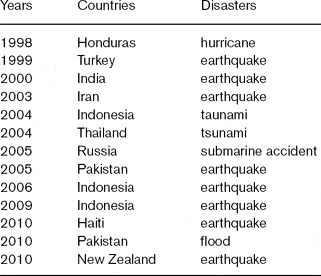
At the time of writing, Japanese SDF have dispatched 13 disaster relief teams since the legislation of the JDR Law in 1987 (Table 3), This number is not significant when compared to the frequent dispatches of medical teams (51 dispatches), specialist teams (40), and rescue teams (17).
The SDF contribution to disaster relief

Source: Y. Nakauchi, ‘The History of Japan's Disaster Relief and the Current Issues’, Legislation and Research, No. 323, December 2011, p. 8.
The SDF crisis management capability in disaster relief was improved following several major operations abroad and in Japan. In January 1995, the SDF were dispatched to Hyogo Prefecture to conduct the disaster relief operations after the Great Hanshin Earthquake. At that time, the SDF were severely criticized for failing to take action immediately. The reason for the slow response was that the dispatching of the SDF to a disaster area was only allowed at the request of governors or officials appointed by government ordinance, according to Article 83 of the SDF law.Footnote 47 Nevertheless, the troops’ efforts to save lives and clear debris following the earthquake improved the image of SDF to the Japanese public. A public opinion poll in July 1995 found that 90.2% of the respondents positively evaluated SDF achievements.Footnote 48 The experience fostered awareness about the necessity of training for disaster relief operations. Subsequently, the annual number of disaster prevention exercises by the SDF was increased to 400, nearly triple the number conducted before the Great Hanshin Earthquake.
Based on the lessons learned from the 1995 earthquake, the SDF were prepared to respond quickly after the Niigata Prefecture Chuetsu Earthquake in October 2004. Immediately after the earthquake in Niigata, the SDF mobilized about 2,700 members, 1,000 vehicles, and 80 aircrafts, which were significantly improved from the case of the Great Hanshin Earthquake when the first deployment consisted of a mere 150 SDF members.Footnote 49
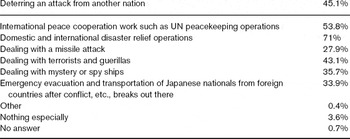
It is significant that disaster relief operations by the SDF are enthusiastically supported by the Japanese public. According to an opinion poll conducted by Yomiuri Shimbun in 2004, as much as 71% of the respondents answered that ‘Domestic and international disaster relief operations’ should be prioritized regarding the SDF participation in the future. This figure is higher than those answering ‘International peace cooperation work such as UN peacekeeping operations’ (53.8%), ‘dealing with terrorists and guerillas’ (43.1%), and even ‘[d]eterring an attack from another nation’ (45.1%) (Table 4).
Regarding the SDF operations in the future, what areas do you think it should prioritize? (multiple answers allowed)

Source: Yomiuri Shimbun, 3 June 2004. Quoted from P. Midford, ‘Japanese Mass Opinion toward the War on Terrorism’, in R. D. Eldgridge R. D. and Midford P (eds.), Japanese Public Opinion and the War on Terrorism (New York: Palgrave Macmillan, 2008), p. 28.
In January 2005, the SDF were dispatched to the tsunami relief operations at the Sumatra Islands, Indonesia. This was the first mission for the SDF jointly involving the three forces, namely the GSDF, the MSDF, and the ASDF. With about 1,000 personnel from the three forces, the mission was the largest international activity which Japan has undertaken, including UN peacekeeping operations. The Indonesian relief operation provided a good opportunity for the SDF to test their integrated administration and to assess the effectiveness of emergency drills and training.Footnote 50
In March 2011, the SDF mobilized an unprecedented 100,000 personnel to conduct rescue and relief activities in East Japan hit by the devastating earthquake and tsunami, as well as to keep the incidents at the Fukushima nuclear power plant from developing into a major disaster. In Fukushima especially, the SDF performed significant missions, including the work of spraying water over extremely dangerous nuclear reactors, reflecting the skills and training of the SDF.
What are the rationales behind Japan's pursuit of disaster relief operations? The first and main rationale is normative. Needless to say, disaster relief is a humanitarian operation, rescuing victims in emergency situations and providing them with first-aid treatments. Basically, such activities are based on humanitarianism, altruism, and liberalism. Likewise, Japan's policy on providing disaster relief abroad is based on the expectation of a ‘give-and-take’ effect. Japan, a country vulnerable to natural disasters such as typhoons, earthquakes, and tsunamis, expects to receive similar support and assistance from foreign countries when in need. In fact, this happened following the Tohoku Earthquake in March 2011, when Japan received a significant amount of finance and humanitarian support from foreign countries, some of which had received similar aid from the Japanese SDF before. Another rationale is related to security. Countries hit by natural disaster are sometimes vulnerable to occupation by external belligerents and terrorist groups. Therefore, disaster relief operations can play a role as a preventive measure from external intervention. Presumably, the Japanese dispatch of the SDF to Pakistan after a disastrous flood in 2010 can be understood based on his strategy.
Despite the significant contributions of the SDF, Japan's crisis management capability in disaster relief has several shortcomings. The first is the need to further improve rapid deployment, something which is a particular requirement in the case of a large-scale disaster. It is generally agreed that the maximum time limit for rescuing victims is 72 hours. When a huge earthquake occurred in Haiti in January 2010, the Japanese government was criticized for failing to dispatch rapidly and instead passively waited for the support request of the Haitian government. Subsequently, the Japanese government decided that future rescue deployments should be decided flexibly if the country hit by disaster cannot immediately request help.Footnote 51
The second shortcoming is SDF lack of equipment for disaster relief. This was clearly illustrated at the Tohoku Earthquake in March 2011. For example, the transportation of SDF from Hokkaido and other places to the disaster area had to be conducted using US military ships and Japanese civilian ferries, because the SDF ships were already engaged in the search for missing people and the transport of relief goods. Furthermore, the SDF had to rely on the US for an unmanned reconnaissance plane that could fly over the crisis-hit Fukushima nuclear plant. Since numerous scientists are predicting frequent large-scale disasters in Japan, the issue of the lack of equipment should be tackled immediately.Footnote 52
The third problem is on the legal restraints on the operational activities of the SDF. The SDF staff are prohibited from carrying arms, since the JDR Law does not allow any staff to be dispatched to the areas where weapons may be needed for self-defense. However, a devastating disaster can occur in a country with internal conflict. This was the case in the Aceh province of Indonesia, which was hit by a devastating earthquake and tsunami in 2004. Because there was an ongoing conflict between the Indonesia government and the Aceh independent movement, it was unclear whether Japan's dispatching of 900 SDF troops for disaster relief was legal under the JDR Law.
Furthermore, even if there appears to be no internal conflict in the disaster area initially, the security environment can deteriorate after the deployment of the SDF. This scenario happened in the case of SDF deployment to Pakistan after disastrous floods in 2010. The previous year, a suicide bomber had killed 12 people in the city where the Japanese troops were deployed. Due to the possibility of terrorist attacks, the SDF were prohibited from going out of their hotels at night. Reportedly, the Japanese government also declined a request from the Pakistani government to send the SDF to the north-western part of Pakistan, an area severely damaged by the flood, but with a particularly tense security enviornment.Footnote 53
4.3. The SDF disaster relief training to Southeast Asian countries
According to The Daily Yomiuri, the MoD plans to provide Southeast Asian nations with technical assistance in disaster relief, humanitarian support, and other forms of assistance. The assistance is aimed at improving security in Southeast Asia by sharing expertise acquired by the SDF through domestic and international disaster relief. About 30 million yen has been allocated in the fiscal budget for 2011 for the dispatch of SDF personnel to Southeast Asian nations. The MoD has received requests from Cambodia, Indonesia, and Vietnam for training. The National Defense Program Outline for fiscal year 2011 and beyond stipulated that the SDF expertise on disaster relief be used to promote cooperative relations with nations in the Asia-Pacific region.Footnote 54
5. Discussion and conclusion
This article examined Japan's crisis management capability towards three types of overseas operations by the SDF: UN peacekeeping, counter-terrorism, and disaster relief. The international community has requested that Japan participate in all three types of operations. Japan, as a member of the community, should fulfill its international responsibilities by dispatching the SDF.
First of all, when one considers Japan's crisis management capability in terms of overseas operations, the technical resources of the SDF are always highly appreciated. The skill and expertise of the SDF have won high reputation in almost all of the operations, including the mission to the Golan Heights and Timor-Leste as UN peacekeeping, the mission to the Indian Ocean as counter-terrorism, and disaster relief operations in Indonesia and Japan. The main limitation is not technical but legal. Japan's ‘peace’ constitution, including its Article 9, has imposed constraints on all of the three overseas operations by the SDF. In terms of UN peacekeeping, Japanese operations have so far been limited to logistics such as transportation and engineering. The reason is that the use of force by the SDF is still limited to self-defense due to the constitutional ban on collective defense and collective security. In reality, however, SDF personnel may easily face a situation where they need to rescue peacekeeping forces of foreign battalions from belligerent groups. As discussed above, precarious situations can also occur in disaster relief operations.
It is ironic that while Article 9 of the Japanese constitution was created to enhance the stability of Japanese security policy, it actually constrains the Japanese SDF contribution to international peace and security. Above all, it is the SDF staff themselves who are inconvenienced and feel isolated and ashamed about the limited tasks they may perform under the constitution. A review of Article 9 is urgently needed, since Japanese overseas operations by the SDF, especially UN peacekeeping and counter-terrorism, still trail behind when compared with missions of other developed countries. In this sense, the most significant issue in Japan's crisis management capability with regard to SDF dispatches is political. A lack of political will on this issue has been apparent, as politicians only engaged in minor amendments of laws. Japan's political debate has lacked in-depth consideration about revising the definition of collective defense and of Article 9 with a grand vision of how Japan can contribute to international peace and security.
Second, this article provided a comparative perspective on the three types of crisis management operations. When examining the commitment of the SDF to UN peacekeeping and counter-terrorism, there are several factors in common. The crisis management capabilities in the both types of operation were significantly improved due to historical events, namely the Gulf war in 1990–1991 for UN peacekeeping operations, and the 9/11 terrorists attacks in 2001 for counter-terrorism operations. Both of the operations were initiated after the passing of new laws, specifically the PKO Law in 1992 and the Anti-Terrorism Law in 2001. Both of the operations were decided under strong US pressure.
However, there are also several differences between the two types of missions. Seen as a necessary contribution to the global community, SDF participation in UN peacekeeping has long been advocated by Japanese society including the government, academic and legal experts, even since 1950s. Opinion polls demonstrate the public's widespread support for such missions. By contrast, Japan's counter-terrorism mission after the 9/11 attacks was not seen to have the same legitimacy as a UN operation. The Indian Ocean operation gradually lost support from the public and the DPJ government. While the PKO Law is a permanent one, the Anti-Terrorism Law was a temporary one, dealing only with the response to the 9/11 incidents. Therefore, it seems likely that Japan's crisis management capability towards UN peacekeeping will continue evolving, while counter-terrorism may receive less attention. With regard to UN peacekeeping, this article highlighted areas for further improvement, such as in the sectors of rapid capability and peacekeeping training.
The role of the SDF crisis management capability in disaster relief can be debated from different angles. For example, this article indicated that the main rationales behind enhancing Japan's crisis management capabilities in UN peacekeeping and counter-terrorism are political and security-related, while the main rationale for disaster relief is normative. On the one hand, it is JICA and not the SDF which has played a central role in disaster relief in Japan. Therefore, the SDF are not able to play the central role in all disaster relief missions in Japan. On the other hand, it is impressive that the SDF have been dispatched to a number of such operations since the passing of the JDR Law in 1987. SDF disaster relief operations have been consistently supported by the vast majority of Japanese public. This is due to the belief that the aims of such missions are humanitarian, not political. Given that SDF capabilities in disaster relief improved with recent operations in Kobe, Indonesia, Niigata, Haiti and Tohoku Japan, the demand for the SDF in disaster relief will be immense. However, the lack of sufficient equipment needs to be addressed. Furthermore, the question of using military force for self-defense in insecure disaster areas requires attention.
It must be noted that the SDF capabilities in the three types of operations cannot be enhanced independently of each other. In other words, the crisis management capabilities in UN peacekeeping, counter-terrorism, and disaster relief are interrelated. For instance, the successful completion of the counter-terrorism mission in the Indian Oceans significantly built on the SDF experience in the UN peacekeeping operations in Cambodia and the Golan Heights. Thus, the SDF can boost their general crisis management capabilities by participating in all kinds of international operations including UN peacekeeping, counter-terrorism, and disaster relief.
Third, the capacity of the SDF to manage several overseas operations simultaneously remains limited. As discussed above, in January 2005, the Japanese SDF experienced an overstretching of their dispatches to Indonesia, Iraq, Afghanistan, and the Golan Heights. One of the main reasons why Japan did not contribute much to UN peacekeeping operations in the mid-2000s was the strong commitment by the SDF to the oil-fueling missions in the Indian Ocean during the same period. It is no coincidence that in November 2011 the Japanese government decided to send several hundred SDF engineers to the UN peacekeeping operation in the newly independent state of South Sudan (UNMISS) following the termination of the fueling missions in January 2010.Footnote 55 The SDF should enhance their capacity to manage multiple overseas operations simultaneously.
A fourth issue concerns domestic politics. Differences between the DPJ and the LDP in their policies towards SDF crisis management have been apparent. There was a clear difference between both parties in their policy towards the counter-terrorism operation in the Indian Ocean. The fueling mission in the Indian Ocean, which was initiated by the LDP-led government, was completed in January 2010 when a newly replaced DPJ-led government allowed the Anti-Terrorism Law to expire. Meanwhile, both DPJ and LDP have been positive towards UN peacekeeping and disaster relief operations, because Japan has traditionally adopted the UN-centered policy and valued the concept of human security.Footnote 56 Regarding the amendment of the PKO Law to allow more freedom in the use of force in operational areas, the LDP has been more supportive than the DPJ. However, some hawkish members in the DPJ, including Prime Minister Noda, advocate the amendment of the PKO Law.Footnote 57 While differences between political parties towards international security policy is inevitable to some extent, a larger political consensus on the SDF overseas operations is desirable to ensure capability improvements.
To conclude, this article focused on the major overseas operations of the SDF in discussing crisis management capability, namely UN peacekeeping operations, counter-terrorism operations, and disaster relief. By highlighting strengths and weaknesses of the SDF in the three cases, this paper identified several issues to be tackled in order to further develop Japan's crisis management capability. The areas that need to be addressed are legal amendment, the enhancement of the capacity of the SDF, a larger political consensus, and further public understanding of overseas operations by the SDF.
About the author
Katsumi Ishizuka is professor in the Department of International Business Management at Kyoei University, Japan. He received an MA in International Relations in the Department of Politics at the University of Nottingham, England, in 1996. He received a Ph.D. in the Department of International Relations at University of Keele, England, in 2000. He was an associate research fellow at the University of Nottingham in 2000. He wrote several books including Ireland and International Peacekeeping Operations 1960−2000: A Study of Irish Motivation (London: Frank Cass, 2004), and The History of Peace-building in East Timor: The Issues of International Intervention (New Delhi: Cambridge University Press India, 2010).