Of the various media through which the late imperial Chinese order was manifested, perpetuated, and changed, material culture is the least understood. Moreover, because most of the texts, visual record, and surviving objects emanated from a relatively small number of people, their role in shaping this order has been correspondingly emphasized. Their material culture has received concentrated attention from scholars and appreciation from collectors, and are well represented in books, illustrations, and tourist sites. These now famous monuments and treasures are, furthermore, understood to have a shared character that allows them to be called “Chinese.”
It has been difficult for scholars to get beyond this supposedly recognizable Chinese order or to turn their attentions to the now vanished materiality of everyday life. Relevant evidence of the latter, such as it is, has been considered too late for Archaeology, too insignificant for History, and not good enough for Art. In this essay, so as to provide a broader and more unconventional framework for a study of late imperial material culture, I will set to one side the “things” of the empire-wide elites, and examine instead the non-luxury, regional materialities through which most people experienced the world.
When referring to the “elites” of the Ming and Qing periods (1368–1911), I am collapsing together people with demonstrably different if overlapping resources, powers, and tastes: the very wealthiest families and members of the imperial household especially, as well as representatives of the state, and those educated in the Confucian, Buddhist, and Daoist canonical texts. To insiders, these distinctions were essential in defining status, but toward the world at large, most elites had a vested interest in claiming a seemingly homogenous material culture. Some contrasts were acceptable—between the rich and the very rich, between north and south, between domestic and foreign—but twentieth-century nationalism has reinforced the commitment to a shared “Chinese” culture. Such differences obviously matter to scholars too, but for the purposes of this essay lumping will be more useful than splitting.
Familiar to us now, Ming and Qing elite culture was, at the time, the exclusive purview of a few, and known to most people only at a mediated distance. In the cities of the empire, the state was embodied openly in the parades of degree-holders and officials and in standardized architectural structures seen from the outside. In public places and private homes, actual and would-be elites claimed status through possessions (as well as manners, speech, and education). The expensive and diverse objects of their prestigious culture, however, were sold in exclusive shops or displayed inside walled off residences, visible only to servants and invited guests.
Non-elites were in part defined by their inability to acquire or appreciate such possessions. For them, the overwhelming majority of the population, daily life was shaped by and embodied in different material cultures, ones that, I will argue here, had distinctly regional characters. As I have tried to show elsewhere, temples constituted significant public spaces in villages, towns, and cities and, because they are researchable, I have used them as a point of entry into this non-elite material universe.Footnote 1
It is hardly a surprise that before recent times it was locally available materials that shaped ordinary life. Studies of vernacular architecture worldwide recognize that buildings were usually made from what was convenient and cheap: hide tents on grasslands, log cabins in deep forests, stone structures in mountains. In the history of late imperial Chinese culture, however, this kind of approach has not been seen as intellectually productive. “Local products” were usually framed in terms of specialty items prized by elites. The neglect of ordinary workers and artisans (gong 工, jiang 匠, marginalized as anonymous and unknowable) has further impeded the study of material history. “Pre-industrial” work that was dirty, dangerous, and out of sight has attracted interest when relevant to state procurement, and scholarship has been oriented toward certain ceramics, textiles, and metals.
This essay will explore the possibilities for a geographically based view of Ming and Qing material history: first, by arguing that such an approach is possible and demonstrating some answers to the problem of sources; and second, by raising for general consideration the relevance of regional materiality to history that focuses on the state and the elites. By learning about and paying attention to such regional materialities, not only will new areas of research be opened up, but we historians will also become better equipped to assess the Chinese culture that we think we know. I will concentrate on the geologically homogeneous region of the Greater North China Plain and focus on temple buildings, ritual vessels, and images of gods.
The Greater North China Plain
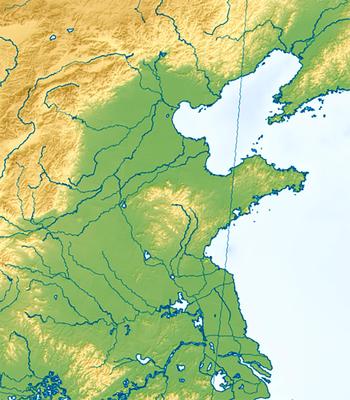
The flat fertile Great Plain, as nineteenth-century visitors called it, is the dominant geographical feature of northern China (see Figure 1). Created by the many rivers (not just the Yellow) that run across it eastward to the sea, surrounded by mountains on three sides, it has been settled for thousands of years. Its cultural centrality—expressed in the resonant term Zhong Yuan 中原, “Central Plain”—is deeply embedded in the written record, and the economic importance of its flatland agriculture has been continuous. During the Ming and Qing, the population of the Plain was ethnically and linguistically homogeneous by comparison with other parts of the empire.Footnote 2
The Greater North China Plain and its region.

Over the centuries, imperial regimes divided the Plain into different administrative units, while modern scholars have attempted to place it within various geographically determined systems of component regions, usually relying on similar soil, climate, and farm crops. G. William Skinner saw a “North China macroregion” that consisted of the Plain's densely settled economically active “core,” surrounded by a less populated mountainous “periphery.”
These and other approaches share a common bias toward agriculture, cities, and networks of communication. Of course, farming was fundamental to the survival of governments and to daily life, cities to elite culture and economic vitality, and communication to trade and integration. But these emphases, reinforced by the biases of historians and their sources, are not the whole story. Attention to geology and to artisanal production point instead toward the importance of the mountains. What I understand to be the Greater North China Plain region (hereafter, North China), therefore, considers the surrounding hills and mountains as economically and culturally essential.
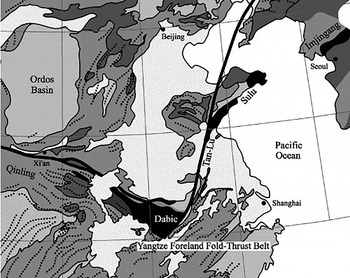
Geology is fundamental to a proper study of both the artisans and the raw materials that define material culture, national or regional. Some two hundred million years ago two huge, different, continental blocks collided to form much of modern China. The V-shaped line of their suture, today called the Tan-Lu fault,Footnote 4 marks a division between two distinct underground regimes, northern and southern, and is fundamental to their different soils, clays, rocks, and minerals (see Figure 2). Such geologically complex and valuable underground resources have made the mountains into storehouses of North China's wealth. For the Plain, these were accessible resources that shaped the material life of its residents.
Tectonic map of China, showing the V-shaped Tan-Lu fault.Footnote 3

There were many natural resources that this Greater North China Plain region lacked during Ming/Qing times. Gold and silver had been used up. Copper and tin, the crucial ingredients of the bronze that had once been plentifully manufactured here, had been long since mined out near the surface and converted into cultural objects. Geology had not provided jade or porcelain stone.Footnote 5 The climate limited the local plants and animals: only some bamboos, no lacquer trees, no elephant ivory. North China did have its own rougher and less sturdy counterparts of more durable southern materials. For furniture, there was elm, poplar, and willow rather than the hardwoods of warmer climates; for paper, reeds and hemp rather than paper-mulberry and bamboo; for fabrics, ramie, hemp, and cotton, rather than silks; for paints and varnishes, northern tree and plant resins and oils, rather than lacquer or tong-oil.
To add to this limited repertory, more expensive but desirable materials and products had to be imported, and were selectively available in higher-order cities and along the Grand Canal, as well as in a few major capitals just outside North China (Xi'an, Hankou, Nanjing). Beijing was the pre-eminent regional manufacturing center during the Ming and Qing because of its large concentrated demand for and supply of luxury items. The productive workshops of the Imperial Household were staffed by first-class artisans and provided with raw materials from all over the empire. Cities and towns were thus far from irrelevant to the shaping of North China's material culture, but they supplied the high-end products that were beyond the reach of most people. Such materials (porcelain, lacquer, silk, jade) could, however, still create powerful ideals precisely when they were unattainable.
Although most of the “Chinese art” that is housed in modern museums and for sale in the auction market was scarcely even visible to the North China villager and townsperson, the region did have its own resources, accumulated through geological and historical time, and turned to human use. Some were in the mountains, some on the flatlands.
The mountains that encircled the Plain housed coal, the fuel that powered the regional manufacturing economy. Coal of different types and quality was accessible by pre-modern technology in uplifted and folded hillside seams, and it provided the means for obtaining the high heat necessary to many processes. Once mined, and when possible converted to coke, it was shipped out by mule, camel, cart, or boat, and used in various forms from chunks to briquettes to combustible dust.
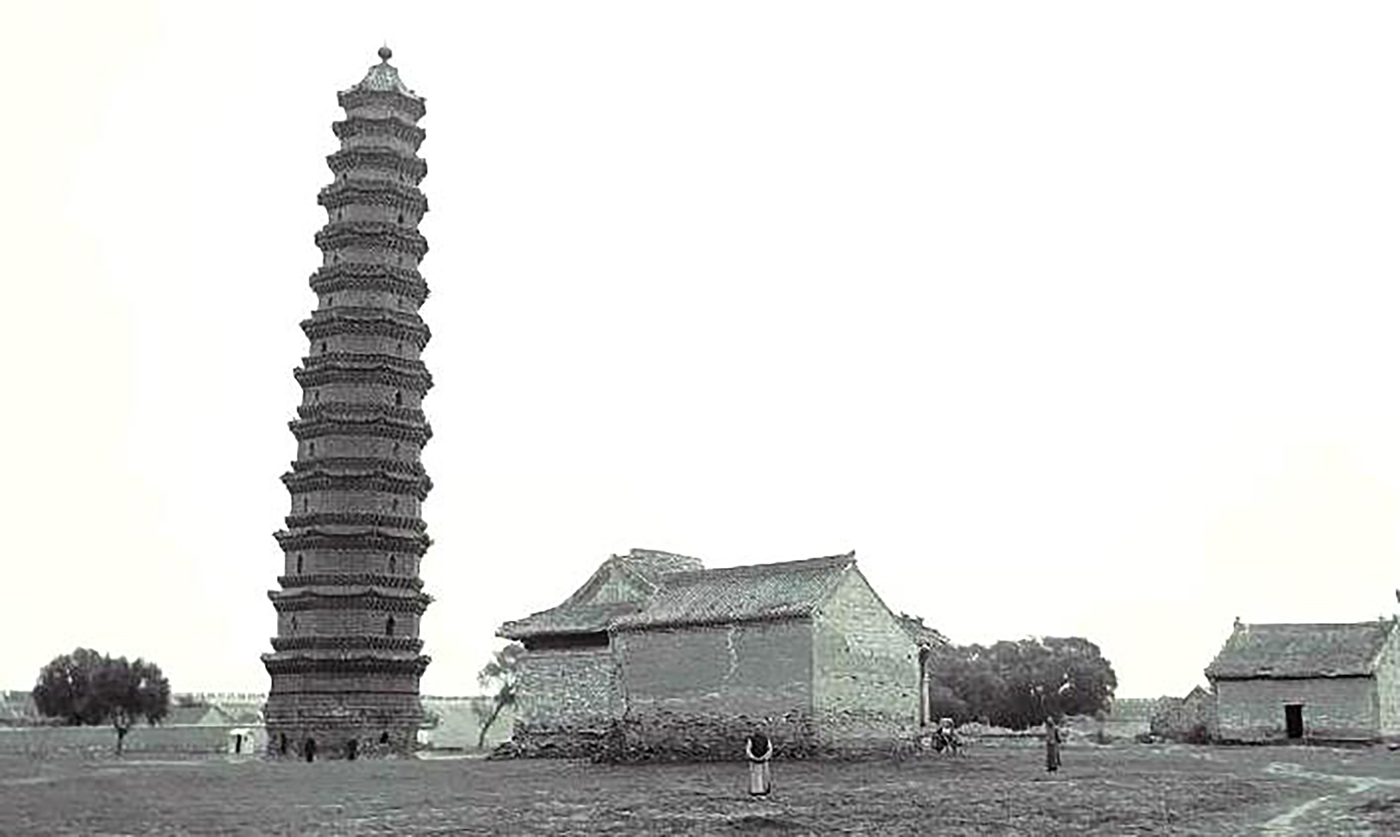
The availability of coal helped offset the lack of wood for making charcoal. Material regimes have their own histories, and since at least late medieval times, the densely and long-settled North China Plain had been progressively deforested, and so had its nearby mountains, leaving a stark and empty landscape. To make furniture or construct buildings, it was necessary to use small, fast-growing, softwood local trees, or else be rich enough to import hardwood logs from big trees in increasingly distant mountains. By mid-Qing times, the nearest old forests were in western Henan/southern Shaanxi (the Lao Lin 老林) or in the frontier Northeast. The everyday material culture of the Greater North China Plain was thus characterized by this paucity of wood and availability of coal (see Figure 3).
Temple buildings of earth, clay, and tile in an otherwise treeless landscape. Kaifeng (Henan), Youguo monastery 祐國寺, 1910.Footnote 6

In the hills and mountains there was also stone, mostly limestone (shihui shi 石灰石) laid down in the Carboniferous together with coal and iron. Limestone's uses were many, and over the centuries uncounted small hills that had dotted the Plain had been quarried out of existence. (This still ongoing process of what I like to call “de-mountainification” has yet to exhaust the supply.)
Limestone in its numerous varieties is reasonably workable, and blocks could be cut to many sizes and used to build houses and make objects of daily use. It could also be turned into lime (shihui 石灰) through heating in a brick kiln (fired by coal). The resultant powder was cheaper to transport and extremely versatile. A powerful binding agent and sealant, lime was used in all kinds of construction, but was also needed for the processing of iron, ceramics, paper, dyes, and leather.
Iron was part of this same geological complex. On the Shanxi (western) side of the Taihang mountains where it was actively mined, it was also smelted and then cast directly into small useful objects (nails, knives, woks, ploughshares, axels) that could be sold, or into iron ingots for re-use by artisans elsewhere. These products were carried on pack mules by the thousands east onto the Plain, especially via the town of Huolu 獲鹿, a major iron emporium on the north–south road between Beijing and the Yellow River.Footnote 7 The geologically more diverse mountains across the Plain, east of Mount Tai 泰山 and around modern Zibo 淄博, were in the Tan-Lu fault zone, and held not only coal and iron, but also earthen ingredients for glass and special glazes.Footnote 8
Because it was efficient for industries to be located near the sources of their raw materials, mountains attracted workers. Villages of skilled specialists who mined, quarried, cut, heated, smelted, and cast coal, metal, and stone dotted the foothills. The residents of the Plain were their customers, and were dependent on this productive connection for essentials. We can see this relationship in microcosm at the Ming/Qing Northern Capital. For the city of Beijing in general and the Imperial Household in particular, the hills and mountains just to the west were its industrial park, the convenient source of stone, clay, iron, and coal, and the location of the workshops that mined and processed them.
Rather than being culturally peripheral and non-productive zones, the mountain foothills thus actually had wealth and manufacturing power that can make the Plain seem impoverished by comparison.Footnote 9 The merchant distributors travelled to the productive centers to get goods and processed materials, and then fanned back out to sell these wares all over the North and beyond.
And yet the North China Plain also had its own riches, and they too lay underfoot: in the earth that constituted the plain itself. The suitability of the soil for agriculture (enriched with regular organic waste and periodic flood waters) has been often noted, but clays (ni 泥) of many types were equally important. They were a seemingly limitless reservoir for many basics of material life, buildings and utensils especially. Ceramic jars of all sizes and shapes were necessary to each household and to a host of processing industries, and bricks and tiles substituted everywhere for wood and stone in construction and interior decoration. A few centers exported bricks (e.g. Linqing 臨清 on the Canal), but knowledge of earths and clays and their many uses was as widespread on the Great Plain as the omnipresent materials themselves.
The material culture of the residents of the Greater North China Plain region thus had its own specific characteristics. Yellow-earth clay and bricks were its basics, with coal, limestone, and iron from nearby mountains as distinctive and essential industrial products. We can see the visible manifestations of this ensemble by examining the religious buildings that were everywhere in the region, from mountain foothills to villages to town and cities.
Temple Buildings
Most homes on the North China Plain were made of mud-and-wattle or sun-dried bricks, sealed with lime whitewash, and covered with thatch. The better-off had kiln-fired bricks for walls and fired tiles for roofs. Wood was kept to a minimum. Although such dwellings were not very sturdy, commonplace construction knowledge made damage and repairs easy to fix. Making bricks was straightforward and could be done in the off-season: dig up earth from a pit, shape it in molds, let the bricks dry in the sun or fire them in a kiln built on the spot.
Temples, essential to every community, were expected to endure, and therefore they needed a stronger structure and, ideally, suitable lumber.Footnote 10 Shaped by the desire for a respectable cultural heritage for modern China, and influenced by buildings that were prestigious in the past, our ideas today about the typical Chinese temple have been based on large, surviving, richly endowed buildings characterized by large-timber frames, bracket-held overhanging tile roofs, and multiple wall-enclosed halls and courtyards.Footnote 11 An examination of historical drawings and photographs, and even new buildings of the 1980s and 90s, makes clear that most temples in North China were a long way from this architectural ideal.
Lacking large strong straight timbers for the columns and beams, shorter spindly wood had to substitute. When stone was nearby, carved stone columns stood in for wooden ones. In many if not most cases, genuinely load-bearing brick walls, with a small front-door opening, shared with the columns the work of holding up the roof. Well carved clay could adorn the lintel and imitate bracket-sets. Coats of varnish and paint protected vulnerable exposed wood, while ornamented stone bases stood between the columns and the damp earth. To add distinctiveness and protect against routine flooding, the temple could be constructed on a raised stamped-earth terrace faced with brick or stone. In mountain foothills, small temples (like houses) could be made entirely of rocks and stone slabs.
Most of these religious structures were far smaller than today's tourist sites would lead us to believe, but each stage of construction was done with the idea that later, as the god's power became better known and more resources were available, expansion and improvements (xiu 修) could take place.Footnote 12 To a single stand-alone hall an enclosing wall could be added, and a proper gate, then the hall enlarged, side halls added, a second (and third) hall and courtyard built, and so forth. Elite or imperial ideals were exemplified in the relatively few large and rich temples or monasteries that could be found in most counties. Materials from earlier incarnations could be salvaged for rebuilding after fires, floods, and routine weather damage, but such projects could still stretch over many years, especially in poorer areas. Big jobs taxed the resources of even the wealthy and were more likely to be undertaken in commercial towns and cities—provincial capitals and Grand Canal nodes especially—where imported timber might be obtained.
Finding raw materials that matched the high standards of the national elite could challenge even emperors. In the 1410s when the Yongle emperor was rebuilding the Daoist complex at Wudangshan 武當山, in the mountains of northern Hubei, the timbers for these large structures had to be purchased further south, at the Yangtze entrepot of Hankou.Footnote 13 In 1678, when the Qing throne sponsored a thorough rebuilding of the Daimiao 岱廟 at Mount Tai in Shandong, the official in charge also went south to shop, starting in Nanjing and going down river to buy fir-tree (shamu 杉木) lumber (which was shipped north as rafts), tong-oil, and mineral paint ingredients. He had to purchase lead from Shanxi so that, using kilns built on-the-spot near Taishan, he could make the brightly colored lead-glazes—a Shanxi specialty—for the special rooftiles that were like those that adorned the palaces in Beijing. Other ingredients and workers were local.Footnote 14 In 1771, for another rebuilding at Mount Tai, the Qianlong emperor had fine southern Nanmu 楠木 lumber sent down to Shandong from leftovers previously imported from afar for his suburban palaces near Beijing.Footnote 15
What was difficult for emperors could be impossible for others. Temples like those at Mounts Tai and Wudang set standards that pilgrims could admire and be inspired by, but such expensive imported resources were not an option for most people. It was the modest, familiar brick and stone culture of the region that defined what local temples looked like. Inside and outside.
Inside
A North China temple hall required few furnishings. An altar, a god-image, and a few ritual vessels were the only essentials. Petitioners stood or knelt, but did not sit. Ceilings were usually unfinished, but the exposed beams (such as they were) might be painted; the walls were whitewashed and sometimes adorned with murals. Columns might break up the empty space. Given the climate, windows tended to be few and placed along the south-facing front. Floors were brick or packed earth.
The ritual space was located along the back wall facing the door. In lieu of a table, a chest-high brick-and-clay ledge was often built there (and sometimes along the side walls) as a shelf for the images of gods.Footnote 16 Ideally a canopy of some sort would define a niche for the central image. It could consist of merely a simple, locally woven, dyed fabric hung above or behind, but where and when skilled carpenters were available a carved frame (of local woods) added dignity. A mural or a screen set behind the god could further enhance the ambiance, as could banners hanging from the rafters. I think we should imagine such arrangements as exemplifying no more than the best that local craftsmen and women could do.
A brick or wood altar table was set in front of the god for the ritual vessels (jiqi 祭器): an incense burner (xianglu 香爐), if possible flanked with a pair of flower vases and/or a pair of candlesticks (making up what were formally called sangong 三供 or wugong 五供). The danger of fire encouraged the use of only narrow incense sticks that burned without a flame, placed in non-flammable burners. (Large burners were outside.) The candles themselves were sealed and not lit. Food items and other offerings were brought and taken away by petitioners.
Chinese had been casting iron for thousands of years and, because of the large supplies of both ore and coal in the Taihang mountains, iron had become an affordable and characteristic component of North China's material culture. (In Shanxi, iron was even more common, and cast in large and complex forms. See below.) With a high melting point, cast iron was safe for incense burners, and even more popular in the form of the round empty chime-bowls (qing 磬) (20–40 cm across) that were common on North China temple altars. Like much more expensive bells, their sound when struck could signal the god that a donation had been made.Footnote 17
In the prestigious world of the emperor and, ideally, in the county-level temples of the state cult (of which there were a dozen or so per county), the preferred material for essential offering vessels was bronze, made in shapes drawn from “antiquity.”Footnote 18 But Ming and Qing magistrates who were interested in such matters were often horrified when they arrived at their North China posts and surveyed the ritual vessels in the Confucian temple—which should have been the best in their jurisdiction. Even there, bronze was rare, many objects were broken, and few sets were complete.Footnote 19
The challenge for ordinary community-funded temples was even greater than those faced by magistrates. Their patrons seem to have settled for vessels of hollowed out stone, cast iron, or fired earthenware (and in the late Qing, pewter and tin). The ceramics were at best locally made or imitations of the prestigious blue-and-white ware from Jingdezhen. Without a rich patron, even a single bronze incense burner was unlikely. We should not expect that the objects for an altar, donated at different times, were of the same sizes, styles, or materials. Such considerations were a luxury in a culture where piecemeal upgrades were the norm.
Images of gods for the altar were the object of even greater concern when a temple was built or renovated. The Ming/Qing statues of gods that we see in museums and the marketplace today are nearly all bronze, wood, or lacquer. Those that populated the temples of North China in that era were, by contrast, nearly all clay.Footnote 21 Few have survived except in situ or in photographs, but the readiness with which such statues were made locally in the 1990s to fill the temples that were then coming back to life reflected the ubiquitous survival of the technology.
North China's gods were not sculpted in the Western sense of the word. Using a technology already known before the Ming, they were shells built up around a core of lighter materials of which clay was only one ingredient, making them “stuffed” (tuotai 脫胎, nitai 泥胎, as modern Chinese has it) rather than solid. Skilled workmen were needed but the materials were not exotic, and such figures could be made (su 塑) life-sized or larger and built on-the-spot inside a temple hall.Footnote 22
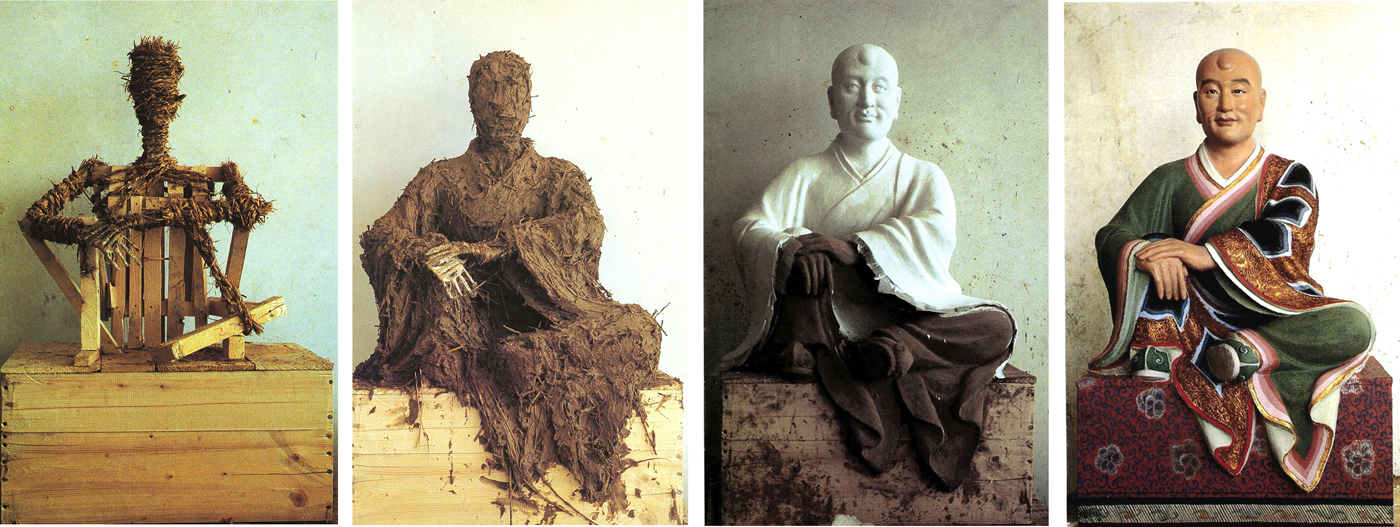
The specialist began with pieces of ordinary wood, nailed together to make a simple stick figure that would serve as the sturdy armature for the body, head, arms, and legs (see Figure 4). Common straw was then bundled and wrapped around this skeletal rack as its musculature. These light, well dried materials were then covered with layers of “clay.” First, a coarse mixture of earth, sand, and chopped up grasses was packed around the straw core, giving the body shape and substance. The next layer covered the roughness with a more substantial and finer combination of earth and millet husks that provided more precise contours. The visible parts of the face, body, limbs, clothing, and accouterments that needed to be carefully delineated were then defined with fine clay mixed with pulp paper. Then, a layer of fabric or paper was carefully laid down, smooth and tight over the entire figure; it was brushed with a protective alum-solution sealant and sanded down to make the surface even. The points of jointure were covered over and hidden by these final layers. The distinctions of hands, facial features, fabric, and so forth could then be drawn on this surface, and then fine white plaster applied as a basis for the careful application of paint, gilding, or a lacquer-like resin.
Making a clay statue.Footnote 20

This technology allowed the addition of arms or legs in outstretched positions, of elaborate flowing robes and free-standing ribbons, of ornate headdresses, of strangely shaped objects held by the god. These were created by attaching a similarly coated, stiffened fabric that would dry and be painted in place.Footnote 23 Special care would be given to the head, the most important focus for the viewer's attention, especially the eyes, with their dark iris, white sclera, and pupils that were dotted in to bring the image to life.
In general, clay statues had a life-like appearance and a three-dimensional immediacy. Their vibrant shapes were more difficult to execute in wood or metal and nearly impossible in stone. Given the needs of the tens of thousands of temples that filled out the North China countryside in the course of the Ming and Qing, it seems likely that artisan specialists in clay could be found in most towns. But different earths and different skills meant that the statues were not the same everywhere on the Plain, and even neighboring workshops made distinctive faces and hands. In the expectation of improvements at a later date, some statues began as no more than raw clay shaped and left to dry and crack, unpainted, covered with a loose fabric cape. In poor areas west of Beijing, statues were brown and muddy, while in the mountains of central Shandong along the Tan-Lu fault, enriched by southern resources, they were white faced and brightly colored.Footnote 24
The walls inside temple halls were sometimes also decorated with murals. These were another feature of the North, another clay technology, once common on the Plain.Footnote 25 Painting the interior brick-wall surface was not so different from completing the outer layers of a clay statue, and involved similar layers of straw, fabric, sealants, and glue combined with increasingly fine clay on which the actual painting was drawn and painted. The famous monastery murals admired by art historians (Yonglegong 永樂宮; Fahaisi 法海寺) are comparatively large, well executed, and made with high quality ingredients. In the far more normal single-hall temples, local artisans worked with inexpensive materials and a more restricted palate. Nonetheless, the effect was to brighten the dark room and bring the freely rendered gods right into the temple.
Clay was the cheapest option for temple statues, but not the only one. For niches and shrines carved into a cliff-side, existing stone was a natural choice, and free-standing statues could be (and were) carved from exposed marble and limestone in hills and mountains. By late imperial times, however, stone figures tended to be small, compact, crudely carved, and painted in order to help them achieve the liveliness of the clay ones. They were made from cut blocks by stone-mason workshops near the quarries or on well-travelled roads but because of their weight may not have travelled far. On the Plain, near rivers, where softer sandstone lay, it could be carved into less durable god-statues.
For other materials, especially iron, the North China Plain was particularly dependent on the Taihang mountains. “Iron Buddha” temples (Tiefosi 鐵佛寺) were not uncommon, especially in the foothills in Hebei and Henan, and iron statues of gods have survived into modern times. Manufacture of these hollow images relied on a complex combination of metal and clay technologies of casting and assembly, but could be done by specialists in the workshops that also produced small useful objects. Completed statues were heavy but sturdy.Footnote 26
Expensive bronze statues of gods from North China, which are the ones that have been most plentifully collected, were a special case, and a point of intersection between elite tastes and resources and those of the region. By mid-Ming the key ingredients of bronze were copper and zinc (which was increasingly replacing tin in the alloy). These ores were no longer local, but market access and availability made a small god-image a gift that a group or a middling sort of person might be able to sponsor.
Some metals (copper, lead, zinc) seem to have been available in the mountains south of the provincial capital in Xi'an (at the western border of the Greater Plain), but as the mines of the far Southwest were developed in the Qing, expanded supplies were shipped north, along the Yangtze and up the Grand Canal (to be used especially for coinage), making Hankou, Nanjing, the Canal cities, and Beijing into places where the metal could be purchased on the open market.Footnote 27 As a result, large bronze statues were made in the Imperial Household in the capital, and medium-sized ones (around 30 cm high) could be commissioned by private individuals, all as gifts for those temples that were fortunate enough to number such donors among their patrons.
For many new or small temples—or for a new hall in an existing one—a life-sized image in any medium was initially too expensive. A starter god-image was more likely to be a painting by a local person, executed on a rough locally made fabric, and hung on the rear wall. Even more humble was a woodblock print of a deity. These were plentiful in North China, cheaply printed on thin, inexpensive, locally made paper, and normally intended for one year's use in the home. If prayers made before such images were answered, simply-made pictures would be upgraded from paper to fabric to clay, and perhaps to iron or bronze.
Outside
In addition to halls of worship, other architectural and decorative features were built or added to temples as community resources permitted. Their material base was likewise regional. Enclosing walls that formed courtyards were made of compressed earth and/or brick (in ceramic-producing areas, sappers, and kiln refuse) and faced with clay. In some larger Ming era temples in North China, a raised terrace-platform (lutai 露台, xiandian 獻殿) was sometimes built, extending out from the front of the main hall. Covered or not, it could be used for community rituals performed by hired clerics. More common was a small, separate, usually two-story, stage (xilou 戲樓), placed so as to face the main hall within sight of the gods. These all used local construction materials.
A proper temple had bell and drum towers (zhonglou 鐘樓, gulou 鼓樓). The first step was to acquire a bell that could hang on a wooden rack inside the hall or outside under the eaves (if the building was large enough to have eaves). It might later be placed on a low, open, but covered platform and, if funds ever permitted, moved along with a drum to a pair of expensive two-story brick “towers.” Bronze bells gave off a good sound and were, because of their expense, more prestigious and dependent on wealthy donors.
Iron bells were far more common in North China. The metal came (in smelted units of a few kilos) from the mountain foothills near the coal and the iron mines. These manageable ingots were then cast locally in pits. Bells ranged in size from some 80 cm up to 150 or more and could weigh many hundreds of kilograms.Footnote 28 Chinese white-cast iron was hard and impervious to rust, and it was thus long lasting and an excellent investment.Footnote 29 The sound was more Clang than Bong, but adequately loud. Flagpoles (qigan 棋杆) announcing the temple's presence to an audience beyond the walls were a similar but less common iron ornamentation, an improvement on wood: manageable lengths of hollow tapered cast-iron tubes were fitted together to make poles several meters high.
These same casting processes, and perhaps the same town or city-based iron-worker firms, also made the large burners for incinerating incense and paper money that usually stood in the center of a temple courtyard or even safely outside the surrounding wall. Fire was an ever-present danger. If painted wood or columns covered with hanging fabric should catch fire, altar tables, columns, or roof frame could go up in flames and the whole building be brought down. A temple that received hundreds or thousands of pilgrims on the god's birthday was at even greater risk, so its burners were ideally even bigger and more isolated. Large ceramic or iron vats (gang 缸) filled with water, another gift that could be made to upgrade a temple, might stand ready for use. (Sturdy and watertight, glazed earthenware vats and jars, most a gleaming black, were another regional product of great versatility.)
Stone stelae (shibei 石碑) placed in a temple courtyard recorded the history of the building and its donors. Because many have survived and their texts are of interest to historians, we probably exaggerate the ubiquity of these monuments. Where there was limestone (or granite) or a rich donor willing to pay to import the stone, stelae could be numerous, but most temples did not have one.Footnote 30
If the community could afford it, a pair of carved stone lions or a free-standing ceramic or brick screen-wall (zhaobi 照壁, yingbi 影壁) were set up outside the front gate. Such additions were luxuries, and they may have had to be made by specialists from the county town, not because the materials were hard to find but because the demand was infrequent.
Clay, stone, iron. Ordinary life all across the North China Plain was dependent on the people who knew how to obtain and process and transform these materials, and these primary producers lived near their resources at or near the foothills of mountains. There, they did the hard work of transforming raw materials into forms in which they could be taken away and processed—sometimes finished products, sometimes intermediary stages that would be subject to further transformation further along the commodity chains. The iron and coal miners, the metal casters, the quarry men, the stone masons, the lime burners, the mold- and glaze-makers. Their work was dangerous, involving heavy objects, high temperatures, and polluting and poisonous fumes, so it is not surprising that communities dedicated to such work might be well off the main roads—and out of the sight of the well-to-do. But this spatial marginality does not mean we should ignore such artisans or assume that mountains were economic peripheries in late imperial times. Their foothills and lower reaches were quite the opposite.
Toward Some Wider Questions
I have argued here that the material world of ordinary people was strongly shaped by local craftsmen using distinctive, locally available resources, and that the Greater North China Plain can be identified as a coherent region in these terms. If correct, I see no reason why the related issues of method and perspective raised here should be limited to one place or one time. “Chinese” environmental history makes better sense as different local stories, and the further we are from the present, the more important nearby resources and their material expression should have been.
To judge whether what I am calling North China was unusually coherent as a region, comparable research—on the greater Sichuan basin or the Pearl River delta, perhaps?—could provide context. Attention to the geological history of southeastern and southern China and its underground resources might illuminate its subregions in new ways. At this stage, using my own research on North China, I can suggest only superficial comparisons with two other material regimes that had been selectively imported by sojourners.
Worship of Tianfei 天妃 /Tianhou 天后 began in southeastern coastal China, and its spread in Fujian, Guangdong, and Taiwan by sea-borne merchants is well known. It is less often noted that these same businessmen also brought this Empress of Heaven onto the rivers and coastline of the North, building dozens of temples as native-place lodges. There, judging from the surviving buildings that I have seen in situ, a wood-rich temple culture meant fat columns, wooden statues, and elaborately carved altar niches. This extravagance of wood is striking but should not be surprising. These were southern men who came, by water, from a heavily forested region.Footnote 31 Other dimensions of a wood-based culture (charcoal, paper, ink, lacquer) need exploration.
The temples built by travelling merchants from Shanxi and Shaanxi province, just to the west of the Plain, were more ostentatiously distinct, despite some similarities in material regimes. By the Qing period, not the famous Shanxi bankers (Jinshang 晋商) but a group of much less rich or powerful businessmen from southern Shaanxi and Shanxi had come through the Taihang mountains and extended their businesses into the towns and small cities of the North China Plain. Trading in cloth, wood, leather, medicine, tobacco, and other goods, and travelling by smaller rivers and streams (now gone), they too built lodges dedicated to a patron deity, in this case Guan Yu 關羽 (Guanwang 關王, Guandi 關帝), himself a southern Shanxi native. They distinguished the ways their temples to this popular god looked both inside and outside by using their own regional resources.
Lead-glazed ceramics were a Shanxi regional specialty, and these merchants imported the crucial ingredients and skills (just as the Kangxi emperor had done at Mount Tai) so that their Guandi temples had bright green glazed-tile roofs visible from a considerable distance away. Though not unknown on the Plain, such non-imperial green roofs may have been rarely seen and, like the magnificent tile facade of a Shan-Shaan lodge in Bozhou 亳州 (northern Anhui, far from the mountains), for example, stood out dramatically.
Iron was plentiful in the western Taihang mountains, and these sojourners’ temple-lodges also had large cast-iron lions bristling with life placed outside their front gates, not the more familiar North China stone ones. Moreover, tall ornamented iron flagpoles towered over adjacent buildings and further identified these temple-lodges from afar. Not short and plain, but ten to twenty meters in height, formed of four or five sections, with fancy iron-work baskets to conceal the join, these flagpoles were decorated with extravagant flying dragons whose roiling silhouettes stood out against the sky. In the towns that made up the nodes of the water-and-road trading networks of the North China Plain, such unusually large buildings dominated the surrounding neighborhoods, and showed off an extravagance of ingredients and special skills that came from a different regional culture.Footnote 32
In recent years, scholars have been adding “visual” materials to the textual sources that have so far dominated the study of China's late imperial past, but they too encourage us to focus on the throne, scholar-officials, big cities, and luxury commerce. The three-dimensional object-, artisan-, and resource-centered approach presented here is intended as an alternative. Recovering local material regimes requires extensive travel, attention to any and all surviving “old” objects and “traditional” practices, and reading in geographical, geological, and environmental history. Although my own research was carried out in a now bygone era,Footnote 33 the basic methods still seem useful.
Commonplace but understudied materials need more attention. The words “stone,” “wood,” and “clay” should to be replaced by specific identifications, and bronzes, iron, and earthenwares need testing of the sort usually reserved for textiles and porcelain. That is, the materials of late imperial daily life need to be treated with the seriousness of pre-historic archaeological evidence. When written and visual sources are limited, “letting the objects” speak is an appealing idea, but it is not a simple matter. To learn what things have to say, we have first to learn some different languages, at the very least those of the raw materials, of the craftsmen, and of the manufacturing technology. These have led me to the geological and technological contexts that underlie both ordinary life and its luxuries, and the necessity of seeing artisans at work. And we will not understand the making of any objects without trying harder to learn about the people who made them. Here too, there are untapped possibilities for a field-working historian, despite the rapid, thoughtless destruction of the everyday material past in China today.
Moreover, in terms of research, I have found that it is not enough to look closely at the singular, intact, pleasing object. To understand the class to which it belongs, to make sense of differences in size, materials, skill, and use, it is better to attempt to see as many examples as possible in a variety of states and conditions. I have chosen to aggregate large numbers of often fragmentary examples, and to look across our historiographical categories so as to understand context fully. Imposing some geographical and temporal limits helped maintain a focus.
This time-consuming approach (not recommended for dissertations) has meant relying on the objects that survive in situ, in public and private collections, and in the art marketplace. Because local products have more often been understood as ethnographic artifacts rather than as art, museum storerooms and auction houses hold neglected sources for Ming/Qing history, venues that can also make possible the close examination and physical handling of objects. Increasingly available on-line collections and sales can now be the means for surveying a large array of examples, as does the digitization of local histories and other texts, while mapping technologies make possible greater attention to geology and geography. Managing information and self-consciousness about what one is doing will, however, be no easier.
As Dorothy Ko's fine book on inkstones has already demonstrated, taking material evidence seriously can lead in many directions different from the one discussed in this essay.Footnote 34 If late imperial empires did consist of distinctly regional manufacturing and consuming cultures, then larger issues of historical change are also implicated. Some concern the history of technology. For example, were innovations geographically and culturally constrained before—or after—the Ming/Qing period? How easily did such changes move through space without state intervention? Was late imperial know-how really as backward as we have been led to believe? How revolutionary was the transition to machine-driven “modern” industry?
The example of the lead-glazed roof-tiles of the Forbidden City suggests that attention to regional materialities can alter how we look at Ming/Qing manifestations of the state. This Taihang mountain technology was transferred to the capital during the Ming, and at some point it became understood as an expression of imperial power. How often were such roofs found outside of the North in Ming or Qing times? Did other regions attempt to imitate the look with different materials? How did state buildings achieve a standardized public look across the diverse empire, or did they? With what materials did the state assert its physical presence in Inner Asia? Was an “imperial order” more than an imperfectly promoted ideal outside Beijing?
It also seems wise to ask whether “elite” material culture really had the empire-wide uniformity that I have casually imputed to it here. Doesn't it seem likely that the elite luxuries of Guangzhou were not the same as those of Nanjing or Beijing or Xi'an? Which goods achieved more limited circulation and where (ivory, for example, or lacquerware)? Weren't scholar-official lifestyles actually rather different, depending on place, time, and relative status?
In any case, for most people—as well as for the empire as a whole—the familiar materials of everyday life were, in my opinion, essential to sustaining the “order of things” and to managing changes to it. As essential as the structures of the state, cultures of the elite, economic networks, and other more familiar topics of historical work.
Acknowledgements
This essay began as a paper prepared for the 2016 conference on “Visualizing China's Imperial Order in Eurasia (1500–1800),” held in connection with the Mactaggart Art Collection at the University of Alberta and circulated a few months later at a conference on “Thinking through Things” at the Johns Hopkins University. I am grateful to my fellow participants in both events, and to the reviewers for this journal for their helpful comments.